Year: 2022

  • Special team probing Kanpur’s 1984 anti-Sikh riots to send officials to Punjab

    Special team probing Kanpur’s 1984 anti-Sikh riots to send officials to Punjab

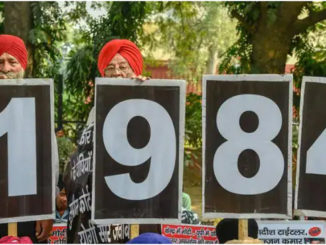
    New Delhi (TIP)- The Special Investigation Team (SIT), constituted to re-investigate the anti-Sikh riots in Kanpur following the assassination of former Prime Minister Indira Gandhi, will send a team of three sub-inspectors and three constables to Punjab. The team will gather statements and further investigate some of the witnesses.

    If needed, witnesses will be brought to Uttar Pradesh and their statements recorded again, officials told India Today TV. Arrests will be made soon on the administration’s orders after the statements are recorded. The SIT has identified 67 accused in 11 cases so far. The SIT has handed over the list of the accused to the government. And they will be arrested as soon as the order is received, they said.

    127 Sikhs were killed in Kanpur in the riots of 1984. 40 cases were registered in Kanpur Nagar for murder, robbery and dacoity. The police had submitted the final report in 29 of these cases. Earlier, the SIT had recorded statements and searched the archives by meeting members of the victims’ families in different states. In these cases, 146 rioters were identified, of whom 79 are dead. Although, of the 67 alive, nearly 22 are over the age of 75 or are suffering from serious diseases, the officials added.

  • Poll debacle: Sonia sacks Cong chiefs in five states

    Poll debacle: Sonia sacks Cong chiefs in five states

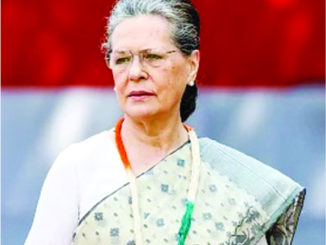
    New Delhi (TIP)- In a move to fix accountability for the party’s decimation in the recently concluded Assembly elections in five States, Congress president Sonia Gandhi on Tuesday, March 15,  sacked the Congress chiefs of Uttar Pradesh, Uttarakhand, Punjab, Manipur and Goa. Cricketer-turned-politician Navjot Singh Sidhu is among the Pradesh Congress Committee (PCC) chiefs asked to put in their papers.

    The Congress’ chief spokesperson, Randeep Surjewala, claimed it was for the reorganisation of the PCCs. Uttarakhand’s PCC chief Ganesh Godiyal was the first to tender his resignation. The move not only comes just two days after the Congress Working Committee (CWC) asked Ms. Gandhi to take immediate corrective steps but also before a possible meeting of the “G-23” leaders, who had earlier written to Ms. Gandhi for sweeping internal reforms and collective leadership, on Wednesday to decide their next strategy.

    A key member of the group, Kapil Sibal, has already publically taken on the Gandhis by stating that while people like him wanted a “Congress for all”, some others wanted a “Congress for the family”. Former party chief Rahul Gandhi walked away when reporters asked him for a response as he was entering Parliament House. But several Gandhi family loyalists including Rajasthan Chief Minister Ashok Gehlot and his Chhattisgarh counterpart, Bhupesh Baghel, slammed Mr Sibal.

    Lok Sabha member Manickam Tagore tweeted: “Why RSS [Rashtriya Swayamsevak Sangh] and BJP [Bharatiya Janata Party] wants Nehru-Gandhi’s out of the leadership? Because without Gandhi’s [Gandhis’] leadership Congress will be become Janata party. It’s easy to kill Congress then it’s easy to destroy the idea of India. Kapil Sibal knows it but why he is speaking the language of RSS/BJP.”

    Another member of the G-23 grouping, Sandeep Dikshit, said, “Those who were responsible for formulating policies in the poll-bound States should accept responsibility for the loss.” Former Uttarakhand Chief Minister Harish Rawat was one of the Congress leaders who took responsibility. Mr. Rawat hit out at his detractors. He hinted at sabotage by colleagues, not just against him but also his daughter, while countering the charge that he had “sold” tickets to unworthy candidates. He indicated that he could look at “other options” if he alone was seen as a liability for repeatedly losing elections.

    The Congress veteran, who has been blamed for the loss in Uttarakhand as well as “mishandling” Punjab as a former in-charge of that State, also defended himself. “In Punjab, Hindus are our largest support base. In the middle of the elections, who said I was not made a Chief Minister because I am a Hindu?” asked Mr. Rawat, referring to former Punjab Congress chief Sunil Jakhar.

    “I pray to god that the Congress takes note of the allegations against me and expels [me] from the party. Holi is a festival where one burns down evil and Harish Rawat should also be politically buried,” Mr. Rawat added, to counter the allegation by friend-turned-foe Ranjeet Rawat (who lost the election from the Salt constituency of Almora) that tickets were sold.

    As the disquiet within the Congress over the poll debacle played out in the public domain, general secretary Priyanka Gandhi Vadra held a closed-door review of the party’s performance in Uttar Pradesh. The review meeting came just two days after the CWC decided to hold a chintan shivir (brainstorming session) to review as well as prepare for the upcoming Assembly elections this year and next year, and the Lok Sabha election of 2024.            Source: The Hindu

  • Vadodara businessman gifts a land on moon to his fiancee

    Vadodara (TIP)- For centuries, the beauty of the moon has remained a central theme amongst couples across the world. Even today, people promise to bring moons and stars for their partner’s happiness. For Hemali Patel of Vadodra, this, however, turned out to be more than just affectionate words when her fiance, 25-year-old businessman Mayur Patel, brought an acre of land on the moon, in her name. Hemali, who works as an engineer, got engaged to Mayur on February 27, this year, after a relationship of two and a half years. Expecting her would-be husband to gift her a diamond ring or a gold necklace, Hemali’s joy knew no bounds when Mayur surprised her with the ownership document of the land that he had brought on the moon, in her name. Although provided with a written document stating Hemali as the owner of the piece of the heavenly body, the couple can only treat their ownership as a digital property. An international treaty called ‘The Outer Space Treaty of 1967’ prohibits any individual or organization from laying claim to any celestial body, citing it as a common heritage of mankind.

  • India doesn’t expect OIC to encourage terrorist actors: MEA on invite to Hurriyat leader

    Chandigarh (TIP)- India does not expect Organisation of Islamic Cooperation (OIC) to encourage actors and organisations engaged in terrorism, the Ministry of External Affairs (MEA) said on Thursday, March 17. The MEA spokesperson made the statement in response to a question about OIC’s invitation to the chairman of the All Parties Hurriyat Conference. The OIC has invited the chairman of All Parties Hurriyat Conference to attend a meeting of its foreign ministers in Islamabad on March 22 and March 23.

    Addressing a press conference on Thursday, MEA spokesperson Arindam Bagchi said the Government of India takes a very serious view of such actions, which are aimed directly at subverting India’s unity and violating our sovereignty and territorial integrity.

    “We do not expect the OIC to encourage the actors and organisations engaged in terrorism and anti-India activities,” Bagchi said.

    Without naming Pakistan, the MEA spokesperson added, “It is highly unfortunate that OIC continues to be guided by a single member’s political agenda rather than focusing on other important development activities.

                Source: India Today

  • Holi: Let the color shower joy

    Holi: Let the color shower joy

    Holi is considered as one of the most revered and celebrated festivals of India and it is celebrated in almost every part of the country. It is also sometimes called as the “festival of love” as on this day people get to unite together forgetting all resentments and all types of bad feeling towards each other. The great Indian festival lasts for a day and a night, which starts in the evening of Purnima or the Full Moon Day in the month of Falgun. It is celebrated with the name Holika Dahan or Choti Holi on first evening of the festival and the following day is called Holi. In different parts of the country it is known with different names.

    The vibrancy of colors is something that brings in a lot of positivity in our lives and Holi being the festival of colours is actually a day worth rejoicing. Holi is a famous Hindu festival that is celebrated in every part of India with utmost joy and enthusiasm. The ritual starts by lighting up the bonfire one day before the day of Holi and this process symbolizes the triumph of good over the bad. On the day of Holi people play with colours with their friends and families and in evening they show love and respect to their close ones with Abeer.

    History of Holi

    Holi is an ancient festival of India and was originally known as ‘Holika’. The festivals finds a detailed description in early religious works such as Jaimini’s Purvamimamsa-Sutras and Kathaka-Grhya-Sutras. Historians also believe that Holi was celebrated by all Aryans but more so in the Eastern part of India. It is said that Holi existed several centuries before Christ. However, the meaning of the festival is believed to have changed over the years. Earlier it was a special rite performed by married women for the happiness and well-being of their families and the full moon (Raka) was worshiped.

    Holika Dahan

    There are numerous mythological explanations that are described in the historical books regarding the death of Holika and its reference for the celebration of Holi. In accordance to those historical explanations Holika was booned by Brahma for not getting any harm from fire or never getting burnt in fire. Following the order of his Brother Hiranyakashyap (who was also the father of Prahlad) Holika sat on fire with Prahladf in order to burn him in fire and let to death. It was Prahlad’s prayers to Lord Vishnu that saved him from burning in fire. It was the protective shawl of Holika that flew to cover Prahlad’s body from Holika who was having it. This is the story behind the celebration of Holika Dahan that is still followed by the people of India.

    Holika and Prahlad

    There was once a demon king by the name of Hiranyakashyap who won over the kingdom of earth. He was so egoistic that he commanded everybody in his kingdom to worship only him. But to his great disappointment, his son, Prahlad became an ardent devotee of Lord Naarayana and refused to worship his father.

    Hiranyakashyap tried several ways to kill his son Prahlad but Lord Vishnu saved him every time. Finally, he asked his sister, Holika to enter a blazing fire with Prahlad in her lap. For, Hiranyakashyap knew that Holika had a boon, whereby, she could enter the fire unscathed. Treacherously, Holika coaxed young Prahlad to sit in her lap and she herself took her seat in a blazing fire. The legend has it that Holika had to pay the price of her sinister desire by her life. Holika was not aware that the boon worked only when she entered the fire alone. Prahlad, who kept chanting the name of Lord Naarayana all this while, came out unharmed, as the lord blessed him for his extreme devotion. Thus, Holi derives its name from Holika. And, is celebrated as a festival of victory of good over evil.

    Holi is also celebrated as the triumph of a devotee. As the legend depicts that anybody, howsoever strong, cannot harm a true devotee. And, those who dare torture a true devotee of god shall be reduced to ashes.

    The Legend of Radha-Krishna

    Young Krishna is known to be very playful and mischievous. The story goes that as a child, Krishna was extremely jealous of Radha’s fair complexion since he himself was very dark.

    One day, Krishna complained to his mother Yashoda about the injustice of nature which made Radha so fair and he so dark. To pacify the crying young Krishna, the doting mother asked him to go and colour Radha’s face in whichever colour he wanted.

    In a mischievous mood, naughty Krishna heeded the advice of mother Yashoda and applied colour on her beloved Radha’s face; Making her one like himself.

    Well, there is also a legend to explain Krishna’s dark complexion. It so happened that once a demon attempted to kill infant Krishna by giving him poisoned milk. Because of which Krishna turned blue. But Krishna did not die and the demon shriveled up into ashes.

    The Legend of Dhundhi

    It is believed that there was once an Ogress called Dhundhi in the kingdom of Prithu (or Raghu). The female monster used to specially trouble little children who became fed- up of her.

    Dhundhi, had a boon from Lord Shiva that she would not be killed by gods, men nor suffer from arms nor from heat, cold or rain. These boons which made her almost invincible but she also had a weak point. She was also cursed by Lord Shiva that she would be in danger from boys going about crazy.

    Deeply troubled by the Ogress, the King of Raghu consulted his priest. Giving the solution, the priest said that on Phalguna 15, the season of cold vanishes and summer starts. Boys with bits of wood in their hands may go out of their house, collect a heap of wood and grass, set it on fire with mantras, clap their hands, go around the fire thrice, laugh, sing and by their noise, laughter and homa, the ogress would die.

    The legend has it that on the day of Holi, village boys displayed their united might and chased Dhundhi away by a blitzkrieg of shouts, abuses and pranks. It is for this reason that young boys are allowed to use rude words on the day of Holi without anybody taking offence. Children also take great pleasure in burning Holika.

    Lathmaar Holi

    In what is known as the hub of holi in India – Barsana, Holi is known as Lathmaar Holi. Sounds violence?? There is more violece than the name signals off. The stick is in the hands of the women on this day and the men need to work a lot to save themselves from the immensely charged up womenfolk.

    The birth place of Lord Krishna’s beloved Radha, Barsana celebrates Holi with extreme enthusiasm as Krishna was famous for playing pranks on Radha and gopis. In fact, it was Krishna who started the tradition of colours by first applying colour on Radha’s face.

    Womenfolk, of Barsana it seems, after thousands of centuries want to take a sweet revenge of that prank of Krishna. Even men have not left their mischief and are still eager to apply colour on the women of Barsana.

    Following the tradition, men of Nandgaon, the birthplace of Krishna, come to play Holi with the girls of Barsana, but instead of colours they are greeted with sticks.

    Completely aware of what welcome awaits them in Barsana, men come fully padded and try their best to escape from the spirited women. Men are not supposed to retaliate on the day. The unlucky ones are forcefully led away and get a good thrashing from the women. Further, they are made to wear a female attire and dance in public. All in the spirit of Holi.

    The next day, it is the turn of men of Barsana. They reciprocate by invading Nandgaon and drench the womenfolk of Nandgaon in colours of kesudo, naturally occurring orange-red dye and palash. This day, women of Nadagow beat the invaders from Barsana. It is a colourful site.

  • The Sikh festival of Hola Mohalla

    The Sikh festival of Hola Mohalla

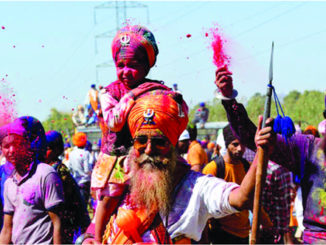
    Hola Mohalla is a Sikh festival that takes place on the first of the lunar month of Chet, which usually falls in March. This, by a tradition established by Guru Gobind Singh, follows the Hindu festival of Holi by one day; Hola is the masculine form of the feminine sounding Holi. The word “Mohalla” is derived from the Arabic root hal (alighting, descending) and is a Punjabi word that implies an organized procession in the form of an army column. This year, the festival will conclude with a mohalla (procession) by Nihang Sikhs on March 19 in Anandpur Sahib. But unlike Holi, when people playfully sprinkle color, dry or mixed in water, on each other, the Guru made Hola Mohalla an occasion for the Sikhs to demonstrate their martial skills in simulated battles.

    Together the words “Hola Mohalla” stand for “mock fight.” During this festival, processions are organized in the form of army type columns accompanied by war-drums and standard-bearers, proceeding to a given spot or moving in state from one Gurdwara to another.

    The custom originated in the time of Guru Gobind Singh, who held the first such mock fight event at Anandpur Sahib in February 1701. The foothills of the Shivaliks in Ropar district of Punjab’s north-eastern region, especially around the historic townships of Anandpur Sahib and Kiratpur Sahib, have, since 1701 been playing host to Hola Mohalla.

    The military exercise, which was personally supervised by the Guru, was carried out on the bed of the River Charan Ganga with the famous Hindu temple of Mata Naina Devi in the Shivaliks as the backdrop.

    The Indian government eventually accorded it the status of a national festival.

    On this three-day grand festival, mock battles, exhibitions, displays of weapons, etc. are held, followed by Kirtan, music and poetry competitions. The participants perform daring feats, such as Gatka (mock encounters with real weapons), tent pegging, bareback horse-riding, standing erect on two speeding horses and various other feats of bravery.

    There are also a number of Darbars where the Sri Guru Granth Sahib is present, and Kirtan and religious lectures take place. On the last day a long procession, led by Panj Pyaras, starts from Takhat Keshgarh Sahib, one of the five Sikh religious seats, and passes through various important Gurdwaras like Qila Anandgarh, Lohgarh Sahib, Mata Jitoji and terminates at the starting place (Keshgarh Sahib).For people visiting Anandpur Sahib, langars (voluntary community kitchens) are organized by the local people as a part of seva (community service). Raw materials like wheat flour, rice, vegetables, milk and sugar are provided by the villagers living nearby. Women volunteer to cook and others take part in cleaning utensils and other manual tasks that need to be carried out. Traditional cuisine is served to the pilgrims who eat while sitting in rows on the ground (Pangat). Sikhs in large numbers still assemble at Anandpur Sahib on this day and an impressive and colorful procession is taken out in which the Nihangs, in their traditional panoply, form the vanguard while parading their skill in the use of arms, horsemanship, tent-pegging, and other war-like sports.

    Originally known as Akalis, the Nihang Singhs are endearingly designated as Guru’s Knights or the Guru’s beloved. They still carry the military ambience and heroic style that was cultivated during the lifetime of Guru Gobind Singh. Nihangs constitute a distinctive order among the Sikhs and are readily recognized by their dark blue Bana and their ample Dumallas.

    The most spectacular event at Hola Mahalla is the magnificent procession of Nihangs on horses and elephants and on foot carrying a variety of traditional and modern weapons and demonstrating their skill in using them.

    The Hola Mahalla festival is unique and distinguishable from other festivals in that the Nihang have tried to preserve the traditional form and content as established during its inception, and strictly observed by the Akalis, for more than three centuries.

    Highlights

    –           It is a yearly fair where Nihangs, renowned for their courageous acts dating back to the days of Ranjit Singh, demonstrate their martial arts skills in a distinctive yet traditional style.

    –           The Nihangs, adorned in their ceremonial garb, show the people gathered, their astonishing feats of fighting, drills and ‘gatka’ or mock-battles.

    –           Daredevil acts like bareback horse-riding, standing upright on two speeding horses and many other such performances.

    –           Since the Hola Mohalla Festival is celebrated after Holi, the festival of colours is also celebrated during the three days.

    —         According to Guru Gobind Singh, “mostly during festivities of Hola Mohalla, a sword is often in demand at Nanded, so each member in the ceremony (jaloos) must have one in his hand.”

    –           An exciting part of the Sikh community is their cuisine. The Langars, which is a Sikh community kitchen, prepares delicious vegetarian food. Visitors enjoy their meal sitting together on Pangats.

    –           Visitors also enjoy a traditional line of Kirtans and Bhajans which are devotional songs and various religious lectures, music and poems.

  • Shaheed Diwas: Remembering Bhagat Singh, Sukhdev and Rajguru

    Shaheed Diwas: Remembering Bhagat Singh, Sukhdev and Rajguru

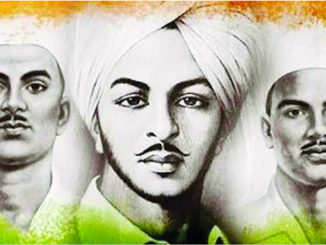
    Shaheed Diwas or Martyrs’ Day is observed on March 23 every year throughout the country. It marks the death anniversary of young freedom fighters Bhagat Singh, Sukhdev Thapar and Shivaram Rajguru. On March 23 in 1931, the three were hanged to death by Britishers. The sons of India were sentenced to death in the Lahore conspiracy case and ordered to be hanged on March 24, 1931. However, the schedule was moved forward by 11 hours and they were hanged on March 23, 1931 at 7:30 pm.

    After Lala Lajpat Rai’s death in November 1928, Bhagat Singh, Rajguru, Sukhdev and others vowed to take revenge. Rai was a prominent leader of India’s freedom movement who had inspired many young Indians to join the quest for freedom.

    In order to teach the ruthless Britishers a lesson, the three planned to execute James A Scott. Scott was the Superintendent of Police during the British rule and was infamous for his cruelty.

    It was Scott who had ordered the police to lathi charge the protesters and personally assaulted Rai, causing life threatening injuries. The plan was to send a message to the British forces that we will not bow down anymore and are capable of taking action.

    However, it was John P Saunders, an Assistant Superintendent of Police, who was killed by mistake. The three freedom fighters were charged for murder of Saunders.

    Bhagat Singh, Rajguru and Sukhdev were only 23 years old when they were hanged for executing Saunders. Their contribution in the freedom struggle is immense and will continue to inspire generations to fight for their rights.

    Bhagat Singh

    Bhagat Singh was born on September 27, 1907, in the village of Banga near Lyallpur district in Punjab, British India. He was an Indian freedom fighter who is considered to be one of the most influential revolutionaries of the Indian independence movement. Bhagat Singh joined the Hindustan Republican Association (HRA) at a young age and became involved in revolutionary activities. He participated in several acts of sabotage against British institutions, including an attempt to bomb the Central Legislative Assembly in Delhi. In 1929, he and two other activists were convicted of assassinating John Saunders, a British police officer. Singh was executed by hanging on March 23, 1931, at Lahore jail at the age of 23. Despite his short life, Bhagat Singh left a lasting legacy in the struggle for Indian independence. He is revered by many as a martyr and symbol of resistance to British colonialism in India. His example continues to inspire new generations of activists worldwide.

    Bhagat Singh had a great impact on the Indian independence movement due to his participation in various activities that led India towards its freedom from colonial rule. His involvement with revolutionary groups resulted in him being jailed for various crimes, but he continued his activism even behind bars through writing and publishing newspapers aimed at spreading nationalist sentiments among people all over India. He was executed by hanging when he was 23 years old after leading an unsuccessful plot to kill a British police officer who ordered a lathi charge on Lala Lajpat Rai, who was protesting colonial policies at the time. This murder had a major impact on Indian society and brought Bhagat Singh to national attention as a revolutionary hero of India’s independence movement.

    Rajguru

    Shivaram Rajguru (1908-1931) was a great Indian freedom fighter who played a major role in the India’s struggle for Independence. He is amongst those great Indian revolutionaries who sacrificed their lives for the freedom of country. His full name was Hari Shivaram Rajguru and was born into a Deshastha Brahmin family. Since his childhood days, he had witnessed the brutal atrocities that the Imperial British Raj inflicted on India and her people. This instilled within him a strong urge to join hands with the revolutionaries in a bid for India’s freedom struggle.

    In the days of the Indian Freedom Movement, the Hindustan Socialist Republican Army (HSRA) was an active force working against the British. Their main motive was to strike fear into the heart of the British regime. They simultaneously spread awareness amongst the people. They made them take notice of the growing domestic uprising when they dealt crucial blows with attacks like in the Lahore Conspiracy Case (December 18, 1928) and the bombing of the Central Assembly Hall in New Delhi (April 8, 1929).

    The protest against the Simon Commission in October 1928 saw the British police lathi-charge the protestors, severely injuring veteran leader Lala Lajpat Rai. Owing to the excessive beating, Lala succumbed to his injuries, which thus instilled revenge in the hearts of the revolutionaries. On December 18, 1928, in Ferozepur, Lahore, a planned retaliation was enforced that led to the assassination of Deputy Superintendent of Police, J.P. Saunders. Shivaram Rajguru, along with Sukhdev Thapar, was accomplice of the legendary Bhagat Singh who spearheaded the attack. Rajguru then went into hiding in Nagpur. Whilst taking shelter in the house of an RSS worker, he even met Dr. K. B. Hedgewar. On his travel to Pune, however, Shivaram was finally arrested. Bhagat Singh, Shivaram Rajguru and Sukhdev Thapar were then convicted of their crime and sentenced to death.

    Sukhdev

    Sukhdev was a famous Indian revolutionary who played a major role in the India’s struggle for Independence. He is amongst those great Indian freedom fighters who sacrificed their lives for the freedom of their country. His full name is Sukhdev Thapar and he was born on 15th May, 1907.

    His ancestral house is in Naughara Mohalla of Ludhiana city, Punjab, India. His father’s name was Ram Lal. Since his childhood days, Sukhdev had witnessed the brutal atrocities that the Imperial British Raj had inflicted on India, which then led him to join the revolutionaries, vowing to set India free from the shackles of British dominion.

    Sukhdev Thapar was a member of the Hindustan Socialist Republican Association (HSRA), and organized revolutionary cells in Punjab and other areas of North India. A devoted leader, he even went on to educate the youth at the National College in Lahore, greatly inspiring them about India’s glorious past. He along with other renowned revolutionaries started the ‘Naujawan Bharat Sabha’ at Lahore that was an organization involved in various activities, mainly gearing the youth for the freedom struggle and putting an end to communalism. Sukhdev himself took active part in several revolutionary activities like the ‘Prison hunger strike’ in 1929; however, he would always be remembered in the chronicles of the Indian Freedom Movement for his daring yet courageous attacks in the Lahore Conspiracy Case (18th December, 1928), that shook the very foundation of the British Government. Sukhdev was the accomplice of Bhagat Singh and Shivaram Rajguru, who were involved in the assassination of Deputy Superintendent of Police, J.P. Saunders in 1928, thus avenging the death of veteran leader, Lala Lajpat Rai, owing to excessive police beating in the Conspiracy case. After the Central Assembly Hall bombings in New Delhi (8th April, 1929), Sukhdev and his accomplices were arrested and convicted of their crime, facing the death sentence as verdict.

  • Russia bogged down, blasting Ukrainian cities as war enters 4th week

    Russia bogged down, blasting Ukrainian cities as war enters 4th week

    Kyiv/Lviv, Ukraine (TIP): Russian forces in Ukraine are blasting cities and killing civilians but no longer making progress on the ground, Western countries said on March 17, as a war Moscow was thought to have hoped to win within days entered its fourth week.

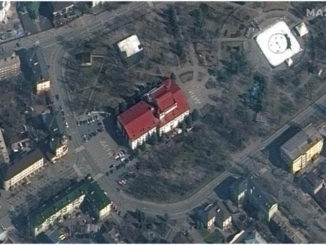
    Ukraine said Russian forces had destroyed a theatre where women and children had been sheltering in the besieged southern port of Mariupol. An official in the Mariupol mayor’s office said a bomb shelter at the theatre had “withstood” and there were survivors, but details of casualties were still not known. Russia denied striking the theatre, which commercial satellite pictures showed had the word “children” marked out on the ground in front before it was blown up.

    ViacheslavChaus, governor of Chernihiv, a northern city that has been intensely bombarded, said 53 civilians had been killed there in the past 24 hours. The toll could not be independently verified.

    Although both sides have pointed to limited progress in peace talks this week, President Vladimir Putin, who ordered Russia’s invasion on Feb. 24, showed little sign of relenting. In a vituperative televised speech, he inveighed against “traitors and scum” at home who helped the West, and said the Russian people would spit them out like gnats.

    Kyiv and its Western allies believe Russia launched the unprovoked war to subjugate a neighbour that Putin calls an artificial state carved out of Russia. Moscow says it is carrying out a “special operation” to disarm it and “denazify”. Heavily outnumbered Ukrainian forces have prevented Moscow from capturing any of Ukraine’s biggest cities so far despite the largest assault on a European state since World War Two. More than 3 million Ukrainians have fled and thousands of civilians and combatants have died.

    ‘STALLED ON ALL FRONTS’

    Russia has assaulted Ukraine from four directions, sending two massive columns towards Kyiv from the northwest and northeast, pushing in from the east near the second biggest city Kharkiv, and spreading in from the south near Crimea.

    But British military intelligence said in an update on Thursday that the invasion had “largely stalled on all fronts”, and Russian forces were suffering heavy losses from a staunch and well-coordinated Ukrainian resistance.

    Northeastern and northwestern suburbs of Kyiv have been reduced to rubble by heavy fighting, but the capital itself has held firm, under a curfew and subjected to deadly nightly rocket attacks. At least one person was killed and three were wounded when a residential building was struck by a downed Russian missile, emergency services said on Thursday.

    Amid the unrelenting fighting, both sides have spoken of progress at talks. Ukrainian officials have said they think Russia is running out of troops to keep fighting and could soon come to terms with its failure to topple the Ukrainian government. Moscow has said it is close to agreeing a formula that would keep Ukraine neutral, long one of its demands. Moscow said peace talks resumed on Thursday by videolink for a fourth straight day, discussing military, political and humanitarian issues. (Reuters)

  • Powerful quake off north Japan kills 4, more than 90 injured

    Powerful quake off north Japan kills 4, more than 90 injured

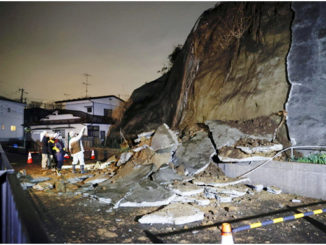
    Tokyo (TIP): A powerful 7.4 magnitude earthquake struck off the coast of Fukushima in northern Japan on March 16 night, smashing furniture, knocking out power and killing four people. A small tsunami reached shore, but the low-risk advisory was lifted by Thursday morning. The region is part of northern Japan that was devastated by a deadly 9.0 quake and tsunami 11 years ago that caused nuclear reactor meltdowns, spewing massive radiation that still makes some parts uninhabitable.

    Prime Minister Fumio Kishida told a parliamentary session on Thursday morning that four people died during the quake and the cause of their deaths are being investigated, while 97 others were injured. A man in his 60s in Soma city died after falling from the second floor of his house while trying to evacuate, and a man in his 70s panicked and suffered a heart attack, Kyodo News reported earlier.

    The Japan Meteorological Agency early on Thursday lifted its low-risk advisory for a tsunami along the coasts of Fukushima and Miyagi prefectures. Tsunami waves of 30 centimetres (11 inches) reached shore in Ishinomaki, about 390 kilometres (242 miles) northeast of Tokyo. The agency upgraded the magnitude of the quake to 7.4 from the initial 7.3, and the depth from 60 kilometres (36 miles) below the sea to 56 kilometres (35 miles). NHK footage showed broken walls of a department store building fell to the ground and shards of windows scattered on the street near the main train station in the inland prefectural capital of Fukushima city. Roads were cracked and water poured out from pipes underground.

    Footage also showed furniture and appliances smashed to the floor at apartments in Fukushima. Cosmetics and other merchandise at convenience stores fell from shelves and scattered on the floor. In Yokohama, near Tokyo, an electric pole nearly fell.

    The Tokyo Electric Power Company Holdings, which operates the Fukushima Daiichi nuclear plant where the cooling systems failed after the 2011 disaster, said workers found no abnormalities at the site, which is being decommissioned.

    Japan’s Nuclear Regulation Authority said a fire alarm went off at the turbine building of No. 5 reactors at the Fukushima Daiichi but there was no actual fire. Water pumps for the spent fuel cooling pool at two of the four reactors at Fukushima Daini briefly stopped, but later resumed operation. Fukushima Daini, which survived the 2011 tsunami, is also set for decommissioning.

    More than 2.2 million homes were temporarily without electricity in 14 prefectures, including the Tokyo region, but power was restored at most places by the morning, except for about 37,000 homes in the hardest hit Fukushima and Miyagi prefectures, according to the Tohoku Electric Power Co. which services the region.

    The quake shook large parts of eastern Japan, including Tokyo, where buildings swayed violently. East Japan Railway Co. said most of its train services were suspended for safety checks. Some local trains later resumed service. Many people formed long lines outside of major stations while waiting for trains to resume operation late on Wednesday, but trains in Tokyo operated normally on Thursday morning.

    A Tohoku Shinkansen, express train partially derailed between Fukushima and Miyagi due to the quake, but nobody was injured, Prime Minister Fumio Kishida said. He told reporters that the government was assessing the extent of damage and promised to do its utmost for rescue and relief operations. “Please first take action to save your life,” Kishida tweeted. (AP)

  • Russia says air defence systems for Ukraine would destabilise situation

    Kyiv/Lviv (TIP): Russia’s foreign ministry said on March 17 that giving Ukraine air defence systems, as requested by Ukraine’s president in the U.S. Congress a day earlier, would be a destabilising factor that would not bring peace to the country.

    Ukrainian President VolodymyrZelenskiy urged American lawmakers on Wednesday to do more to protect his country from Russia’s invasion, pushing for the imposition of a no-fly zone and asking for aircraft and defensive systems. “Such deliveries … would be a destabilising factor which will definitely not bring peace to Ukraine,” foreign ministry spokeswoman Maria Zakharova told a news briefing.

    “In the long term, they could have much more dangerous consequences,” she added.

    The United States and its allies want to avoid NATO being drawn into the Ukraine conflict, but they have supplied Kyiv with military aid since Russia invaded Ukraine on Feb. 24.

    Moscow calls its offensive in Ukraine a “special operation” to destroy its southern neighbour’s military capabilities and capture what it regards as dangerous nationalists. Slovakia’s Prime Minister Eduard Heger on Sunday said NATO could discuss sending his country’s Soviet-made S-300 air defence system to Ukraine. Reuters

  • Ukraine legalisescryptocurrency to fight Russian invasion

    Kiev (TIP): Ukraine has legalisedcryptocurrency as the country received donations worth tens of millions of dollars from individuals and groups to help it fight the Russian invasion. Ukraine President VolodymyrZelensky has signed the law that creates conditions for further formation of the legal field in the market of virtual assets. The new market will be regulated by the National Commission on Securities and Stock Market. The signed law determines the legal status, classification and virtual assets ownership rights and determines the list of providers of virtual assets and conditions of their registration. Until now, the Ministry of Digital Transformation has been developing the legal framework in this area. “The Ministry of Digital Transformation is also actively working to amend the tax and civil codes of Ukraine to fully launch the virtual assets market,” the government said in a statement. The signing of the crypto law is an important step towards bringing the cryptocurrency sector out of the shadows and launching a legal market for virtual assets in Ukraine. (IANS)

  • Zelenskyy urges Germany to tear down wall dividing free and unfree Europe

    Berlin (TIP): Invoking the fall of the Berlin Wall, Ukrainian President Volodymyr Zelenskyy on March 17 urged German Chancellor Olaf Scholz to tear down what he called a wall between “free and unfree” Europe and stop the war in Ukraine. Speaking to the Bundestag by video link, Zelenskyy appealed to Scholz to restore freedom to Ukraine, tapping Germany’s collective memory with reference to the historic 1948-1949 Berlin Airlift and the fall of the Berlin Wall in 1989.

    Zelenskyy described a new wall “in the middle of Europe between freedom and unfreedom”, which he said Germany had helped build, isolating Ukraine with its business ties to Russia and its previous support for the Nord Stream 2 gas pipeline.

    “And this wall is getting bigger with every bomb that falls on Ukraine, with every decision that is not taken,” he added. Germany last month halted the Nord Stream 2 Baltic Sea gas pipeline project, designed to double the flow of Russian gas directly to Germany. Recalling former U.S. president Ronald Reagan’s appeal to Mikhail Gorbachev, the last Soviet leader, to tear down the Berlin Wall, Zelenskyy told German lawmakers: “That’s what I say to you dear Chancellor Scholz: destroy this wall.” “Give Germany the leadership role that it has earned so that your descendants are proud of you. Support freedom, support Ukraine, stop this war, help us to stop this war,” he added.

    Lawmakers in the Bundestag welcomed Zelenskyy with a standing ovation and the chamber’s vice president, Katrin Goering-Eckardt, told him: “Your country has chosen democracy, and that’s what (Russian President) Vladimir Putin fears.” She said Putin was trying to deny Ukraine’s right to exist, adding: “But he has already failed with that.”  (Reuters)

  • UK to lift all remaining Covid international travel restrictions

    London (TIP): The UK government will lift all its remaining Covid-19 pandemic-related international travel restrictions from March 17, including the requirement for travellers to fill in a compulsory Passenger Locator Form prior to entering the country. From 4 am GMT on March 17, arrivals into the UK will no longer be required to submit travel details or take a PCR test even if they are unvaccinated. The change would remove the remaining rules in place for unvaccinated passengers to take a pre-departure test and another test two days after arrival. “The UK is leading the world in removing all remaining Covid-19 travel restrictions, and today’s announcement is a testament to the hard work everyone in this country has put in place to roll out the vaccine and protect each other”, said UK Transport Secretary Grant Shapps on Monday evening. “I said we wouldn’t keep travel measures in place for any longer than necessary, which we’re delivering on today – providing more welcome news and greater freedom for travellers ahead of the Easter holidays.  (PTI)

  • North Korean missile explodes mid-air in failed launch

    Seoul (TIP): A North Korean missile fired from its capital region exploded in mid-air in an apparent failed launch on March 16, South Korea’s military said, amid speculation that the North could soon launch its biggest long-range missile in its most significant provocation in years. Details of the missile explosion weren’t immediately known. But the launch, the 10th of its kind this year, shows North Korea is determined to press ahead on its push to modernize its weapons arsenal and pressure its rivals into making concessions amid dormant denuclearization talks. The North Korean missile blew up while it was flying at an altitude of about 20 kilometres (12.4 miles), a South Korean military official said requesting anonymity because he wasn’t publicly authorized to speak to media on the issue. He said the cause of the explosion wasn’t known. South Korea’s Joint Chiefs of Staff earlier said in a statement that the launch made from the Pyongyang region around 9.30 am apparently failed. It said South Korean and US intelligence authorities were analyzing details of the launch.

    The US Indo-Pacific Command later said that North Korea fired a ballistic missile but didn’t say whether it was a failed launch. A command statement said the launch didn’t pose an immediate threat to US territory and its allies but called on North Korea to refrain from further destabilizing acts. Japanese Chief Cabinet Secretary HirokazuMatsuno told reporters that a flight of a ballistic missile has not been confirmed and that Tokyo is working with Washington and Seoul to further analyze what happened.

    Experts say past failures still have moved North Korea closer to its goal of acquiring a viable nuclear arsenal that could threaten the American homeland. The US and South Korean militaries said last week that North Korea had tested an ICBM system in two recent launches, referring to the developmental Hwasong-17 missile that North Korea unveiled during a military parade in October 2020.

    In the two recent launches on February 27 and March 5, the North Korean missiles flew medium-range distances, and experts have said North Korea could eventually perform a full-range ICBM test.

    The North has said it tested cameras and other systems for a spy satellite and released what it said were photos taken from space during one of the two tests, but it didn’t confirm what rocket or missile it launched. Observers say North Korea aims to boost its ICBM capability while trying to place its first functioning spy satellite into orbit. North Korean leader Kim Jong-Un has vowed to acquire an improved ICBM and a spy satellite among an array of sophisticated weapons systems.  (AP)

  • Myanmar eyes using rupee for border trade

    Bangkok (TIP): Myanmar’s military-led administration on March 15 agreed to accept Thai baht as an official currency in border trade dealings and plans a similar arrangement for use of India’s rupee, seeking to limit the country’s reliance on the US dollar in trade. The State Administration Council on Tuesday said that Settlements in Thai baht will be done online according to regulations set by Myanmar’s central bank. Thailand is Myanmar’s second largest trading partner after China, with border trade at five checkpoints — Tachileik, Myawady, Kawthoung, Myeik and Hteekhee — amounting to $4.3 billion in fiscal 2020-2021, up from $3.9 billion the year before, the statement said. Earlier this year, Myanmar had allowed direct currency settlements using Chinese yuan with its kyat. By expanding direct conversion of other currencies in border trade, Myanmar intends to reduce its dependence on the US dollar by up to 70%. — AP

  • 21 students injured in Pakistan’s Punjab University campus clash over boy and girl sitting together

    Lahore (TIP): Twenty-one students of Pakistan’s Punjab University here were injured, some of them critically, when they clashed with members of a radical Islamic outfit who objected to a boy and a girl sitting together. A girl and a boy were seen sitting at a canteen outside the Gender Studies Department on March 15, when members of the IslamiJamiatTulaba (IJT) asked them to leave. When they objected, one of the IJT members slapped the boy, a university official said. Other students stepped in and they first tried to stop the IJT members from harassing the boy and the girl. But it soon escalated into a full-blown clash. Some of the students were armed with iron and wooden rods, the Dawn newspaper reported. Most of the students were admitted to a nearby hospital after suffering head injuries. So far, two students were arrested, police said. The Punjab University has more than 30,000 students in its rolls. (PTI)

  • In a first, Indian trader exports goods to Uzbekistan via Pak and Afghanistan

    Islamabad (TIP): In a first, a private trader in India has exported commercial goods to Uzbekistan through Pakistan and Afghanistan in a historic trade activity linking the four countries, according to a media report. Trucks carrying 140 tonnes of cargo, mostly sugar from India, departed Kabul on March 16 for the Uzbek capital Tashkent, the Voice of America reported on Wednesday.

    The shipment arrived in the Afghan capital a day earlier from Pakistan via the Torkham border crossing between the countries, a spokesperson of the Taliban’s Ministry of Industry and Commerce MaulanaZaheer was quoted as saying in the report.

    The ministry organised a special ceremony to facilitate the transit of the Indian goods, hailing it as a major step towards turning Afghanistan into a key trade link between Central and South Asia. The commercial cargo originated from Mumbai and travelled through the Karachi seaport in Pakistan earlier this month before being trucked to its Uzbek importer under a recently inked bilateral transit trade agreement between Pakistan and Uzbekistan, a Pakistani official told the state-owned American radio broadcaster.

    (PTI)

  • SBI to give $1-billion loan to Sri Lanka for food, medicine and other essential items

    SBI to give $1-billion loan to Sri Lanka for food, medicine and other essential items

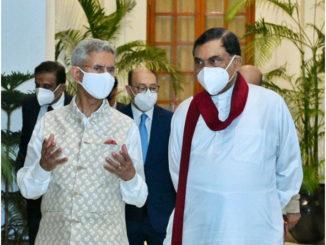
    Colombo/New Delhi (TIP): The State Bank of India on March 17 signed an agreement for extending a credit line of $1 billion to Sri Lanka enabling it to buy food, medicine and other essential items. The agreement was signed after Union Ministers S Jaishankar and NirmalaSitharaman held discussions on economic cooperation and “issues of mutual interest’’ with Sri Lanka Finance Minister Basil Rajapaksa, said an official news release. Basil Rajapaksa visited India for financial assistance which will temporarily enable the cash-strapped Sri Lanka to stave off an unprecedented economic crisis.

    On the eve of his visit, Colombo sent a positive signal by signing a joint venture with India three days back for a 100 mw solar power plant at Sampur in Trincomalee to compensate for the scrapping of an Indo-Japan coal power project on environmental grounds. On the security side, Colombo last week hosted another conference of NSAs of regional countries for a collective approach to maritime security.

    In January, India had bailed out Sri Lanka from its balance of payments difficulties by extending a $400 million swap facility and deferring the settlement of $515.2 million. Thus, the help extended by India is worth over $900 million and about $1.5 billion more is in the pipeline.

    Basil Rajapaksa had met PM NarendraModi for the assistance provided to Sri Lanka at this critical time. The two leaders discussed a wide range of issues pertaining to the bilateral relationship. These included agriculture, renewable energy, digitalisation, tourism and fisheries among others, said a release from the Sri Lanka High Commission.

    Basil Rajapaksa also held talks with Jaishankar the same evening, which were followed by a working dinner. Rajapaksa was accompanied to the meeting by Sri Lanka’s High Commissioner to India MilindaMoragoda, Secretary to the Ministry of Finance S.R. Attygalle and Sri Lanka’s Deputy High Commissioner to India NilukaKadurugamuwa. (TNS)

  • Taliban says healthcare should be denied to female patients who do not observe hijab

    Taliban says healthcare should be denied to female patients who do not observe hijab

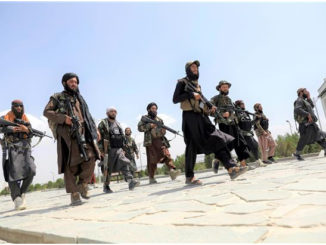
    Kabul (TIP): Since regaining power in August, the Taliban has gradually resurrected its discriminatory policies, enforcing strict segregation in universities, government offices, and on public transportation, RFE/RL reported. Right groups have accused the Taliban of imposing gender apartheid in Afghanistan, with fears that girls and women will be excluded from public life. The Taliban has dramatically rolled back women’s rights in recent months, including closing most girls’ secondary schools and banning women from most forms of employment. Women who have demonstrated for greater rights have been arrested and, in some cases, disappeared.

    The Taliban’s Ministry for the Promotion of Virtue and Prevention of Vice earlier this month sent a letter to the Health Ministry ordering it to segregate male and female employees, RFE/RL reported.

    “The offices for men and women should be separate,” said the letter. The ministry, which is the enforcer of the Taliban’s radical interpretation of Islamic law, also warned that health care should be denied to female patients who do not observe the Islamic hijab.

    The Taliban initially ordered women not to return to work. But it later called female health workers back to clinics and hospitals, although many were too scared to resume their work. Rights groups say gender segregation has created barriers to women and girls accessing health care. At many facilities, patients are only treated by a health professional of the same sex, RFE/RL reported. –IANS

  • International group BAPS of Indian-origin volunteers helping refugees fleeing Ukraine

    International group BAPS of Indian-origin volunteers helping refugees fleeing Ukraine

    REZSZOW, POLAND (TIP): As a devastating humanitarian crisis unfolds in Ukraine, hundreds of thousands are fleeing the warzone seeking refuge in neighboring countries. This has included thousands of Indian nationals, mainly students, who have been left stranded amid the conflict. “Indian Prime Minister Narendra Modi personally called BAPS to assist the government’s efforts for the safe passage of Indian nationals from Ukraine. Pujya Brahmaviharidas Swami reassured the Prime Minister: We have also been instructed by His Holiness Mahant Swami Maharaj to mobilize BAPS volunteers,” said a press release issued by BAPS.

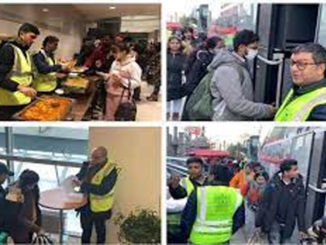
    Volunteers from the USA, UK, Ireland, France, Switzerland, Italy, Germany, Austria and Poland swiftly sprang into action to support the emergency relief efforts on the ground. This has included setting up a mobile field kitchen in the south-eastern Polish city of Rzeszów, which has begun feeding around 1,000 hot vegetarian meals daily to refugees of all faiths and nationalities. BAPS is also arranging accommodation facilities and coordinating medical assistance and is working closely with the Indian government and local partners.

    Volunteers traveled from Robbinsville, NJ to Rezszow, Poland and to Budomierz, Poland, on the Ukrainian border to help distribute humanitarian supplies to and facilitate the transport of international students and others fleeing Ukraine.

    Darshan Patel, an attorney by profession serving at the refugee camp said, “Seeing the need to help students and refugees leaving Ukraine, I took a flight to Poland to serve them. The least we can do is make them comfortable during this stressful time by providing them food and basic necessities.” Shailesh Bhavsar, a lead BAPS volunteer from Paris, explained the process at the camp: “Once they arrive at the camp, we work on registering them, providing them with meals, giving them a place to stay and rest before processing them to go to the airport for a flight home.” “Helping others through selfless service — ‘seva’ is a fundamental principle of BAPS Swaminarayan Sanstha,” Dharmik Sheth, a pharmaceutical professional, said. “I am following my faith – and my family tradition. My father also volunteered during humanitarian crises when I was young.”

    “Our volunteers are inspired by the ethos of HH Pramukh Swami Maharaj, who personified the motto ‘In the joy of others lies our own’, and there has perhaps never been a more opportune moment to embody this selfless spirit of public service by providing the basic needs for those severely impacted by the conflict,” said Pujya Nilkanthsevadas Swami, Head Swami at the BAPS Shri Swaminarayan Mandir in Robbinsville, NJ. “We are working with local members of the Ukrainian community and our volunteer forces on the ground in Poland to send necessary humanitarian aid via our logistics partners. The volunteers who flew from New Jersey have been communicating information about supplies needed on the ground. We are trying our best to supply them.” Vijay Kumar Singh, former Army Chief of Staff and current Minister of State for Transport and Civil Aviation, observed the tireless efforts of the volunteers first-hand in Rzeszów and commented: “I would like to personally congratulate and commend BAPS volunteers. You are helping everyone with a sense of unity, without any expectations, and without worrying about yourselves. The people of India are indebted to your swift, selfless and organized action.”
    Robbinsville Mayor Dave Fried immediately commended Ravi Patni and his fellow volunteers: “On behalf of Robbinsville, we are very proud of BAPS and their efforts to help the Ukrainian people. Hopefully, we can find a way to have the Township work together to help those people who are going through an unimaginably difficult time.”

    His Holiness Mahant Swami Maharaj has also prayed for the welfare of those affected: “We offer our deepest gratitude to these volunteers. We also offer our prayers that peace prevails, and those who are suffering are provided support, strength and courage.”

    (Based on a Press Release)

  • Indian-origin Telangana student dies in road accident in Germany

    Indian-origin Telangana student dies in road accident in Germany

    HYDERABAD (TIP):  A student from Telangana has died in a road accident in Germany, according to information received by his family. Amar Singh, 27, died in an accident that occurred on March 13. Officials from Germany informed the family on Wednesday night. A car in which he was travelling with a few friends met with an accident. He died on the spot.

    The student hailed from Achampet village in Akkaram mandal of Nagarkurnool district. He had gone to Germany for higher studies a couple of years ago. His parents were anxious as he was not responding to calls made on his mobile phone. As they were trying to contact his friends in Germany, they received the shocking news. Telangana Rashtra Samithi MLA from Achampet, G Balaraju, called on the family, which has appealed to the state government to make arrangements for bringing the body home. The MLA said he spoke to Minister of Industries and Information Technology KT Rama Rao and requested him to help in bringing the mortal remains. 

  • Indian-origin political activist Shefali Razdan nominated as  envoy to Netherlands

    Indian-origin political activist Shefali Razdan nominated as envoy to Netherlands

    WASHINGTON, D.C. (TIP): US President Joe Biden has announced his intent to nominate Indian origin political activist Shefali Razdan Duggal as his envoy to the Netherlands, according to the White House. An immigrant to the US from Kashmir, Duggal, 50, has been raised in Cincinnati, Chicago, New York and Boston. The White House made the announcement on Friday along with several other key administrative and diplomatic positions. Duggal, a mother of two, is an experienced political activist, women’s rights advocate and human rights campaigner, the White House said. She is a former Presidential Appointee to the United States Holocaust Memorial Museum Council and continues to serve as a Western Regional Advisor. Duggal is a San Francisco Committee member of Human Rights Watch, a member of the Wake Forest University Leadership and Character Council and served on the National Board of Directors for Emily’s List. She received an MA in Political Communication from New York University. She also studied Mass Communication at Miami University.

  • Indian-origin doctor run over by thieves fleeing in his car

    Indian-origin doctor run over by thieves fleeing in his car

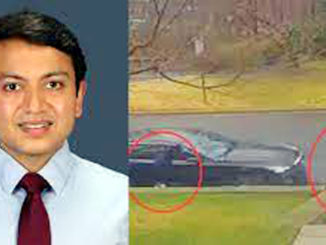
    WASHINGTON (TIP): An Indian origin doctor has been killed by persons who allegedly stole his Mercedes Benz and hit him with the car, according to Washington police. Police said that the suspect entered Rakesh Patel’s car when he was outside it and hit him while fleeing in the vehicle on Tuesday, March 8. Police have announced a $25,000 reward for the capture of the person/s who were involved in the killing.

    While the car was recovered, the suspects had not been captured as of Thursday, March 10. WJLA TV said that when Patel, 33, stepped out of his car to give his girlfriend a package, the thieves entered the car started to drive away. “In a panic, he ran after them somehow getting in front of the car. The car thieves ran him down killing him” while his “girlfriend watched in horror”, the TV station reported. According to NBC4 Washington TV, Patel’s father and two siblings are also doctors. He was the youngest child, and his mother Charulatta Patel told the station: “I always used to call him my baby”. Calling the killing senseless, she asked: “For what? A car”?

    Washington, like places across the US, has seen a huge spike in carjackings, vehicle thefts and major crimes in the aftermath of anti-police protests that followed the killing of an African-American man by police two years ago in Minnesota.

    The Washington Post reported that carjackings in Washington “spiked 200 per cent from 2019 to 2021 and continue to rise this year”.

    Last March, a Pakistani food delivery person was killed by two girls, 13 and 15 years old, who carjacked his car.

  • Indian American documented dreamer tells lawmakers she would be forced to leave US without change in immigration system

    Indian American documented dreamer tells lawmakers she would be forced to leave US without change in immigration system

    WASHINGTON, D.C. (TIP): An Indian American documented dreamer has told lawmakers that she would be forced to leave the US, where she has spent her entire life since the age of four, in eight months in the absence of any meaningful legislative reforms in immigration system that addressed the major issue of aged-out kids.Dreamers are basically undocumented immigrants who enter the US as children with parents. There are nearly 11 million undocumented immigrants, including over half a million  from India, according to a policy document issued by the Biden campaign in November 2020.

    “Without a change in eight months, I will be forced to leave, not only my home of 20 years but also my mom who is my only family left,” Athulya Rajakumar, a 23-year-old recent graduate of the University of Texas at Austin from the Moody College of Communication, told members of the Senate Judiciary Subcommittee on Immigration, Citizenship and Border Safety on Tuesday, March 15. Testifying before the subcommittee during a hearing on “Removing Barriers to Legal Migration,” the Indian American told the Senators that over 5,000 documented dreamers face this every year. “Erin, a nursing graduate was forced to self-deport last summer in the midst of a pandemic…a data analyst student was forced to self-deport two months ago, Summer will be forced to self-deport in four months, even though her family has legally resided here since she was a baby,” she said. An aspiring journalist  shared the story of her family’s struggle through years of immigration limbo, which contributed to her brother’s tragic death. “I’m outraged by this broken system that you, your brother, and thousands of documented dreamers have had to face. We organized this hearing today because we cannot allow the inaction of Congress to continue to cause this suffering,” Senator Alex Padilla said in his remarks.

    Padilla is chair of the Senate Judiciary Subcommittee on Immigration, Citizenship, and Border Safety. Barriers to legal migration routinely separate families across international borders for years, he said.

    “Visa caps that keep employers from expanding their businesses and hold back the US economy, an arbitrary cut-off for legal status that forced children, visa holders, to leave the only country they’ve ever known when they age out of their parents’ visas. The gap between our country’s needs and the realities of our broken immigration system should come as no surprise,” Padilla said. “Employment-based visas allow participating immigrants to bring extraordinary skills to our workforce, start new businesses, create new jobs in rural areas, and to help address worker shortages in industries like healthcare,” he said.

    “But only 1,40,000 of these individuals can obtain visas every year. Because the spouses and children who accompany them count against the total, far fewer than 70,000 visas actually go to eligible workers. Hundreds of thousands of others are left in limbo, restricted by a temporary visa, or turned away from their dreams and they’re kept from realizing their potential,” he said.

    Ranking Member Senator John Cornyn said the Congressional Research Service recently estimated that without significant changes, the employment-based green card backlog could exceed 2 million by 2030.

    “Indian nationals have been hit especially hard because our system’s per-country caps do not allow them to receive more than seven per cent of the available employment-based visas in any given year,” he said.

    “To make matters worse due to processing inefficiencies attributable in part to USCIS’ paper-based system and to the closures of many of our consulates, we fail to issue as many as 92,000 employment-based visas in the height of the pandemic,” he said.

    Rajakumar told lawmakers that she got a full-time offer from a major news corporation in Houston, a top 10 market, but the same company who saw her potential withdrew their offer the second they heard about her visa status. “But worst of all, being considered an alien, an outsider in the only place you know to call home is a different kind of pain,” she said.

    Dip Patel, president of Improve the Dream, in a statement, said that Rajakumar’s moving testimony shows the urgent need to update the broken system, including the need to permanently end the problem of aging for children who are raised and educated in the United States. “For thousands of young people growing up with uncertainty, there is constant anxiety regarding one’s future in what we consider our home…We urge Congress to consider this and act fast to pass common-sense immigration reform,” he said.

    During the hearing, Padilla questioned Rajakumar about her experience as a documented dreamer and how a pathway to citizenship and the enactment of America’s Children Act would impact her life. Raja kumar pointed to the fact that it would mean that she wouldn’t have to be separated from her family and the country she’s called her home for the last twenty years.

  • Green Triangle’ named after Mahatma Gandhi inaugurated in Madagascar’s capital Antananarivo

    Green Triangle’ named after Mahatma Gandhi inaugurated in Madagascar’s capital Antananarivo

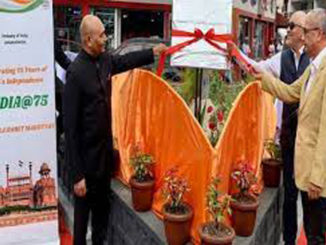
    ANTANANARIVO,MADAGASCAR (TIP): As part of the ‘Azadi ka Amrit Mahotsav’ to commemorate India’s 75th year of independence, a “Green Triangle” named after Mahatma Gandhi was inaugurated in Madagascar’s capital Antananarivo by Mayor of Antananarivo Naina Andriantsitohaina and India’s Ambassador to Madagascar Abhay Kumar on Wednesday, March16 at a special ceremony here. The ceremony was attended by members of local government, diplomatic corps, heads of international organizations and members of the Indian diaspora, to mark ‘Azadi ka Amrit Mahotsav’ celebrations. Speaking on the occasion, Andriantsitohaina voiced appreciation for efforts by the Embassy in greening the area, saying it meets the objective of the Urban Municipality of Antananarivo to create the maximum green space in the capital city of Madagascar, according to a press release by the Embassy. Kumar said Gandhi was the “greatest Pravasi” who returned to India from South Africa, led India’s freedom struggle and changed the lives of Indians forever. He added that Madagascar has a large diaspora from the Indian state of Gujarat, and it is fitting that a green triangle named after Gandhi, who hailed from Porbandar in the state, is being unveiled in the capital of Madagascar.