Year: 2022

  • How to break up with someone you love

    How to break up with someone you love

    Give it your all before leaving

    Actively trying to better the relationship – such as working on breaking unhealthy habits or trying couples therapy –before you end it for good can help you avoid “could haves” and “should haves” that you might dwell on down the line. “Knowing that you gave it your all to improve the relationship and it did not work will allow you to heal faster,” says Ana De la Cruz, LMFT, relationship therapist at Choosing Therapy.

    Know that it will hurt

    There’s no need to sugar coat it: breakups are hard, so you should keep in mind that it’s absolutely normal to feel pain during this process. While this is scary, it shouldn’t be a reason to go back on your decision to break up. “Breaking up with someone you love is probably the hardest decision of your life. You might feel that you are literally pulling a piece of your heart out,” says De la Cruz.

    Know your “why” and stand your ground

    Having a clear reason (or reasons) why the relationship needs to end can help you stand your ground throughout the breakup process, says De la Cruz. This way, you can be prepared if your partner tries to convince you to change your mind. Stay strong and remember exactly why the relationship isn’t working out for you. Tune into the logical side of your brain rather than getting overtaken by emotion.

    Don’t try to be friends right away

    Taking time apart and temporarily cutting contact can help you heal post-breakup. Know that it’s okay that you and your ex won’t be friends right away. “Trying to jump into a friendship right away will just be confusing and painful. It’s possible to be friends down the road, but only once both parties have processed the breakup and moved on,” says Ashera DeRosa, LMFT, relationship therapist at Whole Stories Therapy.  Source: Business Insider

  • Germany mulls new Covid restrictions as Omicron advances

    Germany mulls new Covid restrictions as Omicron advances

    Berlin (TIP): Germany’s leaders are set to consider possible new restrictions and changes to quarantine rules on January 7 as the new Omicron variant advances quickly. Chancellor Olaf Scholz and the country’s 16 state governors are likely to build on restrictions introduced just after Christmas that limited private gatherings to 10 people, among other things.One measure under consideration is toughening a measure that requires people to provide proof of full vaccination or recovery to enter restaurants or bars. They could now be required to provide proof of either a booster shot or a fresh negative test.

    Scholz and the governors also are expected to consider shortening required quarantine or self-isolation periods that are currently as long as 14 days, something that many other countries already have done.

    The Covid-19 situation in Germany has been foggy for the past two weeks because of very patchy testing and slow reporting over the holiday period. Official figures, which authorities have acknowledged don’t yet show the full picture, have shown a steady increase in the infection rate over the past week.

    On Friday, the national disease control centre, the Robert Koch Institute, reported an official rate of 303.4 new cases per 1,00,000 residents over the past seven days. Over the past 24 hours, 56,335 new cases were reported.

    In its weekly report on Thursday, the institute said Omicron accounted for 44.3 per cent of cases tested for variants in Germany last week, up from 15.8 per cent the previous week.

    Germany’s vaccination campaign is regaining speed after the holidays. As of Thursday, 71.5 per cent of the population had received a full first vaccine course and 40.9 per cent had had a booster shot. —AP

  • Kazakh leader ordered use of lethal force on ‘terrorists’

    Kazakh leader ordered use of lethal force on ‘terrorists’

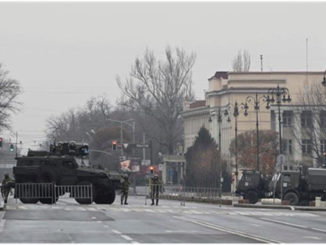
    Moscow (TIP): The President of Kazakhstan said on January 7 he authorised law enforcement to open fire on “terrorists” and shoot to kill, a move that comes after days of extremely violent protests in the former Soviet nation.

    In a televised address to the nation, Kassym-Jomart Tokayev blamed the unrest on “terrorists” and “militants” and said that he had authorised the use of lethal force against them.

    “Those who don’t surrender will be eliminated,” Tokayev said.

    He also blasted calls for talks with the protesters made by some other countries as “nonsense”. “What negotiations can be held with criminals, murderers?” Tokayev said.

    Kazakhstan’s Interior Ministry reported on Friday that 26 protesters had been killed during the unrest, 18 were wounded and more than 3,000 people have been detained.

    A total of 18 law enforcement officers were reported killed as well, and over 700 sustained injuries.

    Kazakhstan is experiencing the worst street protests since the country gained independence three decades ago. The demonstrations began over a near-doubling of prices for a type of vehicle fuel and quickly spread across the country, reflecting wider discontent over the rule of the same party since independence. Protests have turned extremely violent, with government buildings set ablaze and scores of protesters and more than a dozen law enforcement officers killed. Internet across the country has been shut down, and two airports closed, including one in Almaty, the country’s largest city. In a concession, the government on Thursday announced a 180-day price cap on vehicle fuel and a moratorium on utility rate increases.

    Tokayev has vacillated between trying to mollify the protesters, including accepting the resignation of his government, and promising harsh measures to quell the unrest, which he blamed on “terrorist bands”.

    In what was seen as one such measure, the president has called on a Russia-led military alliance for help.

    The alliance, the Collective Security Treaty Organization, includes the former Soviet republics of Kazakhstan, Belarus, Armenia, Tajikistan and Kyrgyzstan and has started deploying troops to Kazakhstan for a peacekeeping mission.

    Kazakh officials have insisted that the troops will not be fighting the demonstrators, and instead will take on guarding government institutions.  (AP)

  • Small protest outside Djokovic Melbourne detention hotel

    Small protest outside Djokovic Melbourne detention hotel

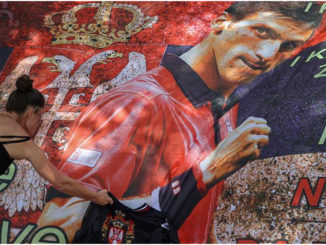
    Melbourne (TIP): A small group of protesters supporting Novak Djokovic waved flags and banners outside an Australian immigration detention hotel where he remained on January 7.  Locked in a dispute over his COVID-19 vaccination status, the number 1 men’s tennis player in the world is awaiting a court ruling on whether he can compete in the Australian Open later this month.

    Djokovic, a vocal skeptic of vaccines, had travelled to Australia after Victoria state authorities granted him a medical exemption to the country’s strict vaccination requirements.

    But when he arrived late Wednesday, the Australian Border Force rejected his exemption as invalid and barred him from entering the country. A court hearing on his bid to stave off deportation was set for Monday, a week before the season’s first major tennis tournament is set to begin.

    The defending Australian Open champion is waiting it out in Melbourne at a secure hotel used by immigration officials to house asylum seekers and refugees. Djokovic is hoping to overtake rivals Rafael Nadal and Roger Federer and win his 21st Grand Slam singles title, the most by any player in men’s tennis. Djokovic’s securing of an exemption so that he could play triggered an uproar and allegations of special treatment in Australia, where people spent months in lockdown and endured harsh travel restrictions at the height of the pandemic.

    After his long-haul flight, the tennis star spent the night at the airport trying to convince authorities he had the necessary documentation, to no avail. (AP)

  • Weak testing, data outage leave Brazil ‘in the dark’ as Omicron advances

    Rio de Janeiro (TIP): Insufficient testing for Covid-19 and a data blackout caused by hackers have left Brazil in the dark as it grapples with a wave of infections from the Omicron coronavirus variant, health experts warn.

    Brazilians with Covid-19 symptoms are facing long lines to get tested due to the lack of kits in a country without a comprehensive testing strategy since the start of the pandemic.

    Substantial testing and genomic sequencing of confirmed infections are crucial to tracking and fighting the pandemic, especially with the onset of the highly contagious Omicron.

    To make matters worse, some Health Ministry databases have been offline since an apparent ransomware attack seriously hampered the government’s ability to gather data from state health authorities. “In general, the registration system was bad from the start, and it got worse with the hacker attack, so we’re really under water,” said Gonzalo Vecina, former head of Brazilian health regulator Anvisa and professor at the University of Sao Paulo.

    “We’re in the dark,” he said.

    Despite having the world’s third-deadliest outbreak after the United States and Russia, according to Reuters calculations, Brazil tests for Covid-19 far less than South American peers.

    Over the last seven days, Brazil performed an average 0.23 tests per 1,000 inhabitants, according to statistics compiled by the Our World in Data website. By contrast, Argentina applied 2.15 tests per 1,000 people in the same period and Uruguay performed 3.88 tests per 1,000 inhabitants.

    Demand for tests in Brazil surged during year-end holidays and many pharmacies and clinics ran out of kits. Inventory had dwindled as vaccination advanced in the country and cases fell.

    ‘AN EXPRESSIVE INCREASE’

    Despite limited data sources, Covid-19 cases are clearly rising in Brazil. In Rio de Janeiro, the rolling seven-day average of confirmed cases jumped more than 2,000% since mid-December to 398 on Monday.

    “We are seeing an expressive increase in the number of cases, dealing with patients and people in everyday life. And this increase is happening in the places where Omicron has been detected,” said Esper Kallas, a doctor specialized in infectious diseases and professor at the University of Sao Paulo.

    The Health Ministry did not respond to a request for comment on how the cyberattack affected monitoring of the pandemic. Health Minister Marcelo Queiroga has said that data is being collected but not made public.

    The ministry’s website was back online this week, but with numbers only through early December, before it was hacked. Brazil has so far verified just 265 Omicron cases since late November, according to the ministry. Extensive sequencing in other countries showed Omicron quickly became the dominant variant, causing cases to surge in a matter of days.

    The hope, experts say, is that Omicron does not seem as lethal as previous variants and its death toll may be limited in Brazil, where a vaccination campaign.  Reuters

  • 12 cops killed, Russia sends troops to quell Kazakh unrest

    Moscow (TIP): Dozens of protesters and 12 policemen died during extraordinarily violent demonstrations in Kazakhstan that saw government buildings stormed and set ablaze, authorities said on January 6. One police officer was found beheaded in escalating unrest that poses a growing challenge to authoritarian rule in the Central Asian nation. Russia sent paratroopers into Kazakhstan to help put down the countrywide uprising.

    Tens of thousands of people, some reportedly carrying clubs and shields, have taken to the streets in recent days in the worst protests the country has seen since gaining independence from the Soviet Union three decades ago. Although the demonstrations began over a near-doubling of prices for a type of vehicle fuel, their size and rapid spread suggest they reflect wider discontent in the country that has been under the rule of the same party since independence. After breaking into the presidential residence and the mayor’s office in the country’s largest city on Wednesday, demonstrators continued to try to storm more buildings overnight.

    “Dozens of attackers were liquidated,” police spokeswoman Saltanat Azirbek said. Twelve police officers were killed in the unrest and 353 injured, according to city officials cited by a news channel.

    While the President initially seemed to try to mollify the protesters, he later promised harsh measures to quell the unrest, which he blamed on “terrorist bands”, and called on a Russia-led military alliance for help. — AP

  • Sri Lanka vaccinates children as doctors warn of Covid surge

    Colombo (TIP): Sri Lankan health authorities on January 7 began vaccinating children aged 12 to 15, as the island nation’s top medical specialists warned of a wave of COVID-19 infections in the coming weeks driven by the omicron variant. Under the new vaccination program, children will be given a single dose of the Pfizer vaccine, said the health ministry. Earlier, children above 15 could be vaccinated. The latest effort begins as schools are set to fully reopen from Monday. Children were previously allowed to attend schools in two groups.

    The move also comes as authorities take steps to make vaccination certificates compulsory to enter public places.

    According to health officials, 47 omicron cases have been detected so far in Sri Lanka.

    The Association of Medical Specialists, which comprises the country’s top doctors, pointed to a surge in Covid-19 cases last April as a warning “that history is repeating itself.” Almost 15,000 people died in that outbreak.

    “Shops and bars, (New Year’s Eve) parties were jampacked,” the association said in a statement. “It is therefore inevitable that the omicron variant will cause a massive wave of infection during the coming weeks.” Last April’s surge led to two separate lockdowns. The latest lockdown was lifted in October and authorities have since gradually relaxed many Covid related restrictions.

    At the peak last July, Sri Lanka reported more than 3,000 daily infections and more than 200 deaths. Daily infections are now around 500, with fewer than 20 deaths.

    The country has recorded 589,479 total confirmed cases and 15,065 deaths.

    Life in Sri Lanka has begun returning to normal with the partial lifting of restrictions on restaurants, supermarkets, cinemas and weddings. But authorities have maintained strict restrictions on public transport and they discourage public gatherings. Face masks and social distancing in public are still mandatory and police take legal action against anyone who fails to comply. Nearly 64% of Sri Lanka’s 22 million people have been fully vaccinated, and about 20% have received boosters.  AP

  • Won’t allow fencing along Durand Line: Taliban

    Islamabad (TIP): Afghanistan’s Taliban regime has said it will not allow fencing by Pakistan in any form along the Durand Line, issuing a stern warning to Islamabad amid escalating tensions between the neighbouring countries on the contentious issue of border fencing, a media report said. “We (Taliban) will not allow the fencing anytime, in any form. Whatever they (Pakistan) did before, they did, but we will not allow it anymore. There will be no fencing anymore,” Mawllawi Sanaullah Sangin, Commander of the Taliban, said on January 5. Sangin’s sharp reaction comes following Pakistan Foreign Minister Shah Mehmood Qureshi’s comments earlier this week, when he said this issue would be resolved peacefully, through diplomatic channels. — PTI

  • Cabinet nod for MoU for bridge between India and Nepal at Dharchula

    Kathmandu (TIP): Union Cabinet on January 6 approved signing of a Memorandum of Understanding (MoU) between India and Nepal for construction of a bridge over Mahakali river at Dharchula in Uttarakhand.

    Briefing the media on the Cabinet decisions, I&B Minister Anurag Thakur said the MoU between India and Nepal will be signed in the “near future” and the bridge will be completed within three years. “The construction of the bridge will help people living in Dharchula in Uttarakhand and in the territory of Nepal,” he said.

    Thakur said as close neighbours, India and Nepal share unique ties of friendship and cooperation characterized by an open border and deep-rooted people-to-people contacts of kinship and culture. The diplomatic relations between the two countries will further improve with the signing of the MoU, an official statement said. It noted that India and Nepal have been working together on different regional forums such as SAARC and BIMSTEC as well as the global fora. PTI

  • Pakistan’s PM has been exposed as ‘corrupt and dishonest con man’: Nawaz Sharif on PTI’s foreign funding fraud

    Pakistan’s PM has been exposed as ‘corrupt and dishonest con man’: Nawaz Sharif on PTI’s foreign funding fraud

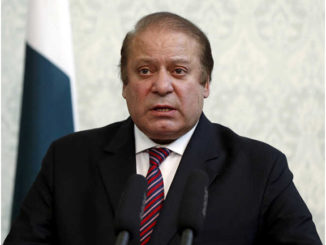
    Lahore (TIP): Pakistan’s deposed premier Nawaz Sharif has slammed Prime Minister Imran Khan for the “fraud” detected in the ruling Pakistan Tehreek-i-Insaf party’s foreign funding, saying that he has been exposed as a “corrupt and dishonest political con man”. According to a damning report by the Election Commission recently, Prime Minister Khan’s ruling Pakistan Tehreek-i-Insaf (PTI) party grossly under-reported funds received from foreign nationals, firms, and also concealed its bank accounts. The ruling party has under-reported an amount of PKR 312 million over a four-year period, between FY 2009-10 and FY 2012-13. The year-wise details reveal that an amount in excess of PKR 145 million was under-reported in FY 2012-13 alone.

    “Finally, ‘Mr Clean’ has been exposed as a corrupt and dishonest political con-man. And the other dishonourable man (former chief justice of Pakistan Saqib Nisar) who declared him ‘Sadiq & Amin (honest)’ to engineer my ouster has already been heard admitting his crime. Divine justice is done, only the legal one remains to be seen & done,” Sharif, who is also the Pakistan Muslim League-Nawaz (PML-N) supreme leader, said in a tweet on Tuesday.

    Sharif has been living in the UK in self-exile since November 2019. He had gone to London after the Lahore High Court granted him bail for four-weeks to get his treatment abroad. He was serving a seven-year term at Lahore’s Kot Lakhpat jail in a corruption case.

    Sharif said the ECP’s report not only has exposed Prime Minister Khan and PTI but what would happen when they would have to tell the names from whom they had taken money and where they spent it.

    “You (Imran) have not only committed financial fraud but also insulted the title of Sadiq aur Ameen,” he said.

    His younger brother and Opposition leader in National Assembly Shehbaz Sharif said, “It has been clear now as to why the PTI was running away from the foreign funding case for the last seven years. Truth has a strange way of exposing people. The Scrutiny Committee’s report is a damning indictment of IK (Imran Khan). The facade of ‘Sadiq aur Ameen (honesty)’ has been shredded into pieces”.

    Sharif’s daughter and PML-N vice president Maryam Nawaz said, “If you (Imran Khan) welcome the ECP’s report, then why didn’t you let this case proceed for the last seven years through force. Why did you keep running away (from the ECP’s scrutiny of PTI foreign funding) for so many years and pleading not to make the scrutiny committee’s report public? Do you think the people are fools who believe whatever you say… be ready as the time of your accountability is near.” —PTI

  • Pravasi Bharatiya Divas

    Pravasi Bharatiya Divas

    Pravasi Bharatiya Divas (PBD) is celebrated annually on 9 January to mark the contribution of the non-residential Indian community towards the development of the country. According the Ministry of External Affairs, 9 January was chosen for the observance, as on this day in the year 1915, Mahatma Gandhi returned to India from South Africa. He then went on to lead the country in its freedom struggle. Being celebrated since 2003, the year 2015 saw a slight change with PBD being celebrated every two years from then on. The convention allows NRIs to engage with the government and people of the land of their ancestors for mutually beneficial activities.

    It is sad that the day  has lost importance over the years under the Modi government.

    This year, due to the COVID-19 pandemic, Non-Resident Indians (NRI) across the globe are coming together to celebrate the 16th Pravasi Bharatiya Divas Convention in a virtual format.

    The Day holds great significance as it not only reconnects NRIs with their roots but celebrates their achievements as well. It also acknowledges the difficulties faced by Indian expatriate workers living abroad.

    Established in 2000, Pravasi Bharatiya Divas is sponsored by the Ministry of External Affairs of the Government of India and the Federation of Indian Chambers of Commerce and Industry (FICCI), the Confederation of Indian Industries and the Ministry of Development of North Eastern Region.

    A celebratory event is held on 7-9 January every other year in an Indian city: a forum for issues concerning the Indian Diaspora is organised and the Pravasi Bharatiya Samman Awards are given.

    In 2006, the concept of Overseas Citizen of India (OCI) was launched during the Pravasi Bharatiya Divas convention at Hyderabad on 9 January.

    In 2014, Pravasi Bhartiya Divas was held in New Delhi and was attended by 1,500 delegates from 51 countries. President Pranab Mukherjee gave the Pravasi Bharatiya Samman Awards.

    In 2013, 11th Pravasi Bharatiya Divas was held in Kochi from 7-9 January, where the Indo-Canada Chamber of Commerce (ICCC) is organizing partner of the summit. The President of Mauritius, Rajkeswur Purryag, was the chief guest at the official inaugural session. Canadian Minister Jason Kenney became the first individual of non-Indian heritage to address the gathering.

    The 12th Pravasi Bharatiya Divas was held during 7-9 January 2014 at Vigyan Bhawan, New Delhi. The Theme for this year was Engaging Diaspora: Connecting Across Generations.

    The 13th Pravasi Bharatiya Divas was held during 7-9 January 2015 at Mahatma Mandir, Gandhinagar, Gujarat . The Theme for this year was “Apna Bharat, Apna Gaurav”.

    The 14th Pravasi Bharatiya Divas, which was supposed to be held during 7-9 January 2016 at New Delhi, was cancelled under the MEA’s decision to make the event biennial.

    The 15th Pravasi Bharatiya Divas was held during 7-9 January 2017 at Bengaluru, Karnataka. The theme for this year was “Redefining engagement with the Indian diaspora”.

    The 16th Pravasi Bharatiya Divas 2018 was held during 6-7 January 2018 at Marina Bay Sands, Singapore.

    The 17th Pravasi Bhartiya Divas 2019 was held during 21-23 January 2019 at Varanasi, India. Prime Minister of Mauritius, Pravind Jugnauth was the chief guest.

    History

    The decision to celebrate Pravasi Bharatiya Divas was taken in accordance with recommendations of the High Level Committee (HLC) on the Indian Diaspora set up by government of India under the chairmanship of L. M. Singhvi. The then Prime Minister of India,  Atal Bihari Vajpayee, received the report of the Committee at a public function at Vigyan Bhavan in New Delhi on 8 January 2002, and announced the “Pravasi Bharatiya Divas” (PBD) on 9 January 2002. The day was chosen to mark the return of Mahatma Gandhi from South Africa to India in 1915.

    The occasion is marked by special programs to recognise the contributions of NRI/PIO individuals of exceptional merit, felicitate NRI/PIO individuals who have made exceptional contributions in their chosen field/profession (Pravasi Bharatiya Samman and provide a forum to discuss issues and concerns of people of the diaspora. The event has been organized every year since 2003, and is sponsored by the Ministry of Overseas Indian Affairs and the CII (Confederation of Indian Industry), initially sponsored by FICCI.

    The 8th Pravasi Bharatiya Divas took place on 7-9 January 2010 and was webcast live at the official Ministry of Overseas Indian Affairs website, also covered live on social media via live blogging and live tweeting at Pravasi Bharatiya Divas, an online platform powered by Kotak Mahindra Bank. An investment facilitation platform for overseas Indians, the Overseas Indians Facilitation Centre, was launched by India’s Prime Minister, Manmohan Singh, with a view of strengthening ties with the diaspora for partnering in India’s growth story on the occasion.

    The 2012 Pravasi Bhartiya Divas was held from 7-9 January 2012. The venue was Jaipur, Rajasthan. Chief Guest of this event was the Prime Minister of Trinidad and Tobago, Ms Kamla Persad-Bissessar.

    The 2013 Pravasi Bhartiya Divas was held from 8-9 January 2013 in Kochi, Kerala. Chief Guest of this event was the President of Mauritius, Rajkeshwar Purryag. The 2015 Pravasi Bharatiya Divas was held in Ahmedabad celebrating 100 years of Mahatma’s return to India. Chief guest was Mr Donald Ramtar, President of Republic of Guyana. The theme for this was “Apna Bharat Apna Gaurav” “Connecting Generations”.

    Pravasi Bharatiya Divas (PBD), the annual event for the Indian diaspora, was canceled for 2016. The format of the event, which is held between 7 and 9 January, has been changed as announced by the minister of external affairs and overseas Indian affairs Sushma Swaraj, in October 2015. As per the announcement, the event was being moved to different states every two years; a smaller event would be held in Delhi every alternate year.

    In 2017, the Pravasi Bharatiya Divas was held from 7-9 January 2017 in Bengaluru. The theme of this edition was “Redefining Engagement with the Indian Diaspora”. The Ministry of External Affairs, under the guidance of Prime Minister Narendra Modi, had used digital modes to reach out to Indians abroad. The campaign Digital India also played a major role in bringing the success to Pravasi Bhartiya Divas. The plenary session ‘Leveraging Social Media for Diaspora Connect’ held on 9 January 2017, at the Pravasi Bharatiya Divas looked at social media as a medium in connecting the Indian Diaspora.

    About PBD Convention 2021

    In a virtual format, the convention will be held and the theme of the 16th PBD Convention 2021 is “Contributing to Aatmanirbhar Bharat”. The Convention of PBD will have three segments and will be inaugurated by the Prime Minister of India Narendra Modi. It will also be addressed by the Chief Guest, Chandrikapersad Santokhi, President of the Republic of Suriname. Winners of the online Bharat ko Janiye Quiz for the youth will be announced.

    The inaugural session will also be followed by the two Plenary sessions. The first will be on the Role of Diaspora Aatmanirbhar Bharat and will be featured by the External Affairs Minister and Commerce and Industry Minister. And the second will be on Facing Post Covid Challenges – Scenario in Health, Economy, Social and International Relations that will be addressed by Minister of Health and Minister of State for External Affairs.

    The Valedictory Session will be the finale where the President will deliver his Valedictory address to mark the occasion of Pravasi Bharatiya Divas.

    Here to inform you that the Youth PBD was also be observed virtually on the theme “Bringing together Young Achievers from India and Indian Diaspora” on 8 January 2021 and was anchored by the Ministry of Youth Affairs and Sports. The Special Guest for the event is Priyanca Radhakrishnan, Minister for Community& Voluntary Sector of New Zealand.

    In January 2019, it was celebrated at Varanasi, Uttar Pradesh to acknowledge the Indian Diaspora of Indian origin to share their experience, knowledge which can help in the development of the country.

  • Makar Sankranti

    Makar Sankranti

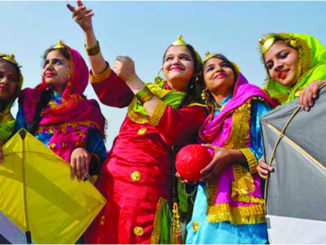
    Makar Sankranti is the first major festival to be celebrated in India and usually takes place in January, this year the festival will be celebrated on January 14. Makar Sankranti is a major harvest festival celebrated by Hindus across India, however different states celebrated the festival under different names, traditions and festivities. Makar Sankranti marks the end of winter as well as the beginning of longer days on account of the sun’s northward journey, this period is also known as Uttarayan on this account and is considered to be very auspicious.

    The harvest festival is both a religious as well as seasonal observance, and is dedicated to Lord Surya, the Sun God and marks the sun’s transit into Makara (Capricorn) raashi (zodiac sign). The festival is majorly celebrated in the Indian Subcontinent and also by Indians and Hindus around the world.

    The festivities related to Makar Sankranti have many names depending on the region it is being celebrated in. For example, by north Indian Hindus and Sikhs, it is called Maghi and is preceded by Lohri. It is called Makara Sankranti and also Poush sôngkranti in Maharashtra, Goa, Andhra Pradesh, West Bengal, Karnataka and Telangana, Sukarat in central India, Magh Bihu by Assamese, and Thai Pongal or Pongal by Tamils.

    While festivities may not be at par as previous years on account of the coronavirus pandemic, usually on this day devotees take a dip in rivers like Ganga, Yamuna, Godavari, Krishna and Cauvery that are considered to be holy. For believers, taking a dip washes away their sins, it is also considered a time of peace and prosperity and many spiritual practices are conducted on this day. Sesame and jaggery ladoos or chikkis are distributed on this day. Popularly referred to as til-gud. The sweet signifies that people must stay together in peace and harmony despite their differences. In Gujarat, kite flying is organised as part of Makar Sankranti festivities. It is also believed that those who die on Makar Sankranti are not According to Hindu belief, if one dies on Makar Sankranti they are not reborn, but go straight to paradise.

    The auspicious day of Makar Sankranti will fall on Friday, 14 January 2022.

    Believe goes that Makar Sankranti is the most auspicious day of the year and has a very sacred mythological story associated. It marks the end of an inauspicious phase that begins around mid-December. Further, it is also believed that any sacred Makar Sankranti ritual can be performed from this day onwards. The auspicious day of Makar Sankranti also marks the beginning of warmer and longer days as compared to nights. Now let’s know what mythology says about this lucky day.

    Mata Mahishasurmardini – a powerful form of Goddess Durga, had descended with the purpose of destroying Mahishasur. The Goddess had first set foot on earth, in the Kataraaj ashram of Rishi Kardam and Devahuti.

    It is also believed that on this day Lord Sun visits God Shani who is the owner of the constellation Makar. Since Shani is the foster child of Sun, they do not share a good relation. However, it is Shani’s responsibility to take care of his father. Hence, this day signifies the priority of responsibilities.

    Even in the epic of Mahabharata, an episode mentions how people in that era also considered the day as auspicious. Bhishma Pitamah even after being wounded in the Mahabharata war lingered on till Uttarayan set in so that he can attain heavenly abode inauspicious times. It is said that death on this day brings Moksha or salvation to the deceased.

    History of Makar Sankranti

    The great savior of his ancestors, Maharaj Bhagirath, did great Tapasya to bring Gangaji down on the earth for the redemption of 60,000 sons of Maharaj Sagar, who were burnt to ashes at the Kapil Muni Ashram, near the present-day Ganga Sagar. It was on this day that Bhagirath finally did tarpan with the Ganges water for his unfortunate ancestors and thereby liberated them from the curse. Thus Makar Sankranti marks the start of good luck and fortune for all endeavors.

    Another legend says that any boy or girl who takes a bath at any of the holy places will be blessed with a charming and beautiful partner. Another belief associated with the holy dip is that Lord Vishnu himself comes down to take a dip in the Triveni Sangam and therefore anyone who bathes there is blessed with his grace.

    Culture and Festivity of Makar Sankranti in different states

    Makar Sankranti is celebrated differently at different places and has a variety of rituals associated.

    Maharashtra

    Maharashtra takes the limelight when it comes to the celebration of Makar Sankranti. People here come together to exchange sweets especially laddus made of Til (Sesame seeds) and Jaggery. Women who are married get together to exchange utensils and put Haldi Kumkum on their forehead. Hindus wear ornaments made of ‘Halwa’ on this day.

    Orissa

    In Orissa, families get together to prepare some authentic delicacies on the eve of Makar Sankranti. They prepare a special dish called ‘Ghantaa’ which is a curry made of different cereals and vegetables. They also prepare some sweet dishes. Many of Orissa celebrate the day of Sankranti by lighting bonfires, dancing and eating their particular dishes sitting together. The Bhaya tribals of Orissa have their Magh yatra in which small home-made articles are put for sale.

    Uttar Pradesh

    In Uttar Pradesh, Sankranti is called ‘Khichiri’. Taking a dip in the holy rivers on this day is regarded as most auspicious. A big one-month long ‘Magha-Mela’ fair begins at Prayag in Allahabad on this occasion. Apart from Triveni, ritual bathing also takes place at many places like Haridwar and Garh Mukteshwar in Uttar Pradesh, and Patna in Bihar.

    Bengal

    The famous Ganga Sagar river witnesses a huge Mela every year during Makar Sankranti. This is the place where river Ganga is believed to have divided into the nether region and vivified the ashes of the sixty thousand ancestors of King Bhagirath. This meal is attended by a large number of pilgrims from all over the country.

    Tamil Nadu

    Pongal is the festival which is very similar to Makar Sankranti and is one of the major festivities of South India. Rice and pulses cooked together in ghee and milk are offered to the family deity after the ritual worship. In this, they worship the Sun God.

    Andhra Pradesh

    The people of Andhra celebrate it for three long days and call it ‘Pedda Panduga’ meaning big festival. The whole event lasts for four days, the first day Bhogi, the second day Sankranti, the third day Kanuma and the fourth day, Mukkanuma.

    Gujarat

    For the Gujurati’s, the festival is more about socializing and show your love for your relatives. They exchange gifts, arrange dinners and perform Puja together. The Gujarati Pundits on this auspicious day grant scholarships to students for higher studies in astrology and philosophy. This festival thus helps the maintenance of social relationships within the family, caste, and community.

    Punjab

    Punjab celebrated this occasion as Lohri. This period being the coldest of the year they lit huge bonfires and participate in entertaining activities. Sweets, sugarcane, and rice are thrown in the bonfires, around which friends and relatives gather together. The following day, which is Sankrant, is celebrated as MAGHI. The Punjabi dance their famous Bhangra dance and eat sumptuous dinner together.

  • Lucknow Woman Scientist Plays a Key Role in Launching of Ten Billion Dollar NASA’s Webb Space Telescope

    Lucknow Woman Scientist Plays a Key Role in Launching of Ten Billion Dollar NASA’s Webb Space Telescope

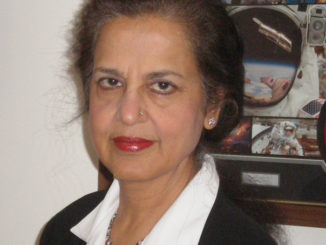
    WASHINGTON, D.C. (TIP): “What are the odds of a girl child born in the newly formed Republic of India to become a Program Scientist at NASA,” said Dr. Hashima Hasan reminiscing about her early school days during a recent NASA podcast interview. The words of her Class VI teacher in Loreto Convent, Lucknow, that they could do anything if worked hard made a big impact on her. Loreto Convent—an educational institution established in 1872 for girls—had recently allowed girls to take science subjects for their studies. She took the challenge and got interested in science. She was inspired by the scientific career of her great-uncle, Dr. Husain Zaheer, who was the Director-General of India’s Council of Scientific and Industrial Research (CSIR), and later her aunt Dr. Najma Zaheer, a renowned biological scientist. Hashima recalled that her mother had unwavering faith in her capabilities and she encouraged her to pursue her ambitions. The inspiration to pursue space science was born when, in 1957, her grandmother gathered the entire family in the backyard of her home in the early dawn to watch Sputnik pass by. It was very fascinating to see the Sputnik in the clear sky.

    Hashima completed a B.Sc. degree at Lucknow University, securing the fifth position, and went on to Aligarh Muslim University (AMU) and obtained an M.Sc. (Physics) degree securing first place and a gold medal. She started a Ph. D. program under the tutelage of the legendary Dr. Zillur Rahman Khan. After completing the pre-requisite degree of M. Phil., she took the bold step of applying to the University of Oxford. With encouragement from Dr. Rais Ahmad, Head, Department of Physics, she applied and received a Commonwealth Scholarship and joined the University of Oxford, U.K. Three years later, with a D.Phil. (Theoretical Nuclear Physics) in hand, she returned to India as a post-doctoral scholar at the Tata Institute of Fundamental Research (TIFR), Bombay. With scholars like Dr. J. V. Narlikar, and Dr. Obaid Siddiqi, TIFR was a haven of intellectual thought. After two intense years at TIFR, she secured a faculty position at the Physics Department, University of Poona, Pune. She was the only non-Marathi-speaking faculty member. The atmosphere at Poona University was welcoming, respectful, academic, idyllic, and she enjoyed teaching the post-graduate students.

    Her life took an important turn when her family arranged her marriage and she moved to Raleigh, NC, joining her husband, Dr. Aftab Ansari. She pursued her passion for Nuclear Physics at Duke University, Durham NC, switching gears two years later to Atmospheric Science when she was awarded a Resident Research Associateship by the U.S. National Research Council.

    A year later, they were back in India, this time with an infant son. Her first experience as a working mother came when she started research in Nuclear Physics at the Bhabha Atomic Research Center, Mumbai. When they returned to the USA with their second son, her journey took a turn towards NASA.

    Arriving in Baltimore, she sought research opportunities and was hired by the newly formed Space Telescope Science Institute to write the simulation software for the optics of the soon-to-be-launched Hubble Space Telescope and its science instruments. Never one to turn down a challenge, she once again switched gears from Nuclear Physics – this time towards optics and astronomy.

    Little did she know that within a few years she would be using her software to analyze the optical error of the Hubble mirror and would be assigned the responsibility of keeping Hubble in the best focus till a fix was designed.

    Once Hubble was repaired after the first servicing mission, she took advantage of an opportunity at NASA Headquarters, Washington DC, to work as a Senior Scientist. Thus started her career in science management. There was never a dull moment at NASA Headquarters. Every second keeps one intellectually on the edge – whether it is involved in the strategic planning for the next flight mission; the solicitation, review, and selection of new technology, research program, payloads on sounding rockets and balloons; the next Explorer mission; direction of the data archives; or management of advisory committees and communication with educators and the public.

    Hashima has managed every aspect of Astrophysics during her 27 years+ services at NASA Headquarters. One of her significant responsibilities is that of the Deputy Program Scientist, James Webb Space Telescope (JWST), a successor to the Hubble Space Telescope. Her responsibilities included oversight during the mission development phase to make sure that the science requirements were being met, and the best science observation program selected for the operation phase. She is currently serving as a spokesperson for JWST to the media and delivering invited talks to school students.

    After many years of hard work with its partners, the European Space Agency, and the Canadian Space Agency, NASA launched JSWT from the European spaceport of Kourou in French Guiana on 25th December 2021. The telescope equipped with multiple instruments will be positioned at a spot called Lagrange Point 2, 1.5million km from earth or more than four times beyond the moon. Its mission stretches from five to 15 years. As Deputy Program Scientist for the JWST, she was part of the team on board when the world’s largest and most powerful telescope was launched. This was an exhilarating moment for her, the entire JWST team, and indeed the entire world. Once in operation, JWST will show the wonders of the Universe never seen before. The world is eagerly waiting for those first science images. Hashima is gazing at the night skies at her home in the USA with the same wonder that she gazed at it as a little girl in Lucknow – it is the same sky with the same mysteries waiting for all of us to discover.

    A few selected videos.

    https://www.bhaskar.com/international/news/james-webb-spaDce-telescope-news-and-updates-worlds-most-powerful-space-telescope-is-ready-to-launch-129239575.html?media=1

    https://m-timesofindia-com.cdn.ampproject.org/c/s/m.timesofindia.com/city/mumbai/touch-of-india-

    AMU Alumna Dr Hashima Hasan plays a key role in the launch of NASA telescope

  • “If above 60, see your ophthalmologist at least once a year”: Dr. VK Raju

    “If above 60, see your ophthalmologist at least once a year”: Dr. VK Raju

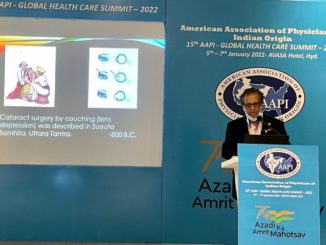
    HYDERABAD/NEW YORK (TIP): Eminent ophthalmologist and President of Eye Foundation of America spoke on cataract surgery at the AAPI Global Health Summit held in Hyderabad from January 5 to 7, 2022.
    “Cataract surgery was first described in Sanskrit literature 3000 years ago by Susruta of ancient India. We have come a long way since then. With modern technology, and skillful surgeon it has become an outpatient surgery. Not long ago, patients were hospitalized for 5-7 days”, said Dr. Raju.
    He described the modern cataract surgery and its benefits.
    Cataracts are one of the leading causes of blurry vision in patients over 50. Other symptoms of cataracts like glare, halos, double vision, loss of contrast sensitivity, dimness of vision, or difficulty with depth perception can lead to trouble reading or difficulty with driving during the day or night.”
    Multiple studies have shown that decreased vision in the elderly has been associated with a decrease in their mental, emotional, and physical wellbeing. In fact, the visual disturbances from cataracts have been shown to increase the risk of falling and hip fractures.” Cataract surgery is the only way to treat cataracts and is a low risk, quick, and efficient procedure. Having cataract surgery has been shown in multiple studies to decrease the rate of falls and fractures and improve the emotional, mental and physical wellbeing of patients, Dr. Raju explained.

    His advice: if you are close to 60 years you should see your ophthalmologist once a year at least. Today many eye problems can be prevented or treated if the ophthalmologist catches them early, he said.

  • CICA University Bestows on Journalist Kishor Panthi an Honorary Doctorate Degree

    CICA University Bestows on Journalist Kishor Panthi an Honorary Doctorate Degree

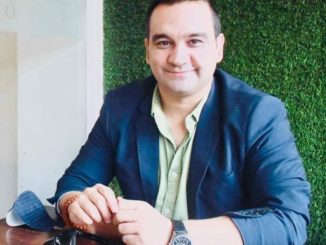
    NEW YORK (TIP): In recognition of the meritorious service of humanity through journalism, CICA University America has bestowed Kishor Panthi with an honorary Doctorate of Humane Letters. Kishor Panthi is a New York based journalist, anchor, and television host. Dr. Sharon J. Baquedo-Phinn, the president of the university, said the honor was bestowed on the party for its contribution to the good of humanity. She said that the ceremony for the graduation program has been fixed for 22nd January 2022. Every year, the university honors the great and selfless humanitarian contributions of individuals by awarding honorary doctorate degrees. While explaining the criterion for the award of an honorary doctorate degree, Sharon J. Finn explained that the minimum standard is more than a decade-long outstanding professional service to humanity.
    Journalist Panthi is the editor-in-chief of Khasokhas, which is being published in New York for the last 11 years. During his two-decades-long journalism career, Panthi has worked in the United States for almost twelve years now. In the United States, he has been the voice of the Nepali Diaspora. He is quite well known in the Nepali American community because he has always focused on the interests of the Nepali-American community. He also writes on pro-American immigration, politics, and social issues. Kishor Panthi said that the conferment of this prestigious award is not only a distinction for him but also for the whole American-Nepali community. Many personalities, including Prophet Shepherd Bushiri from CICA University, have been awarded honorary doctorate degrees in the past. Some of the U.S. lawmakers have also received honorary Ph.D. from CICA University. The 42nd Commissioner of the Boston Police Department, William Gross, also received an honorary Ph.D. from CICA University. He received his honorary Ph.D. in 2015 as Boston Police Superintendent of Chief.

  • MAYOR ADAMS ANNOUNCES MEMBERS OF HIS SENIOR TEAM

    MAYOR ADAMS ANNOUNCES MEMBERS OF HIS SENIOR TEAM

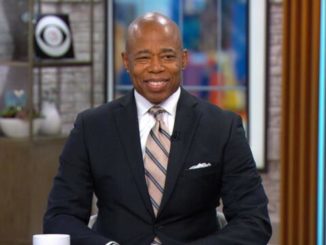
    NEW YORK (TIP): Mayor Eric Adams, on January 6, announced members of his senior staff who will oversee operations at City Hall and advance his strategic policies and priorities.

    “This team has the experience, knowledge, and skill to take our government — and our city — to new heights,” said Mayor Eric Adams. “Our motto is Get Stuff Done — and we are already off to a flying start. Together, we will workday in and day out to make New York City safer, more equitable, and more prosperous for all.”

    “We are at a pivotal moment in our city’s history, and we need strong leadership to bring New York back better than ever,” said Chief of Staff Frank Carone. “Mayor Adams has already proved himself in the early days of his administration to be exactly that kind of leader. I am honored to join his team and serve the city that I love. As chief of staff, I will be focused on ensuring City Hall runs smoothly, keeping our City agencies aligned, and delivering on the mayor’s vision for the city.”

    The following appointments were announced.

    Frank Carone, Chief of Staff

     Dawn Miller, First Deputy Chief of Staff

    Madeline Labadie, Deputy Chief of Staff

    Ryan Lynch, Deputy Chief of Staff

    Menashe Shapiro, Deputy Chief of Staff

    Tiffany Raspberry, Senior Advisor for External Affairs

    Stefan Ringel, Senior Advisor to the Mayor

    Andrea Shapiro Davis, Senior Advisor for Talent and Appointments

    Eric Ulrich, Senior Advisor to the Mayor

    Edward Mermelstein, Commissioner, Mayor’s Office of International Affairs

    Fred Kreizman, Commissioner, Mayor’s Community Affairs Unit

    Roberto Perez, Director for Intergovernmental Affairs

    Dan Steinberg, Director, Mayor’s Office of Operations

    Rachel Atcheson, Special Assistant to the Mayor

    Brief biographies of appointees.

    Frank Carone, Chief of Staff

    Frank Carone will join the Adams administration as chief of staff. Most recently, he was a partner at Abrams, Fensterman, Fensterman, Eisman, Formato, Ferrara, Wolf & Carone, LLP. He also served as law secretary for the Kings County Democratic Committee. Carone earned a B.S. from St. John’s University and a JD from Brooklyn Law School.

    Dawn Miller, First Deputy Chief of Staff

    Dawn Miller will join the Adams administration as first deputy chief of staff. Most recently, she was Vice President for Policy and Partnerships at Coord, a mobility technology company partnering with cities across the country. She previously served as chief of staff at the New York City Taxi and Limousine Commission (TLC). Dawn launched TLC’s Research and Evaluation practice, serving as its first director, and worked as a researcher at the Urban Institute in Washington, DC. She has a M.P.A. from Princeton University and a B.A. from the University of Virginia.

    Madeline Labadie, Deputy Chief of Staff

    Madeline Labadie will join the Adams administration as a deputy chief of staff. Most recently, she served as the director of strategic initiatives at TLC, where she led Vision Zero efforts and priority projects for the commissioner. She has also worked in policy and research roles for the Hotel Trades Council and Council Member Brad Lander. She holds a M.P.A. and a B.A. from New York University.

    Ryan Lynch, Deputy Chief of Staff

    Ryan Lynch will join the Adams administration as a deputy chief of staff. Before joining the Adams administration, he served as chief of staff for then-Borough President Adams, and prior to that as policy director. Lynch began as a Peace Corps volunteer in Burkina Faso and has also served as an Alternative Livelihoods Officer for WEAVE, a small, community-based organization working to support economic empowerment for Burmese refugees along the Thai-Burma border. He served as the associate director for the Tri-State Transportation Campaign. Lynch earned a B.S. in psychology from Mary Washington College, and his M.S. in urban and regional planning from the University of Wisconsin-Madison.

    Menashe Shapiro, Deputy Chief of Staff

    Menashe Shapiro will join the Adams administration as a deputy chief of staff. Most recently, he ran his own consulting firm where he advised candidates for public office as well as companies and non-profits waging large public-facing campaigns. In 2021, Shapiro was a key advisor to Mayor Adams’ campaign and a member of the appointments committee on his mayoral transition. Prior to that, he worked on Michael Bloomberg’s presidential and mayoral campaigns, as a managing director at Tusk Strategies, and in private law practice. Shapiro earned his B.A. cum laude in economics from Yeshiva University and his J.D. from Cardozo Law School of Yeshiva University.

    Tiffany Raspberry, Senior Advisor for External Affairs

    Tiffany Raspberry is joining the Adams administration as senior advisor for external affairs, where she will be the key liaison between the mayor and key stakeholders and leaders both nationally and globally. She started her career working at the House of Representatives as a legislative assistant and scheduler, and later as a policy analyst and chief of staff at the New York City Council. Most recently, Raspberry was a senior team member of Mayor Adams’ campaign and co-led the intergovernmental committee on his mayoral transition. She earned her B.A in political science and African-American studies from Fordham University and a M.P.A in global public policy and management jointly from New York University and the University College of London.

    Stefan Ringel, Senior Advisor to the Mayor

    Stefan Ringel is joining the Adams administration as senior advisor to the mayor. He served in the same capacity to Borough President Adams and was a key advisor on media and communication to Eric Adams campaign for Mayor. Previously, he served in the Brooklyn Borough President’s Office in various capacities, first as communications director for former Borough President Marty Markowitz, and subsequently as then-Borough President Adams’ communications director. Prior to that, Ringel was media relations director to then-Council Member Jumaane Williams. Ringel earned his BA in political science and international studies from the University of North Carolina, and his MA in Elections and Campaign Management from Fordham University.

    Andrea Shapiro Davis, Senior Advisor for Talent and Appointments

    Andrea Shapiro Davis will join the Adams administration as senior advisor for talent and appointments. She had been serving as CUNY’s interim vice chancellor for university advancement since August 2019. Since 2013, she has served as CUNY’s associate vice chancellor for Corporate, Foundation and Major Gift Development, a role in which she has spurred the growth of initiatives for women’s rights and diversity. Shapiro Davis also served in the administration of former Mayor Michael Bloomberg, in which she served as special adviser to the mayor, executive director of the Mayor’s Office of Appointments, and executive director of the NYC Commission on Women’s Issues. She also spent four years as an assistant district attorney in Queens County and was an attorney in private practice. Shapiro Davis is a proud graduate of Queens College and Hofstra University School of Law.

    Eric Ulrich, Senior Advisor to the Mayor

    Eric Ulrich joins the Adams administration as senior advisor to the mayor. He served as a member of the New York City Council for 12 years, representing the diverse communities of southwest Queens. He was instrumental in passing legislation that established the New York City Department of Veterans Services (DVS) and following Superstorm Sandy he organized relief efforts that helped displaced residents rebuild and recover. He is the product of New York City public and parochial schools and is the first member of his family to earn a college degree. Ulrich earned his B.A. from St. Francis College and his M.P.A. at Baruch College School of Public Affairs.

    Edward Mermelstein, Commissioner, Mayor’s Office of International Affairs

    Edward Mermelstein joins the Adams administration as the director of the Mayor’s Office of International Affairs. He joins the administration after a career as an attorney and an investment advisor with a broad range of international clients.  Fluent in English and Russian, Mermelstein emigrated as a refugee to the United States in 1976. He holds a B.A. from NYU and a J.D. from Western Michigan Law School. In addition to his work, he is involved in numerous charitable organizations supporting local as well as national causes rooted in culture, politics, education, and the arts.

    Fred Kreizman, Commissioner, Mayor’s Community Affairs Unit

    Fred Kreizman will join the Adams administration as commissioner of the Mayor’s Community Affairs Unit (CAU).  From 2002 to 2014, Kriezman worked at CAU serving Mayor Bloomberg, rising through the ranks from Brooklyn director to deputy commissioner. He also served on the board of directors of the Brooklyn Navy Yard Development Corporation from 2005 to 2016.  Recently, he worked at Capalino, serving as a managing director. Kreizman earned an M.P.A in government from Pace University, and a B.S. from Yeshiva University’s Sy Syms School of Business. Kreizman is from Jewish and Russian background.

    Roberto Perez, Director for Intergovernmental Affairs

    Roberto Perez is joining the Adams administration as director of intergovernmental affairs (IGA). Most recently, he served in the de Blasio administration as commissioner of CAU, where led efforts to connect communities with the City’s COVID -19 recovery efforts. Prior to that role, Perez was senior executive director of intergovernmental affairs at the New York City Department of Education (DOE) where he managed city, state, and federal legislative affairs on behalf of the chancellor.

    Dan Steinberg, Director, Mayor’s Office of Operations

    Dan Steinberg will join the Adams administration as director of the Mayor’s Office of Operations. Steinberg is an urban planner with degrees from the University of Chicago and Columbia University. He recently served as Chief of Data Analytics for the NYC Vaccine Command Center (winner of the Citizen’s Budget Commission Prize for Public Service Excellence) and played a number of instrumental roles throughout the City’s pandemic response. He previously served as the deputy director of project and performance management at the Mayor’s Office of Operations. Steinberg originally began his career as State Senator Liz Krueger’s first legislative aide, and also worked as a researcher and advocate.

    Rachel Atcheson, Special Assistant to the Mayor

    Rachel Atcheson will join the Adams administration as senior assistant to the mayor and will also be the at-large director of the SUNY Downstate Committee on Plant-Based Health and Nutrition. She most recently worked as deputy strategist for Borough President Adams, working on plant-forward nutrition initiatives such as launching NYC Health + Hospitals/Bellevue’s Plant-Based Lifestyle Medicine Program, and expanding healthy and sustainable food options in New York City schools. Previously, Atcheson served in the Office of the Mayor as the animal welfare liaison. Outside of government, she was senior campus outreach director for The Humane League, growing the organization’s campus outreach program from 18 to 52 campuses. She received a B.A. from Boston University.

    (Based on a Press release issued by José Bayona, Executive Director, Mayor’s Office of Ethnic & Community Media)

  • To-Go Drinks to Return to NY Bars and Restaurants: Hochul

    To-Go Drinks to Return to NY Bars and Restaurants: Hochul

    NEW YORK (TIP): Drink up and go! Gov. Kathy Hochul announced Wednesday, January 5 the return of New York’s to-go drink policy. “[We’re] going to do something bars and restaurants have been asking for, to once again allow the sale of to-go drinks,” Hochul said. “Cheers, New York.” Gov. Kathy Hochul promised the return of the lapsed COVID-19 shutdown policy — which loosens restrictions on how bars and restaurants serve alcohol — during the State of the State address in Albany.
    New Yorkers once again will be able to buy to-go drinks and enjoy them outside of bars and restaurants, the governor said. Hochul said she would support small businesses struggling to survive during a new surge of omicron cases.To further this effort, Hochul promised bar and restaurants a tax credit to buy outdoor heaters and extra seating to fund socially distanced outdoor dining. New Yorkers responded to the news with questions, demands and pointers to Hochul’s public relations team. The NYC Hospitality Alliance toasted Hochul’s good news — “We look forward to toasting her administration and the state legislature once this important policy is reinstated,” said executive director Andrew Rigie — but for some New Yorkers it felt like the return of a bad hangover.
    (Source: Patch)

  • Nassau County Executive Blakeman Signs 3 Executive Orders on Masks in Schools, Businesses, County Offices

    Nassau County Executive Blakeman Signs 3 Executive Orders on Masks in Schools, Businesses, County Offices

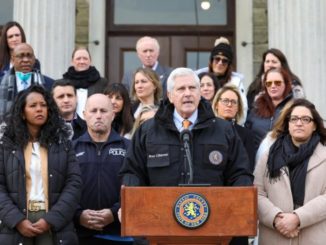
    MINEOLA(TIP): Nassau County Executive Bruce Blakeman signed three executive orders on Thursday, January 6 reaffirming that Nassau will not follow New York State’s mask mandate, instead leaving it up to local school boards, small businesses, and individuals to decide on mask wearing. Gov. Kathy Hochul issued a statewide mandate requiring masks indoors at all schools, businesses, and offices in December in anticipation of a winter surge in Covid cases, which is now in full swing. The mandate lasts until Feb. 1, at which time it will be reevaluated.

    “Let no one be fooled that we in Nassau County are not taking the challenges and risks of Covid-19 lightly. We are taking a very aggressive approach in fighting Covid-19,” said Blakeman, a Republican who officially took office on Monday. “But this aggressive approach must be balanced by keeping in mind the psychological and economic risks of every decision we make as well as individuals’ constitutional rights.”

    Blakeman’s first executive order gives school boards the power to choose whether their district will require mask wearing. The second removes mask mandates for county employees, making it optional for them to wear masks. The third solidifies that Nassau will not cooperate with the state’s mandate, which would “unfairly fine residents and small businesses thousands of dollars,” Blakeman said.

    “School boards are composed of elected officials who make decisions based upon the unique circumstances of each district. They are in the best position to make these decisions, not an autocracy in Albany,” Blakeman added about mask wearing in schools.

    His executive order related to schools drew the most criticism on Thursday. In a statement, New York State Education Department Commissioner Betty A. Rosa insisted that mask mandates are still in effect according to state public health laws that require counties to enforce them.

    “Counties do not have the legal authority to require boards of education to vote on specific issues,” Rosa said. “School officers take an oath to obey all legal requirements. The State Education Department expects school boards will follow all legal requirements, including the face-covering regulation.”

    Democratic leaders in Nassau, including Democratic Party Chairman Jay Jacobs, expressed strong opposition to the orders, as well. Jacobs issued a statement saying that Blakeman’s “refusal to comply with the law … gravely endangers children, teachers, and our population’s most vulnerable.”

    “This politically motivated directive will make school closures more likely, leaving middle and working class families unable to work or require them to pay for childcare,” Jacobs said. “School mask mandates must end, but now is certainly not the time.”

    William Biamonte, Chief of Staff for the Nassau County Legislature’s Minority Caucus, also issued a statement denouncing the orders on Thursday, January 6.

    “When ideology trumps science and politics are prioritized over the common good of society, our most vulnerable residents stand to suffer the most,” he said. “[Blakeman] can say that ‘Nassau is normal again’ all he wants, but as Omicron continues to spread like wildfire and hospitalize more children than any other Covid variant to date, this is a recipe for disaster.”

    Long Island’s Covid-19 positivity rate on a seven-day average was nearly 27% on Wednesday. Tests remain in high demand as the highly contagious Omicron variant continues to spread.

    Blakeman announced and signed the bills during a news conference outside the executive and legislative building in Mineola, at which he also announced that the county will distribute a total of 160,000 Covid-19 testing kits at Eisenhower Park and Tobay Beach on Saturday from 8:30 a.m. to 1 p.m.

    In addition, the county will hold a vaccination pod at Nassau Community College on Saturday and Sunday, from 10 a.m. to 3 p.m.

    (Source: Long Island Press)

  • Biden is right: Trump’s wounded ego was the main reason for Jan. 6

    Biden is right: Trump’s wounded ego was the main reason for Jan. 6

    By Max Boot

    “Biden was accurate in warning that “those who stormed this Capitol and those who … called on them to do so held a dagger at the throat of America and American democracy.” He needs to keep reminding voters of the real stakes in November 2022 — and 2024. We are fighting, as he said, for “the right to vote, the right to govern ourselves, the right to determine our own destiny.” Republicans, sadly, are willing to jettison all those hallowed principles simply to feed Trump’s insatiable ego.”

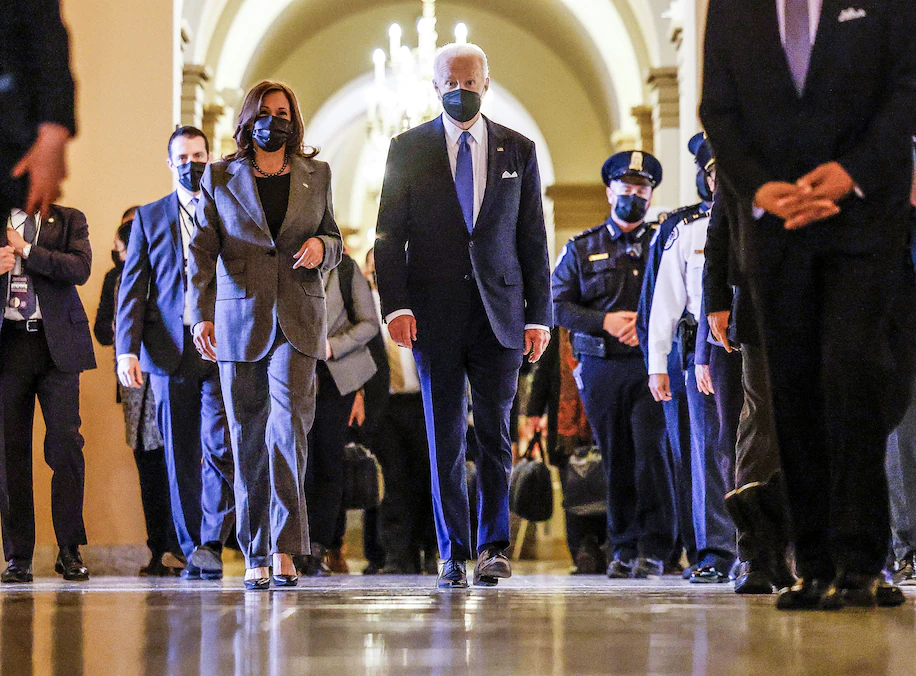
    In what may be the most powerful speech of his presidency so far, President Biden delivered a searing (and overdue) indictment on Thursday, January 6 of his predecessor — never mentioned by name — for inciting a mob attack on the Capitol exactly a year ago. Biden identified the central truth of the insurrection: “The former president of the United States of America has created and spread a web of lies about the 2020 election … because his bruised ego matters more to him than our democracy or our constitution. He can’t accept he lost.”

    That’s exactly right. There was no higher principle at operation on Jan. 6. This was not a battle over tax cuts, abortion, immigration, infrastructure, vaccine mandates or any other policy — none of which former president Donald Trump seems to care much about anyway, save to the extent that they are useful chum to excite his followers into a frenzy. Trump was willing to stage an assault on more than two centuries of democracy in America simply because his all-encompassing ego will not allow him to admit that he was repudiated by more than 81.2 million voters.

    And most Republicans, it is now clear, seem just fine with that. A party that once stood for certain principles — lower taxes, traditional values, a strong defense — has been reduced to a cult of personality for a narcissistic television personality. The GOP didn’t even have a policy platform in 2020. What is normally a lengthy document listing positions on issues big and small was reduced to a one-page statement affirming “that the Republican Party has and will continue to enthusiastically support the President’s America-first agenda.” Trump-first agenda is more like it. Remarkably enough, Republicans’ desire to cater to the whims of the orange emperor has not lessened in the past year despite his loss of power (and his Twitter account). The Republican National Committee — whose chair, Ronna McDaniel, dropped the “Romney” from her name to appease Trump — even agreed last month to pay up to $1.6 million of the former president’s personal legal bills in investigations of his shady business practices. The probes of Trump by New York prosecutors have nothing to do with his actions in office. But the RNC has become his personal piggy bank. Indeed, the entire Republican Party has become a wholly owned subsidiary of the Trump Organization. You can blame spineless Republican leaders for abasing themselves before one of the worst presidents in U.S. history. But they are just giving their voters what they want. According to FiveThirtyEight, Trump’s net favorability rating among Republicans declined only slightly over the past year, from 82 percent to 76 percent. But Vice President Mike Pence’s fell off a cliff in January 2021, when he certified Biden’s win — not that he had any other choice. So did then-Senate Majority Leader Mitch McConnell’s, after he condemned Trump’s actions. Pence’s net favorability among Republicans is down to just 28 percent, while McConnell’s rating is 32 points underwater with voters of his party.

    In another recent poll from the University of Massachusetts, only 21 percent of Republicans said that Trump’s election defeat was legitimate — even though, as Biden noted Thursday, “93 United States senators, his own attorney general, his own vice president, governors and state officials in every battleground state have all said it: He lost.” The handful of elected Republicans who actively call out the “big lie” — most prominently Reps. Liz Cheney (Wyo.) and Adam Kinzinger (Ill.) — have become pariahs in Republican ranks. Meanwhile, Rep. Matt Gaetz (Fla.), who said on Thursday that “we are proud of the work we did on Jan. 6 to make legitimate arguments about election integrity,” remains a Republican in good standing.

    I had hoped that Trump’s role in inciting a mob attack on Congress might have shaken his hold on the Republican Party — that it might have led Republicans to reconsider the perilous path they are on. But no. A year later, Trump’s attack on democracy has emerged not as a dealbreaker for most Republicans but as a deal-clincher. Forced to choose between Trump and the Constitution, most Republicans choose Trump.

    Shortly after the November election, a “senior Republican official” under cover of anonymity explained why Republicans were refusing to admit the obvious — Trump had lost. “What is the downside for humoring him for this little bit of time?” this Republican said. You would think that the downside would be readily apparent a year after lawmakers had to run for their lives from a #MAGA mob ransacking the Capitol. And yet the Republican Party continues to humor Trump even as he has turned increasingly authoritarian.

    Biden was accurate in warning that “those who stormed this Capitol and those who … called on them to do so held a dagger at the throat of America and American democracy.” He needs to keep reminding voters of the real stakes in November 2022 — and 2024. We are fighting, as he said, for “the right to vote, the right to govern ourselves, the right to determine our own destiny.” Republicans, sadly, are willing to jettison all those hallowed principles simply to feed Trump’s insatiable ego.
    (The author is a columnist with Washington Post)

  • January 7 New York & Dallas E – Edition

    [vc_row][vc_column][vc_column_text]

    [/vc_column_text][/vc_column][/vc_row][vc_row][vc_column width=”2/3″][vc_custom_heading text=”Dual Edition” font_container=”tag:h2|text_align:center” google_fonts=”font_family:Istok%20Web%3Aregular%2Citalic%2C700%2C700italic|font_style:700%20bold%20regular%3A700%3Anormal” link=”url:https%3A%2F%2Fwww.theindianpanorama.news%2Fwp-content%2Fuploads%2F2022%2F01%2FTIP-January-7-Dual-Edition.pdf”][vc_single_image image=”118955″ img_size=”full” add_caption=”yes” alignment=”center” onclick=”custom_link” link=”https://www.theindianpanorama.news/wp-content/uploads/2022/01/TIP-January-7-Dual-Edition.pdf”][/vc_column][vc_column width=”1/3″][vc_single_image image=”82828″ img_size=”medium” alignment=”center” onclick=”custom_link” link=”https://www.theindianpanorama.news/advertising-media-kit-portal-indian-panorama/”][vc_single_image image=”82829″ img_size=”medium” alignment=”center” onclick=”custom_link” link=”https://www.theindianpanorama.news/advertising-media-kit-portal-indian-panorama/”][/vc_column][/vc_row][vc_row][vc_column][vc_custom_heading text=”Lead Stories This Week” font_container=”tag:h2|text_align:center” google_fonts=”font_family:Istok%20Web%3Aregular%2Citalic%2C700%2C700italic|font_style:700%20bold%20regular%3A700%3Anormal” link=”url:https%3A%2F%2Fwww.theindianpanorama.news%2F%20″][vc_wp_posts number=”8″][/vc_column][/vc_row]

  • Modi’s Christmas shocker hurts the poor and disadvantaged in India during the Covid

    Modi’s Christmas shocker hurts the poor and disadvantaged in India during the Covid

    By George Abraham

    “These calls have an eerie familiarity with what has happened to the Jews in Germany during World War II. Even Hitler has used euphemism instead of direct appeal to annihilate a community. However, the religious extremists in India have gone even a step further and made their open call. Undoubtedly, India is at an inflection point in history, and the question is whether the current leadership acquiesce to the sounds and fury from these diabolical mindsets by keeping their deafening silence!”

    Like many other nations globally, India has been navigating through an economic crisis while battling an onslaught of Covid-19 and its variants. However, one may find it hard to pin down a leadership anywhere bent upon augmenting that misery for its own people through arbitrary and quirky actions. That is probably what the Modi administration has done by canceling about 6000 of FCRAs (Foreign Currency Remittance Act) of NGOs and various religious organizations that serve the poorest of the poor and disadvantaged in the educational, charitable, and healthcare arena. These leaders appear to be unimpressed with the vital work done by many of these civic organizations in blunting the fury of the pandemic by providing food and assistance when the government was found missing in action. Missionaries of Charity, an organization founded by Mother Teresa, is one of the impacted organizations and might have garnered the most attention. However, so many of those organizations on that list might soon be depriving a dying patient of urgent medical care due to their inability to pay or denying a meal to a hungry person from the ranks of the poor and disadvantaged. It is bizarre to learn that one of the reasons for cutting off funds for the Missionaries of Charities was that the inspectors had found copies of Bibles on the premises! Missionaries of Charities have had a long record of distinguished humanitarian service that began in 1950 on the streets of Calcutta. The group is revered worldwide for its work under Mother Teresa, an Albanian Christian nun who made India her home. She was awarded the Nobel Peace Prize for her dedicated work over a lifetime, and her legacy inspires so many to carry on with similar missions.

    The published list contains organizations belonging to various religious affiliations. Although one can fully understand the need for transparency and accountability in these organizations, this discretionary decision may have a far-reaching effect of closing their doors for good, resulting in a denial of services to the most vulnerable needy. Moreover, by releasing this list on the eve of Christmas, the Modi administration may also be sending a clear message to the Christians in India that you are no longer welcome as a partner in the social development arena. They may look at the Christian community as having undue influence in the society-at-large through their educational and charitable work and are determined to shut it down. While people worldwide are on edge dealing with variants of this virus, only a wicked mindset could think of this type of ordinance in a time such as these.

    Thanks to the rising antagonism of the authorities towards minorities, we have also seen a spate of attacks on Christians during this holiday season. The right-wing extremists, who are emboldened by the words and deeds of the current leadership, went on a rampage disrupting Carol services and destroying church properties in several parts of India. A group of men led by a politician barged into a Gurgaon private school and disrupted the Christmas carnival. They also chanted slogans of “Jai Shri Ram and Bharat Ki Jai,” and the videos of the incident show a man addressing the gathering, stating that “Christianity is not acceptable here.”

    In another incident, a statue of Jesus Christ was vandalized at the Holy Redeemer Church entrance, a century-old building with great historical importance. In the Chandmari district of Varanasi, Uttar Pradesh, a group of right-wing men carrying saffron flags protested outside the Matridham Ashram before a Christmas event was to take place. The group of 20-30 people raised the “Jai Shri ram” slogan along with “Church murdabad” (death to the church) and “stop conversion.” In Assam, the Bajrang Dal was also involved in impeding the Christmas midnight mass celebrations in Silchar. The men allegedly forced their way into the church and demanded that the celebration be shut down because it was also ‘Tulsi Diwas.’

    The action against Missionaries of Charity also happened in the backdrop of an anti-conversion bill passed in the Karnataka Assembly that has stoked anxieties among Christians in that southern state, the IT hub of India. The first anti-conversion law was passed in Odisha in 1967, leading to an attack on Christians, culminating in the Kandhamal violence in 2008. Six other states followed suit resulting in increased violence against Christians. Rev. Peter Machado, Archbishop of Bengaluru, summed up his heartfelt feelings this way: “This is frightening and a sad commentary on secularism, signals are suggesting it is not a good time to be a Christian in Karnataka.” One also wonders that if there is such a rampant conversion as alleged, why has the Christian population in Karnataka decreased from 1.91% as per the 2001 census instead of 1.87% as per the 2011 one?
    Why are these attacks occurring at an increased frequency now? For those observers, it becomes apparent that it is part of the BJP efforts to promote their long-cherished goal of a majoritarian rule under the banner of a Hindu Rashtra. The recently held Dharam Sansad in Haridwar in the name of Sanatana Dharma indicated what extent they are willing to go to accomplish that goal. One of the main organizers of the Sansad, Prabodhhanand Giri, was heard praising the Myanmarese people for killing and driving out Rohingya Muslims. The Swami wants the Hindus in India to imitate the Buddhists and drive out the Muslims from the country. A female speaker went even further, asking every Hindu to wield the sword and start killing Muslims. Christians may be considered collateral damage in their quest to fulfill that dream in the whole scheme of things.

    These calls have an eerie familiarity with what has happened to the Jews in Germany during World War II. Even Hitler has used euphemism instead of direct appeal to annihilate a community. However, the religious extremists in India have gone even a step further and made their open call. Undoubtedly, India is at an inflection point in history, and the question is whether the current leadership acquiesce to the sounds and fury from these diabolical mindsets by keeping their deafening silence!
    (Author is a former Chief Technology Officer of the United Nations and the Vice-Chairman of the Indian Overseas Congress, USA)

  • The hint of a ‘one nation one NGO’ regime

    The hint of a ‘one nation one NGO’ regime

    The current purge against civil society organizations seems to be indiscriminate and alarming

    By M.S. Sriram

    “Why foreign funding? As we know, “causes” have no boundaries and funding for such socially desirable belief systems could come from beyond borders. Some causes carried out by organizations such as Doctors Without Borders, or Reporters Without Borders are by definition international in nature. Similar is the case with the Jaipur foot provided by the Bhagwan Mahaveer Viklang Sahayata Samiti. The humanitarian work by the Missionaries of Charity is beyond the capability of a state. Such causes do not have a rational basis to be explained in terms of a financial model; how do you put a price tag to press freedom? The niche funding will happen from agencies that may be beyond the borders. They need to be encouraged.

    On December 31, 2021, the Ministry of Home Affairs issued another public notice extending the validity of registration certificates that were expiring from September 29, 2020, to March 31, 2022, till the latter date, provided that the request for renewal had not been rejected. What should have been a routine activity of the Ministry has turned out to be a fairly detailed exercise of scrutiny, resulting in a paralysis in granting permissions. The levels of due diligence and the information sought on the one hand and the annual declarations to be given by the board members of civil society organizations on the other have increased significantly. The mandatory opening of bank accounts for foreign contributions has been centralized in one branch of the State Bank of India. The linking of Permanent Account Number (PAN), Aadhaar number and mapping it with the bank account/s of the individual board members are happening with gusto. All this has resulted in a chill settling over the people who are and have been associated with civil society organizations serving a social or cultural cause. The registrations under Foreign Contribution (Regulation) Act (FCRA) have been long necessitated in order to undertake due diligence of the causes for which the organization is working for and also to have a handle on the traceability of funds.

    Data on cancellations
    Recently, the Missionaries of Charity established by Nobel Laureate Mother Teresa, was in the news for the cancellation of its permission under the FCRA. A perusal of the statistics available on the website of the Ministry of Home Affairs (https://bit.ly/32Kij6E) reveals an interesting pattern. Of the 20,675 permissions under the FCRA that were cancelled from 2011 onwards, only 89 have been cancelled on request; the rest have been cancelled on violation. Of these 20,675 cancellations, 80% of the cancellations are after 2014, with a massive purge of around 10,003 permissions in the year 2015. The dashboard (https://bit.ly/3sXfOsu) shows a little under 17,000 active organizations — which have either got permission or will know their fate by March 2022, while around 33,000 organizations have either lost their permission or it has expired. These cancellation numbers do not include the rejection of around 600 applications that have been in the news in the recent past, as the website shows only three cancellations in the year 2021 and none in 2020.

    There has been a pattern to the organized attack on civil society organizations and this looks like the final shot. In the past, the amendments in the FCRA that restricted the ability to sub-grant, killed many of the niche organizations working in very remote areas which had no direct access to international funding but were doing it through larger non-governmental organizations. The other amendment restricting the proportion of expenses on administration almost choked organizations that worked for the rights of the disposed. The increasing level of surveillance type of data sought has resulted in many organizations losing people on their governance structure and resulting in problems in funding. The level of the purge is alarming on two fronts. If this purge is because of violations that seem to threaten sovereignty because of evidence of money laundering, subversive activities and violation of the laws, then it is worrying that these organizations survived for all these years. This says a bit about the system of scrutiny that we have had in the past.

    Alternately, if these are organizations that have been purged on xenophobic considerations — because they are activists usually questioning the Government and speaking for the marginalized — organizations working on issues such as human rights, and organizations serving the people whom the state is unable to reach, then it is even more alarming. That is because it is suppressing the concept of antyodaya — reaching the last person with rights, services and entitlements.

    Organizations that are needed
    Why we need civil society organizations is a moot question. We need them because they usually work on what can be called an unreasonable agenda. This unreasonableness falls in three large verticals. The first is that they ask for greater efficiency, delivery and accountability from the state. Whether is it about rehabilitation and compensation in the case of land acquisition or setting up a great accountability framework as was done through the movement led by the Mazdoor Kisan Shakti Sangathan for the Right to Information. The second vertical is in correcting the extractive nature of markets. The groups asking for environmental accountability are looking at inter-generational justice on a matter that is not very precisely measurable but is palpable. The third is basically picking up causes that are so niche that it is beyond the capability of the state to come up with such initiatives such as a school of drama set up by NINASAM (Nilakanteshwara Natyaseva Samgha) in a village called Heggodu, Karnataka, or an idea of distributing clothing for work as done by Goonj. These initiatives cannot be put into specific business plans, spreadsheets or government schemes. They, therefore, need a grant-based, cause-based revenue stream model.

    Issue of funding
    Why foreign funding? As we know, “causes” have no boundaries and funding for such socially desirable belief systems could come from beyond borders. Some causes carried out by organizations such as Doctors Without Borders, or Reporters Without Borders are by definition international in nature. Similar is the case with the Jaipur foot provided by the Bhagwan Mahaveer Viklang Sahayata Samiti. The humanitarian work by the Missionaries of Charity is beyond the capability of a state. Such causes do not have a rational basis to be explained in terms of a financial model; how do you put a price tag to press freedom? The niche funding will happen from agencies that may be beyond the borders. They need to be encouraged.

    In general, past regimes have been tolerant of all developmental and cultural causes; somewhat wary and tolerant of rights-based causes; and largely suspicious of civil society organizations working for human rights and environmental causes. Both human rights and environmental causes put these civil society organizations directly in confrontation with the job of policing/internal security and “development” or economic growth. That is a fight that the civil society organizations were used to.

    Deeper study needed
    However, the current purge seems to be indiscriminate. The depth and the variety of the work of a civil society organization cannot be captured in the annual returns filed on the FCRA portal, where there is no scope for explaining something beyond the binary. There needs to be a study on how many civil society organizations lost their permissions on “expiry” only because the pre-populated dropdowns given by the FCRA portal were unable to capture the work of the organizations.

    The duality of welcoming foreign investments (which takes away capital gains and dividends) while actively discouraging foreign aid to charities is staring us in the face. The definition of what is foreign in the case of electoral bonds and donations to political parties is dodgy at best. This duality is the signature of the current dispensation. Its appetite to collect data is matched only by its reluctance to share data. If the hope, therefore, for civil society organizations is corporate social responsibility funding and funding from Indian philanthropists, watch this space. As cartoonist P. Mahamud indicated in a cartoon, we are moving towards a ‘One Nation One NGO’ regime.

    (Author is Faculty member, Centre for Public Policy, Indian Institute of Management Bangalore. He is on the boards of non-governmental organizations, or NGOs that have applied for FCRA permission. None of those NGOs is mentioned in the article.)

  • President’s rule in Punjab is not a good idea

    One has been hearing a demand by certain sections of politicians, both in Delhi and in Punjab for imposition of president’s rule in the state of Punjab, following the lapse in the security of Prime Minister Narendra Modi on his visit to the state.

    Prime Minister was to announce developmental schemes and address a party rally in Ferozepur in Punjab. He was to travel from Bathinda to Hussainiwala by a helicopter where he was to pay tribute to the three martyrs -Bhagat Singh, Rajguru and Sukhdev. But a bad weather forced him to make changes to his travel plan.
    It was decided that he would travel by road from Bathinda to Hussainiwala- a good two hours’ drive. Somewhere on the road some 20 miles shy of Hussainiwala his convoy had to stop because there were, as alleged, protesting farmers who had blocked the road.

    Prime Minister’s convey was held up there for about 20 minutes. And then the PM returned to Bathinda where he told a Punjab government official to convey his thanks to Punjab chief minister that he had come back alive to Bathinda.

    The Prime Minister’s remark generated all kinds of conspiracy theories. The central government blamed the Punjab government for the lapses and Punjab government defended its police officers, administration and itself by saying that the security of the Prime Minister is the responsibility of the SPG which cleared all plans of movement of the Prime Minister. However, since Punjab is going to elections in the next couple of months, the state is politically surcharged.

    The BJP which has lost ground in Punjab, after its break with SAD knows very well that it doesn’t have the kind of strength to win elections and therefore, it decided to go with Capt Amarinder Singh only to realize soon that Capt did not have enough sway in the State and that an alliance with his party was not going to get them the number of assembly seats they wanted.

    The Indian Panorama had pointed out a couple of months ago when the center had given BSF special powers and control over 50 kilometers of area of the state of Punjab along the Pakistan border that it was the beginning of an exercise to prevent elections in Punjab. Today, we hear a clamor for imposition of president’s rule. Unconfirmed reports say that when Prime Minister Modi and Home Minister Shah went to President Kovind and requested him for imposing President’s rule, President did not oblige them. BJP leaders demanding President’s rule in Punjab say that because Punjab government is not able to secure law and order which is evident from the lapse in the security of the Prime Minister, the government has no right to remain in power.
    The fact is that BJP government is looking for a pretext to not hold elections in Punjab knowing full well that it has no chance of winning enough seats to be able to in any way form a government. Therefore, it is better that elections are not held. What the BJP wants is a number of Rajya Sabha members from any state because that is where they need people. They need people to be able to amend the Constitution to make India a theocratic state, a Hindu Rashtra. If opposition parties have their Raja Sabha members, that will weaken the strength of the BJP in the parliament.

    We are concerned over this scenario. It’s not going to help democracy in the country. It is not going to serve the interests of the people of India. It is not going to serve the interests of the people of Punjab, and it certainly will be a bad precedent if the BJP government at the center made the issue of lapse in the security of the Prime Minister a reason for imposition of President’s rule in Punjab.

  • An improved protocol for the PM’s travel, and a repurposing of the SPG might be necessary

    The lapse in Prime Minister Narendra Modi’s security arrangements, which left his convoy stranded on a flyover for around 20 minutes, near Ferozepur in Punjab on Wednesday is indeed a serious one as stated by the Union Home Ministry. But by quickly blaming the Punjab government and the State police, the Central functionaries triggered a blame game that has forestalled the possibility of a fair and credible inquiry into the incident. Two parallel inquiries have been announced, one by the Centre and another by the State, both of which are on hold until Monday when the Supreme Court of India will hear a plea on the issue. Discussions on national security are always surcharged in India but at least this one involving the personal security of the Prime Minister should have been more tempered. Union Ministers and Bharatiya Janata Party functionaries turned this into yet another loyalty test and resorted to hyperbole. India takes the security of its Prime Minister very seriously. After all, a sitting Prime Minister, a former Prime Minister, and the leader revered as the father of the nation are among the list of the country’s assassinated leaders. The Special Protection Group (SPG), with an outlay of around ₹600 crore in 2020 and around 3,000 personnel has just one job — protect one person, the Prime Minister.

    The critical question that is to be probed is who made the decision that the Prime Minister could, and should, travel by road for more than 100 km, from Bathinda to Ferozepur and what inputs went into making that decision. Assuming that someone concluded that it was advisable for the Prime Minister to be on the road for nearly two hours, the process that preceded it must be probed. It was also decided that the Prime Minister should not be using a helicopter as was originally planned. The route was identified in advance as a contingency plan, but the decision to use it was made at the last moment — a version that both the State and Central governments agree on. Various scenarios involving miscommunication, misinformation and misjudgment are possible. Protesters who blocked the route were reportedly unaware of the Prime Minister’s travel. As the Union Home Minister said, accountability must be fixed, and loopholes must be plugged. Considering the mutual distrust the State and the Centre have now public, a Supreme Court-monitored probe could be a good way to get to the bottom of the matter in a credible manner. This episode must also lead to a more efficient protocol for the Prime Minister’s travel, and a repurposing of the SPG, if required. Meanwhile, loose talk, diatribe and electioneering on the issue must be shunned at all cost.
    (The Hindu)

  • Bad Weather, Farmers, Rallyists Play Foul with PM Modi

    Bad Weather, Farmers, Rallyists Play Foul with PM Modi

    • Ferozepur visit cancelled because of ‘security lapse’, says Home Ministry

    NEW DELHI /NEW YORK (TIP): Prime Minister Narendra Modi’s proposed event at Ferozepur in Punjab on Wednesday, January 5, had to be cancelled owing to a “security lapse”, the Ministry of Home Affairs (MHA) has said. The Prime Minister was scheduled to lay the foundation stones for several projects.

    According to a Ministry of Home statement, Prime Minister Modi landed at Bathinda in the morning from where he was to go to the National Martyrs Memorial at Hussainiwala by helicopter. “Due to rain and poor visibility, PM waited for about 20 minutes for the weather to clear out. When the weather didn’t improve, it was decided that he would go by road, which would take more than two hours. He then proceeded to travel by road after confirmation of necessary security arrangements by the Director General of Police (DGP) Punjab,” the statement said, adding, “Around 30 km away from National Martyrs Memorial in Hussainiwala, when the PM’s convoy reached a flyover, it was found that the road was blocked by some protesters. The PM was stuck on the flyover for 15-20 minutes. This was a major lapse in the security of PM.”

    The statement noted that the Prime Minister’s schedule and travel plan were communicated well in advance to the State government. “As per procedure, they have to make necessary arrangements for logistics, security as well as keep a contingency plan ready. Also, in view of the contingency plan, Punjab Government has to deploy additional security to secure any movement by road, which was clearly not deployed. After this security lapse, it was decided to head back to Bathinda airport,” it stated.

    Punjab Chief Minister Channi, on the hand, said there was no security lapse on the part of the Punjab administration, and that Special Protection Group which is responsible for Prime Minister’s security took sudden decision to go by road, without the advance information to Punjab State authorities responsible for security of VIPs.

    Farmers have been opposing Modi’s visit to Ferozepur. Bhartiya Kisan Union (Ekta Ugrahan), one of the largest farmer outfits in Punjab, was at the forefront of the protest against his visit and its members were seen demonstrating and blocking roads at several places across the State.

    Reports came in that huge arrangements were made for Prime Minister’s rally where a gathering of 100,000 was expected, but weather played foul and people just could not make it to the venue, leaving chairs and open spaces around unoccupied, and that was one of the reasons for Prime Minister to get back, in stead of waiting  for the police to clear the roads of protesting farmers and go ahead to address the rally.

    Punjab government has since submitted the report to Home Ministry of India. Meanwhile, many BJP leaders have demanded action against the erring Punjab administration officials, and some have gone further and demanded imposition of President’s rule in Punjab, alleging that the present Channi government is not able to maintain law and order, and that fair elections cannot be held with his government in power. The days to come are likely to witness interesting political jugglery, given the fact that Punjab is in no mood to welcome BJP.

    (With inputs from PTI)