Year: 2022

  • Corbevax, Covovax, Molnupiravir approved for restricted emergency use against Covid-19

    Expanding India’s basket of Covid-19 vaccines, the Central Drug Authority has approved Serum Institute of India’s vaccine Covovax, Biological E’s jab Corbevax and anti-Covid pill Molnupiravir for restricted use in emergency situation. The announcement by Union Health Minister Mansukh Mandaviya on Tuesday came a day after the Subject Expert Committee (SEC) on Covid-19 of the Central Drugs Standard Control Organisation (CDSCO) recommended granting emergency use authorisation (EUA) to the Covid-19 vaccines Covovax and Corbevax with certain conditions.

    The committee also had recommended granting restricted emergency use approval to the drug Molnupiravir for treatment of adult patients with Covid-19 and who have high-risk of progression of the disease. In a tweet, the minister said, “Congratulations India. Further strengthening the fight against Covid-19, CDSCO, @MoHFW_INDIA has given 3 approvals in a single day for: – CORBEVAX vaccine – COVOVAX vaccine – Anti-viral drug Molnupiravir For restricted use in emergency situation”. With this approval, the number of Covid vaccines which have received EUA in the country has increased to eight.

    Six Covid-19 vaccines — Serum Institute’s Covishield, Bharat Biotech’s Covaxin, Zydus Cadila’s ZyCoV-D, Russia’s Sputnik V and the US-made Moderna and Johnson and Johnson — had already received EUA from the Indian drug regulator earlier.

    “Corbevax vaccine is India’s 1st indigenously developed RBD protein sub-unit vaccine against #Covid19, Made by Hyderabad-based firm Biological-E. It’s a hat-trick! It’s now 3rd vaccine developed in India,” Mandaviya said in another tweet. The Nanoparticle Vaccine, Covovax, will be manufactured by Pune-based firm Serum Institute of India, he said.

    Source: PTI

  • Tricks to get shiny legs

    Go For Waxing :  In order to get flawless and shining legs, you should opt for a closer shave. You should avoid using razors, tweezers, and other electronic devices while shaving, as it will prevent giving you a closer shave. Instead, you should go for waxing, as it will help to remove hair follicles deeply without leaving any marks behind.

    Keep Your Legs Moisturised : You should always keep your legs moisturised by using an ounce full of moisturiser. Applying a good-quality moisturiser can help to keep your legs hydrated and moisturised for a longer period of time, thus preventing dark spots or bumps. You should make sure you moisturise your skin well and reapply the lotion after 5-6 hours. When you step out, remember to apply a sunscreen, so that your legs are protected.

    Look For A Firming Cream : Using firming cream can help to tighten your skin and also improve the elasticity of same. You should look for a lotion which contains extracts of caffeine in it, as it helps to rejuvenate your skin quickly and prevents dullness or sagging. Leg creams with extracts of caffeine are especially designed to keep your legs to look younger and beautiful.

  • Revocation of the draconian farm laws

    Revocation of the draconian farm laws

    Democratic norms flouted by machinations of Modi establishment

    By Gurmit Singh Palahi
    English translation by Amarjit Singh Anand

    At the height of the pandemic, in a sheer dictatorial manner, Modi government had introduced an ordinance in the Parliament to get the 3 black laws ratified in a matter of days, by both Houses and to get them stamped by the President, all in a jiffy, sans any debate in the Temple of Democracy, after subverting the Constitution and throttling the voice of the States. Verily in consonance with his modus operandi, the Leader chosen by the People, made the unilateral announcement of revocation of the laws, outside the Parliament. Just as at the time of introduction, there was no debate allowed while withdrawing them. Rather, 12 members of the Rajya Sabha were summarily suspended from the House for making protestations to have a discussion on the floor of the House.

    Anti-democratic Attitude

    The reality is that, between 2014 and 2021, almost 95% of all the Bills tabled in the Parliament, were carried through, without allowing any debate and were declared to have become the Law, without the approval of the Parliamentary Committees. The ‘Emperor’, as per his wont, went ahead with the Demonetization policy, thereby shattering the nation’s economy.  By publicizing the slogan of “one country, one tax”, GST was announced overnight, while the opinion of merchants was ignored. Later, 150 amendments had to be made in this case. Article 370 of the Constitution was abrogated to deny the rights of the public in Kashmir. By breaking up Jammu & Kashmir into pieces, the Central regime gave a tyrannical signal that it can wreak havoc on anyone and also that the Minorities in India do not matter and are a non-entity.

    What does the Indian Constitution say

    Article 246 clause 14 clearly stipulates that ‘agriculture is a State-subject’ and all related laws shall be made by the States, but the Central government decided otherwise, subverted the Constitution to deny the States their due rights, thereby enacted the 3 black laws. According to Article 246, there are 3 Lists in the matter of enacting laws on various subjects, namely Center, States and Center-State Concurrent Lists. In all these Lists, agriculture has been mentioned 12 times under Schedule 7 but the Parliament has no legality to decide on matters pertaining to farm-lands and agricultural work.

    Government evades debate in Parliament

    Agro-laws are not the only area in which the government has acted hastily. In several other spheres like exercising control over many autonomous institutions, it has mistreated them like a ‘parrot in a cage’. Now, in the same breath, the PM has tendered an apology to the farming community and has, simultaneously, said that “some sections of farmers did not accept the laws made for their prosperity”. The agriculture minister did not facilitate any debate in Parliament, to evade any accountability about the death of almost 700 martyrs, during the year-long agitation by farmers. In an utterly shocking statement, he said that he has no access to any statistics about the deaths of martyrs, during the agitation. If a debate had happened, the government would have had to face questions about the various conspiracies hatched to discredit the agitation, about the shattered economy of Punjab, Haryana, Uttar Pradesh as well as about the arrogance, apathy and all misdemeanors of the government, regarding the agitation. Several hundred thousands of farmers were imprisoned in an ‘Open-Jail’, surrounded by various fortifications, in sheer violation of human-rights, which issue was raised on international platforms, including the United Nations and in Parliaments of many countries. Thousands of cases were registered against agitating farmers. However, ultimately, the government was left with no option but to retreat, with an eye on emerging victorious in the impending elections in Punjab and Uttar Pradesh.

    Corporate Houses hold all the Keys

    Since long, thegovernment had been conniving to fill coffers of the corporate sector, by depriving the already marginalized farmers of their farmlands. The Seed-Bill of 2019 ensured that the farmers were weakened, and the control of corporate sector was enhanced, in the matter of providing seeds, which is the foundation of farming. Overall, 4 major agro-chemical corporations rule the roost in this sphere and have all the rights for seed-distribution. They control the seed-prices which have sky-rocketed. This is wrecking the farmers in every way:economically, mentally, emotionally and psychologically.

    Economic catastrophe

    A survey has highlighted the poor economic health of the farmers, Agriculture has been reduced to an impractical and non-profitable occupation. Small-scale farmers are leasing out their land, under contract, thereby reducing their own status to that of a laborer on their own lands.

    Limited success has been attained in promoting animal-husbandry and non-farming businesses, as alternate or additional sources of generating income. Small farmers are unable to avail of loan-facilities through the channels of institutionalized credit-lines.

    The report has suggested the government should, now, keep aside the political verbiage of “doubling the income of farmers” through new policies. Instead, it should concentrate upon enhancing the productivity, pricing and practicality of farm-produce. It should also improve the conditions of small and medium farmers by amending the policies. Minimum Support Prices should be ensured, without violating the stipulations laid down by the World Trade Organization. And how best to implement the Swaminathan Commission Report, towards the benefit of farmers. Also, measures must be taken to increase publicizing awareness about the traditional farming and to encourage and facilitate modern techniques, to enhance productivity without polluting the environment.

    Dictatorial Governance

    The government has, conveniently, sidelined the detailed findings of all these Reports and Surveys and is determined to remain arrogant and to become fearfully subservient to WTO conditions, which leads the government to become a rubber-stamp in the hands of the Corporate-Bigwigs. So, the government went ahead with enacting the 3 black laws namely:The Farmers‘ Produce Trade and Commerce Promotion and FacilitationAct2020, The Farmers Empowerment and Protection Agreement on Price Assurance and Farm services Act 2020 and The EssentialCommodities Amendment Act 2020).

    Under the Farmers‘ Produce Trade and Commerce Promotion and FacilitationAct2020, the main objective was to provide more avenues to farmers, enabling them with freedom to sell the produce at a good profit. Also, this Act prohibited the States from imposing taxes upon any sale-purchase of produce outside the sale-zones. The farmers could determine the sale-price and sell the produce, anywhere in the country, to an individual, store or any organization.

    Under the Farmers Empowerment and Protection Agreement on Price Assurance and Farm services Act 2020, farmers could make an advance-sale of their produce,even prior to sowing the seeds, as per the given prices and set quality parameters. This condition is directly associated with and clearly promotescorporate farming, which is detrimental to the farmers. The government says this shall reduce the risk for farmers and they would not have to run around looking for buyers; furthermore, the farmers shall be able to have direct access to wholesale buyers, the big exporters and merchants. Before the Essential Commodities (Amendment) Act,2020 there was the Essential Commodities Act 1955 under which traders were authorized to maintain only a limited stock of any produce. Under the Amendment, many varieties of produce were kept outside the purview of the List of Essential Commodities, namely grains, cereals, pulses, oilseeds, edible-oils, onion, potato. Government says there shall be no limit imposed on the stocks, during the eventuality of a National Emergency or a drought.

    Social Impact of the 3 Laws

    These laws would not have affected only the farmers but would have crushed the masses, on the price front. The first law would have totally wiped off the existence and relevance of the Governmental Procurement Infrastructure. Government was on way to gifting an unconditional free-hand to the Corporate Entities, regarding sale-purchase of the produce. In the near future, the government was planning to buy large stocks, all by itself. Just imagine a scenario whereby, during any emergency or pandemic, the government would have to rely on buying huge stocks from the private sector, in striking contrast to the prevailing situation during Corona phase, when the government has been providing free grains to the public, from the stocks of Food Corporation of India. This would have, soon, demolished the governmental self-reliance mechanism and consequently the MSP would have been destroyed because MSP depends on a strong governmental procurement organization.

    The 2nd law is widely in discussion, in correlation with the current stipulations which can be an answer to the controversial contract-farming system. However, the reality is that one clause here clearly prohibits farmers from seeking recourse to legal redress, in case of dispute with corporate parties. This law would have hugely impacted a large section of the landless farmers. As per the 2011 census, 26.3 crore families are engaged in agriculture and agro-businesses. Of these, 14 crore families own farmlands, and 14.43 crore are landless. The question is how a week, poor farmer could have competed with the powerful corporate sector which could, at any time, get a farmer’s land on a 5-year lease, but what would a landless farmer do with no land to give on lease? So, he would be totally annihilated. Then, the corporate could also bring in huge machinery to replace the landless laborer-farmer and so he would be deprived of even any meager income to sustain his family.

    The 3rd law was, actually, a document which ensures huge inflation in the prices of all edibles. This enabled the private sector to hoard huge unlimited stocks, about which the government would be totally in the dark, ignorant about who has how much stock and where! This law would have legitimized and legalized hoarding and black-marketing, on an unimaginable scale. It was clearly stated the State governments would and could initiate legal action only when the price levels of any commodity would become double. Such a scenario would have become torturous for the middle-class and low-income groups. So, the poor farmer would have lost the land and the poor citizen wouldn’t have been able to afford edibles for sustenance. This implies that massive sections of the populace would have been further impoverished beyond imagination.

    Global Procurement-Reform Policy Failure

    The hasty enactment and sudden revocation of 3 black laws is a signal in the direction of an emergent need towards a complete rethinking about farming in India. The so-called reforms advocated by Modi government have, already, been a proven failure, worldwide, in several nations and across continents. From The Americas to Australia and from India to Philippines, such marketing-systems have massively multiplied the existing problems in the agro-sector. In Canada and America, during the past 150 years, problems have increased, and income has rapidly fallen in the agro-sector, despite all the heavy investments, technological utilization, huge productivity and well-defined community-pricing mechanisms in place. Then, wasn’t Modi government building castles in the air, by proclaiming that farmers would have their income doubled in 5 years?

    Corporate World and Farming Sector

    Currently, the corporate folks are desirous of completely swallowing the agricultural sector, heritage, culture, lifestyle and life, as a whole. And the government is displaying a total sense of utter apathy towards the farmers. As of today, the farming sector and allied occupations/businesses are fully capable of providing multifarious avenues of employment to extremely large sections of the population. With governmental investment, further improvement is possible in the spheres of increased production, stockpiling, establishing processing unitsand giving reasonably higher prices to the farmers, for their produce. But the government is deliberately being evasive about providing adequate facilities in the areas of education and health. Similarly, this apathy has come out in the open, in correlation with the agricultural sector. The entire world is witness to the whole imbroglio involving the Indian government and corporate sector being hand-in-glove to deprive the farmers of their right to landownership.

    Farmer Agitation against Modi Government

    The government has been propagating about the worthiness of the forcibly enacted laws, as being pro-farmer, who would be able to generate an increased income; shall be enabled to overcome issues pertaining to borrowings, loans and mortgage; would become free from the fear and anxiety of rampant incidents of suicide amongst troubled farmers. But the farmers understood the nefarious agenda of the government collusion and connivance with the corporate world, and so the farmers became determined to launch an agitation to challenge the progressive model advertized by the corporate culture. The farmers, armed with their own energy and motivational force, received immediate massive support from rural and urban populace, which included laborer’s, small business-owners, students, teachers, intelligentsia, artists, social activists, retired personnel in the police, defense-forces and civil services. So, the farmer-protestation was transformed into a nationwide public movement expressing outrage. The clear signal emanating from the agitation was that of creating a narrative of a public-outcry against the laws and in favor of the restoration of pro-democratic norms. All this became possible due to the sheer spirit of resilience displayed by farmers, the women, families, workers and supporters all of whom went through harrowingly painful times for over a year of protests, bearing financial losses, mental and physical tortures of weather extremities and governmental atrocities, during the protest under the sky. However, the farmers succeeded in subduing the government, due to an able leadership. Hence, this agitation joined the rank and file of other successful protests in India, like: Champaaran (1917-18) Kherra (1918-19) Bardoli Satyagraha (1928) Moplaha Rebellion (1921) Telengana Wave (1945-46) Punjab Andolan (1907 to 1930) despite braving all odds.

    History of Farmer Protests in Punjab

    Prior to 1947 (pre and post independence) there have been many struggles amongst which Mujara Andolan was very successful in getting land ownership rights restored. In the 1960s during the tenure of Partap Singh Kairon (Congress CM of Punjab) a movement was launched against prosperity-tax, in which the farmers emerged victorious. After the Green Revolution, the 1980s witnessed 40 thousand farmers surround the Governor, in Chandigarh. This culminated in favor of the farmers, and they got concessions. But the 2020 farmers-agitation against 3 black laws assumed the form of a Peoples’ Protest and succeeded in thwarting the ulterior designs of the government-corporate-combine.

    The 1st agitation originating from Punjab was named ‘Save The Turban’. Then came Champaran and Telengana Movements. The recent struggle was against the State and Corporate Sector, where the United Farmers Front, a conglomerate of several hundred organizations, succeeded despite an apathy displayed by fake-media propaganda against the farming community.

    Is it Half-the-Victory for the Farmers?

    The basic pre-requisite is ensuring MSP which would be the real reform, much needed by Indian agricultural sector. This means there would be no purchase possible, at a price lower than the pre-designated MSP as this would become a second steppingstone towards a reformed farming. The farmers receive 40% less price than the Minimum Support Price, announced by the government. The Economic Survey 2016 proves that in 17 States (equivalent of half the nation) the average farming income is a meager Rupees 40,000 per annum. According to the Evaluation Survey 2019, the income is only Rupees 27 daily. Only when MSP is actually implemented, the farmers would really be able to enjoy a fairly good income. Consequently, the National GDP would register a record rise and the Rural Economy shall flourish. The current structure is built, to further enrich the affluent, at the expense of the poor who shall be further impoverished. This system needs an overhaul. The “New-Order’ shall involve Human Resource or Manpower as an investment and it shall entail Public-Good as the noble objective, verily in consonance with the ethical values of a Welfare State. Without a guaranteed MSP, this current Victory of the Farmers shall be rendered incomplete.

    Can MSP for crops be a Constitutional Guarantee?

    Let’s analyze the elaborative ramifications of MSP:MSP means the government shall provide (to the farmer) at least such an amount which shall cover the expenditures incurred on crop cultivation and harvesting. In 1964, the L. K. Jha Committee had formed The Farming Costing & Pricing Commission and the Fertilizer Corporation of India. And so, the management-process of purchase and storage of crops commenced. Initially, two prices were announced: Purchase Price (which was higher than MSP) and Minimum Support Price. However, since 1973-74, only MSP was retained, and Purchase Price was discontinued. Currently, plans are afoot to get rid of EVEN the MSP. In reality, Swaminathan Committee (formed to determine the prices for 23 varieties of crops) had also proposed an MSP Formula which was C2+50% which was, indeed, a formula that was for the Good of the farmers. C2 suggested inclusion of clauses like considering the head of the family as a skilled worker or technician, instead of a mere laborer. But the government says it requires to raise 17 lakh crore rupees for this. Upon analyzing all facts, we find that the MSP for 23 varieties of crops comes to only 9 lakh crore rupees and the entire yield does not even reach the market. If the expenses on manure, seeds and fodder for the cattle is taken into account, then the crops would fetch a total of 7.7 lakh crore rupees at MSP rates. Large part of the overall amount spent by the government on the purchase of crops goes down the drain, due to mismanagement in storage and also on account of corruption. Huge amounts can be saved by the government, if a proven and an efficient managerial cadre is entrusted with this assignment.

    ‘Guru Nanak’sunique model’ is the Need of the Hour

    In order to rectify the flaws and shortcomings in agricultural sector in India, it would only be appropriate if the great model initiated 500 years ago at Kartarpur Sahib, by Sree Guru Nanak Sahib Ji, is implemented in letter and spirit. Guru Ji had blessed a model wherein Community-Living was encouraged by giving equal stakes to everyone, as units are given in a Co-operative Society.  Under that model, owners of land, the workers, artisans and everyone pooled all the earnings and shared with each other, as per the requirements. Honest earning, compassionate giving and Remembrance of Almighty One were the ethical values which sustained Guru Nanak’s model which made everyone flourish, healthy, contented and happy. Everybody was involved in the social activities. The cooperative farming model, adopted in Hoshiarpur District of Punjab is one example that can be followed, Also, must mention Milkfed Punjab and Amul Dairy as marketing models. In Kerala State, a women’s organization named ‘Kudumbashree’ presents another successful model worth emulating and so is the work of Land Acquisition Committee in Punjab. Must consider the functioning of Farmers Produce Organization operating with governmental grants and support. A new agricultural structure needs to be built, where farmers must be brought in contact with markets. The utmost humanitarian service shall be to ensure feeding the insecure and poor families in the area of fulfilling their nourishment needs.

    Undemocratic Regime subdued by The Agitation

    The Agitation by Indian Farmers is, possibly, the longest drawn-out protest, globally, attracting worldwide attention and moral support. It attained the honor of sowing the seeds of an Evergreen Revolution, having exposed the Designs of The Establishment, in the Public Square, so to say. In reality, this Agitation is a historic victory, having registered visible records, taught a lesson to the rulers. Most significantly, the greatest achievement is that a fresh new message of oneness, camaraderie, religious equality, acceptance and goodwill has gone out to the Great Resilient People of India.

    (The author is a retired Principal, and a well-known columnist. He is President of Punjabi Columnists Patrakar Manch. He can be reached at gurmitpalahi@yahoo.com)

  • Moong Dal Kachori

    Moong Dal Kachori

    INGREDIENTS

    2 cup all purpose flour, 1/2 teaspoon salt, 2 cup refined oil

    5 teaspoon refined oil, For Filling, 2 tablespoon chopped coriander leaves, 1 teaspoon coriander powder, 1/4 teaspoon red chilli powder, 1/2 teaspoon ginger powder, 1/4 teaspoon garam masala powder, 1/2 cup soaked moong dal, 2 cup chopped green chilli, 1 teaspoon fennel seeds powder, 1 gm asafoetida

    1/2 teaspoon salt, 1/2 tablespoon cumin seeds

    Method

    Take all purpose flour in a big bowl, add salt and oil. Mix well. Add little water at a time and knead soft dough. Cover the dough and keep it aside for 15-20 minutes.

    Preheat a pan and add 3-4 tbsp oil in it. Add cumin seeds, cumin seeds, asafoetida, green chilly, coriander powder, fennel powder and saute the spices for few minutes. Now add soaked dal, salt, garam masala, ginger powder and red chilly powder. Stir constantly and cook dal until it dries up. Allow it to cool and keep it separate. Now take one dough ball and flatten it with help of your fingers. Fill it with dal stuffing and make kachori. Repeat the process with other dough balls. Preheat oil in a wok. Fry the kachori till it turns golden brown. Crunchy moong dal kachori is ready. Serve hot with green coriander chutney or sweet chutney.

  • Washington Post lists “21 good things that happened in the US in 2021”

    Here we are again, with our fifth annual list of good things that happened this year — a list that grows to match the number of the year itself. The best thing that might be said about 2021 may be that it wasn’t 2020. Naming 21 good things that happened this year was a challenge — could we count the trio of coronavirus vaccines as three, we wondered? But just as the summer reemergence of the 17-year cicadas reminded us that the natural order of things can prevail in even the most turbulent of times, the exercise offered some sorely needed optimism for us. We hope reading our list will bring you a bit of joy, too.

    Washington Post Editorial Team

    1. Vaccines

    Yes, we’re starting — like last time around — with a silver lining on a worldwide plague: the coronavirus vaccines! The Moderna, Pfizer-BioNTech and Johnson & Johnson shots that gained widespread distribution this past spring arrived as medical triumphs, achieved in record speed through global cooperation and scientific gumption. Finally, after more than a year in which people were isolated from each other, restaurants could reopen; grandparents could hug their grandkids; normal life, or at least a tentative semblance of it, could resume. We’d also be remiss not to note the remarkable progress in preventing diseases less present in today’s headlines — malaria and HIV/AIDS foremost among them.

    1. Innovations

    All that time apart taught us things we’ll hang on to, even after that dreamed-of day sometime in the future when we can all discard our masks. The need to find a vaccine, fast, spurred scientists to impressive advances in coding diseases. The rest of us learned how to take advantage of the digital age: innovations abounded in telemedicine and remote work, and we began to commune as never before with faraway friends and family. We can keep that up in sickness and in health.

    1. A fresh start

    President Biden was inaugurated, marking the beginning of what we still hope can become — despite the bumps along the way in 2021 — an era of healing, restored global leadership and good old-fashioned governing.

    1. Curbing emissions

    To kick off that renaissance, the United States reentered the Paris climate agreement. That’s only one step toward preventing the planet from warming past a critical threshold; the country must do more to curb emissions here and push others to cut down in equal measure. Even the executive order signed this month tasking the government with reaching net-zero greenhouse gas emissions by 2050 isn’t enough without Congress passing a comprehensive policy that charts a national transition off polluting energy. But restored regulations and new goals embraced by this administration are a sharp and welcome turn from the total abdication of responsibility by its predecessor.

    1. Protecting our environment

    Valley of the Gods within the Bears Ears National Monument near Bluff, Utah. (Katherine Frey/The Washington Post)

    So, too, should we celebrate the White House bringing back protection to Bears Ears, Grand Staircase-Escalante and other monuments — protecting natural grandeur, Indigenous tribes’ sacred land and delicate ecosystems along with it.

    1. A more diverse White House

    The new White House filled its ranks with an unprecedentedly diverse group of public servants. This year saw the country’s first female vice president — as well as its first Black and South Asian one — in Kamala D. Harris, along with its first female treasury secretary in Janet L. Yellen and its first Native American Cabinet secretary in Deb Haaland at the Interior Department.

    1. The coup failed

    A violent insurrection attempted to circumvent the democratic processes under which the new administration would be formally authorized to assemble. The good news: The coup egged on by lame-duck President Donald Trump failed. Congress came back into session after a mid-certification siege on the U.S. Capitol, and Vice President Mike Pence did his ceremonial job of counting the electoral votes, despite pressure to overturn the legitimate 2020 election result and declare his boss victorious.

    1. The few brave Republicans

    The Republican Party mostly bought into — or at least indulged — the “big lie” of a stolen election, in a dispiriting betrayal of democracy. Still, a principled few of them refused to fall in line. Conservatives such as Reps. Adam Kinzinger (Ill.) and Liz Cheney (Wyo.) deserve praise for speaking out against the GOP’s corrupt new orthodoxy — even when it cost them politically, which in Ms. Cheney’s case included being stripped of her leadership position in the House Republican Conference.

    1. Bipartisan compromise

    And who says one party’s descent into unreality means compromise is impossible? After years of empty promises from both parties, Sen. Rob Portman (R-Ohio), Sen. Kyrsten Sinema (D-Ariz.) and the other members of a bipartisan group managed to push a massive infrastructure package through Congress and onto Mr. Biden’s desk, to the tune of $1.2 trillion. The merits of what was left in and what was left out are obviously up for debate, but the achievement represented by the Infrastructure Investment and Jobs Act’s passage was remarkable in an era otherwise marred by partisan gridlock.

    1. Worker empowerment

    Speaking of jobs, 2021 saw a record number of Americans quitting them. That might sound like bad news, but maybe not. Workers took advantage of the fact that there were far more job openings than people looking for work — empowered at last to take a stand for better pay and better labor conditions. And pay did rise substantially this year, especially for the lowest-paid laborers. This year alone can’t compensate for decades of meager growth in worker pay, but the improvement is encouraging.

    1. Entrepreneurship

    Another example of a new sense of economic empowerment: Americans are starting businesses at the fastest pace in years. There has been an especially large jump in people working for themselves as consultants and other sole proprietorships, as well as people entering arts businesses such as selling crafts on Etsy. Not all of these ventures are likely to survive. Still, it’s inspiring to see individuals — many of whom gained a sense during the pandemic that they should live their dreams now or never — feeling confident enough to try building something of their own.

    1. Cultural innovation

    Okay, we’re cheating a little with this one. Netflix’s hit show “Bridgerton” technically came out at the very end of 2020, but it was the talk of the world in early 2021 as viewers delighted in the Regency-era romance’s reinvention of the period drama — made modern by its soundtrack but also by its multiracial cast. Showrunner Shonda Rhimes proved that casting actors of all backgrounds in leading roles that once went only to White actors is about more than equality: It enhances the storytelling. And as storytelling goes, the movie revival of “West Side Story” arrived to critical acclaim to close off the year — respecting the much-loved original while respecting Puerto Rican culture, and sensitively if imperfectly exploring racial power dynamics, in a manner the 1961 film did not.

    1. Free Britney

    There’s more pop culture out there to take note of, but an icon of a decade gone by deserves a mention as this one dawns: Britney Spears was released from a cruel and unjust conservatorship. Her testimony in court also made achingly clear the fact that the singer was subject to callous treatment from the media at the peak of her stardom in the 2000s; now, a keener understanding of misogyny as well as the stigma surrounding mental health issues has engendered the empathy she always deserved and that we can hope will benefit others.

    1. Lessons in compassion 

    Simone Biles and Naomi Osaka helped this understanding grow by speaking out during the Olympics about their own psychological struggles — the gymnastics star and tennis phenom both stepping back from competition, choosing what they knew was best for them rather than buckling to the demands of a society that too often views top-tier athletes as objects for public consumption rather than human beings. We’re crossing our fingers we’ve learned a lesson about treating each other and ourselves with compassion.

    1. The Chauvin verdict

    Derek Chauvin was convicted on all three counts in the murder of George Floyd — whose death when the then-Minneapolis police officer knelt on his neck for more than nine minutes set off a summer of protests against the too-frequent exercise of anti-Black police brutality nationwide. The verdict could never make up for a life unjustly taken. Nor is it an indictment of all law enforcement officers everywhere, most of whom do vital public safety work with honor and decency. But the jury’s refusal to accept that the officer was merely doing his job represented progress on which the country must continue to build as it strives to improve policing and reckon more broadly with its racist past and present. The same glimmer of promise emerged when in December three White men were convicted of murder for pursuing and killing 25-year-old Ahmaud Arbery while he was on a jog in their suburban neighborhood.

    1. Another Independence Day

    Juneteenth was made a national holiday. June 19 is the anniversary of the 1865 day when enslaved Black people in Galveston, Tex., finally heard of the Emancipation Proclamation issued two years before. The recognition of what many Black Americans have long honored informally as their real Independence Day was a long time coming, just as liberation itself was more than a century and a half ago.

    1. Farewell to Confederate relics

    The same goes for the removal of the Robert E. Lee statue on Monument Avenue in Richmond. This relic of the post-Confederate era didn’t deserve its place of honor; the removal of the 40-foot stone pedestal covered in protest-art graffiti along with the general was more controversial than it should have been. Now, the city must make sure its history isn’t erased but rather confronted with honesty and humility.

    1. Cuomo resigns


    Another point for accountability: New York Gov. Andrew M. Cuomo (D) resigned following revelations of serial sexual harassment, showing that even the most powerful men can’t get away with abusing their power. At least, not always.

    1. Exploring Mars

    A helicopter called Ingenuity lifted off the surface of Mars, representing an opportunity for exploration whose import dwarfs the small but mighty machine. The success shows how much robots can achieve even in the most inhospitable conditions — and humanity played no small part.

    1. A near miss

    A less friendly missive from space arrived this month when a surprise asteroid almost hit Earth. The good news, of course, is it missed. See? 2021 could have been so much worse.

    1. And last …

    All the same, let’s not forget the very best thing about this year: It’s almost over!

     (Source: Washington Post)

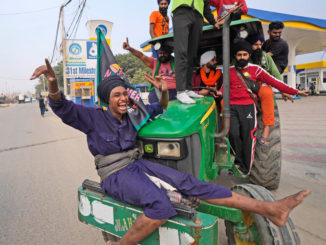
  • Historic victory of the Farming Soldiers on Delhi borders

    Historic victory of the Farming Soldiers on Delhi borders

    By Amarjit Singh Anand

    In 2021, The Almighty One manifested a miracle in the form of Victory for the farmers, when the Indian establishment revoked the 3 black laws.

    All Prophets, Seers, Saints have advised humanity to live in peace and harmony, by refraining from indulgence in tyranny. This agitation had attained such expansive support from all quarters because it is being conducted on the basis of principles, preached and practiced by Divine Guru Nanak Sahib Jee and his nine illustrious successors, over a period of 239 years from 1469 through 1708.Guru Nanak Sahib says: we, humans are unaware whether we would have adequate time to inhale the next breath. Yet, we continue indulging in self-aggrandizement, totally ignorant about this reality.

    “Don’t judge each day by the harvest you reap but by the seeds that you plant”, says Robert Louis Stevenson (1850-1894).

    While the farmers sow seeds in the soil, the ruling elite sowed iron nails on the roads around the nation’s capital. The citizens of Delhi, including the intelligentsia, students, lawyers, homemaker women, shop owners, traders all protested in support for farmers, at the famed Jantar Mantar, which happens to be at a stone’s distance from Gurdwara Bangla Sahib, where the eight-year-old Guru Harkrishan Sahib Jee (the 8th Guru Nanak) served patients during an epidemic 355 years ago. The Gurdwara was built at the venue of a bungalow donated by Raja Jai Singh, a Rajput-royal who was a devoted Sikh of the Divine House of Guru Nanak Sahib Jee.

    *Contemporary version of slavery*.

    When democratically elected governments assume the form of autocratic, dictatorial, totalitarian and tyrannical establishments, then they become more ruthless than invaders and occupant rulers, who arrive from other regions. India had undergone such invasions for over eleven hundred years. Here is a scenario where subjugation is the order of the day, in an undeclared emergency or martial law. Torturous conditions are being heaped upon the peaceful protesting natives, who elected them, instead of fair and just governance based upon the Preamble to the Indian Constitution. The entire system is subverted, to fill the coffers of the chosen corporate elite, at the expense of the farmers. Enactment of the laws was done during the pandemic, when lockdown was made an excuse to avoid convening the Parliamentary session to have a requisite debate and voting in the Lok Sabha (the lower house) and then the mandatory ratification in the Rajya Sabha, the upper house.

    Provocative measures to overpower the agitation started with barricades, soon to be followed by water cannons, tear gas shells, baton charge.

    There was a suicide by a religious leader. One protestor was hit in the head with a bullet, while driving the tractor. He succumbed, instantaneously, and his tractor overturned.

    Internet, water, electricity services were disrupted. Train services were discontinued.  Trenches, nails, barbed wire, iron, steel, concrete were used to build permanent structures as barricades. Police personnel were seen wielding steel rods.

    Bullets have been aimed by the British colonial power, at peaceful gatherings as in Jallianwala Bagh, on the 13th of April 1919, in Sri Amritsar Sahib, Punjab, India.

    Tiananmen Square, China where thousands of protesters fought back human rights violations.

    The farmer’s agitation of 2020 has been, variously, labelled as anti-national and sponsored by Khalistan terrorists and other nations when it had started from Punjab State. Soon after, as it was gathered momentum and support came in thousands from neighboring States, the government dubbed the protest as being ignited by Maoists and Naxalites in India.

    During the worst pandemic lockdown, the same people were seen distributing cooked food, medications, and providing shelter and all kinds of assistance to mitigate suffering of humanity, without discrimination, verily in consonance with the Sacred Tenets enunciated by Divine Guru Nanak Sahibji. Several world governments had gratefully acknowledged these humanitarian endeavors. As a mark of honor and gratitude, in some nations, their national flag fluttered alongside the Nishaan Sahib, the saffron colored religious insignia of the Sikh community.

    The Red Fort was the scene of some disturbance on the 26th of January 2021, when a small group raised the Nishaan Sahib, without touching the Indian Tricolor national flag. Astonishingly, the small group was able to, rather allowed to go atop the ramparts to unfurl the Nishaan Sahib, in the presence of a massive police and para-military forces. At this juncture, it would be pertinent to make a mention of the fact that the army regiment on 24-hour duty was found missing.  Nishaan Sahib was intentionally described as the flag of Khalistan.

    The same Nishaan Sahib is hoisted by the Sikh Regiment of the Indian Army, wherever it is stationed. It was fluttering atop the very same Red Fort, when Victory Day was celebrated in recent years, to rejoice over the conquests over Delhi’s despotic rulers in the bygone era of Mughal rule, before the British colonialists plundered India, in the guise of trading through the East India Company. Allegations and aspersions of funding from neighboring countries, that is being leveled now, were not made when the same people served good during the pandemic, in India and worldwide. Political leaders were not being allowed to make any speech from the rostrum. If and when they visit the various mass gatherings, in areas bordering Delhi, they are asked to sit with the farmers, on the ground, in the audience. In support of the agitation, several opposition parties have boycotted the Presidential-Address, to the joint session of the two houses of Indian Parliament, at the commencement of the budget session.

    Why were the Indian farmers protesting? 

    This is a highly pertinent question, a really significant query, which is pervading the thought-process of the entire world.

    Indian farmers are literally on the road. They should be in their fields, sowing the seeds or irrigating the crops or harvesting the yields, but they have been forced to sit on the roads, bordering Delhi, the nation’s capital, seat of “the powers that be”, in the largest democracy of the world. Before marching upon Delhi’s borders and then camping there, the protestors had been protesting in Punjab, for a couple of months, by blockades of railway tracks and national highways. When their voice went unheard, they moved the epicenter of their agitation, right to Delhi, the heart of their motherland.

    The farmers are in a warzone of sorts, battling it out, “with weapons of words and demands”, of course, protesting against their own elected government, demanding their very legitimate fundamental rights, which have been guaranteed in the Indian Constitution, but which are not being implemented and given to the distressed farmers.

    Most certainly, they can be awarded the rank of “farming soldiers on the interstate borders of Delhi”. 

    However, what started initially as the farmers’ movement, has assumed the form of a people’s protest, with everyone joining the fray. Students and professors, retired defense personnel and bureaucrats, artists and intellectuals, writers and activists, businessmen and traders, workers and transporters, are all standing up, as they realized the impending impact of inflated prices of edibles, upon the entire populace, as the aftermath of the three laws.

    All of the happenings are really an unfortunate and unwarranted situation, especially considering the fact that India has a parliamentary form of government, and the following golden words are enshrined in the Preamble to the Constitution: “Sovereign, Socialist, Secular, Democratic Republic”. This is an unusually dark phase in the history of the Indian polity, post 1947 independent India, when the programs, policies, procedures and decisions of the government are being denounced by the people. The earlier such black-period was the Emergency-Era in 1975 to 1977. And so, the protests, around Delhi, have been ongoing for over one hundred days, now, after the current unrest had commenced in November last year, after the Indian government suddenly announced a decision to issue an ordinance in June 2020 thereby totally overhauling the basic structure of the agricultural sector. This has impacted the entire fabric of the Indian people. Ordinances were passed, at the height of the pandemic lockdown, when the Parliament was not in session. The farmers say the new laws are draconian and are absolutely unacceptable to them and must be revoked, with immediate effect. Soon thereafter, the agitation spread like wildfire, across the entire country, with a few hundred organizations joining the protests and these groups represent not only the farmers but all communities.

    Quite a few leaders of other nations and celebrities and general masses took to the internet, voicing their support in favor of the rightful demands of the farmers.

    Several unions of farmers, in Punjab and Haryana, soon joined the protests at several locations, primarily on the outskirts of Delhi.

    The farmers, numbering hundreds of thousands, brought groceries, clothing and other essentials to last a year, if required. The old and the young, children and ladies, everyone joined the protests, in a spirited and motivated way.

    The epicenter of this protest is Singhu border, on Grand Trunk Road National Highway, connecting Delhi with Punjab and Haryana. The Tikri border is the second focal point of the protest. This is on the border of Delhi with Rohtak and Bahadurgarh areas in the State of Haryana. The third important point is Ghazipur border of Delhi with the State of Uttar Pradesh.

    People’s Power of Peaceful Protest*: An Unprecedented Agitation.

    “No farmer, no food” is the slogan emanating from Punjab India, and soon it started resonating well, deeply and absolutely, with the populace of the entire world. Protests, by Indians, were organized worldwide and outside the New York based headquarters of the United Nations Organization, to register a vociferous opposition to the draconian laws, enacted by the autocratic Indian regime, which is also resorting to atrocious measures and machinations to discredit the agitation.Some world leaders and the public of many nations have castigated the highhandedness of the Union government of India.

    The farmers had started staging their protest in Punjab, in June 2020. Then, in November 2020, the scene of the agitation moved to Delhi, the capital of India, where they were joined by farmers from all across India. Similar agitations are on-going in various Indian States.

    The intelligentsia and the illiterate, the celebrities and the commoners, the affluent and the poverty-stricken, all of whom are lending their vociferous support to the farmers.

    Over eight hundred people have succumbed to the extremities of weather. One religious leader and preacher committed suicide, leaving a note that he was sacrificing his life for the cause of the fundamental right to speech and expression, when democratic norms are thrown to the wind, by an autocratic regime. On the 26th of January, the police shot a farmer in the head, while he was riding a tractor, as part of the peaceful rally in Delhi.

    The farmers, in India, have been undergoing tumultuous times, on account of the massive upheaval, brought about in their livelihoods. People were appalled at the enactment of the draconian laws, by the Indian government. To add salt to the wounds, subsequent actions have been ongoing, in order to crush and denigrate the peaceful agitation.

    On December 4, 2020, a clarion-call was given for a nationwide strike or shutdown. The unity factor amongst the farming community and their supporters became clearly evident, during this momentous event. The farming community constitutes almost sixty percent of India’s population. Various political parties supported the agitation. Labor unionists and business sector, too, came to the forefront of the protest, with the farmers. Although the economy is almost paralyzed, yet the entire country is supporting the farmers.

    From Tractor-Trolleys & Tent-Cities to bricked dwellings. 

    The agitating farmers started building brick-houses, at Singhu border, right on both sides of the highway, where they have been protesting for over a hundred days. This has been necessitated by the impending scorching heat, in Delhi, where the sheltering weather claims many lives, every year. The farmers have, already, tackled the extremities of freezing climes, since November 2020.

    Now, the bedding, clothing and utensils are being moved from the trolleys and tents to the comfort of houses. When they had started camping there, in November, their requirements were different, when they managed to deal with excessive cold, under heated tents. The houses are very much visible and are growing in numbers, along the segment of the Grand Trunk Road, connecting Delhi and Punjab.

    The scenario is changing rapidly, as the farmers, gradually graduated from Tractor-Trolleys & makeshift Tent-Cities towards solid bricked dwellings, enabling them to cope with the summer, looming large on the horizon. To build the houses, masons and building materials, from Punjab. Earlier, in December, they had to shift from their roadside agitation positions to tented facilities, when the need arose for the privacy and safety of womenfolk and children, including some infants and toddlers, all of whom started arriving in great numbers, to support the men.

    Owing to the magnanimity and sense of purpose, displayed by NGOs and social organizations, tents were installed to provide succor to the farmers and their families. This endeavor of the NGOs and some local residents’ cane as a massive relief to the farmers. The insulated tents proved to be a welcome change, offering protection from chilling winter and rain, especially for the old, some partially handicapped people, ladies and children. Alongside providing physical comfort, this measure yielded emotional, psychological and mental relief, safety and security.

    The waterproof tents were set up by NGOs like Khalsa Aid, Hemkunt Foundation and United Sikhs and provided mattresses, blankets and pillows. Khalsa Aid also set up a tented mall, to provide sundry items, all for free. Nearby petrol-pumps (gas-stations) and some hotels provided bathing facilities, clean water for cooking and drinking, and hot-spots to charge mobile phones and laptops.At this juncture, special mention must be made of Delhi Sikh Gurdwara Management Committee, who provided a regular supply of ration commodities, tents, geysers and other items of daily use. The farmers kept their luggage in the tents, went out during the day to join fellow protesting fraternity, rested whenever they wanted, in between, and finally had a peaceful nightly sleep.The tented facility proved to be a real boon, especially for the women, who found a great sense of security and privacy, which were not possible while resting in tractor-trolleys. Not to forget the important protection from mosquitoes. And thus, the agitation continued, in full swing, as the motivated farmers were braving the weather, in addition to various impediments created by the government, including disconnection of basic amenities like water, electricity and internet.

    The farmers were absolutely resolute in attaining their most cherished and clear objective of getting the farming laws repealed. And, to achieve such gains and results, they are willing to overcome all circumstances and bear the brunt of cruel consequences. The evidence of their bravery was seen in the way they faced the police, who resorted to actions like baton-charge, water-cannons and tear-gas shells.

    On the 26th of January 2021, all eyes were glued towards the grand spectacle, to be staged on ‘The Rajpath’ (implying the Pathway to the Seat of Power) in Delhi, where the prowess of the Indian Defense Forces, during the Parade is showcased, in a gesture denoting National Glory & Esteem, while celebrating freedom and also saluting the Warrior-Defenders of the Indian populace and Indian territorial sovereignty. Simultaneously, on the same day, the farmers agitating peacefully, at several locations, on the borders of Delhi, had decided to have their unique Tractor-March, entering the city. For this, they were given an official permission and a definitive route to follow, to which they had expressed compliance.

    Going by several accounts, it would appear that the so-called chaos and anarchy, on the roads of Delhi, was the direct outcome of an orchestrated plan to destroy the agitation. It could not have been the desire or the design of the farming Unions, as they were well aware that such an act would be detrimental and suicidal, for the image and Power of the People’s Peaceful Protest.

    A small group of protestors forced their way, into the historic Red Fort complex,running amuck atop the ramparts, to hoist the ‘Nishaan Sahib’, the Religious-Insignia of the Sikhs, that is visible atop every Gurdwara, around the world.

    They hoisted the ‘Nishaan-Sahib’, at the very spot where the Prime Minister of India unfurls the Tricolor National Flag, every year, on the 15th of August, India’s Independence Day. One Tricolor is always fluttering on another pole. Although this flag was untouched, yet the protestors were charged with desecration of the National Flag. The ‘Nishaan-Sahib’ was deliberately labeled as the ‘Flag of Khalistan’ (an alleged separatist militant movement) even though the entire world is aware of the ‘Nishaan-Sahib’ being the Insignia of the 551-year-old religion, which is the 5th largest, in terms of numbers, and whose adherents reside globally.

    The farmers, who were staging a peaceful protest, throughout since November 2020, were squarely blamed for this scenario and were charged were framed, accordingly. Some minor skirmishes were branded by the authorities, as a “violent action by the farmer-protestors”.

    However, there is immense speculation about the entire episode and several indicators clearly point towards a definitive plan to discredit the agitation. At this juncture, it is worth mentioning how, in the first place, this very small group of protestors could manage to intrude the Fort-arena, right under the nose of the police and para-military forces, especially on a significant occasion,  which is a National Day, the Republic Day of India.

    In fact, since India’s independence, from the yoke of British colonialism, in 1947, the national monument has remained under the control of the Indian Army, protected by military guards. After the Army handed over the heritage site to the Archeological Survey of India (ASI) in 2003, the Red Fort has been under the protection of the Central Industrial Security Force (CISF) and the Central Reserve Police Force (CRPF), which fall directly under the control of the Union government’s Ministry of Home Affairs (MHA). So, the moot query remains “how could and how did a bunch of unarmed folks manage to reach the ramparts of the Red Fort unhindered”?  “Could it be that the security forces actually allowed them in, by extending them the courtesy of a free-passage”?

    Another aspect is quite suspect. To begin with, this group was stopped by Delhi Police, at a point on the designated route and was told to follow another route. This diversion took them straight towards Red Fort.

    Subsequent upon all such high-voltage drama, the farmers’ Unions washed off their hands, from this specific unruly incident, while continuing with the overall agitation.

    Delhi Police initiated a probe into these incidents, while filing first information reports against several protestors.This incident proved to be an utter embarrassment for the farmers’ Unions and hence they had to call off the scheduled protest-march, towards Parliament House, on the 1st of February, the day of the presentation of the union-budget.

    Amongst those who have expressed their support for Indian farmers are American pop star Rihanna and Swedish environmental activist Greta Thunberg.In a tweet to her more than 101 million followers, Rihannawrote: “Why aren’t we talking about this?!”, in reference to a news report about the heavy-handed measures being used against the protesting farmers.Greta wrote: “I still Stand with Farmers and support their peaceful protest. No amount of hate, threats or violations of human rights will ever change that”.Talk show host and actor Lilly Singh tweeted, “Yes! Thank you so much @rihanna. This is a humanity issue! #IStandWithFarmers and this narrative is tired.”Singer Jay Sean wrote on Instagram, “It’s one of the largest protests ever in history and hardly any mainstream coverage. I live in the US, and I’ve barely seen it on the news or mainstream media. I don’t know what needs to be done to raise more awareness and have more eyes on this, but I’ve seen videos that are far too graphic and heartbreaking to post. People that are old enough to be my grandparents being trampled over with no remorse or regard. Pls go to my story where I will post a petition link and something actionable. #istandwithfarmers #farmersprotest.”Vlogger Amanda Cerny posted, “The world is watching. You don’t have to be Indian or Punjabi or South Asian to understand the issue. All you have to do is care about humanity. Always demand freedom of speech, freedom of press, basic human and civil rights-equity and dignity for workers”.Mia Khalifa wrote, “What in the human rights violations is going on?! They cut the internet around New Delhi?! #FarmersProtest.”

    Taapsee Pannu said “If one tweet rattles your unity, one joke rattles your faith or one show rattles your religious belief then it’s you who has to work on strengthening your value system not become ‘propaganda teacher’ for others.”Sonakshi Sinha wrote a long post in her Instagram stories, an excerpt of which read, “The voices raised are about the violation of human rights, suppressions of free internet and expression, state propaganda, hate speech and abuse of power. Journalists are being harassed. Internet has been banned. Protesters are being vilified through state and media propaganda. Hate speech (desh ke gaddaro ko, goli maro sardaro ko resurfaced) is flourishing. THAT is the issue that’s taken global centre stage…. While news and media will have you think that these are outside forces trying to control the functioning of our country, you must remember that these are not alien species but fellow humans who are speaking up for the rights of other humans. To re-iterate, news tonight will try to paint a picture that ‘outside forces’ are trying to meddle in the functioning of our country. Please don’t give in to that narrative. It’s human, standing up for other humans. THAT’S the narrative.”

    Others, from amongst the Indian filmdom, who shared similar posts include Richa Chadha, Shibani Dandekar, Siddharth, Swara Bhasker, Vir Das, Prakash Raj, Abhay Deol, Onir and Arjun Mathur.Singer-actor DiljitDosanjh, addressing the farmers protesting at Delhi’s Singhu border, said, “It is my humble request to the government to listen to the demands of our farmers. I would also request the national media to show that this is a peaceful protest.

    Ugandan climate justice activist Vanessa Nakate also came in support of agitating farmers. Nakate wrote multiple tweets in amplifying the plight of protesting farmers.In one of her tweets, she said: “The people united will never be defeated

    Hollywood star John Cusack, who previously voiced support to anti-CAA protestors in February 2020, retweeted a post by Vanessa Nakate, a Ugandan climate activist, reading, “Let us talk about what is happening in India right now

    Baljit Singh Padam aka rapper DrZeus retweeted Rihanna’s tweet and wrote that “everyone with sense” across the world are wondering about the lack of spotlight on the protests. “World media needs to wake up. #FarmersProtest,” the Indian-origin British singer said.Kamaljit Singh Jhooti, popularly known by his international stage name Jay Sean, took to Instagram and wrote that despite the farmers agitation being one of the largest protests “ever in history”, there has not been enough mainstream coverage of the event.

    American Vice President Kamala Harris’ niece Meena Harris, or climate activist Greta Thunberg — no one was spared by the right-wing trolls. These women have been subjected to slut-shaming and mockery. Their mentions were filled with death threats, abuse, and violent consequences — reiterating, yet again, how internet trolls and misogyny go hand-in-hand.

    Meena Harris, author, attorney and fashion entrepreneur, urged the release of Nodeep Kaur, a 24-year-old activist in India who was detained after being accused of assaulting police officers during the protests. Meena Harris, a Harvard and Stanford-educated lawyer, children’s book author and the founder of the Phenomenal Woman Action Campaign — is an outspoken social media presence whose profile has drastically increased in connection with her aunt, Kamala Harris, US V-P. Meena tweeted in support of the release of Nodeep Kaur, the Indian activist.

    MPs from many countries supported the farmers. “Violence perpetrated by Indian government against farmers peacefully protesting is appalling,” said Jagmeet Singh Canadian popular politician.  UK Leaders Tanmanjeet Singh Dhesi and Preet Kaur Gill from UK, Jagmeet Singh from Canada have come out in support of protesting farmers. The protest by farmers received the support of a number of politicians outside India as well. A number of leaders from United Kingdom, Canada, Australia and the United States expressed their solidarity with farmers and criticized the Modi government’s handling of the protests.

    United Kingdom Labour MP from Slough and Shadow Rail Minister Tanmanjeet Singh Dhesi tweeted: “It takes a special kind of people to feed those ordered to beat and suppress them. I stand with farmers of the Punjab and other parts of India, including our family and friends, who are peacefully protesting against the encroaching privatization of FarmersBill2020.”Quote tweeting Dhesi, another Labour MP, John McDonnell from Hayes and Harlington, wrote “I agree with TanDhesi. This sort of oppressive behavior against peaceful protesters is unacceptable and tarnishes the reputation of India”.

    Labour MP from Birmingham Edgbaston and Shadow Secretary for International Development Preet Kaur Gill tweeted, “Shocking scenes from Delhi. Farmers are peacefully protesting over controversial bills that will impact their livelihoods. Water cannons, and tear gas, are being used to silence them. This is no way to treat citizens who are peacefully protesting over the controversial Farmers Bill in India”.

    In Canada, the support has come mainly from the New Democratic Party led by Jagmeet Singh.Leader, New Democratic Party, tweeted:”The violence perpetrated by the Indian govt against farmers peacefully protesting is appalling. I stand in solidarity w/ the farmers from Punjab and across India – and I call on the Indian govt to engage in peaceful dialogue rather than violence.” Jack Harris, MP from St John’s East. Harris tweeted: “We are shocked to see the Indian government’s suppression of farmers protesting new laws which will endanger their livelihood. Instead of using water cannons and tear gas, the Indian government needs to engage in open dialogue with farmers”. Leader of Opposition in the Ontario Assembly, Andrea Horwath tweeted:

    “I stand with Farmers in India who are protesting peacefully, as well as their loved ones here in Ontario, who are watching the violent crackdown in horror. Everyone deserves to be able to exercise their democratic rights without fear of state-sanctioned violence.”

    Gurratan Singh, who represents Brampton East in the Ontario provincial parliament even spoke about the farmers’ protest in the House.

    “Farmers are under attack in India…That’s why I’m asking this house to stand with farmers against these unjust laws by the Indian government”.

    Kevin Yarde, Member of provincial parliament from Brampton North tweeted:

    “Treatment of Punjab Farmers is terrible. They are protesting bills that will impact the lives of so many. Farmers are the backbone of the Punjab they deserve to be treated with dignity. Indian government needs to engage in dialogue with farmers

    MPP from Brampton Centre Sara Singh tweeted: As the granddaughter of a farmer from Punjab, as they fight to protect their livelihoods & protest harmful legislation. These scenes are deeply concerning. Everyone deserves to be able to exercise their democratic rights without fear of state-sanctioned violence.

    In Australia, it was Rob Mitchell, Labour MP from McEwen in Victoria, who spoke in the country’s Parliament in support of Punjabi farmers. He said:

    “I join many in our community who are disturbed at the treatment of Punjabi farmers in India and those who fear for their safety while peacefully protesting. I urge the Indian government to show restraint while dealing with protesters.”

    US Republican Party official Harmeet K Dhillon wrote “As the Punjab-born descendant of farmers, my heart breaks to see Punjabi farmers assaulted for protesting Indian govt’s pro-big-corporation farm bill that will destroy their farms, way of life, and culture. Hear them, meet with them, & compromise, P.M. Modi. And for the peanut gallery, I have relatives who farm the land in Punjab. I’m confident they know what’s best for them and don’t need to be told that by central government bean-counters. At a minimum, in the vaunted democracy of India, they have a right to protest & be heard”.

    Really commendable are the initiatives of US Senators Charles Schumer and Robert Menendez writing to US Secretary of State Antony Blinken and US Congressman Andrew Garbarino’s letter to Taranjit Singh Sandhu, Indian Ambassador to the U.S. The People’s Power of Peaceful Protest has been reinforced through an unprecedented agitation of such immense magnitude. This was a momentous chapter in the history of protests, worldwide, whereby democratic norms are being re-emphasized by the farming community in India.

    (The author is a thinker and writer. He is a regular contributor to The Indian Panorama)  

  • COVID-19 Vaccine Booster Drive in NJ: 250 Received Vaccination

    COVID-19 Vaccine Booster Drive in NJ: 250 Received Vaccination

    BRUNSWICK, NJ (TIP): Indian Health Camp of New Jersey (IHCNJ) continues to provide support in the communities during the Pandemic.  Legacy Pharmacy Group, Marlboro Medical Arts Pharmacy, NJ State Department of Health and Doc Go in collaboration with IHCNJ, Shree Swaminarayan Temple in South Brunswick and Ved Mandir in Milltown, NJ held two COVID-19 Vaccine Booster drives on December 18, 2021; More than 250 received the vaccination:

    Indian Health Camp of New Jersey – IHCNJ, a non-profit organization under tax exempt code 501© (3) organized COVID-19 Booster Vaccine drives at Shree Swaminarayan Temple in South Brunswick and Ved Mandir in Milltown, NJ on December 18, 2021.  More than 250 people received booster dose of Moderna and Pfizer vaccinations offered by Legacy Pharmacy Group – Marlboro Medical Arts Pharmacy, New Jersey State Department of Health and Doc Go in collaboration with local temples in New Jersey and Indian Health Camp of New Jersey.  Both temple management and their volunteers provided their support and services to this worthy cause.  During this unprecedented time of public health crisis due to COVID-19 pandemic which affected millions of Americans and more than 800,000 people succumbed to the illness in the USA.  Indian Health Camp of New Jersey continued to provide their humanitarian and health care services in the community since the beginning of the pandemic in early 2020.

    Ritesh Shah, owner of four independent pharmacies in Central Jersey and CEO of Legacy Pharmacy Group, a group purchasing organization for independent pharmacies has been practicing pharmacy in New Jersey for more than 20 years. When COVID-19 hit the U.S. in 2020, Mr. Shah and his team began setting up testing stations in their pharmacies and other locations in the communities.   A long-time public health advocate, Shah has relationships with NJ State Health Department officials and lawmakers and spends a good deal of his time educating them about the needs of his patients.  In October 2020, Mr. Shah received a commendation from the Governor of New Jersey, a state Senator and the General Assembly for his efforts in helping educate the public, testing for COVID-19 and helping prevent the spread of the disease.  Indian Health Camp of New Jersey was recognized by Governor Phil Murphy with New Jersey State Governor’s Jefferson Awards for the 2021 in the Health Care Services Category in recognition of their extraordinary health care services to the community.

    IHCNJ has been serving communities by organizing many activities virtually to include online interviews on TV and radio to provided education via articles and social media platforms related to current topics of COVID-19, mental health and other chronic diseases education and awareness as part of their health promotion and disease prevention objectives.  In addition, the organization also donated personal protective equipment such as gloves and masks earlier in 2020 when there was severe shortage and scarcity at the local hospitals in New Jersey.  The donations were graciously accepted by Robert Wood Johnson University Hospital in Somerset and Saint Peter’s Medical Center in New Brunswick.  As part of community outreach and efforts for healthier living, Indian Health Camp of New Jersey also provided free COVID-19 FDA authorized antigen and antibody testing to hundreds of people in collaboration with Hematology & Oncology Care, Helping Hearts Foundation and Durham Pharmacy earlier in 2021.

    For additional information about IHCNJ services during the pandemic or any assistance in getting the vaccine or testing, call Dr. Tushar Patel at 848-391-0499, e-mail tpatel434@yahoo.com or visit organization website at www.IHCNJ.org.

    (Based on a press release)