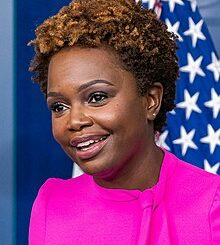
WASHINGTON, D.C. (TIP): India played an essential role in negotiating the Bali Declaration of the just concluded G-20 Summit in Indonesia, the White House said on Friday and applauded Prime Minister Narendra Modi for saying that today’s era must not be of war. “India played an essential role in negotiating the summit’s declaration. Prime Minister Modi made clear today’s era must not be of war,” White House Press Secretary Karine Jean-Pierre told reporters at her daily news conference.
“Among other priorities addressed, we have a path forward to addressing current food and energy security challenges while continuing our efforts to build a resilient global economy,” she said. US President Joe Biden returned from Indonesia on Thursday after attending the G-20 Summit in Bali. India takes over the presidency of G-20 in December, which all its members and international community say would be an important milestone in the history of the grouping. “Prime Minister Modi’s relationship was critical to this outcome, and we look forward to supporting India’s G-20 presidency next year. We look forward to that next meeting,” Jean-Pierre said. She said Biden spoke with Modi and the Indonesian president on the margins of the summit.
WASHINGTON, D.C. (TIP): In the history of India-US ties, 2022 has been a huge year and the next year will be even bigger, a top White House official has said, asserting that the Biden administration sees this alliance as among the most consequential relationships for America anywhere in the world.
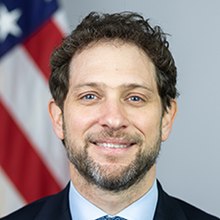
Principal Deputy National Security Advisor Jon Finer also applauded Prime Minister Narendra Modi for being instrumental in forging a consensus during the recently concluded G-20 Summit in Indonesia’s Bali province.
“Looking around the world when the United States and (its) President (Joe) Biden look for partners that can truly help carry the load, truly helped move forward a global agenda, India and Prime Minister Modi are very high on that list,” Finer told a gathering of several hundred Indian-Americans here on Sunday.
“We just saw this in real-time at the G-20 where the prime minister was instrumental in forging a consensus around a joint statement among a far-flung group of countries and in the comments and work that the prime minister has done and others in the Indian government have done to highlight the increasing risk related to nuclear issues,” he said. This relationship is being steered by Prime Minister Modi and President Biden who have met more than 15 times, the latest one being in Bali last week, said India’s Ambassador to the US Taranjit Singh Sandhu, addressing the gathering at a lunch reception hosted by him to celebrate the ‘Festival Season’. The unique event organized by the Embassy of India showcased the syncretic nature of Indian culture. The event saw festivals of different faiths – from Diwali to Hanukkah, Eid to Bodhi day, and from Gurpurab to Christmas celebrated with aplomb.
Attended by top officials of the Biden administration, including Senior Advisor to the President Neera Tanden and Surgeon General Dr Vivek Murthy, the event demonstrated amply India’s unique stature as the embodiment of ‘Unity in Diversity’ – a land where various faiths have not only coexisted but flourished.
“This event really demonstrates so much about what President Biden is talking about when he talks about an inclusive country, a country that celebrates our diversity and our strength in diversity,” Tanden said. “I’m grateful for this partnership between the United States and India. I think it has been important in the past, but it will be even more important going forward,” Murthy said.
Reflecting on his views on the India-US relationship, Finer reiterated the administration’s commitment to it and said 2022 and 2023 are two critical years for this. “The year 2022 was huge in US-India relations. We think we have an even bigger year ahead in 2023. We have the Quad summit on the agenda coming up. We have India’s G20 presidency, which I know we’re all looking forward to, including Prime Minister Modi,” Finer said in his address.
He referred to the 2+2 Quad ministerial meetings taking place this spring, the relaunch of Indi US CEO dialogue and launch of critical and emerging technology dialogue early in 2023.
“That’s just the tip of the iceberg,” Finer said, adding that both 2022 and 2023 are emblematic of how this relationship has proceeded for decades now.
The entire Biden administration and certainly the president sees this as among the most consequential relationships for the US anywhere in the world, but also almost uniquely one of the relationships that still retains some of the greatest potential to continue to evolve and strengthen and improve, Finer said.
“We are deeply committed to doing just that. It’s easy to see why that is the case. At a time that can be extremely difficult to forge a bipartisan consensus in Washington on almost anything, there is a strong bipartisan consensus in support of the US-India relationship and has been for decades and a high degree of continuity from one administration to the next,” he said. “There is obviously an increasing alignment of our interests, both geopolitically and as two world-leading democracies. And then, of course, the deep ties and incredible dynamism of our diaspora community, our cultural ties or commercial ties. “And then finally, and I don’t want this to be lost, there are the ties of our leadership, which we consider to be hugely important,” he said. Among those who attended the event included an array of important dignitaries, with friends of India from the administration, the US Congress, from different states, the think-tank community, private sector organizations, and the Indian diaspora.
Notable attendees included Special Presidential Coordinator Amos Hochstein and Lieutenant Governor-Elect of Maryland Aruna Miller.
WASHINGTON, D.C. (TIP): The Biden administration is committed to getting Eric Garcetti as the US envoy to New Delhi, the White House has said, hoping that the Senate will confirm his nomination soon. “India is a very important relationship that we have. You saw the President (Biden) greet and meet very briefly with Prime Minister (Narendra) Modi just last week when he was in Bali. So clearly, it’s an important relationship that we truly respect,” White House Press Secretary Karine Jean-Pierre told reporters here on Monday. She exuded confidence that the presidential nominee for the US Ambassador to India, Garcetti, would be soon confirmed by the Senate. The nomination has been pending before the upper chamber of the US Congress for more than a year now. “As for Mayor Garcetti, we are committed to getting him through the process. We’re continuing to talk to the Senate about making that happen. That is a priority of ours,” Jean-Pierre said. In July 2021, US President Biden nominated Los Angeles Mayor Garcetti as his Ambassador to India.
But the Senate confirmation of Garcetti has been pending for more than a year now. His nomination was initially blocked by Republican Senator Chuck Grassley because of allegations of inappropriate behavior by one of his senior staffers. Though the hold on his nomination has been lifted, the ruling Democrats are reluctant to bring his nomination for confirmation before the full Senate as they think they don’t have enough votes for it. Earlier this month, the White House had exuded confidence that Garcetti would be confirmed by the Senate.
Kyiv (TIP): About 70 per cent of the Ukrainian capital was left without power, Kyiv’s mayor said on November 24, a day after Moscow unleashed yet another devastating missile and drone barrage on Ukraine’s energy infrastructure.
Ukraine’s energy minister Herman Haluschenko said three out of four nuclear power stations that are fully functioning and which had been forced offline by Wednesday’s strikes were subsequently reconnected to the grid.
“In the next few hours, we will start supplying energy to critical infrastructure, and then to the majority of household consumers,” Lunin said on Telegram, noting that power has already been restored for 15,500 people and 1,500 legal entities in the region.
Wednesday’s renewed Russian attack on Ukrainian infrastructure caused power outages across large parts of the country, further hobbling Ukraine’s already battered power network and adding to the misery for civilians as temperatures plunge. Ukraine’s General Staff reported on Thursday morning that Russian forces fired 67 cruise missiles and 10 drones during Wednesday’s “massive attack on residential buildings and energy infrastructure” in Kyiv and several other regions in Ukraine.
Governor of the Poltava region DmytroLunin said “an optimistic scenario” suggested that electricity will come back to residents of his central Ukrainian region on Thursday.
Lunin added that water supplies resumed in several parts of the city of Poltava, and four boiler stations have started to heat regional hospitals across the country.
In the Dnipropetrovsk region, power has been restored for up to 50 per cent of consumers, GovValentynReznichenko said, but noted that “the power situation is complicated.” — AP
Brasilia (TIP): Brazilian President Jair Bolsonaro has challenged his electoral defeat last month to leftist rival Luiz Inacio Lula da Silva, according to a complaint filed with the country’s federal electoral court (TSE) that alleges votes from certain electronic voting machines should be “invalidated.”
Bolsonaro’s claim seems unlikely to get far, as Lula’s victory has been ratified by the TSE and acknowledged by Brazil’s leading politicians and international allies. But it could fuel a small but committed protest movement that has so far refused to accept the result. Bolsonaro’s right-wing electoral coalition, which filed the complaint, said its audit of the vote count had found “signs of irreparable… malfunction” in older voting machines.
“There were signs of serious failures that generate uncertainties and make it impossible to validate the results generated” in several older models of the voting machines, Bolsonaro allies said in their complaint. As a result, they urged that the votes from those models should be “invalidated.” Bolsonaro, a far-right former army captain, has for years made baseless claims that the country’s electronic voting system is liable to fraud, without providing substantiating evidence.
Brazil’s currency deepened losses after news of the electoral complaint, losing 1.5% against the U.S. dollar in afternoon trading.
The TSE did not immediately respond to a request for comment. Reuters
Colombo (TIP): Sri Lankan President RanilWickremesinghe on November 23 rejected the opposition’s demand for early parliamentary elections and vowed to use the military to crush any future anti-government protests aimed at regime change. Wickremesinghe, 73, who took over as the President of Sri Lanka in July this year after then-president Gotabaya Rajapaksa fled Colombo in the face of the country’s worst economic crisis since 1948, said that he will not dissolve the parliament until the economic crisis is resolved.
“I will not dissolve parliament early until the economic crisis can be resolved,” he said while speaking in Parliament.
Wickremesinghe has a mandate to serve out the rest of Rajapaksa’s term, which ends in November 2024. However, the opposition parties are demanding early parliamentary elections, claiming that Wickremesinghe’s government lacks electoral credibility. The next presidential election is scheduled to be held in 2024.
The president said a radical political party named Frontline Socialist Party was behind the protests for their political benefits. — PTI
Kathmandu (TIP): Nepal Airlines Corporation, the Himalayan nation’s flag carrier, has urged the civil aviation authority to drop its unilateral decision to cut the number of flights on the lucrative Kathmandu-Delhi sector from 14 to 10 per week for not utilising the newly-opened Gautam Buddha International Airport.
In a statement on November 22, Nepal Airlines Corporation (NAC) said that its income has been sliced and it is having to bear the additional cost of rerouting passengers after the Civil Aviation Authority of Nepal (CAAN) slashed the number of flights to Delhi from the Tribhuvan International Airport (TIA), Nepal’s first international airport here. The authority reduced the number of flights to Delhi from TIA to 10 from 14 per week from October 30. The Gautam Buddha International Airport is 300 km west of Kathmandu, the country’s capital. The reduction of four flights per week during the peak season has caused a weekly loss of around Rs 90.5 million to the national flag carrier, The Himalayan Times newspaper reported, quoting an NAC official. “We’d been operating two Kathmandu-Delhi flights per day at near full occupancy, which was one of the major income sources for NAC,” the official said.(PTI)
In spite of the presence of committed young leaders in the Congress, the party’s overall image is that of a jaded force. It may be rooted in Gujarat, but it lost its credibility after defections from its ranks on many seats. Except for some individually wealthy candidates, the party is also stretched for resources and even the rally of Rahul Gandhi, held on November 21 in a tribal pocket of Gujarat, was organized on a modest scale.
By Saba Naqvi
The hegemony of the BJP is all too visible in travels across Gujarat, not because all people are deliriously happy with the uninterrupted 27-year reign of the party; some indeed are die-hard fans of what can be called ‘Moditva’, which combines personality worship of the Prime Minister with regional and Hindutva pride. But there are also many among the Adivasis, Dalits and Muslims and a section of the urban working class who are distressed by price rise, unemployment and poor public infrastructure in education and health. They could stay with the Congress, the traditional opposition, or explore the Aam Aadmi Party (AAP) the second time. Yet, scratch beneath the surface and they too believe that neither opposition party is in a position to eventually defeat the BJP. Therein lies the rub for when people do not believe that there can be a change through the electoral process, what we get is a relatively dull election in Gujarat. Never mind the razzmatazz of the many rallies of the PM: he is out there campaigning because he would know there is a certain ennui among the electorate and the huge cadre mobilization is designed to change that, add an edge to the process, and bring voters to the polling booth.
It is a particularly flat election compared to the last contest in 2017, when the Patidar agitation, led by Hardik Patel, had made a strong impact and resulted in the worst-ever performance of the BJP, which got just 99 seats in a House of 182 (more were added later through defections from the Congress, but that is now a routine story). Many observers believe that the Congress could have won that election, had it not been for some last-minute reversals in the Surat belt. Since then, Hardik Patel has become a spent force who lamely joined the very BJP he abused day and night. Ahmed Patel, long-time Congress treasurer and financier of all campaigns in Gujarat, has passed away and there is none among the traditional state leadership who can do anything beyond attempting to maintain the status quo. Still, it’s not as if there are no exciting young figures in the Congress. There is 42-year-old MLA Anant Patel (an Adivasi Patel), who led a strong protest against the Par-Tapi-Narmada river-linking project in tribal areas outside Surat and compelled the Narendra Modi-led Central Government to withdraw it for now. Union Finance Minister Nirmala Sitharaman had announced the project in her Budget speech and instantly a protest erupted in the tribal pockets of south Gujarat along the Narmada and Tapi rivers. The Congress was at the forefront of those protests and has its hopes pinned on doing well in the Adivasi belt.
Also, there is 41-year-old Jignesh Mevani, a Dalit politician, contesting this time on the Congress ticket from his constituency Vadgam in Banaskantha district of north Gujarat. He had won the seat in 2017 as an Independent, but given the huge machinery that the BJP is unleashing against him, it is a David versus Goliath contest in which Mevani is short of resources. So much so that he has started a crowd-funding initiative to finance his campaign and can be seen poring over every bill in the midst of electioneering. An advocate of land reforms and labor rights, he runs platforms and agitations for the Dalit community and was prominent in the protest against the public flogging of Dalits at Una, Gujarat, in 2016. A former journalist, was arrested by the Assam police in April for a tweet criticizing the PM. In spite of the presence of committed young leaders in the Congress, the party’s overall image is that of a jaded force. It may be rooted in Gujarat, but it lost its credibility after defections from its ranks on many seats. Except for some individually wealthy candidates, the party is also stretched for resources and even the rally of Rahul Gandhi, held on November 21 in a tribal pocket of Gujarat, was organized on a modest scale. What the Congress is spending is peanuts, grown in abundance in Gujarat, compared to the BJP in an age when the wealthiest businessmen of India are from Gujarat (there is a road in Ahmedabad referred to as Billionaire Street).
The AAP, meanwhile, has the energy and audacity that the Congress is missing in this campaign. Party leader Arvind Kejriwal has set the agenda, but AAP does not have the necessary organizational base to make a mark in many parts of Gujarat. Meanwhile, conventional wisdom says that the young party could cut into the Congress’ vote share. But if it does well in Surat, where it is visibly in the contest, it would also be damaging the BJP that dominates the city and indeed all urban centers in the nation’s most urbanized state.
Congress candidates admit that there is public interest in AAP and it’s hard to predict how much impact the new party will eventually have in the election. A visit to an AAP office, however, also reveals the troubles confronting the party: as the countdown to the voting day begins, some volunteers have vanished due to pressures from family, community and fear of reprisal. The starkest example of this was the ‘disappearance’ of AAP candidate from Surat East, Kanchan Jariwala, who later turned up to withdraw his nomination at the last minute.
The AAP actually remains the X-factor in this election as traditional parameters cannot be applied to it. Will it crash or singe other players remains to be seen. What can be said about this election in Gujarat is that if there is an undercurrent against the BJP, it is muted, while the supporters and cadre of the ruling party are emphatic about their faith in Prime Minister Modi in an age of Gujarati ascendancy.
SAARC. Flags of memebers of South Asian Association for Regional Cooperation and symbol. 3d illustrationBy Prabhjot Singh
If South Asia in general and India in particular are hawking world attention, it is primarily because of an intense power competition involving the US, Russia, China and India. India’s ascend to the Presidency of the G20, the US-China rivalry, and an intense competition between India and China are some of the factors that make the Indian Ocean region a significant arena that would control world politics in the years to come. If the recent events, including holding of Conferences of Interpol, No Money for Terror, and COP 27 are any indication, it is an opportunity for India to make a concerted push for the global south.
The Russian-Ukraine conflict has been a major contributing factor in catapulting India on podium with the global leaders even while Beijing is continuing to increase its presence and influence in almost every South Asian country. As the emerging power equation in the Indian Ocean region was nakedly apparent at the just concluded G20 summit in Bali, Chinese President Xi Jinping had extended his sojourn forward with an Asian trip for deepening his country’s economic patronage in the region. As a sequel, the emerging power rivalries are likely to impact the regionsubstantially, both in terms of risks and opportunities.
The long-standing China-India rivalry may turn out to be a crucial factor to determine the balance of power in the region, especially after developments that unfolded in Sri Lanka and Pakistan this year. This and China-US rivalrycould also influence the extent to which these economic powers choose to cooperate or compete with each other. It will be equally important whether they collaborate with other major powers—regionally and globally, including in international institutions or interest-based coalitions – or confront them. Other major powers, including Japan, Russia and the European Union, that have existing strategic or economic equities in the region, or, in some cases, their stand on China’s rising influence and diktat —will also be crucial for its overall stability of the region. Every power has to watch its interests while managing its rivals. A new power play is in the offing with the smaller States looking up to bigger brothers for both political and economic immunity. Needless to reiterate, the changing dynamics will shape the future geopolitical landscape of the region.
Since Russia’s invasion of Ukraine resonates at every major political forum, G20 summit has been no different. G20 is a diverse group of nations of varying economies at different stages of development. Most of the member nations want this conflict to be resolved through dialogue. Other than India, no other South Asian nation, including Pakistan, Sri Lanka, Afghanistan or Bangladesh, with internal turmoil in hand, had shown any significant interest in resolving this conflict. Some of the G20 nations were, however, appalled by those that lecture others on diplomatic resolution but continue themselves to add fuel to the fire. Apparently, everyone is opposed to war.
The fact remains that hostilities are not abating. Prime Minister Joko Widodo of Indonesia was more than justified in his observation that the discussion on the conflict was the “most contentious” at the summit. Russian President Vladimir Putin did not attend. Instead,he sent Foreign Minister Sergei Lavrov in his place, who lashed out at the assembly for politicizing the war. Prime Minister Narendra Modi — whose advice to President Putin in September that “this is not the era of war” is said to have played a role in hammering out the joint declaration at the end of the Bali summit. It did underline the challenges India will face during its presidency: Geopolitical tensions, economic slowdown, rising food and energy prices, and the long-term ill-effects of the pandemic being the major ones. Modi stressed that peace and development were essential for people to reap the fruit of economic development. He promised that India’s leadership of the G20 will be “inclusive, ambitious, decisive, and action-oriented”, hinting that Delhi was planning to push a global campaign for a sustainable lifestyle, LiFE (Lifestyle for Environment). The theme of India’s G-20 chairmanship, as announced earlier this month, is “One Earth, One Family, One Future”. It looks India is reinventing its role as leader of non-aligned.
For India, this is an opportunity to make a concerted push for the global south. A debt crisis haunts many middle income economies. Both Sri Lanka and Pakistan were going through their worst phases both on economic and political fronts. They are both financially wrecked as their foreign reserves are exhausted. They have little or no money for fresh imports, including food. Crises led to fighting on streets, including invasion of President’s Palace in Colombo and assassination bid on former Prime Minister Imran Khan of Pakistan.
In addition, Climate change, and finding the money to make the “clean” transition, is another challenge. Pakistan faced fury of unprecedented floods as the world continues to be peeved by drastic climate changes. This is an opportunity for India to make a mark as a global leader. All eyes will be focused on Delhi. It has an important task on hand that requires it to avoid the temptation to turn its G20 presidency into a gimmicky year-long “festival of India” in the run-up to the 2024 general elections.
The outcome of the present intricate rivalries will have implications beyond South Asia and the Indian Ocean—for regional stability and security in the Indo-Pacific and for the global balance of power.
It is why this region has Joe Biden administration’s interest and attention. It will require new alignments mandating collaborations with allies and partners while competing with rivals to protect U.S. interests, grappling with the risk of conflict, and, if possible, exploring cooperation with China. Realizing the changing geopolitical scenario, Singapore’sdefense minister Ng Eng Hen was forthright when he said his country wanted India to play a bigger role in the South China Sea. Similar views have been expressed by the leaders of Vietnam and the Philippines.
Putting confidence in India by the leaders of Southeast Asia to secure the region’s security affairs is a significant development. It virtually indicates India’s emergence as a great power in Southeast Asia, and by extension, in Asia itself. The significance of Southeast Asia lies in the fact that this crucial strategic region connects the Indian and the Pacific Oceans, and includes some of the most important maritime chokepoints. Further it may be the site of order-making in Asia in the context of the rise of China. Therefore, India’s emergence as an undisputed power in Southeast Asia is significant. There could be many factors responsible for it. The foremost of these is cordiality on the territorial front where there are no territorial disputes between India and its immediate neighbors in Southeast Asia. In the Southeast Asian region, India has a land border with only one country, Myanmar, which was fixed by their British colonial rulers in 1937. It has maritime borders with three Southeast Asian states: Myanmar, Thailand, and Indonesia. India’s maritime boundaries with Thailand and Indonesia were fixed through a trilateral agreement in 1978, while India’s maritime boundary with Myanmar was finalized in 1987. The situation, however, continues to remain unaltered and sensitive in the South Asian region where Pakistan continues to raise the Kashmir issue at every possible forum.
Looking at South Asia today, one tends to agree somewhat with former National Security Advisor Shivashankar Menon, as he talks of a paradox, saying: “Many of our countries are in economic difficulty and face political uncertainty; and yet, to my mind, we have a moment of geopolitical and economic opportunity. “Many describe our present condition as a crisis. Five governments changed in south Asia in the last year and a half—not all of them in an orderly, willing or predictable manner. Three of our countries are in the advanced stages of working out solutions to their debt crises with the IMF and international community, and more may have to seek help. “Our economies are reeling from the global economic slowdown and the real prospect of recession in major economies, from the fall in remittances and tourism earnings caused by the pandemic, from volatility in commodity prices, and a decline in export earnings. “This is not unique to south Asia. We are not alone in our economic troubles. The IMF says that 53 developing countries are at grave risk of debt crises. What makes this truly worrying is the fact that we have seen this coming for years but still nothing meaningful has been done about it.
Judging by the response, or lack of it, that the international community mounted in the last decade to the Covid pandemic, the developing country debt crisis, climate change, and other transnational problems, I think we can safely say that we should have low or no expectations from the international order.
“We cannot look to the world for answers or solutions to our present problems. Besides, the prospects for the world economy are also not good with growth forecasts being steadily revised downward and the real possibility of a recession in the US and Western Europe and a considerable slowdown in China. “Politics is in command of economic decisions in all these countries, both internally and externally, unlike the globalization decades after the Cold War. “If this is how I see the situation, how can I say that we may have a moment of geopolitical and economic opportunity?” says Shivashankar Menon. He has his viewpoint. Developments in South Asia have been rapid and more or less on expected lines.
Since a lot of action has been taking place here, South Asia has become the center of global geopolitics. Developments in Afghanistan, Pakistan and Sri Lanka are far too obvious. They put India on active alert as problematic neighborhoods are not what it needs. Instead, it needs to play a role and use the developments as an opportunity to stay a leader in the new world order.
Tormented by Covid 19 pandemic and rapid globalization have greatly influenced the world economy and global politics. Emerging economies are all in trouble and changing. The trouble spots are on the rise and resources are drying up. Terror has been raising its head. And intriguingly, the economies tottering to the brink face accusations of abetting terror. These could be diversionary tactics for those abetting it but are devastating for the rest. The writing is on the wall for everyone as the power rivalry is getting intensified. The troubled zones are swelling in size and threaten world peace. South Asia has more hot spots than any other region elsewhere. Trouble-torn nations make the region more vulnerable as they are gasping for breath. Global politics are more fraught than they have been for a long time, with power rivalries becoming intense and alarming.
It is the time for India to shed its role as a mute spectator to developments in its immediate periphery and elsewhere and become more proactive. South Asia now has the leverage to make the sub-region an object of outside great power interest for its rivalry and contention. Nepal has just completed its elections to elect a new Parliament. Its destiny, both as part of BRI and the free and open Indo-Pacific strategy, needs a close watch. This great power rivalry also creates an opportunity. One cannot ignore or overlook that in the decade before Covid direct foreign investment in South Asia, particularly from China, grew in proportion to how acute their contention was as great power relations deteriorated. Of late, international organizations are not only losing their significance but are becoming ineffective. World powers are trying to score a point with their direct economic interventions. Great power rivalry has assumed new disturbing and telling proportions. Covid 19 pandemic witnessed greater dependence on big brothers as multilateral organizations and international institutions got pushed to side lines.
The global powers have been successfullyscoring debating points and gaining political advantage rather than dealing with the humanitarian crisis caused by COVID-19.
If South Asia is at the center stage of global politics, it is because of the change in the center of gravity of economic and political activity. South Asia, from geopolitical backwaters, has now become an integral part of the global economy. All South Asian economies are now integrated into the global economy. It is this integration that brings both problems and opportunities for South Asia. The figures show that South Asia did well from the globalization decades: Countries like Bangladesh did best, improving their economic condition and the welfare of their people. Both our present economic crisis and our geopolitical opportunity are proof that South Asia is now an integral part of a globalized world though some problems of the region may be attributed to globalization. Then there is no going back. South Asia needs to enhance its regional connectivity and cooperation, improve its dealings with the rest of the world, and create new opportunities for its growing clout. Supply and value lines, too, need to be supported and supplemented.
Qamar Javed Bajwa, in his last address as Pakistan’s army chief, had an embarrassing task to perform. He was forced to defend the country’s most powerful institution, which has historically played an outsized role in domestic politics and foreign policy. Facing a wave of criticism, particularly from former Prime Minister Imran Khan who has accused the army of a role in his removal in April, the outgoing General admitted that the army had unlawfully meddled in politics for decades and will no longer do so. The catharsis has started, claimed the 62-year-old who has been at the helm since 2016. The duplicity came through moments later as he warned the political parties that there were limits to the army’s patience. The more things change, the more they stay the same in Pakistan.
The appointment of Bajwa’s successor is being seen as a major subplot in the political crisis engulfing the country. Prime Minister Shehbaz Sharif named former spy head Asim Munir as the army chief, and Sahir Shamshad Mirza as Chairman of the Joint Chiefs of Staff Committee. Munir’s appointment as army chief was approved by President Arif Alvi, who belongs to Khan’s party. The seniormost officer after Bajwa, his elevation signals a setback for the former premier as it could be a possible obstacle to Khan’s attempts to force early elections. Munir headed the Inter-Services Intelligence when India-Pakistan tensions escalated following the Pulwama attack in February 2019. His eight-month stint as the top intelligence officer was the shortest-ever as he was replaced on the insistence of Khan. Bajwa, in his farewell tours, is also seeking to rewrite the history of the 1971 war, the latest in a slew of stupefying attempts by the Pakistan army to cover up its genocide and defeat in Bangladesh. He has termed the surrender a political and not a military failure. An estimated 93,000 Pakistani soldiers were taken prisoners of war. Bajwa says only 34,000 were fighting soldiers. Coming from the army chief, it’s embarrassing. What can be worse than a country disowning its soldiers?
Transparent selection a must for constitutional posts
The Supreme Court has expressed concern over the absence of a law governing the appointments of the Chief Election Commissioner (CEC) and Election Commissioners. It has also red-flagged the ‘disturbing trend’ of the CEC being handicapped by a truncated tenure over the past two decades or so. During the UPA’s 10-year rule, there were six CECs; eight have already served after the NDA took charge in 2014. The Constitution’s Article 324, which pertains to the Election Commission (EC) and its top brass, does not mention any criterion for the appointment of these officers; nor does it spell out the conditions of their service. It’s the Election Commission (Conditions of Service of Election Commissioners and Transaction of Business) Act, enacted in 1991, which clearly states that the CEC or an Election Commissioner shall hold office for a term of six years (or till he/she attains the age of 65 years). However, successive governments at the Centre have had no qualms about picking a new incumbent every year or two. After TN Seshan — who was the CEC from 1990 to 1996 — no officer has served a full term.
The apex court has also stressed the need for a ‘fair and transparent mechanism’ so that the ‘best man’ is appointed as the CEC. It has stated that the CEC should be capable of taking action even against the Prime Minister. However, with opacity dominating the appointments, it’s no wonder that the Centre has opposed petitions seeking a collegium-like system for the selection of CECs and Election Commissioners.
It requires political will to take a cue from the American system, where public hearings are held over the nomination of judges of the Supreme Court and other officers. The US President’s power to make major appointments is conditionally bound by the ‘advice and consent’ of the Senate. An important exercise such as appointing the CEC and his subordinates should not be left to the whims and fancies of the executive. The arbitrary selection process, which is eroding the sanctity of these constitutional posts, must be discontinued as it poses a grave threat to India’s democratic setup.
At Ganesh Vandana. Seen among others are Padma Bhushan DR Mehta, Prem Bhandari, CJI Randhir Jaiswal, KK Mehta.D R Mehta giving award and flowers to Dr Subha Jain on behalf of Dr Vijay Arya Deep Chopra, BOD RANA, and her son.Prem Bhandari giving flowers to LP Pant, national head, Dainik Bhaskar.Consul General of India, New York, Randhir Jaiswal, givinga plaque to Dr Raj Bansal, Mrs Raj Bansal. RANA joint treasurer Dr Sharad Kothariis giving flowers to Mrs Raj Bansal.Dr Sadhna Joshi from Canada being awarded by Dr Varun Jeph, Deputy Counsel General of India, New York.Rakesh Goenka of Canada being honored by Rashi Bajaj, Canada RANA President.RANA President Prem Bhandari noted the importance of unity among various diaspora communities and organizations in the US andsaid “it is important that all are united in raising their voices against discrimination and hate crimeslike vandalism of the Gandhi statue at the Hindu temple in Queens. He alsopledged to continue his efforts to bring together all Rajasthanis living in different parts of the world.Nidhi Ladda and Krupa Patel performed Ganesh Vandana and Mahishasur Mardini.Founder of Bhagwan Mahaveer Viklang Sahayata Samiti (BMVSS) Padma Bhushan D.R. Mehta is seen in attendance among other honorable guests.Actor Prashantt Guptha, who acted in Neerja Tashkand Files among others, hosted the Gala Event.
NEW YORK (TIP): The Rajasthan Association of North America (RANA) held its annual gala event in Long Island, where it honored community leaders from the Indian diaspora for their selfless service and contributions to society. The Indian diaspora in the US has risen to the occasion time and again, in the direst circumstances. Some of the community leaders have led by example by giving selflessly for the welfare of fellow diaspora and beyond in need. The Rajasthan Association of North America (RANA),one such organization that has been a reliable source of help, organized an annual gala in Long Island to honor the community members from the Indian diaspora for their service and contributions to society.
At the grand event, RANA also raised a generous $1.3 million from various community leaders in contribution to various charitable causes such as Jaipur Foot. Founder of Bhagwan Mahaveer Viklang Sahayata Samiti (BMVSS), which is the parent organization of Jaipur Foot USA, Padma Bhushan D.R. Mehta attended the event as the special guest alongside Consul General of India in New York Randhir Jaiswal, IFS, who was the chief guest, Deputy Consul General Varun Jeph as well as prominent members of the Indian-American community, particularly those hailing from Rajasthan. Dr. Samin Sharma, a noted interventional cardiologist at Mt Sinai, was the guest of honor at the event. At the event, D.R. Mehta spoke at length and gave a power point presentation about the charitable work of Jaipur Foot, which is a prosthetic limb provider to the differently-abled for free of cost. With BMVSS at the helm, Jaipur Foot camps have benefitted millions in India and abroad through various camps.
As a way to show their support and appreciation, many diaspora members made generous contributions to Jaipur Foot USA and other charitable purposes. K K Mehta and Chandra Mehta announced a contribution of $1 million from their family trust and $100,000 in scholarships. KK Mehta was also the first NRI to donate Rs 1 crore on the first day PM Narendra Modi announced the PM CARES Fund, which was at the peak of the COVID-19 pandemic in India. RANA president and Jaipur Foot USA Chairman Prem Bhandari, who is also the family trust advisory board chairman, said BMVSS chief patron D.R. Mehta will be advising the trust with respect to utilizing the contribution in the best way possible. Bhandari also praised KK Mehta and Chandra Mehta for offering the Times Square Hotel to Air India pilots and crew members during the second phase of the Vande Bharat mission amid the COVID-19 pandemic. He also hailed the generosity with which 100 rooms were given to distressed Indian students for free at the request of the Indian consulate in NY request during the peak of COVID. Demonstrating yet another peak of generosity, Dr. Raj Bansal pledged to sponsor one Jaipur Foot camp in the memory of his late father. Besides this, Dr. Shubha Jain, a noted philanthropist from California, announced a contribution of $100,000 to RANA for charity purposes, and Anil Jain and Jugal Kishore Ladda also announced contributions of $50,000 each for Jaipur Foot.
RANA posthumously honored Dharamchand Hirawat, and former RANA presidents Dr. Ajay Lodha and Rajiv Garg with the Lifetime Achievement Award “for their memorable contribution towards society.”
The association also felicitated prominent diaspora members Dr. Raj Bansal, Dr. Sadhna Joshi, Dr. Shubha Jain and Rakesh Goenka for their contribution to the community over the years, including during the pandemic.
Bhandari noted the importance of unity among various diaspora communities and organizations in the US. He pointed out that there are many state and community-specific organizations like RANA, Telugu Association of North America (TANA) and Bihar Jharkhand Association of North America (BJANA) GANA Gujrat Association of North America and diaspora organizations like FIA and Associations of Indians In America (AIA). But it is important that all are united in raising their voices against discrimination and hate crimes, he said highlighting the incident of vandalism of the Gandhi statue at the Hindu temple in Queens. “We are all Indians first,” Bhandari said, adding that he will continue efforts to bring together all Rajasthanis living in different parts of the world. On the sidelines of the gala event, Prem Bhandari praised International Business Times and said that “IBT is not like other international newspapers that are unable to digest India’s progress under the leadership of Prime Minister Narendra Modi.” He condemned such international news outlets while criticizing their efforts to “spoil India’s image by the means of fake news.” The RANA gala turned out to be an engaging event, complete with cultural performances showcasing Rajasthan’s heritage as well as songs by prominent artists from India. A group of RANA members’ wives also performed Rajasthan’s traditional Ghoomar dance at the event, which enthralled the audience. Nidhi Ladha and Kripa Patel did Ganesh Vandana and performed the Mahishasura Mardini dance.
At the event, a Hindi newspaper and a TV channel were also awarded for their coverage of social concerns, COVID-19 updates, the Ukraine crisis, and issues related to immigrants. The entire event was hosted by the talented Prashantt Guptha, a Rajasthan-origin actor, producer and writer. He kept the proceedings of the event interesting, keeping the audience occupied in the most fun and entertaining way.
KYIV (TIP): Ukraine battled on November 24 to get water and power to millions of people cut off after Russia launched dozens of cruise missiles that battered the country’s already crippled electricity grid.The latest attacks by Russia on Ukraine’s power grid come with winter setting in and temperatures in the capital hovering just above freezing.The energy system in Ukraine is on the brink of collapse and millions have endured emergency blackouts over recent weeks. The World Health Organization has warned of “life-threatening” consequences and estimated that millions could leave their homes as a result.
“The situation with electricity remains difficult in almost all regions,” Ukrainian President Volodymyr Zelensky said on Thursday evening. “However, we are gradually moving away from blackouts, every hour we return power to new consumers.” More than 24 hours after Russian strikes smashed Kyiv, mayor Vitali Klitschko said late Thursday that 60 percent of homes in the capital were still suffering emergency outages. Water services had been fully restored however, said city officials. But the shelling had killed seven people at Vyshgorod, on the outskirts of the city, said Oleksiy Kuleba, head of the Kyiv Regional Military Administration.
And a fresh round of strikes Thursday killed at least four people in the southern city of Kherson, recently recaptured by Ukraine, said a senior official there. The latest attacks on the power grid come with winter setting in and temperatures in the capital hovering just above freezing.
The western region of Khmelnytsky was one of the worst affected by power outages, with just 35 percent of its normal capacity, but that was enough to connect critical infrastructure, according to Serhii Hamaliy, the head of the regional administration. About 300,000 residents in the eastern Kharkiv region, near the border with Russia, were still without power on Thursday evening, but electricity supply had been restored for nearly 70 percent of consumers, said Oleh Synehubov of the regional military administration.
“We’ve restarted power supplies,” said Igor Terekhov, mayor of Kharkiv city, adding that water was being restored to homes and municipal workers were reconnecting public transport.
“Believe me, it was very difficult.” Ukraine accused Russian forces of launching around 70 cruise missiles as well as drones in attacks that left 10 dead and around 50 wounded. But Russia’s defense ministry denied striking any targets inside Kyiv, insisting that Ukrainian and foreign air defense systems had caused the damage. “Not a single strike was made on targets within the city of Kyiv,” it said. Moscow is targeting power facilities in an apparent effort to force capitulation after nine months of war that has seen its forces fail in most of their stated territorial objectives. “The way they fight and target civil infrastructure, it can cause nothing but fury,” said Oleksiy Yakovlenko, chief administrator at a hospital in Ukraine’s eastern city of Kramatorsk. Despite the increasingly frequent blackouts, Yakovlenko said his resolve was unwavering. “If they expect us to fall on our knees and crawl to them it won’t happen,” Yakovlenko told AFP. Russian troops have suffered a string of battlefield defeats. Ukraine’s recapture of Kherson meant a withdrawal from the only regional capital Russia had captured, Moscow’s troops destroying key infrastructure as they retreated. On Thursday, Yaroslav Yanushevych, head of the Kherson military administration, said Russian strikes there had killed at least four people. “The Russian invaders opened fire on a residential area with multiple rocket launchers. A large building caught fire,” he said on Telegram.
Ukraine prosecutors also said Thursday that the authorities had discovered a total of nine torture sites used by the Russians in Kherson, as well as “the bodies of 432 killed civilians”. Wednesday’s attacks disconnected three Ukrainian nuclear plants automatically from the national grid and triggered blackouts in neighboring Moldova, where the energy network is linked to Ukraine. All three nuclear facilities had been reconnected by Thursday morning, said the energy ministry. Power was nearly entirely back online in ex-Soviet Moldova, where its pro-European president Maia Sandu convened a special meeting of her security council. The Kremlin said Ukraine was ultimately responsible for the fallout from the strikes and that Kyiv could end the strikes by acquiescing to Russian demands. Ukraine “has every opportunity to settle the situation, to fulfil Russia’s demands and as a result, end all possible suffering of the civilian population,” spokesman Dmitry Peskov said. Mr. Zelensky said Ukraine’s forces were “preparing to advance” in some areas. “Almost every hour I receive reports of occupiers’ attacks on Kherson and other communities of the region,” he said. “Such terror began immediately after the Russian army was forced to flee from Kherson region. This is the revenge of those who lost.” The Ukrainian leader struck an optimistic tone at the end of his nightly address. “We have withstood nine months of full-scale war, and Russia has not found a way to break us.”
NEW DELHI (TIP): Delhi Deputy chief minister Manish Sisodia alleged that the BJP was conspiring to eliminate Delhi Chief Minister and AAM Adami Party Chief Arvind Kejriwal. The kind of language used by BJP leader Manoj Tiwari against Kejriwal on Thursday, November 24, is an open threat, alleged Sisodia, and demanded a thorough probe.
SAN FRNCISCO (TIP): Twitter CEO Elon Musk has kicked off a fresh poll to find out how many of his over 118 million followers support or reject the move to reinstate all the previously banned users back on the micro-blogging platform who have not violated any law. “Should Twitter offer a general amnesty to suspended accounts, provided that they have not broken the law or engaged in egregious spam?” he asked in a tweet.
So far, “yes” is clearly in the lead.Several users expressed their thoughts on Musk’s post. While one user commented, “Let the people speak,” another said, “YES. No more politically motivated bans!” Based also on a poll, Twitter CEO Elon Musk on November 20 had announced that former US President Donald Trump has been allowed to rejoin the micro-blogging platform.Musk tweeted, “The people have spoken. Trump will be reinstated.”
He kicked off the poll on November 19 to find out how many of his over 117 million followers support or reject the move to reinstate Trump on the platform.
WASHINGTON, D.C. (TIP): The Supreme Court on Tuesday, November 22, cleared the way for the imminent handover of former President Donald Trump’s tax returns to a congressional committee after a three-year legal fight.
The court, with no noted dissents, rejected Trump’s plea for an order that would have prevented the Treasury Department from giving six years of tax returns for Trump and some of his businesses to the Democratic-controlled House Ways and Means Committee. Alone among recent presidents, Trump refused to release his tax returns either during his successful 2016 campaign or his four years in the White House, citing what he said was an ongoing audit by the IRS.
It was the former president’s second loss at the Supreme Court in as many months, and third this year. In October, the court refused to step into the legal fight surrounding the FBI search of Trump’s Florida estate that turned up classified documents. In January, the court refused to stop the National Archives from turning over documents to the House committee investigating the January 6 insurrection at the Capitol. Justice Clarence Thomas was the only vote in Trump’s favor. In the dispute over his tax returns, the Treasury Department had refused to provide the records during Trump’s presidency. But the Biden administration said federal law is clear that the committee has the right to examine any taxpayer’s return, including the president’s.
Lower courts agreed that the committee has broad authority to obtain tax returns and rejected Trump’s claims that it was overstepping and only wanted the documents so they could be made public.
Chief Justice John Roberts imposed a temporary freeze on November 1 to allow the court to weigh the legal issues raised by Trump’s lawyers and the counter arguments of the administration and the House of Representatives. Just over three weeks later, the court lifted Roberts’ order without comment.
Rep. Richard Neal, D-Mass., the committee chairman until the next Congress begins in January, said in a statement that his committee “will now conduct the oversight that we’ve sought for the last three and a half years.” In a message on his social media network, Trump said the Supreme Court’s action created “terrible precedent for future Presidents.” He accused the court of becoming “nothing more than a political body, with our country paying the price.” He also said: “Why would anybody be surprised that the Supreme Court has ruled against me, they always do!” The House contended an order preventing the IRS from providing the tax returns would leave lawmakers “little or no time to complete their legislative work during this Congress, which is quickly approaching its end.” Had Trump persuaded the nation’s highest court to intervene, he could have run out the clock on the committee, with Republicans ready to take control of the House in January. They almost certainly would have dropped the records request if the issue had not been resolved by then. The House Ways and Means panel first requested Trump’s tax returns in 2019 as part of an investigation into the Internal Revenue Service’s audit program and tax law compliance by the former president. A federal law says the Internal Revenue Service “shall furnish” the returns of any taxpayer to a handful of top lawmakers. The Justice Department under the Trump administration had defended a decision by then-Treasury Secretary Steven Mnuchin to withhold the tax returns from Congress. Mnuchin argued that he could withhold the documents because he concluded they were being sought by Democrats for partisan reasons. A lawsuit ensued. After President Joe Biden took office, the committee renewed the request, seeking Trump’s tax returns and additional information from 2015-2020. The White House took the position that the request was a valid one and that the Treasury Department had no choice but to comply. Trump then attempted to halt the handover in court. Then-Manhattan District Attorney Cyrus Vance Jr. obtained copies of Trump’s personal and business tax records as part of a criminal investigation. That case, too, went to the Supreme Court, which rejected Trump’s argument that he had broad immunity as president.
CHENNAI (TIP): The actor-cum-politician has been admitted to Sri Ramachandra Medical Centre (SRMC) on November 23, 2022 (Wednesday) evening with mild fever, cough and cold, according to the hospital.
“He is recovering well and will be discharged in a day to two,” stated the press release issued by the hospital on Thursday, November 24, 2022. Kamal Haasan had recently posted on Instagram that he met veteran filmmaker K. Viswanath at the latter’s residence in Hyderabad. The duo had collaborated in award-winning movies such as Swati Muthiyam and Sagara Sangamam. Kamal Haasan is currently hosting Bigg Boss Tamil in Vijay TV and shooting for Indian-2, a Tamil movie directed by Shankar. He was last seen in Vikram, also starring Fahadh Faasil and Vijay Sethupathy, which was a blockbuster.
Amardeep Singh with the Guru Nanak Interfaith Award. From L to R: Comptroller Thomas DiNapoli, Businessman and Philanthropist Tejinder Singh Bindra, Honoree, Amardeep Singh, President of Hofstra University Dr Susan Poser, Dean Daniel Seabold.
NEW YORK (TIP): An author, researcher and filmmaker who has focused his work on the history and legacy of Sikhism was awarded Hofstra University’s 2022 Guru Nanak Interfaith Prize at a banquet Nov. 14 at the Crest Hollow Country Club. Amardeep Singh, co-managing director and co-founder of Lost Heritage Productions in Singapore, recently completed a 24-episode documentary series retracing the 16th century travels of Guru Nanak, the founder of the Sikh religion. The series, “Allegory: A Tapestry of Guru Nanak’s Travels” was filmed at more than 150 multi-faith sites in nine countries.
Singh has written several books, including “Lost Heritage: The Sikh Legacy In Pakistan” and “The Quest Continues: Lost Heritage – The Sikh Legacy” and produced two documentaries based on his experiences traveling in Pakistan, “Peering Warrior” and “Peering Soul”. The $50,000 Guru Nanak Interfaith Prize is bestowed every two years to recognize significant work to increase interfaith understanding. “Hofstra University is pleased to present the 2022 Guru Nanak Interfaith Prize to Amardeep Singh, for his work exploring and preserving Sikh heritage and culture,” Hofstra President Susan Poser said during the award ceremony. “As an author and independent filmmaker, Mr. Singh demonstrates a deep commitment to the values that Guru Nanak embodied and to the principles of religious understanding.” Before the banquet, Singh and his wife, Vininder Kaur, who directed and wrote the Guru Nanak docuseries, discussed the project at Hofstra University. “Having the Guru Nanak prize at Hofstra provides our College of Liberal Arts & Sciences faculty and students with an extraordinary opportunity, and one that aligns with our mission as an educational institution,” President Poser said. A committee of faculty and administrators unanimously chose Singh from among 18 nominees, said Daniel Seabold, acting dean of Hofstra College of Liberal Arts and Sciences. “The committee was greatly impressed by Amardeep Singh’s examination of Guru Nanak’s interest in seeking universal fellowship among people of diverse faiths,” Seabold said. Members “considered several worthy organizations whose work is larger in scale but decided that an award to Mr. Singh would be more impactful.”
His Holiness the 14th Dalai Lama of Tibet, Tenzin Gyatso was the first winner of the Guru Nanak Prize in 2008. Since then, eight individuals and organizations have been recognized with the prize, including 2020 co-honorees author and scholar Dr. Karen Armstrong and her global Charter for Compassion movement, and the Interfaith Center of New York. “To receive the Guru Nanak Prize from Hofstra University is a humbling recognition of our belief that the essence of existence is love for togetherness,” Singh said. “His message of unity in diversity was, is and will remain a ray of hope for a united world.”
The Guru Nanak Interfaith Prize was established in 2006 by Sardar Ishar Singh Bindra and family and named for the founder of the Sikh religion. It is meant to encourage understanding of various religions, and foster collaboration between faith communities. Guru Nanak believed that all humans are equal, regardless of color, ethnicity, nationality, or gender identity.
The Bindra family in 2000 endowed the Sardarni Kuljit Kaur Bindra Chair in Sikh Studies to honor its matriarch. Speaking on behalf of the Bindra family, businessman, philanthropist, and former member of Hofstra’s Board of Trustees Sardar Tejinder Singh Bindra said: “Guru Nanak spoke about love for humanity as well as respect for every religion. With that in mind, my parents established the Guru Nanak Interfaith Prize as a way to recognize as well as support the efforts of individuals/organizations that work to advance dialogue between religions to help minimize religious conflict, which all the recipients have strived to achieve, from the very first recipient, His Holiness the Dalai Lama, to the current recipient, Amardeep Singh. We are pleased that the award is being given this year a week after Guru Nanak Dev Ji’s birthday as honor to his vision and teachings.”
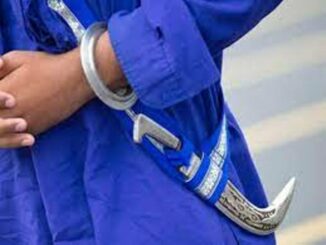
CHARLOTTE (TIP): The University of North Carolina, Charlotte, has updated its ‘Weapons on Campus’ policy to allow Sikh students to wear a kirpan, a religious expression of faith, on campus.
The move comes about two months after a Sikh student at the university was arrested on campus for wearing the ceremonial dagger. According to the updated policy, the university will allow students to wear kirpans on campus if the blade length is under 3 inches and is “worn close to the body in a sheath at all times”. The university also said other religious accommodations, including a request to wear a larger kirpan, can be made to the Office of Civil Rights and Title IX and evaluated on a case-by-case basis. “The Office of Diversity and Inclusion, with support from Institutional Integrity, also conducted additional awareness training this week with our police department and will continue its work to expand our cultural education and training opportunities for all of campus,” a university statement, released this week, read.
In its statement, the university thanked Sikh leaders, including nonprofit organizations—The Sikh Coalition and the Global Sikh Council—who provided expertise and perspective to help with the policy change. “We will continue to use this incident as an opportunity for learning and growth for our community,” said the statement, signed by Chancellor Sharon L Gaber and Chief Diversity Officer Brandon L Wolfe. The ruling was effective immediately, the university, which had apologized for the incident, said. A week after the September 22 incident, the university had shared a list of planned actions, including providing support and resources to the students affected by the event. It mentioned changing the school’s policy and providing additional education and training. The matter first came to light when the student uploaded a video on Twitter and said that the police had handcuffed him for refusing to let the officer remove his kirpan. Describing his suffering, the student wrote: “I wasn’t going to post this, but I don’t think I will receive any support from @unccharlotte. I was told someone called 911 and reported me, and I got cuffed for ‘resisting’ because I refused to let the officer take my kirpan out of the miyaan.” The video, which was seen by more than 21,00,000 people, amassed 56,000 likes and several comments in support on social media. The amritdhari, or baptized, Sikhs are required to carry five articles of the faith—kesh (uncut hair), kara (steel bracelet), kanga (small comb), kachera (undershorts) and a kirpan (resembling a knife or sword).
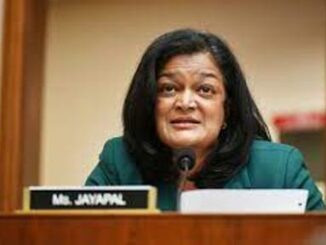
WASHINGTON, D.C. (TIP): Indian American Congresswoman Pramila Jayapal has told colleagues she will not enter the House Democratic leadership race and instead will run for reelection as Congressional Progressive Caucus Chair. Jayapal, the first Indian American woman to serve in the US House of Representatives, announced her decision in a letter to her colleagues Friday after House Speaker Nancy Pelosi stepped down from House leadership, media reported. Democrats are holding their leadership elections Nov 30. “I am writing with humility, intentionality, and excitement to ask for your support to serve a second term as Chair of the Congressional Progressive Caucus,” Jayapal wrote. As Democrats craft their new leadership slate, she wants to make sure that “progressives are given their seat at the table,” Jayapal told CNN. She argued that progressives delivered in the 2022 midterms and with the agenda of the current Congress, and she wants to make sure “that is appreciated and front and center.”
She also acknowledged the challenges House Democrats face as they become the minority party in January when the control of the chamber passes to the Republicans.
“The next two years are going to be important in a very different way than the last two years were,” Jayapal said in a media interview on Thursday.
“The last two years were about governing, about pushing, about getting the most that we could get,” she wrote. “The next two years are going to be about being an opposition party, which I am extremely good at because I fought on immigrant rights, and I came in 2016 when (Donald) Trump was elected.” First elected in 2016, the lawmaker representing Washington’s 7th Congressional district, has helped progressives become a powerful force in Congress, leveraging their positions to negotiate directly with Pelosi, who had to navigate a narrow House majority, and President Joe Biden, the report stated.
Jayapal was at the forefront of negotiations surrounding the American Rescue Plan and expanding the Child Tax Credit. She pushed to broadly expand the nation’s social safety net, but because negotiations fell apart between Biden and moderate Democratic Sen. Joe Manchin, progressives settled for a smaller but still sweeping health care, tax and climate bill known as the Inflation Reduction Act. Jayapal also led progressives to push the Biden administration on several executive actions to curtail the narrow margins in Congress, including to address student loan debt relief, the report stated. “The CPC showed we could push for the maximum while also being able to land the plane, govern, and execute a deeply popular agenda,” Jayapal wrote. With more than a dozen newly elected House members set to join the caucus, the progressive caucus is set to continue to be influential as Democrats navigate a narrow minority.
COLUMBUS, OH (TIP): Federal law enforcement authorities in the US arrested an Indian American, Rathanakishore Giri, in Ohio on Friday on criminal charges related to his alleged involvement in a cryptocurrency investment fraud scheme that raised at least USD 10 million from investors. According to court documents, Giri (27) from New Albany allegedly misled the investors by fraudulently promoting himself as an expert cryptocurrency trader, with a specialty in trading Bitcoin derivatives. As alleged in the indictment, the accused falsely promised the investors that he would generate lucrative returns with no risk to their principal investment amount, which he guaranteed to return, federal prosecutors alleged.
In reality, Giri often allegedly used money provided by new investors to repay old ones—a hallmark of a Ponzi scheme, the prosecutors said.
In addition, Giri allegedly had a record of investment failures, including a long history of losing investors’ principal investments, and misled the investors about the reasons for delays when they sought to cash out their investments or otherwise obtain the return of their “guaranteed” principal, according to court papers. Giri is charged by indictment with five counts of wire fraud. If convicted, he faces a maximum penalty of 20 years in prison on each count. A federal district court judge will determine any sentence after considering the US Sentencing Guidelines and other statutory factors, according to a media release.
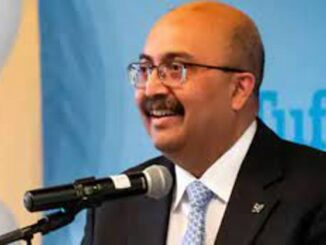
NEW YORK (TIP): Eminent Indian American academician Sunil Kumar has been appointed the next president of Massachusetts-based Tufts University. He is the first person of color to occupy the position. Kumar, provost and senior vice-president for Academic Affairs at Johns Hopkins University was named the next president of Tufts University by the Board of Trustees and will succeed President Anthony Monaco as Tufts’ 14th President on July 1, 2023, a statement from the university said on Thursday. Kumar will be the first person of color to occupy the position, the statement said. Chair of the Board of Trustees and chair of the presidential search committee Peter Dolan said Kumar brings to Tufts a “lifelong commitment to excellence in higher education and an exceptionally strong record as a leader, teacher, and colleague.” An “outstanding successor” to Monaco, Kumar’s commitment to research and learning, along with civic engagement and innovation, will help bolster Tufts’ mission to improve the world, Dolan said in the statement.
Indian-born Kumar was previously dean of the University of Chicago Booth School of Business.
Among Kumar’s priorities as president will be to develop ways “to ensure that we have even more resources to make Tufts as affordable as we possibly can,” he said in the statement.
In a video posted on the Tufts website, Kumar said he would not have achieved this position in life if it were not for the full financial support he received when he was a graduate student at the University of Illinois at Urbana Champaign.
“It would not have been possible for me as a son of a police officer to do anything else. And therefore, affordability is not a theoretical concept for me. I hope I represent an example of somebody who benefited from an institution opening its doors wide.
“And I would like even more people to have the same opportunity,” he added. The statement quoted Kumar as saying that he was attracted to Tufts because of its mission to serve “not only the people within its confines—its students, faculty, and staff—but society at large.”
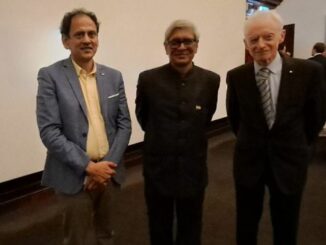
MELBOURNE (TIP): India’s leading economist & Chairman of the Economic Advisory Council to the Prime Minister (EAC-PM) Bibek Debroy has been conferred a Lifetime Achievement Award by The Australia India Chamber of Commerce (AICC). The business network that seeks to facilitate, nurture and transform Australia-India business, bestowed this highly coveted honor upon Debroy In appreciation of his outstanding contribution and service towards growing economic prosperity in India.
The award was handed over by Chris J. Mooney, Chairman of the Australia India Chamber of Commerce, in the presence of Harish Rao, the Executive Director of AICC at an event in Melbourne.
Accepting the award, Debroy said, “I accept this award with all humility. There are many I have received in the course of my life, but this is one I will always treasure, as a reminder of the close ties that bind India and Australia.”
Australia’s Department of Foreign Affairs and Trade (DFAT) has a Special Visit Program under which distinguished visitors from overseas are invited to visit Australia, to understand Australia and to have discussions with their counterparts in Australia.
Under this Special Visit Program, Debroy visited Melbourne, Canberra and Sydney from Nov 13 to Nov 21. Other than discussions and talks, he delivered a special lecture at the Australia India Chamber of Commerce on Nov 14, outlining the course and trajectory of India’s reform. The event was held at the Australian Club (The Gallery), Melbourne.
Educated in Calcutta, Delhi and Cambridge, Debroy has worked in the realm of academia, the government and research institutions. Debroy was a Member of Niti Aayog, the successor to the former Planning Commission, from its formation in January 2015 till August 2017 after which he became the Chairman of the Economic Advisory Council to the Prime Minister.
Debroy has worked on poverty, inequality, development, governance, law reform and international trade issues and has been the Chairman of a Committee set up by the Chief Minister of Jharkhand (2010-12) to recommend a development plan for the State and a Member of the Rajasthan Chief Minister’s Economic Advisory Council (2014-15).
He was also Chairman of a High-Powered Committee for Restructuring the Railways, set up by the Indian government (2014-2015).
From September 2018 to September 2022, he was the President of the Indian Statistical Institute. He has received several awards in the past including Honoris Causa DLitt, DPhil and DS. degrees, Lifetime Achievement Awards by US-India Business Summit (2016), Prestige Institute of Management and Research (2018) and Skoch Foundation (2022) and Padma Shri (2015).
An astute scholar, Debroy has translated the unabridged version of the Mahabharata into English, in a series of 10 volumes. He has also translated the Bhagavad Gita, the Harivamsa, the Vedas and Valmiki’s Ramayana (in three volumes). He has translated the Bhagavata Purana (in three volumes), the Markandeya Purana (one volume), the Brahma Purana (two volumes) and the Vishnu Purana (one volume). He is only the second person to have translated both the Mahabharata and the Ramayana, in unabridged form, into English.
BRAMPTON (TIP): Harkirat Singh has become the first turbaned Sikh to be appointed as Deputy Mayor of Canada’s Brampton city for a four-year term period from 2022-2026.
He has served as Brampton’s City Councilor for Wards 9 and 10 from 2018-2022.
As a Deputy Mayor, Singh will preside over Council and other Committee meetings and assume ceremonial and civic event duties on behalf of the mayor if the mayor is absent or unavailable.
“I am proud to have Councilor Harkirat Singh serve as this Term of Council’s Deputy Mayor. He is a dedicated, hardworking Councilor with proven results in delivering what is best for Brampton,” said Brampton Mayor Patrick Brown. “Entering his second term as Councilor, and holding a School Trustee role before that, he is a known and trusted elected official to many who I am confident will represent and serve the City of Brampton well in this role,” Brown said in a release by Brampton City Council. Prior to his role as City Councilor, Singh served a four-year term as School Trustee at the Peel District School Board.
As a Trustee, he sat on the Audit Committee, Instructional Program/Curriculum Committee and Physical Building and Planning Committee.
“It is an honor to be appointed by my Council colleagues as this Term of Council’s Deputy Mayor. With the opportunity that lies ahead of us in Brampton, I am excited and proud to support Mayor Brown and Councilors in prioritizing the community while we move our City forward,” Singh said.
The position of Deputy Mayor was established by the City of Brampton in April 2022 and was divided into East and West parts. Singh was also the regional representative at the Ontario Public School Board Association (OPSBA).
Alongside his role as a Trustee, he spent two-and-a-half years as a Professor at Lambton College and two years as a Professor at Humber College teaching Marketing & Entrepreneurship.
To promote community development, Singh runs mentorship workshops and career fairs in local schools.In 2016, he was nominated for a mentorship award by the Brampton Board of Trade for his work with youth.He holds a B.A. from the University of Toronto, where he majored in Economics and Public Administration.He is an M.Sc. in Economics from London Metropolitan University and has an MBA from the Schulich School of Business, specializing in Marketing, Entrepreneurship and Organizational Behavior.
Nobel Prize Winner & Author, Kailash Satyarthi. Photo: iaac.us
NOBEL PEACE PRIZE WINNER KAILASH SATYARTHI,
INTERNATIONAL BOOKER PRIZE WINNER DAISY ROCKWELL &
PADMA SHRI AWARDEE SUNITA KOHLI
MICHELIN STAR CHEF, VIKAS KHANNA, FIRST “PHYGITAL” COOKBOOK
And many more
Are you an avid reader?
Here’s something you shouldn’t miss!
IAAC brings you another year of outstanding writers, poets, translators, and editors at its International Literary Festival 2022 at New York city!
IAAC’s fabulous lineup of authors are all set to interact with you either online, November 7-11 or in person, November 12. Hear their stories and get inspired by their noteworthy works! The Festival will end with the Gala Dinner on November 13.
Learn more at t.co/zlsFHnoZ6L
#IAAC#LitFest2022
To register, visit t.co/L3JDzri0R5
The Indo-American Arts Council (IAAC), in its 8th Year, offers the IAAC Literary Festival – an intimate interaction with the leading minds and works of authors and poets writing about the Indian experience. IAAC is dedicated to celebrating and showcasing the arts in North America, has the lineup for its eighth annual Literary Festival on November 7-13, 2022, in New York.
Notable speakers, making in-person appearances at the Caelum Gallery (526 W 26th St.) in New York’s renowned Chelsea neighborhood, include Padma Shri Barkha Dutt, Priya Kumari and Raza Mir. In continuation of its honored tradition, IAAC will also host a live Poetry Panel headlining Arundhathi Subramaniam and moderated by poetry curator, Dr. Ravi Shankar.
Prior to the in-person weekend events, there will be a series of online events hosted on Facebook and YouTube each evening starting November 7-11 at 6:30 p.m. ET, which will feature ten writers including Nobel Peace Prize winner Kailash Satyarthi; London-based restaurateur and Netflix’s “Chef’s Table” star, Asma Khan with Michelin Chef Vikas Khanna – author of the world’s first “phygital” (physical and digital) cookbook; plus, actress, dancer and choreographer, Rukmini Vijayakumar. This series also includes a dedicated Children’s Literary Panel on Tuesday, November 8, 2022 which will showcase readings of “When Blackbirds Fly” by Hannah Lalhlanpuii and “Jamlo Walks” by Samina Mishra. “IAAC’s Literary Festival showcases writers who bring stories of the Indian experience and ethos to the world. Supporting the festival will be a stellar group of moderators who themselves are literary luminaries. As always there will be a focus on first time regional translations, children’s literature and poetry,” said Rakesh Kaul, Vice Chairman, IAAC.
IAAC’s in-person literary festival will be an intense two-day immersive experience featuring thought-provoking conversations, readings and discussions of stories told by courageous authors. Each of the 27 authors’ skill and expertise cover a wide range of civilizational and cultural topics including archeology, design, dance, history, compassion, wonder and the culinary arts. A panel of four poets will showcase powerful wordplay that will make imaginations soar and speak directly to hearts, young and old. Refreshments, breakfast and lunch will be served, wine and cheese will accompany the poetry session. The festival wraps on a high note with the Annual Gala on November 13th. “At IAAC, we pride ourselves on our ability to seek out and find foundational storytellers who are not only noteworthy for their skill with language but whose seminal works also weave remarkable narratives that shape the world around them,” said Preethi Urs, Literary Festival Director, IAAC.
Participants in Virtual Event, poster. Photo: iaac.us
A full list of writers and featured works is below.
For the full schedule with dates, times and moderators, visit IAAC.us.
Online Events (November 7-11):
Kailash Satyarthi’s greater body of work
‘Ammu: Indian Home Cooking to Nourish your Soul’ (Interlink Books, May 2022) by Asma Khan
‘Sacred Foods of India’ in NFT format (Akshaya, June 2022) by Vikas Khanna
‘His Holiness the Dalai Lama in 100 Anecdotes’ (India Penguin, December 2022) by Arthy Muthanna Singh and Mamta Nainy
‘The Dalai Lama: Leadership and the Power of Compassion’ (Interlink Books, November 2022) by Ginger Chih which includes a forward by His Holiness the Fourteenth Dalai Lama
‘Finding Shiva: An Inner Journey of the Performative Experience’ (INDIC, 2021) by Rukmini Vijayakumar
Children’s Panel:
‘When Blackbirds Fly’ (Duckbill, February 2022) by Hannah Lalhlanpuii
‘Jamlo Walks’ (India Puffin, September 2021) by Samina Mishra
‘Somnath Hore: Wounds’ (Art1st, August 2021) conceptualized by Ritu Khoda, written by Likla Lall and featuring illustrator, Kripa
Participants in In-Person Event, poster. Photo: iaac.us
In-Person Events (November 12-13):
‘The Way of the Goddess: Daily Rituals to Awaken Your Inner Warrior and Discover Your True Self’ (TarcherPerigee, September 2022) by Ananta Ripa Ajmera
‘Tata’s Leadership Experiment: The Story of the Tata Administrative Service’ (HarperBusiness, August 2022) by Bharat Wakhlu, Mukund Rajan, Sonu Bhasin
‘TO HELL AND BACK: Humans of COVID’ (Juggernaut, February 2022) by Barkha Dutt
‘The Greatest Telugu Stories Ever Told’ (Rupa, March 2022) translated by Tamraparni Dasu and Dasu Krishnamoorty
‘A Country Called Childhood: A Memoir’ (Aleph Book Company, July 2022) by Deepti Naval
‘[Block] Chain Reaction – The Future of How We Live and Work’ (Soul Excellence Publishing, January 2022) by Elizebeth Varghese
‘Tomb of Sand: A Novel by Geetanjali Shree’ (Tilted Axis Press, August 2021), translated by Daisy Rockwell
‘Shehnai Virtuoso and Other Stories by Dhumketu’ (Deep Vellum Publishing, July 2022) translated by Jenny Bhatt
‘Rajaraja Chola: King of Kings’ (Aleph Book Company, November 2022) by Kamini Dandapani
‘Dava Shastri’s Last Day’ (Grand Central Publishing, November 2021) by Kirthana Ramisetti
‘A Matter of Trust’ (HarperCollins India, July 2021) by Meenakshi Ahamed
‘The View from the Very Best House in Town’ (Walker Books US, February 2022) by Meera Trehan
‘The Soul Catcher’ (Bodes Well Publishing, September 2021) by Monica Bhide
‘Mirror Made of Rain’ (The Unnamed Press, May 2022) by Naheed Phiroze Patel
‘The Candid Life of Meena Dave’ (Lake Union Publishing, June 2022) by Namrata Patel
‘People of the Indus’ (India Penguin, November 2022) by Nikhil Gulati
‘Leaf Talks Peace – Buddha’s Message of Harmony’ (Eternal Tree Books, May 2022) by Priya Kumari
‘Talent: The Market Cap Multiplier’ (Ideapress Publishing, January 2022) by Ram Charan and Anish Batlaw
‘Murder at the Mushaira: A Novel’ (Rupa Publications India, January 2021) by Raza Mir
‘Smashing the Patriarchy: A Guide for the 21st-Century Indian Woman’ (Rupa, November 2021) by Sindhu Rajasekaran
‘KALA – Essays on Contemporary Design Aesthetics’ (Times Group Books, 2020) edited by Padma Shri Sunita Kohli
‘Somnath Hore: Wounds’ (Art1st, August 2021) conceptualized by Ritu Khoda, written by Likla Lall and featuring illustrator, Kripa
Notable International Poets:
‘Love Without a Story’ (Westland, April 2019) by Arundhathi Subramaniam
‘My Body Lives Like a Threat’ (Flowersong Press, January 2022) by Megha Sood
‘Time Regime’ (Gaudy Boy, March 2022) by Jhani Randhawa
‘Singing in the Dark’ (Vintage Books, October 2020) edited by Nishi Chawla and K Satchidanandan
For a complete calendar of events, November 7-13, 2022, visit iaac.us/iaac-literary-festival-2022