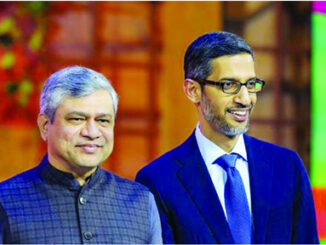
Rajeev Badyal, vice-president of Project Kuiper of Amazon, is among the 30 space experts named by Harris to the National Space Council’s Users Advisory Group (UAG) on December 16.
WASHINGTON, D.C. (TIP): Vice President Kamala Harris has named Indian American Rajeev Badyal to a key national space advisory group, which is tasked to maintain a robust and responsible US space enterprise and preserve space for current and future generations, the White House has said. Badyal, vice-president of Project Kuiper of Amazon, is among the 30 space experts named by Harris to the National Space Council’s Users Advisory Group (UAG) on December 16.Harris had named US Air Force Rtd General Lester Lyles as chair of the UAG.
Project Kuiper is a long-term initiative to launch a constellation of Low Earth Orbit satellites that will provide low-latency, high-speed broadband connectivity to unserved and undeserved communities around the world.Previously he was the vice president of satellites at SpaceX.
He has a Masters in Electrical and Computer Engineering from Oregon State University. The UAG will provide the National Space Council advice and recommendations on matters related to space policy and strategy, including but not limited to, government policies, laws, regulations, treaties, international instruments, programs, and practices across the civil, commercial, international, and national security space sectors, the White House said in a statement.
The 30 members named to UAG represent a cross-section of companies and organizations that support the United States’ large and highly skilled space workforce; users of space services, including climate scientists and agriculture providers; individuals focused on developing the next generation of space professionals; and leading experts in space, it added.
Coinciding with 75 years of Independence, noted film critic Murtaza Ali Khan scanned for The Indian Panorama the 75 years of Indian Cinema. The article here will give readers a fairly good idea of the beginnings and the growth of Indian Cinema, the impact of government policies, the contribution of the Indian Diaspora, the influence of the NRI film makers, the difference the rise of web and the OTT platforms made to mainstream Indian Cinema, and the contribution of certain film makers. The author has also dwelt on the historical phases in the Indian cinema’s 75-year journey. Please send in your comments to murtaza.jmi@gmail.com – EDITOR
Satyajit Ray behind the camera. (Photo: courtesy Ray Society)
Storytelling is undeniably one of the most powerful tools known to mankind. It also happens to be one of the oldest art forms. Storytelling is not merely a means of indulgence but also a great source of learning. Since times immemorial, storytellers have spun yarns with the hope of delighting mankind. Be it the Iliad and the Odyssey of Homer, the Jataka tales, the Mahabharata of Vyasa, the One Thousand and One Nights, or the plays of Shakespeare, each of these sprawling sagas, above all, has proven to be a consummate manifestation of the human expression. Storytelling shares an intimate relationship with performing arts. As far as India is concerned, the history of performing arts can be traced back to Bharatmuni’s Natya Shastra, which describes art as the search for truth. Human life too is a pursuit for truth and happiness. It is this connection that makes life and art inseparable. While discussing art in the context of the 20th and the 21st centuries, it is essential to explore cinema as a mass medium of storytelling that’s often looked upon as the definitive art form that seamlessly combines elements of storytelling, performing arts, and science.
Post-Independence, Indian cinema started evolving at a breakneck pace. While the film industry did suffer huge losses in terms of actors, writers, and technicians who decided to move to Pakistan, the industry greatly gained from the nation building campaigns helmed by Jawaharlal Nehru. For, many of these campaigns revolved around film stars whose mass appeal was leveraged upon by Nehru to give impetus to what came to be known as the Nehruvian idea of India. There is no denying that we have come a long way as a nation over the last 75 years: from bullock carts to jeeps to airplanes to space to the internet. As far as cinematic storytelling is concerned, OTT is the new buzz word, even as the jury is still out on whether cinema the way we know it would survive or not. So, let’s take a look at the journey of cinema since independence.
The origins of the cinematic medium
At the turn of the 19th century, cinema became a phenomenon across Europe thanks to the exploits of the Lumière brothers who conducted private screenings of projected motion pictures in the world’s major cities such as Paris, London, New York, Montreal, and Buenos Aires. It was in July 1896 that the Lumière films finally got screened in Bombay (now Mumbai). A couple of years later, an Indian photographer named Hiralal Sen made India’s first short film, A Dancing Scene, from the scenes of a stage show, The Flower of Persia. It was followed up by H S Bhatavdekar’s The Wrestlers (1899) – a recording of a wrestling match at the Hanging Gardens in Mumbai – which was also India’s first documentary film. In 1912, Dadasaheb Torne made a silent film titled Shree Pundalik – a photographic recording of a popular Marathi play.
A year later in 1913, Dadasaheb Phalke made India’s first feature-length motion picture – a silent film in Marathi titled Raja Harishchandra. Phalke, who is often referred to as the Father of Indian Cinema, had mastered the art of integrating centuries old narrative techniques, borrowed from the indigenous epics, with the emerging technique of making motion pictures. In 1916, R Nataraja Mudaliar made Keechaka Vadham, the first silent film in Tamil. Bangla motion pictures soon followed. The year 1931 proved to be a landmark for Indian cinema as it marked the end of the silent era with Ardeshir Irani making India’s first sound film Alam Ara, made in Hindi/Urdu.
A Still from India’s First Feature Film Raja Harishchandra.
Unfortunately, there is no surviving print of the same. And that’s what brings to me to this wonderful documentary by Shivendra Singh Dungarpur called Celluloid Man about the erstwhile director of the Nation Film Archive of India (NFAI), P K Nair who devoting his life collecting and preserving films. Of course, in the documentary we learn how Ardeshir Irani’s son disposed off the Alam Ara reels himself, after extracting silver from them. It would be due to the efforts of Nair that prints of Raja Harishchandra could be retrieved from Phalke’s daughter kept in Phalke’s Nasik house in a wooden box. Sometimes Nair world look for films in cowsheds and godowns. Of course, now we are becoming more aware about the importance of film preservation. The National Museum of Indian Cinema (NMIC) was inaugurated by the Indian Prime Minister. Narendra Modi on 19th January, 2019 at the Films Division Complex, Pedder Road, Mumbai.The Museum is open to the public from Tuesday to Sunday (11 AM to 6 PM) and is closed on Mondays and Public Holidays. It is housed in two buildings – the New Museum Building and the 19th century heritage building, Gulshan Mahal. The Museum showcases history of India Cinema and has ample artefacts, digital elements including kiosks, interactive digital screens, information-based screen interfaces, etc. It is frequently visited by leading personalities from the world of cinema. Film properties and costumes, vintage equipment, posters, copies of important films, promotional leaflets, soundtracks, trailers, transparencies, old cinema magazines, statistics covering film making & distribution etc. are displayed in a systematic manner depicting the history of Indian cinema in a chronological manner. NMIC not only provides a store house of information to the laymen, but also help filmmakers, students, enthusiasts and critics to know and evaluate the development of cinema as a medium of artistic expression.
Independence and further
On 15 August 1947 India became independent from the British Empire. The early commercial success of Phalke’s films not only paved the way for more such motion pictures but also set the ball rolling for cinema as a commercial art form. In the years to come, cinema in India evolved further as a potent art form capable of mirroring socio-political and economic issues plaguing India with films like Achhut Kanya (1936) and Sujata (1959). Hindi cinema gained international visibility with Chetan Anand’s Neecha Nagar (1946) and Bimal Roy’s Do Bigha Zamin (1953), which won the Grand Prix and Prix International awards at the Cannes Film Festival in 1946 and 1954, respectively.
Nehruvian socialism and post-independence Hindi cinema
(L to R): Madhubala, Nargis, and Meena Kumari
National Award-winning film critic, M K Raghavendra, highlights in his book, The Politics of Hindi Cinema in the New Millennium: Bollywood and the Anglophone Indian Nation, how Hindi cinema, post-independence, played a big part in helping Indians imagine themselves as an entity binding them together – the Indian nation. Evidently, the first couple of decades after independence saw the influence of Nehruvian socialism on Hindi cinema. It is sometimes argued that popular films of the 1950s failed to capture the prevalent reality of the times owing to the filmmakers’ compulsion to fortify the nationalistic myths created by the newly appointed Jawaharlal Nehru government. However, if one tries to closely examine some of the most important films made during this period such as Raj Kapoor’s Awaara (1951), Bimal Roy’s Do Bigha Zamin (1953), Mehboob Khan’s Mother India (1957), and Guru Dutt’s Pyaasa (1957), it becomes evident that the Hindi films of this period were not always in harmony with Nehru’s vision of India. But, it is also true that other important films from this era like Andaz (1949), Naya Daur (1957), and Howrah Bridge (1958) did succeed in depicting the dichotomy associated with Nehru’s ideals of modern India – the good side of modernity shown through the doctors, engineers, etc. and the bad side through the caricatures of the gamblers, cabaret dancers, etc.
Guru Dutt
Vasanth Kumar Shivashankar Padukone, better known as Guru Dutt, is lauded for his artistry, notably his usage of close-up shots, lighting, and depictions of melancholia. He is often referred to as the Orson Welles of Indian cinema. He directed a total of 8 Hindi films, several of which have gained a cult following internationally. This includes Pyaasa (1957), which made its way onto Time magazine’s 100 Greatest Movies list, as well as Kaagaz Ke Phool (1959), Chaudhvin Ka Chand (1960), and Sahib Bibi Aur Ghulam (1962), all of which are frequently listed among the greatest films in Hindi cinema.
Raj Kapoor
Raj Kapoor is often described as the Charlie Chaplin of Indian cinema. He was greatly inspired by Charlie Chaplin and played characters based on The Tramp in films such as Awaara (1951) and Shree 420 (1955). The song ‘Awara Hoon’ (which translates to I am a Vagabond/Tramp) from his movie Awaara becoming an anthem for protest against oppression in so many places across the globe: In China, in Soviet Union, In Middle East. It’s popularity led to creation of localized versions of the songs in Greece, Turkey, Romania, Soviet Union, and China. It is still considered a timeless song in South Asia, Balkans, Russia, and Central Asia.
Speaking of the leading ladies, Suraiya, Madhubala, Meena Kumari, Nargis, Wahida Rehman, Vyjayanthimala, Nanda, Nutan, Hema Malini, Rekha, Sridevi, Madhuri Dixit, Kajol, Aishwarya Rai, Vidya Balan, Deepika Padukone, Kangana Ranaut, and Alia Bhatt are amongst the most important Bollywood actresses to have graced the silver screen.
Indian cinema’s leading men Dilip Kumar, Raj Kapoor, and Dev Anand with India’s First Prime Minister Pandit Jawaharlal Nehru
Indian cinema beyond Nehru
While these trends continued, Hindi cinema never eschewed from capturing the nerve of the important historical events in post-colonial India such as highlighting the gloomy reality of the Sino-Indian war, the euphoria associated with green revolution of the mid-1960s, Indira Gandhi’s meteoric rise in the late 1960s, her growing populism in the 1970s and her crushing defeat in the 1977 general elections following the 21 dark months of Emergency, emergence of regional conflicts during the 1980s like the Khalistan movement, and the economic liberalization during the early 1990s under the prime minister ship of P V Narasimha Rao, ushering in a new era of globalization.
Satyajit Ray and Indian Neo-Realism
Bengali filmmaker Satyajit Ray, the father of Indian neo-realistic cinema, is widely regarded as one of the greatest auteurs of the 20th century. It wouldn’t be a hyperbole to call Satyajit Ray the most consummate filmmaker of all time, for when it came to the different aspects of filmmaking, he himself practically took care of everything: be it casting, scripting, direction, music, cinematography, art direction, editing, or marketing and publicity. An alumnus of Nobel Laureate Rabindranath Tagore’s Visva-Bharati University at Santiniketan, Ray was born in a Calcutta based Bengali family noted for their long legacy of art and literature. It was in Santiniketan that Ray, under great painters like Nandalal Bose and Benode Behari Mukherjee, fell in love with the Oriental art. However, Satyajit Ray’s love for cinema and Indie filmmaking was sparked by his interaction with the legendary French filmmaker Jean Renoir who had come to Calcutta to scout locations for his forthcoming movie. After establishing Calcutta Film Society in 1947, Ray embarked on a six-month-long trip to Europe, as part of his job assignment in an advertising agency, during which he religiously explored the different facets of cinema, watching as many as 100 international films including Vittorio de Sica’s neorealistic masterpiece Bicycle Thieves (1948). Greatly inspired by the concept of realistic cinema that promoted a whole new degree of realism through the use of an amateur cast in place of a professionally trained one and real shooting locations instead of the custom-built sets and studios, Ray was more determined than ever to start a new chapter in Indian Cinema.
After facing many hardships including a major financial crunch, Ray finally managed to complete his adaptation of Bibhutibhushan Bandyopadhya’s celebrated novel Pather Panchali in 1955. The movie was presented with several international awards, including Best Human Documentary at the 1956 Cannes film festival. Just like Akira Kurosawa had managed with Rashomon in 1950, Ray succeeded in introducing the Indian Cinema to the whole world with Pather Panchali. Pather Panchali is the first part of Ray’s now world renowned The Apu Trilogy—the other two being Aparajito [The Unvanquished,1956] and Apur Sansar [The World of Apu, 1959]—that chronicles the troubled, poverty-stricken life (from childhood to maturity) of the movie’s protagonist, Apu, in the backdrop of the early 20th century Bengal. During the next few decades, Satyajit Ray continued with his merry ways making influential movies like Jalsaghar [The Music Room, 1958], Postmaster (1961), Abhijan [The Expedition, 1962], Mahanagar [The Big City, 1963], Charulata (1964), Days and Nights in the Forest (1969), and Pikoo [Pikoo’s Diary, Short, 1980] that dealt with the cultural, religious and socio-economic ambiguities of the Indian middle class. In the 70s, Ray went on to make the Calcutta trilogy: Pratidwandi [The Adversary, 1970], Seemabaddha [Company Limited, 1971] and Jana Aranya [The Middleman, 1975]. In 1977, Ray made his first Hindi film named Shatranj Ke Khiladi [The Chess Players], an adaptation of a story by the famous Hindi novelist Munshi Premchand. In 1980, Satyajit Ray made Hirok Rajar Deshe [The Kingdom of Diamonds], a political allegory written in the backdrop of Emergency to castigate the totalitarian political regime under Mrs. Indira Gandhi. During his long and illustrious career, Ray was a beneficiary of a multitude of meritorious awards, national and international, including the Bharat Ratna (Republic of India’s highest civilian award) and an Academy Honorary Award (an Oscar for his lifetime contribution to cinema) in 1992. Such has been the extent of influence of Ray’s multifaceted humanistic works that even today the global audience relates to the Indian Cinema mostly through the means of his oeuvre.
Ritwik Ghatak
Satyajit Ray’s contemporary, Ritwik Ghatak is best known for his films such as Nagarik (1952), Ajantrik (1955), Madhumati (1958), Meghe Dhaka Tara (1960), Subarnarekha (1965), and Titash Ekti Nadir Naam (1973), among others.
Ghatak’s cinema is primarily remembered for its meticulous depiction of social reality, partition and feminism. Ghatak moved briefly to Pune in 1966, where he taught at the Film and Television Institute of India (FTII). His students included filmmakers Mani Kaul, Kumar Shahani, Adoor Gopalkrishnan, Saeed Akhtar Mirza, andJohn Abraham. Although his stint teaching film at FTII was brief, his students who would go on to become noted filmmaker themselves such as Mani Kaul, John Abraham, and especially Kumar Shahani, carried Ghatak’s ideas and theories, which were elaborated upon in his book ‘Cinema and I,’ which was described by Satyajit Ray as a book that covers all aspects of filmmaking. As opposed to Ray who succeeded in creating an audience outside India during their lifetime, Ghatak and his films were appreciated primarily within India. But, it has changed in the recent decades as Ghatak’s work continues to get discovered globally.
Mrinal Sen
Along with Satyajit Ray and Ritwik Ghatak, Mrinal Sen pioneered the parallel cinema movement in India, as a counterpoint to the mainstream fare of Hindi cinema. Sen’s cinema is primarily known for its artistic depiction of social reality.
Sen is one of the very few filmmakers to have won an award or recognition at all the major cinematic forums. In addition to a barrage of National Awards, Mrinal Sen’s immensely thought-provoking films have been recognized at Cannes Film Festival (Jury Prize for Kharij, 1983), Berlin International Film Festival (Grand Jury Prize for Akaler Sandhane, 1981), Venice Film Festival (Honourable Mention for Ek Din Achanak, 1989), Montreal World Film Festival (Special Prize of the Jury for Khandhar, 1984), Moscow International Film Festival (Silver Prize for Chorus, 1975), Cairo International Film Festival (Silver Pyramid for Best Director for Aamaar Bhuvan, 2002), Chicago International Film Festival (Gold Hugo for Khandhar, 1984), etc.
In 1981, the Government of India awarded him with the Padma Bhushan. In 1985, President Francois Mitterrand, the President of France awarded him the Commandeur de Ordre des Arts et des Lettres the highest civilian honor conferred by that country. In 2005, he was conferred with the Dadasaheb Phalke Award. In 2000, President Vladimir Putin of the Russian federation honored him with the Order of Friendship.
Regarded by many as Sen’s greatest film, Bhuvan Shome’s sardonic humor and its realistic depiction of rural India made it a landmark of Indian cinema. In his Calcutta trilogy, Sen explored the civil unrest in contemporary Calcutta through stylistic experiments and fragmented narratives. Sen examined middle-class morality in his films Ek Din Pratidin and Kharij.
A recipient of countless national and international film awards, Sen was instrumental in drawing youth to theatre as a member of the Indian People’s Theatre Association. Unlike his contemporaries, Sen succeeded in breaking the language barrier by making films in languages other than Bangla. Some of his prominent films are in Oriya and Telugu, as well as in Hindi. Sen is regarded as the pioneer of political cinema in India. Before Sen, filmmakers usually stayed away from politics, thinking it to be a taboo subject. But Sen never eschewed from depicting the unrest, angst and deprivation of the Indian society. And perhaps that’s what inspired his successors to make films heavily laced with socio-political commentary.
Tapan Sinha
Tapan Sinha was one of the most prominent Indian film directors of his time forming a legendary quartet with Satyajit Ray, Ritwik Ghatak and Mrinal Sen. He was primarily a Bengali filmmaker who worked both in Hindi cinema and Bengali cinema, directing films like Kabuliwala (1957), Louha-Kapat, Sagina Mahato (1970), Apanjan (1968), Kshudhita Pashan and children’s film Safed Haathi (1978) and Aaj Ka Robinhood.
Amitabh Bachchan and the Rise of the Angry Young Man
Amitabh Bachchan in a still from Yash Chopra’s DeewaarAmitabh Bachchan
While during the late ’60s and early ’70s Hindi cinema witnessed the dominance of romantic movies with actors like Dev Anand, Rajesh Khanna, Shashi Kapoor, Dharmendra and actresses like Sharmila Tagore and Asha Parekh becoming household names, by the mid-1970s a new kind of hero emerged who was not identified by his chocolate boy image but by his rugged machismo. Popularly described as the ‘Angry Young Man’, this new protagonist actually represented the anger and frustration of an entire generation exploited by those in power. For, this was a period of political, social, and economic upheaval in India with the issues of poverty, unemployment, and political violence plaguing the common man more than ever.
While Amitabh Bachchan made this character his own (with the grand success of films like Zanjeer, Deewaar, and Sholay) through the ’70s and the ’80s, actors like Anil Kapoor and Sunny Deol carried the mantle forward into the ’90s. The ’70s and ’80s also marked the advent of the Indian New Wave or Parallel Cinema with films like Ankur (1973), Nishant (1975), Manthan (1976), and Saaransh (1984). Mrinal Sen’s Bhuvan Shome (1969) is widely considered as the starting point of this movement. Shyam Benegal, Mani Kaul, Ketan Mehta, and Govind Nihalani are some of the prominent names of the Indian New Wave.
The ‘90s and the Khan Trio
Kajol and Shah Rukh Khan in Dilwale Dulhaniya Le Jayenge.
The late ’80s and the ’90s witnessed commercial Hindi cinema go from strength to strength with blockbusters like Mr. India (1987), Tezaab (1988), Qayamat Se Qayamat Tak (1988), Maine Pyar Kiya (1989), Khiladi (1992), Darr (1993), Mohra (1994), Hum Aapke Hain Koun..! (1994), Karan Arjun (1995), Dilwale Dulhaniya Le Jayenge (1995), Raja Hindustani (1996), Dil To Pagal Hai (1997), Kuch Hota Hai (1998), Pyaar To Hona Hi Tha (1998), and Mann (1999) setting new box office records. Many of these films starred Anil Kapoor, Shah Rukh Khan, Salman Khan, Akshay Kumar, Aamir Khan, Ajay Devgan, Madhuri Dixit, Karisma Kapoor, and Kajol.
Kangana Ranaut and R. Madhavan in Anand L. Rai’s Tanu Weds Manu
At the turn of the 21st century, parallel cinema underwent a revival of sorts with the arrival of filmmakers like Ram Gopal Varma, Madhur Bhandarkar, and Anurag Kashyap, whose cinema mainly dealt with depiction of organized crime. The success of Satya (1998), Chandni Bar (2001), Company (2002), Black Friday (2004), and Sarkar (2005) proves beyond doubt the changing tastes of the Hindi film audiences during this phase.
The growing influence of the Indian Diaspora on Bollywood filmmakers
If we study Hindi cinema closely, we observe that the 1990s proved to be the tipping point with Nehruvian socialism making way for economic liberalization in India. As the Indian economy gradually opened up to the world, the Hindi cinema underwent an Anglicization of sorts owing to the growing influence of the Indian Diaspora – a trend that is best demonstrated by films like Dilwale Dulhania Le Jayenge (1995), Pardes (1997), Kabhi Khushi Kabhie Gham (2001), and Namastey London (2007). During this period, Bollywood started catering more and more to the English-speaking Indians. The trend perpetuated with the multiplex boom.
Subsequently, filmmakers like Vishal Bhardwaj, Anurag Kashyap, and Tigmanshu Dhulia made efforts to bring about a change to this trend by making films such as Matru Ki Bijlee Ka Mandola (2013), Gangs of Wasseypur (2012), Paan Singh Tomar (2012), etc.
Bollywood and the 100 Crore Club
During this phase, Hindi cinema continued to take new leaps in terms of revenue generation but there appeared to be a stagnation of sorts in terms of creative thinking. The success of a Hindi film started depending on whether it entered the ‘100 Crore Club’ or not. Even the most successful films would run only for a few weeks as opposed to the ‘Jubilee Era’, when success was measured in terms of the number of weeks a movie ran in the theatres: 25 weeks (Silver Jubilee), 50 weeks (Golden Jubilee), or 75 weeks (Platinum Jubilee).
Hindi cinema and the Hindi heartland
Manoj Bajpayee as Bhikhu Mhatre in Ram Gopal Varma’s Satya
Building on the trend that was started by the likes of Anurag Kashyap, Tigmanshu Dhulia, Vishal Bhardwaj, and Aanand L. Rai, Hindi films subsequently started focusing consciously on stories based in the Hindi heartland. The diaspora no longer remained the primary target of Hindi filmmakers and as a result as the industry witnessed a surge in the number of films that are set in north-central India which enjoys a Hindi-speaking majority. But, a lot of the mainstream Hindi films since Lagaan (2001) seemed to lack the impetus needed to march in the global arena. It is true that there have been Hindi films like Miss Lovely (2012), Titli (2014), and Masaan (2015) which have made it to the Un Certain Regard Section at Cannes.
The rise of web and the OTT platforms
Speaking of the audiences, the rise of various OTT platforms has had a dramatic impact on the nature of content produced. Today, we have audiences with such diverse tastes that content creators are forced to create content targeted at different segments of audiences. The COVID-19 pandemic has further given a fillip to OTT platforms. With cinemas indefinitely shut down more and more viewers are forced to shift to one or more of these platforms for their daily dose of entertainment. This has also given rise to what is described as binge-watching. But before we try and examine this in detail, it is first important to decipher the nuances of binge-watching. For the uninitiated, binge-watching is a way of consuming content all in one go as opposed to consuming it in serialized weekly installments. It’s an effective way to watch plot-heavy shows. Now that we have a basic understanding of this novelty we will try and analyze its various aspects. For years cinema has been enjoying an undisputed status over its poor cousin television. While one agrees with the classification of cinema and television as two different mediums it cannot be denied that with the advent of new age content the line between the two is fast fading. In fact, today we can easily look at the majority of binge-worthy international television / web series as 8 or 10 hour films and that’s primarily because of the topnotch production values and the cinematic grammar associated with them.
A still from SonyLiv show Rocket Boys
The advent of streaming services like Netflix and Amazon Prime has given rise to Indian original shows like Delhi Crime, The Family Man, Special Ops, Sacred Games, Scam 1992, Rocket Boys, Mirzapur, Apharan ,Inside Edge, Panchayat, Undekhi, Aashram, and Kota Factory, among others. The rapid emergence of binge-worthy content is proving to be a real game changer for the Indian entertainment industry at large. This is in stark contrast to some of the daily soaps we have grown accustomed to watching on Indian television over the years. But there is an interesting flip side to this trend. Often the viewer is in such a hurry to finish off a season that he / she often ends up overlooking some important details. Perhaps, this is a price that most viewers are willing to pay.
The emergence of binge culture is not just impacting the end consumers it is also pushing the artists to expand their horizons. The rise of binge culture poses a big challenge for the artists to make themselves platform agnostic. Putting together an 8 to 10 hours of quality content for every season requires a different level of creative commitment. However, at the same time, it provides them with a wonderful opportunity to reinvent themselves as per the changing needs of time. Now, India’s entertainment industry has a great scope for embracing new trends, the rise of binge culture is bound to have a strong impact on cinema viewing in the longer run once normalcy returns post-pandemic. While the opinions surrounding binge culture may widely vary, even the staunchest critics wouldn’t deny that the rise of new platforms like Netflix has led to greater accessibility, reach, and creative freedom.
The contribution of NRI filmmakers to Indian cinema
A still from Tirlok Malik’s Khushiyaan
While discussing Indian cinema post-independence one would be remiss to overlook the contributions of NRI filmmakers whose multifaceted work offers a unique blend of cinema that binds the Indian Diaspora with the general populace. Emmy-nominated Indian-American filmmakerTirlok Malik is best known for making films about Indian immigrants in the US. Malik’s filmmaking journey started with his pioneering work Lonely in America (1990) which he wrote and produced while also acting in it. The film was shown in over 70 countries and screened at several leading festivals all across the globe. Since then he has made several other films about issues pertaining to the Indian diaspora such as Love Lust and Marriage, On Golden Years, and Khushiyaan which he shot in India with an ensemble cast that featured the likes of Jasbir Jassi, Tisca Chopra, Kulbhushan Kharbanda, and Rama Vij. Many internationally acclaimed filmmakers have also contributed wholeheartedly to the growth and development of Indian cinema in the global arena—most notably Mira Nair (Salaam Bombay!, Kama Sutra: A Tale of Love, Monsoon Wedding, The Namesake, The Reluctant Fundamentalist, A Suitable Boy), Deepa Mehta (Fire, Earth, Midnight’s Children, Leila), and Gurinder Chadha (Bend it Like Beckham, Bride and Prejudice, Viceroy’s House, Beecham House). Also, filmmakers Raj & DK deserve a special mention here as they too started their filmmaking journey outside India with their 2003 film Flavors about Indian immigrants living in America. In the recent years, Raj & DK have emerged as two of the most sought-after filmmakers in India. Their Amazon Prime Video web show The Family Man starring Manoj Bajpayee in the role of an Indian intelligence officer named Srikant Tiwari has emerged one of the most popular shows in the Indian web space.
The journey of Indian cinema since 1947 has had its share of ebbs and flows and the path forward is laden with difficulties and challenges. While there are opportunities galore, there are also many obstacles. Amit Khanna, the writer, director, and producer who has been an integral part of the Hindi film industry for the last five decades, recollects how he convinced his filmmaker friends to join him for a meeting he had set up with Federation of Indian Chambers of Commerce & Industry (FICCI) during the early ‘90s which proved to be instrumental in helping Bollywood get an industry status. “After our studio system got dismantled around WWII, it took us almost five decades to once again get a little organized and corporatize things. I remember when I took my close friends such as Yash Chopra, Manmohan Shetty, Ramesh Sippy and others to a meeting with FICCI they all questioned the rationale behind it. Then over time the people realized the importance of the corporate connect. Back then I was the lone voice pushing for institutional financing and recognition as an industry. Through repeated representations with the government and relentless efforts we finally succeeded in securing the industry status that paved the way for the entry of the larger corporate players while some of the smaller ones also started getting institutionalized as funding became a lot more transparent,” explains Khanna who began his career as an executive producer with actor-producer Dev Anand’s Navketan Films in 1971. “In the ‘70s the video came in and kind of disturbed the equilibrium. There was a lot of resistance from producers and distributors against video. Also, there was a video piracy which continued well into the ‘80s. From a peak cinema screen count of 13,000 the number went down drastically by the ‘90s to less than 9,000. It was only towards the end of the 90s with the multiplex boom that things changed,” recollects Khanna.
Award-winning filmmaker and author Dr. Bhuvan Lall feels that the rich diversity that the Indian cinema continues to enjoy is seen nowhere else in the world. “A healthy cinema culture with regional flavors can only exist in a democratic setup where the artists are free to speak. India is a striking example of the largest producer of content on earth today. There is no denying that despite all the problems that we face as a country, our film industry is totally secular, totally based on Indian ethos, and capable of producing a vast array of content ranging from realism to fantasy. Here people love to say what they want to say. In any other country this is not possible as the population size doesn’t allow it. At the end of the day, you need to have a market for such diverse content and most countries in the world don’t enjoy the same luxury,” explains Lall.
Noted Indian critic Ajit Rai, however,feels that European audiences need to know more about Indian cinema, especially beyond the works of Satyajit Ray. In the past, most of our commercial films to have tasted global success outside of the Indian Diaspora actually had a strong melodramatic appeal which greatly worked to their advantage,” opines Rai whose book on the Hinduja Family and the Indian Cinema titled ‘Hindujas and Bollywood,’ which tells the untold story of the global journey of over 1200 Hindi films as undertaken by the Hinduja brothers, starting with the 1950s, establishing Bollywood as a global brand, was launched in London, back in July 2022.
(Murtaza Ali Khan is an Indian Film & TV Critic / Journalist who has been covering the world of entertainment for over 10 years. He tweets at @MurtazaCritic and can be mailed at: murtaza.jmi@gmail.com).
Dir/Writ: S.S. Rajamouli l 2022 l India l Telugu w/Eng subs l 3h 2m
‘RRR,’ dance scene. (Photo: Courtesy ‘RRR.’)
‘RRR,’ from writer-director S. S. Rajamouli (Baahubali) is the international blockbuster that has enchanted movie audiences of all ages with its jaw-dropping action sequences, swooning romantic intrigue, infectious musical numbers— including the sensation “Naatu Naatu”—and rousing central friendship between two pre-Independence revolutionaries, played by Telugu-language megastars Ram Charan and N.T. Rama Rao, Jr. (better known as Jr. NTR).
From an original story by V. Vijayendra Prasad, the historical action epic RRR (short for Rise, Roar, Revolt) follows the fictionalized paths of real-life freedom fighters Alluri Sitarama Raju (Charan) and Komaram Bheem (Rama Rao) as they come together in 1920s Delhi to battle the nefarious British Raj for the rescue of a kidnapped girl from Bheem’s tribe.
Watch the trailer –player.vimeo.com/video/709590385?autoplay=1&h=a79303822a
Opening: Check local listings for re-release dates.
HIDDEN LETTERS
Dirs: Violet Du Feng & Qing Zhao l 2022 l China/USA/Norway/Germany l
1h 26m
Women in China were historically forced into oppressive marriages and forbidden to read or write by their households for thousands of years. To cope, they developed and shared a secret language among themselves called Nushu. Written in poems or songs with bamboo pens on paper-folded fans and handkerchiefs, these hidden letters bonded generations of Chinese women in a clandestine support system of sisterhood, hope and survival. Spanning between past and present, from sunken rice fields and rural villages to bustling metropolitan cities, ‘Hidden Letters’ follows two millennial Chinese women who are connected by their fascination with Nushu and their desire to protect its legacy.
In Jiangyong, Hu Xin works as a Nushu museum guide and aspires to master the ancient script following the breakup of her marriage. In Shanghai, Simu is passionate about music and Nushu, but marital expectations threaten to end her pursuit of both. Influenced by Nushu’s legacy of female solidarity, the two women struggle to find balance as they forge their own paths in a patriarchal culture steeped in female subservience to men. Learn more at hiddenlettersfilm.com
Opening: Watch on major streaming platforms.
ALL IN: MIRACLE AT ST. BERNARD’S
Dirs: Gregg Backer & Evan Kanew l 2022 l USA l 1h 35m
‘All In: Miracle at St. Bernard’s’ is about faith, family and football. This documentary chronicles a tiny, 100-year-old Catholic school in Fitchburg, Massachusetts struggling with insolvency yet defying the odds at a time when the Church was shuttering similar institutions nationwide.
It’s the underdog story of a working-class community and the state’s smallest football program rallying in pursuit of an impossible goal: to save their school from closure by the Church.
The Bernardians faithful needed a miracle. So they set about creating one. All In follows the dramatic campaigns to raise money and enrollment as well as a magical football season that together saved a beloved institution.
Opening: Watch on Prime Video
DOC SHORTS
BAREFOOT EMPRESS
Dir: Vikas Khanna l 2022 l USA l 15m
‘Barefoot Empress,’ Amma in class (Photo: Courtesy’ Barefoot Empress.’)
‘Barefoot Empress’ follows the remarkable journey of 96-year-old Karthyayani Amma as she joins a first grade class, realizing her lifelong dream of receiving an education. Amma went to school for the first time at 96 and became the top of her class. In the trailer she can be seen soaking up a lesson amidst a classroom of girls a tenth of her age. “I’m not ashamed to be sitting in a classroom with students of my great-grandchildren’s age,” she says.
Watch the trailer: youtu.be/7LZ1w8KvD_U
The film is Executive Produced by world-renowned speaker and author, Dr. Deepak Chopra, directed by Michelin Star Chef and social impact filmmaker Vikas Khanna, and produced by Academy Award nominated Doug Roland.
Inspired by Vikas Khanna’s own grandmother who was not given an opportunity at an education, Khanna has partnered with non-profit Leap to Shine to use the film to raise funds in service of providing high quality education for girls in underserved communities in India. To date, ‘Barefoot Empress’ has helped rehabilitate eleven classrooms in India, with many more on the way. Speaking about the film, Dr. Chopra said, “‘Barefoot Empress’ carries a universal message of hope and perseverance that has the power to move viewers, and the momentum to impact the lives of thousands of girls in India.” Learn more at barefootempress.com
FAVORITE DAUGHTER
Dir: Dana Reilly l 2022 l USA l 19m
Winner – Audience Award for Best Docu Short – Sidewalk Film Festival
“‘Favorite Daughter,’ is an endearing, funny, and poignant look at aging, sex, cooking, finding love, and of course the mother-daughter bond.” – Tribeca Citizen
‘Favorite Daughter’ is an intimate portrait of the director’s grandmother Sylvia Weinstock and mother Janet Isa, sheltering in place together in a lower Manhattan apartment during the COVID-19 pandemic. Sylvia was living alone for the first time in her life when after her partner of 69 years, (the director’s grandpa), Ben, passed away. Then her youngest daughter, Janet, moved in.
This short documentary is both raw and charming, melancholy and funny — a portrait of two women with vastly different experiences coming together and supporting one another through the uncertainty of spending the next chapters of their lives “alone,” without a partner.
View the trailer: player.vimeo.com/video/711406850
Opening: Running on Paramount+.
HOLDING MOSES
Dirs: Rivkah Beth Medow & Jen Rainin l 2022 l USA l English l 17m
WORLD PREMIERE – 2022 San Francisco International Film Festival
SFFILM Festival 2022 – Winner – Golden Gate Award
SF Jewish Film Festival 2022 – Winner – Best Short Documentary
‘Holding Moses’ focuses on Randi, who studied Butoh dance in Japan before performing in the show ‘Stomp,’ forging a deep connection with movement and her body. Randi is visually striking, with close-cropped salt and pepper hair, and presents as very masculine of center, defying most people’s image of a mother. Birthing her son felt triumphant, then confusing as he was whisked away to the neonatal intensive care unit (NICU) . When doctors shared that Moses was profoundly disabled and faced a tenuous future, Randi fell into a well of grief before unearthing a new language by which to learn and love her son – one born and honed in the body. Learn more at franklyspeakingfilms.com/projects/holding-moses
Opening: Streaming on the New Yorker Documentary
(Mabel Pais writes on The Arts and Entertainment, Social Issues, Health & Wellness, Cuisine and Spirituality)
Founders of SAH (Left to Right) – Jitin Hingorani, Monika Samtani, Rohi Mirza Pandya & Kirtana Banskota. (Photo: Satwic Mudigulam)
By Mabel Pais
South Asian House (SAH), for the first time, partners with South By South West® (SXSW®) Film Fest 2023, a Festival held for 37 years. SAH will convene at Fourth and Co. in the iconic Warehouse District of downtown Austin, six blocks from SXSW® event headquarters.
There will be two full days of programming on March 11 and 12, 2023 of this innovative initiative to highlight, recognize, and appreciate South Asians from seven countries – India, Nepal, Pakistan, Bangladesh, Sri Lanka, Bhutan, and Maldives – as well as accomplished members of the diaspora.
Programs will range from panel discussions on women in film, business tech, and climate change to curated sets of live and electronic music to a Reel Deal session, Comedy Hour, Industry Leadership Sessions, Mental Health Corner, Queer/Dalit Visual Art NFTs, and Desi Drag Brunch to a red carpet, awards ceremony on Oscar® Sunday recognizing South Asian Trailblazers in Cinema.
The initiative is the brainchild of veteran producers, curators, and programmers Rohi Mirza Pandya (Box Office Guru Media & Desipina), Monika Samtani (Ms. Media & The Fem Word), Jitin Hingorani (Jingo Media & DFW South Asian Film Festival), and Kirtana Banskota (Banskota Productions & Nepal America Film Society).
Follow @southasianhouse on Instagram or sign up to receive updates through the website, southasianhouse.com.
(Mabel Pais writes on The Arts and Entertainment, Social Issues, Health & Wellness, Cuisine and Spirituality)
By Chirag Daruwalla – Son of Astrologer Bejan Daruwalla
Aries
Ganesha says that this year is bringing auspicious results for the people of Aries. This year is going to be better for them as compared to the last several years. Work in the workplace will give auspicious results. More hard work will have to be done in the job business, which will also get proper benefits. You will get cooperation and respect from colleagues and officers. You will be interested in religious works. Take special care of your health during the year 2023. There is a possibility of misunderstanding in the matter of business, so work cautiously.
Taurus
Ganesha says that from this year the planetary transit will be auspicious for you in many respects. Your interest in religion-work and spirituality will increase. Old relations and old friends will come close to you once again. You can also undertake religious journeys this year. In terms of health, you have to pay attention this year. Time is favorable for progress in the job business. Efforts made in the economic sector will also be successful this year. With the auspicious effect of the zodiac lord Venus, this year will be wonderful for you.
Gemini
Ganesha says this year can be full of ups and downs for you. You may have to do a lot of running around this year. You have to take care in terms of health. Be careful while traveling, there is a possibility of an accident. The time after June will be somewhat auspicious for you. During this time, the situation in jobs and business will improve. May the whole year be good for you. Efforts to change jobs will also be successful during this time. You will get financial benefits. This is a good time for Gemini people to express love.
Cancer
Ganesha says that this year will be mixed for Cancer people. This year, efforts for promotion in the job will be successful. Health will generally be favorable. There can be minor problems in family life. The months of April to June are going to be auspicious for you. There will be progress in the economic sector during this period. You will also get a lot of benefits of position and prestige. There is a need to be health conscious in the year 2023. Try not to ignore any issues in the year 2023.
Leo
Ganesha says this year is going to be better for you than the previous years. This year is auspicious for you. The coming time of the year will be good for you. There will be progress in economic matters. There will be a favorable change in the workplace. Luck will be in full support and the opponents will be defeated. The planetary change will increase your anxiety; there will be some mental problems in family life. This year will be beneficial in terms of business and money. In matters of married life and love, you will get good results in the year 2023.
Virgo
Ganesha says that this year is bringing a message of relief for the people of Virgo. This year, the people of Virgo will remain free from the inauspicious effects of the planet. In general, you will be healthy throughout the year and there will be mutual harmony in family life. Relations with relatives will be favorable. The year will be progressive for the students; there will be interest in reading and writing. Efforts made in the job business will be successful. This time will be important from April to June.
Libra
Ganesha says this year will be fluctuating for the people of Libra sign of Venus. You have to be a little careful in terms of health. There may be conflicts and tensions in family life. There will be more hard work and running in the job business. This year will have to be careful in financial matters. Keep unnecessary expenses under control. Control anger and speech, otherwise there will be an inauspicious effect on relationships. If you are married then the year 2023 is likely to give mixed results in your married life.
Scorpio
Ganesha says that the end of the year of the Scorpio zodiac will be full of ups and downs. Mental problems will increase and there will be a possibility of accidents. There will be mutual cooperation in family life. Position-prestige and economic benefits will increase job business. Money will be spent on religious work this year. This is a good time for new work. Apart from improving your health, this year can also give you relief from many stomach-related problems.
Sagittarius
Ganesha says for the people of Sagittarius, this year will be a sour-sweet experience. You will have to work hard, but you will also get its benefits, due to which you will feel happy when the time comes. Your interest in religious work and spiritual work will increase and you can go on pilgrimage. Your health will be normal this year. There will be some tension in the job business. In this year 2023, you will also get success in your financial life.
Capricorn
Ganesha says that this year is not more beneficial for Capricorns than the previous year. The end of the year is not positive for you. Hard work will give financial benefits to the position of planets. Expenditure will increase in comparison to income. You may have to travel abroad for work and family matters. Health has to be taken care of. The influence of opponents will increase. Restraint has to be exercised on speech and behavior; otherwise, there may be differences with loved ones.
Aquarius
Ganesha says for the people of Aquarius, this year will bring some changes in jobs, businesses, and other areas of life. There will be ups and downs in health this year. There is also the possibility of an accident, so do not take the risk. Financial expenditure will increase, so work should be done keeping in mind the budget. Luck is getting less support this whole year, so hard work will have to be done more. Avoid VAT disputes with any family member.
Pisces
Ganesha says this year is going to be generally pleasant for the people of Pisces. The position of the planets is unfavorable for you this year. Luck will be with you in these situations. There will be progress in the job / business. Money-related problems will also bother you less this year. If you keep a balance between food and living, then you will generally remain healthy. You will get cooperation and benefits from friends and relatives. Maintain balance in family life and take care that there are no mutual differences.
By Chirag Daruwalla – Son of Astrologer Bejan Daruwalla
Aries
Ganesha says the people of Aries will have a lot of need to manage their money and time in the month of January. Along with this, you have to control your speech and behavior as well. At the beginning of the month, there will be a need for more hard work in the workplace. During this time, you will get fewer results in proportion to your hard work. There will be a slight improvement in the situation in the second week of the month. With the help of friends and relatives, some stalled work will be completed during this period. Livelihood business will increase. Time will be normal in terms of health, but in the middle of the month, you will need to pay attention to both your health and your relationship. During this, avoid getting misled by anyone and take decisions with your wisdom and discretion. At the same time, pay special attention to food and your daily routine. Avoid investing money in any such place where there is a possibility of even the slightest risk. During this, there can be a dispute with your relatives. A trustworthy person can betray you in time. During this time money-related problems will also remain. This month you need to be very careful in your love affairs. There can be a rift with your love partner regarding something. In such a situation, avoid arguing with him excessively. Avoid ignoring the feelings of your spouse for a happy married life. Take care of your father’s health.
Taurus
Ganesha says this month is going to bring more auspiciousness and success for the people of Taurus. At the beginning of the month, you will get praise from the boss in your workplace and respect will increase in society. During this, you will get desired progress and profit in your career and business. In such a situation, try to complete your important tasks in the month itself. For those who are unmarried, there may be some obstacles in their marriage in the middle of the month. You will have to face all kinds of problems even in love relations. During this, use your mind along with your heart while taking any decision. Only after working hard in the month there will be chances of success in a particular work. During this, pay full attention to your luggage and health during the journey. Do not disclose before the implementation of your plans in the workplace, otherwise, opponents may put obstacles in it. People working abroad will get unexpected success and profit in the middle of the month. There will be full support from parents amidst the ups and downs of life.
Gemini
Ganesha says the month of January has brought auspiciousness and good fortune to the people of Gemini. This month you will be able to attract you through your speech and behavior. At the beginning of the month, the journey done in relation to your career or business will give you great success and profit. However, during the journey, you should take special care of things related to food and drink. Jobs will become an additional source of income for the people. The economic condition will be stronger. In the middle of the month, good news related to a dear person can be heard. During this, there will be chances to complete religious work at home. There will be full cooperation and support from siblings while taking any major decision. The wish to buy and sell land buildings, vehicles, etc. will be fulfilled. Students engaged in the preparation of examination competitions will be able to get the desired success. This month is also auspicious from the point of view of a love affair. If you are already in a love relationship, then it is possible that your relatives may accept your love and put a seal of marriage on it. Sweetness will remain in married life.
Cancer
Ganesha says the second half of the month of January is going to be more favorable for Cancerians than the first half. At the beginning of the month, avoid getting misled by anyone and take any decision very carefully. During this time, due to not getting the desired cooperation from relatives and close friends, the mind will be a little upset. You may have to travel long or short distances with family in the second week of the month. During this time, you will have to make extra efforts and hard work to get desired financial benefits in business. In any case, maintain your strength and patience and avoid laziness. In case of confusion, do not forget to take the advice of a loved one or a well-wisher. In the first half of the month, things may not go according to your wish, but in the second half, you will get full support of good luck. There will be a possibility of benefit from working together with friends. This time will be normal in terms of health. The economic condition will be strong and businesses will get the desired profit. However, avoid investing money in any risky scheme and take a decision keeping your circumstances in mind while spending money. There will be strength in the love relationship and there will be opportunities to spend quality time with the love partner. Married life will remain happy.
Leo
Ganesha says at the beginning of the month of January, the natives of the Leo zodiac will get full support from friends and family, etc. and during this, the desired work will be completed on time. Working together with siblings will increase auspiciousness and profit. A plan will be made for the purchase and sale of land and buildings. There will be a need to take more careful decisions while doing any important work in the middle of the month. During this, there will be a possibility of making a big mistake in haste. Opponents in the workplace may try to distract you from your goal or obstruct your work. During this time there may be some ideological differences between best friends. In such a situation, avoid giving weight to small things. In the second half of the month, the situation will be seen changing, and once again your work will start getting back on track, and misunderstandings with best friends will also be removed. During this, there will be success in the love affair. There will be opportunities to spend time happily with the spouse and health will also be normal.
Virgo
Ganesha says the month of January will be full of ups and downs for the people of Virgo. This month you will sometimes see happiness and sometimes sadness. At the beginning of the month, where you will get the full support of seniors and juniors in the workplace and your work will be completed easily, whereas, in the second week of the month, some obstacles related to the workplace will be a cause of great concern for you. During this time, do not force people to act according to your feelings, otherwise, it may spoil your personal relations. Avoid unnecessary arguments with anyone. Whether it is family or co-workers associated with the workplace, only if everyone works together, there will be a chance of getting the desired success. In the second half of the month, you will need to pay more attention to your health along with your relationship. During this, take full care of food and drink and if you are on any kind of medicine, then take it on time and do not make the mistake of ignoring health-related problems. During this, you will need to manage your time and money and walk. Avoid interfering excessively in the life of the love partner to deepen the love relationship.
Libra
Ganesha says the people of the Libra zodiac should be careful in the month of January, always keeping in mind the mantra of accidents. The month of January is going to be mixed for you. There will be chances of success in work only after working hard. The workload will remain in the workplace. Avoid unnecessary arguments both at home and outside. To maintain better relations with best friends, it would be better to ignore small things. In terms of health, you need to be very cautious this month. Take full care of food and routine. Economically, this month will not be very positive. Avoid making unnecessary expenses and manage money, otherwise, by the end of the month, you may have to borrow money. In the second half of the month, you will see some relief. During this time new sources of income will be created with the help of an influential person. Businesses will also see improvement. If you are already having a love affair, then be honest about it, otherwise, things may get spoiled. To keep married life happy, do not ignore the feelings of your life partner. Take special care of your health.
Scorpio
Ganesha says the month of January will bring more auspiciousness and success in the second half than in the first half for the Scorpio zodiac. At the beginning of the month, you will get mixed results. During this, you will need to be very careful in money-related transactions. Be it home, family or workplace, avoid imposing your views on others, otherwise, your reputation may decrease. At the beginning of the month, the mind may remain a little upset due to not getting the desired help from best friends and associates. During this, health can also remain a little soft. There may be some stomach problems in particular. In such a situation, pay full attention to food and routine. Financial problems may have to be faced in the second week of the month. During this, sudden big expenses will be a big cause of your worry. From home repair to material comforts, more money can be spent out of pocket. The second half of the month will be better in terms of career and business. During this, employed people can get promoted or transferred to the desired place. There will be unexpected profit in business as well. Relations with family members will be strong. However, you have to avoid showing your love, otherwise, you will have to face unnecessary problems. Due to the busy schedule, it will be a bit difficult to find time for the spouse.
Sagittarius
Ganesha says for the people of Sagittarius, the month of January has brought auspiciousness and good luck. If you manage your time and money this month, then you can earn more success and profit than you expected. At the beginning of the month itself, you will heave a sigh of relief when major disputes related to land and buildings are resolved or the target of its purchase and sale is met. During this time, you will be able to take many big and beneficial decisions with courage and determination. Women’s mind is more engaged in worship. Long or short distance pilgrimage with family is also possible. In the second half of the month, while taking any big decision related to family, you will get the support and cooperation of parents and all the family members. During this, desired progress will be seen in career and business. People engaged in the preparation for examination competitions can get some good news. For those who are already having a love affair, their relationship with their love partner will be strong. Whereas there can be the entry of a love partner in the life of single people. Sweetness will remain in married life and there will be opportunities to spend moments of laughter and happiness with the spouse.
Capricorn
Ganesha says the month of January can prove to be a bit volatile for the people of Capricorn. This month, you will have to leave the habit of postponing your work and trying to complete it on time. This month you will have to try your best to avoid insults and pride. In such a situation, be polite while controlling your speech and behavior, and be very careful of those people who may try to obstruct your work or insult you. In the month of January, the people of Capricorn will need to work extra hard for success in their work. At the same time, unnecessary arguments in the workplace will also have to be avoided. There will be chances of short journeys this month but take special care of your health and belongings during the journey. Take special care in money transactions in the middle of the month. During this time, do not invest money in any such scheme where there is any possibility of risk. Avoid flirting with anyone this month, otherwise, you may have to give and take. If you are already in a love relationship, be honest with him and avoid interfering excessively in his personal life. To make married life sweet, do not make the mistake of ignoring the feelings and needs of your spouse.
Aquarius
Ganesha says for the people of Aquarius, the month of January is going to be sometimes happy and sometimes sad. This month, you will sometimes see things getting easier and sometimes getting worse. However, you have to maintain equanimity in all situations. If you wish, you will be able to achieve every goal with your own intelligence and hard work. If you do any work in partnership or are thinking of doing it, then keep the accounts correct and proceed only after clearing things. In terms of health, you will need to pay more attention in the latter part of the month of January than in the first half. During this time any of your old diseases can emerge once again. During this, be careful with your opponents in your workplace and do not disclose or glorify any plan before its implementation. During this, avoid unnecessary argumentative situations and do not make the mistake of taking any big decision by getting carried away by emotions or in haste. If you find yourself in a state of confusion while taking decisions related to career and business, do not forget to take the advice of your well-wishers. Increase the ping in a love relationship only after thinking, otherwise, you may have to face all the problems unnecessarily. Relations with the spouse will be normal with sour disputes.
Pisces
Ganesha says the people of Pisces will have to avoid taking any decisions in haste or getting carried away in the month of January. At the beginning of the month, some big problems related to family and home can come to the fore. It would be better to solve those with the help of relatives. During this time, instead of relying on luck, you will need extra hard work and effort for success in your work. Success in important tasks will be achieved only by working in a planned manner. In the middle of the month, students’ minds can be filled with studies and during this time they will spend more time having fun. Your opponents may become active in the second half of January. In such a situation, be completely careful of your known and unknown opponents and enemies. During this, you must control your anger and avoid taking any wrong steps under someone’s provocation. Obstacles in a love affair will be a big reason for your worry. A female friend of yours can prove to be helpful in clearing any kind of misunderstanding with the love partner. In difficult times of life, the life partner will stand by your side like a shadow and will provide you with support. The health of an elderly person in the house can be a cause of concern for you.
Ganesha says as the economy improves, you benefit from your day. You would be better off financially if you started new projects and plans. You would be proud of the accomplishments of your kids. You’d feel relieved knowing that any pending legal concerns would be resolved successfully. Patients who have a chronic condition would need to take special care of them. The benefits of yoga and meditation are enormous. Your financial commitments will increase and generate healthy returns.
January 3
Ganesha says your financial situation will get better if you find new sources of income. New agreements will be very advantageous. You will make frequent, fruitful excursions that will yield the desired outcomes. You’ll priorities receiving blessings from a spiritual being or visiting a holy site. Gaining favors and benefits from influential individuals will be a result of your outgoing personality. During this time, it is likely that there will be a real estate transaction or a vehicle purchase.
January 4
Ganesha says you’re urged not to put too much faith in other people this time , especially when it comes to significant matters. It will not be in your best advantage to divulge private and confidential information. Your life will experience a stunning alteration as a result of a spiritual person’s sudden influence. In addition to offering you love and attention, your spouse and family will be sympathetic to your worries. For some people, long distance travel may even take them abroad. You will need to handle crucial tasks with higher responsibility due to the workplace environment.
January 5
Ganesha says today should be one to remember, filled with success and luck. Women will benefit from this time since there will be fresh opportunities to advance their job prospects. The family’s elders and young ones will need a lot of your attention. Your spouse’s health may give you cause for worry and concern. Students must focus on their schoolwork and make plans for the future. For the single, romance and new connections are conceivable.
January 6
Ganesha says success today means that whatever you do will make you pleased. You will receive attractive returns on previous investments, and long-pending legal problems will be resolved in your favor. You will have unexpected financial and in-kind donations from family and friends throughout the time. There may be some small health issues as a result of stress and strain. You will become more spiritually connected and this will have a profound impact on how you think and behave.
January 7
Ganesha says it appears that this day will bring awards and acclaim for women working in the advertising and marketing industries as well as for scientists, lawyers, and authors. As the day goes on, your financial advantages will grow, causing you to spend more on comforts and luxuries. Do not disregard medical advice when necessary because health issues will raise concerns. Your family will be happier, more peaceful, and more prosperous if you and your family members can communicate better.
January 8
Ganesha says it’s the ideal time to implement significant changes and make decisive choices today. We will settle issues involving real estate, partnerships, and new businesses. Some positive news from children is anticipated. Today key highlights will include remodeling, building, and socializing. Growth and success will come about on their own if you focus on your efforts. Opportunities for both business and leisure travel abroad will present themselves. Gains can be realized through selective speculating.
Ganesha says, there are rewards and a walk on the schedule for this week. You will select the best options when generating judgments at business. Your business component will grow this week, which might conflict with your schedule because you won’t have enough of it. You will become connected to your romantic interest by engaging in a straightforward endeavor together. While accusations are not yet on the topic, you two will develop communication, which will help you communicate your emotions more clearly. Eat only home-cooked dishes and stay away from unhealthy foods and frozen cuisine. Ensure that you get good care of your gastrointestinal issues this week.
Taurus
Ganesha says, this week, external pressure to produce quick results will impede your thoughts, yet you should keep your composure with coworkers. You’ll start to see results from your prior commitments this week. This week, the hospitality company will generate a significant amount of revenue. Your love life will demand forbearance this week. Individuals who are wedded will enjoy one other’s company, while those in new connections may quarrel over somebody else ‘s advice. Take care of oneself this week since you will exaggerate your health issues, which are actually sensitivities.
Gemini
Ganesha says, if you operate in marketing or promotion, your imaginative approaches will be praised. You may put your funds into suitable projects in the works. You will squander all you have if you are hungry for rapid money. You can decide to invest some precious time with your partner while planning a treat for them. Jupiter will help you overcome any psychological barriers that exist between you and your partner. You’ll feel smarter once you understand how your companion believes about you. This week, you’ll receive a lot of health advice, and you must abide by it. It won’t be simple for you to deal with your worry this week, but mindfulness may be able to assist.
Cancer
Ganesha says, you will gain the help of somebody this week that will open doors for you ahead. Considerable wise judgments will need to be made this week but being overly definite will make your conversation difficult. This week, Venus will be in an adverse attitude, so be certain to take the required measures. You will meet somebody at cultural occasions and business activities this week with whom you will communicate deeply, but maturity will be a problem for you. You’ll need to be more grounded this week. You won’t need to worry about your wellness this week since everything will be Alright. Ensure that you adhere to the exercise programmed you’ve created.
Leo
Ganesha says, this week, you won’t be allowed to assign responsibilities to others, and if you tried to handle things on your own, your work might be less productive. It’s a terrific week to launch a venture in the leisure and tourism sector. You will have a really tough time in your romantic life. This week, your partner will doubt your loyalty, so you’ll need to defend oneself. You’ll be capable of maintaining discipline in your marital relationships. Your wellness will suffer this week as a result of uneven resting patterns that will disturb your calmness. Dear Leo natives, exercise cautious.
Virgo
Ganesha says, you will pay close attention to every little aspect of your work this week. You’ll be prepared to implement a tenacious approach that will let you close the holes in your objectives. Be cautious not to generate too many forecasts this week if you purchase shares. You’ll commit the mistake of picturing your partnership too much on your own this week, which will result in uncomfortable arguments among you and your partner. Traveling should be prevented at all expenses this week since it is an elevated week for accidents. This week, be sure you’re not terrified of cliffs.
Libra
Ganesha says this week is a great time to make significant investments in component shares. Consider creating a corporation this week and obtain the counsel of a skilled economic professional rather. A mortgage for a home or a company will be authorized this week. Keep clear of the financial markets this week. It is always too late to prevent a decent guy from leaving. You will be possible to reestablish contact with your beloved throughout this week. If one chooses to maintain silence about small concerns, this week’s marital appearances will also hold strong. Take a brisk walk this week and practice breathing. Keeping close to the outdoors can assist you to unwind this week.
Scorpio
Ganesha says, you will be joining the workforce this week, and networking with a few influential people will present you with fresh opportunities. These days, if you operate alone, you may earn a comfortable income. The share marketplace is not a terrific place to trade this week. You will encounter somebody this week, but you will mistakenly evaluate them too quickly. This week, ensure you’re in control of your thoughts. The ideal time to preserve your vitality is during this week. this week, practice meditation and good sleep. This week don’t worry over slight matters.
Sagittarius
Ganesha says you may need to postpone a few of your projects this week due to a technical gap in your personnel. It’s a great week to bring in new employees. Avoid engaging in immoral conduct if you operate for a partnership firm because you could find yourself embroiled in a conflict this week. Your charming demeanor will act as a gateway to a more substantial collaboration this week. You will surely meet new people this week and make new friends, but it would be premature to have high expectations. If you have an optimistic outlook, you’ll be able to continue. You’ll feel anxious in the afternoons this week, so look after oneself.
Capricorn
Ganesha says, this week, your bosses will motivate you. You’ll also do a review of the fatalities in your present line of work. This week, you’ll be capable of maintaining a significant degree of esteem at the workplace. You will also benefit from the fortunate arrangement of factors in your 6th sector. Your partner will be able to tell that you are worried about them. Your relationship will be guided in the right direction this week. You’ll be able to maintain a strong marital stance this week. A daily walk will help you a lot this week. You’ll experience a change in your mental well-being this week.
Aquarius
Ganesha says, this week, you’ll be fairly forthright about your goals since you were raised with desire; others will trust you owing to the conviction in your words, which will be a benefit on its own. Businesspersons must avoid the financial markets this week. This is the perfect time of the week to confess to somebody your secret admiration for their sincere feelings. You’ll need to be a little harsh with your partner in order to get them to realize their mistake. You should travel very carefully this week. Ask your kids to prevent consuming excessive amounts of liquid and to prevent going into unsafe situations.
Pisces
Ganesha says, your present expenditure will be impacted by high inflation for the goods and resources you need to operate your business. Avoid starting any intimate connections this week. Additionally, you will act very frequently if you have a vocation. You can squander a jewel of a personality if you don’t take care of your connection. They’ve started to think that this connection is ending, therefore you need to act right away. You’ll be compelled to establish fresh, beneficial behaviors this week. The aim for this week is to stop bad habits.
Ashwini Ramaswamy with dancers. (Photo: Courtesy ragamaladance.org)
By Mabel Pais
Ashwini Ramaswamy & Kevork Mourad’s ‘Invisible Cities,’ world premiere, will be presented both livestream and in-person on January 27 & 28, 2023 at 7:30 pm at the Cowles Center’s Goodale Theater, 528 Hennepin Avenue, Minneapolis, MN. This two-night engagement is part of Ragamala Dance Company’s 30th Anniversary Season. The event is a collaborative presentation of The Great Northern Festival, The Cowles Center, and Northrop.
Bharatanatyam choreographer and dancer Ashwini Ramaswamy (Ragamala Dance Company), deepens a choreographic methodology she began in 2019 with ‘Let the Crows Come’ — named a “Best of the Year” in The Washington Post and a critic’s pick in The New York Times. ‘Invisible Cites’ is a collaborative reimagining of Italo Calvino’s metaphysical novel, interweaving cultural perspectives with a dynamic group of dance artists — Ranee and Aparna Ramaswamy (Bharatanatyam); Berit Ahlgren (Gaga), Alanna Morris (Modern), and Joseph Tran (Breaking), and visual artist Kevork Mourad, who creates Invisible Cities’ interactive, immersive projections in real time. Ranee and Aparna join Ashwini as guest choreographers and performers on this work.
TICKETS
For more Information & Tickets, visit thecowlescenter.org/2023/invisible-cities
CHOREOGRAPH YOUR CLASSIC EVENT
‘Choreograph Your Classic’ event takes place on January 19, 2023, at Magers & Quinn Booksellers.
Ashwini Ramaswamy, lead choreographer of Invisible Cities, and Will McGrath (author, Everything Lost is Found Again, Farewell Transmission) discuss her process of adapting Italo Calvino’s book as a multi-faceted dance performance (premieres January 27 and 28, 2023). Long an inspiration for artists of many disciplines, Calvino’s 1973 novel is a meditation on the environments all around us. The ‘Invisible Cities’ performance will evoke the book’s themes through movement communicated via four dance traditions: Bharatanatyam (Classical Indian), Modern/African Diasporic, Breaking, and Gaga, as Syrian-American digital artist Kevork Mourad fills the space with live illustrations. Ramaswamy and the other lead choreographers Alanna Morris, Berit Ahlgren, and Joseph ‘MN Joe’ Tran will describe their process of finding cohesion and harmony among the myriad perspectives they bring to their work.
Ragamala Dance Company
Ragamala Dance Company was founded in 1992 by Ranee Ramaswamy and is under the leadership of Artistic Directors Ranee Ramaswamy and Aparna Ramaswamy, and Choreographic Associate Ashwini Ramaswamy (respectively, mother and daughters). Their guru, the legendary Bharatanatyam artist Alarmel Valli of Chennai, India, has guided their training for almost 40 years, imparting her rare combination of aesthetic brilliance, emotive depth, and physical rigor. Ranee and Aparna have ushered this lineage into their own imaginative ecosystems, infusing it with their personal experiences as diasporic artists. Ragamala has become the standard bearer for Bharatanatyam dance in the United States, and has been called “soulful, imaginative, and rhythmically contagious” (The New York Times) and “a wholly magnificent piece of live art” (The Chicago Tribune). We are a pioneering, intergenerational, family-run organization committed to the idea that while history is time bound, the stories we share are timeless. Ragamala engages in a collaborative practice with myriad artists and aesthetics and is rooted in the idea of Bharatanatyam as a dynamic living tradition.
Ranee Ramaswamy (mother of Aparna & Ashwini) serves on the National Council on the Arts, appointed by President Barack Obama. Among her recent awards and honors are a Guggenheim Fellowship, Doris Duke Performing Artist Award, Bogliasco Foundation Fellowship (Italy), Rockefeller Foundation Bellagio Center Research Fellowship (Italy), United States Artists Fellowship, and McKnight Distinguished Artist Award.
Aparna is a recipient of a Guggenheim Fellowship, Doris Duke Performing Artist Award, Bogliasco Foundation Fellowship (Italy), Rockefeller Foundation Bellagio Center Research Fellowship (Italy), Joyce Award, and Bush Fellowship for Choreography, among others, and has been selected as one of Dance Magazine’s 25 to Watch for 2010.
Ashwini is the lead choreographer and director of ‘Invisible Cities. Her work has been commissioned by The Liquid Music Series, The American Dance Platform, Macalester College, and The Great Northern Festival, among others.
Learn more at ragamaladance.org
The Great Northern
To more information on The Great Northern, visit the greatnorthernfestival.com or follow along on social media
@TheGreatNorthernFestival on Facebook and Instagram and
@greatnorthern on Twitter.
The Cowles Center
Learn more at thecowlescenter.org/2023/invisible-citiesthecowlescenter.org or follow @thecowlescenter on Facebook and Instagram.
Sleeping Beauty is one of the world’s most beloved ballets and one of Tchaikovsky’s most captivating masterpieces. The tale of a princess cursed to sleep for 100 years comes to life with The State Ballet Theatre of Ukraine, who perform dazzling choreography adapted from the legendary Marius Petipa. Tchaikovsky himself declared Sleeping Beauty his best work, and audiences of all ages will enjoy the colorful costumes, festive music and charming fairytale love story.
TICKETS
For Tickets, visit njpac.org/event/sleeping-beauty-the-state-ballet-theatre-of-ukraine
(Mabel Pais writes on The Arts and Entertainment, Social Issues, Health & Wellness, Cuisine and Spirituality)
Moscow (TIP): Russian and Chinese warships on December 22 practised joint action in the East China Sea, continuing a series of drills that reflect a growing defence cooperation between the two countries.
The Russian Defence Ministry said the Varyag missile cruiser, the Marshal Shaposhnikov destroyer and two corvettes of Russia’s Pacific Fleet were taking part in the drills that began on Wednesday.
China has deployed two destroyers, a diesel submarine and several others ships for the exercise.
Russian and Chinese aircraft were also taking part in the week-long maneuvers that will involve firing exercises and anti-submarine drills, according to the ministry.
“The main goal of the drills is to strengthen naval cooperation between the Russian Federation and the People’s Republic of China and to maintain peace and stability in the Asia Pacific region,” the ministry said.
Military ties between Moscow and Beijing has grown stronger since Russian President Vladimir Putin sent his troops into Ukraine on February 24.
China, which has declared a “no limits” friendship with Russia, has pointedly refused to criticise Moscow’s actions, blaming the US and NATO for provoking the Kremlin, and has blasted the punishing sanctions imposed on Russia.
Russia, in turn, has strongly backed China amid the tensions with the US over Taiwan.
In November, Tu-95 bombers of the Russian air force and Chinese H-6K bombers flew joint patrols over the Sea of Japan and the East China Sea.
As part of the drills, the Russian bombers landed in China for the first time, and the Chinese bombers flew to an air base in Russia.
In September, China sent more than 2,000 troops along with more than 300 military vehicles, 21 combat aircraft and three warships to take part in a sweeping joint exercise with Russia. AP
Toronto (TIP): Eight teenage girls, who apparently met on social media, have been charged with second-degree murder in the stabbing death of a 59-year-old man in Toronto, police said December 21.
Investigators allege that the girls assaulted and stabbed the man in the city’s downtown core early Sunday morning. Toronto Police said medics took the man to a hospital, where he died.
According to police, the eight girls were arrested near where the attack happened. Three of the girls are 13 years old, three are 14 and two are 16. Detective Sgt. Terry Browne of the Toronto Police Service Homicide Squad said investigators think the girls were trying to take a bottle of alcohol from the man.
“I’ve been in policing for almost 35 years and you think you’ve seen it all,” Browne said in an interview with The Associated Press. “Anyone who isn’t shocked with hearing something like this has clearly just thrown in the towel and just said that anything is possible in this world. Eight young girls and most under the age of 16. If this isn’t alarming and shocking to everyone, then we’re all in trouble quite frankly.” Browne said the same girls got into an altercation earlier in the night in the area. He declined to release more details about that.
“They met each other through social media. They come from varying parts of the city,” Browne said said. “We don’t know how or why they met on that evening and why the destination was downtown Toronto. We don’t know how long they were acquainted with each other. I wouldn’t describe them as a gang at this point.” Browne said they took part in a “swarming.” He declined to say if they videotaped it. He said they will look to see if there are similar attacks online. “Maybe these were eight young women that wanted to make a name for themselves and see if they could become socially famous,” he said.
Police believe they all acted in concert. “They are all equally culpable,” he said. “There is no doubt in our minds that they were all working as a singular entity in a swarming mob mentality when they chose to attack this man.” He said a number of weapons were seized, but he declined to say what kind. He also said three of the girls had prior encounters with the police. “It’s bizarre that they would all have hooked up together and found their way to downtown Toronto. Their primary residences are all over the place,” he said.
Browne said police spoke to the parents of the teens.
“I can tell you it was a shock to find out that their children were involved in an event like this,” he said.
Canadian authorities can’t release the girls’ names by law because they’re underage.
They have made their first court appearance and remain in custody. The next court appearance is December 29.
Browne said the victim started living in Toronto’s shelter system in September. He said they haven’t been able to reach certain family members and until they do they won’t release his name. “He does have a very supportive family in the area so I wouldn’t necessarily call him homeless. Maybe just recently on some hard luck,” he said. Browne said they are asking anyone who saw the group of teens that night to contact police.
He said 20 or 30 years ago in Toronto young teen boys would swarm others and try to steal Dr. Martens boots or Air Jordan shoes for a time but said that faded away. (AP)
Geneva/Beijing (TIP): The World Health Organization has received no data from China on new Covid hospitalisations since Beijing lifted its zero-Covid policy, prompting some health experts to question whether it might be hiding information on the extent of its outbreak.
However, the WHO has said gaps in data might be due to Chinese authorities simply struggling to tally cases. WHO weekly reports showed rising hospitalisations for Covid-19 in China running up to Beijing’s December 7 decision to ease restrictions on movement that were meant to stamp out any transmission of the virus but which prompted extraordinary public protests and hobbled the world’s second largest economy. They peaked at 28,859 through to December 4, according to a WHO graph, the highest reported figure in China since the Covid-19 first emerged three years ago, but figures have been absent in the last two reports.
WHO spokesperson Margaret Harris said to direct questions about data reporting to the country concerned. China’s diplomatic mission in Geneva did not respond to Reuters questions.
China has been routinely accused of downplaying its Covid outbreak and some experts say its narrow criteria for identifying deaths will underestimate the true toll. Some estimates predict large numbers of deaths ahead and China has been racing to bolster its health system. Lawrence Gostin, a law professor at Georgetown University who follows the WHO closely, called the missing data “highly suspicious”.
“What it tells me is that China is hiding data that are vital for understanding the full impact of its decision to end its zero-Covid strategy,” he told Reuters.
Adam Kamradt-Scott, professor of Global Public Health at the European University Institute, said countries frequently tried to hide the extent of disease outbreaks.
“It’s hard to criticise China when there’s other countries that haven’t reported Covid cases (at all),” he said.
WHO emergencies chief Mike Ryan has pointed to possible capacity issues. “I wouldn’t like to say that China is actively not telling us what’s going on. I think they’re behind the curve,” he said. Global rules on disease outbreaks require countries to communicate information on ongoing outbreaks but they cannot be enforced. Reuters
Moscow (TIP): Russian President Vladimir Putin on December 22 said Russia was aiming for a speedy end to the conflict in Ukraine and that fighting should end as soon as possible, reported The Sydney Morning Herald (SMH). “Our goal is… to end this conflict. We are striving for this and will continue to strive… so we will seek to make sure that it all ends, and the sooner, the better,” Putin told reporters.
Putin’s comments were met with scepticism by Ukraine and its allies. White House spokesman John Kirby said Putin had “shown absolutely zero indication that he’s willing to negotiate”, an end to the war that began with Russia’s invasion of Ukraine on February 24, reported SMH.
“Quite the contrary,” Kirby told reporters during an online briefing, adding, “Everything he (Putin) is doing on the ground and in the air bespeaks a man who wants to continue to visit violence upon the Ukrainian people (and) escalate the war.” Meanwhile, the Russian President said a speedy end to the conflict in Ukraine would inevitably involve a diplomatic solution.
Russia has persistently said it is open to negotiations. Still, Ukraine and its allies suspect it as Moscow’s ploy to buy time after a series of Russian defeats and retreats, reported SMH.
“I have said many times: the intensification of hostilities leads to unjustified losses,” Putin told reporters.
“All armed conflicts end one way or another with some negotiations on the diplomatic track,” he said, adding, “Sooner or later, any parties in a state of conflict sit down and make an agreement. The sooner this realisation comes to those who oppose us, the better. We have never given up on this.” Meanwhile, Ukrainian President Volodymyr Zelenskyy returned to Ukraine buoyed by the support shown by President Joe Biden on his trip to Washington, his first foreign journey since Russia invaded its neighbour. Notably, US Congress moved closer on Thursday to approve an additional USD 44.9 billion in the emergency military and economic assistance, part of a wider US government spending bill. That is on top of some USD 50 billion already sent to Ukraine this year, reported SMH.
The Biden administration announced another USD 1.85 billion in military aid for Ukraine, including the Patriot system. Zelenskyy told the Congress that US aid to his country was an investment in democracy and Patriot system was an important step in creating an air shield.
However, Putin played down the significance of the Patriot air defence system. He said it was ‘quite old’ and did not work like Russia’s S-300 system. “An antidote will always be found,” he said, boasting Russia would ‘crack’ the Patriots. “So those who do it are doing it in vain. It’s just prolonging the conflict, that’s all,” he said. (ANI)
Taipei (TIP): China’s military sent 39 planes and three ships toward Taiwan in a 24-hour display of force directed at the island, Taiwan’s defence ministry said on December 22. China’s military harassment of self-ruled Taiwan, which it claims is its own territory, has intensified in recent years, and the Communist Party’s People’s Liberation Army has sent planes or ships toward the island on a near-daily basis. Between 6 am on Wednesday and 6 am on Thursday, 30 of the Chinese planes crossed the median of the Taiwan Strait, an unofficial boundary once tacitly accepted by both sides, according to Taiwan’s Ministry of National Defence.
Taiwan scrambled combat jets to warn away 39 Chinese aircraft that entered its southeastern air defence zone, the island’s defence ministry said on Thursday. Taiwan has complained of repeated missions by the Chinese air force over the last two years, often in southern areas of its air defence identification zone, or ADIZ.
Thursday’s incursion included 21 fighters and four H-6 bombers, as well as early warning, antisubmarine and aerial refuelling aircraft, Taiwan’s defence ministry said in a report detailing Chinese activities in its ADIZ over the last 24 hours.Among the planes were 21 J-16 fighter jets, 4 H-6 bombers and two early-warning aircraft.
Taiwan said it monitored the Chinese moves through its land-based missile systems, as well as on its own navy vessels. China’s military held large military exercises in August in response to US House speaker Nancy Pelosi’s visit to Taiwan. Beijing views visits from foreign governments to the island as de facto recognition of the island as independent and a challenge to China’s claim of sovereignty. — AP
London (TIP): The Bank of England on December 20 unveiled the design of banknotes featuring King Charles III. In a statement, the central bank said the portrait of the King will appear on existing designs of all four polymer banknotes (5, 10, 20 and 50 pounds), with no other changes to the existing designs. The King’s image will appear on the front of the banknotes, as well as in cameo in the see-through security window. The new notes are expected to enter circulation by mid-2024.
All polymer banknotes carrying a portrait of the late Queen Elizabeth II remain legal tender, and the public can continue to use these as normal, the statement said. “In line with guidance from the Royal Household, to minimise the environmental and financial impact of this change, new notes will only be printed to replace worn banknotes and to meet any overall increase in demand for banknotes.
“Notes featuring Queen Elizabeth II and King Charles III will therefore co-circulate,” it added. Speaking ahead of the release, Bank of England Governor Andrew Bailey said: “I am very proud that the Bank is releasing the design of our new banknotes which will carry a portrait of King Charles III. This is a significant moment, as the King is only the second monarch to feature on our banknotes. People will be able to use these new notes as they start to enter circulation in 2024.” (IANS)
Myanmar (TIP): Up to 20 people have died of hunger or thirst on a boat carrying ethnic Rohingya that has been stranded at sea for two weeks off India’s coast, two Myanmar Rohingya activist groups said.
The boat with at least 100 people is currently in Malaysian waters as members of the Muslim minority continue to escape violence in Myanmar and hardship in Bangladesh refugee camps.
“We estimate that probably as many as 20 have died… some from hunger and thirst, and others jumped overboard in desperation. This is absolutely awful and outrageous,” said Chris Lewa, director of the Arakan Project, which works to support Myanmar’s Rohingyas.
It is not clear if the boat drifted or was towed to Malaysian waters or if India attempted to provide aid.
Indian Navy and Coast Guard did not immediately respond to requests for comment.
Each year many Rohingya risk their lives boarding rickety vessels to reach Malaysia.
Asia Pacific Refugee Rights Network’s Rohingya Working Group said the group had been adrift for more than two weeks.
“These people have been adrift on a damaged boat for more than two weeks without food and water. We have heard that up to 16 people may have already died,” said Lilianne Fan, chair of Asia Pacific Refugee Rights Network’s Rohingya Working Group.
The Sri Lankan navy rescued more than 100 Rohingya on another boat over the weekend. In 2018, more than 730,000 Rohingya Muslims fled to neighbouring Bangladesh following a military crackdown in Myanmar that witnesses said included mass killings and rape. Rights groups and media have documented killings of civilians and burning of villages. “These people must be urgently disembarked to safety. It’s inhuman to keep them at sea after such an ordeal,” said Dil Mohammed, a Rohingya refugee leader in Bangladesh camps. (reuters)
Kabul (TIP): Taliban security forces in the Afghan capital on December 21 enforced a higher education ban for women by blocking their access to universities, with video obtained by The Associated Press showing women weeping and consoling each other outside one campus in Kabul. The country’s Taliban rulers a day earlier ordered women nationwide to stop attending private and public universities effective immediately and until further notice. The Taliban-led administration has not given a reason for the ban or reacted to the fierce and swift global condemnation of it. Journalists saw Taliban forces outside four Kabul universities Wednesday. The forces stopped some women from entering, while allowing others to go in and finish their work. They also tried to prevent any photography, filming and protests from taking place. Rahimullah Nadeem, a spokesman for Kabul University, confirmed that classes for female students had stopped. He said some women were allowed to enter the campus for paperwork and administrative reasons, and that four graduation ceremonies were held Wednesday.
Members of an activist group called the Unity and Solidarity of Afghanistan Women gathered outside the private Edrak University in Kabul on Wednesday morning, chanting slogans in Dari.
“Do not make education political!” they said. “Once again university is banned for women, we do not want to be eliminated!”
Despite initially promising a more moderate rule respecting rights for women and minorities, the Taliban have widely implemented their interpretation of Islamic law, or Sharia, since they seized power in August 2021.
They have banned girls from middle school and high school, barred women from most fields of employment and ordered them to wear head-to-toe clothing in public. Women are also banned from parks and gyms.
A letter shared by the spokesman for the Ministry of Higher Education, Ziaullah Hashmi, on Tuesday told private and public universities to implement the ban as soon as possible and to inform the ministry once the ban is in place.
The move is certain to hurt efforts by the Taliban to win international recognition for their government and aid from potential donors at a time when Afghanistan is mired in a worsening humanitarian crisis. The international community has urged Taliban leaders to reopen schools and give women their right to public space. Qatar and Pakistan, both Muslim countries, have expressed their disappointment at the university ban and urged authorities to reconsider their decision.
Qatar played a key role in facilitating the negotiations that led to the withdrawal of U.S. forces from Afghanistan last year. It called on the “Afghan caretaker government” to review the ban in line with the teachings of Islam on women’s education. (AP)
Lahore (TIP): A large number of supporters of Pakistan’s ousted Prime Minister Imran Khan “besieged” the governor’s house here on December 22 and warned the governor of de-notifying the chief executive of Punjab province on the pretext of a trust vote.
Khan, addressing the participants via video link from his residence in Lahore, criticised the federal government for creating hurdles in the dissolution of the Punjab Assembly.
The constitutional crisis in Punjab has deepened following Chief Minister Chaudhry Parvez Elahi’s refusal to obtain a vote of confidence on the order of Punjab Governor Baligur Rehman of Pakistan Muslim League-Nawaz (PML-N).
Seventy-year-old Khan had announced the dissolution of Punjab and Kyber Pakhtunkhwa assemblies on December 23 to push the federal coalition government to call for snap elections.
The elections are due between October and November 2023 after the completion of the tenure of the incumbent government. (PTI)
Kathmandu (TIP): Nepal Prime Minister Sher Bahadur Deuba will be the ruling Nepali Congress party’s candidate for the post of Prime Minister in the new government after he was elected the parliamentary party leader on Wednesday. The 76-year-old Nepali Congress President, who has served as the prime minister for a record fifth term, defeated his challenger party General Secretary Gagan Kumar Thapa by 39 votes, officials said. Deuba secured 64 votes, while Thapa could muster only 25 votes, they said. All 89 lawmakers of the party participated in the voting. The win means that Deuba will possibly lead the next government after the Nepali Congress emerged as the single-largest party in the general elections held on November 20 in Nepal. Deuba thanked party lawmakers and said that he will work to create a party free from obstacles. “Everyone helped me win. (pti)
Buenos Aires (TIP)- Thousands of ecstatic fans gave Argentina’s football squad a hero’s welcome in Buenos Aires in the early hours before dawn on Tuesday, December 20, after the plane carrying Lionel Messi and his World Cup-winning team mates touched down at Ezeiza airport. The Argentine capital has been in party mode since their dramatic victory over France in Sunday’s final in Qatar, which gave the country its first World Cup win since Diego Maradona hoisted the trophy 36 years ago. The players, wearing their gold winners’ medals around their necks and taking turns to hold the World Cup trophy aloft, waved at fans from an open-top bus as the lights from thousands of mobile phones sparkled and flags fluttered in the crowd.
Joyous fans sang to the beat of a drum and fireworks lit up the sky as the bus slowly wound its way through the crowd.
The players are expected to spend a few hours at the Argentine Football Association (AFA) facilities near the airport before heading at noon to the huge Obeliso monument in the center of town. “Good morning!” Messi said on Tuesday in an Instagram post in which he could be seen sleeping in his room at the AFA complex next to the golden trophy.
Local media estimated that there were already more than 100,000 people waiting for the players at the Obeliso by mid-morning, with more crowds joining from streets on all sides.
Thousands had tracked the plane, the state airline Aerolineas Argentinas AR1915, all the way from Doha and a stop-off in Rome.
Argentina beat France 4-2 on penalties after a scintillating 3-3 draw, with Messi scoring twice and France’s Kylian Mbappe netting three times. Messi, 35, said the final would be his last match in the World Cup, though he intends to play a few more games for the national side. Source: Reuters
Mirpur (TIP)- India seamer Umesh Yadav and off-spinner Ravichandran Ashwin claimed four wickets apiece as the tourists bowled out Bangladesh for a below-par 227 on the opening day of the second and final Test here on December 22. India, pressing for a 2-0 series sweep, finished the day on 19 for no loss with stand-in skipper KL Rahul (3) and Shubman Gill (14) seeing off the final eight overs.
Rahul had been given lbw to Shakib Al Hasan but the batsman reviewed the decision which was overturned after replays confirmed the ball would have missed the stumps. Bangladesh’s modest total was built around former captain Mominul Haque’s gritty 84 in his first match of the series.
On a day when several batsmen squandered starts, Haque was the glorious exception who dug his heels in and kept the scoreboard ticking. Bangladesh lost both of their openers in the morning session after Shakib won the toss and elected to bat at the Shere Bangla National Stadium. India sprang a surprise by dropping spinner Kuldeep Yadav, whose match-haul of eight wickets in their comprehensive victory in Chittagong earned him the Player of the Match award.
Jaydev Unadkat was picked instead and the left-arm seamer, playing in his second Test 12 years after his first, drew first blood by removing Zakir Hasan for 15. Zakir, who smashed a century in his Test debut in Chittagong, could have been dismissed for a golden duck but Mohammed Siraj dropped him in the deep in the second over of the day. Najmul Hossain (24) was trapped lbw by Ashwin (4/71) after offering no shot to a ball which rapped him below the knee roll.
Shakib (16) survived a stumping opportunity before lunch but could not capitalise on it and fell to the first ball after the break.
Mushfiqur Rahim (26) fell to Unadkat and Litton Das made a run-a-ball 25 before chipping an Ashwin delivery to Rahul at midwicket.
Yadav (4/25) dented the Bangladesh lower-order and Ashwin removed Haque and Khaled Ahmed in the space of three balls as Bangladesh wilted in 74 overs. Haque, who relinquished the captaincy in May after overseeing a string of defeats, hit 12 fours and a six before his bizarre dismissal.The No. 3 batsman lunged forward but then decided to leave the ball from Ashwin which brushed his glove on the way to Rishabh Pant behind the wicket.
Former cricketer Ramiz Raja has been removed as chairman of the Pakistan Cricket Board (PCB) by the country’s government, which has appointed a 14-member committee, headed by Najam Sethi, to run the affairs of the game for the next four months. The Pakistan government, through a notification late on Wednesday, removed Raja following the team’s 3-0 whitewash by England in the Test series.
The notification, issued by Pakistan Prime Minister Shahbaz Sharif, has to be approved by the federal cabinet, which is just a formality.
The developments on Wednesday, December 21, confirmed speculation that Sharif, who is the patron-in-chief of the PCB, had decided to appoint Sethi as the new chairman of the country’s cricket body. Raja served as PCB chairman for 15 months after he was appointed by former premier Imran Khan to head the board in September 2021. Raja had taken over as the 36th chairman of the PCB after his predecessor Ehsan Mani had stepped down from the post. He was the fourth former cricketer to be appointed to the post after Ijaz Butt (2008-11), Javed Burki (1994-95) and Abdul Hafeez Kardar (1972-77).
Sethi was the chairman and CEO of the PCB from 2013-2018 and resigned soon after Imran and his party won the 2018 general election. There was, however, no official word from the PCB or Raja on the latest developments days before the Test series against New Zealand, beginning in Karachi on December 26. The notification states that the PM has “reviewed” the 2014 constitution of the PCB and abolished the existing constitution made in 2019.
As per the notification, Sethi will head the management committee that includes former Pakistan players Shahid Afridi, Haroon Rasheed, Shafqat Rana, and former women’s team captain Sana Mir. Source: PTI
The instant messaging platform WhatsApp banned lakhs of accounts in the month of November. These WhatsApp accounts have been banned under Rule 4(1)(d) of the Information Technology (Intermediary Guidelines and Digital Media Ethics Code) Rules, 2021. The latest report from the messaging platform shows that WhatsApp banned over 37 lakh accounts between November 1 and November 30, which is a couple of lakhs more than the accounts banned in October. The report clearly stated that among the 37+ lakh accounts, 990,000 of these accounts were proactively banned, before any reports from users.
Commenting on banning lakhs of accounts in India, a WhatsApp Spokesperson said, “WhatsApp is an industry leader in preventing abuse, among end-to-end encrypted messaging services. Over the years, we have consistently invested in Artificial Intelligence and other state of the art technology, data scientists and experts, and in processes, in order to keep our users safe on our platform.” The company said that it deploys tools and resources to prevent harmful behavior on the platform. “We are particularly focused on prevention because we believe it is much better to stop harmful activity from happening in the first place than to detect it after harm has occurred,” the messaging platform said.
WhatsApp’s abuse detection operates at three stages of an account’s lifestyle: at registration, during messaging, and in response to negative feedback, which is received in the form of user reports and blocks.
Researchers at the University of California, Irvine have been motivated to consider new ways that reveals microbes can assist humans in colonising the Moon and Mars by studying the biochemical process by which cyanobacteria absorb nutrients from rocks in Chile’s Atacama Desert. Researchers in UCI’s Department of Materials Science and Engineering and Johns Hopkins University’s Department of Biology used high-resolution electron microscopy and advanced spectroscopic imaging techniques to gain a precise understanding of how microorganisms modify both naturally occurring minerals and synthetically made nanoceramics.
A key factor, according to the scientists, is that cyanobacteria produce biofilms that dissolve magnetic iron oxide particles within gypsum rocks, subsequently transforming the magnetite into oxidized hematite.
The team’s findings, which are the subject of a paper published recently in the journal Materials Today Bio, could provide a pathway for new biomimetic mining methods. The authors also said they see the results as a step toward using microorganisms in large-scale 3D printing or additive manufacturing at a scale that’s useful in civil engineering in harsh environments, like those on the moon and Mars.
“Through a biological process that has evolved over millions of years, these tiny miners excavate rocks, extracting the minerals that are essential to the physiological functions, such as photosynthesis, that enable their survival,” said corresponding author David Kisailus, UCI professor of materials science and engineering. “Could humans use a similar biochemical approach to obtain and manipulate the minerals that we find valuable? This project has led us down that pathway.”
The Atacama Desert is one of the driest and most inhospitable places on Earth, but Chroococcidiopsis, a cyanobacterium found in gypsum samples collected there by the Johns Hopkins team, has developed “the most amazing adaptations to survive its rocky habitat,” said co-author Jocelyne DiRuggiero, associate professor of biology at the Baltimore university.”
Some of those traits include producing chlorophyll that absorbs far-red photons and the ability to extract water and iron from surrounding minerals,” she added.Using advanced electron microscopes and spectroscopic instruments, the researchers found evidence of the microbes in the gypsum by observing how the very minerals contained within were transformed.
Google, the world’s most popular search engine, is working on making text and voice internet search available in over 100 Indian languages, its India-born CEO Sundar Pichai said. Pichai, who is visiting India, said the pace of technological change in the country has been extraordinary and Google is supporting small businesses and startups, investing in cybersecurity, providing education and skills training, and applying AI (Artificial Intelligence) in sectors like agriculture and healthcare.
“I’m here to see progress being made from our USD 10 billion, 10-year India Digitization Fund (IDF), and share new ways. We’re helping to advance India’s digital future at our Google for India event.
“That includes our efforts to build a single, unified AI model that will be capable of handling over 100 Indian languages across speech and text – part of our global effort to bring the world’s 1,000 most-spoken languages online, and to help people access knowledge and information in their preferred language,” he wrote in a blog.
In July 2020, Google had announced plans to invest USD 10 billion in India over next five to seven years as the search giant looks to help accelerate adoption of digital services in the key overseas market.
“We’re also supporting a new, multidisciplinary centre for responsible AI with IIT Madras,” Pichai said.
This as part of Google working to seize the opportunity in AI globally, balancing the need to be bold with innovation and responsible in its approach. “I’m excited to see the ways India will contribute to breakthroughs in AI that could benefit over a billion people in India, and more around the world,” he said.
Pichai said he was amazed at the ways people are already using technology to make their communities better.
“One of the local tech founders I met today has broken new ground by offering a radiation-free and non-invasive breast cancer screening tool; another developed a chatbot that helps people manage stress. I was glad to hear their stories and to share thoughts on how technology can expand opportunity during a conversation at Women Will,” he said.
Pichai met telecommunications and IT minister Ashwini Vaishnaw and was later scheduled to meet Prime Minister Narendra Modi.
“Prime Minister Modi’s Digital India vision has helped to accelerate the progress we’re seeing across India, and I’m excited for India to share its experience with the world as it takes over the G20 presidency in 2023.” he said. “The pace of technological change in India has been extraordinary, and there’s so much opportunity still ahead. Glad to be able to see it up close, and I’m already looking forward to my next visit.” Sanjay Gupta, Google’s Country Head and Vice President, India, said Google is making search results pages bilingual in India by tapping into its advanced ML (Machine Learning)-based translation models and a cross-language search technology. Source: PTI
Signup to our Newsletter!
Don’t miss out on all the happenings around the world