New York State Doubles Investment to Expand Diversity Programs Managed by the Associated Medical Schools of New York and Serving More Than 800 Students
About 20 percent of All Medical Students in New York now from the Black and Hispanic/Latino, Pacific Islander, and Native American Demographic
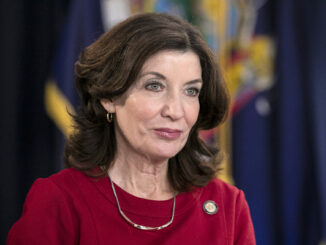
NEW YORK (TIP): Governor Kathy Hochul announced, on October 13, that the state has doubled its investment – committing more than $2.4 million – in diversity programs managed by the Associated Medical Schools of New York to help bring more traditionally unrepresented students to the physician workforce. Funded in part through the state Department of Health, these programs are designed to encourage students from backgrounds traditionally underrepresented in medicine – including those who are Black, Hispanic/Latino, Pacific Islander, or Native American – to get accepted into and complete medical school in New York.
“For far too long, communities of color in New York have faced disparities in their access to healthcare and have endured poorer health outcomes, both of which have resulted partially from their under-representation in the medical field,” Governor Hochul said. “By doubling our commitment to programs that champion diversity in medicine, we can ensure that our state’s healthcare workforce is more representative of our state’s population and help right historic wrongs.”
While more than 30 percent of the state’s population is Black or Hispanic, only 12 percent of physicians represent those demographics. Research has shown that patients seeing doctors from their own background have better health outcomes, which makes diversifying the state’s physician workforce imperative to improving the overall health of New Yorkers and addressing disparities.
New York State is now providing more than $2.4 million to diversity in medicine programs, which are designed to close gaps in the medical profession, doubling the funding commitment made last year. This funding is expected to serve more than 800 students through new and existing diversity initiatives, including Bridges to Medicine, AMSNY’s successful post-baccalaureate program at SUNY Downstate Health Sciences University. New York State Health Commissioner Dr. Mary T. Bassett discussed the importance of this commitment today during an event at SUNY Downstate, and how these programs are helping to build diversity at medical schools statewide. For the first time, about 20 percent of all medical students in New York are now from traditionally underrepresented populations, including Black and Hispanic/Latino, Pacific Islander and Native American backgrounds.
Department of Health Commissioner Dr. Mary Bassett said, “There are few things more important to our goals of improving health equity than the work of ensuring that the medical profession is as diverse as the New Yorkers they serve. Having a trusted voice and someone who understands the unique facets of your life experience can change a person’s understanding of their own health. This funding makes an investment in the people who make that a reality, and it will help for years to come by improving diversity, equity and inclusion to achieve better health outcomes for those who are traditionally underserved.”
Launched in 2017, the Bridges to Medicine is a year-long post-baccalaureate line of study designed to increase the representation of students from traditionally underrepresented and low socioeconomic backgrounds seeking admission into medical schools. Accredited as Master of Science in Physiology program in 2020, students participate in co-mingled classes as first-year medical students
Of the 57 medical students enrolled in Bridges to Medicine between 2017 and 2021, 88 percent were accepted into medical schools. In addition, six students from the program’s first cohort were matched to SUNY Downstate for their residencies.
In addition to Bridges to Medicine, the state’s investment is supporting new, innovative initiatives to ensure underrepresented students are prepared for medical school. The funding is supporting a program to encourage Black male athletes interested in entering medicine; MCAT preparation programs; research and physician shadowing opportunities; a web-based program to match students with faculty mentors; and community resources to help medical students with housing, nutritional resource, and other life skills, such as financial literacy. The increased funding is also supporting more students at AMSNY’s preexisting programs:
Post Baccalaureate Programs at Jacobs School of Medicine and Biomedical Sciences, University at Buffalo, SUNY; New York Medical College; Renaissance School of Medicine at Stony Brook University; Norton College of Medicine at Upstate Medical University.
Pathways to Careers in Medicine and Research Program at City College of New York.
Learning Resource Center at CUNY School of Medicine.
Associated Medical Schools of New York (AMSNY), a consortium of the 17 public and private medical schools in New York State, launched its first diversity pipeline programs in 1985 and has continually provided opportunities for underrepresented students to prepare for and enter medical school. The state Department of Health has provided funding for these programs since 2002 in an effort to help broaden the demographics of people entering the medical profession in New York.
Associated Medical Schools of New York President and CEO Jo Wiederhorn said, “The state Department of Health’s commitment represents a historic investment in the physician pipeline in New York State and will improve the diversity of the healthcare workforce. Our programs have shown results for over 35 years and now we will be able to really scale the impact. Over 94 percent of students in AMSNY’s four Post Baccalaureate programs, go on to medical school with approximately half going on to primary care specialties, often in underserved areas.” State University of New York Downstate President Dr. Wayne J. Riley said, “We are encouraged by the impact the Bridges to Medicine program has had on our students’ abilities to transition into their first year of medical school. In a community where the diversity is so great, in addition to providing quality healthcare, we are proud that our patients recognize and appreciate the reflection of their diverse and unique backgrounds. Our Bridges to Medicine Master’s program is a benefit to the students and an even greater benefit to the community.”
State Senator Jamaal T. Bailey said, “Diversity and representation in medicine is critical to addressing persistent racial health disparities. It is vital that our state continues to invest in programs like Bridges to Medicine that will not only provide opportunities for medical students of color but improve the health of our communities through increased access to quality, culturally competent care. Our communities deserve to have physicians they trust who understand their needs. I applaud Governor Kathy Hochul, Commissioner Mary Bassett, and the New York State Department of Health for their work to increase diversity in the medical field, create pathways to careers in medicine for communities of color, and inspire the next generation of healthcare leaders.”
Assemblymember Brian Cunningham said, “I express my gratitude to the New York State Department of Health and AMSNY for their visionary leadership and support for programs increasing diversity in medicine,” “We are fortunate to have many talented medical students and practitioners right at home in District 43, here at SUNY Downstate. Through this funding, not only are we enhancing medical services available in underserved areas like Brooklyn, but also providing incomparable opportunities to BIPOC students. These programs enable a diverse pool of medical students to pursue opportunities they might not otherwise have access to, so on behalf of myself and my constituents, I thank you.”
Assemblymember Pamela J. Hunter said, “I am immensely proud to have been the primary advocate in the Assembly for the funding of the Diversity in Medicine program for multiple state budgets. Increasing the diversity of our doctors and nurses leads to better health outcomes as we enable new practitioners in the medical field who are directly invested in their communities. I look forward to the expansion of these programs and the many benefits it will have for our medical students as well as their future patients.”
WASHINGTON , D.C. (TIP): Starting this week, the Internal Revenue Service is sending letters to more than 9 million individuals and families who appear to qualify for a variety of key tax benefits but did not claim them by filing a 2021 federal income tax return. Many in this group may be eligible to claim some or all of the 2021 Recovery Rebate Credit, the Child Tax Credit, the Earned Income Tax Credit and other tax credits depending on their personal and family situation. The special reminder letters, which will be arriving in mailboxes over the next few weeks, are being sent to people who appear to qualify for the Child Tax Credit (CTC), Recovery Rebate Credit (RRC) or Earned Income Tax Credit (EITC) but haven’t yet filed a 2021 return to claim them. The letter, printed in both English and Spanish, provides a brief overview of each of these three credits. “The IRS wants to remind potentially eligible people, especially families, that they may qualify for these valuable tax credits,” said IRS Commissioner Chuck Rettig. “We encourage people who haven’t filed a tax return yet for 2021 to review these options. Even if they aren’t required to file a tax return, they may still qualify for several important credits. We don’t want people to overlook these tax credits, and the letters will remind people of their potential eligibility and steps they can take.”
Claiming the credits
These and other tax benefits were expanded under last year’s American Rescue Plan Act and other recent legislation. Even so, the only way to get the valuable benefits is to file a 2021 tax return. Often, individuals and families can get these expanded tax benefits, even if they have little or no income from a job, business or other source. This means that many people who don’t normally need to file a tax return should do so this year, even if they haven’t been required to file in recent years.
For this mailing, Treasury’s Office of Tax Analysis identified individuals who don’t typically have a tax return filing requirement because they appear to have very low incomes, based on Forms W-2, 1099s and other third-party statements available to the IRS.
The letters are similar to a special IRS mailing made in September 2020 encouraging 9 million potential non-filers to submit a tax return for the first Economic Impact Payment. This is part of an ongoing effort to encourage people who aren’t normally required to file to look into possible benefits available to them under the tax law. Every year, people can overlook filing a tax return when they may be entitled tax credits and a refund. People can file a tax return even if they haven’t yet received their letter. The IRS reminds people that there’s no penalty for a refund claimed on a tax return filed after the regular April 2022 tax deadline. The fastest and easiest way to get a refund is to file an accurate return electronically and choose direct deposit.
Free File to stay open until Nov. 17
To help people claim these benefits, without charge, Free File will remain open for an extra month this year, until Nov. 17, 2022. Available only at IRS.gov/FreeFile, Free File enables people whose incomes are $73,000 or less to file a return online for free using brand-name software. Free File is sponsored by the Free File Alliance, a partnership between the IRS and the tax-software industry.
People can also visit ChildTaxCredit.gov/file to file a 2021 income tax return. Individuals whose incomes are below $12,500 and couples whose incomes are below $25,000 may be able to file a simple tax return to claim the 2021 Recovery Rebate Credit—which covers any stimulus payment amounts from 2021 they may have missed—and the Child Tax Credit. Individuals do not need to have children in order to use ChildTaxCredit.gov/file to find the right filing solution for them.
Further details on these expanded tax benefits
The three credits include:
An expanded Child Tax Credit: Families can claim this credit, even if they received monthly advance payments during the last half of 2021. The total credit can be as much as $3,600 per child.
A more generous Earned Income Tax Credit: The law boosted the EITC for childless workers. There are also changes that can help low- and moderate-income families with children. The credit can be as much as $1,502 for workers with no qualifying children, $3,618 for those with one child, $5,980 for those with two children and $6,728 for those with at least three children.
The Recovery Rebate Credit: Those who missed out on last year’s third round of Economic Impact Payments (EIP3) may be eligible to claim the RRC. Often referred to as stimulus payments, this credit can also help eligible people whose EIP3 was less than the full amount, including those who welcomed a child in 2021. The maximum credit is $1,400 for each qualifying adult, plus $1,400 for each eligible child or adult dependent. Besides these three credits, many filers may also qualify for two other benefits with a tax return filed for 2021:
An increased Child and Dependent Care Credit: Families who pay for daycare so they can work or look for work can get a tax credit worth up to $4,000 for one qualifying person and $8,000 for two or more qualifying persons.
A deduction for gifts to charity: Most tax-filers who take the standard deduction can deduct eligible cash contributions they made during 2021. Married couples filing jointly can deduct up to $600 in cash donations and individuals can deduct up to $300 in donations. In addition, itemizers who make large cash donations often qualify to deduct the full amount in 2021. Further details on all these benefits are available in a fact sheet, FS-2022-10, posted earlier this year on IRS.gov.
Helpful reminders
The IRS urges everyone to make sure they have all their year-end 2021 tax statements in hand before filing their 2021 return. Besides all W-2s and 1099s, this includes two statements issued by the IRS — Letter 6419, showing their total advance Child Tax Credit payments, and Letter 6475, showing their total EIP3 payments. People can also use IRS Online Account to see the total amounts of their third round of Economic Impact Payments or advance Child Tax Credit payments. For married couples who received joint payments, each spouse will need to sign into their own account to retrieve their separate amounts.
Whether or not they use Free File, anyone can find answers to their tax questions, forms and instructions and easy-to-use tools online at IRS.gov. They can use these resources to get help when they need it, at home, at work or on the go.
Claiming these credits has no effect on the ability of someone to be eligible for federal benefits like Supplemental Security Income (SSI), Supplemental Nutrition Assistance Program (SNAP), Temporary Assistance for Needy Families (TANF), and the Special Supplemental Nutrition Program for Women, Infants, and Children (WIC). Claiming these credits also has no effect on an individual’s immigration status or their ability to get a green card or immigration benefits
Filers affected by a natural disaster in Puerto Rico, Florida, North Carolina and South Carolina may have their FBAR due date further extended.
WASHINGTON, D.C. (TIP): – The Internal Revenue Service today reminds U.S. citizens, resident aliens and domestic legal entities that the extension deadline to file their annual Report of Foreign Bank and Financial Accounts (FBAR) is October 15. For additional information about filing deadlines, filers should look to Financial Crimes Enforcement Network’s (FinCEN) websitePDF.
Filers who missed the April 15 annual due date earlier this year received an automatic extension until October 15, 2022, to file the FBAR. They did not need to request the extension. Filers affected by a natural disaster may have their FBAR due date further extended. Its important filers review relevant FBAR Relief Notices for complete information. On October 6, 2022, FinCEN announced that victims of Hurricane Fiona in Puerto Rico; Hurricane Ian in Florida, North Carolina, and South Carolina; and storms and floods in parts of Alaska have until February 15, 2023, to file FBARs for the 2021 calendar year.
Who needs to file?
The Bank Secrecy Act requires U.S. persons to file an FBAR if:
They have a financial interest in or signature or other authority over one or more accounts, such as a bank account, brokerage account, mutual fund or other financial account located outside the United States, and
The aggregate value of all foreign financial accounts exceeds $10,000 at any time during the calendar year 2021.
Because of this threshold, the IRS encourages U.S. persons with foreign accounts, even relatively small ones, to check if this filing requirement applies to them. A U.S. person is a citizen or resident of the United States or a domestic legal entity such as a partnership, corporation, limited liability company, estate or trust.
How to file
Filers do not file the FBAR with their federal income tax return. The 2021 FBAR must be filed electronically with FinCEN and is only available through the BSA E-Filing System website. Individuals who are unable to e-file their FBAR must contact FinCEN at 800-949-2732 or FRC@fincen.gov to request an alternative filing method. Callers from outside the U.S. can contact the helpline at 703-905-3975.
Avoid penalties
Those who don’t file an accurate FBAR when required may be subject to significant civil and criminal penalties that can result in a fine and/or imprisonment, depending on the facts and circumstances.
FBAR resources on IRS.gov:
Report of Foreign Bank and Financial Accounts (FBAR)
Details on reporting foreign bank and financial accounts (FS-2022-24)
Publication 5569, Report of Foreign Bank & Financial Accounts (FBAR) Reference GuidePDF
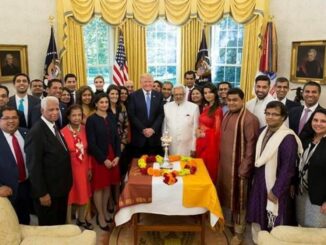
WASHINGTON, D.C. (TIP): US President Joe Biden plans to celebrate Diwali at the White House on October 24 while his predecessor Donald Trump is working on celebrating the festival of lights at his Mar-a-Lago resort in Florida on October 21. Biden plans to celebrate Diwali with eminent members of the Indian American community and members of his administration. First Lady Jill Biden will also join the festivities at the White House on October 24.
Details of Diwali celebrations at the White House are still being worked out.
Meanwhile, the Republican Hindu Coalition (RHC) on Tuesday, October 11, announced that Trump would celebrate Diwali with its members and Indian American community leaders at his Mar-a-Lago resort on October 21. It is being planned for four hours, said Shalabh Kumar from RHC, adding that the Trump team was exploring the possibilities of fireworks as well.
NEW YORK (TIP) The Executive Committee of the Kerala Chapter of the Indian Overseas Congress, USA has convened an Executive Committee meeting on October 12,2022 and unanimously passed the following resolution.
IOCUSA Kerala Chapter Resolution:
Indian Overseas Congress, USA Kerala chapter has resolved to throw its unanimous support behind the candidacy of Mr. Shashi Tharoor for the post of the Presidency of the All-India Congress Committee
IOCUSA Kerala Chapter is:
-cognizant of the fact that Mr. Rahul Gandhi has decided not to take up the position;
-appreciative to the Congress working committee for holding an open and independent election;
– anticipating a very tough election battle ahead in 2024;
– conscious of the importance of attracting the youth to the Congress fold;
– sharing the consensus to make the organization more responsive to the grassroots;
– believing that it is time for dynamic and energetic leadership;
– expecting an avalanche of support from the public to reshape the party and catapult into a new horizon to recapture the old glory of the Grand Old party that won Independence and laid the foundation for a progressive India;
– and while expressing intense disappointment that the leadership in Kerala has failed to support its native son.
The war can either go towards negotiated peace or a nuclear conflict
“Russia has lost support and sympathy across Europe. But, it is a country with scientific skills and immense natural resources. It is also one of the world’s leading producers of oil and natural gas. With shortages in supplies worldwide, there is little the western world can do to halt the looming rise in oil prices now brought about by Arab oil producers like Saudi Arabia and the UAE. This, despite appeals by Biden to lower oil prices. Prince Salman of Saudi Arabia, however, appears determined to challenge Biden’s diktats. The impact of Russia’s actions will be felt by people in Europe during winter months without the availability of Russian gas supplies.”
By G. Parthasarathy
Russia’s ties with its former republics have generally been good, even after the disintegration of the Soviet Union in 1996. It was only natural for Russia’s smaller neighbors to seek to widen their regional and international options, which is happening now. Moreover, there are millions of Russians living as local citizens in virtually all former Soviet Republics. Russia also has a long coastline across the freezing waters of the Arctic Ocean. It has, therefore, historically used ports, in what is now Ukraine, for the bulk of its trade and military operations across the sea. It also has serious concerns about ensuring uninterrupted access to the seas, through Crimea, in Ukraine. Under the leadership of President Volodymyr Zelenskyy, Ukraine has, however, in recent years, sought to widen its options through a growing strategic partnership with the US.
India has positioned itself as a constructive participant in the emerging situation in Ukraine.
Russia took control of the port facilities in Crimea in southern Ukraine in 2014. Russian population constituting 17% of Ukraine’s population lives largely near and across the shores of the Black Sea. Matters came to a head when the young and charismatic Zelenskyy hastily sought close military relations with President Biden’s administration in 2021. This transpired even as ethnic tensions between Russians and Ukrainians in southern Ukraine were escalating. Rather than seeking to promote stability in Ukraine, the Biden administration chose to play to the ego of the Ukrainian President.
In 2021 emerged a joint declaration by Biden and his Ukrainian counterpart, laced with strong anti-Russian rhetoric, which included: ‘Unwavering commitment to Ukraine’s sovereignty, independence, and territorial integrity within its internationally recognized borders, including Crimea, and extending to its territorial waters, in the face of Russian aggression’. This was an assurance of support to Ukraine for actions which would undermine Russia’s access to the sea in Crimea. This was accompanied by rapid transfer of sophisticated US military hardware to Ukraine. President Putin ordered his troops into southern Ukraine in February, with the stated objective of seizing the cities of Luhansk and Donetsk by declaring them independent states. He thereby established Russia’s control over areas where the Russians are well positioned. There are an estimated 7.7 million Russians in Ukraine, which has a total population of 43.3 million. The Russian population resides predominantly in six southern districts of Ukraine which control Russia’s access to the sea in Crimea. The Russian Black Sea Fleet was established in the Crimean Peninsula in 1783. It has historically been the gateway of Russia to the Black Sea, the Sea of Azov and the Mediterranean Sea. The ill-planned and poorly executed Russian military response that followed the Biden-Zelenskyy declaration, combined with massive US and NATO arms assistance, threatened the only historical Russian access to the seas.
The Russians are now confined to operating almost exclusively in Ukraine’s six districts of Mariupol, Luhansk, Donetsk, Melitopol, Kherson and Crimea. While Russia had taken control of these largely Russian-dominated areas, its forces are now under tremendous risk of being overrun by far better equipped Ukrainian forces. Given the strategic dimensions and the location of these areas, there is every possibility of Russia resorting to the use of tactical nuclear weapons, if unavoidable. Just over a year ago, Biden and Putin proclaimed in a joint statement that: ‘A nuclear war cannot be won and should never be fought’. The durability of that statement is now under test, with Putin not ruling out the use of tactical nuclear weapons. Biden, in turn, is warning of dire consequences if Russia does so.
Putin placed Russia’s nuclear forces in ‘special combat readiness’ on February 22 and held high-profile nuclear drills. More recently, he said: ‘If the territorial integrity of our country is threatened, we will, without a doubt, use all available means to protect Russia and our people. This is not a bluff.’ Biden predictably rebuffed Putin’s threat. This is the first time that the world is facing such a dangerous threat of an impending use of nuclear weapons, especially as the Ukrainians are now eyeball to eyeball with Russians. While many Russians may not agree with Putin’s policies, they will rally behind him in such a situation.
While the atomic bombs that devastated Hiroshima and Nagasaki had a capacity of 15-25 kilo tons of high explosives, tactical nuclear weapons have capacities ranging from 0.1 to 1 kilo ton. According to US intelligence, Russia has about 2,000 tactical weapons. One hopes Zelenskyy does not provoke the Russians to act drastically.
Russia has lost support and sympathy across Europe. But, it is a country with scientific skills and immense natural resources. It is also one of the world’s leading producers of oil and natural gas. With shortages in supplies worldwide, there is little the western world can do to halt the looming rise in oil prices now brought about by Arab oil producers like Saudi Arabia and the UAE. This, despite appeals by Biden to lower oil prices. Prince Salman of Saudi Arabia, however, appears determined to challenge Biden’s diktats. The impact of Russia’s actions will be felt by people in Europe during winter months without the availability of Russian gas supplies.
India has positioned itself as a constructive participant in the emerging situation in Ukraine. This is evident as all sides have hailed PM Modi’s talks with Putin at the recent SCO Summit, where Modi drew attention to the reality that: ‘Today’s era is not an era of war.’ This statement has been welcomed by the governments and media in the US, Russia and across Europe. One hopes that Biden, Putin and Zelenskyy heed the advice and move towards a negotiated settlement to avoid a looming, dangerous conflict.
(The author is Chancellor, Jammu Central University & former High Commissioner to Pakistan)
Only a compromise through talks can end the hostilities in Ukraine
The massive Russian bombing of cities across Ukraine that followed a blast at the Kerch Strait bridge linking the Russian mainland to the Crimean Peninsula suggests that the Ukraine war is in a dangerous escalatory spiral with no way out in sight. Saturday’s attack on the Russian-built bridge was cheered by many in Ukraine, with President Volodymyr Zelenskyy’s adviser Mykhailo Podolyak calling it “just the beginning”. But Russia retaliated the next day with its broadest missile strike on Ukraine since the war began on February 24, targeting military and civilian infrastructure. The missile attack has demonstrated not just Russia’s firepower eight months into the war but also its little regard for civilian lives and infrastructure. It also points to the desperation of Russia whose forces have suffered a series of setbacks in recent weeks. But besides this show of strength punishing Ukraine’s population, the attack has little strategic value. It has not improved Russia’s battlefield positions. And it has not weakened the resolve of Ukraine and its allies to continue to resist the Russian invasion either. On the contrary, the Group of Seven industrialized countries have vowed undeterred support for Ukraine “as long as it takes”.
Typically, conflicts come to an end either with an outright victory by one side or through a negotiated settlement. Both possibilities look distant at this point in the Ukraine war. Russia wants to seize at least Ukraine’s eastern and southern provinces. It has made some territorial gains but its advances have been stalled by the Ukrainian troops with backing from NATO. Ukraine wants to oust the Russian troops from all captured territories, including Crimea, which appears to be impractical. And Russian President Putin’s unilateral decision to annex four Ukrainian provinces, in flagrant violation of international laws and norms, has made the prospects for peace extremely difficult. But the alternative to talks is continuation of the conflict — Europe’s most dangerous land war since the Second World War, with its human and economic costs and growing fears of a nuclear attack. That is the last thing the world wants now. Even in 1962, when Soviet nuclear missiles were in Cuba and U.S. warships had quarantined the Caribbean Sea, Kennedy and Khrushchev had talked to each other, exchanged letters and found a solution to the missile crisis that had pushed the world to the brink of a nuclear war. Mr. Putin should back off from his maximalist threats and offer some concrete proposals for talks. His rivals in the West should also work towards creating conditions for negotiations that could bring this conflict, which has already wreaked havoc, to an end.
Need to avoid pick-and-choose action against offenders
The Supreme Court has acknowledged that a petitioner may be right in claiming that the ‘entire atmosphere is getting sullied’ due to hate speech against minorities, even as it has sought responses from the Uttarakhand and Delhi governments on action taken by the police against the speakers who spewed communal venom during Dharam Sansads last year. The court’s remarks come weeks after it had stated that ‘hate speech is like a layered thing, like killing someone, you can do it in multiple ways, slowly or otherwise.’ The court had not only pulled up the Centre for remaining a mute spectator to the goings-on, but also emphasized the need for stricter regulations to monitor TV debates which often degenerated into platforms for hate speech.
Speeches that demonize certain groups often inflame communal passions, posing a threat to peace as well as law and order; what’s worse, they undermine India’s secular credentials. New Delhi had to do a lot of diplomatic firefighting after the controversial statements made by a couple of BJP leaders about the Prophet triggered a backlash from Islamic nations. The onus is on the political and religious leadership to restrain the hotheads and rabble-rousers and weed them out whenever they cross the line.
The prompt registration of an FIR against the Vishva Hindu Parishad and other organizers of an event in Delhi, where a BJP MP and other speakers allegedly stoked communal tensions, conveys the stern message that nobody is above the law. Hate speech, however, is not always unleashed on minority communities. Sometimes, one minority group may use it to target another, or even direct it at the majority community. During a rally organized by the now-banned Popular Front of India in Kerala in May, a boy raised slogans that called for the killing of Hindus and Christians. The now-banned outfit did not even offer an apology for this extreme form of hatemongering. With their credibility at stake, law enforcement agencies must crack the whip on all offenders who fan the flames, no matter which community they belong to.
Modi regime’s American support base suffers multiple defeats in Summer of 2022
“Hindu nationalists in the US are contributing to the “alarming trend” of anti-Asian hate crimes in the country. “If we are to confront and begin to counter such hateful assaults, we must recognize Hindutva’s deep roots and long-standing harms in New Jersey,” she writes. “A hard truth is that while many New Jerseyans are only now learning the basics of Hindu nationalism, many of our state’s minority communities — especially South Asian Muslims — have lived for decades with the specter of fear and intimidation imposed by purveyors of this intolerant ideology. It is time for that era to end, and for us to say together — Hindutva hate has no home in New Jersey.”-Dr Truschke.
By Peiter Friedrich
After the Old Paramus Reformed Church in Ridgewood, New Jersey cancelled a 10 September 2022 speech by infamous Hindu nationalist demagogue Sadhvi Ritambhara, it sent shockwaves felt on the other side of the Atlantic. Throughout the Summer of 2022, from New Jersey to California, organized resistance against the influence of Hindutva (that is, Hindu nationalist) politics in the US resulted in multiple victories. The most recent victory started in the small village of Ridgewood, but it soon took on international dimensions.
Ritambhara’s multi-state US tour was shrouded in protest from the outset.
Beginning in Atlanta, Georgia on 30 August, she faced protest by an interfaith crowd of over 100. “She has openly called for the massacre of Muslims and Christians in India,” warned protestor Rahim Shah Akhunkhail. “We reject it. America rejects it. We call people of all faiths to reject and denounce such people.”
Sadhvi Ritambhara, the fiery orator.
Ritambhara — who is the founder of Durga Vahini, the women’s wing of the Vishwa Hindu Parishad (VHP), which is the religious wing of India’s fascist Rashtriya Swayamsevak Sangh (RSS) paramilitary — next went to New Jersey. There she faced her first defeat. Over two days, the Ridgewood church reported receiving over 100 calls and 1,000 emails requesting it de-platform her. On the eve of the event, the church’s pastor finally revoked permission.
The protest continued clouding Ritambhara’s US tour as she travelled to Los Angeles, where a large multi-faith crowd again rallied outside the venue hosting her. “She does not represent the Hinduism of inclusion, justice, and service to humanity,” declared protestor Tahil Sharma. “She is focused on a narrative that is trying to hurt those that are minorities in India. Her focus is on hatred rather than uniting people.” Ritambhara soon faced total defeat. After completing her US tour in mid-September, she was scheduled for a multi-city tour of the UK. It didn’t go as planned.
She was still in America when British Members of Parliament launched demands to deny her entry to the UK. In letters to the Home Minister, MPs denounced her “xenophobic” and “Islamophobic” rhetoric, warning that it could stoke communal tensions in their constituencies. Within days, her entire UK tour was scrapped. “Just prior to her planned visit to the UK, she was disinvited from speaking in a church in the US, thanks to the campaigning by progressive groups in America,” noted British journalist Amrit Wilson. “She obviously did not wish to face a similarly humiliating situation in the UK.”
Some sources suggest Ritambhara’s cancellation was not voluntary but rather the result of Britain’s Home Office, responding to the “coordinated action of concerned citizens and civil society group” demanding it, actually revoking her visa. Whatever the case may be, shifting focus back to New Jersey, the Ritambhara drama was not the end of the anti-Hindutva resistance’s recent successes in that state.
“America, especially New Jersey, is a stronghold for Hindu nationalist groups who provide financial support and ideological guidance for the larger global movement,” explains Dr Audrey Truschke. Many anti-Hindutva activists ruefully refer to the state — in reference to the Indian city where the RSS is headquartered — as the “Nagpur of America.” Yet, surprisingly, New Jersey is ground zero for most of the latest victories against the movement.
Since 2014, Hindutva ideologues have dominated India through Prime Minister Narendra Modi’s regime. Through his Bharatiya Janata Party (BJP), which serves as the political wing of the RSS, Modi and his devotees are unleashing an authoritarian nightmare upon a country once celebrated as the world’s largest democracy. Although mainstream America has been slow to realize it, the RSS-BJP’s rise to power in India was aided and abetted by an immense US support base.
The collection of affiliated Hindutva groups in India — which includes the RSS, VHP, and BJP — is commonly known as the “Sangh Parivar” (Family of Organizations). All three outfits have American affiliates, namely: Hindu Swayamsevak Sangh USA (HSS-USA), Vishwa Hindu Parishad of America (VHPA), and Overseas Friends of the BJP USA (OFBJP-USA). Although all three are legally distinct entities, their leadership and membership — just as it is in India — is heavily cross-pollinated.
Notably, the HSS-USA is registered as a nonprofit in New Jersey. Up until at least 2019, after which it was compelled to register as a Foreign Agent, so also was the OFBJP-USA.
While this American Sangh Parivar has supported the Hindutva agenda in India in many ways, one of the most notable was their mass mobilization efforts to get Modi elected in 2014 and re-elected in 2019. During both election cycles and in coordination with leaders from both HSS-USA and VHPA, the OFBJP-USA reportedly deployed thousands of volunteers to India to campaign for the BJP.
Striking back against the American Sangh, therefore, has great potential to undermine the agenda of the regime in India.
Baba ka Bulldozer which caused a massive reaction to the right-wing Hindutva elements in New Jersey
he current series of struggles in New Jersey began after a 14 August parade hosted in the city of Edison to celebrate India’s Independence Day, an event in which many city and state elected officials enthusiastically participated. Organized by the India Business Association (IBA), the event was overtly partisan from the start as organizers invited BJP Spokesperson Sambit Patra to serve as the event’s grand marshal. Other participants in the event reportedly included the HSS-USA and VHPA.
Controversy soon erupted.
The parade’s centerpiece was a bulldozer bedecked with photos of Modi as well as the BJP Chief Minister of the Indian state of Uttar Pradesh, Yogi Adityanath. Leading the way for the bulldozer, their banner proudly stretched out for all to see, was a contingent of the OFBJP-USA. The symbolism was beyond inflammatory. “To those who understood its symbolism, it was a blunt and sinister taunt later likened to a noose or a burning cross at a Ku Klux Klan rally,” reported The New York Times. It represented an open endorsement of one of the BJP’s most egregious current anti-Muslim tactics.
The bulldozer, in short, was a symbol of hate.
A foundational ideological aspect of the RSS-BJP is its devotion to transforming India into an exclusively Hindu nation where all minorities — particularly Christians and Muslims — are either subjugated or eliminated. The bulldozer has increasingly come to symbolize that goal. Under the chief minister’s regime, the machine is being used to routinely and extrajudicially demolish the homes, businesses, and religious sites of Muslims, particularly those known for dissenting against him. The New York Times reports that bulldozers have become “a symbol of oppression” while France24 explains that “bulldozer justice” is now perceived as an example of “an unlawful exercise in collective punishment.” The RSS-BJP wants to crush the spirit of Indian minorities, especially the vocal Muslim population, and the physical manifestation of that is currently the bulldozer.
In Spring 2022, Adityanath embraced the symbolism in his campaign for reelection, welcoming slogans hailing him as “Baba Bulldozer” (Daddy Bulldozer) — a slogan displayed alongside his photo on the bulldozer in Edison. The message at the New Jersey parade was clear: Indian minorities are as unwelcome there as they are under RSS-BJP rule in India. Rather than be intimidated, however, locals pushed back hard — and won.
Resistance was swift and successful.
Throughout Edison Township Council meetings on 22 and 24 August, dozens turned out to register their protest in the public comments session. The backlash soon sparked reactions by elected officials ranging from Edison Township all the way to the US Senate.
“This was a tipping point for us,” one woman in hijab told the council. Tasim Ansari warned that the bulldozer is being “used to dehumanize people,” explaining that anyone who saw it in the parade would be disgusted. “India Day Parade is supposed to be for all the Indians who are living in the US, not for only 30-35 per cent of Hindutva ideology, those who are growing, spreading hate in India, and now sending it overseas in America,” said Nasir Ahmed. “Modi, the current prime minister of India, came from RSS. They’re the ones who acquired ideology from Hitler.” Taj Shaikh claimed the bulldozer represented “fascism and the BJP,” noting, “Hindutva is not Hinduism. It is a murderous, socially and culturally backwards, bigoted ideology.”
“This is clearly giving a message of intimidation to American Indian Muslims and other minorities that ‘hey, we are here, we are in control, you can’t do anything, even in America’,” explained Dylan Terpstra of CAIR-NJ. Comparing what a bulldozer symbolizes for Indian Muslims to what a noose symbolizes for African-Americans, he continued: “It needs to be understood what this bulldozer really means. Homes, mosques, businesses, and churches, are being demolished in India because people speak up and out against Baba Bulldozer and other Hindutva leaders.” As Bishop Nikolaos Brown concluded: “This act of hatred and injustice not only has repercussions here in Edison but across the state, across the country, and across the world.”
In response, all but one of the township’s nine councilors — many of whom actually attended the parade — vehemently condemned the incident.
“I would not have participated in the parade had I known [about the bulldozer],” said Council President Joseph Coyle. “I would have walked right off the street.”
Council Vice-President Joyce Ship-Freeman was even more emphatic, declaring, “Had it been the noose, would we all have been walking behind it and following it? No. This is not the Edison we should accept. We should all stand out against it because if it’s on one group today, it will be on another group tomorrow.” Councilor Margot Harris called the incident “absolutely hideous and unacceptable.” Councilor John Poyner stated, “We do not want that type of divisiveness and that type of hatred, quite honestly, spread about the township.” Councilor Nishith Patel — noting that he’s a Hindu of Indian origin — denounced the bulldozer as representing “intolerance of culture, division, hatred.” Simultaneously, the controversy spilled over into the neighboring township of Woodbridge, some of whose officials had also attended the parade. It didn’t end at the borders of the townships, however, but soon reverberated across the entire state. On 25 August, a day after the final showdown at Edison Township Council, five members of the New Jersey State Legislature — four assemblymembers and one senator — issued a joint statement condemning the inclusion of the bulldozer in the parade, describing it as “a symbol of division and hate.”
The following day, US Congresswoman Bonnie Coleman, declaring that “hate has no place in New Jersey” and warning that Modi’s regime is targeting Muslim properties with bulldozers, stated, “The inclusion of a bulldozer with a picture of Modi at the India Day parade in Edison was a display of bigotry.” Finally, in early September, the state’s two US senators issued a joint statement. Noting that many local South Asian Americans were “angered and deeply hurt” by the incident, Senators Cory Booker and Bob Menendez declared, “The bulldozer has come to be a symbol of intimidation against Muslims and other religious minorities in India, and its inclusion in this event was wrong.” Inexplicably, two politicians who participated in the event have maintained their silence. Neither New Jersey Assembly Speaker Craig Coughlin nor US Congressman Frank Pallone (founder of the powerful Congressional Caucus on India and Indian Americans) have offered any comment.
Initially, the IBA stubbornly refused to apologize, insisting that “it had not done anything wrong” and calling complaints about the bulldozer “prejudiced.” Yet it took less than a week for them to reverse course and, in the face of mass pressure, offer their “sincere apologies” for having “offended the Indian American minority groups, especially Muslims.”
Ultimately, the IBA probably deserves a heartfelt thank you from the US’s anti-Hindutva resistance for — unintentionally — creating a golden opportunity to direct the attention of American elected officials not only to the growing human rights crisis in Modi’s India but also to how his authoritarian regime is backed by radical elements from abroad.
Shifting focus from the East to the West Coast, a similar — though smaller-scale — victory occurred after HSS-USA activity in the small city of Manteca, California also offered an opportunity to educate local officials about the realities and dangers of the global Hindutva movement. On 3 August, the Manteca City Council unanimously rescinded and apologized for a proclamation they had passed earlier in the year to honor the US wing of the RSS.
The HSS-USA routinely solicits such proclamations from city councils around the country. Taking advantage of the general American ignorance of even the existence — let alone the nature — of the Sangh Parivar, it stacks up dozens, scores, and hundreds of these official recognitions, then publicizes them through its networks to build up its veneer of legitimacy. After all, the outfit seems to think, if it can show that it has been praised and platformed by local governments all around America, people will be far less likely to heed concerns about how the HSS-USA’s leadership and membership systematically work to help prop up the RSS-BJP back in India.
Pushback in Manteca began on 19 July when approximately 50 people gathered during a city council meeting to raise placards and speak in protest during the public comments session. Their appeals were heard. By the following council meeting, a resolution to rescind the HSS-USA proclamation was on the agenda. During a nearly four-hour meeting, dozens from both opposing sides commented. Eventually, the council — while noting that the HSS did, by all appearances, seem to be linked to the RSS — voted to rescind the proclamation.
It was the first time ever that an American city has overturned one of their recognitions of the HSS-USA, and it has great potential to set a precedent as other neighboring cities are now considering doing the same. Just as in Edison, NJ, the incident offered the anti-Hindutva resistance a chance to turn the eyes of American officials to the situation in India.
In New Jersey, the Edison incident and the Ritambhara drama are now helping to escalate broader regional action against Hindutva.
On 12 September, 40 miles north of Edison, the Democratic Party unit in the township of Teaneck passed a resolution condemning Hindu nationalist groups which operate in the US with “direct and indirect ties” to the RSS. The resolution urged members of US Congress to request the Federal Bureau of Investigation and the Central Intelligence Agency to investigate “foreign hate groups that have domestic branches with tax-exempt status” and called for changes to the visa process to prevent speakers like Ritambhara from entering the country. With any luck, and according to feedback from talking to activists on the ground, this may be just the first of many such resolutions to come.
Indeed, since May 2022, we have seen anti-Hindutva activism expand from the confines of the South Asian American community as it is taken up by progressive groups in both Illinois and Maryland. However, while these kinds of efforts are needed nationwide, there are few places in the country where such pushback is of greater urgency than in the Hindutva hub of New Jersey.
The risk of allowing Hindutva-aligned entities to operate in the US without oversight is that they may not stop short of bigoted displays of intimidation — such as with the bulldozer — but stoop deeper to commit actual atrocities. This was most vividly illustrated in 2021 in Robbinsville, a small town less than 40 miles south of Edison.
The religious group Bochasanwasi Akshar Purushottam Swaminarayan Sanstha (BAPS), while building a giant temple in the town, was raided by the FBI in May 2021. BAPS was accused, essentially, of using slave labour for construction. For years, they had allegedly lured mostly low-caste men from India, reportedly confiscating their passports upon arrival, housing them in guarded complexes, and forcing them to work up to 13 hours a day for less than $500 a month.
BAPS reportedly has “strong ties” with Modi (who has called its founder his mentor) and has been described as holding both a “close link” with the BJP as well as being “widely suspected of having some connection” with a 2002 anti-Muslim pogrom in the Indian state of Gujarat, which is both Modi’s home state as well as the site of the sect’s founding.
The FBI raid coincided with the filing of a federal lawsuit on behalf of the allegedly exploited laborer’s. By November 2021, the lawsuit expanded to include BAPS properties in Atlanta, Chicago, Houston, and Los Angeles — all cities which, alongside New Jersey, serve as major hubs for the Hindutva movement in the US.
Even more recently, peaceful American protests against Hindutva have faced outright violence. On the same day that the bulldozer rolled through Edison, protestors in Anaheim, CA were assaulted by participants in an India Independence Day Mela.
As the group of mostly young South Asian American protestors, holding placards calmly walked through the event at Anaheim’s La Palma Park, a mob formed and screamed at them to leave.
“Open your hearts,” said one sign. Another asked: “Where is your empathy?” Yet another stated: “Protect India’s Muslim Lives.” Even as the protestors exited the public event, the enraged mob continued to pursue them, shoving them, swinging at them, and stealing and destroying their signs. Frightened protestors cried out, “Don’t touch me. Get away from me.” In response, at least one of their assailants shouted, “Stupid Muslim, get out!”
The greatest concern prompted by the Hindutva violence in California — although it is already perhaps the most egregious witnessed in the US during the Modi regime’s reign — is that unchecked, it could escalate to the higher levels already occurring in other countries where the movement has gained strong footholds.
In October 2021, for instance, Australian resident Vishal Jood was deported to India after being arrested and jailed for multiple armed assaults on Sikhs who had protested Modi’s policies. Upon returning to India, he received a “hero’s welcome,” complete with a street parade in his honor. In September 2022, far more organized violence broke out in the streets of Leicester, UK.
The city, which is reportedly home to the largest population of British Indians outside of London, has seen brewing tension between Hindu and Muslim communities for several months. One of the flashpoints allegedly occurred in May, when a gang of 30 apparently Hindu youth savagely beat a young Muslim man with baseball bats, breaking his arm while demanding to know if he is Muslim.
As conflict successively escalated, it came to a head on 17 September when a mob of approximately 200 masked and hooded men — many of whom appeared armed with metal rods or pipes — marched through the city chanting, “Jai Shri Ram.” As British criminologist Chris Allen notes, the phrase has become “synonymous with Hindu nationalist violence”; or, to quote British journalist Faisal Hanif, it is “a Hindu chant that became ‘a murder cry’ in India.” As the mob marched through the streets, scuffles broke out that bled over into the next day. Nearly 50 people were ultimately arrested, with authorities reporting that a large number of them hailed from outside the region.
Should US authorities continue to ignore the spread of Hindutva influence in the country, the risk that the same sort of street violence witnessed in Australia and the UK will spread to the US grows. The bulldozer incident — an example of hateful intimidation — was handled peacefully through proper civic channels. Yet the incident in Anaheim is an entirely different story.
In fact, when I spoke with organizers of the peaceful protest in Anaheim (who chose to remain anonymous), they expressed fears about even registering a case with the local police, even though their attackers, their violent actions, and their faces were all clearly caught on camera and even personally witnessed by a Los Angeles Times journalist.
So extensive is the network and influence of the American Sangh Parivar, it seems, that when its apparent sympathizers begin enacting physical violence, their victims don’t feel safe to even file a police report. If that’s the case now, imagine what the situation — left unchecked — will look like over the ensuing years, particularly considering that the RSS-BJP appears likely to remain in power in India (probably thanks, in part, to continued backing from its overseas support base) for quite some time to come. As Indian academic Pratap Bhanu Mehta notes, Hindutva has become “a global ideology of hate and asserting cultural dominance.” Thus, he warns, “It is bizarre to think you can have this much dissemination of hate without it having violent political consequences. Now that inhibitions have been broken, brace for more conflict.”
It is well past time that the American public — especially the nation’s elected officials, from city to state to federal level — wake up not only to the threat that the Hindutva movement poses to the citizens of India but even to those living abroad who would dare to oppose it. Successful resistance like that seen in New Jersey with Ritambhara, the bulldozer, and one small political party chapter rising up must be applauded and replicated throughout the US — as must be the victory over the HSS-USA witnessed in California.
Can New Jersey remain the ground zero for such resistance?
For the sake of saving lives, action is urgently needed. International experts are sounding the alarm, warning that India is edging closer and closer — day by day — to the brink of genocide. Let it not be said that we live abroad stood silently by while that impending atrocity unfolded. Let it certainly not be said that we allowed violence in India to be supported by elements within our own countries — let alone bleed over to touch and harm anyone within our own nations.
Dr Truschke — who herself is a professor at New Jersey’s Rutgers University — says that Hindu nationalists in the US are contributing to the “alarming trend” of anti-Asian hate crimes in the country. “If we are to confront and begin to counter such hateful assaults, we must recognize Hindutva’s deep roots and long-standing harms in New Jersey,” she writes. “A hard truth is that while many New Jerseyans are only now learning the basics of Hindu nationalism, many of our state’s minority communities — especially South Asian Muslims — have lived for decades with the specter of fear and intimidation imposed by purveyors of this intolerant ideology. It is time for that era to end, and for us to say together — Hindutva hate has no home in New Jersey.” With any hope, New Jersey — that “Nagpur of America — will shine forth as one of the most gloriously victorious battlegrounds against the fascism of Hindutva.
(Pieter Friedrich is a freelance journalist specializing in analysis of South Asian affairs. He is the author of India at a Crossroads: Hindu Nationalist Efforts to Eradicate Christianity, Sikh Caucus: Siege in Delhi, Surrender in Washington and Saffron Fascists: India’s Hindu Nationalist Rulers as well as co-author of Captivating the Simple-Hearted: A Struggle for Human Dignity in the Indian Subcontinent. Discover more at PieterFriedrich.com.)
UNITED NATIONS (TIP): The U. N. General Assembly voted overwhelmingly Wednesday, October 12, to condemn Russia’s “attempted illegal annexation” of four Ukrainian regions and demand its immediate reversal, a sign of strong global opposition to the seven-month war and Moscow’s attempt to grab its neighbor’s territory. The vote in the 193-member world body was 143-5 with 35 abstentions. It was the strongest support from the General Assembly for Ukraine and against Russia of the four resolutions it has approved since Russian troops invaded Ukraine on February 24. Ukraine’s U. N. ambassador, Sergiy Kyslytsya, called the vote “amazing” and “a historic moment.” U. S. Ambassador Linda Thomas-Greenfield said supporters were “holding our breaths” and called it “a monumental day.” European Union Ambassador Olof Skoog called it “a great success” that sends “a resounding message to Russia that they are and remain isolated.”
U. S. President Joe Biden said in a statement that the vote demonstrated the world “is more united and more determined than ever to hold Russia accountable for its violations.” It is “a clear message” that “Russia cannot erase a sovereign state from the map” and it “cannot change borders by force,” he said. The Western-sponsored resolution was a response to Russia’s announced annexation last month of Ukraine’s Donetsk, Luhansk, Kherson and Zaporizhzhia regions. Moscow acted following Kremlin-orchestrated “referendums” that the Ukrainian government and the West have dismissed as sham votes conducted on occupied land amid warfare and displacement.
Violation of U.N. Charter
During two days of speeches at the assembly’s resumed emergency special session on Ukraine speaker after speaker accused Russia of violating key principles of the United Nations Charter — respect for the sovereignty and territorial integrity of all U. N. member nations.
There was intense lobbying by supporters of the E. U.-facilitated resolution ahead of Wednesday’s vote. U, S. envoy Thomas-Greenfield told the assembly before the vote that when the United Nations was established on the ashes of World War II it was built on an idea — “that never again would one country be allowed to take another’s territory by force.” Afterward, she told reporters the vote means “that in the eyes of the world and the United Nations, Ukraine’s borders remain the same.” “The resolution also sends an enormously important signal to Moscow and to everyone: It does not matter if you as a nation are big or small, rich or poor, old or new. If you are a U. N. member state, your borders are your own and are protected by international law,” Ms. Thomas-Greenfield said. “They cannot be redrawn by anyone else by force.”
Result beyond expectations
A key issue for the resolution’s Western backers was how many countries would support it, and the result went beyond their most optimistic expectations. The General Assembly voted 141-5 with 35 abstentions March 2 to demand an immediate Russian ceasefire, withdrawal of all its troops and protection for all civilians. On March 24, it voted 140-5 with 38 abstentions on a resolution blaming Russia for Ukraine’s humanitarian crisis and urging an immediate ceasefire and protection for millions of civilians and the homes, schools and hospitals critical to their survival. But the assembly voted by a far smaller margin April 7 to suspend Russia from the U. N.’s Geneva-based Human Rights Council over allegations Russian soldiers in Ukraine engaged in rights violations that the United States and Ukraine have called war crimes. That vote was 93-24 with 58 abstentions. A 2014 resolution affirming Ukraine’s territorial integrity and declaring the referendum that led to Russia’s annexation of the Crimean Peninsula illegal was adopted by a vote of 100-11 with 58 abstentions.
Among the surprise supporters of Wednesday’s resolution were the “yes” votes from Saudi Arabia, the United Arab Emirates and other members of the Gulf Cooperation Council as well as Brazil.
Russia responds
Russia’s U. N. ambassador, Vassily Nebenzia, had appealed to countries to vote against the resolution, calling it “a politicized and openly provocative document” and denouncing its sponsors as “unscrupulous Western blackmailers”. He expressed regret the vote was not by secret ballot, as Russia sought but the assembly rejected. Mr. Nebenzia reiterated Russia’s claims the referendums were valid, saying “the populations of these regions do not want to return to Ukraine.” The four countries that joined Russia in voting against the resolution were North Korea, Belarus, Syria and Nicaragua. Ukraine’s Kyslytsya expressed profound regret that the four countries made “the wrong choice against the U. N. Charter” and urged them to reconsider their commitment to the U. N.’s principles.
India abstains
Among the 35 countries that abstained, 19 were from Africa, including South Africa. China and India, the world’s two most populous countries, also abstained along with Pakistan and Cuba.
The more powerful Security Council, whose resolutions are legally binding, has been stymied on taking action on Ukraine because of Russia’s veto power, which it used September 29 to block condemnation of Russia’s attempts to annex Ukrainian territory.
Not legally binding
By contrast, the General Assembly, where there are no vetoes, has now approved four resolutions criticizing Russia over Ukraine. Its votes reflect world opinion but are not legally binding.
The resolution adopted Wednesday declares that Moscow’s actions violate Ukraine’s sovereignty and territorial integrity, are “inconsistent” with the principles of the U. N. Charter, and “have no validity under international law and do not form the basis for any alternation of the status of these regions of Ukraine”. It demands that Russia “immediately, completely and unconditionally withdraw all of its military forces from the territory of Ukraine within its internationally recognized borders”. And it supports “the de-escalation of the current situation and a peaceful resolution of the conflict through political dialogue, negotiation, mediation and other peaceful means” that respect Ukraine’s sovereignty, territorial integrity and internationally recognized borders.
What the countries said
Many countries among the more than 70 speakers urged a negotiated end to the war. The E. U.’s Skoog called the appeal for a peaceful solution “very important,” but stressed it must be based on Ukraine’s territorial integrity. During Wednesday’s debate there was strong support for the resolution. Australian Ambassador Mitch Fifield called Russia’s attempted annexation “illegal and a dangerous escalation” and urged all countries to oppose acts of aggression. Ambassador Fergal Mythen of Ireland said voters in the “sham” referendums in the four regions “faced intimidation by the Russian military and Russia’s illegitimately appointed authorities”.
Cambodian Ambassador Sovann Ke didn’t indicate how he would vote but said that “the forcible annexation of regions from a sovereign country is a flagrant violation of the U. N. Charter and international laws, which is not acceptable” and urged that internationally respected borders “be fully respected.” In the voting, Cambodia supported the resolution.
South Korea’s ambassador, Hwang Joonkook, gave unequivocal support “to the sovereignty, political independence and the territorial integrity of Ukraine.” He said his country’s “own painful experiences” after the 1950-53 Korean War “can testify that any attempt to divide a nation in any form or method is merely the beginning of lasting very serious troubles, rather than a solution”.
North Korea backs Russia, slams the West
On the other side of that divide, North Korean Ambassador Kim Song supported the “self-determination” of the people in the four regions annexed by Russia as a right protected in the U. N. Charter and said the results must be respected.
He accused the United States and Western countries of “brutally” violating the sovereignty and territorial integrity of former Yugoslavia, Afghanistan, Iraq and Libya under “the pretext” of promoting international peace and security without ever having its actions called into question by the Security Council. He argued that U. S. interference in the internal affairs of countries is continuing in the 21st century.
Syrian Ambassador Bassam Sabbagh accused the General Assembly of “being manipulated flagrantly by some Western countries for their own geopolitical interests” and urged countries to oppose efforts “to isolate Russia and to employ double standards”.
WASHINGTON, D.C. (TIP): The House Jan. 6 committee has subpoenaed Donald Trump for his testimony about the 2021 Capitol attack. The House Jan. 6 committee voted Thursday, October 13, to subpoena Donald Trump for testimony before the panel over the 2021 attack at the Capitol. The panel voted unanimously to compel the former President to appear. “We must seek the testimony under oath of January 6th’s central player,” said Rep. Liz Cheney, R-Wyo., the committee’s vice chair. The Jan. 6 panel is showing previously unseen footage of congressional leaders phoning officials for help during Capitol siege. House Speaker Nancy Pelosi and Senate Democratic Leader Chuck Schumer can be seen talking to governors in neighboring Virginia and Maryland. Later the footage shows Senate Republican Leader Mitch McConnell and other GOP leaders as the group asks the acting attorney general for help. “They’re breaking the law in many different ways — quite frankly at the instigation of the President of the United States,” Pelosi is heard saying at one point.
The U.S. House Jan. 6 Committee planned to vote Thursday to subpoena former President Donald Trump to testify, as it presented interviews with his aides and new documents detailing his unflagging multi-part efforts to overturn his 2020 election loss.
The vote seeking Trump’s testimony comes as the panel is producing vivid new details and evidence of Trump’s state of mind as he refused to concede his election loss to Joe Biden, resulting in the 2021 attack at the Capitol.
In never-before-seen Secret Service messages, the panel produced evidence of the way extremist groups provided the muscle in the fight for Trump’s presidency, planning weeks before the attack to send a violent force to Washington. “Their plan is literally to kill people,” read a tip that was sent to Secret Service more than a week before the violence on Jan. 6. The Secret Service warned in a Dec. 26, 2020, email of a tip that members of the right-wing Proud Boys planned to march in Washington on Jan. 6 with a group large enough to outnumber the police. “It felt like the calm before the storm,” one Secret Service agent wrote in a group chat. The House panel warned that the insurrection at the Capitol was not an isolated incident but a warning of the fragility of the nation’s democracy in the post-Trump era. “None of this is normal or acceptable or lawful in a republic,” Republican Rep. Liz Cheney said. “There is no defense that Donald Trump was duped or irrational. No President can defy the rule of law and act this way in a constitutional republic, period.”
The 10th public session, just weeks before the congressional midterm elections, was delving into Trump’s “state of mind,” said Democratic Chairman Bennie Thompson. The committee is starting to sum up its findings that Republican Trump, after losing the 2020 Presidential election, launched an unprecedented attempt to stop Congress from certifying Democrat Biden’s victory. The result was the mob storming of the Capitol. Statements from Thompson and Cheney were laden with language frequently seen in criminal indictments. Both lawmakers described Trump as “substantially” involved in the events of Jan. 6. Cheney said Trump had acted in a “premeditated” way.
To illustrate what it said were “purposeful lies,” the committee juxtaposed repeated instances in which top administration officials recounted telling Trump the actual facts with clips of him repeating the exact opposite at his pre-riot rally at the Ellipse on Jan. 6.
The committee may well make a decision on whether to make a criminal referral to the Justice Department.
Thursday’s hearing opened at a mostly empty Capitol complex, with most lawmakers at home campaigning for reelection. Several people who were among the thousands around the Capitol on Jan. 6 are now running for congressional office, some with Trump’s backing. Police officers who fought the mob filled the hearing room’s front row. To describe the President’s mindset, the committee divulged new material, including interviews with Trump’s top Cabinet officials, aides and associates in which some described the President acknowledging that he had lost. In one, according to ex-White House official Alyssa Farah Griffin, Trump looked up at a television and said, “Can you believe I lost to this (expletive) guy?”
The committee is also drawing on the trove of 1.5 million documents it received from the U.S. Secret Service, including an email from Dec. 11, 2020, the day the Supreme Court rejected one of the main lawsuits Trump’s team had brought against the election results.
“Just fyi. POTUS is pissed,” the Secret Service wrote, according to documents obtained by the committee. White House aide Cassidy Hutchinson, a top aide to then-chief of staff Mark Meadows, recalled Trump as being “livid” and “fired up” about the court’s ruling. Trump told Meadows “Something to the effect of: ‘I don’t want people to know we lost, Mark. This is embarrassing. Figure it out,’ “Hutchinson told the panel in a recorded interview. Cabinet members including former Secretary of State Mike Pompeo, Attorney General William Barr and Labor Secretary Eugene Scalia also said in interviews shown at the hearing that they believed that once the legal avenues had been exhausted, that should have been the end of Trump’s efforts to remain in power. “In my view, that was the end of the matter,” Barr said of the Dec. 14 Electoral College vote.
But rather than the end of Trump’s efforts to stay in power, the committee signaled it was only the beginning — as the President summoned the crowd to Washington for a rally to fight the election on Jan. 6.
The session was serving as a closing argument for the panel’s two Republican lawmakers, Cheney of Wyoming and Adam Kinzinger of Illinois, who have essentially been shunned by Trump and their party and will not be returning in the new Congress. Cheney lost her primary election, and Kinzinger decided not to run. Another committee member, Rep. Elaine Luria, D-Va., a retired Naval commander, is in a tough reelection bid against state Sen. Jen Kiggans, a former Navy helicopter pilot.
The panel was expected to share information from its recent interviews — including testimony from Ginni Thomas, the conservative activist and wife of Supreme Court Justice Clarence Thomas. She was in contact with the White House during the run-up to Jan. 6.
The committee, having conducted more than 1,500 interviews and obtained countless documents, has produced a sweeping probe of Trump’s activities from his defeat in the November election to the Capitol attack.
“He has used this big lie to destabilize our democracy,” said Rep. Zoe Lofgren, D-N.Y., who was a young House staff member during the Richard Nixon impeachment inquiry in 1974. “When did that idea occur to him and what did he know while he was doing that?”
This week’s hearing is to be the final presentation from lawmakers before the midterm elections. But staff members say the investigation continues. The Jan. 6 committee has been meeting for more than a year, set up by the House after Republican senators blocked the formation of an outside panel similar to the 9/11 commission set up after the 2001 terrorist attacks. Even after the launch of its high-profile public hearings last summer, the Jan. 6 committee continued to gather evidence and interviews.
Under committee rules, the Jan. 6 panel is to produce a report of its findings, likely in December. The committee will dissolve 30 days after publication of that report, and with the new Congress in January.
House Republicans are expected to drop the Jan. 6 probe and turn to other investigations if they win control after midterm elections, primarily focusing on Biden, his family and his administration. At least five people died in the Jan. 6 attack and its aftermath, including a Trump supporter shot and killed by Capitol Police.
Police engaged in often bloody, hand-to-hand combat, as Trump’s supporters pushed past barricades, stormed the Capitol and roamed the halls, sending lawmakers fleeing for safety and temporarily disrupting the joint session of Congress certifying Biden’s election.
More than 850 people have been charged by the Justice Department in the Capitol attack, some receiving lengthy prison sentences for their roles. Several leaders and associates of the extremist Oath Keepers and Proud Boys have been charged with sedition. Trump faces various state and federal investigations over his actions in the election and its aftermath.
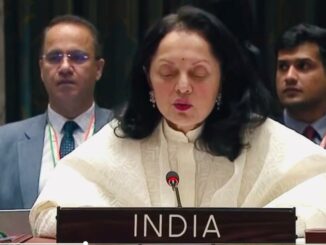
UNITED NATIONS (TIP): At the United Nations, India dismissed as “frivolous and pointless’’ an attempt by Pakistan to raise the Kashmir issue during the emergency debate on the Ukraine issue. Speaking after the UNGA had voted on the issue, Pakistan’s Permanent Representative Munir Akram said he looked forward to “similar concern and condemnation about the attempts by India to formalize’’ annexation of Kashmir. India’s Permanent Representative Ruchira Kamboj replied by stating that statements “by one delegation to misuse this forum and make frivolous and pointless remarks against my country deserve our collective contempt and sympathy for a mindset which repeatedly utters falsehoods.’’ “We call on Pakistan to stop cross-border terrorism so that our citizens can enjoy the right to life and liberty,’’ she also said. Pakistan replied with diplomat Gul Kaiser Sarwani commenting on Hindutva, the RSS, cow vigilantism and the state of minorities in India. India preferred not to exercise its right to reply.
India and Pakistan also clashed over the issue of Kashmir at two other international forums spread as far apart as Kigali (Rwanda) and Astana (Kazakhstan). In Astana, Minister of State for External Affairs Meenakshi Lekhi said it was unfortunate that Pakistan misused the ongoing CICA conference to “propagate false and malicious propaganda against my country and distract from the theme and focus of today’s discussions and cooperation among the member states’’.
“The UTs of J&K have been and will remain an integral part of India. Pakistan has no locus standing to comment on India’s internal affairs,’’ she added at the CICA Summit in Astana. In Rwanda, Deputy Chairman of Rajya Sabha Harivansh exercised his right of reply against remarks made by a Pakistani delegate on the issue of Kashmir at an Assembly of the Inter-Parliamentary Union (IPU). Both he and Lekhi said it was unfortunate that Pakistan has once again chosen to misuse the platform to “propagate false and malicious propaganda against India and distract from today’s discussion’’. The Rajya Sabha Deputy Chairman called on Pakistan to immediately cease anti-India cross-border terrorism and shut down its infrastructure of terrorism.
WASHINGTON, D.C. (TIP): Elon Musk is being investigated by federal authorities over his conduct in his $44 billion takeover deal for Twitter Inc., the social media company said in a court filing released on Thursday, October 13.
While the filing said he was under investigations, it did not say what the exact focus of the probes were and which federal authorities are conducting them. Twitter, which sued Mr. Musk in July to force him to close the deal, said attorneys for the Tesla Inc CEO had claimed “investigative privilege” when refusing to hand over documents it had sought.
In late September, Mr. Musk’s attorneys had provided a “privilege log” identifying documents to be withheld, Twitter said. The log referenced drafts of a May 13 email to the U.S. Securities and Exchange Commission (SEC) and a slide presentation to the Federal Trade Commission (FTC). The court filing, which asked a Delaware judge to order Mr. Musk’s attorneys to provide the documents, was made on October 6—the same day that the judge that paused litigation between the two sides after Mr. Musk reversed course and said he would proceed with the deal. “This game of ‘hide the ball’ must end,” the company said in the court filing.
Alex Spiro, an attorney for Mr. Musk, told Reuters that Twitter’s court filing was a “misdirection.” Twitter declined to comment on Mr. Spiro’s response and to Reuters queries about its understanding of any investigation into Mr. Musk. The SEC did not immediately respond to request for comment and the FTC declined to comment.
The SEC has questioned Mr. Musk’s comments about the Twitter acquisition. In April, the SEC asked Mr. Musk whether the disclosure of his 9% Twitter stake was late and why it indicated that he intended to be a passive shareholder. Mr. Musk later refiled the disclosure to indicate he was an active investor. In June, the SEC asked Mr. Musk in a letter whether he should have amended his public filing to reflect his intention to suspend or abandon the deal.
The Information, a tech news site, reported in April that the FTC was scrutinizing whether Musk failed to comply with an antitrust reporting requirement as he amassed his stake in Twitter. Twitter said in June that the takeover deal with Musk had cleared an antitrust waiting period for review by the FTC and U.S. Justice Department.
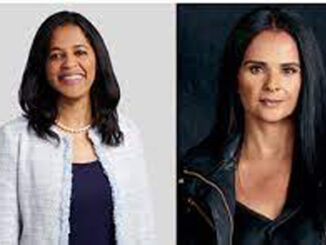
NEW YORK (TIP) : Two Indian American executives, Revathi Advaithi and Bela Bajaria, have made it to Fortune’s Most Powerful Women in Business list for 2022 headed by CVS Health president and CEO Karen Lynch for the second year running.
The competition to be listed among Fortune’s Most Powerful Women has gotten a little stiffer this year with Fortune deciding to merge its domestic and international lists of top corporate women leaders.
Ranking close behind Lynch, who is leading the highest-ranking Fortune 500 and Global 500 company ever run by a woman, once again are Julie Sweet, chair and CEO of Accenture (No. 2); Jane Fraser, CEO of Citi (No. 3); and Mary Barra, chair and CEO, GM (No. 4).
Advaithi, 54, who took over as the CEO of the $26 billion manufacturing giant Flex in 2019, is ranked 37 on the list.
She recognizes the efforts of 1,70,000 Flex employees as they navigated Covid-19, supply chain shortages and Russia-Ukraine war to deliver 7.9% revenue growth in FY22, Fortune says. “This is amazing considering the complex industry issues,” says Advaithi. Flex which makes products ranging from facial derma roller to robots for industrial applications, has big plans for India.
India is among the top 10 strategic markets for Flex, says Advaithi. “Many of our customers are interested in a ‘Made in India’ strategy to support their growth markets.”
She has seen a lot of interest from customers seeking to manufacture complex products in industrial, automotive and Cloud Enterprise and Communications segments to gain from Flex’s advanced design and manufacturing capabilities.
Prior to joining Flex, Advaithi held leadership positions at Eaton and Honeywell. She also serves as a director on the boards of Uber and Catalyst.org and is a member of the MIT Presidential CEO Advisory Board.
Bajaria, 51, Head of Global TV, Netflix is ranked 44 on the Fortune list. “This may have been a year of highs and lows for Netflix, but Bela Bajaria continues to have a razor-sharp focus on making the ‘best shows,’” says Fortune. Bajaria, who was president of Universal Television before this, says she continues to work on local, authentic storytelling. “Our most popular shows are the ones with authenticity and specificity,” she says. That is why the American streaming major is hiring creative teams locally.
The year gone by was tough, but Bajaria oversaw some top-notch programming. Netflix had its biggest TV show ever, ‘Squid Game,’ in 2021. It also became the most Emmy-winning network and Oscar winning movie studio.
But challenges remained. The company had to cut jobs as number of subscribers fell. There was tough competition from players like Disney+, Prime Video and HBO Max. The Indian market has also been a tough nut to crack. Netflix has about five million subscribers compared to Disney+ Hotstar’s 50 million and Amazon Prime Video’s 20 million. However, Bajaria says the Indian market continues to be exciting with its rich history of storytelling”.
Prior to joining Netflix, Bela Bajaria worked as the president of Universal Television for nearly five years. She was behind such successful shows like “Chicago Fire” and Mindy Kaling’s “The Mindy Project,” the first major show from a South Asian American female creator. Before that she was senior vice president at CBS, where she worked for 15 years.
HENRICO COUNTY, VA (TIP): In yet another incident of rising hate crimes against the Indian American community, an Indian restaurant in Henrico County, Virginia was vandalized with vulgar and racist graffiti.
The side and back of the India K’ Raja restaurant building at 9051 W. Broad St. were spray-painted with derogatory words and phrases targeting Asian Americans on the 27th anniversary of its Oct 1 opening, local media reported.
“For 27 years, this has been home. Nobody has ever displayed that kind of anger or hate to us,” restaurant owner Tony Sappal told media. “I’ve spent more of my life here than anywhere else. I’ve raised my family here.”
Sappal told media that he showed up to the business on Oct 1 night and saw his building had been vandalized.
“When I turned to the back of the parking lot driving, the first thing I noticed was a big graffiti sign with a hateful message: Do* He***,” he said. “Such a hateful message. I was shocked and disturbed by this.”
A profane word, along with other racial slurs, were spray painted on the side and on the back of the restaurant’s building. The front door and glass windows were spray painted in dark red. The wire to the outside speakers was also torn down.
Sappal said he and his family take pride in their longstanding small business and have felt loved by the community. The restaurant is involved in several community organizations. When schools initially shut down during the Covid-19 pandemic, the restaurant provided free lunches for students who depended on schools for their meals.
“I just wanted to introduce healthy, delicious Indian food to the people. Back when we opened in 1995, there was no Indian food here,” Sappal told media. “I’m very happy with living here and being able to fulfill my dream.”
“This is heinous. We will not tolerate hate crimes and acts of racism in Henrico. India K’ Raja is a beloved staple in our community,” Virginia State Delegate, Rodney Willett, said in a tweet.
Anti-Asian hate crimes in the US increased by 224% last year compared to 2020, according to a compilation of hate crime data published by the Center for the Study of Hate and Extremism.
Authorities are investigating the incident as vandalism at this point and have documented the matter as a “biased-based incident,” said Henrico police Lt. Matt Pecka. Depending on the overall cost of the damage, the vandalism charge could be a misdemeanor or felony.
“Acts of intimidation or hatred will not be tolerated in our community. Anyone committing criminal acts will be charged accordingly,” Police Chief Eric English said in a statement. Henrico police urged anyone with information about the vandalism to contact Detective Stone at (804) 501-7176 or contact Crime Stoppers at (804) 780-1000 or online at P3Tips.com.
NEW YORK (TIP): Indian American author Sarah Thankam Mathews has made it to the finals of the 2022 National Book Awards with her debut novel ‘All This Could Be Different.’
The Winners will be announced on Nov 16 at the 73rd National Book Awards Ceremony & Benefit Dinner at Cipriani Wall Street in New York City and broadcast live for readers everywhere. Mathews’ debut novel tells the story of a young queer immigrant who creates a community for herself while grappling with the oppressive demands of capitalism.
Publisher Viking Books describes it as “A beautiful and capacious novel rendered in singular, unforgettable prose.”
“It’s a wise, tender, and riveting group portrait of young people forging love and community amidst struggle, and a moving story of one immigrant’s journey to make her home in the world.”
“I simply will never be over this,” Mathews tweeted after the National Book Foundation announced the name of five finalists in fiction category with the New York Times.
“Congratulations to the #NBAwards Fiction Finalists: Tess Gunty, Gayl Jones, @JamilJanKochai, Sarah Thankam Mathews (@smathewss), and Alejandro Varela (@drovarela)! And the Fiction publishers: @AAKnopf, @penguinrandom, @beaconpressbks, @VikingBooks, @astrahousebooks,” it tweeted,
Mathews grew up between Oman and India and moved to the US at the age of 17. Her work has been published in places including AGNI, SSENSE, and Best American Short Stories.
She was a 2020 Margins Fellow at the Asian American Writers’ Workshop, and the recipient of a Rona Jaffe fellowship at the Iowa Writers’ Workshop.
“Sarah Thankam Mathews has written one of the buzziest, and most human, books of the year,” the Vogue said.
“…an extraordinary novel, spiny and delicate, scathingly funny and wildly moving. Sarah Thankam Mathews is a brilliant writer, one whose every ringing sentence holds both bite and heart,” Lauren Groff, author of Matrix, said.
The National Book Foundation will broadcast the National Book Awards Ceremony on YouTube, Facebook, and the Foundation’s website at nationalbook.org/awards.
Winners of the National Book Awards receive $10,000 and a bronze medal and statue; Finalists receive $1,000 and a bronze medal; Winners and Finalists in the Translated Literature category will split the prize evenly between author and translator.
Between the five categories – Fiction, Nonfiction, Poetry, Translated Literature, and Young People’s Literature — there are six writers and one translator who have been previously honored by the National Book Awards.
They are: Gayl Jones, a 1998 Fiction Finalist; Scholastique Mukasonga, a 2019 Translated Literature Finalist; Sharon Olds, a 2002 Poetry Finalist; David Quammen, a 2018 Nonfiction Longlister; Yoko Tawada and Margaret Mitsutani, the 2018 Translated Literature Winners; and Jenny Xie, a 2018 Poetry Finalist. All five of the Finalists for Young People’s Literature are first-time National Book Award honorees. Six of the twenty-five Finalist titles are debuts.
Publishers submitted a total of 1,772 books for this year’s National Book Awards: 463 in Fiction, 607 in Nonfiction, 260 in Poetry, 146 in Translated Literature, and 296 in Young People’s Literature.
Two lifetime achievement awards will also be presented as part of the evening’s ceremony: Art Spiegelman will be recognized with the National Book Foundation’s Medal for Distinguished Contribution to American Letters, presented by Neil Gaiman, and Tracie D. Hall will receive the Foundation’s Literarian Award for Outstanding Service to the American Literary Community.
WASHINGTON, D.C. (TIP): With Indian Americans making about 4.5 million people in the United States, an Indian Diaspora group has launched a campaign to encourage more participation in mid-term election to augment their influence on policy matters.
The Foundation for India and Indian Diaspora Studies (FIIDS), a US-based non-profit institution for policy research and awareness, launched the #IndoAmericanVotesMatter campaign on Oct 12 to increase participation of American voters in the Nov 8 elections.
“This campaign targeted outreach to leaders of 1000+ Indo-American organizations to propagate this message to their two million members,” said FIIDS Director Khanderao Kand. “We are also launching media advertisements and social media campaigns.”
“As an immigrant minority, it is not only a civic duty, but it is also imperative for Indo-Americans to vote in the elections to get their voice heard,” said Professor Ved Nanda, a distinguished law professor at Denver University and a FIIDS advisor.
“Both Democrats and Republicans should recognize the importance of Indo-Americans as they are concentrated in critical races spanning states such as Florida, Georgia, Arizona, Virginia, New Jersey, Texas, and California,” FIIDS said.
FIIDS’ survey team will be surveying Indo-American voters on policies and issues important for their votes, FIIDS National Executive Committee member Nar Koppula said. The results of this survey will be shared with media, democratic and Republican Party as well as candidates.
FIIDS’ policy research team will also provide an in-depth analysis of candidates in critical races to Indo-American voters. The voter survey contains issues and policy matters in three categories: US international issues, domestic issues and immigrants related issues.
The questions related to the US international issues include Indo-Pacific, China, military aid to Pakistan, Ukraine war, and stand on internal issues/matters of sovereign India. The questions related to the domestic matters include inflation, gas prices, merit-based admissions, religiophobia (like Hinduphobia), etc. The immigration related questions include tech immigration policies, H1B, GC, H4EAD etc.
This survey will also have questions on the performance and socio-political environment under the leadership of President Joe Biden and the current campaign. “It is important for Indo-Americans to participate in the electoral voting process to ascertain our rights, especially many issues of religiophobia and discrimination against Indo-Americans and a negative campaign against India,” said Dr. Sampath Shivangi, the chairman of the American Association of Physicians of Indian Origin (AAPIO) and a patron of FIIDS.
FRESNO (TIP): A 74-year-old Indian American man has been arrested in Fresno, California, for fatally shooting his daughter-in-law last week at a parking lot of a Walmart in San Jose where she worked.
Sital Singh Dosanjh killed Gurpreet Kaur Dosanjh “possibly out of anger over her plans to divorce his son. According to the police, just before her murder, a “frightened” Gurpreet Kaur was on the phone with her uncle, telling him that her father-in-law was looking for her.
The victim said she saw him “driving in the lot” in his black Silverado pickup truck, and that he “travelled 150 miles to find her”.
Five hours later after the call, a Walmart co-worker discovered Gurpreet Kaur’s body in the same parking lot, in the same car, suffering from at least two gunshot wounds. She was pronounced dead on the spot. The police said the uncle, who was the last person to hear his niece alive, helped investigators formally identify Sital Dosanjh as the likely suspect.
He told the police that his niece “was in the process of divorcing Sital Dosanjh’s son”, adding that the husband and his father lived in Fresno, while Gurpreet Kaur lived in San Jose, a media report said.
Sital Dosanjh was arrested at his home in Fresno, the next morning, and a .22-caliber Beretta pistol was seized from his home, according to a police investigative summary accompanying a murder charge filed by Santa Clara County District Attorney’s Office.
Sital did not enter a plea and was ordered to return to court on November 14.
Indian American killings have been on a steep rise in the US with four kidnapped members of a Sikh family, including their eight-month-old infant, found dead in Orchard, California. The same day, a 20-year-old Purdue University student, Varun Manish Chheda, was brutally killed by his roommate in the dorm room of the university campus.
NEW YORK (TIP): Indian American health justice lawyer Priti Krishtel has been awarded a McArthur Fellowship for exposing inequities in the patent system to increase access to affordable, life-saving medications on a global scale.
“By distilling the technical aspects of the patent system to show its sometimes-devastating impact on people’s lives, Krishtel is galvanizing a movement to center people instead of only commercial interests in our medicines patent policy,” McArthur Foundation said announcing this year’s 25 fellowships on Oct 12.
One of America’s most prestigious awards for intellectual and artistic achievements, commonly known as the “genius grant,” carries a $800,000, no-strings-attached grant for individuals who have shown exceptional creativity in their work and the promise to do more.
”I think a lot about who owns our right to heal. We live in a hierarchy of health. Some people get medicine first, and some don’t get it at all. Our ability to heal should not depend on our ability to pay or where we live. But it does,” says Krishtel.
“The patent system is not working as intended. The system blocks competition and concentrates the power to access medicine in the hands of an elite few. It helps create that hierarchy of health,” she says. “Medicine must always be a global public good. Knowledge can no longer be locked up in this way.”
“I believe in a future where people know they can keep their loved ones healthy, where people actively shape what access to medicines looks like for their families and communities. Where incentives exist for more just drug development and equitable access, ensuring that innovation exists to serve people, to save lives,” says Krishtel.
“The challenge right now is that we are living in the age of the bully. A time when a small minority of the historically powerful are trying to own the un-ownable. We are saying no and creating a new, more compassionate and inclusive future in its place,” she says.
“The 2022 MacArthur Fellows are architects of new modes of activism, artistic practice, and citizen science. They are excavators uncovering what has been overlooked, undervalued, or poorly understood,” said Marlies Carruth, said Director, MacArthur Fellows.
“They are archivists reminding us of what should survive,” she said. “Their work extends from the molecular level to the land beneath our feet to Earth’s orbital environment—offering new ways for us to understand the communities, systems, and social forces that shape our lives around the globe.”
Early in her career, Krishtel worked to increase access to antiretroviral (ARV) treatments at the height of the global AIDS epidemic. She worked alongside patients dying of AIDS and saw first-hand how patent monopolies often reduced the availability of life-saving medications in lower income countries, according to her Foundation profile.
In 2006, Krishtel co-founded the Initiative for Medicines, Access, and Knowledge (I-MAK) to ensure the public had a voice in the pharmaceutical patent system.
Krishtel and the organization are drawing attention to weaknesses within the patent system while identifying needed reforms to make it more responsive to the public good.
Patents are intended to incentivize innovation by ensuring that only the patent holder can sell and profit from the product for a fixed time. However, many pharmaceutical companies seek to extend their monopolies by filing multiple patents on small changes (such as changes in dosage) to existing drugs over several years. This stifles competition, delays generic production, and keeps medicines out of the hands of people who need them the most.
I-MAK has successfully contested patents worldwide, saving governments billions of dollars in public health spending and giving millions of people access to life-saving treatments. The I-MAK team publishes a series of reports, entitled Overpatented, Overpriced, that exposes the scale of pharmaceutical companies’ exploitation of the US patent system.
I-MAK also brings together a range of stakeholders—including patient groups, policymakers, and patent lawyers and judges—to deepen collective understanding of the impact of the patent system across different communities.
Krishtel and I-MAK draw on this participatory process in proposing reforms to US patent policy. Their proposed reforms include ensuring only meaningful inventions are rewarded with a patent, increasing oversight from other government branches, and increasing public participation in the patent process.
For example, the Public Advisory Committee of the US Patent Office historically is comprised of lawyers and representatives from companies who financially benefit from the current system.
Adding individuals from patient groups and others with a public interest perspective would help make the patent process more responsive to the full spectrum of stakeholders in the system.
Throughout the Covid-19 pandemic, Krishtel has argued powerfully that incentivizing innovation should not come at the expense of equity and public health. Particularly during public health emergencies and for taxpayer-funded research, commercial and public interest concerns can be balanced. Krishtel is increasing understanding of how intellectual property policy can impact personal, public, and global health care, and she and I-MAK are envisioning a patent system that benefits all people regardless of geography and economic status.
Krishtel received a BA (1999) from the University of California at Berkeley and a JD (2002) from New York University School of Law.
She worked with the Indian NGO Lawyers Collective (2003–2006) before co-founding the Initiative for Medicines, Access, and Knowledge (I-MAK) in 2006, where she is currently co-executive director.
Krishtel has published in a variety of scientific journals and media platforms, including Science, Journal of the International AIDS Society, The British Medical Journal, San Francisco Chronicle, The New York Times, and USA Today.
NEW YORK (TIP): Isha Gadi of Warrington, Pennsylvania, and Riya Balaji of San Jose, California, have won this year India Philanthropy Alliance Youth Essay Competition in the high school and middle school categories, respectively.
For the first time since the inception of the competition in 2020, essay winners will have the opportunity to present their ideas, live and in person, to a room full of business leaders, philanthropists, and nonprofit executives, IPA announced Tuesday, October 11.
The gathering will be hosted by Indiaspora, a founding member of the Alliance, and GiveIndia as part of their annual Philanthropy Summit and will be held at the Indian Consulate in New York City.
“Honestly, it means everything to me that I’ve won,” says Gadi. “It gives me hope that people really do care about this topic [sexual assault]. It makes me realize that we can truly change as a society together, for the better.”
“I entered this competition in 2021 and I didn’t win, but that didn’t stop me,” says Balaji. “I was determined to do it again but this time with more research, facts, and concrete actions.
“Because I won, I feel really excited and now I’m even more enthusiastic to donate money to a charity knowing that I’m going to make a big difference to the underprivileged.”
Runners up are Yashi Bhowmick of Pooler, Georgia and Chinmayi Joshi of Basking Ridge, New Jersey. Finalists include Tej Shah of Chicago, Illinois, Rithvi Sathish of Redmond, Washingyon, and Ramanathan Venkatesh of Brambleton, Virginia.
Competition winners are awarded grants of $1,000 and runners-up are awarded grants of $500 to give to the charity of their choice.
Each submitted essay was in response to the following:
India is the world’s largest democracy and has made significant progress on social and environmental issues over the past 25 years.
But India and its 1.3 billion people still have many urgent and unmet needs including access to food, shelter, health care, clean water, education, and a safe environment.
What do you think is the most significant issue facing India and its people today? What role do you think individuals (young and old) and groups here in the US can play in being a part of the solution?
The Youth Essay Competition was inspired by the need to engage today’s youth to ensure the philanthropy of tomorrow, said IPA, a US-based coalition of 14 nonprofit, philanthropic, and charitable organizations that operate programs in India.
Central to the mission of both Indiaspora and IPA is inspiring the Indian diaspora to be a force for good through collaboration, community engagement and by catalyzing social change, it said.
Learning about the key issues facing India today and doing the research to provide a compelling argument for how best to address these issues, has been a key ingredient to student success and satisfaction, the release said. The number one reward students report is learning that their voice can and will be heard and they can truly have an impact.
The competition, as well as the grants to nonprofits awarded by the students, is sponsored by Sarva Mangal Family Trust (SMFT), which has supported the competition since its inception, and by the Iowa-based Sehgal Foundation.
“IPA’s Youth Essay competition is one of the ways we invest in the philanthropy of tomorrow,” says Mona Shah, representative of the Sarva Mangal Family Trust.
With the aim of improving health, education, and wellness of communities where they live and work, SMFT has impacted more than 19 million lives through their generosity.
“As change makers and philanthropists, we need to focus on the future of philanthropy and encourage youth in the United States to engage with issues confronting India, as well as work to have the greatest impact here and now.”
The winners of the competition will be interviewed by Shah as they present to attendees at the Philanthropy Summit in New York.
Subjects covered by essay contestants included a variety of topics such as women’s rights and safety, pollution, religious intolerance, the stigma of HIV/AIDs, the availability of quality education.
Indian American philanthropy is expected to grow in the coming years from an estimated $1 billion currently to $3 billion annually, the release said. IPA seeks to influence how quickly this growth take place and the quality of the giving that it translates into. The Youth Essay Competition is one of several IPA initiatives designed to catalyze giving to benefit India, particularly with today’s youth, it said.
WASHINGTON, D.C. (TIP): President Joe Biden has nominated US Surgeon General, Dr Vivek Murthy, to serve as the country’s representative on the executive board of the World Health Organisation. Dr Murthy, 45, will serve in the new position alongside his continued duties as the US Surgeon General, the White House said in a statement. He was confirmed by the US Senate in March 2021 to serve as the 21st Surgeon General of the country. He previously served as the 19th Surgeon General under President Barack Obama. As the nation’s doctor, the Surgeon General’s mission is to help lay the foundation for a healthier country, relying on the best scientific information available to provide clear, consistent and equitable guidance and resources for the public. The first Surgeon General of Indian descent, Murthy, was raised in Miami and is a graduate of Harvard, the Yale School of Medicine, and the Yale School of Management, the White House said.
WASHINGTON, D.C. (TIP): United States Vice President Kamala Harris and Indian actress Priyanka Chopra shared a stage past week, reflecting on their Indian connections, marriage equality and climate change. Chopra, who is now settled in Los Angeles, was invited by the Democratic National Committee’s Women’s Leadership Forum to interview the Vice President for a fireside chat. The Indian actress kicked off the fireside chat with their Indian connection. “I think we’re both daughters of India, in a way,” Priyanka told the room full of prominent Democrats invited for the conference from across the country. “You’re a proud American-born daughter of an Indian mom and a Jamaican father. I am an Indian born of two physicians as parents and a recent immigrant to this country who totally still believes in the wholehearted, you know, American Dream,” she said. The United States, she said, is regarded as a beacon of hope, freedom, and choice for the whole world. “And these tenets are being endlessly assaulted right now,” she said. Chopra said after working for over 20 years, it was only this year that she got pay equal to male actors. The actress also touched upon the issue of marriage equality. Harris acknowledged that right now they are living in an unsettled world. “I’ve been travelling around the world as Vice President. I’ve directly talked with 100 world leaders in person or by phone,” she said, adding “things that we long took for granted are now up for debate and question”.
“You look, for example, at Russia’s unprovoked war in Ukraine. We thought it was pretty well settled–the issue of territorial integrity and sovereignty — and now that is up for some debate, given what’s happening there,” she noted.
Harris quickly turned to the United States. “We look in our own country. We thought, surely with the Voting Rights Act and all that it stood for, we assumed and thought the issue of voting rights in America was settled,” she said.
“Then we had the Shelby v. Holder decision. And then after the 2020 election, when more people voted and more young people voted than ever before, states around our country started systematically and intentionally making it more difficult for people to vote,” Harris said. “We thought a woman’s right–a constitutional right–to make decisions about her own body was settled. No longer,” said Harris.
Agreeing with her, Chopra said, “Absolutely. You’re so right. There’s so much to navigate right now.” Chopra also touched upon the climate change issue as she acknowledged the relief efforts in hurricane-hit Florida.
“Extreme weather conditions like this are becoming more frequent and more severe. And I wanted to acknowledge the administration for passing the biggest climate legislation in history earlier this year because it is a fact that America’s leadership sets an example to other major economies around the world, which are truly dragging their feet when it comes to doing their bit,” Chopra said.
“The crisis is real, and the clock is ticking. And the urgency with which we must act is without any question,” Harris responded stressing on adapting to extreme weather conditions.
“On the point that you made about disparities, you know, back when I was the district attorney of San Francisco, I started one of the first environmental justice units of any DA’s office in the country focused on this issue,” she said.
“As you have described rightly, which is that it is our lowest income communities and our communities of color that are most impacted by these extreme conditions and impacted by issues that are not of their own making,” Harris said.
CHICAGO (TIP): Indian National Congress leader Priyanka Gandhi’s husband and businessman Robert Vadra attended the marriage function of an eminent Indian-American from Chicago. The wedding of Iram Shareef, daughter of Chicago-based businessman Iftekhar Shareef, last Friday, September 30, at the popular Shalimar Banquets in the city was attended by eminent Indian-Americans, including Bharat Barai and Congressman Raja Krishnamoorthi. “Robert Vadra presented a special congratulatory message signed by Gandhis to Iftekhar Shareef,” said a media release issued on Monday. The media release carried a set of pictures of Vadra attending the marriage ceremony. In one of them, Vadra is seen presenting a letter to Shareef signed by his wife Priyanka Gandhi. Shareef, who is from Andhra Pradesh, is the president and CEO of National Bankcard Corp, according to his LinkedIn profile.
The renowned Bollywood singer Shreya Ghoshal known for her melodious and soulful voice and robust on-stage energy will headline a series of concerts across the world in different countries. As the world is working its way back towards normalcy after the pandemic, the music industry is also trying to bring back happiness and certain excitement by resuming music tours and concerts. Bringing the euphoria back to the stage in the festive season, this year Shreya Ghoshal along with her band and crew, already performed at world-class venues in UAE (twice), London, Birmingham, Kochi, Kolkata, Thiruvalla, New Delhi, Bangalore, Indore and now are scheduled to perform in a 5-city Australia-New Zealand tour from 7th to 16th October 2022 and in Ireland on 29th October 2022 and The Netherlands on 30th October 2022 as well. And then she is all set to perform in the USA from 4th to 19th in the month of November 2022.
This is going to be the ultimate musical tour to celebrate twenty years of iconic singer Shreya Ghoshal which will bring back timeless tunes and memories from her singing journey to the music lovers. This special concert tour is organized by one of the biggest event organizers ‘Intense Entertainment’ owned by Manish Sood and Deepa Shahani Sood, both Indian-born-US citizens now, who hosted more than 85 shows with every Bollywood renowned singer. This high-profile international large-scale live-music concert will be a seven-city tour across the US in the month of November 2022 and has been going to other parts of countries this whole year. The tour starts on the 4th Nov in New Jersey, followed by Dallas, Texas on the 5th Nov, Washington, DC on 11th Nov, Oakland, Bay Area on 12th Nov, Los Angeles on 13th Nov, Orlando, Florida on 18th Nov, and New York on the 19th November 2022. They promise to be the nights of coming together and enjoying their favorite singer’s enthralling performances for the Indian diaspora and Bollywood music lovers in the US.
On being asked about the tour, Shreya Ghoshal excitedly said, “This US tour is very special for me as I am completing twenty years in Bollywood, and what a beautiful way to celebrate my journey with my fans. Coincidentally this is my first tour in the US after the unfortunate pandemic disruption. I am humbled to be a part of the concert and to be able to continue entertaining my fans. I always had an amazing experience performing for the warm crowd of the US and I am quite excited to perform there after three long years.”
The fans in the US can expect a scintillating and energetic performance from the popular Bollywood songstress. With a beautiful versatile vocal range, Shreya will enthrall fans not only with her popular Bollywood hits but also with her famous love ballads, regional songs in different Indian languages, folk songs originating from different parts of India exhibiting the culture, raag-based songs as well as classical songs. Talking about the event, Mr. Manish Sood said, “There is a certain excitement about attending a live concert and we can’t be happier bringing back the symphonic singer Shreya who has given us glorious music. The idea behind Shreya Ghoshal’s US Tour is to celebrate her journey as well as it will be a tribute to legendary singer Lata Mangeshkar Ji. We are ready to make new memories and cherish old ones on this tour.” This concert is a celebration of brilliant music and memories and will definitely be a great way to connect with music lovers across the world. With Shreya Ghoshal, an array of global musicians will also join her on stage. Kinjal Chattopadhyay is the male singer who is performing with Shreya along with musicians Abhishek Pradeep Kumar Dasgupta and Jobin Joshua David as guitarists, keyboardist Abhishek Babaji Mestry and Vatan Dhuriya, flautist Rajeev Prasanna, Bass Guitarist Sanglap Sengupta, drummer Jairaj Shrikant, octopad and percussionist Ganesh Bhau Thorat and Umakant Parab as an Indian rhythm instruments player such as tabla, dholak, dholki. This tour will not be a regular musical concert but will also be a unique cultural act.
The concert tickets are now available through the event company’s website IntenseDMV.com.
Signup to our Newsletter!
Don’t miss out on all the happenings around the world