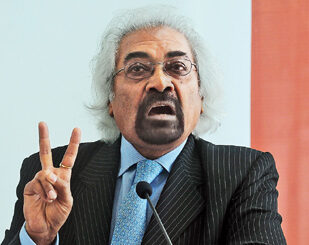
WASHINGTON, D.C. (TIP): In the last nine years, the country has “polarized” and a very small percentage of people have really concentrated power and wealth, senior Congress leader Sam Pitroda has alleged. Pitroda is the chairperson of the Indian Overseas Congress and he is accompanying Congress leader Rahul Gandhi on his six-day US tour. “I think in the last nine years over a period of time, our society has been polarized. Polarized by focusing on religion. On the one hand, there is Hindu, on the other hand, there is everything else,” Pitroda told PTI. Senior BJP leaders, including Union ministers and chief ministers, highlighted the achievements of Prime Minister Narendra Modi-led government in a nationwide outreach on Monday to mark its nine years in office. The BJP said in a statement that India has witnessed “unprecedented” development in every sector with the mantra of “nation first” guiding Modi’s policies.
However, Pitroda said the growth has been twisted. “It is uneven. And that’s a great cause of concern. When you don’t have democratic institutions functioning normally, you don’t feel secure. So, there’s a fear in the mind of the people that somebody will come and attack me. So, they don’t speak,” Pitroda, who is based in the US, said.
“We all know that 85 per cent of India’s population is Hindu or whatever the number is, maybe 82. But within the Hindu community, a very small per cent of high-level people have really concentrated power and wealth. And in the process, a large number of scheduled castes, scheduled tribes, artisans, carpenters, blacksmiths, plumbers, Dalits, have not really progressed as well as they should have,” he said.
“So, the fight is not about Hindu and non-Hindu. The fight is about the underprivileged and privileged. In the nine years, I think wealth is concentrated. We brag about so many billionaires, which is fine, I’m happy with it. But we have not lifted a large number of people out of poverty,” he said.
“The trolls on social media just harass people. They harass women. They harass reporters, they harass media people, whether it is typically Ravish Kumar of the world or anybody else, they attack your family, they attack your mother… this is out of control. And it cannot be tolerated. The trolls cannot be tolerated,” he said.
“Somebody in the government has to stand up and say, look, anybody who trolls and attacks somebody unnecessarily will be punished as opposed to we are encouraging parole. That is a worry for a lot of us. Look at the violence. Violence has increased. Look at violence against women. It has increased,” Pitroda said.
People who are worshipped today are corrupt, dictatorial, and abusive, he alleged.
“(They) use all kinds of language against everybody. Promote hate. And I’m saying, where did we go wrong? What’s going on? And it bothers me not that you’re gonna change it overnight, but at least you can raise your voice and have an honest conversation about how I feel. You don’t have to agree with me. But can I get a chance to talk and we don’t have that space,” Pitroda said.
(Source: PTI)
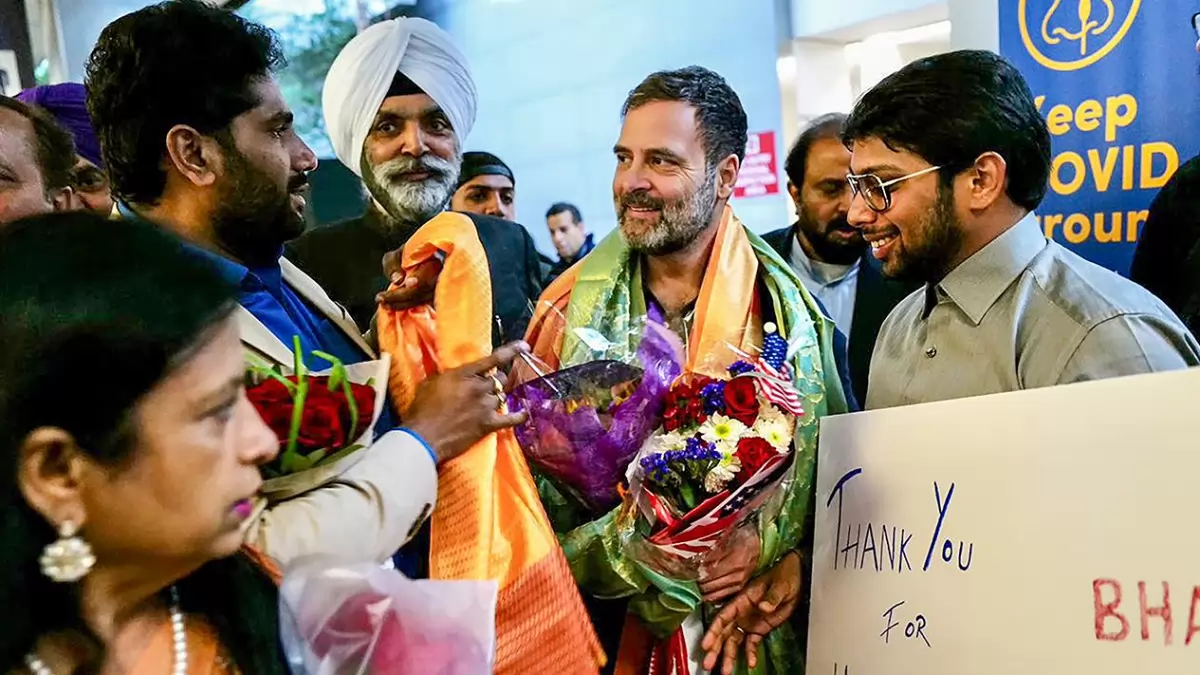
Rahul Gandhi gets a warm reception on arrival at the San Francisco airport on May 30, 2023. Seen among others is IOC USA President Mohinder Gilzian in white turban (Photo / PTI
I.S. Saluja
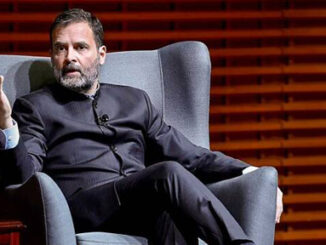
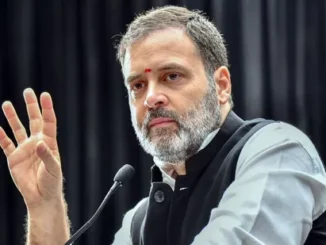
NEW YORK (TIP): On his first visit abroad after being disqualified from the Lok Sabha, Rahul Gandhi spoke candidly on a number of national and international issues at a number of events which included a National Press Club appearance in Washington, D.C. , meetings with students at universities, and with the public in California and Washington D.C.
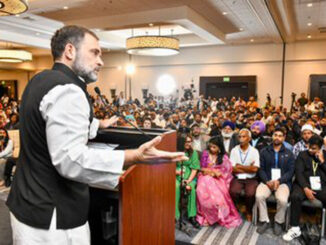
On a six-day visit to the US, Rahul Gandhi was in California on May 30 and 31 on the first leg of his tour where he spoke at the ‘Mohabbat Ki Dukaan’ event organized by Indian Overseas Congress USA in Santa Clara on Tuesday, May 30.
On May 31, he held interactions with Silicon Valley AI experts and startup entrepreneurs.
Rahul Gandhi was in Washington, D.C. on June 1 and 2 where he appeared at a number of events including the National Press Club appearance , held meetings with students, business and trade representatives, the Indian Diaspora organizations and with US lawmakers.
He would arrive in New York on June 3 on the last leg of his tour where the Indian Overseas Congress USA has planned a huge public meeting at the Javits Center in Manhattan on Sunday, June 4, and before that, on June 3, a dinner has been organized where Rahul Gandhi will meet people in an informal setting.
During his stay in New York, he will be meeting with representatives of various organizations and have interactions with a number of delegations . He will also speak to students.
Indian Overseas Congress chairperson Sam Pitroda said Gandhi’s visit is aimed at promoting shared values and a vision of “real democracy”.
“The purpose of his (Gandhi’s) trip is to connect, interact and begin a new conversation with various individuals, institutions and media, including the Indian diaspora that is growing in numbers in the United States and abroad to promote the shared values and vision of the real democracy with a focus on freedom, inclusion, sustainability, justice, peace and opportunities world over,” Pitroda said in a statement on Sunday, May 28. The Indian Panorama brings you below the media coverage of Rahul Gandhi’s visit to the US from May 30 to June 2, 2023.
BJP can be defeated if Opposition is ‘aligned properly’: Rahul Gandhi
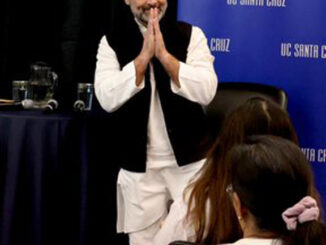
@RahulGandhi Interacts with activists, academics and civil society at University of California, Santa Cruz (Twitter photo)
SANTA CLARA, CA (TIP): The ruling BJP can be defeated if the Opposition is “aligned properly” and the Congress party is working towards it and it is “coming along very nicely”, Rahul Gandhi has told Indian Americans here, citing his party’s emphatic victory in the recent assembly elections in Karnataka.
Responding to questions from the moderator and the audiences at an event at the Silicon Valley Campus of the University of California in Santa Cruz on Tuesday, Gandhi said he can clearly see “vulnerabilities” in the BJP.
“As a political entrepreneur, I can clearly see vulnerabilities in the BJP… The BJP can be defeated if the Opposition is aligned properly,” he said.
“If you look at the Karnataka elections, the general sense is that the Congress Party fought the BJP and defeated the BJP. But what is not well understood is the mechanics that we used,” he said.
The Congress party used a completely different approach to fighting an election and building a narrative, Gandhi said, adding that elements of what happened in Karnataka came out of the ‘Bharat Jodo Yatra’.
In the May 10 elections to the 224-member Karnataka Assembly, the Congress won 135 seats, while incumbent BJP and the former prime minister H D Deve Gowda-led Janata Dal (Secular) got 66 and 19, respectively.
Gandhi said in the Karnataka elections, the BJP spent 10 times more money than the Congress party.
He said the country needed an alternative vision to defeat the ruling Bharatiya Janata Party (BJP), in addition to having a united Opposition in the 2024 general elections.
“On the matter of opposition unity, we are working towards it and it is coming along very nicely. But I think in order to defeat the BJP, you need more than just opposition unity. Just opposition unity, in my opinion, is not going to be enough to do the job. I think you need an alternative vision to the BJP,” he said.
“Part of Bharat Jodo Yatra was the first step in proposing such a vision. It’s the vision that all opposition parties are aligned with. No opposition party would disagree with the idea of the Bharat Jodo Yatra,” he said.
Bharat Jodo Yatra (Unite India March) was a Gandhi-led mass movement aimed at uniting India. The yatra began on September 7 from Kanyakumari, passed through 12 states and culminated in Jammu and Kashmir on January 31. During the course of the yatra, Gandhi, 52, addressed 12 public meetings, over 100 corner meetings and 13 press conferences. He had over 275 planned walking interactions and more than 100 sitting interactions.
“So, I think bringing the opposition together is important, but also aligning the opposition and making the people of India understand that there is not just a group of opposition parties that have combined but a proposed way forward for the country. And we’re working on those things,” Gandhi said.
The ex-Wayanad MP said it is the president of the Congress party who will decide the prime ministerial candidate.
“We believe that everybody in India, regardless of who they are, whichever part of the society they come from, they should have a voice that voice should be respected, to be listened to be appreciated. And I think that voice is an asset,” he said.
In his address, Gandhi also took a dig at the ruling BJP government, saying it is “threatening” the people and “misusing” the country’s agencies.
“The BJP is threatening people and misusing government agencies. The Bharat Jodo Yatra started because all the instruments that we needed to connect with the people were controlled by the BJP-RSS,” he said.
“We were also finding that in some way, it had become quite difficult to act politically. And that’s why we decided to walk from the southernmost tip of India to Srinagar,” he said.
Gandhi said the yatra carried the spirit of affection, respect and humility.
“If one studies history, it can be seen that all spiritual leaders — including Guru Nanak Dev ji, Guru Basavanna ji, Narayana Guru ji — united the nation in a similar way,” he said.
Gandhi said India is not what is being shown in the media which likes to promote a political narrative that is far from reality, asserting that there is a “huge distortion”.
“It was very clear to me in the Yatra that it’s in the media’s interest to project these things, it helps the BJP. So, don’t think that everything you see in the media is the truth,” he said.
“India is not what the media shows. The media likes to show a particular narrative. It likes to promote a political narrative that is actually not what is going on in India,” he said.
The Congress leader arrived here on Tuesday, May 30 on a three-city US tour during which he will interact with the Indian diaspora and meet American lawmakers.
He had a first-hand experience of the American immigration system as he had to wait for about two hours along with his other co-passengers on the Air India flight because of the common shortage of staff at the US airports.
People were seen taking selfies with him and asking him questions. He was seen interacting and mingling with other traveler’s at the San Francisco airport.
(Source: PTI)
Rahul Gandhi says PM Modi thinks he knows more than God, calls him ‘specimen’
SANTA CLARA, CA (TIP): There are people in India who think they know more than God and Prime Minister Narendra Modi is “one such specimen”, Congress leader Rahul Gandhi has said.
Speaking at the ‘Mohabbat Ki Dukaan’ event organized by Indian Overseas Congress USA in Santa Clara in the US state of California on Tuesday, May 30, Gandhi said these people are “absolutely convinced” that they know everything and can explain history to historians, science to scientists and warfare to the army.
“The world is too big and complicated for any person to know everything. That is the disease…There is a group of people in India who are absolutely convinced they know everything. They think they know even more than God.
“They can sit with God and explain to him what’s going on. And of course, our prime minister is one such specimen. If you sat Modiji with God, he would explain to God how the universe works and God will get confused about what have I created,” he said, evoking peals of laughter from hundreds of his Indian American supporters.
“They think they can explain history to historians, science to scientists and warfare to the army. But at the core of it is mediocrity. They’re not ready to listen!” he said.
Gandhi’s event was attended by community members not only in Silicon Valley but also from Los Angeles and Canada. Gandhi told the Indian Americans that the idea of India was under attack and is being challenged.
He applauded the Indian Americans for holding up the Indian flag in America, showing the American people what it means to be an Indian by respecting their culture and learning from them while also allowing the Americans to learn from them.
“You make us all proud. When we think of our country, you are all our ambassadors. When America says Indian people are extremely intelligent. Indian people are masters of IT, Indian people are respectful. All these ideas that have come, they’ve come because of you and because of your actions and your behaviors,” he said.
(Source: PTI)
Rahul Gandhi says his disqualification from Lok Sabha has given him huge opportunity
Congress @INCIndia Scenes from @RahulGandhi ji’s interaction with the Indian diaspora in San Francisco, California, in the United States. Twitter photo
SAN FRANCISCO (TIP): Congress leader Rahul Gandhi has said that he did not imagine his disqualification from Lok Sabha was possible when he joined politics but asserted that it has given him a “huge opportunity” to serve the people.
Gandhi, who is in the US for a three-city US tour, made the remarks on Wednesday, June 31 night in response to a series of questions from Indian students at the prestigious Stanford University Campus in California.
The Wayanad (Kerala) Member of Parliament was disqualified from Lok Sabha earlier this year after he was convicted by a Surat court in a 2019 criminal defamation case over his “Modi surname” remark.
In his remarks, Gandhi said that when he joined politics in 2000, he never imagined this is what he would go through. What he sees is going on now is way outside anything that he had thought when he joined politics.
Referring to his disqualification from Lok Sabha as a Member of Parliament, Gandhi, 52, said he didn’t imagine that something like this was possible.
“But then I think it’s actually given me a huge opportunity. Probably much bigger than the opportunity I would have. That’s just the way politics works,” he said.
“I think the drama started really, about six months ago. We were struggling. The entire opposition is struggling in India. Huge financial dominance. Institutional capture. We’re struggling to fight the democratic fight in our country,” he said, adding that at this point in time, he decided to go for the ‘Bharat Jodo Yatra’.
“I am very clear, our fight is ours fight,” he said. “But there is a group of young students from India here. I want to have a relationship with them and want to talk to them. It’s my right to do it,” he said during his interaction with Indian students and academicians of Indian origin at the University here.
He also emphasized in his frequent foreign trips like this, he is not seeking support from anybody.
“I don’t understand why the prime minister doesn’t come here and do it,” Gandhi asked amidst applause from the audience who had packed the entire auditorium at Stanford.
The moderator said that the Prime Minister is welcome to come to Stanford anytime and interact with the students and academicians.
Some of the students were denied entry as the auditorium was packed. Students started queuing up two hours before the event started. In the last one and a half years, several Indian ministers have interacted with Indian students.
(Source: PTI)
Rahul Gandhi holds interactions with Silicon Valley AI experts, startup entrepreneurs
SUNNYWALE, CA (TIP): Congress leader Rahul Gandhi Wednesday, May 31 spent the first half of his day with Silicon Valley-based startup entrepreneurs, known for doing path-breaking work in the field of Artificial Intelligence and cutting-edge technologies.Sitting in the front row of the Plug and Play auditorium along with Indian Overseas Congress chairperson Sam Pitroda and some other key aides who have been travelling with him from India, Gandhi was seen engrossed in the panel discussion of experts on various aspects of artificial intelligence, big data, machine learning and their implications on mankind in general and on issues like governance, social welfare measures and also disinformation and misinformation.
Based out of Sunnyvale in California, the Plug and Play Tech Centre is one of the largest incubators of startups. According to its CEO and Founder Saeed Amidi, more than 50 per cent of the startups founder at Plug and Play have been Indians or Indian Americans. Amidi told PTI after the event that Gandhi has shown a deep understanding of the IT sector and his knowledge of the latest and cutting edge technologies are quite impressive.
Participating in a fireside chat with Amidi and Shaun Shankaran, founder of FixNix Startup, Gandhi tried to link all the technologies with the impact this would have on the common man in the remote villages of India.
“If you want to spread any technology in India, you have to have a system where power is relatively decentralized,” he said in response to a question and then went on to share with the select group of invited entrepreneurs about his personal experience of drone technology and its regulation, which, according to him, “faced massive bureaucratic hurdles”.
Data, Gandhi said, is the new gold and countries like India have realized the real potential of it. “There is need to have appropriate regulations on data safety and security”. However, on the issue of Pegasus spyware and similar technologies, Gandhi told the audience he is not worried about it. At one point of time he said he knows his phone is being tapped. And jokingly said, “Hello! Mr Modi” on his iPhone.
“I presume my iPhone is being tapped. You need establish rules with regard to privacy of data information as a nation and also as an individual,” he said.
“If a nation state decides that they want to tap your phone, no one can stop you. This is my sense,” he said. “If the nation is interested in tapping phone, then this is not a battle worth fighting. I think whatever I do and work, is available to the government,” he claimed.
Shankaran, who hosted Gandhi for the AI event at Plug and Play, said he is very much impressed about the knowledge he has shown about the latest developments in technology.
(Source: PTI)
India, China relationship is going to be ‘tough’, says Rahul Gandhi
Rahul Gandhi speaks at a gathering during his US visit (Photo / ANI)
SAN FRANCISCO (TIP): Congress leader Rahul Gandhi has asserted that India cannot be pushed around by China as he underlined that the relationship between the two neighbors is going to be “tough” and not an easy one.
Gandhi, who is in the US for a three-city US tour, made the remarks on Wednesday, May 31 night in response to a question from Indian students at the Stanford University Campus in California.
“How do you see the India-China relationship evolving in the next 5-10 years?” he was asked.
Gandhi replied, “It’s tough right now. I mean, they’ve occupied some of our territory. It’s rough. It’s not too easy (a relationship).” “India cannot be pushed around. That something is not going to happen,” Gandhi said.
India and China are also locked in a lingering border standoff in eastern Ladakh for three years.
The bilateral relationship came under severe strain following the deadly clash in Galwan Valley in eastern Ladakh in June 2020.
India has maintained that the bilateral relationship cannot be normal unless there is peace in the border area.
During his interaction at Stanford University, Gandhi supported New Delhi’s policy of having its relationship with Russia in the context of the Ukrainian war, despite the pressure it feels from the West.
“We have a relationship with Russia, we have certain dependencies on Russia. So, I would have a similar stance as the Government of India,” Gandhi said in response to a question when asked does he supports India’s neutral stance on Russia. At the end of the day, India has to look for its own interest. India, he said, is a big enough country whereby it generally will have relationships with other countries.
It’s not so small and dependent that it will have a relationship with one and nobody else, he added.
“We will always have these types of relationships. We will have better relationships with some people, evolving relationships with other people. So that balance is there,” the former Congress president said.
Supporting a strong relationship between India and the United States, Gandhi underscored the importance of manufacturing and both countries collaborating in emerging fields like data and artificial intelligence. Simply focusing on the security and defense aspect of this bilateral relationship is not enough he said.
(Source: PTI)
BJP will be ‘decimated’ in the next three-four assembly elections: Rahul Gandhi
WASHINGTON, D.C. (TIP): Rahul Gandhi has said that the BJP will be “decimated” in the next three-four assembly elections by the Congress, emphasizing that they have the basic requirements that are needed to defeat the ruling party which do not have the support of the vast majority of the Indian population.
These remarks were made by Gandhi, who is in the US for a three-city US tour, on Thursday, June 1, at a reception hosted for him by eminent Indian American Frank Islam.
“There is a tendency of people to believe that this sort of juggernaut of the RSS and the BJP is unstoppable. This is not the case. I’ll make a little prediction here. You will see that the next three or four elections that we fight directly with the BJP will be decimated,” Gandhi said in response to a question at the reception.
“I can give it to you right now, that they’re gonna have a really tough time in these assembly elections. We’ll do to them the very similar stuff that we’ve done in Karnataka. But if you ask the Indian media that’s not going to happen,” he said.
The Congress secured a comfortable majority and ousted the BJP from power in Karnataka in the May 10 assembly elections. The visiting leader told the invited group of Indian Americans, members of the think-tank community and lawmakers that the Indian press is currently giving a highly favorable version of the BJP.
“Please realize that 60 per cent of India does not vote for the BJP, does not vote for Narendra Modi. That’s something you have to remember. The BJP has the instruments of noise in their hand, so they can shout, they can scream, they can distort, they can yell, and they are much better at doing that. But they do not have the vast majority of the Indian population (supporting them),” he said.
Responding to another question, Gandhi said that he is convinced that the Congress will be able to defeat the BJP.
Assembly elections will be held in five states — Madhya Pradesh, Chhattisgarh, Rajasthan, Telangana and Mizoram — later this year, setting the stage for the crucial general elections in 2024.
“Rebuilding the democratic architecture is not gonna be easy. It’s gonna be difficult. It’s gonna take time. But we are absolutely convinced that we have the basic requirements that are needed to defeat the BJP,” the 52-year-old former Congress party President said.
“You will hear from the media that Modi is impossible to defeat. A lot of it is exaggerated. Modi is actually quite vulnerable. There’s huge unemployment in the country, a massive increase in prices in the country, and these things in India, pinch people, very, very quickly and very hard,” he said.
“But it’s been a very interesting time for me to see how this process plays out. I would’ve never imagined that this is how democracy is attacked. This is the method of attacking a democracy. It has been very good for me,” he said responding to a question on his disqualification as an MP.
The Wayanad (Kerala) Member of Parliament was disqualified from Lok Sabha earlier this year after he was convicted by a Surat court in a 2019 criminal defamation case over his “Modi surname” remark.
“These are good things for me because they teach me and they crystallize exactly what I’m supposed to do and how I’m supposed to do it. I thank all of you for your support, your love and affection. It means a lot to me, especially coming to the United States and seeing that there are many, many people who are ready to fight for Indian democracy and protection,” he said.
(Source: PTI )
Indian democracy is a ‘global public good’; its ‘collapse’ will have an impact on world says Rahul Gandhi
Rahul Gandhi at the National Press Club in Washington D.C. Photo / PTI
WASHINGTON, D.C. (TIP): Asserting that Indian democracy is a “global public good”, Congress leader Rahul Gandhi has said that its “collapse” will have an impact on the world and is not in America’s national interest.
At the same time, Gandhi, who is currently on a six-day tour of the United States, said in multiple settings that the issue of democracy is an internal matter of the country, and he is committed to fighting against it.
“It’s our job, it’s our business, and it’s our work to fight the battle for democracy in India. “And it’s something that we understand, we accept, and we do,” he told reporters at a news conference here at the National Press Club on Thursday, June 1.
“But the thing to remember is that Indian democracy is a global public good. Because India is large enough that a collapse in democracy in India will affect…will have an impact on the world. So that is for you to think about how much you have to value Indian democracy. But for us, it’s an internal matter, and it’s a fight that we are committed to, and we are going to, we are going to win,” Gandhi said. He gave a similar answer to questions on democracy at a reception hosted for him by eminent Indian American Frank Islam.
Responding to a question, Gandhi said that there is a need to broaden the India-US relationship and it should not be restricted to just defense relationships alone. “India has to do what’s in its interest. And that’s what will guide us… So, I am not entirely convinced about the sort of autocratic vision that is being promoted. I think that it’s very important that democracy is protected on the planet. So, India has a role there. India, of course, has its view on things, and I think that that view should be put on the table, but I don’t think one should think about these things as the center of things. I think that’s, that would be arrogant,” he said.
“We understand the strengths that we bring to the table: democratic values, data, these are some of the things that technology, a highly educated, technically educated population. These are our strengths. I think we have to chart our course based on these strengths,” he said in response to a question on the India-US relationship.
During an interaction with the media at the National Press Club, Gandhi said that “the US and India have synergies, that if they come together can be very powerful. What we are facing is a particular vision of the world, the Chinese vision of the world that offers productivity, and prosperity, but under a non-Democratic field.”
“That’s not acceptable to us, because we simply cannot thrive under non-democratic. So, we have to think about productive production and prosperity in a Democratic field. And I think that’s where the bridge between India and the United States can play a very important role for us and for you,” he said.
Responding to a question on China, at a dinner reception, Gandhi said the Chinese system offers prosperity, but under a non-democratic system. “I feel that an alternative vision needs to be put on the table. I think that’s the real challenge facing the United States and India and other democracies. What exactly does a countervailing vision look like and what are the core elements of that vision?” he said.
“I think we are in the midst of a number of transitions. We are in the midst of a transition in mobility, a transition in energy, a transition in communication. How do we, how do we think about those transitions? I think those are really the big questions. Of course, uh, with regards to the United States, we have cooperation on defense, and that’s very important, but I think it’s equally important to widen the relationship and make it broader so it’s more secure,” Gandhi said.
China is occupying Indian territory, the former Congress party chief claimed.
“It’s an accepted fact. I think 1,500 square kilometers of land the size of Delhi is occupied by them. It’s absolutely unacceptable. The Prime Minister seems to believe otherwise. Maybe he knows something that we don’t know,” he said at the National Press Club.
(Source: PTI)
WASHINGTON, D.C. (TIP): Asserting that Indian democracy is a “global public good”, Congress leader Rahul Gandhi has said that its “collapse” will have an impact on the world and is not in America’s national interest.
At the same time, Gandhi, who is currently on a six-day tour of the United States, said in multiple settings that the issue of democracy is an internal matter of the country, and he is committed to fighting against it.
“It’s our job, it’s our business, and it’s our work to fight the battle for democracy in India. “And it’s something that we understand, we accept, and we do,” he told reporters at a news conference here at the National Press Club on Thursday, June 1.
“But the thing to remember is that Indian democracy is a global public good. Because India is large enough that a collapse in democracy in India will affect…will have an impact on the world. So that is for you to think about how much you have to value Indian democracy. But for us, it’s an internal matter, and it’s a fight that we are committed to, and we are going to, we are going to win,” Gandhi said.
He gave a similar answer to questions on democracy at a reception hosted for him by eminent Indian American Frank Islam.
Responding to a question, Gandhi said that there is a need to broaden the India-US relationship and it should not be restricted to just defense relationships alone.
“India has to do what’s in its interest. And that’s what will guide us… So, I am not entirely convinced about the sort of autocratic vision that is being promoted. I think that it’s very important that democracy is protected on the planet. So, India has a role there. India, of course, has its view on things, and I think that that view should be put on the table, but I don’t think one should think about these things as the center of things. I think that’s, that would be arrogant,” he said.
“We understand the strengths that we bring to the table: democratic values, data, these are some of the things that technology, a highly educated, technically educated population. These are our strengths. I think we have to chart our course based on these strengths,” he said in response to a question on the India-US relationship.
During an interaction with the media at the National Press Club, Gandhi said that “the US and India have synergies, that if they come together can be very powerful. What we are facing is a particular vision of the world, the Chinese vision of the world that offers productivity, and prosperity, but under a non-Democratic field.”
“That’s not acceptable to us, because we simply cannot thrive under non-democratic. So, we have to think about productive production and prosperity in a Democratic field. And I think that’s where the bridge between India and the United States can play a very important role for us and for you,” he said.
Responding to a question on China, at a dinner reception, Gandhi said the Chinese system offers prosperity, but under a non-democratic system. “I feel that an alternative vision needs to be put on the table. I think that’s the real challenge facing the United States and India and other democracies. What exactly does a countervailing vision look like and what are the core elements of that vision?” he said.
“I think we are in the midst of a number of transitions. We are in the midst of a transition in mobility, a transition in energy, a transition in communication. How do we, how do we think about those transitions? I think those are really the big questions. Of course, uh, with regards to the United States, we have cooperation on defense, and that’s very important, but I think it’s equally important to widen the relationship and make it broader so it’s more secure,” Gandhi said.
China is occupying Indian territory, the former Congress party chief claimed.
“It’s an accepted fact. I think 1,500 square kilometers of land the size of Delhi is occupied by them. It’s absolutely unacceptable. The Prime Minister seems to believe otherwise. Maybe he knows something that we don’t know,” he said at the National Press Club.
(Source: PTI)
SAN FRANCISCO (TIP): Congress leader Rahul Gandhi has asserted that India cannot be pushed around by China as he underlined that the relationship between the two neighbors is going to be “tough” and not an easy one.
Gandhi, who is in the US for a three-city US tour, made the remarks on Wednesday, May 31 night in response to a question from Indian students at the Stanford University Campus in California. “How do you see the India-China relationship evolving in the next 5-10 years?” he was asked.
Gandhi replied, “It’s tough right now. I mean, they’ve occupied some of our territory. It’s rough. It’s not too easy (a relationship).” “India cannot be pushed around. That something is not going to happen,” Gandhi said.
India and China are also locked in a lingering border standoff in eastern Ladakh for three years.
The bilateral relationship came under severe strain following the deadly clash in Galwan Valley in eastern Ladakh in June 2020.
India has maintained that the bilateral relationship cannot be normal unless there is peace in the border area.
During his interaction at Stanford University, Gandhi supported New Delhi’s policy of having its relationship with Russia in the context of the Ukrainian war, despite the pressure it feels from the West.
“We have a relationship with Russia, we have certain dependencies on Russia. So, I would have a similar stance as the Government of India,” Gandhi said in response to a question when asked does he supports India’s neutral stance on Russia. At the end of the day, India has to look for its own interest. India, he said, is a big enough country whereby it generally will have relationships with other countries.
It’s not so small and dependent that it will have a relationship with one and nobody else, he added.
“We will always have these types of relationships. We will have better relationships with some people, evolving relationships with other people. So that balance is there,” the former Congress president said.
Supporting a strong relationship between India and the United States, Gandhi underscored the importance of manufacturing and both countries collaborating in emerging fields like data and artificial intelligence. Simply focusing on the security and defense aspect of this bilateral relationship is not enough he said.
(Source: PTI)
SAN FRANCISCO (TIP): Congress leader Rahul Gandhi has said that he did not imagine his disqualification from Lok Sabha was possible when he joined politics but asserted that it has given him a “huge opportunity” to serve the people. Gandhi, who is in the US for a three-city US tour, made the remarks on Wednesday, June 31 night in response to a series of questions from Indian students at the prestigious Stanford University Campus in California.
The Wayanad (Kerala) Member of Parliament was disqualified from Lok Sabha earlier this year after he was convicted by a Surat court in a 2019 criminal defamation case over his “Modi surname” remark.
In his remarks, Gandhi said that when he joined politics in 2000, he never imagined this is what he would go through. What he sees is going on now is way outside anything that he had thought when he joined politics.
Referring to his disqualification from Lok Sabha as a Member of Parliament, Gandhi, 52, said he didn’t imagine that something like this was possible.
“But then I think it’s actually given me a huge opportunity. Probably much bigger than the opportunity I would have. That’s just the way politics works,” he said.
“I think the drama started really, about six months ago. We were struggling. The entire opposition is struggling in India. Huge financial dominance. Institutional capture. We’re struggling to fight the democratic fight in our country,” he said, adding that at this point in time, he decided to go for the ‘Bharat Jodo Yatra’.
“I am very clear, our fight is ours fight,” he said. “But there is a group of young students from India here. I want to have a relationship with them and want to talk to them. It’s my right to do it,” he said during his interaction with Indian students and academicians of Indian origin at the University here.
He also emphasized in his frequent foreign trips like this, he is not seeking support from anybody.
“I don’t understand why the prime minister doesn’t come here and do it,” Gandhi asked amidst applause from the audience who had packed the entire auditorium at Stanford.
The moderator said that the Prime Minister is welcome to come to Stanford anytime and interact with the students and academicians.
Some of the students were denied entry as the auditorium was packed. Students started queuing up two hours before the event started.
In the last one and a half years, several Indian ministers have interacted with Indian students.
(Source: PTI)
SANTA CLARA, CA (TIP): There are people in India who think they know more than God and Prime Minister Narendra Modi is “one such specimen”, Congress leader Rahul Gandhi has said.
Speaking at the ‘Mohabbat Ki Dukaan’ event organized by Indian Overseas Congress USA in Santa Clara in the US state of California on Tuesday, May 30, Gandhi said these people are “absolutely convinced” that they know everything and can explain history to historians, science to scientists and warfare to the army.
“The world is too big and complicated for any person to know everything. That is the disease…There is a group of people in India who are absolutely convinced they know everything. They think they know even more than God.
“They can sit with God and explain to him what’s going on. And of course, our prime minister is one such specimen. If you sat Modiji with God, he would explain to God how the universe works and God will get confused about what have I created,” he said, evoking peals of laughter from hundreds of his Indian American supporters.
“They think they can explain history to historians, science to scientists and warfare to the army. But at the core of it is mediocrity. They’re not ready to listen!” he said.
Gandhi’s event was attended by community members not only in Silicon Valley but also from Los Angeles and Canada.
Gandhi told the Indian Americans that the idea of India was under attack and is being challenged.
He applauded the Indian Americans for holding up the Indian flag in America, showing the American people what it means to be an Indian by respecting their culture and learning from them while also allowing the Americans to learn from them.
“You make us all proud. When we think of our country, you are all our ambassadors. When America says Indian people are extremely intelligent. Indian people are masters of IT, Indian people are respectful. All these ideas that have come, they’ve come because of you and because of your actions and your behaviors,” he said.
(Source: PTI)
SANTA CLARA, CA (TIP): The ruling BJP can be defeated if the Opposition is “aligned properly” and the Congress party is working towards it and it is “coming along very nicely”, Rahul Gandhi has told Indian Americans here, citing his party’s emphatic victory in the recent assembly elections in Karnataka.
Responding to questions from the moderator and the audiences at an event at the Silicon Valley Campus of the University of California in Santa Cruz on Tuesday, Gandhi said he can clearly see “vulnerabilities” in the BJP.
“As a political entrepreneur, I can clearly see vulnerabilities in the BJP… The BJP can be defeated if the Opposition is aligned properly,” he said.
“If you look at the Karnataka elections, the general sense is that the Congress Party fought the BJP and defeated the BJP. But what is not well understood is the mechanics that we used,” he said.
The Congress party used a completely different approach to fighting an election and building a narrative, Gandhi said, adding that elements of what happened in Karnataka came out of the ‘Bharat Jodo Yatra’.
In the May 10 elections to the 224-member Karnataka Assembly, the Congress won 135 seats, while incumbent BJP and the former prime minister H D Deve Gowda-led Janata Dal (Secular) got 66 and 19, respectively.
Gandhi said in the Karnataka elections, the BJP spent 10 times more money than the Congress party.
He said the country needed an alternative vision to defeat the ruling Bharatiya Janata Party (BJP), in addition to having a united Opposition in the 2024 general elections.
“On the matter of opposition unity, we are working towards it and it is coming along very nicely. But I think in order to defeat the BJP, you need more than just opposition unity. Just opposition unity, in my opinion, is not going to be enough to do the job. I think you need an alternative vision to the BJP,” he said.
“Part of Bharat Jodo Yatra was the first step in proposing such a vision. It’s the vision that all opposition parties are aligned with. No opposition party would disagree with the idea of the Bharat Jodo Yatra,” he said.
Bharat Jodo Yatra (Unite India March) was a Gandhi-led mass movement aimed at uniting India. The yatra began on September 7 from Kanyakumari, passed through 12 states and culminated in Jammu and Kashmir on January 31. During the course of the yatra, Gandhi, 52, addressed 12 public meetings, over 100 corner meetings and 13 press conferences. He had over 275 planned walking interactions and more than 100 sitting interactions.
“So, I think bringing the opposition together is important, but also aligning the opposition and making the people of India understand that there is not just a group of opposition parties that have combined but a proposed way forward for the country. And we’re working on those things,” Gandhi said.
The ex-Wayanad MP said it is the president of the Congress party who will decide the prime ministerial candidate.
“We believe that everybody in India, regardless of who they are, whichever part of the society they come from, they should have a voice that voice should be respected, to be listened to be appreciated. And I think that voice is an asset,” he said.
In his address, Gandhi also took a dig at the ruling BJP government, saying it is “threatening” the people and “misusing” the country’s agencies.
“The BJP is threatening people and misusing government agencies. The Bharat Jodo Yatra started because all the instruments that we needed to connect with the people were controlled by the BJP-RSS,” he said.
“We were also finding that in some way, it had become quite difficult to act politically. And that’s why we decided to walk from the southernmost tip of India to Srinagar,” he said.
Gandhi said the yatra carried the spirit of affection, respect and humility.
“If one studies history, it can be seen that all spiritual leaders — including Guru Nanak Dev ji, Guru Basavanna ji, Narayana Guru ji — united the nation in a similar way,” he said.
Gandhi said India is not what is being shown in the media which likes to promote a political narrative that is far from reality, asserting that there is a “huge distortion”.
“It was very clear to me in the Yatra that it’s in the media’s interest to project these things, it helps the BJP. So, don’t think that everything you see in the media is the truth,” he said.
“India is not what the media shows. The media likes to show a particular narrative. It likes to promote a political narrative that is actually not what is going on in India,” he said.
The Congress leader arrived here on Tuesday, May 30 on a three-city US tour during which he will interact with the Indian diaspora and meet American lawmakers.
He had a first-hand experience of the American immigration system as he had to wait for about two hours along with his other co-passengers on the Air India flight because of the common shortage of staff at the US airports.
People were seen taking selfies with him and asking him questions. He was seen interacting and mingling with other traveler’s at the San Francisco airport.
(Source: PTI)
NEW YORK (TIP): On his first visit abroad after being disqualified from the Lok Sabha, Rahul Gandhi spoke candidly on a number of national and international issues at a number of events which included a National Press Club appearance in Washington, D.C. , meetings with students at universities, and with the public in California and Washington D.C.
On a six-day visit to the US, Rahul Gandhi was in California on May 30 and 31 on the first leg of his tour where he spoke at the ‘Mohabbat Ki Dukaan’ event organized by Indian Overseas Congress USA in Santa Clara on Tuesday, May 30.
On May 31, he held interactions with Silicon Valley AI experts and startup entrepreneurs.
Rahul Gandhi was in Washington, D.C. on June 1 and 2 where he appeared at a number of events including the National Press Club appearance , held meetings with students, business and trade representatives, the Indian Diaspora organizations and with US lawmakers.
He would arrive in New York on June 3 on the last leg of his tour where the Indian Overseas Congress USA has planned a huge public meeting at the Javits Center in Manhattan on Sunday, June 4, and before that, on June 3, a dinner has been organized where Rahul Gandhi will meet people in an informal setting.
During his stay in New York, he will be meeting with representatives of various organizations and have interactions with a number of delegations . He will also speak to students.
Indian Overseas Congress chairperson Sam Pitroda said Gandhi’s visit is aimed at promoting shared values and a vision of “real democracy”.
“The purpose of his (Gandhi’s) trip is to connect, interact and begin a new conversation with various individuals, institutions and media, including the Indian diaspora that is growing in numbers in the United States and abroad to promote the shared values and vision of the real democracy with a focus on freedom, inclusion, sustainability, justice, peace and opportunities world over,” Pitroda said in a statement on Sunday, May 28.
The Indian Panorama brings you below the media coverage of Rahul Gandhi’s visit to the US from May 30 to June 2, 2023.
WASHINGTON, D.C. (TIP): Asserting that Indian democracy is a “global public good”, Congress leader Rahul Gandhi has said that its “collapse” will have an impact on the world and is not in America’s national interest.
At the same time, Gandhi, who is currently on a six-day tour of the United States, said in multiple settings that the issue of democracy is an internal matter of the country, and he is committed to fighting against it.
“It’s our job, it’s our business, and it’s our work to fight the battle for democracy in India. “And it’s something that we understand, we accept, and we do,” he told reporters at a news conference here at the National Press Club on Thursday, June 1.
“But the thing to remember is that Indian democracy is a global public good. Because India is large enough that a collapse in democracy in India will affect…will have an impact on the world. So that is for you to think about how much you have to value Indian democracy. But for us, it’s an internal matter, and it’s a fight that we are committed to, and we are going to, we are going to win,” Gandhi said.
He gave a similar answer to questions on democracy at a reception hosted for him by eminent Indian American Frank Islam.
Responding to a question, Gandhi said that there is a need to broaden the India-US relationship and it should not be restricted to just defense relationships alone.
“India has to do what’s in its interest. And that’s what will guide us… So, I am not entirely convinced about the sort of autocratic vision that is being promoted. I think that it’s very important that democracy is protected on the planet. So, India has a role there. India, of course, has its view on things, and I think that that view should be put on the table, but I don’t think one should think about these things as the center of things. I think that’s, that would be arrogant,” he said.
“We understand the strengths that we bring to the table: democratic values, data, these are some of the things that technology, a highly educated, technically educated population. These are our strengths. I think we have to chart our course based on these strengths,” he said in response to a question on the India-US relationship.
Read here: ‘Muslim League secular’: Rahul; ‘Compulsion to stay acceptable in Wayanad’: BJP
During an interaction with the media at the National Press Club, Gandhi said that “the US and India have synergies, that if they come together can be very powerful. What we are facing is a particular vision of the world, the Chinese vision of the world that offers productivity, and prosperity, but under a non-Democratic field.”
“That’s not acceptable to us, because we simply cannot thrive under non-democratic. So, we have to think about productive production and prosperity in a Democratic field. And I think that’s where the bridge between India and the United States can play a very important role for us and for you,” he said.
Responding to a question on China, at a dinner reception, Gandhi said the Chinese system offers prosperity, but under a non-democratic system.
“I feel that an alternative vision needs to be put on the table. I think that’s the real challenge facing the United States and India and other democracies. What exactly does a countervailing vision look like and what are the core elements of that vision?” he said.
“I think we are in the midst of a number of transitions. We are in the midst of a transition in mobility, a transition in energy, a transition in communication. How do we, how do we think about those transitions? I think those are really the big questions. Of course, uh, with regards to the United States, we have cooperation on defense, and that’s very important, but I think it’s equally important to widen the relationship and make it broader so it’s more secure,” Gandhi said.
China is occupying Indian territory, the former Congress party chief claimed.
“It’s an accepted fact. I think 1,500 square kilometers of land the size of Delhi is occupied by them. It’s absolutely unacceptable. The Prime Minister seems to believe otherwise. Maybe he knows something that we don’t know,” he said at the National Press Club. The Indian government has rejected Gandhi’s claim.
The Indian and Chinese troops are locked in an over three-year confrontation in certain friction points in eastern Ladakh even as the two sides completed disengagement from several areas following extensive diplomatic and military talks.
Read here: In US, Rahul backs India’s position on Ukraine
India has underlined the importance of resolving the eastern Ladakh border row with China and ensuring peace and tranquility along the Line of Actual Control for the development of bilateral ties.
(Source: PTI)
WASHINGTON, D.C. (TIP): Prime Minister Narendra Modi has been invited to address a joint session of the U.S. Congress on June 22, during his state visit to the U.S.
The leaders of the U.S. House of Representatives and the U.S. Senate from both parties invited Mr. Modi to share his vision of India’s future and the global challenges faced by both countries.
Mr. Modi first addressed the legislative bodies in June 2016 on an earlier visit to Washington.
The invitation to Mr. Modi was co-signed by House Speaker (Republican) Kevin McCarthy, Senate Majority (Democrat) Leader Chuck Schumer, Senate Republican Leader Mitch McConnell and House Democratic Leader Hakeem Jeffries. “Your historic address to a Joint Meeting of Congress seven years ago left a lasting impression and greatly deepened the friendship between the United States and India,” the letter said. The lawmakers also said that the two countries’ “shared values and commitment to global peace and prosperity” was the basis on which the bilateral partnership was growing. “We look forward to continuing to work together to build a brighter future for our countries and for the world,” the letter said. Mr. Modi will be in Washington on June 22 and 23.
PM Modi to visit train accident site, hospital in Odisha
NEW DELHI (TIP): Prime Minister Narendra Modi will on Saturday, June 3 visit the site of the train accident in Odisha and also the Cuttack hospital where the injured are being treated.
At least 238 people were killed and around 900 were injured in a horrific three-train collision in Odisha’s Balasore, officials said Saturday, June 3, the country’s deadliest rail accident in more than 20 years. Railway Minister Ashwini Vaishnaw said a high-level committee will be set up to investigate the train crash.
The crash involved the Bengaluru-Howrah Superfast Express, the Shalimar-Chennai Central Coromandel Express, and a goods train.
The accident saw one train ram so hard into another that carriages were lifted high into the air, twisting and then smashing off the tracks. Another carriage had been tossed entirely onto its roof, crushing the passenger section.
“The rescue operation has been completed, now we are starting the restoration work,” Amitabh Sharma, Railways Spokesperson, said. Chief Minister Naveen Patnaik has declared one-day state mourning in view of the horrific train crash. Vaishnaw has also announced compensation of Rs 10 lakh for those who have died, Rs 2 lakh for those seriously injured and Rs 50,000 for those who sustained minor injuries in the accident.
Prime Minister Narendra Modi too expressed his distress over the accident, and announced a compensation of Rs 2 lakh for the family of the dead and Rs 50,000 for the injured from the PM’s National Relief Fund (PMNRF).
WASHINGTON, D.C. (TIP): The U.S. Senate on Thursday, June 1 passed bipartisan legislation backed by President Joe Biden that lifts the government’s $31.4 trillion debt ceiling, averting what would have been a first-ever default, reports Reuter.
The Senate voted 63-36 to approve the bill that had been passed on Wednesday, May 31 by the House of Representatives, as lawmakers raced against the clock following months of partisan bickering between Democrats and Republicans. The Treasury Department had warned it would be unable to pay all its bills on June 5 if Congress failed to act by then.
“We are avoiding default tonight,” Senate Majority Leader Chuck Schumer said on Thursday, June 1, as he steered the legislation through his 100-member chamber.
Biden praised Congress’ timely action. “This bipartisan agreement is a big win for our economy and the American people,” the Democratic president said in a statement, adding that he will sign it into law as soon as possible. He said he would make an additional statement on Friday at 7 p.m. EDT (2300 GMT).
Biden was directly involved in negotiations on the bill with House Speaker Kevin McCarthy.
While this bitter battle has ended, Senate Republican Leader Mitch McConnell wasted no time flagging the next budget fight. “In the coming months, Senate Republicans will continue working to provide for the common defense and control Washington Democrats’ reckless spending,” he said in a statement.
McConnell was referring to 12 bills Congress will work on over the summer to fund government programs in the fiscal year beginning Oct. 1, which will also carry out the broad instructions of the debt limit bill.
Treasury Secretary Janet Yellen, meanwhile, issued some pointed advice saying, “I continue to strongly believe that the full faith and credit of the United States must never be used as a bargaining chip,” as Republicans did over the past several months.Before the final vote, senators tore through nearly a dozen amendments – rejecting all of them during a late-night session in anticipation of Monday’s deadline.
With this legislation, the statutory limit on federal borrowing will be suspended until Jan. 1, 2025. Unlike most other developed countries, the United States limits the amount of debt the government can borrow, regardless of any spending allocated by the legislature.
“America can breathe a sigh of relief,” Schumer said in remarks to the Senate.
‘TIME IS A LUXURY’
Republicans had blocked passage of any debt limit increase until they locked in some wide-ranging spending cuts in a move they said would begin addressing a rapidly escalating national debt.
Biden instead pushed for tax increases on the wealthy and corporations to help address the growing debt. Republicans refused to consider any sort of tax hikes.
Both parties walled off the sprawling Social Security and Medicare retirement and healthcare programs from cuts, and McCarthy refused to consider reducing spending on the military or veterans.
That left a somewhat narrow band of domestic “discretionary” programs to bear the brunt of spending cuts. In the end, Republicans won about $1.5 trillion in reductions over 10 years, which may or may not be fully realized. Their opening bid was for $4.8 trillion in savings over a decade.
Treasury technically hit its limit on borrowing in January. Since then it has been using “extraordinary measures” to patch together the money needed to pay the government’s bills.
Biden, Yellen and congressional leaders all acknowledged that triggering a default for lack of funds would have serious ramifications. Those included sending shock waves through global financial markets, possibly triggering job losses and a recession in the United States and raising families’ interest rates on everything from home mortgages to credit card debt.
The Republican-controlled House passed the bill on Wednesday evening in a 314-117 vote. Most of those who voted against the bill were Republicans.
“Time is a luxury the Senate does not have,” Schumer said on Thursday. “Any needless delay or any last-minute holdups would be an unnecessary and even dangerous risk.”
Among the amendments debated were ones to force deeper spending cuts than those contained in the House-passed bill and stopping the speedy final approval of a West Virginia energy pipeline.
COBBLED OVER WEEKS
Republican Senator Roger Marshall offered an amendment to impose new border controls as high numbers of immigrants arrive at the U.S.-Mexico border. His measure, he said, would “put an end to the culture of lawlessness at our southern border.”
The Senate defeated the amendment, however. Democrats said it would strip away protections for child migrants and rob American farmers of needed workers.
Some Republicans also wanted to beef up defense spending beyond the increased levels contained in the House-passed bill.
In response, Schumer said the spending caps in this legislation would not constrain Congress in approving additional money for emergencies, including helping Ukraine in its battle against Russia.
“This debt ceiling deal does nothing to limit the Senate’s ability to appropriate emergency supplemental funds to ensure our military capabilities are sufficient to deter China, Russia and our other adversaries, and respond to ongoing and growing national security threats, including Russia’s evil ongoing war of aggression against Ukraine,” Schumer said. The bill was cobbled together over weeks of intensive negotiations between senior aides for Biden and McCarthy.
The main argument was overspending for the next couple of years on discretionary programs such as housing, environmental protections, education and medical research that Republicans wanted to cut deeply.
The nonpartisan Congressional Budget Office estimated the bill would save $1.5 trillion over 10 years. That is below the $3 trillion in deficit reduction, mainly through new taxes, that Biden proposed.
The last time the United States came this close to default was in 2011. That standoff hammered financial markets, led to the first-ever downgrade of the government’s credit rating and pushed up the nation’s borrowing costs.
There was less drama this time as it became clear last week that Biden and McCarthy would find a deal with enough bipartisan support to get through Congress.
Neither Indira was India and India was Indira, nor will Modi be India and India be Modi. No individual is more than the nation. No party is more than the nation. No ideology is more than the nation.
It is pathetic to find that those who until yesterday were critical of the Congress slogan: Indira is India and India is Indira are vigorously marketing the idea of Modi being India and India being Modi. When Anurag Thakur the other day accused Rahul Gandhi of giving India a bad name because he was criticizing Prime Minister Modi, he only reinforced the synonymity of Modi and India.
It may not be forgotten that it is the job of a politician from the opposition to evaluate the government policies. In a democracy , one allows people the right to question government policies and actions. Rahul Gandhi, though no more a member of parliament, nevertheless is an Indian individual who has all the right to express his views on men and matters and demand course correction. It is interesting to see the reaction of the present rulers of India to any criticism of their policies and actions . For them all such people are anti-national. It is unfair on the part of the government to stifle the voice of the people who are their master, constitutionally. It is a violation of the oath of office of ministers , including the Prime Minister, to discriminate and deny justice. It is a shame that this government has failed to do justice to the women wrestlers who brought glory to the nation. They made India and Indians proud with their achievements . The rulers want to shield a criminal with a rather “brilliant “ record of crimes just because he is “their man”. And those in government who are given to reacting to the most harmless comment are dumb. Prime Minister Modi has once again proved that he is not to be trusted to live up to the oath of his office of not discriminating and doing justice to all. The agitating wrestlers surely deserve better standards of justice.
In 1970 when the newly set up Punjab School Education Board (PSEB) conducted its first ever Matriculation examination, Rajinder Singh Bhatia of Government Model High School, Cemetery Road, Ludhiana, stood first in the State. He scored 753 marks out of a maximum of 900.
Twenty-seven students, including nearly 50 percent boys of the same school, figured in the State Merit list. Lot of water has flown down the Sutlej since then. Number of boys, especially those from Government schools, on the merit list has since then been on the downslide.
How many times since 1970, a boy has topped the Matriculation examination in Punjab. The number may be close to reaching a double figure. In 53 years, the State has not produced even 10 boys as toppers in one of the prime examinations conducted by the State Board. Several hundred thousand students appear in the exam.
Recently, when the Central Civil Services examination results were announced, Punjab, once a front runner, drew a poor consolation. Representation of the State not only in Civil Services but other areas, including defense forces, Railways, and education is shrinking fast. It is why a section of eminent Punjabis, including politicians, bureaucrats, technocrats, writers and businessmen, have shown their serious concern at diminishing Punjab’s face from the national horizon. Who is responsible for this downslide?
Perhaps, we, the people.
Senior secondary education has come to such a pass that the State that once used to pride itself with institutions like SC Dhawan Government College (Ludhiana), Government Mahendra College (Patiala) and Government College (Hoshiarpur). They long ago lost their status as exclusive men or boys’ colleges. These institutions, that used to produce top bureaucrats, technocrats, doctors, academicians, writers and captains of trade and industry, would have closed down but for the change of their nomenclature. From exclusive men, they have conveniently become co-educational institutions.
Interestingly, there may be no example of any women college in the State becoming co-educational for want of students.
Where are Punjab boys going? What are they doing? These are some of the questions that are uppermost on the minds of parents of Punjab boys. Parents have been taking bank loans, selling their agricultural land and investing their lifetime savings only to make sure their son goes abroad and earns while he learns. It is a sad story that those entrusted with the governance and shaping the future of the youth of the State have “more important things to work on.” What are those important things that keep them overly occupied?
Controlling and combating the end results of this exodus of youth, shrinking job opportunities and deteriorating standard of education is what they collectively pretend to be doing. Drugs, domestic violence and pollution are the byproducts that have assumed dangerous proportions.
Yes, it is time to feel proud of the achievements of our girls as Chief Minister Bhagwant Mann said in his tweet. But at the same time boys, too, need attention and careful handling. Time is up for serious introspection. Otherwise, it will be too late.
(Prabhjot Singh is a senior journalist)
As suspicion and distrust in Manipur run deep, returning to the status quo ante is now widely seen as amounting to a Hobson’s choice
By Kham Khan Suan Hausing
In a press statement issued on May 12, 10 Kuki-Zo legislators of the Manipur Assembly, seven of whom belong to the ruling Bharatiya Janata Party (BJP), called for a “separate administration”. They said that the Government of Manipur tacitly supported the “unabated violence” by the majority Meiteis “against the Chin-Kuki-Mizo-Zomi hill tribals,” which has “already partitioned the State and effected a total separation from the State of Manipur.” Not surprisingly, in response, a new valley-based Meitei committee staged a rally in Thoubal on May 20 urging for protection of the State’s “territorial integrity”. Of late, media and public debates have centered around the “sacrosanctity” and “inviolability” of borders.
The demands for a separate administration and for the protection of the territorial integrity of Manipur override the differences within and across the segmented Kuki-Zo and Meitei societies. The road to a separate administration will naturally be a bumpy one. And despite the grandstanding of the Biren Singh-led BJP government and the position taken by Meitei frontal organizations on the “inviolability” of borders, effecting a change of Manipur’s border lies outside the exclusive preserve of the State. For, it is Article 3 of the Constitution that gives unilateral power to the Centre on a State’s border change.
A popular demand
The central question then is: how will this demand for a separate administration constitute a critical juncture in effecting or resisting border change? The answer is that this demand enjoys unprecedented popular support among the Kuki-Zo groups. Earlier demands by tribal communities for a separate administration in the form of a Union Territory or a Territorial Council or the Sixth Schedule were what the report of the National Commission to review the working of the Constitution, constituted by the BJP-led National Democratic Alliance government in 2000, called “non-serious” as they did not have popular support. Also given dissension within and across different segments of the Kuki-Zo groups in the past, a sustained mobilization for a separate administration remained elusive. Now, faced with a common antagonistic “other,” whose position on this demand is not likely to change in the short term, popular support for this edition of the demand for a separate administration is likely to be sustained and gain more political traction.
Thus, this moment may well constitute a critical juncture in the demand by Kuki-Zo groups for a separate administration. The extensive erasure of lives and land titles, destruction of property, and the unprecedented displacement of the population across the hills and the valley suggest that the Rubicon of living under one political roof has already been crossed. As suspicion and distrust in Manipur run deep, returning to the status quo ante is now widely seen as amounting to a Hobson’s choice. Given that the violence and ethnic cleansing unleashed against both sides of the divide since May 3 has resulted in complete “demographic” and “geographical separation,” to borrow from what W.L. Hangshing, the general secretary of the Kuki People’s Alliance, told The Wire, the demand for a separate administration has become a fait accompli.
Shifting of constitutional gears
This may require a radical shifting of constitutional gears. Three possible institutional architectures are plausible. The first is to grant a separate administration in the hill areas of Manipur for not only the Kuki-Zos, but also the Nagas. The roadblocks to this are the reluctance of some Naga groups to compromise on their expansive territorial project under the rubric of a sovereign ‘Nagalim’ and the staunch opposition by the State and Meitei groups.
The second is to grant a separate administration for the Kuki-Zo in districts where they are dominant, and resolve the Naga’s demand in due course. Invoking administrative convenience and economic viability, the two cardinal principles of State reorganization in India, as counterpoints against this demand may not work in this case. This is because the institutional and administrative blueprints for this have already been laid down by the extant sub-State constitutional arrangements under the Manipur (Hill Areas) District Councils Act, 1971, where the territorial boundaries of District Councils broadly overlap with ethnic boundaries. In 2016, seven new districts were created out of the existing nine districts in Manipur, which further sharpened this overlap.
Given that Pherzawl and Churachandpur, the two districts where the majority are Kuki-Zo, sit on a rich natural gas belt (the Assam-Arakan basin), effective exploration and harnessing of these resources may offset any counter argument about the economic non-viability of this demand for a separate administration. The Kuki-Zo-dominated districts have two important strategic gateways to Southeast Asia (Behiang and Moreh). This makes the demand for a separate administration a compelling economic proposition. The challenges to this blueprint are districts such as Chandel, Kamjong and Tengnoupal, which are marked by a mixture of populations and have seen long-standing territorial disputes between the Kukis and the Nagas. However, this may not be insurmountable if a combination of territorial and non-territorial autonomy is crafted in the future.
The third possibility is to maintain the status quo ante where the territorial integrity of Manipur is secured. Given the increasingly hardened integrationist position taken by the State and frontal Meitei groups, this may entail dissolution of extant sub-State constitutional asymmetrical arrangements under Article 371C, the district councils and tribal land rights. This will, of course, require not only amendment of the Constitution, but also a revisit to the normative and political foundations of Manipur. The position of the Kuki-Zo groups, to no longer accept the powerless sub-State constitutional asymmetrical arrangements or any political solution within the existing State of Manipur, suggests that this impasse is likely to continue.
This means that Manipur will remain a deeply divided society. If the experience of other such societies including Belgium, Canada, the Netherlands, and Switzerland are to be used as any guide, the holding together of federal polity or polities requires genuine recognition and accommodation of territorially mobilized groups — not as a matter of strategic convenience of the majority but as a matter of enduring value. The reluctance to do this and the lack of democracy and federalism in East European states in the 1990s had led to state break-ups which Manipur may not like to emulate.
The jury is out
The debates to protect the territorial integrity of Manipur are likely to lead to spawn a competing constellation of agendas, ideas and interests without any immediate resolution. Or these may align in complex ways to effect or resist change in the State’s border. This is likely to resuscitate the point that defenders of the rights of States and democracy, such as K.T. Shah, raised during the Constituent Assembly debates against Article 3, which B.R. Ambedkar envisaged as a flexible and democratic constitutional provision. Shah argued that to “place power and authority in the Centre” to effect a change of State boundaries without requiring the “consent” of the said States would amount to “the serious prejudice not only of the Units, but even of the very idea of democracy.” In their overweening ambition to protect the rights of States and democracy, Shah and others forgot what K. Santhanam, another influential member, cautioned, that mandating “consent” of the States would leverage “absolute autocracy of the majority in every province and State” when they vote down a minority’s demand for merger with an adjacent State or for formation of a separate State of their own.
This debate continues to remain unresolved. The jury is out on whether the constellation of agendas, ideas and interests of multiple actors across India’s multi-level federal polity and processes align to foster institutions which protect the “absolute autocracy of the majority” or promote and accommodate the rights of territorially mobilized minority groups within and across Indian States.
(The author is Professor and Head, Department of Political Science, University of Hyderabad, and Senior Fellow of the Centre for Multilevel Federalism, Institute of Social Sciences, New Delhi. Views are personal)
The country is appalled by the Centre’s response to the allegations made by sports celebrities
“Yet, the government of a party that swears by Hindu family values and traditions refuses to ask this alleged molester to even step down. Why? Custodial interrogation is a sign of an accused losing his immunity or political clout. Since he has not been taken into custody by the Delhi police, it can be safely assumed that he has not fallen from the government’s grace. So, those victims waiting to see what turn the case takes would obviously hesitate to come forward with their complaints. All this leads to the most obvious question: what is so special about Brij Bhushan?”
By Rajesh Ramachandran
When Cassius Marcellus Clay Jr threw his Olympic boxing light heavyweight gold medal into the Ohio river, it was an act of rebellion, followed by the rejection of his Christian identity, which did not guarantee him basic human dignity and equality. He embraced Islam and as Muhammad Ali, remained one of the greatest sporting icons; his 1960 Rome medal was restored and replaced in 1996 as a mark of universal respect. He achieved what he set out to do. When the protesting Indian wrestlers decided to throw their medals into the Ganga, they were upholding their Hindu identity against injustice. There is nothing more holy, sublime or revered than the Ganga for the average Indian. After a parent’s death, a handful of ashes is immersed into the river as a ritual of purification for the departed soul in its eternal journey. And of all places, Haridwar holds the utmost significance for this ritual.
The wrestlers’ protest is not a Jat issue, but a fight against naked patriarchy which will have resonance all over the country.
Agitating women wrestlers should not have dithered on the Haridwar ghats at the last minute. They should have hired a boat, gone into the river and reverentially ‘immersed’ their medals in an act of Gandhian satyagraha, symbolically purifying their sport of the grave sins of its administrators. According to the Hindu tradition, Mother Ganga purifies everything and hence the offering of the medals would have helped the wrestlers purify society of the evil deeds of a demon, who was once jailed for harboring Dawood Ibrahim’s sharpshooter. Such an act would have shaken the nation’s conscience, leaving a lasting impact on the politics of religious symbolism — victims of sexual harassment making a ritualistic offering of their most precious possessions to Ganga Ma.
Unfortunately, khap leaders intervened, thereby turning into a caste issue a non-denominational gender struggle for women’s rights against a sexual predator in a position of power. The khaps are caste-based organizations of the Jat community of Haryana and western Uttar Pradesh, often accused of extreme patriarchy and even supporting honor killings. They are not champions of women’s empowerment or modernity. In fact, all that these upholders of the old order could achieve was to proclaim to the world the caste of the women wrestlers and to reduce them to their Haryanvi Jat identity. These athletes — role models for the entire nation — have now been made part of a reductive, exclusionary cattiest performance by khap leaders, who after their intervention in Haridwar met at Muzaffarnagar and Kurukshetra, reinforcing their regional and caste identities.
The khap’s intervention has helped the government wriggle out of an extremely difficult situation by painting the protest as that of a single community which is angry with the ruling party, whereas the whole country is appalled by the Central government’s response to the allegations made by sports celebrities, including a minor. The practice in all such cases, particularly involving a minor, is to register a First Information Report and arrest the person immediately. However, all the norms have been violated to shield Wrestling Federation of India president Brij Bhushan Sharan Singh. Why? Obviously, this ruling party MP representing UP’s Kaiserganj constituency is more equal than other Indian citizens and the norms of custodial interrogation in cases registered under the Protection of Children against Sexual Offences (POCSO) Act do not apply to him.
In fact, investigators seem to be keen to recheck the minor complainant’s age. Such leeway is not normally offered to an accused whose defense lawyer can always take up discrepancies, if any, in the complainant’s age certificates during the trial. Then, Brij Bhushan is not a regular politician accused of a sexual offence, but the head of the country’s wrestling fraternity, expected to nurture, groom and inspire generations of athletes. A 66-year-old person holding such a position of guardianship of India’s wrestling fraternity has been accused of demanding sexual favors, stalking young women and touching them inappropriately. A criminal breach of trust has happened. This ought to be treated like an accusation of incest in a society that tries to bring in familial metaphors in all kinds of administrative situations. A man accused of incestuous advances loses his moral right to head the family.
Yet, the government of a party that swears by Hindu family values and traditions refuses to ask this alleged molester to even step down. Why? Custodial interrogation is a sign of an accused losing his immunity or political clout. Since he has not been taken into custody by the Delhi police, it can be safely assumed that he has not fallen from the government’s grace. So, those victims waiting to see what turn the case takes would obviously hesitate to come forward with their complaints. All this leads to the most obvious question: what is so special about Brij Bhushan? Politicos who perennially search for logic in illogical situations claim that the BJP central leadership is nurturing him as a counterpoise to UP Chief Minister Yogi Adityanath within the party in a possible power struggle as both belong to the same caste. But such a far-fetched reasoning only proves the utter lack of reason for anyone to protect Brij Bhushan’s interests.
The Central government has handed over an emotive gender issue on a platter to the Opposition in the run-up to the 2024 Lok Sabha polls. The government is badly mistaken if it thinks this is a mere Jat issue. It is not a Jat issue, but a fight against naked patriarchy which will have resonance all over the country. The wrestlers may well have political ambitions, may be supported by the Opposition, may even be motivated by the lure of high offices and post-retirement sinecures. But all that does not take anything away from their accusations that have been amplified by international wrestling bodies. It is India’s pride that is getting hurt; Indian womanhood that is getting demeaned. This could well become something akin to the then UPA government’s Commonwealth Games fiasco, which marked the beginning of its unravelling.
(The author is editor-in-chief of Tribune Group of Newspapers)
“Modi has his nose in front on these considerations and also because of his communication skills. But if he needles his political rivals to the point of desperation, like what he is doing with the AAP in Delhi, disparate forces will stack up against him for sheer survival. Misusing powers to deter critics, while going easy on supporters by releasing jailed convicts prematurely or allowing prolonged release on parole, will be noted by those voters who are wedded to the ideals of justice and equity. Reluctance to act against a party strongman accused by renowned women wrestlers of sexual harassment can influence female voters.”
By Julio Ribeiro
The controversy over the inauguration of the new building to house our Parliament was totally unnecessary. What is more relevant is whether the spanking new premises will be useful or not. The trend, of late, is to argue over issues outside Parliament on the streets, where the language used can be more colorful and lies can be bandied about without an instant challenge.
If Opposition politicians want to emulate Modi, they will first have to displace him from his pedestal in 2024.
What exactly did the Opposition gain by boycotting the inauguration by our nation’s most ‘Prominent Citizen’? It is true that our Prime Minister utilizes different vehicles to remind citizens of his omnipresence. What is wrong with that? He is a politician, extremely adept at popularizing himself. It will be difficult to compete with him as he occupies a commanding position on the popularity index. If Opposition politicians want to emulate him, they will first have to displace him from his pedestal in 2024, and that will not be easy.
The main Opposition parties agreed on which dignitary was appropriate for doing the honors on May 28 — the nation’s first tribal President. The selection of an Adivasi woman to occupy that exalted, albeit ceremonial, position was hailed as a coup of sorts when it was announced. But everyone in India, including the President herself, knew that whenever it would be politically expedient to showcase the Prime Minister instead of the President, the choice would be preordained.
The BJP has never made a secret of its wish for a unitary form of government. The Sangh Parivar, influenced strongly by the importance of discipline and obedience to the ruler or the presiding elder — as it was in the days of the Ramayana — is happy with Modi’s sole presence on the political stage. Droupadi Murmu would have understood this by now. She has not disputed her benefactor’s right to assert his popularity during inaugurations even where the President should have been showcased by right.
The BJP feels that the inauguration of the new Parliament building will contribute to its prospects in 2024. I do not think it will matter. The voter in 2024 will ponder more on his or her own well-being. Economic well-being will naturally be the top priority, followed by security of the homeland and security of life and property around his home.
Modi has his nose in front on these considerations and also because of his communication skills. But if he needles his political rivals to the point of desperation, like what he is doing with the AAP in Delhi, disparate forces will stack up against him for sheer survival. Misusing powers to deter critics, while going easy on supporters by releasing jailed convicts prematurely or allowing prolonged release on parole, will be noted by those voters who are wedded to the ideals of justice and equity. Reluctance to act against a party strongman accused by renowned women wrestlers of sexual harassment can influence female voters.
The inauguration of a highway, a fast train or a new Parliament building will not change the equation, even though such events are organized at the expense of the exchequer and not from the party’s coffers. Our peripatetic PM has been traipsing around the country throughout the year almost, inaugurating one construction or the other. The end result is that people have stopped looking at the remarkable progress in infrastructure development and, instead, started concentrating on the august persona of the Prime Minister himself. That does help the party.
Twenty-one Opposition parties boycotted the inauguration of the Parliament building. It made no difference. It cut no ice with the electorate, whose attention was turned to the Sengol, which is intended to signify the Speaker’s authority in the Lok Sabha. It was constructed by a jewelry firm in Tamil Nadu, which had also made the Sengol that was ceremonially handed over to Nehru by the last British Viceroy, Lord Louis Mountbatten, on August 14, 1947. The Opposition parties which came together to boycott the inauguration should unite to oppose the ordinance that the Central government has promulgated to nullify the Supreme Court’s judgment on the powers of the Delhi government over its bureaucrats. The ordinance attempts to overturn the mandate given by Delhi’s people to AAP. The ordinance vests authority to govern the National Capital Territory in bureaucrats despite the clear wishes of the people to the contrary.
If this move succeeds, the Central government could invent ingenious ways to negate the people’s mandate in other states where the double-engine government is not installed by popular will. And that is a disturbing thought. The Congress should beware of this possibility. Its dislike of Arvind Kejriwal should not come in the path of opposing the ordinance in the Rajya Sabha.
An ordinance has to be cleared by both Houses of Parliament within six months. The government faces no problem in the Lok Sabha, but there is one in the Rajya Sabha. If all Opposition parties unite, there is no way the BJP can push through an Act on the lines of the ordinance. The danger to state governments in non-BJP-ruled states is stark. It should be obvious to even the most trusting of the NDA’s allies that their installed governments will not be safe should this ordinance prevail. The headlong rush for a unitary, ‘Opposition-mukt’ government at the Centre as well as BJP governments in every state will turn this ‘mother of democracy’ (Modi’s term for our existing system of governance) into a ‘child of autocracy’.
From all indications at present, Modi will not find the going as easy in 2024 as it was in 2019 if the Opposition parties really unite. But I doubt if such unity is possible, considering the egos and aspirations of various leaders. I doubt if they will agree to put up a common candidate against a BJP nominee in every Lok Sabha constituency. If they agree to do so in a majority of the constituencies, they can expect to have a much stronger Opposition in the Lok Sabha than at present. That in itself should prevent this democracy from sliding into autocracy.
(The author is a retired Indian Police Officer and a former governor)
MIDDLESEX COUNTY, NJ (TIP): Middlesex County Arts Institute has taken a significant step toward cultural preservation by repatriating historic cultural material from its museum collection to Peru. As an integral part of the American Alliance of Museum accreditation process, the Division of History and Historic Preservation meticulously identified culturally significant objects to be voluntarily returned to their country of origin.
Recognizing the ethical, moral, and legal concerns surrounding the artifacts, the County’s curators collaborated with the Consulate General of Peru to facilitate their repatriation. The Middlesex County Board of Commissioners demonstrated unanimous support for this endeavor, authorizing the deaccession through a resolution presented on Thursday, June 1. The official repatriation ceremony followed shortly thereafter.
“Middlesex County takes immense pride in returning these historically and culturally significant artifacts to their rightful place in Peru,” said Director of the Board of County Commissioners, Ronald G. Rios. “On behalf of the Middlesex County Board of County Commissioners, I would like to extend our gratitude to the County’s Division of History and Historic Preservation for their efforts in identifying the ethical and problematic issues with having these artifacts in our collection and working diligently to repatriate them. We are committed to returning these cultural items to their rightful owners, while safeguarding the world’s cultural history and knowledge of past civilizations for future generations.”
“Middlesex County stands firmly committed to cultural stewardship, acknowledging the importance of returning these artifacts to their rightful owners,” said Middlesex County Commissioner Chanelle Scott McCullum. “This collaborative effort sets an exemplary precedent for ethical cultural preservation initiatives worldwide.”
Working in collaboration with Consul General Patricia Raez Portocarrero of the Consulate General of Peru in Paterson, museum staff meticulously identified the materials in question. Photographs of several clay artifacts were sent to the Ministry of Culture in Lima, Peru, where they were confirmed to belong to the pre-Hispanic Culture “Chimu” with “Lambayeque and Casma” styles, originating from the North Coast of Peru during the Middle Horizon (600 AD – 1000 AD) and Late Intermediate (1000 AD – 1476 AD) periods. These clay vessels feature incised geometric patterns, with some adorned with animal motifs.
“This repatriation effort marks an important milestone in preserving Peru’s cultural heritage,” said Middlesex County Historian Mark Nonestied. “Through collaboration and mutual respect, we ensure the rightful owners reclaim their rich history, while allowing future generations to appreciate and learn from these remarkable artifacts.”
“Thank you very much to the Arts Institute of Middlesex County and the County and the County Commissioners for acknowledging and returning these artifacts to the People of Peru, as this is an integral part of who are as Peruvians and where we come from, as part of our identity and National History,” said the Consul of Peru for New Jersey and Pennsylvania, Patricia Raez Portocarrero.
This would be the second time this year that the Middlesex County Arts Institute has repatriated historical artifacts to their native land. In March, a collection of indigenous artifacts that were taken from Mexico City in 1941 were returned to the Government of Mexico. The artifacts consisted of over 160 ceramic and stone objects many with decorative images and sculpted elements. It is believed they belonged to pre-Aztec cultures at Teotihuacán about 1,000 years ago, however the materials are undergoing further evaluation by experts in Mexico City to make a final determination.
For more information on historic preservation initiatives in Middlesex County, please visit www.middlesexcountynj.gov/history. MIDDLESEX COUNTY, NJ
Middlesex County is home to numerous Fortune 500 companies, three universities, 19 park systems, and world-class healthcare and research facilities making it one of the nation’s most dynamic regions and a leader in technology, transportation, the arts, and food innovation. As one of the most diverse populations in the country, Middlesex County is home to over 860,000 residents living throughout 25 municipalities. The County’s award-winning Middlesex County Magnet Schools system and two-year Middlesex College uphold its position as #1 in the state for best schools, offering secondary and postsecondary education and workforce development programs that create a unique ecosystem in which opportunities abound. Conveniently located between New York and Philadelphia, Middlesex County is a leading destination for businesses and residents alike to live, work, and play – and has been since the 17th century. For more information, visit middlesexcountynj.gov and find us on Facebook, Instagram, and LinkedIn.
Famous poet Surendra Sharma made the audiences go into peels of laughter
BY PRADEEP TANDON
NEW YORK (TIP): The magic of Hindi poetry was seen in the “Hasya Kavi Sammelan” of UP Association of New York. The auditorium at Nathaniel Hawthorne Middle School in Oakland Gardens, New York reverberated with laughter and applause on Saturday evening, May 20 2023. The occasion was the ‘Hasya Kavi Sammelan’ organized by the Uttar Pradesh Association of New York. In the jam-packed auditorium, the audience delved into the sea of laughter and emotion on the recitation of four imminent, renowned poets from India. Dr. BK Mehta, President of Akhil Vishwa Hindi Samiti New York, former National President of International Hindi Association, Major Sher Bahadur Singh, President of New York Chapter Mrs. Kamla Panchal, Hindi lover and philanthropist Indrajit Sharma and President of Uttar Pradesh Association of New York Pradeep Tandon inaugurated the event by lamp lighting ceremony; with the chanting of Mantras by Pandit Ram Niwas Dixit, the priest of the Hindu Center. Saraswati Vandana was performed by Esha Mishra in a beautiful Kathak dance performance. Smt. Sushma Kaushik, President of Bharatiya “Pravasi” Sahitya Sangam, started the Kavi Sammelan with the recitation of a poem by her father late Dr. Om Prakash “Pravasi”, the founder of her organization. On this occasion, international poet Padma Shri Surendra Sharma was honored with ‘Kavikul Shiromani Samman’, Mr. Ramesh Muskan was awarded ‘Vyangya Bhushan Samman’, renowned poetess of ‘Shringar Ras’, Dr. Anu Sapan was awarded ‘Shabd Sadhna Samman’ for her poetic talent and Mr. Chirag Jain was honored with ‘Sarthak Srijan Samman’. Despite the heavy rains the Kavi Sammelan was attended by more than 440 persons. There was tea and snacks in the beginning and sumptuous dinner after the ‘Kavi Sammelan’. The poets recited poems for about three hours, reminding the audience of Indian culture and India. Kavi Sammelan started with humor and sarcasm of Ramesh Muskan. Dr. Anu Sapan recited her poems of ‘Shringar Ras’ in her beautiful melodic voice. Chirag Jain was at his best with his mischievous and emotional poems. Padma Shri Surender Sharma enthralled the audience with his comic talent, as well as his special poem ‘Radha-Krishna’.
The president of the Uttar Pradesh Association of New York, Mr. Pradeep Tandon coordinated the entire program.Dr.Usha Tandon proposed the vote of thanks. The Kavi-Sammelan was a great success, due to the hard work of all the members of the association. The audience congratulated Pradeep Tandon by saying that such a ‘Kavi Sammelan’ has never happened before in New York.
TRENTON, NJ (TIP): Gov. Phil Murphy is opposed to a broad tax cut plan for New Jersey’s seniors being pushed by a top state lawmaker and is willing to shut down the state government over the proposal, NJ Advance Media has learned. Murphy would veto the proposal if it’s sent to his desk as is, over concerns that it’s “irresponsible” because it would benefit even the richest residents 65 and older, as well as worries over how the state would pay for it at a time when tax revenue is dropping, according to two senior administration sources.The sources spoke on the condition of anonymity because they are not authorized to discuss the matter in public. The development adds a large layer of uncertainty and new drama during the final month of negotiations between Murphy and his fellow Democrats who control the state Legislature as they hammer out a final state budget, due by July 1. If they don’t come to an agreement by the deadline, Murphy could order a shutdown of the state government — something that has happened only twice in state history. The last time was 2017. State Assembly Speaker Craig Coughlin, D-Middlesex, introduced the tax cut plan Monday. Dubbed Stay NJ, it would establish a property tax credit program for all seniors in the Garden State. “It’s time to be there for our seniors, to make our state a better place to retire,” Coughlin, a 65-year-old who recently welcomed his first two grandchildren, wrote in a corresponding op-ed published on NJ.com. State Senate President Nick Scutari, D-Union, said he is working with Coughlin on the measure and suggested the state could help pay for it by extending a corporate business tax surcharge that Murphy and top Democrats have agreed to let expire at the end of the year. But Murphy still plans to let the surtax expire, sources said, despite pushback from progressive advocates and experts who warn against such changes at a time of plummeting revenue and economic uncertainty. The governor is also concerned about the senior tax cut plan because it’s “uncapped,” benefitting even wealthy residents despite seniors already receiving property tax relief from the state, according to the sources. Murphy’s administration is preparing a “contingency” plan for a government shutdown if lawmakers stand firm on the proposal, sources said. That could mean Murphy closes state government services, as well as state parks, just before the July 4 holiday. That’s what happened in 2017, when then-Gov. Chris Christie shut down the government over a budget fight — one that included those famous photos of Christie on the beach. Spokespeople for Coughlin and Scutari did not immediately respond to messages seeking comment Thursday morning.
SACRAMENTO (TIP): California Governor Gavin Newsom has nominated two Indian Americans as Superior Court judges. While Sweena Pannu will serve as a Judge in the Stanislaus County Superior Court, Marsha Bipin Amin will serve as a Judge in the San Diego County Superior Court.
Their nominations were announced by the Governor’s office in Sacramento on May 19 with a slate of three Court of Appeal Justices and 27 Superior Court Judges.
Stanislaus County Superior Court
Pannu of Stanislaus County has served as a Deputy County Counsel in the Stanislaus County Counsel’s Office since 2020. She served as a Deputy Public Defender at the Stanislaus County Public Defender’s Office from 2006 to 2020. Pannu, a Democrat, was an Attorney at M.L.SARIN from 1996 to 2004. Pannu earned a Master of Laws degree from the University of Aberdeen School of Law. She fills the vacancy created by the retirement of Judge Thomas D. Zeff.
San Diego County Superior Court
Marsha Bipin Amin of San Diego County, also a Democrat, has been appointed to serve as a Judge in the San Diego County Superior Court. Amin has served as a Managing Attorney at the Fourth District Court of Appeal since 2018 and was a Senior Appellate Court Attorney there from 2011 to 2018.
She was an Associate at Procopio from 2006 to 2010 and served as a Law Clerk at the US District Court, Southern District of California from 2005 to 2006. Amin earned a Juris Doctor degree from the University of San Diego School of Law and a Master of Social Work degree from the University of Southern California. She fills the vacancy created by the retirement of Judge Laura Halgren.
NEW YORK CITY (TIP): A leading India-born entrepreneur and author has been honored by New York City Mayor Eric Adams for her pioneering efforts to foster cross-cultural exchange and contribution to the city’s vibrant South Asian community.
Anu Sehgal, founder and president of The Culture Tree, was honored with a citation by Adams at the Asian American and Pacific Islander (AAPI) Heritage Reception 2023 here on Tuesday.
Sehgal was one of six honorees and the only South Asian awarded during the special commemoration attended by prominent members of the diaspora and AAPI communities.
The citation applauded Sehgal for her “efforts to foster cross-cultural exchange while uniting our vibrant South Asian community. Together, we look forward to the many ways she and all AAPI New Yorkers will continue to make a positive difference as we take bold steps to ‘Get Stuff Done’ and forge a brighter, safer and prosperous future for our global city”.
In the citation, Adams said he is pleased to recognize the accomplishments of Sehgal, “a proud Indian American who has strengthened New York for nearly two decades”.
Sehgal said she is honored to be recognized by Adams and his office for the work she has been doing for cultural enrichment and in representing New York’s South Asian community.
Anu said about herself: “I grew up in India and moved to the US more than 20 years ago. After the move, I was starved for authentic Indian experiences and community and devoured anything that came my way: film festivals, exhibits, book readings etc. Once I became a mother, the lack of quality and authentic Indian programs and classes became even more evident. I am an active parent and believe an awareness of one’s heritage, culture and language are key for children to become self-aware and confident individuals. I also recognize the immense benefits of being bilingual.
“As a cultural educator, I am looking forward to providing children with authentic, immersive and inspiring experiences. Through classes and events, we can offer cross-cultural exposure that can help shape knowledgeable, open-minded and respectful individuals.
“The Culture Tree continues to expand. Although initially language was our primary focus, we have now expanded to cultural events and cooking classes and building a sense of community. We are also partnering with organizations and museums to bring South Asian culture and languages to the forefront.”
WASHINGTON, D.C. (TIP): A 17-year-old Indian-origin student in Missouri has won the prestigious Regeneron Young Scientist Awards of $50,000 for his research relating to the mpox virus.
Saathvik Kannan of David H Hickman High School in Columbia was awarded for using biocomputational methods to understand the causes of heightened infectivity in the disease mpox after it re-emerged in 2022.
Saathvik’s approach, named Bioplex, uses a combination of machine learning and three-dimensional comparative protein modelling to decode structures like those that enable the mpox virus to replicate.
This allowed him to identify the mutations in the virus that likely made it more infectious as well as other mutations that could make it resistant to antibiotics. He credited his mentor, Kamlendra Singh, an assistant professor of veterinary pathobiology at the University of Missouri.
“I was overjoyed and incredibly excited!” Saathvik wrote in an email to the Columbia Daily Tribute about the prize.
“I felt that it reflected our work with Dr Singh’s mentorship and guidance over the last few years culminating in my project from this year.” Saathvik believes scientists will also be able to apply Bioplex to future outbreaks of other viruses.
More than 1,600 young scientists and engineers representing 49 states and 64 countries across the world competed at the 2023 Regeneron International Science and Engineering Fair. Saathvik also took first place in the fair’s computational biology and bioinformatics division, receiving another $5,000.
According to Regeneron, a leading biotechnology company, the winners were selected for their commitment to innovation in tackling challenging scientific questions, using authentic research practices and creating solutions to the problems of tomorrow.
Rishab Jain, another Indian American student from Portland, won the same award last year for developing an AI-based model to enable rapid and cost-effective production of drugs, such as recombinant Covid-19 vaccines, using synthetic DNA engineering.
OXON HILL, Md. (TIP): Dev Shah, an eighth-grader from Largo, Florida, spelled “psammophile” correctly to win the 95th national Bee and the $50,000 prize on Thursday, June 1. Charlotte Walsh, the hometown kid from just across the Potomac River in Arlington, Virginia, could not nail “daviely” in the preceding round. Walsh’s prize was $25,000 for the second-place finish, while the third-place finishers ― Shradha Rachamreddy and Surya Kapu ― each won $12,500. With time running out on Scripps’ intended broadcast window, the judges could have called for a “spell-off,” a 90-second window for competitors to spell as many words as they can. Instead, they allowed Shan and Walsh to duke it out in one final orthographic volley. “It’s surreal,” Shah said onstage after confetti fell on his head and he lifted the trophy high above. “I don’t know if it’s settled in. My legs are still shaking.”
Minutes later, still onstage, Shah felt the same way. “I made a lot of sacrifices these last three months and I’m glad I made them,” Shah said. “I’m glad to now get back what I sacrificed.” Shah cut back on his extracurricular activities to dedicate more time to the dictionary. Some days he would not even go to school since exams were over. He’d be better off studying, Shah figured.
“I knew I had to study,” Shah said. “It paid off.”
What was the winning word at 2023 Spelling Bee?
Shah’s spelling bee-clinching word was “psammophile.”
According to Merriam-Webster, a psammophile is “an organism that prefers or thrives in sandy soils or areas.”
Other words that Shah correctly spelled during the competition include: bathypitotmeter, tolsester, rommack, aegagrus, schistorrhachis, poliorcetics, Perioeci, exhortation, cocomat and ardoise. The moment he heard the word, Shah knew he had the Bee in his pocket. Rachamreddy and Kapu could not make it through the fifth round of the evening and finished tied for third. It was a heartbreaking outcome for Kapu, who finished tied for fifth last year. He was the lone repeat finalist from the previous year and received a standing ovation from the crowd.
Due to time constraints of a two-hour broadcast window and the eight-way tie for the title in 2019, Scripps two years ago invented the spell-off, which debuted in last year’s championship, won by Harini Logan.
That didn’t stop Bee organizers from bringing out the buzzers in anticipation. With a new prop in her way, Walsh correctly spelled “collembolous” to secure her spot among the final two. A half hour after Shah won, she returned to the stage to offer a congratulatory hug. “I don’t feel like I was competing against anyone,” Shah said. “In between rounds, and even during rounds, we would congratulate each other. That’s what separates the Spelling Bee from other competitions. Everyone’s in there together.”
(Source: USA Today)
Signup to our Newsletter!
Don’t miss out on all the happenings around the world