Elected representatives say there is a need to pay attention to discrimination against the Hindus in the US
WASHINGTON, D.C. (TIP): A group of eminent Indian-Americans has urged lawmakers here to take steps against rising Hinduphobia activities in the US and protect the rights of the Hindu community in the country.
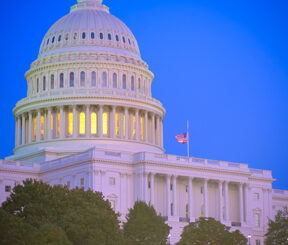
As many as 21 Congressmen attended the Second National Hindu Advocacy Day on the US Capitol during which the elected representatives said that there is a need to pay attention to discrimination against the Hindus in the US.
There is need to pay attention to how, “there is discrimination not just by race but also by religion and Hinduphobia and intimidation of the Hindu community is an old problem,” Congressman Rich McCormick told attendees of the day-long conference at the US Capitol organized by Coalition of Hindus of North America (CoHNA). McCormick said that bills like California’s SB403 “are racist, discriminatory and divisive, since they seek to classify people in ways that the people themselves reject.” This is not American and needs to be opposed, the Republican Congressman from Georgia said.
“I believe strongly in freedom of religion for every individual and stand against any kind of attacks and phobia,” said Congressman Sri Thanedar.
He spoke of the importance of ensuring representation for diverse groups and freedom of religion.
“The Hindu religion is a peaceful one, yet it has been attacked and needs to be protected. Like others, Hindus deserve to be able to practice their religion without any kind of hate, prejudice or phobia. As a Congressman, I myself noted the lack of a Hindu caucus and therefore helped create one,” Thanedar said.
Hindu Americans from 12 states who attended the day-long conference were Hank Johnson, Tom Keane, Rich McCormick, Thanedar, Buddy Carter and Sanford Bishop, as well as Ohio State Senator Niraj Antani. “Hindus are under attack in the US,” Atani said. According to Nikunj Trivedi, president of CoHNA, there has been growing awareness about the Hindus in the US “It’s been a productive year of advocacy for the Hindu community with states like Georgia and cities as far apart as Fremont, California and Memphis, Tennessee, seeking to educate about the problem with resolutions and proclamations against Hinduphobia.
“We also witnessed history as the growing popularity of Hindu festivals like Diwali led to the successful declaration of the festival as a holiday in New York City public schools,” he said.
The idea of ‘caste discrimination’ in America is strange at best, given the lack of proper data of any actual discrimination, said Prof Babones, executive director of the Indian Century Roundtable.
“How do California lawmakers plan to figure out someone’s caste in the US, given that there are over 1100 scheduled castes, over 700 scheduled tribes and over 2500 castes in the OBC category just in India alone? Dalit is not a ‘caste’,” he added.
(Source: PTI)
WASHINGTON, D.C. (TIP): The United States and like-minded countries including India need to work together to shape the course of artificial intelligence, Arti Prabhakar, the Science Advisor to President Joe Biden, said on Friday, July 21 as the administration roped in several IT giants like Google and Microsoft to ensure that it is not misused and is being used for public good.
“The work that we are doing includes working with companies to hold them accountable and there’s some important progress on that today. We’re also working on executive actions that we can take within existing law, and the President is considering an executive order that we think can really boost our ability to deal with AI’s harms and also start using it for good,” Indian-American Prabhakar told PTI in an interview.
“That’s what we can do from the executive branch. We’ll also continue to work with Congress on bipartisan legislation as they start putting legislation forward. Then critically and underpinning all of this is the work that we’re doing globally with our international partners and allies, including with India,” Prabhakar said.
“And that is because this is a global technology. It’s everywhere. Everyone is participating and it’s really affecting, it’s going to affect everyone’s lives and we want to make sure that like-minded countries work together to shape the course of AI,” she said in response to a question.
AI, she said, was one of the important topics of discussion when President Joe Biden met Prime Minister Narendra Modi here last month.
“I think that’s very much on the minds of our global leaders when they meet with President Biden. That’s what happened with Prime Minister Modi and many others. I had the opportunity to be at Congress when the Prime Minister spoke and then at the State Dinner and then again at the luncheon that the Vice President and the Secretary of State hosted and artificial intelligence came up repeatedly in those conversations,” she said.
“In fact, the prime minister made a wonderful joke when he addressed Congress and he said he thought AI stood for America, India, which is another way of interpreting it. But I think really the theme of many of the conversations that have happened is exactly what you’re saying is we’re going to have to link arms and be clear about how to achieve safe AI so all of our citizens can benefit from it,” Prabhakar said.
Prabhakar, who spent half of her professional life in Silicon Valley and has her regular home in Palo Alto, said she senses the excitement about AI in Silicon Valley.
“What I would say is go build amazing applications for artificial intelligence because that is part of how we’re going to go forward and make sure while you’re doing it, to build AI that is safe and trustworthy so that it really does lift us up in the end,” she said.
On Friday, Biden announced voluntary commitments that the administration has worked on with seven leading AI companies. These companies include Google, Microsoft, Amazon, Meta, and some of the smaller AI companies. A number of tech companies, some of the biggest leaders in AI, are signing up for some commitments on safety, security and trust.
“It is such an important step that we’ve been able to achieve by holding these companies to account because it’s the first time that the industry has started to come together and take responsibility,” she said.
“Then we’re going to be working on what we need to do as an executive branch, and that will include figuring out how do we manage as AI makes voice cloning, makes fraud easier. As cybercrime becomes easier, some of these harms start advancing. How do we mitigate those harms within the laws and regulations that we already have?” she said. “And then how do we start using AI for public purposes? How do we use it to deal with the climate crisis that we’re confronting? How do we use it to improve health outcomes for everyone here in America and around the world? So, we’re seeing both the bright and the dark side and we’re actively working on both pieces,” she said.
Describing AI as the most powerful technology of this time, she said the president’s been clear that how it is used is going to express their values. But that’s true as well around the world.
“We know every part of the world is trying to use AI to create a future that expresses their values. I think we can disagree about lots of things in this country and around the world, but the one thing I think we would all of us would agree on is that we don’t want to live in a future that’s driven by technology, that’s shaped by authoritarian regimes,” Prabhakar said. “That’s why I think it is so important for like-minded countries, for democratic countries to come together and make sure that we’re working together to use AI in ways that express our values,” said the top American scientific official.
(Source: PTI)
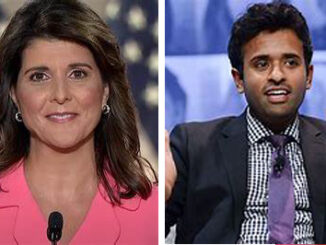
WASHINGTON, D.C. (TIP) : Nikki Haley and Vivek Ramaswamy, the two Indian American Republican aspirants in 2024 presidential race, are on track to qualify for the first Republican primary debate on Aug 23 in Milwaukee, according to media reports.
Haley and Ramaswamy would be facing off with former President Donald Trump and Florida Governor Ron DeSantis, South Carolina senator Tim Scott and former New Jersey governor Chris Christie during the debate in Milwaukee − the largest city in the key battleground state of Wisconsin.
Several other candidates including former Vice Present Mike Pence, Will Hurd, Doug Burgum, Asa Hutchinson, Ryan Binkley, Francis Suarez and Larry Elder are still working on qualifying, according to the reports.
The Republican National Committee set forth requirements in June that candidates must meet on status, polling, fundraising and pledging to take part in the debate.
Candidates must poll at least 1% in three national polls or 1% in two national polls and 1% from an early state poll from two “carve out” states recognized by the committee.
Candidates must also have a minimum of 40,000 unique donors’ part of their presidential campaign committee – with at least 200 unique donors per state – and sign a pledge agreeing to support the eventual party nominee.
According to the reports Haley, the first Indian American to serve in a presidential cabinet under Trump as US ambassador to UN is on track to meet the requirements for the debate.
The news reported she’s raised over $7.3 million through her campaign and affiliated committees between April and June.
The survey from Morning Consult shows she has registered 3% of support among Republican voters, which is on par with two of her rivals. She’s also maintained scoring above 1% in other polls.
Haley indicated on Twitter she plans on supporting the eventual nominee for the Republican party.
“Absolutely irresponsible that Trump, DeSantis, and others won’t commit 100% to supporting the Republican nominee,” Haley tweeted. “There’s no room for personal vendettas in this battle to save our country.”
Biotechnology entrepreneur Vivek Ramaswamy has also fulfilled the debate criteria, according to his spokesperson Tricia McLaughlin cited by media reports.
McLaughlin told the media that Ramaswamy has 65,000 donors. As part of his fundraising strategy, Ramaswamy has laid out incentives for supporters such as offering to give them a 10% cut of the total money he raises for his presidential bid, according to Axios. The survey from Morning Consult shows Ramaswamy has received 8% support from GOP voters, surpassing former Vice President Mike Pence and trailing behind DeSantis. He’s also starting to receive double-digit figures in some polls.
Trump, the Republican frontrunner, has 56% of support from potential Republican voters, and he’s placed first in other national and state polls, according to a survey from Morning Consult.
His campaign said that he has also raised more than $35 million during the second quarter of the year – about twice the amount raised during the first quarter.
DeSantis, who’s trailing behind Trump in the Republican primary polls, has raised more than $20 million during the first six weeks of his candidacy and has about 50,000 donors as of late June.
RICHMOND, VA (TIP): Virginia Governor Glenn Youngkin has appointed Indian-American gastroenterologist Dr Bimaljit Singh Sandhu to a key administration position in the health sector.
Dr Sandhu on Tuesday, July 18, was sworn in as a Board member of the Virginia Commonwealth University Health System Authority, a position in which the Indian-American will play a key role in the state’s health education system. The role of the board of directors is to oversee the entire operations of the health system, the med school, nursing school and pharmacy school.
“It’s a lot of responsibility. We provide direction as far as the fundraising, giving strategic direction to the different medical schools and hospitals so that we are at the cutting edge and provide the best care to the Virginians,” Dr Sandhu said after the swearing-in ceremony in Richmond.
Hailing from Faridkot in Punjab, Dr Sandhu migrated to the US in 2004 as a faculty member of Virginia Commonwealth University Medical Centre as a gastroenterologist.
(Source: PTI)
WASHINGTON, D.C. (TIP): An association of more than 2,100 small and mid-size IT companies in the US mostly owned and operated by Indian-Americans has urged lawmakers to double the H-1B quota from the current 65,000 to address the massive shortage of highly skilled workforce in the country.
The H-1B visa is a non-immigrant visa that allows US companies to employ foreign workers in specialty occupations that require theoretical or technical expertise. Technology companies depend on it to hire tens of thousands of employees each year from countries like India and China.
More than 240 members of the association named ITServe converged in the US capitol on Tuesday for the first-ever in-person Congressional advocacy day during which they plan to reach out to Congressmen and Senators to brief them about the massive shortage of highly skilled workforce in the US.
They said the shortage of highly skilled workforce is impacting their businesses and the American advantage in general. In addition to increasing the number of H-1B visas from 65,000 currently to 130,000 per annum, ITServe is also urging lawmakers to increase the investment in STEM (Science, technology, engineering, and mathematics) education in the US to develop the required high-skilled force within the country.
Coinciding with the Congressional advocacy of ITServe, Indian-American Congressman Raja Krishnamoorthi on Tuesday introduced the High-Skilled Immigration Reform for Employment (HIRE) Act.
The act would strengthen US competitiveness by helping to close the skills gap – the space between the skills required for jobs that employers need to fill, and the skills possessed by current prospective employees.
It would help to close the skills gap by providing additional funding to strengthen US elementary and secondary school science, technology, engineering, and math (STEM) education programs while also doubling the number of H-1B visas available annually from 65,000 to 130,000 to allow American employers, including in critical technology sectors, to draw the best talent from around the world.
“Creating jobs and building the economy of the future requires us to lead the way in technology by developing our domestic workforce while drawing the best talent from around the world,” Krishnamoorthi said.
“The US needs to maintain its leadership in technology and innovation,” Vinay Mahajan, ITServe Alliance president, said.
(Source: PTI)
RIVERSIDE, CA (TIP): : An Indian American man who killed three teens by ramming their car off the road after they played a doorbell prank on him has been sentenced to life in prison without the possibility of parole.
In April, Anurag Chandra, 45, was found guilty by a jury on three counts of murder, three counts of attempted murder and a special circumstance allegation of multiple murders in January 2020, according to a news release from the Riverside County District Attorney’s Office.
“The lives of countless families will never be the same because of one man’s anger, callousness and outrageous conduct, and I am grateful to Judge Navarro for imposing the maximum sentence in this case,” District Attorney Mike Hestrin said during the sentencing on Friday.
On the night of Jan 19, 2020, the teens were having a sleepover and one of them was dared to play a prank commonly known as Ding-Dong Ditch.
One of the victims’ mother told the media that they were celebrating a birthday and played the prank on the home of another teenager they thought lived there.
According to an investigation by the California Highway Patrol, the victims drove to a nearby home, where one of them jumped out of the Prius they were riding in, rang Chandra’s doorbell, jumped back in the car and drove off with the other teens.
Chandra then chased down the teens in his car, rear-ending and sideswiping the Prius until he ultimately accelerated to 99 mph and “intentionally rammed his car into the back of the Prius, causing it to veer off the road and into a tree,” the release stated.
According to reports, Chandra did not report the crash and drove away. During the trial, Chandra testified that he became alarmed when he saw someone in front of his house with a sweatshirt hood pulled over his head.
He testified that the person rang the bell, pulled his pants down and mooned him by exposing his buttocks, Afraid for his family’s safety, he testified that he jumped in his 2019 Infinity and chased the Prius.
Chandra also testified that he drank 12 beers in less than three hours before the teens rang his bell, He claimed that he hit the Prius from behind when it suddenly braked, according to a media report.
Chandra was arrested on Jan 20, 2020, and has since been in custody at the Robert Presley Detention Center in Riverside.
Oppn has its task cut out if it is to cohere into a credible alternative to BJP-led NDA
“After the Patna warm-up exercise, the Opposition took a few steps forward in Bengaluru. The most significant of these were christening the coalition ‘INDIA’ — an acronym for Indian National Developmental Inclusive Alliance (note the absence of the words ‘secularism’ and ‘socialism’, which used to be pet shibboleths), and drafting a resolution that addressed the concerns of each participant.
From here to 2024, the Opposition has its task cut out if it is to cohere into a credible, convincing alternative to the BJP. As for the BJP, the fundamental question is: if its electioneering is going to center around Modi, as it surely will, what was the compulsion to revive the NDA?”
By Radhika Ramaseshan
Coalition politics, which dominated the Indian landscape from time to time, gradually receded from popular consciousness when the BJP got a majority on its own in 2014. The party did not need the allies which sailed alongside, hoping to be deal-makers and deal-breakers, as they had done in the past. In his thanksgiving speech in May that year, Prime Minister Narendra Modi had said that despite the BJP being comfortably cushioned against instability, he would take the constituents along and allow them to be part of his government. It was a statement that was condescending and yet a token acknowledgment of the times when BJP dispensations led by PM Atal Bihari Vajpayee depended critically on the support of their associates. It seemed as though Modi did not want the National Democratic Alliance (NDA) put together by Vajpayee to unravel because who knows when he would have to fall back on it again!
It seemed as though the NDA relaunch was a quick response to the forum of 26 Oppn parties.
The NDA, like other amalgams formed by a covenant of practicality and interdependence, mutated periodically. Some parties left when their leaders believed their political interests were threatened, while others departed in search of greener pastures. In 2014, Modi had 11 allies who were part of his dispensation and others who were out of it because they failed to open their accounts in the Lok Sabha polls, such as the Haryana Janhit Congress.
In 2019, the BJP’s old friends such as the undivided Shiv Sena, the Shiromani Akali Dal (SAD) and the AIADMK remained with Modi. A fair-weather ally, the Janata Dal (United) — which quit the NDA before 2014 amid its leader Nitish Kumar’s bitter relationship with Modi — returned, sensing that there was little point in throwing his lot with the ‘secular’ spectrum and being relegated to the margins. By then, the BJP had found new partners in the North-East, a hitherto untrodden region it had set its eyes on. The elections that year marked a new high for the BJP and Modi as they won with a bigger majority that rendered the NDA virtually redundant. Increasingly, the BJP became the strong fulcrum on which power depended. Mere appendages to a powerful core, the NDA constituents could not exercise the leverage they had in Vajpayee’s somewhat wobbly governments.
The difference between that period and the present one is that Modi never cared to set up a steering committee, while the NDA meetings became a thing of the past. Vajpayee made it a point to nominate the leader of a non-BJP party as the steering committee’s convener. Modi’s NDA was faceless. Its near-anonymity briefly broke over a contretemps between Chirag Paswan, son of Ram Vilas Paswan, and his uncle Pashupati Kumar Paras over who would claim Paswan Senior’s legacy after his death. The BJP drove a wedge in the Paswan clan and spirited away the uncle, who walked away with the MPs and MLAs of the Rashtriya Lok Janshakti Party (RLJP), leaving Chirag with nothing except his own Lok Sabha seat. Paras was the first ally who was inducted into Modi’s BJP-heavy Cabinet out of sheer expediency.
The NDA’s then-and-now saga had an unexpected twist when BJP president JP Nadda proclaimed that 38 allies would participate in a meeting of the coalition in Delhi on July 18. Thirty-eight? Which were these parties? The Sena, one of the BJP’s oldest allies, was split into two, with the BJP getting the faction headed by rebel Eknath Shinde on its side. The faction helmed by Uddhav Thackeray, founder Balasaheb Thackeray’s heir, who had earlier snapped his ties with the BJP, became a part of the Opposition’s Maha Vikas Aghadi; Uddhav was the Maharashtra CM for a couple of years. Uddhav was outfoxed by the BJP’s machinations. The SAD broke away from the NDA in 2020, while the Janata Dal (United) returned to the Mahagathbandhan in Bihar last year.
Maharashtra, which experienced a tectonic shift in the form of the Sena split, was subjected to another seismic jolt when the Nationalist Congress Party (NCP), headed by strongman Sharad Pawar, broke. The mutineer was none other than Pawar’s nephew Ajit Pawar, who walked into the NDA. During Tuesday’s NDA show, the BJP got Chirag Paswan on board. Though the Telugu Desam Party did not get an invite for the meeting, it is also expected to return to the NDA fold.
Modi was the centerpiece of the event as the leaders of each constituent vied to sing his praises. In his long speech, he trained his guns on another meeting which concluded shortly before the NDA members sat together.
Over 2,000 km away in Bengaluru, the Opposition parties met in a gathering of the Congress’ steadfast friends such as the DMK, the Rashtriya Janata Dal and the Jharkhand Mukti Morcha and newer ones like Uddhav Thackeray’s Sena faction, Aam Aadmi Party, the JD(U), the Trinamool Congress and the Samajwadi Party-Rashtriya Lok Dal combine. This meeting was planned soon after the Opposition rallied around for its first congregation at Patna on June 23. It seemed as though the NDA relaunch was a quick response to this forum of 26 parties, as though it was a parallel demonstration of strength.
After the Patna warm-up exercise, the Opposition took a few steps forward in Bengaluru. The most significant of these were christening the coalition ‘INDIA’ — an acronym for Indian National Developmental Inclusive Alliance (note the absence of the words ‘secularism’ and ‘socialism’, which used to be pet shibboleths), and drafting a resolution that addressed the concerns of each participant.
From here to 2024, the Opposition has its task cut out if it is to cohere into a credible, convincing alternative to the BJP. As for the BJP, the fundamental question is: if its electioneering is going to center around Modi, as it surely will, what was the compulsion to revive the NDA?
(The author is a senior journalist)
There is an all-round weakening of the rule of law in India, best exemplified by the impasse in the wrestlers’ sexual harassment complaint and the feeble administrative, judicial and political attempts to ensure justice.
Police selectivity in the investigation became legally established when after over 40 days of investigation, the police filed its long report in two parts: a charge sheet relating to different sexual offences against the adult wrestlers, and a closure application (over 500 pages long) in connection with the POCSO Act offence. The closure application relied on an extra-legal withdrawal application by the minor, who is alleged to have made the first complaint, including a statement under Section 164 in a state of anger or dispiritedness.
By B. B. PandeB. B. Pande
The autonomy and the supremacy of the law cannot be taken for granted, because it is dependent on political commitment and a robust rule of law culture. Contemporary Indian society is passing through a phase of an all-round weakening of the rule of law, mainly on two counts: first, a trust deficit in the colonial model of the rule of law, and second, a faith-oriented majoritarian re-imagination of laws that locate their essence in the divine providence. The malaise of such weakening is best exemplified by the case of the Indian medal-winning wrestlers and their complaints of alleged sexual harassment, where there has been no resolution even after their long sit-in protest in the national capital.
The airing of complaints
For almost a decade now, women trainee wrestlers — this also includes award-winning sportspersons — have faced and put up with alleged sexual advances and grave indignities during their training. In January 2023, some of the wrestlers began their sit-in/dharna at Jantar Mantar, New Delhi. Despite the Sports Ministry referring the batch of complaints to an oversight committee, there was no concrete and satisfactory outcome.
After being subjected to insensitive probings during the depositions, the wrestlers decided to resume the sit-in in late April. This time the protest appeared to be better organized; there was more public support and the survivors also approached the Supreme Court of India, where the Chief Justice of India passed orders relating to the registration of the First Information Report (FIR) under the relevant laws and providing security to the wrestlers.
As a sequel to the orders of the Court, the Delhi Police registered two FIRs: the first, under Sections 354, 354A, 354D and 506 of the Indian Penal Code and the second, under the provisions of the Protection Of Children from Sexual Offences (POCSO) Act in connection with the minor wrestler’s allegations. With the registration of the two FIRs for the first time, the sexual harassment complaints came into the domain of criminal justice, making them the subject of police investigation as well as judicial oversight.
Following this, the alleged perpetrator and his followers began a campaign to vilify the wrestlers following growing public and even some political support. The campaign of vilification even went to the extent of critiquing the very basis of the POCSO Act. Growing support for the wrestler’s cause and increasing social visibility of the issue pushed the Union Home Minister to try and resolve it politically by having a closed door meeting with the representatives of the protesting wrestlers in June, followed by a more exhaustive meeting with the Sports Minister; this also included ‘advising’ the protesting wrestlers who hold regular jobs to resume work. As a sequel to the talks and assured relief, the sit-in ended, with the wrestlers saying their fight would now continue in court.
Slothful and selective investigation
As a key criminal justice agency that occupies the top slot in the investigation of crime, the Delhi Police ought to have responded quickly when internationally acclaimed wrestlers levelled serious charges against the perpetrator/politician who also occupies a top position in the sports world.
After the first sit-in, which also highlighted the murky goings-on in the Wrestling Federation Of India, the police could have acted as in Section 156(i) of the Code of Criminal Procedure (Cr.P.C.), i.e., “Any officer in charge of a police station may, without the order of a Magistrate, investigate any cognizable case which a Court having jurisdiction over the local area within the limits of such station would have power to inquire into or try under the provisions of Chapter XIII”, like the Magistrate under Section 190(c) of the Cr.P.C.
The Delhi Police is also under legal obligation, under Section 166A(c) in the amended Penal Code of 2013, as in the amendment to the Penal Code, which makes the ‘non-recording’ of information about sexual offences an offence punishable up to two years imprisonment. Therefore, when the Solicitor General advised the Supreme Court on May 28 that the FIRs would be registered ‘if your Lordships so directs’ and the Court complied with the wish, both displayed unusual deference to the Delhi Police. The Delhi Police would have been better reminded of their obligation to follow the mandatory FIR registration, as laid down in the ruling in Lalita Kumari (2013).
The Delhi Police has taken its own time in investigating the crime, with a focus on the credentials of the complainants and only cursory fact gathering as far as the accused persons are concerned. Despite an FIR that falls under the POCSO Act, the prime accused person has not been interrogated or subjected to any kind of restraint even as he continues with this campaign of vilification on social media in an attempt to mount pressure on and intimidate the witnesses.
Police selectivity in the investigation became legally established when after over 40 days of investigation, the police filed its long report in two parts: a charge sheet relating to different sexual offences against the adult wrestlers, and a closure application (over 500 pages long) in connection with the POCSO Act offence. The closure application relied on an extra-legal withdrawal application by the minor, who is alleged to have made the first complaint, including a statement under Section 164 in a state of anger or dispiritedness.
The rule of law course correction
The credibility and endurability of the rule of law is critically linked to universal and equal applicability in all situations, which is ensured by the equality principle propounded by legal philosophers. In the context of the sexual harassment complaints and FIRs, the equality principle demands a free, fair and impartial investigation that ensures a just and expeditious disposition of the complaints. It appears that the legal course at the police level has been designed to be slow and selective and overly deferential to the main accused person.
But that alone is not enough to tilt the scales for or against the accused, who is equally entitled to a ‘fair trial’. However, the journey of the rule of law is expected to continue without impediment; that is why the Bench in the Lalita Kumari case relied on the reason of keeping an efficient check on police powers and having the measure of ‘judicial oversight’ of the magistrate, the idea being to obligate the jurisdiction Magistrate to follow up on each of the FIRs. Such judicial intervention in investigation may arise from an application by the complainant directly under Section 156(3) of the Cr.P.C. or on a writ petition before the High Court. In addition, the appellate courts (High Courts and the Supreme Court of India) enjoy powers to take suo motu cognizance and call for an action taken report or direct the lower court to monitor the investigation.
The Supreme Court, in Sakiri Vasu vs State of U.P. (2008), has already imbued the magistracy with implied/inherent powers to monitor an investigation in the event of any abuse of powers. Sadly, in the case before us, the survivors have, by and large, had a raw deal. Neither the Delhi police nor the judiciary appear to have considered it worthwhile to stem the rot. They have been protesting in the open — at the site and then on the streets of Delhi — for months now. But administrative relief and judicial vindication seem distant. For the political dispensation, the ‘delay’ may be part of a ‘smart’ strategy to let the complaints lapse with time, even as it is convenient to blame the ‘failing colonial model’ of the rule of law.
But for all those who have a greater stake in upholding the basic ideas of the rule of law and ensuring fidelity to constitutional justice, the approach ought to be different. The need is to stand up and resort to course correction to save the soul of the rule of law. We are not alone in such a fight to save the rule of law, as in many other democracies across the world, the rule of law confronts similar threats. This appears to be why the Stockholm Criminology Symposium (June 2023), focused on the theme of ‘principled and equitable law enforcement’.
(B.B. Pande is a former professor of law at Delhi University) (Source: The Hindu)
Of late, much of the ED’s powers have been discharged in effecting pre-trial arrests Unfortunately, of late, much of the ED’s powers have been discharged in effecting pre-trial arrests, which used to be the prerogative of the police investigating the predicate offence. In the past, the CBI was used to impart fear among political opponents. In the process, the agency received the condemnation of various courts and earned the nickname “caged parrot”. Whether the ED will go down the same path or reorient its approach will entirely depend on the intervention of the country’s constitutional courts.
By Manuraj Shunmugasundaram
The Prevention of Money Laundering Act (PMLA), 2002 vested a cadre of officers under the Directorate of Enforcement (ED) with powers to prevent money laundering, attach proceeds of crime, and confiscate assets. However, over the last few years, the ED has assumed powers akin to that of a policing agency and has often been accused of turning its gaze against political opponents of the Union government. These concerns were bolstered when the Union government granted ED Director Sanjay Kumar Mishra a third extension, which the Supreme Court struck down.
The ED is not the police
It has been repeatedly held that the PMLA is a sui generis legislation, enacted to tackle money laundering through white collar crimes. According to Section 3 of the PMLA, the act of projecting or claiming proceeds of crime to be untainted property constitutes the offence of money laundering. Under the Schedule to the PMLA, a number of offences under the Indian Penal Code and other special statutes have been included, which serve as the basis for the offence of money laundering. In other words, the existence of predicate offence is sine qua non to charge someone of money laundering. It is crucial to note that the investigation and prosecution of the predicate offence is done typically by the Central Bureau of Investigation (CBI) or the State Police.
Section 50 of the PMLA provides powers of a civil court to the ED authorities for summoning persons suspected of money laundering and recording statements. However, the Supreme Court held that ED authorities are not police officers. It observed in Vijay Madanlal Choudhary v. Union of India (2022) that “the process envisaged by Section 50 of the PMLA is in the nature of an inquiry against the proceeds of crime and is not ‘investigation’ in strict sense of the term for initiating prosecution.”
There are other dissimilarities between ED authorities and the police. While the police are required to register a First Information Report (FIR) for a cognizable offence before conducting an investigation, ED authorities begin with search procedures and undertake their investigation for the purpose of gathering materials and tracing the ‘proceeds of crime’ by issuing summons. Any statement made by an accused to the police is inadmissible as evidence in court, whereas a statement made to an ED authority is admissible. A copy of the FIR is accessible to the accused, whereas the Enforcement Case Information Report is seldom available.
During the discussion on the PMLA Bill in the Rajya Sabha in 2022, the erstwhile Union Minister of Finance, Jaswant Singh, said that he was “not entrusted with the responsibility of acting as a policeman of the country or acting as a policeman on the economic morals of the country.” He added, “It is not… the intention of the Government to have a piece of legislation which can be used as a… disguise for political vendetta or political revenge-taking.”
These words were likely in reference to the powers of arrest under Section 19 of the PMLA, which permits superior ED authorities to arrest any person whom they have “reason to believe” is guilty of money laundering based on the material in their possession. Combined with the stringent conditions for grant of bail under Section 45 of the PMLA, the specter of arrest by the ED is always real and present. However, the use of the phrase “reason to believe” indicates that the ED authorities must satisfy themselves of the need for arrest and that such belief must pass the reasonableness test. As such, this should be the test that courts assessing the necessity of remand must apply, but seldom do.
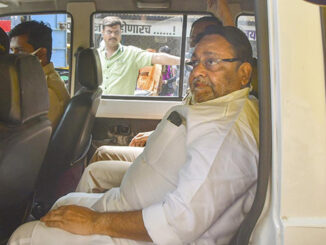
Over the last year or so, the ED has arrested Ministers of the Delhi government, Satyender Jain and Manish Sisodia; former Minister from the Shiv Sena, Nawab Malik; former Principal Secretary to Kerala Chief Minister Pinarayi Vijayan, M. Sivasankar; Deputy Secretary to Chhattisgarh Chief Minister Bhupesh Baghel, Saumya Chaurasia; YSRCP MP Srinivasulu Reddy’s son, Magunta Raghava Reddy; and Tamil Nadu Minister, V. Senthil Balaji. In spite of such high-profile arrests, the ED has only filed charge-sheets after concluding investigation in only 1,142 cases out of the 5,906 cases registered since 2005. It is apparent that the majority of the focus is unduly spent on effecting pre-trial arrests and not thereafter. It is reported that 85% of cases registered against politicians involve those belonging to the Opposition parties.
Role and purpose
Political malice aside, this raises another fundamental question about the role and purpose of the ED. While the police investigating the predicate offence are empowered to arrest and seek custody of the accused, the ED is meant to focus on recovering the proceeds of crime in order to redistribute the same to victims. It is not clear whether the ED has managed to do this. Per contra, the Proceeds of Crime Act, 2002, the analogous legislation in the U.K., almost entirely concentrates on confiscation of assets through dedicated civil proceedings.
Unfortunately, of late, much of the ED’s powers have been discharged in effecting pre-trial arrests, which used to be the prerogative of the police investigating the predicate offence. In the past, the CBI was used to impart fear among political opponents. In the process, the agency received the condemnation of various courts and earned the nickname “caged parrot”. Whether the ED will go down the same path or reorient its approach will entirely depend on the intervention of the country’s constitutional courts.
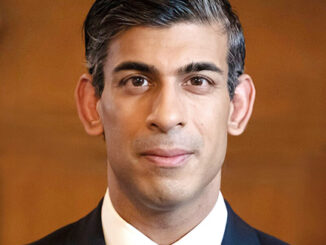
LONDON (TIP): Prime Minister of U.K. Rishi Sunak’s Conservative Party suffered significant losses in two of three parliamentary byelections on Thursday, July 20, in what is being seen by some as a strong indicator of their prospects in next year’s general election.
The Tories lost to Labour by a sizeable margin in the northern England constituency of Selby and Ainsy, and to the Liberal Democrats (Lib Dems) in the Conservative stronghold of Somerton and Frome. They managed to retain former Prime Minister Boris Johnson’s seat in the west London area of Uxbridge and South Ruislip, but with a reduced majority.
Labour secured a record win in Selby, with twenty-five-year-old Keir Mather ousting them after winning by a margin of over 4,100 votes or 46% of the vote share (versus the Conservatives’ 34.3%). The newly minted youngest MP, who is a former parliamentary researcher and public relations adviser, ran a campaign focused on the cost of living crisis facing the country.
In the Somerton area in England’s South West, the Lib Dems’ Sarah Dyke won a majority of over 11,000, taking a Conservative seat — a 29% swing away from the Tories. Local councillor Seve Tuckwell won a recount in Uxbridge by a 495-vote majority. Former Prime Minister Johnson had held the Uxbridge and South Ruislip seat for eight years before resigning last month, after a parliamentary committee found that he lied to Parliament and was about to suspend him. Following his resignation, his colleague Nigel Adams, representing Selby, also resigned.
British Prime Minister Rishi Sunak defended his party’s performance and pushed back against the idea that his party was heading for a defeat next year. His party is trailing labour in opinion polls, with the country reeling from high levels of inflation, dissatisfaction over public sector pay, rising interest and mortgage rates, problems with public services, specifically in the National Health Service (NHS).
“Westminster’s been acting like the next election is a done deal. The Labour Party has been acting like it’s a done deal. The people of Uxbridge just told all of them that it’s not,” he said on Friday, as he visited the constituency. Mr. Tuckwell attributed his victory in part to London Mayor Sadiq Khan’s decision to increase the size of London’s Ultra Low Emission Zone (an area covering parts of London that require automobiles to pay a congestion charge). The area is set to expand to cover all of London from August 29. Members of Mr. Khan’s own Labour party have suggested he rethink his decision but the mayor has stuck to his plans.
““Even if we include the Uxbridge result, together with Selby and Somerton, on average, the Conservative vote was down by 21 points in those three constituencies,” political scientist John Curtice told BBC Radio 4.
“The message on Thursday, July 20, is that basically the Conservatives are indeed as deep [down] an electoral hole as the opinion polls have been suggesting.”
NEW YORK CITY (TIP): The M.T.A. board voted to raise the base fare to $2.90 from $2.75, after pausing increases to try to lure back riders lost during the pandemic.
Ever since the coronavirus pandemic decimated subway ridership in New York City, the Metropolitan Transportation Authority has resisted raising the price of a ride out of fear that even more people would abandon mass transit, says a New York Times report.
But after years of financial uncertainty, the authority intends to balance its budget. On Wednesday, July 19, the M.T.A.’s board voted to raise the base fare for subway and bus trips for the first time in eight years, to $2.90 from $2.75, by Aug. 20. The decision will almost certainly reverberate across the United States, where transit systems of every size have experienced steep and lingering losses as many white-collar commuters continue to work from home at least part of the time.
A May survey by the American Public Transportation Association found that larger cities have been hit especially hard — 71 percent of transit agencies with operating budgets greater than $200 million were predicting shortfalls in their operating budgets. Transit agencies in Washington, D.C., and the San Francisco Bay Area have also moved to raise fares this year. In New York, weekday ridership has rebounded significantly but still hovers at about 70 percent of pre-pandemic levels.
Lower-income workers who rely on the system to reach their jobs would bear the greatest burden of a fare increase, advocates said, especially as the cost of essentials such as housing, food and health care continues to rise.
Transportation in New York City
Hudson Tunnel Project: The federal government is on track to give $6.88 billion, the most ever awarded to a mass-transit project, for the construction of a second rail tunnel under the Hudson River to New York City.
Penn Station: A private development firm presented an alternative plan for the remaking of the station, saying it would be significantly cheaper than a rival proposal backed by the M.T.A.
Congestion Pricing: A program that would charge people a toll to enter the busy commercial districts of Manhattan south of 60th Street cleared its final federal hurdle. Here’s a look at how the program could work.
Fare Evasion: A report unveiled by the M.T.A. proposed a range of new solutions, including replacing turnstiles with gates that are harder to jump over, to deter people from sneaking into subways without paying.
Janno Lieber, the M.T.A. chairman, defended the increase, describing it as a return to biennial fare increases meant to keep up with inflation. “We need this to be responsible,” Mr. Lieber said before Wednesday’s vote. “It’s not without its downsides, because anytime you’re asking people to pay a little more, you know that has consequences. But for everybody who depends on this transit system — like I always say, mass transit is like air and water for New Yorkers — we need it.”
The $2.75 base fare has been in place since 2015. The most recent fare increase came in 2019, when the price of unlimited weekly and monthly MetroCards rose.
The board also voted to raise monthly passes on the Long Island Railroad and Metro-North Railroad by as much as 4.5 percent. Tolls on bridges and tunnels will rise by 6 percent for drivers paying through the E-ZPass system and by 10 percent for those who pay by mail.
According to the United Way of New York City, about half of working-age New Yorkers are struggling to cover basic needs this year, up from 36 percent of households in 2021.
Elizabeth Angeles, who helps oversee advocacy efforts for the organization, said that when people struggle to make ends meet, they tend to skip meals in order to pay for what are typically fixed costs, like transportation.
“Or, they’re relying on our emergency food pantries, which are already strapped,” Ms. Angeles said. “It’s going to exacerbate a system that is already on its knees.”
But the M.T.A. and even some of its regular critics said that a fare increase was a crucial step to ensure the survival of the transit system, which continues to rely heavily on rider payments.
The authority this year is also building a first-in-the-nation congestion pricing program that will allow it to collect billions of dollars from drivers to pay for infrastructure enhancements, including new elevators in subway stations and updates to the signals that keep trains moving. But by law, the money can only be used to pay for capital projects, not for operating costs.
Earlier this year, the authority had faced a budget gap of nearly $3 billion by 2025. A bailout from Gov. Kathy Hochul and lawmakers in Albany helped to significantly shore up the transit system’s finances by providing new and recurring funding for the authority, but not enough to avert a fare increase.
“The fare increases are going to ensure there is sufficient funding to keep transit going,” said Lisa Daglian, the executive director of the transit authority’s Permanent Citizens Advisory Committee, a watchdog group. “The budget would be balanced not only because of the incredible generosity of the governor and efficiencies by the M.T.A., but because riders are investing.”
The state’s funding package includes a $65 million payment earmarked to prevent an even larger fare increase.
In hopes of offsetting the increase, many had urged Mayor Eric Adams to expand eligibility requirements for the Fair Fares program, which subsidizes public transit fares for New Yorkers whose income falls below the federal poverty line — about $30,000 a year for a family of four.
City Council leaders pushed during budget negotiations last month to double the program’s income threshold. The council struck a deal with Mr. Adams to boost funding for the program by $20 million, but the proposal to make it more widely accessible was scaled back.
The M.T.A. has struggled financially since at least the 1970s, when a municipal fiscal crisis worsened problems caused by the system’s crumbling infrastructure. Lawmakers moved in the 1980s to allow the authority to issue bonds, but its debt has exploded since then, and expenses have outpaced income.
Opposition, government spar over rules of discussion
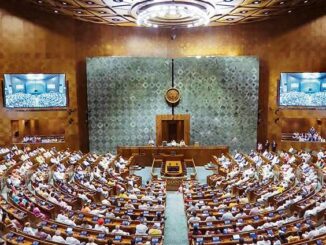
NEW DELHI (TIP): Video evidence of brazen mob violence against two Manipur women stalled Parliament for the second straight day with the Lok Sabha and the Rajya Sabha adjourned amid constant sloganeering without transaction of business.
At the heart of the stalemate were rules under which to debate violence in the northeastern state, which has been on the edge since May 3 following a court ruling recommending the ST status for the majority Meiteis, a move that sparked protests among tribal locals.The Opposition wants discussions under provisions that allow suspension of all business to discuss an urgent issue at the day’s start, followed by Prime Minister Narendra Modi’s reply. The government is agreeable to debating under rules where the presiding officer slots a discussion at any time. Also, the government says Union Home Minister Amit Shah will reply to the discussion. Disagreement over rules had the Opposition and the government blaming one another for stalling a crucial debate, even as protests continued in Manipur following the shocking visuals of two women being groped by a mob. Both Houses witnessed frenzied sloganeering by opposition MPs with “INDIA” placards appearing in the wells. In Lok Sabha, Defence Minister Rajnath Singh, deputy leader of the House, said the government wanted a debate on Manipur to be held in all seriousness but the opposition was disinterested. “We want a discussion on Manipur… I want to say the Opposition is not serious, as it should be, for a discussion on Manipur,” he said moments before LS Speaker Om Birla adjourned the House after MPs protesting in the well declined his pleas to return to seats.
Rajya Sabha saw similar scenes, with Chairman Jagdeep Dhankhar adjourning the House for the day.
The ruckus is expected to continue on Monday with the Opposition scheduling a protest at Mahatma Gandhi statue in Parliament house complex. The Congress upped the ante today, urging President Droupadi Murmu to dismiss the state government.
Party’s deputy leader in RS Pramod Tiwari said the Opposition wanted a debate “without time restrictions but the government is offering a short duration discussion”. Outside Parliament, the BJP condemned Manipur incident but cited violent crimes against women in TMC-ruled West Bengal and Congress-ruled Rajasthan to ask if crime videos needed to go viral for the people to be outraged.
BJP’s Hooghly MP Locket Chatterjee broke down recalling a woman being paraded naked in South Panchla for contesting the recent panchayat elections in the state.
Union Jal Shakti Minister Gajendra Singh Shekhawat and BJP general secretary (Rajasthan) Arun Singh listed crimes against women in the state. “Rajasthan is a failed state. There has been a tsunami of crimes against women in four years. There is no safe space left. There have been a million criminal cases in four years of Congress rule,” Jodhpur MP Shekhawat said, mentioning a recent brutal gang-rape and murder of a Scheduled Caste girl in Karauli.
As BJP flagged “Manipur-like situation in opposition-ruled states,” BSP chief Mayawati said a “discussion should be held in Parliament on the sensitive Manipur matter and political blame game should stop”.
Earlier, many opposition leaders expressed shock and concern over the inhuman incident of two women paraded naked and subjected to indignities.
Terming sexual violence against women “heart wrenching”, Congress general secretary Priyanka Gandhi Vadra said women and children had to bear the brunt of the violence in any society.
“We must all condemn the violence in one voice while furthering the efforts for peace in Manipur. Why have the Central Government and Prime Minister shut their eyes to the violent incidents in Manipur? Do such pictures and violent incidents not disturb them?” asked Ms. Vadra on Twitter.
Former Congress chief Rahul Gandhi, who had visited Manipur in the last week of June, also questioned the Prime Minister’s silence.
“PM’s silence and inaction led Manipur into anarchy. INDIA will not stay silent while the idea of India is being attacked in Manipur. We stand with the people of Manipur. Peace is the only way forward,” Mr. Gandhi tweeted, referring to the common stand taken by the opposition bloc of INDIA or the Indian National Developmental, Inclusive Alliance.
CPI(M) general secretary Sitaram Yechury tweeted, ”PM Modi continues to remain silent even after this horrendous double engine horror. Silence reflects inhuman callousness. Such barbarism is criminal & abhorrent”.
“This kind of heinous act cannot be tolerated in the Indian society. The situation in Manipur is becoming very worrying. I appeal to the Prime Minister to pay attention to the situation in Manipur. Please take strict action against the culprits seen in the video of this incident. There should be no place for people of such criminal nature in India,” Aam Aadmi Party convener and Delhi Chief Minister Arvind Kejriwal said on Twitter.
Trinamool Congress’ Rajya Sabha member Jawahar Sircar tweeted, “Shocking! Two helpless Kuki women gang-raped and paraded with video by majority community in Manipur. What were the police and armed forces doing? Neither BJP Meitei-led Govt of Manipur nor Modi-Amit Shah Central govt appear bothered at such beastly conduct!”
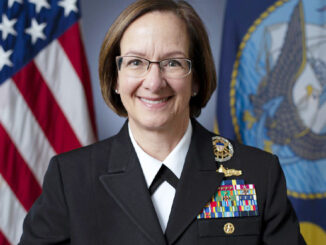
WASHINGTON, D.C. (TIP): President Joe Biden on July 21 nominated Admiral Lisa Franchetti to lead the Navy, an historic step that would break a gender barrier in the U.S. military by making her the first woman to command the service and to become a member of the Joint Chiefs of Staff.
The decision by Mr. Biden is a surprise. Pentagon officials had widely expected the nomination to go to Admiral Samuel Paparo, who leads the Navy in the Pacific and who has experience grappling with the growing challenge from China. Still, Ms. Franchetti, who is currently the Vice-Chief of Operations for the Navy, was among the candidates believed to be in the running for the position, is widely respected and counts broad experience, including as commander of U.S. Naval Forces Korea, officials said.
In a statement, Mr. Biden noted Ms. Franchetti’s 38 years of experience.
“Throughout her career, Admiral Franchetti has demonstrated extensive expertise in both the operational and policy arenas,” Mr. Biden said in a statement, noting that she was the second woman ever to achieve the rank of four-star admiral in the U.S. Navy.
Last year, Mr. Biden picked Admiral Linda Fagan to lead the U.S. Coast Guard, making her its first female commanding officer. But the coast guard is not formally part of the Department of Defense, and instead falls under the Department of Homeland Security.
Ms. Franchetti would become the first woman to lead a military service within the Defense Department and to join the Joint Chiefs of Staff, a group of eight top uniformed service members who advise the President on military issues.
Mr. Biden also elevated Mr. Paparo, nominating him to become the commander of all U.S. military forces in the Pacific. He picked Vice-Admiral Stephen “Web” Koehler to succeed Mr. Paparo as commander of U.S. Pacific Fleet.
Mr. Biden’s announcement comes during a block on all U.S. military nominations in Congress by Senator Tommy Tuberville, who is protesting a Defense Department policy that reimburses costs for service members who travel to get an abortion. Senior military nominations must be approved by the Senate. Although the review is usually routine, a single senator can pause the process by putting a hold on nominations that force them to be considered one at a time, taking many hours each. Mr. Tuberville’s block could have a far-reaching impact across the armed forces, affecting troops and their families, and ultimately costing the U.S. military talent, a point underscored this month by Mr. Biden’s pick to become the top U.S. general, Air Force General Charles “C.Q.” Brown.
The military is already having to shuffle staff to fill a top leadership post after the commandant of the Marine Corps, one of the members of the Joint Chiefs of Staff, stepped down on July 10 when his four-year term ended.
His Number 2 has taken over but the hold on promotions has left the Marine Corps without a confirmed leader in the job for the first time in more than a century, the Pentagon said.
Mr. Biden said the delay undermined national security.
“What Senator Tuberville is doing is not only wrong — it is dangerous,” Mr. Biden said in the statement.
“He is risking our ability to ensure that the United States Armed Forces remain the greatest fighting force in the history of the world. And his Republican colleagues in the Senate know it.”
The battlelines for the 2024 General Election are now clearly drawn, with 26 Opposition parties forming an anti-BJP front named INDIA, an acronym for the Indian National Developmental Inclusive Alliance. The Opposition now has a name, though it still doesn’t have a face. Congress leader Rahul Gandhi, who faces the prospect of being debarred from contesting next year’s Lok Sabha poll if the Supreme Court upholds his conviction and sentence in a defamation case, has declared that INDIA will unitedly fight Prime Minister Narendra Modi for the ‘idea of India’. PM Modi, in turn, said during a meeting of the National Democratic Alliance (NDA) that India had a long tradition of coalitions, but those formed on the basis of negativity had never succeeded. Notably, 38 parties attended the meeting of the BJP-led NDA, including the Shiv Sena and NCP factions led by Eknath Shinde and Ajit Pawar; respectively.
The NDA’s parallel show of strength made it obvious that the BJP is not taking the Opposition lightly; the latter has already held two major meetings (in Patna and Bengaluru) in less than a month, with a coordination committee set to be formed at the next meeting in Mumbai.
The all-important question is: do these parties have the firepower and cohesion to stop the BJP’s juggernaut in 2024? The 26 parties account for around 150 seats in the Lok Sabha, less than half the NDA’s current strength. The Congress, which is in power in Karnataka, Chhattisgarh, Rajasthan and Himachal Pradesh (besides being a junior member of the ruling alliance in Jharkhand), continues to be the premier Opposition party. Much will depend on whether the Congress and its INDIA partners such as AAP and the Trinamool Congress are able to rise above their differences. Going by the split in the Shiv Sena and the NCP, the BJP will stop at nothing to cripple the Opposition camp.
(Tribune, India)
Dear Prof. Saluja, I am writing to express my deepest admiration and gratitude for the exceptional work you have done in your recent issue of the Indian Panorama News exposing criminals in Indian politics. Your relentless pursuit of truth and your unwavering commitment to exposing the nexus between criminals and politicians in India have not gone unnoticed.
In an era where journalism faces numerous challenges, your courage and integrity shine like a beacon of hope. By fearlessly bringing to light the actions of those who seek to undermine the very fabric of Indian democracy, you have demonstrated the true essence of responsible journalism.
Your dedication to unbiased reporting and your willingness to tackle such sensitive subjects are truly commendable. You have proven that journalism is not just a profession but a mission to safeguard the principles of transparency and accountability in our society.
Please know that your efforts have not only inspired me but have also motivated countless others who believe in the power of truth. Your work serves as a reminder that the pen is indeed mightier than the sword and that even in the face of adversity, the pursuit of justice must never waver.
With due respect, I strongly feel based on the facts that the nexus between the criminals and politicians is entirely financed by the so-called world-renowned billionaires of India. The criminalization of politics is directly related to “Gangster Capitalism” that is being practiced in India since its independence in 1947. In India, politicians are selected & financed by the state created billionaires and voters play a part in the charade of voting for them! It was Congress in 1947 that started creating billionaires with public money and wealth to use them as their ATM’s during election time. BJP has gone too fat with the help of state created billionaires; they are buying elected representatives for couple of hundred crores for each in wholesale to form state governments even with 2 MLA’s by toppling non-BJP state governments.
In 1990, BJP was also the part of the anti-India scam along with Congress and others to topple the VP Singh government just to save Dhirubhai Ambani from spending the rest of his life in Jail for crimes against India in 1990. Chandra Shekhar with 61 MP’s (out of 525-member lower house) from the breakaway group of Janta Dal was installed PM with the outside support of 195 Congress MPs under Rajiv Gandhi & 25 MPs of splinter groups by toppling the V P Singh government. The entire operation was financed by Dhirubhai Ambani from money stolen from Indian public. It was a turning point for Indian democracy with the demise of morality, ethics, honesty and patriotism in public life. After that Indian democracy turned to an “Elected Autocracy” and now under BJP’s Modi mostly financed by top billionaires; it is turning into a Dictatorship with Hinduism being turned into a fanatic religion with no space for minorities.
The Indian billionaires along with the Politicians with big majority of them hardcore criminals they select; are the termites that have eaten up the public wealth along with the social and moral fiber of India. They are also responsible for acute poverty, illiteracy, un-employment, lack of basic civic & health care services and massive corruption at all levels of governance including judiciary & media in India. These billionaires are also promoting and financing “Hindu Rashtra” a communal agenda, call it a “Majoritarian Rule” where Upper caste Hindus are more equal even than the lower caste Hindus. No one can ignore how the minorities especially Muslims & Christians are being treated under Modi Rule since 2014. Unfortunately, history tells us that such countries rarely progress much. Retd. Admiral Arun Prakash in an interview has observed that under the current rulers, “India is prone to a Civil War in the very near future”.
I request you to enlighten the Indian public with your thoughts on the issue of “Gangster Capitalist” financing criminals in Politics of India. I stand with you and your team, offering my support and encouragement in any way possible. If there is anything I can do to contribute to the cause of ethical journalism or assist you further, please do not hesitate to reach out.
Once again, thank you for your unwavering commitment to truth and justice. Your work is a testament to the positive impact journalism can have on our society, and I eagerly await your future endeavors.
With sincere appreciation and respect,
Dave Makkar
New Jersey
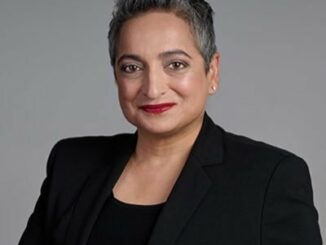
Shamina Singh has studied at Harvard, Yale, Stanford, and the Indian School of Business
WASHINGTON, D.C. (TIP): US President Joe Biden has announced his intent to appoint Shamina Singh, a prominent Indian-American business leader, to the President’s Export Council, which serves as the principal national advisory committee on international trade. Singh, who is the Founder and President of the Mastercard Center for Inclusive Growth, has said that she is “honored to join the group of esteemed leaders that make up the President’s Export Council.” According to a statement from the White House, on July 14, President Biden announced his intent to appoint Singh to serve in the key role. “I am deeply honored to join the group of esteemed leaders that make up the President’s Export Council,” Singh said.
The President’s Export Council serves as the principal national advisory committee on international trade. The Council advises the president of government policies and programs that affect US trade performance, promotes export expansion and provides a forum for discussing and resolving trade-related problems among the business, industrial, agricultural, labor and government sectors.“From the earliest days of my career, I’ve gravitated toward work that helps create long-lasting and inclusive prosperity for people and economies in the US and around the world,” she was quoted as saying in the statement on Mastercard’s website.
Singh also serves as the Executive Vice President of Sustainability at Mastercard and is a member of the company’s Management Committee.
She has drawn on over 20 years of global experience to develop a unique social impact model that leverages public and private sector assets. In 2018, Mastercard created the Mastercard Impact Fund with an initial USD 500 million investment. Singh was named President and charged with activating those philanthropic dollars to advance inclusive growth and financial inclusion worldwide.“Through that work, and particularly at Mastercard, I’ve learned how the dialogue between the public and private sector can open bigger doors more widely than many other approaches. I’ve seen firsthand the catalytic impact that can result from effective cross-sector partnerships. I look forward to bringing this perspective to the Council, serving the Administration and having an opportunity to advance America’s economic interests across the globe,” she said.
Deeply committed to public service, Singh has held senior positions in the White House and the US House of Representatives. Singh was the Executive Director of the first President’s Advisory Commission on Asian Americans and Pacific Islanders. In 2015, she was appointed by President Barack Obama and confirmed by the US Senate to a six-year term on the board of AmeriCorps. She served as chair for two years.
Singh co-chairs the Ad Council of America’s Advisory Committee on Public Issues and serves on the Advisory Boards of the Aspen Institute Civil Society Fellowship and the New York Department of Financial Services Innovation. Singh has studied at Harvard, Yale, Stanford, and the Indian School of Business. She earned a Bachelor of Science from Old Dominion University and a Master of Public Affairs from the Lyndon B. Johnson School of Public Affairs at the University of Texas, Austin. She received the Alumni of Distinction award from both institutions. Singh becomes the latest addition from the Indian-American community to serve in the key positions in the Biden administration. A record 150-plus Indian-Americans serve in the key positions.
(Source: PTI)
Six-member Indian team has done the country proud by securing two gold, two silver and two bronze medals and finished 9th out of 112 countries. Along with Atul, Arjun Gupta of Delhi secured gold at the event
BENGALURU (TIP): Atul Shatavart Nadig, student of Shri Ram Global School, Whitefield, bagged the gold medal at the 64th International Mathematical Olympiad (IMO), held in Chiba, Japan, from July 2 to 13.
Six-member Indian team has done the country proud by securing two gold, two silver and two bronze medals and finished 9th out of 112 countries. Along with Atul, Arjun Gupta of Delhi secured gold at the event.
“In terms of Olympiad Math, I am mostly self-taught. Ever since grade 10, I have been doing Olympiad Math, through the Art of Problem Solving website, classes on the Online Math Club and handouts by Evan Chen, a past Olympiad medalist. I won a gold medal and placed 12th overall in this year’s event,” said Atul.
He got a perfect score of 1600 on the SAT last year and he will be continuing my future studies, doing Mathematics and Computer Science at the Massachusetts Institute of Technology, USA. “I am also the director of the Sophie Fellowship, an initiative to prepare Indian students for Math Olympiads by showing them its beauty. With this, I also hope to reach out to more students in India, most of who are unaware of the prospects mathematics holds as a career,” he added. This is the fourth time India secured a position in the Top 10. The team was accompanied by Prithwijit De, Homi Bhabha Centre for Science Education, Mumbai, Sahil Mhaskar, Chennai Mathematical Institute, Chennai, Anant Mudgal, University of California, USA and Pranjal Srivastava, MIT, USA.
(Source: The Hindu)
Sud, the outgoing CEO of video hosting, sharing, and services platform provider Vimeo, succeeds Massoudi, Tubi’s Founder and CEO
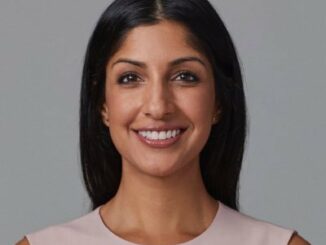
NEW YORK (TIP): Indian-origin businesswoman Anjali Sud will be the new CEO of Tubi –Fox Corporation’s free ad-supported TV streaming service– succeeding its Founder and CEO, Farhad Massoudi.
Sud’s appointment, effective from September 1, was announced on Monday, July 17, by the Fox-owned company, which recently became the most watched free ad-supported TV streaming service in the US.
Sud, the outgoing CEO of video hosting, sharing, and services platform provider Vimeo, succeeds Massoudi, Tubi’s Founder and CEO, a press release by the company said. “Anjali is a highly accomplished executive in the technology and media industry with a passion and track record for strategic disruption and authentic leadership,” said Paul Cheesbrough, CEO of Tubi Media Group.
“As Tubi continues to scale and solidify its momentum as the most watched free TV and movie streaming service in the US, she is the perfect candidate to lead Tubi into a new era of creativity, growth and market leadership,” he said. Announcing her appointment on Twitter, Sud said, “Today I am sharing my next adventure, as the incoming CEO of @Tubi!…excited for rabbit holes, changing things up in the media world, and shaping the next gen of entertainment by giving all people access to all the world’s stories.” “I’m excited to be dedicating my next chapter to empowering audiences. We are witnessing a seismic shift in where and how content will be consumed, and I hope to play a role in shaping the future of entertainment by giving all people access to all the world’s stories,” she said in a LinkedIn post.
“To the Tubi team – I can’t wait to go down this rabbit hole with you and shape the next generation of entertainment together!” Sud added. According to the press release, Sud, the outgoing CEO of Vimeo, spent the last decade enabling the world to make and share high-quality content.
“Under Sud’s leadership as CEO of Vimeo, the platform established itself as the home for video creators and professionals worldwide, building a thriving community of over 300 million users and generating scaled revenue growth and significant cash flow,” it said. Before her tenure at Vimeo, Sud held finance, media and e-commerce positions at Time Warner and Amazon. Recently, Tubi reached 64 million monthly active users and surpassed PlutoTV, Peacock and HBO Max in total TV viewing minutes, the press release said, quoting Nielsen, an audience insights, data and analytics firm based in the US.
Bera served as Chief Medical Officer for Sacramento County in California before being sworn in as a Congressman in 2013
WASHINGTON, D.C. (TIP): Dr Ami Bera, an Indian-American physician-turned politician has received the Champion of Healthcare Innovation Award for his contributions to making high-quality care affordable and accessible in the US. Bera, 58, the longest-serving Indian-American serving in the US Congress, was among those facilitated during the council’s Innovation Expo held here last week.”Honored to receive the Champion of Healthcare Innovation Award from @HealthInFocus. As a doctor, I’m committed to working to ensure that every American has access to high-quality, affordable health care,” Bera, a Democrat, tweeted on Friday, July 14.
Bera served as Chief Medical Officer for Sacramento County in California before being sworn in as a Congressman in 2013 and has represented Sacramento County in the US House of Representatives since then.
He is currently a member of the House Foreign Affairs Committee, where he serves as Chairman of the Subcommittee on Asia, the Pacific, Central Asia, and Nonproliferation.
He is also a member of the House Permanent Select Committee on Intelligence and the Select Subcommittee on the Coronavirus Pandemic. During his 20-year medical career, Bera worked to improve healthcare availability, quality, and affordability. A first-generation American born and raised in California, Bera earned both his Bachelor of Science (BS) and Doctor of Medicine (MD) from the University of California, according to his website.
(Source: PTI)
LONDON (TIP): Three men and two women members of a gang have been found guilty of the honeytrap murder of an Indian-origin man in the east of England. Vishal Gohel, 44, was discovered unresponsive inside a flat in Hertfordshire in January and pronounced dead at the scene. The court was told that Gohel had been led to believe he would be having a sexual liaison but the gang had intentions to rob him, resulting in the crime.
LONDON (TIP): Two Indian-origin brothers and an accomplice have been jailed for a total of over 45 years for kidnapping a businessman in Wolverhampton City Centre in the West Midlands region of England.
Baljit Baghral, 33, and his brother David Baghral, 28, along with 22-year-old Shanu Shanu, were found guilty of having ambushed their victim as he walked to his car after work in November last year.
They bundled him into a van and drove him bound and blindfolded to a shop where they threatened him with violence and held a gun against his head. The trio were found guilty after a trial at Wolverhampton Crown Court last month and sentenced this week with the Baghral brothers handed 16-year prison sentences each and their accomplice sentenced to 13 years and four months.
“These men subjected their victim to a terrifying ordeal which lasted for hours and left him fearing for his safety and even his life,” said Detective Constable Dan David from the Major Crime Team of Wolverhampton Crown Court. “They planned this venture with the sole purpose of extracting a large sum of money but instead they now face a significant amount of time in jail,” he said.
The trial heard how the victim was held captive for a number of hours and his ordeal only ended after the men persuaded one of his work colleagues to leave GBP 19,000 in a bag at a bus stop as a ransom. The men then left him in the van, which they later claimed was stolen, where he managed to get out and call the police.
Using CCTV, number plate recognition and mobile phone data, West Midlands Police investigators pieced together what had happened and even discovered a group chat called “Robbers Gang” on Baljit’s phone, which David had created two days before the kidnap. David Baghral was arrested from his home, while his brother Baljit was arrested at Birmingham Airport the same day as he returned from Cyprus.
Shanu Shanu was arrested a few days later at Heathrow Airport as he tried to flee to the US.
While David and Baljit Baghral both denied conspiracy to kidnap, conspiracy to blackmail and possession of an imitation firearm with intent to cause fear of violence, Shanu Shanu had pleaded guilty to the charges.
LUDHIANA, INDIA (TIP): A 42-year-old NRI Barinder Singh was killed by motorcycle-borne assailants at Thakur Colony on Pakhowal Road on Monday, July 17 night.
Barinder was heading back to his home from his farmhouse when he was waylaid. He had arrived from Canada four months ago. ADCP Suhail Qassim Mir said it’s a case of personal enmity as the assailants didn’t take away Barinder’s cellphone or cash from the spot. He said they had obtained a CCTV footage of four suspects and would check call details of the deceased. Mir said several cases were registered against Barinder for usurping property. “We are working on various angles. The case will be cracked soon,” he said.
Sources said Barinder had a dispute with some people over ownership of a bungalow. However, Barinder’s friend Jaspreet Singh said the former had documents related to the disputed bungalow in his possession.
Barinder had reportedly purchased a disputed 250 sq yd house at Satjot Nagar for just Rs 10 lakh and took possession of the property in a forceful manner. A case has been registered.
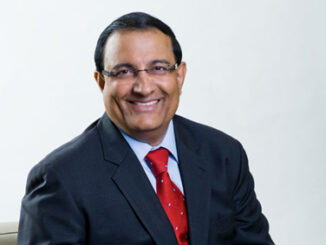
SINGAPORE (TIP): Singapore’s Indian-origin Transport Minister S Iswaran was arrested on Tuesday and released on bail while his passport was impounded, the Corrupt Practices Investigation Bureau (CPIB) has said.
A CPIB spokesperson on Friday said Iswaran was arrested on the same day as Ong Beng Seng, founder and managing director of Hotel Properties Limited, reported The Straits Times. Ong was also released on bail.
“As part of bail conditions, subjects’ passports are impounded. Subjects on bail can, however, make requests to travel overseas. CPIB will assess such requests on a case-by-case basis,” the Singapore daily quoted the CPIB spokesperson as saying. “CPIB assessed and acceded to Ong’s request to travel overseas. Ong’s bail quantum was also increased to SGD100,000. Upon his return, Ong is required to report to CPIB and surrender his passport to the bureau.” The spokesperson declined to provide further details, citing ongoing investigations.
Iswaran (61), is a senior member of the ruling People’s Action Party and has been on a leave of absence from his official duties, was assisting the CPIB with an investigation into a case it had uncovered.
Iswaran’s political career spans more than 26 years since he was first elected in 1997 as a Member of Parliament for West Coast GRC. Before he was appointed to the Cabinet in 2006, he was on several government parliamentary committees and was the deputy speaker of Parliament from September 2004 to June 2006.
He has been Minister for Transport since May 2021 and has been concurrently minister-in-charge of trade relations at the Ministry of Trade and Industry (MTI) since May 2018.
Before his career in politics, Iswaran worked in both the public and private sectors, including at MTI as well as Temasek Holdings. “No charges have been filed against Ong. He will be traveling from July 14 and will be surrendering his passport to CPIB upon his return to Singapore,” Hotel Properties Ltd (HPL) said on Friday.
Ong (77) is a Malaysian based in Singapore and owns the rights to the Singapore Grand Prix and is chairman of race promoter Singapore GP.
Iswaran has been actively involved in the government’s engagements with F1, including making appearances at press conferences where announcements about the event’s future have been made.
“As this is an ongoing matter, he is unable to provide further details at this point. He has undertaken to provide updates to the board if there are subsequent material developments,” Channel News Asia had HPL as saying of Ong’s current position in the high-profile case related to a possibility of corruption.
The contract for Singapore to host the Formula 1 Grand Prix for another seven years was signed last year – the fourth renewal and longest extension – bringing the event back to Marina Bay in the central business district after a two-year absence due to the COVID-19 pandemic. The Formula 1 (F1) Singapore Airlines Singapore Grand Prix 2023 is scheduled for September 15-17.
(Source: PTI)
The top 10 finalists of this year’s Global Student Prize are expected to be announced by next month
LONDON (TIP): Five students studying in India have made it to the top 50 shortlist for the USD 100,000 Chegg.org Global Student Prize 2023, selected from 3,851 applications from across 122 countries.
The annual award goes to one exceptional student who has made a real impact on learning, the lives of their peers and on society beyond. In the running from India this year will be: Namya Joshi, a 16-year-old student at Sat Paul Mittal School, Ludhiana, Punjab; Vinisha Umashankar, a 16-year-old student at SKP Vanitha International School, Tiruvannamalai, Tamil Nadu; Gladson Vaghela, a 25-year-old medical student at Gujarat Medical Education and Research Society Medical College, Gandhinagar, Gujarat; Padmaksh Khandelwal, a 17-year-old computer science student at Sir Padampat Singhania School, Kota, Rajasthan; and Ravinder Bishnoi, a 20-year-old information technology student at Chandigarh Engineering College, Landran, Mohali, Punjab.
“Chegg not only celebrates your achievements but also the endless possibilities that exist when young minds are driven by a passion for change,” said Heather Hatlo Porter, Head of Chegg.org and Chief Communications Officer of Chegg. “The top 50 Global Student Prize finalists deserve the opportunity to have their stories told and have their voices heard. Their dreams, wisdom, and inventive spirit will illuminate a more hopeful future for everyone,” she said. Joshi, acclaimed as the “Top Tech Savvy Student in India” and a global teacher at the age of 16, got hooked on Minecraft, realizing that it can also be used as an education tool. She went on to create a virtual library of lessons in Minecraft, now numbering around 500 which are available on her YouTube channel and website.
Umashankar is an artist, TEDx speaker, innovator, and environmentalist whose favorite subjects in school are math and science. Her innovation journey of inventing the award-winning “Solar Ironing Cart” and a power-saving “Smart Ceiling Fan” began when she was 12 years old, and she has since participated in many science and innovation competitions, winning international, national, and state awards.
Vaghela is a medical student advocate for healthcare equity and accessibility for all, participating in healthcare outreach programs in underserved communities. He has helped produce a global mental healthcare service providers’ database for more than 150 countries worldwide and has also been serving as a Youth Advisor to YuWaah (Generation Unlimited) at UNICEF India.
Khandelwal works on student suicide prevention and also as an anti-poaching activist who launched the current homeschooling model of the Mogya Education Program for children through the support of NGO Tiger Watch.
Bishnoi used his cyber cafe visits to learn about robotics, electronics, design, and other engineering areas and over the past decade has created many devices, developed robots, exoskeletons, portable water and air filters to help needy people. The Varkey Foundation partnered with Chegg.org to launch the annual Global Student Prize in 2021 as a sister award to its annual USD 1 million Global Teacher Prize.
The intention was to create a new platform that shines a light on the efforts of extraordinary students everywhere. The prize is open to all students who are at least 16 years old and enrolled in an academic institution or training and skills program. Part-time students as well as students enrolled in online courses are also eligible for the prize.
“As time runs out to achieve the Sustainable Development Goals (SDGs), it is more important than ever to prioritize education so we can face the future with confidence,” said Sunny Varkey, the Kerala-born founder of the Varkey Foundation. The top 10 finalists of this year’s Global Student Prize are expected to be announced by next month. The winner, who will be announced later in the year, will be chosen from the top 10 finalists by the Global Student Prize Academy, made up of prominent individuals.
KAMAL AHMED’S Narrative Feature ‘Crash the System’
Shorts from
SNIGDHA KAPOOR’S ‘Look Like You,’ and
DARSHAN SINGH BHULLER’S ‘Nala’
And many more
Crash the System (Credit : festivalofcinemanyc.com)Look Like You. (Credit : festivalofcinemanyc.com)Nala. (Credit : festivalofcinemanyc.com)
The Festival of Cinema NYC (festivalofcinemanyc.com) returns to the Regal UA Midway (108-22 Queens Blvd. Forest Hills, NY 11375) and the Queens Library at Forest Hills (108-22 Queens Blvd Forest Hills, NY 11375) for its 7th year, August 3-13.
After a pre-launch party inside Resorts World NYC’s famous 360º Bar and Lounge (110-0 Rockaway Blvd, 110-00 Rockaway Blvd, South Ozone Park, NY 11420) on Wednesday, August 3, FOC NYC will screen over 100 independent films from local filmmakers as well as world cinema representing countries that include Turkey, Spain, Denmark, The Philippines, Germany, and more.
New initiatives and presentations include participating in the Theaters Unsilenced Initiative. A nonprofit organization founded by three sisters in Queens whose mission is to spread awareness and provide educational resources and tools to help improve communication with the deaf and hard of hearing community. As part of the initiative, participating filmmakers have added subtitles and captioning to aid in making the festival accessible to individuals with hearing impairment.
The Festival of Cinema NYC Founder and Executive Director Jayson Simba, said, “This year’s edition of the film festival embraces the idea of not simply screening our films and celebrating our filmmakers, but underlining the ‘festival’ in “’film festival’, by emphasizing the connection of filmmaker to audience member via our panels, discussions, and Q&As, focusing on our accessibility, and increasing the interactive nature of FOC NYC. It always begins and ends with great films, but it becomes special by highlighting why we love to come to the movie theater and the artistic accomplishments of our filmmakers.”
2023 FESTIVAL OF CINEMA NYC FILM LINEUP
OPENING NIGHT
Paris is in Harlem
Director: Christina Kallas l USA l 110m
On the eve of New York City’s controversial “No Dancing” Law getting repealed, the lives of several strangers are forever changed by a shooting at a historic jazz bar in Harlem.
Preceded by
Herizon
Director: Miguel Gallardo l USA l 7m
A woman’s escape to the beach becomes a desperate quest for self-liberation when she’s confronted with an enigmatic force of nature. As the sun sets, the boundaries between reality and metaphor quickly begin to disappear.
CLOSING NIGHT
Disfluency
Director: Anna Baumgarten l USA l 96m
After unexpectedly failing her final college class, Jane, an aspiring speech pathologist, retreats home to her parent’s lake house in the hometown she grew up in. Her sister and friends soften the burden of failure, inspiring her to embrace the carefree summer as she tries to sort out what to do next. She also rekindles an old friendship with her neighbor Amber, a single mother with a difficult toddler, utilizing her skills and knowledge to help her connect with her son. Jane, however, fights through PTSD and imposter syndrome as she attempts to piece together what exactly happened in order to unravel the emotional and psychological tangle that has been haunting her as she finds a path forward toward the never-ending process of healing.
Preceded by
Floppies
Director: John Cappello l USA l 14m
Floppies is an intimate glimpse into the complicated relationship between an artist-son and his dementia-addled father as they attempt to communicate by collaborating on a one page comic. As they bring this comic to life, they recall flashbacks to key moments in each of their lives.
SPECIAL SCREENINGS AND PRESENTATIONS
A Guide To Recognizing Your Saints (2006)
Dir: Dito Montiel l USA l 100m
Fire Bones
Dirs: Greg Brownderville, Bart Weiss l USA l 90m
ADDITIONAL NARRATIVE FEATURES
Boys at Twenty – World Premiere
Dir: Isaac Dell l USA l 76m
Crash the System
Dir: Kamal Ahmed l USA l 75m
An ex-conman unwillingly becomes a pawn to the industrial weapons industry and tries to overthrow them when he meets up with an underground group of saboteurs who are iconoclastic.
D.O.A.
Dir: Kurt St.Thomas l USA l 82m
Ghosts of the Void
Dir: Jason Miller l USA l 91m
The Goldsmith
Dir: Vincenzo Ricchiuto l Italy l 89m
Good Side of Bad
Dir: Alethea Root l USA l 96m
Guy Friends
Dir: Jonathan Smith l USA l 84m
Miss Viborg
Dir: Marianne Blicher l Denmark l 100m
Sibel’s Silence – North American Premiere
Dir: Aly Yeganeh l France l 95m
Stars
Dir: Mars Roberge l USA, Canada l 108m
Tales of Babylon – North American Premiere
Dir: Pelayo De Lario l UK l 126m
There´s No Place Like Home
Dir: Puk Grasten l Denmark l 106m
Waiting for the Light to Change
Dir: Linh Tran l USA l 89m
Where Is The Lie?
Dir: Quark Henares l Philippines l 87m
DOCUMENTARIES
Aurora’s Sunrise
Dir: Inna Sahakyan l Armenia, Germany, Lithuania l 96m
The Book of Harth
Dir: Pierre Guillet l USA l 63m
Copyright Infringement
Dir: David Sabshon l USA l 105m
Gotham: The Fall and Rise of New York
Dir: Matthew Taylor l USA l 124m
The Unseen Crisis: Vaccine Stories – North American Premiere
You Were Never Told
Dir: Cindy Drukier l Canada l 89m
SHORT FILMS
There are 85 Short films, including
Look Like You
Dir: Snigdha Kapoor l USA l 13m
Nala
Dir: Darshan Singh Bhuller l USA l 13m
SCREENPLAY COMPETITION
There are 13 screenplays in the competition.
Festival of Cinema NYC:
Festival of Cinema, Inc. was founded by local independent filmmakers with a passion to get movies made and to expand the reach of artists’ work. Recognizing the challenges filmmakers face in the film industry, the festival’s aim is to establish a presence, and spread awareness, of cinematic creativity. Learn more at festivalofcinemanyc.com
(Mabel Pais writes on The Arts and Entertainment, Social Issues, Education, Cuisine, Health & Wellness, Spirituality, and Business.)
Signup to our Newsletter!
Don’t miss out on all the happenings around the world