Timothée Chalamet and Kylie Jenner were spotted for the first time together. As per a report by Page Six, the duo, who have been reportedly dating for months now, were seen cozying up at Beyoncé’s Renaissance tour in their first public appearance. Pictures and videos of them at the concert soon appeared online and are now going viral.
Timothée and Kylie were in attendance at the star-studded Los Angeles show as part of Beyoncé’s Renaissance tour at SoFi Stadium on Monday. In a video that emerged from the concert, Timothée was seen in a black hoodie smoking a cigarette. Beside him stood Kylie in a sleeveless outfit which she paired with a pair of gold hoop earrings. Both of them were seen sharing a laugh and in good spirits.
This is the first time both Timothée and Kylie have been seen in public together, ever since rumours about their relationship grabbed media headlines in April. Last week, the Dune star was seen leaving his Beverly Hills mansion in an incognito mode, separately. Kylie was also spotted leaving the driveway in her luxury car.
Even a month ago, there were reports doing the rounds that the two have ended their romance. Neither of them have addressed the rumours yet. These relationship rumours became public months after Kylie had broken up with singer-rapper Travis Scott, with whom she shares two children – daughter Stormi, who is five, and son Aire, who is one. Earlier it was also reported that Kylie didn’t want to make things official with Timothée Chalamet during the recent Coachella festival, where she was spotted with her friends.
Timothée has been previously linked to several high-profile stars from the industry, including actor Lily-Rose Depp, Eiza González and Madonna’s daughter Lourdes Leon. On the work front, he will be next seen in Wonka, which is set for a December release. His upcoming release, Dune 2, was initially set to release on October 20, before being pushed back a month to November 17, 2023. It will now hit theaters on March 15, 2024.
Month: September 2023
-

Kylie Jenner and Timothée Chalamet go public with their romance at Beyoncé concert
-

Jennifer Lopez shares hot pics in lingerie, fans say ‘you look gorgeous’
Jennifer Lopez took to Instagram on Sunday and posted steamy pics of herself, wearing black lingerie with white lace details. She also highlighted that it was a paid partnership with Italian lingerie retailer Intimissimi. Lopez captioned the series of pictures as: “When it feels right…nothing else matters”. In the first picture, Lopez is seen looking at herself in the mirror. In the second one, she lies on the bed and poses for the camera. In the third and fourth pictures as well, the Hollywood star is seen giving sensual looks to the camera.
Fans absolutely loved Lopez’s new pics and complimented her for the same.
“Queen on fireeee,” read one comment. “You are my inspiration every day for having such a beautiful body,” wrote a second user. “You are absolutely beautiful. Congrats to you for how hard you work and how dedicated you are to feel good about yourself,” commented a third person.
“YOU KNOW WHAT I ALWAYS SAY, MY JENNY: “YOU ARE GORGEOUS INSIDE OUT,”” read another comment.
“So amazing so beautiful so wonderful. very pretty,” posted a fifth person.
Recently, Lopez celebrated her one year marriage anniversary with husband Ben Affleck. Lopez and Affleck had got married in 2022 at the Little White Wedding Chapel in Las Vegas. Later, the couple had their marriage celebration on August 20, 2022 at Affleck’s residence in Georgia.
Both Lopez and Affleck have children from their previous marriages. With ex-husband Marc Anthony, Lopez shares her 15-year-old twins, Emme and Max. On the other hand, Affleck shares three children namely Violet, Seraphina and Samuel with his ex-wife, Jennifer Garner -

Emma Stone embraces graphic sex in new film
Actress Emma Stone felt ‘no shame’ filming raunchy scenes in Poor Things. The actress takes on the lead role of Yorgos Lanthimos’ surreal new movie and the filmmaker was grateful for the effort she put into her alter ego, Bella Baxter’s intimate sequences in the adaptation of Alasdair Grey’s novel. “It’s a shame that Emma could not be here to speak more about it because it will all be coming from me. First of all sex is an intrinsic part of the novel itself — her freedom about everything, including sexuality,” Yorgos said at the Venice Film Festival, where Poor Things premiered with none of the cast in attendance due the ongoing SAG-AFTRA strike.
The 49-year-old director continued: “Secondly, it was very important for me to not make a film that would be prudish because that would be like completely betraying the main character. We had to be confident Emma had to have no shame about her body while engaging in those scenes and she understood that right away.” -

Akshay starrer ‘The Great Indian Rescue’ renamed ‘Mission Raniganj’
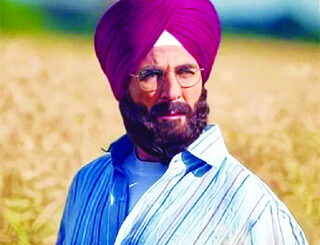
Akshay Kumar, fresh off the success of OMG 2, has a busy schedule ahead with numerous projects in the pipeline. His next film co-starring Parineeti Chopra, a survival thriller reportedly inspired by the life of mining engineer Jaswant Singh Gill, who saved 64 miners in the Raniganj Coalfields in 1989, was originally titled Capsule Gill and later The Great Indian Rescue. Now, the film has been rebranded as Mission Raniganj, and fans can look forward to the teaser’s imminent release. The upcoming Jaswant Singh Gill biopic, featuring Akshay Kumar and Parineeti Chopra, has undergone a title change. Previously known as The Great Indian Rescue, the film is now titled Mission Raniganj. Additionally, sources suggest that the teaser for the movie will be released soon. Akshay is currently occupied with the filming of Sky Force in Lucknow, where he will also celebrate his 56th birthday on September 9, as exclusively reported by Pinkvilla. Meanwhile, Parineeti is preparing for her impending wedding to Raghav Chadha, with reports indicating a September 25 wedding date. Both actors are anticipated to take a break from their busy schedules to commence promotions for their second collaboration following Kesari.
-

‘Fukrey 3’ trailer out: Richa Chadha, Fukra gang returns with signature gags
The highly anticipated trailer for the third installment of the much-loved franchise, ‘Fukrey’, is finally out after a long wait. With ‘Fukrey 3’ scheduled for release on 28 September 2023, the makers treated fans to the trailer during a grand launch event attended by the Fukra gang, Bholi Punjaban, Pandit Ji and the entire film team.
The trailer of ‘Fukrey 3’ was released on September 5. It brought back fond memories of this beloved comedy franchise. Seeing the Fukra gang – Hunny (Varun Sharma), Choochaa (Pulkit Samrat), Lali (Manjot Singh), Bholi Punjaban (Richa Chadha), and Pandit Ji (Pankaj Ji) back on the screens is a delight for the fans who absolutely love the franchise. The trailer is filled with laughter and hilarious moments, ensuring that the film will be incredibly entertaining. Fukrey 3 promises to surpass the previous installments, offering even more fun and enjoyment. Additionally, Choochaa’s surprise gift in this film is bound to have us laughing uncontrollably, adding to the excitement.
The trailer appears promising and effectively carries forward the legacy of this much-loved comedy franchise. With sequels making waves at the box office, now is the perfect time for ‘Fukrey 3’ to make its mark and surpass all records upon its release.
Starring Pulkit Samrat, Varun Sharma, Richa Chadha, Manjot Singh, and Pankaj Tripathi, Fukrey 3 promises to deliver yet another rib-tickling and unforgettable cinematic experience. The earlier parts of the franchise also included Ali Fazal as one of the leads. The film is directed by Mrighdeep Singh Lamba and produced under the banner Excel Entertainment by Ritesh Sidhwani and Farhan Akhtar.
Source: India Today -

Thank You For Coming: Bhumi Pednekar, Shehnaaz Gill redefine friendship
Thank You For Coming starring Bhumi Pednekar, Shehnaaz Gill, Dolly Singh, Kusha Kapila, Shibani Bedi, and Anil Kapoor marks the directorial debut of Rhea Kapoor’s husband Karan Boolani in Bollywood.
In August this year, Bhumi and others dropped the first poster of the upcoming film and it invited excitement among fans. Ahead of the trailer release, Bhumi, Sonam Kapoor, Rhea Kapoor, and others shared anew poster of the film.
Bhumie Pednekar shared a new poster of her upcoming film Thank You For Coming on Instagram. Sharing the poster, the actress captioned, “In real life, your girlfriends are your real Fairy Godmothers. Don’t forget to come on 6th October, to watch #ThankYouForComing in cinemas near you.”
Sonam Kapoor also shared the same poster and wrote, “When your friendship game is stronger than any magic spell!
Don’t forget to come on 6th October, to Cinemas near you to watch #ThankYouForComing #ComebackOfTheChickFlick #DontForgetToCome.”
And, Rhea Kapoor shared, “My girls and I will see you tomorrow with our TRAILER!!!!!!!!!! Talk about squad goals…” Thank You For Coming is produced by Rhea Kapoor along with Ekta Kapoor and Shobha Kapoor under Balaji Motion Pictures. It is set to release on October 6, 2023. -

SRK offers prayers at Tirumala temple
Bollywood superstar Shah Rukh Khan along with his family members offered prayers at the Tirumala temple on September 5. The actor, who had reached the temple on Monday night, had early morning darshan at the famous hill shrine. Accompanied by wife Gauri Khan, daughter Suhana and actress Nayanathara, he participated in Suprabhata Seva. Tirumala Tirupati Devasthanam (TTD) officials welcomed the superstar on arrival at the temple. They had made all arrangements for the actor and his family to offer prayers.
After the darshan, Shah Rukh and his family reached Ranganaykula Mandapam where the priests performed the Veda Ashirvachanam and presented Teertha Prasadam.
He offered prayers at the Tirumala temple ahead of the release of his much awaited movie ‘Jawan’. -

2 killed, Major among 50 hurt in Manipur violence
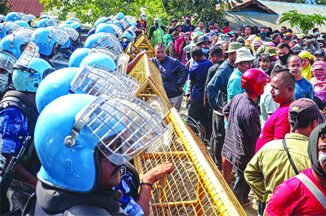
Imphal (TIP)- Two persons were killed and 50 others, including an Army Major, were injured in fresh violence in Manipur on Friday, Sedptember 8, when hundreds of people from the majority community attempted to storm tribal villages, officials said.
In the morning, a gunfight erupted at Molnoi village near Pallel in Tengnoupal district between the security forces and armed persons who attempted to resort to arson and violence in the village.
As the news of the gunfight spread, large groups of Meitei community members, including Meira Paibis and Arambai Tenggol militiamen dressed in commando uniforms, attempted to break through security check-posts and move towards Pallel. Security personnel attempted to stop the mob to ensure peace and stability in Pallel, where the situation has been tense for a few days. Being blocked by the forces, some armed persons who were dressed in police uniforms and part of the mob opened fire, resulting in gunshot injuries to an Army Major. The officer was evacuated to a military hospital in Leimakhong by a helicopter. Three other police personnel were also injured in the incident. In a calibrated response, the forces used minimum force to disperse the mob, officials said. More than 45 women were injured after security men lobbed teargas shells to defuse the situation. The morning gunfight led to one death, the officials said. Also, a 48-year-old man was killed in the crossfire.
Earier on September 6, local groups defied prohibitory restrictions and tried to remove army barricades in Manipur’s Bishnupur district on Wednesday, sparking clashes that left over 40 injured according to news agency PTI, hours after the administration clamped curfew in five Valley districts to stave off violence.
The clashes were reported from Phougakchao Ikhai bazaar, 52 km south of Imphal, along the Imphal-Churachandpur route, after the crowd gathered in response to a call by the Coordinating Committee on Manipur Integrity (COCOMI), a Meitei civil society organisation, to remove security barricades at Phougakchao Ikhai village.
COCOMI has sought the removal of the barricades from Meitei-inhabited areas in Phougakchao Ikhai village up to Torbung, another Meitei-inhabited village, along the border of Bishnupur and Churachandpur districts. The groups says this is needed for the resettlement of community members who have been displaced in the ongoing ethnic violence that has lasted four months. -

PM Modi says ‘India fully supports ASEAN centrality’ in big message to China
Jakarta (TIP)- Prime Minister Narendra Modi, on Thursday, September 7, said that ASEAN is a “central pillar of India’s ‘Act East’ policy” and emphasized the group’s role in India’s “Indo-Pacific strategy”. PM Modi also underlined India’s full support for ASEAN centrality and called for ensuring a free, open and rules-based Indo-Pacific as he met leaders of the 10-member bloc at the ASEAN-India summit in the Indonesian capital of Jakarta.
The Prime Minister’s remarks assume significance amid growing concerns among members of the Association of Southeast Asian Nations (ASEAN) over China’s increasing assertiveness in the South China Sea, an important trade corridor in which several member-nations have claims that conflict with Beijing’s. The term ‘ASEAN centrality’ calls for the dominant Southeast Asian platform to overcome common challenges and engage with external powers.
PM Modi’s strong remarks came a day after China warned against a ‘new Cold War’ in ASEAN.
“Need of the hour is an Indo-Pacific where international law applies equally to all countries,” PM Modi said at the 20th ASEAN-India Summit
He further said, “Current global scenario is surrounded by difficult circumstances and uncertainties” and told the ASEAN leaders that “terrorism, extremism, and geopolitical conflicts are big challenges for all of us”.
“We also share common values, such as democracy, secularism, and respect for human rights. Along with shared values, regional unity, peace, prosperity and mutual trust in a multipolar world also bind us together,” PM Modi said.
He called for “multilateralism and rules-based international order” and said they are “important to face various global challenges”. Prime Minister also highlighted that the Comprehensive Strategic Partnership between India and the bilateral bloc has injected new dynamism into the relations.
“ASEAN matters because here everyone’s voice is heard and ASEAN is epicentre of growth because ASEAN plays an important role in global growth,” Prime Minister added.
Sharing a group photograph of ASEAN leaders on X, PM Modi wrote, “The ASEAN-India Summit is testament to our shared vision and collaboration for a better future. We look forward to working together in futuristic sectors which will enhance human progress.”CHINA’S ‘COLD WAR’ REMARK
PM Modi declaration of full support for the ASEAN centrality assumes strategic importance as concern about China’s increasingly assertive activity in the South China Sea, a vital trade route where several ASEAN members have claims that conflict with China, was high on agenda of the Jakarta summit. On Wednesday, addressing the summit, Chinese Premier Li Qiang said it is important to avoid a “new Cold War” when dealing with conflicts between countries. He said, countries needed to “appropriately handle differences and disputes”. “At present, it is very important to oppose taking sides, bloc confrontation and a new Cold War,” Chinese Premier said. -

Mixed score in bypolls, Opposition secures 4, BJP 3
The results of seven Assembly bypolls across six states announced on Friday, September 8, signalled a mixed bag for rival camps with the ruling BJP at the Centre winning three seats and opposition Congress, Jharkhand Mukti Morcha, Samajwadi Party and Trinamool Congress taking one each. The CPM emerged the top loser with the Congress-led UDF defeating it in Kerala’s Puthuppally and the BJP wresting Tripura’s Boxanagar from it. Overall, the BJP retained two of the three seats it earlier held (Dhanpur in Tripura; Bageshwar in Uttarakhand) and bagged Boxanagar from the CPM. The INDIA parties either fought or defeated one another in West Bengal, Kerala and Uttarakhand. In Bengal, INDIA partners Congress and CPM allied against the TMC, which bagged the Dhupguri segment from the BJP by a margin of around 4,300 votes.
In Kerala, the Congress-led opposition UDF candidate Chandy Oomen trounced the CPM-led LDF’s Jack Thomas by over 37,000 votes. In the INDIA bloc, the Congress and CPM are allies. Again in Uttarakhand, the BJP retained Bageshwar by a narrow margin of 2,400 votes with the Congress and SP both in the fray. INDIA parties won comfortably in two seats where they put up a united show. These include Jharkhand’s Dumri which the JMM retained by a margin of over 17,000 votes, defeating NDA ally All Jharkhand Students’ Union. In Uttar Pradesh’s Ghosi, united opposition candidate Sudhakar Singh beat the BJP’s Dara Singh Chauhan. This bypoll was necessitated because Chauhan, a sitting SP MLA, crossed over to the BJP.
INDIA alliance however could not deter the BJP from bagging the minority-dominated Boxanagar from the CPM in Tripura, where saffron nominee Tafajjal Hossain won by a margin of over 30,000 votes against the united opposition-backed CPM’s Mizan Hossain.
While Bengal CM Mamata Banerjee and SP chief Akhilesh Yadav both declared today’s results a thumbs up for the INDIA bloc, BJP’s Sambit Patra (in charge for the Northeast) said the results signalled the end of the road for communists. -

ASI granted 8 more weeks to complete Gyanvapi survey
Varanasi (TIP)- A Varanasi court on Friday issued an order granting four more weeks to the Archaeological Survey of India (ASI) to complete the scientific survey of the Gyanvapi mosque complex and submit its report.
A copy of the court order was uploaded late Friday evening.
Earlier, government counsel Rajesh Mishra had said that eight more weeks were provided by the court to the ASI for completing its survey work. District Judge A K Vishvesh dismissed the mosque management committee’s objection and provided the additional time to the ASI, Mishra said. The ASI is carrying out a scientific survey of the Gyanvapi mosque premises, next to Kashi Vishwanath temple here, to determine whether the 17th-century mosque was constructed over a pre-existing structure of a Hindu temple.
The survey began after the Allahabad High Court upheld a Varanasi district court order and ruled that the step is “necessary in the interest of justice” and will benefit both the Hindu and Muslim sides. Advocate of the Hindu side Madan Mohan Yadav said the court had earlier given time till September 4 to survey the Gyanvapi complex except the Wazoo khana and submit its report. As the survey work was not complete, the advocate of the Archaeological Survey of India had sought additional time of eight weeks to complete the survey work.
During the last hearing, the Muslim side had presented its objection and said the ASI team was not authorised to survey the premises by removing debris or garbage.
The Muslim side alleged that ASI is digging in the basement as well as other places of the Gyanvapi complex without permission and accumulating debris on the western wall of the structure, which may pose a risk of collapse of the structure. Secretary of Intezamia committee Mohd Yaseen said they would give their reaction to the latest judgment only after seeing the order.
The ASI survey work resumed on August 4. The Varanasi court, the same day, also granted the ASI an additional month to complete the survey, extending its original deadline from August 4 to September 4.
The mosque side also went to the Supreme Court against the Allahabad HC’s order. The apex court had on August 4 refused to stay the Allahabad High Court order on an ASI survey.
In its order the bench of Chief Justice D Y Chandrachud and Justices J B Pardiwala and Manoj Misra, however, asked the Archaeological Survey of India not to carry out any invasive act during the survey. This ruled out any excavations, which the Varanasi court had said can be conducted, if necessary.Source: PTI
-

Telugu Desam Party chief Chandrababu Naidu arrested in corruption case
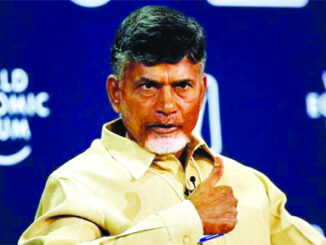
Nandyala (TIP)- Former chief minister and Telugu Desam Party chief Chandrababu Naidu was arrested in connection with an alleged Rs 371 crore Skill Development scam in an early morning police operation here on Saturday which involved officers knocking on the door of the caravan in which he was sleeping.
The former CM was arrested by the CID around 6 am from a marriage hall (outside which his caravan was parked) at Gnanapuram in Nandyala town, police said.
In a notice served to Naidu, the Deputy Superintendent of Police of the CID’s Economic Offences Wing (EOW), M Dhanunjayudu, said, “It is to inform you that you have been arrested… at 6 am at R K Function Hall, Gnanapuram, H/o Moolasagaram, Nandyala town and it is a non-bailable offence.” The former Andhra Pradesh chief minister has been arrested under Sections 120B (criminal conspiracy), 420 (cheating and dishonestly inducing delivery of property) and 465 (forgery) of the IPC, according to the notice.
The Andhra Pradesh CID has also invoked the Prevention of Corruption Act against him. The notice was served under Section 50 (1) (2) of the CrPC. At a recent meeting in Rayadurgam, Anantapur district, Naidu hinted that he could be attacked or arrested soon.
Meanwhile, TDP’s official X handle, shared dramatic videos of police swooping in on Naidu’s bus to arrest him. The video showed TDP leaders arguing with police officials.
After addressing a women’s gathering at Banaganapalli in Kurnool district under ‘Babu Surety – Bhavishyathuku Guarantee’ outreach programme, Naidu retired in his caravan at Nandyala to be woken up by police in the small hours of Saturday for his arrest. Police were seen knocking Naidu’s caravan door to wake him up in the run-up to his arrest. Further visuals showed the TDP chief discussing with officials while seated in the marriage hall.
Before arresting him, in the video shared by TDP, Naidu was seen demanding the police to provide him the FIR copy. “How could you arrest me without having my name in the FIR? Without providing the material. You have to give me all the information,” demanded Naidu.
Another TDP leader sitting beside Naidu demanded the police to show the prima facie cause for arresting the opposition leader.
However, the police official observed that this was a two-year-old case, referring to the alleged Skill Development Scam involving the misappropriation of Rs 371 crore.
TV visuals suggest that there are protests by the TDP cadre at some places in the state.
Government Adviser S Ramakrishna Reddy told media that the police need not give notice before arrest in economic offences. Even if there is no mention of the accused name in the FIR, he added.
Source: PTI -
Shivaji’s iconic ‘Wagh Nakh’ to be brought back from UK
Maharashtra cultural affairs minister Sudhir Mungantiwar on Friday reiterated that Chhatrapati Shivaji Maharaj’s iconic ‘wagh nakh’, an iron weapon used to kill Bijapur sultanate’s general Afzal Khan in 1659 will likely be brought back to India from the United Kingdom in November. He also said efforts were also on to bring the famed ‘Jagdamba’ sword of the 17th century Maratha warrior king from a London museum. The minister is set to travel to the UK this month to sign an MoU (Memorandum of Understanding) to get the ‘wagh nakh’ back to India. “In the first phase we are bringing the wagh nakh. It should be brought here in November and we are signing an MoU for that. Our effort is to bring it on the day when Chhatrapati Shivaji Maharaj disembowelled Afzal Khan,” he said.
-
No need to mix religion, politics: Congress chief on DMK leader’s remarks
Congress president Mallikarjun Kharge on Friday, September 8, said religion and politics were different things and shouldn’t be mixed. Kharge’s comment came amid a political controversy over DMK leader Udhayanidhi Stalin’s remarks about Sanatan Dharma recently.
The Congress president was speaking to reporters after attending the Chhattisgarh Government’s ‘Bharose ka Sammelan’ event at Thekwa in Rajnandgaon district.
Udhayanidhi, Tamil Nadu minister and son of Chief Minister MK Stalin, had derided Sanatan Dharma for its alleged divisiveness and lack of equality and had called for its eradication on the lines of diseases like malaria, dengue and Covid. Asked about Udayanidhi’s remark, Kharge said, “I haven’t come here to speak about anyone’s religion. I have come to participate in a programme meant for the poor. Religion and politics are different things and there is no need to mix the two. I don’t want a debate on this.”
He hit out at the Centre saying while his party was engaged in uniting Bharat (India), the BJP was trying to break it. “We have formed an alliance, INDIA, for the 2024 Lok Sabha elections and now, the BJP is saying the country’s name India should be changed to Bharat. There is both India and Bharat in the Constitution itself. Then why are they triggering a dispute over it?” Kharge said. -

Stage set for 2 days of tough parleys
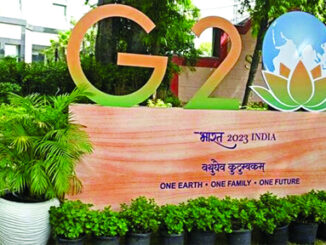
New Delhi (TIP)- With negotiations on a draft leaders’ declaration for the G20 Summit going down to the wire on Friday because of differences over the Ukraine conflict and other issues, people familiar with the matter said expectations were growing that a final push by the leaders would be needed to break the impasse.
The sherpas, or personal envoys of the G20 leaders, were unable to agree on a compromise text to refer to Russia’s invasion of Ukraine at a meeting held at a resort at Manesar near the Indian capital despite discussions being extended by a day, people from four G20 member states said on condition of anonymity.
There were also differences on other issues, such as phasing out or phasing down of fossil fuels and debt restructuring, but the people said these were expected to be ironed out by the time the two-day G20 Summit gets underway on Saturday.
“There are a few other issues but they aren’t insurmountable. A lot of ideas are being thrown around and these issues are likely to be sorted out. But things are still stuck on the issue of Ukraine,” one of the people cited above said. The people said the negotiations could require the intervention of leaders of G20 states to break the logjam over text to refer to the Ukraine crisis, just as had happened at last year’s summit in Indonesia.
Both Russia and China have so far refused to accept the text used in the joint communique at last year’s G20 Summit to refer to the Ukraine conflict. Russia has argued the situation on the ground has changed, while China has insisted that the G20 is an economic forum that shouldn’t take up geopolitical issues.
Two officials from G20 member states said another major sticking point in the negotiations was the “obstructionist” role being played by China, especially in blocking initiatives proposed by India and its partners such as the US.
“Russia is largely isolated but China is obstructing a lot of things,” one of the officials said.
Among the formulas discussed to address the impasse over the Ukraine crisis was the possibility of issuing two statements – one a consensus document with all the issues the G20 states had agreed on and another that referred only to the Russian invasion of Ukraine. However, this proposal was not favoured by several G7 member states, the people said.
A senior Japanese government official, speaking on condition of anonymity, said it was still unclear in what format the situation in Ukraine would be incorporated in the draft leaders’ declaration but the G7 members want the issue to be included.
“Japan wants to see a reference to a principled position upholding a free and open international order based on international law, especially the UN Charter and respect for sovereignty and territorial integrity. This shouldn’t be a problem as the G20 members are also UN members. We hope the statement will have the fundamental concept that all countries adhere to,” the Japanese official said. The negotiations for a “consensus expression” of the Ukraine crisis are “really tough” and a final push could be needed from the G20 leaders to arrive at a principled position, the Japanese official added.
The people made it clear that there was no getting around a discussion on the Ukraine issue on the grounds that it is a geopolitical issue – something that China has been pushing for.
“We must discuss Ukraine as it affects lots of issues, including the hike in the prices of food and energy. The root cause is the blatant violation of international law. We can’t fall back from the Bali text,” the Japanese official said. India has so far refrained from publicly criticising Russia’s invasion of Ukraine or voting on resolutions at the UN denouncing Moscow’s actions. The Indian leadership has consistently called for an immediate cessation of hostilities and a return to the path of dialogue and diplomacy.
Russia remains a key partner and major supplier of military hardware and energy for India, which has had to engage in a delicate balancing act amid its growing strategic partnership with the US. Source: HT -

G20 agrees to grant permanent membership to African Union
New Delhi (TIP)- Ahead of the G20 Summit, the member nations of the group have agreed to grant permanent membership to the African Union, a continental body of 55 member states, Bloomberg agency news reported. With this, the African Union has earned the same status as the European Union.
Prime Minister Narendra Modi had written a letter to the G20 nations in which he proposed that the African Union be given full, permanent membership of the bloc at the upcoming summit in New Delhi. Countries like Germany, Brazil, and Canada have also expressed their support for African Union membership to the G20.
At present, the G20 group comprises 19 countries and the European Union.
Besides, the G20 this year has also invited nine non-member countries, including Bangladesh, Singapore, Spain, and Nigeria, and international organisations such as the United Nations, World Health Organization, the World Bank, and the IMF on the 9 and 10 September Summit. -

‘Bharat’ in official documents at summit venue
New Delhi (TIP)- The first glimpses of the government using the name “Bharat” instead of “India” to designate officials tasked with G20 summit duties were available at the venue’s International Media Centre on Friday.
Officials carried passes marked “Bharat-Official” to designate them as part of the government delegation handling responsibilities at the main Bharat Mandapam complex, which will host 41 global leaders starting Saturday and International Media Centre located nearby at the same venue. Mirror images of car parking stickers issued to government officials also bore the name “Bharat”, further indicating that a change of country’s name from India to Bharat could well be in the offing in the upcoming special session of Parliament.
The latest evidence on printing of “Bharat” on official documents follows “President of Bharat” Murmu’s dinner invites to G20 leaders and description “PM of Bharat” in Modi’s document for ASEAN visit to Indonesia. -
India, US, UAE, Saudi, Europe to launch unprecedented infra project: US official
New Delhi (TIP)- India, the US, the UAE, Saudi Arabia, and Europe are set to unveil an unprecedented and groundbreaking infrastructure initiative of a railway and shipping corridor that will enhance commerce, energy and digital connectivity on Saturday, September 9, on the sidelines of the G20 summit, US principal deputy national security advisor Jon Finer has said. Speaking to reporters on Saturday, September 9 morning, Finer said that the project will fill a major infrastructure gap and will be “high-standards, transparent, sustainable, non-coercive” and based on the demand signal from the region instead of being an imposition, drawing an indirect but sharp contrast with China’s Belt and Road Initiative (BRI).
BRI is widely criticised for locking countries into unsustainable debts, being non-transparent, coercive, and compromising standards. Finer said that the initiative fits in with the Joe Biden administration’s larger strategy in West Asia. Laying out the strategic case for the project, he said that there was first a “value proposition” of a corridor linking three regions of the world as it would enhance prosperity.
Second, it filled a broader infrastructure gap in low and middle-income countries, with the US doing what it can with partners and allies to fill the gap. Third, he said that for the Middle East, “which has been a net exporter of turbulence and insecurity,” the project was a major opportunity in line with the American efforts to “reduce the temperature and enhance connectivity”.
While the project has not been implemented under the I2U2 framework (which includes India, Israel, UAE, and US), most likely because the efforts at normalisation between Israel and Saudi are still a work in progress, officials believe that Israel will be an obvious partner in the project if and when there are formal diplomatic ties between Tel Aviv and Riyadh. On a question on Israel’s participation, Finer said he will let countries speak for themselves.
“We have an approach focused on turning the temperature down, de-escalating conflicts underway in the region, and incentivising stability and connectivity in the region. The railway and shipping project is wholly in line with that,” Finer said. Asked about the contrast with BRI, Finer claimed that while he understood the appeal of that narrative, the US saw the infra project as a “positive affirmative agenda” that had appeal in countries.
Source: HT -

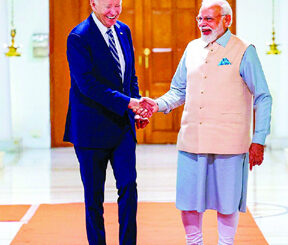
Biden, Modi vow to deepen defense ties, explore new domains; India gets backing for UNSC seat
New Delhi (TIP)- Prime Minister Narendra Modi and US President Joe Biden vowed to extend bilateral ties in newer domains and expressed appreciation for the substantial progress underway to implement the wide-ranging decisions taken by them at their last interaction less than three months back in June.
In a joint statement issued at the end of their meeting at the PM’s Office on Friday, September 8, they resolved to deepen and diversify the India-US defence partnership through expanded cooperation in new and emerging domains such as space and AI, and accelerated defence industrial collaboration.
Here to attend the G20 Summit, Biden lauded India’s presidency and said it demonstrated how the G20 as a forum was delivering important outcomes. He also congratulated PM Modi, the scientists and engineers on Chandrayaan-3’s historic landing in the south polar region of moon, as well as the successful launch of India’s first solar mission, Aditya-L1.
India and the US will now mount a joint effort to the International Space Station next year and are continuing efforts to finalise a strategic framework for human space flight cooperation by the end of this year. The joint statement skirted the Ukraine conflict although US Treasury Secretary Janet Yellen has accompanied Biden and will be pressing for more countries to join in sanctions against Russia. But they said the relationship was strengthened by the “shared values of freedom, democracy, human rights, inclusion, pluralism, and equal opportunities for all citizens”. The joint statement had little political content with the most important being that Biden will visit India next year for the Quad Leaders’ Summit and the leaders’ backing for freedom of navigation.
Biden also reaffirmed his support for a permanent seat for India in the UN Security Council and welcomed India’s candidature for the UNSC non-permanent seat in 2028-29.
Turning to technology partnerships, which formed the bulk of the joint statement, the two leaders felt it was playing a “defining role” in their strategic ties especially through the NSAs-led Initiative on Critical and Emerging Technology (iCET).
They were also satisfied over the building of resilient global semiconductor supply chains and noted that Microchip Tech will invest about $300 million and Advanced Micro Device $400 million in India, while Micron, LAM Research, and Applied Materials are implementing the announcements made during PM Modi’s State Visit to the US in June.
A substantial part of the joint statement covered the defence industrial ecosystems and touched on US Congressional Notification approving tech transfer and manufacturing of GE jet engines in India, a second Master Ship Repair Agreement, Letter of Request from the Ministry of Defence to procure 31 highly advanced drones and intensified talks on next generation small modular reactor technologies.
The two leaders also welcomed the growing bilateral cooperation in cancer research, prevention, control, and management, and looked forward to the launch of the India-US Cancer Dialogue in November. It will be preceded by the US-India Health Dialogue in October. -

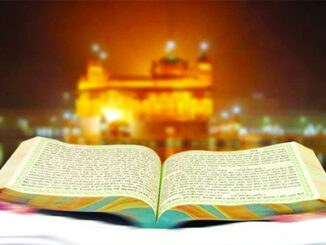
Prakash Utsav of Sri Guru Granth Sahib Ji
Prakash Utsav of Sri Guru Granth Sahib Ji takes place on the 15th day (New Moon) of Bhadon, the sixth month of the Punjabi calendar, which occurs in August or September in the Western calendar.
Guru Granth Sahib Ji is unique among the great texts of the world. It is considered to be the supreme spiritual
authority and head of Sikhism rather than any living person. It is also the only book of its kind that not only contains the works of its religious founders but also the writings of people of their faith. The living Guru of the Sikhs, the book is kept with great reverence by the Sikhs and is treated with the utmost respect. The Guru Granth Sahibji is a compilation of many hymns, poems, Shabad and other writings from several different scholars, including the Sikh Gurus and other saints.
Guru Granth Sahib jihas 1,430 pages, and each copy is identical.It contains words spoken by the Gurus. It is known as Gurbani, which means ‘from the mouth of the Guru’.It is considered the word of God. It is written in Gurmukhi.
History of Guru Granth Sahib ji
Guru Arjan Dev ji, the fifth Sikh Guru compiled the original version of Guru Granth Sahib ji. Guru Arjan Dev ji felt that the Sikhs needed authentic compilation of the hymns of their gurus. Thus Guru ArjanDev ji started the collection of original verses of all the Gurus. He sent reliable Sikhs like Bhai Piara ji, Bhai Gurdas ji and Baba Buddha ji across the country in search of original manuscripts. Guru Arjan Dev ji travelled to Goindwal, Khadur and Kartarpur to visit the families of the previous Gurus. Guru Arjan Dev ji collected original manuscripts of the Gurus from Mohan ji (son of Guru Amar Das ji), Datu ji (son of Guru Angad ji) as well as Sri Chand ji (son of Guru Nanak ji).
Compilation and Contents of the Guru Granth Sahib
Many of Guru Nanak ji’s hymns and prayers were preserved and complied by Guru Angad ji and Guru ArjanDev refuse to expunge the so-called offensive text or pay the fine. Guru Arjan Dev ji was against making alterations in the hymns as required by Jahangir and instead preferred a martyr’s death. This led to his execution. The Adi Granth was completed in 1604 and installed in the Golden Temple. In 1708, Adi Granth became Sri Guru Granth Sahib Ji, the Eternal Guru of Sikhs as was declared by Guru Gobind Singh Ji. After Guru Gobind Singh ji’s martyrdom in 1708, Baba Deep Singh ji and Bhai Mani Singh ji prepared many copies of the Sri Guru Granth Sahib ji for distribution. The original version of the Sri Guru Granth Sahib can be found at Nanded, a city in Maharashtra state.
Sri Guru Granth Sahib ji which presides over in other gurdwaras are copies of this edition.The first Shabad of the Guru Granth Sahib ji is the “Mool Mantra”. This is a statement of recognition for Sikhism. This underlines the belief in one God.The first line of the Sri Guru Granth Sahib ji is “Ik Onkar”. It literally means ‘there is only one God’.
Guru Gobind Singh Ji raised Sri Guru Granth Sahib ji to the status of a permanent Guru and conferred it the title of “Guru of the Sikhs” in 1708. Declaring the Sri Guru Granth Sahib ji to be the next Guru after him, Guru Gobind Singh ji commanded the Sikhs to regard the Guru Granth Sahib ji as their next and everlasting Guru.
He said, “Sab Sikhan ko hukamhai Guru Manyo Granth” meaning thereby that all Sikhs are commanded to regard the Granth as a Guru.Guru Gobind Singh ji commanded the Sikhs in the following words
– Agya Bhai Akal Ki Tabhi Chalayo Panth. (Under orders of the Immortal Being, the Panth was created)
– Sabh Sikhan Ko Hukam Hai Guru Manyo Granth. (All the Sikhs are enjoined to accept the Granth as their Guru)
– Guru Granth Ji Manyo Pargat Guran Ki Deh. (Consider the Guru Granth as embodiment of the Gurus)
– Jo Prabhu Ko Milbo Chahe Khoj Shabad Mein Le. (Those who want to meet God, can find Him in its hymns)
– Raj Karega Khalsa Aqi Rahei Na Koe, (The pure shall rule, and impure will be no more)
– Khwar Hoe Sabh Milange Bache Sharan Jo Hoe. (Those separated will unite and all the devotees shall be saved)
Facts about Sri Guru Granth Sahib ji
– Total words – 398697
– Most often repeated word is “Hari” – 9288 times
– No punctuation marks have been used
Authors /contributors:
– Six Sikh Gurus, first Five Gurus (Guru Nanak dev Ji, Guru Angad dev Ji, Guru Amar Das ji, Guru Ram Das ji,Guru Arjan Dev ji) and ninth Guru (Guru Tegh Bhadur Ji)
– Sri Guru Granth Sahib jiincludes sermons of Guru Nanak Dev Ji (974 Shabad and Shloka), Guru Angad Dev Ji (62 Shloka), Guru Amardas Ji (907 Shabad and Shloka), Guru Ram Das Ji (679 Shabad and Shloka), Guru Arjan Dev Ji (2218 Shabad and Shloka) and Guru Tegh Bahadur Ji (115 Shabad and Shloka).
– Three Sikhs (Bhai Satta ji, Bhai Balwand ji and Bhai Sundar ji)
– 17 Bhatts: The Bhatts were a group of musicians who lived in the sixteenth century. All of them were scholars, poets and singers. (Bhat Kal, Bhat Kalsehar, Bhat Tal, Bhat Jalup, Bhat Jal, Bhat Kirat, Bhat Sal, Bhat Bahil, Bhat Nal, Bhat Bhikha, Bhat Jalan, Bhat Kas, Bhat Gend, Bhat Sevak, Bhat Mathra, Bhat Bal andBhat Harbans)
– 15 Bhagats (Kabir, Namdev, Ravidas, Sheikh Farid, Trilochan, Dhanna, Beni,Sheikh Bhikan, Jaidev, Surdas, Parmanand, Pipa, Ramanand, Sadhna and Sain)Prayers
Nitnem
It is the collection of hymns of different Gurus to be read daily by the common people at least three times a day. Nitnem usually includes Panj Bania and sometimes includes Rehiras Sahib and Kirtan Sohilla ( for the night). The morning and the evening prayers should be followed by a set of prayers known as Ardas. The five Banis or the Panj Bania are Japji Sahib- appears at the beginning of the Guru Granth Sahib
Jaap Sahib
Morning prayers of the Sikh which was composed by tenth Guru Gobind Singh and is found at the start of Sikh scripture Dasam Granth. It is the praise of God and includes names of various Gods in different languages. It is composed of 199 verses and is the first Bani of Dasam Granth.
Tav- Prasad Savaiye
It is a short composition that contains around 10 stanzas and is present on pages 13 to 15 of Dasam Granth.
Chaupai Sahib
Also referred as Banti Chaupai is a hymn by Guru Gobind Singh
Anand Sahib
It is the collection of hymns written by Guru Amar das Ji who was the third Guru in Sikhism. It is available from page 917-922 in Guru Granth Sahib. It is chanted at all the religious ceremonies of the Sikhs
Rehras Sahib
It is the evening prayer of Sikhs which is a part of Gurbani ( Hymns in the central text of Guru Granth Sahib). It contains hymns of four different Gurus Guru Nanak, Guru Amardas, Guru Ramdas, Guru Arjan Dev, and Guru Gobind Singh Ji. It gives energy to the mind and body after the day-long hard work. It is in a way to thank God for completing the day with no hassles. Rehras contains hymns from So Dar and So Purakh, Chaupai Sahib, Anand Sahib, and Mundhavani. Chaupal Sahib is taken from Dasam Granth.
Kirtan Sohila
It is the night prayers chanted by all Sikhs before they go to bed. It is composed of five hymns or Shabd. The five hymns are contributed by Guru Nanak, Guru Ram das, and Guru Arjan. The first three hymns were uttered by Guru Nanak, the fourth by Guru Ram Das, and the fifth by Guru Arjan Dev. -

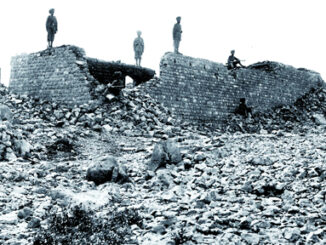
Battle of Saragarhi: The greatest last stand in history
The Battle of Saragarhi has been rated as one of the 10 most historic battles of the world. On September 12, 1897, 21 Sikh soldiers in the fort of Saragarhi faced an estimated 15,000 Afghan tribesmen who wanted to control Saragarhi. The 21 brave soldiers did not surrender but fought the attackers, and lost their lives. Anniversary of the Battle of Saragarhi falls on September 12.
The Battle of Saragarhi, one of the greatest last stands in history that was fought on September 12, 1897, by 21 Sikh soldiers of the British India Army against 15,000 Afghans in the Samana Valley of Pakistan’s Khyber Pakhtunkhwa province, which was then part of India. During this battle, all the 21 soldiers of 36 Sikh Regiment fought till their last breath against the Afghan hordes with unprecedented courage and unparalleled valour and went down as superheroes. Here’s the story of the Saragarhi’s legendary battle.
Where is Saragarhi?
Saragarhi was a small village in the Kohat district along with the Samana range (modern-day Pakistan). The British succeeded in gaining control over the Khyber Pakhtunwa region, although they were prone to attacks from rebellious Pashtuns. Saragarhi served as a communication post between Fort Lockhart and Fort Gullistan which served as headquarters for the British Indian army in the North-Western region, as these two forts were not visible to each other despite being a few miles apart.
Between August 27 to September 11, 1897, the Pashtuns tried to attack these British strongholds but their efforts were continuously thwarted by the 36th Sikh regiment under the command of Col. Haughton. Communication between Saragarhi and Fort Lockhart took place over heliograph. On September 12, 1897, 15,000 Pashtuns attacked Saragarhi in order to break communication between the two forts. The Battle of Saragarhi is considered to be one of the greatest last stands in history. Where 21 soldiers of the 36 Sikh Regiment fought an army of over 15,000 Afghans and killed more than 600 of them before perishing to enemy bullets. The 36 Sikh Regiment leader Ishar Singh managed to kill over 20 enemies in this epic battle.
Most Epic Battle Of All Time
This battle is epic because these 21 soldiers sacrificed their lives for their country and managed to hold back 15,000 men for an entire day until reinforcements arrived. The efforts of 36th Sikh Regiment soldiers never went unnoticed when the news received a standing ovation at the British Parliament in London. A commemorative tablet was put stating the names of the 21 men, after recognising their efforts. Post the battle, Col. Haughton narrated the heart-wrenching story of the battle to the top brass of the British Indian Army. As a result, all 21 soldiers were awarded the prestigious Indian Order of Merit Class III award. It was also for the first time in history, that each and every member of the unit won the gallantry awards for a single battle.
Remembrance and legacy
Khalsa Bahadur is an epic poem written by Chuhar Singh describing the chivalry and sacrifice of Sikh soldiers at the Battle of Saragarhi. The poem is 55 pages long in the Punjabi language.
In remembrance of these 21 warriors, the British built two gurdwaras, one in Amritsar near the Golden Temple and another in Ferozepur Cantonment, which was in the district where these men hailed from.
Even today, 12th September is celebrated as the Saragarhi Day in honor of the sacrifices made by those 21 brave soldiers and it’s observed as the Sikh military commemoration day. Three gurdwaras – Saragarhi, Ferozepur and Amritsar have been made to commemorate their sacrifice. -

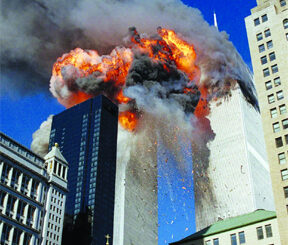
9/11: The deadliest terrorist attacks in American history
This year marks the 22nd anniversary of the terrorist attacks on the U.S. On September 11, 2001, 2,977 people were killed in the deadliest terrorist attacks in American history. The moment shocked the nation. Two planes, hijacked by Islamic jihadists vowing death to all Americans, plowed into both towers at the World Trade Center in New York.

On September 11, 2001, terrorists linked to the Islamic extremist group al Qaeda—founded by Osama bin Laden—hijacked four commercial passenger airplanes and carried out suicide attacks against targets in the United States. Two of the planes were flown into the World Trade Center in New York City. Within a few hours, both of the twin towers collapsed into rubble, demolishing a large section of lower Manhattan. A third plane hit the Pentagon in Arlington, Virginia, just outside Washington, D.C. The passengers and crew of the fourth plane fought back, and the plane was downed in a field near Shanksville, Pennsylvania.
Almost 3,000 people were killed in the 9/11 terrorist attacks, including the 19 al Qaeda terrorists. The shocking events of September 11 were televised globally and left much of the world reeling in horror. The administration of President George W. Bush responded by declaring a “war on terrorism,” including the creation of the Department of Homeland Security and the invasion of Afghanistan.
World Trade Center
On September 11, 2001, at 8:45 a.m. on a clear Tuesday morning, an American Airlines Boeing 767 loaded with 20,000 gallons of jet fuel crashed into the north tower of the World Trade Center in New York City.
The impact left a gaping, burning hole near the 80th floor of the 110-story skyscraper, instantly killing hundreds of people and trapping hundreds more in higher floors.
As the evacuation of the tower and its twin got underway, television cameras broadcasted live images of what initially appeared to be a freak accident. Then, 18 minutes after the first plane hit, a second Boeing 767—United Airlines Flight 175—appeared out of the sky, turned sharply toward the World Trade Center and sliced into the south tower near the 60th floor.
The collision caused a massive explosion that showered burning debris over surrounding buildings and onto the streets below. It immediately became clear that America was under attack.
The hijackers were Islamic terrorists from Saudi Arabia and several other Arab nations. Reportedly financed by the al Qaeda terrorist organization of Saudi fugitive Osama bin Laden, they were allegedly acting in retaliation for America’s support of Israel, its involvement in the Persian Gulf War and its continued military presence in the Middle East.
Some of the terrorists had lived in the United States for more than a year and had taken flying lessons at American commercial flight schools. Others had slipped into the country in the months before September 11 and acted as the “muscle” in the operation.
Where Did the 9/11 Planes Take Off From?
The 19 terrorists smuggled box-cutters and knives through security at three East Coast airports—Logan International Airport in Boston, Dulles International Airport in Washington, D.C. and Newark International Airport in New Jersey—and boarded four early-morning flights bound for California, chosen because the planes were loaded with fuel for the long transcontinental journey. Soon after takeoff, the terrorists commandeered the four planes and took the controls, transforming ordinary passenger jets into guided missiles.
Pentagon Attack
As millions watched the events unfolding in New York, American Airlines Flight 77 circled over downtown Washington, D.C., before crashing into the west side of the Pentagon military headquarters at 9:45 a.m.
Jet fuel from the Boeing 757 caused a devastating inferno that led to the structural collapse of a portion of the giant concrete building, which is the headquarters of the U.S. Department of Defense.
All told, 125 military personnel and civilians were killed in the Pentagon, along with all 64 people aboard the airliner.
Twin Towers Collapse
Less than 15 minutes after the terrorists struck the nerve center of the U.S. military, the horror in New York took a catastrophic turn when the south tower of the World Trade Center collapsed in a massive cloud of dust and smoke.
The structural steel of the skyscraper, built to withstand winds in excess of 200 miles per hour and a large conventional fire, could not withstand the tremendous heat generated by the burning jet fuel.
At 10:30 a.m., the north building of the twin towers collapsed. Only 18 people in the World Trade Center towers at the time of the collapse survived. Most were with a group of FDNY firefighters in the North Tower’s Stairwell B, which remained intact. One woman survived after the stairs she was rushing down disintegrated around her. Almost 10,000 others were treated for injuries, many severe.
Flight 93
Meanwhile, a fourth California-bound plane—United Flight 93—was hijacked about 40 minutes after leaving Newark Liberty International Airport in New Jersey. Because the plane had been delayed in taking off, passengers on board learned of events in New York and Washington via cell phone and Airfone calls to the ground.
Knowing that the aircraft was not returning to an airport as the hijackers claimed, a group of passengers and flight attendants planned an insurrection.
One of the passengers, Thomas Burnett, Jr., told his wife over the phone that “I know we’re all going to die. There’s three of us who are going to do something about it. I love you, honey.” Another passenger—Todd Beamer—was heard saying “Are you guys ready? Let’s roll” over an open line.
Sandy Bradshaw, a flight attendant, called her husband and explained that she had slipped into a galley and was filling pitchers with boiling water. Her last words to him were “Everyone’s running to first class. I’ve got to go. Bye.”
The passengers fought the four hijackers and are suspected to have attacked the cockpit with a fire extinguisher. The plane then flipped over and sped toward the ground at upwards of 500 miles per hour, crashing in a rural field near Shanksville in western Pennsylvania at 10:10 a.m. All 44 people aboard were killed. Its intended target is not known, but theories include the White House, the U.S. Capitol, the Camp David presidential retreat in Maryland or one of several nuclear power plants along the eastern seaboard.
How Many People Died in the 9/11 Attacks?
A total of 2,996 people were killed in the 9/11 attacks, including the 19 terrorist hijackers aboard the four airplanes. Citizens of 78 countries died in New York, Washington, D.C., and Pennsylvania.
At the World Trade Center, 2,763 died after the two planes slammed into the twin towers. That figure includes 343 firefighters and paramedics, 23 New York City police officers and 37 Port Authority police officers who were struggling to complete an evacuation of the buildings and save the office workers trapped on higher floors.
At the Pentagon, 189 people were killed, including 64 on American Airlines Flight 77, the airliner that struck the building. On Flight 93, 44 people died when the plane crash-landed in Pennsylvania.
America Responds to the Attacks
At 7 p.m., President George W. Bush, who was in Florida at the time of the attacks and had spent the day being shuttled around the country because of security concerns, returned to the White House. At 9 p.m., he delivered a televised address from the Oval Office, declaring, “Terrorist attacks can shake the foundations of our biggest buildings, but they cannot touch the foundation of America. These acts shatter steel, but they cannot dent the steel of American resolve.”
In a reference to the eventual U.S. military response he declared, “We will make no distinction between the terrorists who committed these acts and those who harbor them.”
Operation Enduring Freedom, the American-led international effort to oust the Taliban regime in Afghanistan and destroy Osama bin Laden’s terrorist network based there, began on October 7. Within two months, U.S. forces had effectively removed the Taliban from operational power, but the war continued, as U.S. and coalition forces attempted to defeat a Taliban insurgency campaign based in neighboring Pakistan.Osama bin Laden, the mastermind behind the September 11th attacks, remained at large until May 2, 2011, when he was finally tracked down and killed by U.S. forces at a hideout in Abbottabad, Pakistan. In June 2011, then-President Barack Obama announced the beginning of large-scale troop withdrawals from Afghanistan; it took until August 2021 for all U.S. forces to withdraw.
Department of Homeland Security Created
In the wake of security fears raised by 9/11 and the mailing of letters containing anthrax that killed two and infected 17, The Homeland Security Act of 2002 created the Department of Homeland Security. It was signed into law by President George W. Bush on November 25, 2002. Today, the Department of Homeland Security is a cabinet responsible for preventing terror attacks, border security, immigrations and customs and disaster relief and prevention.
The act was followed two days later by the formation of the National Commission on Terrorist Attacks Upon the United States. The bipartisan “9/11 Commission,” as it came to be known, was charged with investigating the events that lead up to September 11th. The 9/11 Commission Report was released on July 22, 2004. It named Khalid Sheikh Mohammed, the accused mastermind behind 9/11, “the principal architect of the 9/11 attacks.”
Mohammed led propaganda operations for al Qaeda from 1999-2001. He was captured on March 1, 2003 by the Central Intelligence Agency and Pakistan’s Inter-Services Intelligence and interrogated before being imprisoned in Guantanamo Bay detention camp with four other accused terrorists charged with 9/11-related war crimes. The use of torture, including waterboarding, during Khalid Sheikh Mohammed’s interrogation has received international attention. In August 2019, a U.S. military court judge in Guantánamo Bay, Cuba set a trial date for Mohammed and the other four men charged with plotting the 9/11 terrorist attacks to begin in 2021; it was later postponed because of the COVID-19 pandemic.
Economic Impact of 9/11
The 9/11 attacks had an immediate negative effect on the U.S. economy. Many Wall Street institutions, including the New York Stock Exchange, were evacuated during the attacks. On the first day of trading after the attacks, the market fell 7.1 percent, or 684 points. New York City’s economy alone lost 143,000 jobs a month and $2.8 billion wages in the first three months. The heaviest losses were in finance and air transportation, which accounted for 60 percent of lost jobs. The estimated cost of the World Trade Center damage is $60 billion. The cost to clean the debris at Ground Zero was $750 million.
Victim Compensation Fund
Thousands of first responders and people working and living in lower Manhattan near Ground Zero were exposed to toxic fumes and particles emanating from the towers as they burned and fell. By 2018, 10,000 people were diagnosed with 9/11-related cancer.
From 2001 to 2004, over $7 billion dollars in compensation was given to families of the 9/11 victims and the 2,680 people injured in the attacks. Funding was renewed on January 2, 2011, when President Barack Obama signed The James Zadroga 9/11 Health and Compensation Act into law. Named for James Zadroga, a New York City Police officer who died of respiratory disease he contracted after rescuing people from the rubble at Ground Zero, the law continued health monitoring and compensation for 9/11 first responders and survivors.
In 2015, funding for the treatment of 9/11-related illness was renewed for five more years at a total of $7.4 billion. The Victim Compensation Fund was set to stop accepting claims in December 2020.
On July 29, 2019, then-President Trump signed a law authorizing support for the September 11 Victim Compensation Fund through 2092. Previously, administrators had cut benefits by up to 70 percent as the $7.4 billion fund depleted. Vocal lobbyists for the fund included Jon Stewart, 9/11 first responder John Feal and retired New York Police Department detective and 9/11 responder Luis Alvarez, who died of cancer 18 days after testifying before Congress.
Anniversary and Memorial
On December 18, 2001, Congress approved naming September 11 “Patriot Day” to commemorate the anniversary of the 9/11 attacks. In 2009, Congress named September 11 a National Day of Service and Remembrance.
The first memorials to September 11 came in the immediate wake of the attacks, with candlelight vigils and flower tributes at U.S. embassies around the world. In Great Britain, Queen Elizabeth sang the American national anthem during the changing of the guard at Buckingham Palace. Rio de Janeiro put up billboards showing the city’s Christ the Redeemer statue embracing the New York City skyline.
For the first anniversary of the attacks in New York City in 2002, two bright columns of light were shot up into the sky from where the Twin Towers once stood. The “Tribute in Light” then became an annual installation run by the Municipal Art Society of New York. On clear nights, the beams are visible from over 60 miles away.
A World Trade Center Site Memorial Competition was held to select an appropriate permanent memorial to the victims of 9/11. The winning design by Michael Arad, “Reflecting Absence,” now sits outside the museum in an eight-acre park. It consists of two reflecting pools with waterfalls rushing down where the Twin Towers once rose into the sky.
The names of all 2,983 victims are engraved on the 152 bronze panels surrounding the pools, arranged by where individuals were on the day of the attacks, so coworkers and people on the same flight are memorialized together. The site was opened to the public on September 11, 2011, to commemorate the 10-year anniversary of 9/11. The National September 11 Memorial & Museum followed, opening on the original World Trade Center site in May 2014. The Freedom Tower, also on the original World Trade Center site, opened in November 2014.
Although to many Americans 9/11 seemed like a random act of terror, the roots of the event had been developing for years. A combination of factors that coalesced in the late 1990s led the catastrophic event. These factors included regional conditions in the Middle East that motivated the perpetrators, as well as intelligence lapses and failures that left the United States vulnerable.
Osama Bin Laden was relatively unknown in the United States before 9/11, even as he was amassing popularity, followers, and fame in the Middle East during the 1990s. In 1988, he was one of the founders of al Qaeda, a militant Islamic terrorist organization that organized and carried out the 9/11 attacks. Bin Laden called for indiscriminate killing of all Americans who, he claimed, were “the worst thieves in the world today” (9/11 Report, page 47). It was the perfect historical moment for that rallying cry.Throughout the 20th century, a wave of secular, nationalist revolutions swept through the Middle East, taking root in Egypt, Libya, Iraq, Yemen, and other countries. While these movements were awash in promising ideology, the new regimes quickly became autocratic and suppressed dissent. Their critics turned to violent revolution to express their dissatisfaction with the secular governments.
At the same time, social malaise, especially among young men who were struggling to find decent jobs and start their own families in corrupt oil states, provided easy targets for radicalization. Bin Laden’s message that America was the “head of the snake” and the root of all society’s problems resonated well with the discontent.
By the mid-1990s, Bin Laden was the head of al Qaeda, a multifaceted and highly developed terrorist network carrying out attack after attack on Americans in the Middle East. It was a new type of terrorism to which the US intelligence agencies struggled to adapt. Much of the intelligence community had not even imaged the specific type of hijacking and terrorism carried out on 9/11. They were preparing for threats such as the 1993 bombing of the World Trade Center and bombing in 2000 of the USS Cole.
Much of the intelligence community’s focus was on reactive law enforcement activity rather than proactive countering of terrorism. A telling quote from the 9/11 commission report focuses on the lack of a proactive response: “The process was meant, by its nature, to mark for the public as the events finished – case solved, justice done. It was not designed to ask if the events might be harbingers of worse to come. Nor did it allow for aggregating and analyzing facts to see if they could provide clues to terrorist tactics more generally – methods of entry and finance, and mode of operation inside the United States” (Commission Report, p. 73).
Bin Laden had amassed substantial power due to conditions in the Middle East as well as his charismatic leadership, and the US intelligence community was underprepared for a 9/11 style attack. In the aftermath of 9/11, these two factors continued to affect US policy in the Middle East, particularly in Iraq.
The aftermath
The emotional distress caused by the attacks—particularly the collapse of the twin towers, New York City’s most visible landmark—was overwhelming. Unlike the relatively isolated site of the Pearl Harbor attack of 1941, to which the September 11 events were soon compared, the World Trade Center lay at the heart of one of the world’s largest cities. Hundreds of thousands of people witnessed the attacks firsthand (many onlookers photographed events or recorded them with video cameras), and millions watched the tragedy unfold live on television. In the days that followed September 11, the footage of the attacks was replayed in the media countless times, as were the scenes of throngs of people, stricken with grief, gathering at “Ground Zero”—as the site where the towers once stood came to be commonly known—some with photos of missing loved ones, seeking some hint of their fate.
Moreover, world markets were badly shaken. The towers were at the heart of New York’s financial district, and damage to Lower Manhattan’s infrastructure, combined with fears of stock market panic, kept New York markets closed for four trading days. Markets afterward suffered record losses. The attacks also stranded tens of thousands of people throughout the United States, as U.S. airspace remained closed for commercial aviation until September 13, and normal service, with more rigid security measures, did not resume for several days.
The hunt for bin Laden
In September 2001 President Bush announced that he wanted Osama bin Laden captured—dead or alive—and a $25 million bounty was eventually issued for information leading to the killing or capture of bin Laden. Bin Laden evaded capture, however, including in December 2001, when he was tracked by U.S. forces to the mountains of Tora Bora in eastern Afghanistan. Bin Laden’s trail subsequently went cold, and he was thought to be living somewhere in the Afghanistan-Pakistan tribal regions.
U.S. intelligence eventually located him in Pakistan, living in the garrison city of Abbottabad, and in the early morning hours of May 2, 2011, on orders from U.S. Pres. Barack Obama, a small team of U.S. Navy SEALs assaulted his compound and shot and killed the al-Qaeda leader.
Source: Miller Center and History.com -

One Nation, One Election: An idea fated to fail
“The idea of ‘one nation, one election’ is based on the premise that there should be countrywide elections to the state Assemblies and the Lok Sabha once in five years. It does not allow for the fact that party positions at the Centre and in the states would fluctuate, and there could be mid-term elections anytime. There was a mid-term election in Kerala in 1960 after the Communist Party government, which came into power in 1957, was brought down by the Congress. And there was a mid-term election in Bihar in 1969, and again in 1972. Similarly, West Bengal had gone through three elections in quick succession — 1967, 1969 and 1971. The instability came about because no party could get a majority and the elections had to be held till the decisive vote came. That is the way democracy functions.”
The Prime Minister’s tendency to simplify complex issues is at the root of the problem. He wants to eliminate complexity and uncertainty. That is indeed the way of authoritarianism and it comes in the garb of utopianism — an orderly republic with once-in-five-years elections across the country, and no hiccups in the process. If there are hurdles, they will be removed in the favor of those who are in power. So, the dance of democracy or the play of democracy, which we have been celebrating for the past several decades, is under threat.

By Parsa Venkateshwar Rao Jr. A countrywide election to the state Assemblies and the Lok Sabha was held every five years from 1951-52 to 1967. The cycle was disrupted when Indira Gandhi called an election in 1971, a year earlier than it was due, even as most of the states had their elections in 1972. The Lok Sabha election, which was due in 1976, took place in 1977 because of the Emergency. There were elections to the Lok Sabha in 1980 because the Morarji Desai-led Janata Party government fell in 1979, and Chaudhary Charan Singh, who had subsequently assumed charge as PM, could not prove his government’s majority.
The idea of ‘one nation, one election’ does not allow for the fact that party positions at the Centre and in the states would fluctuate, and there could be mid-term elections anytime.
In 1989, the VP Singh-led National Front formed the government, but it fell in 1990; Chandra Shekhar, too, had a short-lived tenure as Prime Minister. There were elections in the summer of 1991. Later, there were back-to-back elections in 1998 and 1999. The United Front government of IK Gujral was brought down by the Congress in 1998, and Atal Bihari Vajpayee-led National Democratic Alliance (NDA) formed the government, which lasted just a year as Jayalalithaa’s AIADMK withdrew support. In October 1999, the NDA came back to power under Vajpayee. It was at this time that election fatigue set in and there was talk that Parliament must have a fixed tenure. It was an idea mooted by the BJP.
The idea of ‘one nation, one election’ is based on the premise that there should be countrywide elections to the state Assemblies and the Lok Sabha once in five years. It does not allow for the fact that party positions at the Centre and in the states would fluctuate, and there could be mid-term elections anytime. There was a mid-term election in Kerala in 1960 after the Communist Party government, which came into power in 1957, was brought down by the Congress. And there was a mid-term election in Bihar in 1969, and again in 1972. Similarly, West Bengal had gone through three elections in quick succession — 1967, 1969 and 1971. The instability came about because no party could get a majority and the elections had to be held till the decisive vote came. That is the way democracy functions.
The idea of a fixed tenure — and ‘one nation, one election’ does not work if this is not the case — needs a lot of changes in the party system. In France, several governments rise and fall as coalitions change and the majority fluctuates. That is one way, a messy way. But the French are making it work. They do not go for an election once the government loses majority or is defeated on a legislative measure.
Then there is the example of the United States. The House of Representatives, with its two-year term, works because in the two-party system a few members cross over from the minority side to vote for the passage of laws. There is no anti-defection law and members of the Opposition who vote for the ruling party are not expelled.
And the same principle of compromise and cross-voting across the aisle works in the Senate with its six-year term. So, in these two systems, the fixed tenure is the rule, but conventions and traditions have been evolved to deal with the legislative business. The British system, like the Indian one, works on the majority principle. Once the party loses majority, elections are called.
Prime Minister Narendra Modi has been working on the BJP idea of a fixed tenure for Parliament so that a change in the party positions in Parliament does not necessitate an election before five years are over.
So, the BJP has not really worked out the idea of ‘one nation, one election’. And the ideologues who support the idea have no clue as to how to deal with the nitty-gritty to make it doable. The Prime Minister and his supporters believe that there is a need to eliminate political confusion. They fail to realize that it is the people of the country who are holding back from giving any one party an absolute majority.
The new system would require that one of the parties will have to have an assured majority, and one of the ways of doing it is to have a run-off, where a candidate has to get a minimum of 50 per cent of the vote. So, there would be run-offs for all Assembly and Lok Sabha seats. People will be forced to cast their vote for a person whom they do not approve of because they have to choose between two candidates and not more. In France, the run-off is only for the President’s post. It is indeed a debatable issue. There has to be a widespread debate and the people must have a say in the matter — perhaps through a referendum. Or the Modi government should fight the 2024 General Election on the plank of ‘one nation, one election’. But the government has to present before the people a detailed plan for implementing the idea.
The Prime Minister’s tendency to simplify complex issues is at the root of the problem. He wants to eliminate complexity and uncertainty. That is indeed the way of authoritarianism and it comes in the garb of utopianism — an orderly republic with once-in-five-years elections across the country, and no hiccups in the process. If there are hurdles, they will be removed in the favor of those who are in power. So, the dance of democracy or the play of democracy, which we have been celebrating for the past several decades, is under threat.
PM Modi wants an ordered and orderly democracy. And that is what the middle class wants, too. However, the people at large are likely to throw out the idea — if not now, then most probably in the future.
(The author is a senior journalist) -

Hong Kong flooded by heaviest rainfall in 140 years
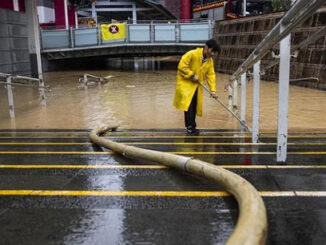
HONG KONG (TIP): Hong Kong was flooded by the heaviest rainfall in nearly 140 years on September 8, leaving the city’s streets and some subway stations underwater and forcing its schools to close.
Just across the border, authorities in China’s tech hub Shenzhen recorded the heaviest rains since records began in 1952.
Climate change has increased the intensity of tropical storms, experts say, with more rain and stronger gusts leading to flash floods and coastal damage.
The heavy rains in Hong Kong started on Thursday and in the hour leading up to midnight, the city’s weather observatory recorded hourly rainfall of 158.1 millimetres at its headquarters, the highest since records began in 1884. On Friday afternoon, the Hospital Authority said at least 110 people were hospitalised due to injuries, with four in serious condition. A man was found unconscious off the shore of western Hong Kong Island and declared dead at the hospital, though authorities were still investigating if the death was flood-related. The city’s highest rainstorm warning level, “black”, was hoisted for a record-breaking 16 hours before being lowered at 3:40 pm Friday, with rainfall mostly easing by late afternoon.
“It’s absolutely shocking,” said Jacky, 52, who lives in the Wong Tai Sin district with his elderly parents. “I don’t remember floods ever being this bad in our district.”
“The bottom floor of the mall is completely flooded, the water level is higher than the storefronts… It’s turned our day into chaos,” he added.
Authorities issued flash flood warnings, with emergency services conducting rescue operations in parts of the territory.
“Residents living in close proximity to rivers should stay alert to weather conditions and should consider evacuation” if their homes are flooded, the observatory said.
It also warned of potential landslips, telling motorists to “keep away from steep slopes or retaining walls”. Hong Kong’s stock exchange cancelled all trading sessions on Friday.
‘Once in a century’
Hong Kong Chief Secretary Eric Chan described the deluge as “a once-in-a-century heavy rainstorm”, adding that extreme conditions would continue until midnight local time (1600 GMT). “It’s like putting four bathtubs of water into one bathtub… it will spill,” Chan said at a press conference when asked if the government had done enough to prevent flooding.
The Hong Kong Observatory said it recorded more than 600 millimetres of rainfall at its headquarters over 24 hours – roughly a quarter of the city’s annual average.
Earlier in the day, taxis struggled through flooded roads as commuters attempted to make their way to work, with some cars stranded in the deluge.
“It felt like the whole neighbourhood was isolated by the floodwater. One of the underground car parks is totally underwater,” Olivia Lam, who lives on the eastern side of Hong Kong Island, told AFP. “The water was almost waist-deep outside my building, and that’s not the worst (case) in the neighbourhood.”
An AFP reporter saw boulders and mud from a landslide block off a two-lane road in the Shau Kei Wan district, with mud also spilling over into a nearby basketball court.
Residents of a public housing block just 30 metres from the landslide lined up with buckets to collect fresh water after the building’s supply was disrupted.
Roads were also flooded on the island of Lantau, where rivers swelled over their banks.
Southern China was hit the previous weekend by two typhoons in quick succession — Saola and Haikui — though Hong Kong avoided a feared direct hit.
Tens of millions of people in the densely populated coastal areas of southern China had sheltered indoors ahead of those storms.
Hong Kong’s weather observatory said the latest torrential rain was brought by the “trough of low pressure associated with (the) remnant of Haikui”.
Authorities suspended schools and cargo clearance services on the city’s border with Shenzhen were paused. The border disruption came hours after Hong Kong authorities announced that Shenzhen was preparing to discharge water from its reservoir, which they said could lead to flooding in northern parts of the city.
Hong Kong’s subway operator said there was a service disruption on one of its lines after a station in the Wong Tai Sin district was flooded.
A handful of other stations were also affected by the rain.
Footage posted on social media showed a subway train not stopping at Wong Tai Sin station, which had floodwater on its platform. The flooding could cost Hong Kong at least $100 million, according to a Bloomberg Intelligence estimate, compared to $470 million in damage when the city was hit by typhoon Mangkhut in 2018. (AFP)