SAN FRANCISCO (TIP): A stretch of a highway in California has been named after a 33-year-old Indian-origin police officer who was shot dead while conducting a traffic stop in 2018. Dedicated to Ronil Singh from Newman Police Department, the “Corporal Ronil Singh Memorial Highway”, which stands at Highway 33 and Stuhr Road, was unveiled at a ceremony on September 2, a local newspaper reported. “Love you papa,” Singh’s son Arnav, who was just five months old when his father was killed, wrote on the back of the signboard.
He was present along with Mother Anamika and other family members and was joined by Singh’s Newman Police Department colleagues and officials, including county Supervisor Channce Condit, state Senator Marie Alvarado-Gil, US Representative John Duarte and Assemblyman Juan Alanis.
“Today, a promise that was made has finally been brought to life. The Newman community honored the late Corporal Singh for his dedication and commitment to putting his life on the line for the safety of others,” Senator Alvarado-Gil wrote in a Facebook post, saying Singh will always be a hero. A resolution for naming a portion of Highway 33 after Singh was passed by the Assembly Transportation Committee in September 2019.
Fiji-born Singh started his law enforcement career as a volunteer with the Modesto Police Department and then served as a cadet and animal service officer with the Turlock Police Department. He was gunned down by a suspected drunk driver when he was working overtime on Christmas night in 2018. Multiple agencies responded to assist Singh, who was found at the scene with gunshot wounds. He was transported to a local hospital where he was pronounced dead.
WASHINGTON, D.C. (TIP): Indian American policy expert Vaishu Jawahar, former Domestic Policy Coordinator to Vice President Kamala Harris, has joined Waxman Strategies, a public interest focused policy and communications firm, as a director in its health practice team. “Vaishu Jawahar is a valuable addition to our team as a Director in the Health Practice,” said Claire McAndrew, Senior Vice President in the Health Practice, announcing her appointment with two other new hires — Jen Schultz and Jackson Thein.
Jawahar has experience in the executive and legislative branches, as well as advocacy, said the announcement noting, “Her contributions include work on implementing the White House Maternal Health Blueprint and the National Strategy on Hunger, Nutrition, and Health.”
Her commitment to health care advocacy is evident from her work with the Committee to Protect Health Care, the Biden Campaign, and other impactful organizations, it said.
Jawahar brings a range of experience from the executive branch, legislative branch, and advocacy field, it said.
Before Waxman Strategies, Jawahar worked at the White House and helped implement the Biden-Harris Blueprint to Address the Maternal Mortality Crisis and spearheaded equity-focused policy priorities, according to her official profile.
Prior to the Office of the Vice President, Jawahar interned with the White House Domestic Policy Council’s Health and Veterans team, where she monitored the implementation of the National Strategy on Hunger, Health, and Nutrition and drafted memos and talking points for senior officials on subjects ranging from maternal health to FDA regulation.
Previously, Jawahar was a grassroots organizer. She held multiple roles in healthcare advocacy groups and political campaigns, including the Committee to Protect Health Care, the Biden-Harris 2020 campaign, and the Obama 2012 campaign.
At the Committee to Protect Health Care, Jawahar mobilized over 4,000 doctors to speak up for their patients – helping protect reproductive rights in Michigan, expand Medicaid in North Carolina, and secure paid sick leave for 30,000 workers in Virginia.
Her work generated 517 TV hits, 351 written hits, $17.5 million in earned media, and headlines on CNN and Axios.
Jawahar also interned with the Senate Committee on Health, Education, Labor, and Pensions and worked with Enroll America to help North Carolinians gain coverage through the ACA. In addition, Jawahar brings a breadth of experience in health care to Waxman Strategies, from research at the National Institute of Health to shadowing doctors and public health officials in Appalachian Kentucky, according to the profile. Jawahar received a master’s degree in medical physiology and biophysics from the Georgetown University School of Medicine and graduated cum laude with a BS in biology and minors in political science and public health from the University of North Carolina at Charlotte.
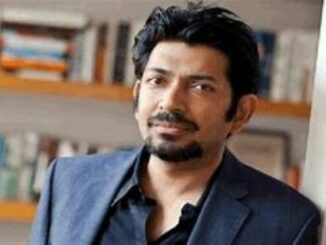
LONDON (TIP): Indian American physician-author Dr Siddhartha Mukherjee’s ‘The Song of the Cell: An Exploration of Medicine and the New Human’ has been longlisted for the prestigious Baillie Gifford Prize for Non-Fiction here on Wednesday, September 6.
The New York-based cancer physician and researcher, an Assistant Professor of Medicine at Columbia University, will go up against 12 other authors from around the world for the annual GBP 50,000 prize, which aims to recognize and reward the best of non-fiction and is open to authors of any nationality. Mukherjee’s longlisted work has been described as at once panoramic and intimate and the author’s “most spectacular book yet”.
“The cell is the foundational unit of life. Its discovery reshaped our understanding of our bodies and brains as never before,” note the judges with reference to the 53-year-old’s latest work. “This revolutionized medical practice in the past and, centuries on, holds ever-greater clinical promise for the future. Mukherjee provides the definitive account of this remarkable cellular story, authoritative yet at the same time personal. He has that rarest of scientific gifts – the ability to pull back the magical curtain of complexities to reveal, like cells themselves, the foundations of life,” they said. The longlist of 13 books was chosen by this year’s judging panel, which includes the Literary Editor of ‘The Financial Times’ Frederick Studemann, who is also chair of the panel, along with award-winning author Andrea Wulf, theatre critic for ‘The Guardian’ Arifa Akbar, writer and historian Ruth Scurr, journalist and critic Tanjil Rashid, and Chief Executive of the Royal Society of Arts Andrew Haldane.
“Given the wealth of options on offer, getting to a long list was never going to be easy. And indeed, our judging discussions were intense and rigorous – and also enjoyable and highly stimulating,” said Studemann.
“I’m delighted that the resulting longlist spans a wide range of subjects and genres – from history and science to technology and geopolitics along with a flash of swashbuckling adventure. The books on the longlist share an ability to communicate lucidly and engage with readers in an intelligent and relevant way,” he said. The prize covers all non-fiction in the areas of current affairs, history, politics, science, sport, travel, biography, autobiography and the arts. As part of the celebrations marking the prize’s 25th anniversary, it has been announced that as well as the winning author receiving GBP 50,000, the other shortlisted authors will receive GBP 5,000 (up from GBP 1,000), bringing the total prize value up to GBP 75,000. The announcement of the six books shortlisted for this year’s prize will take place on October 8 in a live event at England’s annual Cheltenham Literature Festival, and the winner will be awarded on November 16 at a ceremony at the Science Museum in London.
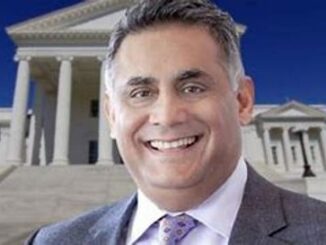
FAIRFAX, VA (TIP): Puneet Ahluwalia, a first-generation Indian American businessman, is running for Fairfax County supervisor in Virginia to, as he says, “bring accountability, good governance and diversity of ideas to the supervisor board.”
“We have a large number of Indian and Asian Americans residing and doing business in Fairfax County and they need representation,” said Ahluwalia who has lived and raised a family in Fairfax with his wife Nadia.
“Puneet knows the struggles our families face because they’re the same struggles he, his wife, and his children face,” his campaign stated noting that Ahluwalia “wasn’t born here, he chose to be an American.” Noting that there has been a serious spike in crime, he stressed “the need to hire 300+ police officers to ensure the safety and security of our communities.”
Fairfax County schools SAT scores had dropped 27 points with more emphasis on hiring administrators than teachers, Ahluwalia said.
Making “a commitment to make parents partners in their children’s lives and education,” he said the County “should hire and retain our hard-working teachers to ensure merit-based education to all our children.”
He also vowed to identify waste and misuse of “our tax dollars to reduce property taxes.
“Our incomes have not doubled but our property taxes have in the last 10 years,” Ahluwalia said. “The cost of living and increasing inflation is making it very hard on Fairfax County families. “Local government elections are so important as these issues impact our daily lives,” he stated. “Puneet will bring sanity back to politics in Fairfax County. He’ll work hard to restore integrity and honesty in county government. And he’ll put our people first,” according to a note on his website.
“Northern Virginia has become ground zero for an ideology-driven agenda that wants to re-create society, disempower families, and promote a narrative that puts a small group of elites in charge of your destiny,” he said.
“Very often these days those of us who disagree with that ideology, are slurred with name calling,” Ahluwalia said. “I believe that’s a big part of the problem with politics these days. Narrow doctrine over thoughtful action.”
“I’m running for Fairfax supervisor in the Dranesville district because we have real problems. But the growing division and incivility of our politics make it almost impossible to solve those problems,” he said.
“Rising crime, the declining quality of our schools, unmanaged growth, and the high cost of living here — these aren’t left wing issues or right-wing issues. They’re problems eroding the quality of life for all of us who make this special corner of America home.”
“My wife and I have built a business here and raised a family here. We love Fairfax County, and we love the people,” Ahluwalia said. “I believe that under all the anger in our politics today, our shared values can unite us in finding solutions to the problems Fairfax residents face.” Ahluwalia pledged that as supervisor “I will always be honest and tell you the truth. I’ll not pursue any agenda other than uniting with others to find practical solutions to the issues that confront us.” “I’ll work without fear or favor to do the right thing and always remember I work for you, not the other way around.”
Arjun Gupta, Indian American founder and chief believer at TeleSoft Partners, an Aspen, Colorado, -based special situations venture capital firm, has been appointed chair of a newly established Investment Capital Advisory Committee.
The 14-member committee will advise the US Small Business Administration (SBA) in the development of a more inclusive and accessible ecosystem for small businesses nationwide. Consisting of members with diverse perspectives, experiences, and occupational backgrounds in and related to the US private investment industry, the committee has been formed to increase small businesses and startups’ access to investment capital, according to an SBA press release.
“The launch of SBA’s inaugural Investment Capital Advisory Committee with its distinguished membership will serve as a critical resource to the Biden-Harris Administration as we strengthen our policies and programs to foster a more inclusive investment ecosystem,” said SBA Administrator Isabella Casillas Guzman.
“ICAC’s insights and recommendations will help the SBA expand access to investment capital, increase public awareness of SBA resources, and identify and fill capital gaps facing small businesses and the fund managers seeking to support them.”
The committee’s main objective is to promote, expand, and strengthen the ecosystem of private funds financing US small businesses and startups, to fund entrepreneurs and small business owners from traditionally underserved communities.
Gupta, a naturalized US citizen, founded TeleSoft Partners in 1996. TeleSoft was licensed by SBA for two SBICs covering 1997-2012. Gupta invests directly in portfolio companies and fund-of-funds investments, according to his official profile.
Over the last 25 years, he has invested directly or indirectly in over 250+ private technology companies, resulting in 150+ acquisitions and IPOs (including 60+ unicorns).
Over this period, Gupta raised cumulative capital commitments of over $1+ billion. He was on the Forbes Midas List of the Top 100 Venture Capital Investors in 2006, 2007, 2008, and 2009.
Earlier in his career, Gupta was a strategy consultant for high-tech clients with McKinsey & Company and a software engineer and product specialist for Tektronix, Inc.
In 2001, Gupta launched a family foundation. The foundation or Arjun personally has supported numerous non-profit projects.
Gupta is a passionate outdoorsman. He was a Liaison Officer with the Indian Mountaineering Foundation and has climbed with six Himalayan expeditions to peaks over ~20,000 feet.
He was a member of the 100th Anniversary Ski Expeditions to the North Pole and to the South Pole. Arjun was elected a Fellow of the Explorer’s Club (USA); a Fellow of the Royal Geographic Society (UK), and FAO of the UN appointed Arjun a Mountain Partnership Goodwill Ambassador.
Gupta received his MBA from Stanford University, MS and BS (Phi Beta Kappa) in Computer Science from Washington State University, and BA (Honors) in Economics from St Stephen’s College (India).
Gupta is an Advanced Leadership Fellow (ALI) from Harvard University and a Henry Crown Fellow and Trustee of the Aspen Institute. He is a co-founder and former co-chair of YPO Aspen. Gupta is a naturalized US citizen and lives in Colorado.
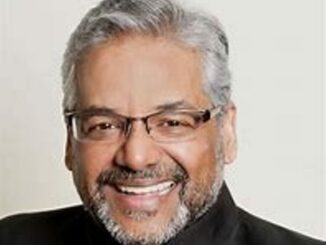
ATLANTA (TIP): The American Tamil Medical Association honored Dr. Indran B. Indrakrishnan of Atlanta with the 2023 Public Service Award during its Biennial Convention, held from August 18th to 21st, 2023, at the Trump International Resort Hotel in Florida.
The American Tamil Medical Association Awards Committee carefully selects distinguished physicians from North America who have made significant contributions to their communities’ long-term well-being, extending beyond routine healthcare services. Professor Appu Rathinavel of the Rumbaugh-Goodwin Institute for Cancer Research in Florida introduced Dr. Indrakrishnan, the 2023 Award recipient, on behalf of the Awards Committee on the convention’s final day. Dr. Ashok Kumar, President of the American Tamil Medical Association, presented the award to Dr. Indrakrishnan, making him the first physician from Georgia to receive this prestigious Public Service Award from the Tamil American Medical Association.
Within a year, Dr. Indrakrishnan received distinguished awards from three Tamil Organizations in North America. He previously earned the Tamil American Pioneer (TAP) award from the Federation of Tamil Sangams of North America (FeTNA) in July 2023 in California. Additionally, the Tamil Information Center and Thamizhar Thahaval Magazine of Canada honored Dr. Indrakrishnan with the Lifetime Achievement Award in July 2022 at their annual event at Toronto City Hall, Toronto, Canada.
Dr. Indran B. Indrakrishnan is an adjunct professor of Medicine at Emory University School of Medicine and operates his private Gastroenterology practice in Georgia. He serves on the Georgia Board of Healthcare Workforce, overseeing Georgia’s rural healthcare. Furthermore, he is on the board of directors of Rainbow Village, a charitable organization in Georgia dedicated to caring for homeless mothers with children. Dr. Indrakrishnan also lends his support to Meals by Grace/Fill Ministries, a non-profit organization providing meals to hungry children in Georgia, and Third Eye Dancers, another non-profit organization raising funds for underprivileged children through cultural dance programs.
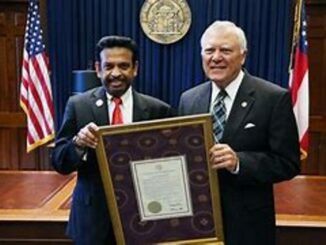
On February 14th, 2018, the Georgia State Assembly passed a resolution declaring it Dr. Indrakrishnan Day in Georgia, recognizing his relentless service to the community. This accolade marked him as the first Tamil American, first physician, and the first American of Asian descent to receive such an honor. Georgia Asian Times Magazine also acknowledged his contributions by naming him one of the 25 Most Influential Asian Americans in Georgia in 2016 and again in 2018.
Dr. Indrakrishnan holds fellowships with the American College of Gastroenterology, the American College of Physicians, the Royal College of Physicians of London, England, and the Royal College of Physicians and Surgeons of Canada. He actively participates in the editorial boards of numerous national and international medical journals and has published several research papers in the field of Gastroenterology and Hepatology. Dr. Indrakrishnan’s expertise has led to invitations as a visiting professor and speaker, both nationally and internationally. He has also contributed to radio talk shows, discussing various healthcare topics.
His extensive service record includes roles on examination boards for the Royal College of Physicians of London, England, as a Question Author and Relevance Reviewer for the Examination Board for the American Board of Internal Medicine and Gastroenterology, and on the International Advisory Board of the Royal College of Physicians of the UK. Additionally, Dr. Indrakrishnan has actively served on the National Affairs and International Relations Committees of the American College of Gastroenterology and the Health and Public Policy Committee of the American College of Physicians. His leadership roles include being the past and the first Indian-descent president of the Georgia Gastroenterological & Endoscopy society and a past president of Georgia Association of Physicians of Indian heritage (GAPI).
The bypolls across the country were decided by local factors
Bypolls in seven Assembly segments in six States across the country threw up mixed political signals. The Bharatiya Janata Party (BJP) won three and Opposition parties won four. There is no national pattern to be sought in these elections that answer widely different situations and calculations, but the polls do offer pointers to local shifts. In Ghosi in Uttar Pradesh, the BJP’s Dara Singh Chauhan lost the election to the Samajwadi Party (SP) candidate. Mr. Chauhan represented a pattern of BJP expansion through defections and allurement. He was the sitting SP MLA who crossed over to the saffron party and sought re-election as a BJP MLA. The SP candidate was supported by the Congress, the CPI(M) and the CPI(ML)-Liberation, broadly the INDIA bloc of Opposition parties in the State. Uttar Pradesh is critical for the BJP’s fortunes in 2024, and the Ghosi by-election had turned high profile after SP chief Akhilesh Yadav, who had been keeping his head down for some time, and Chief Minister Yogi Adityanath both campaigned hard. The BJP also sought to reinforce its multi-caste Hindu coalition in the by-election, but it did not find favor with voters in the end. The BJP retained a seat in Uttarakhand, while it lost a sitting seat in West Bengal to the ruling Trinamool Congress (TMC). The ruling Jharkhand Mukti Morcha retained Dumri in Jharkhand.
Dhupguri in West Bengal witnessed a combination of INDIA bloc parties facing off against another constituent, while Puthuppally in Kerala had the parties in the combination fighting each other. In Dhupguri, the CPI(M) and the Congress jointly opposed a third INDIA partner TMC, and finished a distant third. The TMC is eager to prevent an alliance between the Congress and the CPI(M), both of which are confused and struggling to survive in West Bengal. In Kerala, fronts led by the CPI(M) and the Congress, clashed for the seat vacated by the death of Congress veteran Oommen Chandy. His son Chandy Oommen romped home comfortably. Though it had repeatedly framed the by-election as a test of Chief Minister Pinarayi Vijayan’s governance, the Left’s stakes in Puthuppally were not as high as they were in Boxanagar in Tripura which it lost for the first time since 1988 to the BJP. The BJP also retained Dhanpur in the State. The CPI(M) has alleged electoral malpractices and violence by the ruling BJP in Tripura. The outcomes were largely decided by local factors, but they also indicate the political winds in the respective regions.
In Tamil Nadu’s backward-caste electoral politics, Sanatan Dharma is a phrase to abuse Brahmins
“So, Periyar’s politics suited the upsurge of backward-caste pride and empowerment, as it turned electorally insignificant Brahmins into a racial ‘other’. The Congress had a considerable number of Brahmin leaders, and in all probability, it was to attack the Congress and Mahatma Gandhi that Periyar turned Sanatan Dharma into a catchphrase of abuse. His pro-British leanings were evident in his opposition to the freedom movement and his refusal to accept freedom in 1947. It was this pro-British, anti-Brahmin politics that laid the intellectual framework for Tamil secessionism, which has cost the nation the lives of many, including that of former Prime Minister Rajiv Gandhi — the LTTE leadership of Sri Lanka always relied on the extremist Dravidar Kazhagam cadre for intellectual succor on the mainland.”
At the national level, the Stalins’ attack on Sanatan Dharma has embarrassed the INDIA coalition no end. And therein lies the irony of Indian politics — what is a dog whistle for caste mobilization in one state can turn into a communal own-goal alarm in another. When all is said and done, here is a request to these great progressive leaders — please don’t stigmatize diseases like HIV and leprosy by turning them into metaphors of hatred.
By Rajesh Ramachandran
Sanatan Dharma means eternal values. Then, why should the DMK leadership have any quarrel with everlasting virtues, leave alone abuse it in the vilest possible terms by equating them with deadly diseases? Herein lies the dog whistle of the so-called Dravidian politics. In Tamil Nadu’s backward-caste electoral politics — otherwise known as Dravidian ideology, which has no currency in other South Indian states — Sanatan Dharma is a code word or phrase to abuse and demean Brahmins.
If Periyar used the attack against Sanatan Dharma to delegitimize Congress, the tactic is being used by the Stalins to paint the BJP as a Brahminical enterprise out to disempower TN’s backward castes.
For the backward-caste politicians of Tamil Nadu and their voters, Sanatan Dharma symbolizes Brahminical hegemony, ritualism, superstition and feudal overlordship of the Brahmins. Just as a Hindutva politician may use the dog whistle of the Muslim ‘other’, the backward-caste politicians of Tamil Nadu use Sanatan Dharma to whip up anti-Brahmin sentiments and mobilize their own caste brethren. In fact, EV Ramasamy Naicker — famous as Periyar — had packaged hatred for Brahmins into an ideology, terming the platform Dravidar Kazhagam.
Intriguingly, both RSS and Dravidar Kazhagam were formed in the same year, 1925, and both have been accused by their detractors of being British stooges. Periyar, when he was the Madras Presidency Congress Committee chief, had an epiphany to fight the Brahmins instead of the British and joined hands with the pro-British Justice Party, led interestingly by a Nair (for Periyar, all non-Brahmins were oppressed, however big landlords they were). Then, Dravidian politicians are mostly from the middle castes, though technically categorized as backward or most backward castes. Most of those who claim Chola and Pandya lineage are now beneficiaries of backward-caste quotas in Tamil Nadu.
So, Periyar’s politics suited the upsurge of backward-caste pride and empowerment, as it turned electorally insignificant Brahmins into a racial ‘other’. The Congress had a considerable number of Brahmin leaders, and in all probability, it was to attack the Congress and Mahatma Gandhi that Periyar turned Sanatan Dharma into a catchphrase of abuse. His pro-British leanings were evident in his opposition to the freedom movement and his refusal to accept freedom in 1947. It was this pro-British, anti-Brahmin politics that laid the intellectual framework for Tamil secessionism, which has cost the nation the lives of many, including that of former Prime Minister Rajiv Gandhi — the LTTE leadership of Sri Lanka always relied on the extremist Dravidar Kazhagam cadre for intellectual succor on the mainland.
All this would have been fine had it not been for the inherent hypocrisy. Now, the Brahmins are a defeated, minuscule minority in Tamil Nadu, fleeing their homeland in search of prosperity. The old Brahmin hegemony over temples and the community at large is a thing of the past. And the sweetest irony is that the Dravidian cadres are great believers and temple-goers. Since Sanatan Dharma is for them only a term of racial abuse against Brahmins, the DMK voters do not see a dichotomy in their contempt for Brahminism and their belief in Hinduism or temples.
Tamil Nadu Chief Minister MK Stalin’s son Udhayanidhi Stalin, thus, can afford to read out a written speech seeking the ‘eradication’ of Sanatan Dharma because it is now being equated with the politics of Hindutva and the Sangh Parivar, thereby very significantly drawing a parallel between Brahminism and the BJP, delegitimizing the Hindutva party as an organization that perpetuates Brahminical hierarchy in society. If Periyar used the attack against Sanatan Dharma to delegitimize the Congress, the tactic is being used by the Stalins to paint the BJP as a Brahminical enterprise out to disempower the backward castes of Tamil Nadu.
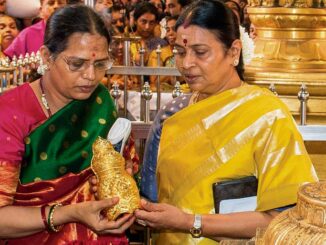
This is politics of caste hatred nuanced as electoral messaging which the speaker and the listener understand. And it doesn’t mean anything more than that. For, it was only last month that Durga Stalin, Udhayanidhi’s mother, offered a gold crown to the deity of the famous Guruvayoor Krishna temple in Kerala, where daily prayers are done according to Vedic rituals. Only the most devout make the trip to Guruvayoor or an astrologer ought to prescribe it as a remedy for some dosha. Either way, Durga wouldn’t have made this expensive gift had it not been to seek Lord Krishna’s blessings for her husband and son.
Worse hypocrisy is to explain Sanatan Dharma in terms of casteism and untouchability. For, terrible caste discrimination exists in established TN Christian churches and even in village tea shops, where the two-tumbler system prevailed for long — one for forward/backward castes and the other for the Dalits. Why, even Periyar is accused of not having visited the site of the massacre of 44 Dalits at Keezhvenmani in 1968.
A Dalit activist-writer has quoted Periyar’s magazine Viduthalai, in which he is alleged to have spoken thus about Keezhvenmani: “The Communists are pretending to help you. They give promises of a pay hike and a better life. But a wage hike is not possible through political agitations. It is only possible from the market value of the commodities. Instead of teaching you (Dalits) how to live peacefully with the wages you get, they want to create riots in the state and they want to get the DMK government disturbed.”
The landlord of Keezhvenmani, prime accused Gopalakrishna Naidu, belonged to Periyar’s caste. Not surprisingly, the DMK government till today is in the dock for having made the police mute spectators to the massacre and then later letting Naidu get acquitted after an appeal. So, the DMK’s anti-caste talk should be tempered with the understanding of anti-Dalit atrocities, just as all talk of Dravidian rationalism should be counterpoised with the donation of a gold crown to Lord Krishna by the first family.
At the national level, the Stalins’ attack on Sanatan Dharma has embarrassed the INDIA coalition no end. And therein lies the irony of Indian politics — what is a dog whistle for caste mobilization in one state can turn into a communal own-goal alarm in another. When all is said and done, here is a request to these great progressive leaders — please don’t stigmatize diseases like HIV and leprosy by turning them into metaphors of hatred.
(The author is editor-in-chief of Tribune group of publications)
On International Day of Clean Air for Blue Skies (September 7), there is urgent need to address risks posed by pollution
By Benno Boer, Srishti Kumar, Neha Midha
“The world is not just grappling with climate change, but also with another silent killer — air pollution. Global health statistics reveal a disturbing scenario with lung cancer claiming 10 million deaths worldwide in 2020, as stated in the World Health Organization (WHO) factsheet published in 2023. This could soar by another 3.2 million by 2050 according to a report, ‘Mapping of global, regional and national incidence, mortality and mortality-to-incidence ratio of lung cancer in 2020 and 2050’, by the Indian National Institute of Health. South Asia, home to two billion people, is also home to nine of the world’s 10 most polluted cities, including Delhi, where the air quality continues to pose a perilous long-term threat putting its inhabitants at risk each day. While policy measures have led to statistical improvements in the Air Quality Index (AQI), the health risks associated with Delhi’s polluted air persist. Delhi is knocked to its knees every winter facing hazardous levels of air pollution.”
Youngsters around the world are taking charge of environmental advocacy, running marathons, and tracking real time data of air quality, creating environmental awareness. But the absence of a specific Sustainable Development Goal (SDG) for ‘Clean Air to Breathe’ indicates a lack of global attention.
Dr. Benno Boer
According to UN Secretary-General António Guterres, the earth has entered the era of global boiling. Scorching heatwaves, devastating floods and erratic weather patterns are stark reminders for an urgent need to address the triple-planetary crisis of biodiversity loss, climate change and pollution.
The world is not just grappling with climate change, but also with another silent killer — air pollution. Global health statistics reveal a disturbing scenario with lung cancer claiming 10 million deaths worldwide in 2020, as stated in the World Health Organization (WHO) factsheet published in 2023. This could soar by another 3.2 million by 2050 according to a report, ‘Mapping of global, regional and national incidence, mortality and mortality-to-incidence ratio of lung cancer in 2020 and 2050’, by the Indian National Institute of Health. South Asia, home to two billion people, is also home to nine of the world’s 10 most polluted cities, including Delhi, where the air quality continues to pose a perilous long-term threat putting its inhabitants at risk each day. While policy measures have led to statistical improvements in the Air Quality Index (AQI), the health risks associated with Delhi’s polluted air persist. Delhi is knocked to its knees every winter facing hazardous levels of air pollution.
Lung cancer, cardiovascular disorders, respiratory ailments, and mental health issues continue to destroy lives. Delhi’s air, a lethal mix of SO2 (sulphur dioxide) and NOX (nitrogen oxides), along with high particulate matter concentrations (2.5 or even 10µg/m3), carbon monoxide and ozone, deprive over 30 million residents of their human right to breathe clean air.
The air pollution toll is troublesome especially for immunocompromised individuals, pregnant women, children, and the elderly. As per a Lancet Report, 1.67 million pollution-related deaths were attributed to air pollution in India in 2019, accounting for a staggering 17.8% of the total deaths in the country.
Efforts to combat this crisis are already being made. State governments, research institutions, and NGOs are pioneering solutions such as the PUSA Decomposer, developed by the Indian Agricultural Research Institute (IARI), employing biotechnology to address agricultural pollution. State-level policies such as GRAP 3 (Graded Rapid Action Plan), monitoring air quality in hotspots, and establishing Green War Rooms, have shown some potential. Many innovative startups involving young entrepreneurs are turning agricultural waste into valuable products.
Viable solutions
Acknowledging the existence of air pollution remains the primary step towards solutions. Next comes a debate on viable solutions and actions, many of which are already known. Eventually, these best practices need to be implemented. Without implementation, the best laid out plans will not lead to any improvement. Globally, cities such as Ljubljana (Slovenia), Accra (Ghana), Seville (Spain), Bogota (Colombia), Medellin (Colombia), epitomize the power of prioritizing human health and environmental sustainability. Car-free zones, green spaces, smart urban designs, electrified public transportation, nature-based solutions, and innovative biotechnology demonstrate positive results. China’s shift to clean energy and e-mobility after battling severe pollution, Indonesia’s project on ‘Carbon Efficient Farming’ assessing biomass to reduce CO2 emissions, Thailand and Vietnam undertaking measures to reduce open straw burning, are all gleams of hope.
UNESCO’s initiatives to combat air pollution include implementing an internal carbon tax on all flight tickets, and investing in emission reduction measures. The World Air Quality Project allows residents to make informed decisions by real time Air Quality data. In collaboration with UNEP, environmentally conscious practices have been introduced such as digital working via the ‘Virtual Meetings’ project. Clean-Air-For-Schools is spreading education among all for clean air. Other laudable activities include switching to electric vehicles, replacing lighting systems to greener LED arrangements, implementing solar powered offices, protecting historical sites by developing strategies to curb air pollution, and effective green solutions ( urban forests, parks, green corridors).
Youngsters around the world are taking charge of environmental advocacy, running marathons, and tracking real time data of air quality, creating environmental awareness. But the absence of a specific Sustainable Development Goal (SDG) for ‘Clean Air to Breathe’ indicates a lack of global attention.
However, in 2019, laying emphasis on the interest of the international community for clean air, and the need to improve air quality, the UN General Assembly decided to designate September 7 as the International Day of Clean Air for Blue Skies. Nevertheless, clean air remains a long stride in many mega-cities and other places. We hope that a concerted action to systematically improve the air quality including in Delhi will receive priority attention. The problem has been caused by people, so it should be people who will find and apply solutions, supported by innovative adequate air quality policies and action plans. As we inhale the consequences of our actions, the ultimate question beckons: are we the torchbearers of change for the future of our planet or will we be silent bystanders who let pollution script a tragic ending?
(Benno Böer is the Chief of the Natural Sciences Unit, UNESCO Multisectoral Regional Office for Bangladesh, Bhutan, India, Maldives, Nepal and Sri Lanka. Neha Midha is the National Programme Officer, UNESCO Multisectoral Regional Office for Bangladesh, Bhutan, India, Maldives, Nepal and Sri Lanka. Srishti Kumar is a UNESCO Natural Sciences Intern. UNESCO is a member of Team UN in India, together helping deliver on the Sustainable Development Goals)
Our G20 Presidency strives to bridge divides, dismantle barriers, and sow seeds of collaboration that nourish a world where unity prevails over discord, where shared destiny eclipses isolation. As the G20 President, we had pledged to make the global table larger, ensuring that every voice is heard and every country contributes. I am positive that we have matched our pledge with actions and outcomes.
“The post-pandemic world order is very different from the world that came before it. There have been three important changes, among others. First, there is a growing realization that we need a shift away from a GDP-centric view of the world to a human-centric one. Second, the world is recognizing the importance of resilience and reliability in global supply chains. Third, there has been a collective call for boosting multilateralism through the reform of global institutions. Our G20 Presidency has played the role of catalyst in all three of these shifts.”
Photo Credit :UnsplashBy Narendra Modi
“Vasudhaiva Kutumbakam.” These two words capture a deep philosophy. They mean, “The world is one family.” It’s an all-embracing outlook that encourages us to progress as one universal family, transcending borders, languages, and ideologies.
During India’s G20 Presidency, this has translated into a call for human-centric progress. As One Earth, we are coming together to nurture our planet. As One Family, we support each other in the pursuit of growth. And we move together towards a shared future—One Future—which is an undeniable truth in these interconnected times.
The post-pandemic world order is very different from the world that came before it. There have been three important changes, among others. First, there is a growing realization that we need a shift away from a GDP-centric view of the world to a human-centric one. Second, the world is recognizing the importance of resilience and reliability in global supply chains. Third, there has been a collective call for boosting multilateralism through the reform of global institutions. Our G20 Presidency has played the role of catalyst in all three of these shifts.
In December 2022, when we took over the Presidency from Indonesia, I had written that the G20 must catalyze a mindset shift. This was especially necessary in the context of mainstreaming the marginalized aspirations of developing countries, the Global South, and Africa.
The Voice of Global South Summit in January 2023, which witnessed participation from 125 countries, was one of the foremost initiatives under our Presidency. It was an important exercise to gather input and ideas from the Global South. Furthermore, our Presidency has not only seen the largest-ever participation from African countries but has also pushed for the inclusion of the African Union as a permanent member of the G20.
An interconnected world means our challenges across domains are interlinked. This is the midway year of the 2030 Agenda, and many are noting with great concern that the progress on Sustainable Development Goals (SDGs) is off track. The G20 2023 Action Plan on Accelerating Progress on SDGs will spearhead the future direction of the G20 towards implementing SDGs.
In India, living in harmony with nature has been a norm since ancient times, and we have been contributing our share toward climate action even in modern times. Many countries of the Global South are at various stages of development, and climate action must be a complementary pursuit. Ambitions for climate action must be matched with actions on climate finance and transfer of technology.
We believe there is a need to move away from a purely restrictive attitude of what should not be done to a more constructive attitude focusing on what can be done to fight climate change. The Chennai High-Level Principles for a Sustainable and Resilient Blue Economy focus on keeping our oceans healthy. A global ecosystem for clean and green hydrogen will emerge from our presidency, along with a Green Hydrogen Innovation Centre. In 2015, we launched the International Solar Alliance. Now, through the Global Biofuels Alliance, we will support the world to enable energy transitions in tune with the benefits of a circular economy.
Democratizing climate action is the best way to impart momentum to the movement. Just as individuals make daily decisions based on their long-term health, they can make lifestyle decisions based on the impact on the planet’s long-term health. Just as Yoga became a global mass movement for wellness, we have also nudged the world with Lifestyles for Sustainable Environment (LiFE).
Due to the impact of climate change, ensuring food and nutritional security will also be crucial. Millets, or Shree Anna, can help with this while also boosting climate-smart agriculture. In the International Year of Millets, we have taken millets to global palates. The Deccan High Level Principles on Food Security and Nutrition is also helping in this direction.
Technology is transformative, but it also needs to be made inclusive. In the past, the benefits of technological advancements have not benefited all sections of society equally. India over the last few years has shown how technology can be leveraged to narrow inequalities, rather than widen them.
For example, the billions across the world who remain unbanked or lack digital identities can be financially included through digital public infrastructure (DPI). The solutions we have built using our DPI have now been recognized globally. Now, through the G20, we will help developing countries adapt, build, and scale DPI to unlock the power of inclusive growth.
That India is the fastest-growing large economy is no accident. Our simple, scalable and sustainable solutions have empowered the vulnerable and the marginalized to lead our development story.
From space to sports, economy to entrepreneurship, Indian women have taken the lead in various sectors. They have shifted the narrative from the development of women to women-led development. Our G20 Presidency is working on bridging the gender digital divide, reducing labor force participation gaps and enabling a larger role for women in leadership and decision-making.
For India, the G20 Presidency is not merely a high-level diplomatic endeavor. As the Mother of Democracy and a model of diversity, we opened the doors of this experience to the world.
Today, accomplishing things at scale is a quality that is associated with India. The G20 Presidency is no exception. It has become a people-driven movement. Over 200 meetings will have been organized in 60 Indian cities across the length and breadth of our nation, hosting nearly 100,000 delegates from 125 countries by the end of our term. No Presidency has ever encompassed such a vast and diverse geographical expanse.
It is one thing to hear about India’s demography, democracy, diversity and development from someone else. It is totally different to experience them first-hand. I am sure our G20 delegates would vouch for this. Our G20 Presidency strives to bridge divides, dismantle barriers, and sow seeds of collaboration that nourish a world where unity prevails over discord, where shared destiny eclipses isolation. As the G20 President, we had pledged to make the global table larger, ensuring that every voice is heard and every country contributes. I am positive that we have matched our pledge with actions and outcomes.
(The author is the prime minister of India)
The views expressed in this article are the writer’s own.
Aries
Ganesha says this week is bringing you a lot of better things. As you foresee the upcoming seven days, the losses incurred in the last few weeks will be revived. You will earn the trust of everyone in your life. The monotonous nature of your job will make you feel dull but this feeling is temporary. The last three days of the week will be a little bit challenging but this adventure of hardship will bring you growth. Income is going to increase and your family will support you in whatever you do. Your love life is expecting some challenges as there will be some misunderstandings between your partner and you.
Taurus
Ganesha says a lot of travelling, most likely to be solo trips is in your cards this week. Though it may initially seem like a bad thing, stepping beyond the usual boundaries of your life, it could be a real adventure and you’ll realize in the end how far you’ve come. This week is all about being street smart for you. You have been quite delusional when it comes to knowing yourself and your capabilities of managing unexpected situations; this week is all about learning about yourself. As you navigate through unexplored terrains you will realize the true nature of your existence. The beginning of the week will have you perplexed and upset but as the days go by, you will adjust to the new routine and by the end of this week, learn to love it.
Gemini
Ganesha says, you will have a lot of free time on your hands and pretty much nothing to do as your business is flourishing by the work of outsources hence you will only need to dedicate a little amount of time and attention to your business. Plan fresh activities and avoid discussions that have the possibility of turning into fights and arguments. You should take the time you have this week to build stronger connections with existing relationships, instead of ruining connections by getting into petty fights and arguments.
Cancer
Ganesha says, you will feel extremely loved and appreciated this week, which will boost your confidence. Your partner will make you feel like you’re worth a lot more than you have been given till date. Hence you will walk through every place as if it’s the most beautiful thing you have ever seen. You need to care for your partner as much as they care for you. Be careful of letting yourself come across as rude and snobby to your partner, and seek out new ways to delight your partner. Singles should seek our intellectual stimulation when searching for their special someone. When looking for a connection seeks out people who hold a zest for life and a search for deeper meaning. As you notice that your well-being improves over this week, you will have a lot of energy to go on fun adventures with your partner.
Leo
Ganesha says this week is going to be fabulous for you. Positive news at the beginning of the week itself will boost your confidence to a whole another level. This week is going to be full of excitement and unique experiences for you. You will go through a positive shift when it comes to your mental and physical health. This positive shift will help you to participate and indulge more in social events. You will have an overall very positive week. Your competitors will think twice before facing you! People will not dare to pick fights with you this week. You need to use this opportunity starting early this week itself to build better relationships.
Virgo
Ganesha says your social prestige is likely to increase based on the decisions you have taken in the past few days. You will make new plans to start some new project; your patience will help you throughout this week be it your relationships or your work. You will spend a huge amount of money which might be necessary for your business. Singles will be blessed by the moon. If you’re single you might find your soul mate this week if they focus on socializing and meeting new people every day. To those who are already in a relationship, you are likely to take the next step this week. Your health will bother you on and off throughout the week, as it is nothing major relying on home remedies will help you recover.
Libra
Ganesha says, you will have to go through a difficult phase when it comes to your health this week. Your stomach and digestion area seem to be troublesome this week hence you will need to take care and focus on the good things as well as becoming as better as you can. Consulting a specialist in the area that you’re facing trouble in will give you a great start when it comes to improving your health. You will have to stay disciplined when it comes to avoiding certain foods and maintaining a very strict eating schedule. You might want to focus on becoming the healthiest version of yourself this week.
Scorpio
Ganesha says your inner strength will be on a high level and you will perform well at your work. You will get good results for your hard work. Disputes with your colleagues will be resolved now. There is likely to be an increase in your network. You will plan for a short work-related trip, which will give you benefits in the near future. Your team members and friends will help you in the completion of some important projects. Job seekers will find good jobs with the help of a network. You will receive a lot of help from your partner, family as well as friends consistently this week. Make sure to take the help as well as appreciation each and every person, every time they help you.
Sagittarius
Ganesha says you will keep busy at work, your focus towards your goal as well as your patience will be tested. With the help of patience, you might be able to achieve your goals on time. Your dedication to work will be tested many times. Expect some rewards as a result of hard work at the end of the week. You are likely to make investments in fixed assets as well. Expect to hear good news in terms of parent’s health. Your losses will convert into gains by the end of this week. Your past dead investments might become profitable as well.
Capricorn
Ganesha says although not every aspect of your life will work out as you would have liked it to be, you’ll come through struggles stronger and smarter. You’re likely to feel slightly nervous and excited about how things will work out financially for you this week, as you have already made investments based on estimation of an income that’s yet to come. Mid-week you’ll realize that you have been blessed in all aspects of life; you will enjoy your personal as well as work life.
Aquarius
Ganesha says you are blessed with the moon this week which will give you inner strength and confidence. Self-respect will stop you from taking some negative decisions, specifically in regards to your relationships. Your social prestige is likely to increase based on the decisions you have taken in the past few days. You will make new plans to start some new project; your patience will help you throughout this week be it your relationships or your work. Singles will be blessed by Venus.
Pisces
Ganesha says you will gain a lot of profit in your business this week which will set a positive tone for the entire week. You won’t need to do things that you hate in terms of work anymore. You will have the time, space and affordability to follow your passion. Financial abundance is in your cards this week, which will keep you satisfied and happy throughout the week. You need to be more analytical about making investments now as managing the funds that you receive this week and in the future will make a significant difference in your life.
September 4
Ganesha says you enjoy living alone and freely, which enables you to take small steps toward your goals, but you need to manage your propensity for being occasionally wasteful, domineering, and restless. There will be enough energy available to you, and if you use it well, it can yield impressive results. Friends and family won’t be very helpful, so don’t rely on them. In terms of money, it will be an excellent moment to buy stocks and real estate, but all purchases should be made with the long term in mind.
September 5
Ganesha says you will make new connections and sign new collaborations this year that will help your career greatly. Past investments will result in financial gains. Family members and friends will offer encouragement and assistance. You’ll experience some minor tensions and stress, particularly in relation to your parents’ health and the rise in household costs. Trips for fun or get-togethers with friends will be interesting and intellectually stimulating.
September 6
Ganesha says you will get profit from the contacts you made recently this year. You can enter attractive industries thanks to your extensive business expertise, which will also help you become more visible on the market. Gains in money are certain, but unforeseen losses are also anticipated. More attention must be paid to health, particularly for people with chronic illnesses. Yoga and meditation should be practiced for both spiritual and physical benefits.
September 7
Ganesha says the time is now to make crucial business decisions. During this era, investments will yield good returns. The home’s renovation and other construction-related tasks will likewise be high on your priority list. Gains will come from property-related issues. Traveling far away, even to another country, is enjoyable and can result in a probable reunion with old friends. Patients with chronic conditions need to pay closer attention to their health.
September 8
Ganesha says if you pay attention to what your family members have to say this year, you will gain a lot. Your financial situation will improve and your confidence level will be at its highest if you find new sources of income. The wife and other female family members will make every effort to keep you content. If there are any career changes, they will be advantageous. Your outspoken personality will be advantageous to you. Avoid being a standing surety or guarantee for others since this could cause awkward situations and legal issues.
September 9
Ganesha says you love someone with all of your heart, but you need to learn to control your occasionally erratic and rebellious behavior. You are constantly looking for a committed romantic connection, and the idea of being alone can make you unhappy. Yoga and meditation should be practiced for both spiritual and physical benefits. You must amass knowledge, information, and enduring connections. Entrepreneurs will diversify their businesses into new and lucrative fields.
September 10
Ganesha says you enjoy reading to expand your knowledge and learn about new and undiscovered things, and you constantly welcome new ideas, but you need to learn to control your urge to act in times when you are bashful, conceited, or moody. You will receive honors and accolades in the upcoming year. Financial advantages will come from a variety of sources. Your way of life will improve as you find new sources of income. Significant gains will come from real estate matters.
Pallekele (TIP)- After a one-sided victory for Pakistan against Nepal in the tournament opener, the second match of the 2023 Asia Cup, between Sri Lanka and Bangladesh in Pallekele on Thursday, August 31, was a more competitive affair as the hosts completed a five-wicket win. Having made it to the upcoming ODI World Cup through the qualifiers, Sri Lanka, the defending champions at the Asia Cup, went into their encounter against Bangladesh without star all-rounder Wanindu Hasaranga and a couple of their first-choice fast bowlers, who have been sidelined due to injuries.
However, Dasun Shanaka and Co put in an impressive performance with the ball to bowl out Bangladesh for just 164 runs before finishing with 165/5 in 39 overs to bag the two points.
Opting to bat first in sultry conditions, Bangladesh struggled to stitch together partnerships throughout. Najmul Hossain Shanto came to the crease at No.3 and held fort to score 89 runs off 122 balls, but the rest of the batting order crumbled. Towhid Hridoy, in at No.5, was the second-highest scorer with 20 runs, in what was a forgettable performance with the bat by the visitors who lost their last six wickets for a mere 37 runs.
Right-arm pacer Matheesha Pathirana, who has impressed in the IPL for Chennai Super Kings, was the pick of the bowlers and returned with figures of 4/32 from 7.4 overs. The 20-year-old became the youngest Sri Lankan to take a four-wicket haul in ODI cricket.
In reply, Sri Lanka found themselves in trouble at 15/2 and then 43/3 as Shoriful Islam, Taskin Ahmed and Shakib Al Hasan dismissed Pathum Nissanka, Dimuth Karunaratne and Kusal Mendis respectively. But there was no real trouble from there on as Sadeera Samarawickrama (54 off 77) and Charith Asalanka (62* off 92) put on a partnership of 78 runs for the fourth wicket to all but kill the contest.
It was a fourth ODI half-century for Samarawickrama, who hit six boundaries in his knock. Mahedi Hasan got the right-hander stumped in the 30th over before Shakib cleaned up Dhananjaya de Silva 11 balls later. But it remained a mini fightback by Bangladesh.
Asalanka showed composure and went to on register his ninth ODI fifty, with five fours and a six, while skipper Shanaka was not-out on 14 off 21 as Sri Lanka closed out the win.
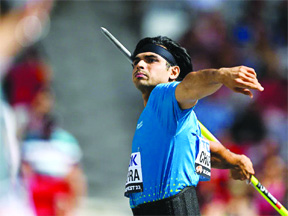
Zurich (TIP)- World champion Neeraj Chopra found enough reserves to unleash an 85.71m throw on his final attempt to finish second at the Zurich Diamond League on Thursday, August 31. This is the first time the 25-year-old came second in any competition this season.
It was an uncharacteristic event for the newly-crowned world champion Chopra — used to imposing himself on the field with big early throws — who began with a modest 80.79m on the chilly night. As Czech Republic’s Jakub Vadlejch and Germany’s Julian Weber zoomed to the top, Chopra stormed into the top three from the fifth spot, avoiding a maiden finish outside the top three since May 2018.
The result though ends Chopra’s winning streak this season — he won Doha and Laussane legs of the Diamond League before scooping gold in Budapest. Chopra began the competition with a modest 80.79m throw. Former world champion Anderson Peters threw 78.78m while Czech Republic’s Jakub Vadlejch, who took bronze in Budapest, and Germany’s Julian Weber fouled their opening attempts. At the end of the first series, Lithuania’s Edis Matusevicius took the lead with 81.62m. Chopra fouled his next two attempts and slipped to the fifth spot but found his groove in the fourth series when he got his first decent throw in, an 85.22m effort that placed him second, leapfrogging Weber and Finland’s Oliver Helander and only behind Vadlejch’s 85.86m. In fact, the fourth series had Vadlejch, Chopra and Weber all recording their best throws of the night till that point. Chopra fouled in his penultimate attempt. With Chopra, Vadlejch and Webber still in the hunt for a top finish, the Indian came up with an 85.71m throw on the last try to ensure he ended second. His effort was just 0.15m short of Vadlejch’s leading mark. After the event, Neeraj said his aim was to respect his body, stay healthy and give his best. “I feel very good now, because everyone is a little tired after the World Championships – we gave our 100 percent there, but for this competition here my focus was to just stay healthy, and we have to focus now for Eugene (Diamond League Final) and then the Asian Games,” Neeraj Chopra said.
“For me, the focus was just to stay healthy and to give my 100 percent in my next competitions,” the Indian ace added. “Sometimes we need to read our body. Today, I feel OK, I am 100 percent OK, but I did not push too much. Sometimes, our No. 1 goal is to stay healthy. Today I gave it my best, but still with the focus to stay healthy.” Source: HT
12 days after Spanish football federation head Luis Rubiales kissed footballer Jenni Hermoso on the lips during the post-match victory celebrations of Spain’s World Cup-winning women’s football team, FIFA president Gianni Infantino has ended his silence with a hard-hitting statement. Though FIFA launched disciplinary proceedings against Rubiales on August 24 — four days after the FIFA World Cup final in Sydney – Infantino had not made any official comment on the incident that shook the sporting world, sending more than 80 Spain footballers on an indefinite strike and sparked a nation-wide protest.
Infantino said Rubiales’ act “spoiled” the night of the FIFA Women’s World Cup final and what followed should “never have happened”. “The well-deserved celebrations for these magnificent champions were spoiled by what happened after the final whistle,” Infantino wrote on Instagram. “And what continued to happen in the following days. This should never have happened.”
Rubiales, who was a part of the presentation party in the FIFA Women’s World Cup final, was seen grabbing Hermoso’s face and kissing her on the lips before patting her on the back. While Rubiales kissed almost every Spanish female footballer on the cheek as they came for their medals that day, for Hermoso he went a too far.
FIFA provisionally suspended Rubiales from all football activities at the national and international level for 90 days, while the investigation continues.
“FIFA’s disciplinary bodies immediately assumed their responsibility and took the necessary actions. The disciplinary proceedings will continue their legitimate course,” added Infantino who was at the trophy presentation after the final.
“On our side, we should continue to focus on how to further support women and women’s football in future, both on and off the pitch. Upholding true values and respecting the players as persons as well as for their fantastic performances.”
Hermoso, on her part, denied that it consensual and slammed Rubiales for making her feel molested. “I want to clarify that at no time did I consent to the kiss that he gave me and in no case did I seek to lift up the president,” Hermoso said in the Futpro statement.
Khajuraho, a UNESCO World Heritage Site located in Madhya Pradesh, is known around the world for its stunning temples adorned by erotic and sensuous carvings. A small town located in the Bundelkhand region, Khajuraho is a brilliant example of Indian architecture and its culture back in the medieval period. The architecture of these Hindu and Jain temples depict the erotic forms of love, the carvings on the walls display passion in the most sensuous yet aesthetic ways. Built between 950 to 1050 AD the sheer confrontational nature of these carvings shows a stark paradox with the conventional Indian ideals about eroticism, leaving everybody spellbound.
Art in this small town is engrained in all of its structures and are a classic example of the finesse of India’s cultural and artistic heritage. The best part about Khajuraho is that although scores of plunderers tried to destroy the whole complex, they could never succeed, even though they managed to reduce the number of temples and caves to 25 from a staggering 85 at the time it was created.
Dulhadev Temple
Built in the year 1130 the Dulhadev Temple enshrines a beautiful shivalingam and striking sculptures of Apsaras and other ornamented figures. The temple also has a stunning sculpture of Lord Shiva with his wife Parvati, the intricate details of the carvings adding to the charm of the overall architecture.
Kandariya Mahadev Temple
Built around 1025-1050 AD, this temple exudes grandeur and finesse in its architecture. With beautiful frescos of women in various postures adorning the walls of this temple, this place is one of the most stunning tourists sites in Khajuraho.
Kandariya Mahadev Temple has an artistically engraved shrine with over 800 images of women, most of which are more than 3 feet high. The temple is dedicated to Lord Shiva and has a shivalingam at the centre of Garba Griha. Made of a typical sandstone structure, the artisitic representation of eroticism on the walls of this temple are bound to give a new perspective on India’s cultural heritage.
Lakshman Temple
The oldest and most aesthetically pleasing temples among the Western group of Temples, the Lakshman temple is named after the ruler of that time. The trinity of Brahma, Vishnu and Shiva is depicted in the horizontal beam over the entrance of the temple.
Parsvanath temple
This temple is the largest among the Eastern group of temples and has intricately detailed carvings on its walls. The most intriguing side of the architecture of this temple is the aesthetic blend of Hindu, muslim and Buddhist styles.
The highlights of the temple are the sculptures on the northern outer walls.
Vishwanath Temple
Dedicated to Lord Shiva, this temple is one among the western group of temples. It has a beautiful marble shivalinga as the main deity. An imposing image of Brahma is also housed in this temple. A massive sculpture of Nandi the Bull is also enshrined alongside the Shivalingam.
HOW TO REACH KHAJURAHO?
By Train: Khajuraho railway station is five km away from the main town and is linked to a few cities of Madhya Pradesh. Mahoba is the closest major railhead from Khajuraho which is around 78 km away. Trains from Mathura, Varanasi, Mumbai, Kolkata, Allahabad, Jabalpur, Gwalior, etc. run regularly from Mahoba.
By Air: Khajuraho has its own domestic airport at a distance of two km from the temple sites. It has flights connected to Delhi, Mumbai, Bhopal, Varanasi etc. You can hire local cabs to reach the nearest hotel or the temple.
By Road: With a decent transport network, roads to Khajuraho are well linked to all the major National and State Highways. From Khajuraho, many public and private buses travel to nearby cities like Jhansi. Standard buses, non AC and AC buses run regularly. Also, you have the option to hire private cabs to reach your destination.
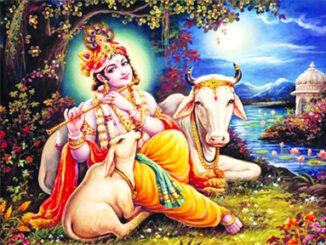
Bahula Chauth is fasted on the Chaturthi of Krishna Paksha of Bhadrapada. This fast is observed by mothers to protect their sons. Items made of wheat and rice are prohibited on this day. The law of worshiping a clay statue of cow and lion is prevalent. This fast is also called Gau Pooja Vrat. Consumption of cow products is considered prohibited. It is believed that only the calves have the right over the milk of this cow. Fasting on this day gives the child of a child a child.
Law of worship
Bathing in the morning at the base of Bahula Chaturthi Vrat and wearing clean clothes should be done. If there is a cow in your house, then its place should be cleaned and its calf should be left with the cow. Ganesha, Gauri Mata, Shri Krishna and Gau Mata should be duly worshiped in the evening after fasting for the whole day. During the fast, the mantra of ‘Om Namo Bhagwate Vasudevaya Namah’ should be chanted.
The story
There was a cow named Bahula coming back home to feed her calf. On the way home, he encountered a lion. Bahula is afraid of death but with enough courage she tells the lion that she has to feed her calf. Bahula tells the lion that once she lets him go, she will feed the calf and then come back, after which the lion can eat it. The lion freed him and waited for him to return.
Bahula returned after feeding his calf, which surprised the lion. He was greatly shocked and impressed by the cow’s commitment to his child, so he freed her and let her return.
It shows that the physical strength, anger and passion of the lion also had to be bowed down to the care and love of the cow towards its calf. From that particular day, devotees sacrifice cow’s milk and save it only for calves and celebrate Bahula Chaturthi. It is a symbol of worship that is performed to get blessings from the gods.
Bahula Chaturthi Rituals
Just like the unique significance of Bahula Chauth, there are unique rituals that people follow on this day. These rituals and celebrations are mostly centred around cattle, as they are the most important part of the Bol Chauth festival.
Preparing yourself
On this day, farmers and devotees wake up early in the morning to begin the preparations for this auspicious festival. They take a bath in the Brahma Muhurat, as it is the best time to begin with festivities. Then they remember lord Krishna to begin this festival on an auspicious note with his divine blessings. Afterwards, they begin with the rest of the festivities with a pure body and a religious spirit.
Cleaning Cattle and their sheds
This is one of the most important rituals of the Bol Choth festival. People of the agricultural community give a bath to their cattle with deep devotion and appreciation. They also clean the sheds of their cattle as a token of gratitude and respect. This day is all about having genuine thankfulness for cattle in your heart. Therefore, cleaning the cow shed is a gesture of gratitude towards these wonderful creatures.
Praying to Lord Vishnu or Krishna
Another significant ritual of the Bahula Chauth festival is offering prayers to Lord Vishnu and Lord Krishna. People put photos of the deities in their homes and apply kumkum and chandan to offer prayers. They also light incense sticks and offer fruits and flowers to the gods. Additionally, people visit the temples of Lord Vishnu and Lord Krishna to seek their blessings.
Chanting Mantras and Aarti
Mantras and hymns are a great way to energise your soul and connect with the divine. These melodious tunes bring immense peace to our minds as well as divine blessings. Therefore, reciting the mantra: ‘Om Namoh Bhagwatey Vasudevaye’ with your family members becomes a fun and interesting ritual of the Bahula Chaturthi. People read the Bahula Chauth Aarti and chant the Vishnu Mantra and Krishna mantras to bring positivity to their life.
Godhuli Puja
Godhuli Puja, or Gau pooja, is the sacred worship of cows or calves, which gives immense benefits to devotees. In this pooja, people decorate their cows with flowers and garlands. Afterwards, they put a tilak on the cows using kumkum and offer prayers to them. People wish for harmony in their families and a good upcoming agricultural year.
Bahula Chauth Vrat
Fasting is an integral part of any Hindu festival in India. Therefore, the celebrations of Bahula Chauth remain incomplete without the auspicious fast on this day. Farmers and devotees observe a fast on this day. Moreover, this fast begins in the morning and continues until the day’s end. People break the fast after the Godhuli Puja at night and offer Arghya to the moon.
Special food items
Bol Chauth’s unique rituals include the fantastic food that devotees prepare. On this day, people do not consume milk or any dairy products. It is due to the respect of calves who have the most right over a cow’s milk. Therefore, people prepare and eat food made of millet and other non-dairy products. They also prepare various rice dishes and feed them to their cattle.
New Delhi (TIP)- India remained fastest growing major economy of the world in first quarter of the current financial year. India’s gross domestic product (GDP) rose at 7.8 per cent in first quarter of current financial year compared with growth of 13.1 per cent during the same period last year. Sequentially, India’s GDP rose sharply from 6.1 per cent in the previous quarter.
“Real GDP or GDP at Constant (2011-12) Prices in Q1 2023-24 is estimated to attain a level of Rs 40.37 lakh crore, as against Rs 37.44 lakh crore in Q1 2022-23, showing a growth of 7.8 percent as compared to 13.1 percent in Q1 2022-23,” Ministry of Statistics & Programme Implementation said in a press release.
India’s economic growth was however lower than Reserve Bank of India’s GDP growth estimate of 8 per cent for first quarter of current financial year.
India’s nominal GDP that is GDP at current prices in the first quarter of current financial year rose at 8 per cent compared to growth of 27.7 per cent in the same period last year.
“Nominal GDP or GDP at Current Prices in Q1 2023-24 is estimated at Rs 70.67 lakh crore, as against Rs 65.42 lakh crore in Q1 2022-23, showing a growth of 8 per cent as compared to 27.7 percent in Q1 2022-23”, ministry added. Gross Fixed Capital Formation (GFCF), which indicates how much of the new value was added in an economy, rose 7.95 per cent to Rs 1,400,832 crore from Rs 1,297,588 crore.
“Economic activity in Q1 FY-2024 was boosted by a continued catch-up in services demand and improved investment activity, particularly a welcome front-loading in government capital expenditure,” noted Aditi Nayar, chief economist at ICRA. Growth in the service sector, the main engine of Asia’s third-largest economy, hit a 13-year high in July, a private survey showed. Capital expenditure increased to around Rs 2,78,500 crore during April–June 2023 from Rs 1,75,000 crore spent during the same period last fiscal year.
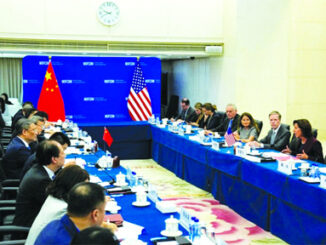
New York (TIP)- China’s commerce minister urged Chinese companies investing in the US to be given “equal treatment” and called US tariffs on Chinese imports “discriminatory”, when he met US Commerce Secretary Gina Raimondo this week, his ministry said on Thursday, August 31. Wrapping up her four-day visit to Beijing on Tuesday, August 29, Raimondo said she had not expected any breakthroughs but was “leaving with some optimism,” after engaging with top Chinese leaders, including with commerce minister Wang Wentao.
The world’s two biggest economies used to be each other’s largest trade partners, and while both governments publicly oppose decoupling, China is now trading more with Southeast Asia and the US with neighbouring Canada and Mexico. A tariff war erupted between Beijing and Washington under the previous Trump administration. Since then, US President Joe Biden and some US allies have restricted exports to China of advanced semiconductors and the equipment to make them, citing security concerns. “China demands the US give equal treatment to Chinese enterprises investing in the US in terms of market access, regulatory enforcement, public procurement and policy support,” Shu Jueting, a commerce ministry spokesperson, said.
“China expressed serious concerns concerning the US’ discriminatory (Section) 301 tariffs,” she added. The commerce secretary was the latest Biden administration official to visit China in a bid to strengthen communications, particularly on economics and defence, amid concern that friction between the superpowers could spiral out of control.
“We believe that a better way to de-risk is to bring China-US economic and trade relations back to a stage of sound and steady development,” Shu said. Wang and Raimondo have agreed to meet at least once a year.
Oil prices rise on supply picture, weak Chinese data weighs
Oil prices rose on Thursday, August 31, boosted by a large drawdown in US crude inventories and production cuts by OPEC+, but a slowdown in China’s manufacturing activity limited gains.
Brent crude futures for October, expiring on Thursday, rose 45 cents, or 0.5%, to $86.31 a barrel by 1004 GMT. The more active November contract was up 25 cents, or 0.3%, at $85.49.
US West Texas Intermediate crude futures for October rose 29 cents, or 0.4%, to $81.29.
US government data on Wednesday showed the country’s crude inventories fell by a larger than expected 10.6 million barrels last week, depleted by high exports and refinery runs.
Meanwhile, analysts expect Saudi Arabia to extend a voluntary oil production cut of 1 million barrels per day (bpd) into October, adding to cuts put in place by the Organization of the Petroleum Exporting Countries (OPEC) and allies led by Russia, a combination known as OPEC+.
“With Brent prices having stalled in the mid-$80s … the prospect of those Saudi barrels returning to the market any time soon looks slim and the impact is increasingly being felt across the world as commercial stock levels of crude and fuel products continue to drop,” said Saxo Bank analyst Ole Hansen.
UBS Group embarked on a sweeping plan to cut more than $10 billion in costs, saying on Thursday it will axe 3,000 jobs in Switzerland alone after it took over its stricken rival Credit Suisse. The plan to cut roughly one in 12 Swiss jobs gives a glimpse of the scale of shake-up at the newly forged banking giant, as it grapples with the task of swallowing a competitor that unravelled after panicked customers withdrew tens of billions.
The initial round of job cuts follows a decision by the globe’s biggest wealth manager to absorb Credit Suisse’s local arm – a solid profit-maker that last year was the only Credit Suisse division in the black – rather than spin it off, which UBS had also considered.
“Our analysis clearly shows that a full integration is the best outcome for UBS … and the Swiss economy,” Chief Executive Sergio Ermotti said.
He wrote in a memo to staff that 3,000 Swiss jobs would go, while more people would leave of their own accord, for example, through retirement. Globally, 8,000 Credit Suisse have already left over the first half of the year.
The prediction of over $10 billion in cost-savings by end 2026 compares with an earlier estimate of $8 billion by 2027.
The news lifted UBS shares, which were up more than 5% in early afternoon trade, hitting highs not seen since 2008, after the cuts were announced alongside the first financial results UBS published since the takeover, hastily arranged over one March weekend.
Japanese conglomerate Softbank on Wednesday, August 30, divested a 1.16% stake in online food ordering company Zomato for Rs 947 crore through an open market transaction.
Softbank through its affiliate SVF Growth (Singapore) Pte offloaded the shares of Zomato on the National Stock Exchange. Aditya Birla Sun Life Mutual Fund (MF), Axis MF, Franklin Tempelton MF, Kotak Mahindra MF, Societe Generale, Morgan Stanley Asia Singapore, Nomura Singapore, Goldman Sachs and Ghisallo Master Fund LP were among the buyers of shares of Zomato.
Elon Musk, the owner of X (formerly Twitter), on Thursday, August 31, announced that the micro-blogging platform will soon add video and audio call feature, which will be supported on iOS, Android, Mac, and PC.
He also said that no phone numbers would be needed to make the call.
“Video & audio calls coming to X – Works on iOS, Android, Mac & PC – No phone number needed – X is the effective global address book,” Musk posted on X.
“That set of factors is unique,” he added.
Several users expressed their thoughts on this new development.
“Now I can call more people and tell them to buy #Dogecoin directly from X,” a user wrote.
“Please make sure there are privacy options to stop randoms from calling us. Even if I follow someone it doesn’t mean I want them to be able to call me,” another user said.
One more user mentioned, “Absolutely groundbreaking! Your team never fails to spearhead innovation! Can’t wait to enjoy seamless video & audio calls on X across multiple platforms without the fuss of phone numbers. Truly visionary, setting a new benchmark in user experience. Bravo”.
Meanwhile, X has announced that it will allow US political candidates and parties advertise on the platform ahead of the 2024 presidential election.
Another instrument onboard the Chandrayaan-3 mission’s rover ‘Pragyan’ has confirmed the presence of sulphur in the lunar region by deploying a different technique, ISRO said on Thursday, August 31.
The Alpha Particle X-ray Spectroscope (APXS) has detected sulphur, as well as other minor elements on the Moon, the Bengaluru-headquartered national space agency said in a social media post.
“This finding by Ch-3 compels scientists to develop fresh explanations for the source of Sulphur (S) in the area: intrinsic?, volcanic?, meteoritic?,……?” read the post.
ISRO also released a video of the rover rotating in search of a safe route. The rotation was captured by a lander imager camera.
“It feels as though a child is playfully frolicking in the yards of Chandamama, while the mother watches affectionately.
“Isn’t it?” ISRO quipped in the social media post.
The space agency released a video showing an automated hinge mechanism rotating the 18-cm-tall APXS, aligning the detector head to be approximately five centimetres in proximity to the lunar surface. The 26 kg, six-wheeled, solar-powered Pragyan rover is equipped to use its scientific instruments to record what the lunar soil and rocks are made of in the south polar region where Chandrayaan-3 landed and it would also show how the readings contrast with that of the highland regions.
APXS instrument is best suited for in-situ analysis of the elemental composition of soil and rocks on the surface of planetary bodies having little atmosphere, such as the Moon, an ISRO statement said. It carries radioactive sources that emit alpha particles and X-rays onto the surface sample. The atoms present in the sample in turn emit characteristic X-ray lines corresponding to the elements present. By measuring the energies and intensities of these characteristic X-rays, researchers can find the elements present and their abundances.
APXS observations have discovered the presence of interesting minor elements, including sulphur, apart from the major expected elements such as aluminum, silicon, calcium and iron. The Laser Induced Breakdown Spectroscope (LIBS) instrument onboard the rover has already confirmed the presence of sulphur. Detailed scientific analysis of these observations are in progress. APXS has been developed by the Physical Research Laboratory (PRL), Ahmedabad, with support from the Space Application Centre (SAC) Ahmedabad, whereas UR Rao Satellite Centre (URSC), Bengaluru has built the deployment mechanism, it was stated.
Source: PTI
Signup to our Newsletter!
Don’t miss out on all the happenings around the world