Month: October 2023

  • Inspiring colors: On the 2023 Chemistry Nobel

    Chemistry Nobel Prize goes to trio that made ‘artificial atoms’

    Travelling in a bus can be an enjoyable experience if you have your own seat, the vehicle is not crowded, and there is a nice breeze. But if the bus is packed with people, you can get irritable. Something similar happens to atoms: if they are contained in a vessel at a low density, they behave in a certain way, but if they are packed densely together, with little moving space, something new happens. The 2023 Nobel Prize in Chemistry has been awarded to three people who found out what happens. Technically, they have been selected for discovering and refining quantum dots — small crystals a few nanometers wide. Each quantum dot has only a few thousand atoms (whereas a single droplet of water can have a sextillion). And because the atoms are packed so closely together in the dot, their electrons are very close to each other. In this setting, the laws of quantum mechanics describe the behavior of quantum dots — so much so that an entire dot can mimic the behavior of an atom. The dots have another famous property. If you shine some light on a quantum dot, it will absorb and re-emit that light at a different frequency (or color) depending on its size. Smaller dots emit light of higher frequency (bluer) and vice versa. So, a quantum dot made of some material would respond in one way whereas a quantum dot made of the same material but smaller would respond differently. For these reasons, quantum dots have found many applications in transistors, lasers, medical imaging, and quantum computing. In 1981, Alexei Ekimov, then working in the Soviet Union, first synthesized quantum dots ‘frozen’ inside glass. Two years later, Louis Brus synthesized quantum dots in a solution in the U.S. and worked out their quantum-physical properties. Finally, Moungi Bawendi, whose work on quantum dots began as a student under Dr. Brus, found a way to make quantum dots of high quality in an easy and reliable way in 1993. For their contributions, they have shared the Nobel Prize.

    Some of the most fascinating scientific discoveries, for all their technical sophistication, are actually innocuous in their appeal. Quantum dots are one such. Understanding why they behave the way they do requires specialized knowledge of quantum mechanics, but quantum mechanics do not dictate their behavior. Dr. Ekimov himself was inspired by the colors in stained glass. While quantum dots light up LED screens and the location of a tumor that needs to be removed, it is important not to lose sight of the colors — the reds, the greens, and the blues — and whatever more they might inspire.
    (The Hindu)

  • Lakhimpur Kheri : Expedite trial against minister’s son

    The chilling violence in Uttar Pradesh’s Lakhimpur Kheri marked an inflection point for the farmers’ protracted agitation against the three Central farm laws. Four farmers were mowed down by an SUV allegedly driven by Ashish Mishra, son of Minister of State for Home Affairs and BJP MP Ajay Mishra Teni, at Kheri’s Tikonia village on October 3, 2021, while they were returning home after taking part in a protest against the contentious laws. Four other persons, including two BJP workers, were killed in the ensuing clashes.

    The farmers’ families are not hopeful of getting justice, going by the excruciatingly slow pace of the trial. The statements of only four of the 208 prosecution witnesses have been recorded so far. Ashish, who is facing charges of murder, criminal conspiracy and other offences, has been out on bail since January this year after the district court informed the Supreme Court that the trial would continue for at least five years.

    The fact that Ajay Mishra continues to be a Minister of State shows how callously the Central Government has dealt with the entire matter. Opposition parties and farmers’ organizations have repeatedly sought his ouster, but the ruling BJP has persisted with him. Ironically, farmers’ anger over the gruesome killings did not stop the BJP juggernaut — the party swept all eight seats in Lakhimpur Kheri district in the 2022 UP Assembly elections. The state government has paid compensation to the aggrieved families, but it needs to do a lot more. It must dispel the strong impression that political interference is slowing down the trial. The proceedings should be expedited in the interests of justice. At the same time, earnest efforts must be made to scuttle attempts to influence or intimidate the witnesses. They should be able to testify without fear or favor, notwithstanding the clout of the main accused.
    (Tribune, India)

  • Enforcement Directorate under fire

    Supreme Court of India wants probe agency to do course correction

    The Enforcement Directorate (ED), which arrested AAP MP Sanjay Singh in the Delhi excise policy case on Wednesday, October 4, has come under intense judicial scrutiny, with the Supreme Court saying that the premier investigating agency — which is tasked with probing money laundering and other economic offences — is not expected to be ‘vindictive’ in its conduct and must act with utmost probity. Ordering the release of the directors of a Gurugram-based realty group in a money laundering case, the court said every action of the ED was expected to be ‘transparent, above board and conforming to pristine standards of fair play in action’.

    The court’s observations come amid accusations by AAP and other Opposition parties that the ED is being misused by the BJP-led Centre to settle political scores. The arrest of Sanjay Singh — the second senior AAP leader (after Manish Sisodia) to be nabbed by the ED this year — has sparked protests by party workers in Delhi and other parts of the country. Opposition leaders are apprehensive that more such arrests will take place in the run-up to the 2024 General Election. The ED has claimed that AAP used Rs 100 crore received as kickbacks from various stakeholders for its Assembly election campaign in Goa last year. However, the apex court has asked the directorate to answer a ‘legal question’ about why the political party alleged to be the main beneficiary of a purported scam has not been made an accused in the money laundering case pertaining to the now-scrapped excise policy.

    Repeatedly accused of overreach and overzealousness, the ED would do well to take a serious note of the court’s strictures. Any attempt to circumvent the due process during investigations would erode the credibility of the probe agency. No corrupt person should be spared, but at the same time, no innocent one should be implicated — irrespective of his or her political affiliations.
    (Tribune, India)

  • After McCarthy, here is how to start fixing the House

    After McCarthy, here is how to start fixing the House

    The GOP’s chaos caucus is tiny. There are more Republicans in the moderate bipartisan Problem Solvers Caucus. Only 8 Republicans voted to oust Kevin McCarthy. 210 Republicans voted to keep McCarthy as the Speaker.32 Republicans are members of the bipartisan Problem Solvers Caucus.3 Republicans did not vote.

    “It’s unclear how the House will pick a new leader, though two candidates, Majority Leader Steve Scalise (La.) and Judiciary Committee Chair Jim Jordan (Ohio), have come forward. On the off chance anyone in the House is interested in ending the chaos, one way to do it would be for whichever Republican next takes the speakership to deal with Minority Leader Hakeem Jeffries (N.Y.), soliciting Democrats’ support and outlining the road forward on the budget as well as on the unresolved matter of military assistance to Ukraine. Mr. Jeffries and other Democrats, in turn, would have to lend at least tacit support — in the form of voting “present” on matters such as the speaker’s election, which would disempower the GOP ultras by changing the math needed to elect the chamber’s leader — without demanding a pound of flesh.”

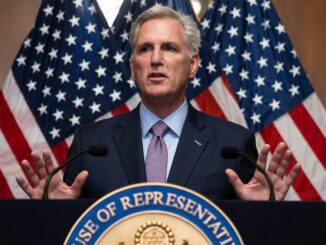
    “Well, I made history, didn’t I,” Rep. Kevin McCarthy quipped Tuesday, October 3, after becoming the first speaker of the House voted out of the office. Perhaps the only upside for the nation’s suddenly destabilized legislative branch is that the House of Representatives has a clean slate now; the personal animosities that some lawmakers — including a crucial bloc of his fellow Republicans — hold toward Mr. McCarthy (Calif.) are no longer relevant. And his desperation for the gavel is no longer exploitable. The chamber has a chance to make itself more functional.

    Though Mr. McCarthy’s speakership heretofore was hardly distinguished by principled decisions, as opposed to appeasement of his slender majority’s far-right fringe, his downfall ironically came as punishment for a good deed: his surprise weekend decision to shake hands with Democrats on a short-term budget deal, keeping the government open but drawing a leadership challenge from a small number of ultraconservatives. The eight mutinying members of his party, led by Matt Gaetz (Fla.), were angry that Mr. McCarthy committed the apparently unforgivable sin of bridging the partisan divide in the national interest.

    It would have taken just a handful of Democrats to keep Mr. McCarthy in the speaker’s chair. But some of Mr. McCarthy’s less praiseworthy actions came back to haunt him. Democrats could not forgive Mr. McCarthy’s groveling before Donald Trump after the Jan. 6, 2021, attack on the Capitol, a legitimate grievance he aggravated by opening a bogus impeachment inquiry against President Biden. He refused to offer Democrats any concessions in exchange for their help keeping him on as speaker. Instead, Mr. McCarthy claimed on national television that they wanted to shut down the government. More grace, and less partisanship, might have resulted in a different outcome.

    It’s unclear how the House will pick a new leader, though two candidates, Majority Leader Steve Scalise (La.) and Judiciary Committee Chair Jim Jordan (Ohio), have come forward. On the off chance anyone in the House is interested in ending the chaos, one way to do it would be for whichever Republican next takes the speakership to deal with Minority Leader Hakeem Jeffries (N.Y.), soliciting Democrats’ support and outlining the road forward on the budget as well as on the unresolved matter of military assistance to Ukraine. Mr. Jeffries and other Democrats, in turn, would have to lend at least tacit support — in the form of voting “present” on matters such as the speaker’s election, which would disempower the GOP ultras by changing the math needed to elect the chamber’s leader — without demanding a pound of flesh.

    The GOP’s chaos caucus is tiny. There are more Republicans in the moderate bipartisan Problem Solvers Caucus. Only 8 Republicans voted to oust Kevin McCarthy. 210 Republicans voted to keep McCarthy as the Speaker.32 Republicans are members of the bipartisan Problem Solvers Caucus.3 Republicans did not vote.

    In this hyperpartisan era, that much comity and pragmatism might be too much to hope for. Even less likely, though also in the national interest, would be for moderate members of each party to assert themselves. Only eight Republicans were reckless enough to vote against Mr. McCarthy; more than 200 others understood that chaos isn’t conducive to sound policymaking; 32 of those are members of the Problem Solvers Caucus, which is dedicated to bipartisan solutions. They come much closer to representing America’s broad middle than does the GOP fringe — or even the rest of the House Republicans. If they were willing to partner with Democrats more often, they could be a more formidable voting bloc capable of sidelining House GOP radicals.

    No matter the circumstance, nobody should accept the speakership without more job security than Mr. McCarthy had. To become speaker in the first place, he courted the right fringe by agreeing to amend the “motion to vacate” rule so that any one member could force the chamber to consider firing him. Whoever comes next should insist that the bar be much higher. The last time House ultraconservatives foiled Mr. McCarthy’s ambitions, during the 2015 speaker’s race, then-Rep. Paul D. Ryan (R-Wis.) set conditions on agreeing to take the gavel after Mr. McCarthy’s bid fell flat among the ultras.

    Getting at least that much right is not some arcane matter but a national necessity. The House GOP’s next leader will immediately face negotiations with the White House and the Democratic-controlled Senate on funding the government, with a shutdown as the price of failure. If the next speaker is not at least marginally more empowered, as opposed to constantly fearful of another ouster attempt driven by online activists or conservative media personalities, the chaos will continue.

    (Source: Washington Post)

  • The shift in BJP’s Kashmir approach

    The shift in BJP’s Kashmir approach

    Mirwaiz Umar Farooq’s release signals the ceding of space for separatist voices

    “The Mirwaiz’s release reflects a change in the BJP’s approach to Kashmir. It is hard to put a finger on the right reason for his release — whether under external pressure or due to internal demands. However, in a first, senior BJP leader and Waqf Board chairperson Darakhshan Andrabi, who posted her picture with the Mirwaiz from a meeting held last year, took credit for the release. Earlier, Ms. Andrabi conspicuously visited the house of Jamiat Ahle-Hadith preacher Mushtaq Ahmad Bhat alias Mushtaq Veeri and made a phone call to Islamic preacher Moulana Abdul Rashid Dawoodi after they were released from jail. Both preachers were booked under the Public Safety Act (PSA) last year for “instigating youth in Kashmir”. On the contrary, Ms. Andrabi said these religious scholars were “very precious for the society.”

    As Kashmir remains in a political flux, the picture will get clearer in the coming months as to whether the BJP has decided to see a lasting peace through the institution of dialogue or not.

    By Peerzada Ashiq

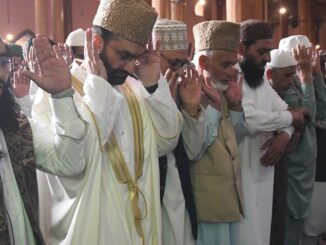
    After over four years of house detention, Mirwaiz Umar Farooq was released on September 22. The 50-year-old was allowed to deliver sermons at the historic Jamia Masjid in the volatile Nowhatta region in capital Srinagar. His release marks the first move by the Central government and the Jammu and Kashmir Lieutenant Governor since August 5, 2019 to concede space to separatist politics in Kashmir. Prior to that, separatist leaders called the shots in Kashmir through their agitational politics, much to the chagrin of New Delhi. Currently the chief cleric of the Kashmir valley, the Mirwaiz joined separatist politics at the age of 17, soon after his father Maulana Muhammad Farooq was assassinated by gunmen in 1990. More than 130 years old, the position of the Mirwaiz is rooted in distinct indigenous culture and has to do with preaching Islamic tenets with a thrust on accommodation and moderation while practicing the faith.

    However, the Mirwaiz clan saw itself go up against the Hindu Dogra monarchy from Jammu in the 1930s and participated in an agitation to seek equal rights and fought for an end to the persecution of Muslims of Jammu and Kashmir. Eventually, the clan got drawn into identity-based politics. To date, it remains the hallmark of the Mirwaiz clan’s policy.

    In fact, sidelining the Mirwaiz from political space since 2019 was part of the Bharatiya Janata Party (BJP)-led Centre’s larger policy to deny room to separatism in Kashmir. The Central government, in the run-up to the division of Jammu and Kashmir into two Union Territories and ending its special constitutional status in 2019, completely dislodged separatist politics from the political landscape. Top separatist leaders and their second-rung leadership were arrested in different cases. The crackdown extended to influential Islamic religious scholars too. It was followed by a vigorous exercise to sow the seeds for a new crop of leadership.

    New ways
    However, the Mirwaiz’s release reflects a change in the BJP’s approach to Kashmir. It is hard to put a finger on the right reason for his release — whether under external pressure or due to internal demands. However, in a first, senior BJP leader and Waqf Board chairperson Darakhshan Andrabi, who posted her picture with the Mirwaiz from a meeting held last year, took credit for the release. Earlier, Ms. Andrabi conspicuously visited the house of Jamiat Ahle-Hadith preacher Mushtaq Ahmad Bhat alias Mushtaq Veeri and made a phone call to Islamic preacher Moulana Abdul Rashid Dawoodi after they were released from jail. Both preachers were booked under the Public Safety Act (PSA) last year for “instigating youth in Kashmir”. On the contrary, Ms. Andrabi said these religious scholars were “very precious for the society”.

    The BJP leader’s acknowledgement of these religious scholars is a departure from the past when they were projected as the party’s bete noire in Kashmir. It bears some resemblance to the approach adopted by the BJP-led National Democratic Alliance (NDA) in 2000. In the autumn of 1999, the entire Hurriyat leadership was arrested as the Lok Sabha polls were marred by boycott calls issued by the separatists. At 32.3%, Jammu and Kashmir recorded the lowest-ever participation in six Lok Sabha seats that year, with the Srinagar seat registering a mere 11.93% polling, to the embarrassment of New Delhi. In spite of the Kargil war in 1999, the NDA took bold steps to engage with the Hurriyat leadership in 2000. It culminated in direct talks between former Deputy Prime Minister L.K. Advani and Hurriyat leaders in January of 2004.

    The Mirwaiz’s first-ever sermon in September this year saw a stark resemblance to the stand made by the Hurriyat before Mr. Advani in 2004, where the separatist amalgam advocated that “guns should be replaced by political talks”. In the latest statement, the Mirwaiz picked up threads from that stand and elaborated on the Hurriyat position to push for efforts to seek a resolution to the Kashmir issue “through an alternative to violent means, which is dialogue and reconciliation”. He, in fact, sought a fresh prism to look at the Hurriyat from being so-called separatists or peace disrupters to “realist resolution seekers”. As Kashmir remains in a political flux, the picture will get clearer in the coming months as to whether the BJP has decided to see a lasting peace through the institution of dialogue or not.
    (The author is a journalist)

  • October 6 New York & Dallas E – Edition

    [vc_row][vc_column][vc_custom_heading text=”E-Edition” font_container=”tag:h2|text_align:center” google_fonts=”font_family:Istok%20Web%3Aregular%2Citalic%2C700%2C700italic|font_style:700%20bold%20regular%3A700%3Anormal” link=”url:https%3A%2F%2Fwww.theindianpanorama.news%2Fwp-content%2Fuploads%2F2023%2F10%2FTIP-E-Edition-October-6.pdf”][vc_single_image image=”151833″ img_size=”full” alignment=”center” onclick=”custom_link” link=”https://www.theindianpanorama.news/wp-content/uploads/2023/10/TIP-E-Edition-October-6.pdf”][/vc_column][/vc_row][vc_row][vc_column width=”2/3″][vc_custom_heading text=”Lead Stories This Week” google_fonts=”font_family:Istok%20Web%3Aregular%2Citalic%2C700%2C700italic|font_style:700%20bold%20regular%3A700%3Anormal” link=”url:https%3A%2F%2Fwww.theindianpanorama.news%2F”][vc_wp_posts number=”5″ show_date=”1″][/vc_column][vc_column width=”1/3″][vc_single_image image=”82828″ img_size=”medium” alignment=”center” onclick=”custom_link” link=”https://www.theindianpanorama.news/advertising-media-kit-portal-indian-panorama/”][vc_single_image image=”82829″ img_size=”medium” alignment=”center” onclick=”custom_link” link=”https://www.theindianpanorama.news/advertising-media-kit-portal-indian-panorama/”][/vc_column][/vc_row]

  • The narrative of development and populism

    The narrative of development and populism

    An easy way to make development an appealing proposition for voters is to define it narrowly in terms of visible physical infrastructure

    “Equating development to visible mega-infrastructure could, over time, become a dangerous obsession for two reasons. First, the suitability of such projects for the specific geographic location or users is often overstated without realistically assessing long-term environmental consequences and its implications on the livelihoods of present and future generations. Second, the mechanisms of financing mega-infrastructure are often on the assumption of exaggerated revenue accruals from multiplier effects and flattened costs without any time and cost over-run. The fiscal burden of such financing modes would start surfacing in the medium term, and addressing it imposes additional costs.”

    By M  Suresh Babu

    On September 14, the Prime Minister laid the foundation stone of projects worth over ₹50,700 crore in the election-bound State of Madhya Pradesh. This included a petrochemical complex and 10 new industrial projects. He emphasized that this investment would boost the State’s development. Just a few days later, on September 18, a major Opposition party announced “guarantees” for the people of Telangana ahead of the Assembly elections. These include ₹2,500 a month financial assistance to women, gas cylinders at ₹500, free travel for women in State transport buses, schemes promising an annual financial assistance of ₹15,000 for farmers, a housing scheme with a piece of land and ₹5 lakh for construction of house for homeless poor, 200 units of free electricity to each poor household, health insurance cover of up to ₹10 lakh and ₹5 lakh financial assistance to students from a poor background to pursue higher education. Both these announcements in conjunction show that ‘development and populism’ gain wide circulation before elections and that these two are pitched as poll promises with a call to evaluate the gains emanating with respect to short-term versus long-term benefits. The most common narrative is that development is the long-term ideal and populism is dubbed as myopic, with development-retarding effects.

    The development obsession

    There are no two arguments on the need to achieve higher and better development outcomes. However, there exists a need to assess its trajectory and inclusivity to understand the implications for welfare and sustainability. While the need for accelerated development is sold easily as a poll promise, the need to take stock and address unevenness in welfare gains is neither mentioned nor taken up in the post-poll time period. An easy route to make development as an appealing proposition for voters is to define it narrowly in terms of visible physical infrastructure. The advantage of such a narrow definition is that it can be easily showcased and achievements can be quantified. This in turn would give an advantage to the incumbent governments if the scale of physical infrastructure creation is high. The opposing political parties would then be left with three options: promise an even higher scale of infrastructure creation if voted to power; highlight the unsuitability of the created infrastructure and dub it as failure, and/or address welfare of some section of the population that is left out through economic populism.

    Equating development to visible mega-infrastructure could, over time, become a dangerous obsession for two reasons. First, the suitability of such projects for the specific geographic location or users is often overstated without realistically assessing long-term environmental consequences and its implications on the livelihoods of present and future generations. Second, the mechanisms of financing mega-infrastructure are often on the assumption of exaggerated revenue accruals from multiplier effects and flattened costs without any time and cost over-run. The fiscal burden of such financing modes would start surfacing in the medium term, and addressing it imposes additional costs. Two examples would clarify the above. First, during the period June 24 to July 10, 2023, over 41 landslides, 29 flash floods, and one cloud burst occurred in Himachal Pradesh amid relentless rain. One could call these as events of ‘climate crises’. But Himachal Pradesh is an active participant in the race to ‘development’ through the construction of several highway roads connecting various tourist locations, thereby making the mountain regions fragile and unleashing unplanned urbanization.

    Uttarakhand faced a big disaster in 2013. Rather than learning from it, the government went on to ‘rebuild’ the State, which was a rebranding of the State with many highway projects. The ‘Char Dham Yatra’ is hyped as road connectivity that brings millions of people as religious tourists despite the fact that most places have infrastructure for only a few thousand people. These are two of the many recent examples of projecting mega-infrastructure as development symbols, resulting in environmental disasters. The costs of such disasters are not one-time as the easy route of development selected by the policy regimes sets off a spiral of calamities. Second, to assess the fiscal burden, the story of the National Highways Authority of India (NHAI), the apex body for the construction and management of national highways in the country, is revealing. The total debt of the NHAI stood at ₹3,42,801 crore as on March, 2023, up from ₹23,797 crore in 2014. The bulk of the debt, i.e., ₹3.27 trillion, was contracted between 2017-18 and 2021-22. The NHAI’s debt servicing cost will cross ₹50,000 crore in FY28 as the money was raised through bonds in 112 tranches; the last of those will mature in 2050. Apart from debt, the NHAI also has contingent liabilities, most of which are from disputed claims that have been filed by contractors and developers. The fiscal implications of financing development lingers in the system, imposing long-term constraints. These two examples given above highlight the perils of the obsession of symbolizing mega- infrastructure as icons of development.

    Space for populism

    Populism has two dimensions — political and economic. According to Dani Rodrik, noted political economist of Harvard University, “The distinctive trait of populism is that it claims to represent and speak for ‘the people,’ which is assumed to be unified by a common interest. This common interest, the ‘popular will,’ is in turn set against the ‘enemies of the people’ — minorities and foreigners (in the case of right-wing populists) or financial elites (in the case of left-wing populists). Since they claim to represent ‘the people’ at large, populists abhor restraints on the political executive. They see limits on their exercise of power as necessarily undermining the popular will.” This is the hallmark of political populism which allows the majority to ride over the rights of the minorities. Economic populists too disfavor restraints on the conduct of economic policy, as restraints, in general, narrow their policy options. However, the economic policy environment tends to prefer rules and restraints because short-term interests might dominate when economic policy is largely shaped by political considerations. Rules and restraints serve the purpose of checking those in power from pursuing short-sighted policies. But unwavering commitment to rules and restraints may at times serve to advance the interests of narrower groups, enabling them to cement their temporary advantage for reaping long-term benefits. Thus, it emerges that while rules and restraints are vital in checking unbridled growth of political populism, a fine blend of rules with discretion is required to curtail the expansion of economic populism.

    On conventional models

    Conventional models of economic growth did not attach much importance to distribution as it was expected to be an inbuilt consequence of growth. These models assumed that the benefits of growth would percolate through the ‘trickle-down effect’, that is, growth is characterized as a ‘high tide that lifts all boats’. In this scheme of things, populist re-distributive policies do not find a place. However, cross-country growth experience shows that the benefits of growth do not trickle down that easily and some sections of the population become ‘outliers’ in the growth process. Government-led redistribution is needed to reduce the size of such outliers and spread the benefits of growth more evenly. The rationale for economic populism arises in this context.

    While economic populism imposes fiscal costs, inappropriate physical infrastructure-led development imposes additional costs, especially environmental costs. These costs might work as a binding constraint on subsequent governments. Poor resilience coupled with an injection of fragility to the environment results in a situation of costs of such ‘infrastructure led development’ remaining in the system for long. In contrast to narrowly defined and prominently visible megaprojects-led development, not all economic populism hurts. At times it might be the only way to forestall the dangerous obsession with physical infrastructure-led development.

    (The author is Professor of Economics at IIT Madras) 

  • Fireworks, entertainment and festivities attract  crowds to AIA-NY’s 36th Deepavali Festival

    Fireworks, entertainment and festivities attract crowds to AIA-NY’s 36th Deepavali Festival

    Eminent ophthalmologist Dr. V.K. Raju who has made a world without childhood blindness the mission of his life was honored for his great humanitarian work. Assemblywoman Jenifer Rajkumar honored Dr. Raju with a plaque.

    NEW YORK CITY (TIP): The 36th Annual Deepavali Festival was held at the South Street Seaport here on Sunday, October 1, attracting  crowds that enjoyed sumptuous food by Michelin Star Chef Hemant Mathur, danced to the music of legendary Basement Bhangra Queen DJ Rekha Team, watched the presentation of a few episodes from the Ramayana,  and were enchanted by the finale – a spectacular display of fireworks on the East River.

    The daylong event was organized by the Association of Indians in America, New York chapter, established in 1967 with a mission to promote the rich culture and traditions of Indians in their adopted land and to pass on these values to their younger generations.  “AIA represents the hopes and aspirations of our immigrant community united by the ideal of ‘Indian Heritage and American Commitment’, which is the AIA motto”, said Dr. Jagdish Gupta, President of AIA-NY. In his opening remarks, Dr. Gupta  elaborated on the main achievements of AIA over the last 56 years, such as New York City recognizing Diwali as an official holiday and suspending Alternate Side Street Parking on Diwali since 2005, celebrating the festival of lights in Gracie Mansion and later in White House in 2006, and release of official USPS “Forever Stamp” commemorating Diwali in 2013.

    The iconic Deepavali Festival this time was graced and addressed by Assemblywoman Jennifer Rajkumar, who proudly mentioned “Deepavali Day as a school holiday” for all our children in the entire NYC school system, which is the largest in the nation.

    Council Member Shekar Krishnan from District 25 in Jackson Heights in his speech explained the meaning of Deepavali as a ‘A row of lamps’. It signifies the triumph of ‘Good over Evil’, ‘Light over Darkness’, and  ‘Knowledge over Ignorance’.

    Deputy Commissioner of the Community Relations Bureau at the NYC Commission on Human Rights, Ms. Kajori Chaudhuri spoke about Diwali as the festival of joy and happiness for families highlighting that the holiday is celebrated by Hindus, Jains, Sikhs, Buddhists and people of many different countries including Indo-Caribbeans.

    On the occasion, an eminent ophthalmologist Dr. V.K. Raju who has made a world without childhood blindness the mission of life  was honored for his humanitarian work.

    The event at South Street Seaport started with the American Anthem sung by Mrs. Toral Shah followed by the Indian National Anthem sung in a chorus by the Executive Committee of AIA’s NY chapter and joined by everyone.  Swati Vaishnav curated the cultural show participated by the best dance schools in the Tristate area, including Nartan Dance Academy, Reba Brown Dance Company, Kalakriti Academy of Arts, Neela Zareen Dance Academy, Shehnaaz Dance Academy and Ranjaneeny Dance School.

    The classical and traditional cultural program was beautifully emceed by Ms. Siddhi Vaishnav. All performances were of the highest artistic level and enjoyed by all with appreciation by frequent clapping. She also conducted a workshop with children on the stage and audience participation for various dance moves that was well received.

    The celebration continued with the reenactment of Ram Leela, directed by Pandit Satya Narayan Charka. He has been directing Ram Leela in AIA-NY Deepavali Festivals for the last 36 years. AIA-NY salutes him for his devotion. The story of Ramayana was beautifully performed by over 15 artists with excellent acting including dances and a musical component. Young and old in the audience were riveted by it.  The star entertainment of the evening was Basement Bhangra Queen, legendary DJ Rekha and her team – MC Reena Shah, Alisha Desai, Juhi Desai, Avish on Dhol, Elizabeth Pupo-Walker as percussionist, dancers and instructors who kept the audience spellbound.

    The celebrations ended in a crescendo with the Fireworks Extravaganza from the barge on East River sponsored by the Association of Indians in America. The amazing pyro technique display lasted almost 30 minutes. The display of multiple colors and shapes along with the sounds of Indian music was thoroughly enjoyed by hundreds of viewers in the observation deck. An event of this magnitude is not possible without the support of the community at large including major sponsors CheapOair and Qatar Airways, New York Life, Mount Sinai Health System, Northwell Health System, Eye Foundation of America, and The Brooklyn Hospital Center.  AIA-NY President Dr. Jagdish Gupta also expressed gratitude to his executive committee and advisers and media sponsors for their support.

    (Based on a press release by AIA)

    One of the main attractions at the Diwali Mela was presentation of a few episodes from the Ramayana.
    A view of the gathering .
  • Former President Kovind praises the diaspora, apprising them of the progress made back home

    Former President Kovind praises the diaspora, apprising them of the progress made back home

    Shri Ram Nath Kovind and his wife were received at the airport on their arrival on September 27 by Consul General Randhir Kumar Jaiswal (extreme right), Maneesh Media Chairman Chandmal Kumawat, Rajasthani community stalwart Haridas Kotahwala and a few other members of the Indian Community.

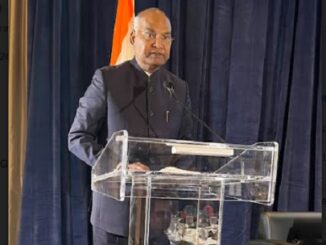
    NEW YORK CITY (TIP):  At a reception in his honor here, Ram Nath Kovind, the 14th President of India, praised the diaspora in the US, encouraging them to keep nurturing their roots and heritage.  The former President was speaking at a community reception on September 28 at The Pierre, a Taj hotel, organized by the Indian Consulate of New York and hosted by Maneesh Media.

    Kovind also released a coffee table book titled ‘Modi Hai to Mumkin Hai’ (Modi Makes it Possible) published by Maneesh Media, timed to belatedly celebrate  Prime Minister Narendra Modi’s 73rd birthday which fell on September 17. The book chronicles Modi’s foreign travels over the years.

    The former President said during his travels to foreign countries as President, he never felt satisfied unless he interacted with the Indian diaspora, “There is no substitute for the feeling you get on meeting your own”. He said the success of Indians settled abroad, particularly in the US, is a matter of pride. “In their success, Indian values and the Indian family system have stood them in good stead,” he added. Kovind exhorted the Indian diaspora to not only keep nurturing their roots and heritage but also pass on that legacy to the next generation.

    It is heartening to note, he said, that it is not just Diwali, but all Indian festivals from Ganesh Chaturthi to Jains’ Paryushan are now celebrated in America.

    He lauded the leaps of progress India has made under PM Modi, singling out the successful Chandrayaan-3 mission. He added that the consensus on various issues developed by the host India at the recent G20 conference was remarkable and yet another indicator that the country has emerged as a ‘Force for Global Good’ and PM Modi is a Global Statesman.

    Kovind said many smaller countries he traveled to post-Covid expressed to him their extreme gratitude for India for saving their countries by supplying vaccines.

    Doing a riff on the refrain ‘Modi Hai to Mumkin Hai’ and perhaps alluding to the 2024 general election, Kovind said next year the sequel will have to be titled, ‘Modi Hai to Pakka Hai’ (Modi Makes it a Certainty).

    Consul General Randhir Jaiswal, who had served in  President Kovind’s Secretariat before getting posted to New York, also spoke.

    TV Asia Chairman H.R. Shah, philanthropist Kiran Patel, who came down from Tampa, Florida, and Maneesh Media Chairman Chandmal Kumawat felicitated Kovind, praising him for rising from humble roots to become the President of India, and for his genial nature. In attendance at the chandeliered ballroom of the hotel adjacent to Central Park were many prominent members of the Indian community and media. Maneesh Media, based in Jaipur with a presence in  New York and Canada, specializes in publishing coffee table books, mainly profiling diaspora personalities with the motto of ‘Connecting Beyond Boundaries’.

    Shri Ramnath Kovind released a book-‘Modi Hai to Mumkin Hai’
  • Russian President Putin talks about India’s growth; says such countries must be represented in UN Security Council

    Russian President Putin talks about India’s growth; says such countries must be represented in UN Security Council

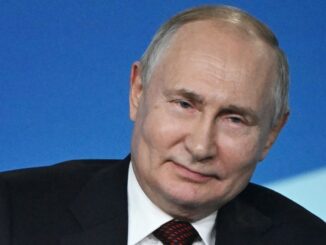
    MOSCOW (TIP): Heaping praise on India, Russian President Vladimir Putin has said that the Indian leadership is “self-directed” and led by the country’s national interests, according to Reuters.

    Speaking at an event, Putin alleged that the West is trying to cast everyone “who is not ready to blindly follow these Western elites as the enemy”. “At a certain point in time, they tried to do the same with India. Now they are flirting, of course. We all understand this very well. We feel and see the situation in Asia. Everything is clear. I want to say that the Indian leadership is self-directed. It is led by the national interests. I think that those attempts make no sense. But, they continue. They are trying to cast Arabs as the enemy. They are trying to be careful, but overall, that’s what it all boils down to,” Putin said.

    The Russian President said countries such as India, Brazil and South Africa deserve more representation in the UN Security Council and added that the UN should be reformed but gradually, according to Reuters.

    Calling India a “powerful country”, Putin said that it is growing stronger and stronger under the leadership of Prime Minister Narendra Modi, Russia-based RT News reported.

    “…India, more than 1.5 billion of population, more than 7 per cent of economic growth…that’s a powerful country, mighty country. And it’s growing stronger and stronger under the leadership of Prime Minister Modi…,” Putin said, according to a video shared by RT News.

    Earlier on Wednesday, Putin had called PM Modi a “very wise man”, adding that India is making great strides in development under his leadership, RT reported. Last month, too, he had praised PM Modi stating he was doing the “right thing” in promoting the Make in India program.

    (Source: ANI)

  • Journalists bodies slam raids on NewsClick scribes, call it attempt to ‘muzzle’ free media

    Journalists bodies slam raids on NewsClick scribes, call it attempt to ‘muzzle’ free media

    US based Journalists Beyond Borders condemned the police action on journalists and demanded immediate release of those held

    NEW DELHI / NEW YORK (TIP): Media bodies on October 3 described the police action against those associated with NewsClick portal as yet another attempt to muzzle the freedom of press, expressing solidarity with the journalists whose premises were searched.

    The Press Club of India, which demanded that the government should come out with the details of the matter, held a spontaneous protest meeting against the multiple raids. “The meeting resolved to continue protest by several journalists bodies for defending media freedom,” it said through its X (formerly Twitter) handle.

    The Editors Guild of India (EGI) executive committee released a statement, expressing concern over the raids at the residences of senior journalists. “Their laptops, mobile phones and other devices have been seized. Senior journalists have been taken into custody by the Delhi police, allegedly for ‘questioning.’ Media reports suggest that the raids have been widespread,” it said.

    Noting that the police action pertained to a First Information Report registered under the stringent Unlawful Activities (Prevention) Act and other provisions relating to criminal conspiracy and disruption of communal harmony, the EGI said, “While we recognize that the law must take its course if actual offences are involved, the due process has to be followed.”

    The EGI said: “The investigation of specific offences must not create a general atmosphere of intimidation under the shadow of draconian laws, or impinge on the freedom of expression and the raising of dissenting and critical voices. We remind the government of the importance of an independent media in a functioning democracy, and urge it to ensure that the fourth pillar is respected, nurtured and protected.”

    The National Alliance of Journalists, the Delhi Union of Journalists and the Kerala Union of Working Journalists (Delhi Unit) also condemned the police raids at the Bhasha Singh, Urmilesh, Prabir Purkayastha, Paranjoy Guha Thakurta, Teesta Setalvad, Abhisar Sharma, Aunindyo Chakraborty, Mahesh Kumar, Subodh Varma, Aditi Nigam, Mukund Jha and others.

    “Several of the media persons have been taken into custody. The Delhi police have also raided the homes of comedian Sanjay Rajoura and academic Sohail Hashmi…these raids are in connection with alleged foreign investments in NewsClick. The government has been targeting Newsclick apparently after the coverage this news portal gave to the issues of workers and farmers. We believe that this is yet another attempt by the Centre to muzzle the freedom of press,” said a joint statement.

    It added, “We believe that this is yet another attempt by the Centre to muzzle the freedom of press. Such an action, raiding and intimidating almost all the employees in a media organization, is unheard of. The NewsClick management has been maintaining that whatever funding they have received was through legal sources and evidence for this have been submitted in the High Court of Delhi. These new raids are to divert public attention from burning livelihood issues of people.”

    “Unfortunately, journalists are being targeted for furthering the political agenda of the ruling party. We condemn this with the strongest possible words. We will stand with these journalists in this matter. We urge the Centre to immediately stop this attack on press freedom. We urge the media fraternity to protest against this witch-hunt by the government,” the statement read.

    DIGIPUB, in its statement, said: “This coordinated action of the police against news professionals and commentators clearly violates due process and fundamental rights. This has taken the government’s pattern of arbitrary and intimidatory behavior to a whole other level.”

    US based Journalists Beyond Borders condemned the police action on journalists and demanded immediate release of those held, and called upon government of India to refrain from taking recourse to curb the freedom of the fourth pillar of democracy. Its President Prof. Indrajit S Saluja also called upon the journalists fraternity to voice their resentment and opposition to any attack on the freedom of journalists anywhere in the world. “Our strength lies in pour unity “, said Prof. Saluja.

    Over a dozen media bodies on Wednesday, October 4,  sought Chief Justice of India D.Y. Chandrachud’s intervention on the issue of raids against those linked to NewsClick, a digital news platform. Media persons and activists also turned up in large numbers at the Press Club of India to protest the police action.

    In a letter to the Chief Justice, the media organizations urged the courts to consider framing norms to discourage the seizure of journalists’ phones and laptops on a “whim”; and to develop guidelines for the interrogation of journalists and for seizures from them, to ensure that “these are not undertaken as fishing expeditions with no bearing to an actual offence”.

    They also requested the courts to consider finding ways to ensure the accountability of State agencies and individual officers who were found overstepping the law or willfully misleading courts with vague and open-ended investigations against journalists for their journalistic work.

    “[T]he developments over the past 24 hours have left us no option but to appeal to your good conscience to take cognizance and intervene before it is too late and an autocratic police state becomes the norm,” said the letter, adding that as journalists and news professionals, they were always ready and willing to cooperate with any bona fide investigation. The letter’s signatories were: Digipub News India Foundation; Indian Women’s Press Corps; Press Club of India, New Delhi; Foundation for Media Professionals; Network of Women in Media, India; Chandigarh Press Club; National Alliance of Journalists; Delhi Union of Journalists; Kerala Union of Working Journalists; Brihanmumbai Union of Journalists; Free Speech Collective, Mumbai; Mumbai Press Club; Arunachal Pradesh Union of Working Journalists; Press Association of India; and the Guwahati Press Club.

  • Indian American student Atul Rao saved in UK after heart stopped six times

    Indian American student Atul Rao saved in UK after heart stopped six times

    LONDON (TIP): An Indian American student studying in London has decided to choose a career in medicine after the UK’s National Health Service (NHS) medics saved his life after his heart stopped six times.
    Atul Rao, from Seattle and a student from Baylor University in Texas, developed a blood clot in his lungs which stopped the blood flow through his heart, a condition called pulmonary embolism, and caused him to go into cardiac arrest.
    After he was rushed to London’s Imperial College Healthcare NHS Trust Hammersmith Hospital’s heart attack center, scans confirmed that blood clots in the lungs were blocking the flow of blood from the heart. Recently, Rao returned to the hospital in London with his parents to express his gratitude. “Before this happened, I was starting to wonder if I was doing the right thing doing medicine and whether I should be going into business instead,” Rao told the NHS medics during the visit last month.
    “But the minute I woke up I knew. I want to use my time in a productive way. I want to use my second chance at life by helping others,” he said.
    Rao is in his final year of a pre-med degree which would allow him to go on to a further degree to practice medicine. On July 27, he was discovered collapsed by fellow students who raised the alarm before an Imperial College London security guard began to give him chest compressions (CPR) in the minutes ahead of London Ambulance Service crews arrived.
    “The last time I saw Atul I didn’t think he was going to survive. To meet him again and speak with his parents after giving them such terrible news was a very special moment in my 18 years in this job,” said Nick Sillett, the ambulance service’s paramedic.
    Staff at Hammersmith Hospital worked tirelessly through the night to keep Atul alive and he was still critically unwell when he was transported to St. Thomas’ Hospital the following day in case he needed access to extracorporeal membrane oxygenation (ECMO) – a life support system which can fully replace the work of the heart and lungs so that patients have time to heal.
    The clot-busting drugs had begun to work and with the help of other life support machines, he was able to recover without the need for ECMO.
    “This was a real team effort and so many people helped ensure Atul was able to be here. It’s a privilege to be a part of that and hear that you have helped make such a positive impact,” said Dr Louit Thakuria, critical care consultant at Imperial College Healthcare NHS Trust’s Hammersmith Hospital. Atul’s father Ajay, who works at a software company in the US, recalled his agonizing flight over to London after knowing decisions were being made which could affect whether his son would live.
    “I’m not exaggerating, Hammersmith and St. Thomas’ hospitals have become places of worship for us. We will be coming here whenever we come to London. It was the heroic efforts of London Ambulance Service, the amazing medical teams of Hammersmith, St Thomas’ and Royal Brompton that saved him from this life-threatening series of events,” he said.
    Mother Srividhya, a maths professor in Seattle, added: “A really bad thing happened in a really good place. Everyone who worked around Atul wanted him to be well. It’s clear they love and care about what they do.
    “I feel blessed to be here and I’m so thankful and grateful to you for giving my son back to me. I have gained perspective about life and he gets to see it at such a young age. His life has changed, and it’s had a profound impact.”

  • Indian American cancer physician chosen among 15 White House Fellows of 2023

    Indian American cancer physician chosen among 15 White House Fellows of 2023

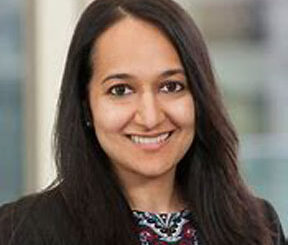
    WASINGTON, D.C. (TIP): Kamal Menghrajani, an Indian American cancer physician, is among 15 “remarkably gifted, passionate, and accomplished” individuals chosen to the 2023-2024 class of White House Fellows.
    Menghrajani is placed at the Office of Science and Technology Policy. She treats patients with leukemia. She will spend a year working with senior White House Staff, Cabinet Secretaries, and other top-ranking administration officials.
    Menghrajani, who is from New York, is the lone Indian American among 15 “remarkably gifted, passionate, and accomplished” individuals chosen to the 2023-2024 class of White House Fellows, the White House said in a statement on September 20.
    “President Biden announced my appointment as a White House Fellow. As the first oncologist ever selected, I’m excited to lead, serve, and innovate for our patients in this new role with the Cancer Moonshot and Health Outcomes teams @WHOSTP,” she wrote on X, after the recent White House announcement. Menghrajani will work with the Cancer Moonshot and Health Outcomes teams at the Office of Science and Technology Policy in the Executive Office of the President, she said in a post on her LinkedIn profile.
    While on faculty at Memorial Sloan Kettering Cancer Center, she conducted cancer research focused on early diagnosis and prevention and has spearheaded health equity efforts for vulnerable populations in global contexts, including Nicaragua, Bolivia, and Uganda, the statement said.
    “Congratulations Dr. @KamalMe, a former attending on MSK’s #leukemia service, on being named a @WHFellow supporting the #CancerMoonshot!” the cancer center posted on X on September 22.
    As an entrepreneur, Menghrajani has co-founded startups to address unmet needs in cancer treatment and deploy AI for rapid cancer diagnosis. She helped grow the non-profit Nourish International, which engages student leaders as social entrepreneurs in international development work, it said.
    Founded in 1964, the White House Fellows program offers exceptional young leaders first-hand experience working at the highest levels of the Federal government. Fellows spend a year working with senior White House Staff, Cabinet Secretaries, and other top-ranking administration officials and leave the Administration equipped to serve as better leaders in their communities.

  • Indian American CEO of pharma company agrees to pay $20 million to settle kickback allegations

    Indian American CEO of pharma company agrees to pay $20 million to settle kickback allegations

    NEW YORK (TIP): BioTek reMEDys, a Delaware-based pharma company and its Indian-origin CEO Chaitanya Gadde, have agreed to pay $20 million to resolve allegations of violating the False Claims Act of paying kickbacks to patients and physicians to protect its revenue stream.
    The government alleged that, from at least August 2015 through May 2020, the specialty pharmacy that offers drugs and infusion services, routinely waived the copayments of Medicare and TRICARE patients to induce those patients to purchase its drugs and services.
    Many of the specialty drugs offered by BioTek were expensive and required patients to pay large copays, a Department of Justice release stated on Monday.
    The government said that the company sought to avoid deterring patients from purchasing its drugs and services by engaging in a scheme, orchestrated and implemented by Gadde to routinely waive these large copays, without regard for whether the patients were experiencing financial hardship.
    When a Medicare beneficiary obtains a prescription drug covered by Medicare, the beneficiary may be required to make a partial payment, which may take the form of a copayment, coinsurance or a deductible (collectively copays).
    Congress included copay requirements in the Medicare program in part to serve as a check on health care costs.
    It was also alleged that BioTek provided remuneration in the form of gifts, dinners and free administrative and clinical support services to physicians to induce them to refer patients to BioTek.
    The government named Dr David Tabby — who operated a neurology practice in Pennsylvania — and claimed that he knowingly solicited and accepted the remuneration in exchange for referring numerous patients to BioTek.
    The Department’s release stated that Tabby has separately paid $480,000 to settle these allegations, based on his ability to pay.
    “BioTek allegedly provided improper physician inducements and covered up kickbacks for patient referrals by waiving co-pays,” said US Attorney Jacqueline C. Romero for the Eastern District of Pennsylvania.
    “BioTek’s alleged scheme, orchestrated and implemented by Gadde, Dr Tabby, and others, to routinely waive these copays — without regard for whether the patients were experiencing financial hardship — ensured a steady revenue stream for BioTek and undermined patient care to citizens of this District,” Romero said.
    The federal Anti-Kickback Statute prohibits the offering, paying, soliciting or accepting, directly or indirectly, of any remuneration — which includes money or any other thing of value — to refer or arrange for the referral of items or services payable by any federal healthcare program.
    This prohibition extends to companies that routinely waive the copays of Medicare patients without determination of financial need.
    The Anti-Kickback Statute also extends to the payment of remuneration to physicians in exchange for patient referrals. The civil settlement includes the resolution of claims brought under the qui tam or whistleblower provisions of the False Claims Act by former BioTek employees Shantae M. Wyatt and Latoya Sparrow.
    Under those provisions, a private party may file an action on behalf of the US and receive a portion of any recovery. Wyatt and Sparrow will receive $4 million as their share of the settlement with BioTek and Gadde, and $91,200 as their share of the settlement with Dr Tabby.

  • 3 Punjabi-origin NRIs enter Manitoba Assembly in Canada

    3 Punjabi-origin NRIs enter Manitoba Assembly in Canada

    TORONTO (TIP): Three Punjabi-origin Canadians have been elected to the Manitoba provincial assembly. While Diljeet Brar won from Burrows, Mintu Sandhu (Sukhjinderpal) and Jasdeep Devgan were elected from The Maples and Mc Phillips, respectively.

    All three belong to the New Democratic Party (NDP), which won the majority and will form the government in the province. Brar and Sandhu are also in the race for a cabinet post.

    A total of nine Punjabi-origin NRIs were in the fray. Six candidates — Navraz Brar from Burrows, Sumit Chawla from The Maples, Kirt Hayer from St. Boniface, Paramjit Shahi from Fort Richmond, Manjit Kaur Gill from Waverley and Amarjit Singh from Southdale lost the poll.

    Born in Bhuchangari village of Muktsar, Brar graduated with a master’s degree and worked as a broadcast journalist before moving to Canada in 2010. He also worked in Manitoba Agriculture Department till 2018. Sandhu moved to Canada with his parents at an age of 16 years in 1989. He owned a gas station and worked to modernize the transportation system in Manitoba.

    Devgan worked as a director of government and community engagement at University of Manitoba. He is the youngest ever vice-president of the Sikh Society of Manitoba.

  • Agarwalla trots into Indian dressage history

    Agarwalla trots into Indian dressage history

    Two days after he helped India win a landmark dressage team gold, Anush Agarwalla scripted history by winning the country’s first individual medal in dressage at the Tonglu Equestrian Centre on Thursday, September 28. Astride his nine-year-old stallion Estro, the Kolkata rider took bronze to mark a seminal moment in India’s equestrian history.
    “I am still coming to terms with it. The team gold is yet to sink in and this bronze is truly special. This is what I had always wished for and visualised,” Agarwalla said. The 24-year-old is based in Borchen, Germany where he trains under 2004 Olympic champion Hubertus Schmidt. Agarwalla took up equestrian aged eight when his parents enrolled him in Kolkata’s Tollygunge Club. “Actually, my parents wanted the club membership and rules stated that at least one member of the family ought to play a sport at the club. So, I was enrolled in equestrian classes there.” Three years on, he started making weekend trips to Delhi to train but soon realised it wasn’t yielding tangible results. In 2017, he shiftedto Germany to train under Schmidt. “That was a big, life-changing decision. There were times when I felt I was not good enough, but somehow I persisted. All that has paid dividends,” he said. Agarwalla’s day began with a text to his mother, “Today is going to be special”. Source: HT

  • Ravichandran Ashwin replaces injured Axar Patel in India’s World Cup squad

    New Delhi (TIP)- India have predictably named veteran off-spinner Ravichandran Ashwin as a replacement for injured spin bowling all-rounder Axar Patel in their 15-member squad for the upcoming ODI World Cup, ICC announced on Thursday, September 28. Axar had sustained a quadriceps tear and is not expected to recover anytime soon, forcing the Ajit Agarkar-led selection committee to name the 37-year-old Ashwin, who took four wickets in the two ODIs in the recently concluded series against Australia, in the squad.
    “Axar Patel has failed to recover in time for the World Cup after sustaining a left quadriceps strain during India’s Asia Cup Super Four encounter against Bangladesh. The spin-bowling all-rounder missed the final of the Asia Cup as a result,” ICC stated in a media release.
    “Veteran spinner Ravichandran Ashwin has been named his replacement, who was impressive on his return to ODI cricket in the recently concluded series against Australia where he picked up four wickets in two games,” the release further stated.
    The writing was there on the wall when Axar failed to recover on time for the third ODI against Australia in Rajkot. Ashwin travelled with the Indian team to Guwahati where they will play the first warm-up game against England on Saturday, September 30.
    India World Cup squad: Rohit Sharma (c), Hardik Pandya (vc), Shubman Gill, Virat Kohli, Shreyas Iyer, KL Rahul, Ravindra Jadeja, Shardul Thakur, Jasprit Bumrah, Mohammed Siraj, Kuldeep Yadav, Mohammed Shami, Ravichandran Ashwin Ishan Kishan, Suryakumar Yadav. Source: PTI

  • Asian Games

    Asian Games

    New Delhi (TIP)- Faridkot girl Sift Kaur Samra ended India’s wait for an individual gold medal at the Asian Games with a world record score of 469.6 in the women’s 3-Positions Rifle final event as the country dominated the shooting ranges on Wednesday, September 27, by claiming seven medals. “I have been told that I won the first individual gold for India today. Coaches also told me that this was a first medal in my discipline after many years,” Sift told The Tribune over phone from Fuyang Yinhu Sports Centre shooting ranges on Wednesday. Sift relegated the reigning world champion Zhang Qiongyue to the second place by a margin of 7.3 points.
    In fact, it was double delight for India as Ashi Chouksey won the individual bronze medal with a total of 451.9 points in the 60-Shot final.
    Earlier, Sift, Akshi combined with Manini Kaushik with a total aggregate score of 1,764 points from the qualification round to win a team silver.
    Chinese trio of Zhang, Xia Siyu and Han Jiayu who tallied 1,773 points only bettered it. In the women’s 25M pistol competition, young Esha Singh won a silver medal, while Manu Bhaker finished fifth with yet another malfunction of her weapon. Esha scored 34 points to finish second behind China’s Liu Rui who garnered 38 points. Korea’s Yang Jiin finished third. They alongside Rhythm Sangwan bagged the team gold with 1,759 points.
    The day ended with good news from the shotgun ranges, where Anant Jeet Singh Naruka won individual silver. Kuwait’s Abdullah Rashidi broke all 60 targets to win the gold medal and equalling the world record. Naruka, who was in the joint lead until the first 14 targets, failed to break targets number 43 and 46. He had to settle for the second place finish. Qatar’s Nasser Al-Attiya took the bronze with 46 hits.
    The Indian skeet team comprising Naruka, Gurjoat Khangura and Angad Vir Singh Bajwa totalled 355 to finish behind China and Qatar. Source: TNS

  • Nepalese climber Kami Rita sets new record for ‘Most Climbs of 8,000 metres’

    Kathmandu (TIP): Nepal’s veteran summiteer Kami Rita Sherpa has made a new record for the ‘Most Climbs of 8,000 metres’, as he scaled 8,000ers 42 times, an official said.
    The 53-year-old summited 42 mountains of more than 8,000 metres, breaking the record set by another famous climber, Nims Purja, who had set a record by scaling 8,000ers 41 times.
    Kami Rita climbed the 8,163 metre Mt Manaslu – the world’s eighth highest peak – on Septemebr 26 morning as a part of his Seven Summit Treks 14 Peaks expedition, according to Thaneswar Guragai, General Manager at Seven Summit Treks.
    “Kami Rita, along with other climbers, reached the summit of Mt Manaslu at 8:10 am,” Guragain told PTI. The Nepalese climber now holds the record for ‘Most Climbs of 8,000 metres’, he said, adding that Kami Rita has made a total of 42 summits of 8,000ers to date.
    “Mt Manaslu ascent earns Kami Rita the title of ‘Most successful ascent of 8000ers by any individual’,” Guragain said.
    Last year, Kami Rita scaled the world’s eighth-highest peak, Mt Everest, for the 28th time, setting a world record for most ascents on the world’s highest mountain.
    Kami, a Senior Climbing Guide at Seven Summit Treks Pvt Ltd, had scaled Mt Everest for the first time in May 1994.
    According to Guragain, between 1994 and 2023, Kami Rita climbed Mt Everest 28 times, Mt K2 and Mt Lhotse one time each, Mt Manaslu four times and Mt Cho Oyu eight times. (PTI)

  • Nepal, China sign 12 agreements

    Beijing/Kathmandu (TIP): China and Nepal on September 25 signed 12 agreements, including seven MoUs, to enhance bilateral cooperation in various sectors including trade and road connectivity coinciding with the visit of Nepalese Prime Minister Pushpa Kamal Dahal Prachanda amid reports that he was not inclined to sign up Beijing’s new security doctrine.
    Prachanda who met President Xi Jinping two days ago on the sidelines of the Asian Games in Hangzhou travelled to Beijing where he held wide-ranging talks with Chinese Premier Li Qiang on Monday. The two sides exchanged views on the ways to further strengthen and consolidate the mutual understanding and cooperation and give a new impetus to the economy, trade and people-to-people contacts, said Nepal’s embassy in Beijing.
    Reports from Kathmandu said Prachanda was sidestepping China’s pressure to welcome Xi’s new doctrines, the Global Security Initiative (GSI) and its Global Civilisation Initiative (GCI).
    Speaking in the context of China’s Belt and Road Initiative (BRI) during the interview, the Prime Minister stated that China was initiating the GSI, the GCI and the Global Development Initiative (GDI) and among these, there is no hesitation to participate in the GDI.
    “But we cannot wade into security-related issues,” Prachanda said. (PTI)

  • Afghanistan embassy in New Delhi to shut down its operations

    NEW DELHI (TIP): The Afghan Embassy in Delhi has closed down, due to a lack of finances, and infighting amongst diplomats with some seeking asylum in other countries.
    “The presence of the Afghan Diplomatic Mission in India cannot function normally without the help of the Indian government. After a careful consideration and assessment of the current situation, disappointingly the Embassy finds itself in a position where this support is not forthcoming. Given these circumstances, the Embassy has concluded that it is in our mission and its staff’s best interest to bring it to a close by the end of September 2023. The Embassy requests the Ministry of External Affairs (MEA),’’ according to a note verbal issued by the Ministry of Foreign Affairs (Afghanistan).
    While the Ambassador, Farid Mamundzay, has been in London for several months, many other diplomats have received asylum in several countries including the US, Canada and Australia. Trouble had been brewing for many months after the power struggle between Ambassador Mamundzay and Taliban-appointed Ambassador Qadir Shah became public a few months back. Ambassador Mamundzay was appointed by the previous Ashraf Ghani government and has been operating as the envoy even after the Taliban took over in 2021.
    However, in April Qadir Shah claimed to be appointed by the Taliban as head of India’s mission. Shah has been working as a trade councillor since 2020 in Delhi.
    After taking power the Taliban sent Ambassadors to four countries –Russia, Pakistan, China and Turkmenistan. “Indian government is aware of the developments and have received a note verbal on the same – which they are said to be examining. The authenticity of the communication and its contents are being examined. This is in the context of the Ambassador being out of India for the past many months, steady departure of diplomats to other countries reportedly after receiving asylum as well as reports of infighting amongst Embassy personnel,” according to a source. Meanwhile, many Afghans are sore with India for not issuing visas for their students (nearly 3000) who want to continue their studies in India.
    “We had written to the Indian government many times to enable Afghan students to continue their education in India, and all in vain,” said Onib Dadgar, who represents a student body of Afghans, adding that all their hopes have crashed with this closure. After the Taliban took over the country in 2021, India closed down its embassy in Kabul. (ENS)

  • At least 34 people killed, over 130 injured in suicide blast in Pakistan

    At least 34 people killed, over 130 injured in suicide blast in Pakistan

    KARACHI (TIP): At least 34 people were killed and over 130 injured in a suicide blast near a mosque in Pakistan’s restive Balochistan province on September 29 when people were gathering for a rally to celebrate the birthday of Prophet Muhammad, according to media reports. The explosion occurred near Madina Mosque in the Mastung district, Geo News reported. Mastung’s Deputy Superintendent of Police (DSP) Nawaz Gashkori, who was on duty for the rally, was among the deceased. The explosion took place when people were gathering to mark Eid Miladun Nabi, the birth anniversary of Prophet Muhammad.
    City Station House Officer (SHO) Mohammad Javed Lehri said the explosion was a ‘suicide blast’ and that the bomber exploded himself next to DSP’s car.
    Lehri said that the wounded are being shifted to a medical facility while an emergency has been imposed in the hospitals. At least 34 people were killed and over 130 injured in the blast, the Dawn newspaper quoted Dr Saeed Mirwani, chief executive officer of Shaheed Nawab Ghous Bakhsh Raisani Memorial Hospital, as saying.
    Some of the injured were in critical condition. Balochistan interim Information Minister Jan Achakzai said rescue teams have been dispatched to Mastung.
    He added the critically injured persons are being transferred to Quetta and that an emergency has been imposed in all the hospitals. “The enemy wants to destroy religious tolerance and peace in Balochistan with foreign blessings,” Achakzai said.
    “The explosion is unbearable.” He further said caretaker Chief Minister Ali Mardan Domki has directed authorities to arrest those responsible for the blast. Meanwhile, interim Interior Minister Sarfraz Ahmed Bugti strongly condemned the blast. (PTI)

  • As China censors homegrown feminism, a feminist scholar from Japan is on its bestseller lists

    As China censors homegrown feminism, a feminist scholar from Japan is on its bestseller lists

    HONG KONG (TIP): In the last few years, China’s government has promoted increasingly conservative social values, encouraging women to focus on raising children. It has cracked down on civil society movements and made laws to drive out foreign influence.
    So a 75-year-old Japanese feminist scholar who’s not married and does not have children is an unlikely celebrity on the country’s tightly censored internet.
    But Chizuko Ueno, a professor emeritus at the University of Tokyo, is a phenomenon. She leapt to fame in China in 2019 with a speech that criticized social expectations for women to act cute and the pressure they face to hide their success.
    Ueno’s popularity reflects a surge in interest in women’s rights, said Leta Hong Fincher, a research associate at the Weatherhead East Asian Institute who has written about gender discrimination and feminism in China.
    About a decade ago, China had a rambunctious feminist movement that staged protests like occupying a men’s restroom to demand more toilets for women, or marching in wedding dresses spattered with fake blood to draw attention to domestic violence. But that movement has been silenced as President Xi Jinping’s administration has tightened controls on civil society and promoted conservative family values in a bid to boost childbirths.
    Ueno declined multiple requests to be interviewed for this story.
    In mainland China, Ueno’s books sold more than half a million copies in the first half of 2023, according to sales tracker Beijing OpenBook, and 26 were available in Chinese bookstores as of September. They cover topics ranging from “misogyny” in Japanese society to feminist approaches to elder care issues in an ageing society.
    “Starting From the Limit,” a collection of letters between Ueno and Suzumi Suzuki, a writer who used to act in Japanese porn, topped the 2022 Books of the Year list on the popular Chinese review platform Douban. Fans said Ueno’s openness about choosing not to marry or have children makes her a role model.
    Edith Cao, a writer who spoke on the condition of being identified by her English nickname due to fear of government retaliation, said seeing an East Asian woman succeed without a family helped her decide not to marry. Yang Xiao, a graduate student, said Ueno’s example helped assuage her anxieties about being single and inspired her to start booking holidays alone to build confidence.
    Relationships are a divisive issue even among Ueno’s Chinese fans. Earlier this year, fans attacked a Chinese video blogger who asked Ueno if she hadn’t married because “she’d been hurt by men,” saying the blogger had reinforced traditional assumptions. That started a series of online conversations about marriage and feminism that lasted for months, with related hashtags drawing some 580 million views on the Twitter-like social media platform Weibo.
    Ueno doesn’t write about China, and that’s probably one key reason her books have escaped censorship, said Hong Fincher. Feminist ideas are not banned in China, but authorities view all activism with suspicion. Police regularly summon owners of bookstores and cafes and pressure them to cancel feminism-themed events, several organizers and founders told The Associated Press. Online, posts that refer to the #MeToo movement are deleted, and nationalist bloggers attack feminists with a public presence as foreign agents.
    Chinese journalist and activist Huang Xueqin, who helped spark China’s first high-profile #MeToo case, was tried last week for allegedly inciting subversion of state power. According to a copy of the indictment published by supporters of Huang, she was accused of publishing “seditious” articles and facilitating training activities on “non-violent movements.”
    Protest and campaigning are no longer possible, said Lü Pin, a Chinese feminist activist based in the U.S., meaning feminism is confined to individual action and small groups. The Ueno boom, she said, has helped keep feminist ideas in the “lawful” mainstream.
    Megan Ji, a 30-year-old financial analyst, said it wasn’t until she read one of Ueno’s books that she began taking an interest in the ideas of feminists.
    That helped her confront her boss when he began caressing her back at an after-work karaoke party with colleagues and potential business partners. (AFP)

  • Karabakh fuel depot blast toll jumps to 170: Officials

    YEREVAN (TIP): The toll from an explosion at a fuel depot in Nagorno-Karabakh that was thronged with Armenians fleeing an Azerbaijani military offensive has jumped to 170 people, authorities in the region announced on September 29.
    The blast occurred days after the breakaway region’s separatist fighters announced they would disarm and integrate with Azerbaijan, spurring an exodus of thousands of ethnic Armenians. “To date, a total of 170 remains … have been found in the same area and handed over to the forensic medical examination bureau,” separatist authorities said in a statement on social media.
    Authorities had earlier said the blast claimed the lives of 68 people and wounded another 200. They said Monday that the remains would be transferred to Armenia for identification.
    The fireball erupted as refugees were stocking up on fuel for the long drive along the lone mountain road leading to Armenia. (AFP)

  • Russia says 11 Ukrainian drones destroyed overnight

    MOSCOW (TIP): Russia claimed on September 29 that it had destroyed 11 Ukrainian drones overnight, though one UAV dropped explosives on a substation, cutting the local power supply, a regional governor said. “Eleven Ukrainian unmanned aerial vehicles were destroyed by air defence systems on duty, one of them over the territory of Kaluga region and 10 over Kursk region,” Russia’s defence ministry said on the messaging platform Telegram.
    Kursk governor Roman Starovoyt said that the region bordering eastern Ukraine was “massively attacked” by Ukrainian UAVs.
    In Belaya village, less than 25 kilometres (16 miles) from the border, “a Ukrainian drone dropped two explosive devices on a substation”, he said on Telegram.
    “One of the transformers caught fire. Five settlements and a hospital were cut off from power supply. Fire crews rushed to the scene,” he added.
    “Power will be restored as soon as it is safe to do so.”
    The governor warned citizens that “due to the danger of self-destruction of downed UAVs, it is forbidden to touch their debris, approach them or take photographs”.
    Russia earlier said it had destroyed two Ukrainian drones on Thursday evening over the neighbouring Belgorod region. The defence ministry said the first drone was “thwarted” at about 5:00pm (1400 GMT), while a second was brought down around four hours later.
    The Belgorod and Kursk regions, south of Moscow, border eastern Ukraine. Kaluga region is closer to the Russian capital. Since Ukraine launched its counter-offensive in early June, Russia has weathered waves of drone attacks that have sporadically damaged buildings, including in Moscow. (AFP)