Month: October 2023

  • Sikhs in Fiji Police force now allowed to wear turban with official crown

    Sikhs in Fiji Police force now allowed to wear turban with official crown

    • Acting Commissioner of Police says move a testament of the organization’s commitment in upholding the fundamental principles of equality and diversity

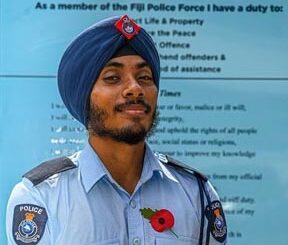
    SUVA, FIJI (TIP): Navjeath Singh Sohata has become the first Sikh cop to don a turban with the official Fiji Police crown after the island nation’s police force approved changes to the uniform in a bid to promote diversity, IANS reports.

    Recognizing that the respect for diversity and inclusivity are integral to the success of policing efforts, Acting Commissioner of Police Juki Fong Chew approved the wearing of a turban with the official Fiji Police crown.

    Police Constable Sohata, 20, is a member of Batch 66 undergoing the Basic Recruits Course Training in Nasova, after being selected from the open market recruitment drive.

    A devout Sikh, Sohata had marched into the academy knowing the training requirements would require personal sacrifices on his part.

    “However, the Acting Commissioner of Police, in respecting Sohata’s rights, approved the wearing of the turban with the official Fiji Police crown,” the Fiji Police said in a statement.

    Commissioner Chew said the move was a testament of the organization’s commitment to upholding the fundamental principles of equality and diversity.

    According to a book by Stanley Brown, ‘The History of the Fiji Police Force’, the first Sikh constables were recruited in force the early 1910s.

    Sharing his experience as a recruit, Sohata, who hails from Dreketi village in Northern Division of Fiji, said it was difficult at first being away from his family.

    “I have a number of people in my life who I look up to as inspiration and role models, and it is my goal to make them proud and be just as good as them when it comes to my professional life,” Sohata said.

    According to records kept by the Lautoka Gurudwara, Sikhs arrived in Fiji towards the end of the indentured labor system and mostly established themselves as farmers, policemen and teachers.

    The first school built by Sikhs in Fiji was the Khalsa High School in Ba district and the Suva gurdwara, built in 1922, is the oldest of all.

  • GOPIO-CT Chapter Hosts Welcome Dinner for University of Connecticut Students

    GOPIO-CT Chapter Hosts Welcome Dinner for University of Connecticut Students

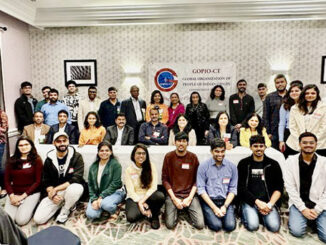
    STAMFORD, CT (TIP): GOPIO-CT organized a highly successful Meet and Greet session with the new students enrolled at the University of Connecticut Business School on Friday, October 20th at the Hampton Inn and Suites in Stamford, CT. An Interactive Discussion Panel “Tips on How to Market Oneself and Succeed in America.” followed. It was moderated by GOPIO-CT President Dr. Jaya Daptardar MHA, Chief Strategy and Compliance Officer, Bridges Healthcare, Milford, CT. The program, coordinated by GOPIO Trustees Prasad Chintalapudi and Dr. Thomas Abraham, started with welcoming remarks by Chintalapudi. Chintalapudi shared his own experience of being an entrepreneur. He then introduced GOPIO Chairman Dr. Abraham for his greetings.

    Dr. Abraham said, “America is the greatest country which provides opportunity to open up your mind and you can be whatever you want to become, whether a professional in a large corporation, or help to manage a hedge fund or as a scientist or professor or as an entrepreneur, so, go and grab the opportunities awaiting you.”

    Prasad invited panelists and the moderator GOPIO-CT President Dr. Jaya Daptardar. The panelists were: Vijay Anand, CEO, Everest DX, Stamford, CT; Indira Yedavalli, Vice President, Franklin Templeton Investments, New York; Sushanth Krishnamurthy, Director of IT, UBS, Stamford, CT; Prashanthi Reddy, Esq, Immigration Attorney, New York, NY; Amit Lakhotia, Founding Principal ADH (A Real Estate Development and Management Company), Westport, CT; Padmini Viswanath, MPH, Monitoring, Evaluation and Learning Manager, Last Mile, New York City; Anand Chavan, Senior Director of S&P Global Market Intelligence, New York. Many GOPIO-CT members also attended, so the students had one to one interaction with senior GOPIO members. All the students at the event were introduced at the beginning of the panel discussion.

    Panelists at the Session Discussion “Tips on How to Market Oneself and Succeed in America.” From l. to r. Anand Chavan, Amit Lakhotia, Padmini Viwanath, Sushanth Krishnamurthy, Vijay Anand, Indira Yedavalli, Prashanthi Reddy, Esq. and Moderator Dr. Jaya Daptardar.

    Each of the panelists were asked to talk about their journey to where they reached today and how earlier career choices lead them to where they are now. The panelists provided personal experience to their success. The panelists also provided guidance and inputs on educational preparation, resume preparation, necessary prior experience, what skills are the most important and transferable skills to acquire so as to market oneself to the American job market. A question/answer session followed.

    Important questions were asked to immigration attorney Prashanti Reddy about do’s and don’ts for students from the immigration law perspective. Students were keen to get more information on the process to apply for a permanent visa. Multiple questions were asked by the students about the guidance for fresh grads who are looking for jobs in this tough job market. Panelists suggested to do networking with community, join linked and follow those in one’s filed of interest and utilize the alumni network of one’s graduating school from India. Many careers were discussed during the Q/A session, which ended with vote of thanks presented by GOPIO CT executive vice president Mahesh Jhangiani.

    Over the last 17 years, GOPIO-CT, a chapter of GOPIO International has become an active and dynamic organization hosting interactive sessions with policy makers and academicians, community events, youth mentoring and networking workshops, and working with other area organizations to help create a better future. GOPIO-CT – Global Organization of People of Indian Origin – serves as a non-partisan, secular, civic and community service organization – promoting awareness of Indian culture, customs and contributions of PIOs through community programs, forums, events and youth activities. It seeks to strengthen partnerships and create an ongoing dialogue with local communities.

  • Sriniketan Foundation Sangeet Mahotsav dished out a musical treat to savor for a long time

    Sriniketan Foundation Sangeet Mahotsav dished out a musical treat to savor for a long time

    Purnima ji impressed with a Kathak performance

    BHARATNATYAM, MOHINIATTAM AND FOLK DANCE RECIALS BY CHANDRIKA AND LAKSHMI GROUP.
    LAKSHMI KURUP GAVE A SPLENDID PERFORMANCE ON SRI RAM’S CHILDHOOD DANCE THUMAK CHALAT RAMACHANDRA.
    CHANDRIKA KURUP THE DIRECTOR OF NUPUR DANCE SCHOOL WITH PURNIMA JI AND STUDENTS.

    Flora Parikh

    FLUSHING, NY (TIP): Sriniketan Foundation, a 501 (C) (3), non-profit organization founded by Purnima A. Desai in 2015, celebrated its Annual Sangeet Mahotsav – an International Music Festival by internationally renowned artists with a special tribute to Pandit Vishnu Narayan Bhathkhande on October 14. 2023.

    The organization is An Abode of Success of Body, Mind & Soul through Various Therapies, geared towards uplifting the cultural heritage and rich treasure of India’s classical music, dance and natural healing therapy. Each year, the organization showcases the talent of internationally renowned artists and recognizes their phenomenal talent, unrivaled contributions, and dedication to preserving the heritage of Hindustani Classical Music.

    At Sangeet Mahotsav 2023, over 47 professionally trained artists showcased a shower of international talent for almost 12 hours nonstop with a divine, mesmerizing experience of healing Ragas, Indian classical dances – Bharatanatyam, Mohiniyattam, Kathak and folk and a heart throbbing special Manipuri performance by our own Vidushi Purnima Desai ji. Their exceptional performances captivated the senses, transporting listeners to realms of bliss and tranquility, captivating the audience with their magnificent performances

    FAMOUS VOCALIST KASTURI BANDOPADHYAY ACCOMPANIED BY ANIRBAN CHAKRABORTY ON HARMONIUM AND ANIRBAN R. CHOWDHURY ON TABLA.
    JUGALBANDI BETWEEN SITARIST SUPRATIK SENGUPTA AND SAROD BY SOUMYA CHAKRAVERTY.
    VIDYA, TEJAL, SURESH, CYNTHIA ,FLORA, PURNIMA JI DEVENDRA AND PARESH HONORES FOR THEIR SUPPORT.

    The event showcased the rich and cultural heritage of Bharat’s exceptional talent, educating on various ragas, dance forms and festivities, through mesmerizing musical and vocal blessings and a divinely spiritual healing experience. The event was supported and blessed by over 250 music lovers, including Community Leaders, Presidents, Supporters and Well-wishers.

    Our special Thanks to our supporters, attendees, well-wishers, dedicated volunteers – Tejal Desai, Flora Parekh, Cynthia & Suresh Ketwaroe, Professor Indrajit Saluja, Rohit Pandya, Vidya Patel, Devendra Vora, Paresh Parekh, Amarnath Banarsi and each and everyone of you for making the event an astounding success year over year.

    Starting with Morning Ragas, the program was split into three parts. The first part showcased the sublime and inspiring Instrumental Recital by Anirban Chakraborty (Harmonium), Anirban R. Chowdhury (Tabla), Shankh Lahiri (Tabla) and Eric Fraser (Flute) followed by melodious Vocal by Kasturi Bandopadhyay. A special Manipuri Dance Recital by Vidushi Purnima A. Desai, Sanjib Bhattacharya, Jagannath Lairenjam, Jolly Moni Lairenjam & Chaobithoi Lairenjam Debi

    VOCALIST SANDIP BHATTACHARJEE ACCOMPANIED BY ANIRBAN ON HARMONIUM AND SANDIP GHOSH ON TABLA.
    MANIPURI DANCE RECITAL BY SANJIB BHATTACHARYA, JOLLY AND CHAOBITHOI.
    BHARATNATYAM DANCE BY STUDENTS OF LAKSHMI KURUP.
    MOHINIATTAM DANCE BY STUDENTS OF CHANDRIKA KURUP.

    The magic continued to the second part, as the stage lit up with mesmerizing Afternoon Ragas, a special jugalbandi of Pallab Bandopadhyay (Violin) and Shankh Lahiri (Tabla), followed by vocalist Vidushi Kankana Banerjee accompanied by Anirban Chakraborty (Harmonium). Traditionally dressed 23 classically trained dance performers from Chandrika & Lakshmi Kurup Dance Group rocked the stage with truly classical extravaganza combination showcase of Bharatnatyam, Mohiniyattam, Kathak and folk, depicting the various festivities of India.

    The musical extravaganza part 3 continued with a story telling Kathak dance performance by Pt. Satya Narayana Charka Dance Group. The Evening Ragas included a special Instrumental Recital by Supratik Sengupta (Sitar), Soumya Chakraverty (Sarod), Anirban R.Chowdhury (Tabla), Sandip Ghosh (Tabla), Naren Budhakar (Tabla) & Rohan Mishra (Sarangi). Internationally famed vocalists Ruchira Panda & Sandip Bhattacharjee led the audience through a soothing evening experience. The organization honored the artists in Recognition of their remarkable Talent and Exceptional performance, enriching the World of Hindustani Classical Music and inspiring many.

    ROHIT PANDYA JI SPOKE ABOUT THE IMPORTANCE OF SANGEET MAHOTSAV EVERY YEAR.
    VIDUSHI KANKANA BANERJEE GAVE A SPLENDID PERFORMANCE AS A SENIOR VOCALIST.

    The community is truly blessed with the remarkable contribution of organizations like Sriniketan Foundation, gracing us with sublime music and for being an inspiration to aspiring musicians. Sriniketan foundation has been serving the community tirelessly for years educating our younger generation with Monthly Educational & Cultural Events – “Shyama Shyam Shashtriya Sugam Sangeet Sammelan”, training them for Indian classical music, singing and dancing. The organization also offers various services not limited to – Naturopathy, Homeopathy, Basic Yoga, Mantra Therapy, Music Therapy, Laughing Therapy, Kriya Yog, Ayurveda, Meditation, Reflexology, Reiki Therapy, Listening Therapy For Chaitanya – Jagruti (Awareness & Pure Consciousness) and much more.
    For additional information visit www.sriniketanfoundation2015.org.

    One of the attendees, Mr. Rohit Pandya, who was literally mesmerized by the superb music and dance performances, felt impelled to send to The Indian Panorama his appreciation and comments on the Mahotsav. Here are some excerpts.As the curtain of the grand stage slowly unveiled, the mellifluous notes of a flute, as sweet as honey, began to dance through the air. The melodious tunes, as delicate as a blooming lotus, evoked a sense of tranquility that wrapped the audience in a soothing embrace. The flutist performance, like a gentle zephyr, carried the promise of a day filled with musical magic.

    The momentous journey continued as classical dancers, resplendent in vibrant attire, graced the stage with their artistry. Their graceful movements were as exquisite as the petals of a thousand roses, each step echoing the rich traditions of Indian classical dance. Their expressions painted stories of love, devotion, and celebration, captivating the audience’s hearts.

    The transition to classical vocal performances was seamless, and the vocalists transported the audience to another realm with their voices that were as ethereal as a monsoon downpour in the desert. Their renditions, passionate and resonant, were nothing short of divine. The words and melodies, like rare jewels, shone brightly in the hearts of the listeners.

    DR. KOMAL AND TEJAL APPRECIATED THE MANIPURI DANCE RECITAL BY THEIR MOTHER PURNIMA JI.
    ANIRBAN CHAKRABARTY RECEIVED CERTIFICATE OF RECOGNITION & MERIT BY THE TOWN OF NORTH HEMSTEAD, COUNTY OF NASSAU, STATE OF NEW YORK, NEW YORK STATE AND RAGINI SRIVASTAVA – TOWN CLERK. SANJIB BHATTACHARYA, KANKANA BANERJEE, LAKSHMI KURUP AND ERIC FRASER RECIVED THE CERTIFICATES AS WELL.
    LIVE KATHAK RECITAL DIRECTED BY PANDIT SATYA NARAYAN CHARKA WITH NAREN BUDHAKAR ON TABLA AND ROHAN MISRA ON SARANGI WITH KATHAK DANCERS POOJA BHARDWAJ AND NISHITHA SOBRIN AND PANDIT CHARKA JI HIMSELF.

    The stage then welcomed the maestro of the violin, who painted vibrant ragas that were as vibrant as a peacock’s plumage. The notes resonated with depth and emotion, taking the audience on a journey through the landscapes of classical music. The violinist’s skill and precision were as sharp as a katana blade, creating an exquisite tapestry of sound.

    The soul-stirring performance continued with the enchanting strains of the sarod, which were as evocative as a sunrise over the Himalayas. The sarod’s timbre, like liquid gold, flowed through the hearts of the listeners, enveloping them in a cocoon of musical ecstasy. The sitar, played with a finesse that was as delicate as a spider’s silk, followed suit. The artist’s nimble fingers plucked the strings, conjuring melodies as intricate as a spider’s web. The sitar’s resonant tones, like the soft caress of moonlight, filled the air with enchantment. Throughout the performances, the tabla and harmonium provided a rhythmic canvas that was as sturdy as the roots of ancient banyan trees. The interplay of beats and chords was a testament to the synchronicity and harmony that permeated the entire day’s program, binding it together like a string of pearls.

    And then, as the day turned to night, the grand finale, a celestial performance, unfolded. The stage seemed to transcend earthly boundaries as artists from different disciplines united to create an otherworldly experience. The music and dance, like shooting stars in the night sky, left the audience spellbound. In the midst of this magical day, the heart and soul of the event was the visionary and dedicated Purnima Dasai, the founder and president. Her passion and commitment to preserving and promoting Indian classical arts were as boundless as the ocean. Her leadership, like the North Star, guided this magnificent event to its zenith.

    Purnima Dasai’s unwavering dedication, like a lighthouse in the storm, has illuminated the path for countless artists and enthusiasts, ensuring the continued glory of Indian classical arts. Her vision and tireless efforts have been instrumental in weaving this tapestry of musical and visual splendor. As the event came to a close, the audience rose to their feet, their applause a thunderous testament to the day’s sheer brilliance. Purnima Dasai, a true luminary in the world of Indian classical arts, stood at the heart of it all, radiating with grace and poise. Her name will forever be etched in the annals of classical excellence, and her legacy will continue to inspire generations to come.

    TRIBUTE TO PANDIT VISHNU NARAYAN BHATHKHANDE JI.
    A GREAT VIOLINIST PALLAB BANDOPADHYAY WITH TABLA PLAYER SHANKH LAHIRI JUGALBANDI WAS SUPERB.
    FLORA PAREKH ONE OF THE EMCEES APPRECIATED RADHA KRISHNA MANIPURI DANCE RECITAL.
    JAGANNATH A GREAT MANIPURI DANCER WTH ALL THE ARTISTS WERE RECOGNIZED BY SRINIKETAN FOUNDATION.
  • Indian-American teen wins second spot in America’s Young Scientist Challenge

    Indian-American teen wins second spot in America’s Young Scientist Challenge

    • Says wants to gain experience and advice from a mentor to help change lives with EasyBZ

    SAN JOSE (TIP): Indian-American teen Shripriya Kalbhavi won second place at the annual 2023 3M Young Scientist Challenge, a premier science competition for middle school students in the US. Kalbhavi, a ninth grader at Lynbrook High School in California, received a $2,000 prize for developing EasyBZ — a cost-effective micro-needle patch that allows for self-automated drug delivery without pills or needles. Kalbhavi said in a blog post on the 3M Young Scientist Challenge website that she entered the contest because she wanted to help change lives. “Scientific research and innovations have always interested me, and I find the scientists, especially doctors, all around me to be extremely inspiring because they work to help people every day,” Kalbhavi, who wants to become a practicing neurosurgeon, said.

    “I want to gain experience and advice from a mentor to help improve people’s lives with my invention, BZ reaction-automated micro-needle patches, by making their medication painless and more affordable,” she added. She also hosts a podcast called ‘Famous Personalities’, and as part of the theme of her show, she does research about women scientists and speaks about their lives, achievements and research.

    Apart from Kalbhavi, five other Indian-American teens were among the top 10 finalists and each of them received a $1,000 prize and a $500 gift card.

    The first prize of $25,000 with the prestigious title of ‘America’s Top Young Scientist’, went to Heman Bekele from Virginia for his compound-based skin cancer-treating soap.

    “For 16 years, the 3M Young Scientist Challenge has exemplified our belief in harnessing the power of people, ideas and science to reimagine what’s possible. The remarkable young innovators of this competition share our determination to help shape a brighter future.” said John Banovetz, 3M executive vice president.

    “By asking students to think creatively and apply the power of science to everyday problems, incredible solutions and leaders arise.” Each finalist in the challenge was evaluated on a series of challenges, including a presentation of their completed innovation.

    America’s Top Young Scientists have gone on to give TED Talks, file patents, found non-profit organizations, make it to the Forbes 30 Under-30 list, ring the bell at the New York Stock Exchange and exhibit at the White House Science Fair.

    The young innovators have also been named Time magazine’s first Kid of the Year, featured in The New York Times magazine, Forbes, and Business Insider.
    (Source: IANS)

  • Indian American scientists Subra Suresh, Ashok Gadgil presented National Medal of Science by Joe Biden

    Indian American scientists Subra Suresh, Ashok Gadgil presented National Medal of Science by Joe Biden

    WASHINGTON, D.C. (TIP): Two Indian American scientists — Subra Suresh and Ashok Gadgil — were among 19 Americans honored by President Joe Biden for “exemplary achievements in science, technology, and innovation to strengthen our nation’s well-being.”
    Biden awarded the National Medal of Science, the nation’s highest scientific honor, to Suresh of Massachusetts Institute of Technology, Brown University along with eight other scientists at a White House ceremony on Tuesday.
    Gadgil of the University of California, Berkeley, Lawrence Berkeley National Laboratory, received the National Medal of Technology and Innovation, the nation’s highest award for technological achievement, with nine others.
    Suresh was awarded the science medal “for pioneering research across engineering, physical sciences, and life sciences. A transformative educator, he has advanced the study of material science and its application to other disciplines.  His commitment to research and collaboration across borders has demonstrated how science can forge understanding and cooperation among people and nations,” the White House stated.
    Suresh was the first Asian-born professor to lead any of the five schools at MIT. Born in Mumbai, Suresh received a BTech degree from the Indian Institute of Technology, Madras. Later, he received a Master’s degree in Mechanical Engineering from Iowa State University and a PhD in Mechanical Engineering from the Massachusetts Institute of Technology in Cambridge.
    Gadgil received the technology and innovation medal for “providing life-sustaining resources to communities around the world.. His innovative, inexpensive technologies help meet profound needs, from drinking water to fuel-efficient cookstoves.  His work is inspired by a belief in the dignity of all people and in our power to solve the great challenges of our time,” the White House stated. Born in Mumbai, Gadgil graduated in Physics from the University of Mumbai and completed his postgraduate studies at the Indian Institute of Technology Kanpur. He earned an MSc and PhD in physics from the University of California, Berkeley.
    “I’ve long said America can be defined by a single word — Possibilities,” Biden told the winners. “The fact that several of today’s honorees immigrated from other countries is proof of the assertion that everything is possible.”
    “You know, there will be more technological change in the next 10 years, maybe in the next five years, than in the last 50 years,” he said.  “There’s a — in large part to the minds sitting in front of us.  And I want America to lead — to lead that change.”
    “Because the greatness of a country is measured not only by the size of its economy or the strength of its military,” Biden said. “The strength of the nation is also measured by the boldness of its science, the quality of its research, and the progress it helps bring forth for not only the country but whole the world,” Biden said.
    “These trailblazers have harnessed the power of science and technology to tackle challenging problems and deliver innovative solutions for Americans, and for communities around the world,” the White House stated.
    “These medalists have made discoveries that enable lifesaving medical treatments, help fight the opioid epidemic, improve food security, advance accessibility, protect our democracy, and much more.” “Their accomplishments advance American leadership in science, technology, and innovation, and their work inspires the next generation of American minds,” it added.
    Established by Congress in 1959 and administered by the US National Science Foundation, the National Medal of Science is bestowed on individuals deserving of special recognition for their outstanding contributions in biology, computer sciences, education sciences, engineering, geosciences, mathematical and physical sciences, and social, behavioral, and economic sciences, in service to the Nation. The National Medal of Technology and Innovation recognizes American innovators whose vision, intellect, creativity, and determination have strengthened America’s economy and improved our quality of life.
    Established by Congress and administered by the United States Patent and Trademark Office, the first Medal of Technology was presented in 1985.


  • Indian-origin diplomat nominated by Joe Biden as US ambassador to Indonesia

    Indian-origin diplomat nominated by Joe Biden as US ambassador to Indonesia

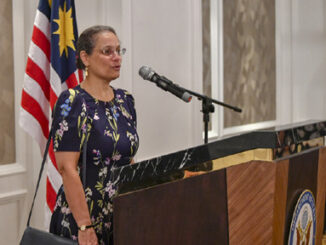
    WASHINGTON, D.C. (TIP): Indian-origin diplomat Kamala Shirin Lakhdhir has been appointed by President Joe Biden as US Ambassador to Indonesia. Lakhdhir, who has served the State Department for almost 30 years, is a career member of the Senior Foreign Service, class of Minister-Counselor, and was most recently Executive Secretary of the Department of State, the White House said. Her father, Noor, immigrated to the US from Mumbai to attend the University of California, Berkeley in the 1940s.
    A Harvard graduate and an M.S. from the National War College, Lakhdhir had formerly served as an ambassador to Malaysia from 2017 to 2021. Prior to that, Lakhdhir served as US Consul General in Belfast, Northern Ireland from 2009 to 2011.
    She joined the Foreign Service in 1991 and has served as Director of the Office of Maritime Southeast Asian Affairs, which includes responsibility for US relations with Indonesia.
    Early in her career, she was Deputy Coordinator of the Taiwan Coordination Staff in the Bureau of East Asian and Pacific Affairs. Her other overseas assignments included China, Indonesia, and Saudi Arabia, the statement added.
    Lakhdhir grew up in Westport, Connecticut, and was inspired to pursue an international career because of her parents, she said in an interview published in the National Museum of American Diplomacy. She said her “international career began as a child” due to her parents’ rich international background and family trips abroad.
    These experiences encouraged Lakhdhir to begin her career overseas as a teacher in China for two years after graduating from Harvard College in 1986.

  • Indian-origin Thomas Kurian, Google Cloud CEO, wins top ASEI award

    Indian-origin Thomas Kurian, Google Cloud CEO, wins top ASEI award

    MICHIGAN (TIP):  Thomas Kurian, CEO of Google Cloud, received the American Society of Engineers of Indian Origin’s (ASEI) prestigious Lifetime Achievement award at its 35th National Convention focusing on next-generation engineering innovations in Southfield, Michigan.

    ASEI National convention and celebratory awards gala dinner and entertainment event also honored six other outstanding individuals for their contributions to the engineering profession, society, and the community at large, according to a press release.

    The annual ASEI awards were presented to the following in different categories:

    • ASEI Entrepreneur of the Year: Dheeraj Pandey, Founder & CEO, DevRev;
    • ASEI Scientist of the Year: Dr Nina Tandon, CEO, EpiBone;
    • ASEI Engineer of the Year- AI: Rama Akkiraju, Vice President, NVIDIA;
    • ASEI Engineer of the Year- Transportation & Sustainability: Dr Praveen Vayalamkuzhi, CEO MobilityVision;
    • ASEI Service Excellence Award: Surbhi Kaul, Vice President, Juniper Networks; and
      Hari B. Bindal ASEI Founder’s Award: Muthu Sivananthan, Energy & Materials Industry Solutions Leader, Dassault Systèmes.

    The Corporate Excellence Recognition Program (CERP) was also revived as part of ASEI CorporateConnect initiative and employees nominated by sponsoring organizations Detroit Engineering Products and GHD were recognized.

    GMS Registrar honored the original founders of the CERP, Dr Ravi Rout, Jag Kottha and Mahesh Reddy, in addition to their Vice President Anjali Kottha. ASEI President Piyush Malik said, “On behalf of ASEI, I am very pleased to recognize and congratulate each awardee for their dedication, hard work, and exemplary contribution in their respective fields.”

    “For the past four decades, ASEI has served the community well in Indo-US technology relations and provided mentoring, networking and learning opportunities for young technologists & engineers through our strategic initiatives. We are now gearing up for our future 40 years!”

    The objective of the convention was to provide a forum to promote and share advancements related to the latest cutting-edge innovations and technologies across various engineering disciplines, according to the release.

    The convention was attended by over 400 professionals including scientists, engineers, entrepreneurs, and corporate leaders across the USA. ASEIcon2023 featured keynotes and multiple interactive sessions with prominent business and technology leaders, scientists, media personalities, educators, policymakers, and venture capitalists.

    ASEIcon 2023 featured a stellar line-up of speakers. In the opening keynote, Mamatha Chamarthi, Chief Growth Officer at Stellantis, spoke about disruption and networked talent, encouraging attendees to have a bolder planet-wide vision to disrupt oneself as well as their organization. She emphasized “Discover your authentic leadership style and learn to exit your comfort zone” and lauded ASEI on its “School to University to Profession to Planet” vision articulated by Malik. Rophin Paul, CEO of Wipro Pari, Ashwini Balasubramanian of Harley Davidson and Ankur Ganguli of General Motors, were among 30+ CEOs and engineering executives who spoke at the convention.

    Apart from talks and panel discussions in parallel tracks covering Automotive, Mobility, Infrastructure and Energy, there was a youth technology exposition (YTE) featuring projects by prize-winning STEM students as well.

    A deep-dive on policy decisions for the Mobility Industry by K. Venkatesh Prasad, of CAR was the closing keynote where he stressed that “Innovation today needs research and investments from decades ago.” Noting that the US is investing heavily in Mobility, AI, and Space, Materials, he said it will keep it relevant on the global stage. Shawn Lee of TEDx Detroit energized the awards banquet audience with his talk on DEI, people investment and selfless giving.

  • Indian American elderly Sikh punched after NYC car crash, dies

    Indian American elderly Sikh punched after NYC car crash, dies

    NEW YORK (TIP): New York Mayor Eric Adams has vowed to protect the city’s Sikh community after a 66-year-old Sikh man was killed after being pummeled following a car crash in Queens. “Jasmer Singh loved his city and deserved so much more than his tragic death,” Adams wrote on X, formerly Twitter, on Sunday, October 22, after Singh succumbed to his injuries from the accident last week.
    “On behalf of all New Yorkers, I want our Sikh community to know you have more than our condolences,” he wrote. “You have our sacred vow that we reject the hatred that took this innocent life and we will protect you.”
    Gilbert Augustin, 30, was arrested and charged in the death of Jasmer Singh. However, NYPD’s Hate Crime Task Force is not yet investigating the incident, which they believe was sparked by a car crash, media reported citing a police spokesperson.
    Both cars had dents and scratches, but when Singh went to call 911, witnesses heard a man say, “no police, no police” and watched as a man ripped the victim’s phone from his hands as he sat in his car, according to prosecutors.
    Singh got out of the car and followed Augustin in an attempt to get his phone back as the two argued. The older man got his phone back and was walking back to his car when Augustin punched him three times in the head and face, they added.
    Singh fell to the ground and hit his head, while Augustin hopped back into his Ford Mustang and took off, according to a criminal complaint. Medics rushed Singh to Jamaica Hospital Medical Center in critical condition, where he died the next day of a brain injury.
    Police pulled Augustin over on Friday about two miles from the crash site and found he had a suspended driver’s license and his Alabama license plate did not match his New York registration.
    Police at the NYPD’s 102 Precinct connected him to Singh’s death and charged him with manslaughter and assault, among other lesser charges.
    Following an arraignment in Queens Saturday, Augustin was held without bail.
    Jenifer Rajkumar, the first Indian American elected to New York State assembly, has also condemned the assault on Jasmer Singh and 19-year-old Mani Sandhu last week and vowed to work with Adams to protect the community. “I represent Richmond Hill, the ‘Sikh Capital of the USA.’ In our community, Sikhs, Christians, Hindus, Muslims, and Jews live together in harmony, often on the same block,” she stated. “When a crime occurs against any of us, it is a crime against all of us, and we come together in solidarity.”
    “Sikhs are our protectors: their faith preaches seva, meaning selfless service,” Rajkumar stated. “Their religion teaches that there is divinity in every one of any faith, and that there is an obligation to protect the welfare of all humanity.”
    “Every single day, Sikhs serve free meals to anyone who asks, the practice of langar. Their daily prayers include the saying, ‘Blessings for everyone.’ Every practitioner of this beautiful faith deserves our unyielding respect,” she stated. “As the first Punjabi-American ever elected to New York State Office, I will always fight for the freedom and dignity of Sikh Americans and people of every faith,” Rajkumar stated. “I will continue working with New York City Mayor Eric Adams, Police Commissioner Edward Caban, and all stakeholders to deliver the resources for our Sikh family to live in peace and safety,” she stated.

  • DHS proposes changes to H-1B work visas

    DHS proposes changes to H-1B work visas

    WASHINGTON D.C. (TIP): The Biden administration Monday rolled out a series of proposals to change how work visas are granted and what rights they convey to foreign nationals. The Department of Homeland Security (DHS) published the changes “to modernize and improve the efficiency of the H-1B program, add benefits and flexibilities, and improve integrity measures” in the Federal Register. But the proposals are hit-and-miss for many advocates and researchers. “The regulation is a very modest attempt to make the H-1B program work a little bit better than it does now,” said David Bier, associate director of immigration studies at the Cato Institute. In balance, the proposal liberalizes certain aspects of the H-1B, while tightening regulations that lawyers worry could make the application process more difficult.

    The H-1B is directed toward specialty occupations: engineers, doctors and journalists, for instance, who are foreign nationals with U.S.-based jobs.

    The visa is often granted to graduates of U.S. universities, and for many it serves as a bridge between college or graduate school in the United States and permanent residency or naturalization. But for many others, the H-1B is a trap. The H-1B in principle is granted for three years and renewable for another three, after which beneficiaries can either move to another status, such as a green card, or leave the country.

    Green cards, however, are subject to a per-country cap, where no one country can receive more than 7 percent of the annual allocation. That leaves nationals of countries such as India, which is a heavy user of H-1Bs, stuck in decades-long backlogs, renewing their H-1Bs yearly after the two three-year periods end.

    “The fact going forward is that there aren’t enough green cards, that the cap is going to be filled very quickly for green cards this year, and it’s not going to be just Indians anymore. Everybody’s going to be starting to face increasing wait times,” said Bier. Because current regulations make it risky and difficult to switch employers, workers on green card backlogs are at heightened risk for labor abuses. The new regulation does not address that issue, said Bier, and it adds language that could make it more difficult to obtain the visa in the first place.

    Immigration lawyer Cyrus Mehta wrote that the new regulation’s tightening of rules to match college and graduate school degrees with occupations “will make the H-1B program more restrictive and will negate all the good features.”

    “The proposed regulation seeking to amend the definition of ‘specialty occupation’ is of great concern as it would incentivize [U.S. Citizenship and Immigration Services] examiners to issue requests for evidence, which in turn would be burdensome on employers,” wrote Mehta.

    The administration’s new proposal would adopt language similar to a Trump administration proposal saying an applicant’s job needs to be “directly related” to their studies, and to the needs of any given job. Because people often study one thing and end up working in a different field, immigration law experts are worried this measure could create unnecessary red tape.

    But the administration’s proposal also makes it less risky to apply for an H-1B.

    The visa is granted to a set number of people, regardless of how many apply; the winners are chosen at random from the pool of eligible applicants.

    That’s made many would-be applicants reconsider the expenses and effort of an application, while other applicants enter the system on repeated occasions sponsored by different companies, getting more tickets for the lottery. Under the new system, each individual applicant would count once for the lottery system, regardless of how many applications they filed.

    The new proposal would also codify a way for entrepreneurs to self-sponsor, whereas only U.S.-based companies can sponsor applicants now. “That whole thing was thrown out by a court, so the rule should be right now that any entrepreneur who wants to sponsor themselves for an H-1B should be able to do so, but in practice, I’ve been told that that is not what is happening. They are still making it difficult to do that,” said Bier.

    The proposal would also extend the time recent graduates of U.S. universities can work before requiring an H-1B to continue working, a process known as Optional Practical Training, making it easier to time applications to avoid interruptions in work eligibility.

    And it would require U.S. Citizenship and Immigration Services, the agency that grants work permits, to defer to its prior decisions, meaning that renewals for people with unchanged underlying circumstances would be virtually guaranteed.

    In parallel, the State Department is mulling a proposal to allow H-1B applicants to receive their visa stamps without leaving the United States. Currently, applicants must leave the country to get stamps at a U.S. consulate abroad.

  • Indian American Satish Garimella Morrisville, NC, Town Councilman, seeks another term based on his record

    Indian American Satish Garimella Morrisville, NC, Town Councilman, seeks another term based on his record

    MORRISVILLE, NC (TIP): Indian American Satish Garimella, who is on the verge of completing his eighth year on the Morrisville, NC, Town Council, is seeking a third term, counting on voters to recognize his eight-year record in office.
    “Earning the trust of our residents is a cherished privilege,” he told The American Bazaar. “Serving on the town council brings me enormous satisfaction. The community holds great importance for me. Addressing the concerns and needs of individual residents and their families inspires me, as I truly value the positive contributions I can make. The election is scheduled for November 7. Early voting began on October 19 and will conclude on November 4.
    Garimella, who was raised in Mumbai, India, is running for an at-large seat on the council, allowing all eligible voters of the town to cast their votes for the candidate.
    Primarily situated within Wake County, North Carolina’s most populous county, Morrisville is a key town of the Research Triangle metropolitan region, which is anchored by the cities of Raleigh, Durham, and Chapel Hill.
    Morrisville is one of the very few U.S. towns where Indian Americans make up the largest ethnic group. Approximately 46 percent of the town’s nearly 32,000 residents are of Indian American descent, while 35 percent are white, and 10 percent are African American.
    In addition to a mayor and pro team mayor, there are five members on the town council. The current council also includes another Indian American, Steve Rao.
    Garimella, the son of two university professors, arrived in the Research Triangle area in 2003. An engineer by training — he holds a bachelor’s degree in electrical engineering and a master’s in computer science and serves as a senior manager at a large pharmaceutical company — it was his passion for community service and politics that inspired the Indian American to run for the town council in 2015.
    Since taking office as a council member in December of that year, Garimella has had a significant impact on both the council and the town. He found particular satisfaction in his role when he secured vaccinations for 17,000 individuals during the COVID-19 pandemic.
    As an Indian American, the councilman often receives requests for assistance from community members in need of help with visa and consular matters. Through nurturing strong relationships with the Embassy of India in Washington, DC, as well as U.S. missions in India, he has been able to provide vital support to those seeking assistance. Over the past eight years, he has also coordinated numerous camps and events to benefit the community.
    The councilman said that his role as a council member has provided him with the opportunity to serve on multiple boards and committees, further enhancing his ability to serve his constituents effectively.
    Some of the influential boards and council-appointed committees he has served in the past eight years include the Board of Directors for WakeMed Health and Hospitals, the Board of Directors for the North Carolina League of Municipalities (NCLM), the North Carolina League of Municipalities Legislative Policy Committee, the Cary/Morrisville Joint Issue Subcommittee, and the Wake County Fire Commission.
    “I’m deeply grateful for the enriching experiences and insights gained,” he said, reflecting on these experiences. “I ventured into unfamiliar territories by joining various boards, expanding my understanding of community needs. Forming friendships with diverse individuals has been particularly rewarding.”
    The feeling that is earned when an initiative is completed, and the opening-day ribbon is cut on a complex project that required months and years of focused and committed work is something special, Garimella said. He added, “It is in that moment that you realize the importance of public service in cultivating and strengthening the bonds of community that are so vital to Morrisville’s residents.”
    Bringing professional cricket to Morrisville
    One cause that Garimella was able to effectively advance using his position of power as a council member is the promotion of cricket in the Research Triangle Area, renowned for its world-class universities and cutting-edge research facilities.
    He played a crucial role in the redevelopment of Church Street Park, one of the two venues for Major League Cricket’s inaugural season last July.
    When Church Street Park was originally developed in the mid-2010s, it was designed for multiple sports. However, with the increasing South Asian American population and the rising popularity of cricket in the region, especially through the Triangle Cricket League (TCL), which was founded in 2009 and overseas and regulates a number of tournaments and players, there was a growing need for a high-quality cricket ground with a well-maintained pitch and proper floodlights. (Established in 2009, TCL oversees and regulates various tournaments, featuring nearly 3,000 players in various men’s, women’s, boys’, and girls’ categories.)
    Garimella — who played college cricket in Mumbai and once trained under the legendary Ramakant Achrekar, the same coach who nurtured India’s cricketing legend Sachin Tendulkar —said it’s fortunate that previous councils recognized cricket’s popularity in the region and converted four baseball fields into cricket grounds. “After my election in 2015, I looked at the park and told the council that we need lights at the park,” he recalled. “Without the lights, nothing will work. So, in 2017, I proposed to the council to install the lights. Around the same time, the hotel-motel tax department of the county inquired if we had any projects that could bring economic development to the area. We had other big players competing for the same dollars: museums, the PNC Arena, home to the National Hockey League’s Carolina Hurricanes, and many other different projects. In fact, we were very late in the game, too.”
    Before the proposal was presented to the council, it underwent a vetting process by the staff. There was one major issue: the cost. “It was a hard sell,” the councilman recalled. “I had to lobby all the top country officials. Then I got all the county commissioners to look at Church Street Park. They saw the potential and they voted.
    They realized that it had value for money. Then we had to give a matching fund: they gave most of the money, but we had to give a small share. And ultimately, the lights were installed.”
    Following the installation of lights, Church Street Park hosted a number of northern sub-region group matches of the 2018-19 ICC T20 World Cup Americas Qualifier. The matches were held under the aegis of USA Cricket, the governing body for cricket in the United States and affiliated with the International Cricket Council (ICC), the global governing body for the sport.
    To bring professional cricket, there was another requirement: international-standard pitches that needed to be maintained year-round. This is where American Cricket Enterprises (ACE), a private organization on the verge of launching Major League Cricket (MLC), played a pivotal role. ACE was actively seeking a suitable venue for the inaugural MLC, and Morrisville, with its substantial South Asian population, was identified as one of the two venues.
    On July 20, 2023, Church Street Park hosted the largest match in its brief history, a Major League game between the LA Knight Riders and Washington Freedom. Over the next few days, the stadium witnessed six additional matches, drawing thousands of cricket fans from various parts of the country.
    The Town of Morrisville, which owns Church Street Park, has an agreement with ACE that allows MLC to use it. The rest of the time TCL uses it for the games and leagues it overseas. “We take a lot of pride in maintaining the ground,” Garimella said.
    The councilman said the story of how a small town like Morrisville became a cricket hotspot in the United States is a testament to the work put in by his colleagues on the council and the cricket enthusiasts of the region. He also thanked ACE and USA Cricket for choosing to make Church Street Park one of the two venues for MLC in its inaugural season
    Endorsements
    For his re-election, Garimella has garnered the endorsement of several influential political leaders and prominent Political Action Committees (PACs) within the Tar Heel State.
    Those who have endorsed him include U.S. Rep. Deborah Ross, who represents the state’s second congressional district, which includes the town of Morrisville, and the North Carolina Senate Minority Whip Jay Chaudhari, one of the most prominent Indian American political leaders in the state. “I am profoundly humbled and deeply honored to receive endorsements from Congresswoman Deborah Ross, who has been a guiding mentor throughout my journey, and Senate Minority Whip Leader Jay Chaudhari,” said Garimella, who also has the support of two key state lawmakers, Sen. Gale Adcock and Reps. Ya Liu and Mariah Cervania.
    Additionally, he has received the backing of PACs and community organizations such as the North Carolina Indian American Political Action Committee (NC-INPAC), North Carolina Asian Americans Together (NCAAT) and North Carolina American Indian Association (NCAIA).
    “The support from various influential PACs, including those representing the Asian American community, fills me with gratitude,” Garimella said. “I want to emphasize that I do not take these endorsements lightly. They are a testament to the collaborative efforts I’ve invested in working alongside their respective offices for the betterment of our community. I firmly believe in the power of building strong relationships with a diverse array of entities, from the Indian Embassy to U.S. immigration authorities, and from local healthcare professionals to dedicated attorneys. These connections are crucial in fostering the growth and prosperity of the Triangle community.”

  • US Senator moves resolution on ‘religious bias’ in India: Wants govt to push New Delhi to take action

    US Senator moves resolution on ‘religious bias’ in India: Wants govt to push New Delhi to take action

    WASHINGTON, D.C. (TIP): US Senator Tammy Baldwin has introduced a resolution in the Senate, urging the Biden administration to engage with India to “reverse” its policies that allegedly discriminate on the basis of religion and push for an end to violence against peaceful protesters in the country. “Religious freedom is a fundamental human right, and when any country infringes on it, the United States must stand up and speak out,” Senator Tammy Baldwin said in a statement after introducing the resolution this week.

    “I am calling on the United States to continue pushing the government of India to reverse course on the systematic religious and political persecution that is endangering and disenfranchising innocent civilians,” she said.

    India has previously trashed “motivated” and “biased” reports by the US State Department on religious freedom that criticized the country for alleged attacks on minorities.

    External Affairs Ministry Spokesperson Arindam Bagchi said in May this year such reports continue to be based on “misinformation and flawed understanding”.

    The resolution urges the government to engage with the Indian government to end the persecution of, and violence against, religious minorities and human rights defenders in India, and work to reverse government policies that discriminate against Muslims and Christians on the basis of faith. It also calls for an end to the demolition of homes, businesses, and places of worship belonging to Muslims and Christians.

    Welcoming the resolution, Rasheed Ahmed, Executive Director of the Indian American Muslim Council, said rising social conflict and democratic backslide in India will weaken and not strengthen India’s relevance as a global bulwark against anti-democratic forces.
    (Source: PTI)

  • Mike Johnson elected speaker of US House of Representatives

    Mike Johnson elected speaker of US House of Representatives

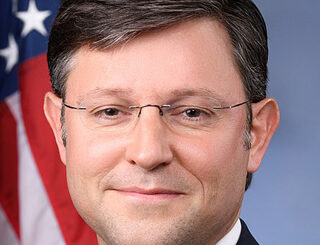
    WASHINGTON, D.C. (TIP): Republican Congressman from Louisiana Mike Johnson has been elected as the Speaker of the House of Representatives, bringing an end to three weeks of uncertainty in US politics. He is the 56th Speaker of the Chamber.

    The position of Speaker of the House of Representatives is one of the most powerful political chairs in the country and is third in the line of succession after the US President.

    Johnson on Wednesday October 25, was elected by 220 to 209 votes in a bitterly divided Congress, three weeks after his predecessor Kevin McCarthy was unceremoniously voted out of the seat for the first time in US history. In the 435-member House, the Republicans hold a slender majority with 221 seats against 212 of the Democrats.

    The 56th Speaker of the House of Representatives, Johnson, 51, a lawyer by profession, is a four-term Congressman from the Fourth Congressional District of Louisiana.

    In his maiden address to the Congress, Speaker Johnson said his first legislative agenda would be to bring a resolution in support of Israel, a country that was hit by a terrorist attack by Hamas early this month. “We are going to show not only Israel but the entire world that the barbarism of Hamas that we have seen play out on our television screens is wretched and wrong,” he said.

    “We want our allies around the world to know that this body of lawmakers is reporting again to our duty stations. Let the enemies of freedom around the world hear us loud and clear: The people’s house is back in business,” Johnson said. However, his main challenge at hand would be to avoid a government shutdown by passing the spending bill and approving the USD100 billion request by President Joe Biden to fund the war in Israel and Ukraine.

    Johnson, whose candidature was supported by former president Donald Trump, said that he would propose a short-term measure to fund the government through January 15 or April 15.

    “So, at this time yesterday, nobody was thinking of Mike and then we put out the word and now he’s speaker of the House, so I wanted to thank all of the supporters that I have and I want to thank all of the supporters Mike has, and again he will be a great speaker,” Trump said after the election of the new speaker.

    In his speech, Johnson indicated that he is getting down to business immediately. “The American people’s business is too urgent at this moment,” he said.

    “We’re in the majority right now. We’ve gone through a little bit of suffering. We’ve gone through a little bit of character building. And, you know what it’s produced? More strength, more perseverance, and a lot of hope. And that’s what we are about to deliver to the American people,” Johnson said, adding that he would have an aggressive schedule in the days and weeks ahead. US President Joe Biden said he is looking forward to working with the Speaker Johnson.

    According to the White House, this afternoon, Biden called Johnson to congratulate him on his election, and expressed that he looks forward to working together to find common ground on behalf of the American people “While House Republicans spent the last 22 days determining who would lead their conference, I have worked on those pressing issues, proposing a historic supplemental funding package that advances our bipartisan national security interests in Israel and Ukraine, secures our border, and invests in the American people. These priorities have been endorsed by leaders in both parties,” Biden said in a statement.

    “We need to move swiftly to address our national security needs and to avoid a shutdown in 22 days. Even though we have real disagreements about important issues, there should be mutual effort to find common ground wherever we can,” he said.
    (Source: PTI)

  • Artificial Intelligence company from Silicon Valley enters Bihar

    Artificial Intelligence company from Silicon Valley enters Bihar

    WASHINGTON, D.C. (TIP): A Silicon Valley-based Artificial Intelligence company has opened an office in Bihar, making it the first IT company from the US to enter the state.

    Tiger Analytics, headquartered in Santa Clara, has opened its first office in Patna this month. “We are hoping that the initial step that we are taking, can lead to a lot of progress down the road,” Mahesh Kumar, founder and CEO of Tiger Analytics, told PTI in a recent interview. The company currently has some 4,000 employees in India, but they are mostly in Chennai, Bangalore and Hyderabad. Kumar, who is himself from Bihar, said during the COVID crisis a large number of its employees went back home to Bihar and started working remotely. “We have close to a hundred people between Bihar and Jharkhand right now. They’re working remotely and they were happy there, they didn’t want to come back,” he said.

    “So, we realized that they’re very good talented people, young people, they want to stay close to home but there are no opportunities in Bihar for them to work. Even when we set up this office (in Patna), a lot of social media responses came. People are looking forward to Tiger (Analytics) growing there (in Bihar) so they can go back and work from there,” Kumar said.

    Kumar, who interacts with other successful entrepreneurs from Bihar in Silicon Valley regularly, said their goal is to encourage more like-minded people to come together and use it as an initial seed to grow a bigger no ecosystem in Bihar. Tiger Analytics is primarily a consulting company in the field of artificial intelligence and machine learning.

    “We hope that taking this lead into account, many more companies will come to Bihar in the same way,” Sandeep Poundrik, Additional Chief Secretary, Department of Industries, Bihar told PTI. A delegation of senior Bihar officials travelled to Silicon Valley this summer for meetings with Bihar-origin successful tech entrepreneurs.

    “We are trying to get IT companies to start their operations in Bihar. …. . It’s not a very easy task, especially because right now there are not many IT companies in Bihar,” said Poundrik who is also CEO of the Bihar Foundation, a state government-supported body for its diaspora community. Thousands of engineering students from Bihar currently seek opportunities outside the state due to the limited presence of IT companies within Bihar, he said. Responding to a question, Poundrik acknowledged that it’s a little more challenging to attract investment in Bihar in the IT sector. “Number one…. I would say their perception of Bihar is not very positive, especially outside India. Because they have never heard of Patna or Bihar. So if any IT company wants to start their unit, they only think about Chennai, Bangalore or Hyderabad. They never think about Bihar,” he said.

    “Second, I think the market is not local as far as IT is concerned. We have created the infrastructure. So in addition to whatever infrastructure the government has created for startups and IT companies, there’s a lot of private infrastructure which has come up in Patna. About 12 IT towers are being developed in Patna in various stages of construction in the Patliputra industrial area,” he said. Encouraged by Tiger Analytics’ move, the Bihar government is now planning to organize a Global Investors Summit in Patna on December 13 and 14. “One of the key priority areas in that summit is IT. We will try to get IT companies from India and outside India to come and at least look at the opportunities, the strengths of Bihar,” he said.
    (Source: PTI)

  • Indian American food delivery driver arrested for alleged sexual assault on minor in California

    Indian American food delivery driver arrested for alleged sexual assault on minor in California

    SAN JOSE, CA (TIP): A 21-year-old Indian American food delivery driver has been arrested for allegedly sexually assaulting a minor girl after forcefully getting into her motel room in California, police said. Identifying Sandeep as “primary suspect”, the San Jose Police Department (SJPD) said on Wednesday, October 25, that the incident occurred on October 21 in the 1000 block of The Alameda in San Jose city.
    The girl was staying with her mother in the motel and had ordered a pizza.
    The mother was not in the room at the time of the incident, the KTVU news channel reported. Investigations by the SJPD Sexual Assault Investigations Unit (SAIU) revealed that Sandeep forced his way into the motel room and sexually assaulted the female juvenile.
    SAIU detectives and patrol officers located and arrested Sandeep on the same day in the city of Campbell late in the evening.
    He was booked into Santa Clara County Main Jail for assault with intent to commit a sex crime, sexual battery, and false imprisonment. Anyone with more information is asked to contact Detective Bolduc of the department’s Sexual Assault Investigations Unit.

  • Challenge to Hindutva

    Challenge to Hindutva

    • The clamour for a caste census can redefine political equations and alliances in the run-up to Lok Sabha polls

    It’s premature to conjecture if caste is a robust counter to the BJP’s Hindutva. But the BJP’s strategy of employing religion to heighten a pan-Hindu identity among the non-upper castes might be past its shelf life, at least in the state elections.

    “The belated wisdom of a national party such as the Congress plunging headlong into sectional politics discomfited some of its insiders, who believed that it should focus on the economy’s big picture, inflation and livelihood and leave matters like a caste count to the identity-wedded entities it is aligned with in the regions. Insiders said that would be more in keeping with the ‘character’ of these players, some of whom, incidentally, are products of the post-Mandal period.”

    By Radhika Ramaseshan

    The upcoming Assembly elections in Madhya Pradesh, Chhattisgarh, Rajasthan and Telangana have got inextricably linked with three factors — the Bihar Government’s release of a comprehensive caste survey (CCS), the Congress’ promise to conduct a similar caste count if elected to power in these states and the BJP’s response to frame the discourse in a different idiom, featuring leitmotifs drawn from the Hindutva ideology. As the BJP garnered a little over 40 per cent of the OBC votes in the 2019 elections, largely by projecting Modi both as an OBC mascot and a Hindu icon, the Congress was bereft of any such attribute.

    A little before and immediately after the Bihar CCS demonstrated the potential of resurrecting the issue of the empowerment of Other Backward Classes (OBCs) or backward castes, the Congress strongly advocated for a caste count. Former party president Rahul Gandhi described it as an ‘X-ray’ that would reveal the socioeconomic condition of the OBCs, Dalits and Adivasis and challenged Prime Minister Narendra Modi to lay bare the findings of a socioeconomic caste survey undertaken during then PM Manmohan Singh’s tenure. Rahul claimed that the Congress governments in Rajasthan and Chhattisgarh had initiated a process to carry out a CCS — brave words from the Congress, which belatedly recognized and acknowledged the seriousness of OBC empowerment in shaping the politics of the Hindi heartland. Successive Congress Prime Ministers — from Jawaharlal Nehru to Rajiv Gandhi — did not pursue the recommendations of the Kaka Kalelkar Commission, the first Backward Classes panel, which submitted its report in 1955. It identified 2,399 backward castes in the country, with 837 of them classified as ‘most backward’. The commission also recommended undertaking a caste-wise enumeration of the population during the 1961 census and establishing a connection between the social backwardness of a caste and its low position in the traditional caste hierarchy, among other suggestions.

    The Congress ignored the Mandal Commission’s report mandated to identify the socially and educationally backward castes and adopt ameliorative measures to bring them on a par with the upper and intermediate castes. While the BJP was quick to grasp the political ramifications of the Mandal report and co-opted large OBC sub-groupings under the Hindutva umbrella, the Congress was convinced that its time-tested coalition of the upper castes, Muslims and Dalits/Adivasis would endure an epic churn. As it happened, the amalgam came apart and the party lost its base in the heartland, except in pockets. As the BJP garnered a little over 40 per cent of the OBC votes in the 2019 elections, largely by projecting Modi both as an OBC mascot and a Hindu icon, the Congress was bereft of any such attribute. Now, the party is making a concerted effort to position, front and center, its OBC Chief Ministers Siddaramaiah (Karnataka), Bhupesh Baghel (Chhattisgarh) and Ashok Gehlot (Rajasthan), despite the high command’s express misgivings about Gehlot.

    The belated wisdom of a national party such as the Congress plunging headlong into sectional politics discomfited some of its insiders, who believed that it should focus on the economy’s big picture, inflation and livelihood and leave matters like a caste count to the identity-wedded entities it is aligned with in the regions. Insiders said that would be more in keeping with the ‘character’ of these players, some of whom, incidentally, are products of the post-Mandal period.

    There is more than a grain of truth in this belief if the rejoinder coming from a regional party is an indication. Flagging the caste count issue in Telangana, Rahul contextualized his rationale with the alleged corruption by the Bharat Rashtra Samithi government, Chief Minister K Chandrashekar Rao and his family. A caste survey, Rahul claimed, would bring to light the extent to which the KCR clan had ‘looted’ Telangana. Can caste become a synonym for corruption, considering that the party of Lalu Prasad, whose household is enmeshed in graft charges, is a Congress ally and the Rashtriya Janata Dal draws its sustenance from identity politics? Can the RJD survive without its Muslim-Yadav support?

    The Telangana Government was not in slumber. In 2014, it carried out a household survey of the OBCs which showed that they made up 51 per cent of its 3.6 crore population. With the Dalits and Adivasis, the figure went up to 85 per cent.

    The Chief Minister is from the Velama community, a dominant caste of agriculturists, but in his two stints in office, he made space for OBCs such as the Gouds, Yadavs, Munnuru Kapu and Padmashali as ministers and Rajya Sabha MPs. Having been vociferous about a caste count, the Congress might be hoist by its own petard because its OBC leaders have clamored for three Assembly seats each in Telangana’s 17 Lok Sabha constituencies that add up to 51 OBC candidates in the 119 Assembly segments.

    The Chhattisgarh Government’s OBC survey in 2022 puts their population at 43.5 per cent, while as per the Madhya Pradesh and Rajasthan Backward Classes Commissions, the figures stand at 48 per cent and 42 per cent, respectively. Confronted with the data, the three governments — Chhattisgarh and Rajasthan are Congress-ruled, while MP is BJP-helmed — have made OBCs the centerpiece of their policies and welfare initiatives.

    Madhya Pradesh CM Shivraj Singh Chouhan set up dedicated welfare boards for specific sub-castes, as have Gehlot and Baghel. Rajasthan earmarked 64 per cent reservation in government employment and educational institutions with 16 per cent for the Dalits, 12 per cent for the Adivasis, 26 per cent for the OBCs and most backward castes and 10 per cent for the ‘economically weaker’ sections. In MP, despite the BJP high command’s manifest distrust of Chouhan, he was nominated again from his Budhni seat shortly after the caste census and the accent on OBC empowerment gained currency. Chouhan is from a backward caste. In Chhattisgarh, Baghel legislated an increase in the OBC reservation quota from 14 to 27 per cent and that of the Adivasis (a sizeable population) from 12 to 13 per cent in public employment and educational admissions.

    It’s premature to conjecture if caste is a robust counter to the BJP’s Hindutva. But the BJP’s strategy of employing religion to heighten a pan-Hindu identity among the non-upper castes might be past its shelf life, at least in the state elections.
    (The author is a Senior Journalist)

  • The voice of a Gaza under occupation

    The voice of a Gaza under occupation

    • There may be merit in the claim from Gaza – of a knocking on every door and trying every path, for peace, rights and freedom, but to no avail

    “While Biden is right to support Israel, he must get clear answers from Netanyahu now, before it’s too late: Once Israel topples Hamas, who will govern Gaza? If Israel intends to govern Gaza, will it pay for the rebuilding of the infrastructure that it is destroying? And if not, who will? How long does Israel intend to allow the humanitarian crisis to unfold in southern Gaza? Does Israel plan to build settlements in Gaza? Does Israel respect Gaza’s borders? Does it have a plan to help rebuild the Palestinian Authority in the West Bank?”

    U.S. President Joe Biden was emphatic in his condemnation of Hamas for the responsibility of the hospital attack. Its timing is yet to be established and Professor Anthony H. Cordesman of the Center for Strategic and International Studies is of the opinion that the only way to convince those who do not take sides is to establish some form of international investigation that is led by nations or individuals who are credible.

    By Hamid Ansari

    While the conflict rages in Gaza amidst allegations and counter-allegations, and in the midst of unabashed American partiality, it is relevant to recall what the senior leader of Hamas, Mousa Abu Marzouk, told The New Yorker magazine (October 13) about the political approach: “We rolled down all of the pathways to get some of our rights — not all of them. We knocked on the door of reconciliation and we weren’t allowed in. We knocked on the door of elections and we were deprived of them. We knocked on the door of a political document for the whole world — we said, ‘We want peace, but give us some of our rights’ — but they didn’t let us in.” He added, “We tried every path. We didn’t find one political path to take us out of this morass and free us from occupation… We spoke to the Americans, Europeans and all of the people in order to achieve the Palestinian people’s rights, without any benefit. Nothing has been achieved towards the idea of two states, from 1948 until today. We are a people under occupation.”

    Abu Marzouk added that in earlier conflicts, the Israelis waged wars outside their borders; “This is the first time that the Palestinians are crossing the borders and fighting in their historic land.” The conflict has shattered the aura of invincibility.

    Tel Aviv’s response
    The Israeli response to the Hamas attack has been to order the evacuation of the northern half of Gaza, to enforce it by a blockade, by the cutting off of food, water and electricity as also by the massing of 3,00,000 troops on Gaza’s border. The objective presumably is to occupy the northern zone and expand space for new settlements. The Palestinians see it as such and recall the manner in which the state of Israel came into existence on May 14, 1948 when 6,56,000 Arabs inhabited of the Mandate Territory of Palestine were made to flee by what the historian, Paul Johnson, called (History of the Jews, p.521) as ‘the scientific use of terror to break the will of liberal rulers’. Palestinians were thus made to pay for the genocide of Jews in Europe, which was committed by Germans, not Arabs.

    Nor should the ideological motivation, particularly of the present Israeli leadership, be overlooked. It has repeatedly equated the Palestinians with the Nazis who should be eliminated. This is a reiteration of what Vladimir Jabotinsky, a respected predecessor in right-wing Zionism said in 1923: Zionism ‘is a colonizing adventure and therefore it stands or falls by the question of armed force.’ He predicted that the Palestinian will not leave his land unless confronted ‘by a wall of Jewish bayonets so that a new race, proud, generous and cruel, shall arise.’

    The reality of this perception has been reinforced by decades of connivance by world powers. Innumerable United Nations Security Council (UNSC) resolutions have remained unimplemented. Each reiterated the earlier ones and some even indicated new goalposts; each sought to explain away the guilt of the culprits. Resolution 2334 of December 2016, for instance, outlawed all settlement activity and reiterated the desirability of implementing the two-state solution. A departure from the UNSC route was attempted in September 2020 by the Abraham Accords seeking, piously, to ‘end radicalization and conflict’ while ignoring the causes of both. An expectation of expanding the ambit of both has not materialized.

    No more invincible
    Israel’s objectives for the Gaza operation have been officially identified with precision: toppling Hamas and destroying its military capabilities; eliminating the threat of terrorism emanating from the Gaza strip; exerting maximum pressure to find a solution to the hostage issue, and defending the borders of the state and its citizens. These would require going into Gaza. Informed Arab columnists like Abdel Bari Atwan are of the opinion that the most recent fighting has deprived Israel of its two most effective weapons: its scariness and its deterrent power. Such a move, he says, would be more far reaching than Ehud Olmert’s foray and Ariel Sharon’s venture.

    The response of the United States and some of its allies to the present crisis raises the question of motivation. Did they know more about the chink in Israel’s armor? Did they apprehend the implications of conflict going beyond Gaza and its adverse impact on Israel?

    Pertinent questions
    The prognosis of Thomas L. Friedman in The New York Times of October 16, 2023 sheds light on the prospects: “If Israel goes into Gaza now, it will blow up the Abraham Accords, further destabilize two of America’s most important allies (Egypt and Jordan) and make normalization with Saudi Arabia impossible — huge strategic setbacks. It will also enable Hamas to really fire up the West Bank and get a shepherd’s war going there between Jewish settlers and Palestinians. Altogether, it will play directly into Iran’s strategy of sucking Israel into imperial overstretch and in that way weakening the Jewish democracy from within.”

    Friedman adds: “While Biden is right to support Israel, he must get clear answers from Netanyahu now, before it’s too late: Once Israel topples Hamas, who will govern Gaza? If Israel intends to govern Gaza, will it pay for the rebuilding of the infrastructure that it is destroying? And if not, who will? How long does Israel intend to allow the humanitarian crisis to unfold in southern Gaza? Does Israel plan to build settlements in Gaza? Does Israel respect Gaza’s borders? Does it have a plan to help rebuild the Palestinian Authority in the West Bank?”

    U.S. President Joe Biden was emphatic in his condemnation of Hamas for the responsibility of the hospital attack. Its timing is yet to be established and Professor Anthony H. Cordesman of the Center for Strategic and International Studies is of the opinion that the only way to convince those who do not take sides is to establish some form of international investigation that is led by nations or individuals who are credible. Clearly, there may be merit in Abu Marzouk’s claim. Hasty resort to partiality may not be the option.

    (Hamid Ansari is a former Vice President of India)

  • A middle path needed to resolve Israel-Palestine conflict

    A middle path needed to resolve Israel-Palestine conflict

    With not even Europe fully supporting the US-UK stance on Israel, these two powers stand isolated globally.

    “The immediate need is to take four steps — a ceasefire, release by Hamas of all Israeli hostages, uninterrupted flow of international humanitarian aid into Gaza and complete abandonment by Israel of aerial bombing of Gaza and its stated aim of a ground offensive in Gaza. The emergence of powerful Jewish voices in the US and the UK, especially among the younger generations, against the current and intended military action by the Israeli state in Gaza, and the growing chorus within Israel against the warmonger President Netanyahu, are signs of revival of hope in a seemingly hopeless situation.”

    By Pritam Singh

    The Israel-Palestine conflict has been arguably the most intractable conflict in the world ever since Israel was created as a state in 1948 and projected as the homeland of Jewish people from all over the world. The creation of this state was accompanied by the displacement of 7,50,000 Palestinians, the original inhabitants of the place. This simultaneous possession and dispossession created the physical and cultural conditions for an enduring conflict. The dispossessed Palestinians want their homeland decolonized. Jewish settlers perceive Palestinian economy, politics and culture as a persistent threat to the security of the land they have possessed.

    The seeming resolvability of the conflict arises from a combination of two forces: moral and economic-geographical. Both sides claim that morality is on their side. The Jews, especially those who are committed to the Zionist variant of the faith, claim that the persecution of the Jews over centuries — culminating in the Nazi Holocaust that caused the slaughter of six million of them — entitles them morally to have a state of their own where they can be secure from discrimination and persecution. Non-Zionist Jews considered the Zionist perspective as vulgarization of the faith, but their views were marginalized, especially in light of Holocaust sufferings. The Palestinians claim that they never committed atrocities on Jews and had, in fact, lived in peace with the Palestinian Jews, but they were still punished by being thrown out of their homeland.

    The economic-geographic location of Israel in West Asia confounds the conflict. An Oxford geographer once made a pithy remark that has become a quotable quote. He argued that the one who controls West Asia controls oil and the one who controls oil controls the world. West Asia is the most oil-rich region in the world and when petroleum, also called liquid gold, became the critical source of energy for running modern capitalist economies, the US, the UK and France became involved in the region to have access to that liquid gold. The creation of Israel by these powers as their permanent strategic ally in West Asia was aimed to create a firm foothold in this resource-rich region. This strategic alliance is the source of Israel’s military and economic power.

    The vulnerability of Israel despite this powerful military-economic alliance lies in its geographic location. It is surrounded by Muslim-majority countries whose populations, if not their autocratic rulers, are deeply sympathetic to the Palestinians. Though some Palestinians are Christians (including the world-famous Palestinian intellectual, the late Edward Said), most are Muslims. Israel’s geographical vulnerability is the Palestinians’ strength.There are three ‘perfect’ solutions that can be imagined, but none is feasible. The ‘perfect’ solution for the hardcore Zionist Israelis is the complete elimination of all signs of Palestinian life. This is not possible at all because of the growing global revulsion against Israeli bombing of Gaza. The changing global order, with declining military and economic powers of old imperialist countries and the rising economic and military powers of newly emerging economies, means that the global balance of forces is pitted against Israel taking any action remotely resembling annihilation of Palestinians. With not even Europe fully supporting the US-UK stance on Israel, these two powers stand isolated globally.

    The ‘perfect’ solution for the hardcore Palestinians is the liquidation of the state of Israel. Hamas, the organization that carried out the deadly attack on Israeli territory on October 7, is committed to this aim. However unjustified the creation of Israel might be from any point of view, Palestinian or non-Palestinian, the liquidation of the Israeli state is not possible. The global history of at least the last two centuries shows that no state once created has been destroyed. The territory of a state does shrink because of secession of some region from it but the state does not disappear. Russia, Serbia, Pakistan, Indonesia and Ethiopia are some recent examples of this. The Hamas agenda is a dangerous delusion and, therefore, not feasible.

    The ‘perfect’ solution from a democratic point of view would be the creation of an integrated Israel-Palestine or Palestine-Israeli state where all citizens — Jews, Muslim, Christians or non-believers — have equal rights and they can, through a democratic process, choose their form of economic governance — capitalist, socialist or social democratic. This certainly is the most sensible way but let the perfect not be the enemy of the good. This most desirable solution is also not feasible, not only in the immediate future, given the current polarization, but also in the medium term. This does not, however, mean that the transitional path cannot be imagined. That transitional path is the two-state solution — a sovereign Palestinian state existing alongside the Israeli state. It is a feasible solution. However, it has not been sincerely tried out despite the Oslo Accords, which were the most hopeful sign of progress in this direction.

    The learning experience of the two states existing side by side might lead them eventually to build an integrated state — the truly ideal solution.

    The immediate need is to take four steps — a ceasefire, release by Hamas of all Israeli hostages, uninterrupted flow of international humanitarian aid into Gaza and complete abandonment by Israel of aerial bombing of Gaza and its stated aim of a ground offensive in Gaza. The emergence of powerful Jewish voices in the US and the UK, especially among the younger generations, against the current and intended military action by the Israeli state in Gaza, and the growing chorus within Israel against the warmonger President Netanyahu, are signs of revival of hope in a seemingly hopeless situation.

    India and other countries have a stake in a peaceful West Asia because all past military conflicts in the region have led to a rise in oil prices, inflation and adverse economic conditions, such as the rise of Third World debt in petroleum-importing countries like India after the 1973 oil price rise. This conflict sharply highlights the link between global oil business and military confrontations.
    (The author is Professor Emeritus, Oxford Brookes Business School)

  • Stop the Hate

    Combating Hate Crimes Against Sikhs in the United States

    By Prof. Indrajit S. Saluja

    The United States has long been celebrated as a melting pot of cultures, beliefs, and backgrounds. However, in recent years, the country has grappled with an alarming increase in hate crimes targeting minority communities. Sikhs, in particular, have been victims of these hate crimes, despite their commitment to principles of equality, love, and selflessness.The Sikh community in the United States has been disproportionately affected by hate crimes. Sikhs are often mistaken for Muslims due to their turbans and beards, which has made them vulnerable to hate crimes in the post-9/11 era. According to data from the Federal Bureau of Investigation (FBI) and advocacy organizations, hate crimes against Sikhs have surged over the years.

    In 2018, the FBI reported that hate crimes against Sikhs had more than doubled since 2017. These crimes are driven by prejudice, misunderstanding, and xenophobia, making the Sikh community an unfortunate target for violence and discrimination.

    Several tragic incidents in recent years have underscored the urgency of addressing hate crimes against Sikhs in the U.S. One of the most harrowing cases was the Oak Creek Sikh temple shooting in 2012, where a white supremacist killed six worshippers and wounded several others. This horrifying act of violence demonstrated the real and immediate threat that hate poses to the Sikh community.

    More recently, in 2021, an elderly Sikh man in California was brutally assaulted in a hate crime, highlighting that such acts are not confined to a particular region but a nationwide concern.
    Only recently, two incidents of hate crime against the Sikhs in New York city , have shaken the Sikh community in the US. In one case, a 19-year-old Sikh young man with turban was the target of hate crime. In another it was a 66-year-old Sikh man Jasmer Singh who was punched mercilessly in a hate crime resulting in his death. These incidents are not isolated; they are part of a larger pattern of discrimination and violence against Sikhs.

    Hate crimes against Sikhs are not only an attack on individuals but also an assault on the very principles upon which the United States was founded. The Sikh faith teaches love, tolerance, and compassion, and Sikhs contribute to American society in various ways. However, the persisting hate crimes undermine the ideals of diversity and inclusion that the nation aspires to uphold.

    To stop the hate, a multi-pronged approach is needed. I emphasized recently in a meeting with the Mayor of New York City Eric Adams and Assemblywoman Jenifer Rajkumar that education alone can stop the hate against the Sikhs in years to come. Raising awareness about Sikhism and the values it represents is crucial in dispelling misconceptions. Schools and communities should teach tolerance and respect for all faiths and backgrounds. Make education about all faiths a compulsory subject from Grade 1 in schools. Let kids understand one another better.

    Stricter legislation against hate crimes should be enforced. Perpetrators must be held accountable for their actions to deter future acts of violence.

    Community Engagement is very important. Building bridges between Sikh communities and the broader society can help foster understanding and acceptance. Dialogue and partnerships can go a long way in reducing hate crimes.

    Law enforcement agencies should provide training to their personnel on recognizing and responding to hate crimes, with a focus on cultural sensitivity. The media can play a significant role in combating hate by accurately representing the Sikh community and other minority groups. Responsible reporting can help counter stereotypes and prejudice.

    Hate crimes against Sikhs in the United States are a grave concern that threatens the core principles of equality and diversity. The Sikh community, like all Americans, deserves to live without fear of discrimination and violence. It is imperative that society, government, and institutions come together to stop hate, raise awareness, and ensure that all individuals can practice their faith and live their lives without fear. The United States can only truly live up to its ideals when it becomes a place where all are free from the scourge of hate crimes.

  • Readers write

    Dear Editor
    Apropos of article in October 20 edition- “Prioritizing America: The Non-Desirability of American Intervention in Foreign Conflicts” by Prof. Indrajit S Saluja.
    I hope our elected Senators and congressmen read this article & act accordingly. It is high time to use our tax money for the American people, our Health care, Social security, Housing & Infrastructures.
    Ahmed Shakir
    New York

  • Maine mayhem :Laxity in gun control making America bleed

    Speaking at the UN Security Council meeting on Palestine on Tuesday, US Secretary of State Antony Blinken asserted that terrorist acts were ‘unlawful and unjustifiable’, whether they were carried out by ISIS, Boko Haram, Lashkar-e-Taiba or Hamas. He also underlined the vital need to protect civilian lives anywhere in the world. During his impassioned speech, Blinken apparently did not have on his mind the gun-toting ‘lone wolves’ who unleash terror in the US from time to time — be it in schools, grocery stores, restaurants or places of worship (for instance, the Wisconsin gurdwara in 2012).

    One such gunman killed at least 18 people at a restaurant and a bowling alley in Lewiston, Maine, on Wednesday. The suspect has been identified as Robert Card, a trained firearms instructor and a member of the US Army Reserves. Admitted to a mental health facility for two weeks earlier this year, he had reportedly been hearing voices and had threatened to ‘shoot up’ a military base. The fact that a mentally unstable American with violent tendencies was on the loose, and that too with a gun, sums up the sorry state of gun laws in that country. The US has time and again failed to protect the lives of its own civilians on its own soil.

    More than 560 mass shootings — in which four or more people were shot — have occurred in the US this year so far, according to the Gun Violence Archive, a non-profit group. As many as 647 mass shootings took place in 2022. The occasional outrage, however, has not been potent enough to shake up the powerful American gun lobby or tighten gun laws. After two such incidents in May last year, US President Joe Biden had made a fervent plea for standing up to the gun lobby, but the Maine bloodbath shows that America has no sincere intention of setting its own house in order or learning lessons from its mistakes.
    (Tribune, India)

  • Israeli forces conduct 2nd ground raid into Gaza, US jets strike targets in Syria

    Israeli forces conduct 2nd ground raid into Gaza, US jets strike targets in Syria

    Palestinian death toll soars past 7,000 as Israel prepares for widely expected ground invasion of the Hamas-ruled territory

    NEW YORK (TIP): Israeli forces backed by fighter jets and drones carried out a second ground raid into Gaza in as many days and struck targets on the outskirts of Gaza City, the military said Friday, as it prepares for a widely expected ground invasion of the Hamas-ruled territory, says an October 27 AP report from Deir Al-Balah (Gaza Strip).

    US warplanes, meanwhile, struck targets in eastern Syria that the Pentagon said were linked to Iran’s Revolutionary Guard after a string of attacks on American forces, and two mysterious objects hit towns in Egypt’s Sinai Peninsula, adding to the already high tensions fueled by the three-week-old Gaza war. The Palestinian death toll has soared past 7,000 as Israel has carried out waves of devastating air strikes in response to a bloody Hamas incursion into southern Israel on October 7. The Health Ministry in Gaza, which tracks the toll, released a detailed list of names and identification numbers on Thursday. The toll includes more than 2,900 minors and more than 1,500 women. The overall number of deaths far exceeds the combined toll of all four previous wars between Israel and Hamas, estimated at around 4,000.

    More than 1,400 people in Israel, mostly civilians, were slain during the initial Hamas attack, according to the Israeli government. Hamas is holding at least 229 captives inside Gaza, including men, women, children and older adults.

    The air strikes have flattened entire neighborhoods, causing a level of death and destruction unseen in the last four wars between Israel and Hamas. More than a million people have fled their homes, with many heeding Israeli orders to evacuate to the south, despite continuing Israeli strikes across the sealed-off territory.

    The military said ground forces raided inside Gaza, striking dozens of militant targets over the past 24 hours. It said aircraft and artillery bombed targets in Shijaiyah, a neighborhood on Gaza City’s outskirts that was the scene of an urban battle in the 2014 Gaza war.

    The military said the soldiers exited the territory without suffering any casualties. It reported an earlier, hours long raid into northern Gaza early Thursday.

    Rear Adm. Daniel Hagari, an Israeli military spokesman, said the raids enable forces to “uncover the enemy,” to kill militants and to remove explosives and launch pads. The aim is “to prepare the ground for the next stages of the war,” he added.

    The damage to Gaza from nearly three weeks of bombardment showed in satellite photos of several locations taken before the war and again in recent days.

    Entire rows of residential buildings simply disappear in the photos, reduced to smears of dust and rubble. A complex of 13 high-rises by the sea was pounded to dust near Gaza City’s al-Shati refugee camp, leaving only a few tottering bits of facade, according to the photos by Maxar Technologies. The military says it only strikes militant targets and accuses Hamas of operating among civilians in an attempt to protect its fighters. The Israeli military said that an airstrike killed one of two masterminds of the October 7 massacre, Shadi Barud, the head of Hamas’ intelligence unit. Palestinian militants have fired thousands of rockets into Israel since the war began. Hamas’ military wing said Thursday that Israeli bombardment has so far killed about 50 of the hostages. There was no immediate comment from Israeli officials, who have denied previous, similar claims. The conflict has threatened to ignite a wider war across the region.

    Hezbollah, an Iranian-backed ally of Hamas in Lebanon, has repeatedly traded fire with Israel along the border, and Israel has carried out air strikes targeting Iran-linked groups in Syria. The United States has sent two aircraft carrier strike groups to the region, along with additional fighter jets and other weaponry and personnel, in part to deter Iran and its allies from entering the war on the side of Hamas. US Defense Secretary Lloyd Austin said that the strikes in eastern Syria were “a response to a series of ongoing and mostly unsuccessful attacks against US personnel in Iraq and Syria by Iranian-backed militia groups that began on October 17.” He said the operation was separate from the Israel-Hamas war.

    Iran-backed fighters later fired rockets at an oil facility housing US troops in eastern Syria, according to Syrian opposition activists. The Britain-based Syrian Observatory for Human Rights said the US strikes had wounded seven Iran-backed Iraqi fighters.

    Egypt’s military said a drone crashed into a building in the Red Sea town of Taba, on the border with Israel, slightly wounding six people. State media had initially said it was a rocket. In a separate incident, the state-run Al-Qahera news said a “strange object” landed near a power station in the Red Sea town of Nuweiba, further south. Footage showed debris and smoke rising from the side of a nearby mountain. Hagari, the Israeli military spokesperson, said “an aerial threat was identified in the area of the Red Sea,” which appeared to be the source of the Taba incident. He said that fighter jets were dispatched to the area and that Israel, Egypt and the U.S. were tightening their defenses in the region.

    Last week, a US Navy destroyer in the northern Red Sea shot down three cruise missiles and several drones launched toward Israel by Iran-backed Houthi rebels in northern Yemen.

    The war has also sparked protests across the region, and more demonstrations were held Friday in cities across the Middle East after weekly Muslim prayers.

    In Gaza, supplies of food, medicine and fuel for powering emergency generators are running low. The U.N. agency for Palestinian refugees, which provides basic services to hundreds of thousands of people, including operating schools turned into shelters, has said it may run out of fuel within days. Gaza’s sole power station shut down because of a lack of fuel days after the start of the war, and Israel has barred all fuel deliveries, saying it believes Hamas would steal them for military purposes. About 1.4 million of Gaza’s 2.3 million residents have fled their homes, with nearly half of them crowding into UN shelters. Hundreds of thousands remain in northern Gaza, despite Israel ordering them to evacuate to the south and saying that those who remain might be considered “accomplices” of Hamas.

    Over the past week, Israel has allowed more than 80 trucks with aid enter from Egypt through the Rafah crossing, the only entry point into Gaza not controlled by Israel. But aid workers say the convoys meet only a tiny fraction of the territory’s mounting humanitarian needs. Before the war, an average of 500 trucks entered Gaza each day, according to the United Nations.

    The US has been working with other mediators to send in more humanitarian aid, but Israel is insisting on strict screening procedures for all trucks that enter. Washington says Hamas has refused to open the Gaza side of the Rafah crossing to let hundreds of foreign passport holders leave. The head of the UN agency for Palestinian refugees said that its aid operations were crumbling, citing distressing reports from local staff.

    “For the first time ever, they report that now people are hungry.” Philippe Lazarini told reporters in Jerusalem. “Civil order is collapsing.”
    (Source: Agencies)

  • Young Indians should work 70 hours a week, says billionaire Tech founder

    Young Indians should work 70 hours a week, says billionaire Tech founder

    BENGALURUNEW YORK (TIP): One of India’s most revered entrepreneurs believes that young people need to put in exceptionally long hours at work if they want to see the country become a global economic powerhouse. N.R. Narayana Murthy, co-founder of the software behemoth Infosys, said India needs “highly determined, extremely disciplined and extremely hardworking” youngsters, who should put in 70 hours a week at work.

    “You know, this is exactly what the Germans and Japanese did after the Second World War,” Murthy told Mohandas Pai, the former CFO of Infosys, in a chat published on YouTube Thursday, October 26. Murthy, whose wealth is estimated at over $4 billion by Forbes, co-founded Infosys in 1981. It went on to become one of the world’s biggest outsourcing firms.

    He is also the father-in-law of British Prime Minister Rishi Sunak.

    “Somehow our youth have the habit of taking not so desirable habits from the West and then not helping the country,” Murthy said. “India’s work productivity is one of the lowest in the world.”

    He added that Indians should learn from policies that helped other emerging markets, particularly China. The tech tycoon said that corporate leaders in India should motivate young people to “work very hard” by telling them that “for the first time India has received certain respect (globally). This is the time for us to consolidate and accelerate the progress.”

    India, one of the fastest growing major economies in the world, is projected to expand 6.3% this year, according to the International Monetary Fund.

    Murthy’s comments on putting in longer hours professionally come at a time when there has been a drastic shift in the way people think about work in the West and in China.

    For a few years now, many young people in China have embraced a new philosophy they’ve called “lying flat,” to fight against the country’s “996” excessive work culture‚ or the practice of working from 9 a.m. to 9 p.m. six days a week.

    In the United States, quiet quitting became a workplace trend last year, in which people decided to stop doing work that is beyond what they were hired to do. Murthy’s comments were slammed on social media. Over the past few years, several surveys have shown that Indians feel they are among the most overworked and underpaid people in the world.
    (Source: CNN)

  • Faith leaders and elected officials denounce Hate attacks against the Sikh community members

    Faith leaders and elected officials denounce Hate attacks against the Sikh community members

    • I.S. Saluja

    RICHMOND HILL, NY (TIP): “STOP THE HATE” was a call given by faith leaders and elected officials at a press conference to denounce hate at the Sikh Cultural Society Gurdwara (Sikh temple) at 118 Street, Richmond Hill on October 25. The press conference was called by an upcoming Sikh politician Japneet Singh who had earlier in 2022 contested election for NY State Senate to represent District 15 and lost in Democratic Primary in August 2022.

    Present at the press conference were the wife and son of Jasmer Singh, 66, who was punched to death in a hate crime earlier this week. Also present was Mani Singh Sandhu a 19-year-old turbaned Sikh who was subjected to a hate attack on an MTA bus last week. “I don’t feel safe … when I come out from home,” said Mani Singh Sandhu. Subeg Multani, son of the deceased Jasmer Singh described how brutally his father was hit. “He just hit my father so intense, like so hard on his head. His two front teeth were taken out,” he said.
    The NYPD came for a bitter criticism. While NYPD numbers show overall hate crimes in the city are lower than last year, Japneet Singh says hate crimes against Sikhs are rising.
    “They (NYPD) are making as many excuses as possible to make sure it doesn’t get investigated as a hate crime. I don’t know why that is,” Japneet Singh said.

    For a community who has been dealing with bias and hate since 9/11 because of their religious attire, the fear is back once again.

    “This is the NYPD’s job to protect us. They failed to do so. They failed to do so,” said Subeg Multani. There was consensus that the incidents of hate, discrimination and bullying must stop , and that the faith leaders, the politicians and the community leaders should come together to educate people about the Sikhs and the Sikh faith to create a better understanding about the Sikh community.

  • Suspect in Maine mass shootings is dead, officials say

    Suspect in Maine mass shootings is dead, officials say

    LEWISTON, MAINE (TIP): Robert Card, the suspect in the Lewiston mass shooting is dead from an apparent self-inflicted gunshot wound to the head, authorities confirmed, bringing an end to a sweeping two-day manhunt. The gunman suspected of killing 18 people and injuring 13 others in Maine was found dead of an apparent self-inflicted gunshot wound on Friday, October 27 night, the authorities said. Officials briefed on the matter said the discovery was made at a recycling center where the man used to work. The news brought an end to a sweeping two-day manhunt that put people across much of the state’s southern tier under threat.

    Officials said the man, Robert R. Card II, 40, had opened fire on Wednesday, October 25, on crowds at a bowling alley in Lewiston and a bar several miles away, where patrons were playing cornhole. The hunt for him had extended across a vast swath of a largely rural state with many potential hiding places.

    Mike Sauschuck, Maine’s public safety commissioner, said that Mr. Card’s body was found at 7:45 p.m. on Friday in Lisbon Falls at a location near the Androscoggin River, but he did not specify when officials think he died. Lisbon Falls is about 11 miles southeast of Lewiston.

    “Our community can now breathe a sigh of relief,” said David St. Pierre, the Lewiston police chief. The authorities had warned residents not to approach the suspect under any circumstances, saying he was armed and dangerous. Pentagon records suggest that he spent more than two decades in the Army Reserve.

    The shooting turned a night of socializing into one of panic and forced family members to suffer through excruciating waits to learn their loved ones’ fates. It also prompted a Democratic congressman from Maine who had previously opposed a ban on assault-style weapons to reverse his position.

    The authorities in Maine released a list late Friday of the 18 people who were killed in shootings at a bar and bowling alley in Lewiston on Wednesday evening. They are:
    Tricia C. Asselin, 53
    William Frank Brackett, 48
    Peyton Brewer-Ross, 40
    Thomas Ryan Conrad, 34
    Michael R. Deslauriers II, 51
    Maxx A. Hathaway, 35
    Bryan M. MacFarlane, 41
    Keith D. Macneir, 64
    Ronald G. Morin, 55
    Joshua A. Seal, 36
    Arthur Fred Strout, 42
    Lucille M. Violette, 73
    Robert E. Violette 76
    Stephen M. Vozzella, 45
    Jason Adam Walker, 51
    Joseph Lawrence Walker, 57
    Aaron Young, 14
    William A. Young, 44

    Gov. Janet Mills released this statement:
    “I stand before you tonight to report that Maine State Police have located the body of Robert Card in Lisbon. He is dead. I called President Biden to inform him about this news, and I also informed Senator King and Senator Collins and Representative Pingree and Representative Golden. “Commissioner Sauschuck will describe the circumstances of that discovery to the extent possible in a few moments. This discovery is entirely thanks to the hundreds of local, county, state, and federal law enforcement members who searched tirelessly to arrive at this moment. On behalf of all Maine people, I want to express my profound gratitude for your unwavering bravery and determination, and I want to thank Lewiston Police Chief St. Pierre.

    “Like many Maine people, I breathe a sigh of relief knowing that Robert Card is no longer a threat to anyone else. I know there are many people who share that sentiment. I also know that his death may not bring solace to the victims of this tragedy. “While this search has concluded, I know that law enforcement continues to fully investigate this tragedy so that we can bring what closure we can to the victims and their families. I ask that all Maine people continue to keep those families, and all of the people impacted by this tragedy, in their thoughts.

    “Lewiston is a special place. It is a closeknit community with a long history of hard work, of persistence, of faith, of opening its big heart to people everywhere.

    “Tonight, Lewiston, and the State of Maine, begin to move forward on what will be a long and difficult road to healing, but we will heal together.”
    (With inputs from agencies)

  • Bangladesh Officials Risk Inciting Violence

    Dhaka (TIP): At a “Peace and Development Rally” organized on October 9 by Bangladesh’s ruling Awami League, a government official responded to perceived criticism over the government’s recent import of Russian uranium by reportedly threatening to “pour the Russian uranium on the heads of those” opposition members.
    “We won’t calm them by beating,” media reported him saying. “Rather we’ll pour uranium over their heads to make them quiet.” Threats of violence by Bangladesh political leaders are common, and they often instigate attacks. A minister reportedly warned during a recent rally, “Awami League knows what to do if someone gives threat.” However, while the authorities are quick to prosecute critics and opposition members, ruling party leaders are not prosecuted for inciting violence. Indeed, even Prime Minister Sheikh Hasina has threatened violence. Last year, the prime minister reportedly stated that opposition leaders “should be taken to Padma bridge and dropped into the river.” Ahead of protests in December 2022, Hasina directed her party members, reportedly saying “The hands that would be raised against us have to be broken.” In response to calls to allow Khaleda Zia, the leader of the main opposition party, to go abroad for medical treatment, the prime minister recently lamented that “she is over 80, it is time to die.” Such statements have succeeded in further chilling free speech as Bangladesh fast approaches the January 2024 national elections. In a country where much of the election violence is carried out by party supporters, such threats by party leaders could help lead to further attacks. Hundreds have died due to election violence in Bangladesh. If the government is serious about its repeated promises of peaceful elections, party leaders can start by deescalating threats of violence and urging peaceful participation. (AP)