Month: October 2023

  • The perils of social media messaging

    The perils of social media messaging

    Israeli relationship is important, but Delhi has significant interests in West Asia that can’t be ignored
    Leaders’ social media comments on global issues should be so crafted that they do not raise doubts about basic policy positions.

    “This incomprehension about Indian policy continued because after the tweet, India made no comment on the situation, which was becoming increasingly clear from the morning of October 8, for the next three days. On October 10, Modi again tweeted after receiving a phone call from Israeli PM Benjamin Netanyahu. Modi emphasized: “People of India stand firmly with Israel at this difficult hour. India strongly and unequivocally condemns terrorism in all its forms and manifestations.” This tweet, too, did not really go beyond Modi’s first one. The Ministry of External Affairs (MEA) issued a brief press statement, essentially reproducing the content of the tweet. Thus, the confusion on India’s stand on the Israel-Palestine issue was not removed by the tweet or the statement.”

    By Vivek Katju

    India’s response to the Hamas terror attack starkly shows the changing nature of its diplomatic practice and articulation. These transformations are driven partly by the pressures exerted by the media, both mainstream and social, which have diminished response times of the political leadership as well as diplomats to evolving regional or global crises. At the same time, the predilection of the top leadership to take to social media, even as events are unfolding, is also a major factor. Leaders’ social media comments on global issues should be so crafted that they do not raise doubts about basic policy positions. The problem is that while sometimes these social media comments are innocuous, on other occasions they give rise to confusion, especially in the case of complex issues with long histories. It is, therefore, essential that those who manage the social media accounts of the top leadership are aware of the complexities of foreign policymaking and the need for nuanced diplomatic comments.

    The October 7 Hamas attack threw Israel’s intelligence and military establishment into complete confusion for many hours. The New York Times, which has always had deep access in the Israeli governmental system, noted in a report: “The speed, precision and scale of the Hamas attack had thrown the Israeli military into disarray…” The report stated that Hamas fighters overwhelmed eight Israeli military bases. They also neutralized an intelligence center near Gaza, thereby compromising the army’s ‘communications and surveillance’ systems. The terror attack killed 1,300 Israelis, including 286 military personnel. This number included those who fought the Hamas fighters. Around 150 Israelis and people of other nationalities were abducted and taken to Gaza by Hamas.

    With communications down amid the confusion caused by an unprecedented attack, the Israeli authorities would have come to know the details of the destruction caused by Hamas only by the evening of October 7. If this was the situation within Israel, the outside world naturally had an incomplete picture of what was happening. Therefore, when Prime Minister Narendra Modi tweeted on the Hamas attack at 4.44 pm on October 7, he and his advisers would have mainly gone by media reports and such information that the Indian embassy in Tel Aviv and India’s contacts in Israel and elsewhere could have provided. Despite the limited information that would have been available to him, the PM decided to tweet. He expressed shock at the attack and stressed: “We stand in solidarity with Israel at this difficult hour.”

    This expression of solidarity was correct because of Hamas’ savagery. While the tweet was fine as an expression against terrorism, the problem was that its narrow focus and brevity made it difficult for the diplomatic community and analysts to comprehend if it signaled a modified Indian approach to India’s position on the larger Israel-Palestine issue. This was particularly so because unlike some Western countries, India has not designated Hamas as a terrorist organization. This incomprehension about Indian policy continued because after the tweet, India made no comment on the situation, which was becoming increasingly clear from the morning of October 8, for the next three days. On October 10, Modi again tweeted after receiving a phone call from Israeli PM Benjamin Netanyahu. Modi emphasized: “People of India stand firmly with Israel at this difficult hour. India strongly and unequivocally condemns terrorism in all its forms and manifestations.” This tweet, too, did not really go beyond Modi’s first one. The Ministry of External Affairs (MEA) issued a brief press statement, essentially reproducing the content of the tweet. Thus, the confusion on India’s stand on the Israel-Palestine issue was not removed by the tweet or the statement.

    If anything, the confusion increased because by October 10, Israel’s response to the Hamas attack had led to hundreds of civilian deaths in Gaza. Besides, the Indian statement, unlike those of many Arab and other countries, did not caution against an Israeli response that would cause a humanitarian disaster in Gaza. As India’s focus was only on Hamas’ terrorism, questions on India’s broader policy on the Israel-Palestine relations became more urgent after October 10, but there were no answers from Indian officials.

    The fact is that once the Prime Minister tweets, it becomes very difficult for diplomats or even ministers to clarify broader policy positions to avoid a dilution of the PM’s message or intention. In the ‘old’ Indian diplomatic tradition, statements were made by the MEA. That left space for modifications, clarifications and even reversals without the political leadership, let alone the PM, getting publicly involved. All this ensured that any confusion could be addressed at the diplomatic level and it left the PM to make carefully crafted statements which took all aspects of a situation and Indian interests into account.

    The broader questions were finally cleared at the media briefing given by the MEA spokesperson on October 12. He correctly reiterated that the October 7 incident was a terror attack and condemned it but did not take a position on the designation of Hamas as a terrorist organization. He said that issue was for the ‘relevant’ authorities. On the Palestine issue, the spokesperson said: “Our policy in this regard is long-standing and consistent. India has always advocated the resumption of direct negotiations towards establishing a sovereign, independent state of Palestine, living within secure and recognized borders, side by side at peace with Israel. I think that position remains the same.” Significantly, he also said: “There is a (sic) universal obligation, I think, to observe international humanitarian law.”

    It is doubtful if Israel would have been happy with these clarifications. Naturally, they would have been cleared at the highest levels of the government. India has to condemn terrorism and Israel has helped it at critical times. There is, therefore, no doubt that the Israeli relationship is important, but India has very significant interests in West Asia and they cannot be ignored.

    If leaders cannot avoid social media comments on global issues, they should be so crafted that they do not raise doubts about basic policy positions even while stressing, as in this case, India’s strong position on terrorism.
    (The author is a former Secretary, Ministry of External Affairs)

  • Supreme Court of India  refers electoral bonds case to 5-judge Constitution Bench, to start hearing on October  31

    Supreme Court of India refers electoral bonds case to 5-judge Constitution Bench, to start hearing on October 31

    NEW DELHI (TIP): In a quick of turn of events, Chief Justice of India D.Y. Chandrachud on October 16 referred the challenge to the validity of the electoral bonds scheme, which facilitates anonymous donations to political parties, to a Constitution Bench of five judges. During the oral mentioning hour, the Chief Justice said the court had received a plea to refer the case from the current three-judge Bench to a larger Bench of at least five judges. He said the case would now go before a five-judge Bench due to “importance of the issue”. The court said the case would, as scheduled in an earlier hearing on October 10, be listed before a five-judge Bench on October 31. By refusing to delay the hearing for the formation of a five-judge Bench, the court has sent a clear message to the government that it does not intend to delay the hearing anymore. The case has been pending in the Supreme Court for over eight years now. “We are here to decide the case,” Chief Justice Chandrachud had observed in the October 10 hearing. Advocate Prashant Bhushan, for petitioner NGO Association for Democratic Reforms, had pressed the court to hear and decide the electoral bonds issue before the Lok Sabha election in 2024.
    The court has agreed to the petitioners’ urging to focus primarily on two issues concerning the electoral bonds scheme, that is, the legalization of anonymous donations to political parties, and the violation of citizens’ right to information about the funding of political parties, promoting corruption. The two issues concern violation of Articles 19, 14 and 21 of the Constitution. The five-judge Bench may also not wade into the legal question concerning the passage of the electoral bonds scheme as a Money Bill. It may, instead, wait for a seven-judge Bench to deliver an authoritative pronouncement on “when a Bill could be designated a Money Bill”. The electoral bonds scheme was passed as a Money Bill, circumventing the Rajya Sabha. Advocate Shadan Farasat, for a petitioner, said the scheme had completely “anonymized” and “sanitized” political donations, giving scant information to the public. He said even amendments were introduced in the Companies Act by which a company could throw a cloak of anonymity to its donations to political parties via purchase of electoral bonds. Advocate Bhushan had argued that amendments made via Finance Acts of 2016 and 2017, both passed as Money Bills, had through the electoral bonds scheme, “opened the floodgates to unlimited political donations”.
    “The amendments have removed the caps on campaign donations by companies and have legalized anonymous donations. The Finance Act of 2017 has introduced the use of electoral bonds which are exempt from disclosure under the Representation of Peoples Act, 1951, opening doors to unchecked, unknown funding to political parties,” Bhushan had argued.
    The Finance Act, 2016, had also amended the Foreign Contribution Regulation Act, 2010, to allow foreign companies with subsidiaries in India to fund political parties in India, effectively, “exposing Indian politics and democracy to international lobbyists,” the petitioners contended.

  • “Filmmaker Neha Lohia, Bollywood Star Rituparna Sengupta, and Singer Swapnali Gaikwad Unveil ‘Devi Song: Unmasked Goddess’ – A Global Empowerment Anthem”

    “Filmmaker Neha Lohia, Bollywood Star Rituparna Sengupta, and Singer Swapnali Gaikwad Unveil ‘Devi Song: Unmasked Goddess’ – A Global Empowerment Anthem”

    NEW YORK (TIP): Universal Music India, one of the world’s leading music labels, is thrilled to introduce Neha Lohia’s ‘Devi Song: Unmasked Goddess – A Journey of Empowerment,’ a groundbreaking musical project that transcends boundaries and empowers women worldwide. Conceptualized, Produced and Directed by visionary filmmaker Neha Lohia, this phenomenal work marks a historic collaboration between Universal Music India and an artistic visionary truly making this a global project.
    ‘Devi Song: Unmasked Goddess’ is an extraordinary musical and visual journey, led by the indomitable protagonist Shakti, portrayed by the celebrated Bollywood actress Rituparna Sengupta. This global anthem and music video delve deep into the multifaceted nature of the feminine spirit, serving as an inspiration for all women. Filmed in Bravo Studios in New York with support of incredibly diverse talent from Hollywood and under the production banner of Apple Productions Inc by Tirlok Malik who is also the co-producer for this project along with Neha and Swapnali.
    The core of this project lies in the intricate portrayal of Shakti’s inner self. A remarkable international ensemble brings to life different facets of her character, making ‘Devi Song’ a true global collaboration. From Switzerland’s TV sensation Ankita Makwana to Hollywood actress Holly Zuelle, award-winning classical dancer Nirupama Chandrashekhar, the venerable 93-year-old Indranila, and the young prodigy Elina Annmary Kurian, each artist breathes life into Shakti’s transformative journey.
    At the heart of this musical masterpiece is a powerful composition, a testament to the synergy between gifted singer Swapnali Gaikwad and musician Rajan Sarvade, who have flawlessly captured Neha Lohia’s artistic vision. ‘Devi Song’ was filmed at Bravo Studios in New York, supported by an incredibly diverse cast and produced by Tirlok Malik, who co-produces alongside Neha and Swapnali. Ankita Makwana and Christine Mendes also serve as associate producers, while After Dream Entertainment, an independent music label from India, presents the project to the world.
    This mesmerizing music video paints a vivid picture of Shakti’s inner journey. It deftly addresses the struggles faced by women as she confronts her inner demons, shadows of abuse, and self-doubt. Ultimately, Shakti emerges as a stronger, more empowered version of herself, delivering a powerful message about the resilience and strength of the human spirit.
    ‘Devi Song: Unmasked Goddess’ is a tribute to the Adi Shakti, the divine mother who resides in every woman. It extends an invitation to women around the world to shed their masks and embrace the boundless power of the all-encompassing feminine spirit. Through captivating music and stunning visuals, the project encourages women to walk in this world with grace, bringing healing and transformation to themselves and the world.
    Universal Music India’s collaboration with ‘Devi Song: Unmasked Goddess’ is a historic moment in the world of music and empowerment. This monumental release reminds us all to unmask the goddess within, and we invite you to join this global phenomenon.
    For media inquiries, please contact: Filmwithher@gmail.com
    Unmask Your Inner Shakti: A Journey of Empowerment
    As ‘Devi Song: Unmasked Goddess’ takes the world by storm, the message is clear: it’s time to unmask yourself and integrate all the parts of your inner realm to awaken the Shakti within you. This monumental collaboration by Universal Music India, Neha Lohia, and the brilliant ensemble of artists is an anthem for women’s empowerment, transcending borders and inspiring women worldwide. Let ‘Devi Song’ serve as a reminder that each woman possesses the strength to face her inner demons and emerge more empowered. It’s time to embrace your multifaceted power.
    About Neha Lohia: Neha Lohia is an award-winning filmmaker and director deeply committed to women’s empowerment and upliftment of Consciousness. Her acclaimed work bridges cultural divides and inspires women to embrace their innate strength. With notable projects like “Yashodhara: The Buddha’s Wife” and upcoming endeavors such as the animated film “The Voice of Spirit” and the documentary “Who Am I,” featuring luminaries like Deepak Chopra and Krishnadas, Neha showcases her dedication to powerful storytelling. Her latest venture, “Devi Song: Unmasked Goddess – A Journey of Empowerment,” epitomizes her mission to celebrate the multifaceted power of femininity. Through unique global collaborations, Neha crafts films, anthems and music videos that resonate with audiences worldwide. Her creative vision encourages individuals to unmask their inner strength and bring healing and grace to the world through their fully integrated selves. www.nehalohia.com

  • Canada withdraws 41 diplomats; suspends in-person services at all consulates

    Canada withdraws 41 diplomats; suspends in-person services at all consulates

    NEW DELHI (TIP): Visa services will be badly affected after Canada withdrew 41 diplomats and 42 accompanying dependents from India following a diktat from the Ministry of External Affairs here. “We are going to pause all in-person services at our consulates in Chandigarh, Mumbai and Bengaluru,” announced Canadian Foreign Minister Melanie Joly at a press conference. Her statement suggested that only the Delhi window would remain open.

    “I can confirm that India has formally conveyed its plan to unilaterally remove diplomatic immunities for all but 21 Canadian diplomats and dependents in Delhi by October 20,” announced Joly at a press conference.

    MEA had told Canada to reduce its diplomatic staff by October 20. “We had no choice but to comply. The safety of Canadians, of our diplomats, is always my top concern,” Joly said.

    “India’s decision to declare persona non grata is unreasonable. But we will not retaliate,” added Joly. She said only 21 Canadian diplomats remain in India. Canada maintained a larger complement of diplomatic staff here than India in Canada on grounds that it had to process huge amounts of visas, especially for students who touched a record 2.26 lakh in 2022. In all, the Canadian missions in India processed over six lakh visas.

    Joly claimed that Indians were suggesting lack of security for the diplomats if they did not leave. “The safety of Canadians and of our diplomats is always my top concern. Given the implications of India’s actions on the safety of our diplomats, we have facilitated their safe departure from India,” she said, adding that it was a “clear violation” of the Vienna Convention on Diplomatic Relations. “And threatening to do so is unreasonable and escalatory,” she added.

    The fresh development came even as India has stopped issuance of visa services in Canada, badly hitting travel to India. The issue was flagged by Rajya Sabha member from Punjab Vikramjit Singh Sawhney, who wrote to External Affairs Minister S Jaishankar that he was getting calls “every day from Indian diaspora, especially Punjabis, regarding their inability to get Indian visa for family exigencies. “Every second home in Punjab has one or the other family member in Canada. In case of staff shortage in Indian missions, granting of e-visas can be considered,” he had suggested. The latest development is due to strained ties after Canadian Prime Minister Justin Trudeau alleged a potential Indian government link in the murder of Khalistani terrorist Hardeep Singh Nijjar on Canadian soil. India and Canada have also thrown out the respective station heads of their intelligence services.

  • Asian Columbia Alumni Associationorganizes Panel discussion titled Art and Identity: Navigating the Spaces In Between

    Asian Columbia Alumni Associationorganizes Panel discussion titled Art and Identity: Navigating the Spaces In Between

    From Left, Isheeta Ganguly, Tim McHenry, Aroon Shivdasani and Faraan Irfan.(Photos:- Jay Mandal/On Assignment)

    New York (TIP) : Columbia alumni and students for a celebratory evening at the annual Asian Columbia Alumni Association (ACAA) Welcome Back Reception organized a panel discussion titled Art and Identity: Navigating the Spaces In Between. The event was moderated by Mumbai-based Playwright/Director Isheeta Ganguly. The panel included the founder and CEO of Saarey Music, Faraan Ifran, Aroon Shivdasani, Founder and retired Executive and Artistic Director of the Indo-American Arts Council (IAAC); and Tim McHenry, Deputy Executive Director, and chief Programmatic Officer at the Rubin Museum of Art in New York City.

    During an hour-and-a-half-long interactive panel discussion, the participants had an engaging conversation, emphasizing how artists, as “social doctors” draw inspiration from their individual and collective identities to create music, visual art, cinema, or novels that reflect their own histories and stories.

  • Study of NYS agency advertising practices reveals lack of transparency that leaves community media business sector and audience overlooked

    Study of NYS agency advertising practices reveals lack of transparency that leaves community media business sector and audience overlooked

    NEW YORK (TIP): Over the past year, the Center for Community Media’s (CCM) Advertising Boost Initiative (ABI) has investigated the advertising expenditure trends of New York State agencies. This in-depth study of $216 million spent across 90 advertising campaigns by six key state agencies revealed an alarming trend: a paltry 2.6% of these funds, amounting to $5.6 million, has reached community media since 2015.1 This despite community media’s audience size in the millions, their robust coverage of local issues and the trust they have earned from underrepresented communities.

    This disparity is particularly glaring when compared to New York City’s 2019 executive order and subsequent legislation, which channeled a notable percentage of city agencies’ print, digital and broadcast advertising budgets into community media. This strategic allocation reinvigorated community outlets as potent instruments for civic engagement.

    Our findings strongly suggest that New York State would benefit from adopting an approach similar to New York City’s successful model. This would be pivotal toward creating more inclusive, diverse, and engaged media ecosystems across the state. A comprehensive policy would work toward increasing not just the amount of advertising funding that would go to community media but also the number of outlets receiving ad dollars. This, in turn, would broaden the reach of ad campaigns to residents across the state from a variety of backgrounds and spur increasing transparency in the ad distribution process, making agencies accountable for their spending.

    It’s important to emphasize that these community news outlets are not just media organizations; they are small businesses. Supporting them stimulates small, independent, locally owned businesses and employers that contribute to the local economy, and boost civic engagement by reporting on important issues such as education, local elections and other underreported local matters. By advertising in community media, state agencies can target and reach underrepresented communities left out of state messaging critical to New Yorkers civic, social, and economic lives.

    Here are some of our key findings:

    NYS agencies spent over $905 million on state-contracted advertising agencies from FY 2012 to 2022. CCM analyzed $216 million spent on 90 advertising campaigns by six New York State agencies.Community media only received 2.6% ($5.6 million) of the $216 million spent on media buys.

    Of the $216 million, traditional media received the most dollars at $133 million or 61.5% of the total.2. In media placements we analyzed, the Office of Temporary and Disability Assistance spent 0% of the $3.9 million budget directly on community media outlets. The Office of Children & Family Services spent only 0.8% ($17K) of $2.2 million on community media outlets, based on media placements we analyzed. State agencies’ combined spending on media placements in social media, tech and ad-serving/targeting companies amounted to $42.4 million, or 20% of the total ad dollars – almost eight times the amount that community media received.3

    The Department of Labor spent 29% ($144K) on community media outlets, based on the $497K in media placements we analyzed. Of the six agencies who gave us records, the DOL spent by far the most on community media.

    New York state is home to a substantial concentration of community and ethnic media. Many organizations have their own directories for the community and ethnic media they serve. These include:

    CCM’s Many Voices, One City directory which has more than 300 outlets based in the New York City region.The Mayor’s Office of Ethnic and Community Media’s (MOECM) media directory has more than 357 publications based in the New York City region.

    New York Press Service whose members comprise more than 700 newspapers, with the majority being community and ethnic media. The print circulation of their newspaper database is 7.5M for weekly newspapers, 4.8M for daily newspapers, and 4.2M for culturally-specific newspapers. 500 community newspaper websites have 15+ million unique users and growing.” New York State also has at least 62 community television stations and more than 20 community radio stations.

    New York State is becoming increasingly multiracial and multicultural.

    From 2010-2020:

    Residents of Hispanic and Latino origin increased by 16%, comprising 19.7% of the population.

    Residents of Asian origin increased by 36%, comprising 9.6% of the population. The most recent Census estimates say that 30.5% of New Yorkers speak a language other than English at home.

    A 2001 comptroller’s audit of advertising practices of nine state agencies/authorities found that the state “has no laws or regulations to establish guidelines for the types of advertising State agencies and public authorities should conduct, to promote accountability for advertising expenditures.”

    One exception was passed in 2007, prohibiting the appearance of elected officials in advertisements made with public funds. Given what we know is achievable in terms of equity for community media, CCM hopes this report makes a similar impact on New York State law that its 2013 study had on New York City Law 83.

    CCM urges state policymakers to demand transparency in ad spending of state agencies and hold state agencies accountable for the fair allocation of advertising dollars among community media outlets to reach the communities they serve.

  • Consulate General of India in New York Hosts Panel Discussion on Reimagining STEM Education and Research in India

    Consulate General of India in New York Hosts Panel Discussion on Reimagining STEM Education and Research in India

    Mr. Neeraj Aggarwal, Chair of the Board of Trustees at Plaksha University and Chair for Asia Pacific at the Boston Consulting Group, moderated the panel discussion. Panelists included Prof. S. Shankar Sastry, Founding Chancellor of Plaksha University and NEC Distinguished Professor of Electrical Engineering and Computer Sciences at the University of California, Berkeley; Ms. Chandrika Tandon, Founder and Chair of Tandon Capital Associates, and Chair of the Board at NYU Tandon School of Engineering; and Mr. Mukesh Aghi, President and Chief Executive Officer of the USISPF.

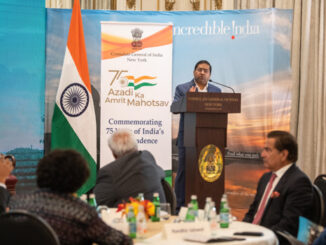
    NEW YORK CITY (TIP): The Consulate General of India in New York, in collaboration with Plaksha University, U.S.-India Strategic Partnership Forum (USISPF), and Indiaspora, organized a thought-provoking Panel Discussion on the topic “Reimagining STEM Education and Research in India” on October 12. The event emphasized the critical need to transform STEM education in India and explored opportunities for collaboration between Indian and US educational institutions. Plaksha University is a not-for-profit private research university situated in Mohali, Punjab, India. Founded by visionary businessmen and tech entrepreneurs from India and USA. Plaksha University is dedicated to creating a revolutionary higher education model that combines academic excellence with industrial relevance.

    At the event, Mr. Neeraj Aggarwal, Chair of the Board of Trustees at Plaksha University and Chair for Asia Pacific at the Boston Consulting Group, moderated the panel discussion. Esteemed panelists included Prof. S. Shankar Sastry, Founding Chancellor of Plaksha University and NEC Distinguished Professor of Electrical Engineering and Computer Sciences at the University of California, Berkeley; Ms. Chandrika Tandon, Founder and Chair of Tandon Capital Associates, and Chair of the Board at NYU Tandon School of Engineering; and Mr. Mukesh Aghi, President and Chief Executive Officer of the USISPF.

    During the discussion, panelists shared their insights on promoting STEM education in India and expanding opportunities for diverse STEM-related courses. The event highlighted the possible ways to reshape the educational landscape and foster greater collaboration between educational institutions in India and the United States. Consul General Mr. Randhir Jaiswal, addressing the attendees, expressed the importance of such initiatives in strengthening the knowledge & research ties between the two nations and fostering innovation and excellence in STEM education. The event marked a significant step toward redefining the future of STEM education in India and fostering international partnerships that will contribute to the advancement of knowledge and skills in science, technology, engineering, and mathematics.

    A view of the attendees.
  • Sikh mayor of Hoboken city in New Jersey gets letters threatening to kill him, family

    Sikh mayor of Hoboken city in New Jersey gets letters threatening to kill him, family

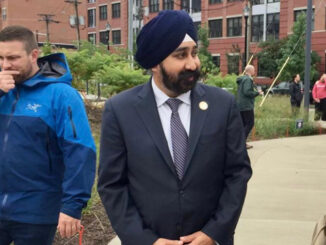
    HOBOKEN, NJ (TIP): The Indian-origin Sikh mayor of Hoboken city in the US state of New Jersey has opened up about being the target of a series of letters that threatened to kill him and his family. The letters, which he received last year, first called on Hoboken Mayor Ravi Bhalla, who is a practicing Sikh, to resign, but then began threatening his and his family’s life, targeting him for his Sikh faith, CBS News reported on Tuesday, October 17.

    Bhalla, however, told CBS News in an interview that he and his family were standing strong and that hate was not welcome in his city.

    Bhalla, who was first elected for the post of Hoboken mayor in 2017, said: “I’m very proud to lead this city as an American of Sikh background.” He won again in 2021 after running unopposed.

    For a man who always wears his turban with pride, Bhalla said he had been the target of threatening messages. “Our family began receiving a series of letters in the mail,” he said. The first, more than a year ago, asked him to resign, and then a second letter threatened his life.

    “The third threat, the most jolting, came soon thereafter and said, ‘This is your last warning. If you don’t resign immediately, we will kill you, we’ll kill your wife, we’ll kill your children,” he recounted. One letter read: “It’s time to kill you.” “There was a lot of angst, anger, a lot of hate, combined with actual threats upon my life and the life of my children and my wife,” Bhalla said.

    It was enough for law enforcement agencies to provide the mayor with 24-hour security, including for his two children at school. “My biggest concern was for my kids. I signed up to be mayor, but my kids didn’t sign up to this type of behavior,” Bhalla said.

    Bhalla said during the same time he was receiving these threatening emails, his neighbors, his brother and a few city colleagues began receiving packages with sexually explicit and threatening materials. He said the person responsible for those was caught and charged, but the person behind the threatening letters is still out there. Bhalla is well aware of the backlash Sikh-Americans endured after 9/11.

    “As a Sikh-American, I’m a proud American and I want people to be treated equally,” Bhalla said in response to a question on his experience as a Sikh politician 22 years after the attack that shook the entire country. “There still is a strain of extremism in America, and it’s just unfortunate to see that small strain is somewhere in Hoboken, as well. And I think that’s what needs to be called out and that’s what people need to know about so that we can eventually put an end to it through education and through love,” he said.
    (Source: PTI)

  • Assemblywoman Jenifer Rajkumar mourns the tragic death of School Crossing Guard Krystyna  Naprawa

    Assemblywoman Jenifer Rajkumar mourns the tragic death of School Crossing Guard Krystyna Naprawa

    QUEENS, NY (TIP): Assemblywoman Jenifer Rajkumar released a statement on the tragic incident this morning in which school crossing guard Krystyna Naprawa was fatally struck by a truck at Woodhaven Boulevard and Atlantic Avenue. Assemblywoman’s statement read : “I spoke with 102nd Precinct Commanding Officer Jeremy Kivlin about the tragic incident this morning in which school crossing guard Krystyna Naprawa was fatally struck by a truck at Woodhaven Boulevard and Atlantic Avenue. Ms. Naprawa was a beloved member of the community who devoted her life to the safety and education of our children. I am here for her family and offer them any help they need in this time of grief. I will continue to be in touch with the 102nd Precinct, Police Commissioner Edward Caban, and Transportation Commissioner Ydanis Rodriguez about this incident, and investigate the need for any safety upgrades to improve visibility at this dangerous intersection.”

  • UN Secretary-General Antonio Guterres appeals for aid trucks to be allowed into Gaza

    UN Secretary-General Antonio Guterres appeals for aid trucks to be allowed into Gaza

    Egyptian state-linked broadcaster Al Qahera News said the Rafah border crossing – the only one in and out of besieged Gaza not controlled by Israel

    UNITED NATIONS (TIP): Israeli authorities announced plans to evacuate the northern city of Kiryat Shmona on Friday, October 20,  after days of clashes with Hezbollah fighters along the border with Lebanon. “A short while ago, the Northern Command informed the mayor of the city of the decision. The plan will be managed by the local authority, the Ministry of Tourism and the Ministry of Defense,” the Israeli military said in a statement.

    President Joe Biden on Thursday, October 19,  said Hamas and Russia are both out to “annihilate” democracies in an impassioned speech to the nation from the Oval Office, where he made the case for U.S. assistance to Ukraine and Israel. Mr. Biden exhorted the U.S. Congress to approve urgent military support for Israel and Ukraine, saying the aid would boost U.S. security “for generations.” Meanwhile, Palestinians in war-torn Gaza on Thursday, October 19,  eagerly awaited the arrival of aid trucks promised in a deal struck by U.S. President Joe Biden, as Israel’s military kept up its bombardment of targets in the Hamas-run enclave.

    Egyptian state-linked broadcaster Al Qahera News said the Rafah border crossing — the only one in and out of besieged Gaza not controlled by Israel — would open on Friday, October 20.

    Gaza has been hit by a relentless barrage of Israeli fire in retaliation for a Hamas militant attack on October 7, which Israel said killed at least 1,400 people, most of them civilians.

    (With inputs from Agencies)

  • Biden requests $105 billion in emergency funds for Israel, Ukraine and other crises

    Biden requests $105 billion in emergency funds for Israel, Ukraine and other crises

    WASHINGTON, D.C. (TIP): The Biden administration formally asked Congress for $105 billion in emergency funding on Friday, including $10.6 billion in military support for Israel and $61.4 billion to continue providing weapons and economic assistance to Ukraine as it battles Russia, New York Times reports. The request also includes about $9 billion in humanitarian assistance for Israel, Gaza and Ukraine.

    “These conflicts can seem far away,” Jake Sullivan, the national security adviser, said in a call with reporters Friday, October 20  morning. “But the outcome of these fights for democracy against terrorism and tyranny are vital to the safety and security of the American people.”

    The fate of the funding request in Congress is likely to be a test of the argument for global engagement that President Biden made to the American people in a speech to the nation Thursday night. In that address, he said that coming to the aid of allies, even when expensive, will “pay dividends for American security for generations.”

    But Mr. Biden’s request comes as House Republicans struggle to pick a speaker, leaving Congress unable to act. And it already faces deep skepticism from some members in both parties who have raised doubts about the about the need for the United States to provide military assistance to either Ukraine or Israel.

    Anticipating those criticisms, Mr. Sullivan said the conflicts raging in Europe and the Middle East demonstrate why “we need Congress to urgently pass a budget that meets America’s national security needs and those of our critical partners.”

    The funding request included $12 billion for more agents and facilities along the U.S. border with Mexico, and $7.4 billion for security to support Taiwan and other allies in the Indo-Pacific.

    Administration officials said the $10.6 billion in security aid for Israel will be used primarily to enhance that country’s air and missile defense abilities, such as the Iron Dome system, and to restock American supplies after sending ammunition and equipment to Israel. An additional $3.7 billion will be used to enhance security at the American embassy in Israel, officials said.

    Shalanda Young, the director of the Office of Management and Budget, said some of the administration’s request for $9 billion in humanitarian aid would be used to help the victims of the violence in Israel and Gaza.

    “You’ve already seen a commitment from this administration in making sure humanitarian aid gets to those in Gaza,” she said. “That aid will continue robustly as Congress funds more humanitarian aid.”

    The administration’s request for Ukraine would be in addition to the $113 billion in assistance that the United States already has provided to that country since Russia’s full-scale invasion.


    Mr. Sullivan said that the money for Ukraine is necessary to help that country’s military advance on the battlefield even as winter arrives and as Russian forces attempt an offensive.


    “We have to send the unmistakable message that in the 21st century, a dictator cannot be allowed to conquer or carve up his neighbor,” Mr. Sullivan told reporters, in reference to President Vladimir V. Putin of  Russia.

  • Hardeep Nijjar’s killing: Australian intel chief says ‘no reason to dispute’ Canadian PM Trudeau’s claim

    Hardeep Nijjar’s killing: Australian intel chief says ‘no reason to dispute’ Canadian PM Trudeau’s claim

    MELBOURNE (TIP): Australia’s domestic intelligence chief has said that he has “no reason to dispute” Canadian PM Justin Trudeau’s claim of the Indian government’s role in the killing of Sikh separatist Hardeep Singh Nijjar in June this year, according to IANS. The accusations, which came last month, kicked up a diplomatic row between India and Canada with both nations expelling a diplomat each and New Delhi dismissing the claims as “absurd”.

    Australian Security Intelligence Organisation (ASIO) Director General Mike Burgess told ABC News channel that “it is a serious allegation” and he would have “no reason to dispute what the Canadian government said in this matter”.

    “There’s no doubt any allegation of any country being accused of carrying out an execution of a citizen in that country, it’s a serious allegation, and something that we don’t do and something that nations should not do,” he said.

    Burgess’ comments came in California where he was present for a public gathering of Five Eyes intelligence partners, which includes Australia, US, UK, Canada, and New Zealand as its members.

    The intelligence chief did not confirm whether the issue was being discussed at the gathering but a national security source told ABC that Burgess was briefed on the matter before last month’s G20 summit in New Delhi.

    Quoting Western-allied officials, The New York Times reported last month that US intelligence agencies provided information that led Canada to hold India responsible for Nijjar’s killing.

    After claiming that Indian agents played a role in the murder of its citizen Nijjar on Canadian soil, Trudeau has called on India to cooperate on the investigation, and said that he shared evidence on killing with India before going public with his claims.

    “Whether or not it will happen here, I wouldn’t publicly speculate, I don’t think that’s appropriate,” Burgess said when asked if Australia could be the next target for Indian agents.

    “I can assure you that when we find governments interfering in our country, or planning to interfere in our country, we will deal with them effectively,” he told ABC. The Khalistan menace picked up in Australia beginning this year with close to half-a-dozen Hindu temples being attacked in quick succession, leaving the Indian community, which forms three per cent of the country’s population, enraged, scared and dismayed.

    In the month of January alone, between 12 to 23, three Hindu temples in Melbourne were defaced with anti-India graffiti and pro-Bhinderanwale slogans by Khalistani supporters, and later, temple priests received threatening calls to raise ‘Khalistan Zindabad’ slogans. Indians were attacked with sticks at the Federation Square in Melbourne during a referendum call in January this year by banned Khalistan outfit, Sikhs For Justice (SFJ). Sikhs number over 2,10,000 and account for 0.8 per cent of Australia’s population as of 2021, forming the country’s fifth-largest and fastest-growing religious group. A small but influential number of Sikhs support the idea of Khalistan, but politically, it has found little support.

    (Source: IANS)

  • Consul General of India at New York Randhir Kumar Jaiswal  has been appointed  Spokesperson of Ministry of External Affairs

    Consul General of India at New York Randhir Kumar Jaiswal  has been appointed  Spokesperson of Ministry of External Affairs

    • I.S. Saluja

    NEW YORK (TIP): Randhir Kumar Jaiswal, currently Consul General of India at New York,  will succeed the current MEA spokesperson, Arindam Bagchi, who has been appointed as the next Ambassador/Permanent Representative of India to the United Nations and other International Organizations in Geneva.

    A 1998 batch Indian Foreign Service (IFS)  officer, Mr. Jaiswal, during his diplomatic career spanning two decades, has served with distinction in various capacities within and outside India.

    In  India, he served in the external affairs ministry as  deputy secretary, looking after relations with the US and as joint secretary managing ties with countries in western Europe. In mid-2017, he was deputed to serve the President of India as the joint secretary responsible for international relations. His assignments abroad took him to Portugal, Cuba, South Africa and New York at  India’s permanent mission to the UN. He was appointed Consul General at  New York in July 2020. Mr. Jaiswal has also been part of the Indian delegation at climate change conferences.

    Speaking with The Indian Panorama, Mr. Jaiswal said he was very much excited to have been appointed to a challenging position and was looking forward to assuming the charge soon.

    During the three years that Mr. Jaiswal has been in New York as Consul General, he is credited with introducing systems within the Consulate to ensure ease for everyone seeking consular services. From cutting down  wait time to quick resolution of people’s problems,  he ensured people got satisfactory services. Also, he made the Consulate a welcoming place to all sections of people who organized various types of events aimed at promoting fraternity, cultural values, education, information, trade and commerce, etc.

    Mr. Jaiswal worked tirelessly across the ten States in his jurisdiction to introduce the best of India  and to promote better and  stronger  ties between Indian Americans and the non-Indian Americans in almost every sphere. His outreach to American lawmakers, intellectuals, professionals , businesses contributed a lot to a better understanding about India and promoted better relationship  between them and the Indian American community.  People are surely going to miss him. But, as they say, somebody’s loss is somebody’s gain.

  • As Ukraine war drags on, US arms firms make a killing

    As Ukraine war drags on, US arms firms make a killing

    The US sold military hardware, services and technical data to its clients worth $153.7 bn in 2022, up from $103.4 bn the year before.

    “With the deterioration of global security, particularly after the commencement of the Ukraine war, US arms sales have been on the rise. Last year, US defense companies reaped huge dividends selling their weapons and defense platforms to their clients in Asia, Europe and Africa. Latest data shows that 2022 saw an increase of $51.9 billion in the sale of weapons. Most of it is largely due to the Russia-Ukraine war, where the US is backing Ukraine.”

    By Maroof Raza

    Russian President Vladimir Putin made a candid admission at Sochi in June. He acknowledged that Moscow’s troops were experiencing a shortage of modern weapons and expressed hope that the country’s military industry would soon be able to meet their growing demand amid the Ukraine war. One of the critical reasons for the shortage is the global sanctions that have imposed curbs on the acquisition of sophisticated parts used in the production of a variety of weapons and their auxiliary systems. This has led to a shortfall of main battle tanks and ballistic missiles. Besides, using cruise missiles is a costly affair. Thus, the recent visit by North Korean leader Kim Jong Un to Russia attracted much attention. Apart from North Korea, Russia is getting help from Belarus, China and Iran in maintaining its ammunition stocks.

    Manned and unmanned aircraft, missiles and electronic warfare equipment require modern, high-tech components such as microchips and ball bearings. Russia faces challenges in sourcing these components adequately from domestic suppliers and importing them — as it did before the present conflict — from North America and Europe due to the sanctions. Now, Russia is forced to replace imports of critical components with supplies from China or Malaysia, which do not match the quality standards of those from the West. Another significant reason for Moscow’s urgent need to go shopping for ammunition from sources other than the usual ones is the extensive and disproportionate use of artillery by the Russian military.

    Swarms of Shahed 136 drones have been supplied to Moscow from Iran, and these have wreaked havoc on Ukrainian cities. China has repeatedly denied sending military equipment to Russia since Moscow’s all-out invasion of its neighboring country, even though the two nations signed a ‘no-limits’ partnership in February 2022. The US Secretary of State, Antony Blinken, warned China earlier this year that there would be ‘consequences’ if Beijing were to provide materiel support to Russia for its conflict in Ukraine.

    Russia can also fall back on its ammunition stocks and older weapon systems from the Cold War era. Battlefield losses and Western sanctions have left the Russian military in a state of decline, but Moscow will still have enough firepower to extend the war in Ukraine, according to the Centre for Strategic and International Studies (CSIS). It gives stark numbers of Russian military losses — almost 10,000 units of key equipment, such as tanks, trucks, artillery pieces and aerial drones, according to one estimate.

    But it also says that Russia can utilize Cold War-era and older stocks on the frontlines to make up in numbers what it may have lost in terms of technology. “The quality of the Russian military in terms of advanced equipment will likely decline, at least over the near term,” the CSIS report says. “Moscow is under pressure to adapt, often turning to less-reliable and costlier suppliers and supply routes, lower-quality imports, or trying to reproduce Western components internally. This is likely hampering the rate and quality of Russian defense production,” the report says.

    It cautions that Ukraine and its Western supporters should not expect a swift resolution to the hostilities due to these supply issues. Russia still retains numerical advantages over Ukraine, the report adds, because it has large inventories in reserve. “Russia’s military capabilities still greatly outnumber those of Ukraine on most indicators of air, land and naval power,” the report says.

    “While an accurate count of Moscow’s current military stocks is not available publicly, it has been roughly estimated that, as of February 2023, the total number of aircraft at the Kremlin’s disposal has been 13-15 times more than Kyiv’s. Russia has nearly seven to eight times more tanks and four times more armored fighting vehicles, while its naval fleet is 12-16 times larger than Ukraine’s,” it says. These numerical advantages will enable Moscow to run a war of attrition over the next year, throwing numbers on the battlefield until Ukraine, even with fewer losses, runs out of hardware, the report observes.

    While Russia’s military-industrial complex is struggling, its US counterpart is reaping the benefits. This can be ascertained by a recent report published by the Congressional Research Service (CRS) titled, ‘US Security Assistance to Ukraine’. The United States has been a leading provider of security assistance to Ukraine, particularly since Russia launched its renewed and expanded invasion of Ukraine on February 24, 2022. From 2014, when Russia first invaded Ukraine, to August 22, 2023, the US has committed more than $46 billion in security assistance “to help Ukraine preserve its territorial integrity, secure its borders and improve interoperability with NATO”, according to the State Department.

    With the deterioration of global security, particularly after the commencement of the Ukraine war, US arms sales have been on the rise. Last year, US defense companies reaped huge dividends selling their weapons and defense platforms to their clients in Asia, Europe and Africa. Latest data shows that 2022 saw an increase of $51.9 billion in the sale of weapons. Most of it is largely due to the Russia-Ukraine war, where the US is backing Ukraine.

    Several European countries have started arming themselves as they perceive a threat from Russia. American defense companies are on a high. They have received new orders for military equipment as these nations strengthen their defenses. As the data shows, the US sold military hardware, services and technical data to its clients worth $153.7 billion in 2022, up from $103.4 billion the year before. The State Department data claims that the increase in the sale of defense products is attributed to the crisis in Ukraine, where the US government has authorized massive supplies. The Ukraine war has also caused huge insecurity among European nations like Germany, Poland and Spain, which have started arming their defense forces, fearing the unintended consequences of this long-drawn-out war could very well spill over to their borders.
    (The author is a Strategic Affairs Analyst)

  • Prioritizing America: The Non-Desirability of American Intervention in Foreign Conflicts

    Prioritizing America: The Non-Desirability of American Intervention in Foreign Conflicts

    The non-desirability of American intervention in foreign conflicts must be viewed through the lens of prioritizing the American people and making the nation stronger. The costs of military interventions, both in terms of finances and human lives, are staggering. These resources could be better used to address pressing domestic needs and improve the well-being of American citizens.

    By Prof. Indrajit S. Saluja

    American foreign policy has long been a subject of debate, and one of the most contentious issues is the desirability of American intervention in conflicts abroad. While the United States has a history of involvement in international affairs, it is crucial to question whether such interventions are truly in the best interest of the American people and the nation as a whole.

    The Cost of Foreign Interventions

    One of the most significant arguments against American intervention in foreign conflicts is the tremendous financial burden it places on the nation. The cost of deploying troops, maintaining military bases, and funding foreign aid programs in conflict zones is exorbitant. These expenses divert resources from critical domestic needs, such as healthcare, education, infrastructure, and social welfare programs. The American people should rightfully question whether such financial resources could be better allocated to address pressing domestic issues.

    Furthermore, the human cost of intervention cannot be overlooked. American servicemen and women face physical and psychological trauma, and many make the ultimate sacrifice on foreign soil. The toll on military families and the broader community is immeasurable. Prioritizing the American people means considering the physical and emotional well-being of those who serve and their families.

    Undermining National Sovereignty

    Another critical issue is the potential erosion of national sovereignty that can occur through foreign interventions. When the United States intervenes in another country’s conflict, it often requires the establishment of military bases and the deployment of troops. This can lead to the perception that the U.S. is imposing its will on other nations, which can breed resentment and fuel anti-American sentiment.

    Furthermore, interventions can disrupt the political stability of other countries, sometimes leading to unintended consequences, such as power vacuums, civil unrest, and terrorism. This, in turn, can pose security threats to the United States and its allies. By refraining from unnecessary interventions, America can maintain a strong stance on respecting the sovereignty of other nations and avoid unintended consequences that could harm its own interests. 

    The Efficacy of Nation-Building

    One of the justifications for American intervention in foreign conflicts has been the notion of nation-building. The idea is that by intervening in a conflict-ridden country, the United States can help establish a stable government and a more peaceful society. However, history has shown that nation-building is a complex and often unsuccessful endeavor.

    The American people should be concerned about the effectiveness of such endeavors. From Afghanistan to Iraq, and other examples, the track record of nation-building is mixed at best. The enormous resources expended in these efforts often yield limited results, and long-term stability remains elusive. American intervention can inadvertently create more problems than it solves, potentially dragging the nation into protracted conflicts that sap resources and erode national prestige.

    Shifting Focus to Diplomacy

    Rather than relying on military intervention as a primary tool of foreign policy, the United States should place greater emphasis on diplomacy and international cooperation. Diplomatic efforts, such as negotiation, sanctions, and international alliances, can often achieve the same goals without the costly and destructive consequences of military intervention.

    Promoting diplomacy is not only more cost-effective but also better aligns with American values and ideals. It demonstrates a commitment to peaceful resolution of conflicts and a respect for international law. By prioritizing diplomacy, the United States can strengthen its diplomatic corps, enhance its soft power, and foster positive relationships with other nations. This approach not only serves the American people by reducing the human and financial costs of intervention but also enhances the nation’s global standing. 

    Blowback and Anti-American Sentiment

    American intervention in foreign conflicts often results in blowback, where unintended consequences have a negative impact on U.S. interests. For instance, the United States’ involvement in the Soviet-Afghan War in the 1980s led to the rise of extremist groups, including al-Qaeda. The consequences of such actions can reverberate for years, posing threats to national security.

    Furthermore, American intervention can breed anti-American sentiment in the countries where it occurs and around the world. This sentiment can fuel recruitment for extremist groups and make it more difficult for the United States to build positive relationships with foreign nations. Prioritizing the American people means considering the long-term consequences of intervention and minimizing the risks of blowback.

    Resource Reallocation and National Priorities

    The United States faces a multitude of domestic challenges that require significant attention and resources. These challenges include healthcare reform, infrastructure investment, environmental sustainability, education, and economic inequality. Focusing on these domestic priorities is essential for ensuring the well-being of the American people and the strength of the nation.

    By reducing foreign interventions, the government can reallocate resources to address these pressing issues. This not only improves the quality of life for American citizens but also bolsters the nation’s resilience and stability. A strong nation is one that can effectively address the needs of its citizens, and this can be achieved by shifting resources from foreign interventions to domestic priorities. 

    The Role of International Institutions

    Another approach to addressing global conflicts while avoiding direct American intervention is to strengthen international institutions and cooperation. The United Nations and other international organizations provide avenues for multilateral solutions to global problems. By investing in and reforming these institutions, the United States can play a leadership role in fostering peaceful and diplomatic resolutions to conflicts without resorting to unilateral military action.

    Strengthening international institutions also aligns with the principle of shared responsibility. It ensures that the burden of addressing global challenges is distributed among many nations rather than being shouldered solely by the United States. This approach is more cost-effective, reinforces America’s global leadership, and is consistent with prioritizing the American people and the nation’s interests.

    Lessons from History

    History provides valuable lessons on the non-desirability of American intervention in foreign conflicts. Examples such as the Vietnam War, where the U.S. became deeply entangled in a costly and protracted conflict with minimal gains, should serve as cautionary tales. It took decades for the United States to recover from the psychological, financial, and social scars of this conflict.

    Similarly, the Iraq War in the early 2000s had far-reaching consequences, including destabilizing the Middle East and straining international relations. It demonstrated the perils of acting on incomplete or inaccurate information and highlighted the need for a more prudent and deliberative foreign policy.

    The non-desirability of American intervention in foreign conflicts must be viewed through the lens of prioritizing the American people and making the nation stronger. The costs of military interventions, both in terms of finances and human lives, are staggering. These resources could be better used to address pressing domestic needs and improve the well-being of American citizens.

    (The author is chief editor of The Indian Panorama)


  • Dr. Manohar Singh Gill, a doyen of Punjab and Punjabiyat

    Dr. Manohar Singh Gill, a doyen of Punjab and Punjabiyat

    By Prabhjot Singh

    Manohar Singh Gill, Former chief election commissioner and Union Minister of State has passed away. He was admitted to Max Hospital, New Delhi where he breathed his last on October 15. He was a doyen of Punjab and Punjabiyat. Farmers and farming were very dear to his heart. It was he who conceptualized “Apni Mandi”, a marketplace, where farmers could bring and sell their produce directly to the consumers thus eliminating the commission agents. Once introduced, it spread rapidly and neighboring State of Haryana and the Union Territory of Chandigarh, too, adopted it.

    At a meeting in New Delhi. (L to R): MS Gill, PC Alexander, Atal Behari Vajpayee and Vilasrao Deshmukh. (File Photo : Indian Express)

    The man, Dr Manohar Singh Gill, a hardcore bureaucrat, lived 87 years of distinguished life, getting into prestigious Indian Administrative Service (IAS) at the age of 22. After superannuating from the elite central civil service, he was appointed Chief Election Commissioner. He was the pioneer of introducing Electronic Voting Machines (EVMs) besides the first CEC to head a team of Election Commissioners.

    Earlier in his career, he was Deputy Commissioner, Lahaul and Spiti, in undivided Punjab. It was here, he fell in love with the hills and mountaineering. He later served as Principal Secretary to the longest serving Punjab Chief Minister Parkash Singh Badal and Development Commissioner, Punjab. He held several other important positions, both in Punjab and at the Centre.

    It was not the end of his long-distinguished career. He joined Indian National Congress and served two terms as Member of Upper House of Parliament, Rajya Sabha. When India played host to the 2010 World Cup Hockey and the Commonwealth games in New Delhi the same year, he was then Union Minister for Youth Affairs and sports. It was under his supervision that all stadia, including the historic Major Dhyan Chand National Hockey Stadium, were renovated in time for the two major sporting events held within a single calendar year.

    Dr Manohar Singh Gill came from the Majha region of Punjab. His father, Colonel Partap Singh Gill (retd), was a great admirer of JP Narayan. And when the first non-Congress government was formed at the Centre under Morarji Desai, he was appointed Lieutenant-Governor of Goa. After his stint in Goa, Colonel Gill came and settled in Chandigarh. It was he who thought of uniting hundreds and thousands of families separated by the 1947 partition. Since the then Prime Minister of Pakistan, Nawaz Sharief, originally belonged to Taran Tarn – Jatti Umrah was his native village – Colonel Gill floated Jatti Umrah Parivar Milap Trust. On getting in touch with Nawaz Sharief, he started working on families that had suffered the pangs of partition. On completion of 50 years of Independence. Colonel Gill, with all back up support from his elder son, Dr Manohar Singh Gill, took a delegation to Pakistan to reunite 20-odd families after an agonizing and unending wait of 50-odd years. The delegation went as personal guests of Pakistan PM Nawaz Sharief.

    Like his father, Punjab and Punjabiyat were very dear to Dr Manohar Singh Gill. Not only Apni Mandi, but he also initiated several schemes, both as a bureaucrat and later as a Rajya Sabha member for the welfare of farming community of Punjab. He played a stellar role in the development of Khadoor Sahib, a Sikh historic town in the Majha region. As a Union Sports Minister, he sanctioned a couple of synthetic hockey surfaces for the border belt as hockey remained a major sport in the region. His initiative helped young girls to take to competitive hockey well.

    Former Chief Election Commissioner Manohar Singh Gill inaugurates a library set up in the memory of Saadat Hasan Manto, at Paproudi village in Samrala, Punjab. (File photo : Tribune)

    And not many would know that Baldev Singh, who rose to the fame by producing a record of women and men hockey Olympians from a sleepy town of Shahabad Markanda on the Amritsar-Kolkata National Grand Trunk Road, was chosen for the prestigious Dronacharya award even without his applying for it. Dr Gill told Baldev Singh that he had been following his work and was highly impressed. Baldev Singh still recalls his meetings with Dr Gill saying that he would not have applied for or got the award but for Dr Gill.

    Dr Gill was so attached to anything that was close to the hearts of Punjabis. When Punjab decided to organize the World Cup Kabaddi championships, he did not like the new rules. “There is no Kabaddi until the raider keeps chanting kabaddi, kabaddi till the break of his breath,” lamented Dr Gill as the game does not require “kabaddi, Kabaddi” chants anymore.

    He was a vociferous supporter of solving Punjab problems, including Rivers Water dispute through a dialogue or negotiations than taking the matter for legal adjudication. He vehemently criticized the reorganization of Punjab as he felt many speaking areas were left out of the 1966 partitioning of Punjab.

    He was a scholar as he used to read and write a lot. Many, while praising his uprightness and initiative in promoting Punjab and Punjabiyat thought he was too strong and outspoken and lived to the adage “while getting things done, I do not listen to anyone”. And this applied to his political career also. He would speak out his mind even if his comments were contrary to the party line on sensitive policy matters. But that was the way Dr Manohar Singh Gill was.

    (The author is a senior journalist. Read his columns at www.probingeye.com
    https://www.facebook.com/PrabhjotSingh.Journalist/?ref=pages_you_manage)

  • Embassy of India in Guatemala Celebrates Gandhi Jayanti and UN International Day of Non-Violence on 2nd October 2023

    Ambassador Dr. Manoj Kumar Mohapatra delivered a keynote address highlighting the enduring legacy of Mahatma Gandhi

    GUATEMALA CITY (TIP): The Embassy of India in Guatemala marked the occasion of Gandhi Jayanti, and the United Nations International Day of Non-Violence on 2nd October 2023. The event was held at the Embassy premises in Guatemala City, where Ambassador Dr. Manoj Kumar Mohapatra, members of the Indian community, and embassy officials came together to pay tribute to the Father of the Nation, Mahatma Gandhi.

    Gandhi Jayanti, celebrated annually on October 2nd, marks the birth anniversary of Mahatma Gandhi, a global symbol of peace and non-violence. The day is also observed as the UN International Day of Non-Violence, reaffirming the universal relevance of Gandhi’s principles of truth, tolerance, and non-violence in promoting a culture of peace and understanding. Mahatma Gandhi, referred as the “Father of the Nation” in India, played a pivotal role in India’s struggle for independence from British colonial rule. His life was a testament to his unwavering commitment to truth, non-violence, and social justice. Gandhi’s philosophy of non-violence, known as “Satyagraha,” inspired millions and became a powerful tool for social and political change.

    Ambassador Dr. Manoj Kumar Mohapatra delivered a keynote address highlighting the enduring legacy of Mahatma Gandhi and India’s contributions to the world in politics, trade, and tourism. He emphasized the relevance of Gandhi’s teachings in today’s world, emphasizing the importance of non-violence, tolerance, and harmony in resolving global conflicts. Mr. Harshu Patel, a prominent member of the Indian community, delivered a heartfelt speech underscoring the profound impact of Gandhi’s philosophy of non-violence. He stressed that Gandhi’s teachings continue to inspire people around the world to work towards a more peaceful and just society.

    Floral tribute led by Ambassador Dr. Mohapatra, members of the Indian community, and embassy officials at the statue of Mahatma Gandhi

    The event included a floral tribute led by Ambassador Dr. Mohapatra, members of the Indian community, and embassy officials at the statue of Mahatma Gandhi. This gesture symbolized the reverence and respect held for Gandhi’s ideals of peace and non-violence. A cultural program was organized as part of the celebration, featuring captivating performances by Mr. Javier Anand who played ‘Vaishnav Jan to Tene kahiye’, a mesmerizing favorite Bhajan of Mahatma Gandhi.

    Mr. Javier Anand played Vaishnav Jan to tene kahiye….., Bapu’s favorite song, to pay tribute to Mahatma Gandhi on his 154th birth anniversary.

    Ambassador Dr. Mohapatra expressed his gratitude to the Indian community in Guatemala for their active participation and support in commemorating this significant day. He highlighted the role of Mahatma Gandhi as a guiding light not only for India but for humanity as a whole.

    Dr. Shobhana Radhakrishna, a globally recognized speaker on Mahatma Gandhi’s principles, delivered a virtual lecture titled Mahatma Gandhi’s Transformational Leadership – An Inspiration for World Peace.

    In commemoration of Mahatma Gandhi’s Birth Anniversary, the Embassy conducted a series of seminars in collaboration with San Carlos University, the largest university in Central America. Dr. Shobhana Radhakrishna, a globally recognized speaker on Mahatma Gandhi’s principles, delivered a virtual lecture titled “Mahatma Gandhi’s Transformational Leadership – An Inspiration for World Peace.” This enlightening seminar drew extensive virtual participation, including students, faculty members, prominent figures from Guatemala, and members of the Indian community. It served as a platform to reflect on the enduring significance of Gandhi’s teachings in fostering global peace and non-violence.

    Mr. Harshu Patel, a prominent member of the Indian community, delivered a heartfelt speech underscoring the profound impact of Gandhi’s philosophy of non-violence.

    The celebration of Gandhi Jayanti and the UN International Day of Non-Violence is a testament to the enduring impact of Mahatma Gandhi’s teachings, which continue to resonate with people worldwide. As the world faces numerous challenges, the principles of non-violence, truth, and tolerance championed by Gandhi serve as a source of inspiration and a path toward a more peaceful and harmonious world.

  • Embassy of India in Guatemala Celebrates Hindi Diwas

    Embassy of India in Guatemala Celebrates Hindi Diwas

    GUATEMALA CITY (TIP): The Embassy of India in Guatemala celebrated Hindi Diwas with remarkable zeal and enthusiasm, fostering the rich cultural tapestry of India on 14 October 2023. The event was a resounding success, with a diverse array of participants, including local Guatemalan nationals, showcasing their passion for the Hindi language. Hindi is an Indo-Aryan language spoken by over 260 million people around the world, making it one of the most spoken languages in the world. Hindi Day, observed annually on September 14, is a significant occasion for the promotion of India’s national language and the culture it represents. This day is celebrated in India and around the world by Hindi speakers and enthusiasts as an opportunity to promote the language and its literature. The celebration of Hindi Diwas has its roots in the early 20th century when Hindi was first recognized as an official language of India. In the years following independence, Hindi speakers around the world began to celebrate the language and its culture. Like many other languages, Hindi possesses a unique scientific and linguistic heritage. Hindi, an Indo-Aryan language, has a well-defined linguistic structure. It has a rich vocabulary, extensive grammar rules, and a clear phonetic system.

    Indian community members and local Guatemalan participants enthusiastically participated in various Hindi Diwas Competitions.

    The Embassy of India in Guatemala consistently organizes a series of events to celebrate Hindi Day, with activities that promote the Hindi language and Indian culture. This year was no exception, as the Embassy conducted various competitions and events. Among the activities organized, the Embassy hosted an essay writing competition (Nibandh Lekhan), where participants submitted their entries online. Additionally, the Embassy conducted events for Hindi writing (Sulekh) and poem recitals (Kavita Path). These events were not only well-received by the Indian community but also garnered an exceptional response from the local Guatemalan population. The enthusiasm displayed by the local Guatemalan participants in the Hindi writing competition was particularly remarkable. It is a sign of growing interest in Hindi language and Indian culture in the region.

    Distinguished guests at the celebration, including notable figures from Guatemalan society like Congressman H.E. Manuel Conde, Congressman H.E. Herbert Figueroa, Congressman H.E. Estuardo Rodríguez Azpuru, Mayor of San Juan Sacatepequez H.E. Juan Carlos Pellecer, Ms. Silvia Estefanía Moscoso Arana Director CONJUVE and Ms. Carmen Reyes Director SOSEP shared their views on the value of Hindi as a language of heritage, culture, and communication. They appealed for the continued promotion and preservation of Hindi both in India and Guatemala.

    Winners from Indian community members in Guatemala receiving their certificates from Ambassador H.E. Dr. Manoj Kumar Mohapatra.

    The highlight of the event was Ambassador Dr. Manoj Kumar Mohapatra’s address, in which he emphasized the importance of Hindi as a unifying force in a diverse nation like India. He read the message by the Hon’ble Home Minister of India delivered on the occasion of Hindi Diwas. He stressed that the promotion and practical use of Hindi in official work should be encouraged. While acknowledging that extensive use of Hindi in a foreign Mission might be challenging, he emphasized the importance of using the language in administrative tasks. Ambassador Mohapatra encouraged the Guatemalan guests to explore the Hindi language, highlighting the benefits of being multilingual. He assured them of assistance, ranging from starting Hindi language classes to providing Hindi books for reading. He expressed his hope that more individuals would actively participate in various competitions organized during Hindi Diwas to promote the Hindi language. Prizes were awarded to the winners in different categories, highlighting the growing interest and proficiency in Hindi in Guatemala.

    Winners from local Guatemalan participants receiving their certificates from Ambassador H.E. Dr. Manoj Kumar Mohapatra.

    The Embassy’s commitment to organizing such events underscores its dedication to promoting Hindi and strengthening cultural ties between India and Guatemala. Hindi Day celebrations serve as a platform for people from diverse backgrounds to come together, share their love for the language, and learn more about India’s rich linguistic and cultural heritage. Hindi Diwas is also an opportunity for people around the world to learn more about the language and its culture. The Embassy of India in Guatemala remains committed to nurturing this linguistic and cultural connection for years to come. The Embassy of India in Guatemala expresses its heartfelt gratitude to all participants and attendees who made Hindi Day a resounding success. This celebration not only strengthens cultural ties but also enhances mutual understanding between the peoples of India and Guatemala.

  • PULITZER PRIZE WINNING JOURNALISM ICONS SHARE

    PULITZER PRIZE WINNING JOURNALISM ICONS SHARE

    • By Mabel Pais

    To celebrate the 50th anniversary of their landmark book, ‘All The President’s Men,’ the New Jersey Performing Arts Center (NJPAC) welcomes journalism icons Bob Woodward and Carl Bernstein, The Washington Post journalists for a conversation moderated by Jonathan Alter. ‘All The President’s Men,’ uncovered the real story behind the Watergate break-in and spurred Nixon’s resignation. Join these Pulitzer Prize winners for an evening of conversation in honor of the 50th anniversary of their landmark book on Thursday, Oct. 26, at 7:30 p.m.

    Bob Woodward and Carl Bernstein lead remarkable careers with decades of reporting experience in political news; they will share their stories and conversation about their newest books published just last year (Woodward’s ‘The Trump Tapes’ and Bernstein’s ‘Chasing History’). This will be more than a look back—a look ahead. What lessons did America learn (and forget) from Watergate, and what parallels do we see in the headlines today?

    In the early 1970s, Woodward and Bernstein broke the Watergate story for The Washington Post, leading to the resignation of President Richard Nixon. The story set the standard for modern investigative reporting, for which they and The Washington Post were awarded the Pulitzer Prize.

    Born and raised in the Chicago suburbs, Woodward has written 18 books, with 12 of them becoming No. 1 best-sellers, and serves as an associate editor for The Washington Post. Woodward was the primary reporter for the Post’s articles on the aftermath of the Sept. 11 terrorist attacks that won the National Affairs Pulitzer Prize in 2002. He won the Gerald R. Ford Prize for Distinguished Reporting on the Presidency in 2003.

    Bernstein, the author of five best-selling books, including biographies of Hillary Clinton and Pope John Paul II, also is an on-air contributor for CNN and a contributing editor of Vanity Fair magazine. In the late 1970s, Bernstein spent a year investigating the CIA’s secret relationship with the American press during the Cold War for a groundbreaking Rolling Stone article.

    TICKETS

    Reserve tickets to see Bob Woodward and Carl Bernstein on Thursday, Oct. 26 at 7:30 p.m. by visiting NJPAC.org or the NJPAC Box Office at 1 Center Street, Newark, New Jersey or calling 888. GO.NJPAC (888.466.5722).

    The New Jersey Performing Arts Center (NJPAC)

    Follow NJPAC Online:

    Website:   njpac.org

    Twitter:    @NJPAC

    Instagram: @NJPAC

    Hashtag:   #NJPAC

    Facebook:  facebook.com/NJPAC

    YouTube:   NJPACtv

    Follow NJPAC’s Standing in Solidarity Series Online:

    Website: njpac.org/takeastand

    Hashtag: #NJPACTakeAStand Youtube: Standing in Solidarity playlist

    ————————————————————————–

    MONTCLAIR FILM PRESENTS FILMMAKER TRIBUTE TO SCORSESE

    (left) Martin Scorsese & Stephen Colbert. (Photo Credit : NJPAC)
    • By Mabel Pais

    The Montclair Film Festival presents its 2023 Filmmaker Tribute to Martin Scorsese with Stephen Colbert hosting Mr. Scorsese on the Prudential Hall stage at the New Jersey Performing Arts Center (NJPAC) in downtown Newark, NJ on Friday, October 27, 2023 at 8:00 PM. They will sit down for an unforgettable evening of conversation celebrating Mr. Scorsese’s legendary career as one of the cinema’s greatest filmmakers.

    “Over the course of his career as a filmmaker, preservation advocate, and film historian, Martin Scorsese has made an unparalleled impact on the art of cinema” said Tom Hall, Co-Head and Artistic Director of Montclair Film. “To honor him with our festival’s 2023 Filmmaker Tribute is an absolute thrill, and we look forward to a delightful, celebratory evening of stories and conversation hosted by Stephen Colbert.”

    “All of us at NJPAC are delighted to partner with our friends at Montclair Film to host this extraordinary evening,” said John Schreiber, President and CEO of NJPAC. “Stephen Colbert’s insightful conversations with the artists who inspire us all have become an annual highlight of the Arts Center’s fall season, and this celebratory event with the inimitable Martin Scorsese promises to be especially exciting.”

    MARTIN SCORSESE

    Martin Scorsese is an Academy Award-winning Director and one of the most influential filmmakers working today. In 2007, his film ‘THE DEPARTED’ won an Academy Award for Best Director and Best Picture. Scorsese also directed ‘THE WOLF OF WALL STREET’ and ‘THE IRISHMAN,’ which both received Academy Award nominations for Best Director and Best Picture. His latest feature, ‘KILLERS OF THE FLOWER MOON’ made its World Premiere at the 2023 Cannes Film Festival and will be released exclusively in theaters worldwide October 20, 2023 before streaming globally on Apple TV+.

    Scorsese has directed numerous documentaries including the Peabody Award winning ‘NO DIRECTION HOME: BOB DYLAN,’ the Emmy Award winning ‘GEORGE HARRISON: LIVING IN THE MATERIAL WORLD,’ the Emmy nominated docuseries ‘PRETEND IT’S A CITY’ and the critically acclaimed feature docs ‘THE LAST WALTZ’ and ‘PERSONALITY CRISIS: ONE NIGHT ONLY.’

    STEPHEN COLBERT

    (Host, Executive Producer and Writer, ‘THE LATE SHOW with STEPHEN COLBERT’) Stephen Colbert hosts the Emmy and Peabody Award winning, #1 show in late night ‘The Late Show with Stephen Colbert.’ From 2005 to 2014, he hosted ‘The Colbert Report’ on Comedy Central, following his seven years as a correspondent on ‘The Daily Show.’

    In addition to ‘The Late Show,’ Colbert previously served as Executive Producer on several television shows. In 2021, Colbert’s Spartina Industries banner set a three-year first-look deal to develop television and streaming content for CBS Studios.

    Colbert has also authored five books, the most recent of which, ‘Whose Boat Is This Boat?,’ reached #1 on the New York Times Bestseller List.

    Follow him on Twitter and Instagram @StephenAtHome.

    TICKETS

    Tickets for the event are available online at njpac.org and ticketmaster.com, by telephone at 1-888-GO-NJPAC (1-888-466-5722), and at the NJPAC Box Office at One Center Street in downtown Newark.

    Montclair Film

    Connect with Montclair Film Online:

    Websites:    montclairfilm.org and theclairidge.org

    Twitter:      @MontclairFilm @TheClairidge

    Facebook:    facebook.com/MontclairFilm and /TheClairidge

    Instagram:  instagram.com /MontclairFilm and /TheClairidge

    YouTube:     youtube.com/montclairfilmfest

    (Mabel Pais writes on The Arts and Entertainment, Social Issues, Spirituality, Education, Cuisine, Health & Wellness, and Business)


  • ARTIS-NAPLES INVITES YOU TO 15TH ANNUAL FILM FEST

    • By Mabel Pais

    Artis-Naples, Florida presents for its 15th annual edition the Naples International Film Festival (NIFF), October 26-29, 2023.

    This year, NIFF will include 57 films (12 narrative features, 10 documentary features and 35 short films) representing eight countries, with several of those films including in-person post-screening filmmaker Q&A conversations. Select filmmakers will also participate in panel discussions during the festival. All screenings and associated events will be held in-person in Hayes Hall or Norris Garden on the Artis—Naples Kimberly K. Querrey and Louis A. Simpson Cultural Campus or at the festival’s new venue partner, Paragon Theaters – Pavilion.

    “We are thrilled to unveil this exceptional lineup of films that promises to captivate and inspire our audiences during the 15th anniversary of the Naples International Film Festival. These offerings are a testament to our unwavering commitment to the art of independent film and to the community,” said Artis—Naples CEO and President Kathleen van Bergen. “We have pulled out all the stops with this selection of films reflecting the diverse and compelling breadth of stories from around the world, and we are eager to share these cinematic treasures with our patrons.”

    “We strive every year to unite the world of cinema, the creativity of filmmakers and the enthusiasm of our audiences,” explained David Filner, executive vice president, artistic operations. “Whether we’re spotlighting documentaries that resonate with our artistic mission or sharing profound narratives about the highs and lows of life, NIFF is a unique forum where filmmakers and our vibrant community of cinephiles converge, embracing the multidisciplinary vision that defines Artis—Naples.”

    Themes for the Naples International Film Festival’s curated short film programs include True Stories, Family Affair, Journeys, Viewpoints, Unexpected Outcomes and the recurring Student Filmmaker Showcase.

    Films in the Naples International Film Festival’s competition categories will vie for more than $10,000 in cash prizes, including the Audience Awards for Best Narrative Feature, Best Documentary Feature and Best Short as well as the Focus on the Arts Award, given to a feature-length narrative or documentary film with an emphasis on one or more of the visual or performing arts. For the fifth consecutive year, NIFF will also present juried awards in the Narrative Feature and Documentary Feature categories.

    The 2023 Naples International Film Festival (NIFF) Film Lineup

    OPENING NIGHT FILM

    Hard Miles – East Coast Premiere

    Dir: RJ Daniel Hanna; USA; 108m

    ‘Hard Miles’ takes a page from the heartfelt, humor-filled coming of age sports dramas that graced our screens in the ’80s and ’90s.

    CLOSING NIGHT FILM

    E.T. (Photo Credit / artisnaples.org/niff)

    E.T. (1982)

    Dir: Steven Spielberg; USA; 105m

    After a gentle alien becomes stranded on Earth, the being is discovered and befriended by a young boy named Elliott (Henry Thomas).

    NARRATIVE FEATURES

    JURIED COMPETITION

    All Happy Families – Florida Premiere

    Dir: Haroula Rose; USA; 90m

    The Problem of the Hero – Florida Premiere

    Dir: Shaun Dozier; USA; 85m

    Scrap – Florida Premiere

    Dir: Vivian Kerr; USA; 105m

    ADDITIONAL NARRATIVE FEATURES

    Duelers – World Premiere

    Dir: Christian Cicerone; USA; 99m

    Everybody Wants to Be Loved

    Dir: Katharina Woll; Germany; 80m

    Grey Matter – U.S. Premiere

    Dir: Arabella Burfitt-Dons; UK; 100m

    Heightened – Florida Premiere

    Dir: Sara Friedman; USA; 98m 

    Karaoke – Florida Premiere

    Dir: Moshe Rosenthal; Israel; 100m

    La Syndicaliste

    Dir: Jean-Paul Salomé; France; 122m

    Long December – Florida Premiere

    Dir: Thomas Torrey; USA; 80m

    Mr. Blake At Your Service! – East Coast Premiere

    Dir: Gilles Legardinier; France; 110m

    DOCUMENTARY FEATURES

    JURIED COMPETITION

    Art for Everybody – Florida Premiere

    Dir: Miranda Yousef; USA; 99m

    Full Circle

    Dir: Josh Berman – Florida Premiere; USA; 103m

    Maestra – Florida Premiere

    Dir: Maggie Contreras; USA; 88m

    ADDITIONAL DOCUMENTARY FEATURES

    Geoff McFetrige: Drawing a Life – Florida Premiere

    Dir: Dan Covert; USA; 81m

    Happy Clothes: A Film About Patricia Field    Florida Premiere

    Dir: Michael Selditch; USA; 100m

    Immediate Family – Florida Premiere

    Dir: Denny Tedesco; USA; 102m

    Karen Carpenter: Starving for Perfection

    Dir: Randy Martin; USA; 110m

    The Longest Goodbye – East Coast Premiere

    Dir: Ido Mizrahy; Canada, Israel; 87m

    Out There: A National Parks Story

    Dir: Brendan Hall; USA; 75m

    Pianoforte. (Photo Credit / artisnaples.org/niff)

    Pianoforte

    Dir: Jakub Piątek; USA; 91m

    SHORT FILMS

    There are 27 short films and 8 student (short) films.

    TICKETS

    Tickets for all screenings and activities at Paragon Theaters – Pavilion go on sale September 27. Tickets for the Opening Night Film and Party; the Closing Night Awards Ceremony, Film and Wrap Party; and E.T. the Extra-Terrestrial in Concert are currently on sale. For more information, visit artisnaples.org/niff.

    ARTIS—NAPLES

    Home of The Baker Museum and the Naples Philharmonic, Artis—Naples is unique among cultural institutions nationwide, equally dedicated to both the visual and performing arts featuring artists of global distinction. Learn more about the KIMBERLY K. QUERREY and LOUIS A. SIMPSON CULTURAL CAMPUS, the NAPLES PHILHARMONIC, THE BAKER MUSEUM, EDUCATION AND COMMUNITY at Artis-Naples, Florida at artisnaples.org.

    (Mabel Pais writes on The Arts and Entertainment, Social Issues, Spirituality, Education, Cuisine, Health & Wellness, and Business)


  • INDY SAINI RIDES AGAINST THE TIDE

    INDY SAINI RIDES AGAINST THE TIDE

    • By Mabel Pais

    WOMEN IN THE FRONT SEAT

    Dir/Writ/Co-Prod/Cine: Maninder K. (Indy) Saini; 2023; Doc; 1h 14m 

    ‘Women in the Front Seat’ from filmmaker Indy Saini captures the growing movement of women hitting the throttle and riding into the wind, breaking social norms and shattering stereotypes about women and women riders. The film is about the filmmaker’s cross country ride with female motorcycle riders and their singular sisterhood. Learn more at womeninthefrontseat.com.

    AVAILABLE: Now streaming on Amazon, Tubi, Google Play, and You Tube

    ———————————————————–

    AMERICAN CINEMATHEQUE PRESENTS DEBUT OF ‘PROOF’ FEST

    Confessions (Photo Credit : americancinematheque.com)
    Unbound (Photo Credit : americancinematheque.com)

    By Mabel Pais

    The American Cinematheque (americancinematheque.com) presents the film lineup and events for the debut of PROOF: Proof of Concept Film Festival, taking place October 20-22. The innovative new film festival will present a dozen thematically curated programs featuring 42 official selections, filmmaking labs and panels – all taking place at the Culver Theater (9500 Culver Boulevard, Culver City, CA 90232). PROOF will be one of the first-ever film festivals dedicated solely to the presentation of proof-of-concept short films, looking to be expanded into feature-length productions or series.

    There will be 46 proof-of-concept shorts screened, with filmmaker workshops and panels during a three-day event dedicated to the presentation and development of new work created as a first step for new feature films and series.

    The festival, programmed and produced by American Cinematheque, will look to spotlight a slate of innovative films from up-and-coming filmmakers, as well as panel conversations on the art and business of filmmaking, the ultimate goal being to help filmmakers make inroads to the industry with access to mentorship workshops, professional development opportunities and more.

    American Cinematheque Film Programmer and Proof Film Festival Founder, Imani Davis, said, “Short films are often the way we are introduced to new talent and voices. Many times, filmmakers have a further vision to expand the world they have created in the short into a feature film or even an episodic series. Though this film festival is specifically for those types of films and goals, the American Cinematheque hopes to create an effective platform for that work, as well as foster connections with filmmakers that will lead connections to further their vision, and even help build industry relationships that will serve as the foundation of their career.”

    Four juried awards will be presented at the festival’s end, along with one audience choice award, with the jury consisting not only of filmmakers, but also creative executives, managers, agents and more.

    The ‘Black List’ will provide the winning filmmakers with free script hosting on their website, with ‘ShotDeck’ to provide free yearlong subscriptions to their services, and a $60K camera package will go to the grand jury award winner, courtesy of Panavision, as they look to flesh out a larger project from their proof-of-concept.

    The 2023 Proof Film Overview

    OPENING NIGHT PRESENTATION

    LIMITLESS: BLOCK #1

    Block #1 includes 4 shorts.

    DISCOVERY: BLOCK #2

    Block #2 includes 5 shorts.

    INDEPENDENCE: BLOCK #3

    Block #3 includes 3 shorts.

    AGE OF CHANGE: BLOCK #4

    Block #4 includes 4 shorts.

    AN EXAMINATION OF LEARNING: BLOCK #5

    Block #5 includes 3 shorts.

    DARING: BLOCK #6

    Block #6 includes 5 shorts.

    BUMP IN THE NIGHT: BLOCK #7

    Block #7 includes 6 shorts.

    CHICAGO FILMMAKERS: BLOCK #8

    Block #8 includes 3 shorts.

    NOT AS THEY SEEM: BLOCK #9

    Block #9 includes 3 shorts.

    SELF-ASSURED: BLOCK #10

    Block #10 includes 3 shorts.

    FISH OUT OF WATER: BLOCK #11

    Block #11 includes 3 shorts.

    Special Out-of-Competition Program

    ALTER & DUST PRESENT LATE NIGHT SCI-FI AND HORROR SHORTS

    This category presents 4 shorts.

    PROOF

    PROOF is a short film festival in Los Angeles dedicated to showcasing the best in proof-of-concepts. Providing a highly competitive and unique festival experience, as well as opening the door for fruitful future filmmaking opportunities, PROOF is a one-stop-shop for the newest emerging talent.

    AMERICAN CINEMATHEQUE

    The American Cinematheque believes that cinema is a communal experience with the power to entertain, enlighten and inspire. Learn more at americancinematheque.com.

    (Mabel Pais writes on The Arts and Entertainment, Social Issues, Spirituality, Education, Cuisine, Health & Wellness, and Business)

  • Kohli sniffs at Tendulkar’s record as India slay Bangla Tigers by 7 wickets

    Kohli sniffs at Tendulkar’s record as India slay Bangla Tigers by 7 wickets

    Pune (TIP)- The legend of Virat Kohli continued to grow exponentially as he reached within handshaking distance of Sachin Tendulkar’s world record of 49 hundreds during India’s walk-in-the-park seven-wicket victory over Bangladesh in a World Cup game on October 19. Kohli, who plans 50-over chases with a precision of a surgeon, remained unbeaten on 103 off 97 balls as India knocked off the 258-run target with 51 balls remaining. India have now make it four wins out of four games and one more win would virtually put them in semi-finals.
    While Kohli hit six fours and four sixes, it was his exemplary running between the wickets in pursuit of his 48th hundred that would be etched in the memory for the longest time.
    But credit should also go to Ravindra Jadeja (2/38 in 10 overs) and Jasprit Bumrah (2/41 in 10 overs), who were exemplary covering all bases in absence of Hardik Pandya, who hobbled off the field after twisting his left ankle.
    “Sorry for stealing it (the player of the Match award) from Jaddu. I wanted to make a big contribution. Have made fifties in World Cups, wanted to finish it off this time,” Kohli said after the match. While skipper Rohit Sharma (48 off 40 balls) and Shubman Gill (53 off 55 balls) added 88 in just 12.4 overs to set up the chase, it was a cakewalk for Kohli at a venue, with which he shares an intimate relation.
    If Rohit rattled the Bangladeshis with an all-out attack, Kohli bled them with thousand cuts, running those twos in the 90s with effortless ease, another testimony to his fitness.
    Earlier, as has been the case with each of India’s opponents in the World Cup so far, scoring runs against arguably the best bowling attack in the competition proved a big ask for Bangladesh too, who managed a modest 256/8 on a batting-friendly surface.
    In fact, Bangladesh squandered a terrific start which had them placed formidably at 90 for no loss after 14 overs, but India’s bowling once again came to fore on a featherbed here.
    India lost Pandya as early as in the ninth over, when he tried to stop a straight drive off Litton Das’ bat with his right foot and fell on the ground. Pandya received initial treatment on the field but as he began moving to his bowling mark, it became clear he would not continue and left the field subsequently.
    With all options at his perusal, the fact that Rohit Sharma chose Virat Kohli to complete the injured Pandya’s over — with India still in search of first breakthrough — showed how assured India are with their bowling attack in this competition.
    Kuldeep Yadav provided the first breakthrough and Ravindra Jadeja the second, as it was India all the way with Bangladesh going at under five runs per over after a robust beginning.
    In fact, Jadeja’s was the standout performance with the all-rounder producing a measly 10-0-38-2 and a superb diving catch to dismiss Mushfiqur Rahim.
    But the initial exchanges belonged to the young Tanzid Hasan, who struck a dazzling maiden fifty scoring 51 off 43 balls (5x4s, 3x6s). Litton Das made 82-ball 66 (7x4s), whereas Rahim’s 38 and a late charge from Mahmudullah (46, 36 balls, 3x4s, 3x6s) brought the Tigers their runs.
    With no assistance from the surface, the task to make early inroads with the new ball appeared challenging even though Jasprit Bumrah (2/41) found some movement in the air.
    After a watchful start Das took on Mohammed Siraj (2/60) in the sixth over, hitting two fours to get a move on and Tanzid pulled Bumrah over fine leg for the first six of the innings in the next. The Bangladesh openers immediately pressed on the scoring rate as 53 runs came off the last five overs in the powerplay. Source: PTI

  • Pandya’s injury throws a spanner in India’s plans

    Pandya’s injury throws a spanner in India’s plans

    Pune (TIP)- When the television camera zoomed into the Indian dressing room during the drinks break after the 17th over of the India innings, it captured the worried face of captain Rohit Sharma sitting next to his allrounder Hardik Pandya, surrounded by coach Rahul Dravid, batting coach Vikram Rathour and other members of the support staff. The grim picture was a result of a freak ankle injury Pandya suffered while bowling the ninth over of the Bangaldesh innings on Thursday. Every team has a few irreplaceable players and in the Indian cricket team, Pandya is that player. The home side’s game plan for the World Cup has been based on his batting at No 6 and chipping in with crucial overs too.
    But Pandya appeared to twist his ankle in his follow-through while trying to stop a straight drive off Litton Das. He did not return to the field for the remainder of the innings and in their update posted on social media platform X (Twitter) by the BCCI stated: “Hardik Pandya’s injury is being assessed at the moment and he is being taken for scans.”
    In a chat just after the seven-wicket win, Rohit revealed: “He pulled up a bit sore. There is no major damage, that is good for us. But obviously with an injury like that, we have to assess every day and we will do whatever is required.” Coming in place of Jasprit Bumrah from the Press Box end, Pandya’s third ball was driven straight down the ground by Litton Das, and almost by reflex, the bowler stuck his right foot out to stop it, but he got into a tangle and ended up overstretching his left leg and twisting his ankle.
    After getting treatment from the physio, Pandya tried to go back to his bowling mark but was visibly hobbling and was forced to leave the field. Virat Kohli stepped in to complete the last three balls of the over.
    Given how important his role is to the team’s cause, the India camp will be desperately be hoping that he recovers quickly. Source: HT

  • Dussehra: Triumph of good over evil

    Dussehra: Triumph of good over evil

    Dussehra and Vijay Dashmi represent different names for the same Hindu festival, observed on the tenth day of the Ashvin month in the Hindu calendar. This significant festival symbolizes the triumph of good over evil and is alternatively referred to as Dasara, Dashain, and Navratri Puja in different regions. It is going to be celebrated across the country on October 24 this year. Dussehra or Dusshera is celebrated to mark Lord Rama’s victory over the demon Ravana that signifies the triumph of good over evil. On Dussehra, huge effigies of Ravana are burnt with fireworks which symbolize the quelling of darkness by light. Dussehra also paves the way for the next big festival of Diwali (the festival of lights) which is celebrated across India with great pomp and fervour. Diwali is celebrated twenty days after Dussehra and signifies the return of Lord Rama, Sita and Lakshman to Ayodhya after killing the demon Ravana.The word ‘Dussehra’ signifies the meaning of the festival itself. The word is formed from two words – Dus and Ahara. ‘Dus’ means ten and ‘Ahara’ means day, so tenth day. Another meaning comes from the mythology of the festival where ‘Dus’ signifies the ten heads of Ravana or bad or evil and ‘hara’ means to defeat or removal. In the northern and western states of India Dussehra is celebrated in the honour of Lord Rama who was an avatar of Lord Vishnu. Plays based on Ramayana and Ramcharitmanas called Ramlila are performed at outdoor fairs by theatre troupes. Dussehra is also celebrated as Vijayadashami and also signifies the killing of demon Mahishasura by Goddess Durga on the tenth day of Navratri.
    Victory of Ram over Ravan
    On this day Ram (the seventh avatar of Vishnu) killed Ravan, who had abducted Ram’s wife Sita to his kingdom Lanka. Ram, his brother Lakshman, their disciple Hanuman and an army fought a battle to rescue Sita. The story is recorded in the Hindu epic, the Ramayan.
    On the day of Ashvin Shukla Dashami, Ram defeated Ravana and rescued Sita. Based on inferences from Valmiki’s Ramyan, Kalidas’s Raghuvasa, Tulsidas’ Ramcharitmanas and Keshavdas’ Ramchandrika, Ram, Sita and Lakshman returned to Ayodhya on the 30th day of Ashwin (19–20 days after Vijayadashami). To celebrate Ram’s return, in the evening the city’s residents lit millions of earthen lamps (deepak); the day is celebrated in India as Deepawali.
    Durga’s victory over Mahishasur
    Some of the demigods (asurs) were powerful and ambitious, and tried to defeat the devs and capture heaven. One asur, Mahishasur, grew powerful and wreaked havoc on earth. Under his leadership, the asurs defeated the devs. The devs combined into Shakti (a mass of incandescent energy) to kill Mahishasur. A bolt of lightning emerged from the mouths of Brahma, Vishnu and Shiva, and a young, beautiful female virgin with ten hands appeared. The gods gave her their weapons, and Shakti coalesced to form the goddess Durga. On a lion who assisted her, Durga fought Mahishasur for nine days and nights; on the tenth day, Mahishasur was killed. Durga, as Shiv’s consort, represents two forms of female energy: mild and protective, and fierce and destructive.
    Durga’s homecoming
    Daksha (Brahma’s son) and his wife, Prasuti, had a daughter named Sati. As a child, Sati worshiped Shiva as her would-be husband. Shiva, pleased with her worship, married her. Although Daksha opposed the marriage, he could not prevent it. He arranged a yajna, to which everyone but Shiva was not invited. Sati, ashamed of her father’s behavior, killed herself. Shiva, anguished when he discovered this, lifted Sati’s body on his shoulders and began dancing; the world was on the verge of destruction.
    Pandav exile
    In the age of Dvapar Yug, the pandavs (the five sons of Pandu with his wife, Kunti) lost to the Kaurav in a dice game and were exiled in the forest for twelve years. The brothers hid their weapons in a hole in a Shami tree before they entered the kingdom of Virat to complete their final year of exile. After that year, on Vijayadashmi they recovered the weapons, declared their true identities and defeated Kauravas, who had attacked King Virat to steal his cattle. Since that day, Shami trees and weapons have been worshiped and the exchange of Shami leaves on Vijayadashmi has been a symbol of good will.
    Kautsa’s gift
    Kautsa, the young son of a Brahmin named Devdatt, lived in Paithan. After completing his education with Rishi Varatantu, he insisted that his guru accept a present. The guru said, “Kautsa, to give dakshina in return for learning wisdom is not appropriate. Graduation of the disciple makes the guru happy, and that is the real Guru Dakshina.”
    Kautsa was not satisfied, since he still felt it his duty to give his guru something. The guru said, “All right, if you insist on giving me dakshina, then give me 140 million gold coins—10 million for each of the 14 sciences I have taught you.” Kautsa went to King Raghu, an ancestor of Rama who was known for his generosity. However, at that time he had spent all his money on the Brahmins. Raghu asked Kautsa to return in three days, and left to get gold coins from Indra. Indra summoned Kuber, the god of wealth. Indra told Kuber, “Make gold coins rain on the Shanu and Aapati trees around Raghuraja’s city of Ayodhya.” The rain of gold coins began. King Raghu gave the coins to Kautsa, who offered them to Varatantu Rishi. Since the guru had requested only 140 million, he returned the rest to Kautsa. Kautsa, considering honour more valuable than wealth, asked the king to take the remaining gold coins. The king refused, since kings do not take back a daan (gift). Kautsa distributed the gold coins to the people of Ayodhya. To commemorate this, leaves are plucked form the Aapati tree and given as gifts.
    Celebrations
    In Kashmir, Himachal Pradesh, Uttar Pradesh, Haryana, Punjab, Uttarakhand and western Bihar, it is tradition to plant barley in earthen pots on the first day of Navratri. On the day of Dussehra, the nine-day-old sprouts (called noratras or nortas) are used for luck; men place them in their caps or behind their ears.
    In most of northern India and some parts of Maharashtra, Dasha-Hara is celebrated in honour of Rama. Plays based on the Ramayana (Ramlila) are performed at outdoor fairs, and large parades with effigies of Ravana (a king of ancient Sri Lanka), Kumbhakarna and Meghanada are held. The effigies are burnt on bonfires in the evening. After Dasara, the hot summer ends (especially in North India) and the onset of cold weather is believed to encourage infections. The burning of the effigies, filled with firecrackers containing phosphorus, supposedly purifies the atmosphere.
    In the Kumaon region of Uttarakhand, Dasara begins with the performance of a Ramlila based on theatrical traditions begun by Uday Shankar during his stay in Almora and elaborated by Mohan Upreti and Brijendra Lal Sah. Known as the Almora or Kumaon style, the Ramlila was recognised by UNESCO in its 2008 report as a representative Indian style.
    Kullu Dussehra, celebrated in the Kullu valley of Himachal Pradesh, begins on the tenth day of the rising moon and continues for seven days. Its history dates back to the 17th century, when King Jagat Singh installed an idol of Raghunath on his throne as a gesture of penance. After this, Raghunath was declared the ruling deity of the valley.
    Mysore Dussehra as is the Nadahabba (state-festival) of the state of Karnataka in India. It is also called Navaratri (Nava-ratri = nine-nights) and is a 10-day festival with the last day being Vijayadashami, the most auspicious day of Dasara. Dasara usually falls in the month of September or October. According to a legend, Vijayadashami denotes the victory of truth over evil and was the day when the Hindu Goddess Chamundeshwari killed the demon Mahishasura. Mahishasura is the demon whose slaying by the Goddess gave the name Mysore. The city of Mysore has a long tradition of celebrating the Dasara festival with utter grandeur and pomp to mark this day and the festivities there are an elaborate affair, attracting a large audience including foreigners.

  • Alwar: The Tiger Gate of Rajasthan

    Alwar: The Tiger Gate of Rajasthan

    Alwar is the first major city that comes while travelling from Delhi to Rajasthan and is uniquely located at 150 km south of Delhi and 150 km north of Jaipur. Alwar is a hub of tourism with forts like the Bhangarh fort, lakes, nature reserves like Sariska Tiger Reserve and heritage havelis. Apart from being a popular tourist centre, Alwar also draws pride from its reputation of being featured in a number of Bollywood movies. It is also famous for the Mega Alwar Trade fair held at Dussehra Ground every year and handmade Papier-mâché (literally ‘chewed paper’). Alwar is also famous for Alwar ka Mawa, a sweet preparation.
    Surrounded by Aravali hills, Alwar is a pretty city of rich culture and heritage. The majestic fort, beautiful City Palace and the colorful markets make Alwar one of the most interesting cities in Rajasthan. Alwar has been one of the oldest of Rajasthani Kingdoms and one of the first Rajput states to align itself with the British empire. The city becomes a great weekend getaway from New Delhi.
    Sariska National Park
    Nestled in the Aravali Hills over an area of about 800 sq. Km covering the grasslands, dry deciduous forests, cliffs and rocky landscape, lays the Sariska National Park, now known as The Sariska Tiger Reserve. This area was once hunting preservation of The Maharaja of Alwar. The Reserve is known for its majestic Royal Bengal Tigers. It was declared as a national park in 1982. The protected area is a part of the Aravali Range and the Kathiawar-Gir dry deciduous forests ecoregion. In 1978, it was given the status of Tiger Reserve under the Project Tiger. It is the first tiger reserve to relocate the Tigers (from Ranthambore) successfully. As it lies in the lap of Aravali Hills, it holds an abundant amount of mineral resources like copper.
    Bhangarh Fort
    Famous for the historical ruins and the ghost stories, Bhangarh has been regarded as the most haunted place in the country. It is located on the way between Jaipur and Delhi. The Bhangarh Fort is a 17th Century fort in the Alwar district of Rajasthan. It was built by Bhagwant Das for his son Madho Singh I. It was named by Madho Singh after his grandfather Man Singh or Bhan Singh. As soon as you enter through the main gate of the ruined fort city, also known as Bhoot Bangla, it gives a chill down your spine. Within the fort, there are temples, palaces, and Havelis. Apart from that, there are also four more gates for the entry to the fort: the Lahori Gate, the Ajmeri Gate, the Phulbari Gate and the Delhi Gate.
    Bala Quila Fort
    Bala Quila Fort or the Alwar Fort is situated in the Aravalli Ranges, above the town of Alwar. Built in 15th century by Hasan Khan Mewati, it has been under the rule of the Marathas, Yadavas, and the Kachwaha Rajputs. ‘Bala Quila’ means Young Fort. Laxman Pole is the only metalled road which connects the Fort to the Alwar city. The silver pages of history speak that Pratap Singh, the founder of Alwar state, entered the Fort through this metalled way only.
    In 1775 A.D. Kachhwaha Rajput Pratap Singh captured the fort and laid the stones of Alwar city. With a distance of 595 m, the massive fort is visible from the city itself. It gives a majestic view of the town as it is perched on a 300m high cliff. It spreads over an area of 5 km from North to South and 1.6 km from East to West. The forts have six gates which are Jai Pol, Suraj Pol, Laxman Pol, Chand Pol, Krishen Pol and Andheri Gate. The walls are finely crafted with ancient scriptures and sculptures.
    Siliserh Lake Palace
    Spread over a large area of 7 square kilometres, Siliserh Lake is an amazing tourist attraction with Silserh Lake Palace bordering the water reservoir. The lake is a famous picnic spot in the region. Having recently been converted into a heritage hotel by the Rajasthan Tourism Development Corporation (RTDC), the Siliserh Lake Palace now serves as an esteemed royal getaway amidst the rolling hills of the Aravalli range and the spectacular Siliserh Lake. Activities such as boating and fishing are popular crowd attractors along with the huge number of migratory birds that vacation in during peak seasons. Source: Holidify