This humble fruit can do much more than you think! From treating acne to anti-ageing benefits, this genius fruit needs to be part of your beauty regime. And here’s our scoop on top 5 benefits of banana.
Natural moisturizer
Banana is rich in potassium, which makes it a great moisturizer for your skin. All you need to do is mash half a banana and use it as mask to reveal soft and supple skin. For extreme dry skin, you can also add honey to make the mask more effective.
Acne control
Banana peels is as useful as banana; it’s rich in antioxidant properties and does wonder to your skin too. For acne solution, you can rub the white part of the peel on acne affected areas till the peel turns brown. Like this the active nutrients on your skin will do its magic. You can do this twice a week to reduce acne and even the scars.
Reduce puffy eyes
For instant DIY solution; you can use banana mash to reduce puffy eyes. Use the mash bananas on the affected area for about 15-20 minutes and rinse with cold water. This will help to reduce the swelling.
Foot care
Just like your face, you can use banana mash on your feet too. Use banana mask on your feet as a foot mask for 15 minutes and wash them with lukewarm water to get smoother and softer feet.
Year: 2023
-
Beauty benefits of banana
-

Kevin Costner and Jewel set off romance rumors after getting cozy in the Caribbean
Kevin Costner and singer Jewel are sparking romance rumors after appearing together at a charity event in the Caribbean. Photos obtained by TMZ show Jewel speaking into a microphone and appearing to sit on Costner’s lap, with his arms around her waist. The two were on Richard Branson’s Necker Island in the British Virgin Islands for a tennis fundraiser for the Inspiring Children Foundation, an organization started by Jewel.
Sources told TMZ the pair had flown to the Caribbean together, and hung out longer than the event, saying, “There was definitely something going on. They were flirty, and when they were together, it was like they both just lit up.”
Jewel mentioned the “Yellowstone” star on social media while recapping the event for fans. She shared a reel of photos, including a group photo featuring her and Costner.
“Every year, my foundation @inspiringchildren and I go to Necker Island to help host a tennis event w @richardbranson to raise funds for our kids. Amazing players like @geniebouchard come and support us in playing doubles with the folks who come… it’s an incredible time, and one I use to relax, rest and play w my son!” the 49-year-old wrote in the caption.
She also thanked Costner, writing, “@kevincostnermodernwest was kind enough to mentor our kids this year, and Sir Richard was his usual inspiring self- who also plays a mean game of doubles!” Representatives for both parties did not immediately respond to Fox News Digital’s request for comment. Earlier this year, Costner finalized his divorce from his wife of 18 years, Christine Baumgartner, with whom he has three children.
Baumgartner filed for divorce on May 1 citing irreconcilable differences. In documents obtained by Fox News Digital, Christine cited April 11 as the date of separation. -

‘I thought I was gonna die’ Sydney Sweeney recalls brush with death moment on set after a spider bite
Many people share a common fear of spiders, and Hollywood actress Sydney Sweeney is no exception. The actress, busy filming for her upcoming project Anyone But You, recently disclosed a frightening experience on set. During an interview on The Tonight Show Starring Jimmy Fallon, Sydney revealed the details of the terrifying event while filming a scene with a trained spider. She revealed the moment when she truly thought she might die.
While discussing her role in the upcoming film Anyone But You on NBC’s show, the Euphoria actress shared the challenges of her character. Despite the animal being deemed safe to work with, Sydney Sweeney revealed that she was still bitten by a trained spider. Sydney was supposed to record a dramatic shot of herself coming across a huntsman spider on her partner’s underwear in one of the scenes. “They told me it was trained,” she said. I don’t know how you train a freaking spider. There’s no way.”
When asked what happened next the actress said “The thing just starts biting me,” she continued by explaining that the team had assumed she might be acting as her scream became more intense, but they were unaware that it was genuinely severe. “But we’re in the middle of the scene, and I’m supposed to be screaming. But then my screaming got a little serious.”
“They thought I was making really serious dramatic choices in a rom-com. It was terrible. So no one cut. So I’m just standing there with this spider on my arm, biting me, and I’m screaming, and just everyone’s watching.” She added.
Luckily, Glen saw what was really going on and intervened to aid. Sydney’s injuries were treated by the team medic, who made the hilarious remark that she had become Spider-Woman as a result of the bite. “That was, like, a soul scream. I thought I was gonna die. Well, I was like, ‘It’s poisonous. I’m gonna die.’”
Source: HT -
James Cameron confirms Kate Winslet will be back as Ronal in ‘Avatar 3’
Filmmaker James Cameron confirmed that along with actress Kate Winslet he was working on Avatar 3. James said the project’s post-production schedule was ‘hectic’, but the film was due for release on Christmas 2025.
James said in an interview that Kate would once again play Ronal. While Kate’s involvement in Avatar: The Way of Water was relatively minimal, it sounded like she would have more to do in the third film.
The director said Kate was in touch with a real-life shaman to learn more about her role. “When you see her doing that purification ritual to try to revive Kitty in the film and some of the stuff that she’s going to do in the third movie is based on actual practice,” he said.
Source: IANS -

Kajol would never do scenes where she gets molested
Actor Kajol has shared why she would not do ‘scenes that require (her) to be molested’. Speaking at the Netflix Film Actors’ Roundtable 2023, Kajol accepted that she has been part of films where she has had to do such scenes. She added that such scenes are ‘very very very uncomfortable and very disturbing’.
Kajol said, “It has always been my take as an actor that I’ll not do scenes that require me to be either molested or in any which way show me in a place where I don’t want to be because I think as actors when we do a shot, we’re feeling it, we’re really feeling it. So yes, we are actors up to a point but the camera I feel is one of those things it’s like man-made magic and it tends to capture it if you’re not being honest in front of it. At times like this, you need to be honest.”
She also said, “That’s been my personal this thing on it that, ‘No, I don’t want to do this. I don’t feel comfortable. I don’t feel comfortable when I have to act out a scene where I am being physically abused or molested’…I have done it, it’s not that I haven’t. But it’s very very very uncomfortable and very disturbing. And I don’t feel I need to do it to prove a point. I can prove my point to be a good actor in 100 different other ways, I don’t need this particular experience.”
Kajol has been part of several films where she had to shoot molestation scenes. The movies include–Baazigar (1993), Ishq (1997), and Dushman (1998). In Lust Stories 2 (2023), Kajol played a character who was abused by her partner. Though the abuse scenes weren’t shown, her character was shown to have bruises on her face.
Kajol was last seen in series The Trial – Pyaar, Kaanoon, Dhokha, which was helmed by Suparn Varma. The actor was also part of Lust Stories 2. She will be seen with Kriti Sanon in Do Patti. Helmed by Shashanka Chaturvedi, Do Patti is produced by Kathha Pictures and co-produced by Kriti Sanon, co-written by Kanika Dhillon and will stream exclusively on Netflix. -

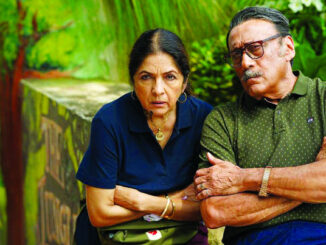
Mast Mein Rehne Ka: Jackie and Neena Gupta film is feel-good and effortless
Leave aside good messaging or bad, strong filmmaking or not — we’re witnessing a spanking-new mini-renaissance in Hindi cinema. After the staid and occasionally engaging Sam Bahadur and baffling monstrosity that was Animal, two films from two starkly contrasting worlds and raisons d’être — Joram and The Archies — vie for the audience’s attention (and I’m not even considering the perfect streaming vehicle Kadak Singh on grounds of relative recentness). And this is just 10 days of December.
In the middle of all this splendid plenty, Vijay Maurya’s Mast Mein Rehne Ka breaks the mould somewhat. Minus any pre-release publicity, minus a hyped star cast, minus any expectation for the moviegoer, this sweet little diptych achieves what most of our recent big-screen and OTT releases (maybe with the exception of 12th Fail, with its austerity and heart) have failed to.
At the outset a slice-of-life geriatric romance straight out of a Modern Love: Mumbai episode propelled by the Macguffin of neighbourhood robberies, Mast Mein Rehne Ka hits you like a bolt from the blue (of course without the intention to hurt). It is incredibly well-acted and beautifully shot, delivering not only a winsome portmanteau of two shorter films bumping into each other as if in a city park to say hello, but a stirring commentary on multifarious lonelinesses and an indulgent portrait of the city itself.
Jackie Shroff is Kamath, a taciturn and lonely 75-year-old widower who likes to spend his time gazing at the leaping waves or guzzling frothy beer and chicken lollipop every week. Early into the film, his house is broken into by Nanhe, a down-on-his-luck tailor trying his best to stand on his two feet in the city of dreams. An anticlimactic scuffle ensues and the clumsy debutant bungles his first-ever burglary. Kamath survives the blow to his nose and — after a vaudeville encounter with law enforcement helped by the rappy title song — runs into Mrs Handa (Neena Gupta) a potty-mouth but effervescent sexagenarian who has just returned from Canada. Yet, what heightens your adoration of this film in light of the above observations is the fact that it doesn’t allow weighty trifles to encumber its storytelling. Director Maurya and cinematographer Nagaraj Rathinam are generous in allowing two out of every five frames to cliché and there are lines that feel especially stagey in a script that is otherwise free-flowing and inventive. But as I said, Mast Mein Rehne Ka is the first acolyte of its title, and that isn’t to celebrate the low-hanging fruit but to applaud the authenticity and purpose of telling the story and eschewing the frills.
Monica Panwar and Abhishek Chauhan play the other two protagonists in the quartet that are somehow reminiscent of the crackerjack lead pair of Joyland. He is Nanhe, the bumbling, soft-spoken migrant tailor intent on pursuing his practice no matter the circumstances. She is the loutish tramp with boot polish on her face, making a living on the streets and telling off anyone at the drop of a hat. While Chauhan feels both restrained and strained in his absorption of the character, Panwar has a raw ferocity about her, and I have to say her submission to a character that’s so far away from her station in life as I understand it — is rocket fuel for the audience’s investment in the story. -

Alia Bhatt’s the perfect bridesmaid at best friend’s wedding
Alia Bhatt was a stunning bridesmaid as she attended her friend’s pre-wedding ceremony. Alia took to Instagram to share a series of photos as she had a good time with her friends. Alia was glowing as she wore a bright pink ensemble and posed with her friends. Alia attended her friend Disha Khatwani’s mehendi ceremony on Wednesday, December 13, along with her gang Akansha Ranjan Kapoor, stylist Usaamah Siddique, Tanya Saha Gupta, and Kripa Mehta.
More photos from the evening were shared online by Alia’s friend. She reposted them on Instagram story with a heart hands emoji. The post has Ranbir Kapoor-starrer Animal’s trending song ‘Jamal Kudu’ playing in the background. This is Bobby Deol’s Animal entry song in the film and is getting a lot of love.
On the work front, Alia Bhatt will next be seen in Vasan Bala’s Jigra. The film is jointly produced by Alia Bhatt and Dharma Productions and Alia has been busy shooting for it. -

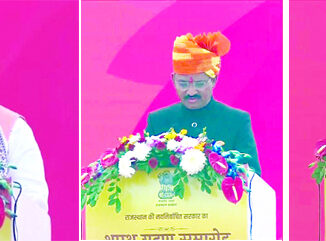
Rajasthan: Bhajan Lal Sharma sworn in as CM
- By Dr Yash Goyal
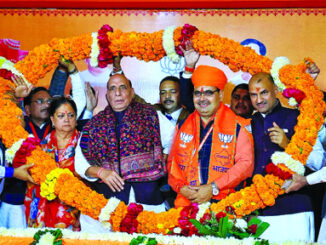
Jaipur (TIP) – Bhajan Lal Sharma, BJP-Legislative Party Leader, was on Friday, December 15, sworn-in as the new Chief Minister of Rajasthan by the Governor of Rajasthan Kalraj Mishra at a gala event outside Albert Hall Museum in the Ram Niwas Bagh here..
The Governor also administered the oath of office and secrecy to two Deputy Chief Minister Diya Kumari, ex-royal of Jaipur and Vidhyadhar Nagar MLA, and Prem Chandra Bairwa, a Dudu MLA, in presence of Prime Minister Narendra Modi, Union Home Minister Amit Shah, Defense Minister Rajnath Singh, Nitin Gadkari, BJP President JP Nadda, and Chief Ministers of BJP ruled states including Madhya Pradesh and Chattisgarh, Union Ministers, party MPs, and other top party functionaries.
Former Chief Minister Ashok Gehlot also shared dias and he shook hands with a number of senior BJP leaders and a few union ministers. Vasundhara Raje was sitting on chair close to Gajendra Singh Shekhavat, union minister. Sharma, who is celebrating his 56 birthday coinciding with the swearing in ceremony, is the 15th Chief Minister of Rajasthan and beginning a new era of youngest CMs in the state.
It is worth mentioning that Rajasthan gets Sharma of Brahmin caste after 33 years of Late Hari Deo Joshi (Congress) who ruled the state 1973-77, 1985-1988 and 1989-90. This also ended the 20 years of CM ships in the state ruled by Bhairon Singh Shekhawat (former Vice President), Vasundhara Raje, and Ashok Gehlot till yesterday.
Hailing from Bharatpur district, fifty-six year old Bhajan is post-graduate in Political Science. In his early age of young life he was an active member and functionary of Akhil Bharatiya Vidyarthi Parishad in Nadbai and Bharatpur. He took active participation in the Kashmir March in 1990 and he spent some time in Jail during Sriram Janam Bhoomi Andolan in 1992. He who is the BJP and its frontal organisations BJYM and BJP Zila Mantri in Bharatpur was also twice Sarpanch at the age of 27. In 2023 assembly poll he won from Jaipur’s Sanganer constituency.
In view of the upcoming LS elections-2024, with today’s ministry formation coined by the Prime Minister Narendra Modi, BJP aims to target Brahmin votes through Bhajan Lal, BJP State President C P Joshi (Brahmin), Rajput votes through Diya Kumari, SC/ST votes via deputy CM Bairwa, and Sindhi mandates from Speaker Vasudev Devnani. -
Kin of Nikhil Gupta, accused of Pannun murder ‘plot’ files plea; apex court says ‘sensitive matter’
New Delhi (TIP) – An unidentified family member of Indian national Nikhil Gupta, who is accused in a US court of plotting an assassination attempt in New York, approached the Supreme Court on Friday alleging human rights violations but the apex court described the matter as an “extremely sensitive” for the Centre and refused to issue directions to the government.
The petition, filed by a member of Gupta’s family identified as “Mr X”, alleged that he was not shown any arrest warrant, subjected to forced consumption of beef and pork during his detention in Czech custody in violation of his religious beliefs as a Hindu vegetarian, denied consular access, the right to contact his family in India, and the freedom to seek legal representation. The plea sought the Centre’s intervention in the extradition proceedings pending before the Extradition Court in Prague, Czech Republic. The court refused to step in but agreed to examine a petition seeking consular access and legal assistance on January 4.
“This is an extremely sensitive matter for the ministry to come in,” a bench of justices Sanjiv Khanna and SVN Bhatti told senior advocate CA Sundaram, who represented Mr X. “We won’t direct the government [of India]. You are capable of taking care of yourself. You have already been supplied with the necessary documents and papers,” the bench added.
Sundaram argued that the case had turned into a “diplomatic and political quagmire” between India and the US. “He (Gupta) is a hapless victim caught in the crossfire,” he said, adding that Gupta’s family was not aware of his whereabouts, there was no lawyer or translator to help him get a fair trial and that he had exhausted his financial resources fighting proceedings against him in courts under US and Czech jurisdictions.
To be sure, it remains unclear whether Gupta, who was arrested on June 30, is still in the Czech Republic or has already been extradited to the US.
The top court also expressed doubts about looking into the plea. “The person detained has not given his own affidavit. He cannot have given it. As a next friend, you have filed this petition. If there is any violation of law, you have to go to the concerned court there. We are not going to have an adjudication here. Go there and appear.”
To this, Sundaram said, “I fully understand that he has to approach the concerned court but let the ministry of external affairs see if it can assist him.”
US prosecutors have alleged that Nikhil Gupta, alias Nick, worked on the directions of an Indian government employee, who described himself as a “senior field officer” responsible for intelligence, to arrange the assassination of US-Canadian citizen Gurpatwant Singh Pannun, a senior leader of the outlawed Sikhs for Justice (SFJ) who has been declared a terrorist by India. -
India flight tests indigenous high-speed flying-wing UAV
The Defence Ministry on Friday said a successful flight trial of an indigenous high-speed flying-wing Unmanned Aerial Vehicle (UAV) was carried out in Karnataka’s Chitradurga that propelled India into an elite club of nations to have the technology to produce such a platform. The autonomous flying wing technology demonstrator has been developed by the Defence Research and Development Organisation (DRDO).
“The DRDO has successfully carried out a flight trial of autonomous flying wing technology demonstrator, an indigenous high-speed flying-wing UAV from the aeronautical test range in Chitradurga,” the ministry said.
The successful flying demonstration of this autonomous stealth UAV is a testimony to maturity in the technology readiness levels in the country, it said. -
Cabinet okays pact with US to enhance innovation ecosystem
The Union Cabinet on Friday cleared a slew of pacts signed between India and nations such as the US, Saudi Arabia, Italy and Tanzania related to several key sectors like trade, electronic manufacturing and commerce.
The Cabinet approved the draft MoU between India and the US to enhance innovation ecosystems through an innovation handshake.
It would contribute significantly strengthening commercial opportunities in high tech sector, official sources said.
During the 5th India-US Commercial Dialogue which was held in March during the visit of US secretary of commerce Gina Raimondo, the Commercial Dialogue was re-launched with strategic focus on supply chain resiliency, climate and clean technology cooperation, advancing inclusive digital economy, and facilitating post-pandemic economic recovery especially for SMEs and start-ups.
It included launch of a new working group on talent, innovation and inclusive growth (TIIG) under the Commercial Dialogue. -

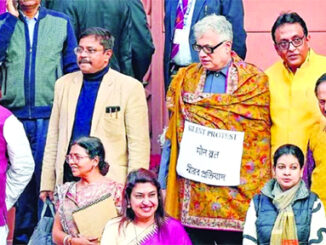
Govt, Oppn clash over security breach, 14 MPs suspended
New Delhi (TIP) – As many as 14 opposition MPs were suspended from Parliament for the remainder of the winter session for disrupting proceedings, as the Lok Sabha security breach incident snowballed into a major row on Thursda, December 14, y with the government asking the opposition not to “politicise” the “grave national issue” and the Congress, Trinamool Congress and others demanding a statement from Home Minister Amit Shah.
While TMC’s Derek O’Brien was suspended in the Rajya Sabha, as many as 13 opposition MPs, including nine from the Congress and the Dravida Munnetra Kazhagam’s Kanimozhi, were suspended from the Lok Sabha for disrupting the proceedings.
Amid opposition protests, demanding a statement from Home Minister Shah and Prime Minister Narendra Modi over the security breach incident, Parliamentary Affairs Minister Pralhad Joshi moved two resolutions separately for the suspension of the MPs for disrupting the Lok Sabha proceedings. The MPs had moved into the well of the Lok Sabha raising slogans, questioning the security breach, and demanding a statement from the government. While T N Prathapan, Hibi Eden, Jothimani, Ramya Haridas and Dean Kuriakose, all from the Congress, were suspended when the first resolution was adopted, four Congress MPs — VK Sreekandan, Benny Behanan, Mohammed Jawaid and Manickam Tagore — along with PR Natarajan (CPI-M), Kanimozhi (DMK), K Subbarayan (CPI), SR Parthiban (DMK) and S Venkatesan (CPI-M) were suspended through the second resolution.
Later, after several opposition MPs pointed out that Parthiban was named among the suspended MPs even though he was not present in Delhi but was in Chennai, his suspension was revoked.
Soon after the Rajya Sabha House met at noon after an adjournment, chairman Jagdeep Dhankhar warned O’Brien against his unruly behaviour and for disrupting the proceedings. He asked O’Brien to leave the House, but the opposition MP did not relent and protested instead. The chairman then allowed Leader of the House Piyush Goyal to move a motion to suspend O’Brien under Rule 256. The motion to suspend O’Brien for the remainder of the session was adopted with a voice vote.
O’Brien did not leave the Rajya Sabha chambers even after suspension and the matter of his conduct was referred to the privileges committee of the house. The committee has been asked to submit a report on O’Brien’s conduct in three months. -

Krishna Janmabhoomi Case : SC declines to stay survey of Shahi Idgah mosque complex
New Delhi (TIP) – The Supreme Court on Friday, December 15, refused to stay the survey of the Shahi Eidgah mosque abutting the Krishna Janmabhoomi temple in Mathura, observing that neither is a petition challenging the order of survey before it nor does it consider it necessary to pass a restraining order at this stage.
“At this stage, we won’t stay anything. If there is any adverse order, you can come back…Should we be staying a matter without the impugned order being in front of us,” a bench of justices Sanjiv Khanna and SVN Bhatti asked senior counsel Huzefa Ahmadi, who appeared for the Uttar Pradesh Sunni Waqf Board and the Eidgah management committee.
Responding, Ahmadi emphasised that the high court must be asked to stay its hands since a related matter has already been listed by the Supreme Court on January 9. “Why should the high court go ahead when the very issue of whether they can proceed with the matter is pending before this court?” asked Ahmadi.
By an order on November 10, the Supreme Court fixed January 9 for considering the objections of the Eidgah committee and UP Sunni Waqf Board to the high court order deciding to hear nearly 18 suits relating to Krishna Janmasthan-Shahi Eidgah land dispute by transferring them to itself from various civil courts in Mathura.
However, the high court on Thursday went ahead and directed the appointment of an advocate-commissioner to oversee the survey of the mosque, which Hindu petitioners say holds signs proving that it was a once a Hindu temple, opening a new chapter in the decades-old dispute that is part of a raft of cases where Hindu petitioners are pushing for legal change to gain rights over Islamic holy sites. To be sure, there has been no stay order by the apex court against the proceedings before the high court.
Ahmadi, challenging the Thursday high court order, urged the Supreme bench to issue a restraining order to stop the high court from going ahead with the procedural directions regarding the survey on December 18 when the matter will be heard next.
But the top court was not in favour of this. The bench only recorded in its order that the hearing in the Supreme Court is fixed on January 9 and that in case the petitioners have any grievance against a particular order, it was open for them to file an appropriate petition.
“We are not staying anything. What we have recorded is good enough. You bring this order to the notice of the high court. That’s it. We won’t record anything more,” the bench told Ahmadi. When Ahmadi replied that the high court has not been paying heed to the committee’s request to defer the proceeding since their petition was pending at the top court, the bench said that the committee will have to file a separate petition if they were to challenge the order of survey.
“At present, the issue here is only of the jurisdiction. The merits of the matter are not before us…You file your appeal and we will see,” it added.
During the proceedings, Ahmadi repeatedly pointed out that the committee will find it extremely difficult to secure an urgent hearing from the top court if it is aggrieved by the December 18 order of the high court since the Supreme Court break for winter vacation is from December 18 to December 31. “Mr Ahmadi, if any urgent order is required, you know the procedure,” the bench retorted.
The Supreme Court is seized of the challenge to a May 26 order of the Allahabad high court, transferring to itself all suits filed by Hindu parties claiming right over the mosque land. The mosque committee has argued that it did not have the financial wherewithal to defend the suits in the Allahabad high court which is 600km away and would prefer having it in Delhi which is only 150 km away.
The May 26 order by the high court had come on a plea by Bhagwan Shrikrishna Virajman at Katra Keshav Dev Khewat Mathura (deity) through the next friend, Ranjana Agnihotri, who is also an advocate, and seven others. -

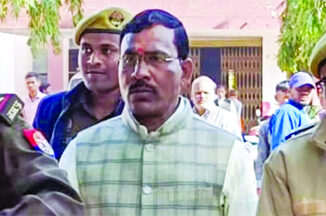
BJP MLA in UP gets 25 years in jail for raping minor, faces disqualification from Assembly
A court on December 15 sentenced BJP MLA Ramdular Gond to 25 years of rigorous imprisonment for the rape of a girl nine years ago, setting the stage for his disqualification from the Uttar Pradesh Assembly.
According to the Representation of the People Act, a lawmaker sentenced to imprisonment of two years or more shall be disqualified “from the date of such conviction” and remain disqualified for another six years after serving time.
Ahsan Ullah Khan, the additional district and session judge of the MP-MLA court in Sonbhadra, also imposed a fine of Rs 10 lakh on Gond which would be used for the rape survivor’s rehabilitation.
Special Public Prosecutor Satyaprakash Tripathi said the court held the MLA from Duddhi assembly constituency guilty on December 12. Before the pronouncement of the verdict, Gond’s lawyer urged the court for minimum punishment. He also assured the court that Gond would take complete care of the family of the rape survivor.
Giving detail of the case, Tripathi said the incident took place on November 4, 2014, and a case was registered against Gond under sections 376 (rape), 506 (punishment for criminal intimidation) and 5L/6 of the Protection of Children from Sexual Offences (POCSO) Act. -

Revanth Reddy takes charge as CM of Telangana along with 11 ministers
Soon after Anumula Revanth Reddy was sworn in as the first Congress Chief Minister of Telangana on December 7 in front of a crowd of thousands at the Lal Bahadur Stadium in the State’s capital, he vowed to revive a tradition of inviting the public into the halls of power to present their grievances directly to him. He immediately signed his first file, to implement the six welfare ‘guarantees’ that headlined the Congress’ poll manifesto.
Telangana Governor Tamilisai Soundararajan administered the oath of office to Reddy, who steered his party to victory in India’s youngest State, in the presence of Congress president Mallikarjun Kharge and other senior leaders, including Sonia Gandhi, Rahul Gandhi and Priyanka Vadra, as well as the Congress CMs of Karnataka and Himachal Pradesh.
On December 9, Reddy assigned portfolios to 11 ministers in his newly formed cabinet. According to a gazette notification issued by the state government, Revanth Reddy has retained the Municipal Administration and Urban Development portfolio along with the General Administration and Law and Order. He will also hold all other unallocated portfolios.
Deputy Chief Minister Bhatti Vikramarka Mallu was allocated the Finance and Planning and Energy portfolios. The allocation of the portfolios to the ministers was approved by Telangana Governor Tamilisai Soundararajan.
Nalamada Uttam Kumar Reddy was given the Irrigation and Food & Civil Supplies portfolios, while Damodar Rajanarsimha was allocated the Health and Family Welfare as well as the Science and Technology portfolios.
Komatireddy Venkat Reddy will oversee Roads and Buildings and Cinematography, while Duddilla Sridhar Babu will take charge of Information Technology, Electronics and Communications Industries and Commerce and Legislative Affairs departments. Ponguleti Srinivas Reddy has been allocated the Revenue & Housing as well as Information & Public Relations departments.
The Transport and BC Welfare departments were assigned to Ponnam Prabhakar, while Konda Surekha would oversee the Environment and Forests, and Endowment departments.
Danasari Anasuya (Seethakka) will take charge of Panchayat Raj & Rural Development and Women & Child Welfare departments, while Tummala Nageswara Rao was assigned the portfolios of Agriculture, Marketing, Co-operation, as well as Handlooms and Textiles. Jupally Krishna Rao will be the Minister for Prohibition and Excise, and Tourism and Culture departments.
First Cong CM of the youngest Indian state
In the 2023 Telangana Assembly elections, Congress emerged victorious in 64 of the total 119 seats, while the ruling Bharat Rashtra Samithi (BRS) was restricted to 39 seats.
The BJP and All India Majlis-E-Ittehadul Muslimeen (AIMIM) received eight and seven seats, respectively. On the other hand, the Communist Party of India secured only one seat.
Earlier, as speculations rifed over PCC chief Revanth Reddy becoming the next CM, a few reports claimed that there is opposition with the party on this name. Among those who reportedly opposed the decision include former Telangana Congress chief N Uttam Kumar Reddy, Bhatti Vikramarka, Komatireddy Venkat Reddy, and Damodar Rajanarasimha.
Who is Anumula Revanth Reddy?
Born in Mahboobnagar district, Anumula Revanth Reddy started his career in politics with the ABVP while he was a student. He was also associated with the Telangana Rashtra Samithi (now changed to Bharat Rashtra Samithi). He was elected as a Member of the Legislative Council (MLC) as an independent candidate and soon after he joined the N Chandrababu Naidu-led Telugu Desam Party (TDP).
Reddy has been an MLA thrice, twice from the TDP and once from the Congress, which he joined in 2017.
During the 2018 Telangana Assembly polls, he represented Congress from the Kodangal seat but lost to the BRS candidate. However, Revanth Reddy won from Malkajgiri Lok Sabha seat in the 2019 general elections by a margin of 10,919 votes. In 2021, he was appointed as Telangana Pradesh Congress Committee president, replacing N Uttam Kumar Reddy. In the 2023 Telangana elections, Reddy was a Congress candidate from Kodangal and Kamareddy Assembly constituencies.
While Reddy won the Kodangal seat by a margin of 32,532, he was defeated by BJP’s K Venkata Ramana Reddy in Kamareddy. -

Telangana: India’s youngest state
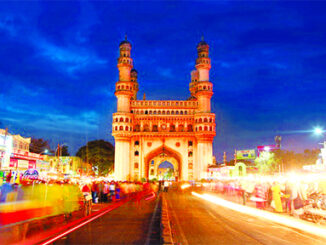
Telangana is a state in southern India. In the capital of Hyderabad, the Charminar is a 16th-century mosque with 4 arches supporting 4 towering minarets. The monument overlooks the city’s long-running Laad Bazaar. Once the seat of the Qutb Shahi dynasty, the sprawling Golconda Fort is a former diamond-trading center. In the city of Warangal, the centuries-old Warangal Fort features carved stone towers and gateways. Telangana was earlier part of the Hyderabad state from the end of 1948 to 1956. The youngest state in India is Telangana. It was formed as the ’29th state of India’.
The state has an area of 1,14,840 Sq Km and has a population of 3,52,86,757.
Telangana is situated on the Deccan Plateau, in the central stretch of the eastern seaboard of the Indian Peninsula. It covers 112,077 square kilometers (43,273 sq m). The region is drained by two major rivers, with about 79% of the Godavari River catchment area and about 69% of the Krishna River catchment area, but most of the land is arid. Telangana is also drained by several minor rivers such as the Bhima, the Maner, the Manjira, the Musi, and the Tungabhadra.
The annual rainfall is between 900 and 1500mm in northern Telangana and 700 to 900mm in southern Telangana, from the southwest monsoons. Telangana contains various soil types, some of which are red sandy loams (Chalaka), Red loamy sands (Dubba), lateritic soils, salt-affected soils, alluvial soils, shallow to medium black soils and very deep black cotton soils. These soil types allow the planting of a variety of fruits and vegetable crops such as mangoes, oranges, coconut, sugarcane, paddy, banana and flower crops.
Telugu one of the classical languages of India is the official language of Telangana and Urdu is the second official language of the state. About 75% of the population of Telangana speak Telugu and 12% speak Urdu. Before 1948, Urdu was the official language of Hyderabad State, and due to a lack of Telugu-language educational institutions, Urdu was the language of the educated elite of Telangana. After 1948, once Hyderabad State joined the new Republic of India, Telugu became the language of government, and as Telugu was introduced as the medium of instruction in schools and colleges, the use of Urdu among non-Hyderabadi Muslims decreased. Both Telugu and Urdu are used in services across the state, such as the Telangana Legislature website, with Telugu and Urdu versions of the website available, as well as the Hyderabad metro, wherein both languages are used on station names and signs along with English and Hindi. The Urdu spoken in Telangana is called Hyderabadi Urdu, which in itself is a dialect of the larger Dakhini Urdu dialects of South India.
Telangana is one of the fastest-growing states in India posing average annual growth rate of 13.90% over the last five years. Telangana’s nominal gross state domestic product for the year 2020-21 stands at Rs 13.59 lakh crore.
Agriculture also form a backbone of Telangana’s Economy. Two important rivers of India, the Godavari and Krishna, flow through the state, providing irrigation. Farmers in Telangana mainly depend on rain-fed water sources for irrigation. Rice is the major food crop. Other important local crops are cotton, sugar cane, mango and tobacco. Recently, crops used for vegetable oil production, such as sunflower and peanuts, have gained favor. There are many multi-state irrigation projects in development, including Godavari River Basin Irrigation Projects. -

Rajasthan: The ‘Land of Kings’
Rajasthan ‘Land of Kings’ is a state in northern India. It covers 342,239 square kilometers (132,139 sq mi) or 10.4 percent of India’s total geographical area. It is the largest Indian state by area and the seventh largest by population. It is on India’s northwestern side, where it comprises most of the wide and inhospitable Thar Desert (also known as the Great Indian Desert) and shares a border with the Pakistani provinces of Punjab to the northwest and Sindh to the west, along the Sutlej-Indus River valley. It is bordered by five other Indian states: Punjab to the north; Haryana and Uttar Pradesh to the northeast; Madhya Pradesh to the southeast; and Gujarat to the southwest. Its geographical location is 23°.3′ to 30°.12′ North latitude and 69°.30′ to 78°.17′ East longitude, with the Tropic of Cancer passing through its southernmost tip.
Its major features include the ruins of the Indus Valley civilisation at Kalibangan and Balathal, the Dilwara Temples, a Jain pilgrimage site at Rajasthan’s only hill station, Mount Abu, in the ancient Aravalli mountain range and eastern Rajasthan, the Keoladeo National Park of Bharatpur, a World Heritage Site[16] known for its bird life. Rajasthan is also home to three national tiger reserves, the Ranthambore National Park in Sawai Madhopur, Sariska Tiger Reserve in Alwar and the Mukundra Hills Tiger Reserve in Kota.
The State of Rajasthan was formed on 30 March 1949 when the states of the Rajputana Agency of the erstwhile British Empire in India were merged into the new Indian Union. Its capital and largest city is Jaipur. Other important cities are Jodhpur, Kota, Bikaner, Ajmer, Bharatpur and Udaipur. The economy of Rajasthan is the seventh-largest state economy in India with Rs 10.20 lakh crore (US$130 billion) in gross domestic product and a per capita GDP of Rs118,000 (US$1,500). Rajasthan ranks 22nd among Indian states in human development index. -

Madhya Pradesh: The Heart of India
Madhya Pradesh meaning ‘central province’ is a state in central India. Its capital is Bhopal, and the largest city is Indore, with Gwalior, Jabalpur, Ujjain, Dewas, Sagar, Satna, and Rewa being the other major cities. Madhya Pradesh is the second largest Indian state by area and the fifth largest state by population with over 72 million residents. It borders the states of Uttar Pradesh to the northeast, Chhattisgarh to the east, Maharashtra to the south, Gujarat to the west, and Rajasthan to the northwest.
The area covered by the present-day Madhya Pradesh includes the area of the ancient Avanti Mahajanapada, whose capital Ujjain (also known as Avantika) arose as a major city during the second wave of Indian urbanisation in the sixth century BCE. Subsequently, the region was ruled by the major dynasties of India. The Maratha Empire dominated the majority of the 18th century. After the Anglo-Maratha Wars in the 19th century, the region was divided into several princely states under the British and incorporated into Central Provinces and Berar and the Central India Agency. Some years after India’s independence, the Central Provinces and Berar was renamed as Madhya Pradesh with Nagpur as its capital: this state included the southern parts of the present-day Madhya Pradesh and northeastern portion of today’s Maharashtra. In 1956, this state was reorganized and its parts were combined with the states of Madhya Bharat, Vindhya Pradesh and Bhopal to form the new Madhya Pradesh state, the Marathi-speaking Vidarbha region was removed and merged with the Bombay State. This state was the largest in India by area until 2000, when its southeastern Chhattisgarh region was designated a separate state.
The economy of Madhya Pradesh is the 10th-largest in India, with a gross state domestic product (GSDP) of Rs 9.17 trillion (US$110 billion) and has the country’s 26th highest per-capita income of Rs 109372.
Madhya Pradesh ranks 23rd among Indian states in human development index. Rich in mineral resources, Madhya Pradesh has the largest reserves of diamond and copper in India. 25.14% of its area is under forest cover. Its tourism industry has seen considerable growth, with the state topping the National Tourism Awards in 2010-11. In recent years, the state’s GDP growth has been above the national average. In 2019-20, state’s GSDP was recorded at 9.07.
Madhya Pradesh is also famous for honey production in district Morena.
The state has an agrarian economy. The major crops of Madhya Pradesh are wheat, soybean, gram, sugarcane, rice, maize, cotton, rapeseed, mustard and arhar. Minor Forest Produce (MFP), such as tendu leaves used to roll beedi, sal seed, teak seed, and lak also contribute to state’s rural economy. -

Milk vendor, sarpanch, rebel: Bhajan Lal Sharma takes the helm as Rajasthan CM
A viral video on social media shows Vasundhara Raje, former BJP chief minister of Rajasthan, at a party legislature meeting in Jaipur. Sitting next to union minister Rajnath Singh, the party observer for Rajasthan, she opens a slip of paper that he hands to her.
Raje looks taken aback by its contents — the script of which was written in Delhi. That piece of paper allegedly had the name of Rajasthan’s new CM, Bhajan Lal Sharma, announced by the party on December 12. Raje proposed his name at this meeting, and then accompanied Sharma and other senior leaders to meet governor Kalraj Mishra and stake claim to form the government.
Sharma, 56, is a first-time MLA who won from Sanganer constituency in Jaipur by 48,081 votes. He’s the second Brahmin CM in Rajasthan in 33 years after Congress’s Haridev Joshi. He will have two deputies – Diya Kumar, a Rajput, and Prerchand Bairwa, a Dalit – while Vasudev Devnani will be speaker.
Before his candidature from Sanganer, Sharma was a familiar face at press conferences, often introducing speakers or checking arrangements. Chosen as the state BJP’s general secretary for the fourth time before the assembly polls, he would hold meetings across the state, and also oversaw arrangements of public meetings for Home Minister Amit Shah and Prime Minister Narendra Modi.
Milkman to sarpanch
Born in Atari village in Bharatpur district, Sharma is described as a “simple and righteous” man by friends and party colleagues. He’s the only son and his father, Kishan Swaroop Sharma, is a farmer who owns 25 bighas of land in Atari.
A day before counting of votes, Sharma visited Atari and sought blessings from elders, said Om Prakash Jatav, a farmer in the village.
Sharma’s schooling took place in Atari and Gangwana villages and Nanbai tehsil, all in Bharatpur. A note shared by the BJP with journalists said, “After completing his primary education in Atari, he came to Nadbai for secondary education and got in touch with the Akhil Bharatiya Vidyarthi Parishad.” The ABVP is the student wing of the Rashtriya Swayamsevak Sangh.
Schooling done, Sharma enrolled in MSJ College in Bharatpur and graduated in 1989. He was already a BJP member at this point – according to Rakesh Sharma, president of Nanbai BJP (rural), he and Bhajan Lal had joined the party in 1984.
The family depended on agriculture and milk for their livelihood. After Bhajan Lal finished college, he helped out.
“He would collect milk from his village and sell it to a dairy in Bharatpur,” said his uncle Maniram Sharma, a retired teacher in Atari. “This continued for seven or eight years until he was given bigger responsibilities by the BJP.”
In 1990, Bhajan Lal took part in a “Kashmir march”. He went to Udhampur in Jammu and Kashmir and courted arrest with 100 BJP workers. He was also jailed for participating in the Ram Janmabhoomi agitation in 1992.
In the early 1990s, he served with the Bharatiya Janata Yuva Morcha in Bharatpur in various capacities. He got on well with Lok Sabha Speaker Om Birla, who was then the state president of the BJYM. Bhajan Lal, as district president of the BJYM in Bharatpur, would campaign with Birla during elections and take on organisational work for the party.
At this time, Sharma would also often travel to Kota, where Birla lived.
“At the time, I was posted at a school in Kota,” said his uncle Maniram. “He would come to the city and stay with me. In the morning, he would leave for Om Birla’s house. Bhajan Lal and Om Birla would campaign together during the assembly elections.”
First tryst with elections
In 2000, Sharma contested his first election – a panchayat poll. He won, and became sarpanch of Atari gram sabha. Three years later, the BJP denied him a ticket from Nadbai during the assembly polls. So, Sharma quit and fought on the lock-and-key symbol of a new party, the Rajasthan Samajik Nyay Manch, which had been floated by Devi Singh Bhati and Lokendra Singh Kalvi.
“He did not tell us that he was denied a ticket by the BJP,” Bhati, a seven-time MLA from Bikaner’s Kolayat, told Newslaundry. “But he did say this to me: ‘Since reservation is the goal of the party, I will fight this battle.’” The RSNM’s main poll plank then was reservation for economically weaker sections.
The Nadbai seat was eventually won by an independent candidate named Krishnendra Kaur. The BJP candidate came fourth with 13,949 votes and Sharma came fifth with 5,969 votes. The RSNM won only one seat in the polls. Bhati, considered a Raje loyalist, rejoined the BJP this September. This election, his grandson Anshuman Singh Bhati won from Kolayat in Bikaner on a BJP ticket. -

Madhya Pradesh: Shivraj Singh Chouhan out, Mohan Yadav is new CM
The Narendra Modi-Amit Shah duo on Monday, December 11, struck out veteran Shivraj Singh Chouhan, the last remaining BJP leader from the Atal-Advani era, and foisted a low-profile Mohan Yadav as chief minister-designate of Madhya Pradesh, tightening their grip over the party.
The sidelining of Chouhan was also seen as a signal to Vasundhara Raje Scindia, another pre-Modi era chief minister, in Rajasthan to get ready to bow out.
In what could rub salt in his wound, Chouhan was made to propose the name of Yadav, the Ujjain South MLA, as his replacement at the meeting of the newly elected MLAs in Bhopal and later hail his choice.
Not only has the four-term chief minister been shown the door but along with him a bunch of politically dominant leaders, some of whom had been made to quit as ministers in the Modi government and sent to the state, have also been left looking as dispensable faces.
The bunch included Narendra Singh Tomar, who till recently was a senior minister in the Modi government. Tomar, whose supporters had projected him as the next chief minister when he was dispatched to contest the state polls, has been offered the Assembly Speaker’s job, considered a retirement post. Along with him, former junior minister Prahlad Singh Patel and party general secretary Kailash Vijayvargiya have been left hoping that they get a decent portfolio in the new government.The foisting of Yadav, one of the 165 BJP MLAs, as chief minister is being seen in BJP circles as the first experiment of its kind by the Modi-Shah duo outside their home turf of Gujarat. What Modi-Shah did in Gujarat nearly a year ahead of the polls by installing the low-profile Bhupendra Patel as chief minister has been applied to Madhya Pradesh after the polls.BJP leaders said the nature of the party’s runaway victory in three heartland states, projected as a victory of “Modi’s guarantee”, could be used to ram through more decisions like this.
The choice of Yadav, a three-term MLA from Ujjain South, a prominent Hindu pilgrimage town, is being projected as not only a generational change. Yadav is being projected as an OBC face to counter the BJP’s rivals — the Samajwadi Party and the RJD — in Uttar Pradesh and Bihar that are trying to infuse a fresh dose of Mandal politics by pressing for a caste census.
“Mohan Yadav will be the first prominent Yadav face to be made a chief minister by the BJP. It will go out as a signal to the Yadavs in Uttar Pradesh and Bihar that the BJP is not against the community as is projected by Akhilesh and Tejashwi,” a BJP leader said.
In Babulal Gaur, however, the BJP had a Yadav as chief minister as a stop-gap in 2004-05.
The surprise choice was also used to project that in Modi-Shah’s BJP, even low-profile “grass-root” leaders can aspire to get the top post. Party managers said that by choosing a relatively low-profile leader, the top leadership is also looking to demolish the “caucus” of powerful leaders in the state and gain direct control over state politics.
Yadav, who served as a minister in the Chouhan government, is said to have deep links with the RSS, which has a strong network in the state. He owes his political foray to the student wing of the RSS, the ABVP, and is a known Hindutva face in Ujjain.
As in Chhattisgarh, the BJP leadership has also appointed two deputy chief ministers in Madhya Pradesh — Rajendra Shukla (upper caste) and Jagdish Deora (Scheduled Caste). They are equally low-profile like Yadav, though they have served as ministers in the Chouhan government and been elected more than once as MLAs.
Asked what the future holds for Chouhan, who is 64 and still a long way from the unofficial retirement age of 75 in the BJP, party insiders indicated that he could be asked to serve as a senior Union minister and possibly given the agriculture portfolio that Tomar held. -

Chhattisgarh: Land of rich culture and heritage
Chhattisgarh is a landlocked state in Central India. It is the ninth largest state by area, and with a population of roughly 30 million, the seventeenth most populous. It borders seven states – Uttar Pradesh to the north, Madhya Pradesh to the northwest, Maharashtra to the southwest, Jharkhand to the northeast, Odisha to the east, Andhra Pradesh and Telangana to the south. Formerly a part of Madhya Pradesh, it was granted statehood on 1 November, 2000, with Raipur as the designated state capital.
Chhattisgarh is one of the fastest-developing states in India. Its Gross State Domestic Product (GSDP) is Rs 5.09 lakh crore (US$64 billion) (2023-24 est.), with a per capita GSDP of Rs152,348 (US$1,900) (2023-24 est.). A resource-rich state, it has the third largest coal reserves in the country and provides electricity, coal, and steel to the rest of the nation. It also has the third largest forest cover in the country after Madhya Pradesh and Arunachal Pradesh with over 40% of the state covered by forests.Chhattisgarh boasts a unique position that has facilitated cultural exchanges throughout history. This region’s heritage resonates with echoes of ancient civilizations and dynasties, each leaving an indelible mark on its identity. The vibrant tapestry of Chhattisgarh’s culture is woven with threads of traditional festivals, intricate art forms, and resplendent architecture.
Economy
Chhattisgarh’s nominal gross state domestic product (GSDP) is estimated at Rs 5.09 lakh crore (US$64 billion) in 2023-24, the 17th largest state economy in India. The economy of Chhattisgarh recorded a growth rate of 11.2% in 2023-24. Chhattisgarh’s success factors in achieving high growth rate are growth in agriculture and industrial production.
Agriculture
Agriculture is counted as the chief economic occupation of the state. According to a government estimate, net sown area of the state is 4.828 million hectares and the gross sown area is 5.788 million hectares. Horticulture and animal husbandry also engage a major share of the total population of the state. About 80% of the population of the state is rural and the main livelihood of the villagers is agriculture and agriculture-based small industry.
The majority of the farmers are still practicing the traditional methods of cultivation, resulting in low growth rates and productivity. The farmers have to be made aware of modern technologies suitable to their holdings. Providing adequate knowledge to the farmers is essential for a better implementation of the agricultural development plans and to improve productivity. -

Chhattisgarh: From village head to CM, the incredible journey of Vishnu Deo Sai
Hailing from the tribal (Janjati/Vanvasi) dominated Jashpur region of Chhattisgarh, Vishnu Deo Sai has taken oath as the first Vanvasi Chief Minister of the Chhattisgarh state, where the Vanvasi community constitutes a significant majority. The swearing-in ceremony held in Raipur’s science college ground on Wednesday afternoon was attended by a number of senior leaders of the Bharatiya Janta Party (BJP) including the Prime Minister, Narendra Modi, Party’s President, JP Nadda, Union Home Minister Amit Shah, and other BJP CMs.
Sai commenced his political journey after getting elected as a Panch (ward) from Bagia Gramme Panchayat, a remote region located in Jashpur, in the year 1989 and never looked back. Next year, Sai participated in the Panchyat elections again and emerged victorious as Sarpanch of the Bagia Panchayat.
In 1990, Sai contested from the then state assembly seat of Tapkara and had been elected as a member of the legislative assembly of undivided Madhya Pradesh for a term of three years. He was re-elected for the state assembly in the election held in the year 1993. In the year 1999, Sai contested its first Lok Sabha election from the Vanvasi-dominated Raigarh Lok Sabha seat and was elected as a Member of Parliament of the 13th Loksabha. The popularity of Sai can be better understood by the fact that after being elected as an MP in 1999 Sai was re-elected from the same seat in the 2004, 2009 and 2014 Lok Sabha elections. In between his years as an MP, Sai has been nominated in many committees formed by the respective governments of Bharat.
As BJP’s president in Chhattisgarh
During his years as an MP, Sai has also been bestowed with the responsibility of leading the BJP in the state thrice. He was first named as the president of the party in Chhattisgarh in October 2006. Sai first tenure as a party’s president lasted for around three and a half years, during which the party registered a resounding victory in the 2008 state assembly election, securing a total of 50 seats in the 90-seat state assembly election.
Sai was re-appointed as the party’s president for a short term of around six months in the year 2014, though he left the post after he was made the union minister for state for steel, labour, and employment in the NDA government in the subsequent year. He was again appointed as the party’s president in the year 2020 for a period of two years, during which the party managed to perform well in Chhattisgarh in the 2019 Lok sabha election. In December last year, Sai was also nominated as a special invitee in the BJP’s national working committee.
Sai was asked to contest the recently held state assembly election from the much-hyped Kunkuri assembly seat, where he emerged victorious after defeating the Indian National Congress UD Minj by a margin of 25000 votes. Later on, Sai was chosen as the leader of the BJP’s legislative group in a meeting held in state assembly in Raipur on December 10, paving the way for Sai to become the first Vanvasi Chief Minister of the Vanvasi heartland.
It is to be noted that the saffron party’s move to choose Sai as the CM of the state is expected to further solidify the trust of the Vanvasi community in the Narendra Modi-led party, which earlier threw its weight behind Draupdi Murmu, another BJP leader of the Vanvasi community, for the presidential post. -

Police headquarters, checkpost come under attack in Pakistan; 5 law enforcement officials killed
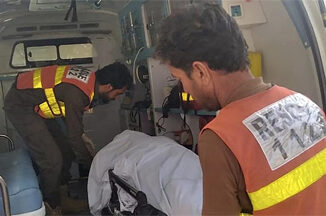
PESHAWAR (TIP): At least five law enforcement officials were killed in militant attacks on a regional police headquarters and a checkpost in the restive northwest Pakistan on December 15 that also killed four rebels, in an uptick in violence against security forces in the country.
The attacks come three days after terrorists killed 23 soldiers in the same region in the Khyber Pakhtunkhwa province.
The first attack occurred at the Police Lines in Khyber Pakhtunkhwa’s Tank district. Three policemen were killed and three others injured in the attack. Four militants were also killed, authorities said.
A terrorist blew himself up at the main entrance of the police office and residence block and the others stormed in. The attack was claimed by a new militant group, Ansarul Jihad.
In another attack, militants attacked the joint police and security forces check post in Nalla Bara tehsil in the Khyber tribal district in which two troops of the Frontier Constabulary were killed.
Six people were also injured in the attack.
The attack comes days after at least 23 soldiers were killed and more than 30 others injured after militants belonging to the Tehreek-i-Jihad Pakistan (TJP), a newly formed militant group that is an affiliate of the banned Tehreek-i-Taliban Pakistan (TTP), stormed a compound used by the military in Dera Ismail Khan.
The TJP terror outfit has been behind some major attacks in Pakistan.
On November 4, the TJP militants attacked the Pakistan Air Force’s Mianwali Training Air Base, some 300 km from Lahore, damaging three grounded aircraft.
The terrorists have repeatedly attacked the security and military installations in Pakistan.
In September 2015, Taliban gunmen killed 29 people, including 16 worshippers in a mosque, when they stormed Badaber Airbase, close to the northwestern city of Peshawar.
In May 2011, 15 terrorists belonging to TTP and Al Qaeda attacked PNS Mehran, the headquarters of the Pakistan Navy’s Naval Air Arm, located in Sindh and killed 18 military personnel and wounded 16.
Two American-built surveillance aircraft were also destroyed. (PTI) -

Pakistanis, Bangladeshi politicians are new targets of deepfake, 90 per cent of videos online are pornographic
Bangkok (TIP) : There was the Bollywood star in skin-tight lycra, the Bangladeshi politician filmed in a bikini and the young Pakistani woman snapped with a man.
None was real, but all three images were credible enough to unleash lust, vitriol – and even allegedly a murder, underlining the sophistication of generative artificial intelligence, and the threats it poses to women.
The two videos and the photo were deepfake, and went viral in a vibrant social mediascape that is struggling to come to grips with the technology that has the power to create convincing copies that can upend real lives.
“We need to address this as a community and with urgency before more of us are affected by such identity theft,” actor Rashmika Mandanna said in a post on X, that has garnered more than 6.2 million views.
She is not the only Bollywood star to be cloned and attacked on social media, with top actors including Katrina Kaif, Alia Bhatt and Deepika Padukone also targeted with deepfakes.
The lycra video, said Mandanna, was “extremely scary not only for me, but also for each one of us who today is vulnerable to so much harm because of how technology is being misused”. While digitally manipulated images and videos of women were once easy to spot, usually lurking in the dark corners of the internet, the explosion in generative AI tools such as Midjourney, Stable Diffusion and DALL-E has made it easy and cheap to create and circulate convincing deepfakes.
More than 90% of deepfake videos online are pornographic, according to tech experts, and most are of women.
While there are no separate data for South Asian countries, digital rights experts say the issue is particularly challenging in conservative societies, where women have long been harassed online and abuse has gone largely unpunished.
Social media firms are struggling to keep up.
Google’s YouTube and Meta Platforms – which owns Facebook, Instagram and WhatsApp – have updated their policies, requiring creators and advertisers to label all AI-generated content.
But the onus is largely on victims – usually girls and women – to take action, said Rumman Chowdhury, an AI expert at Harvard University who previously worked at reducing harms on Twitter.
“Generative AI will regrettably supercharge online harassment and malicious content … and women are the canaries in the coal mine. They are the ones impacted first, the ones on whom the technologies are tested,” she said. “It is an indication to the rest of the world to pay attention, because it’s coming for everyone,” Chowdhury told a recent United Nations briefing.
As deepfakes have proliferated worldwide, there are growing concerns – and rising instances – of their use in harassment, scams and sextortion.
Regulations have been slow to follow.
The US Executive Order on AI touches on dangers posed by deepfakes, while the European Union’s proposed AI Act will require greater transparency and disclosure from providers.
Last month, 18 countries – including the United States and Britain – unveiled a non-binding agreement on keeping the wider public safe from AI misuse, including deepfakes.
Among Asian nations, China requires providers to use watermarks and report illegal deepfakes, while South Korea has made it illegal to distribute deepfakes that harm “public interest”, with potential imprisonment or fines.
(Reuters) -
Sri Lanka arrests 21 Indian fishermen for alleged poaching in its waters
Colombo (TIP) : At least 21 Indian fishermen have been arrested for allegedly poaching in Sri Lanka’s territorial waters, the island nation’s Navy has said, taking the total number this year to 195.
The Indian fishermen were arrested and their four trawlers were seized on December 13 in the northeastern waters off Mannar and Kovilan.
The Navy said in 2023 they had arrested 195 Indian fishermen for poaching in Sri Lankan waters.
The fishermen issue is a contentious one in the ties between India and Sri Lanka, with Lankan Navy personnel even firing at Indian fishermen in the Palk Strait and seizing their boats in several alleged incidents of illegally entering Sri Lankan territorial waters.
The Palk Strait, which is a narrow strip of water separating Tamil Nadu from Sri Lanka, is a rich fishing ground for fishermen from both countries.
There have been periodic instances of Indian fishermen being arrested by Sri Lankan authorities for allegedly crossing the International Maritime Boundary Line and fishing in Sri Lankan waters. (PTI)