The much-anticipated rom-com Shotgun Wedding will premiere exclusively for Lionsgate Play members starting from January 27 exclusively on Lionsgate Play in India, via Prime Video Channels with add-on subscriptions. It stars Jennifer Lopez, Josh Duhamel, Jennifer Coolidge, Sonia Braga, Cheech Marin, Selena Tan, D’Arcy Carden, Callie Hernandez, Desmin Borges, Steve Coulter, Alberto Isaac and Lenny Kravitz. It is directed by Jason Moore and written by Mark Hammer.
In Shotgun Wedding, Darcy (Jennifer Lopez) and Tom (Josh Duhamel) gather their lovable-but-very-opinionated families for the ultimate destination wedding, just as the couple begins to get cold feet. And if that wasn’t enough of a threat to the celebration, suddenly everyone’s lives are in danger when the entire party is taken hostage and ‘Till death do us part’ takes on a whole new meaning in this hilarious, adrenaline-fueled adventure as Darcy and Tom must save their loved ones.
The story goes this way Darcy and Tom are about to get married on an island. Everything is done; the arrangements, dress, and guests everything is done. On the day of the wedding, the whole family and guests are captivated and everything is spoiled. Darcy and Tom somehow escape and now they have to rescue everybody along with their beautiful day. The movie goes on with lots of humor, drama, and action; with Jennifer Coolidge, the movie is going to be filled with laughing gigs.
Prime Video released the trailer for Shotgun Wedding in October. The trailer introduces us to the beautiful couple from the film, Darcy (Jennifer Lopez) and Tom (Josh Duhamel), who is about to have the island wedding of their dreams. Of course, no special day is complete without the couple’s eccentric families, a handsome ex on the guest list, and cold feet, but it’s probably just butterflies.
Actor Madhuri Dixit took to Instagram and shared video as she grooved to Ghodey Pe Sawaar. She left fans impressed with her dance moves on Wednesday as she grooved to the popular song, Ghodey Pe Sawaar from Tripti Dimri, Babil Khan and Varun Grover’s movie, Qala. The original dance video featured Anushka Sharma in special appearance. Reacting to Madhuri’s dance, fans felt that she danced better than Anushka. Many fans reacted to her dance post.
In the video, Madhuri decked up in green ethnic outfit with white embroidery on it, and wore matching bracelet. She left her hair loose. She danced and gave perfect expressions while Ghodey Pe Sawaar played in the background. She was all smiles and lip-synced to the song as well. The song is sung by Sireesha Bhagavatula and penned by Amitabh Bhattacharya, and music is directed by Amit Trivedi.
Sharing the clip, Madhuri wrote, “Balma ghodey pe kyu sawar hai (why is my lover in a hurry)?” She used ‘wednesday’, ‘wednesday mood’, ‘ghodey pe sawaar’, ‘trending reels’, ‘reels instagram’ and ‘explore page’ as the hashtags. Singer Sireesha Bhagavatula commented, “OH MY GOD!!! The best (three red heart emojis) My mom would be on cloud nine seeing this!!! Fav fav.” Actor Chitrangda Singh wrote, “You’re love (red heart emoji).”
Reacting to Madhuri’s dance video, one of her fans wrote, “She did it better than Anushka.” Another fan commented, “The queen of Reels is back.” Other fan wrote, “You are made for this song (smiling face with red heart eyes emoji).” A fan commented, “No one can defeat you.” “The epitome of grace and beauty”, added one. Source: HT
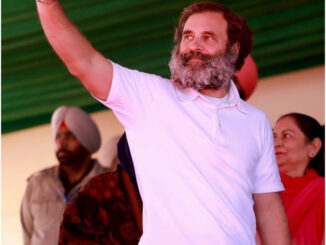
Pathankot (TIP)- Congress leader Rahul Gandhi launched a scathing attack on the BJP and RSS on Thursday, January 19, accusing them of creating an atmosphere of hatred, violence and fear in the country.
Addressing a rally here on the last day of Bharat Jodo Yatra’s Punjab leg, he alleged that the BJP was making one religion fight against another, one caste against another and one language against another.
“They create fear. All of their plans (policies) cause fear to someone or something,” he alleged.
Pointing towards the policies of the previous UPA government, Gandhi said it brought MGNREGA, waived farm loans, urban renewal mission, green revolution, white revolution. “Whatever we do is to wipe out fear. And whatever they do they (BJP) do is to spread fear.
“Look at their policies—farmers get up at 4 am in the morning and they toil hard daily and feed the nation. Farmers do not want anything in return, they only want respect,” he said.
He targeted the Centre over the now-repealed three agri laws and said these created fear in the minds of farmers.
“But what did BJP do for them—they brought black farm laws. These laws created fear among farmers,” he said.
Speaking about Pradhan Mantri Fasal Bima Yojana, the Congress leader claimed that farmers were not getting compensation for their crop damage because of the vagaries of weather. “Not even a single farmer told him that they got insurance compensation when they suffered crop loss due to natural calamities,” he claimed. Source: PTI
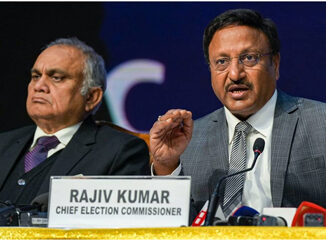
New Delhi (TIP)- The 2023 assembly elections season kicked off on Wednesday, January 18, as the Election Commission of India (ECI) announced the poll schedule for Tripura, Meghalaya and Nagaland next month, setting the stage for a fierce political battle in India’s northeast. Voting for assembly elections in Tripura will be held in a single phase on February 16, and in Nagaland and Meghalaya on February 27. The results will be declared on March 2, chief election commissioner Rajiv Kumar said during a press conference. The Bharatiya Janata Party (BJP) is part of the ruling coalition in all three states, which all have 60 seats in the assembly. The Commission, led by CEC Kumar, and election commissioners Anup Chandra Pandey and Arun Goel, appealed to all the voters to participate in the “festival of democracy”. “I urge all the voters to cast their ballot and be a part of this festival of democracy,” Kumar said while announcing the dates at the press conference. “The Commission is making all efforts to conduct an inclusive election.”
The announcement marks the beginning of a packed assembly elections schedule in 2023, which will see polls in nine states in addition to possible elections in Jammu & Kashmir. The three states that go to the polls in February may be small – with one Lok Sabha and six assembly seats — but are likely to see pitched political contests, especially in Tripura and Meghalaya, where the ruling coalitions appear uneasy.
January 30 will be the last date for nominations in Tripura, and February 7 for Meghalaya and Nagaland. The terms of Nagaland, Meghalaya, and Tripura assemblies are scheduled to end on March 12, 15, and 22 respectively. Each state has 60 constituencies, with 59 of them reserved for Scheduled Tribes in Nagaland, 55 in Meghalaya, and 20 in Tripura.
Kumar urged people to vote and be a part of the festival of democracy. ECI has set up 9,125 polling stations in the three states, where over 628,000 people are eligible to vote. Of these, 22,000 are first-time voters. Nearly 82% of the polling stations are in rural areas.
The poll body will webcast the polling process live from 73% polling stations. Kumar said ECI was committed to conducting free, fair, participative, and ethical elections. “There are only a few states where pre-poll and post-poll violence happens. The commission has spoken to the local authorities and all efforts will be made to ensure peaceful elections.”
About 100 companies of central paramilitary forces will be deployed in Tripura’s sensitive areas due to fears of an escalation in political violence before the assembly polls. “Based on the assessment of the ground situation, Central Armed Police Forces (CAPFs) and State Armed Police (SAP) drawn from other States will be deployed during the elections. The CAPFs shall be deployed well in advance for area domination, route marches in vulnerable pockets, point patrolling and other confidence building measures to re-assure and build faith in the minds of the voters, especially those belonging to the weaker sections, minorities etc,” ECI said in a statement.
The political contest is likely to be the most heated in Tripura, where the BJP made history in 2018 by defeating the Left Front government after two decades. This time, the ruling alliance of BJP and Indigenous People’s Front of Tripura is facing an alliance of erstwhile rivals Congress and the Communist Party of India-Marxist, and a third key force in the form of the TIPRA Motha party, which is expected to do well in the tribal-dominated regions. The party, founded by former Congress leader Pradyot Bikram Deb Barma, who is also a member of the royal family, has yet not decided on whether he will go it alone, or ally with one of the two major coalitions. Deb Barma has kept his cards close to his chest, and said that he will go with the party that accepts in writing his party’s demand for separate state called Tipraland. The key to the election may be held in the 20 tribal-dominated seats in the state.
In Meghalaya, too, the ruling coalition of National People’s Party and the BJP appears to be under stress. Both parties have decided to fight the election separately, even as a third player, in the form of the Trinamool Congress, is trying to make inroads. TMC is led in the state by former chief minister Mukul Sangma, who left the Congress last year. Source: HT
Delhi Police on Thursday, January 19, said they had arrested a man in connection with an incident in which Delhi Commission for Women chief Swati Maliwal alleged that she was “molested” and “dragged by a car” for several metres opposite AIIMS in the national capital in the early hours of the day. Speaking to ANI, DCP South Chandan Chowdhary said that according to Maliwal, she was with her team outside the All India Institute of Medical Sciences here at around 2.45am when the arrested man, later identified as Harish Chandra, hailing from city’s Sangam Vihar and who appeared to be in an inebriated state approached her.
The DCW chief in her complaint to the police alleged that the man who was driving a white-coloured car stopped his car near where she was standing and “made indecent gestures”. He then beckoned her to sit in his vehicle, claimed Maliwal. When the DCW chief reprimanded him, the man allegedly went away but returned a short while later and repeated his actions, the police said.
“She was standing with her team at Gate 2 of AIIMS which falls under the Kotla police station area. According to her, when she was standing on the footpath, a white-coloured vehicle approached her whose driver offered her a lift and started insisting that she sit in the car. “When she refused and went near the driver’s window to reprimand him, the man rolled up the car’s glass window and her hand got stuck and she got dragged for about 10-15 metres,” DCP Chowdhary said.
The police official said a PCR call was received at around 3.12am and a police team, including the ACP, Hauz Khas, reached the spot at around 3.20am and the accused was apprehended.
“The police took a written complaint from Maliwal and sent her and the accused for medical examination,” the DCP added. A case was registered under Sections 323/341/509 of the IPC and 185 of the Motor Vehicles Act. Later, the section of molestation (354) was also included. Further investigation is under way. Source: ANI
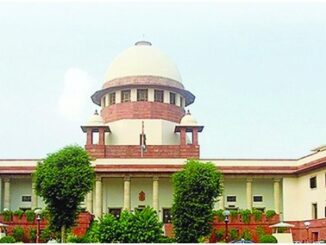
New Delhi (TIP)- The SC has cautioned courts and tribunals against using free online sources such as Wikipedia, saying such sources based on a crowd-sourced and user-generated editing model can provide misleading information.
“We must note that the adjudicating authorities while coming to their respective conclusions, especially the Commissioner of Customs (Appeal), have extensively referred to online sources such as Wikipedia to support their conclusion. While we expressly acknowledge the utility of these platforms which provide free access to knowledge across the globe, but we must also sound a note of caution against using such sources for legal dispute resolution,” a Bench led by Justice Surya Kant said while deciding a case regarding the correct classification of imported ‘All in One Integrated Desktop Computer’ under the First Schedule to the Central Excise Tariff Act, 1985. “These sources, despite being a treasure trove of knowledge, are based on a crowd-sourced and user-generated editing model that is not completely dependable,” it said.
New Delhi (TIP)- China is building a new dam in Tibet on a tributary of the Ganga, close to the tri-junction of its borders with India and Nepal, that could be used to control the flow of water downstream, new satellite imagery has revealed.
The development comes in the wake of China unveiling plans to build a “super” dam close to the Line of Actual Control (LAC) in Tibet on the lower reaches of the Yarlung Zangbo river, which flows into Arunachal Pradesh as the Siang and then to Assam as the Brahmaputra. It also comes at a time when satellite imagery has shown that China has substantially ramped up creation of military and dual use infrastructure and villages in the eastern and western sectors of the LAC.
Satellite images tweeted on Thursday by Damien Symon, a geospatial intelligence researcher at the Intel Lab, showed earth development and dam construction activity done by the Chinese side on Mabja Zangbo river in Burang county of Tibet since May 2021.
The images clearly depict the obstruction of the river’s path, the formation of a reservoir and an embankment-type dam.
The Mabja Zangbo river flows into the Ghaghara or Karnali river in Nepal before eventually joining the Ganga river in India.
The dam is located just a few kilometres north of the tri-junction of China’s border with India and Nepal, Symon said.
According to the latest satellite images, the dam appears to be 350 metres to 400 metres long, Symon said.
“The structure is currently in development, so the purpose is unknown,” he said. “It appears to be an embankment dam,” he added. “An airport is being constructed nearby as well”, he said.
People familiar with the matter said the dam, located at the strategic tri-junction of China’s borders with India and Nepal and opposite the Kalapani region of Uttarakhand state, could be used to divert or restrict the waters of the Mabja Zangbo river. Source: HT
Thiruvananthapuram (TIP)- COVID-19 pandemic will not be the last one and therefore, emergency preparedness is an overarching priority that requires building of resilient health systems across the world to protect people in the face of similar crises, India said on Wednesday, January 18, during the G20 Health Working Group meeting here.
Pointing to the need to respond together each time when such threats to global health emerge, Minister of State for Health and Family Welfare Bharati Pravin Pawar said it was essential to ally with emerging scientific evidence, diversify our capacities and capabilities and strengthen the early warning systems.
She said that emergency preparedness was no longer an initiative in isolation, but rather “an overarching priority” which “requires efforts to build resilient health systems horizontally and vertically across the world”.
“In an increasingly interconnected world we need to ensure that our communities are resilient and have equal opportunities to protect themselves in the face of a crisis. “The principle of equity and equitable support must be non-negotiable in our pursuit for health security,” she stressed in her keynote address at the G20 India Health Working Group meeting.
Union Health Minister Mansukh Mandaviya also tweeted about the meeting.
“My Ministerial Colleagues @DrBharatiPPawarJi & @VMBJP Ji inaugurated the G20 Health Working group meeting. I heartily welcome all the delegates in Kerala, India. India as part of its #G20 Presidency will work towards creating a healthier world & ensuring health equity globally,” he said.
The first Health Working Group meeting under G20 India Presidency is under way presently and will conclude on January 20. India assumed the presidency of the G20 on December 01, 2022.
Pawar said that during the two-day long meeting of the Working Health Group, the aim would be to “realign our politics and policies”. “We must invest collectively and the investment must start today.” The minister noted that the Indian presidency will aim to build on the efforts and proposals laid down by previous Health Working Groups and G20 leaders.
“It will include strengthening our healthcare, prioritising one-health, emergency preparedness, ensuring equitable distribution of life saving vaccines, therapeutics and diagnostics, and utilising digital health as an instrument to aid universal health coverage,” she said.
The G20 countries have to collectively strive to evolve and present the world with a “harmonised blueprint for the fundamental architecture of global health scheme and health emergency management duly avoiding duplication and fragmentation”. Source: PTI
The Directorate General of Civil Aviation (DGCA) has ordered a probe into how a Singapore-bound flight took off hours ahead of schedule, leaving behind 35 passengers at the Amritsar airport.
The probe was initiated by the aviation regulatory authority after a Scoot Airline flight which was scheduled to depart at 7.55pm on Wednesday, January 18, from the Amritsar airport took off at 3pm, hours ahead of its departure time.
This triggered chaos at the airport with angry passengers who were left behind staging a protest. They registered their complaint with authorities concerned at the airport.
After the airport authorities contacted the airline officials they were informed that the passengers had been sounded about the change in flight time via e-mail. “Around 280 passengers were to travel to Singapore but 253 passengers were rescheduled, leaving behind over 30 passengers behind,” Amritsar airport Director told ANI.
The DGCA has sought details from both Scoot Airline which is a Singaporean low-cost airline and a wholly owned subsidiary of Singapore Airlines and the Amritsar Airport authority.
According to the airline, all the passengers were informed about the change in timing via email. An airport official told ANI that the travel agent, who booked the tickets for 30 people in a group, had not informed them (passengers) about the change in flight timings due to which the airline flew with the passengers who had reported on time.
BBC documentary on 2002 Gujarat riots a ‘propaganda piece’: India
India on Thursday, January 19, described a BBC documentary on the 2002 Gujarat riots as a “propaganda piece” designed to push a particular “discredited narrative”.
The bias, lack of objectivity and continuing colonial mindset are blatantly visible, External Affairs Ministry spokesperson Arindam Bagchi said at a media briefing while replying to a volley of questions on the documentary.
The documentary deals with the riots that broke out in Gujarat when Narendra Modi was the Chief Minister.
Bagchi said the documentary is a reflection on the agency and individuals that are peddling “this narrative” again.
“It makes us wonder about purpose of this exercise and agenda behind it,” he said.
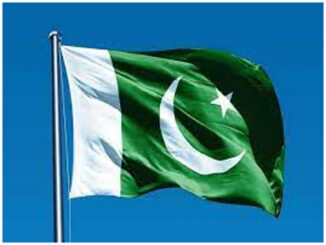
Muzaffarabad (PoK) (TIP): Frustrated residents in the illegally-occupied region of Muzaffarabad staged a protest against the spike in the prices of flour, according to a Pakistan media report.
Trade associations and other groups have warned the government if the prices do not come down, they will launch a movement after January 19, it said. The flour dealers have rejected the government’s plan to form municipal committees to control the supplies.
Pakistan is facing its worst-ever flour crisis, with parts of the country reporting a shortage of wheat and stampedes reported from several areas in Khyber Pakhtunkhwa, Sindh and Balochistan provinces. Tens of thousands spend hours daily to get the subsidised bags of flour that are already in short supply in the market, according to another report.
The residents also suffered an electricity shortage. People in Muzaffarabad took to the streets to protest against increasing load-shedding hours. In Hanza, residents and trade unions were protesting against no electricity, no water, no doctors in hospitals and no medicines in the area. (ANI)
Kandahar (TIP): The Taliban on February 18 publicly flogged nine convicted of robbery and “sodomy” in Ahmad Shahi Stadium in Kandahar. “The Supreme Court said in a statement that nine people were punished in Ahmad Shahi Stadium in Kandahar on Tuesday on charges of robbery and “sodomy”, tweeted Tolo News.
Local authorities and Kandahar residents were in attendance during the lashing. The convicts were reportedly lashed 35-39 times.
Meanwhile, former Policy Advisor to Minister for Afghan Resettlement & Minister for Refugees in the UK, Shabnam Nasimi said that the Taliban have reportedly cut off the hands of four persons accused of theft in a football stadium in Kandahar.
Despite international condemnation, the Taliban has resumed flogging and public execution of criminals. — ANI
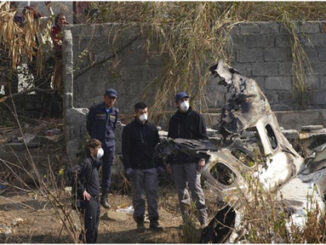
Kathmandu (TIP): A team of experts from France, which is in Nepal to help the government investigate the crash of Yeti Airlines’ aircraft with 72 people on board, on January 18 began its probe and visited the accident site in the resort city of Pokhara, officials said.
The nine-member team is enquiring with the airlines’ staff and concerned authorities in Pokhara to understand details of the ATR-72 aircraft crash, which has left 71 people dead, including five Indians, according to the Yeti Airlines official.
The aircraft that took off from Kathmandu at 10:30 am crashed into Seti river gorge on Sunday, killing all 4 crew members and 68 passengers. One person on board the aircraft is still missing.
The Nepal government has formed a five-member probe committee to investigate the crash. The probe panel headed by former aviation secretary Nagendra Ghimire has been asked to investigate the accident and submit its report within 45 days.
The ATR-72 is a twin-engine turboprop, short-haul regional airliner developed in France and Italy by aircraft manufacturer ATR, which is a joint venture between French aerospace company Aerospatiale and Italian aviation conglomerate Aeritalia.
Meanwhile, the Nepali Army team continued search operations in the Seti gorge to look for the remains of the aircraft, an Army personnel said. As one more dead body was on Wednesday brought to Kathmandu from the air crash site, the medical team performed postmortem on 49 other corpses. Twenty-two bodies of Nepali nationals have already been handed over to their relatives by the Pokhara Academy of Health Sciences, where the doctors completed the postmortem on Tuesday.
Many bodies are burnt or split in parts, thus making it challenging to identify.
The bodies went through DNA tests after postmortem before they were handed over to their family members, Yeti Airlines spokesperson Sudarshan Bartaula said. The DNA identification formality has thus caused a delay in handing over the dead bodies to the family members, who have been complaining about the lengthy procedure. According to Nepal’s civil aviation body, 914 people have died in air crashes in the country since the first disaster was recorded in August 1955.
The Yeti Airlines tragedy in Pokhara on Sunday is the 104th crash in Nepali skies and the third biggest in terms of casualties. (PTI)
Peshawar (TIP): Some six to seven militants attacked Sarband police station bordering Khyber tribal district with hand grenades, automatic weapons and sniper shots and three policemen were killed in the cross-firing, SSP Operation Peshawar Kashif Abbasi said.
The Tehrik-i-Taliban Pakistan (TTP) terror group has claimed responsibility for the attack.
The three slain policemen include the Deputy Superintendent of Police Sardar Hussain and two constables.
Kher Pakhtunkhwa Police chief Moazzam Jah Ansari said the policemen successfully foiled the terrorist attack on the station and fought valiantly. The DSP was injured in the firing while entering the building. He succumbed to his injuries in the hospital.
Chief Minister of Khyber Pakhtunkhwa province Mehmud Khan condemned the incident and said sacrifices of the police in the war against terror will not go to waste.
A search operation to locate the attackers is nderway. In a statement, Muhammad Khurassani pokesman for TTP said their Mujahideen attacked two police posts in Peshawar last night with laser guns.
The TTP claimed killing four policemen, including a DSP rank police officer, and injuring three in the attack, along with seizing two Kalashnikovs, two magazines and Rs 47,000.
In another statement, its spokesman also claimed esponsibility for the attack on a joint security checkpoint of police and CTD in tehsil Tunsa Sharif of Dera Ghazi Khan district Southern Punjab, killing two cops.
TTP, commonly known as the Pakistani Taliban, is an umbrella organisation of various Islamist armed militant groups operating along the Afghan–Pakistani border. Formed in 2007, the group shares a common ideology with the Afghan Taliban and assisted them in the 2001–2021 war. (PTI)
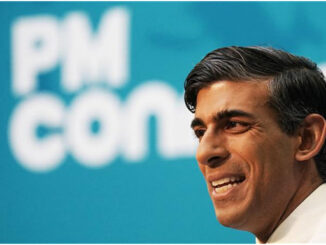
London (TIP): Prime Minister Rishi Sunak has come out in defence of Prime Minister Narendra Modi after a controversial BBC documentary claimed that the British government was aware about the Indian leader having an alleged role in the 2002 Gujarat riots.
Sunak said he does not agree with the characterisation of Prime Minister Modi by Pakistani-origin Imran Hussain, an Opposition Labour Party MP, when he asked if the British Premier agreed with claims in the BBC programme that some UK Foreign Office diplomats believed that “Modi was directly responsible”.
During Prime Minister’s Questions (PMQs) in the House of Commons on January 18, Hussain raised the claims made in the first part of ‘India: The Modi Question’ that UK Foreign, Commonwealth and Development Office (FCDO) knew the “extent of Narendra Modi’s involvement”, then Gujarat Chief Minister, in the communal clashes that claimed hundreds of lives.
“The UK government’s position on that is clear and long standing, and it has not changed,” Sunak responded.
“Of course, we do not tolerate persecution anywhere, but I am not sure that I agree at all with the characterisation that the hon. gentleman has put forward,” the British Prime Minister said.
The Indian government has, meanwhile, condemned the BBC Panorama programme, which has not been screened in India, as a “propaganda piece” with a questionable agenda behind it.
“We think that this is a propaganda piece, designed to push a particular discredited narrative. The bias, lack of objectivity and continuing colonial mindset is blatantly visible,” MEA spokesperson Arindam Bagchi told reporters during a press briefing in New Delhi on Thursday when asked about the controversial series.
The first part of the two-part ‘India: The Modi Question’ programme, which aired on BBC Two on Tuesday, was categorised by the UK taxpayer-funded broadcaster as “a look at the tensions between Indian PM Narendra Modi and India’s Muslim minority, investigating claims about his role in 2002 riots that left over a thousand dead”.
The second part of the series, scheduled to be aired next Tuesday, is pegged as a “look at the troubled relationship between Indian PM Narendra Modi’s government and India’s Muslim minority following his re-election in 2019”.
“We strongly condemn the BBC’s malicious documentary, ‘India: The Modi Question’, said Insight UK, among several diaspora groups who have taken to social media to condemn the documentary.
“Riddled with antisemitism, anti-Hindu and anti-India biases, they have lost many viewers and yet continue spreading their hate without consequence or accountability,” it added. (PTI)
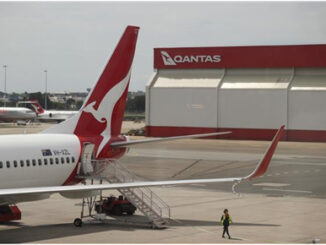
Sydney (TIP): A Qantas Airways flight from New Zealand landed safely at Sydney airport on January 18 after the airline said it had issued a distress signal due to an issue with one of its engines.
The Boeing 737-800 jet from Auckland had an in-flight engine shutdown and issued a “mayday” call while flying over water an hour from its destination of Sydney, a Qantas spokesperson said in a statement. The mayday signal, which indicates grave and imminent danger, was downgraded to “Possible Assistance Needed” before landing, the spokesperson added.
All 145 passengers disembarked normally when the plane landed in Sydney around 3.30pm local time (0430 GMT). “While in-flight engine shutdowns are rare, and would naturally be concerning for passengers, our pilots are trained to manage them safely and aircraft are designed to fly for an extended period on one engine,” the airline said. Passengers told local media they heard a loud bang mid-flight but had not realised there was a problem until the pilot made an announcement on landing. “I turned on my phone and my wife had called me 18 times, ‘Have you landed, have you landed?’” an unnamed passenger told reporters at the airport.
Qantas said it would share more information once engineers had finished inspecting the aircraft. (Reuters)
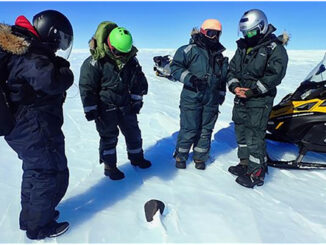
Zurich (IP): In a rare discovery that could hold answers to the Earth’s formation, scientists have found meteorites from the depths of Antarctica Blue Ice, an area with strong winds where the glaciers get ablated, with one of them weighing 7.6 kg.
An international team of scientists went on a reconnaissance mission to Antarctica with the objective of finding new areas of meteorite accumulation around the Belgian Princess Elisabeth Antarctica (PEA) Station, according to a statement.
The exploration was from December 11, 2022 to January 11.
“Meteorites are rocks fallen from space as a shooting star. Previously, three successful Belgian-Japanese missions to the Nansen Blue Ice Field near the Belgian station in Antartica collected more than 600 meteorites. Using satellite images and GPS coordinates, the team set out to discover the potential of several areas of interest by searching them for meteorites,” said professor Maria Schoenbaechler, department of earth sciences at ETH-Zurich in Switzerland, told PTI.
The blue ice zone of Nils Larsen, about 60 km from the station, has been recognised as an accumulation zone worthy of revisiting, the statement said.
“But above all, the team returns with a very nice surprise in its luggage: a 7.6 kg meteorite! Such big meteorites are very rare in Antarctica,” it said.
“At the moment it looks like an ordinary chondrite. This type of meteorite comes from the asteroid belt and ended its travel in the Antarctic blue ice, waiting several tens of thousands of years in the ice before discovery. “It belongs to the oldest material that can be found on Earth and is similar to the building block of the Earth,” said Schoenbaechler.
So, what does this mean for the Earth science research? “This means we can study planet Earth’s formation with this type of meteorite,” said Schoenbaechler. The meteorites were found on the blue ice or in the moraines. The scientists documented them without touching them and packed them directly into plastic bags or aluminium foil to avoid contamination, she said in an email.
Differentiating between meteors and meteorites, Schoenbaechler said, “The rocks, which we found, are called meteorites. The shooting star is the trail which it generates while falling onto the Earth and is called a meteor.”
When asked how the meteorites were identified as such, she said, “The meteorites were first identified by looking at them — our big meteorite has a very typical dark fusion crust, which is formed during the fall of the rock onto earth.
“This generates a shooting star (meteor), in which the upmost surface of the rock is heated by aerodynamical friction and melted. We also used a handheld tool to test the magnetic properties of the rock.” (PTI)
Beijing (TIP): China’s demographic crisis deepened in 2022 as its population declined for the first time since 1961 due to a plunging birth rate, the country’s statistics office said on January 17, amid a forecast that India is poised to overtake the Communist giant as the world’s most populous country. According to a recent report by the World Population Prospects 2022 by the United Nations Department of Economic and Social Affairs, Population Division, India is projected to surpass China as the world’s most populous country in 2023. According to the report, India is projected to have a population of 1.668 billion in 2050, more than China’s 1.317 billion by the middle of this century.
“China and India are countries with a big population and the two countries should take advantage of their population dividend to develop each other’s respective national development and make greater contributions to the international community,” Chinese Foreign Ministry spokesman Wang Wenbin said.
According to the NBS, China registered about 9.56 million new-borns last year, down from 10.62 million in 2021. China’s birth rate stood at 6.77 births per 1,000 people in 2022, down from 7.52 in 2021, it said.
The death rate nationwide stood at 7.37 per 1,000 people last year, putting the natural growth rate at negative 0.6 per 1,000 people. The last time China reported a population decline was in 1961.
China’s concern is not simply a declining population, which was accentuated by the decades-old ‘one child policy’, scrapped in 2016, but also a rapidly ageing population. As per the revised policy, Chinese people can now have up to three children. China conducts a nationwide population census every decade, with the latest being done in 2020. China’s total population size peaked in 2022. (PTI)
London (TIP): British Prime Minister Rishi Sunak has apologised for a “brief error of judgment” in removing his seat belt to film a social media video while driving to a destination in north-west England.
Sunak’s Downing Street spokesperson on January 19 said he had only briefly removed his seat belt and admits he made a mistake.
In the UK, passengers caught failing to wear a seatbelt while in a car, unless covered by a valid medical exemption, can be given an on-the-spot fine of 100 pounds, increasing to 500 pounds if the case goes to court. (PTI)
Moscow (TIP): Former Russian President Dmitry Medvedev, an ally of Kremlin chief Vladimir Putin, warned NATO on January 19 that the defeat of Russia in Ukraine could trigger a nuclear war.
Striking a similar tone at what he described as an anxious time for the country, the head of the Russian Orthodox Church said trying to destroy Russia would mean the end of the world.
Since Russia invaded Ukraine, Medvedev has repeatedly raised the threat of a nuclear apocalypse, but his admission now of the possibility of Russia’s defeat indicates the level of Moscow’s concern over increased Western weapons deliveries to Ukraine.
“The defeat of a nuclear power in a conventional war may trigger a nuclear war,” Medvedev, who serves as deputy chairman of Putin’s powerful security council, said in a post on Telegram.
Medvedev said NATO and other defence leaders, due to meet at Ramstein Air Base in Germany on Friday to talk about strategy and support for the West’s attempt to defeat Russia in Ukraine, should think about the risks of their policy.
Meanwhile, European Union chairman Charles Michel met Ukrainian President Volodymyr Zelenskiy in Kyiv on Thursday to discuss EU support for Ukraine as it fights a Russian invasion, as well as reforms needed for Ukraine to join the EU after the conflict ends.
Britain plans to send 600 Brimstone missiles to Ukraine to support the country in its fight against Russia, defence secretary Ben Wallace said on Thursday.
Putin casts Russia’s “special military operation” in Ukraine as an existential battle with an aggressive and arrogant West, and has said that Russia would use all available means to protect itself and its people from the prevailing western threat. — Reuters
San Juan (Puerto Rico) (TIP): Lawyers for Usain Bolt, one of the world’s greatest sprinters, said that more than USD 12.7 million is missing from his account with a private investment firm in Jamaica that authorities are investigating. Attorney Linton P. Gordon on Wednesday provided The Associated Press with a copy of a letter sent to Stocks & Securities Limited demanding that the money be returned. Gordon said Bolt’s account once had USD 12.8 million but now reflects a balance of only USD 12,000.
“If this is correct, and we are hoping it is not, then a serious act of fraud larceny or a combination of both have been committed against our client,” Bolt’s attorneys say in the letter. They threaten civil and criminal action if the money is not returned within 10 days.
Stocks & Securities Limited did not immediately respond to a request for comment. On its website, the company asked that clients direct all urgent queries to Jamaica’s Financial Services Commission, which is investigating the firm.
“We understand that clients are anxious to receive more information and assure you that we are closely monitoring the matter throughout all the required steps and will alert our clients of the resolution as soon as that information is available,” the company said.
The company has said that it discovered the fraud earlier this month and that several of its clients may be missing millions of dollars.
Jamaica’s finance minister, Nigel Clarke, called the situation alarming but noted it was unusual.
“It is tempting to doubt our financial institutions, but I would ask that we don’t paint an entire hard-working industry with the brush of a few very dishonest individuals,” he said.
Bolt’s lawyers sent the letter Monday, the same day that Jamaica’s Financial Services Commission announced it was appointing a special auditor to look into fraud allegations at Stocks & Securities Limited, which is based in the capital of Kingston.
On Tuesday, financial authorities said they were assuming temporary management of the private investment firm. It is allowed to keep operating but needs approval from the government for any transactions.
Bolt, who retired in 2017, holds the world records for the 100 metres, 200 metres and 4×100 metres. AP
JAIPUR (TIP): Inaugurating the 16th session of Jaipur Literature Festival here, Nobel Laureate Abdulrazak Gurnah on Thursday, January 19, said that writing is not just a form of resistance but it is also about resistance to distraction, neglect, and forgetfulness.
In his keynote address on ‘writing as a form of resistance’, the Tanzanian-born British author of 10 novels and Nobel Laureate in literature in 2021, said, “It is a good way of describing what writing is. It sounds noble, brave and taking on whatever–resisting. But resisting what? Or what is it that writing is resistant to ? Or can there be resistance too ?”.
“It really is not about nobility or bravery alone. It is also about just working. And working at perhaps things which go on over time, rather than inspirations or sudden epiphanies”, he said. Probably resistance to forgetfulness, resistance to distraction and resistance to neglect were the three other forms of writing as a form of resistance, Gurnah said.
“It is resistance to neglect, to ensure that the things we care for, the things that are important, are not neglected, are not distorted by other narratives, are not pushed away by people who wish to inform us that the world is different from what all knowledge tells us”, he who has been professor of English at Cantt University, explained.
Above all, he said, “It is upholding those ideas and beliefs that we think are important and that we value. So if somebody says writing is resistance, those are the kind of things I think of, rather than necessarily fighting tyrants or necessarily standing on platforms and making powerful speeches to energize people”.
“Writing is a continuous process. This should be a part of your daily routine… While writing, don’t think that you have to become someone’s inspiration, or that you will get an award, or that you will ever be noticed. You just have to keep away from distractions. And that’s the truth… In the process you will find it easier to have thoughts and beliefs that are important and matter to you”, he suggested.
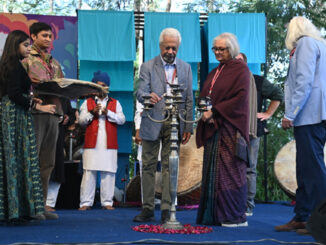
In the inaugural session the festival was opened with the melodious vocals of Sushma Soma, award winning singer of Carnatic music. Among others who addressed the inaugural address included Sanjoy K Roy, its producer & director, and two co-directors Namita Gokhale and William Dalyrymple. The magnificent and diverse programme for the much awaited 16th edition will as always feature some of the most celebrated and extraordinary minds of the world. It will display 21 Indian and 14 International languages with sessions spread across five venues.
The festival is hosting 350 speakers from across a vast array of nationalities, as well as recipients of major awards such as the Nobel, the Booker, International Booker, the Pulitzer, the Sahitya Akademi, Baillie Gifford, Pen America Literary Awards, the DSC Prize for South Asian Literature and JCB Prize for literature, Namita Gokhale, its founder co-director said here today.
JLF is featuring some of the greatest literary minds including Nobel laureate Gurnah, international booker prize winner Geetanjali Shree, author and translator Daisy Rockwell, lyricist and author Gulzar, filmmaker and producer Onir.
NEW DELHI (TIP): India hosted a two-day Voice of Global South Summit on 12-13 January 2023. The Summit was held in virtual format, with 10 sessions in total. It saw participation of Leaders and Ministers from 125 countries of the Global South. India convened this one-of-a-kind Summit to focus international attention on priorities, perspectives and concerns of the developing world.
This is particularly relevant as the world passes through a difficult period marked by challenges to health, food security, affordable access to energy, climate finance and technologies, and economic growth.
This Summit is a timely reminder of what is at stake for over three fourths of the planet’s population that is most vulnerable to the deleterious impact of the several interlinked risks we confront.
Prime Minister Shri Narendra Modi presided over the Inaugural Leaders’ session on 12 January. This was followed by eight Ministerial-level thematic segments dedicated to addressing the most pressing concerns of the developing world. The Summit wrapped up on 13 January with a Concluding Leaders’ Session also hosted by the Prime Minister.
The participating Leaders appreciated and congratulated the leadership of Prime Minister in hosting the Summit at a crucial juncture. They expressed hope that the Summit would serve as a catalyst for building a prosperous and inclusive future for the world that takes into account the needs of the Global South.
In his inaugural remarks, Prime Minister framed the key issues at stake for the developing world. He highlighted the opportunity for uplifting societies and economies of the Global South through a shared vision and agenda for change. In this endeavor, he offered to share India’s experiences through simple, scalable and sustainable solutions. He highlighted India’s achievements in vaccine development, biometric based identification, digital public goods, financial inclusion, satellite technology, digital governance, last mile connectivity, etc. He also spoke about the need for the developing world to have access to technology, knowledge and critical resources. His call for a new human centric development paradigm received widespread support from participating Leaders.
During the Concluding Leaders’ session, Prime Minister announced a number of new initiatives by India in connection with the Voice of Global South Summit. These include:
Aarogya Maitri
Global South Centre of Excellence
Global South Science and Technology Initiative
Global South Young Diplomats Forum
Global South Scholarships
In the Finance Ministers’ session, Ministers exchanged views on financing the development needs of the Global South, achieving financial inclusion, implementation of digital public goods in the financial sector, and development partnerships that are outcome-oriented and financially sustainable.
The Environment Ministers’ session focused attention on balancing growth with sustainability, sharing of best practices in ecological conservation, and the importance of LiFE, or lifestyle for environment launched by Prime Minister in October 2022.
Ministers also called for accelerated climate action and delivery of climate finance and loss and damage funding to deal with growing climate impacts, in accordance with the principles of Equity and Common But Differentiated Responsibilities and Respective Capabilities (CBDR-RC). In the Foreign Ministers’ session, Ministers expressed concern over the increasing fragmentation of the international landscape, and exchanged perspectives on how to create a conducive environment for the development priorities of the Global South. Ministers urged the international community to address the triple challenge of food, fuel and fertilizer shortages. They also called for renewed and inclusive multilateralism that reflects contemporary realities. The need to raise their collective voice against the scourge of terrorism was underlined.
The Energy Ministers’ session emphasized the criticality of energy security for global growth and human development. Access to energy amidst increasing instability, ensuring energy affordability through diversification of energy sources, sharing best practices to develop renewables and alternate energy, and harnessing the potential of biofuels were the main themes of interaction.
In the Commerce/Trade Ministers’ session, Ministers shared strategies on improving the business and investment climate in developing countries; upgrading connectivity and commerce; ensuring access to critical technologies and resources; fostering grass-roots innovation and sharing of best practices; and diversification of supply chains. Ministers agreed that a sustainable post pandemic recovery would be contingent on simplifying procedures, implementing technology based solutions, investing in infrastructure and ensuring equitable access to global markets.
In the Health Ministers’ session, participants emphasized the need to adopt an inclusive approach to global health security. Ways and means to develop digital public goods in healthcare, promote traditional medicine, build public capacities and develop regional networks, and knowledge sharing were discussed. Ministers were particularly appreciative of India’s Vaccine Maitri initiative during the Covid pandemic, as a substantive reflection of South-South cooperation.
In the Education Ministers’ session, ideas to transform developing countries into knowledge-based societies that can create future ready workforces were shared. Ministers spoke about the need to share best practices in vocational training, capacity building and use of technology to provide equity and quality in education. India shared its National Education Policy built on the foundational pillars of access, equity, quality, affordability and accountability.
In the session dedicated to sharing ideas for India’s G20 Presidency, External Affairs Minister shared India’s key priorities for its G20 presidency and also assured that India would work to ensure that the valuable inputs generated from partner countries in the Voice of Global South Summit receive due cognizance globally, including in G20 deliberations.
Participating countries recognized with appreciation that the Summit produced fruitful conversations and charted a new path through an action oriented agenda that strives to address their priorities and challenges. They underscored the agenda and quest for solutions to global challenges must include the voices of its biggest stakeholders, the Global South.
The Indian Panorama Editor Indrajit Saluja interviewed Ambassador Randhir Kumar Jaiswal, Consul General of India at New York. This is the fourth part of the interview.
Consul General of India at New York Mr. Randhir Kumar Jaiswal, a few days after joining the present position on 19th July 2020 in an interview with The Indian Panorama, had spelt out in brief his priorities which included nourishing and strengthening the already strong bonds between India and the US, and exploring new areas of cooperation and relationship in diverse fields of economy, trade, technology, and culture etc. Ambassador Jaiswal added that serving the Indian Diaspora remained the primary focused concern of the Consulate. The strengthening of multi-stake holders relationship will be another priority, he said. The Indian Panorama interviewed him a couple of times, and each time, Mr. Jaiswal was forthcoming on all issues raised ,and questions asked.
Three days to the end of the year 2022, Mr. Jaiswal agreed to sit with the editor of The Indian Panorama to share for the readers of the publication his thoughts. It was a long interview in which Ambassador Jaiswal touched upon all the aforementioned areas.
In the part 1 of the interview published two weeks ago, Ambassador Jaiswal focused on the vibrant Indian American community and its contribution.
In part 2 of the interview, we brought to readers Ambassador’s perspective on Indian students as a powerhouse of knowledge, catalysts of national integration, and promoters of Indian arts, culture and values.
In this third part of the interview, Ambassador Jaiswal spoke about promoting economic relations between the two nations as one of the important functions of the Consulate, besides reiterating what he had said in the first part of the interview that the Consulate is “committed to public service”.
In this fourth part of the interview, Ambassador Jaiswal outlines the big events planned in the year 2023.
Here are some excerpts from the interview.
TIP: It is wonderful to know the good things and the great things you have been doing. Hopefully you will continue with them in 2023. Do we have any specific events which are worth mentioning that you have planned for 2023?
Ambassador:There’ll be a big 2023. As far as India is concerned, we will be taking over the presidency of G20. So that’s a big occasion for us. India will be leading the world in a sense. 20 countries of the world, big countries of the world, they account for 85% of the GDP, will have the meetings, which, in fact, have already started. India will have the summit meeting somewhere in Septemberor in the middle of the year or thereabout. So that will be a big occasion for us to welcome leaders from across the world , and show them how it can contribute to inclusive growth, how it can contribute in solving the challenges of the world, how it can contribute to peace and security of the world, how it can contribute to making the world a more progressive place for one and all, you know issues like inclusive growth, how we have dealt with public digital goods, which is a huge example. India’s success is a huge example everywhere today. 40% of digital payments worldwide having made in India utilize technology platform and digital economy and digital platforms to pull out public services. And everybody has much to say about it. India’s FinTech platform, UPI is a major success and a global talking point today. The approach we have on women empowerment, for example, the President of India is an inspirational figure. Today, India counts for the highest number of women pilots in the world in terms of percentage, 12 and a half percentage. So, all these good stories we want to tell. Even in a startup ecosystem, large number of them are led by women directors, women founders, very good story to tell. We want to tell how we can contribute to the World meeting Sustainable Development goals, the world meeting climate change challenge, etc. We have much to contribute. We will see all this happening next year, as India leads the G 20 as its president.
Consul General Randhir Kumar Jaiswal. (File photo)
Then next year we have is International Year of Millets what we call mota anaj in our country. We piloted a resolution in the United Nations. It was India’s initiative. And thereafter now the United Nations will be celebrating International Year of Millets across the world. The Food and Agriculture Organization which is based in Rome will take the lead. All our embassies and consulates will take lead and of course in India you will have functions throughout the year. The idea behind promoting millet is that millets are useful health wise and water wise. So, while it helps you being healthy, at the same time, it helps you in taking climate change action. You know with less water you can produce more. And then of course, there are several other benefits. There are benefits for farmers also.If you create a market for small and marginal farmers, they will get more income in their hands. So, it helps everybody. Thirty or forty years back everybody in India was given to eating millets, but somehow because of various factors, people moved away from eating them. But millets are back. If you go to Indian restaurants in Manhattan, there is something of millet which is available. So, we’ll try to do our best to promote consumption of millets. In today’s world of sustainability and climate change action everybody is looking for a healthy diet. And, there are so many things that India has to offer, that will promote trade from India. It will also promote sustainability in general.
TIP:That was at the national level. What have you planned here at the Consulate in 2023?
Ambassador:There are a lot of activities that we have definitely planned. 26th January, of course. We will have the reception after two years of COVID induced routine that we had, for which we could not hold the reception to celebrate India’s Republic Day. Hopefully we’llhave no problem and we will celebrate India’s Republic Day and we’ll celebrate it with Indian color, Indian twist and with Indian millet dishes.
We have SwamiVivekananda birthday on 12 January coming up. We’ll have a program on Swami Vivekananda’s birth anniversary. He visited United States in 1893. American people’s attitude towards India changed the way he spoke about Indian philosophy and thought. People in America were able to better appreciate his thoughts because he spoke their language- the language which is universal. So the universality of India, the universalism of Indian thought was brought to the audience here. What he was also able to make an impact on is the way modernity was defined here. He brought spirituality, spiritual understanding to be part of modernity. I think his legacy and his wisdom and his guidance will help us go forward. The first Vedanta society he established was here in New York, even before it was established in India. So, he has a huge imprint on the city. So, we have a busy calendar. We have Republic Day. We have the international year of millets. We will have several food festivals during the food festival year.
TIP:Is there a date?
Ambassador:No. It is the whole year. We will have top shows on millets we’ll be giving gifts made of millets-biscuits for example, and such stuff. Then, we want to promote Indian coffee here. Indian coffee exports have seen a significant jump. We want to promote coffee coming from Karnataka. Coffee has a big market.. We have had programs to promote Indian coffee before but we will have several new programs. We want to promote our superfoods. We also promote Indian wellness products. Wellness products are doing very well internationally. We also have a plan to promote tiles, tile exports from India. There are three or four countries which are our major competitors- Spain, Italy, China, etc. We have a presence here in the United States. But we can compete with the best. Indian tiles are doing very well in the Middle East and other markets. We have a presence here but we want to expand the presence. We also want to strengthen collaboration between startup ecosystem here in the US and in India.
TIP:So, apart from what you have said just now there are so many more. One question about the celebration of days of various States and their language and culture. Have you drawn up a plan for 2023?
Ambassador: Yes. We have several programs lined up as part of the languages series.We also have the states that we celebrate here -Gujarat Day, Maharashtra Day, Punjab Day, Bihar Day etc.
WASHINGTON, D.C. (TIP): The White House on Tuesday, January 17, insisted that the looming debt ceiling crisis be dealt with without conditions and there is no room for negotiations on this.
“This should not be political brinkmanship. We should be dealing with the debt ceiling without conditions. It is important. We’re not going to work our way around this; we’re not going to negotiate on this. This is the basic duty of Congress,” White House Press Secretary Karine Jean-Pierre told reporters at her daily news conference.
In the last administration, the Democrats and Republicans were able to deal with the debt limit three times. “Let’s not forget that,” she said. Last week, Treasury Secretary Janet Yellen in a letter to Congress raised the red flag on an imminent debt crisis. Given the sharp differences between the ruling Democrats and the opposition Republicans, who enjoy a majority in the House of Representatives, not handling the issue on time might result in the United States defaulting on its debt commitment, which has never happened in the past.
Republicans have so far insisted on not raising the debt limit which currently is USD 31.381 trillion as approved by Congress last month. This debt limit is the total amount of money that the US government is authorized to borrow to meet its existing legal obligations and is scheduled to reach its statutory limit on January 19. The United States is the only industrialized nation to have such an arbitrary institution as a debt ceiling, but the players who keep ending up in the same standoff aren’t exactly looking to kill it, Time magazine said Tuesday.
The New York Times warned that a default would most likely rattle markets and carry big risks, no matter how the Federal Reserve and Treasury try to curb the fallout. In her letter to the Congressional leadership, Yellen asserted that it is “critical that Congress act in a timely manner to increase or suspend the debt limit”. Failure to meet the government’s obligations would cause irreparable harm to the US economy, the livelihoods of all Americans, and global financial stability, she warned.
Indian American Congressman Raja Krishnamoorthi, who is a Democrat, has called for an increase in the debt limit. “If we don’t raise the debt ceiling, we’ll go into default, and only one default is enough to nuke the economy,” he said.
Opposing an increase in the debt limit, Republican Congressman Ralph Norman, said that USD31.4 trillion, is a massive amount of debt. “The government owes this money because politicians in Washington simply will not stop spending. This has been the case for decades, and Republicans are just as much to blame as Democrats,” he said.
“We’ll have to see how negotiations play out, but the bottom line is this: Republicans need to see some degree of incremental spending cuts in these debt ceiling negotiations. An agreement without some reasonable cuts is unacceptable,” Norman said.
“Our national debt is approaching a level not just harmful to economic growth and irresponsible to future generations, but dangerous to our national security today. We are entering treacherous waters and must couple any debt ceiling increases with real reforms,” said Congresswoman Victoria Spartz.
“Huge amounts of politically directed spending and crony capitalism have created a significant oligopoly problem in nearly every market sector – not much different from oligarchs ruling in post-socialist countries,” she said.
Senate Majority Leader Chuck Schumer and House Democratic Leader Hakeem Jeffries in a joint statement said that the Congress must act on legislation to prevent a disastrous default, meet America’s your obligations and protect its full faith and credit.
“A default forced by extreme MAGA Republicans could plunge the country into a deep recession and lead to even higher costs for America’s working families on everything from mortgages and car loans to credit card interest rates,” they said.
“America pays its debts. Period. There should be no political brinkmanship with the debt limit. It’s reckless for Speaker McCarthy and MAGA Republicans to try and use the full faith and credit of the United States as a political bargaining chip. A default would be catastrophic for America’s working families and lead to higher costs,” Schumer said in another statement.
(Source: PTI)
Signup to our Newsletter!
Don’t miss out on all the happenings around the world