WASHINGTON, D.C. (TIP): This is what an arms race of the 21st century looks like.It’s not about trying to outrun geopolitical rivals like the Soviet Union.It’s about technology… and specifically, semiconductors. Or “chips.” Right now, things aren’t looking good for the United States in terms of semiconductor capacity.Industry giants like Ford and General Motors are feeling the pain. Due to chip supply shortages, they shipped cars without much-needed accessories, like touchscreens or heated seats.
You see, the U.S. relies on manufacturing facilities located in other places — mainly Taiwan — for its chip supply.It’s not ideal to have a key tech supplier located just 110 miles away from the country’s main geopolitical challenger, China.Especially when said the challenger had no problem flying dozens of warplanes over chip production facilities in Taiwan as part of a military drill.
The U.S. and China aren’t at war- for now. But the risk of an escalating conflict has pushed the United States to start “onshoring” some of the key industries that it relies on Taiwan for, such as semiconductors.
The good news is this decision will kickstart a multi-billion-dollar investment trend… So, in a moment, I’ll explain who the biggest winners will be… and how you can learn about the companies benefitting in 2023.
Chips are critical in a modern economy. Almost any appliance you use has multiple chips in it. On average, a modern car has about 1,500 chips alone. But the COVID pandemic kickstarted a chip shortage due to rising demand and disrupted supply chains failing to keep up with a spike in consumer spending.
As a result, the U.S. government passed the CHIPS Act in late 2022. It’s a sprawling piece of legislation focused on boosting domestic chip production – with over $280 billion of spending over the next 10 years.
Most of the funds, $200 billion, will be spent on scientific research in advanced semiconductors.
Another $53 billion will be dedicated to semiconductor production. What’s more, the bill provides chip plants tax credits of almost $24 billion, to spur U.S. chip manufacturing. The CHIPS Act is so massive that it will create incredible wealth for the companies participating in the chip “onshoring” trend. McKinsey, a consultancy, estimates that chips will become a $1 trillion industry by the end of the 2020s.
For instance, when the U.S. government announced the CHIPS Act in 2020 (two years before it passed), semiconductor companies launched dozens of projects that would benefit from it.
As of mid-December 2022, over 40 new projects in the chip ecosystem were announced. Those included new chip fabrication facilities, expansions of existing ones, and the production of equipment and materials used in chip assembly.
Meanwhile, private companies have dedicated over $200 billion to chip manufacturing projects. As a result, 40,000 new jobs will be created in the country. Best of all, an SIA-Oxford Economics study estimates that each semiconductor-related job supports almost six jobs in the wider U.S. economy…
How This Legislation Relates to the Broader Economy… and Your Money
Much like the Infrastructure Act I wrote about last week, this kind of investment in “digital infrastructure” benefits not only the chip industry, but the broader economy as well.
The biggest winners from the CHIPS Act in the long term include some of the already-established players in the chip space.
Such as Intel. It is building a new semiconductor plant in Ohio and expanding its facilities in Arizona and New Mexico. These investments will have a 25% rebate from the government.
So, the more Intel spends on plant construction and research and development, the more money it will receive from the government. Again, the companies that can fund tens of billions of dollars to build these facilities (a modern one costs about $10 billion) are the largest ones in the business.
Micron and Texas Instruments, two large-scale semiconductor companies, will likely share the bulk of the government subsidies with Intel. But these facilities will take years to build…
Construction at Micron’s facility will begin in 2024, and production will ramp up by the end of this decade.
Although, there is a way to play the semiconductor trend in 2023. Casey Research colleague and financial expert Nomi Prins is going to share how you can benefit from government policy like the CHIPS Act in a special event tomorrow, January 12 at 8 p.m. ET.
She will reveal how the government has already picked the biggest winners and losers for 2023 … and she will show you a little-known strategy that Wall Street pros use every day to profit off their insider knowledge of Washington.
WASHINGTON, D.C. (TIP): The United States has announced another military assistance package of USD 2.5 billion for Ukraine to fight against Russian aggression, taking the total US military assistance to USD 27.5 billion.
“This assistance package will provide Ukraine with hundreds of additional armored vehicles, including Stryker armored personnel carriers, Bradley infantry fighting vehicles, Mine-Resistant Ambush Protected vehicles, and High Mobility Multipurpose Wheeled vehicles,” Secretary of State Antony Blinken announced Thursday, January 19.
The package also includes critical additional air defense support for Ukraine, including more Avenger air defense systems, and surface-to-air missiles, as well as additional munitions for NASAMS that the United States has previously provided, he said.
It also contains night vision devices, small arms and ammunition, and other items to support Ukraine as it bravely defends its people, sovereignty and territorial integrity, Blinken said in a statement.
“This package, which totals USD 2.5 billion, will bring the total US military assistance for Ukraine to an unprecedented approximately USD 27.5 billion since the beginning of the administration,” he said.
“The United States also continues to rally the world to support Ukraine. We have seen incredible solidarity from our allies and partners, including at today’s Ukraine Defense Contact Group, and we applaud the more than 50 countries who have come together to make significant contributions to support Ukraine,” he added.
In a separate statement, the Pentagon said the Kremlin’s most recent air attacks against Ukraine’s critical infrastructure again demonstrate the devastating impact of Russia’s brutal war in Ukraine. This package provides additional NASAMS munitions and Avenger air defense systems to help Ukraine counter a range of short and medium-range threats and bolster its layered air defense, it said. “The 59 Bradley IFVs included in this package, together with the 50 Bradleys previously committed on January 6, and the 90 Stryker APCs will provide Ukraine with two brigades of armored capability,” the Pentagon said.
ISELIN, NJ (TIP): Tanishq, India’s leading jewelry retail brand from the house of Tata, has entered the American market and its first store, in New Jersey’s Little India, was inaugurated by Senator Robert Menendez this week. ”Oak Tree road is the jewelry capital of New Jersey,” Menendez, Chairman of the powerful Foreign Relations Committee, told a gathering of jewelers, local businessmen and Indian Americans. While Oak Tree Road has more than a dozen jewelry stores, mostly owned by Indian Americans, Menendez said the arrival of Tanishq at this popular Indian shopping destination is significant and different from others.
”Some people might look at it as another jewelry store …, a new business, but this is different … because of the creativity of the designer … to create very unique pieces,” the Senator said. A Senator inaugurating a jewelry store is very rare in American politics.
The 3750+ square foot, two-story showroom on New Jersey’s Oak Tree Road, offers over 6,500 unique designs in 18 and 22 KT gold and diamond jewelry, as well as solitaires and colored stones, a media release said.
Tanishq said the brand aims to meet the evolving needs of Indian Americans, who comprise 4.35 per cent of the state’s total population and are 387,000 strong. According to the US Census Bureau, jewelry store sales were estimated at USD 33.2 billion in 2020, which was a 25 per cent increase over the previous decade.
Tanishq has been in the US market through e-commerce for over a year and has received positive community feedback.
The store inauguration among others was attended by Randhir Jaiswal, Consul General of India in New York, along with John E McCormac, Mayor Woodbridge, Sam Joshi, Mayor Edison, Wesley Mathews, Choose New Jersey Inc, Vin Gopal, New Jersey State Senator and Congressman Frank Pallone.
Congressman Pallone described jewelry as a ”pride of India”. This brings home the wonder and culture of India, he told the gathering.
The launch is a part of Tanishq’s retail business expansion strategy. It launched its first international brick-and-mortar store in Dubai in November 2020. It now has eight international stores, seven in the United Arab Emirates (UAE) and the first in the United States of America. ”Tanishq already has a significant online presence in the US market. The high demand and interest shown by the Indian American community encouraged us to have an on-ground presence for them.
”This showroom will have our latest collections and masterpieces designed to suit all jewelry needs of the Indian Americans,” said Kuruvilla Markose, CEO – International Business Division, Titan Company Ltd.
Tanishq said it intends to collectively open 20-30 stores in North America and the Middle East over the next 2-3 years. In India, Tanishq has a presence of 400 plus stores across 240 cities and intends to add another 100 stores in the next year.
”We are on a mission to establish Tanishq as a global brand, and our retail showroom expansion in the United States is a significant step in that direction.
”Tanishq has been balancing the elegance of tradition with the brilliance of modernity for decades and we want to bring it to New Jersey,” said C K Venkataraman, managing director at Titan Company Ltd, the parent company of Tanishq.
The job cuts, which amount to less than 5 percent of the company’s work force, are its largest in roughly eight years
REDMOND, WA (TIP): Microsoft plans to lay off 10,000 workers, the company said Wednesday, as it looks to trim costs amid economic uncertainty and to refocus on strategic priorities, such as artificial intelligence, a Jan 18 New York Times report says.
The company employed about 221,000 workers as of the end of June, and the cuts amount to less than 5 percent of its global work force. “These are the kinds the staffrd choices we have made throughout our 47-year history to remain a consequential company in this industry that is unforgiving to anyone who doesn’t adapt to platform shifts,” Satya Nadella, Microsoft’s chief executive, said in a message to staff. The layoffs, which will begin on Wednesday, are the company’s largest in roughly eight years. Mr. Nadella cut about 25,000 jobs over the course of 2014 and 2015 as Microsoft abandoned its ill-fated acquisition of the mobile phone maker Nokia.
Like other tech companies, Microsoft expanded rapidly during the pandemic. It has hired more than 75,000 people since 2019, seizing on the surge in online services and the expansion of cloud computing.
Microsoft’s annual revenue grew 58 percent over three years but rising interest rates and the prospect of a recession have tempered the company’s outlook. In the quarter that ended in October, it reported its slowest growth in five years and warned that more tepid results could follow. The changes, including severance and other restructuring expenses, will cost $1.2 billion, Mr. Nadella said. Microsoft is scheduled to report its quarterly earnings on Tuesday.
The company has been pursuing several expensive bets, including potentially putting another $10 billion into its investment in OpenAI, which makes the explosively popular ChatGPT artificial intelligence system, and a $69 billion acquisition of the video game maker Activision that is facing challenges globally by antitrust regulators.
Other tech giants have also been reducing costs after several years of breakneck expansion. Amazon is expected to begin a huge round of layoffs on Wednesday as part of its plans to reduce its corporate work force by about 18,000 jobs.
The business software company Salesforce said this month that it planned to lay off 10 percent of its work force, or about 8,000 employees; and Meta, the parent company of Facebook, announced at the end of last year that it was cutting more than 11,000 jobs.
Glimpses of Lohri celebration hosted by Makkars at their home on January 15
SPRINGFIELD, NJ (TIP): A well-known community activist Dave Makkar and his family hosted a Lohri celebration at their home on January 15. Makkars have been organizing Lohri celebrations for the last 21 years. Dave’s daughter Prachi, and son Surya had their friends from different ethnicities joining them at the celebration.
It was a typical Punjabi Lohri celebration, with Lohri prayers, boliyan, Jago , bhangra , and the universally popular Dhol. And the food was delectable and reminiscent of back home delicacies which the Makkars could make possible on the occasion- Makki ki roti and Sarson ka saag , Dal, sabzi, and a variety of sweets.
NEW YORK (TIP): Prominent community leader Roger (Rajesh) Chugh died of a massive heart attack on January 17, 2023. The Indian community in New Jersey and New York is deeply saddened on his sudden death.
Roger leaves behind a rich legacy of four decades of community service. The cremation is scheduled for Friday, January 20. The funeral procession will start at 12.30 P.M. from Lloyd Maxcy & Sons Beauchamp Chapel , 16 Shea Place, New Rochelle, NY 10805 for Ferncliff Cemetery, 280 Secor Rd, Hartsdale, NY 10530 where cremation will take place at 1 P.M.
I am more inclined to think as a common man rather than come out with a scholarly and pedantic analysis. I shall not go in to the nitty gritty of figures or make a presentation through graphs to exhibit gains and losses because these have only confounded the common man. I will not speak of when India will be a 5 trillion or 7 trillion economy. I will not make comment on the growth of GDP. Nor would I make any guesses about the fortunes of an Adani or an Ambani. I leave that to a Narendra Modi or a Nirmala Seetharaman. I shall be more interested in talking about where India stands when it comes to the people of India and their rights as human beings.
For every Indian it was a bliss to be alive on 26th January 1950 when the Constitution of Secular India came in to being. For him it was a day when he was promised certain fundamental rights. Readers may please look into the Preamble to the Constitution of India. It is a day when every Indian felt he was going to see a new sunrise. It is a day that promised every single man, woman and child in India end of inequality and exploitation. It is a day that held the prospect of an end to bigotry. It is the day that spoke of an end of illiteracy. It is a day our leaders described as the day of a new awakening. It is a day of new life of liberty and freedom-the most cherished goals of every human being anywhere in the world. Indians bowed their heads in gratitude before the framers of the Constitution, led by the brilliant Dr. Bhim Rao Ambedkar. They felt they were just about to enter the Promised Land.
Behind the veil of all external growth, all seeming progress, there is decadence in India. To the common people, equality is a word in Dr. Ambedkar’s Constitution of India, not the practice. How can one claim there is equality in India when the majority still is caught in the grinding machine of illiteracy, ignorance and poverty? How can one feel proud of the growing economic stature of the country (India will be a 5 Trillion economy by 2024 and an economic super power by 2050 or even earlier) when one does not get two square meals, is without a home and has neither a present nor a future?
73 years of Republic and we have still not been able to ensure justice to our people. “Might is Right” holds true in the land of the Buddha, Nanak and Gandhi. From far flung hamlets to the city, it is the might that rules. Even the politicians who are supposed to act as the custodians of the Constitution subscribe to the dictum. Dalits and minorities are at the receiving end. A case in point is the 1984 anti-Sikh riots in Delhi and elsewhere in India. Ten thousand Sikh men, women and children were butchered in cold blood then. Thousands of Sikh women became widows. Thousands of children became orphans.
Look at all the cases being reported every day of rape of dalit women, the police brutality, the gangsters’ reign, the highhandedness of government officials, the loot the politicians engage in day in and day out. Law seems to have taken leave of the country.
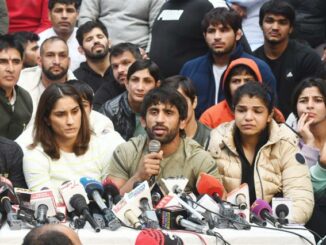
A fresh case is of the top Indian wrestlers who have been forced to gather in Delhi to protest the sexual harassment of players by Brij Bhushan Sharan Singh, the President of Wrestling Federation of India and his colleagues. Brij Bhushan Sharan Singh should have been arrested and interrogated, if the law had respect in the country, but he will not be touched, because he belongs to the ruling party, and, on top of it, he is a “Bahubali”. Those who speak of Ram Rajya are the ones who do not practice Ram Rajya.
The Non-resident Indians have been voicing similar concern at the lawlessness in the country when many pointed out that their property in India was being grabbed by unscrupulous elements and many had been framed in false criminal cases. They pointed the accusing finger at the police and civil officials who connived with criminals to rob the NRI’s of their legitimate property. How can government of India expect the NRI’s to come forward to invest in the country when they feel insecure? Law is on leave, probably a long leave.
Where is Equality promised in the Constitution of the Republic of India? Where is Freedom? Where is Justice?
Let us on this Republic Day ask ourselves these questions, for the sake of the Republic of India.
An ugly bout is playing out, not in the sporting arena but at Jantar Mantar in Delhi, and it calls for immediate and stringent action. Just like a wrestler is disqualified when she breaks the match rules, given the allegations of sexual misconduct against the Wrestling Federation of India (WFI) president Brij Bhushan Sharan Singh, who is also a BJP MP, he must be made to step down from his powerful position pending the inquiry into the charges. That the wrestling community — from Olympic stars to aspiring grapplers — is up in arms over Brij Bhushan’s character and manner of functioning lends gravitas to the situation and calls for a police probe. Spearheaded by Commonwealth Games medalistVignesh Phogat and Olympic medalists Bajrang Punia and Sakshi Malik, nearly 200 wrestlers have been demanding action against the federation chief and several coaches for sexually harassing many young women athletes at camps and running the game in a dictatorial way.
The veteran wrestlers have taken up cudgels for their younger counterparts who are too scared to take on the powerful MP who has been ruling the akhada as WFI chief for three consecutive terms. It is a courageous bid to clean up the management of wrestling — a sport that has been bringing glory to India with its rich haul of medals at global platforms.
The authorities must ensure Brij Bhushan’s ouster. For, it is not every day that one sees so many complainants coming out. The sad truth is that in a bid to achieve personal sporting glory, many sportspersons are forced to endure moral turpitude by those in control of things. Two recent exposes show how such perpetrators carry on with impunity for long before being called out. Last June, cycling coach RK Sharma was accused of sexually harassing a top female cyclist and threatening to derail her career. In 2021, the predatory behavior of a Tamil Nadu sports academy coach, P Nagarajan, was revealed when after a teenaged athlete accused him of sexual misconduct from 2013 to 2020, seven more women who had trained under him during his three-decade career said they had undergone similar torment. Zero tolerance for such transgressions should be the norm.
LONDON (TIP): A 25-year-old Sikh has man has been fined and banned from roads for 22 months by a UK court for driving under the influence of alcohol. Police found open cans of alcohol in Sukhpreet Singh’s car after he was followed through a Derbyshire town swerving across lanes in November last year, the Derbyshire Live reported.
The Southern Derbyshire Magistrates’ Court heard that Singh, a Pizza Hut worker and a resident of Higher Albert Street, Chesterfield, was driving without a license.
According to prosecutor Becky Allsop, a witness informed that Singh’s car was swerving in and out of the zig-zag lines in the center of the road, and vehicles travelling in the opposite direction had to flash their lights at him. The witness, a driver, was following Singh’s car and had informed the police about him.
The witness described the vehicle as coming to a stop in the middle of the road for no reason and then drove off again, still swerving all the way down the road, the report said.
“The road he turned into had two lanes in each direction and Singh crossed both the carriageways, went over the central raised pavement and came to rest facing the opposite direction to the way he should have been,” Allsop was quoted as saying in Derbyshire Live.
Singh had a breath test reading of 77 micrograms of alcohol in 100 milliliters of breath — almost twice the legal limit of 35, the court was informed. Sajid Majeed, mitigating, said Singh has pleaded guilty, and had no previous convictions of any kind. Majeed told the court that his client had moved to the UK with his wife from India and still takes care of the financial needs of his elderly parents back there.
The court fined Singh 250 pounds, ordered him to pay 85 pound costs, a 100 pound victim surcharge and disqualified him from driving for 22 months, according to Derbyshire Live.
The report added that the ban will be reduced by 25 per cent on the successful completion of a drink-drive awareness course, which Singh has agreed to undergo.
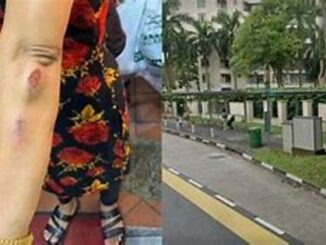
SINGAPORE (TIP): Almost two years after a man allegedly kicked her in the chest and hurled racial slurs at her, Indian-origin woman Hindocha Nita Vishnubhai said she had not been able to overcome the trauma caused by the incident in Chua Chu Kang housing estate on May 7, 2021.
The 57-year-old was speaking in a district court on Wednesday, January 18, the first day of the trial of the accused, Wong Xing Fong, now aged 32. Wong has denied the allegations against him.
According to court documents, Wong is accused of hurling racial slurs at Hindocha with the deliberate intention of “wounding” her “racial feelings”. He is also accused of voluntarily causing hurt by kicking Hindocha’s chest in an attack aggravated by the racial element.
On Wednesday, Hindocha was called as the prosecution’s first witness, but she broke down as she walked into the courtroom, according to a media report.
It was not clear if she cried on seeing Wong but District Judge Shaiffudin Saruwan stood the case down temporarily to allow time for her to compose herself and for a screen to be set up that shielded her from view, the report stated. As the trial resumed about 30 minutes later, Hindocha took the stand to tell the court what happened on the day of the attack.
Hindocha said she typically brisk walks to work as she does not have the time to do any other form of exercise before work and had pulled down her face mask to the chin to breathe more freely.
At the time, Singapore’s covid-19 regulations mandated that everyone keep their face masks on unless they were exercising. As Hindocha was approaching a bus stop beside the Northvale Condominium located along Choa Chu Kang Drive, she heard someone shouting at her from behind, she told the court.
She turned around to see “a couple”, Wong and an unnamed woman, gesturing at her and telling her to mask up. She gestured back to indicate that she was exercising and perspiring. At this point, Wong walked towards her and hurled the racial slur at her, Hindocha claimed. “I don’t like to fight, sir, so I said, ‘God bless you’,” she said, adding that then Wong ran towards her and gave her a “flying kick” in the chest.
The impact, said Hindocha, caused her to fall on her back, leaving her left forearm and palm bleeding.
She alleged that Wong and his female companion then “jogged” away as though nothing had happened.
“I was crying very loudly, sir. I was very scared. Till today, (if) you bring me (to) that road I will cry…I was very scared,” she said. A woman at the bus stop helped her up and gave her a first-aid plaster for her injuries, she said.
Hindocha said she narrated her ordeal to her husband and manager at work and reported the incident to the police only later that evening after she had finished her second job as an English tutor at a tuition center. She had her injuries examined by a doctor at a polyclinic on May 10.
When asked by Deputy Public Prosecutor (DPP) Foo how the incident had affected her, Hindocha said she felt both scared and sad. Wong’s lawyer told Hindocha that it was his client’s position that she was not exercising and had no reason to pull her mask down.
He added that Wong had not used vulgarities against her and had also not kicked her in the chest.
Wong also claimed that Hindocha spat at him and told him sarcastically that she was brisk-walking and that he should mind his own business. Hindocha disagreed with all these statements.
During re-examination by DPP Foo, Hindocha said that while she had difficulty remembering the precise location of the attack, she clearly remembers Wong kicking her.
The second witness was the doctor who attended Hindocha.
The trial will continue Thursday and Friday before being adjourned until early February.
Anyone found guilty of voluntarily causing hurt can be jailed for up to three years or fined up to SGD 5,000 or both. However, in cases where the offence is racially or religiously aggravated, the court may sentence the person to 1.5 times the amount of punishment to which he or she would otherwise have been liable.
As for those found guilty of deliberately intending to wound the religious or racial feelings of any person, they can be jailed for up to three years or fined or both.
CANBERRA (TIP): A 21-year-old Indian from Punjab was killed in a fatal car crash in Australia’s Canberra, a media report said. Kunal Chopra from Hoshiarpur district, who held a student visa in Australia, was returning from work around 7 am when his car collided with a concrete pumping truck on William Hovell Drive in Canberra last week, SBS Punjabi, a multi-cultural and multi-lingual broadcaster in Australia, reported. According to the preliminary investigations, Chopra’s car crossed to the wrong side of the road into the path of the city-bound truck. Chopra was announced dead on the spot. This was Canberra territory’s first road fatality for 2023.
Acting Inspector for Road Policing Travis Mills said the major collisions team continued to investigate the accident of Chopra, who arrived in Australia in February last year.
“We are heartbroken, and his family back home is shattered and inconsolable,” Honey Malhotra, a cousin of Chopra who stayed with him in Canberra, told SBS Punjabi.
Malhotra said he was making arrangements to send Chopra’s mortal remains to his family in India.
Friend and community representative, Gurpreet Singh Gill, said the tragedy has left the tight-knit Indian community in Canberra in deep shock. “We are in touch with his family, and also with the Indian High Commission, which is helping with the repatriation of his mortal remains to India,” Gill told SBS Punjabi, urging young students to remain vigilant on the roads. Chopra’s accident comes days after the Shepparton crash that left four men of Indian origin dead, another tragedy that shocked the community in Australia.
LONDON (TIP): A British-Indian entrepreneur and founder of an ethnic minority-focused marketing agency has been conferred the Freedom of the City of London honor for his contributions to the financial hub of the UK capital. Manish Tiwari, founder of Here and Now 365, read the “Declaration of a Freeman” and signed the Freeman’s Declaration Book recently, when he was presented with the Copy of the Freedom—a parchment document inscribed by a calligrapher, along with a copy of the “Rules for the Conduct of Life” which date from the mid-eighteenth century. The honor is steeped in history and traditionally the recognition gave a “Freeman” the right to trade in the Square Mile or financial heart of London.
“On the strength of its multi-cultural legacy, the City of London continues to grow and prosper. It remains at the forefront of global finance by leveraging its past and embracing change and I am honored to be a part of this legacy,” said Tiwari. As one of the oldest surviving traditional ceremonies of the British capital still in existence today, the tradition of conferring the title is believed to have started in 1237. The title of Freeman is more symbolic today and comes with certain corresponding duties associated with the Lord Mayor’s office.
A previous Indian recipient of the honor is Jawaharlal Nehru, the first Prime Minister of India, and other prominent recipients include South African leader Nelson Mandela and Microsoft founder Bill Gates.
Tiwari became the latest to join the ranks at a solemn admission ceremony at the Chamberlain’s Court in the iconic Guildhall in London earlier this month.
WASHINGTON, D.C. (TIP): Indian American doctor Nirav D. Shah, who played a pivotal role during Covid-19 pandemic, has been appointed Principal Deputy Director at the US Centers for Disease Control and Prevention (US CDC). Shah, 45, who serves as the Director of the Maine Center for Disease Control and Prevention (Maine CDC), will report to US CDC Director Rochelle Walensky in his new role starting March.
“In my new role, I will be honored to serve not just Maine, but the entire nation and carry forward the good work that we have done here. As I prepare for this next step, I thank the people of Maine for taking care of me, as I’ve always asked them to take care of each other,” he said in a statement. Shah was appointed to Maine CDC in 2019 with the mission of rebuilding the agency and the State’s public health infrastructure.
“Dr Shah has been a trusted advisor to me and an extraordinary leader of the Maine CDC. But even more than that, he was a trusted advisor and a leader to the people of Maine during one of the greatest public health crises of our time,” Maine Governor Janet Mills wrote in a tweet.
She added in her statement that Shah spoke calmly and directly to the people of Maine, many of whom were scared and uncertain, and answered their questions with “compassion, empathy, humor, and a clarity”.
Shah’s appointment as Principal Deputy Director comes as part of a planned, broader overhaul of that agency announced by the US CDC Director in August of last year. Born to Indian immigrants, Shah grew up in Wisconsin, and attended the University of Louisville where he majored in psychology and biology.
He studied economics at Oxford University and enrolled in medical school at the University of Chicago in 2000. Shah completed his Juris Doctor in 2007 and his Doctor of Medicine in 2008 -both from the University of Chicago and was a recipient of The Paul & Daisy Soros Fellowships for New Americans.
SANTA CLARA, CA (TIP): Indian American billionaire Vinod Khosla wants the world’s elite to not go to the annual meeting of the World Economic Forum, and instead contribute that money to “a better cause.”
The founder of Khosla Ventures and co-founder of Sun Microsystems, who is a big champion of clean energy, tweeted on Monday, January 16: “Can the people going to Davos not go and contribute the money to a better cause? This is ridiculous.”
The tweet was in response to a tweet by Bill Browder, CEO of Hermitage Capital who is campaigning to channel $350 billion in Russian funds frozen since the beginning of the Ukraine war to be “used for the defense of Ukraine.”
The financier said he is skipping Davos “after 27 years as a regular” because “the Forum wanted to charge him $250,000, more than triple what he paid in the past.” Browder thinks he deserves to be “admitted for free, as a human rights activist.” “I’m in Davos to argue for the frozen Russian $350 billion to be used for the defense of Ukraine,” he wrote. “But I won’t be doing it in the halls of the WEF because they raised the price of attendance to $250k for me (3x what they charged before). Russians are happy.”
The 2023 edition of the Forum began in Davos Monday and runs through January 20. The theme this year is “Cooperation in a Fragmented World.” CEOs of 1,000 member companies and leaders from a wide range of fields are expected to attend the event, covered by hundreds of global media organizations.
It is also a magnet for critics who denounce the gathering for being tone deaf to a number of global issues, including increasing income inequalities and climate change, just to name a few.
Khosla — who is worth $4.9 billion, according to the Forbes Real Time Network tracker on January 16 — himself is no stranger to Davos. The 557th richest person in the world has attended the Forum on multiple occasions.
Born in Pune, India, Khosla, 67, is considered one of the most successful and influential venture capitalists. An alumnus of IIT Delhi where he earned a bachelor’s degree in electrical engineering, Khosla earned his master’s in biomedical engineering from Carnegie Mellon and MBA from Stanford.
OAKLAND, CA (TIP): Janani Ramachandran, a 30-year-old Indian American attorney, has emerged as the youngest and the first woman of color to take oath as the Oakland City Council member in the US state of California.
Ramachandran took the ceremonial oath wearing a saree as the Oakland City Council member for District 4 in an inauguration ceremony held on January 10.
and helped build our movement. Honored to have my loved ones by my side as I took the ceremonial oath!” Ramachandran describes herself as “a daughter of immigrants from a small village in South India.
Ramachandran currently serves on the California Commission on Asian and Pacific Islander American Affairs and has previously served as a Commissioner at the City of Oakland Public Ethics Commission, according to her website. The Stanford University and University of California, Berkeley pass-out has worked in several legal non-profits. As a first-time candidate in her 2021 run for State Assembly, she shocked political experts by advancing to the special election runoff, coming out on top amongst a field of previously elected officials, her website said.
SAN FRANCISCO (TIP): Amid a tight race for Republican Party leadership, Indian American attorney Harmeet Dhillon, a supporter of former President Donald Trump, has alleged that she is facing bigoted attacks from some party leaders owing to her Sikh faith.
But Dhillon, who represented Trump during the Jan 6 select committee’s probe that tried to subpoena him, has vowed that she would not drop out of the contest against current Republican National Committee (RNC) Chair Ronna McDaniel, who has led the RNC since 2017.
“To be very clear, no amount of threats to me or my team, or bigoted attacks on my faith traceable directly to associates of the chair, will deter me from advancing positive change at the RNC, which includes new standards of accountability, transparency, integrity, and decency,” she wrote in a series of tweets.
“Threats incoming today. One of Ronna’s state chair supporters responded to my message about Dr. Martin Luther King Jr’s legacy by threatening me with consequences if I didn’t make the “annoying” text messages from voters stop (no one on my team has asked anyone to text members),” she alleged.
“Another person on my team got a threatening call from a $$$ RNC consultant for raising questions about RNC’s highest-paid vendors. Message delivered was that my supporter would never work on a certain presidential campaign or for RNC if they didn’t shut up,” Dhillon wrote.
“It is hurtful to learn that a handful of RNC members, in a close race for RNC chair, have chosen to question my fitness to run the RNC by using my devout Sikh faith as a weapon against me,” Dhillon told media.
The committee’s 168 members will hold a vote on Jan 27 to determine the RNC chairmanship at the committee’s annual winter meeting in Dana Point, California.
A group of more than two dozen Republican donors threw their support behind Dhillon in a Jan 9 letter to RNC members, Fox News and The Hill have reported previously.
Several of the individuals listed on the letter have donated tens of thousands of dollars to the Republican Party over the years, the news outlets noted.
“We cannot continue on our current trajectory as a Republican Party,” they wrote calling for a change in leadership. “We must change, in order to fulfill our promise to Republican voters to win elections.”
The donors warned the party “is on the verge of permanent irrelevance if we fail to come together to correct course.” The Hill described Dhillon’s campaign to oust McDanielk at the top of the party as “her toughest leadership challenge yet.” A poll released earlier this month cited by the Hill found a large majority of Republican voters backing a leadership change.
Media suggested last month that “A Dhillon candidacy would mark the most serious challenge to McDaniel to date.” Born in Chandigarh, India to a Punjabi Sikh family in 1969, Dhillon, has served as chair of the Republican National Lawyers Association and as a former chair of the San Francisco Republican Party.
“A positive diffusion of institutionalized civic consciousness is possible because, when its energies are harnessed, it improves the delivery of public goods, increases economic productivity, and allow people to live with dignity and integrity.
By Kavitha Iyer
Today, anybody who talks about dignity and integrity is at risk of being labelled a hopeless romantic. What I hope is that we will have a time when people will admire those virtues. Rather than an existence where corruption, criminals in politics, and social violence are woven into the fabric of life, where it is rational to cheat others before they cheat you, to dig the groundwater deeper before your neighbor does, a moral restraint fosters trust and cooperation for shared economic progress.
And it is my contention in the book that the decay of social norms and public accountability prevents the delivery of public goods. I use that interplay of the lived reality with norms and accountability to assess every leader.”
Ashoka Mody wrote his new book India Is Broken: A People Betrayed, Independence To Today to challenge prevailing narratives about India’s place on the world stage and to analyze the growth and development of ‘India at 75’ through the prism of human-welfare indicators. A former World Bank and International Monetary Fund economist and now a professor at Princeton university, Mody argues the country is celebrating ‘superficial gloss’ over rosy predictions made for its future.
A provocative new account of how India moved relentlessly from its hope-filled founding in 1947 to the dramatic economic and democratic breakdowns of today. When Indian leaders first took control of their government in 1947, they proclaimed the ideals of national unity and secular democracy. …
Ashoka Mody, economic historian at Princeton University’s School of Public and International Affairs.
In his new book India Is Broken: A People Betrayed, Independence To Today, Ashoka Mody, an economic historian at Princeton University’s School of Public and International Affairs, spares no one who has ever led independent India, from Jawaharlal Nehru to Prime Minister Narendra Modi.
Before arguing against Nehru’s heavy industrialization policy to build ‘temples of modern India’, he says in a chapter titled ‘Fake Socialism’ that Mahatma Gandhi’s choice of Nehru over Vallabhbhai Patel to lead the Congress party in 1946 emerged from Gandhi’s view of Nehru as “a Harrow boy, a Cambridge graduate”, who would “represent India in international affairs more effectively than Patel”.
And yet, he says, while India came “tantalizingly close” to adopting the strategy followed by Japan, already industrialized by the 1920s, the Nehru era saw the country neglect agriculture and labor-intensive small and medium-sized manufacturing that could have generated job-rich growth.
Tracing the arc of India’s current unemployment crisis, poor quality education and public healthcare to the immediate post-Independence years, India Is Broken tells the story of how the hopes of a newly independent nation in 1947 eroded over decades; and of how uneven but measurable progress on key goals, on poverty, agriculture, industry and employment was gradually lost.
A former World Bank and International Monetary Fund economist, Mody has also written EuroTragedy: A Drama in Nine Acts (2018).
On recent rosy projections of India’s economy (see here, here, here and here), Mody told Article 14 that the country is celebrating “superficial gloss”, and that once the dust settled on the post-Covid base effect, gross domestic product (GDP) growth would be closer to 4% or 3%.
GDP growth itself is a faulty measure of human welfare, Mody said, arguing that on all the metrics of liveability and human welfare including jobs, health, education, women’s participation in the labor force, the quality of life in cities, levels of pollution, the resilience of democratic institutions, India is lagging behind nations with which it competes.
Excerpts from the interview:
Iyer: I am re-reading India Is Broken right after re-reading several expert opinions that say this is India’s time on the world stage—a Morgan Stanley report says this is India’s decade, we are going to be the world’s third largest economy and stock market; Morgan Stanley’s top Asia economist has said India will offer “a compelling opportunity for investors in a world starved of growth”; a World Bank report says India will remain one of the fastest growing major economies; and the CEO of McKinsey says this is going to be India’s century. Is yours just a glass-half-empty assessment, or are all of these guys missing something?
Mody: I know this sounds very presumptuous, but I have to say that all these guys are essentially clueless about the development process. Since about the early 1990s, an Indian elite, which lives first world lives, has set the domestic narrative in the media and politics. A corresponding group in the first world has echoed that narrative.
The Indian elite does not easily relate to the subjects I deal with in the book. The members of that elite have an abstract notion that India has an employment problem. They’ve heard about or seen videos of rioting in January 2022 by young applicants for jobs with the Railways, who were frustrated because the Railways did not honor a promise of recruitment; they’ve heard about the protests against the Agniveer scheme for recruitment to the armed forces.
Iyer: But none of the glowing assessments of India that you pointed to discusses our employment crisis. While most analysts concede that we need a better education system, they rarely focus on the enormity of the task; they are satisfied that most Indians have acquired basic literacy, not recognizing that the nations we compete with have set the bar much higher.
We say we want to receive investments moving out of China. We don’t ask why China has been so successful in becoming the world’s manufacturing hub. The answer lies in a 1983 World Bank report, its first report on China. China had just become a member of the World Bank, having recently come out of its communist phase. Despite the scars inflicted by Communism, the report said, China starts from an extraordinary base of human development. Life expectancies were high because nutrition levels were good. In a pointed comparison with India, the World Bank said China was miles ahead of India in these metrics.
China had similarly made big strides in girls’ education. You know the expression ‘women hold up half the sky’? It’s a phrase that the Chinese supreme leader Mao Zedong often used, and he lived up to it. Women were active members of the Chinese Communist Party, and they had a large presence in the labor force. I’m not saying Chinese women did not suffer from gender inequities, which they continue to do; but Chinese women have made much more progress than Indian women have.
It is not surprising that the vast bulk of the movement of production out of China is going to Vietnam, where education standards match or exceed those in Western industrialized nations and women have high labor force participation rates. We keep recycling one story about Apple investing in Chennai, but if you look at the data, much of the US investment moving from China is going to Mexico.
In Asia, Vietnam, a country of a hundred million people in comparison to our 1.4 billion, now has export levels at par with ours; Vietnam has come from behind us and is poised to go ahead. Bangladesh is also on a superior trajectory, of commitment to education and greater agency of women. Recently, Cambodia is becoming another significant international production site.
Despite the hype about the Apple project, India barely appears in the data on the production moving out of China.
Since the industrial revolution nearly 350 years ago, no country has achieved success without two fundamental achievements: good education and an increase in the participation of women in the workforce. These work as a combination.
As women come into the workforce, they have fewer children, they adopt better child-rearing practices, and they devote greater resources to educating the children. The children therefore grow up to be more productive. That cycle perpetuates itself over generations.
India has an abysmally low labor force participation rate for women.
Today, India does not have well educated kids and it has an abysmally low labor force participation rate for women. So when people say to me, oh but we’ve got this United Payments Interface, I ask if UPI is going to educate your kids? Is it going to reduce the violence against women? Is it going to prevent the sinking of Joshimath? Is it going to prevent the Hasdeo forest from being cut down? Is it going to prevent the denudation of the Aravallis? Is it going to revive all the dying rivers in this country? If not, are you telling me that none of that matters and UPI is going to be our ticket to success?
Iyer: The Indian government’s production-linked incentives have attracted some investment in pharmaceuticals and in assembly of phones, but even there, the output targets are not being met, and certainly employment levels are falling well short of the targets.
Mody: The problem with the elite commentary on India is that instead of examining the lived reality of Indians, it focuses on this animal called GDP growth, and more recently on some magical GDP targets of several trillions. This is juvenile economics. I am a former IMF economist who believes in the Marxian focus on power relations as key determinants of economic outcomes. In my IMF incarnation, I see so-called experts extrapolating from the growth rate this year to the next century, and I want to hold my head in my hand and sob uncontrollably. Because this is madness.
Even if we look at GDP growth, which as I noted is a faulty measure of human welfare, we have a problem. Recall that GDP growth had slowed to between 3% and 4% in 2019, before Covid-19. That, I would say, is the best estimate we have of India’s potential growth. All current growth rates suffer from the base effect: if a number falls from 100 to one, that’s a 99% decrease; but if it goes from one to two, that is a 100% increase. So, today’s GDP growth rates are meaningless. My best reading is that Indian GDP growth rates will fall to 4% once the dust of the base effects settles.
But we cannot allow these growth numbers to distract us from the important objectives: jobs, health, education, quality of cities, clean air and clean water, which are the right metrics of liveability, and hence in the long run are the foundation of sustainable long-term growth.
I have given you a long response to your question on the commentary by so-called experts who have fantastical visions of India’s future but have no knowledge of economic and social success achieved both historically in western nations and in our contemporary world by East Asian countries.
Human development and greater agency of women are the two fundamental ingredients why China succeeded despite having many of the pathologies we have, such as environmental degradation and over-reliance on construction as a motor of growth. China became the world’s manufacturing hub because of the foundation of strong investment in human development and women working in export-oriented factories.
In India, the demand for jobs keeps growing much faster than the supply. If all you care about is GDP growth, you can achieve that with petrochemical plants and maybe a semiconductor factory eventually. But how many jobs does such activity create?
The flip side of this highly capital-intensive growth is an economy that benefits maybe the top 5% of the people, their consumption embellished with a Louis Vuitton or a Lamborghini. The vast bulk are struggling to buy scooters and pressure cookers. And in the heat of summer, they have to wonder, can I afford a table fan?
Iyer: So is the idea of a $7 trillion economy misplaced on our wishlist or is it an empty promise?
Mody: It is both misplaced and empty.
Iyer: Your book begins with a retelling of a scene from the 1946 film Dharti Ke Lal, in which you describe an exodus from famine-struck Bengal towards Calcutta. In greater numbers, climate migrants continue to alight at railway stations in Mumbai, Delhi, Chennai, etc. Is rural India’s move to the cities, persistent over decades, a crisis or is it a solution to unequal growth?
Mody: I was struck in Dharti Ke Lal not so much by the migration to Calcutta but by the return of the migrants to their villages. That reverse trek sunk into my heart for that was the very moment I was writing about the Covid-19 reverse trek.
The reverse trek from the city to the village is heartrending. It tells me that agriculture is distressed, which makes people want to move to the city, but the cities do not have jobs and are inhospitable, which forces people to go back to the very place they want to leave.
We have made much progress since 1946, but in one fundamental sense we have failed: the lack of honorable jobs either on the farm or in the cities.
On the day after the lockdown was announced in March 2020, the factories in Surat closed down. A story of two migrants, narrated beautifully in the New York Times, was about two men who decided to stay on in Surat because going back did not hold much promise for them. Their ancestral lands had been fragmented to a degree where, if they went back, they wouldn’t have a living. However, after a few weeks out of a job in Surat, their savings ran out and they were forced to go back.
What happened during the pandemic was extreme and does not happen regularly, but it does tell you that the cities are still inhospitable because there are too few good jobs.
Additionally, we are facing a climate crisis which, as you quite rightly point out, is forcing more people out of the rural areas. Where are we going to absorb them? What are the opportunities for them? Things will become even more serious as the climate crisis causes coastal erosion, causes more frequent extreme weather events in urban areas, and reduces productivity in industry. For rural migrants to urban areas, the future is set to get harder.
Iyer: You write that the government’s promises on nutrition, health, education tend to be like Groundhog Day, a sort of a continuing winter despite promises of change, while development has tended to focus on construction of dams, riverfronts, overpasses, etc. How far back do you do trace this misplaced focus on big capital expenditures, who got it wrong first?
Mody: This process began with heavy industrialization under Jawaharlal Nehru, but as I have emphasized, Nehru was an idealist and had a vision, even if it was mistaken.
With Mrs Gandhi onwards, policy-making became a business of headline-grabbing. In her case, it was bank nationalization and Garibi Hatao. With the onset of the so-called liberalisation, the focus shifted to mining and construction.
The hard work of development, you will hear me say a million times, is human development, empowerment of women, making the judiciary fairer and responsive, cleaning the air and water.
The river Musi that runs through Hyderabad is dying because the much-celebrated pharma industry is dumping its pollutants in the Musi. Does any of the elite reporting that believes in the Indian century refer to the slow death of that river or of virtually every Indian river? This raises the question, who is development for?
In Varanasi, the river Assi, a tributary of the Ganga, gives the holy city its name along with the Varuna. The Assi has narrowed to a drain, and is extremely polluted, a fact that stays out of sight and out of mind, while the headline is that there is fancy riverfront development along the Ganga and a luxury cruise that only a handful can afford.
Everybody knows of the Sabarmati riverfront, but do people know that downstream, the Sabarmati is a highly polluted river? How many people are aware that Sabarmati riverfront is essentially a lake that’s cordoned off on both sides to collect water so that a select few people can enjoy it.
A seaplane service from the Statue of Unity (the Sardar Patel statue) to the Sabarmati riverfront is a glitzy detail embedded in the headline-grabbing pattern of development which, when extrapolated to an extreme, gives us a message that this is India’s century,
Joshimath in Uttarakhand has been sinking since 1976 when the M C Mishra committee report directed that construction activity in the Himalayas be undertaken with the utmost care because those mountains are very fragile. For years, we did exactly the opposite, building on that fragile surface without restraint or discipline. In February 2021, there was another warning that went unheeded.
Now when the town is sinking, people have suddenly woken up. But we don’t know how long this new concern will last. We also don’t know how much of the rest of the area is sinking and what we can do about it.
These examples highlight the deep erosion of social norms and public accountability. We may be in a trap. Unaccountable politicians do not impose accountability on themselves, and this becomes a Catch 22: How do you restore norms and accountability once they have eroded to such an extent?
The headline-grabbing will continue. The head of Microsoft, who was in India recently, said Indian kids are contributing to the growth of artificial intelligence. We have somehow developed a view that technology will be a substitute for long, time-honored processes of development, that the new technological tools will seamlessly take us out of the current situation into a blissful Nirvana.
Iyer: Apart from Nehru’s temples of industry, what about extractive industry? How far back do you trace the collusion between government and extractive industry, and what has been the impact of that on the people of India?
Mody: In its current form it first became manifest in the UPA period. If I had to give a precise date, I would say it was June 2005, when the Tatas signed an MoU to set up a steel plant in Bastar. Almost exactly at the same time, the vigilante group Salwa Judum was set up to protect corporate interests in the region.
Salwa Judum is a historically important marker. Its leader was a Congressman who was also the opposition leader in the Chhattisgarh assembly. The government was under the BJP. There was complete bipartisan consensus on this one thing: exploitation of natural resources is crucial for India’s model of economic development, never mind the costs of deforestation, the pollution of rivers and waterways, and damage to the livelihoods of the long-time forest dwellers.
In 2005, world trade was booming at a rate that had not been seen since the immediate post-War years. Subprime lending in the US had revved up that country’s growth. China, a recent member of the World Trade Organization, had burst on to the global scene and was importing gobs of iron and gobs of coal. Prices of coal and iron ore were rising giddily.
Suddenly, Indian and international investors became interested in these areas that were mineral-rich. These areas were also forest-rich and were occupied by a population that had suffered the worst indignities since Independence and was now being further deprived of livelihoods. And the government couched its policy approach to protesting forest-dwellers not as a matter of social justice, which it was, but as a national security issue.
We used the fig-leaf of national security to perpetuate inequities for another generation.
The entire model of development shifted at the time to a contestation for natural resources—in effect, we were privatizing the environment, including land and water. This model of development then morphed in its full-blown form into the Gujarat model of development marked by easy access to land, cheap funding, and no-fuss environmental clearances. Indian and international elites celebrated.
The examples continue to multiply. Look at the international seaport being constructed in Vizhinjam in Kerala. The fisherfolk are up in arms, as they should be for their livelihoods are at stake. To those who call this development, I ask what are you giving them in return for their displacement? Are you giving them urban jobs? Are you giving them a good education? Are you giving them good health? Will their next generation have greater opportunities?
Iyer: The most number of index entries in your book are for Indira Gandhi and Jawaharlal Nehru. Did these two leaders have the most impact on India, with outcomes both good and bad?
I don’t think that the book pays disproportionate importance to Nehru and Mrs Gandhi. Pandit Nehru gets about a quarter of the total number of pages of the book, Mrs Gandhi about the same, and the others more or less the other half of the book.
As a storyteller, I have to tell the story through the words and actions of the leaders because that is where the drama is. But as an analyst, the leaders are less important than the frame, which I call the lived reality of people. That lived reality is jobs, education, and the other public goods we discussed earlier. And the quality of the lived reality depends on social norms and public accountability.
And it is my contention in the book that the decay of social norms and public accountability prevents the delivery of public goods. I use that interplay of the lived reality with norms and accountability to assess every leader.
Iyer: You have said the early years under Dr Manmohan Singh’s prime ministership saw a ‘deceptive’ economic glow. Would you compare that situation with the present markets, the addition of all these new Indian billionaires into the world’s richest list?
Mody: I think the two are very different. The world economy grew very rapidly between approximately 2002 and 2007. For reasons we discussed a minute ago, world trade grew on a scale not seen since the immediate post-War years. All countries in the world participated in that boom, including India. But that boom was a bubble in the sense that it could not last.
In India, we also developed a homegrown finance-construction bubble.
By 2018, both these bubbles had fizzled. World trade growth had slowed down after about 2010 and, with the collapse of IL&FS in mid-2018, the finance-construction bubble deflated. That is why Indian growth slowed dramatically in 2019.
Today there is no similar bubble to prop up growth. Some individuals are thriving, but the GDP growth of 6% or thereabouts this year is purely a bounce-back from Covid-19, with the underlying growth being closer to 4% or even 3%.
Iyer: My final question is about communalism and right wing Hindutva in India, described in your book through the lens of the unrest around the time of Partition and then subsequently in 1992-1993. How do you see the current wave of Hindutva taking over India, and what do you think the impact of this is going to be, in the long term?
Savarkar recognized in the 1920s the power of Hindutva
Hindutva lay hidden in the bloodstream of the Indian polity at least since the early 1900s. Gandhi and then Nehru, by the weight of their personalities, were able to marginalize this tendency. In Nehru’s case, a national unifying force based on a newfound freedom from colonial rule helped contain Hindutva, at least in the initial post-Independence years.
But as has been the experience of other countries, national bonds forged by freedom from colonialism are apt to wear out, to be replaced by a more primitive national identification based on local origins and roots. For India, that meant that Hindu nationalism was bound to emerge as a political force.
Even during the Nehru years, a sense of Hindu nationalism prevailed not just in non-Congress parties but in the Congress party itself. Mrs Gandhi began moving towards soft Hindutva for getting votes.
And the 1983 textile strike was a precipitating moment. The many tentacles of that strike spread to this day. In terms of economics, the loss of jobs that followed the strike meant that labor’s bargaining power fell sharply. Millowners lost interest in manufacturing and instead found it more attractive to speculate in property and enter the construction and property development businesses.
So, the de-industrialization of India began with the textile strike, which kept the bargaining power of labor low. Some workers were sucked into criminal gangs that formed around property speculation and construction, a fertile area for organized crime worldwide.
And some workers were attracted to Hindutva’s silent call. They became foot soldiers of Hindutva. That is the moment in Bombay when the Shiv Sena turned away from its anti-south Indian rhetoric to an anti-Muslim stance. And nationwide, the Vishva Hindu Parishad began organizing the first of the many yatras to propagate the Hindutva narrative. The Bombay riots in 1992-1993, which followed the demolition of the Babri Masjid, imparted further strength to Hindutva.
Once unleashed, Hindutva forces had powerful momentum, a potential that Savarkar recognized in the 1920s. The political power of Hindutva stems from the friend-enemy relationship, a theme developed by the German legal theorist Carl Schmitt a few years after Savarkar emphasized that pointing an antagonistic finger at an enemy helps sustain a politically potent group identity.
Therefore, I am not able to see a clear path out of Hindutva because it has very deep historical roots and is sustained by the friend-enemy distinction. To overcome it, we need a very deep cleansing of social norms, a process that is extraordinarily difficult.
Iyer: Is there anything heartening at all? What’s your silver lining?
We need to see more experiments such as the Kerala decentralization model. That model will help generate a new civic consciousness, which is essential to repair social norms, restore accountability, and overcome development deficits.
Essentially, a decentralized governance structure places the governed and those who govern them into close proximity with each other, and for that reason it creates an institutional framework that demands a restoration of social norms and public accountability. My hope is that such institutionalized demand for restoration of norms and accountability spreads to jurisdictions beyond Kerala and percolates up to higher levels of government.
A positive diffusion of institutionalized civic consciousness is possible because, when its energies are harnessed, it improves the delivery of public goods, increases economic productivity, and allow people to live with dignity and integrity.
Today, anybody who talks about dignity and integrity is at risk of being labelled a hopeless romantic. What I hope is that we will have a time when people will admire those virtues. Rather than an existence where corruption, criminals in politics, and social violence are woven into the fabric of life, where it is rational to cheat others before they cheat you, to dig the groundwater deeper before your neighbor does, a moral restraint fosters trust and cooperation for shared economic progress.
And it is my contention in the book that the decay of social norms and public accountability prevents the delivery of public goods. I use that interplay of the lived reality with norms and accountability to assess every leader.
That is the day I am waiting for, when change comes in a fundamental form, rather than in the superficial gloss we are now celebrating.
(Kavitha Iyer is a senior editor with Article 14 and the author of ‘Landscapes of Loss’, a book on India’s farm crisis.)
To suggest that the basic structure doctrine is by itself unsanctioned is to place the Constitution at the legislature’s whim
“Since its judgment in Kesavananda, the Supreme Court has identified several features that are immutable. There is no doubt that on occasion, the Court’s interpretation of these features has suffered from incoherence. But to suggest that the basic structure doctrine is by itself unsanctioned is to place the Constitution at the legislature’s whim. When taken to its extreme, accepting the Vice-President’s claims would mean that, in theory, Parliament can abrogate its own powers and appoint a person of its choice as the country’s dictator. Consider the consequences.”
By Suhrith Parthasarathy
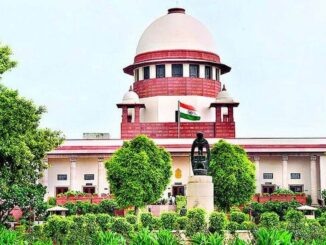
Come April and it will be 50 years since the Supreme Court of India delivered its verdict in Kesavananda Bharati vs State of Kerala. The judgment is widely recognized as a milestone in India’s history. In holding that Parliament’s power to amend the Constitution was not plenary, that any change that damages the document’s basic structure would be declared void, the Court, it was understood, had helped preserve the essence of our republic.
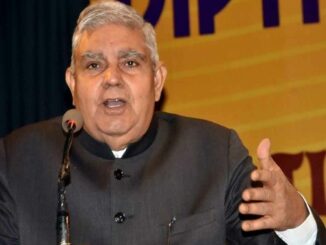
In the years since the verdict – if not in its immediate aftermath – its importance has been recognized by successive governments. During this time, most criticism of the doctrine has been confined to the manner of its application rather than its legitimacy. But last week, India’s Vice-President Jagdeep Dhankhar launched a salvo of attacks at the Supreme Court, by calling into question the ruling’s correctness. Faced as we are with far greater issues of civic concern, this debate might well be regarded as tedious, if only the arguments made against the judgment were not part of what appears to be a concerted effort at undermining the judiciary’s importance.
Collegium as target
Over the course of the last few months, not a day has gone by without one member or the other of the political executive excoriating the Court over its apparent excesses. Much of this criticism has been aimed at the functioning of the collegium — a body of senior judges that makes binding recommendations on appointments and the transfer of judges. The Union Minister of Law and Justice, Kiren Rijiju, and indeed Mr. Dhankhar, have repeatedly doubted the Court’s judgment in 2015, in which it struck down efforts to replace the collegium with a National Judicial Appointments Commission (NJAC). That criticism has now turned sharper, with the Vice-President’s diatribe against Kesavananda.
In his maiden address to the Rajya Sabha in December 2022, Mr. Dhankhar claimed that the striking down of the NJAC had no parallels in democratic history. A “duly legitimized constitutional prescription,” he claimed, “has been judicially undone.” Speaking on January 11 at the 83rd All India Presiding Officers (Assembly Speakers) Conference in Jaipur, Rajasthan, he said that “in a democratic society, the basic of any basic structure is supremacy of people, sovereignty of parliament…The ultimate power is with the legislature. Legislature also decides who will be there in other institutions. In such a situation, all institutions must confine to their domains. One must not make incursion in the domain of others.”
Mr. Dhankar then heightened his criticism by doubting the legitimacy of the basic structure doctrine. The correctness of the Court’s view, he said, “must be deliberated…Can Parliament allow that its verdict will be subject to any other authority? In my maiden address after I assumed the office of Chairman of Rajya Sabha, I said this. I am not in doubt about it. This cannot happen.”
To be sure, genuine criticism of both the Collegium’s functioning and the Court’s judgment upholding the body’s legality ought to be welcomed. But seeing as the Government, as Mr. Rijiju confirmed in Parliament last month, has no plans to implement any systemic change in the way we appoint judges, and given that the Government itself has done little to promote transparency in the process, the present reproach is, at its best, unprincipled, and, at its worst, an attempt at subverting the judiciary’s autonomy. That it is likely the latter is clear from the fact that the Vice-President has now carried his denunciation to a point where his admonishments are reserved not just for the collegium but also for the ruling in Kesavananda.
The foundation of the Constitution
Were we to begin with the elementary premise that India’s Constitution, as originally adopted, comprises a set of principles that together lend it an identity, we will see that the raison d’etre for the basic structure doctrine is not difficult to grasp. On any reasonable reading of constitutional history, one can see that the Constitution is a product of a collective vision. That vision was built on distinct, if interwoven, ideals: among others, that India would be governed by the rule of law, that our structure of governance would rest on Westminster parliamentarianism, that the powers of the legislature, the executive and the judiciary would be separate, that the courts would be independent of government, and that our States would have absolute power over defined spheres of governance.
Now, ask yourself the following questions: what happens when an amendment made to the Constitution harms one or more of these principles in a manner that alters the Constitution’s identity? Would the Constitution remain the same Constitution that was adopted in 1950? Should Parliament amend the Constitution to replace the Westminster system with a presidential style of governance, would the Constitution’s character be preserved? Or consider something rather more radical: can Parliament, through amendment, efface the right to life guaranteed in Article 21? Would this not result in the creation of a document of governance that is no longer “the Constitution of India?”
It is by pondering over questions of this nature that the majority in Kesavananda found that there was much that was correct in the German professor Dietrich Conrad’s address in February 1965 at the Banaras Hindu University, Varanasi. There, Conrad had pointed out, that “any amending body organized within the statutory scheme, howsoever verbally unlimited its power, cannot by its very structure change the fundamental pillars supporting its constitutional authority”.
On ‘amendments’
As the Court would later explained in Minerva Mills vs Union of India (1980) — and incidentally at stake there was the very survival of the idea that fundamental rights are inviolable — “Parliament too is a creature of the Constitution”. Therefore, it can only have such powers that are expressly vested on it. If those powers are seen as unlimited, Parliament, the Court found, “would cease to be an authority under the Constitution”; it would instead “become supreme over it, because it would have power to alter the entire Constitution including its basic structure”. In other words, the principle that Parliament is proscribed from changing the Constitution’s essential features is rooted in the knowledge that the Constitution, as originally adopted, was built on an intelligible moral foundation.
On this construction, it is possible to see the basic structure doctrine as implicit on a reading of the Constitution as a whole. But it is also deductible, as Justice H.R. Khanna wrote in his controlling opinion in Kesavananda, through an interpretation of the word “amendment”. The dictionary defines “amendment” to mean a “minor change or addition designed to improve a text”. As Justice Khanna saw it, when the Constitution that emerges out of a process of amendment as stipulated in Article 368 is not merely the Constitution in an altered form but a Constitution that is devoid of its basic structure, the procedure undertaken ceases to be a mere amendment.
Since its judgment in Kesavananda, the Supreme Court has identified several features that are immutable. There is no doubt that on occasion, the Court’s interpretation of these features has suffered from incoherence. But to suggest that the basic structure doctrine is by itself unsanctioned is to place the Constitution at the legislature’s whim. When taken to its extreme, accepting the Vice-President’s claims would mean that, in theory, Parliament can abrogate its own powers and appoint a person of its choice as the country’s dictator. Consider the consequences.
(Suhrith Parthasarathy is an advocate practising in the Madras High Court)
Now more than ever, it is time to forge the pathways to cooperation in our fragmented world, he said
DAVOS (TIP): The world is facing a perfect storm on multiple fronts and all that can be done now is working together to control the damage and seize the opportunities, UN Secretary General Antonio Guterres said on Wednesday, January 18. In a special address at the World Economic Forum Annual Meeting 2023 here, he also called for ending the addiction to fossil fuels, and stopping “our self-defeating war on nature.” “There are no perfect solutions in a perfect storm. But we can work to control the damage and seize opportunities,” he added.
Now more than ever, it is time to forge the pathways to cooperation in our fragmented world, he said.
“I am not here to sugarcoat the scale of that challenge, or the sorry state of our world. We can’t confront problems unless we look them squarely in the eye. And we are looking into the eye of a Category 5 hurricane,” he said.
“Our world is plagued by a perfect storm on a number of fronts. Start with the short-term, a global economic crisis. The outlook is bleak. Many parts of the world face recession. The entire world faces a slowdown,” Guterres warned.
He further said COVID-19 is still straining economies while the world’s failure to prepare for future pandemics is straining credulity. “Somehow, after all we have endured, we have not learned the global public health lessons of the pandemic. We are nowhere near ready for pandemics to come,” he said.
In addition to that, there is an existential challenge with the world flirting with climate disaster, he said.
“Every week brings a new climate horror story. Greenhouse gas emissions are at record levels. The commitment to limit global temperature rise to 1.5 degrees is going up in smoke. Without further action, we are headed to a 2.8 degree increase,” he added. “The consequences will be devastating. Several parts of our planet will be uninhabitable. And for many, this is a death sentence,” he cautioned.
“But it is not a surprise. The science has been clear for decades… We learned last week that certain fossil fuel producers were fully aware in the 1970s that their core product was baking our planet,” he said.
“Just like the tobacco industry, they rode rough-shod over their own science. Big Oil peddled the big lie. And like the tobacco industry, those responsible must be held to account. Today, fossil fuel producers and their enablers are still racing to expand production, knowing full well that their business model is inconsistent with human survival,” he said. Guterres said all these challenges, including violence and war, are inter-linked and they are piling up like cars in a chain reaction crash.
“It would be difficult to find solutions to these global problems in the best of times — if the world was united. But these are far from the best of times, and the world is far from united,” he said.
“We risk what I have called a Great Fracture — the decoupling of the world’s two largest economies,” he said, adding that it would result in a tectonic rift that would create two different sets of trade rules, two dominant currencies, two internets and two conflicting strategies on artificial intelligence. There are many aspects in which US-China relations diverge — particularly on questions of human rights and regional security. But it is possible and essential for the two countries to have meaningful engagement on climate, trade and technology to avoid the decoupling of economies or even the possibility of future confrontation, Guterres said.
He also said that a “morally bankrupt financial system” is amplifying systemic inequalities and called for a new debt architecture that would provide liquidity, debt relief and long-term lending to enable developing countries to invest in sustainable development. According to him, the multilateral development banks must also change their business models and must concentrate on systematically directing private finance towards developing countries, providing guarantees and being first risk takers.
NEW DELHI (TIP): In a fresh round of confrontation with the Centre, the Supreme Court Collegium has rejected the Centre’s objections to the proposed elevation of senior advocate Saurabh Kirpal, an openly gay person, as a judge of the Delhi High Court and reiterated its recommendations for four other appointments.
Maintaining that Kirpal’s appointment would “add value to the Bench and provide inclusion and diversity,” the Collegium has reiterated its November 11, 2021, recommendation for his appointment.
“The fact that Mr Saurabh Kirpal has been open about his orientation is a matter which goes to his credit. As a prospective candidate for judgeship, he has not been surreptitious about his orientation. In view of the constitutionally recognized rights which the candidate espouses, it would be manifestly contrary to the constitutional principles laid down by the Supreme Court to reject his candidature on that ground,” a three-judge Collegium led by Chief Justice of India DY Chandrachud said.
Brushing aside the IB reports, the Collegium reiterated its recommendations for appointment of advocate R John Sathyam as a judge of the Madras High Court and advocate Somasekhar Sundaresan as a judge of the Bombay High Court. Sathyan had posted certain material on social media, including one critical of the PM, while Sundaresan was “selectively critical” on social media on important policies, initiatives and directions of the government. “Expression of views by a candidate does not disentitle him to hold a constitutional office so long as the person proposed for judgeship is a person of competence, merit and integrity,” said the three-member Collegium – which also includes Justice SK Kaul and Justice KM Joseph.
It made a second reiteration of its recommendation to elevate advocates Amitesh Banerjee and Sakya Sen as judges of the Calcutta High Court.
“…after the Supreme Court Collegium reiterated the proposal on 01 September 2021, it was not open to the Department (of Justice) to repeatedly send back the same proposal which has been reiterated by the Supreme Court Collegium after duly considering the objections of the government,” it said regarding the recommendations for two appointments to the Calcutta High Court.
The Delhi High Court Collegium had on October 13, 2017, unanimously recommended Kirpal – son of former CJI BN Kirpal – for elevation to the Bench and it was approved by the Supreme Court Collegium on November 11, 2021. However, the Law Ministry sent back the recommendation to the Collegium on November 25, 2022, for reconsideration, raising objections about his partner being a Swiss national and his sexual orientation.
Noting that Kirpal possessed “competence, integrity and intellect”, the Collegium said his “conduct and behavior have been above board. The Collegium said, “…it needs to be noted that the decisions of the Constitution Bench of this court have established the constitutional position that every individual is entitled to maintain their own dignity and individuality, based on sexual orientation.” The Collegium, however, said it may have been advisable for the candidate (Kirpal) not to speak to the press regarding the reasons which may have weighed in the recommendations of the Collegium being sent back for reconsideration
In a letter dated April 1, 2021, the Law Minister had said: “Though homosexuality stands de-criminalized in India, nonetheless same-sex marriage still remains bereft of recognition either in codified statutory law or uncodified personal law in India”. Moreover, it had been stated that the candidate’s “ardent involvement and passionate attachment to the cause of gay rights” would not rule out the possibility of bias and prejudice.”
Protesting wrestlers threaten to move court; want WFI disbanded
NEW DELHI (TIP): India’s top wrestlers have intensified their agitation against Wrestling Federation of India (WFI) president Brij Bhushan Sharan Singh after their talks with the Sports Ministry failed. They said the government has given them an assurance but no “satisfactory response” and they will lodge multiple FIRs against WFI president Brij Bhushan Sharan Singh if the Wrestling Federation of India is not disbanded immediately. The wrestlers, who have accused the WFI president of sexual exploitation and intimidation, continued their dharna for the second day as more grapplers joined them in what they called was a fight to give “a new life to Indian wrestling”.
They have also been supported by seven khaps in Charkhi Dadri who will march to Delhi on Friday, January 20, to express solidarity with the wrestlers.
Late in the evening, Sports Minister Anurag Thakur rushed back to Delhi from Hamirpur to hold talks with the wrestlers. He assured them of “action if anyone is found guilty”. Earlier in the day, several wrestlers, including Vinesh Phogat, Bajrang Punia, Sakshi Malik, Ravi Dahiya and Deepak Punia, said they would file an FIR and, if need be, approach the court to press their sexual harassment allegations against the WFI chief.
“We never wanted to turn it into a legal matter. All we wanted was to meet them (PM Modi or Home Minister Amit Shah). I dare the president to sit across me and tell me that our accusations are untrue. If we are forced, we will file an FIR,” Vinesh said during the second day of their dharna at Jantar Mantar here today. “He ruined UP women’s wrestling with sexual abuse. Now he is targeting Maharashtra girls, and we got calls from Kerala girls as well. They want us to keep the fight going,” Vinesh added. “Five-six girls will file an FIR tomorrow. It will be a black day in the history of this country. If girls like us can face such harassment then no girl is safe in this country.”
Bajrang said they wanted the WFI to be disbanded. “If he (Brij Bhushan) resigns, he will hand over the reins to his own people. Even the state associations are being run by his people, they have to go as well,” he said.
Rio Olympics bronze medalist Sakshi Malik, who was part of the delegation that met Sports Ministry officials, including Secretary Sujata Chaturvedi, said: “We were not told what action they will take against him. We are not satisfied with the response.”
“We want the federation to be disbanded. We need a new start,” she added.
A fiery Vinesh said that none of the wrestlers at the protest site would fight under the WFI as long as it was run by Brij Bhushan or his aides. Anshu Malik, among the youngest at the protest, said that during a tournament in Bulgaria, Singh Brij Bhushan made young female wrestlers, including her, “uncomfortable”. Incidentally, veteran CPM leader Brinda Karat, who tried to join the protest, was politely asked to stay away. “Neeche chale jaaiye please madam…. We request you, madam, please don’t turn this into a political matter. It’s an athletes’ protest,” Bajrang requested her. She quietly complied. The wrestlers will continue the protest until their demands are met.
NEW DELHI (TIP): New Zealand Prime Minister Jacinda Ardern, who became a global icon of the left after being elected the world’s youngest female head of state five and a half years ago, on Thursday, January 19, announced her decision to quit her job due to vicious attacks and dwindling prospects of her party winning the next elections, according to a TNS report.
A teary-eyed Ardern said in Napier that February 7 would be her last day as PM. “I know what this job takes, and I know that I no longer have enough in the tank to do it justice. It’s that simple,” she said.
“The pressures on PMs are always great, but in this era of social media, clickbait and 24/7 media cycles, Jacinda has faced a level of hatred and vitriol which in my experience is unprecedented in our country,” said former New Zealand PM Helen Clark in a statement. In 2018, she became the second world leader to give birth while holding office (after Pakistan’s Benazir Bhutto) and in September of that year, she had brought her infant daughter to the floor of the UN General Assembly in New York.
In 2019, Arden was lauded for handling the killing of 51 worshippers in two Christchurch mosques by a white supremacist. She also wanted tertiary education partially free, was focused on child poverty and decriminalized abortion besides calling out sexism in politics.
She also said the next General Election would be held on October 14 but her Deputy Prime Minister Grant Robertson too has said he won’t contest the leadership of the Labour Party.
Ardern’s popularity had declined due to rising living costs, growing crime and concern about social issues.
WASHINGTON, D.C. (TIP): Three Indian Americans, Anahita Dua, Sonia Singhvi, and Neil Vora are among this year’s 60 Presidential Leadership Scholars (PLS) program serving as a catalyst for a diverse network of established leaders. The eighth annual PLS class comprises accomplished leaders including service members, educators, physicians, public servants, and corporate professionals, the program announced Jan 12.
A partnership among the presidential centers of George W. Bush, William J. Clinton, George H.W. Bush, and Lyndon B. Johnson, the PLS program kicks off in Washington, DC, on Jan 24.
“Scholars were selected based on their leadership growth potential and their personal leadership projects aimed at improving civic engagement or social good by addressing a problem or need in their community, the country, or the world,” according to a PLS news release.
Over the course of several months, Scholars will travel to each participating presidential center to learn from former presidents, key former administration officials, business and civic leaders, and leading academics, it said.
They will study and put into practice varying leadership principles and exchange ideas to help maximize their impact in the communities they serve.
The latest class joins an active network of more than 400 Scholars who are applying lessons learned through the program to make a difference in the United States and around the world, the release said.
Scholars have consistently reported remarkable growth in skills, responsibilities, and opportunities for impact since the program began in 2015, it said.
For example, 94% of Scholars said their confidence in how they lead social change has improved as a result of PLS, and 98% of Scholars reported they are inspired to accomplish more since beginning the program.
2023 Indian American scholars
Anahita Dua, Associate Professor of Surgery at the Massachusetts General Hospital/Harvard Medical School in Newton, Massachusetts.
She completed her vascular surgery fellowship at Stanford University Hospital, and her general surgery residency at the Medical College of Wisconsin.
At Massachusetts General Hospital, she is the director of the Vascular Lab, and co-director of the Peripheral Artery Disease Center and Limb Evaluation and Amputation Program.
Last August, the 39-year-old Newton resident, a mother to two young children, took the plunge into politics, forming the Healthcare for Action PAC, “a federal political action committee that aims to elect Democratic health care workers to Congress,” as reported by the Commonwealth.
She told the media she started the PAC because of personal experiences she had with her patients and her 5-year-old daughter. “What I’m noticing is in each realm I’m not able to do what I want to do to protect these people, whether my patients or my daughter,” she said.
Sonia Singhvi, Global Head of Culture, Inclusion, & Diversity at the Boston-based Alexion Pharmaceuticals. A strategic, patient-centric, biopharmaceutical executive with over 20 years of industry experience across multiple therapeutic and functional areas, Singhvi joined the company and rose through the ranks, according to her LinkedIn profile. Singhvi says she’s “excited” to be accepted into the 2023 Presidential Leadership Scholars Program. “PLS serves as a catalyst for a diverse network of leaders to collaborate and create meaningful change in the United States and around the world as they learn from former US Presidents and their administrations.”
“I will leverage these insights to advance health equity, improve patient outcomes, and enhance diversity in clinical trials,” she wrote in a LinkedIn post.
Neil Vora, a physician with the New York-based Conservation International where he leads its efforts on pandemic prevention.
“Throughout his career, he has focused on the link between human health and the health of the planet – particularly as it relates to the increasing threat of ‘spillover’ of viruses from animals to humans because of the destruction of nature,” according to his Conservation International profile.
He served for nearly a decade with the Centers for Disease Control and Prevention (CDC), including as an Epidemic Intelligence Service officer and a Commander in the US Public Health Service (USPHS).
He deployed for CDC to Liberia in 2014 and to the Democratic Republic of the Congo in 2019 to assist in the responses to the two largest Ebola outbreaks ever.
He previously led the investigation of a newly discovered virus in the country of Georgia related to the smallpox virus. For his work, he has received numerous accolades including the USPHS Physician Researcher of the Year Award, CDC James H. Steele Veterinary Public Health Award, CDC Donald C. Mackel Memorial Award, and CDC Alexander D. Langmuir Prize Manuscript Award.
From 2020-2021, Vora developed and led New York City’s Covid-19 contact tracing program, overseeing a team of over 3,000 people. His program traced more than half a million people who had contracted the virus. He still sees patients in a public tuberculosis clinic in New York City.
He has published over 60 articles in various medical journals. He’s an Adjunct Professor of Internal Medicine and Infectious Diseases at Columbia University, and a Term Member of the Council on Foreign Relations.
He completed medical school at the University of California, San Francisco (UCSF) in 2009 and his Internal Medicine training at Columbia University in 2012.
India has made history as the first Asian song with ‘Naatu Naatu’ (film, ‘RRR’) winning the Golden Globe Award for BEST ORIGINAL SONG – MOTION PICTURE, SONGWRITER M.M. KEERAVAANI for 2022!
Further, films from India have been Shortlisted by The Academy of Motion Picture Arts and Sciences (The 95th – ‘Oscars’) in three categories: Documentary Feature Film, International Feature Film and Music (Original Song).
The ten categories are Documentary Feature Film, Documentary Short Film, International Feature Film, Makeup and Hairstyling, Music (Original Score), Music (Original Song), Animated Short Film, Live Action Short Film, Sound and Visual Effects.
The nominees for ‘The Oscars’ will be announced by The Academy on Tuesday, January 24 and the Awards Ceremony will take place on Sunday, March 12.
In the Documentary Feature film category, ‘All That Breathes’ has not only won several awards and recognitions at several film festivals and organizations (see poster) but was also shortlisted in the Documentary Feature Film category by the Academy of Motion Picture Arts and Sciences.
‘OSCAR’ SHORTLISTS
DOCUMENTARY FEATURE FILM
‘All That Breathes’
Dir/Co-Prod: Shaunak Sen l Co-Prods: Aman Mann and Teddy Leifer l 2022 l India/USA/UK l 1h 34m
‘All that Breathes,’ poster (Credit / allthatbreathes.com)
In one of the world’s most populated cities, two brothers – Nadeem and Saud – devote their lives to the quixotic effort of protecting the black kite, a majestic bird of prey essential to the ecosystem of New Delhi that has been falling from the sky at alarming rates. Amid environmental toxicity and social unrest, the ‘kite brothers’ spend day and night caring for the creatures in their makeshift avian basement hospital. Director Shaunak Sen (Cities of Sleep) explores the connection between the kites and the Muslim brothers who help them return to the skies, offering a mesmerizing chronicle of inter-species coexistence.
Gotham Film Awards, in presenting the Best Documentary Feature Award to Shaunak Sen commented – “a sublime mix of social issue focus and poetic artistry that embraces the interconnectedness of all living things in this portrait of a pair of Muslim brothers who tend to sick birds (primarily predatory kites) that fall from the polluted sky in New Delhi and are nursed to health in their small basement clinic.”
‘All That Breathes’ took the top prize for Outstanding Achievement in Non-Fiction Feature Filmmaking as well as the award for Cinematography.
INTERNATIONAL FEATURE FILM
‘Last Film Show’
Dir/Writ: Pan Nalin l Gujarati l 1h 51m
Last Film Show (Credit / lastfilmshow.net)
In the ‘Last Film Show,’ Samay, a 9-year-old boy living with his family in a remote village in India discovers films for the first time and is absolutely mesmerized. Against his father’s wishes, he returns to the cinema day after day to watch more films, and even befriends the projectionist, who, in exchange for his lunch box, lets him watch movies for free. He quickly figures out that stories become light, light becomes films, and films become dreams. Samay and his wild gang of friends move heaven and earth to catch and project light to achieve a 35mm film projection. But little do they know that soon they’ll be forced to make heartbreaking choices as an era is approaching to annihilate everything they love about their 35mm dreams…
MUSIC (ORIGINAL SONG)
“Nattu Nattu” (from film “RRR”)
Dir: S.S. Rajamouli l 2022 l India l Telugu w/Eng subs l 3h 2m
The music for “Naatu Naatu” is composed by M.M. Keeravani with Lyrics by Chandrabose.
Naatu Naatu dance scene. (Credit /RRR.)
From writer-director S. S. Rajamouli (Baahubali) comes the international blockbuster that has enchanted movie audiences of all ages with its jaw-dropping action sequences, swooning romantic intrigue, infectious musical numbers— including the sensation “Naatu Naatu”—and rousing central friendship between two pre-Independence revolutionaries, played by Telugu-language megastars Ram Charan and N.T. Rama Rao, Jr. (better known as Jr. NTR).
From an original story by V. Vijayendra Prasad, the historical action epic RRR (short for Rise, Roar, Revolt) follows the fictionalized paths of real-life freedom fighters Alluri Sitarama Raju (Charan) and Komaram Bheem (Rama Rao) as they come together in 1920s Delhi to battle the nefarious British Raj for the rescue of a kidnapped girl from Bheem’s tribe.
(Mabel Pais writes on The Arts and Entertainment, Social Issues, Health & Wellness, Cuisine and Spirituality)
Jewish Food Society presents ‘The Story That Changed My Life,’ a live taping of their award-winning storytelling podcast, ‘Schmaltzy.’ Hear stories from authors and luminaries, followed by a lively roundtable discussion led by Schmaltzy host Amanda Dell. Book signing to follow, and like all Schmaltzy events, enjoy drinks and bites inspired by the stories.
Sun, Feb 5, 11 am – In Person
Ha’Keves haShisha Asar in Concert
This special event will feature a concert of the classic Israeli children’s story and album Ha’Keves haShisha Asar (‘The Sixteenth Sheep’). Together with host Elad Kabilio of MusicTalks, Yoav Eshed on guitar, Alon Nir on double bass, and Eviatar Slivnik on drums, this performance will celebrate the incredible 1978 collaboration of author Yonatan Gefen and composer Yoni Rechter, which created a unique piece of art that speaks volumes to children and adult alike. Songs will be performed in Hebrew.
Mon, Feb 6, 7 pm – In Person
Author Allegra Goodman in Conversation with Literary Agent Julie Barer P
The Book Group’s Julie Barer, host of the JCC’s Authors in Quarantine series, was inspired by the writing of author Allegra Goodman to go into a career in books and, in a turn of events, eventually became her literary agent. Allegra, whose latest novel Sam is January 2023’s ‘Read with Jenna’ pick, sits down with Julie to talk about the book and each of their respective careers.
Tue, Feb 7, 4:30 pm – In Person
Storytime in the Lobby with Amy Rosenfeld F P
Storyteller: Amy Rosenfeld
Amy Rosenfeld has been the Librarian at the Saul and Carole Zabar Nursery School for 11 years. She enjoys exploring different themes with the children during story times, and strives to find new books pertaining to diversity and inclusion to add into the growing school library.
Amy adapted a children’s book, ‘Daniel and Max Play Together,’ which was published in December of 2021.
Thu, Feb 9, 7 pm – In Person
Banned Books Panel with PEN America
PEN America champions the freedom to write, recognizing the power of the word to transform the world. Join PEN America’s Director of Free Expression and Education Programs Jonathan Friedman, in a timely and important panel discussion with frequently banned authors and topic experts. The panel will include prolific YA author David Levithan (‘Boy Meets Boy,’ ‘Nick & Nora’s Infinite Playlist,’ ‘Dash & Lily’) and additional guests to be announced.
Mon, Feb 13 at 7 pm – In Person
Chelsea Clinton in Conversation with Abigail Pogrebin
New York Times bestselling author Chelsea Clinton’s latest book, ‘Welcome to the Big Kids Club,’ is the essential guide for kids welcoming the newest member of their family. Chelsea sits down with JCC staple Abigail Pogrebin to talk about the book, as well as Clinton’s influential, bestselling, and life-changing ‘She Persisted’ series. Tickets include a signed copy of the book.
Tue, Feb 14, 4:30 pm – In Person
Storytime in the Lobby: Drag Queen Story Hour with Abbi Gezunt F P
Storyteller: Abbi Gezunt | Abbi Gezunt (Yochai Greenfeld) is a Jewish mother from the Five Towns of Long Island who devotes her precious time to creating sensible educational Jewish entertainment. Her Jewtorials can be found online and her Jewish drag shows are the latest sensation at the JCC. Appropriate for ages 6+.
Wed, Feb 15, 5–8 pm – In Person
Altered Book Workshop
Instructor: DJ O’Connel | In this fun workshop, repurpose old books by turning them into personal journals using paint, paper, recycled items, fabric, and ink. Books will be semi-destroyed in the transformation process. Beginners welcome. May not be suitable for children under age 10. All materials will be supplied—just bring your imagination.
Thu, Feb 16, 7 pm – In Person
Michael Winograd Plays Tanz: A Live Album Recreation
Join Brooklyn musician Michael Winograd and his stellar band for a performance of ‘Tanz,’ a recreation of the 1956 album featuring clarinetists Sam Musiker and the King of Klezmer Dave Tarras. Ahead of its time, ‘Tanz’ was a landmark recording, pushing the boundaries of Jewish music. Now celebrated as one of the greatest Klezmer records, more than six decades later, ‘Tanz’ comes to life in this live performance and concert filming.
BTCML, Library. (Photo credit: JCC)
Tue, Feb 21, 4:30 pm – In Person
Storytime in the Lobby
Storyteller: TBD
Wed, Feb 22, 7 pm – In Person
Author Jai Chakrabarti in Conversation with Jewish Book Council’s Becca Kantor
National Jewish Book Award winner Jai Chakrabarti (‘A Play for the End of the World’) had his life changed when he discovered Bernard Malamud’s ‘The Magic Barrel’ at a used bookstore in a suburb of India. This year is the 65th anniversary of the book’s publication, as well as the 65th anniversary of Bernard Malamud receiving the National Jewish Book Award for another work of his, ‘The Assistant.’ Becca Kantor, editorial director of the Jewish Book Council (which administers the National Jewish Book Award), talks to Jai about his newest book and the impact and legacy of Malamud’s work.
Thu, Feb 23, 7 pm – Virtual
Join JCC for a rebroadcast of the very first ‘Books That Changed My Life’ event: an intimate conversation between prolific writers Elizabeth Gilbert (‘Eat Pray Love,’ ‘City of Girls’) and Maggie Smith (‘Good Bones,’ ‘Goldenrod’), inspired by Gilbert’s bestselling book ‘Big Magic,’ a book that changed Smith’s life. The live stream of this event was recorded in April.
Sun, Feb 26, 11 am – In Person
‘Dot Dot Dot: A New Musical’
Based on the Creatrilogy series of books, ‘The Dot, Ish & Sky Color’ by Peter H. Reynolds
An exciting new musical based on the Creatrilogy trio of award-winning picture books (‘The Dot, Ish, and Color Sky’) by New York Times bestselling author Peter H. Reynolds that celebrates the power of originality, self-expression, and opening our eyes to look beyond the expected. Written by Keelay Gipson and Sam Salmond. A TheaterWorksUSA Production. Appropriate for ages 5+.
Mon, Feb 27, 7 pm – In Person
In Conversation with Claudia Fleming, Executive Culinary Director, Daily Provisions
Acclaimed pastry chef Claudia Fleming, executive culinary director for ‘Daily Provisions,’ will discuss her latest cookbook, ‘Delectable: Sweet & Savory Baking,’ as well as books that changed her life. Conversation partner will be announced soon.
Every Tues at 4:30 pm – In Person
Storytime in the Lobby
Every Tuesday at 4:30-5:15 from Jan 10 to Feb 28 will be storytime in the lobby library. Join JCC for special guests including drag queen Yuhua Hamasaki, WonderSpark Puppets, JCC staff members, and more. Storyteller to be announced.
The Marlene Meyerson JCC Manhattan
Learn more at mmjccm.org
(Mabel Pais writes on The Arts and Entertainment, Social Issues, Health & Wellness, Cuisine and Spirituality
Signup to our Newsletter!
Don’t miss out on all the happenings around the world