A low intensity bomb blast at a popular eatery here on Friday left 10 persons injured even as the police invoked the stringent UAPA provisions in the case.
The police suspect that an improvised explosive device (IED) fitted with a timer inside a bag could have exploded. Officials from the local unit of the NIA arrived at the spot and conducted inquiry. The Bengaluru police haev registered a case under the Unlawful Activities (Prevention) Act and Explosive Substances Act.
The cafe which is located at Whitefield’s Brookfield area, a vibrant neighbourhood, a business centre as well as a tech hub. It is usually crowded with employees from nearby offices during the lunch hours. Chief Minister Siddaramaiah said investigation was on to ascertain the cause and nature of the explosion at the cafe, and added it might have been caused by an “improvised explosive” device.
“The incident should not be politicised and everyone should cooperate,” Siddaramaiah said, adding strict action would be taken against those involved. Describing the explosion as a “bomb blast”, state police chief Alok Mohan said nobody was seriously injured in the incident.
Month: March 2024
-

10 injured in Bengaluru cafe blast, CM hints at use of IED
-

Govt signs Rs 39,125 cr deals for BrahMos missiles, radars, aero engines
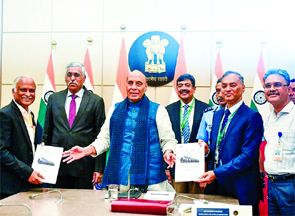
New Delhi (TIP)- In a big push for the ongoing self-reliance drive in the defence manufacturing sector, the defence ministry on Friday, March 1, signed five contracts worth Rs.39,125 crore for BrahMos missiles, ship-borne Brahmos systems, close-in weapon systems, high-power radars, and aero-engines for MiG-29 fighter planes.
“These deals will further strengthen indigenous capabilities, save foreign exchange and reduce dependency on foreign origin equipment manufacturers,” the defence ministry said in a statement.
Two of these deals were signed with BrahMos Aerospace Private Limited — one for around 200 BrahMos supersonic cruise missiles worth Rs.19,518.65 crore and the other for ship-borne BrahMos systems worth ?988.07 crore. The Cabinet Committee on Security, headed by Prime Minister Narendra Modi, approved these deals recently to boost India’s naval power. The BrahMos missile has been developed by India and Russia.
“These missiles would be utilised to meet combat and training requirements of the Indian Navy. This project is likely to generate employment of 9 lakh man-days in the joint venture entity and around 135 lakh man-days in ancillary industries…The ship-borne BrahMos system is the Indian Navy’s primary weapon for maritime strike operations fitted on board various frontline warships. This project is likely to generate employment of around 60,000 man-days over a period of 7-8 years,” the statement said.
It is the fastest cruise missile in the world with a speed of Mach 2.8, nearly three times the speed of sound. BrahMos variants can be launched from land, air and sea, and all three variants are in service in the Indian armed forces. BrahMos missiles can strike targets at 290 km and its extended range variant can hit targets at 500 km.
Two contracts were signed with Larsen & Toubro Limited for close-in weapon systems (CIWS) worth Rs 7,668.82 crore for terminal air defence of select locations in the country, and high-power radars (HPR) with advanced surveillance features for ?5,700 crore to boost air defence capabilities.
CIWS is planned for deployments at various locations across India to protect vital assets from all types of low-flying, low-signature aerial threats, including unmanned aerial vehicles, L&T said in a statement. It consists of air defence guns, tracking radars and search radars linked to a command and control station.
“The CIWS project will boost and encourage active participation of Indian aerospace, defence and associated industries including MSMEs. The direct and indirect employment generated by this project would be about 2,400 persons/year over five years,” the defence ministry statement said. -

Don’t seek votes on caste, religious lines: EC to parties
With Congress leaders feverishly pitching for caste census and Prime Minister Narendra Modi betting big on the Ram Temple ahead of the Lok Sabha polls, the Election Commission (EC) has said that no appeal should be made on the basis of caste and communal feelings of electors.
In a set of advisories issued on Friday, March 1, to the political parties, the election body said no temple, mosque, gurdwara or any other place of worship could be used for election propaganda or electioneering.
“No appeal shall be made on the basis of caste or communal feelings of the electors. No activity which may aggravate existing differences or create mutual hatred or cause tension between different castes/communities/religious/linguistic groups can be attempted,” the EC said.
“References that ridicule the relations between devotee and deity or suggestions of divine censure shall not be made,” it said. The poll body went on to add that political parties and leaders should not make false statements and utterances aimed at misleading the voters. -

Pankaj Udhas: Velvet voice of ghazal falls silent
Renowned ghazal singer Pankaj Udhas, whose velvet smooth voice gave expression to the many colors of love, longing and heartache in songs such as “Chitthi Ayee Hai” and “Aur Ahista Kijiye Baatein”, died here on Monday, Feb 26, after prolonged illness. He was 72.
Udhas, who also made a mark as a playback singer in many Hindi films, including “Dayavan”, “Naam”, “Saajan” and “Mohra”, died around 11 am at the Breach Candy hospital.
“With a very heavy heart, we are saddened to inform you of the sad demise of Padmashri Pankaj Udhas on 26th February 2024 due to a prolonged illness,” his daughter Nayaab wrote in an Instagram post.
“This is not only a personal loss, but the whole nation has lost a prolific singer and a great human being,” Breach Candy Hospital Trust said in a note.
The last rites of the singer, who hit his peak in the 1990s, were performed on Feb 27. He is survived by wife Farida and daughters Reva and Nayaab.
President Droupadi Murmu and Prime Minister Narendra Modi were among the many who mourned the singer’s death.
“Pankaj Udhas ji, honored with Padma Shri and other awards, made an important contribution in popularising music. My condolences to his family and fans,” the president said.
According to the prime minister, Udhas’ singing conveyed a range of emotions and his ghazals spoke directly to the soul.
“He was a beacon of Indian music, whose melodies transcended generations. I recall my various interactions with him over the years. His departure leaves a void in the music world that can never be filled. Condolences to his family and admirers. Om Shanti,” Modi said.
Udhas, one of those credited for making the genre popular along with Talat Aziz and Jagjit Singh, released his first album “Aahat” in 1980 and went on to release over 50 albums in a four-decade career. This was apart from the songs, evoking gentle romance, he crooned as a playback singer.
He is perhaps most famous for “Naa Kajaare ki dhar”, “Aye ghame zindagi kuch to de mashwara”, “Maikhane se sharab”, “Chandi jaisa rang hai tera sone jaise baal”, “Aaj fir tum pe pyaar aaya”, “Mohabbat inyat karam dekhte hain”, “Jaaneman karwate badal badal” and “Chahat desh se aane wale” Udhas was synonymous with ghazals, an Arabic word that means “conversing with the beloved”. It developed in Persia in the 10th century AD from the Arabic verse form ‘qasida’, according to rekhta.com But he was much more than that.
“Ghazal singer, art lover & an avid reader. I love to travel to different destinations; I relish different cuisines. Apart from ghazals, I listen to Beatles,” his Facebook profile says.
Udhas, who received the Padma Shri in 2006, was also a science graduate working to eradicate thalassemia, according to his X profile.
He was born in Gujarat’s Rajkot town to a family of musicians. His father Keshubhai Udhas played the string instrument dilruba. And his two elder brothers Manhar Udhas and Nirmal Udhas were well-known singers too. The young Pankaj initially started learning tabla at the Sangeet Natya Academy in Rajkot. But he was more inclined towards Hindustani classical music and started learning from Ghulam Qadir Khan.
Shah Rukh Khan recalled in an interview that he earned his first money by working as an usher in an Udhas concert and used the Rs 50 to travel to Agra to see the Taj Mahal.
Udhas is also credited with making John Abraham a popular face, giving him the opportunity to appear in his album “Mahek” in 1999. The songs “Chupke chupke sakhiyon se baatein” and “Yun mere khat ka jawab aya” were a rage and the actor became a familiar face.
Information and Broadcasting Minister Anurag Thakur said Udhas’ death is an “irreparable loss” to the music world.
“Deeply saddened the news of passing of Pankaj Udhas ji. His career, spanning more than 4 decades, enriched our music industry and gifted us with some of the most memorable and melodious renditions of gazals,” he wrote on X.
Long time friend and fellow singer Anup Jalota said he knew Udhas had been unwell for the last several months but didn’t realise he would go away so soon.
“I’ve lost my friend. We would discuss everything. Pankaj, Talat and I… our trio was famous. We had great fun together. We would do concerts together. He has had a great contribution in making ghazals popular and accessible. It can never be forgotten,” Jalota said.
Anuradha Paudwal who collaborated with Udhas on many songs, including “Mohabbat, inayat, karam” and “Tere khamosh hoton se”, said she was shocked by news of his death.
“He was a very good artist for the world but to me he was a very close and dear friend… We studied together in St. Xavier’s and then we both joined the industry. We recorded many duets, many of them were popular. He was a great singer, a great artist, very soft spoken… but over and above that, he was a very nice human being. He was close to everyone,” Paudwal told PTI.
Actor Madhuri Dixit, who featured in “Saajan”, her 1991 film with Sanjay Dutt and Salman Khan, also remembered Udhas’ hit number “Jeeye toh jeeye kaise bin aap ke” from the film.
“Deeply saddened by the loss of a music legend, Pankaj Udhas Ji. His gazals touched the souls of people worldwide. His legacy will forever linger in our hearts! Om Shanti,” she said in a post on X. Singer Daler Mehndi said his heart was heavy with the news of the death of the gentlest music exponent.
“Chitthi na koi sandesh… wishing you a beautiful, peaceful journey ahead… sureeley Pankaj-ji, your songs remain etched in our memories,” he said in an X post. Source: PTI -

International Women’s Day
International Women’s Day (IWD), grew out of the labor movement to become a recognised annual event by the United Nations (UN). The seeds of it were planted in 1908, when 15,000 women marched through New York City demanding shorter working hours, better pay and the right to vote. A year later, the Socialist Party of America declared the first National Woman’s Day.
The idea to make the day international came from a woman called Clara Zetkin, communist activist and advocate for women’s rights. She suggested the idea in 1910 at an International Conference of Working Women in Copenhagen. There were 100 women there, from 17 countries, and they agreed on her suggestion unanimously.
It was first celebrated in 1911, in Austria, Denmark, Germany and Switzerland.
Things were made official in 1975 when the United Nations started celebrating the day. The first theme adopted by the UN (in 1996) was “Celebrating the Past, Planning for the Future”.
International Women’s Day has become a date to celebrate how far women have come in society, in politics and in economics, while the political roots of the day mean strikes and protests are organised to raise awareness of continued inequality.
RUSSIAN REVOLUTION: A TURNING POINT
Throughout the early 20th century, International Women’s Day became increasingly associated with the fight for women’s suffrage and labour rights. In 1917, Russian women observed a strike for ‘Bread and Peace’ on March 8th, which marked the beginning of the Russian Revolution.
The date coincided with International Women’s Day, and the strike played a significant role in the eventual overthrow of the Tsarist regime and the granting of women’s suffrage in Russia.
RECOGNITION BY THE UNITED NATIONS
Following these events, International Women’s Day continued to be celebrated annually, spreading to other countries and becoming a symbol of women’s solidarity and activism.
During the mid-20th century, the focus of International Women’s Day expanded to address a broader range of issues affecting women, including reproductive rights, workplace discrimination, and violence against women.
While much progress has been made since the inception of International Women’s Day, significant challenges remain. Gender inequality persists in many aspects of society, including access to education, healthcare, and economic opportunities.
Women continue to face discrimination and violence based on their gender, and their voices are often marginalised in decision-making processes.
RENEWING COMMITMENT TO EQUALITY
As we commemorate International Women’s Day each year, let us renew our commitment to building a more inclusive and equitable world, where every woman and girl has the opportunity to fulfil her potential and contribute to the betterment of society.
Together, we can strive towards a future where gender equality is not only a goal but a reality for all.
Why 8 March?
Clara’s idea for an International Women’s Day had no fixed date.
It wasn’t formalised until a war-time strike in 1917 when Russian women demanded “bread and peace” – and four days into the strike the Tsar was forced to abdicate and the provisional government granted women the right to vote. The date when the women’s strike commenced on the Julian calendar, which was then in use in Russia, was Sunday 23 February. This day in the Gregorian calendar was 8 March – and that’s when it’s celebrated today.
Purple, green and white are the colors of the day, according to the International Women’s Day website.
“Purple signifies justice and dignity. Green symbolizes hope. White represents purity, albeit a controversial concept. The colours originated from the Women’s Social and Political Union (WSPU) in the UK in 1908,” they say.
How is Women’s Day celebrated?
International Women’s Day is a national holiday in many countries, including Russia where flower sales double during the three or four days around 8 March.
In China, many women are given a half-day off work on 8 March, as advised by the State Council.
In Italy, International Women’s Day, or la Festa della Donna, is celebrated by the giving of mimosa blossoms. The origin of this tradition is unclear but it is believed to have started in Rome after World War Two. In the US, the month of March is Women’s History Month. A presidential proclamation issued every year honours the achievements of American women.
SIGNIFICANCE OF WOMEN’S DAY
International Women’s Day holds immense significance globally as a day dedicated to celebrating the social, economic, cultural, and political achievements of women. It serves as a reminder of the contributions women have made to society, often in the face of adversity and discrimination.
Moreover, Women’s Day highlights the persistent challenges women continue to face, including gender-based violence, unequal access to education and healthcare, and under-representation in leadership roles.
CHALLENGES AND OPPORTUNITIES
While Women’s Day is a time for celebration, it also serves as a reminder of the work that remains to be done. Gender inequality persists in various forms, including unequal pay, lack of access to education and healthcare, and gender-based violence.
Addressing these challenges requires concerted efforts from governments, civil society, and the private sector to enact policies and programs that promote gender equality and empower women and girls.
WHY DO WE NEED IT?
Gender inequality persists in areas like pay, education, healthcare, and violence. IWD raises awareness, celebrates women, and pushes for change toward equal opportunities and rights.What Is The IWD 2024 Theme?
The theme of this year’s Women’s Day is ‘Invest in women: Accelerate progress’. This theme means that establishing gender equality and women’s well-being in all aspects of life is more important than ever in order to develop strong economies and a healthy world. When we value and respect women from all different backgrounds, the world gets better for everyone.
Here are key areas needing joint action:
Investing in women, a human rights issue
Time is running out. Gender equality is the greatest human rights challenge, benefiting everyone.
Ending poverty
Due to the COVID pandemic and conflicts, 75 million more people have fallen into severe poverty since 2020. Immediate action is crucial to prevent over 342 million women and girls living in poverty by 2030.
Gender-responsive financing
Conflicts and rising prices may lead 75% of countries to cut public spending by 2025, negatively impacting women and their essential services.
Shifting to a green economy
The current economic system disproportionately affects women. Advocates propose a shift to a green economy and care society to amplify women’s voices.
Supporting feminist change-makers
Despite leading efforts, feminist organizations receive only 0.13% of official development assistance. -

It is Time to Go Back, Only to Move Forward in Time
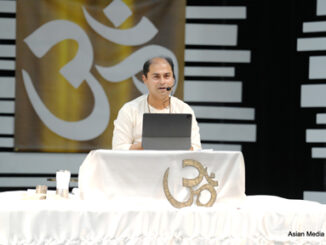
CHICAGO, IL (TIP): Prayagraj Hule is a renowned Vedantic Scholar. He recently concluded a 5-day series on self-help at the International University of Vedic Wellness in Streamwood, IL. His talks resonated with people across Chicago land, leaving a profound impact on the youth and individuals of diverse backgrounds. This universal message transcended race and religion, offering knowledge that spoke to the shared human experience.
In collaboration with the University, Prayagraj will offer youth and adult retreats in 2024 as well as online sessions throughout the year. For more information contact Aparna Kulkarni 847-306-7616 or AparnaK@umasinc.com.
Unearthing Human Nature
Vedanta is a science which deals with human beings. An encyclopedia which has the compilation of subtlest thoughts related to human relationship with the Transcendental Self. Rendered by several enlightened sages of India. These great people dedicated their lives thousands of years ago to reflect upon the mystery of human origin, purpose of living and constitution of human inner nature. The effort of such crystalline contemplation culminated in the Vedanta philosophy, which decoded the apogee of happiness. Present day humans are disconnected with their roots and live in ignorance about this state of Bliss.The Labyrinth
Today, the world over alma maters and mushrooming educational institutions are priming students with a lot of data. No doubt valuable to earn wealth and mark the material progress of nations. But limit the young in their rational approach and application of the knowledge provided. Very few truly implement the knowledge gained. The rest just follow a beaten pattern to work. Consequently, the young become victims of contemporaneity pressure. Affliction is arising out of work culture and impending personal perils caused by lack in clarity of balancing their work and professional life.The Unrestrained Mind, the Ignorance of Intellect
The youth are unaware of Vedantic education. People hence find themselves tormented by the pernicious traits of an ungoverned mind. The lack of higher values absent in present day education has made humans weak. They find challenges in life difficult to handle, mostly, amongst well-educated and the rich. Depression and stress related ailments have risen to alarming proportions. Divorce has reached record breaking numbers world-wide. The human mind turns malignant when left unattended to make decisions by itself in absence of intellect. As a result, greed has led to decadence in society. Humans have turned greedy to amass ill gained wealth and devour millions, billions, without paying any heed to others living juxtaposed in denial. Ultimately, the greedy only find themselves isolated and lonely.The Problem Lies Elsewhere
Knowledge gained from universities has no doubt raised the standard of human living, made people wealthy and indulgent. But are they happy? By their own admission people have lost their morals, peace and cheer. Standard of life has deteriorated to a substantial level.The lack of Vedantic knowledge also makes it difficult for individuals to unravel one’s true aptitude. As a result, few flourish in their natural field of work. Others experience work as a burden, instead of finding it a source of pleasure and joy. Vedanta brings in clarity to discover one’s aptitude and subsequently identify a suitable field of work. One then finds success by employing the right technique of action guided by the intellect. When work becomes a pleasure, so does the working environment.
Live to Give
Giving should be preceded by thinking. Take a look at the charity structure in the world. Ideally, it should be the confluence of feeling and thinking to give society punctiliously. A true philanthropist will initiate research if wealth gives charity and has resolved a whirlwind of present predicaments. Corporation’s today have started charity enclaves, urged by the government to be socially responsible. But has this changed the mind-set of people? Seldom has the donor looked into the effect and effort of organizations and hence the persisting quandaries in the world still remain recurring. Genuine philanthropists share their wealth. But most charitable entities are unable to reach the bottom of the problem. Applying balm to a wound is calming. But that will not help in getting to the source of the disease. True charity is supposed to lift a person spiritually. Make one independent to progress along with others. Not make them dependent and selfish, lethargic and diseased. Remember, “Candent living brings forth Prudent giving”.The Time is Ticking
Few care about Vedantic intellectual education. An education is beyond the precincts of secular education provided by schools and universities. The educated should mull over the recent graph of wars, poverty, crimes, rapes, stress, divorces… These unfortunate escalations of events have gripped all families in the world. Even children are not spared, as crime perpetrated on children is on the rise.Pressure on children has led them not to cooperate with parents and educators. Eager to leave homes, the moment they reach the periphery of youth. Therefore, the necessity of bringing in a value system alongside secular education in society should be implemented imminently. The good and spiritual side of human’s has to be tapped. The negative will then slowly diminish. Vedanta impacts an individual to harness one’s mind. By imbibing its knowledge, you gain intellectual clarity. This then creates collectively awakened human beings to be more affable and reaching out. There is a saying: “You cannot reach God unless you serve & love the expressions of God”.
For the Youth
The future of every country is the power of youth. Parents must pause for a moment and look behind at the legacy they leave, Asian families in recent times a tradition of debts. Westerners, a tradition of separation is in relationships, angst in their behavioral habits and pills to pop anxiety. This directly affects every child.The youth get influenced by anyone higher in stature. They want to emulate everything their icons do. It is hereby the responsibility of all leaders to leave trails of culture and wisdom that follows sound intellectual reason. Social media has become the death knell of values, a harbinger of sorrow. A disorder which is the eating up concentration of youth and even adults. Use it to evolve, benefit others, but don’t get abused by it, harm others and devolve!
An effort has to be made to save the youth. Leaders need to plan a paradigm shift in education. An awakened person would leave behind a cleaner world and not unresolved filth for the young to remove. Albert Einstein made an apt, wise statement: ‘We cannot solve our problems with the same thinking we used when we created them’.
Oh folks! Isn’t it time to wake up? Awaken the intellect with the knowledge of Vedanta.
It is hence time to go back only to move forward in Time.
(Press release by Prayagraj Hule) -

Tamil Nadu Foundation Golden Jubilee Celebrations
CHICAGO, IL (TIP): Tamil Nadu Foundation (TNF), established in 1974 in Baltimore, stands as the oldest and largest U.S.-based humanitarian organization dedicated solely to Tamil Nadu. Over the last 50 years, TNF has evolved as a social organization impacting the lives of less privileged children and families through Education, Women Empowerment, Rural Development and Health & Hygiene.
Over the past five decades, TNF Life Members, TNF Chapters, and TNF Convention donors have collectively supported over 700 projects, positively impacting more than 500,000 underprivileged individuals across Tamil Nadu. This includes providing aid to over 200,000 students in government schools through TNF’s flagship ABC education initiative, assisting over 60,000 victims of the 2015 floods, aiding more than 20,000 victims of Cyclone Gaja in 2018, and donating over 1 million USD during the challenging COVID-19 pandemic.
To commemorate TNF’s Golden Jubilee, a significant milestone, we are delighted to announce our celebratory event scheduled from May 24 to 26 in Rosemont, IL (Chicago), marking fifty years of our Foundation’s impactful journey. TNF lifetime members and the Tamil diaspora are eager to celebrate their accomplishments, reflecting on our journey from a small group of visionaries to impacting over 250,000 children and families across 650 villages in Tamil Nadu. The event promises a rich blend of music, dance, and informative sessions, providing an opportunity to engage with our Youth Force, the future bearers of our mission, and to minimize administrative costs through event profits, ensuring that 100% of donor dollars directly benefit the beneficiaries in Tamil Nadu.
Event Highlights:
• Grand Music Concert: Featuring the legendary “Isai Gnyani Illayaraja.”
• Therukoothu: By Sangagiri Rajkumar with 260 participants (Attempting to make Guinness record).
• “EGAI” Tamil Symphony: A spectacular musical event by Dr. Kanniks Kannikeswaran featuring over a hundred artists.
• Fusion Dance Performance: Showcasing 150 local talents.
• Tamil Isai – Featuring traditional Tamil musical instruments.
• The Renowned YouTube – Village Cooking Channel Team.
• Emerge 2024: An all-day Entrepreneurs Event sponsored by TNF and ATEA.
• Youth Conference: Organized by young adults.
• College Alumni Gathering: Expecting participation from over 25 colleges.
• Districts Parade: Representing 38 districts from Tamil Nadu.
• Other high-quality programs from TNF Chapters and local organizations.Guests from various parts of North America and at least 50 other countries will converge to witness this mega event. Visit www.tnfusa.org for more details.
(Photographs and Press release by Asian Media USA) -

Indian-American jeweler indicted in multi-million dollar international trade fraud
NEWARK, NJ (TIP): An Indian jeweler has been indicted for illegally evading customs duties for millions of dollars of jewelry imports into the US and operating unlicensed money transmitting businesses, a US attorney has said. Monishkumar Kirankumar Doshi Shah (39) — based out of both Mumbai and New Jersey –was arrested over the weekend and appeared on February 26 before US Magistrate Judge André M Espinosa in the Newark federal court. Shah alias “Monish Doshi Shah” was released on a bond of USD 100,000, with home detention and location monitoring. He has been charged on a complaint with one count of conspiracy to commit wire fraud and one count of operating, aiding and abetting the operation of an unlicensed money transmitting business.
From January 2015 through September 2023, Shah engaged in a scheme to evade duties for shipments of jewelry from Turkey and India to the US, according to documents. He would ship or instruct his conspirators to ship goods from Turkey or India, which would have been subject to an approximately 5.5 per cent duty if shipped directly to the US, to one of Shah’s companies in South Korea, these stated.
Federal prosecutors alleged that Shah’s conspirators in South Korea would change the labels on the jewelry to state that they were from South Korea instead of Turkey or India, and then ship them to Shah or his customers in the US, thereby unlawfully evading the duty.
He would also make and instruct his customers to make fake invoices and packing lists to make it look like Shah’s South Korean companies were actually ordering jewelry from Turkey or India.
During the scheme, Shah shipped millions of dollars of jewelry from South Korea to the US, prosecutors alleged.
From July 2020 through November 2021, Shah operated numerous purported jewelry companies in New York City’s Diamond District, including MKore LLC (MKore), MKore USA Inc. (MKore USA) and Vruman Corp (Vruman), it said. He used these entities to conduct millions of dollars in illegal financial transactions for customers, including converting cash to checks or wire transfers, the documents said.
Shah would also collect cash from customers and use conspirators’ jewelry companies, also located in the Diamond District, to convert the cash into wires or checks.
The documents said that at times, Shah and his conspirators moved more than a million dollars of cash in a single day. In exchange for their services, Shah and his conspirators charged a fee.
Prosecutors said that none of Shah’s or his conspirators’ companies were registered as money transmitting businesses with New York, New Jersey, or the Financial Crimes Enforcement Network (FinCEN).
(Source: PTI) -

Indian American Minita Sanghvi secures Democratic nomination for New York’s 44th senate district
NEW YORK (TIP): Indian American Minita Sanghvi has secured the Democratic nomination for New York’s 44th State Senate district, propelled by critical endorsements from the Saratoga County Democratic Committee and Schenectady County Democratic Committee.
Endorsing Sanghvi, Saratoga County Democratic Committee Chairwoman Martha Devaney praised her as a committed advocate and proven problem solver. Devaney highlighted Sanghvi’s multifaceted background, including her roles as a dedicated parent, respected educator, and effective public servant, as evidence of her capacity to deliver results transcending partisan lines. Devaney expressed confidence that Sanghvi embodies the leadership qualities deserving of New York’s 44th State Senate district.
Frank Salamone, Chair of the Schenectady County Democratic Committee, echoed this sentiment, emphasizing Sanghvi’s successful track record as Saratoga Springs Commissioner of Finance. Salamone lauded her fiscal responsibility and highlighted key city improvements under her leadership, including the establishment of a third fire station, a 24/7 homeless shelter, and essential infrastructure enhancements. Salamone voiced certainty that Sanghvi’s commitment to infrastructure development and economic stimulation would benefit the region if elected as state senator.
The 44th State Senate district, encompassing Saratoga County, Niskayuna, and the City of Schenectady, currently under Republican incumbent Jim Tedisco, has witnessed a shifting political landscape. While traditionally Republican, a surge in registered Democrats, outnumbering Republicans by nearly 6,000, signals changing demographics. President Biden’s decisive victory over Donald Trump in the 2020 election within the district further underscores this trend.
“I’m running for State Senate because we deserve better,” said Sanghvi upon announcing her candidacy in January. Emphasizing her status as a parent, business educator, and dedicated public servant, Sanghvi vowed to prioritize community needs over partisan politics. She underscored her track record of collaborative leadership and tangible accomplishments, underscoring her commitment to fiscal responsibility and responsive governance.
Born in India, Sanghvi immigrated to the United States in 2001, holding degrees in accounting and an MBA. She taught business at Skidmore College for nearly a decade before winning the election as Saratoga Springs Finance Commissioner in 2021. Sanghvi emphasized her achievements in delivering fiscally responsible results, prioritizing public safety, and enhancing residents’ quality of life.
Sanghvi’s potential election would mark historic milestones, making her the first openly gay woman and woman of color to represent New York’s 44th State Senate District, as well as the first openly gay woman in the New York Senate. She affirmed her commitment to safeguarding the rights of all residents, advocating for women’s healthcare access, LGBTQ rights, and equal opportunities.
Her opponent and incumbent Tedisco has held political office in Albany for four decades. -

27-year-old Indian American dies in fire in Manhattan residential building in US
NEW YORK (TIP): A 27-year-old Indian national, who worked as a journalist here, tragically lost his life in a “devastating” fire caused by a lithium-ion battery in an apartment building in Manhattan.
Fazil Khan was killed in the fire that broke out in a six-story residential building at 2 St. Nicholas Place in Harlem, Manhattan, which left about 17 other people injured.
The New York City Fire Department said its marshals had determined that the “devastating” fire was caused by a lithium-ion battery.
Khan was a journalist with the New York-based media company The Hechinger Report, which is focused on innovation and inequality in education.
The Consulate General of India in New York expressed condolences on Khan’s death and said it is extending all possible assistance to repatriate his mortal remains to his family in India.
“Saddened to learn about the death of 27-year-old Indian national Fazil Khan in an unfortunate fire incident in Harlem, NY,” the Consulate said in a post on media.
The Consulate said it is in touch with Khan’s family and friends.
“We continue to extend all possible assistance in repatriation of his mortal remains to India,” the Consulate said.
Khan was a data reporter at The Hechinger Report and according to his profile on media, he was an alumnus of Columbia Journalism School. The Hechinger Report said in a post on X that it learned on Saturday that Khan died in a fire in the New York City building where he lived.
“We are devastated by the loss of such a great colleague and wonderful person, and our hearts go out to his family. He will be dearly missed,” it said.
Firefighters said the fire originated in the building’s 3rd floor. At 2.14 pm on Friday, the FDNY responded to the 2-alarm fire at 2 St. Nicholas Place in Harlem. Firefighters arrived within minutes to find people on the fire escape. People were also seen hanging out the windows on the fifth floor, the fire department said. Victims were trapped on the fifth floor of the building.
The fire department had said there were a total of 18 patients, out of which four were in critical condition.
Joseph Pfeifer, the Fire Department’s first deputy commissioner, had said on Friday that one person was in critical condition at the scene but died at the hospital. At the time, the victim’s identity had not been released.
The fire department said that fires caused by lithium-ion batteries have increased dramatically in New York City with deadly consequences. These rechargeable batteries are found in electric bikes and scooters, cars, laptops, tablets, phones and common household devices. Lithium-ion battery fires have caused deaths, serious injuries and devastating damage to property around the city, the department said on its website. -

87 people living in basement taken to migrant shelter
RICHMOND HILL, NY (TIP): An onsite building inspection in New York led to the discovery of 87 people living in a Queens basement Monday, February 26, according to law enforcement sources, says a NewsNation report. NewsNation says the incident happened around 11:40 p.m. at 132-03 Liberty Ave. in Richmond Hill . The FDNY arrived at the building to conduct an onsite inspection. They entered the basement and found 87 people living there, according to sources. Mayor Eric Adams said a 311 call was what prompted an investigation into the building during a news conference Tuesday. WPIX reached out to the FDNY for comment.
The people were transported to a migrant shelter in the Bronx, sources said. The Office of Emergency Management confirmed to WPIX that it responded to the scene.
The backyard of the building was filled with what appeared to be delivery bikes, photos from the scene show.
The building’s owner, 47-year-old Ebou Sarr, told WPIX on Tuesday that he was charging migrants $300 a month to live in the building. He said most of the migrants are from Senegal, and that he was providing them with breakfast, lunch, and dinner. Sarr also said he’s looking at commercial properties to help them find a place to live.
“The city is saying that they have no place for these people,” Sarr said. “It’s not true.”
Officials have not confirmed if the people living in the basement were migrants.
When asked about the situation during Tuesday’s news conference, the Adams administration said that there is a housing problem in the city – but also defended its handling of the migrant crisis.
“What we discovered last night in some ways is also symptomatic of a larger crisis that this city is facing that we’ve talked about repeatedly in terms of the housing shortage in this city,” said Maria Torres-Springer, the deputy mayor for housing. “It is not a new thing that too many people make desperate choices about where to live and what to pay for and at the root of that is the fact that we haven’t built enough housing.”
The Department of Buildings issued a vacate order for the building due to unsafe conditions found in the basement, such as overcrowding, according to sources. After the FDNY found numerous fire hazards, the New York City Emergency Management Department referred people in need of further assistance, sources said.
(Source: NewsNation) -

Two Indian Americans bag Gates Cambridge Scholarship at the University of Cambridge
NEW JERSEY (TIP) : Two Indian Americans — Sadhana Lolla and Ishan Kalburge — are among 26 academically outstanding and socially committed US citizens selected to be part of the 2024 class of Gates Cambridge Scholars at the University of Cambridge.
The US Scholars-elect, who will take up their awards this October, are from a wide range of backgrounds, according to a media release. Nineteen are women, six are men and one would prefer not to specify. Thirteen will pursue PhDs while 13 will undertake one-year master’s degrees.
“In the rural Indian village that my family calls home, I grew up witnessing my grandmother labor endlessly without assistive technology,” says Sadhana Lolla, who plans to pursue an MPhil in technology policy.
“Her experiences, and those of millions of women, elderly, and people with disabilities worldwide, underpin my dedication to pursue artificial intelligence solutions that bring robotic assistive technology to underprivileged communities.”
“My background as a machine learning researcher and roboticist has enabled me to deeply appreciate the transformative power of technology, while also recognizing that technologists and governments must work together to leverage cutting-edge artificial intelligence to uplift those who need it the most,” she says.
“By pursuing the MPhil in technology policy,” Lolla says, “I hope to bring regulators, researchers, and the technology industry together to design policy solutions that promote bias-free, robust, and trustworthy artificial intelligence while spurring innovation.”
“I also hope to uplift the voices of vulnerable communities in conversations about technological development and deployment,” she says. “I’m thrilled to join the Gates Cambridge community and work together with such a diverse and talented group of peers to improve the lives of others.”
Lolla previously studied Computer Science at the Massachusetts Institute of Technology.
Ishan Kalburge, who will do a PhD in engineering, will look at how the human brain forms internal representations of uncertainty.
He hopes to develop computational models that emulate such representations to advance our understanding of human cognition in health and disease and pave the way for developing trustworthy and energy-efficient artificial intelligence.
While at Cambridge, he will also work to expand STEM outreach initiatives in under-resourced communities and lead dialogue on developing responsible AI regulatory policies.
Kalburge is also President of the Johns Hopkins Biomedical Engineering Society. He says the initial motivation for his research is a personal one: “When my grandfather was diagnosed with Parkinson’s Disease, I was driven to deepen my understanding of human cognition to develop solutions that could help people like him,” he says.
At Johns Hopkins University, he pursued a BS in Biomedical Engineering, Applied Mathematics and Statistics, and Economics, developing interdisciplinary skills to achieve his goals. Through his research, Kalburge explored the largely unknown processes underlying human decision-making under uncertainty.
“In my free time, I hope to work on my jazz improve skills on the piano!” he says.
The 26 US scholars-elect will study and research subjects ranging from how magma shapes human life to how to create the necessary infrastructure to bring robots to marginalized communities.
The prestigious postgraduate scholarship program – which fully funds postgraduate study and research in any subject at the University of Cambridge – was established through a US$210 million donation to the University of Cambridge from the Bill & Melinda Gates Foundation in 2000.
Since the first class in 2001, Gates Cambridge has awarded 2,182 scholarships to scholars from 112 countries who represent more than 700 universities globally (more than 200 in the USA) and around 90 academic departments and all 31 Colleges at Cambridge. -

Indian American Sikh teen rolls out album of Gurbani Shabad Kirtan in 31 ragas of Guru Granth Sahib
ALBANY, NY (TIP): A 12-year-old Arjanveer Singh has come out with an album of Gurbani Shabad Kirtan in 31 ragas of Guru Granth Sahib, qualifying him as a prodigy.
Based at Albany, New York he learned the recital of Gurbani Kirtan in classical Ragas pointed towards his dedication towards Gurmat philosophy. About his feat he said it was an initiative aimed at connecting children worldwide with the ‘Ragatmic Shabad Kirtan’ of Guru Granth Sahib. He rendered Gurbani Kirtain in Ragas such as Aasaa, Wadhans, Sorath and others. He learnt Gurbani Kirtan based on 31 ragas of Guru Granth Sahib from renowned Sangeet Kirtankar Dr Gurnam Singh, former head of Gurbani Sangeet Chair of Punjabi University through Baljinder Singh, the head of the Rara Sahib Samprada.
Album containing Gurbani Shabad Keertan in 31 ragas sung by 12-year-old Arjanveer Singh was jointly released by Akal Takht Jathedar Giani Raghbir Singh, SGPC president Harjinder Singh Dhami, Rara Sahib Samprada head Baba Baljinder Singh and others at Akal Takht secretariat in Amritsar on Saturday. -

Indian American healthcare executive Smriti Kirubanandan appointed MD of Accenture’s healthcare practice
WASHINGTON, D.C. (TIP) : Indian American healthcare business executive Smriti Kirubanandan is joining Accenture as Managing Director of the firm’s healthcare practice.
Kirubanandan, 36, “emerges as a contemporary Renaissance figure, achieving significant milestones as a Growth and Partnerships Executive with a distinctive background in Robotics and Public Health,” according to a company press release.
Expressing her “excitement to join a leadership that values kindness, expansiveness, and believes in the power of equity and unity, Kirubanandan highlighted the role of individuals as “value creators, architects of change, and genuine guardians of the healthcare galaxy” in these challenging times.
“I am grateful and excited to share that I have started my journey with Accenture as Managing Director in Healthcare practice,” she wrote on LinkedIn.
Kirubanandan’s passion for emerging technologies and unwavering dedication to advancing healthcare are evident in her remarkable accomplishments, the release stated. Beyond her corporate success, she wears multiple hats, demonstrating expertise as a raw vegan chef and nutritionist, actively engaging in community service, and spearheading initiatives to combat food insecurity, it stated.
In recognition of her outstanding contributions, the World Economic Forum bestowed upon Smriti Kirubanandan the title of Young Global Leader in 2023.
Kirubanandan has “helped organizations globally to build the capacity to empower people to engage in wellness programs,” the WEF stated noting she is “responsible for educating small farmers in Africa to lift them out of poverty to improve food & nutrition insecurity, impacting 2 million people per year.”
Additionally, she was recently elected as a fellow of the British Royal Society of Arts, highlighting her global impact. She holds a distinguished position within the Young Leaders Circle at the Milken Institute and serves as the visionary Founder of the HLTH Forward Podcast.
This celebrated media platform serves as a collaborative nexus, bringing together healthcare leaders, policymakers, and artists to address challenges within the healthcare system and collectively devise strategies for its advancement, according to the release.
In 2022, she was appointed to serve the Los Angeles County food equity round table as a Nutrition & Policy Advisor to design and strategize programs to address food insecurity by educating and improving access and affordability to nutritious food.
Kirubanandan gained her Bachelor of Science in Computer Science and Engineering focused on Robotics (BSCEN), followed by her master’s in engineering management (MSEM) from USC and master’s in public health (MPH) from UCLA. -

Indian American Former MSNBC host Mehdi Hasan launches Zeteo, a new digital media venture
WASHINGTON, D.C. (TIP): British Indian American liberal commentator Mehdi Hasan, who departed from MSNBC last month following the controversial cancellation of his weekly show in November, is preparing to launch his own digital media company, Zeteo.
Named after the Greek word meaning “to seek,” Zeteo is scheduled to make its debut in April on the Substack platform. The company’s flagship offerings will include a weekly streaming show titled “Mehdi Unfiltered,” hosted by Hasan himself, alongside a weekly podcast and a range of written contributions from prominent figures. Subscribers can access the platform for $6 per month, with an annual subscription option available.
Announcing the launch of the platform, Hasan told his 1.5 million followers on X, formerly known as Twitter:
“Some personal & professional news: I’m launching a new media company! It’s called Zeteo.
“And, in this era of war abroad, fascism at home, and propaganda everywhere, I hope I can count on your support.”
To kickstart Zeteo, Hasan told the Washington Post that he secured $4 million in funding, with support from friends, family, and concerned viewers following his departure from MSNBC. The network faced significant backlash after axing Hasan’s television and streaming shows on November 30, which many of his supporters believed was due to the sidelining of critical voices on the US position regarding the Israeli-Hamas war.
“I’ve decided that it’s time for me to look for a new challenge,” Hasan announced during his final episode on January 7. “Tonight is not just my final episode of ‘The Mehdi Hasan Show.’ It’s my last day with MSNBC. Yes, I’ve decided to leave.”
In a message circulated on social media to his followers on Wednesday, Hasan expressed, “I have asked you all to share and repost a lot of things over the years. You’ve always supported me. I am now making my biggest ask of all: I’ve launched my own media company. We need an alternative to the mainstream folks. This is it.”
While Hasan will serve as the face of Zeteo, he emphasizes the platform’s dedication to amplifying diverse voices and perspectives often sidelined by mainstream media. The launch of Zeteo signifies a bold move for Hasan, who acknowledges the risks involved but remains optimistic about the venture’s potential.
Hasan’s foray into the digital realm reflects a broader trend among media personalities seeking greater independence and autonomy in their expression.
Recently, Hasan joined The Guardian as a regular columnist. His first column, published on February 21, called on President Joe Biden to pressure the Israeli government to end the “genocide” of Palestinians in Gaza. Hasan told Semafor that he was grateful for the opportunity to contribute to The Guardian, stating that he has been an avid reader of the publication since his teenage years.
Hasan previously worked for Al Jazeera English and the Intercept. His new venture mirrors a broader shift in media consumption, with digital platforms playing an increasingly influential role in shaping public opinion. The success of Zeteo will be closely monitored as Hasan aims to carve out a space for independent voices. -

Indian American executive Sidhartha Nair joins Alta Equipment Group as director
SAN FRANCISCO (TIP) : Indian American executive Sidhartha Nair has joined Alta Equipment Group Inc, a leading provider of premium material handling, construction and environmental processing equipment and related services, as a director.
Nair, 52, currently is the Head of Strategy, Americas Region, for Mercedes-Benz Mobility and leads Strategic and Transformation activities in the US, Canada and Mexico since December 2021.
Nair brings global experience and knowledge of startup, new market entry, growth, and digital transformation of businesses at different periods in their life cycle, according to a media release.
“Sid brings extensive business leadership experience as well as in-depth knowledge in digital transformation and business transformation in the automotive industry,” said Ryan Greenawalt, Chief Executive Officer and Chairman. “His expertise will be a significant boost to our ongoing initiatives. I look forward to the contributions he will make as part of the Alta family.”
“I am excited to join the Board of Alta and be part of its rapidly expanding growth and position in the market,” said Nair. “My experience should be beneficial to Alta’s diversified strategy to capitalize on the growth opportunities and cost- efficiency initiatives.”
Nair first joined Daimler Financial Services in 2003 and has held roles of increasing responsibility during his tenure of more than 20 years in the US, Caribbean and India business units.
Prior to 2003, he held a previous role with McKinsey & Company as a consultant working on developing strategic solutions addressing growth, turnaround and new market entry.
Nair holds a MBA from the University of Michigan, Ross School of Business and a Masters in Engineering from Purdue University. Alta owns and operates one of the largest integrated equipment dealership platforms in the US and has a presence in Canada. -

Indian American executive Reema Poddar elected to Oceaneering International board
HOUSTON (TIP): Indian American business executive Reema Poddar has been elected to the Board of Directors of Texas-based technology company Oceaneering International, Inc. as an independent, non-executive director for a two-year term. Poddar has also been appointed to the Nominating, Corporate Governance and Sustainability Committee of the Board. Her initial term of office will extend until Oceaneering’s Annual Meeting of Shareholders in 2026, according to a media release.
Poddar has 30 years of software industry experience, including product strategy, product development and digital business transformation. She has been recognized as a leader in data analytics, machine learning, artificial intelligence, cloud services, cyber security, industrial automation, the Internet of Things (IoT), and diversity, equity and inclusion. She has served in executive roles at global firms ranging from startups to Fortune 500 corporations, including holding executive roles at General Electric, GE Digital, Emerson, Philips, Teradata Corporation, AdFender Inc., OptimEyes.AI and Intellution, Inc.
Poddar currently serves on the board of directors of MeridianLink, Inc. and Accion Labs Group Holdings, Inc., and on the board of advisors for OptimEyes.AI. Previously, Poddar served on the corporate council board of advisors to the Dean of UC San Diego Jacobs School of Engineering.
Poddar holds a master’s degree in computer applications from Bangalore University, India and a master’s degree in physics from Mahatma Gandhi University, India.
Kevin McEvoy, Oceaneering’s Chairman of the Board, stated, “We are pleased to welcome Ms. Poddar to Oceaneering’s Board. Our strategic, robotics-focused vision will be strengthened by her successes as an experienced technology executive and respected thought leader and change agent.
“Her experience in setting product and technology strategy, building and delivering innovative, commercially viable products and services, accelerating digital transformations, and delivering results in the digital market is relevant and meaningful to Oceaneering.”
Oceaneering is a global technology company delivering engineered services and products and robotic solutions to the offshore energy, defense, aerospace, manufacturing, and entertainment industries. -

Indian American computer engineer Ashok Veeraraghavan wins award for revolutionary imaging technology
HOUSTON (TIP): Trailblazing Indian American computer engineer Ashok Veeraraghavan has won the 2024 Edith and Peter O’Donnell Award in Engineering for his revolutionary imaging technology that seeks to make the invisible visible. Veeraraghavan, Professor of Electrical and Computer Engineering and Computer Science, George R. Brown School of Engineering at Rice University, was bestowed with the award by The Texas Academy of Medicine, Engineering, Science, and Technology (TAMEST).
Imagine taking a pristine picture through fog, smoke and rain. Imagine taking interior images of the human body through skin, bone and other tissue that scatter light and limit human vision, says a media release about Veeraraghavan’s revolutionary technology.
Veeraraghavan and his team at Rice work on creating imaging systems that use novel multi-dimensional image sensors along with machine learning algorithms to undo the effects of light-scattering and see-through scattering media such as fog, smoke, rain and human tissue.
Recently, with support from researchers at the University of Maryland, his team has developed a new technology dubbed NeuWS, an acronym for “neural wavefront shaping.”
At its core, NeuWS is about undoing the effects of light scattering by using wavefront shaping and a novel machine-learning algorithm. Scattering is what makes light, which has a lower wavelength unusable in many scenarios. If you can undo the effects of scattering, imaging can go much further.
Capturing images through rain and fog is certainly interesting, but this technology could have lifesaving applications, the release stated.
Through NeuWS-like technologies, there could be a time in the future where a firefighter entering into a room filled with smoke could be equipped with goggles that allow them to have clear visibility.
Automakers could be able to install car headlights that can see through a host of dangerous weather conditions. Surgeons could be able to see blood vessels through the skin tissue without making a single cut.
While several further advances are needed to make any of these scenarios possible, their work has made significant progress and make all of this potentially feasible.
“Dr. Veeraraghavan is tackling one of the hardest problems in imaging, what many consider to be a ‘holy grail problem’ of optical engineering,” said nominator Alan Bovik, PhD (NAE), Professor, Cockrell Family Regents Endowed Chair in Engineering at The University of Texas at Austin.
“Every time we improve our ability to see what is unseen, the number of things we can do increases. The NeuWS technology is going to allow us to see things we cannot even imagine today.”
Born in Chennai, Veeraraghavan earned a BTech in electrical engineering from Indian Institute of Technology, Madras in 2002.
He also earned master’s and doctoral degrees from the Department of Electrical in 2004 and Computer Engineering at the University of Maryland, College Park 2004 in 2008.
After joining the ECE Department in 2010, he was promoted to Associate Professor in 2017 and professor in 2020. He co-developed FlatCam, a small sensor chip with a mask that substitutes lenses in typical cameras.
Veeraraghavan is one of five Texas-based researchers receiving the TAMEST 2024 Edith and Peter O’Donnell Awards. Each is chosen for their individual contributions addressing the essential role that science and technology play in society, and whose work meets the highest standards of exemplary professional performance, creativity and resourcefulness.
The Edith and Peter O’Donnell Awards annually recognize rising star Texas researchers who are addressing the essential role that science and technology play in society, and whose work meets the highest standards of exemplary professional performance, creativity and resourcefulness.
Founded in 2004 TAMEST is composed of the Texas-based members of the three National Academies (National Academy of Medicine, National Academy of Engineering and National Academy of Sciences), the Royal Society and the state’s eight Nobel Laureates. -

Four Indian American brothers win $7 billion in California property dispute
LOS ANGELES (TIP): In one of the largest verdicts in the US in a decade, four brothers from India have been awarded $7 billion after a 20year legal battle with a fifth brother over alleged breach of a family partnership agreement. After a five-month trial, a jury Monday ordered Haresh Jogani to pay his brothers Shashikant, Rajesh, Chetan and Shailesh Jogani more than $2.5 billion in damages and to divide up shares of their Southern California property empire.
In total, the Los Angeles Superior Court jury awarded the four successful brothers $2.5 billion in monetary damages and more than $4.5 billion in property interests, making the award one of the largest in the United States this year, according to the plaintiffs’ attorneys.
The case arose from a conflict involving the siblings, all from India, concerning more than 170 apartment buildings incorporating 17,000 units, primarily in the San Fernando Valley.
One of the brothers, Haresh Jogani, is listed on paper as the owner of the buildings. His attorneys maintained that there was no oral partnership as his siblings alleged and that he was the sole owner of the real estate portfolio.
But his brothers contended to the contrary and the jury agreed with them, determining that the defendant owed brothers Rajesh Jogani and Chetan Jogani $750 million in damages, plus real estate interests valued at more than $1 billion. “We are grateful to the jurors for their decision,” said attorney Peter Ross of Ross LLP, who represented Rajesh and Chetan Jogani. “Thanks to them, a long-standing wrong has been corrected, and this brother-against-brother war can come to an end.”
Shashikant Jogani, who was represented by another law firm, received the biggest payout; the jury awarded him $4.75 billion, and the fifth brother, Shailesh, received $570 million.
The jury also found that prevailing brothers Rajesh, Chetan and Shashikant are entitled to punitive damages. The hearing regarding the punitive damages will take place on Friday.
The 2003 lawsuit already has been through 18 appeals, generations of attorneys and five judges in Los Angeles Superior Court. It’s drawing comparisons from some of the lawyers to the fictional Victorian-era probate case that Charles Dickens wrote about in his 1852 novel Bleak House. They’re calling Jogani v. Jogani the new Jarndyce v. Jarndyce, but with a twist. “At end of the book, there was no money, hence the name, Bleak House,” said Peter Ross, an attorney who represents Chetan and Rajesh Jogani. “That’s not the case here. There’s billions here that remain to be distributed.”
The Jogani family from Gujarat, India, built a fortune in the global diamond trade, establishing outposts in Europe, Africa, the Middle East and North America.
Shashikant “Shashi” Jogani moved at age 22 in 1969 to California, where he began a solo firm in the gem business and started to build a property portfolio, according to a complaint he filed in 2003.
The properties suffered losses in the recession of the early 1990s, which worsened after the 1994 Northridge Earthquake killed 16 people in one of his buildings, leading Shashi to bring in his brothers as partners.
The firm then embarked on a buying spree that eventually built the portfolio to roughly 17,000 apartment units with the brothers collaborating until Haresh “forcibly removed” his sibling from managing the firm and refused to pay him, according to Shashi Jogani’s complaint. Haresh Jogani contended that without a written agreement, his brothers couldn’t prove they had a partnership with him.
But the jury found that Haresh had broken an oral contract. Jurors heard testimony that oral agreements are customary in both the diamond trade and among Gujaratis.
“The law is you can have oral contracts that are just as valuable as written contracts,” said attorney Steve Friedman, an attorney for Shashi Jogani.
The jury concluded Shashi owns 50% of the real estate partnership, followed by 24% to Haresh, 10% to Rajesh, 9.5% to Shailesh and 6.5% to Chetan, the youngest, who is now 62 years old, according to Ross. The initial damages award for Shashi, now 77, was $1.8 billion.
The properties generated as much as $137 million a year in net operating income, according to Michael Friedman, 37, who with his father, Steve, has represented Shashi since 2014, the year after he passed the bar to practice law.
“There’s an enormous portfolio that Shashi built,” he said. “And it sustains itself.” -

Eight Indian-origin women among 50 CNBC Changemakers
NEW YORK (TIP): Five Indian American and three other Indian origin women are among this year’s 50 “CNBC Changemakers: Women Transforming Business,” an annual list spotlighting women whose accomplishments have left an indelible mark on the business world.
Besides Indian American business leaders Revathi Advaithi, Sandhya Ganapathy, Dr Geetha Murali, Ritu Narayan, and Aradhana Sarin, the list features Svanika Balasubramanian, Dipali Goenka and Dr Suneeta Reddy from India.
“The women named to the inaugural CNBC Changemakers list are creating a pattern of what it takes to defy the odds, innovate and thrive in a volatile business landscape,” says CNBC.
“From startup founders to S&P 500 C-suite growth drivers, from personalities shaking up the media industry to figures taking women’s sports further into the mainstream, the 2024 Changemakers have broken new ground and set the stage for others to follow,” it says.
“By focusing on women who left an indelible mark on the economy and business world in 2023, CNBC Changemakers recognizes the accomplishments of names in the news and many who have flown under the radar” it says.
Indian Americans on the list are:
Revathi Advaithi, Flex, Chief Executive Officer
Notable in 2023: Advaithi forged a key Biden administration partnership on US/India relations and accelerated climate tech and EV adoption.
Named CEO in February 2019 after starting her career as a shop-floor supervisor in Oklahoma, Advaithi has helped build Flex into one of the most trusted manufacturing partners across a variety of industries by embracing the company’s “do the right thing, always” ethos.
Advaithi has also looked to create stronger alliances between the private and public sector, leading to factory visits from President Joe Biden and US Energy Secretary Jennifer Granholm, as well as her participation at the White House’s “Innovation Handshake” between the US and India and a state dinner for Indian Prime Minister Narendra Modi.
In March, she was named by Biden to the Advisory Committee for Trade Policy and Negotiations. The visits from Biden and Granholm highlighted the role that Flex is playing in the clean energy transition and the future of electrification.
Sandhya Ganapathy, EDP Renewables North America, Chief Executive Officer
Notable in 2023: Leveraged the Inflation Reduction Act to drive a clean energy transition with diverse leadership.
Ganapathy sees her mission as helping to create a cleaner nation – and a cleaner world. She took over the helm at EDP Renewables North America as CEO in 2022.
The Houston-based company is one of the top five renewable energy operators in the US, operating 60 wind farms and 12 utility-scale solar parks.
The company’s projects generate close to nine gigawatts of clean energy annually, enough to power about 2 million homes.
EDP Renewables North America has created more than 1,000 jobs in the US and invested $17 billion in capital in local communities across the US, according to the company.
Dr Geetha Murali, Room to Read, Chief Executive Officer
Notable in 2023: Released a multimedia storytelling project to empower millions of girls to create change.
Murali is leading the effort to combat illiteracy and gender inequality through the development of a love of reading in marginalized children.
In 2023, the organization launched She Creates Change, a multimedia storytelling project intended to broaden its reach by encouraging young women and girls to create change in their own communities and achieve educational goals.
The multimedia project, the first of its kind, tells stories via physical books, live action and animated films, using techniques from vivid abstract imagery to Claymation, and audio productions, with iterations in dozens of languages intended to reach a broad audience.
Room to Read says that as of 2024, it will have benefited the same number of children over the past four years as the organization did during its first twenty.
Ritu Narayan, Zūm, Founder & Chief Executive Officer
Notable in 2023: Expanded school bus service to more major cities and is transitioning to all-electric fleets.
Narayan struggled with managing her career while making sure her kids could get from point A to point B. So, she started Zūm, a transportation company that focuses on students while using technology to create more efficient and environmentally friendly routes.
Zūm raised $140 million in series E financing in early 2024, putting the company’s valuation at $1.3 billion. The company currently serves thousands of schools, including school districts in Los Angeles, San Francisco and Seattle.
The company provides guardians with an app, which gives live route notifications to and from school. Artificial intelligence has helped the company optimize drive times, leading kids to spend less time on the bus.
The company has also committed to having an all-electric fleet by 2027. The project includes the Oakland Unified School District, which will become the first major school district in the nation to have a 100% fully electric school bus fleet in 2024.
Aradhana Sarin, AstraZeneca, Executive Director & Global Chief Financial Officer
Notable in 2023: Led deals to expand AstraZeneca’s drug pipeline, transformed finance function to improve employee retention and productivity.
In November 2023, AstraZeneca launched its health-tech division Evinova. The business uses digital technology to develop clinical trials and medicine delivery.
AstraZeneca also acquired preclinical gene therapy programs and technologies from Pfizer in July 2023, specifically focused on rare diseases.
About 80% of the 7,000 rare diseases — meaning affecting 200,000 or fewer people — are based on genetics. Gene therapy could cure some of these illnesses.
Sarin took on the CFO role in 2022, joining biopharma Alexion, and worked on Wall Street in investment banking for two decades before moving into the pharmaceutical industry.
She trained as a medical doctor and treated patients in Tanzania and India earlier in her career and has an MBA from Stanford.
Three Indian origin women on the list:
Svanika Balasubramanian, rePurpose Global, Co-founder & Chief Executive Officer
Notable in 2023: Muscat, Oman based company collaborated with 300-plus consumer brands to reduce plastic waste and increase margins.
Dipali Goenka, Welspun Living, Chief Executive Officer & Managing Director
Notable in 2023: Jaipur, India based company advanced innovation, sustainability, and gender parity while reaching the $1 billion revenue milestone.
India-based home textiles giant’s products are sold at retailers including Walmart, Ikea, Costco, Kohl’s, Lowe’s, Macy’s and Home Depot, as well as through deals with many major hotel chains.
Suneeta Reddy, Apollo Hospitals Group, Managing Director
Notable in 2023: Spearheading the digital transformation and continued growth of India’s largest hospital system.
As a part of the founding family which began with one hospital, Suneeta Reddy has played a leading role in helping Apollo Hospitals grow into a huge player on the Asian health-care landscape.
It’s the largest integrated healthcare network in India, with 73 hospitals, a workforce of over 100,000, 6,000-plus pharmacies, over 200 clinics and over 2,200 diagnostic centers, and 25 million users on its digital health platform. -

British Indian doctor’s rock band embarks on UK-wide tour
LONDON (TIP): A 25-year-old British Indian doctor whose passion for music resulted in a band with some of his fellow medical colleagues has embarked on his first UK-wide tour, with the launch show in London recently proving a sell-out. Gulzar (Gulz) Singh Dhanoya started the indie-rock band named Gulz during his university days as a medical student. It was over the Covid pandemic that the singer-songwriter plucked up the courage to put out some of his musical creations onto the audio streaming service SoundCloud and soon this one-man project struck a chord with an ever-expanding fan base. The lead singer and songwriter is now busy rehearsing with his four bandmates for their next live gig in Birmingham on March 16.
“How it usually works is that now I go away and think of an idea for a song and its very bare bones. Then we go into a studio rehearsal room and all of us together kind of think about our parts and we just keep playing it over and over. It’s a great way to kind of balance our creative ideas,” Gulz told the media.
While two of his other bandmates are also National Health Service (NHS) doctors like him, two are professionals in other fields which he feels helps bring some flexibility to striking a balance with late-night hospital shifts. He admits sometimes wondering how they are all able to commit to their music with stressful full-time jobs.
“It’s a huge commitment. Obviously, the working day is long and then it fits in shows and rehearsals and social media stuff. It’s like a second job and one that doesn’t realistically pay compared to a ‘normal’ job. It’s very cliche, but it’s just because we love it,” he said.
Born in Newcastle to a Punjabi father born in India and mother born in Southall, west London, music was a part of Gulz’s life from a very young age. From strains of Mohammed Rafi to Stevie Wonder, his musical influences were an eclectic mix – something that chimes with the kind of tunes he is now creating lyrically and musically.
“I began by sort of writing music that sounds like the music I like and have tried to retain that in some ways. I just try to weave certain themes of my life at the time into the stuff that I’m writing, be it relationships and breakups or just having some fun,” he said.
Currently based in Brighton and completing his second foundation year as a junior doctor in the National Health Service (NHS), Gulz plans to take some time off later this year to focus entirely on music for some time. Asked about the ongoing strikes by NHS junior doctors demanding better pay and working conditions, Dr Dhanoya says the band fully supports their medical colleagues in industrial action.
“We always hope the next set of strikes will be the last one because junior doctors don’t want to have to strike. But sadly, there’s no other way to be heard by the government. The working conditions and pay right now are not acceptable. There’s so much responsibility that doctors have, with people’s lives at stake literally, and the working conditions and pay do not reflect that at all,” he said, pointing out that in real terms all his colleagues are fighting for is an extra GBP 5 an hour.
Juggling their work shifts and rehearsals, the band is all set to perform at the Sunflower Lounge in Birmingham and then their tour is slotted for his home crowd in Newcastle followed by Manchester towards the end of next month. Beyond that, Gulz is open to bookings and asked if a tour to India may be in the offing, the doctor-musician sounds very excited at the prospect of playing a gig in the country he has so far only visited with family to spend time with cousins in Punjab.
“After August, I’m out of contract, which sounds dramatic but it’s actually a really good thing because it means that I’ve got a lot more flexibility in my time and work. So, I would love to go to India and perform, in case any promoters out there want to reach out,” he said.
Meanwhile, the band – dubbed the doctors/rockers – have sold-out shows in the UK to look forward to with tickets selling out fast on their socials. -

A new low for Congress high command
Himachal crisis was triggered by the top brass’ refusal to address brewing rebellion against
“The Congress central leadership has effectively alienated all senior leaders who can hold the hand, read the pulse and count a legislator in or out. Their services are no longer required in the post-Sonia Gandhi Congress. All the old leaders are being painted with a tar brush without new ones replacing them. So, Congress lawyer-leader Abhishek Manu Singhvi had to cut a sorry figure and say that he could not judge the character of those whom he supped with a day before the Rajya Sabha election. It is surprising because everybody else knew about a brewing rebellion against Sukhu, which the central leadership refused to address.”

By Rajesh Ramachandran About seven years ago, there was a Rajya Sabha election in Gujarat that disproved the invincibility of the new BJP’s election-winning machine. Then Congress president Sonia Gandhi’s political adviser Ahmed Patel was seeking his fifth consecutive term in the Upper House. There were three seats up for grabs: two for the BJP and one for the Congress. Then BJP president Amit Shah and Union minister Smriti Irani were the BJP candidates who sailed through. The Leader of the Opposition in the Gujarat Assembly, Shankersinh Vaghela, had split the Congress and taken away a chunk of the MLAs. Yet, the Congress had 44 legislators, which was enough for Patel’s victory. Indian democracy is still waiting for the primary Opposition party’s leadership to come of age.
But the difference between the late Patel and Himachal Pradesh Chief Minister Sukhvinder Singh Sukhu is that the former planned for the worst-case scenario. Two Congress MLAs backstabbed the party candidate. However, their votes were declared invalid as they had shown their ballot papers to BJP leaders. Yet, the masterstroke was Patel preparing for a last-minute twist in the tale. He had a BJP rebel and an MLA of BJP ally JD(U) cross-vote for him. These two votes made all the difference. Patel’s victory in August 2017, three years after Modi came to power, was a big morale-booster for the Congress and the Opposition, proving that the BJP could be checkmated in its citadel.
There are no geniuses in politics, but only planners and doers. Patel was credited with magical machinations. But there was no sleight of hand or clairvoyance. His was a basic problem-solving approach towards a political situation. Elections need numbers and they need to be counted, again and again. The basic dictum of power politics is that those who stand closest would serve the hardest blow and the first lesson is to be prepared with extra numbers when the nearest ones slink away. Patel’s magic was to be prepared with a BJP and a JDU cross-voter each. But to count legislators and add up numbers, leaders need to have interpersonal chemistry.
The Congress central leadership has effectively alienated all senior leaders who can hold the hand, read the pulse and count a legislator in or out. Their services are no longer required in the post-Sonia Gandhi Congress. All the old leaders are being painted with a tar brush without new ones replacing them. So, Congress lawyer-leader Abhishek Manu Singhvi had to cut a sorry figure and say that he could not judge the character of those whom he supped with a day before the Rajya Sabha election. It is surprising because everybody else knew about a brewing rebellion against Sukhu, which the central leadership refused to address.
Earlier, the Congress top brass had always encouraged and rewarded rebellion, using rebels to keep satraps under check. Sukhu is the best example of a rebel rising up to topple the legacy of the biggest Congress mass leader in Himachal — Virbhadra Singh. Sukhu’s claim to fame has always been as the high command’s loyalist poking the six-term Chief Minister, who was an MLA nine times and an MP five times. The current crisis has proven that being a rebel is no real qualification to lead.
His detractors accuse him of punishing PWD officials for helping Virbhadra’s widow, state party president and Congress’ Mandi MP Pratibha Singh, during a foundation stone-laying ceremony. Obviously, such a CM would not know what’s cooking in his party.
Indira Gandhi could afford to keep top local leaders on their toes. For, she was not merely Nehru’s daughter but a child of the freedom movement. She knew local leaders and their competitors without any interlocutors introducing her to them. Not Rajiv Gandhi, whose infamous sackings in Andhra Pradesh led to the rise of Telugu pride and the Telugu Desam Party. And definitely not Priyanka Gandhi, who is not an elected member of any House. Democracy cannot be an exercise of power which has not been validated by the people directly or indirectly.
The primary task of the high command is to listen to the competing claims of the CM and his detractors. Most of the legislators, even ministers, do not have access to Priyanka or his brother. This has been the sad story of the Congress for a long time. It is now a family business run by proxies, with the owners refusing to look at the books. Many important functionaries in the Himachal Congress knew that the Rajya Sabha poll may end up messy. A former top leader openly, though privately, said it before the polls. But nobody was listening. Sukhu refused to hold the hands of his colleagues to read their pulse. And his government machinery was rendered useless by sundry advisers.
For a central leadership that has always encouraged rebellion within, this time round, Priyanka did not know how to control the levers of intra-party competition. Himachal is a bipolar polity, which does not offer a third alternative to defectors. Turncoats, in fact, find it difficult to make room for themselves in the opposite camp carrying the stigma of being a defector in society. Yet, if Congress legislators decide to move out of the party, it can only be because of the complete failure of the state and central leaders to “judge the character” of their own glorified selves. They almost surrendered the only government in north India to the BJP.
And it took Karnataka Deputy CM DK Shivakumar and former Haryana CM Bhupinder Singh Hooda to bring the government back from the brink. And these are the kind of leaders that Rahul Gandhi may not like to associate with. Unfortunately, all mass leaders who have earned their spurs are out of Rahul’s charmed circle, reducing it to a bunch of featherweight hangers-on. That leaders like Shivakumar and Hooda should have been pressed into service before the poll and not afterwards is a lesson that Rahul and Priyanka have not yet learnt. Indian democracy is still waiting for the primary Opposition party’s leadership to come of age.
(The author is editor-in-chief of Tribune group of newspapers) -

BJP’s 370-seat target overly optimistic
With the INDIA bloc coming to its senses, the ruling party may not find the going easy
“The north, except Punjab and Himachal, is solidly with the BJP. But with the INDIA bloc coming to its senses, it is possible that the BJP will not reach the figure of even 303, its tally in the 2019 Lok Sabha elections. The figure of 370, quoted by Modi, is far too optimistic.”

By Julio Ribeiro I am convinced that Narendra Modi is going to be the Prime Minister for another five-year term. What I seriously doubt is whether his prediction that the BJP will win 370 seats (and the NDA will get 400) in the Lok Sabha elections will come true.
It is incumbent on the party firmly backed by the majority community to suppress its tendency of misusing its powers to humble the Opposition.
In Maharashtra, which sends 48 MPs to the Lower House, it seems that the Congress, the Sharad Pawar-led NCP and the Uddhav Thackeray-led Shiv Sena faction will each win a few seats in their respective spheres of influence. The BJP has made major inroads into rural constituencies. Along with its new-found friends, the Shinde faction of the Sena and the Ajit Pawar-led NCP, it will win a few more than the Opposition, but certainly not the figure it quotes.
The Hindi-speaking belt is firmly on its side, but here, too, the going is not going to be so smooth that it can afford to let its guard down. The farmers’ renewed agitation is confined mainly to Punjab, a state where the BJP has little influence. Jat farmers of Haryana and Uttar Pradesh have been weaned away by the bestowal of the Bharat Ratna on the tallest Jat leader, former PM Chaudhary Charan Singh. The award ahead of the Lok Sabha elections was one very clever move.
What was far from clever, though, was the attempt to tamper with the result of the Chandigarh mayoral poll. It resulted in prosecution being ordered against the presiding officer by the Supreme Court, whose judgments in the electoral bond case and the Chandigarh episode have alerted the party in power to refrain from venturing into such escapades.
The fate of the presiding officer should serve as a warning to officials wanting to prove their loyalty to the powers that be. The apex court’s decision on the electoral bond scheme has cast a shadow over the willingness of corporates to blindly help the party in power. They should revert to the system followed by the Tata Group and the Aditya Birla Group to donate to all political parties by crossed cheques, properly accounted for. That system was working seamlessly till the electoral bonds were invented.
It is natural for the party in power, particularly one riding a wave as the BJP is at present, to get the bulk of the donations made by corporates. But it is not normal for a ruling party to ensure through government agencies controlled by it to choke the funding of Opposition parties. The ‘freezing’ of bank accounts of the Congress by the income tax (I-T) authorities in the run-up to the General Election was a very ham-handed and mean method of ruffling feathers and it was not appreciated by even BJP supporters. Mercifully, the Income Tax Appellate Tribunal intervened and restored sanity.
Modi was on a roll after he took over the role of the high priest and inaugurated the Ram Janmabhoomi Temple in Ayodhya. Even normally tepid followers of religion, in this case of the religion of India’s majority Hindus, were positively affected by the pomp and splendor associated with the January 22 function. Modi’s popularity went up by a few notches.
This glorious moment was repeated a few days later when he persuaded Qatar to free eight former Navy personnel, who had initially been sentenced to death (later commuted to imprisonment) for suspected spying. Our Prime Minister succeeded in his mission, thus displaying the strength of the country’s soft power in the Muslim world of West Asia.
Unfortunately, the comparatively petty-minded acts of trying to change the mandate in the Chandigarh mayoral poll and the I-T Department’s action against the Congress have neutralized the gains that Modi had generated.
It is incumbent on the party, now firmly backed by the majority community in its stronghold of Hindi-speaking states, to suppress its tendency of misusing its powers to humble the Opposition. Educated voters have realized that their favored party is needlessly needling its political opponents and making obvious attempts to lure Opposition bigwigs with threats of investigations by Central agencies like the ED, the CBI and the income tax authorities. Once they cross over, their sins are forgiven. Some of them are even made ministers or Rajya Sabha MPs!
One cannot be sure if the use of such tactics will be halted once electioneering begins in earnest. The Congress and its allies in the INDIA bloc have woken up to the realization of the likely fate of their leaders if the BJP gets the 370 seats that Modi has quoted. In Delhi, Haryana and Gujarat, AAP and the Congress have reached an understanding. Though late in the day, it may help them salvage a few seats.
The south, which includes Tamil Nadu, Kerala, Andhra Pradesh, Telangana and Karnataka, is not going to go the BJP way. In Kerala and Tamil Nadu, the BJP is likely to draw a blank. Karnataka will contribute the biggest number to the BJP’s kitty, but even that will not make a difference.
In the east, West Bengal is still Mamata Banerjee territory. It has 42 seats to offer. The BJP has made sizeable gains in Bengal, but not enough to dislodge Mamata.
In the North-East, the regional players go along with the ruling party for their own survival. But after the Sangh Parivar’s activities in Manipur, the Baptist Christians of Nagaland, Mizoram, Meghalaya and the hill districts of Manipur have been having second thoughts on this score. Only Odisha and Tripura can be counted upon to partner the BJP. In any case, the number of Lok Sabha seats in the North-East is extremely small.
The north, except Punjab and Himachal, is solidly with the BJP. But with the INDIA bloc coming to its senses, it is possible that the BJP will not reach the figure of even 303, its tally in the 2019 Lok Sabha elections. The figure of 370, quoted by Modi, is far too optimistic.
(The author is former governor and a highly decorated retired Indian Police Service Officer) -

Change and continuity in India’s Palestine policy
India’s historical policy towards Palestine has been evolving, but a permanent fix to the Palestine question should not be lost sight of

By Stanly Johny Historically, India has been a firm supporter of the Palestine cause. And even when India’s relationship with Israel flourished in the past three decades, New Delhi has maintained a careful balance between its new partnership and historical commitment towards Palestine. In recent years, there have been questions on whether India is abandoning this balance and tilting towards the Jewish state in a changing West Asia, where even Arab nations have been ready to sidestep the Palestine question for better bilateral ties with Israel.
Immediately after the October 7 Hamas attack in Israel, in which at least 1,200 people, mostly civilians, were killed, Prime Minister Narendra Modi in a post on X, said he was “deeply shocked by the news of [the] terrorist attack”. He said, “We stand in solidarity with Israel at this difficult hour.”
Mr. Modi, who became the first Indian Prime Minister to visit Israel in 2017, has a good personal chemistry with Israel Prime Minister Benjamin Netanyahu. Supporters of Mr. Modi and the Bharatiya Janata Party (BJP) hardly conceal their admiration towards Israel’s aggressive security model. On October 26, barely three weeks after the Hamas attack, India abstained from a vote at the United Nations General Assembly (UNGA) that called for an “immediate, durable and sustainable humanitarian truce” in Gaza. India explained its stand by saying that there was no explicit condemnation of the October 7 “terror attack in the resolution”. All these factors suggested that India’s historical policy towards Palestine was undergoing a paradigm shift.
Evolving approach
India’s Palestine policy has evolved over the years. When the UN General Assembly voted on a resolution to partition Palestine into a Jewish state, an Arab state and an international city (Jerusalem) in November 1947, India, along with Pakistan and the Arab bloc, voted against it. Prime Minister Jawaharlal Nehru had compared the settler Zionists in historical Palestine to the Muslim League of undivided India. His position was that India, having gone through the horrors of Partition, should not support the partition of Palestine. But when the state of Israel was declared in May 1948, India swiftly adopted a pragmatic line: in 1950, it recognized Israel, but stopped short of establishing full diplomatic relations. Throughout the Cold War, India, an advocate of Third World autonomy, was one of the most vocal supporters of the Palestine cause.After it established full diplomatic relations with Israel in 1992, bilateral ties between New Delhi and Tel Aviv began to deepen and broaden (today, Israel is one of India’s major defense and technology partners). But India publicly maintained its support for “a negotiated solution, resulting in a sovereign, independent, viable and united State of Palestine, with East Jerusalem as its capital, living within secure and recognized borders, side by side at peace with Israel, as endorsed in the Arab Peace Initiative, the Quartet Road map and relevant UNSC Resolutions” — this means that India supported the creation of a Palestine state with East Jerusalem as its capital and based on the 1967 borders.
This position has evolved further after Mr. Modi became Prime Minister. In February 2018, when he visited Ramallah in the occupied West Bank, he called for dialogue to find a permanent solution to the crisis, but stopped short of saying anything on the status of Jerusalem or borders. It does not mean that India supports Israel’s claim over the whole of Jerusalem (New Delhi voted against the U.S. decision to recognize Jerusalem as Israel’s capital), but it will not talk about the contentious issues such as the capital and border any more, while remaining a partner of Israel and a supporter of the two-state solution. Realpolitik displaces the moral content of India’s Palestine policy.
After October 7
A close analysis of India’s voting record at the UN, post-October 7, and the statements made by the Ministry of External Affairs (MEA) suggests that this position of balancing has not changed. It is neither a strong moral critic, like Brazil or South Africa, of the way Israel is conducting the war, nor a mute spectator or enabler of Israel, like the United States or the United Kingdom.A few days after Mr. Modi’s tweet declaring solidarity with Israel over the “terror attack”, the MEA stated that India backed “a sovereign, independent viable state of Palestine”. After its first abstention, there were at least four votes at the UNGA on Israel.
On November 12, 2023, India voted in favor of a resolution that condemned Israeli settlements “in the occupied Palestinian territories, including East Jerusalem and the occupied Syrian Golan”. Two weeks later, New Delhi voted in favor of another resolution that expressed “deep concern” over Israel’s continuing occupation of Syria’s Golan Heights. On December 12, India supported a resolution that called for “an immediate humanitarian ceasefire”. And on December 19, it voted for the Palestinian right to self-determination.
The voting record speaks for itself. One cannot have a two-state solution if Israeli settlements continue in Palestinian territories. And the only path towards a solution is diplomacy, not war, as there is no balance of power between Israel, the mightiest military in West Asia, and the Palestinian militants. So, in essence, if one supports the two state-solution, there should be a call for an immediate end to violence, support dialogue, condemn settlements and, in principle, back Palestinian right to self-determination. This is what India has done, unlike the U.S., which claims to be supporting the two-state solution while voting against all resolutions at the UN and refusing to back the ceasefire call.
India’s interests
The support for the Palestine cause, even if limited, is rooted in tangible national interests. Israel’s ongoing offensive in Gaza, which has killed over 30,000 people, wounded some 70,000 and displaced nearly 90% of Gaza’s population of 2.3 million, is one of the gravest humanitarian tragedies of the 21st century. Israel, despite this rogue behavior, manages to avoid the wrath of the international laws and system mainly because of the unconditional support it enjoys from the U.S. But America’s support for Israel and Tel Aviv’s disregard for Palestinian lives and international laws have created strong reactions in the Global South. South Africa took Israel to the International Court of Justice, while Brazilian President Luiz Inácio Lula da Silva accuses Israel of committing “genocide” in Gaza. China has repeatedly called for a ceasefire, while Russia is hosting different Palestinian factions, including Hamas.India, which aspires to be a leader of the Global South, cannot ignore these voices and sentiments. That is why External Affairs Minister S. Jaishankar said at the Munich Security Conference last month that Israel “should be and should have been mindful of the civilian casualties in Gaza”, which is India’s sharpest criticism of the Israel war till now.
The October 7 attack and Israel’s retaliatory war have also turned the strategic clock in the region back. Before October 7, India was gearing up to work in the post-Abraham Accords strategic reality through its cooperation with the Arabs, Israelis and Americans. But further Arab-Israel reconciliation is now on hold. The U.S.’s reputation stands as tarnished as that of Israel. If Saudi-Israel normalization is not taking place, the India-Middle East-Europe Economic Corridor (IMEC) will have to wait. If the crisis persists and Houthis continue to target vessels in the Red Sea, it would create lasting economic pains for India. A prolonged war in Gaza would also enhance risks of a wider conflict in the region, involving Iran, Israel and America, who are all India’s partners. An immediate end to the war, restoration of order and stability in West Asia and a permanent fix to the Palestine question are as much in India’s interests as anybody else’s in West Asia. This should be the guiding core of India’s Act West policy.
(Stanly Johny is an editor with The Hindu)