Tiger Shroff stirred up excitement after he shared the first glimpse of ‘Baaghi 4’ on March 20. This comes after the fourth part of the popular franchise was announced at the Prime Video event on March 19. The film will release in theatres in 2025. The sneak peek of ‘Baaghi 4’ kicks off with the actor showcasing his signature hardcore action, guaranteed to send your adrenaline soaring. From the looks of it, the team seems determined to elevate the action to new heights. The video also gives a glimpse of the actor’s sequences from a previous franchise that showcases Tiger effortlessly leaping over helicopters and trains.
The film will grace the theaters next year in 2025. He captioned the video and wrote, “The franchise closest to my heart, also the most challenging for my heart (Accompanied by laughter, face exhaling and red-heart emojis) got this far thanks to your love. #2025 #baaghi4 #sajidnadiadwala @nadiadwalagrandson @wardakhannadiadwala (sic).”
Month: March 2024
-
‘Baaghi 4’: Tiger Shroff amps up action in first glimpse, film to release in 2025
-
Ankita Lokhande: Not in any rat race
After a successful stint on Bigg Boss 17, Ankita Lokhande is all set to star on the big screen with ‘Swatantra Veer Savarkar’. Ankita will be essaying the part of Yamuna Bai, Savarkar’s wife, who faced her own ordeal while her husband fought other battles. The actor spoke to IndiaToday.in an exclusive interview and said that she wants to be a part of meaningful films.
Ankita shared that she’s chosen a career path where she wants to associate with meaningful cinema. “I don’t want to be seen everywhere. I want to exclusively be part of certain things. That’s how I want to roll, that’s how I like things. I want to do very different kinds of roles. That also gives me confidence that I can go through such challenging parts. I don’t want to be part of a rat race. I don’t want to run. I do not have a problem with people who do that, but it’s not meant for me. Whatever comes my way, I will pick the best out of the lot. I am very choosy and pick my work wisely. I may make mistakes, but that’s going to be my decision only,” the actor said. -

Sukhdev Thapar, one of the most powerful fighters of the freedom struggle
One of the most revolutionary leaders who played an important role in India’s freedom struggle was Sukhdev Thapar. Born on May 15, 1907 in a Punjabi Khatri family of the Hindu community, Sukhdev Thapar laid down his life for India’s independence. Born in Ludhiana, Punjab, Sukhdev Thapar’s father’s name is Ramlal Thapar and mother’s name is Ralli Devi. Three years after his birth, Sukhdev Thapar’s father died. Due to which Sukhdev Thapar grew up under the supervision of his uncle Lala Achintaram in the midst of various problems and challenges. Lala Achintaram believed in the Arya Socialist Ideology and was an active member of the Congress.
Sukhdev Thapar got a socially conscious atmosphere in his home since he was a child. It was then that he realized the meaning of subjugation. He was a witness to the brutal atrocities committed by the British on the people of India on many occasions. Because of which, from his childhood, he had anti-British sentiments in his mind and the tide of love for the country was raised in his mind. While still in school, Sukhdev Thapar refused to salute the British military officers who came to the school. The teacher had to face punishment for the non-courtesy treatment shown by Sukhdev Thapar towards he British military officer, yet he did not give up his self-respect. Sukhdev Thapar’s uncle Lala Achintaram was a freedom fighter. His uncle had to be arrested in the fight against British colonialism. As a child, these bitter experiences from the British colonial rule naturally caused anger in his mind against the British. During his college studies, Sukhdev studied various revolutions in the world such as the Russian Revolution etc. Sukhdev Thapar tried to usher in a revolution against the British in order to bring back his birthrights and freedom.
Hindustan Socialist Republican Association
After enrolling at the National College in Lahore in 1921, Sukhdev Thapar came in contact with many revolutionary youths, including Bhagat Singh, Bhagwati Charan, Yashpal and many more. He subsequently joined the 1928 Hindustan Socialist Republican Association (HRA). At that time, he was instrumental in forming revolutionary calls in Punjab and various parts of North India. It is to be noted that Sukhdev, who was the head of the Punjab unit of the Hindustan Socialist Republican Association, also played an important role in taking various important decisions in the organization. The Hindustan Socialist Republican Association is a fundamentalist organization involved in revolutionary activities against the British government. At first Sukhdev, along with his fellow fighters, were influenced by the father of anarchism, Pierre-Joseph Proudhon, the revolutionary Mikhail Bakunin of Russia. Later on, however, the thoughts of the Indian Communists Chhabil Das and Sohan Singh Josh were attracted to ideologies and activities.
Apart from this, Sukhdev Thapar narrated to the students the glorious golden independent history of India. Through which the students tried to realize their historical importance and were determined to bring their birth rights. Importantly, along with other fellow revolutionaries, Sukhdev Thapar, together with Bhagat Singh, played a special role in the formation of the Naujawan Bharat Sabha (NJSB) in Lahore in 1926. Apart from preparing the youth for the freedom struggle against the British through the Naujawan Bharat Sabha, they also took various positive steps for the working and peasant class in protest against communalism and untouchability that developed a rational scientific temper. Apart from this, it also formed the Lahore Students Union and Bal Bharat Sabha for college and school students. In a word, they took various steps to increase the national consciousness among the youths of the country.
Later, Sukhdev Thapar participated in the protest against the Simon Commission. The Simon Commission was a commission set up by the British government on November 26, 1927 to investigate the development of government systems, education and development of representative institutions in British India and to suggest future policies on subsequent constitutional reforms. But no Indian was included as a member of the commission. For which protests were held democratically in different parts of India. On October 30,1928, Lala Lajpat Rai, a prominent leader from Punjab, participated in the protest in Punjab against the Simon Commission. Lala Lajpat Rai was also seriously injured along with other protesters due to the lathi charge of the protesting mob by the police force personnel at this democratic and peaceful protest site. As a result, Lala Lajpat Rai died on November 17, 1928.
Importantly, Sukhdev Thapare had some ideological differences with Lala Lajpat Rai. But he could not easily accept the death of Lala Lajpat Rai, who had to lose his life due to the inhumanity of the British. Considering Lajpat Roy’s death as a national insult by the colonial bureaucracy, the Hindustan Socialist Republican Association decided to avenge his death. The mastermind of this decision was Sukhdev Thapar. Bhagat Singh, Chandrashekhar Azad, Rajguru etc. have done this work successfully.
It may be recalled that on December 17, 1928, about a month after the death of Lala Lajpat Rai, police superintendent Scott was conspired to be killed by Chandrashekhar Azad and Rajguru. But by mistake, instead of Scott, they shot and killed police officer John P. Saunders. It is to be noted that the British escaped arrest and extensive raids to arrest the killers of John P. Saunders. Sukhdev is best known for his assaults in the Lahore Conspirecy Case. He is best remembered for his involvement in the assassination of Assistant Superintendent of Police, J.P. Saunders, on 17 December 1928, by Bhagat Singh and Shivaram Rajguru, undertaken in response to the violent death of the veteran leader Lala Lajpat Rai.
Even after being ordered to be hanged, Sukhdev Thapar, Bhagat Singh and their associates tried to awaken the public from jail with a strong attitude without being at all perturbed. Later, Sukhdev, Bhagat Singh, along with Shivaram Rajguru, were hanged on March 23, 1931. Their bodies were secretly cremated at the banks of the River Sutlej. Sukhdev’s patriotism, who sacrificed his life for the country at the age of just 23, will remain an ideal and a source of inspiration for all. -

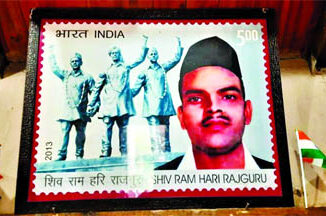
Freedom Fighter Shivaram Rajguru
Shivaram Hari Rajguru was a prominent Indian freedom fighter and revolutionary who played a crucial role in the Indian independence movement against British colonial rule. He was born on August 24, 1908, in a village called Khed near Pune, Maharashtra. Shivaram Rajguru is best known for his participation in the historic incident of Bhagat Singh and Batukeshwar Dutt throwing non-lethal bombs in the Central Legislative Assembly in Delhi on April 8, 1929, as a protest against repressive laws.
Shivaram Hari Rajguru’s Birth Anniversary
August 24th commemorates the birth anniversary of Shivaram Hari Rajguru. Freedom fighter Rajguru, alongside Sukhdev and Bhagat Singh, faced the gallows on March 23, 1931, at the hands of the British government. Rajguru was born to Parvati Devi and Harinarain Rajguru on 24 August 1908 in the village of Khed, Maharashtra.
Early Life and Education of Rajguru
Shivaram Hari Rajguru was born into a middle-class family. His father expired when he was only six years old and the responsibility of family fell on his elder brother Dinkar. He received his primary education in his village and later moved to Pune for further studies. Despite facing financial challenges, he was a bright student and excelled in academics.
As he matured, the ideology of Lokmanya Tilak became a profound source of inspiration for Rajguru. He enlisted in the ‘Seva Dal,’ actively participating in training sessions held at Ghatprabha. Subsequently, he went on to join the Hindustan Socialist Republican Army, dedicating himself to the cause of Indian independence.
Shivaram Rajguru grew up witnessing the injustice and exploitation the British Raj continually wrought upon India. In his late teens, Rajguru became a member of the Hindustan Socialist Republican Association (HSRA), an organization founded in 1928 by prominent figures like Chandrasekhar Azad and Bhagat Singh. Rajguru held steadfast to the belief in militant nationalism, advocating that oppression should be met with unyielding ferocity and violence. He did not share Mahatma Gandhi‘s faith in non-violent Satyagraha.
An incident illustrating his unwavering determination was when he deliberately touched a hot iron with his bare hands. When Chandrasekhar Azad questioned the sanity of such an act, Rajguru explained that he was testing his resilience in preparation for potential police brutality.
Within the HSRA, Rajguru earned the moniker ‘Gunman’ due to his exceptional shooting skills, operating under the alias Raghunath. However, his most notable and enduring legacy was his role in the assassination of British police officer J.P. Saunders. This act was meticulously planned by Bhagat Singh, Chandrasekhar Azad, Sukhdev, and Rajguru, with Rajguru and Bhagat Singh firing the fatal shots.
Their motivation stemmed from a desire for revenge following the death of Lala Lajpat Rai, who was believed to have succumbed to injuries sustained during a brutal police lathi charge while protesting against the Simon Commission. Their original target was James A. Scott, the police officer responsible for ordering the lathi charge. However, in a case of mistaken identity, Saunders was killed. Nevertheless, the revolutionaries declared that they had avenged Lala Lajpat Rai’s death.
Following the assassination, Rajguru fled to Nagpur in an attempt to evade the police. Unfortunately, while travelling to Pune, he was apprehended and subsequently arrested.
Assembly Bombing
One of the most notable events in Rajguru’s life was his involvement in the bombing of the Central Legislative Assembly in Delhi along with Bhagat Singh and Batukeshwar Dutt. The intention behind this action was not to cause casualties but to draw attention to the repressive nature of colonial laws. The revolutionaries wanted to use the trial that would follow to promote their cause.
In 1929, Rajguru, together with Bhagat Singh and Sukhdev Thapar, faced arrest in connection with the Lahore conspiracy case. They were subsequently put on trial and ultimately sentenced to death for their participation in the assassination of J. P. Saunders. On the fateful day of March 23, 1931, Rajguru met his end through execution by hanging in Lahore jail, alongside Bhagat Singh and Sukhdev Thapar.
Shivaram Hari Rajguru’s legacy
Shivaram Hari Rajguru’s legacy is an indelible mark on India’s struggle for independence. His martyrdom remains a poignant symbol of patriotism and selfless devotion to the nation, inspiring generations of Indians in their quest for freedom and justice. His fearless acts, such as testing his resilience by touching a hot iron, serve as a testament to his unwavering commitment.
Shivaram Hari Rajguru’s legacy is also preserved through educational institutions, memorials, cultural representations, and his enduring influence on activists advocating for social and political change, both in India and around the world. In essence, Shivaram Hari Rajguru’s life and sacrifices continue to inspire and guide those who seek a more just and free society.
While Rajguru did not receive any official awards or honours during his lifetime, his stature in history transcends such recognition. He is widely celebrated as one of the foremost martyrs of the Indian independence movement and a true hero in the hearts of the Indian people.
Rajguru’s birthplace has been rechristened as Rajgurunagar, an enduring tribute to his legacy. Additionally, his ancestral home now bears the name Rajguru Wada. Each year, the Hutatma Rajguru Samarak Samiti (HRSS) unfurls the national flag at Rajguru Wada on Republic Day, marking a solemn and patriotic tradition that honors his memory and the sacrifices he made for India’s freedom. -

Bhagat Singh: A revolutionary hero of the Indian independence movement
Bhagat Singh was an Indian revolutionary freedom fighter who was hanged to death by British colonisers at the age of 23 years. Fondly known as ‘Shaheed (martyr) Bhagat Singh’, he is considered a national hero of India’s freedom struggle against colonial rule. As a teenager, Bhagat Singh popularised the slogan of ‘Inquilab Zindabad’ which eventually became the catchphrase of the Indian independence movement.
Bhagat Singh’s Life
Bhagat Singh was born in a Sikh family in Banga village of Faisalabad district (previously called Lyallpur), now in Pakistan’s Punjab province, on 27 September 1907. As his family was deeply inspired by nationalism, he too became actively involved in the country’s freedom movements.
He got admitted to the National College in Lahore, where he studied European revolutionary movements. When his parents tried to get him married, Bhagat Singh left home for Kanpur. In 1926, Bhagat Singh established the ‘Naujavan Bharat Sabha (Youth Society of India) and joined the Hindustan Republican Association (later known as Hindustan Socialist Republican Association). During that time, he met many anti-colonial activists.
In December 1928, Bhagat Singh, along with Sukhdev and Rajguru, planned to avenge the death of Indian nationalist leader Lala Lajpat Rai and plotted to assassinate the Superintendent of Police James Scott in Lahore.
However, in a case of mistaken identity, John Saunders, the Assistant Superintendent of Police was shot. To avoid being recognised and arrested for the crime, Bhagat Singh escaped from Lahore to Calcutta after shaving his beard and cutting his hair.
In April 1929, Singh and Batukeshwar Dutt bombed the Central Assembly Hall in Delhi, and shouted the slogan of “Inquilab Zindabad!”. He was later arrested after the incident.
Execution of Bhagat Singh
Bhagat Singh and his revolutionary comrades Rajguru and Sukhdev were hanged by the British on March 23, 1931, in the Lahore Conspiracy case.
Bhagat Sing’s Revolutionary Activities
Bhagat Singh was a brave and passionate freedom fighter who took part in several revolutionary activities during India’s struggle for independence from British rule.
Hindustan Socialist Republican Association (HSRA)
Bhagat Singh joined this group of like-minded young revolutionaries who believed in using force to overthrow British rule and bring freedom to India.
Assembly Bombing: Bhagat Singh, along with his associates, threw non-lethal smoke bombs in the Central Legislative Assembly in Delhi in 1929. They did this to protest against repressive laws and show their defiance to the British.
Lahore Conspiracy Case
Bhagat Singh and his comrades were arrested after the assembly bombing. They were put on trial in what became known as the Lahore Conspiracy Case, where they boldly declared their revolutionary aims and were willing to face the consequences.
Hunger Strike
While in jail, Bhagat Singh and his fellow prisoners went on a hunger strike to demand better treatment and rights for political prisoners. Their courage and determination drew widespread support.
Slogans and Writings
Bhagat Singh used his writings and slogans to inspire others and raise awareness about India’s fight for freedom. His slogan “Inquilab Zindabad” (Long Live the Revolution) became iconic.
Martyrdom
Bhagat Singh, along with Rajguru and Sukhdev, was sentenced to death for his involvement in the killing of a British police officer. Despite the option of saving his life by renouncing violence, he chose to embrace martyrdom, becoming a symbol of sacrifice for the nation’s freedom.
Bhagat Singh’s revolutionary activities demonstrated his unwavering commitment to India’s independence and inspired countless others to join the struggle. His bravery and sacrifice continue to be celebrated, reminding us of the power of determination in the pursuit of justice and freedom.
Bhagat Singh’s Ideals and Beliefs
Bhagat Singh had strong ideals and beliefs that guided his actions during India’s struggle for independence. Here’s an explanation of his key ideals and beliefs:
Patriotism
Bhagat Singh had deep love for his country, India. He believed in the idea of a free and independent India where every citizen could live with dignity and pride. He was willing to sacrifice everything for his homeland.
Secularism
Bhagat Singh believed in a united and secular India, where people of all religions and backgrounds could coexist peacefully. He rejected any form of discrimination or religious division.
Socialism
Bhagat Singh was influenced by socialist ideas. He believed in a society where wealth and resources were shared more equally among the people, reducing poverty and inequality.
Non-Violence vs. Revolution
While he admired Mahatma Gandhi’s philosophy of non-violence, Bhagat Singh felt that, in certain situations, a more forceful approach was needed to gain independence. He believed in using revolutionary means to overthrow British rule.
Youth Empowerment
Bhagat Singh had great faith in the power of young people to bring about change. He encouraged the youth of India to actively participate in the freedom struggle and take charge of their nation’s destiny.
Sacrifice
Bhagat Singh believed that freedom came with a price. He was willing to sacrifice his life for the greater good of India. He famously said, “It is easy to kill individuals but you cannot kill the ideas.”
Fearlessness
He displayed remarkable courage and fearlessness in the face of adversity. He was unafraid of the consequences of his actions and remained steadfast in his commitment to the cause.
Bhagat Singh’s ideals and beliefs continue to inspire people today, reminding us of the importance of patriotism, equality, and the willingness to stand up for what is right in the pursuit of a just and free society.
Bhagat Singh Quotes & Slogans
Bhagat Singh’s quotes and slogans are powerful words that continue to inspire and remind us of his unwavering dedication to India’s freedom struggle.
“Inquilab Zindabad!” – This iconic slogan, which translates to “Long Live the Revolution,” was often used by Bhagat Singh to inspire the masses in their fight for independence.
“They may kill me, but they cannot kill my ideas. They can crush my body, but they will not be able to crush my spirit.” – Bhagat Singh emphasized the enduring power of his ideas and convictions.
“It is easy to kill individuals but you cannot kill the ideas.” – He believed that while individuals could be silenced, the ideas of freedom and justice would persist. “Revolution is an inalienable right of mankind. Freedom is an imperishable birthright of all.” – Bhagat Singh articulated the belief that every person has the inherent right to strive for freedom and justice.
“I am a man, and all that affects mankind concerns me.” – He expressed his deep concern for the welfare of all humanity, emphasizing the universal nature of his cause.
“Merciless criticism and independent thinking are the two necessary traits of revolutionary thinking.” – Bhagat Singh stressed the importance of critical thinking and independent analysis in pursuing revolutionary goals.
“The sword of revolution is sharpened on the whetting-stone of ideas.” – He highlighted the role of ideas and ideology as the driving force behind revolutionary actions.
Bhagat Singh Legacy
Bhagat Singh’s legacy is a profound and enduring one, deeply rooted in his fearless commitment to the cause of India’s independence and his unwavering dedication to justice and equality. This legacy continues to inspire not only Indians but people worldwide.
At the heart of Bhagat Singh’s legacy is his unparalleled bravery and willingness to sacrifice his life for the greater good. He refused to bow down to British oppression and colonial rule, even when faced with the gravest of consequences. His sacrifice is a reminder of the extraordinary lengths to which individuals can go when they passionately believe in a cause.
Bhagat Singh’s legacy is also deeply intertwined with his ideological beliefs. He was a fervent advocate of socialism, secularism, and equality. His vision for an independent India was one where every citizen, regardless of their religion or background, would enjoy equal rights and opportunities. This vision continues to resonate with the principles of democracy and justice.
Bhagat Singh famous slogan, “Inquilab Zindabad” (Long Live the Revolution), remains a rallying cry for those who strive for social change and justice. It embodies the spirit of resistance against oppression and tyranny. Bhagat Singh’s writings and speeches, which articulated his vision for a just society, continue to inspire scholars, activists, and thinkers.
The impact of Bhagat Singh’s legacy extends to various aspects of Indian culture and society. His birth anniversary, observed on September 28th, is celebrated across the nation as a day of remembrance and reflection. Monuments, memorials, and museums dedicated to his memory stand as a testament to his enduring influence. Films, literature, and documentaries continue to be made about his life, ensuring that his story is passed down to new generations.
Moreover, Bhagat Singh’s legacy has inspired countless individuals to stand up against injustice, tyranny, and inequality not only in India but around the world. His sacrifice and unwavering dedication serve as a beacon of hope for those who believe in the power of ordinary individuals to bring about extraordinary change.
In conclusion, Bhagat Singh’s legacy is a testament to the indomitable spirit of a young revolutionary who dared to challenge the mightiest empire of his time. His principles of justice, equality, and freedom remain relevant, and his memory continues to ignite the flames of inspiration in the hearts of those who aspire to create a better and more just world. Bhagat Singh’s legacy is not just a part of history; it is a living force that continues to shape the aspirations and dreams of a nation and its people. -

Remembering the Heroes: A Tribute to India’s Martyrs on Martyrs Day

By Prof. Indrajit S Saluja India celebrates Martyrs Day on March 23
Martyrs Day in India stands as a solemn reminder of the sacrifice and valor exhibited by countless individuals who fought for the country’s freedom from British colonial rule. It is a day of reflection, commemoration, and reverence for those who laid down their lives in pursuit of liberty. As we observe this day, our thoughts naturally gravitate towards the courageous souls who inscribed the annals of India’s independence struggle with their blood. Among these luminaries, one name shines brightly – Bhagat Singh. However, it is imperative to recognize that he, along with his comrades Rajguru and Sukhdev, represents a legion of martyrs who epitomized the spirit of selfless sacrifice. Delving into their lives, beliefs, and writings unveils the essence of their profound commitment to the cause of freedom.
March 23 holds a poignant significance in the history of India’s freedom struggle as it marks the day when Bhagat Singh, Rajguru, and Sukhdev were executed in Lahore Central Jail in 1931. While these three iconic figures are emblematic of the sacrifices made for India’s freedom, they stand as symbols representing the multitude of unsung heroes who valiantly fought and perished in the struggle against colonial oppression. Their martyrdom underscores the indomitable spirit of resistance and the unwavering commitment to the cause of independence.
Bhagat Singh, often hailed as the epitome of revolutionary zeal, was more than just a martyr; he was a thinker, a visionary, and a fervent advocate of social justice. Born on September 28, 1907, in Banga, Punjab, Bhagat Singh was imbued with patriotic fervor from an early age. His revolutionary ideals were shaped by the prevailing socio-political milieu of colonial India, characterized by exploitation, inequality, and repression.
Central to Bhagat Singh’s philosophy was his unwavering belief in the power of the masses to effectuate change. He viewed armed struggle not merely as a means to overthrow British rule but as a catalyst for social transformation. Bhagat Singh’s commitment to the socialist ideology and his advocacy for the rights of the marginalized sections of society distinguished him as a visionary far ahead of his time.
The courage and audacity displayed by Bhagat Singh in his actions, most notably the Lahore Conspiracy Case and the Assembly Bomb Case, earned him widespread admiration and reverence. His daring exploits, coupled with his eloquent writings, catapulted him into the pantheon of India’s freedom fighters. Despite facing imminent death, Bhagat Singh remained resolute in his convictions, refusing to compromise his principles or seek clemency from the British authorities.
From an early age, Bhagat Singh was drawn to the ideals of socialism and Marxism, which provided him with a framework to understand and analyze the socio-economic injustices prevalent in colonial India. Influenced by the works of Karl Marx, Friedrich Engels, Vladimir Lenin, and other socialist thinkers, Bhagat Singh developed a nuanced understanding of class struggle, exploitation, and imperialism.
Bhagat Singh’s political activism was grounded in the belief that the struggle against British colonial rule was intrinsically linked to the broader struggle for social and economic emancipation. He saw imperialism as not just a political domination but also an economic exploitation, with the British colonial rulers enriching themselves at the expense of the Indian masses.
Moreover, Bhagat Singh was deeply critical of capitalism, which he viewed as inherently exploitative and oppressive. He believed that the capitalist system perpetuated inequalities and injustices, concentrating wealth and power in the hands of a few while impoverishing the masses. For Bhagat Singh, the fight against colonialism was inseparable from the fight against capitalism, as both systems worked hand in glove to perpetuate exploitation and subjugation.
Bhagat Singh’s readings and writings reflect his intellectual depth and political acumen. Despite his young age, he was an avid reader and a prolific writer, penning numerous articles, essays, and pamphlets on a wide range of topics, including politics, history, philosophy, and socialism.
One of Bhagat Singh’s most famous writings is his essay titled “Why I am an Atheist,” in which he eloquently articulates his rejection of religious dogma and his embrace of rationalism and scientific thinking. In this essay, Bhagat Singh critiques organized religion for its role in perpetuating superstition, ignorance, and social divisions. He argues that blind faith in religious doctrines stifles critical thinking and inhibits social progress, advocating instead for a rational and scientific approach to understanding the world.
Bhagat Singh’s prison diary, written during his incarceration, provides profound insights into his thoughts, feelings, and experiences as a revolutionary activist facing imminent death. In these poignant writings, Bhagat Singh reflects on the nature of martyrdom, the significance of sacrifice, and the enduring legacy of the freedom struggle. Despite the hardships he endured, Bhagat Singh remained steadfast in his convictions, refusing to compromise his principles or seek clemency from the British authorities.
Bhagat Singh’s political beliefs and writings continue to inspire generations of activists, thinkers, and revolutionaries, both in India and around the world. His uncompromising commitment to socialism, his critique of colonialism and capitalism, and his unwavering advocacy for social justice and equality resonate with contemporary struggles for liberation and emancipation.
While Bhagat Singh’s name often dominates discussions surrounding India’s independence movement, it is essential to acknowledge the contributions of his comrades, Shivaram Rajguru and Sukhdev Thapar. Alongside Bhagat Singh, Rajguru and Sukhdev formed the core of the Hindustan Socialist Republican Association (HSRA), a revolutionary organization dedicated to the overthrow of British imperialism.
Rajguru, born in Khed, Maharashtra, and Sukhdev, hailing from Ludhiana, Punjab, shared Bhagat Singh’s unwavering commitment to the cause of freedom. Their involvement in various acts of resistance, including the assassination of British police officer J.P. Saunders, exemplifies their dedication to the liberation struggle.
Despite their pivotal roles in the independence movement, Rajguru and Sukhdev often remain overshadowed by the towering figure of Bhagat Singh. However, their sacrifice and valor are integral to the collective memory of India’s struggle for independence. It is incumbent upon us to commemorate their legacy and honor their contributions to the nation’s history.
As we commemorate Martyrs Day and pay homage to the valiant souls who sacrificed their lives for India’s freedom, let us not confine our reverence to mere rituals and ceremonies. Instead, let us imbibe the spirit of courage, sacrifice, and resilience exemplified by Bhagat Singh, Rajguru, Sukhdev, and countless other martyrs who made the ultimate sacrifice for the cause of liberty.
The martyrdom of Bhagat Singh, Rajguru, and Sukhdev serves as a potent reminder of the ideals that animated the freedom struggle. Their unyielding commitment to the principles of liberty, equality, and justice inspired generations of Indians to rise against colonial oppression. Moreover, their advocacy for socialism and their vision of a more equitable society resonate even in contemporary times.
The legacy of India’s martyrs, particularly that of Bhagat Singh, transcends the boundaries of time and space, continuing to inspire and galvanize generations in the pursuit of freedom, justice, and equality. Their sacrifices serve as a poignant reminder of the price paid for independence and the unyielding spirit of resistance against oppression. The legacy of the martyrs for India’s struggle for freedom is multifaceted, encompassing ideological, cultural, and socio-political dimensions.
At the heart of this legacy lies the indomitable spirit of courage and sacrifice exhibited by Bhagat Singh and his comrades. Their willingness to lay down their lives for the cause of freedom epitomizes the highest form of patriotism and selflessness. Their actions ignited a spark of rebellion that reverberated across the length and breadth of the country, mobilizing masses in the fight against British colonial rule.
The martyrs’ steadfast commitment to the ideals of socialism and social justice left an indelible mark on India’s political landscape. Bhagat Singh, in particular, advocated for the empowerment of the oppressed classes and the eradication of social inequalities. His vision of a society based on egalitarian principles continues to resonate with activists and thinkers striving for a more just and equitable world.
Moreover, the martyrdom of Bhagat Singh and his comrades catalyzed the evolution of the Indian nationalist movement, ushering in a new era of militant resistance. Their daring acts of defiance, including the bombing of the Central Legislative Assembly and the assassination of British police officer J.P. Saunders, challenged the conventional strategies of nonviolent protest advocated by leaders like Mahatma Gandhi.
The legacy of the martyrs also underscores the significance of youth in driving social change and political transformation. Bhagat Singh, Rajguru, and Sukhdev were all in their twenties when they made the ultimate sacrifice for the country. Their idealism, passion, and fearlessness continue to inspire young Indians to actively engage in the struggle for a better future. Furthermore, the martyrdom of Bhagat Singh and his comrades served as a catalyst for the radicalization of the Indian nationalist movement, pushing it towards more assertive and confrontational tactics. Their actions forced the British colonial authorities to confront the growing tide of dissent and paved the way for the eventual attainment of independence.
Their legacy serves as a beacon of hope and inspiration for future generations, reminding us of the enduring power of ideals and the transformative potential of collective action. On this solemn occasion, let us reaffirm our commitment to upholding the values of freedom, democracy, and social justice for which these martyrs laid down their lives. As we reflect on their sacrifices, let us pledge to honor their memory by striving for a more just, equitable, and inclusive society. For in remembering the martyrs, we renew our resolve to build a nation worthy of their sacrifice.
-

‘Arunachal part of India’: US amid China’s territorial claims
New Delhi (TIP)- China and the US engaged in verbal skirmishing over India’s sovereignty over Arunachal Pradesh with Beijing stating that it opposes American observations on the issue. China’s reaction came hours the US State Department said the US “recognises Arunachal Pradesh as Indian territory” and “we (the US) strongly oppose any unilateral attempts to advance territorial claims by incursions or encroachments, military or civilian, across the LAC”. Speaking at his press conference on Wednesday, State Department Principal Deputy spokesperson Vedant Patel said, “The United States recognises Arunachal Pradesh as Indian territory and we strongly oppose any unilateral attempts to advance territorial claims by incursions or encroachments, military or civilian, across the Line of Actual Control.”
In response, the Chinese Foreign Office said it “strongly deplores and firmly opposes” the US recognition of Arunachal Pradesh as part of Indian territory, and told Washington that it had nothing to do with the India-China border dispute. It also accused the US of “instigating and using other countries’ disputes” for selfish geopolitical interests. “The question of the China-India border issue is between China and India and it has nothing to do with the US. It is well known that the US has been instigating and using other countries’ disputes by all means to serve its selfish geo-political interests,” said the Chinese Foreign Office spokesperson at a media briefing in Beijing on Thursday, March 21.
Earlier, the Chinese government had deployed its Foreign and Defence Ministries to criticise Prime Minister Narendra Modi inaugurating projects in Arunachal Pradesh that will further strengthen India’s border management. Source: TNS -

Systematic effort to cripple Cong financially: Sonia Gandhi’s all-out attack on PM
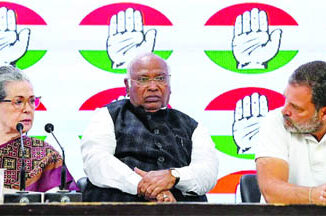
New Delhi (TIP)- The Congress on Thursday, March 21, fielded its top three leaders, party president Mallikarjun Kharge and former presidents Sonia Gandhi and Rahul Gandhi, to launch a frontal attack on Prime Minister Narendra Modi and his administration, accusing the government of virtually freezing the main opposition party’s bank accounts weeks before the general elections.
In the first joint press conference addressed by the three, the leaders alleged there was no level playing field before the polls because the Congress was unable to operate its accounts. They also disclosed that in addition to the ongoing tax dispute with the Income Tax (I-T) department over the assessment year (AY) 2018-19, the party received a fresh notice on March 14 over alleged discrepancies in AY 1994-95, when the late Sitaram Kesri was the party treasurer. “A systematic effort is underway by the PM to cripple Congress financially,” said Sonia Gandhi. Rahul Gandhi echoed her. “This is a criminal action on the Congress by the PM and the home minister. This type of activity doesn’t happen without them in today’s India,” he said. The Congress leadership said that they were unable to book flights for its leaders or advertisement spaces due to the shortage of funds.
Kharge contrasted the Congress’s inability to operate its account to the ruling Bharatiya Janata Party (BJP) “amassing huge resources through electoral bonds and other means”. “This can’t be called a free and fair election…. In the 75 years of India’s democratic system, no other party has amassed so much money (as the BJP). For the first time, the government is making money from various ways. …if you want an impartial election, our party’s account should be freed. BJP has never paid any income tax. We are waiting for the final decision of the law,” he said.
In her statement, Sonia Gandhi said the issues taken up were “extremely serious”.
“This issue affects not just the Congress, but impacts our democracy most fundamentally. A systematic effort is underway by the PM to cripple the INC financially. Funds from the public are frozen and money from our accounts is being taken away forcibly. However, even under these most challenging circumstances, we are doing our very best to maintain the effectiveness of our poll campaigning,” she added.
Registered political parties are exempted from paying tax on specified income such as voluntary contributions, house property, income from other sources and capital gains, under section 13A of the Income Tax Act. But this exemption is subject to a set of stipulations, including maintenance of books of account, records of each contribution of more than ?20,000 and audit reports by a chartered accountant Additionally, political parties must not receive donation of more than Rs 2,000 otherwise than by way of cheque, demand draft or through bank account. Parties must also furnish their verified return of income for the previous year
The Congress’s claim of full exemption was rejected on two grounds. One, the party did not submit its return of income within the time limit and two, the Congress received cash donations to the tune of ?14.49 lakh in excess of ?2,000. The Congress has rejected the allegation, saying it submitted returns within the stipulated time and the money received was from party legislators and office-bearers, and therefore could not be construed as “donations” under the IT Act. -

SBI complies with SC order, gives EC data on electoral bonds
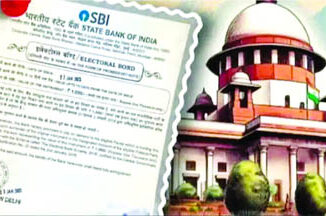
New Delhi (TIP)- The Election Commission of India (ECI) on Thursday, March 21, released State Bank of India (SBI) data listing the unique serial number linked with each electoral bond (EB) and other details about beneficiaries and donors, allowing the matching purchasers of bonds with the political parties that received the funds. The latest tranche of data – the third such trove to be released over the past two weeks on the orders of the Supreme Court – appeared to be the final key to the political funding puzzle locked away behind a veil of anonymity that was finally dispelled by the Supreme Court when it held the scheme unconstitutional last month.
“In compliance with the Supreme Court’s directions, SBI has provided data pertaining to electoral bonds to ECI today i.e. March 21, 2024. The ECI has uploaded it on its website as received from SBI on an ‘as is where is basis’,” the poll body said in a statement.
The two sets of data – 552 pages of details of redemption by political parties and 386 pages of details of donors – cover electoral bonds purchased and redeemed from April 12, 2019 until January 11, 2024. In the end, SBI took three days to disclose the data that it had asked the Supreme Court three months time for.
The data revealed that Tamil Nadu-based Future Gaming and Hotel Services, the top donor that accounted for Rs 1,365 crore worth bonds, donated across party lines. Out of this, 39.7% (Rs 542 crore) went to the All India Trinamool Congress, 36.8% (Rs 503 crore) to the Dravida Munnetra Kazhagam (DMK), 11.3% (Rs 154 crore) to the YSR Congress, 7.3% (Rs 100 crore) to the Bharatiya Janata Party (BJP), and 3.7% (Rs 50 crore) to the Congress. The second highest donor – Hyderabad-based Megha Engineering and Infrastructure Limited (MEIL) – donated 60.5% of its Rs 966 crore to the BJP and 20.2% (Rs 195 crore) to the Telangana-based Bharat Rashtra Samithi (BRS).
The third highest donor, Thane-based Qwik Supply Chain donated 91.5% of its Rs 410 crore to the BJP followed by 6% (Rs 25 crore) to the Shiv Sena. It donated Rs 10 crore (2.4%) to Nationalist Congress Party. According to Zaubacorp, a website that scrapes data from the Ministry of Corporate Affairs, and LinkedIn profiles, two of the directors of the firm are employees of the Reliance group and are directors of multiple Reliance Group companies.
Mining behemoth Vedanta Limited donated Rs 230.15 crore, or 57.5% of its total bonds worth Rs 400.35 crore, to the BJP, followed by Rs 125 crore (31.2%) to the Congress.
The Kolkata-based RP-Sanjiv Goenka Group’s Haldia Energy donated 74.5% of its Rs 377 crore to the TMC followed by Rs 81 crore (21.5%) to the BJP.
For the BJP, which received Rs 5,594.2 crore, MEIL was the largest donor at Rs 584 crore, followed by Qwik Supply Chain at Rs 375 crore and Vedanta at Rs 230.15 crore. Others contributed Rs 4,032.15 crore. In all, the BJP netted Rs 6,061 crore of the Rs 8,252 crore between April 12, 2019 and January 11, 2024.
The TMC received its biggest chunk of funds from Future Gaming at Rs 542 crore, followed by Haldia Energy at Rs 281 crore and Dhariwal Infrastructure at ?90 crore. Others contributed Rs 588.12 crore. In all, the TMC netted Rs 1,610 crore of the Rs 1,708 crore between April 12, 2019 and January 11, 2024.
For the Congress, the biggest donor was Vedanta at Rs 125 crore, followed by Western UP Power Transmission Company Limited at ?110 crore and MJK Enterprise at ?91.6 crore. In all, the Congress netted Rs 1,422 crore of the Rs 1,952 crore between April 12, 2019 and January 11, 2024.
The data disclosure has gained additional importance given that it was revealed just weeks ahead of general elections, where political funding is expected to be among the issues raised during the campaign.
The data solves the mystery of who anonymously donated Rs 10 crore to the Samajwadi Party by post. Keventer Food Park Infra, a part of the Kolkata-based FMCG group Keventer, donated 10 Rs 1 crore bonds to the SP. These bonds were bought on May 7, 2019 and redeemed by the party on May 10, 2019.
But another mystery — of who handed over a sealed envelope with 10 Rs 1 crore bonds to the Janata Dal (United) in its office on April 3, 2019 — still persists because the bonds were credited into JD(U)’s account on April 10, two days before the cut-off of April 12 .
Under the 2018 EB scheme — which was quashed by a Constitution bench of the Supreme Court on February 15 because it completely anonymised contributions made to political parties — each electoral bond is imprinted with a unique number that can assist in tracking the issuance and redemption of bonds, and in tracing the bond back to the purchaser.
On March 18, the bench led by Chief Justice of India Dhananjaya Y Chandrachud ordered SBI to disclose the unique serial number associated with each EB and all other information the bank possesses while supplying the ECI with data for public release.
On the day, the bench, also comprising justices Sanjiv Khanna, BR Gavai, JB Pardiwala and Manoj Misra, noted that the February 15 judgment required SBI to disclose all information in its possession, which will include alphanumeric numbers and serial numbers, besides the date of purchase or redemption, the recipient’s or buyer’s name, and the denomination of EBs.
It called for a categorical affidavit of the SBI chairman by 5pm on March 21 that the bank has disclosed all the information in its custody and that no details have been withheld. The court further directed that as soon as ECI receives the information from SBI, it will post it on its website “forthwith”.
Complying with this direction, the SBI chairman Dinesh Kumar Khara filed his affidavit on Thursday afternoon, stating that “SBI has now disclosed all details and that no details (other than complete bank account numbers and KYC Details) have been withheld from disclosure.” -
‘Will lead to chaos’: SC refuses to stay appointment of new ECs
Noting that it would lead to “chaos and uncertainty” in the midst of the Lok Sabha elections, the Supreme Court on Thursday refused to stay the appointment of Election Commissioners Gyanesh Kumar and Sukhbir Singh Sandhu under the recently enacted law that excluded the CJI from the Prime Minister-led selection panel.
“Now they (two new ECs) have been appointed… elections are round the corner… It’s a question of balance of convenience. We have to see what the effect is if we do (stay) it and what are the consequences which will follow…. There are no allegations against the persons (ECs) appointed,” a Bench of Justice Sanjiv Khanna and Justice Dipankar Datta said.
“We dismiss the applications for stay… We will give reasons later,” said the Bench, which also refused to grant an interim stay on the operation of the Chief Election Commissioner and other Election Commissioners (Appointment, Conditions of Service and Terms of Office) Act, 2023, saying the Election Commission was not under the “thumb of executive”.
“At this stage, we cannot stay the legislation or put it under suspension by way of interim order. It would lead to uncertainty and chaos in case of stay,” it said, dismissing the pleas for stay filed by Congress leader Jaya Thakur and Association for Democratic Reforms.
The Bench, however, said it would examine the main petitions challenging the validity of the 2023 Act. Asking the Centre to respond to the petitions in six weeks, the Bench posted the matter for further hearing on August 5.
On Thursday, March 21, the Bench posed certain questions on the procedure adopted in appointing the new ECs, saying there could have been an opportunity given for the names to be examined.
“This could have easily been avoided by giving two-three days. You should have gone more slowly,” it said. -
RAW operative shunted out over Pannun plot
An intelligence operative has been removed from his position and several others were reshuffled following an investigation into US claims of an alleged plot to kill Khalistani leader Gurpatwant Singh Pannun, people familiar with the matter have said.
The investigation concluded “rogue operatives not authorised by the government had been involved in the plot”, Bloomberg reported, citing unnamed senior officials. The developments in the probe by a high-level committee set up by India last year to examine inputs provided by the US were first reported by Bloomberg.
The operative removed from his position in the Research and Analysis Wing (RAW) is a mid-level official seconded to the agency from a paramilitary force, the people cited above said on condition of anonymity. Several other operatives were part of a reshuffle carried out in recent weeks by the agency amid the probe by the committee, they said.
The Indian side has revealed nothing officially about the work done by the high-level committee, or its composition or findings since an indictment filed by US prosecutors in a Manhattan court last November alleged that Indian national Nikhil Gupta, acting on the instructions of an unnamed Indian official, was involved in a plot to kill Pannun on American soil.
It is understood the operative removed from his position is the Indian government official referred to only as “CC-1” in the US indictment against Gupta. The indictment described CC-1 as a “senior field officer” responsible for “security management” and “intelligence” who directed the plot from India.
Bloomberg reported that “one person directly involved in the alleged attempted assassination is no longer working” for RAW. This person is “still employed by the government and India hasn’t started any criminal action against him”, the report said. India has also informed US authorities about the findings of the high-level committee, the report added.
The “murder for hire” plot, as US officials have referred to the incident, has emerged as an irritant in an otherwise robust India-US relationship that now encompasses collaboration on critical emerging technologies, joint development of military hardware and close cooperation on defence and security issues.
The US has pressed India to prosecute those involved in the plot, and this was a message conveyed to Indian officials by Donald Lu, the assistant secretary of state for South and Central Asian affairs, when he visited New Delhi in January.
Participating in a US House Foreign Affairs Committee hearing in Washington on Wednesday, Lu described the plot as a “serious issue between the US and India”. He added: “We take this in the administration incredibly seriously and have raised it at the highest levels with India. We are, at the moment, working with India to encourage India to hold accountable those responsible for this terrible crime.” Source: HT -

32 Indian fishermen detained by Sri Lanka Navy for alleged poaching
Colombo (TIP): At least 32 Indian fishermen were detained by the Sri Lankan Navy on March 20 off the coast of Talaimannar and near the islet of Delft in the northern province for allegedly fishing in the island nation’s waters, an official statement said. The Navy held two Indian trawlers along with 7 fishermen off Talaimannar, it said, adding that naval personnel also seized three more Indian trawlers and held 25 Indian fishermen off the Delft Island. The two Indian trawlers along with 7 fishermen were brought to the Talaimannar Pier while three Indian trawlers and 25 Indian fishermen were brought to Kankasanthurai harbour.
They will be handed over to the Fisheries Inspectors of Mannar and Mailadi for onward legal proceedings, the statement said.
The Navy has so far held 23 Indian trawlers and 178 Indian fishermen in island waters thus far in 2024, and handed them over to authorities for legal action, it added.
The fishermen issue is a contentious one in the ties between India and Sri Lanka, with Lankan Navy personnel even firing at Indian fishermen in the Palk Strait and seizing their boats in several alleged incidents of illegally entering Sri Lankan territorial waters.
The Palk Strait, a narrow strip of water separating Tamil Nadu from Sri Lanka, is a rich fishing ground for fishermen from both countries.
Fishermen from both countries are arrested frequently for inadvertently trespassing into each other’s waters.
In 2023, the island nation’s Navy arrested 240 Indian fishermen along with 35 trawlers for allegedly poaching in Sri Lankan waters. (PTI) -

Two Pakistani soldiers, 8 Baloch terrorists killed in attack on Gwadar Port Authority complex
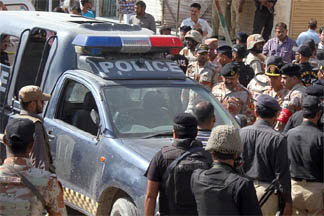
Karachi (TIP): At least two soldiers of the Pakistani Army were killed and eight Baloch terrorists were “sent to hell” when security personnel foiled an attempt by heavily armed Baloch insurgents to storm the Gwadar Port Authority complex in the restive Balochistan province, the military has said.
The port complex hosts several government and paramilitary offices and the strategically located Gwadar Port remains one of the focal points of the billion-dollar China-Pakistan Economic Corridor (CPEC) Project.
A press release from the Inter-Services Public Relations (ISPR), the military’s media wing, said a group of terrorists attempted to enter the Port Authority Colony but were successfully thwarted by security forces personnel on March 20.
“Own troops employed for security responded immediately and effectively engaged the terrorists, and in ensuing fire exchange, all eight terrorists were sent to hell,” the statement said late on Wednesday.
Two sepoys were killed in the exchange of fire, the statement said.
A large quantity of arms, ammunition and explosives was also recovered from the possession of the militants from the separatist Balochistan Liberation Army (BLA).
Balochistan, bordering Iran and Afghanistan, is home to a long-running violent insurgency. Baloch insurgent groups have previously carried out several attacks targeting the USD 60 billion CPEC projects.
The BLA is opposed to China’s investments in Balochistan and accuses Beijing and Islamabad of exploitation of the resource-rich province, a charge rejected by the authorities.
Thousands of Chinese personnel are working in Pakistan on several projects being carried out under the aegis of the CPEC. BLA’s Majeed Brigade, which was formed in 2011, is a particularly lethal guerilla cell of the BLA.
It was named after a guard of former prime minister Zulfikar Ali Bhutto who was killed while attempting to assassinate the Pakistan Peoples Party (PPP) founder. It has been alleged that the group also maintains sanctuaries in areas along the Pak-Iran border.
The brigade, which is the suicide squad of the BLA, mostly targets security forces and Chinese interests in Pakistan. It also claimed responsibility for the April 2022 suicide attack outside the Karachi University’s Confucius Institute. (PTI) -
After losing seven soldiers, Pak airstrikes kill 8 in Afghanistan
Kabul (TIP): The so-called Durand Line turned hot on March 19 as the Taliban retaliated with heavy weapons against Pakistani airstrikes on its territory. Cross-border clashes were also reported at Parachinar in Afghanistan on the border while the Taliban defence ministry said it had targeted Pakistani troops at the border in response to the airstrikes. “The Islamic Emirate, which has a long history of freedom struggle against superpowers, does not allow anyone to invade its territory. The people of Pakistan and the new government should stop some of their Generals from continuing wrong policies,” said Taliban spokesman Zabiullah Mujahid.
Pakistan’s fighter jets had carried out a predawn strike in two bordering Afghan provinces with terrorists belonging to the Hafiz Gul Bahadur Group being the prime targets, said the Pakistan foreign office. It blamed the group along with the Tehreek-i-Taliban Pakistan (TTP) for several terrorist attacks inside Pakistan, resulting in “deaths of hundreds of civilians and law enforcement officials”.
Afghanistan’s Taliban, on the other hand, claimed the airstrikes on its territory killed five women and three children in Khost and Paktika districts. It also said the main target of the strikes, Abdullah Shah, was in fact living in Pakistan though he did have a house in Afghanistan because his tribe was spread on both sides of the Durand Line.
The immediate trigger for the Pakistani airstrikes was an attack on a Pakistan army post in Mir Ali in North Waziristan that killed seven, including two officers. The Pakistan army also conducted ground operations in its territory, killing eight militants, including a “high value target”. Taliban denied the Pakistani claim that the attacks were launched from Afghan soil. “The Islamic Emirate of Afghanistan does not allow anyone to compromise security by using Afghan territory. Pakistan shouldn’t blame Afghanistan for the lack of control, incompetence and problems in its own territory,” said Mujahid.
“Such incidents can have very bad consequences, which will not be in Pakistan’s control,” he warned while alleging that “houses of common people were targeted” in the airstrikes. “We have made our utmost effort and continue to do so. But one thing we must accept is that Afghanistan shares a very long border area with Pakistan, and there are places with rugged terrain, including mountains and forests, and places that might be out of our control,” he said (TNS) -
Indian Navy assists hijacked Bangladeshi-flagged cargo vessel
Dhaka (TIP): An Indian naval warship and a long-range maritime patrol aircraft extended assistance to a Bangladeshi-flagged cargo vessel after it was hijacked in the Indian Ocean, in the latest in a series of such support missions by the Indian Navy in the region.
The Navy said on March 22 that the safety of the crew held hostage by armed pirates was ascertained and the Indian Navy warship continued to maintain its presence in the close vicinity of the vessel till its arrival in the territorial waters of Somalia.
After receiving information about the hijacking of the ship, the Navy on March 12 deployed Long-Range Maritime Patrol aircraft (LRMP) P-8I.
The Navy said that on receipt of intimation, the LRMP was immediately deployed, and on locating the merchant vessel in the evening of March 12, it attempted to establish communication to ascertain the status of the ship’s crew members. “However, no response was received from the ship,” it said. (PTI) -
China says it ‘firmly opposes’ US recognition of Arunachal Pradesh as part of Indian territory
Beijing (TIP): China on March 21 said it firmly opposes the US recognition of Arunachal Pradesh as part of Indian territory and affirmed that Washington has nothing to do with the India-China border dispute.
It also accused the US of “instigating and using other countries’ disputes” for selfish geopolitical interests.
China’s strong reaction came hours after US State Department Principal Deputy Spokesperson Vedant Patel’s remarks that the United States “recognises Arunachal Pradesh as Indian territory.”
Patel also said, “We (the US) strongly oppose any unilateral attempts to advance territorial claims by incursions or encroachments, military or civilian, across the Line of Actual Control.”
“China strongly deplores and firmly opposes this,” Chinese Foreign Ministry spokesman Lin Jian told a media briefing while replying to a question posed by the official Chinese media.
The delimitation of the China-India boundary has not been completed, Lin said adding, “‘Zangnan’ (the official Chinese name for Arunachal Pradesh) has always been China’s territory. This is an undeniable basic fact.”
“The question of the China-India border issue is between China and India and it has nothing to do with the US,” he said. “It is well known that the US has been instigating and using other countries’ disputes by all means to serve its selfish geo-political interests,” the spokesperson said.
The comments by the US official came days after the Chinese military reiterated its claim over Arunachal Pradesh following Prime Minister Narendra Modi’s visit to the state.
Chinese Defence Ministry spokesman Senior Colonel Zhang Xiaogang on March 15 said that the southern part of Xizang (the Chinese name for Tibet) is an inherent part of China’s territory, and Beijing “never acknowledges and firmly opposes” the “so-called Arunachal Pradesh illegally established by India.”
China, which claims Arunachal Pradesh as South Tibet, routinely objects to Indian leaders’ visits to the state to highlight its claims.
On March 9, Prime Minister Modi dedicated to the nation the Sela Tunnel built at an altitude of over 13,000 feet in western Arunachal Pradesh that will provide all-weather connectivity to the strategically located Tawang district and is expected to ensure better movement of troops along the frontier region. (PTI) -

Russia fires 31 missiles at Kyiv in first attack in weeks; 13 hurt
Kyiv (TIP): Russia fired 31 ballistic and cruise missiles at Kyiv before dawn on March 21 in the first attack on the Ukrainian capital in 44 days, officials said. Air defences shot down all incoming missiles, though 13 persons, including a child, were injured by falling wreckage, they said. Residents of Kyiv were woken up by loud explosions around 5 am as the missiles arrived at roughly the same time from different directions, said Serhii Popko, head of the Kyiv City Administration. Ukraine’s air force said Russia launched two ballistic missiles and 29 cruise missiles against the capital.
An 11-year-old girl and a 38-year-old man were hospitalised, the city administration said. Eight other people sustained light injuries, according to Mayor Vitali Klitschko. Ukraine’s Emergency Service said around 80 persons were evacuated from their homes. Falling wreckage from the intercepted missiles set fire to at least one apartment building, burned parked cars and left craters in streets and a small park. Some streets were littered with debris, including glass from shattered windows.
The attack came after repeated Ukraine aerial attacks in recent days on Russia’s Belgorod region near the border with Ukraine. Russian President Vladimir Putin had threatened on Wednesday to “respond in kind” to the attacks.
At an event in the Kremlin, Putin said Russia “can respond in the same way regarding civilian infrastructure and all other objects of this kind that the enemy attacks. We have our own views on this matter and our own plans.” — AP -

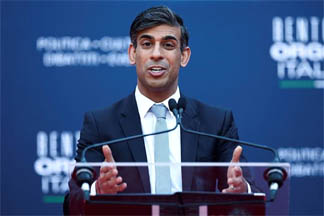
UK PM Rishi Sunak’s flagship bill to fly migrants to Rwanda hits deadlock
London (TIP): British Prime Minister Rishi Sunak’s flagship legislation aimed at flying illegal migrants to Rwanda has hit another set of parliamentary hurdles after the House of Lords delivered multiple defeats on the draft bill, sending it back to the Commons. The Safety of Rwanda Bill will return for members of Parliament to vote on in mid-April after the Easter recess as the Upper House peers rejected the changes of the House of Commons in seven votes, with majorities ranging between 30 and 55, on March 20 night.
They expressed support for amendments to water down the hardline legislation that seeks to deem the East African country safe in law to block legal challenges to migrants being flown out to Rwanda while their asylum claims are assessed.
While the Opposition Labour Party has branded the scheme a costly “gimmick”, the Conservative government has said it is a key tool to tackle soaring illegal migration via dangerous small boats crossing the English Channel.
“It is crystal clear, as we are seeing from the Labour Party’s opposition in this House, that while we are committed to stopping the boats, the Labour Party would keep them coming,” said Sunak in the Commons, when questioned about his Rwanda scheme on Wednesday.
“Since I became Prime Minister, the number of small boat crossings is down by over a third. That is because we have doubled National Crime Agency funding and we have increased illegal immigration enforcement raids by 70 per cent. We have closed 7,500 bank accounts, deported 24,000 illegal migrants and processed over 112,000 cases — more than at any point in the last two decades,” he claimed.
Labour Leader Keir Starmer accused the government of wasting taxpayer’s money on the scheme, which has a reported bill of around GBP 600 million.
“The tragedy is we know the Prime Minister does not even believe in the Rwanda gimmick… His great hope is to placate those in his party with a couple of empty planes, praying they will not notice when the flights stop going, the boats are still coming and the costs keep mounting,” said Starmer.
The Rwanda bill, meanwhile, remains in a deadlock phase between the two Houses of Parliament until an agreement can be reached on the final wording. The government is expected to hold consecutive days of votes in both Houses once Parliament is back in session post-Easter next month until a consensus can be found.
This means the likelihood of the first flights of migrants taking off for Rwanda is not before June at the earliest after the bill clears its parliamentary journey and receives the King’s royal assent to become law.
The legislation is crucial to Sunak’s stated priorities ahead of a general election, with his “stop the boats” pledge hinging on this flagship policy to fly asylum seekers out to Rwanda and show he is cracking down on illegal migration to the UK shores. (PTI) -

South Korean chemical tanker capsizes off Japan; 8 killed, 2 missing
Tokyo (TIP): A South Korean chemical tanker capsized off an island in southwestern Japan on March 20, authorities said, killing eight people on board. One crew member survived, and the fate of two others was unknown. Officials said the tanker was carrying 980 tons of acrylic acid, a corrosive organic compound that is used in adhesives, paints and polishes. No leak has been detected, and officials are studying what environmental protection measures may be needed in case there is a leak.
The Japan Coast Guard said it received a distress call from the chemical tanker Keoyoung Sun, saying that it was tilting while seeking refuge from the weather near Japan’s Mutsure Island, about 1,000 km (620 miles) from Tokyo in southwestern Japan.
The ship was completely capsized by the time rescuers arrived at the scene. Footage on Japan’s NHK television showed the ship lying upside down, a rough sea washing over its red underside. The ship was carrying 11 crew, of whom nine have been found, authorities said. The one crew member confirmed alive is from Indonesia, and the coast guard was still searching for two more.
South Korean officials held a meeting Wednesday to discuss the capsizing. During the meeting, Vice Foreign Minister Kang Insun asked officials to mobilise all available resources to support rescue works and assist the relatives of South Korean crew members, according to the Foreign Ministry.
The ship was en route from the Japanese port of Himeji to Ulsan in South Korea, the coast guard said. Its captain was South Korean, and its crew included another South Korean national, a Chinese national and eight Indonesians, according to the coast guard.
Acrylic acid is also used in plastics, resin and coatings, and can irritate the skin, eyes and mucous membranes, according to the United States Environmental Protection Agency.
No other details, including how the ship capsized, were immediately known. (AP) -
North Korea claims progress in developing a hypersonic missile designed to strike distant US targets
Seoul (TIP): North Korea successfully tested a solid-fuel engine for its new-type intermediate-range hypersonic missile, state media reported on March 20, claiming a progress in efforts to develop a more powerful, agile missile designed to strike faraway US targets in the region.
A hypersonic missile is among an array of high-tech weapons systems that North Korean leader Kim Jong Un publicly vowed to introduce in 2021 to cope with what he called deepening US hostility.
Outside experts say Kim wants a modernised weapons arsenal to wrest US concessions like sanctions relief when diplomacy resumes.
On Tuesday, Kim guided the ground jet test of the multi-stage solid-fuel engine for the hypersonic missile at the North’s northwestern rocket launch facility, the official Korean Central News Agency reported.
It cited Kim as saying the strategic value of the new missile with an intermediate-range is as important as intercontinental ballistic missiles targeting the US mainland and that “enemies know better about it”.
It said that a timetable for completing the development of the new weapons system was “set through the great success in the important test”.
Intermediate-range missiles possessed or pursued by North Korea are the weapons systems primarily aimed at attacking the US Pacific territory of Guam, home to US military bases.
Those missile can also reach Alaska, and with a range adjustment they can be used to strike closer targets like US military installations in Japan’s Okinawa island, experts say.
In recent years, North Korea has been pushing to develop more weapons with built-in solid propellants, which make launches harder to detect than liquid-propellant missiles that must be fuelled before liftoffs and cannot last long.
The North’s pursuit of hypersonic weapons is also meant to defeat US and South Korean missile defence systems, but it’s unclear the North’s hypersonic vehicles proved their desired speed and maneuverability during tests in recent years, analysts say.
In January, North Korea said it flight-tested a new solid-fuel intermediate-range ballistic missile tipped with a hypersonic, maneuverable warhead, in a likely reference to the missile mentioned in Wednesday’s KCNA dispatch.
In November, North Korea said it had tested engine tests for an intermedia-range missile but didn’t say whether it’s designed to carry a hypersonic warhead.
While the North’s missile test in January was likely related to the development of its first-stage rocket, this week’s engine test appeared focused on the development of its second-stage rocket in part of the North’s efforts to increase the weapon’s flying speed, said Chang Young-keun, a missile expert at South Korea’s Research Institute for National Strategy.
Chang said the latest engine test suggests North Korea could soon test-launch the new hypersonic missile.
After short-range tests with hypersonic weapons, North Korea would want to increase their ranges with maneuverable hypersonic warheads, Lee Choon Geun, an honorary research fellow at South Korea’s Science and Technology Policy Institute, said. He said the capacities of the new missile can be assessed when it’s test-flighted.
On Monday, South Korea, the US and Japan said they detected the multiple ballistic missile test-launches by North Korea in what was the country’s first missile firings in about a month. (AP) -
Israel working on national food security plan for first time
Tel Aviv (Israel) (TIP): For the first time in its history, Israel is working to ensure food security in the country. As such, Israel’s Ministry of Agriculture said that it is “changing its face and focusing its mission” in a new way and, in cooperation with other ministries, is developing a proposal for a national plan to that end.
To emphasise the importance of this, the ministry intends to change its name to “Ministry of Agriculture and Food Security”. The ministry said that in the coming days it will submit a decision-making proposal for the government’s approval to formulate a national plan for food security that will include the formulation of goals for the supply of food to the entire population until the year 2050, with intermediate goals for the years 2030 and 2040.
For the purpose of formulating the plan, an inter-ministerial work team will be established, headed by the director general of the Ministry of Agriculture, with the participation of representatives of the relevant government ministries, including the National Security Headquarters, the Ministry of Health, the Ministry of Economy and Industry, the Ministry of Environmental Protection, the Ministry of Housing and Construction, the Ministry of Welfare and many other ministries. (ANI) -
Vapes to be banned in New Zealand in bid to prevent minors from taking up habit
Wellington (TIP): New Zealand said on March 20 it will ban disposable e-cigarettes, or vapes, and raise financial penalties for those who sell such products to minors. The move comes less than a month after the government repealed a unique law enacted by the previous left-leaning government to phase out tobacco smoking by imposing a lifetime ban on young people buying cigarettes.
New Zealand’s Associate Health Minister Casey Costello said on Wednesday that e-cigarettes remain “a key smoking cessation device” and the new regulations will help prevent minors from taking up the habit.
“While vaping has contributed to a significant fall in our smoking rates, the rapid rise in youth vaping has been a real concern for parents, teachers and health professionals,” Costello said.
Under the new laws, retailers that sell vapes to children under 18 years of age will face fines of up 100,000 New Zealand dollars (USD 60,000), while individuals will be fined 1,000 New Zealand dollars (USD 600). (AP) -

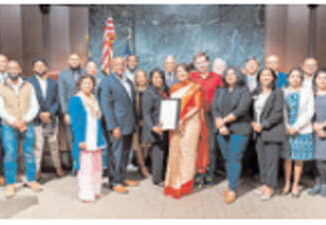
Atlanta Council Honors Indian American Leader Dr Nazeera Dawood for Women’s History Month
ATLANTA, GA (TIP): The Atlanta City Council has bestowed a prestigious honor upon Dr Nazeera Dawood, the esteemed founder and CEO of Vendorship, Inc., recognizing her exceptional contributions and service to the Greater Atlanta community. This recognition comes as a significant highlight during Women’s History Month, celebrating the achievements and resilience of women across the globe. A special ceremony, held on March 7th, saw the Atlanta City Council officially declare March 7th as Dr. Nazeera Dawood Day, followed by a reception at Atlanta City Hall to commemorate Dr Dawood’s remarkable accomplishments.
Andrea L. Boone, Member of the Atlanta City Council, expressed, “Dr Nazeera Dawood encapsulates the spirit of Women’s History Month with her unwavering commitment to public health and economic empowerment. Her path from earning a medical degree to establishing Vendorship showcases her vision and resilience. Dr Nazeera’s leadership not only uplifts women and minority-owned businesses but also cultivates a spirit of community and collaboration across Atlanta.”
Viren Mayani, recognized as a global thought leader, extended his greetings during the ceremony. Darryl Ricardo Matthews Sr., Director of Business Development at Vendorship, introduced the honoree, followed by the Proclamation Presentation by Councilmember Andrea L Boone. Additional speakers at the event included Monidipa Das, Madhu Pareek, Veni Nanjundiah, and Richard Johnson. Burleigh Singleton delivered the closing remarks.
Expressing her gratitude, Dr Nazeera remarked, “As we strive to make diversity and inclusion less of an ideal and more of a common practice, companies like Vendorship can serve as an example of how to bring equitable access and opportunities to all businesses.”
Dr Nazeera hails from Dindigul, Tamil Nadu. Her professional journey is marked by two decades of unwavering dedication and service across various sectors, encompassing impactful roles in both public and private domains, including significant contributions to non-profit organizations. Originating from a successful medical career in India, she expanded her expertise by earning a Master’s Degree in Public Health from the University of North Carolina, Chapel Hill.
During her tenure as a research project manager at Emory University, Dr Nazeera Dawood was honored as a ‘We are Emory, 100 Community Builders.’ Additionally, she served as an adjunct professor at Morehouse School of Medicine and assumed the role of President for the South Asian Public Health Association (SAPHA). A graduate of Leadership Johns Creek and the Johns Creek Community Police Academy, she has continually demonstrated her commitment to community engagement and leadership.
Recognized for her outstanding public service, Dr Nazeera Dawood has received accolades from the American Tamil Medical Association and has actively contributed to the community as a monthly columnist for the Forsyth County News. Fluent in multiple languages including Tamil, Hindi, Kannada, and Telugu, she has leveraged her linguistic skills to foster inclusivity and engagement within diverse communities.
Dr Nazeera Dawood’s advocacy for diversity and inclusion was further highlighted when the Georgia House of Representatives adopted House Resolution 591 designating January 19, 2022, as Dr Nazeera Dawood Reaffirmation of Diversity in Patriotism Day. This commendation, sponsored by State Rep. Angelika Kausche and cosponsored by State Reps. Todd Jones and Josh McLaurin, underscored her commitment to promoting unity and inclusiveness.
Previously, Dr Nazeera Dawood was honored with a proclamation from Fulton County, recognizing October 1 as Dr. Nazeera Dawood Appreciation Day, further emphasizing her profound impact on the local community.
Drawing upon her extensive experience in public service, including roles such as Director of the Fulton County Health Department Division of Health Promotion and Chief of Staff of the Chairman’s Office of Board of Commissioners, Dr Nazeera Dawood gained invaluable insights into the intricacies of government procurement processes. This wealth of experience laid the foundation for the establishment of Vendorship, a pioneering endeavor aimed at revolutionizing government contracting and fostering equitable opportunities for businesses.
Established in 2018 and headquartered in Alpharetta, Georgia, USA, Vendorship Inc is at the forefront of transforming government contracting. By providing inclusive access to revenue-generating contracts, the company aids businesses in securing a share of the $3 trillion available in local, state, and federal contracts. Vendorship simplifies the proposal process, guiding clients through complexities and matching them with optimal bid requests for consistently successful submissions. Additionally, through coaching and interaction, Vendorship empowers clients to present new technologies to government agencies seeking innovative solutions.
Expanding its reach, Vendorship India was founded in January 2024 with its office location in Bengaluru, and is currently in the phase of growth within the Indian market.
For more information, please visit Vendorship’s website at vendorship.net, contact them via email at info@vendorship.net or connect with them on social media platforms including Facebook, LinkedIn or by phone at (404) 982-4070.
(India PR Distribution)
-

Indian American businessman Narender Reddy announces run for State House District 50
ATLANTA, GA (TIP) : Johns Creek businessman Narender Reddy has qualified to run for the Georgia House of Representatives in District 50, which covers most of Johns Creek and a portion of Alpharetta. Since no other Republican qualified for this seat, Reddy will not be having any Primary opponent. The seat is currently occupied by Democrat Michelle Au. “It is important that we hold our elected officials accountable, which is why I have chosen to challenge Representative Au,” Reddy remarked. “Her record shows that she does not reflect the views of the voters of this district, and I intend to give voters an alternative who better understands the pressing issues facing our district, our state, and our country.”
Citing out-of-control inflation as a major concern to voters, Reddy promised to endorse fiscally responsible measures that would give relief to taxpayers.
“Prices have skyrocketed on basic necessities and our working families are struggling,” Reddy said. “We need to help people to keep more of their money to combat this crisis. That means cutting our state income tax, tamping down rising property taxes, and reducing wasteful government spending.”
Reddy also noted rising illegal immigration as an issue that voters have demanded answers on.
“As an immigrant myself, I applaud people for legally immigrating to this country in search of better opportunity,” Reddy said. “However, the current situation with people entering illegally at the southern border is unsustainable. It’s highly unsafe to allow thousands of unvetted, untracked migrants to enter our country. My pledge is to work in the State House to find ways to insulate Georgia from the federal government’s inaction and to continually call for more to be done to alleviate this problem.”
On that note, Reddy emphasized the need for robust public safety in District 50.
“We need to do what is necessary to ensure that this area remains a safe place for our families,” Reddy said. “As your State Representative, I will be a reliable friend to law enforcement and will fight for them to have the resources and support they need to keep our communities safe.”
A Georgia resident for nearly four decades, Narender Reddy has been an invested member of the Johns Creek community. He was appointed to board of the Georgia Regional Transportation Authority by Governor Sonny Perdue and reappointed to two additional terms by Governor Nathan Deal and Governor Brian Kemp and has been serving on the Board for the past 20 years.
Also, he was the co-founder of the Quantum National Bank, the first Indian American owned bank. Reddy is the founder and president of Sterling Realty Services, a commercial real estate firm. He holds a master’s degree in business from the University of Evansville in Indiana. Narender is the proud father of two adult children.