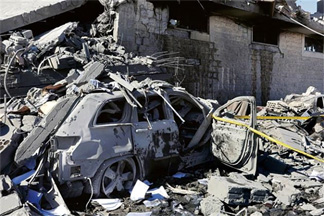
BEIRUT (TIP): Israeli warplanes struck deep into Lebanon for a second consecutive day on March 13, hitting a facility belonging to Hezbollah in the Bekaa Valley and killing at least one member of the Iran-backed group, sources in Lebanon said.
Ship carrying aid to Gaza leaves Cyprus
A ship carrying 200 tonnes of aid for Gaza left Cyprus on Tuesday in a pilot project to open a sea route to deliver supplies to a population aid agencies say is on the brink of famine
Aid groups say it is nearly impossible to deliver aid in much of the territory because of Israeli restrictions and ongoing hostilities. The US has also announced plans to construct a sea bridge near Gaza in order to deliver aid
The Israeli military said its fighter jets had “struck two Hezbollah military command centres” in the Baalbek area, in response to Hezbollah rocket launches towards northern Israel earlier in the day.
The violence marked an uptick of the conflict between Hezbollah and Israel which has been fought in parallel to the Gaza war and fuelled fears of an all-out conflict between the heavily armed adversaries.
Hezbollah said in a statement it had fired more than 100 Katyusha rockets at 7 am (0500 GMT), targeting several Israeli military posts, in response to Israeli shelling of the Bekaa Valley region on Monday night.
At least one civilian was killed and several others were wounded in Monday’s strikes by Israel, one of which hit the southern entrance to the city of Baalbek, about 2 km (1.2 miles) from its ancient Roman ruins, two security sources in Lebanon and the Baalbek governor, Bashir Khader, said.
The Israeli military said in response to Monday’s rocket launches, its fighter jets had struck sites in the Baalbek area which Hezbollah used to store “significant assets used to strength its weapons arsenal”.
“A military compound in the area of Khiam and terrorist infrastructure in the area of Bint Jbeil were also struck,” the Israeli military added.
The Hezbollah member was killed and several more were wounded in an airstrike in the Bekaa Valley village of Nabi Chit, said one of the Lebanese sources. The targeted region is a stronghold of the Shi’ite Islamist group near the Lebanese-Syrian border. — Reuters
Month: March 2024
-

Israeli jets hit more Hezbollah targets in Lebanon’s Bekaa
-
Scary sight: Japan’s 1st private-sector rocket explodes seconds after launch
Tokyo (TIP): A rocket that was supposed to become Japan’s first from the private sector to put a satellite into orbit exploded shortly after takeoff on March 13, a livestreamed video showed.
Online video showed the rocket called Kairos blasting off from Wakayama Prefecture, in central Japan, a mountainous area filled with trees, but exploding midair within seconds.
A huge plume of smoke engulfed the area, and flames shot up in some spots. The video then showed spurts of water trying to put out the blaze.
There were no reports of injuries, and the fire has been brought under control, according to the fire department in Kushimoto city, Wakayama.
Tokyo-based startup Space One, behind the rocket launch, did not immediately respond to a request for comment.
Live footage on public broadcaster NHK relayed a voice announcing to the crowd gathered to watch the takeoff from a safe distance. NHK showed debris scattering from the sky, and later charred pieces strewn about on the ground. The cause of the problems was still under investigation, according to NHK.
The launch was already delayed several times, with the last postponement coming on Saturday, after a ship was spotted in a risk area, according to Japanese media reports.
If it had succeeded, Space One would have been the first private company to put a rocket into orbit.
Tokyo-based Space One was set up in 2018, with investments from major Japanese companies, including Canon Electronics, IHI, Shimizu and major banks. (AP) -

Four, including three Indians, arrested while entering US illegally from Canada
WASHINGTON, D.C. (TIP): Three Indian nationals are among four people arrested in Upstate New York after they jumped off a moving freight train coming from Canada in their bid to enter the US illegally.
US Border Patrol agents arrested the four, including a woman, on March 12. The investigation concluded that all four people were undocumented non-citizens.
Border Patrol agents assigned to the Buffalo Station spotted four people jumping off a moving freight train on the International Railroad Bridge in the city of Buffalo.
The men left the woman who became immobile due to an injury and were caught shortly after a foot pursuit. The injured woman received first aid from Erie County Sheriff’s deputies and U.S. Customs and Border Protection officers (CBP). After treatment, the woman was transported by ambulance to a local medical centre.
Border Patrol agents were able to identify that the woman and two men were from India and the third man was from the Dominican Republic. The three men are being processed for removal and detained in Batavia Federal Detention Facility awaiting a deportation hearing for charges under Sections 212 and 237 of the Immigration and Nationality Act, a media release said.
The woman remains at a local medical centre awaiting further medical treatment. This is a great example of how our Border Patrol agents, CBP officers and law enforcement partners work tirelessly to protect the Western New York area,” said Chief Patrol Agent Thomas G. Martin, US Border Patrol Buffalo Sector.
-

Virginia State Senate commends Indian origin journalist for his “dedication to journalism and foreign policy.”
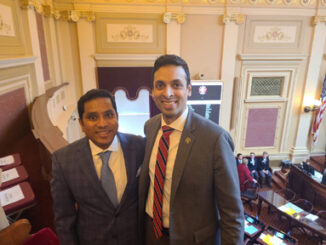
RICHMOND, VA (TIP): On March 8, 2024, the Virginia State Senate approved a formal resolution with a voice vote commending Washington Bureau Chief of News India Times, T. Vishnudatta Jayaraman, for his “dedication to journalism and foreign policy.” The resolution was introduced by Indian-American Virginia State Senator, Suhas Subramanyam, who is also a Democratic candidate for US Congress from Virginia’s 10th Congressional district. Introducing Jayaraman in the Senate gallery, on March 4th, Senator Subramanyam referred to him “as the recipient of the prestigious Ashoka Award for social change,” while commending his dedication to journalism and foreign policy.
He further said, on January 27th, Jayaraman “received a Distinguished Service Award ‘for advancing media coverage for the Indian diaspora and fostering US-India relations’ from the Indian Ambassador to United States Taranjit Sandhu and of course, you Madam President,” referring to Lieutenant Governor of Virginia and President of the Senate, Winsome Sears.
The National Council of Asian Indian Associations hosted the event to commemorate India’s 75th Republic Day Celebrations on January 27th in McLean, Virginia.
Accepting a request from Senator Subramanyam “to give him [Jayaraman] a warm Senate welcome and recognition of all that he’s accomplished in the field,” Lieutenant Governor Sears expressed, “Part of a democracy and I think probably the very first part is that the media be free. And we are so glad that you are there to help remind us of that. Hence, all the accolades that you’ve received, we can congratulate you. And thank you for coming. Senators, let us give him the warm welcome of our Senate.”
On February 28th, Kannan Srinivasan, the first Indian-American immigrant elected to the Virginia House of Delegates, also presented a commendation to Jayaraman on the House Floor for having received the Distinguished Service Award.
The Ashoka Award was presented to Jayaraman by the former Governor of Arunachal Pradesh and 22nd Chief of Army Staff of Indian Army, General J. J. Singh, and former India’s Minister of Home Affairs and Tourism, Subodh Kant Sahay in New Delhi on December 17, 2023. The event was organized by The Charles Walters Council/Society for Innovation & Research, India. Born in Chennai, Tamil Nadu, Jayaraman, also known as J. T. Vishnu, previously worked with Hindustan Times, The Tribune, and The Sunday Observer in New Delhi. He also worked at the Department of Public Information at the United Nations Headquarters in New York, and contributed to publications including UN Yearbook and UN Chronicle.
Jayaraman has an undergraduate degree from Loyola College, Chennai. He has a Master’s Degree in Journalism and Mass Communication, and a PhD in International Administration and the United Nations from the University of Madras. He also has a Master’s degree in Diplomacy and International Relations from Seton Hall University, New Jersey.
-

India-US security cooperation will become even more important in the years ahead: Richard Verma
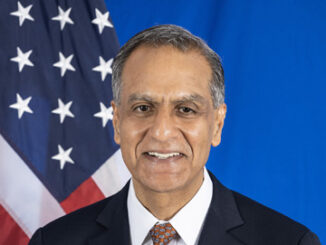
WASHINGTON, D.C. (TIP): India-US security cooperation will become even more important in the years ahead and the work of the two countries on emerging technologies will take on even more promise, a top American diplomat said on Thursday, March 14, reiterating the remarks of President Joe Biden that this is the defining partnership of the 21st century.
“As both President Biden and Prime Minister Modi have said, our impact on each other is important, but what we can do for the world is even more important. Whether it’s addressing food insecurity or battling the next pandemic or connecting millions to the digital economy, there is so much we can do together,” Deputy Secretary of State for Management and Resources, Richard Verma, wrote in a blog post in his recent return from India.
Verma is the highest-ranking Indian-American ever in the State Department. He was also the first ever Indian-American to serve as the US Ambassador to India.
“So, where are we headed?” Verma wrote as he described in detail the significant growth in the India-US relationship over the last few decades.
He identified defense, democracy and technology as three key areas of cooperation between the two countries.
“Our security cooperation will become even more important in the years ahead. The threats we face are real, but building our collective capabilities, increasing sharing of information, and improving maritime domain awareness and interoperability will ensure India continues to be a provider of net security across the Indo-Pacific region and beyond,” Verma wrote. “Our work on protecting, preserving, and strengthening democracy will continue to be even more important, with the rise of authoritarian leaders and movements. This includes continuing to strengthen a global rules-based order architecture, ensuring we bridge the divide on income inequality, and battling mis and disinformation. Democracy must continue to deliver for our peoples,” he said.
“Our work on emerging technologies will take on even more promise. New and emerging technologies offer tremendous opportunities for economic growth and development. At the same time, recent disruptive cyber attacks, carried out by criminals and nation states, demonstrate the risk that cyber vulnerabilities can pose to global peace and security,” said the top American diplomat.
“We must work together to tackle data privacy issues, such as identity theft, by exchanging knowledge on data protection issues. Through the Digital Connectivity and Cybersecurity Partnership, the US is working closely with India to build and maintain internet infrastructure and strengthen cybersecurity protections. From semiconductors to critical minerals to space exploration and innovation in clean energy, battling climate change, and so much more, this is about economic and physical security,” Verma wrote.
-

Indian American indicted in a Ponzi scheme
WASHINGTON, D.C. (TIP): An Indian-American has been indicted by a grand jury in a Ponzi scheme with the FBI urging victims of the investment adviser in Texas to come forward. Siddharth Jawahar, 36, has been ordered imprisonment until sentencing by the court. The FBI on Wednesday, March 13 said it is seeking potential Miami-area victims of Jawahar who has been accused of running a multimillion-dollar Ponzi scheme.
According to the indictment, from July 2016 through roughly December 2023, Jawahar took in more than $35 million from Swiftarc investors but spent about $10 million on investments in companies.
Jawahar used the money from new investors to repay older investors and to fuel an extravagant lifestyle that included flights on private planes, stays at luxury hotels and expensive outings at lavish restaurants, the indictment says. In 2015, Jawahar began investing the majority of client funds in a single investment, Philip Morris Pakistan (PMP), the indictment says, and eventually, 99 per cent of client funds were consolidated into the PMP investment. Jawahar did not tell investors of a dramatic decline in the value of PMP, instead misled investors about the share price and their profits. The indictment says Jawahar also did not tell investors when the Texas State Securities Board revoked Swiftarc Capital’s authority to conduct investment activities on June 7, 2022, and ordered Jawahar to cease from engaging in fraud. Jawahar continued to fraudulently solicit and receive investor funds, including $1 million from an investor weeks after the state board’s order, the indictment says.
The wire fraud charges are each punishable by up to 20 years in prison and a $250,000 fine, or both.
The investment adviser fraud charge is punishable by up to five years in prison and a $10,000 fine, or both.
-

US says it is concerned about CAA and closely monitoring its implementation
WASHINGTON, D.C. (TIP): The United States on Thursday, March 14 said it is concerned about the notification of the Citizenship (Amendment) Act in India and is closely monitoring its implementation.
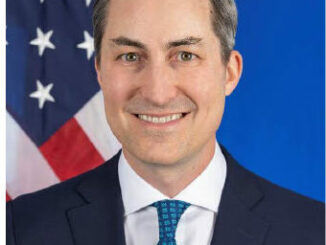
“We are concerned about the notification of the Citizenship (Amendment) Act on March 11,” State Department Spokesperson Matthew Miller told reporters at his daily briefing.
“We are closely monitoring how this act will be implemented. Respect for religious freedom and equal treatment under the law for all communities are fundamental democratic principles,” Miller said in response to a question.
The Indian government implemented the Citizenship (Amendment) Act 2019 on Monday, paving the way for the grant of citizenship to undocumented non-Muslim migrants from Pakistan, Bangladesh and Afghanistan who came to India before December 31, 2014. The government also came out with a press statement to say that Indian Muslims need not worry as the CAA will not impact their citizenship and has nothing to do with the community which enjoys equal rights as their Hindu counterparts. The Indian government has maintained that the CAA is about granting citizenship and that no citizen of the country will lose citizenship.
-

US House passes bill to ban TikTok
WASHINGTON, D.C. (TIP): The US House of Representatives on Wednesday passed a bill to ban Chinese social media app Tiktok, which is very popular among kids, in the United States.
India was the first country to ban TikTok in 2020 after it became public knowledge that the popular Chinese social media platform was being used for gathering personal data and spying on others.
Passed by the House by 352 to 65 votes, the bill now heads to the US Senate for it to be sent to the White House for the President to sign it into law. While 197 Republican lawmakers voted for the measure and 15 against, on the Democratic side, 155 voted for the bill and 50 against. The bill, “Protecting Americans From Foreign Adversary Controlled Applications Act”, was co-authored by Indian American Congressman Raja Krishnamoorthi, a Democrat, and Congressman Mike Gallaghe from the Republican party.
“This bill is not a ban and it is not about TikTok. It is about ByteDance…a 100 per cent owner of TikTok. ByteDance is controlled by the Chinese Communist Party. In fact the editor-in-chief of ByteDance is the secretary of the Chinese Communist Party cell embedded at the very highest ranks of the company,” Krishnamoorthi said.
He said the bill ensures that ByteDance divests itself of the vast majority of the ownership at TikTok. “Our intention is for TikTok to continue to operate but not under the control of the CCP,” Krishnamoorthi said.
Former vice president Mike Pence said the passage of this legislation demonstrates that appeasement to Communist China is over, allowing TikTok to continue operating in the United States while under CCP control is simply unacceptable. “The Senate must take up this legislation as soon as possible and send it to President Biden’s desk. AAF will never falter in our commitment to confronting China at home and abroad, the American government must not falter now,” he demanded.
Former House Speaker Nancy Pelosi said the overwhelming and bipartisan passage of the bill is a strong statement of the Congress’s commitment to the security of the country and privacy of the data. “Let me be clear: this legislation is not a ban on TikTok. I join my colleagues in recognising the platform’s entertainment, educational and entrepreneurial value, especially among younger people. Instead, this legislation would strengthen TikTok: keeping Americans’ data and control of the algorithm out of the hands of a foreign adversary.
“In doing so, we protect against surveillance and influence operations that are hallmarks of the Chinese Communist Party (CCP),” she said.
Repressed communities in China – from the Uyghurs to Tibetans to the people of Hong Kong, and others – are telling us that their stories of their suffering are being blocked or misrepresented on TikTok, Pelosi said.
“At the same time, the CCP is spreading propaganda to cover up its heinous abuses. We cannot allow Beijing to bury the truth of its abysmal record on human rights,” Pelosi said, and urged the Senate to bring companion legislation to a vote as quickly as possible.
“The Senate will review the legislation when it comes over from the House,” said Senate Majority Leader Chuck Schumer. House Foreign Affairs Committee Chairman Michael McCaul said CCP-controlled TikTok is an enormous threat to US national security and young Americans’ mental health. “This past week demonstrated the Chinese Communist Party is capable of mobilising the platform’s users to a range of dangerous, destabilising actions. The Senate must pass this bill and send it to the president’s desk immediately,” he said.
Senate Select Committee on Intelligence Chairman Mark R Warner and Vice Chairman Marco Rubio said they are united in their concern about the national security threat posed by TikTok – a platform with enormous power to influence and divide Americans whose parent company ByteDance remains legally required to do the bidding of the Chinese Communist Party.
“We were encouraged by today’s strong bipartisan vote in the House of Representatives, and look forward to working together to get this bill passed through the Senate and signed into law,” the two Senators said.
-

US lawmakers call for addressing Green Card backlog and resolving H-1B issues at immigration summit
WASHINGTON, D.C. (TIP): Eminent lawmakers from both the Democratic and Republican parties at an immigration summit have called for urgently addressing the Green Card backlog, an issue that is majorly impacting Indian professionals and the issues related to the H-1B visa.
At the first-of-its-kind ‘Tech Immigration Summit’ at the US Capitol on Monday, March 11 hosted by the Foundation for India and Indian Diaspora (FIIDS), the lawmakers pushed for removing the seven per cent country quota when it comes to issuing Green Card or legal permanent residency to foreign guest workers in specialized categories. In the absence of such a move, the Green Card waiting period for Indian immigrants would be more than 20 years and over 70 years in many cases.
A Green Card, known officially as a Permanent Resident Card, is a document issued to immigrants to the US as evidence that the bearer has been granted the privilege of residing permanently. Congressman Ro Khanna, who is also co-chair of the Congressional India Caucus, called for a rational immigration policy.
“We know that immigrants have helped build Silicon Valley, that so many of the companies that have started, that have created so many jobs that have created so much employment have been founded by immigrants from India, from China, from Asia, the Middle East, from Europe,” he said.
Khanna is co-sponsor and lead of the Eagle Act, which he said would get rid of the country caps so that people aren’t perpetually in status because that hurts American workers.
“You are hurting American workers by allowing corporations to underpay folks on an H1-B, and you’re hurting the families on H1-B. And that’s why we need to move them to green cards and ultimately citizenship,” he said.
“It will help raise wages, help American workers, and help these families. We also should be providing a Green Card to folks who are educating in the United States. It makes no sense that we’re paying for someone’s education at college or giving them STEM, and then we’re telling them that they have to go back to where they came from when American taxpayers are funding the education. I’d rather stay here, create the jobs here instead of offshoring those jobs,” Khanna said.
“We made a lot of progress on these bills. We need to now get it again through the House. But the obstacle, as you know, has been the Senate, as is often the case,” Khanna said.
Congressman Eric Swalwell said 40 per cent of his constituents in California were born outside of the United States.
“If we want to take on the bigger challenges, we need the fix. If we want to cure cancer in America, we need to fix a broken immigration system. If we want to see fewer emissions when it comes to how we get our energy, we need to fix our immigration system. If we want to pay less in childcare, we need to fix our immigration system,” he said.
The American immigration system is broken, Indian-American Congressman Shri Thanedar said.
“We need legal immigration solidified; our businesses need that. Every time I meet CEOs of companies, they tell me how important it is to be able to find a skilled workforce. Today we are losing so many people to Australia to Canada because they’re taking advantage of our broken immigration system.
“We need to be able to keep the skilled workforce in the US. That’s going to help our GDP, that’s going to help our businesses to grow, and that’s going to create more American jobs,” he said.
“It’s in the best interest of the United States to continue to welcome immigrants and make it easier. I think the current system is so stressful to the employees and their families,” he said. Congressmen Rich McCormick and Raja Krishnamoorthi called for passage of the relevant legislation from the US Congress.
Khanderao Kand from the Foundation for India and Indian Diaspora Studies (FIIDS) said technology immigrants are leading entrepreneurs in big industries.
“From an innovation point of view, the largest innovators, patent holders are coming from the immigration background,” he said. Technology professionals, when they settle, they create jobs and wealth in the United States.
“However, their situation, particularly the largest source of technology professionals coming from India, they are shackled by the seven per cent country quota. This policy created a huge backlog resulting in the green card processing for new applicants for more than a hundred years. They will never be able to get their green card unless technology policies are changed. That’s why we hosted this immigration summit. We addressed the issues like, seven per cent quota, EAD, OPT, various such kinds of issues,” Kand said.
“We also discuss about the bills pending in the Congress,” he said. In addition to several US lawmakers, representations from think tanks, and an official from the Department of State, there were testimonies from the various impacted people, whether they are the pending backlog green card, or could be the documented dreamers, or the family members or the students, all of them.
“In addition to that, technology entrepreneurs came, and they presented their thought processes. So overall, this summit has been very successful and we hope that we can make a dent in the policies both within the Congress and the administration,” Kand said.
-

NYC KICKS OFF SIXTH ANNUAL CIVICS WEEK
NEW YORK CITY (TIP): NYC Public Schools (NYCPS) and DemocracyNYC, on March 11, kicked off the sixth annual Civics Week, including the 2024 Student Voter Registration Drive, a celebration of youth voice and civic empowerment, at PS K721, the Brooklyn Occupational Training Center. Schools Chancellor David C. Banks and Chief Democracy Officer Kathleen Daniel gave opening remarks and spoke with students about the importance of civic engagement.
Throughout the week, students in all grades across the city will be visited by elected officials and will participate in classroom activities and events designed to empower them to create change as active participants in their community. High Schoolers across the City will pre-register and register to vote, adding to the total of 90,000 new voters registered through Civics Week since these efforts began.
This year is also a celebration of the expansion of the Civics for All Partner District program, with a total of 22 districts opting in to bring Civics for All programming to their schools. Civics for All is a multifaceted initiative designed to narrow the Civic Empowerment Gap and provide equitable civic learning experiences for all NYC students. These opportunities include participation in public speaking programs, events that strengthen student voice and build school community, and voter registration drives.
“Now, perhaps more than ever, we must ensure our students engage with the issues of the day responsibly,” said Schools Chancellor David C. Banks. “To change the world, you must first learn to think critically and engage in public discourse, and the expansion of the Civics for All program opens the doors for thousands more students to gain these invaluable skills. Civics for All is an essential resource for our educators as they nurture the next generation of leaders.”
“Teaching our students how to participate in democracy and exercise one of their most sacred rights by voting is critical to create a culture of engagement and empowerment in our City,” said Chief Democracy Officer Kathleen Daniel. “When young people vote, the whole world hears their voice, and changes to meet their needs. I am so proud of be a part of Civics Week and building a community of leaders among our youth.”
The Mayor’s Public Engagement Unit (PEU), the Civic Engagement Commission, and DemocracyNYC are supporting these efforts by hosting voter registration drives in 15 schools. Additional voter registration drives are being coordinated by student ambassadors and teachers in over 185 high schools.
Since its inception in 2019, over 90,000 New York City students have registered to vote during Civics Week. Additional voter registration drives are being coordinated by student ambassadors and teachers in 185 high schools. This year, students will be registered through PEU, teacher, and student ambassador efforts.
For students in kindergarten through eighth grade, schools will utilize resources from the Civics for All initiative of NYCPS to help students build their civic knowledge and hone their civic engagement skills.
The below additional events are open to press with prior RSVP:
Bronx
March 13, 10:15AM: Grades K-2 Participatory Budgeting Vote
Brooklyn
March 22, 1PM: Grades 6-8 Mock Soapbox presentation
Manhattan
March 14, 1:30PM: Grades 3-5 Soapbox-style presentations in support of participatory budgeting
Queens
March 14, 10AM: Grades K-5 Civics for All presentation. Main topics include Soapbox presentations and participatory budgeting voting results.
Staten Island
March 15, 10AM: Grade 5 visit with Assembly Member Michael Reilly
(Press release)
-

‘Chalo India’ – Global Diaspora Campaign Launched at the Indian Consulate
NEW YORK CITY (TIP): The Consulate General of India, in New York organized a special event on the launch of ‘Chalo India – Global Diaspora Campaign’ on March 7, 2024.
‘Chalo India’ is a unique initiative which was launched by Prime Minister of India, Shri Narendra Modi, on March 7, 2024 at a public event in Srinagar, Jammu & Kashmir. It is aimed at encouraging the Indian diaspora around the world to visit India, and to inspire their friends and families to explore the vast and diverse tourism opportunities India offers.
The launch event at the Consulate was attended by many members of the Indian-American community, professionals, travel bloggers and representatives of the travel and tourism industry.
Speaking on the occasion, Consul General Mr. Binaya S. Pradhan acknowledged the United States as the largest source of international tourists to India. He emphasized the significant potential for further growth, given India’s rich cultural diversity and the state-of-the-art tourism infrastructure that has been developed in recent years.
Referring to the Indian diaspora as India’s cultural ambassadors in the United States, Consul General encouraged them to travel more often to India, and invite at least five American friends of theirs to explore the plethora of tourism experiences in India. Soon, a dedicated website on ‘Chalo India Global Diaspora’ would be The Chalo India website will open to diaspora members for account creation in due course. Visit https://www.chaloindia.gov.in/ to register and get notified.
The Consulate General of India in New York holds regular thematic webinars promoting different facets of Indian tourism, such as wedding, destinations in India, beaches, river, cruises, adventure travel, spiritual tourism, health and well-being, tourism, etc. It also participates in several tourism related expose and shows bringing out the best that India offers to tourists in America.
-

Legislator Carrié Solages Honored as an Inwood Civic Association ‘Citizen of the Year’
INWOOD, N.Y. (TIP)- Nassau County Legislator Carrié Solages (D – Valley Stream) had the high honor of being named one of the Inwood Civic Association’s Citizens of the Year on Sunday, March 10 during a celebration held at the Inwood Country Club. Legislator Solages was recognized by the Civic Association alongside Town of Hempstead Councilwoman Melissa “Missy” Miller.Portions of Inwood were included in the previous iteration of the Third Legislative, and Legislator Solages built close bonds with the community and advocated for the Five Towns Community Center, worked closely with leaders of community organizations like Gammy’s Pantry, and pushed for EZ Pass service for the Atlantic Beach Bridge, crucial artery that connects Lawrence and Atlantic Beach to the mainland over NY 878 over the west end of Reynolds Channel and provides direct access to the Rockaway Peninsula.
“It was extremely humbling and gratifying to be recognized by the Inwood Civic Association and all of the community leaders and friends I have built such close bonds with during the course of our shared advocacy,” Legislator Solages said. “Inwood will always have a special place in my heart, and I will never waver as an ally in the mission to make this beautiful, diverse community the ‘first of the Five Towns’ in the years to come.”

Photos Credit : Office of Legislator Carrié Solages -

Suozzi Appointed Co-Chair of Democrats for Border Security Task Force
WASHINGTON, DC (TIP): Congressman Tom Suozzi (NY-03) and Congressman Henry Cuellar (TX-28), on March 12, launched the Democrats for Border Security Task Force, a group of 26 House Democrats dedicated to addressing our country’s immigration and border crisis and countering the surge of illicit narcotics threatening communities across the country. Suozzi and Cuellar will serve as Co-Chairs of the newly formed Task Force.
“America’s southern border and immigration system aren’t working, and it is time to fix it. This task force will advocate for commonsense, bipartisan compromise to achieve much-needed and long-overdue comprehensive immigration reform. Our approach to the immigration and border crisis is unequivocal; we will work with anybody from any wing of any party if they genuinely care about solving this problem,” said Rep. Suozzi. “Too many in politics today are focused on pointing out the problem and keep busy figuring out what tricks they have ‘up their sleeves’ to weaponize the border crisis, this task force will ‘roll up our sleeves’ to try to fix it.”
“Cities across the country are now feeling the consequences of the humanitarian crisis at the border – something border communities have been dealing with for years,” said Rep. Cuellar, Ranking Member of the House Appropriations Subcommittee on Homeland Security. “This crisis is unsustainable, and Democrats need a forum to approach border security policy as the GOP continues to play partisan politics with the issue. The crisis at our border demands solutions today, and it is unfortunate that a bipartisan Senate bill aimed at addressing the situation was killed before we even had a chance to debate its contents. I’m proud to lead my fellow Democrats on this Task Force so we can find sensible solutions that will secure the border while respecting the rights of migrants to claim asylum.”
The goal of the Task Force will be to provide a platform for House Democrats to contribute to ongoing discussions regarding border security and collaborate with colleagues. The Task Force will hold meetings with Administration officials, NGOs, and local officials from border communities to better inform members of the realities of the border crisis while giving House Democrats a platform to discuss sensible border security measures.
-

The Consulate General of India and the FIA Celebrate the 6th Edition of the Annual International Women’s Day
Achievements of four extraordinary women recognized

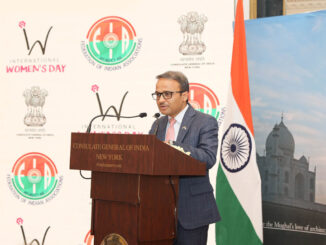
FIA President Dr. Avinash Gupta spoke of FIA’s dedication to fostering diversity and gender equality NEW YORK CITY (TIP): The Consulate General of India in New York, in partnership with the Federation of Indian Associations (FIA) of NY-NJ-CT-NE, proudly celebrated the 6th edition of their annual International Women’s Day event at the prestigious India House, New York City, on the eve of International Women’s Day. This celebrated event recognized the achievements of four extraordinary women, celebrating their significant contributions across various fields and reinforcing a commitment to empowerment and recognition.
The celebration commenced with a welcoming Meet & Greet, followed by a compelling digital showcase of the FIA’s dedication to fostering diversity and gender equality. The night’s proceedings were expertly facilitated by Ms. Payal Shah, Co-chair of International Women’s Day, who served as the emcee, ensuring a fluid and engaging experience for all attendees.

The awardees- Dr. Indu Lew, Ms. Neena Singh, Ms Megha Desai with the Consul General Mr. Binaya Srikanta Pradhan Emphasizing its long-standing tradition, the FIA and the Indian Consulate highlighted the remarkable achievements of women who have left an indelible mark in their respective areas of expertise. The primary goal was to motivate women to rise above their circumstances and make impactful contributions to their families and communities. The event was marked by video presentations that not only celebrated past honorees but also introduced this year’s awardees, whose endeavors have significantly influenced their fields.
2024 Awardees:
Her Royal Highness Maharani Radhikaraje Gaekwad, a visionary committed to education and community empowerment through her philanthropic work.Hon. Deputy Mayor Ms. Neena Singh, celebrated as the first Indian and Sikh woman Mayor in New Jersey, known for her dedication to mental wellness and community engagement.
Dr. Indu Lew, who rose from a clinical pharmacist to become the Executive Vice President and Chief of Staff at RWJBarnabas Health, demonstrating exceptional leadership in healthcare.
Ms Megha Desai, President of the Desai Foundation, whose work focuses on improving health, livelihood, and menstrual equity for women and children in rural India

A view of the gathering The celebration included heartfelt addresses by FIA President Dr. Avinash Gupta and the Consul General of India, Mr. Binaya Srikanta Pradhan. They both acknowledged the indispensable role of women in society and the significant strides made towards women’s empowerment in India, commemorating the spirit of International Women’s Day and applauding the awardees’ contributions.
A special highlight of the evening was the award ceremony, where CG Mr. Pradhan honored the awardees with a Sash, Trophy, Bouquet, and Proclamation, recognizing their outstanding achievements and contributions. The awardees expressed gratitude for the recognition, sharing their visions for a progressive future.
The event concluded with a special dinner prepared and served by Dwarka Princeton, a women-owned and operated business, symbolizing the FIA’s commitment to supporting women-led enterprises. This annual observance of International Women’s Day is a testament to the FIA’s ongoing dedication to promoting gender equality and empowering women to enact positive changes in society.
About the Federation of Indian Associations (FIA) of NY-NJ-CT-NE
The FIA is a preeminent diaspora organization in the United States, dedicated to enhancing cultural ties and advocating for the welfare and interests of the Indian community. With events like the annual International Women’s Day celebration, the FIA remains at the forefront of promoting diversity, inclusion, and the empowerment of women across all societal sectors.
(Based on a press release by the FIA)
Awardees and organizers with the Consul General Mr. Binaya Srikanta Pradhan (10th from the right) and Deputy Consul General Dr. Varun Jeph (8th from the left). -

Russia is ready to use nuclear weapons if threatened, Vladimir Putin tells state media
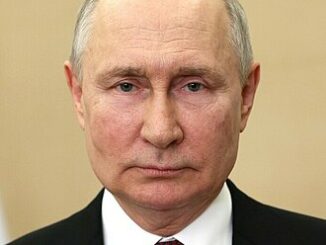
MOSCOW (TIP): President Vladimir Putin said Russia is ready to use nuclear weapons if there is a threat to Russian statehood, sovereignty or independence. Speaking in an interview with Russian state television released early on Wednesday, March 13, Putin said he hoped the US would avoid any escalation that could trigger a nuclear war but emphasized that Russia’s nuclear forces are ready for it. Asked if he had ever considered using battlefield nuclear weapons in Ukraine, Putin responded that there had been no need for that. He also voiced confidence that Moscow would achieve its goals in Ukraine and held the door open for talks, emphasizing that any deal would require firm guarantees from the West.
-

West Bengal CM Mamata Banerjee suffers ‘major injury’, admitted to hospital
KOLKATA (TIP); West Bengal Chief Minister Mamata Banerjee on Thursday, March 14 evening suffered a major injury on her forehead and was admitted to a hospital, the TMC said. The 69-year-old leader had a fall at her Kalighat home in south Kolkata after she returned after attending a programme, her family said.
“Our chairperson @MamataOfficial sustained a major injury. Please keep her in your prayers,” the party posted on X along with pictures of Banerjee bleeding from her forehead.
TMC national general secretary and Mamata’s nephew Abhishek Banerjee got her admitted to the hospital, according to party sources.
“She fell somewhere inside the home and was immediately shifted to the hospital. She was bleeding from the forehead and stitches were required,” her brother Kartik Banerjee told a Bengali news channel.
According to sources, she was admitted to the Woodburn Ward of the state-run SSKM Hospital in Kolkata.
A team of senior doctors are attending to her, hospital sources said.
According to senior TMC leader Sukhendu Sekhar Ray, Vice-President Jagdeep Dhankhar enquired about the Chief Minister’s health condition and expressed “deep anguish and wished her speedy recovery.”
Dhankhar is also a former West Bengal Governor. State BJP president Sukanta Majumdar wished her a speedy recovery. “Our prayers are with her for a quick return to good health,” he posted on X. State Congress president Adhir Ranjan Chowdhury also wished her a quick recovery.
-

SKM holds Mahapanchayat; Farmers from 18 states attend Delhi event
To oppose BJP nominees in Lok Sabha poll
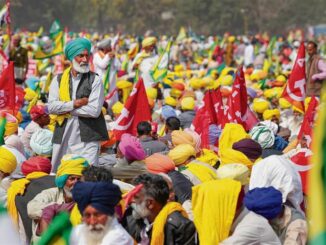
NEW DELHI (TIP): A large number of farmers and agricultural laborers from 18 states today attended the “Kisan Mazdoor Mahapanchayat” at the Ramlila Ground here to protest the BJP-led Centre’s policies related to the farm sector. The protesters resolved to launch a countrywide agitation against the BJP during the upcoming Lok Sabha elections for not accepting their demand for guaranteed minimum support price (MSP) for crops. The Mahapanchayat was organized by the Samyukt Kisan Morcha (SKM), whose leaders said a resolution was unanimously passed to “expose, protest and punish BJP”. They also accused Prime Minister Narendra Modi and his government of not fulfilling the promises made to the farmers during the last General Election.
The SKM urged the farmers to observe March 23 as “Save Democracy from the Threat of Money and Muscle Power Day” in all villages by organizing protests against the BJP for declaring Union Minister of State Ajay Mishra Teni as party candidate from Lakhimpur Kheri instead of punishing him. Mishra’s son Ashish is an accused in the Lakhimpur Kheri violence case in which four protesting farmers were killed after being run over by a car driven allegedly by him.
BKU (Tikait) spokesperson Rakesh Tikait said the Mahapanchayat was the beginning of the battle for guaranteed MSP. BKU (Charuni) President Gurnam Singh Charuni said the SKM was united, and that talks were underway with farmer leaders staging protests at Shambhu and Khanauri borders. SKM leader Darshan Pal said they had established a communication network in all states and they would inform the people how the government had “betrayed farmers”
The demands of the farmers include guaranteed MSP and procurement of all crops as per the C2+50% formula, comprehensive loan waiver, non-privatization of electricity, action against Mishra and the registration of an FIR on murder charges against the Union Home Minister, former Haryana CM and Home Minister for the death of farmer Shubhkaran Singh on the Khanauri border. The protesters have accused the authorities of deliberately diverting drain water to the venue.
(TNS) -

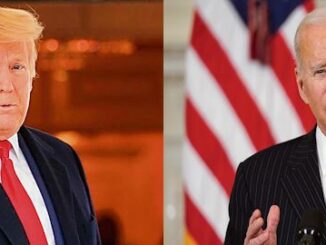
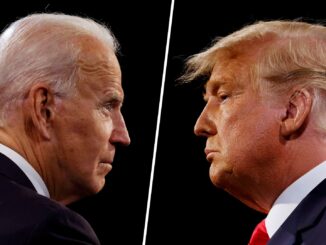
Biden, Trump set for November 2024 clash
WASHINGTON, D.C. (TIP): US President Joe Biden and his predecessor Donald Trump secured their parties’ presidential nominations with impressive wins in another round of key primaries, setting the stage for a grueling 2020 rematch between them in November.
Biden, 81, won the Democratic presumptive nomination on Tuesday, March 12, after easily clinching the presidential primaries in Georgia, as the number of delegates in his kitty crossed the halfway mark of 3,933 pledged delegates. A total of 1,968 delegates were required to win the Democratic nomination for the November 5 presidential election.
With wins in another round of key primaries, Donald Trump and Joe Biden have set the stage for a 2020 rematch in November.
(Also read The Biden-Trump Rematch and the Historical Context of Presidential Rematches on Page 10)
The last presidential rematch came in 1956 when Republican President Dwight D Eisenhower again defeated Adlai Stevenson, the Democratic opponent he had four years priorFour states — Georgia, Hawaii, Mississippi, Washington — one American territory and Democrats living abroad held their primaries on Tuesday. Biden would formally be declared the party’s nomination during the Democratic National Convention in Chicago in August.
Trump, 77, reached the 1,215 delegates necessary with an allocation of delegates from Washington state. Trump will be officially nominated at the Republican National Convention in Milwaukee this July. He will lead the Republican Party in a third consecutive presidential election after clinching the nomination on Tuesday.
Their rematch, long anticipated, but hardly clamored for, is broadly expected to mirror the 2020 campaign, though Trump will run this time under the specter of 91 felony charges.
Trump is scheduled to become the first former American president to go on trial in a criminal case on March 25 in New York, where he faces charges he falsified business records to hide hush money payments to a porn star.
Other charges are related to allegations that he plotted to overturn his 2020 election defeat; played a lead role in the January 6, 2021, insurrection at the US Capitol and illegally took classified documents from the White House.
-

Election Commission of India publishes Electoral bonds data; billionaire tycoons to lesser-known entities among buyers
- Future Gaming and Hotel Services purchased ₹1,368 crore worth electoral bonds, most among firms
- Twenty-two firms donated more than ₹100 crore during this period
- BJP received ₹6,060 crore, highest among all parties
NEW DELHI (TIP): Future Gaming and Hotel Services PR whose managing director is the well-known lottery magnate Santiago Martin, is the largest donor to political parties for the period April 12, 2019 to January 24, 2024, the electoral bonds data released by the Election Commission, on receipt from the State Bank of India, revealed.
The firm donated a cumulative sum of ₹1,368 crore in electoral bonds during this period. Incidentally, the Enforcement Directorate had attached ₹411 crore in the bank accounts of the firm and other companies in March 2022 and had later filed a prosecution complaint against it under the Prevention of Money Laundering Act, 2002 before the PMLA Court, Kolkata on September 09, 2023.
Twenty-two firms donated more than ₹100 crore during this period. Here is a list of top buyers of electoral bonds.
Future Gaming and Hotel Services: Rs 1,368 crore
Megha Engineering and Infrastructure Ltd: Rs 966 crore
Qwik Supply Chain Private Ltd: Rs 410 crore
Vedanta Ltd: Rs 400 crore
Haldia Energy Ltd: Rs 377 crore
Bharati Group: Rs 247 crore
Essel Mining and Industries Ltd: Rs 224 crore
Western UP Power Transmission: Rs 220 crore
Keventer Foodpark Infra Ltd: Rs 194 crore
Madanlal Ltd: Rs 185 crore
DLF Group: Rs 170 crore
Yashoda Super Speciality Hospital: Rs 162 crore
Utkal Alumina International: Rs 145.3 crore
Jindal Steel and Power Ltd: Rs 123 crore
Birla Carbon India: Rs 105 crore
Rungta Sons: Rs 100 crore
In total, electoral bonds worth over ₹12,155 crore were purchased by donors during this period and more than ₹12,769 crore were encashed by all the parties in the period.
The information has been put up in public domain by the Election Commission of India (ECI) after The State Bank of India (SBI) had disclosed this information on March 12. The Supreme Court had directed the ECI to host this information on its website by March 15.
The SBI supplied this data in two sets. The first set contains the date of purchase of each Electoral Bond, the name of the purchaser of the bond, and the denomination of the bond purchased.
Here are the links to bond data.
https://bsmedia.business-standard.com/_media/bs/data/general-file-upload/2024-03/e-bonds1.pdf
https://bsmedia.business-standard.com/_media/bs/data/general-file-upload/2024-03/e-bonds2.pdf
Electoral bonds were introduced in the country on January 28, 2017 by then Union Minister for Finance and Corporate Affairs, Arun Jaitley. The objective was to facilitate transparent political funding. These bonds, issued exclusively by SBI, served as a designated financial instrument that offered individuals and corporate entities the opportunity to contribute funds to political parties discreetly, as those bonds had no identification of the donor and the political party to which it was issued.
Electoral bonds were available in denominations of Rs 1,000 and could be acquired from SBI branches during specific periods stipulated by the government. Political parties could then redeem those bonds through their designated accounts within a prescribed timeframe.
The anonymous political funding via electoral bonds was made unconstitutional by the SC, in its landmark judgement on 15 February 2024 and the five-judge Constitution bench mandated the ECI to disclose donors, the amounts donated by them, and the recipients.
According to the affidavit submitted by SBI on March 13, between April 2019 and February 15, 2024, a total of 22,217 electoral bonds were issued. Of these bonds, 22,030 were redeemed by political parties, while the remaining 187 were redeemed, with the funds deposited into the Prime Minister’s National Relief Fund.
According to data presented in Lok Sabha during the Budget session, Minister of State in the Finance Ministry Pankaj Chaudhry said that a total of Rs 16,500 crore were collected from 30 tranches of electoral bonds issued between March 2018 to January 2024. He added, “The commission paid to the State Bank of India by the Government of India for the issuance and redemption of Electoral Bonds from Phase I to Phase XXV is about Rs 8.57 crore. Also, the amount paid by the Government of India to Security Printing & Minting Corporation of India Ltd (SPMCIL) to date is about Rs 1.90 crore.”
(Agencies
-
The Indian Panorama is grateful to Dr. V.K. Raju and the Eye Foundation of America for their work and support
- By I.S. Saluja
The Indian Panorama is grateful to Dr. V.K. Raju, President of the Eye Foundation of America and the board of directors of the Eye Foundation of America for their noble humanitarian work and great support to the publication. Their collaboration in publishing the special edition to pay tribute to Martyrs of India on the Martyrs Day is worth appreciation and deserves our gratitude.
We take this opportunity to briefly introduce the eminent eye surgeon and a great philanthropist and his team dedicated to creating a world without childhood blindness.

Dr. V.K. Raju VK Raju, MD, FRCS, FACS
Ellis Island Award Nominee 2019
Ophthalmologist, Regional Eye Associates
President and Founder, Eye Foundation of America
President and Founder, Goutami Eye Institute
Clinical Professor, West Virginia University
Director, International Ocular Surface Society
Adjunct Professor, GSL Medical School
Adjunct Professor, Wilmer Eye Institute, Johns Hopkins University
Author: Musings on Medicine, Myth, and History-India’s Legacy
Dr. VK Raju received his medical degree from Andhra University, India and Residency and Fellowship in UK. He is a fellow of the Royal College of Surgeons and a Fellow of the American college of Surgeons.
V.K.Raju, MD, FRCS, FACS is a clinical professor of ophthalmology at West Virginia University, WV, USA, and practicing ophthalmologist at Regional Eye in Morgantown, WV, USA. In 1977, work began on what is now known as the Eye Foundation of America. With Dr. Raju’s guidance, the Eye Foundation of America’s work has grown. To date, the Eye Foundation of America has performed over 4 million vision screenings in rural areas of over 30 countries across the world, the latest being Guatemala in November, 2023. Through the Eye Foundation of America, over 400,000 sight-saving surgeries have been performed at no cost. Over 800 medical professionals, including many residents and ophthalmologists, have been trained to identify and treat eye diseases.
Dr. Raju remains highly involved as the Founder and President of the Eye Foundation of America to this day, returning to India every few months to participate in educational programs, vision screening camps, and surgeries.

New green Goutami Eye Institute under construction His insatiable drive to improve the lives of others has also resulted in the recent culmination of another lifelong goal. The construction of another eye hospital is underway with wings devoted to specialties including ocular oncology, pediatric ophthalmology, and the retinopathy of prematurity, a disease effecting premature babies.

Dr. V.K. Raju with President Jimmy Carter Dr. VK Raju has received awards from American Academy of Ophthalmology four times for his teaching, research and international service. A partial list of awards include Doctor Nathan Davis International award of Excellence in Medicine by American Medical Association Foundation, Lifetime Achievement Award from WV State Medical Association, the President’s Lifetime Achievement Award from President Barack Obama, Mahatma Gandhi Pravasi Samman award for Achievement in Medicine, House of Lords, London. He also received the Martin Luther King, Jr. Achievement Award from West Virginia University. He was also inducted into Medical Missions Hall of Fame by University of Toledo and Medscape placed him among the best doctors in America. Recently, he was awarded The Indian Panorama Lifetime Achievement Honor by Ambassador Ruchira Kamboj, India’s Permanent Representative to the United Nations.

Dr. Raju receiving The Indian Panorama Lifetime Achievement Honor from Ambassador Ruchira Kamboj, India’s Permanent Representative to the United Nations. For over 40 years, Dr. Raju has dedicated himself to eliminating avoidable blindness in children and adults through outreach programs, surgeries, and educational efforts. V. K. Raju has published over 100 scientific articles, 17 book chapters, and 2 books. Still, he will tell you, “My work is only the beginning.” Only this morning, Dr. Raju shared with me two quotes. Now these quotes are a pointer to his mind.
“Of all the senses vision is the most precious.”
( SARVENDRIYANAM NAYANAM PRADHANAM- in Sanskrit.
80% of our learning is through vision.
Join us in giving a gift of vision “
Another now.
“There is nothing new under the sun.”
In this world, nothing is more important than children’s nutrition and education. If we give them nutrition and education, they will take care of themselves.
Since 1977, Eye foundation of America is striving to do just that.
“Be part of that effort”.
He often speaks about the colossal work which needs to be done to prevent childhood blindness. He is passionate about his vision of a world without childhood blindness.
Luckily for him, he says, he has been blessed with a wonderful team who are always there to share his vision and work for its realization. Let me introduce the readers of The Indian panorama to this great team.

The Eye Foundation of America Board of Directors. We have no doubt that the vision of Dr. Raju to have a world without childhood blindness will be realized. If human effort could create a world without polio, why can’t the world be free from childhood blindness?
We wish you, Dr. Raju and your dedicated team all success.
-

The Biden-Trump Rematch and the Historical Context of Presidential Rematches
In reflecting on the Biden-Trump rematch and its place within the historical context of presidential rematches, it becomes evident that electoral dynamics and political rivalries have long shaped the American political landscape.

By Dave Makkar A YouGov-University of Massachusetts Amherst poll conducted in January found that 45% of Americans believe a Biden-Trump rematch is bad for the country. Another 26% say the rematch is neither good nor bad, while just 29% view it as good for the nation.
Following the primaries on March 12th, 2024, Trump and Biden emerged as the presumptive presidential candidates for their respective parties, setting the stage for an inevitable rematch between them.
Based on FiveThirtyEight’s most recent polling averages, Biden’s approval rating is currently at 38.1%, while Trump’s stands slightly higher at 42.6%. This indicates that both individuals are not favored by a majority of Americans.
While the upcoming Trump-Biden rematch in November 2024 bears some similarity to a singular rematch from the 19th century, there exist several other instances of presidential rematches that transpired much earlier in United States history.
Seventy-two years ago, in 1952, Republican Dwight D. Eisenhower secured a landslide victory by winning 39 out of 48 states over Illinois Democratic Governor Adlai Stevenson II, thus becoming the first Republican president in 20 years. In 1956, as the incumbent president, Eisenhower won reelection by an even larger margin, defeating Democrat Governor Adlai Stevenson II once again. This time, Eisenhower won 41 states out of 48, clinching 57% of the popular vote. Stevenson managed to carry only six Southern states and the border state of Missouri, making him the first losing candidate since William Jennings Bryan in 1900 to secure Missouri.
The election of 1888 and its subsequent rematch in 1892 serve as a more fitting parallel to the upcoming Biden-Trump rematch in November 2024. In 1888, former Republican Senator from Indiana, Benjamin Harrison, triumphed over the incumbent Democratic President, Grover Cleveland. However, in the 1892 election, Cleveland staged a comeback and reclaimed victory over Harrison. Notably, Grover Cleveland held the presidency as both the 22nd and 24th president, winning elections in 1884 and 1892. His tenure marks a unique distinction as he remains the only president to serve two non-consecutive terms.THE OTHER REMATCHES:
Former Ohio Republican congressman and governor William McKinley defeated Democrat William Jennings Bryan in both the 1896 and 1900 presidential elections. Bryan ran for president in 1896, 1900, and 1908 as a Democrat.
In 1836, Martin Van Buren, who served as Vice President under Andrew Jackson, secured victory for the Democrats by defeating William Henry Harrison of the Whig Party. However, in a rematch four years later in 1841, Harrison emerged triumphant and assumed the presidency.
John Quincy Adams and Andrew Jackson competed twice for the presidency. Initially, in 1824, Adams emerged victorious, while in 1828, Jackson unseated the incumbent Adams to assume the presidency.
Then there was John Adams, a Federalist who served as the nation’s second president, and Thomas Jefferson, its third, representing the Democratic-Republican party. They competed for the presidency during the first contested presidential election to succeed George Washington in 1796. Adams emerged victorious, with Jefferson elected as vice president. Four years later, Jefferson ran against and defeated the incumbent Adams.
In reflecting on the Biden-Trump rematch and its place within the historical context of presidential rematches, it becomes evident that electoral dynamics and political rivalries have long shaped the American political landscape. From the early contests between John Adams and Thomas Jefferson to the more recent battles between William McKinley and William Jennings Bryan, these rematches underscore the enduring nature of democracy and the ever-evolving nature of political competition. As we anticipate the outcome of the Biden-Trump rematch in November 2024, history continues to provide valuable insights into the intricacies of presidential elections and the resilience of the American electoral process.
(Dave Makkar is a social activist) -

The ossified American electoral system
The seven ‘swing states’ are all-important for Republicans and Democrats
“This archaic system is not based on the popular vote but on an electoral college. When an American citizen votes on the Tuesday following the first Monday of November (this year, November 5), he/she is not voting for the candidate but a slate of electors. Though there is no constitutional compulsion, these electors pledge to vote for one of the candidates when the 538-strong electoral college meets on the first Tuesday after the second Wednesday in December, (this year, December 17). A simple majority of 270 or more electoral votes is needed to win the election. In 2020, Biden won 306 electors against Trump’s 232, and he also got 7 million more votes than Trump.”

By Manoj Joshi Amid the election season in the US, it is important to understand that the American electoral system is ossified — the results in certain states are a foregone conclusion and thus they are clearly identified as red (Republican) and blue (Democratic) states. The 2024 presidential election will really depend on the outcome in just seven of the 50 states and about 100,000-200,000 voters.
An analysis of Super Tuesday primaries, along with US census data, tells us that Trump has wide Republican support, but it varies demographically. This archaic system is not based on the popular vote but on an electoral college. When an American citizen votes on the Tuesday following the first Monday of November (this year, November 5), he/she is not voting for the candidate but a slate of electors. Though there is no constitutional compulsion, these electors pledge to vote for one of the candidates when the 538-strong electoral college meets on the first Tuesday after the second Wednesday in December, (this year, December 17). A simple majority of 270 or more electoral votes is needed to win the election. In 2020, Biden won 306 electors against Trump’s 232, and he also got 7 million more votes than Trump.
Sparsely populated Wyoming, North and South Dakota have three electoral votes each; California has 54 and Texas 40. As per predictions, California will go blue and Texas red. States can and do flip between blue and red, but no one is expecting that this time around.
The seven ‘swing states’, where the election will be decided, are Arizona (11 electoral votes), Georgia (16), Michigan (15), Nevada (6), Pennsylvania (19), Wisconsin (10) and North Carolina (16). In 2020, Joe Biden won all of them except North Carolina. Currently, Donald Trump is leading in five of these states and Biden desperately needs to retain Michigan, a state with a significant number of Arab-Americans who are angry with his West Asia policy.
An analysis of the Super Tuesday primaries, along with US census data, tells us that Trump has wide Republican support, but it varies demographically. He has done better in counties with lower levels of college education and lower incomes. His support is strong in rural counties, but not in large metro areas. Also, support is in places with population older than 50; he is less popular with younger voters, who had favored Biden overwhelmingly in 2020. There is also a gap between those who voted for Haley in the primaries — who tended to be college-educated and against a federal abortion ban and not too happy with Trump’s personality.
If the Democratic Party is able to convert some of the energy Biden displayed in his State of Union (SOTU) address last Thursday into its campaign hereafter, it will go some way in blunting doubts about his age (81). What is clear, though, is that Biden retains that “fire in the belly” that has made him a successful politician.
However as of now, the opinion polls have been saying something else. A New York Times-Siena poll at the beginning of this month said if the elections were held today, 48 per cent would vote for Trump and 43 per cent for Biden. The President’s problems have been accumulating — doubts about his fitness, the backlash over US support to Israel, fears over immigration on the southern border and the continuing worries over the impact of inflation. Even as Trump has consolidated his hold over the Republican Party, Biden’s Democrats are splintering. He is having trouble in retaining the support of younger voters as well as non-college-educated Blacks and Hispanics.
And then there are third-party candidates. In the US system, it is not easy for such candidates to get onto the ballot, but this time there are three — the well-funded Robert F Kennedy Jr, Jill Stein of the Green Party and Cornel West, the leftist political activist. There is also a threat from No Labels, a political organization, to come up with a candidate who will target Republican and Democratic votes. They have no chance of winning, but by depriving a candidate of 5-10 per cent of the vote, they can alter the verdict in particular states, skewing the larger result. As of now, their impact is falling heavier on Biden than Trump.
Eight months are a long time in the presidential elections, and the opinion polls are not always accurate. Issues will be rejigged and new ones can surface. The rate of inflation is declining and people’s skeptical assessment of the economy could change. A ceasefire in West Asia and even Ukraine could shift views, and a Trump conviction in any of his cases could change perceptions of some swing voters.
A Biden victory would have largely predictable consequences, but what will a Trump win bring? There has been an old-fashioned consistency and achievement in Biden’s policies. He has restored the American alliance system and revitalized the US economy, even while maintaining a tough line on China and Russia. He has indicated that the US remains part of the global system by supporting policies to fight climate change and re-engaging with the WHO.
With Trump, it’s different. He is now in complete control of the Republican Party and is, in a sense, ‘unchained’. At the best of times, he is unpredictable and inconsistent. This time, he is going in with a plan to pack the entire government and the judiciary with his supporters and negate all checks and balances on presidential powers. He could walk out of NATO, abandon Ukraine and give up on free trade. The only comfort is that while his approach to India will be transactional, it will not be hostile and could even be friendly.
(The author is a Distinguished Fellow, Observer Research Foundation, New Delhi) -

Europe loath to learn from past disasters
Europe’s combat cacophony is reaching a crescendo. No one is interested in ceasefire and peace talks
“It seems that be it the US or the UK, France, Poland and Russia, all are bent on escalating the Russo-Ukraine ‘local’ war into an international conflict. Does Europe want to repeat its history and now kill 60 crore, 10 times more than the death toll in the 1939-45 war? Deplorably, the influential and powerful Europeans appear to be in a trance and, hence, unable to comprehend the mistakes of their predecessors, whose collective stupidity and arrogance arguably resulted in the most gory and bloodcurdling chapter in the history of Europe, which globalised the business of murder for money.”

By Abhijit Bhattacharyya In the second half of the 19th century, seven aggressive European imperial states (Portugal, Spain, France, Italy, Britain, Germany and Belgium) divided Africa through ‘botanists, buccaneers, the Bible, bureaucrats, bankers and businessmen’. In 1875, less than one-tenth of Africa was colonised by Europeans; by 1895, one-tenth remained unappropriated. In 1916, Lenin termed it ‘imperialism, the highest stage of capitalism’.
Before the 19th-century partition of Africa, 5 million sq km of Indian territory was usurped (through the 18th century and later) by the British. State power and responsibility were brazenly bequeathed to a band of businessmen, accompanied by machine-gunners, who forced South Asia to succumb to the lords of London. The operation was outsourced to a private corporation, which went on the rampage on behalf of the Crown through the state-backed ‘might is right’ policy, supplemented by the unabashed assertion of native panegyrists that the ‘King does no wrong’.
Europe of yore also tried proving that whereas non-Europeans are always wrong, Europe is always right because the West is the king and the rest are subservient subjects. Thus, whereas the global expansion of Europe constituted the ‘white man’s burden’ to civilise the non-white, the opposite is strictly ‘no-no’ and a ‘no-go’ for ‘others’ without the pleasure of the King.
Then came the 20th century, and Europe’s power started waning despite the fruits of the Industrial Revolution. The faultlines emerged fast and furious in the European mainland. With opportunities for overseas expansion drying up, colony-championing Western imperialists fought the bitter intra-Europe World War I of 1914-18 (like today’s Russia-Ukraine war and the divided Europe). Though World War I exhausted, crumbled and shrank Europe, it couldn’t stop another savage civil war, euphemistically referred to as World War II (1939-45), which dragged all continents into one continent’s issues. Thus, both wars proved to be a true precursor of globalisation, reflected in global violence because of interdependence and interconnection between the biggest and the smallest and the richest and the poorest nations.
Ironically, despite being a conglomeration of a handful of small duchies and dukes and princes and principalities — possessing limited land with few feudal landlords, serfs, bourgeoisie and proletariat — Europe, with its bloody past, still mesmerises most Third-World rulers. Hence, whatever the economic, political or diplomatic proposals emanate from there, many non-Europeans are overawed, little realising that the imperial grandeur of the West has faded and it’s now in decay.
Nevertheless, mainland Europe’s rulers also fear the East. Anything from there is looked upon with scepticism. This inexplicable psyche could be caused by the fear of the ethnically different and robust Mongols’ short-lived presence in the West. Hence, Russophobia exists in the official blue book of the West, and the mutual suspicion and hatred gave birth to war in eastern Europe in February 2022.
Two years of intra-Slav manslaughter have already created multiple crises, ranging from economic to agricultural, military, industrial and political. The 27-member European Union (EU) is against Moscow, but perhaps no longer unanimously. There are differences between France and Germany. Besides, whereas farmers of EU nations are on the streets, fighters of non-EU Ukraine face bullets from the EU’s ‘common enemy’, Russia. Thus, amid the war between two belligerent non-EU Slav states, the business of firearm-makers prospers.
Owing to the declining demography of virtually all 27 EU nations, none of them today can join Ukraine on the ground. Further, NATO’s ‘common security threat’ clause makes it well-nigh impossible for anyone to join the fight because that is bound to result in an all-out intra-Europe war — the fire will burn all, from Madrid to Moscow, Stockholm to Stalingrad, London to Leningrad. But still, the EU is yelling and itching for war from outside the battlefield.
Surely, Europe hasn’t learnt any lesson from its past disasters and the colossal loss of around 6 crore people in six years (1939-45). Russia lost three crore soldiers, Germany 70 lakh, Poland 62 lakh, Yugoslavia 17 lakh, Hungary 8.5 lakh, France 8.2 lakh, Austria 4.8 lakh and the UK four lakh. Even distant India lost around one lakh soldiers fighting abroad under British masters, who created a man-made famine, conniving and conspiring with a section of native traders to kill lakhs of Indians at home through forced starvation.
Today, Europe’s orchestrated cacophony for combat is reaching a crescendo. No one is interested in ceasefire and peace talks. The situation has reached such a sorry state that even United Nations Secretary-General Antonio Guterres deplored the deadlock over the Russia-Ukraine war and Israel’s pounding of Gaza since October 2023. He publicly concedes that the 194-member world arbitration organisation is now ‘fatally undermined’. Can it then be said that the two non-EU combatants are more powerful than the 194-member UN club? Let the UN then at least give its tacit approval to a European civil war to push the whole world into the jaws of a nuclear Armageddon. It seems that be it the US or the UK, France, Poland and Russia, all are bent on escalating the Russo-Ukraine ‘local’ war into an international conflict. Does Europe want to repeat its history and now kill 60 crore, 10 times more than the death toll in the 1939-45 war? Deplorably, the influential and powerful Europeans appear to be in a trance and, hence, unable to comprehend the mistakes of their predecessors, whose collective stupidity and arrogance arguably resulted in the most gory and bloodcurdling chapter in the history of Europe, which globalised the business of murder for money.
(Abhijit Bhattacharyya is an author and columnist) -
CAA rollout: Challenge for Centre to dispel fears
Weeks after the consecration of the Ram Temple in Ayodhya and the rollout of the Uniform Civil Code in Uttarakhand, the BJP has ticked another important box in the run-up to the Lok Sabha polls by announcing the implementation of the Citizenship Amendment Act (CAA). Over four years after the law was passed, the Centre has notified the rules to fast-track citizenship for undocumented non-Muslim migrants — Hindus, Sikhs, Jains, Buddhists, Parsis and Christians — who came to India from Pakistan, Bangladesh and Afghanistan before December 31, 2014, fleeing persecution on religious grounds.
Union Home Minister Amit Shah has asserted that the CAA will not take away anyone’s citizenship, even as the Opposition and some religious groups are apprehensive that the enforcement of the law will intensify communal polarization. West Bengal Chief Minister Mamata Banerjee has declared that she would fiercely oppose the CAA if it turns out to be discriminatory against people living in India or curtails their existing citizenship rights. The Indian Union Muslim League (IUML) has approached the Supreme Court, seeking a stay on the implementation of the rules that are ‘manifestly arbitrary and create an unfair advantage in favor of a class of persons on the grounds of religious identity’.
The passage of the Citizenship Amendment Bill by Parliament in December 2019 and the subsequent presidential assent had triggered protests in parts of the country. The law has been under fire for excluding Muslims from its ambit despite the fact that Muslim minority communities have faced persecution in India’s neighborhood. There are also fears that Muslim refugees will be singled out as ‘illegal migrants’ in India. The onus is on the Centre to convince various stakeholders, primarily in states such as West Bengal and Assam which share their borders with Bangladesh, that the law is not politically or electorally motivated but is aimed at weeding out infiltrators and streamlining the grant of citizenship.
(Tribune, India)