For a guy like Glen Powell, the ascent to movie stardom isn’t really a question. It’s more like an inevitability. Blessed with that square jawline, those bright green eyes, a flop of dirty blonde hair and the kind of symmetrical smile that would seem suspect if it weren’t so darn charming, he’s a Disney prince before they all became the bad guys. And he’s got the kind of effortless, high-wattage charisma that ensures a career beyond soaps and procedurals, the typical resting ground for the laughably handsome. Powell has something, you believe, going on behind the eyes.
This is all to say that suspension of disbelief is a prerequisite going into “Hit Man,” a decently entertaining action-comedy-romance about a fake hit man from filmmaker Richard Linklater, who co-wrote the script with Powell.
Based on a “somewhat true story” though it may be, this is a film that asks its audience to buy into the idea that the characters in this film believe that Powell’s face is bland and forgettable. This has everything to do with his character, Gary Johnson, a philosophy professor in New Orleans who lives a quiet, solitary life in the suburbs tending to his two cats, birding, tinkering with electronics and helping the local police install surveillance equipment for sting operations. He drives a Honda Civic and wears ill-fitting polo shirts, knee-length jean shorts and socks with his semi-orthopedic sandals. And, of course, like many hot guys in disguise before him, he’s got a pair of wire-rimmed glasses. Why he dresses like your middle-aged uncle in 1992 is anyone’s guess. Were he in Bushwick, it might not even look odd. But this is a movie and we know that Gary is predestined for a glow-up.
Not that “Hit Man” allows itself to have any fun with the makeover aspect. No, once plain Gary is thrown into this amateur undercover work , we only get to see the final looks he wears to meet all the people looking to hire a hit man. He dips into the theatrical for these occasions, sporting wigs, makeup, accents and fake tattoos in his attempt to be what he thinks each specific person thinks a hit man should be, which is moderately amusing.
Source: AP
Month: June 2024
-

Glen Powell gives big leading man energy in ‘Hit Man’
-

Sofía Vergara says filming sex scenes for Griselda ‘kept me awake’ and ‘worried’
Sofía Vergara opened up she felt “worried” and insecure while filming sex scenes for the 2024 crime drama ‘Griselda.’ During a Netflix FYSEE event on June 2, the Emmy nominee, 51, shared the experience of shooting intimate scenes for the miniseries was one of the times she felt out of her comfort zone, per The US Sun.
Portraying Griselda Blanco, the mastermind behind one of the most lucrative drug cartels in history, Vergara navigated the complexities of the character’s life and death in ‘The Cocaine Godmother.’
“I don’t think I’ve ever done like, a sex scene,” she confessed, noting the absence of such scenes in ‘Modern Family’ alongside co-star Ed O’Neill.
“I’m 50! I mean, when I was 30, I wouldn’t have worried. I think I was worried that I was going to look horrific.”
She admitted, “I was like, ‘Where are they shooting me? The cellulite? From the side.’ Uh, I’m vain I guess. That one kept me awake I think.”
The Hot Pursuit actress acknowledged that the scenes “came out good.”
“It’s really dark and Andy [Baiz], the director, is very artistic and he made me feel super comfortable and he’s like, ‘We’re never going to stay like a long time on you [the camera].’”
During the production phase Baiz had highlighted Vergara’s “physical transformation” as “one of the toughest aspects of the whole show”.
Vergara said, “It was in Miami in the ’70s and the ’80s. Getting the look correct was very important to me.”
“I needed to disappear.”
The Modern Family star’s hair stylish revealed, “We had five wigs, different time periods.” -

Geet is back: Kareena Kapoor dances to ‘Yeh Ishq Haaye’ at Abu Dhabi event
Bollywood superstar and fashion icon Kareena Kapoor Khan recently graced an event in Abu Dhabi for a jewellery brand that has her as its brand ambassador. Videos of Kareena from the event have gone viral which show her dressed in a bespoke saree dancing to the song ‘Yeh Ishq Haaye’ from her 2007 film ‘Jab We Met’ directed by Imtiaz Ali. Kareena wore a pink blush tulle saree with a crafted pearl blouse with a leaf pattern of Kashmir from designer Manish Malhotra’s 2024 summer collection. The viral video shows her graceful dancing with the audience rooting and cheering for her mesmerised by her beauty and the impromptu performance. Watch the clip below. ‘Jab We Met’ revolves around Aditya Kashyap (Shahid Kapoor), a heartbroken tycoon, who aimlessly boards a train after attending his ex-girlfriend’s wedding. On board, he meets Geet Dhillon (Kareena), a spontaneous girl who plans to elope with her lover and gets pulled into her rollercoaster life, gradually falling in love with her as she shows him a more fulfilling and entertaining way of living.
Geet was a chatterbox, crazy young girl and Aditya was the stark opposite. The well-known saying ‘Opposites attract’ truly worked for the plot. The film’s songs were also a hit. From ‘Ye Ishq Hai’ to ‘Mauja Hi Mauja, ‘Tum Se Hi’ and ‘Aaoge Jab Tum’, every track from ‘Jab We Met’ weaved magic. Over the years, the film has developed a cult status, and rumors keep circulating time and again about a possible sequel.
On the work front, Kareena will be seen headlining Hansal Mehta’s ‘The Buckingham Murders’. Starring an excellent ensemble cast of Kareena, Ash Tandon, Ranveer Brar, and Keith Allen, The Buckingham Murders is directed by Hansal Mehta, and written by Aseem Arrora, Kashyap Kapoor, and Raghav Raj Kakker. It is produced by Balaji Telefilms and TBM Films alongside Shobha Kapoor, Ektaa Kapoor, and Kareena herself. It is a detective drama. The release date of the film has not been announced yet. -

Anil Kapoor to host Big Boss OTT
Bollywood star Anil Kapoor is confirmed to take over hosting duties from superstar Salman Khan for the third season of the controversial reality show Bigg Boss OTT. He said he was ‘reverse ageing’ but labels Bigg Boss as ‘timeless’. Talking about being the host for the first time, Anil said, “Bigg Boss OTT and I are a dream team! We’re both young at heart; people often say jokingly that I’m reverse ageing, but Bigg Boss is seriously timeless. It feels a bit like going back to school, trying something new and exciting.” Source: IANS
-

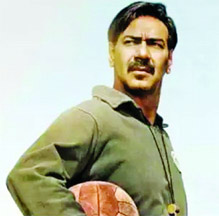
Ajay Devgn’s ‘Maidaan’ releases on OTT, now streaming on Prime Video
Maidaan, the sports biopic, featuring Ajay Devgn, Priyamani, and Gajraj Rao, is now available for streaming on Prime Video from June 5. After its theatrical release on April 10, ‘Maidaan’ has made its digital debut after two months. The film is produced by Zee Studios, Boney Kapoor, Arunava Joy Sengupta, and Akash Chawla, and directed by national-award-winning filmmaker Amit Sharma.
Prime Video’s official X account announced the OTT release, captioning it as “Groundbreaking story of India’s finest hour in football.” Critics praised the movie, although it struggled to attract audiences to theatres. With the OTT release, viewers have another opportunity to watch the film. Maidaan tells the story of Indian football coach Syed Abdul Rahim and the golden era of Indian football from 1952 to 1962 under his leadership. This period was significant for Indian football, aiming to establish an identity for India and gain global recognition. -

Taapsee Pannu says it was not ‘love at first sight’ with husband Mathias Boe
Taapsee Pannu and longtime boyfriend and badminton player Mathias Boe married in Udaipur in March. Now in a new interview with Cosmopolitan India, the actor is opening up about her relationship with Mathias, and revealed that it was not ‘love at first sight’ for her. Instead, she took time in the relationship as she wanted to see how feasible it was for the both of them.
In the interview, Taapsee said that she has a soft spot for athletes and added, “It was not like a love-at-first-sight situation, for me at least—I took time to test if it’s really practical…the feasibility of the relationship was important for me. I was obviously fond of him and respected him, and we kept meeting and I grew to love him. So falling in love didn’t happen in a month or instantly. It is a fact though, which I keep repeating in most interviews about him—when I met him I felt like I met a man.”
She also said, “I had dated so many boys before him, and suddenly, I met a guy who didn’t feel like anyone I’d been with before. So there’s this sudden sense of security and maturity, which was so evident that I felt like ‘okay, you’ve finally found the man’.” Source: HT
Taapsee Pannu and longtime boyfriend and badminton player Mathias Boe married in Udaipur in March. Now in a new interview with Cosmopolitan India, the actor is opening up about her relationship with Mathias, and revealed that it was not ‘love at first sight’ for her. Instead, she took time in the relationship as she wanted to see how feasible it was for the both of them.
In the interview, Taapsee said that she has a soft spot for athletes and added, “It was not like a love-at-first-sight situation, for me at least—I took time to test if it’s really practical…the feasibility of the relationship was important for me. I was obviously fond of him and respected him, and we kept meeting and I grew to love him. So falling in love didn’t happen in a month or instantly. It is a fact though, which I keep repeating in most interviews about him—when I met him I felt like I met a man.”
She also said, “I had dated so many boys before him, and suddenly, I met a guy who didn’t feel like anyone I’d been with before. So there’s this sudden sense of security and maturity, which was so evident that I felt like ‘okay, you’ve finally found the man’.” Source: HT -

Kangana Ranaut: Slapped by CISF woman at Chandigarh airport
Chandigarh (TIP)– Newly elected Bharatiya Janata Party (BJP) MP Kangana Ranaut on Thursday, June 6, alleged she was slapped and abused by a woman constable of the Central Industrial Security Force (CISF) at the Chandigarh airport before she boarded a flight to Delhi.
While officials did not comment on the motive of the alleged assault, Ranaut appeared to link it to “extremism and terrorism” in Punjab although a video of the suspect appeared to suggest she lashed out over the Mandi MP-elect’s stand on the farmers’ protest.
“I was hit on the face, abused. I am safe but concerned about terrorism in Punjab,” Ranaut said in a video uploaded to her handle on X at 6.14pm with the caption “Shocking rise in terror and violence in Punjab.” The CISF constable, identified as Kulwinder Kaur, was immediately detained after the incident, and later suspended after Ranaut lodged a complaint with CISF officials on her arrival at the Indira Gandhi airport. The CISF was also in the process of filing a police complaint.
The incident occurred around 3pm at the security checkpoint ahead of Ranaut’s flight. While some reports suggested the confrontation occurred after Ranaut did not heed Kaur’s instructions to put her phone on the tray during the routine frisking, the BJP MP, in her video, alleged that the constable approached her from the side as she was waiting in the security check area, hit her and began hurling abuses at her, seemingly without any provocation. When Ranaut asked for the reason for her behaviour, Kaur allegedly told Ranaut that she was a supporter of the farmers protests.
“I am safe. I am perfectly fine. There was an incident at the Chandigarh airport during the security check. As I was leaving after completing security checking process, a woman CISF officer came from the side and hit me on the face. She began hurling abuses. When I asked her why she was doing this, she said she is a supporter of the farmers’ protest. I am safe but my question is how we end growing extremism and terrorism in Punjab,” Ranaut said in the video. Airport authorities, on condition of anonymity, confirmed that Kaur was unhappy with the actor-turned-politician’s stand on the farmers’ protest when she said that the agitators were people paid to demonstrate.
Ranaut’s flight, Vistara’s UK707 to New Delhi at 3.30pm, was delayed, eventually departing at 4.10pm. The BJP MP-elect was met by CISF officials from the airport and Delhi headquarters when she landed in the national capital, where she lodged an official complaint. The force is yet to issue a statement. But an official aware of the development in Chandigarh said, “Constable Kaur was immediately detained after the incident. Kangana Ranaut proceeded to board her flight. Punjab police officials also reached the airport.”
A senior CISF officer in Chandigarh said they were also in the process of registering a First Information Report (FIR) against the constable. Source: HT -
Rahul Gandhi granted bail by Bengaluru court in defamation case
Congress leader Rahul Gandhi was granted bail by a local Bengaluru court on Friday, June 7, in connection with a defamation case filed by a Bharatiya Janata Party (BJP) leader.
Special magistrate KN Shivakumar granted bail to Gandhi after he appeared in person.
The court has scheduled the next hearing for June 30.
The bail was secured with former Member of Parliament (MP) DK Suresh providing property worth ?75 lakh as security on Gandhi’s behalf.
BJP had pressed charges against the Congress leaders for disseminating false advertisements targeting its party leaders, including the then Chief Minister Basavaraj Bommai.
BJP MLC and general secretary Keshav Prasad had filed the defamation case alleging that 40% commission was charged for the execution of all public works.
The case was filed against Siddaramaiah, Shivakumar and Gandhi.
On June 1, Karnataka CM and deputy chief minister appeared before the 42nd Additional Chief Metropolitan Magistrate. -
Canada’s Trudeau says ‘ready to work with Modi govt to advance ties’
After months of strain in India’s diplomatic ties with Canada, Prime Minister Justin Trudeau Thursday congratulated his counterpart in New Delhi, Narendra Modi, for securing a third term in the Lok Sabha elections.
“Congratulations to Indian Prime Minister Narendra Modi on his electoral victory. Canada stands ready to work with his government to advance the relationship between our nations’ peoples — anchored to human rights, diversity, and the rule of law,” the Canadian Prime Minister’s official account on X quoted Trudeau as saying.
There has been bitterness in Canada and India’s relations ever since Trudeau’s comments last year, alleging India’s involvement in the killing of pro-Khalistani leader Hardeep Singh Nijjar. India has rejected Canada’s allegations.
In May this year, Canada “informed” India about the arrest of three individuals in connection with Nijjar murder case. India said that Ottawa has “not shared any specific or relevant evidence or information till date”. A fourth Indian national was arrested in Canada in connection with the case just days after. The Indian High Commissioner to Canada, Sanjay Kumar Verma, on May 7 warned that Sikh groups in Canada who call for the separation of their homeland from India are crossing “a big red line” that New Delhi sees as a matter of national security. He added that both the countries were trying to “resolve” the issue.
Modi is set to form the government for the third time after the National Democratic Alliance (NDA) Wednesday elected him as the leader of the bloc. -
TDP, JD (U) eye Lok Sabha Speaker’s post: Know the importance of the custodian of House
New Delhi (TIP)- The support for a numerically challenged BJP appears to be coming at a price with allies demanding key Cabinet/ministerial berths, special status for respective states and, as sources indicate, also the post of the Lok Sabha Speaker. While the demand for Cabinet and ministerial berths is understandable, the big question is why are Telugu Desam Party’s N Chandrababu Naidu and Janata Dal (U)’s Nitish Kumar clamouring for the Speaker’s post.
Notably, the TDP with 16 seats and the JD (U) with 12 seats hold the key to Prime Minister Narendra Modi Government 3.0. Normally, in a coalition, the party with largest number (in this case the BJP) keeps the post because of multiple reasons, the most critical being to ensure stability and security of its government.
Generally, the first agenda of the House is to elect the Speaker of Lok Sabha. Prior to that the President swears in the pro-tem Speaker who is normally the senior-most member of the House who then administers the oath or the affirmation to the newly elected members. Then the elected representatives become the members of the new Parliament and elect a Speaker from amongst themselves. As per convention, the post of Deputy Speaker is given to a member of the Opposition
For a party with a comfortable majority, like BJP in the past two tenures, the Speaker’s post has been mostly ceremonial. In fact, the post of the Deputy Speaker was also kept vacant.
But as the head of the Lok Sabha, the Speaker is the custodian of the House, maintains order in the House, can adjourn/ suspend proceedings in case of absence of decorum, etc. Importantly, the Speaker is also the final authority regarding rules and procedures, and for a party which may not be having a majority on its own, he or she also holds the key to its stability with final say in issues/disputes related to disqualification and situations like a vote of no-confidence against the government.
Experts say the Speaker’s role becomes important when it comes to proving majority on the floor of the House or in case the anti-defection law comes into play.
Take, for example, the classic case of the fall of BJP’s Atal Behari Vajpayee’s 13-month government in 1999 by just one vote. Cutting the long story short, Giridhar Gamang, who had just become the Congress Chief Minister in Odisha, was allowed to vote in the confidence motion against the government by the Speaker who left the decision to the “conscious” of the voter. Interestingly, to achieve the majority, the then BJP-led NDA had offered the post of Speaker to the TDP, following which GMC Balayogi, party MP from Amalapuram, was appointed the Speaker.
“When it comes to the Lok Sabha, the Speaker’s decision is final. The TDP, which has been a part of several coalition governments, knows the importance of the post,” say experts. Source: TNS -
Court denies bail to Arvind Kejriwal, says he’s fine
The extensive campaigning tours and related events undertaken by Delhi Chief Minister Arvind Kejriwal indicate that he does not appear to be suffering from any serious or “life threatening” ailment, a Delhi court has held while denying him interim bail.
In yet another setback to Kejriwal, the court on June 5 dismissed his application for interim bail on medical grounds in the money laundering case linked to the alleged excise policy scam, as reported by the PTI.
“The extensive campaigning tours and related meetings or events undertaken by Arvind Kejriwal as highlighted during the course of arguments indicate that he does not appear to be suffering from any serious or ‘life threatening’ ailment so as to entitle him to the benefit,” Special Judge Kaveri Baweja said. The judge also extended Kejriwal’s judicial custody till June 19. The court is scheduled to take up on June 7 his application seeking default bail in the case.
In the order, the judge further held that grant of interim bail for conducting tests in order to determine if high ketone levels or the stated weight loss could have caused Diabetic Ketoacidosis “stands on an even weaker footing than a medical ground”. -
Cong effectively at 100, talks on LoP set to start
New Delhi (TIP)- Sangli parliamentarian Vishal Patil on Thursday, June 6, extended his support to the Congress, taking the effective tally of the party to 100 even as it fixed two crucial meetings over the next two days that will shape its legislative and political agenda and take a call on naming the new Leader of Opposition (LoP).
Patil, the grandson of former Maharashtra chief minister Vasantdada Patil, was with the Congress, but fought the elections as an independent after ally Uddhav Thackeray staked claim to the Sangli seat. He emerged victorious by around 100,000 votes. His inclusion helps the Congress effectively touch three figures for the first time in a decade after two dismal showings in 2014 and 2019.
“The people of Maharashtra defeated the politics of treachery, arrogance and division. It is a fitting tribute to our inspiring stalwarts like Chhatrapati Shivaji Maharaj, Mahatma Jyotiba Phule and Dr Babasaheb Ambedkar who fought for social justice, equality and freedom. We welcome the support of the elected MP from Sangli Vishal Patil to the Congress party,” said Congress chief Mallikarjun Kharge.
The morale booster came a day before the party holds its legislative party meeting on Friday with its newly elected 99 members and Rajya Sabha parliamentarians. Another meeting of the top decision-making body, the Congress Working Committee (CWC), will be held on Saturday morning to discuss the 2024 campaign and strategy.
At both meetings, top of the leaders’ minds is likely to be the question of appointing the leader of Opposition (LoP). In both 2014 and 2019, the Congress fell short of the 10% seat benchmark required for appointing an LoP .
Though it is not officially part of the agenda, party leaders said that the issue will be discussed with Kharge likely to make a push for Rahul Gandhi, who is credited for reviving the party in the heartland after two lacklustre outings.
Gandhi won both his seats of Rae Bareli and Wayanad with significant margins. The 53-year-old is also favoured by Kharge for two reasons, said the people cited above. First, Gandhi is a strident opponent of Narendra Modi and the Sangh Parivar. The party believes having him as LoP will energise the party in Parliament and put the government on the defensive. Two, the party thinks Gandhi’s Bharat Jodo Yatras gave him a larger worldview. Source: HT -

Rahul Gandhi alleges ‘biggest stock market scam’, demands JPC probe
New Delhi (TIP)- Congress leader Rahul Gandhi on Thursday, June 6, demanded a joint parliamentary committee (JPC) investigation into what it calls the ‘biggest stock market scam’.
“Why did the PM and Union Home Minister give specific investment advice to the five crore families investing in the stock market? Is it their job to give investment advice? Why were both interviews given to the same media owned by the same business group which is also under SEBI investigation for manipulating stock?” Gandhi said at a press briefing.
“What is the connection between the BJP, the fake exit pollsters and the dubious foreign investors who invested one day before the exit polls were announced and made a huge profit at the cost of five crore salaries?” he added.
“We demand a JPC into this. We are convinced that this is a scam. Somebody has made thousands of crores of rupees at the cost of Indian retail investors and the Prime Minister and the Union Home Minister have given an indication to buy. So we demand today a joint parliamentary committee to investigate this,” Rahul Gandhi was quoted by ANI as saying.
On May 23, Prime Minister Narendra Modi had said that the stock market will hit new highs after the Lok Sabha election results. “I can say with confidence that on June 4, as BJP hits record numbers, the stock market will also hit new record highs,” he had said.
On May 13, Union home minister Amit Shah had urged not to link the stock market movements directly to the ongoing Lok Sabha elections.“The market has nosedived in the past as well. So one should not link it directly to elections. Anyway, some rumours may have fuelled it (the fall). In my opinion, buy before June 4. The market is going to shoot-up,” the minister had told NDTV profit.
Rahul Gandhi alleged that PM Modi and Union home minister who had data on actual election results, advised retail investors to buy stock.
“This is a broader issue than just the Adani issue. It is connected to the Adani issue, but this is a much broader issue. This is directly the Prime Minister, the Union Home Minister, who is privy to data on actual election results, who has IB reports, who have their own data, who are advising retail investors to buy stock,” he said.
“This has never happened before. The Prime Minister has never commented on the stock market before. This is the first time the Prime Minister has commented very interestingly and multiple times, one after the other, saying that the stock market is going to boom,” he added.
“At the same time, he has information that the exit polls are wrong. He has information that he knows what is going to happen because he has IB data and he also has his own party data,” Rahul Gandhi further alleged. -

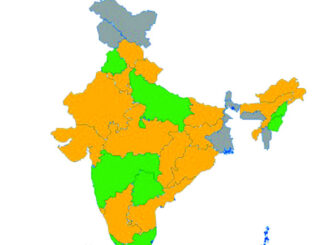
BJP’s vote share shrinks in most states with low growth rates in per capita income
New Delhi (TIP)- The Bharatiya Janata Party’s (BJP’s) vote share in the 2024 general electioncontracted in most of the states and union territories (UTs) that had relatively low rates of growth in per capita income since the previous Lok Sabha polls in 2019, shows an analysis of Election Commission of India (ECI) data and per capita net state domestic product (NSDP) data from states. NSDP per capita is taken as the per capita incomeof a state and is counted among states’ key economic indicators.
Of the 12 states and UTs where per capita NSDP grew by a compounded annual growth rate (CAGR) of up to 2 per cent, and where the BJP contested in the recently-concluded Lok Sabha elections, the party’s vote share shrunk in nine. These nine states and UTs include Bihar, Maharashtra, Jharkhand, Haryana, Delhi, Uttarakhand, Goa, Manipur, and Chandigarh. Kerala, Sikkim, and Andaman and Nicobar Islands were the outliers to the trend.
For the purpose of this analysis, the CAGR of per capita NSDP was divided in three segments: low (up to 2 per cent), medium (2.1-4.0 per cent), and high (over 4 per cent). Among all states and UTs, the overall range of per capita NSDP CAGR ranged up to 6.1 per cent. CAGR was considered over absolute growth as per capita NSDP data for some states was not updated for 2023-24 (FY24) and was available either till FY23 or FY22. The base year for the comparison was taken as FY19. A few UTs that do not maintain per capita NSDP data were not considered.
While the data does suggest a correlation between per capita state income and the BJP’s vote share among most of the low-growth states, the trend is not as stark when it comes to states and UTs in the middle- and high-growth segments.
It is worth noting that like most economic indicators, per capita incomes and their growth rates vary across states and are contingent upon a number of factors and conditions. Also, election outcomes depend on a host of factors — many of which are not directly linked to the economy — and their various permutations and combinations.
Among the nine states with a per capita NSDP growth rate of over 4 per cent, the BJP registered an expansion in vote share from 2019 levels in five — Andhra Pradesh, Assam, Odisha, Chhattisgarh, and Tamil Nadu. Four states — Gujarat, Rajasthan, Karnataka, and Arunachal Pradesh, saw a contraction in the BJP’s vote share despite a relatively high rate of growth in their per capita incomes.
Similarly, the BJP’s vote share expanded in five of the nine states and UTs with per capita NSDP growth rate of 2.1 per cent to 4 per cent. These five states included Madhya Pradesh, Punjab, Telangana, Tripura, and Mizoram. The four where the BJP saw a decline in vote share were Uttar Pradesh, West Bengal, Himachal Pradesh, and Jammu & Kashmir.
41 parties to have MPs in 18th Lok Sabha; 339 members from BJP, Congress alone
As many as 41 political parties will have representation in the upcoming 18th Lok Sabha, with this number rising from 36 in the 17th Lok Sabha that was dissolved on Wednesday, post-poll data shows.
The two largest outfits – the ruling Bharatiya Janata Party (BJP) and the opposition Congress – will have 339 MPs in the 543-member House (BJP: 240, Congress: 99). The BJP, which fell 32 seats short of what would have been its third consecutive single-party majority (282 seats in 2014, and 303 in 2019), the Congress increased its tally from 44 seats in 2014 and 52 five years later.
The BJP, however, is set to form its third successive government at the Centre with help of its National Democratic Alliance (NDA) partners – Prime Minister Narendra Modi is likely to take oath on June 8 for what will be his third consecutive term in office. The NDA parties won 293 seats in the Lok Sabha.
The Congress-led INDIA bloc, on the other hand, will have 233 MPs, with Samajwadi Party (SP), the grand old party’s Uttar Pradesh-based ally, winning 37 seats in the country’s most populous state, making the Akhilesh Yadav-led party the largest after the BJP and Congress. The SP is followed by fellow INDIA members: West Bengal’s ruling Trinamool Congress (29 seats) and the DMK (22 seats), which governs Tamil Nadu.
National parties to have 64% seats
According to an analysis by the think-tank PRS, political outfits recognised as “national parties” secured 346 or 64% seats, while regional parties won 197 (33%) seats.
Candidates from non-NDA/INDIA parties clinched 17 seats, including seven by independents.
As per Association for Democratic Reforms (ADR), a poll rights body, the recently-concluded Lok Sabha elections were contested by 751 parties, up 104% from 2009, when nominees from 368 parties were in the fray. The number of parties that contested in 2014 and 2019 was 464 and 677, respectively, ADR said.
In the upcoming 18th Lok Sabha, as many as 526 candidates will be from the BJP-led National Democratic Alliance (NDA), which won 292 seats in the recently-held general elections, and the Congress-led INDIA bloc, which bagged 234 seats. The remaining 17 to-be Members of Parliament (MPs) do not belong to either bloc; seven of them contested and won as independents.
Who are these seven independents?
They are Amritpal Singh, Sarabjeet Singh Khalsa, Patel Umeshbhai Babubhai, Mohamad Haneefa, Rajesh Ranjan alias Pappu Yadav, Vishal Patil, and Sheikh Abdul Rashid alias Rashid Engineer. Two are currently in jail: Amritpal Singh and Rashid Engineer.
Profile
Amritpal Singh: Amritpal, who heads pro-Khalistan outfit Waris Punjab De, is currently lodged in Assam’s Dibrugarh jail under the National Security Act (NSA). He returned to India in September 2022 from Dubai, where he moved in 2012 to join his family’s transport business.
Sarabjeet Singh Khalsa: He is the son of Beant Singh, one of the two bodyguards who assassinated then-Prime Minister Indira Gandhi in October 1984. Singh’s grandfather, Baba Sucha Singh, also served as a Lok Sabha member, representing Bathinda.
Patel Umeshbhai Babubhai: Babubhai is a social worker, according to ADR. His victory is significant as he defeated sitting BJP MP Lalubhau Babubhai Patel, who was seeking a fourth successive term from the Daman and Diu seat.
Mohmad Haneefa: A former district president of the National Conference, Haneefa is the fourth independent to win the Ladakh seat, which came into existence in 1967. Independents won here in the 1984, 2004, and 2009 national election as well.
Rajesh Ranjan: Also known as Pappu Yadav, Ranjan merged his Jan Aadhikar Party (JAP) with the Congress in March. Ranjan, who has served multiple terms as a Lok Sabha member, contested independently after the Congress gave Purnia to the Rashtriya Janata Dal (RJD) under their seat-sharing agreement.
Vishal Patil: The grandson of former Maharashtra chief minister Vasantrao Patil rebelled against the Congress after the grand old party’s ally, Shiv Sena (UBT), fielded its own candidate.
Sheikh Abdul Rashid: Engineer Rashid is currently lodged in Delhi’s Tihar Jail in a terror-funding case. The former two-time legislator was arrested by the National Investigation Agency (NIA) in 2019 on charges of terror-funding activities, becoming the first mainstream leader to be held under the Unlawful Activities (Prevention) Act. -
5 biggest winners and losers
Biggest winners
PM Narendra Modi (Varanasi)

Prime Minister Narendra Modi has won the Varanasi seat for a third consecutive time as per the results for the 2024 Lok Sabha elections against Congress’s Ajay Rai. Modi won the seat with 6,12,970 votes (54.24%) while Rai got 4,60,457 votes (40.74%). However, this success came along with a little bitterness as Modi’s share dropped by around 9 percentage vis-a-vis 2019.
Varanasi is one of the most high-profile constituencies among the 543 Lok Sabha seats in India as it is represented by Prime Minister Narendra Modi. The constituency has been a saffron party’s stronghold since 1991 and PM Modi has represented the seat since 2014. PM Modi won the seat by a massive margin of 479,505 votes in the Lok Sabha elections 2019, defeating Shalini Yadav of the Samajwadi Party (SP) and Ajai Rai – who came third. In 2014, the Prime Minister defeated Aam Aadmi Party (AAP) supremo and Delhi Chief Minister Arvind Kejriwal by 371,784 votes.Home Minister Amit Shah (Gandhinagar)

Union Home Minister Amit Shah has secured a landslide victory in the Gandhinagar Lok Sabha seat in Gujarat after he gained an unassailable lead of over seven lakh votes against his nearest Congress rival Sonal Ramanbhai Patel. As per latest Election Commission data, Shah got 10,10,972 votes in total, while Patel received 2,66,256 votes. In 2019 Lok Sabha elections, Amit Shah won this seat by more than 5.57 lakh votes, defeating Congress’s Chatursinh Javanji Chavda.
The BJP won the Gandhinagar seat for the first time in 1989 and has been ruling the seat since then. It has been represented by prominent political figures such as former PM Atal Bihari Vajpayee and former Deputy PM LK Advani.Defence Minister Rajnath Singh (Lucknow)

Defense Minister Rajnath Singh won from the Lucknow constituency in Uttar Pradesh by over 1.35 lakh votes defeating his nearest rival Ravidas Mehrotra of the Samajwadi Party. Singh polled 612709 votes, while Mehrotra got 477550 votes. The margin stood at 135159 votes. In the 2019 elections, Singh defeated SP candidate Poonam Sinha, the wife of Shatrughan Sinha, by a margin of almost 3.5 lakh votes. Back in 2014 elections, Singh won with a huge margin of 2,72,749 votes by defeating Congress’s Rita Bahuguna.
However, Bahuguna left Congress in October 2016 and joined BJP. In 2019, NDA won 64 Lok Sabha seats in UP with BJP’s tally alone being 62 and the BJP-led alliance winning 39 in Bihar. This Lok Sabha seat has been a BJP bastion since 1991, having been represented by Atal Bihari Vajpayee five times.
Former Congress chief Rahul Gandhi (Wayanad and Rae Bareli)

Former Congress President Rahul Gandhi won the Wayanad Lok Sabha seat in Kerala with a margin of over 3.5 lakh votes against CPI’s Annie Raja who is a part of INDIA alliance. Gandhi got 6,47,445 votes which was lower than the 7,06,367 votes he got in 2019 from the same constituency.
This time he won by a margin of 3,64,422 votes against his nearest rival, CPI’s Annie Raja who got 2,83,023 votes. In 2019, Rahul bagged 7,06, 367 votes while his main rival PP Suneer of the CPI managed to get 2,74,597 votes. Similarly, in the traditional Congress bastion of Rae Bareli, Rahul Gandhi beat the BJP’s Dinesh Pratap Singh, again Samajwadi Party chief Akhilesh Yadav (Kannauj)
Samajwadi Party under the leadership of Akhilesh Yadav emerged as the dominant force in Uttar Pradesh, which is likely to haunt the saffron party for the times ahead. SP has secured a total of 37 seats out of a total of 80 seats. Akhilesh Yadav himself achieved a notable victory in Kannuj against Subrat Pathak of the BJP with a decisive margin of 1,70,922 votes. Kannauj Lok Sabha constituency has been a traditional SP seat for decades. In the year 1967, Ram Manohar Lohia won the election as a Samyukta Socialist Party candidate, following which Janata Party held the seat twice.Biggest losers
BJP’s Smriti Irani (Amethi)

Smriti Irani, Union Minister for Women and Child Development, who defeated Rahul Gandhi in 2019, has lost in Uttar Pradesh’s Amethi constituency against Congress’ Kishori Lal by a margin of 1,67,196 votes. According to the Election Commission data, Congress’s Sharma won by a margin of over 1,67,000 votes while Irani received 3,72,032 votes. Amethi, established as a constituency in 1967, had long been a stronghold of the Congress, represented by key figures of the Nehru-Gandhi family, including Rahul Gandhi, Sonia Gandhi, Sanjay Gandhi, and Rajiv Gandhi. The Gandhi family legacy in Amethi was broken by Irani after she defeated Rahul Gandhi, marking a significant shift in the constituency’s political landscape back in 2019. She had won with a margin of 55,120 votes in the 2019 election, with a vote share of 49.69%. In 2014, Congress leader Rahul Gandhi had won his third term as Member of Parliament with a total of 6,44,822 votes and a vote share of 46.72%.Former Jammu and Kashmir Chief Minister Omar Abdullah (Baramulla)

Former Jammu Kashmir Chief Minister Omar Abdullah lost the battle against jailed Independent Sheikh Abdul Rashid, popularly known as Engineer Rashid from the Baramulla Lok Sabha constituency. Engineer Rashid defeated junior Abdullah by a margin of 2,04,142 votes. While Rashid garnered 4,72,481 votes, Abdullah was polled 2,68,339 votes.
Sajjad Gani Lone ended up as second runner up with 1,73,239 total votes polled. In the 2019 Lok Sabha Elections, Jammu and Kashmir National Conference (JKNC) leader Mohammad Akbar Lone defeated Jammu and Kashmir People’s Conference Raja Aijaz Ali by a margin of 30,233 votes. Lone was polled 133,426 votes with a vote share of 29.00 per cent, while Ali got 103,193 votes with 22.63 per cent vote share.PDP Supremo Mehbooba Mufti (Anantnag-Rajouri)
Former Chief Minister of Jammu Kashmir Mehbooba Mufti conceded defeat in the Anantnag-Rajouri constituency against National Conference’s Mian Altaf Ahmad. Mian Altaf polled 521836 votes while Mufti got 240042 votes.
BJP candidate Madhavi Latha (Hyderabad)Asaduddin Owaisi retained the Hyderabad Lok Sabha Seat with a margin of over 3.3 lakh votes against his nearest rival, BJP’s controversial new entrant Madhavi Latha, who stood second, in the constituency dominated by AIMIM since decades. Owaisi secured 6,61,981 votes against Madhavi Latha’s 3,23,894.
NCP candidate Sunetra Pawar (Baramati)
Sunetra Pawar, wife of NCP’s Ajit Pawar who broke the party last year, lost to Sharad Pawar’s daughter Supriya Sule by a margin of over 1.5 lakhs. Pawar received 5.73 lakhs votes while Sule got 7.3 lakhs. In 2019, Sule defeated Bharatiya Janata Party’s Kanchan Rahul Kul with a vote margin of 11.94%. She secured 52.63% of the vote share, while Kul received 40.69%.
-

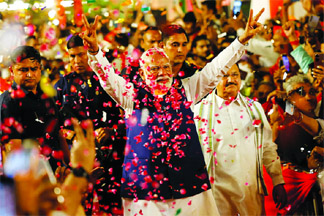
Modi claims victory in Indian election, vows to continue with his agenda despite drop in support
New Delhi (TIP)- Prime Minister Narendra Modi declared victory Tuesday for his alliance in India’s general election, claiming a mandate to push forward with his agenda, even though his party lost seats to a stronger than expected opposition, which pushed back against his mixed economic record and polarizing politics.
“Today’s victory is the victory of the world’s largest democracy,” Modi told the crowd at his party’s headquarters, saying Indian voters had “shown immense faith” both in his party and his National Democratic Alliance coalition.
Official results from India’s Election Commission showed the NDA won 286 seats, more than the 272 seats needed to secure a majority but far fewer than had been expected.
Modi’s win was only the second time an Indian leader has retained power for a third term after Jawaharlal Nehru, the country’s first prime minister. But also, for the first time since his Hindu nationalist Bharatiya Janata Party swept to power in 2014, it did not secure a majority on its own, winning 240 seats —- far fewer than the record 303 it won in the 2019 election.
That means Modi will need the support of other parties in his coalition — a stunning blow for the 73-year-old, who had hoped for a landslide victory.
The party may now be “heavily dependent on the goodwill of its allies, which makes them critical players who we can expect will extract their pound of flesh, both in terms of policymaking as well as government formation,” said Milan Vaishnav, director of the South Asia Program at the Carnegie Endowment for International Peace.
More than 640 million votes were cast in the marathon election held over a span of six weeks in the world’s largest democratic exercise.
In the face of the surprising drop in the BJP’s support, challengers claimed they had also won a victory of sorts, with the main opposition Congress party saying the election had been a “moral and political loss” for Modi. “This is public’s victory and a win for democracy,” Congress party President Mallikarjun Kharge told reporters.
Despite the setback, Modi pledged to make good on his election promise to turn India’s economy into the world’s third biggest, from its current fifth place, and not shirk with pushing forward with his agenda.
He said he would advance India’s defense production, boost jobs for youth, raise exports and help farmers, among other things.
“This country will see a new chapter of big decisions. This is Modi’s guarantee,” he said, speaking in the third person. Many of the Hindu nationalist policies he’s instituted over the last 10 years will also remain locked in place.
Before Modi came to power, India had coalition governments for 30 years.
The opposition INDIA coalition won 225 seats and was leading in five others yet to be called early Wednesday morning. Congratulations for Modi from leaders of regional countries including neighboring Nepal and Bhutan flowed in, while the White House commended India for its “vibrant democratic process.”
In his 10 years in power, Modi has transformed India’s political landscape, bringing Hindu nationalism, once a fringe ideology in India, into the mainstream while leaving the country deeply divided.
His supporters see him as a self-made, strong leader who has improved India’s standing in the world. His critics and opponents say his Hindu-first politics have bred intolerance while the economy, one of the world’s fastest-growing, has become more unequal.
For Payal, a resident of the northern city of Lucknow who uses only one name, the election was about the economy and India’s vast number of people living in poverty.
“People are suffering, there are no jobs, people are in such a state that their kids are compelled to make and sell tea on the roadside,” Payal said. “This is a big deal for us. If we don’t wake up now, when will we?”
Rahul Gandhi, the main face of the opposition Congress party, said he saw the election numbers as a message from the people. “The poorest of this country have defended the constitution of India,” he told a news conference.
Modi’s popularity has outstripped that of his party’s during his first two terms in office, and he turned the parliamentary election into one that more resembled a presidential-style campaign, with the BJP relying on the leader’s brand.
“Modi was not just the prime campaigner, but the sole campaigner of this election,” said Yamini Aiyar, a public policy scholar.
Under Modi’s government, critics say India’s democracy has come under increasing strain with strong-arm tactics used to subdue political opponents, squeeze independent media and quash dissent. The government has rejected such accusations and says democracy is flourishing.
Economic discontent has also simmered under Modi. While stock markets have reached record-highs, youth unemployment has soared, with only a small portion of Indians benefitting from the boom. As polls opened in mid-April, a confident BJP initially focused its campaign on “Modi’s guarantees,” highlighting the economic and welfare achievements that his party says have reduced poverty. With Modi at the helm, “India will become a developed nation by 2047,” he repeated in rally after rally. But the campaign turned increasingly shrill, as Modi ramped up polarizing rhetoric that targeted Muslims, who make up 14% of the population, a tactic seen to energize his core Hindu majority voters.
The opposition INDIA alliance attacked Modi over his Hindu nationalist politics, and campaigned on issues of joblessness, inflation and inequality. “These issues have resonated and made a dent,” added Aiyar, the public policy scholar. Source: AP -

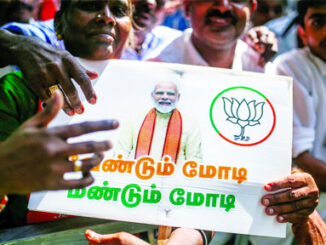
Southern India remains BJP’s weak point
New Delhi (TIP)- Ahead of the election results, all talk was about the Bharatiya Janata Party significantly expanding its presence in the southern part of the country, improving its seat and vote share. To some extent, the party achieved this — it won eight seats in Telangana, up from four in 2019, with its vote share increasing from 19.5% to 35.2%; it won three seats in Andhra Pradesh, thanks to its alliance with the Telugu Desam Party and the Jana Sena, with its vote share increasing from 0.96% to 11.3%; and it won one in Kerala, with its vote share increasing from 12.9% to 16.7%, and comparing well with the LDF’s 33.3%.
But in the state where it expected to take over the mantle of main opposition from its erstwhile ally, the AIADMK, and where it is led by the vocal and articulate K Annamalai, considered by many to be a next-gen leader of the BJP, the party managed to increase its vote share only to 11.3% from 3.6%, and won no seats. Even Tamilisai Soundararajan, the former governor of Telangana who resigned her post to contest from Chennai South lost to her DMK rival, Thamizhachi Thangapandian.
And in Karnataka, where it won 25 of the 28 seats on offer in 2019 (and supported an independent who won the 26th), the BJP won 17 seats (19 with its ally JDS), with a 46.1% share of the vote, down from 51.4% in 2019.
Taken together, that isn’t all-that-bad a performance, but it is definitely not as good as the party would have wanted — and not good enough to offset losses in UP, West Bengal, and Maharashtra. It is also not commensurate with the effort put in by the party, and its campaigner-in-chief, Prime Minister Narendra Modi.
The BJP’s southern focus began soon after its triumph in 2019, when it won the Lok Sabha elections with a massive mandate but failed to secure any seats in three states, Tamil Nadu, Andhra Pradesh and Kerala.
Three years earlier, the BJP had drawn up a plan to transcend the barriers in the southern and eastern states that made up the coromandel belt. But, while it won 18 of the 42 seats in West Bengal and 8 of the 21 in Odisha, the southern states barring Karnataka proved to be insurmountable fortress.
“This did not sit well with the party bosses. Both Prime Minister Narendra Modi and home minister Amit Shah were emphatic that for the BJP to grow as a formidable political entity it will have to shatter the impression that it is a north Indian party or that it is no match to the regional parties,” said a senior party leader familiar.
State units were instructed to work out details of restructuring the party units, mobilising cadre, identifying leaders with mass appeal, aligning with parties that had a hold over influential vote banks and propagate Brand Modi.
“After 2014, Modi became a household name and was popular across castes and classes. While this showed in results in nearly all of North India and large parts of the west, there was a gap in the South. We had to then focus on the power of the brand and build a bridge between Modi and south,” said the leader quoted above.
In each of the five states the outreach was designed keeping in mind cultural sensitivities, local traditions, demography and floating voters who were not opposed to BJP and its brand of Hindutva.
It wasn’t enough. The INDIA bloc, led by the DMK in Tamil Nadu, won all 39 seats. In Karnataka, the Congress managed to win nine seats, eight more than in 2019. And in Kerala, the UDF won 18 seats and the LDF, one.
But local leaders pointed to the vote share
“One should not only look at the seats, but also, at the vote share. Between 1967 and 2024 the combined vote share of the AIDMK and the DMK has been between 67 to 74%. This time it is below 50%… the BJP’s has risen to 10% from 3.6% in 2019. From now on politics in the state, will be tripolar. The BJP’s march towards winning the assembly polls begins now,” said R Srinivasan, general secretary of the BJP’s Tamil Nadu unit and its candidate from Madurai.
In Kerala, where its decision to raise the Sabarimala issue ended up benefiting the Congress in 2019, the BJP opted for development over Hindutva, but could not convert the rise in vote share into more than a single seat, with efforts to build bridges with both Christians and the powerful Ezhava community which accounts for 23% of the electorate coming a cropper. It will also not escape the BJP’s attention that some of its success in the south has come on the back of alliances.
The power of alliances
In Karnataka, the JDS, a family-run party that had been in the BJP’s crosshairs for perpetrating dynasty politics, was inducted into the NDA to shore up the numbers after losing the state polls in 2023. The JDS’s hold over the Vokalliga vote bank was considered a key reason for the alliance. The public outrage over allegations of sexual harassment and rape against JDS scion and Hassan lawmaker Prajwal Revanna may have hurt the BJP, but the alliance has helped it in the state. The JD(S) itself has won two seats.
In Andhra Pradesh, where the party’s organisational capacity has come in for censure from the central leadership on more than one occasion, the tie up with Chandrababu Naidu’s TDP and Pawan Kalyan’s Jana Sena paid off. The TDP broke its ties with the BJP in 2018 over the issue of delay in granting special status to the state but has emerged as a dependable ally adding to NDA’s overall tally. The BJP won 3 seats in the state, and the alliance 21, of a total of 25.
Driving the narrative
The party attempted to drive the narrative in each of the states. Whether it was attacking the Pinnarayi Vijayan government in Kerala for corruption and irregularities or the Karnataka government for mooting reservation for Muslims under the OBC quota, the BJP kept stoking the fire. In Telangana it went all out against the BRS, accusing the party of irregularities. And with the help of governors, it also targeted state governments, most notably in Tamil Nadu.
None of this seems to have worked.
“There were many deficiencies. For instance we could not counter the fears that the new delimitation exercise to be carried out after 2026 will result in the southern states losing out on seats…or the BJP wants to withdraw quotas” said a second BJP leader who asked not to be named.
The leadership issue
Although PM Modi was the central figure of the BJP’s outreach in the south, the party groomed new faces to emerge as leaders on the ground. Consequently, a bunch of new leaders dominated the headlines, in Tamil Nadu, the BJP hustled its way into the political arena, led by a young and belligerent K Annamalai.
In Telangana , while Bandi Sanjay led the campaign against the BRS with a state-wide Yatra, he was abruptly replaced by union minister G Kishen Reddy as the state president and in Andhra, D Purandeswari became the first woman state president.
Yet, none of them managed to take on the regional satraps. Source: HT -
UP, Bengal, Maharashtra: The three states that dealt the biggest blow to BJP
New Delhi (TIP)- They are the three biggest states in the Union that together send 170 parliamentarians to the 543-member Lok Sabha, roughly making up a third of the strength of the Lower House. Stretching from the north of the country to its western and eastern extremities, they’re a microcosm of the country’s political dynamics, representing its diversity of regions and religions, a complex web of caste and class politics, and a mind-boggling cornucopia of political personalities.
When the results streamed in on Tuesday, it was these three provinces — Uttar Pradesh (UP), Maharashtra and West Bengal — that dealt the biggest blow to the Bharatiya Janata Party and the National Democratic Alliance (NDA). In UP, the BJP dropped from 62 to 35, its worst showing since 2009; in Maharashtra, the party slipped from 23 to 12; and in Bengal, it declined from 18 to 10.
In total, the BJP won only 57 of the 170 seats on offer, almost half of its 2019 tally of 103. The BJP-led National Democratic Alliance won 36 in UP, 19 in Maharashtra and 10 in Bengal — a total of 65, again roughly half of the 123 seats the alliance won in 2019.
In contrast, the Opposition’s Indian National Developmental Inclusive Alliance (INDIA) posted superlative results in each of these three provinces as it got caste arithmetic and ticket selection right (UP), cashed in on the ground connect of its leaders and their welfare and organisational network (Bengal) and successfully pinned down the BJP on key local issues and questions of regional pride (Maharashtra).
INDIA’s tally ballooned from 42 in 2019 to 100 in 2024 in these states as each constituent of the bloc held its own against a BJP onslaught, skillfully countering the incumbent’s pitch on welfarism, communalism and Prime Minister Narendra Modi’s popularity with its own unique campaign focussed on local issues and charisma.
In UP, India’s most-populous state, the SP-Congress alliance stunned NDA by posting its best results in 15 years. SP chief Akhilesh Yadav focussed on expanding the caste base of his party beyond its traditional Yadav and Muslim communities as he nominated a large chunk of leaders from smaller groups of both other backward classes and scheduled castes — two demographics the BJP co-opted in its two victories in assembly elections in 2017 and 2022, and two Lok Sabha wins in 2014 and 2019. The SP’s approach to widen its caste coalition played huge dividends as it smashed through the BJP citadel in the old Mandal playground of eastern UP and picked up critical seats in central and western regions. The party, along with its ally Congress, spoke about unemployment among young people and raised fears of the BJP amending the Constitution if it came back with a two-thirds majority — drawing a sharp contrast from the BJP’s campaign rife with pitched communal rhetoric with Modi alleging that the Opposition would give reservations away to Muslims.
In Maharashtra, which saw two regional powerhouses split vertically in the past three years, the elections were uniquely complex with six major parties in the fray. Since no polls were conducted since the 2019 assembly elections, the 2024 Lok Sabha exercise was also a referendum on which faction of the Shiv Sena or the Nationalist Congress Party would inherit the legacy of the parent.
Uddhav Thackeray and Sharad Pawar went into the elections battling significant odds. Their Maha Vikas Aghadi government was toppled and the Election Commission awarded their rivals — Eknath Shinde’s faction and Ajit Pawar’s faction — the poll symbols and party names mere months before polls were called.
But the results clearly showed that the people had decisively backed the original leaders over their rivals. Out of 12 seats where the two Sena factions were pitted against each other, Thackeray won eight and Shinde won four. Sharad Pawar won both seats where his faction faced Ajit Pawar, including the prestige battle of pocket borough Baramati, where his daughter Supriya Sule defeated Ajit Pawar’s wife Sunetra Pawar.
The Congress, too, posted superlative results, winning back its old bastion of Vidarbha on the back of discontent among cultivators and anger in the hinterland over incomes. Especially in seats such as Nanded, where senior leader Ashok Chavan switched to the BJP ahead of the polls, the victory will give heart to a party that ruled Maharashtra in coalition with the NCP for 15 years.
“The results have changed the national scenario and Maharashtra has played a big role in this,” Sharad Pawar said. “The results in Uttar Pradesh had given a new direction to the INDIA alliance.”
And in West Bengal, where a fierce campaign unfolded with the BJP making a huge push to maximise seat count in a state where it has slowly but surely built a base, chief minister Mamata Banerjee held her own. Despite being hamstrung by two adverse high court orders — one that cancelled the appointment of 26,000 teachers and another cancelling OBC certificates awarded to 77 Muslim groups — Banerjee crafted a campaign that focussed on her unique connect with the state’s electorate, especially rural women and her expansive welfare net, including direct cash transfer schemes such as Lokhhir Bhandar. The BJP attempted to attack her directly and fanned communal rhetoric, hoping to cash in on anti-incumbency to break the TMC’s hold over south Bengal.
The results, however, showed that the TMC not only held its bastion of south Bengal but also damaged the BJP in the western regions of Jangalmahal and north Bengal. The BJP was locked in close fights even in seats such as Balurghat, held by its state chief Sukanta Majumder and lost Coochbehar, held by Union minister of state Nisith Pramanik. Banerjee’s charisma and local pitch helped her replicate her 2021 assembly triumph and better her 2019 showing.
Addressing a press conference, Banerjee said, “PM Modi has lost all credibility, he should immediately resign. India has won, Modi has lost.”
The story of the BJP’s inability to cross the 250 mark in terms of seats, is really the story of its failure in the three electorally most important states in the country.
Source: HT -

Lok Sabha Election Results 2024: Decoding the Verdict
New Delhi (TIP)- How will the third Narendra Modi government differ from the two previous ones that came to power in 2014 and 2019? The answer will lie in the composition of the Eighteenth Lok Sabha. Here are a few things that will change.
After a decade, back to days of coalitions at the Centre
For the better part of the last 34 years, India has been governed by a coalition of political parties. It is only in the last 10 years that a single political party — the Bharatiya Janata Party (BJP) — led a majority government at the Centre, crossing the halfway mark in the Lok Sabha elections of 2014 and 2019. Be that as it may be, the biggest structural reforms and rights-based programmes happened during the last 30-plus years, the seeds of most of which were sown during the coalition era.
The BJP had won or was leading in 240 seats at midnight on Tuesday, short of the majority mark of 272 by a long way. It will have to depend on its pre-poll allies, the top four being the Telugu Desam Party led by Chandrababu Naidu, the Janata Dal (United) led by Nitish Kumar, Shiv Sena led by Eknath Shinde, and Lok Janshakti Party (Ram Vilas) led by Chirag Paswan.
The TDP had won or was leading at 16 seats, the JD(U) had won 12, the Shiv Sena had won 7, and the LJP (Ram Vilas) had won 5 seats. Together, these parties will bring 40 seats to the NDA. The BJP will need all these seats to comfortably go past the half-way mark of 272.
The (undivided) Sena and JD(U) were BJP allies earlier too, but with a crucial difference. Their withdrawal of support would not jeopardise the NDA government, given that the BJP on its own had 282 seats in 2014, and an even higher tally of 303 seats in 2019.
So, when Uddhav Thackeray, whose Sena had been a BJP ally with a similar ideology since 1989, and had won 18 seats in the Lok Sabha election of 2019, pulled out of the alliance after the 2019 Assembly polls in Maharashtra, the BJP-led government at the Centre was not affected.
Similarly, the Akali Dal, another long-term BJP ally since 1996, pulling out of the alliance during the farm protests in September 2020 did not matter.
Not anymore. Now, BJP will have to listen to its allies, because they will be key to the stability of the government at the Centre.
Not just that. Given the smaller difference in seat tallies in the new Lok Sabha, the rival INDIA bloc will have a better chance at putting the government under pressure should some NDA allies break ranks and cross over.
Both Rahul Gandhi and Congress president Mallikarjun Kharge did not rule out the possibility of approaching the BJP’s pre-poll allies for a shot at forming the government.
The new and old allies will seek Cabinet berths — maybe important ones, that could impinge on the BJP-led government’s flexibility in policy-making.
And the BJP may be required to revisit its coalition dharma. It will have to call periodic meetings of its allies for temperature checks; it will need to get them on board before deciding on hot button issues such as Uniform Civil Code, delimitation of constituencies, judicial reforms, and ‘one-nation, one-election’. In short, the party will have to reset the framework of running a genuine coalition government, and devise mechanisms to accommodate the sensitivities of other parties with their own ethos and ideologies.
Rise of regional leaders
From the North to the South, East to West, regional leaders have re-emerged to exert influence in the national polity. Chandrababu Naidu will get to wield clout as the Chief Minister of Andhra Pradesh, and as a key partner in the BJP-led government at the Centre. Samajwadi Party’s Akhilesh Yadav will now be heard loud and clear in not just the Uttar Pradesh Assembly, where his party with 108 seats out of total 403 has a significant presence, but also in Parliament.
The Samajwadi Party (SP) has trumped the BJP in Uttar Pradesh, the state that contributed 72 seats to the party’s tally of 282 in 2014. The SP had won or was leading in 37 seats in the state that contributes the largest number of MPs — 80 — to Lok Sabha.
The BJP had won only 33 seats, its strength almost halved from the 62 of 2019. In fact, the SP will be the the third largest party in Parliament after the BJP (240) and the Congress (99).
Mamata Banerjee’s Trinamool Congress (29 seats), M K Stalin’s Dravida Munnetra Kazhagam (22), the Shiv Sena (Uddhav Balasaheb Thackeray) with its 9 seats, and the NCP (Sharadchandra Pawar) with 7 will lend their voice to regional aspirations, and mount pressure on the Central government by speaking up in Parliament.
The Trinamool’s performance in the election, winning 7 seats more than in 2019, could mean that Mamata has managed to stall the BJP’s juggernaut in West Bengal, at least for now. And the DMK-led alliance has retained all 39 seats in Tamil Nadu.
The verdict in Maharashtra suggests that the people have stood by Sharad Pawar and Uddhav Thackeray, who suffered BJP-supported splits in their parties. The state goes to Assembly polls later this year in October, and the Maha Vikas Aghadi alliance of the Congress, Sharad Pawar’s NCP, and the Uddhav Sena is well placed to make a strong bid for power.
Recalibration of power balance, among BJP-RSS and within BJP
Given that the Lok Sabha elections in 2024 too were centred around Prime Minister Narendra Modi, with a high-decibel ‘Modi ki guarantee’ campaign, the burden of a lower tally will inevitably fall on him. Leaders will not speak openly against the Prime Minister, and will continue to rally around him, but it is bound to reflect in the party’s power structure.
What has not gone unnoticed is the performance of Shivraj Singh Chouhan, who delivered a clear majority for the BJP in the Assembly elections just six months ago, and has now ensured a clean sweep in Madhya Pradesh with all 29 Lok Sabha seats falling into the BJP basket. Chouhan has won his own seat, Vidisha, by a staggering margin of 8.21 lakh votes.
Modi may not only have to accommodate but also actively deploy moderate voices to expand his acceptability in the coalition government and in Parliament, which will represent a wider political spectrum than before.
When the new Cabinet is constituted, Modi may not have the kind of free hand he had in 2014 and 2019. RSS, the ideological parent of the BJP, which works quietly on the ground for the party, may put forward its own suggestions.
The BJP, which has grown in strength over the past decade, did not necessarily consult the RSS on government affairs. BJP-RSS relations during the NDA government under Atal Bihari Vajpayee had been starkly different. The RSS claims that it does not seek power, but it has always influenced the political agenda of the party.
Federalism will matter more, expect greater accountability
The oft-repeated slogan of “double-engine sarkar” to garner votes during Assembly elections in states has been seen by the opposition as an affront to federalism, a basic tenet of the Constitution.
For effective and optimal functioning of a state, the same party need not be in power at the Centre as well as in the state. The DMK in Tamil Nadu has a distinct Dravidian ideology or the SP in Uttar Pradesh may seek to actively improve the lives of minorities or backward classes, but the shrill politics of “double-engine sarkar” often ended up pitting the Centre against the states, particularly those ruled by the Opposition. In India’s immense diversity and federal polity, the imposition of a unitary vision or formula is often unsuitable.
Accountability is likely to increase in all institutions from the judiciary to the auditor, from financial regulators to the election watchdog, and even the investigative agencies. A coalition lends itself to better checks and balances, infuses oxygen into the ecosystem, and gives institutions space to innovate and push back against top-down policies of the political executive.
Source: The Indian Express -

How Congress scripted a revival from the lows of 2014 and 2019
New Delhi (TIP)- Forty-four seats and 19.3% of the vote in 2014; 52 seats and 19.49% of the vote in 2019; and 99 seats and 21.26% of the vote in 2024. One of the stories of these elections has been the turnaround of the Indian National Congress, one made all the more remarkable by its improved overall strike rate (defined as seats won to seats contested expressed in percentage) of 30% compared to 8.3 in 2019 and 9.4% in 2014, and improved strike rate of 29% in head-to-head contests against the BJP, compared to 8% in 2019 and 12.2% in 2014.
The performance of the Congress and the INDIA bloc meant that the BJP was restricted to 240 seats, short of the majority, although the larger NDA grouping which it heads won 293 seats.
“The election result that has come today is the result of the people. This is the victory of the people and democracy. We humbly accept the public opinion in the elections of the 18th Lok Sabha. This time the public has not given a clear majority to any one party (especially the ruling party),” Congress president Mallikarjun Kharge said on Tuesday.
He also targeted Prime Minister Narendra Modi.
“BJP has sought votes on one person and one face, but now it is clear that the mandate has gone against Narendra Modi. This is a huge defeat for them morally and politically. They have suffered a huge loss from a moral point of view.”
The Congress’s turnaround was built on three pillars.
The first was alliances
The INDIA bloc of opposition parties got off to a rocky start with many partners going public in late 2022 and early 2023 about the Congress delaying seat sharing talks. But eventually, the Congress-led bloc of 30 parties did manage to do this to a significant extent. The bloc fielded candidates across 543 seats, with the most serious of the intragroup contests in 75 seats across West Bengal, Kerala, and Punjab. And in around 350 seats, the alliance managed to field a single candidate against the BJP.
Much of that came from the Congress’s willingness to let go. It fielded only 328 candidates this time, the lowest it ever has. Interestingly, the party was willing to go even lower.
In an internal meeting of Congress leaders on January 6 at the party headquarters, Kharge hinted that the Congress would fight fewer seats: “We should focus on 255 seats,” he said to a surprised audience.
“We respected INDIA partners. We accommodated their wishes and fought together,” Rahul Gandhi said at a press conference on Tuesday.
But the Congress was also careful about picking its candidates. “During the discussions with Samajwadi Party, they repeatedly advised us not to field Imran Masood from Saharanpur as he had lost in previous polls. But we stuck with Masood and now he is winning the seat with more than 77,000 votes,” said a leader who asked not to be named.
And where it felt a seat adjustment would hurt the alliance, it avoided one, like it did in Punjab, although it entered a pact with the Aam Aadmi Party, which rules that state in two others and in Delhi. “If a ruling party and the principal Opposition party joined hands, our votes would have gone to the BJP and Akali Dal,” said a senior Congress leader from Punjab. Of the 13 seats in Punjab, the Congress won seven and the AAP three.
Similarly, it avoided a pact with the Trinamool Congress in West Bengal.
In Kerala, it did not partner with the Left. It may have won only one seat in West Bengal, but the UDF alliance headed by it won 18 in Kerala (one less than last time), indicating that the approach worked for the party.
“We had to revive our organisation. And now we hope to reclaim the principal Opposition’s role,” said a second Congress leader. In 2014 and 2019, with less than 10% of the seats in the Lok Sabha, the Congress was not eligible to have its house leader designated leader of the opposition. That will change now.
The second was the campaign itself
The Congress focused sharply on the caste census, unemployment and price rise, emphasising the 25 guarantees in its manifesto and aggressively rebutting the BJP’s attempts to claim that Congress would redistribute wealth or hand over resources to Muslims, if it came to power.
An A4-size card with 25 concrete guarantees scribbled on it was perhaps the most important piece of document for the Congress in Lok Sabha 2024 campaign. It contained five guarantees each for women, young people, farmers, workers, and for social justice.These included major sops — Rs 1 lakh for women heads of every poor family, 10kg of free food grain, and the right to apprenticeship. “We gave a new vision to India. We gave a pro-poor vision for India. The country has clearly said that we do not want Narendra Modi and Amit Shah running the affairs of this country,” Gandhi said. “We realised that our focus has to be the aam admi. The rural and urban poor and the middle class. And we curated our manifesto in that way,” said a third Congress leader who asked not to be named.
The issue of caste-based reservation was a key issue. The Congress and the other INDIA bloc parties alleged that the BJP wanted to win over 400 of the 543 Lok Sabha seats so that it could change the Constitution and do away with caste-based quotas for the SC and ST communities.
While this wasn’t factual, the BJP struggled to counter it. And Gandhi also pitched for a caste census, promising proportionate benefits, and also said it would raise the 50% ceiling on reservation for SC, ST, OBCs. Clad in a white polo T-shirt and trousers, his uniform during the Bharat Jodo Yatras, Rahul Gandhi carried a special pocket-edition of the Constitution, waving it around at almost every meeting.
“For the first time in recent history, the Constitution became a key plank in the Lok Sabha election. And it possibly had its effect especially in the poor belts,” said economist Abhirup Sarkar.
“Why do they need 400 seats?” asked a number of Congress candidates as well as INDIA bloc leaders during the campaign. They offered the answer too: to change the Constitution drafted by BR Ambedkar to do away with reservation.
The third was the party organisation
Between 2019 and 2024 elections, Rahul Gandhi travelled more than 10,000km, mostly on foot in his two yatras, reaching out to people and seeking to revive the Congress organisation at the grassroots level. His sister, Priyanka Gandhi Vadra, opted for campaigning across India, and especially in Uttar Pradesh, instead of fighting in Amethi.
The Congress organisation under Kharge emerged united. More importantly, it was responsive and flexible enough to react to the BJP, often using social media to good effect, an area where the party had lagged in 2014 and 2019.
For instance, sitting in front of a portrait of Mahatma Gandhi, on May 8, Rahul Gandhi recorded a short video to debunk Prime Minister Narendra Modi’s claim that the Congress was sent a “tempo-load” of money by Adani and Ambani. “You spoke about tempo. Are you talking from your personal experience?” Gandhi asked Modi.
Congress leaders close to Gandhi said the party was sharp and quick in its rebuttal to what they termed “Modi’s lies”.
So, when the BJP alleged that the Congress wanted to redistribute wealth, the party machinery went full throttle to argue that its entire manifesto didn’t say a word on redistribution.
To be sure, with 99 seats in the Lok Sabha, the Congress is still far behind the BJP, but experts said the improvement is stark. “I think it was a major turnaround for the Congress given the adversities it has faced in the run up to the poll. It will form a bigger and better pressure group inside and outside Parliament but the Congress also has the larger responsibility to take the allies together for the upcoming elections,” said political analyst Suman Chattopadhyay. Source: HT -

Guru Arjan Dev’s Martyrdom Day: Righteousness that changed the course of history
Guru Arjan Dev was born in 1563 at Goindval, and was the youngest of the sons of Guru Ram Das and Bibi Bhani, the daughter of Guru Amar Das. Before his death, Guru Ramdas nominated his son Har Gobind (who became Guru Arjan Dev) as the next Guru. Thus Guru Arjan Dev became the 5th Sikh Guru on 1 September 1581 in the footsteps of his father Guru Ram Das. Guru Arjan Dev was the founder-builder of the golden temple at Amritsar.
Guru Arjan was the first martyr of Sikh Panth, known as ‘Shahidan De Sartaaj’, and his sacrifice initiated the development of martial traits in Sikhs thereafter. He was martyred at the hands of Mughal Officials on May 30th, 1606.
The martyrdom of the fifth Guru of Sikh traditions, Sri Guru Arjan Dev, at the hands of the cruel and bigoted Mughal regime, marks a pivotal moment in Indian history, symbolising unwavering faith and sacrifice. It serves as a lesson for today’s generation to learn about those who sacrificed everything for our freedom and values.
The martyrdom of Guru Arjan Dev was a watershed moment not only in the history of the Sikhs but also the whole of India. This victory of righteousness over evil spelled the beginning of the end of the mighty Mughal empire and the rise of the Sikhs as a proud, courageous and upright community.
Sri Guru Arjan Dev, was a visionary scholar, poet, philosopher, composer of music, administrator with excellent organising ability and eminent statesman.
Sri Guru Arjan Dev was born at Goindwal Sahib on April 15, 1563. His father was Bhai Jetha (later Guru Ram Das) and mother was Bibi Bhani the daughter of Guru Amar Das. He was the youngest of three siblings. His two elder brothers were Prithi Mal and Maha Dev. He became Guru at the young age of 18 on September 1, 1581.
Sri Guru Arjan Dev brought about many changes in the spiritual and temporal aspects of the Sikh community. The most prominent among these were construction of the holy temple Harimandir Sahib at Amritsar and compilation of the Bani (religious literature) of Sikh masters and other prominent saints, into a single holy scripture – the Adi Granth.
These noble contributions of the Guru to led to a rapid evolution of the Sikh community and became the main reason for his imprisonment, torture and martyrdom. Not to ignore, of course, the other reasons, personal and political, that led to the terrible tragedy.
During the reign of Emperor Akbar, the Guru had very good relations with the ruling Mughal monarchy and administration. Abul Fazal, the court historian of Emperor Akbar writes in Akbar Namah (official history of Emperor Akbar) that the Emperor visited the Guru at Goindwal on November 24, 1598. He took a round of the commune and also partook Langar (community food) that he was particularly interested in. The Emperor was so impressed that, on the recommendation of the Guru, he ordered to reduce revenue being paid by Punjab.
In the course of his ministry, the Guru cultivated many enemies. Some like his brother Prithi Chand, who had aspired to become Guru and Chandu Shah, a senior noble in the Mughal court, who held a grudge against the Guru due to the broken marriage alliance of his daughter with Hargobind, the son of the Guru, were antagonistic due to personal reasons. Others like Sulhi Khan, a revenue officer in the imperial administration were influenced against the Guru by Prithi Chand and Chandu Shah.
The most significant among the Gurus enemies was the Muslim clergy that felt threatened by his rising religious acceptance among the masses. The chief among these was Sheikh Ahmed Faruqi Sirhindi, a cleric of the all powerful of Naqshbandi order of Sirhind who also held the title of Qayum (Deputy of God). He looked upon himself as a revivalist of the Islamic order in Punjab and wished to destroy the Guru and the Sikh faith.
The original manuscript of the Adi Granth was installed at Harimandir Sahib on August 16, 1604. Within no time, the protagonists aligned against the Guru started conniving to use the holy book as an instrument to harm him and the Sikhs. They lodged a complaint with Emperor Akbar that the holy Granth contained passages that were blasphemous to Islam. The Emperor called for the Granth, which was sent to him by the Guru in custody of Bhai Gurdas and Baba Buddha. They were assisted by Mian Mir who was revered by Akbar as a great Saint. Akbar was satisfied that the contents were, by no means, against any religion let alone Islam. He termed the scripture as a “volume worthy of reverence.” and made an offering of 51 gold coins to the Granth.
The death of Akbar in October, 1605, led to a succession battle between his son Prince Salim and grandson Prince Khusrau. Prince Khusrau travelled towards Lahore and en-route at Taran Taran he met with and received blessings from Guru Arjan Dev. He was defeated by his father and blinded. Prince Salim thus became Emperor and took the name of Jahangir.
For the enemies of Sri Guru Arjan Dev, this was a golden opportunity! They filled the ears of Jahangir telling him that the Guru had aligned with his enemy. Their ministrations found support from many powerful Muslim clergymen who were getting worried by the growing spiritual influence of the Sikh religion and Sri Guru Arjan Dev Ji on the common people, especially so, after the compilation of the holy Granth and construction of the Harimandir Sahib in Amritsar. These forces were successful in filling the ears of the Emperor who was already opposed to all those who had been good books of Emperor Akbar and those who has assisted his son in the battle for the throne.
Jahangir was barely in the second year of his reign when he ordered the arrest of Guru Sri Arjan Dev. The justification for the same is contained in his autobiography Tuzuk-e-Jahangiri. He records in the autobiography that Sri Arjan in the garments of sainthood and sanctity had captured many simple minded Hindus as well as ignorant and foolish Muslims who had been persuaded to adopt his ways and manners. Jahangir termed the spirituality of Sikh Guru’s as a shop – an exercise for profit. He further admitted that he had it in mind for some time to “stop to this vain affair or to bring him into the assembly of the people of Islam.”
It becomes quite apparent that the Emperor was interested in converting the Guru to Islam and nipping in the bud the Sikh religion once and for all and before meeting the Guru he was already prejudiced against. By his own admission in his autobiography he used the Guru’s meeting with Prince Khusrau as an excuse to order the arrest.
Thus, while the personal enmity of some with the Guru is mostly quoted as the reason behind his arrest and subsequent murder, the actual reason were political and religious insecurities of the Muslim regime and clergy that has, for long, chaffed at the tolerance of Emperor Akbar.
Emperor Jahangir would want the world to believe that he considered Guru Arjan Dev to be an insignificant irritant but deep down he was very worried by the hundreds of thousands of the people, both Hindus and Muslims, who had started following the teachings of Sikhism and were crowding into Goindwal and Amritsar.
When the Guru received summons to the court of Jahangir, he realised that he would probably not come back. Accordingly, as per established rituals, he anointed his son Hargobind as the sixth Nanak.
Sri Guru Arjan Dev explained to Emperor Jahangir that he had simply extended courtesy to Prince Khusrau since the latter was the grandson of Akbar who had shown great respect for the Guru while remaining a benefactor of the Sikhs. He emphasised that there was no political intention on his part.
Jahangir failed to comprehend the high spiritual standing of the Guru and remained unconvinced about the explanation given. He rendered a death sentence to the Guru on the charge of rebellion. In his autobiography Jahangir records that he ordered his Governor of Lahore, Murtaza Khan, to confiscate all properties of the guru and put him to death. Since there is no historical evidence of such confiscation it was either an idle boast or the Governor was scared of the Sikhs and as such did not go to Goindwal to confiscate the properties.
Mian Mir intervened and convinced Jahangir to commute the sentence to a fine of Rupees Two Lakhs plus erasing of a few verses from the Adi Granth which the Emperor had been told were objectionable to the clergy. Sri Guru Arjan Dev refused both the caveats. He said the money of the Sikhs could not be spent for his personal benefit. He was ready to give whatever he possessed personally, but that was not enough. The Sikhs attempted to give the fine but the Guru issued a stern warning that whosoever contributed to pay the fine would not be his Sikh.
On changing the verses in the Adi Granth the Guru was emphatic that not a single word of what has been said by the saints and holy people could be changed especially so since the hymns were not disrespectful to any Muslim prophet.
The Guru was imprisoned in Lahore Fort and brutally tortured over five days under the supervision of Chandu Shah. On the first day he was given nothing to eat or drink; on the second day he was burnt in a cauldron of boiling water; on the third day he was once again boiled in water while hot sand was poured on his head.
His friend and devotee, Mian Mir, was so devastated by the barbarity that he sought permission to use his supernatural and ecclesiastic powers to destroy the torturers and the entire city of Lahore. The Guru strictly forbade him from doing so since the use of such power goes against the tenets of the Sikh religion. The torture thus continued for the fourth day when the Guru was made to sit on a plate of heated iron while hot sand was poured on his upper body.
The Guru went through the torture in an absolutely calm manner, taking the name of the lord all the time and saying “Tera Kiya Meetha Lage, Nam Padarth Nanak Mange” (your will is sweet nectar for me, I desire only the gift of your name) . On the fifth day he asked for permission to bathe in the River Ravi. The torturers felt that the cold water on his blistered body will cause more pain so they gave permission. As soon as Sri Guru Arjan Dev Ji entered the River, he simply disappeared; his body was nowhere to be seen.
The martyrdom of Sri Guru Arjan Dev became a watershed moment in the Indian history. Guru Hargobind adhered to the direction and initiated the concept of Miri and Piri, which gave to the Guru both spiritual and temporal powers, he wore two swords to indicate his dual powers and raised an Army from among his followers. The Sikhs decided that they would never again tolerate injustice, insult or oppression. Like all Sikh Guru’s before him, Sri Guru Arjan Dev taught the message of compassion, love dedication, hard work, the worship of one God the commitment to peace and harmony for all the peoples of the world, but, in his death he created the strongest influence on the Sikh religion. -

ASBURY PARK LAUNCHES SECOND NORTH-TO-SHORE FESTIVAL

Jarod Clemons 
Band of Horses (Photos : Courtesy NJPAC) By Mabel Pais
The ‘Prudential presents North to Shore Festival’ launches the second New Jersey Cultural Summer Festival at ASBURY PARK where more than a dozen much-loved Asbury Park artists will step into the spotlight on the ‘Showcase Stage at the Grand Arcade,’ a new feature of the ‘Prudential presents North to Shore Festival.’
The ‘Prudential presents North to Shore Festival’ presents events in Asbury Park June 10 through June 16, including performances by headlining artists Bleachers, Lake Street Dive, Band of Horses and Gary Clark Jr. The festival’s full lineup can be found at NorthtoShore.com.
Watch this video – youtu.be/4-YG6QgMEAs
JUNE 14
From 3:30 to 11 PM on Friday, June 14, the stage in the Grand Arcade, located within the historic Asbury Park Convention Hall, will offer a continuous sampler of series of FREE performances by some of the city’s most-loved singer-songwriters, spoken word poets, hip hop artists, punk bands, indie rockers and others, interspersed with sets by local DJ Adam Jay. Festival-goers will also have access to centrally located shops, restaurants and more.
This presentation, featuring a cohort of local artists on one stage adjacent to major festival venues like the Stone Pony Summer Stage, is a new feature of ‘Prudential presents North to Shore,’ the three-week, three-city summer festival of arts and ideas produced by NJPAC, now in its annual second season.
“The ‘Showcase Stage’ is our way of highlighting the talent of Asbury Park’s incredible artists, but also of ensuring that all the folks who come out for a festival event not only have a great way to extend their visit, but get a real introduction to Asbury Park’s authentic sound and spirit,” says John Schreiber, President and CEO of NJPAC.
The majority of the local artists and groups appearing on the ‘Showcase Stage’ are ‘Prudential presents North to Shore Official Selections’ — performers chosen to take part in the event by the festival’s committee of city arts professionals and community leaders. Each was given a grant to enable them to appear at the festival.
Overall, this season the ‘Prudential presents North to Shore Festival’ handed grants totaling $355,600 to local artists and organizations in its three host cities: Asbury Park, Atlantic City and Newark.
“From singer-songwriters to R&B, funk, soul, global sounds, world music, rock, pop, punk to funk, this lineup checks all the boxes of Asbury’s eclectic global music sound,” says Jennifer Stine, President of Fortune Creative Collective, an Asbury-based marketing company, who is producing the ‘Showcase Stage’ presentation.
Stine is also Vice President of the Asbury Park Chamber of Commerce, a member of the Historical Society and, as the daughter of local historian Don Stine, a second-generation Asbury Park booster.
“To have the Grand Arcade activated with such talented local artists is very exciting. We cannot wait for everyone coming into town that Friday and see, in this historic setting, everything that Asbury Park has to offer,” Stine says.
Artists who will be featured at the ‘Showcase Stage’ include:
Vintage-flavored punk/blues band Johnny Nameless
Hip hop spoken word poet and teaching artist Myster-E (aka Eric Shandroff)
Singer-songwriters Joe Miller, Mike Montrey and Dave Vargo
Funky R&B singer Space and The Goodstock Jamband
Asbury Park indie rock sensation, The Mercury Brothers
Local R&B, soul, rock, funk and pop band Des and the Swagmatics
These ‘Official Selection’ performers will be joined by spoken word and hip-hop powerhouse and one-time Poet Laureate of Asbury Park Chris Rockwell, rising singer-songwriter Jake Thistle and DJ Adam Jay, a staple of Asbury Park’s night life.
OTHER ATTRACTIONS
Festival-goers can stop by RWJBarnabas Health’s information table in the Grand Arcade to learn about the expansive community health programs offered for free each month at Monmouth Medical Center’ LiveWell Center at the Monmouth Mall. They can also be wowed by New Jersey’s immersive WOW Experience mobile activation on the Ocean Avenue side of the Grand Arcade.
The Grand Arcade houses an array of retail establishments including restaurants ‘The Beach Bar’, ‘Asbury Oyster Bar and Seahorse’, as well as ice cream bar ‘Betty’s Icebox’, coffee shop ‘Asbury Park Roastery’, ‘Paws Pet Boutique’, apparel store ‘Wanderlust’, home decor shop ‘Carla Gizzi’ and high-concept souvenir shop ‘Fun House’.
JUNE 15
On June 15, ‘ASBURY UNDERGROUND’ returns!
The ASBURY PARK tradition, last held in 2019, activates the city’s entire downtown now presented in partnership with ‘Prudential Presents North to Shore Festival.’ Hundreds of musicians, visual artists, comedians and poets will participate in a full day of FREE events during revived ‘art and music crawl’ on Saturday, June 15.
Asbury Park, NJ The Asbury Underground
Downtown Art and Music Crawl, a much-loved city tradition which fills the streets of downtown Asbury Park with FREE concerts, comedy shows and poetry readings, will be held again this year for the first time since 2011. This year’s crawl will be held on Saturday, June 15 from noon to 7 PM.
The event returns to Asbury Park as a feature of the ‘Prudential presents North to Shore Festival,’ New Jersey’s three-week, three-city celebration of arts and ideas. North to Shore, produced by NJPAC, will offer concerts and events across Asbury Park June 10 to June 16.
This year’s Asbury Underground art and music crawl will include approximately 100 performances — highlighting the work of over 200 musicians and some 50 visual artists, plus scores of poets and comedians, at 33 different venues, including stages dedicated to jazz, spoken word poetry and comedy.
Visitors following the crawl map to all of the event’s stages and venues will travel across the city’s downtown, into art galleries, coffeehouses, clothing stores, restaurants and other spaces; each stop along the way will offer a display or a performance by an area artist.
“The whole idea, from the inception of Asbury Underground, was to bring a broader awareness of just how fertile, in all of the arts, our city truly is,” says the founder and producer of Asbury Underground, Patrick Schiavino, a local artist and the owner of art629 Gallery. “It is really heartwarming how everyone pitches in to make this all happen. It is an amazing celebration of who we are as a community.” “North to Shore’s mission is to turn a spotlight on all the artists and creatives who make New Jersey such a uniquely vibrant place, and ‘Asbury Underground’ brings so many of them together in one place, at one time. We’re so pleased to be part of bringing back this Asbury Park tradition that celebrates this city’s incredibly deep artistic bench,” says John Schreiber, President and CEO of NJPAC, which produces ‘North to Shore.’
The crawl begins simultaneously at three different venues downtown at noon: art629 Gallery, 629 Cookman Avenue, Over the Moon Art Studios, 808 Springwood Avenue, and at Lock and Shade Courtyard, Court Square, 608-612 Cookman Avenue. Patrons can progress through the downtown, from any of these three locations, for the rest of the afternoon; performances are scheduled to begin at venues along the path every 15 minutes. All Asbury Underground events are free.
This year’s crawl features several special events including:
- The Joe Harvard Memorial Stage: A specially curated stage of performers in memory of local musician, artist, author, and “personality” Joe Harvard, an original member of the Asbury Underground crew and recent inductee to the Asbury Angels Hall of Fame. The music will start at 12:30 PM and run till 6 PM at Parlor Gallery, 717 Cookman Avenue. Harvard established The gARTen, a community black-light art garden and gallery, in a vacant lot on the Cookman Avenue corridor. It served as an Asbury Underground performance space for many years.
- Quills and Chills: A Supernatural Soiree with Poe, Crowley, and Yeats, a spoken word event with a mystic flavor, curated by poet Robert Goodman, at The Paranormal Museum, 621 Cookman Avenue, beginning at 4PM.
- The Literally Underground Comedy Show, curated and hosted by comedian Jess Alaimo, will be held in the (surprisingly spacious) basement of Cookman Avenue Italian restaurant Capitoline, from 2 to 3:30 PM. The restaurant is at 639 Cookman Avenue. A schedule and a map of the crawl route for visitors to follow will be available at the Asbury Underground website, asburyunderground.com.
For participating artists and the full event schedule, visit asburyunderground.com
Facebook: @asburyunderground
Instagram: @asburyunderground
Twitter: @apunderground
For the latest updates and new concert listings, visit northtoshore.com
For the Asbury Underground/North to Shore Schedule, visit northtoshore.com
Get Festival updates most quickly on social media.
Follow North to Shore on Instagram, X , Facebook and TikTok.
TICKETS
Tickets for the ‘Prudential presents North to Shore Festival’ are available at NorthtoShore.com.
The Prudential presents North to Shore Festival
The ‘Prudential presents North to Shore Festival,’ launched in 2023, features all the talent, diversity, and creativity that New Jersey has to offer, packed into three extraordinary weekends of performances, screenings, parties and conversations in three of the state’s most iconic cities. Hosted by Asbury Park (June 10 – 16), Atlantic City (June 17 – 23), and Newark (June 23 – 30), the ‘Prudential presents North to Shore Festival’ will bring together events at 50+ venues for an over-the-top showcase of Jersey excellence, aligned with Governor Phil Murphy and First Lady Tammy Murphy’s vision of a celebration worthy of the Garden State’s long legacy of innovation in the arts, film and technology. For the latest updates and new concert listings, visit NorthToShore.com.
The New Jersey Performing Arts Center (NJPAC)
Learn more at NJPAC.org
(Mabel Pais writes on The Arts and Entertainment, Social Issues, Cuisine, Spirituality, Health & Wellness, Business, and Education)
-

Man sentenced to hospital order for killing of Indian student in London
LONDON (TIP): A 24-year-old man of Brazilian heritage, who admitted to the manslaughter of Indian student Tejaswini Kontham and the attempted murder of her friend at a residential address here last year, has been sentenced to detention in a mental institution.
Keven Antonio Lourenco De Morais appeared at Isleworth Crown Court on Thursday where he was sentenced under Section 37 of the Mental Health Act, 1983, and a restriction order under Section 41 for the stabbing attacks in June last year, London’s Metropolitan Police said. He had previously appeared at the same court on April 22 and pleaded guilty to manslaughter by diminished responsibility.
His plea was accepted by the court, having previously pleaded guilty to the attempted murder of the second unnamed victim in Wembley, north London.
“This entire incident has been devastating for all concerned. One young woman lost her life and another woman will likely never recover from the emotional scars, even when the physical ones have faded,” said Detective Inspector Louise Caveen, from the Met Police’s Specialist Crime Command.
“It is right that Lourenco De Morais will now receive treatment, however, nothing will bring Tejaswini back to her family. Our thoughts remain with them,” she said.
In court this week it emerged that the accused had been diagnosed with paranoid schizophrenia three months before the stabbing incident.
The judge noted that De Morais would have received a life sentence with a minimum nine-year term before being considered for parole, but considered the agreement among multiple doctors that a hospital order would best serve the public, given the medical attention needed to prevent further relapses. De Morais will serve his time at a medium secure mental health unit in the south-east of London. A murder investigation was launched after police were called to reports of a stabbing at Neeld Crescent in Wembley on the morning of June 13 last year. Officers attended along with the London Ambulance Service and found 27-year-old Tejaswini, who was from Hyderabad, and another woman, aged 28 at the time, suffering from knife injuries.
Despite the efforts of emergency services, Tejaswini died at the scene and her family were informed. The second woman was taken to hospital with stab injuries that were later assessed as not life-threatening.
A post-mortem examination conducted at Northwick Park mortuary in London on the following day found the cause of Tejaswini’s death to have been a stab wound to the chest.
“The senseless and sudden way in which Teju was taken from us compounds our grief. Her death is such a huge loss for our family and we all miss her dearly,” said Shiva Namashivaya, in a statement released by the police on behalf of Tejaswini’s family.
The second victim of the knife attack was named locally as Akhila, also from India. According to the Indian National Student Association (INSA) UK, Tejaswini – whose full name is Tejaswini Kontham Reddy – had recently graduated from the University of Greenwich in south London and went on to secure her post-study work visa. At the time of her tragic murder, she had only recently moved to the flat in Wembley after securing a job in north London.
(Source: PTI) -

Indian immigration agent pleads guilty in international students fraud case in Canada; sentenced to three years in jail
TORONTO (TIP): An Indian immigration agent at the center of a scam to cheat students from India by issuing fake college admission to procure Canadian visas has been sentenced to three years in jail after he pleaded guilty before a court in Vancouver to immigration offences, according to a media report.
Brijesh Mishra, 37, was arrested after a Canadian Border Services Agency (CBSA) investigation tied him to dozens of fraudulent acceptance letters for Canadian colleges and universities that were provided to prospective international students from India between 2016 and 2020. Dressed in a red jumpsuit, Mishra on Wednesday stood inside a Vancouver courtroom and apologized for a slew of Canadian immigration offences.
Mishra pleaded guilty to three charges related to Canada’s Immigration and Refugee Protection Act, including misrepresentation and communicating false information, CBC News reported. “I’m sorry,” he told the courtroom. “I cannot change the past, but I can make sure I do not do it again in the future.”
Mishra was arrested in Surrey, British Columbia, in June 2023. He entered Canada on a tourist visa, which had expired at the time of his arrest.
Crown and defense lawyers issued a joint sentencing submission asking for three years in prison, to which the judge agreed was sufficient. Mishra’s time in custody since his 2023 arrest counts as time served, meaning he will serve an additional 19 months.
“I would say he did show genuine remorse,” CBC News quoted Gagan Nahal, Mishra’s defense lawyer, as saying.
“The pleas that were entered today were clearly a demonstration of his remorse because he did have a right to run a trial in this.” Nahal said 12 victims came forward during the CBSA’s investigation.
After serving his sentence in Canada, Mishra is expected to be deported to India where he faces further criminal charges, including a human smuggling offence. The maximum penalty for that offence is death.
No victims or their family members were present in the courtroom. Federal Crown Prosecutor Molly Greene declined to comment on the case. In an agreed statement of facts between the crown and the defense, Greene outlined a common pattern based on victim testimony.
Greene said prospective students typically came from a modest background in Punjab with the desire to study abroad in Canada and were referred to Mishra by family or friends.
Mishra would advise them to apply to multiple schools to ensure they were accepted. Prospective students would provide him with passport information, transcripts and English language test results. They did not apply to any schools themselves.
Greene said prospective students would then be informed that they were accepted into a school and would collect a letter of acceptance from Mishra’s office.
He took fees in exchange for services, including application fees, tuition costs, immigration fees and consulting fees. Families would usually pay in cash without receipts. Upon arrival in Canada, prospective students would try to enroll in classes at the school only to find out they weren’t admitted.
When they would contact Mishra, his responses would vary. In some cases, assisting enrolment in another institution, in other cases avoiding the victims and their families altogether.
Greene said witnesses would make the best of a bad situation by applying to alternate schools and waiting for upcoming semesters to begin. Mishra and his lawyers said his family remains in India and has been harassed by the family members of his alleged victims. The CBSA said a task force is still locating all possible victims of Mishra and other fraudsters but will work to keep them in Canada.
“Our focus will continue to be on helping individuals assessed as genuine students as part of the task force so they can complete their studies in Canada,” it said in a statement released last year.
(Source: PTI) -

Indian-origin truck driver who caused bus crash in Canada ordered to be deported
Jaskirat Singh Sidhu, a truck driver from Calgary, barreled through a stop sign and into the path of the Humboldt Broncos junior hockey team’s bus at a rural intersection near Tisdale, Saskatchewan, in 2018
TORONTO (TIP): An Indian-origin truck driver who caused a horrific bus crash in Canada involving a junior hockey team was on Friday ordered to be deported to India.
Jaskirat Singh Sidhu, a truck driver from Calgary, barreled through a stop sign and into the path of the Humboldt Broncos junior hockey team’s bus at a rural intersection near Tisdale, Saskatchewan, in 2018. Sixteen people on the bus were killed and 13 injured, CityNews Calgary reported.
The decision came on Friday at an Immigration and Refugee Board hearing in Calgary for Sidhu.
Sidhu’s lawyer Michael Greene has said the decision was a foregone conclusion, as all that’s required to deport Sidhu is proof that he’s not a Canadian citizen and he committed a serious crime, CBC reported.
Sidhu is from India and has permanent resident status in Canada.
“It’s pretty open and shut,” Greene said in an interview with The Canadian Press.
“There’s nothing to contest, so those are as clear as day.” He was granted parole after being sentenced to eight years for dangerous driving in the 2018 bus crash in Saskatchewan. Sidhu’s lawyer has said there are still numerous other legal procedures to come, and the deportation process could take months or years.
In December, the Federal Court dismissed applications from Sidhu’s lawyer, who had argued border officials did not consider Sidhu’s previously clean criminal record and remorse. He wanted the court to order the border agency to conduct a second review.
“This is part of the sadness of the whole process. We’re left with a situation where permanent residents have no rights whatsoever to have their personal circumstances considered,” Greene said, before Friday’s hearing.
“Our only mechanism is (that) after he’s ordered deported, we’re going to ask them to give back his (permanent resident) status (based) on humanitarian grounds. “But in the meantime, he has no status.” Greene said Sidhu won’t immediately be taken into custody after the hearing is over, the report said.
He said a pre-removal risk assessment has to be conducted and Sidhu can also ask for a deferral while his request for permanent resident status is considered.
The process, Greene said, could take months or years.
Several family members of those killed in the crash have said they want Sidhu deported.
(Source: PTI)