Month: June 2024

  • SWING TO THE ‘RHYTHMS OF INDIA’ WITH WYNTON MARSALIS & JLCO

    Anubrata Chatterjee
    Ghatam Umashankar
    Jay Gandhi
    Malini Awasthi
    Roopa Mahadevan (Photos : Courtesy Jazz at Lincoln Center)

    By Mabel Pais

    ‘Jazz at Lincoln Center’ closes out its 2023-24 concert season – a year-long celebration of community – with the final inspirational performance: ‘RHYTHMS OF INDIA: the Jazz at Lincoln Center Orchestra (JLCO) with Wynton Marsalis’, reflecting the organization’s commitment to bridging divides and strengthening a global jazz community.

    The concert takes place in Jazz at Lincoln Center’s Rose Theater located at Frederick P. Rose Hall, home of Jazz at Lincoln Center, at 60th Street and Broadway in New York City.

    ‘Rhythms of India’ featuring the Jazz at Lincoln Center Orchestra (JLCO) with Wynton Marsalis unites a range of cultural influences, multigenerational perspectives, and international traditions, serving the organization’s local patrons and virtual audiences.

    PROGRAM

    WHAT:  RHYTHMS OF INDIA: THE JLCO WITH WYNTON MARSALIS

    WHEN:  FRIDAY, JUNE 7, 2024 @ 8:00 PM

    SATURDAY, JUNE 8, 2024 @ 1 PM & 8 PM

    WHERE: ROSE THEATER, FREDERICK P. ROSE HALL

    BROADWAY @ 60TH STREET, NEW YORK, NY

    THE CONCERT

    The Jazz at Lincoln Center Orchestra with Wynton Marsalis continues its proud commitment to international community building and cross-cultural exchange, joining master Indian musicians to blend two vibrant and storied musical traditions. An exhilarating evening of cross-cultural exchange: Jazz meets Indian music. Featuring the JLCO with Wynton Marsalis.

    A free pre-concert lecture takes place before each 7pm performance.

    NOTE: There will be no pre-concert lecture for the Saturday 1 pm matinee performance.

    In collaboration with master Indian artists – vocalists Malini Awasthi and Roopa Mahadevan, flautist Jay Gandhi, tabla artist Anubrata Chatterjee, ghatam artist Ghatam Umashankar and music consultant Kavi Mani Kapoor, the JLCO fuses the melodies and rhythms of raga-based music and different folk styles with traditional jazz.

    Drawing inspiration from iconic Indian compositions like ‘Kesariya Balam,’ echoing the voices of Rajput princesses welcoming home their beloveds, and classic raga ‘Miyan Malhar,’ evoking thundering clouds and pouring rain, this Rose Theater performance invites listeners on a journey through colorful soundscapes and moving stories. From the lively Punjabi folk song ‘Kothe Te Aa Mahiya’ to the soul-stirring Thumri ‘Ka Karu Sajni,’ each piece reflects a unique aspect of Indian culture and history. For more information, visit jazz.org/india.

    AFTER-SHOW

    Keep the party going after the show by taking your ticket stub to Dizzy’s Club for a complimentary cover to that evening’s Late Night Session at 11:00pm.

    Jazz at Lincoln Center

    Jazz at Lincoln Center’s 2023-24 season focuses on the concept of community; the broader community of jazz; the numerous communities that nurtured its master practitioners across its timeline; the communities of consciousness that influenced these practitioners; the music’s power to bridge divides and coalesce these distinct communities; and the role of jazz – and the arts writ large – in maintaining the human connection in the digital era.

    Throughout its 2023-24 season, ‘Jazz at Lincoln Center’ explored these subjects with concerts featuring the forward-thinking composers, virtuosic improvisers, and ingenious conceptualists that populate the ‘Jazz at Lincoln Center Orchestra’ with Wynton Marsalis. Implicitly or explicitly, season concerts, education programs, advocacy initiatives, and Jazz at Lincoln Center Orchestra tours directly evoke themes that illuminate, as Managing and Artistic Director Wynton Marsalis puts it, the notion that, “Our music has the exceptional ability to bring people together.” For more information on the next season, visit jazz.org/24-25.

    Jazz at Lincoln Center Health and Safety Guidelines

    Jazz at Lincoln Center’s Frederick P. Rose Hall is committed to employing all measures to ensure the safety of patrons and its artists and staff. Learn more about the venue’s health and safety guidelines at jazz.org.

    TICKETS

    Learn about different options to purchase tickets and fees by visiting the Box Office (ground floor) or at jazz.org.

     —————————————

    INDIGENOUS FILMMAKERS’ WORK MAKES ITS ROUNDS IN THE USA

    By Mabel Pais

    The 2024 SUNDANCE INSTITUTE INDIGENOUS FILM TOUR, a 83-minute short film program featuring selections from past editions of the Sundance Film Festival and alumni of Sundance Institute’s Indigenous Program makes its tour this summer and fall.

    The Indigenous Film Tour curates vibrant works by Native filmmakers, providing audiences with a glimpse into the present and future of Indigenous cinema. This year’s program will include eight short films from Indigenous filmmakers: four from the 2024 Sundance Film Festival program, three from the 2023 Sundance Film Festival and one short film from the 2005 Sundance Film Festival.

    The tour begins June 8 and runs throughout the month at venues in California, Michigan, New Mexico, and Oklahoma before expanding to museums, festivals, and theaters throughout the summer and fall.

    The Sundance Film Festival and Sundance Institute Indigenous Program have a long history of supporting and launching talented Indigenous directors including Erica Tremblay, Blackhorse Lowe, Sterlin Harjo, Sky Hopinka, Taika Waititi,  Caroline Monnet, Fox Maxy and Shaandiin Tome.

    Adam Piron, Director of the Sundance Institute Indigenous Program, said, “These eight shorts include narrative and documentary projects, some from Native storytellers outside the U.S., and they’ve all resonated with Sundance Film Festival audiences in the past – it’s our pleasure to take such a diverse cross-section of Indigenous cinema on tour.”

    SCHEDULE, TICKETS

    For more information and to purchase tickets to the Sundance Institute Indigenous Short Film Tour, visit sundance/programs/indigenous-program

    The Sundance Institute

    Learn more at sundance.org.

    Connect with Sundance Institute on Facebook, Instagram, TikTok, X (formerly Twitter), and YouTube.

    (Mabel Pais writes on The Arts and Entertainment, Social Issues, Cuisine, Spirituality, Health & Wellness, Business, and Education)

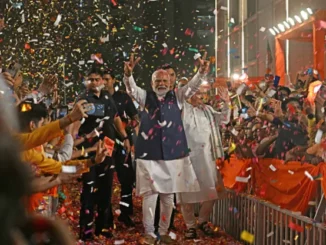
  • India’s Election Humbles Narendra Modi

    India’s Election Humbles Narendra Modi

    He expected a blowout, but his party lost more than one-fifth of its seats and its outright majority

    “For the BJP, disappointment stems from inflated expectations. On the campaign trail Mr. Modi boasted that the BJP-led National Democratic Alliance aimed to win more than 400 seats this year. He also claimed that he had been sent by God to serve India. A flurry of exit polls released a few days before vote counting predicted that the BJP and its allies would win 350 to 400 seats. Most predicted that the opposition alliance would win fewer than 170 seats………………… That Mr. Modi barely scraped through with the help of allies marks a serious blow to the aura of invincibility he has cultivated since becoming prime minister in 2014. In the temple town of Varanasi in the northern state of Uttar Pradesh—Mr. Modi’s constituency—his victory margin over his closest Congress rival in this election shrank by more than two-thirds compared with the 2019 election. The BJP lost 29 seats in Uttar Pradesh, and another 14 in the state of Maharashtra.”

    By Sadanand Dhume

    You might think that an almost-certain return to power for a third successive term after winning more than twice as many parliamentary seats as your nearest rival would be cause for celebration for any politician. Not if you’re Indian Prime Minister Narendra Modi. True, the ruling Bharatiya Janata Party and its allies are on track to form the next government. But by severely underperforming exit-poll predictions and his own hype, Mr. Modi appears diminished rather than exalted by this victory.

    After counting 642 million votes, election officials reported that the BJP-led National Democratic Alliance had won 293 seats in the 543-seat lower house of Parliament. The BJP alone had won 240, a loss of 63 seats compared with the outgoing Parliament and well below the 272 seats needed for a single-party majority. The opposition Congress Party, which many pundits and pollsters had written off for months as a spent force, turned out its best performance in 15 years by winning 99 seats on its own. The Congress-led INDIA Alliance, a coalition of about two dozen parties, won 234 seats, by far the opposition’s best performance since Mr. Modi first rose to power in 2014.

    For the BJP, disappointment stems from inflated expectations. On the campaign trail Mr. Modi boasted that the BJP-led National Democratic Alliance aimed to win more than 400 seats this year. He also claimed that he had been sent by God to serve India. A flurry of exit polls released a few days before vote counting predicted that the BJP and its allies would win 350 to 400 seats. Most predicted that the opposition alliance would win fewer than 170 seats. On paper the election seemed to favor a landslide for the ruling party. Mr. Modi’s high approval rating—74% in May, according to Morning Consult—makes him one of the world’s most popular democratically elected leaders. High-profile temple inaugurations, including one to the Hindu deity Ram in the temple town of Ayodhya in January, were supposed to cement the prime minister’s support among the roughly 80% of Indians who are Hindu.

    The BJP has many advantages over its rivals. After a decade as the ruling party, it enjoys a massive fundraising edge. Much of the media, especially Hindi news channels, have a strong pro-BJP tilt. Before the elections, the Modi government jailed some prominent opposition leaders, including Delhi’s Chief Minister Arvind Kejriwal, for alleged corruption. A slew of defections from the opposition to the ruling party were expected to further strengthen the BJP. And the personality cult around the prime minister ensured that voters were continually reminded of his presence. At one point, Covid-19 vaccination certificates in India bore his image, and the ruling party last year portrayed a routine Group of 20 Summit as a global tribute to Mr. Modi’s leadership.

    That Mr. Modi barely scraped through with the help of allies marks a serious blow to the aura of invincibility he has cultivated since becoming prime minister in 2014. In the temple town of Varanasi in the northern state of Uttar Pradesh—Mr. Modi’s constituency—his victory margin over his closest Congress rival in this election shrank by more than two-thirds compared with the 2019 election. The BJP lost 29 seats in Uttar Pradesh, and another 14 in the state of Maharashtra.

    In a speech to party workers Tuesday night, Mr. Modi attempted to put a positive spin on a disappointing performance. He pointed out that his is the first Indian government to win three successive terms since Jawaharlal Nehru’s in 1962. More silver linings for the BJP: In state-level elections, the party won power for the first time in the eastern state of Odisha, and a BJP ally, the Telugu Desam party, won a substantial majority in the southern state of Andhra Pradesh. The BJP also significantly improved its vote share in the southern state of Tamil Nadu, and for the first time won a seat in neighboring Kerala.

    How might a third Modi term differ from the first two? U.S.-India relations, driven by shared concerns about China’s ambitions, are unlikely to change.

    The prime minister’s domestic agenda will depend on what lessons he draws from his humbling. If India is lucky, Mr. Modi will take a less heavy-handed approach toward his critics in the opposition and the media, and strike a more conciliatory tone toward Muslims, Christians and Sikhs who feel threatened by the excesses of Hindu nationalism. On the economic front, Indians should hope the prime minister continues to build infrastructure and rejects the Congress Party’s push to increase caste-based quotas in education and employment.

    It’s uncertain which direction Mr. Modi will take. But one thing is clear: Indian voters aren’t as enamored with his strongman style and brassy overconfidence as he and his supporters assumed.
    (Source: Bloomberg)

  • Earthquakes shake Japanese region, collapse two homes damaged in deadly January quake

    Earthquakes shake Japanese region, collapse two homes damaged in deadly January quake

    Tokyo (TIP): Earthquakes early on June 4 again struck Japan’s north-central region of Ishikawa, still recovering from the destruction left by a powerful quake on January 1, but the latest shaking caused only minor damage.
    A magnitude 5.9 temblor on the northern top of the Noto Peninsula was followed minutes later by a 4.8 and then several smaller quakes within the next two hours, the Japan Meteorological Agency said. There was no danger of a tsunami. Two houses that had been damaged in the January 1 quake collapsed in Wajiima city but no injuries or other damage was reported so far, according to the Fire and Disaster Management Agency.
    JMA seismology and tsunami official Satoshi Harada said on June 4 quakes were believed to be aftershocks of the magnitude 7.6 earthquake on January 1.
    Seismic activity has since slightly subsided but Harada urged people to be cautious, especially near buildings that were damaged earlier.
    Shinkansen super-express trains and other train services were temporarily suspended for safety checks but most of them resumed, according to West Japan Railway Co.
    The Nuclear Regulation Authority said no abnormalities were found at two nearby nuclear power plants. One of them, the Shika plant on the Noto Peninsula, had minor damage, though officials said that did not affect cooling functions of the two reactors.
    Hokuriku Electric Power Co said there were no power outages.
    Monday’s rattlings rekindled fear among residents who are still struggling to recover from damages from the New Year’s quake. NHK public television showed a number of people who came out of their homes and temporary shelters to see if there were additional damage.
    Reconstruction comes slowly in mountainous areas on the peninsula and many damaged houses remain untouched. In Wajima, which was one of the hardest-hit areas, an inn operator told NHK that he immediately ducked under the desk at the reception when the first quake struck on Monday. Nothing fell to the floor or broke, but it reminded him of the January shakings and made him worry that a big quake like that had occurred even five months later. The January 1 quake killed 241 people. Damages still remain, and many residents remain evacuated. (AP)

  • China pressuring other nations not to attend Ukraine peace talks: Zelenskyy

    Singapore (TIP): President of Ukrainian Volodymyr Zelenskyy accused China of helping Russia to disrupt a Swiss-organised peace conference on the war in Ukraine, speaking at Asia’s premier security conference on June 2.
    In a news conference at the Shangri-La defense forum in Singapore, Zelenskyy said that China is pressuring other countries and their leaders not to attend the upcoming talks.
    “Russia, using Chinese influence in the region, using Chinese diplomats also, does everything to disrupt the peace summit,” he said, according to a simultaneous translation of his remarks. “Regrettably this is unfortunate that such a big independent powerful country as China is an instrument in hands of Putin.” In a speech earlier in the day, Zelenskyy urged top defence officials to attend the upcoming summit, saying he was disappointed at the failure of some countries to commit to joining.
    Chinese Defence Minister Dong Jun spoke earlier in the day at the Shangri-La conference but he did not appear to be in the room when Zelenskyy made his appeal. — AP

  • North Korea sends hundreds of more trash-carrying balloons to South Korea

    Seoul (TIP): North Korea launched hundreds of more trash-carrying balloons toward the South after a similar campaign a few days earlier, according to South Korea’s military, in what Pyongyang calls retaliation for activists flying anti-North Korean leaflets across the border.
    Between June 1 and June 2 morning, about 600 balloons flown from North Korea have been found in various parts of South Korea. The balloons carried cigarette butts, scraps of cloth, waste paper and vinyl, but no dangerous substances were included, South Korea’s Joint Chiefs of Staff said Sunday. The military advised people to beware of falling objects and not to touch objects suspected to be from North Korea but report them to military or police offices instead. There have been no reports of injuries or damage.
    In Seoul, the city government sent text alerts saying that unidentified objects suspected to be flown from North Korea were detected in skies near the city and that the military was responding to them. The North’s balloon launches added to a recent series of provocative steps, which include its failed spy satellite launch and a barrage of short-range missiles launches that the North said was intended to demonstrate its ability to attack the South preemptively. South Korea’s military dispatched chemical rapid response and explosive clearance teams to recover the debris from some 260 North Korean balloons that were found in various parts of the country from Tuesday night to Wednesday.
    The military said the balloons carried various types of trash and manure but no dangerous substances like chemical, biological or radioactive materials. Some of the balloons were found with timers that suggested they were designed to pop the bags of trash midair.
    In a statement on Wednesday, Kim Yo Jong, the powerful sister of North Korean leader Kim Jong Un, confirmed that the North sent the balloons to make good on her country’s recent threat to “scatter mounds of wastepaper and filth” in South Korea in response to leafleting campaigns by South Korean activists.
    She hinted that balloons could become the North’s standard response to leafletting moving forward, saying that the North would respond by “scattering rubbish dozens of times more than those being scattered to us.” South Korea’s Unification Ministry said Friday that North Korea must stop the provocations — also including its missile launches and other acts — or face unspecified “unbearable” consequences. South Korea’s military has said it has no plans to shoot down the balloons, citing concerns about causing damage or the possibility that they might contain dangerous substances. Firing at balloons near the border would also risk triggering a retaliation from the North at a time of high tensions.
    “(We) decided it was best to let the balloons drop and recover them safely,” Lee Sung Joon, spokesperson of South Korea’s Joint Chiefs of Staff, said during a briefing Thursday.
    North Korea is extremely sensitive about any outside attempt to undermine Kim Jong Un’s absolute control over the country’s 26 million people, most of whom have little access to foreign news. (AP)

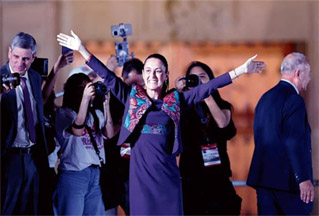
  • Mexico elects Sheinbaum as first woman president

    Mexico elects Sheinbaum as first woman president

    Mexico City (TIP): Claudia Sheinbaum, a scientist with a PhD in physics, has been elected by a huge margin as Mexico’s first female president. Sheinbaum, 61, will succeed her mentor Andres Manuel Lopez Obrador, who first included her in the government in 2000 and with whom she broke away from the Party of Democratic Revolution (PRD) in 2014 to form Morena that is also headed for super majorities in both houses of the Congress.
    “For the first time in the 200 years of the republic, I will become the first woman president of Mexico,” Sheinbaum told supporters, according to the Mexican media.
    A successful politician in her own right, she was the Mayor of Mexico City during Obrador’s tenure as the President. The final vote in Sheinbaum’s favour is expected to be 60.7 per cent, making it the highest vote percentage by a Presidential candidate in Mexico’s democratic history.
    Mexican analysts felt a glass ceiling was broken because of Mexico’s pervasive macho culture and the majority Roman Catholic population which tends to circumscribe the role of women in public life in those parts.
    They noted that she was the first woman to win a general election in the entire North America — the US, Mexico or Canada.
    The elections were the most violent with 38 candidates murdered amid an expansion of organised crime cartels during Obrador’s term as the President during which 1.85 lakh people suffered violent deaths. (TNS)

  • ANC in talks with 5 parties for coalition govt in S Africa

    Johannesburg (TIP): Top officials in South Africa’s African National Congress (ANC) have had initial talks with representatives of five other parties over a coalition or other agreement to form a government, but no decision has been made and the talks are at an early stage, the ANC said June 5.
    South Africa faced an election deadlock after the long-ruling ANC lost its 30-year majority in an election last week but no party managed to overtake it. The ANC remained the biggest party. ANC spokesperson Mahlengi Bhengu-Motsiri told reporters that there had been “exploratory” talks with the main opposition Democratic Alliance, the far-left Economic Freedom Fighters and three other smaller parties.
    She said the ANC had “repeatedly” reached out to the new MK Party of former President Jacob Zuma for talks, but there had been “no positive response.” Zuma is a former ANC leader. — AP

  • Ukraine hits Russian oil facilities

    Kyiv (TIP): In Kyiv’s ongoing effort to disrupt the Kremlin’s war machine, Ukrainian drones struck an oil refinery and a fuel depot in Russian border regions, officials in the targeted areas said on June 6.
    Meanwhile, Ukrainian President Volodymyr Zelenskyy joined world leaders in France on Thursday to commemorate the D-Day invasion and seek more Western help even as his forces battled to stave off a Russian onslaught near the eastern city of Kharkiv in Europe’s biggest conflict since World War II.
    Zelenskyy’s trip came a day after Russian President Vladimir Putin warned that Russia could provide long-range weapons to other countries so that they could strike Western targets. That threat came after NATO allies said they would allow Ukraine to use weapons they deliver to attack Russian territory. (PTI)

  • 40 killed in Israel’s ‘targeted’ strike on UN school in Gaza

    40 killed in Israel’s ‘targeted’ strike on UN school in Gaza

    CAIRO/JERUSALEM (TIP): Israel hit a Gaza school on June 6 with what it described as a targeted airstrike on up to 30 Hamas fighters inside. A Hamas official said 40 people, including women and children, were killed as they were taking shelter in the UN site.
    Video footage showed Palestinians hauling away bodies after the attack, which took place at a sensitive moment in mediated talks on a ceasefire that would involve releasing hostages held by Hamas and some of the Palestinians held in Israeli jails.
    The United States issued a joint statement with other countries on Thursday calling on Israel and Hamas to make whatever compromises were necessary to finalise a deal after eight months of war in the Gaza Strip.
    Ismail Al-Thawabta, the director of the Hamas-run government media office, rejected Israel’s assertion that the UN school in Nuseirat, in central Gaza, had hidden a Hamas command post.
    “The occupation uses … false fabricated stories to justify the brutal crime it conducted against dozens of displaced people,” Thawabta said.
    Israel’s military said its fighter jets had carried out a “precise strike” and circulated satellite photos highlighting two parts of a building where it said the fighters were based. “We’re very confident in the intelligence,” military spokesperson Lt Col Peter Lerner said, accusing Hamas and Islamic Jihad fighters of deliberately using UN facilities as operational bases.
    Meanwhile, the Israeli military has warned the government its policy of cutting off funds to the Palestinian Authority could push the occupied West Bank into a third “intifada”, public broadcaster Kan Radio reported on Thursday.
    The warning underlined the increasingly dire state of the West Bank economy where thousands of workers have lost their jobs in Israel and public servants have been unpaid or on partial pay for months. — Reuters

  • 6 Indian tourists injured in jeep mishap in Nepal

    Kathmandu (TIP): Six Indian tourists, mostly senior citizens, were injured when the jeep they were travelling in overturned near a lake in Nepal’s Chitwan district on June 2, officials said. The accident took place near Darai Lake at Khaireni. The tourists were heading towards Chitwan National Park for a jungle safari, said Kedarnath Panta, chairperson of ward number 12, Khaireni municipality. Chitwan National Park, 250 km south of Kathmandu, is famous for one-horned rhinos and Bengal Tigers. All those who sustained injuries hail from the Bendali Thana area in Mumbai and most of them are above 60, police said. They are identified as Ramchandra Yadav, Sudesh Shanker Khadia, Pankaj Gupteshwor, Vaishali Gupteshwor, Sushmita Sudesh Khadia and Vijaya More. The injured are undergoing treatment at hospitals in Bharatpur and Ratnanagar, police said, adding that they have taken the jeep driver, a Nepalese, into custody. (PTI)

  • Nepal government recalls 11 envoys, including from India, USA and UK

    KATHMANDU (TIP): Nepal government has recalled ambassadors from 11 countries, including those serving in India and the US and appointed under the Nepali Congress’ quota, three months after Prime Minister Pushpa Kamal Dahal ‘Prachanda’ terminated his alliance with the party and joined hands with KP Sharma Oli. Despite strong reservations from Deputy Prime Minister and Minister for Foreign Affairs Narayan Kaji Shrestha, the government on June 6 recalled these ambassadors, including Nepal’s envoy to India Shankar Sharma, The Kathmandu Post newspaper reported. (PTI)

  • Pakistan elected as UNSC non-permanent member

    United Nations (TIP): Pakistan, Somalia, Denmark, Greece and Panama on June 6 were elected as non-permanent members of the UN Security Council for a two-year term, starting January 1, 2025. They were elected by a secret ballot in the UN General Assembly. In the two seats for African and Asia-Pacific States, Somalia got 179 votes and Pakistan received 182 votes. Among the Latin American and Caribbean States, Panama got 183 votes, while in the Western European and other States, Denmark got 184 votes and Greece got 182 votes. “Proud moment as Pakistan receives a resounding 182 votes and is elected to the UNSC,” Pakistan PM Shehbaz Sharif posted on X. (PTI)

  • Top leaders of Bangladesh, Sri Lanka, Maldives, 4 other nations likely to attend Modi’s oath ceremony

    New Delhi (TIP): Top leaders of Bangladesh, Sri Lanka, the Maldives, Bhutan, Nepal, Mauritius and Seychelles are likely to attend the swearing-in ceremony of Prime Minister Narendra Modi over the weekend, authoritative sources said on June 6.
    It is learnt that India has already sent invites to Bangladesh Prime Minister Sheikh Hasina, Sri Lankan President Ranil Wickremesinghe and some other leaders of the countries chosen to grace the ceremony.
    Nepalese Prime Minister Pushpa Kamal Dahal ‘Prachanda’, Maldivian President Mohamed Muizzu, Bhutanese Prime Minister Tshering Tobgay, Prime Minister of Mauritius Pravind Jugnauth and President of Seychelles Wavel Ramkalawan are among the leaders being invited to Modi’s swearing-in ceremony.
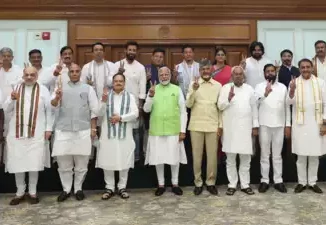
    Modi is all set to take charge as the prime minister for a historic third consecutive term with the Bharatiya Janata Party-led National Democratic Alliance (NDA) winning 293 seats in the Lok Sabha polls.
    The guest list of foreign leaders for Modi’s swearing-in ceremony was primarily guided by New Delhi’s “Neighbourhood First Policy” and its strategic focus on island nations considered important in the Indian Ocean region, it is learnt.
    Modi is likely to take oath on June 9.
    The invitation to Muizzu assumes significance as it came amid frosty ties between the two countries.
    The ties between India and the Maldives came under severe strain since November last year when Muizzu, known for his pro-China leanings, took charge as Maldivian president.
    Within hours of his oath, he had demanded the withdrawal of Indian military personnel from his country. The Indian military personnel were replaced by civilians earlier this month.
    The media division of President Wickremesinghe’s office on Wednesday said Modi invited him to the swearing-in ceremony during a phone conversation. It said Wickremesinghe accepted the invite.
    “During the conversation, Prime Minister @narendramodi invited President Wickremesinghe to his swearing-in ceremony, which President @RW_UNP accepted,” it said on X.
    Modi also had a phone conversation with Hasina on Wednesday. In the phone conversation, Modi invited Hasina to attend his swearing-in ceremony and she accepted it, diplomatic sources said.
    Modi held separate phone conversations with Prachanda as well as Jugnauth.
    On Thursday, Bhutanese PM Tobgay called up Modi and congratulated him on the victory of the NDA.
    “Prime Minister Tobgay appreciated Prime Minister Modi’s visionary leadership in the last decade, and conveyed his warm wishes for his successful third term,” an Indian readout said.
    “The prime minister thanked prime minister Tobgay for the warm felicitations. The prime minister conveyed that India accords the highest priority to its exemplary partnership with Bhutan,” it said.
    It said India-Bhutan partnership is characterized by utmost trust, goodwill, and mutual understanding at all levels and is reinforced by robust people to people linkages and close economic and development partnership. (PTI)

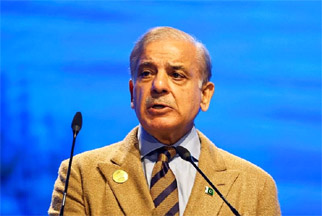
  • Pakistani PM Sharif in Beijing for talks with President Xi to seek more investments, elevate ties

    Pakistani PM Sharif in Beijing for talks with President Xi to seek more investments, elevate ties

    Beijing (TIP): Visiting Pakistani Prime Minister Shehbaz Sharif has reached Beijing for talks with Chinese President Xi Jinping and other leaders to elevate all-weather bilateral ties and prospects of more aid and investments to bail out his cash-strapped country from the current economic crisis.
    Sharif, on a five-day official visit to China since June 4, toured the southern high-tech city of Shenzhen on June 4 and addressed the investors meeting.
    During his stay here, Sharif will meet Xi, Premier Li Qiang and other leaders, Pakistan’s state-run APP news agency reported.
    He will also attend a Pakistan-China Friendship and Business event and have meetings with the CEOs of leading Chinese companies working on the China–Pakistan Economic Corridor (CPEC) projects.
    Several MoUs between the two countries on cooperation in various fields are likely to be signed, the report said.
    Cash-strapped Pakistan’s economy is facing severe headwinds, and it has formally requested the International Monetary Fund (IMF) for the next bailout package between USD 6 billion and USD 8 billion with the possibility of augmentation through climate financing.
    In his address to the investors meeting in Shenzhen, Sharif assured full security to the Chinese personnel from the recurring terrorist attacks targeting them.
    The 72-year-old leader embarked on his first visit to China after he took over as prime minister for the second term after his Pakistan Muslim League-Nawaz (PML-N) party-led coalition government assumed power in March.
    Addressing the Pakistan-China Business Forum, Sharif assured all-out facilitation to Chinese investors and security of Chinese individuals, projects, and investments in Pakistan.
    He said his government had taken various measures to ensure fool-proof security to protect the lives of Chinese workers in Pakistan.
    “I will spare no effort to protect the lives of Chinese workers and assure and guarantee that we will provide them security more than our children. This will never happen again,” he said.
    Referring to the March terrorist attack in Besham in Pakistan, in which five Chinese personnel and their Pakistani driver were killed, he said it was one of the saddest days of his life when the whole nation felt saddened.
    The latest was the March suicide attack in Dasu in which five Chinese nationals and a Pakistan driver were killed. Pakistan paid USD 2.58 million as compensation to the families of those killed in the attack.
    The CPEC, which connects Gwadar Port in Pakistan’s Balochistan with China’s Xinjiang province, is the flagship project of China’s ambitious Belt and Road Initiative (BRI). The BRI is seen as an attempt by China to further its influence abroad with infrastructure projects funded by Chinese investments across the world. (PTI)

  • Democracy Prevails: Reflections on India’s 2024 General Elections

    By Prof. Indrajit S. Saluja

    In a resounding testament to the resilience of democracy, India’s 2024 General Elections bore witness to a pivotal moment in the nation’s political landscape. After a decade marked by soaring rhetoric, unfulfilled promises, and growing disillusionment, the electorate delivered a clear verdict, signaling a shift away from the status quo.

    For ten years, the Modi government captivated the imagination of the Indian populace with grand visions and lofty assurances. However, as time unfolded, these promises remained largely unfulfilled, leaving the marginalized and impoverished masses stranded in a sea of dashed hopes. Instead of uplifting the downtrodden, the government seemed to prioritize the interests of the elite, fostering a growing chasm between the haves and the have-nots.

    Buoyed by a meticulously cultivated image and an extensive propaganda machinery, the Modi government appeared convinced that electoral victory was a foregone conclusion. Slogans like “Modi hai to mumkin hai” (With Modi, anything is possible) and “Modi Ki Guarantee” failed to resonate with a populace weary of rhetoric devoid of tangible results. Even the once potent force of Hindutva, which had propelled the BJP to victory in 2019, lost its grip on the collective consciousness of the electorate.

    The BJP’s overconfidence was palpable, exemplified by their audacious declaration of securing more than 400 seats in the parliament—a stark departure from reality. Prime Minister Modi’s dismissive stance towards the opposition, particularly the Indian National Congress, further underscored the party’s disconnect from ground realities.

    However, the political landscape took an unexpected turn as a formidable coalition of opposition parties emerged, united in their resolve to challenge the hegemony of the ruling party. This coalition deftly leveraged the grievances of the common people, effectively shifting the narrative from personality politics to issues that truly mattered to the electorate.

    At the heart of this electoral upheaval lay the fundamental principles of democracy and constitutional governance. Faced with the erosion of democratic norms and the casual disregard for constitutional institutions by the ruling dispensation, a sense of urgency permeated the political discourse. The opposition, recognizing the imminent threat to the very fabric of Indian democracy, rallied together with a singular purpose—to safeguard the principles enshrined in the constitution.

    The significance of a robust opposition in a democratic framework cannot be overstated. It serves as a vital check on the excesses of those in power, ensuring accountability and transparency in governance. In rallying behind the opposition coalition, the electorate reaffirmed their commitment to the ideals of democracy, signaling a collective desire for change and renewal.

    The outcome of the 2024 General Elections represents a decisive moment in India’s democratic journey. By thwarting the seemingly invincible juggernaut of the ruling party, the electorate has demonstrated their inherent power to shape the course of their nation’s destiny. In halting the unchecked march of the Modi-led BJP, India has reaffirmed its status as a vibrant and pluralistic democracy, where the voice of the people reigns supreme.

    As the dust settles on the electoral battlefield, a renewed sense of optimism pervades the nation. The prospect of a strengthened democracy, bolstered by a vigilant opposition, offers hope for a brighter future. While the challenges ahead are manifold, the resilience of India’s democratic institutions and the unwavering spirit of its people serve as beacons of hope in an uncertain world.

    The  2024 General Election stands as a testament to the enduring power of democracy—a triumph of the collective will over entrenched power dynamics. As the nation embarks on a new chapter in its political journey, let us remain steadfast in our commitment to upholding the principles of democracy, ensuring that the voice of every citizen is heard and respected.

  • T20 World Cup is seeking to energize cricket’s newest format

    Barely a week after the Indian Premier League final (IPL), most of the leading cricketers have already got down to the grind as the ICC Twenty20 World Cup commenced in the United States of America on Saturday (U.S. time). The willow game no longer has an off-season and the championship that would meander through the U.S. and the West Indies, features 20 teams split into four groups and the final will be held in Barbados on June 29. Right through the pedigreed units such as India and Australia to Papua New Guinea and Uganda, the tournament may display an evangelical zeal to promote cricket in a sporting universe that always favors football. Cricket, with its three versions of Tests, ODIs and T20Is, can at times lapse into an identity crisis with the game’s purity and mettle vesting with the five-day format while the commercial muscle almost entirely hinges on the shorter avatars. Even within these layers, the granular issues get complex as T20Is never have the same allure that domestic leagues such as the IPL flaunt. It is in this space that the T20 World Cup hopes to operate and energize the format, once every two years. The ninth edition should offer a cricket of the fast and furious variety while players quickly switch from club loyalties to nationalistic fervor.

    Hope too floats as Papua New Guinea turned up despite grappling with a massive landslide and the resultant loss of life back home. For India, the long quest for an ICC trophy gets another episode. The last silverware was the Champions Trophy won in 2013, and since then it has often been a case of so close and yet so far. Rohit Sharma’s men get another tilt and there is no mistaking the talent they collectively possess. There may be simmering issues such as the leadership angle following the awkward transition from Rohit to Hardik Pandya as captain of Mumbai Indians. At the national level, Rohit continues to helm while Pandya becomes his deputy and coach Rahul Dravid, always clued into ego hassles right from his playing days, may have to steer the ship away from choppy waters. Placed in Group A, India will open its campaign against Ireland on Wednesday but the big game is the one involving Pakistan at New York, on Sunday. Geopolitics has meant that it is only in ICC events that the neighbors face off against each other. While batters such as Travis Head and Heinrich Klassen can set rollicking templates, bowlers such as Jasprit Bumrah too will have a role to play in a format that tends to mask nuance under a breathless pace.

    (The Hindu)

  • India’s Elections 2024: A slight sigh of Relief; Will it last?

    India’s Elections 2024: A slight sigh of Relief; Will it last?

    “The people of India have unequivocally rejected the BJP’s agenda, which sought to undermine the constitution and transform the country. This election outcome is a resounding endorsement of the current constitutional framework envisioned and implemented by Jawaharlal Nehru and B.R. Ambedkar. The voters appeared to have arrested the development of the nation’s slide towards dictatorship and fascism for now. It is also important to note that the BJP has not gotten a majority of its own. Narendra Modi himself has lost substantial vote share in his quest for reelection. Even the BJP candidate in Ayodhya, where the temple has been consecrated, had to concede defeat.”

    By George Abraham

    After the announcement of the election results, I heard nothing but a sigh of relief all around, especially from members of the Diaspora. It is almost as if they have been delivered from some precarious situation or a trap that had a debilitating impact on their thinking and actions. People were virtually living in fear of expressing their opinions and even stating the slightest criticism of the Modi government’s policies. Indeed, at least for now, they appear to feel liberated.

    If that is true, what would it have been if the Modi government had come down? Of course, the country would have truly restored its soul while recapturing the dynamism and freedom that was a hallmark of Indian democracy. The public has been struggling for a breath of air for freedom and liberty in the last decade, which was taken for granted mainly under the Congress party rule for six decades.

    Even the Diaspora was under the guns where there were allegations of conspiracies of assassinations of overseas Indian citizens who had disagreed with the Modi administration. The recent filing by the United States Justice Department accusing an ‘Indian government agent’ plotting to kill an American citizen of Indian origin and a Khalistani activist, regardless of our disapproval of issues he has been advocating, sent chills across the overseas community everywhere.

    Many members of the Diaspora were afraid to speak out because of the fear that any dissenting voice may result in the cancellation of the OCI cards. It happened to Aatish Taseer, who wrote a critical piece on Modi in Time magazine and was punished by denying his wish to visit his aging grandmother. Nitasha Kaul, a professor from Westminster University, was deported directly from the Bengaluru airport back to the U.K. because of her past statements critical of the Modi government on constitutional matters. It should be noted that the Modi government changed the rules to make these arbitrary decisions unchallengeable in the judicial system. The Modi regime has deported many more Christian leaders from the West directly from the airport just because they happened to be Christians.

    Modi Administration’s attacks on civil society have been ferocious, where many of the NGOs were forced to shutter their doors, and the foreign-related ones were either expelled or their FCRAs canceled. Minority-related institutions suffered the most at the hands of this regime, where 20000 or more FCRAs belonging to Christian Educational and Charitable organizations were suspended or frozen, thereby effectively putting them out of business. In contrast, Sangh Parivar organizations were allowed to receive money from abroad without any hindrance.

    In the United States, where people are supposed to have freedom of expression, the Godi media, controlled mainly by Gujaratis, may have stifled voices of dissent by striking any criticism of Modi from either printed pages or visual media. Moderators who tried to play even-handedly on some of those networks started distancing themselves from genuine debates or being banished from the scene altogether. Even the Asianet outfit in the U.S., a popular channel in Kerala, allegedly has been under the influence of Sangh Parivar, their principal correspondent in the USA, who was a no-show at the Javits Center, where Rahul Gandhi addressed a large crowd.

    Considering the above, it is understandable why the Diaspora is somewhat relieved by the changing dynamics with a new coalition government under Modi. However, there is a genuine fear that, given the opportunity, the BJP may poach M.P.s from other parties and craft a new majority of their own as they have plenty of resources to accomplish their set goals. Chandrababu Naidu and Nitish Kumar are crafty politicians who have been victims of Modi’s odious agenda, and the world will be restlessly watching how they navigate through opportunities that come their way.

    Nevertheless, the people of India have unequivocally rejected the BJP’s agenda, which sought to undermine the constitution and transform the country. This election outcome is a resounding endorsement of the current constitutional framework envisioned and implemented by Jawaharlal Nehru and B.R. Ambedkar. The voters appeared to have arrested the development of the nation’s slide towards dictatorship and fascism for now. It is also important to note that the BJP has not gotten a majority of its own. Narendra Modi himself has lost substantial vote share in his quest for reelection. Even the BJP candidate in Ayodhya, where the temple has been consecrated, had to concede defeat.

    If Narendra Modi and Amit Shah persist in governing India through their makeshift coalition, it is imperative for them to uphold the constitution. They must cease divisive and unscrupulous politics, halt the weaponization of investigating agencies, stop the destruction of worship places belonging to minority citizens, and govern the country by the law and its constitution. It is also high time for people to exercise their inherent right to express their opinions without fear of arrest or the cancellation of their OCI cards. The Fourth Estate should be allowed to function freely, promoting objective journalism that reaches people without bias or prejudice. We are again reminded that democracy is not a majoritarian rule but respects diversity and facilitates equal justice regardless of caste, creed, language, religion, or region.

    We at the Overseas Congress salute the INDIA coalition and its leaders, especially AICC President Kharge Ji Rahul Ji and Pitroda ji, for their tireless efforts in getting the message to the people, which elicited the current response through the ballot boxes. We express our special gratitude to all those IOC volunteers from across the globe who participated in the electoral process to save democracy in their motherland.

    (The author is a former Chief Technology Officer of the United Nations. He is Vice Chair of IOC USA. He can be reached at GTA777@gmail.com)

  • Gone are days for single party majority; alliances are back

    Gone are days for single party majority; alliances are back

    Institutions, including political outfits, always stay taller than individuals who come and go. Institutions stay. Of course, individuals contribute immensely to building institutions, but they seldom become indispensable.

    “The party that looked “unbeatable” till early this year, met its Waterloo in its own backyard of the Hindi heartland, including Uttar Pradesh which sends 80 of 545 Lok Sabha members. Known for its political acumen, some call this most populus state “Ultapulta Pradesh”,   it had earlier shown the longest ruling Congress door. After giving the Bharatiya Janata Party enough time in office, the State has now put its confidence in the Samajwadi Party giving it a record 37 seats, a performance that may have even surprised its leadership.”

    By Prabhjot Singh

    Politics is a game of glorious uncertainties. India, the biggest and most vibrant democracy,  has come a long way after it wriggled out of the regimen of mandatory alliances to a single-party majority rule in 2014. And after 10 years, coalitions have again become a political necessity. Though then the Bhartiya Janata Party had broken the hoodoo of coalitions at the center, it now desperately needs its alliance partners in its endeavor to earn the right to govern the biggest democracy in the world for its third term.

    More than 642 million people voted to give a fractured verdict while constituting the 18th Lok Sabha with no single party anywhere near the majority mark. In 2014, the BJP came out as the single largest party by winning the majority verdict. Though it stayed on with its alliance part,, including the oldest regional party, Shiromani Akali Dal,  for almost two terms, it parted company with some of its allies before testing deep troubled waters of the voter’s pool this year. Overconfident of its prowess of swimming to safety, it almost drowned itself in the battle of the ballot nearly allowing its sworn opponents and traditional rivals to swim to the podium.

    Elated at its earlier success starting in 2014, BJP went on improving its performance as it took its individual tally from 282 in 2014 to 303 in 2019 before setting for itself a gigantic task of 350 seats in the lower House of Parliament in the 2024 contest. The voters, however, did not think the way the party supremo and two-term Prime Minister Narendra Modi thinks. They sent a message loud and clear saying “We decide what we want”.

    The party that looked “unbeatable” till early this year, met its Waterloo in its own backyard of the Hindi heartland, including Uttar Pradesh which sends 80 of 545 Lok Sabha members. Known for its political acumen, some call this most populus state “Ultapulta Pradesh”,   it had earlier shown the longest ruling Congress door. After giving the Bharatiya Janata Party enough time in office, the State has now put its confidence in the Samajwadi Party giving it a record 37 seats, a performance that may have even surprised its leadership.

    Institutions, including political outfits, always stay taller than individuals who come and go. Institutions stay. Of course, individuals contribute immensely to building institutions, but they seldom become indispensable.

    The poll results will now obviously force Narendra Modi to rely on allies to form the government after a bitter and divisive election that was projected as a referendum on his popularity. It also now dims light on the coterie that had the country’s Home Minister and former party President as the confidant of the Prime Minister. The element of surprise is now with the I.N.D.I. Alliance provided  browbeats NDA in the battle of “horse trading”, a game that Narendra Modi and his coterie had set in motion just before the start of the 2024 battle of the ballot.

    Interestingly, the BJP candidates, including those who won over from other parties, including Congress,  contested in the name of Modi,  hoping not only for a landslide but also the accomplish the slogan of their leader “iss baar 400 ke paar”  saw success eluding them. They could win-win or were ahead only in 240 seats to emerge as the single largest party, a far cry from the 303 it had won last time in the 543-member Lok Sabha to mark the return of coalition politics.

    BJP’s key allies N. Chandrababu Naidu’s TDP and Nitish Kumar’s JD(U) had every reason to be pleased with the performance of their respective candidates as they won 16 and 12 seats in Andhra Pradesh and Bihar, respectively. With the support of its other allies, the BJP-led NDA  has been forced to a tight-rope walking on its course to reach the 272 majority mark. The TDP also swept the Assembly elections in Andhra Pradesh dislodging Y. S. Jagan Mohan Reddy’s YSRCP.

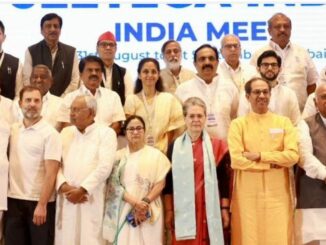
    Congress president Mallikarjun Kharge termed the poll outcome as the “victory of the people and that of democracy.”

    “We had been saying that this battle is between the public and Modi…This mandate is against Modi. This is his political and moral defeat. It is a big defeat for a person who sought votes in his name. He has suffered a moral setback,” Kharge told reporters at the AICC headquarters flanked by Congress leaders Rahul Gandhi and Sonia Gandhi after the good showing by the Congress.

    On the other hand, Narendra Modi with his 52-inch chest, has been on track to equal Jawaharlal Nehru’s record as the PM for a third consecutive term. His accomplishment is, however, subject to acceptance by allies to be in the government.

    In a post on X, Modi said, “I bow to the ‘Janata Janardan’ for this affection and assure them that we will continue the good work done in the last decade to keep fulfilling the aspirations of people.” He retained the Varanasi seat but with a reduced victory margin of nearly 1.53 lakh votes in Varanasi. In 2019, the margin was 4,79,505.

    It was not Modi alone. Others, including the Aam Aadmi Party, too, would love to put behind this debacle as quickly as it can. As a ruling party in Delhi, it drew a blank while in Punjab against its projected claim of 13-0, it ended with just three seats as four of its five Cabinet Ministers fell on the way to their run for Lok Sabha seats.

    And Punjab did the trick. BJP drew a blank from this border State even after it had won over three sitting MPs from other parties in its list of contestants. Two Independents – Amritpal Singh (Khadoor Sahib) and Sarabjeet Singh Khalsa (Faridkot)  – with their splendid triumphs had a message for the rest of the world “Do not take us for granted, we are different.”

    India Votes

    Party                         2014                            2019                       2024

    BJP                              282                                 303                         240

    Congress                     44                                    52                           99

    Trinamool Congress  34                                 22                            22

    Samajwadi Party       5                                    5                              37

    TDP                          16                                     3                              16

    YSR                           9                                     22                           4

    DMK                          *                                    24                           22

    SAD                          4                                      2                               1

    (The author is a senior journalist. He can be reached at prabhjot416@gmail.com)


  • Bangladesh launches massive evacuation as cyclone Remal approaches from Bay of Bengal

    Dhaka (TIP): Bangladesh on May 27 launched an intensified evacuation campaign in vulnerable areas as it prepares for severe cyclonic storm ‘Remal’ forecast to make landfall by evening or midnight with a potential high tidal surge and heavy rainfall in the country’s coastal districts of Satkhira and Cox’s Bazar.
    According to the latest cyclone warning bulletin, ‘Remal’ is likely to move in a northerly direction and may cross Sagar island of West Bengal-Khepupara coast near Mongla by evening or midnight, the BSS news agency reported.
    “A large-scale evacuation has already started. All vulnerable people are presumed to be moved to safer places at the shortest possible time,” Director General of the Department of Disaster Management Mizanur Rahman was quoted as saying by the BSS. On Saturday, State Minister for Disaster Management and Relief Md Mohibur Rahman said that the authorities have kept ready the cyclone centres and taken all types of preparations to tackle it.
    “The district administration has turned social, educational and religious institutions to makeshift shelters alongside 4,000 designated cyclone shelters in coastal districts to accommodate a large number of people including the most vulnerable ones living in remote areas,” Mohibur said.
    “A total of 78,000 volunteers from the Cyclone Preparedness Program (CPP) have been kept ready to deal with cyclone ‘Remal’ in the coastal district,” he said.
    Around 4,000 cyclone shelter centres have been readied in the coastal districts, equipped with adequate dry food supplies. Some 8,600 Red Crescent volunteers and others joined a campaign asking people at risk to move to safety alongside the government officials while the district administration mobilised transports to carry them to the cyclone shelters, the minister said.
    Leaves of officials of all ministries, divisions and subordinate offices have been cancelled to tackle the possible aftermath of Cyclone Remal, the Daily Star newspaper reported.
    The Chattogram Port Authority has suspended all operations in the port as cyclone Remal heads towards the coast, it said. According to the Dhaka Tribune newspaper, flight operations at the Chittagong airport have been suspended for eight hours.
    On Sunday morning, the Bangladesh Meteorological Department asked the Chittagong and Cox’s Bazar ports to hoist great danger signal no 9, the paper said. The coastal districts — Khulna, Satkhira, Bagerhat, Pirojpur, Jhalakathi, Barguna, Bhola, and Patuakhali will also be under great danger signal number 10. Cyclone Remal has now intensified into a severe cyclonic storm. (PTI)

  • Pakistan arrests 140 suspects for alleged involvement in attacks on Christians in Punjab province

    Pakistan arrests 140 suspects for alleged involvement in attacks on Christians in Punjab province

    Lahore (TIP): Pakistan’s Punjab police on May 29 claimed to have arrested a total of 140 suspects involved in attacking members of the Christian minority, their properties and police personnel on the issue of alleged desecration of the Quran.
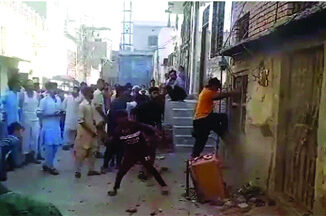
    A charged mob led by radical Islamist Tehreek-e-Labbaik Pakistan (TLP) activists last week attacked the Christian community in Mujahid Colony in the Sargodha district of Punjab, some 200 km from Lahore, that left two Christians and 10 policemen injured.
    The mob burned and ransacked the homes and properties of the Christians.
    According to Punjab police spokesperson Mubashir Hussain, some 140 suspects involved in the Sargodha incident have been taken into custody so far. “They are arrested in light of video and CCTV footage. It has been ensured that no innocent is rounded up,” he said and added many of them have been sent to jail on judicial remand.
    Police booked over 450 people under terrorism and other charges.
    According to the FIR, a mob surrounded the residence and shoe factory of Nazir Masih alias Lazar Masih (an elderly Christian), accusing him of desecration of the Quran.
    The enraged mob set fire to the shoe factory, some shops and a couple of houses. “The mob also brutally torched Masih but the timely arrival of a heavy contingent of police saved the lives of Masih and 10 other members of the Christian community,” the FIR said. It says some pages of the holy Quran were reported to have been found outside the shoe factory of Masih. This instigated the locals. Although the family of Masih denied desecration of the Quran the mob wanted to lynch him.
    “The enraged mob pelted stones at police personnel when they resorted to baton charge to disperse it. At least 10 policemen, including officers, have been injured,” as per the FIR.
    According to the residents’ accounts recorded by a team led by Cecil & Iris Chaudhry Foundation (CICF), the blasphemy charges brought up against Lazar Masih were a “consequence of a festering resentment between Lazar’s family and the local Muslim community over a drainage issue.”
    Masih’s nephew, Irfan Gill also confirmed that the former’s grandsons were often drawn into a fight by the local Muslims over the same issue.
    “On May 22, three days prior to the incident of May 25, the provocation was dispensed by Ayub, a neighbour working as a dairyman. Two of Masih’s grandsons somehow got involved in a fight with Ayub and ended up going to the local police station to file a complaint against the dairyman,” CICF said.
    Three days later, the Mujahid Colony’s loudspeakers were resounding with charges of blasphemy against Masih.
    Last year, at least 24 churches and over 80 houses belonging to Christians in Jaranwala tehsil of Faisalabad district, some 130 km from the provincial capital, were burnt down by a mob enraged over reports that two Christians had desecrated the Quran. (PTI)

  • Youngest Indian Everest summiter felicitated by Nepal PM Prachanda among others

    Kathmandu (TIP): Kaamya Karthikeyan, the youngest Indian Mount Everest summiter, was on May 29 felicitated by Nepal Prime Minister Pushpa Kamal Dahal ‘Prachanda’ at a special function here on the International Everest Day along with other veteran international summiters. The International Everest Day is celebrated on May 29 every year to mark the first ascent of the world’s highest peak at 8,848.86 metres. 71 years since Nepal’s Tenzing Norgey and New Zealander Edmund Hillary stood atop Everest in 1953, more than 8,000 people have scaled it. At just 16 years and 9 months old, Kaamya reached the top of the world on May 20 from the South Col on the Nepalese side successfully along with her father S Karthikeyan, 45, an Indian Navy Commander.
    Kaamya said she got attracted to climbing Everest when she had trekked to the Everest Base Camp seven years ago. “I am overwhelmed by the love and affection that the people of Nepal have shown during my journey here,” she said.
    The young Indian student has embarked on a journey to climb all the highest peaks on the seven continents; Mt Everest being her sixth peak. She plans to climb Mt Vinson Massif in Antarctica in December.
    Besides Kaamya, Prime Minister Prachanda also felicitated Kami Rita Sherpa, who climbed Mt Everest for a record 30 times this spring, and Phunjo Lama, who climbed Everest in just 14 hours and 31 minutes becoming the first female to do so in the shortest time. (PTI)

  • Taiwan Parliament passes ‘pro-China’ Bills, sparking protest

    Taipei (TIP): Taiwan’s opposition-controlled legislature passed changes on May 25 that are seen as favouring China and diminishing the power of the island’s president, sparking protests by thousands of people.
    The changes pushed by the opposition Nationalist Party and its allies would give the legislature greater power to control budgets, including defense spending that the party has blocked in what many see as a concession to China.
    It remains unclear whether the package of bills will become law. The Executive Yuan, the executive branch of government headed by the premier, may veto legislation or pass it on to the president, who has to proclaim bills into law within 10 days. If the Executive Yuan or the president does not comply, the bills will not become law.
    Thousands of people gathered outside the legislature to protest the changes. The legislative chamber was festooned with banners promoting both sides in the dispute, while arguments on the floor broke into shouting and pushing matches. The Nationalists, also known as the KMT, officially back unification with China, from which Taiwan separated during a civil war in 1949. —AP

  • UK’s July General Election: Impact on India FTA, Indo-Pacific tilt

    London (TIP): The prospect of an India-UK free trade agreement (FTA) has been kicked into the long grass after British Prime Minister Rishi Sunak surprised many this week with a snap summer poll on July 4, exactly a month after India’s election results on June 4.
    While political analysts and strategic experts have expressed confidence that very little should change on the bilateral relationship front whatever the outcome in either election, the very small window that was open for a deal being clinched by the Sunak-led Tory government has now been swept away in the election wave of both countries.
    The India-UK Free Trade Agreement (FTA) negotiations opened in January 2022 and are aimed at significantly enhancing bilateral trade – currently worth around 38.1 billion pounds a year.
    The Opposition Labour Party, in the lead in most pre-election surveys, has committed itself to “finish the job” but the timelines will remain uncertain for some time.
    “Rishi Sunak’s shock poll date announcement of July 4 has skewered any prospect of the finalisation of the long-awaited and much-anticipated FTA with India by a Conservative government,” said Rahul Roy-Chaudhury, Senior Fellow for South and Central Asian Defence, Strategy and Diplomacy at the London-based think tank International Institute for Strategic Studies (IISS).
    “The Labour Party, widely expected to form the next government in the UK, has maintained steadfast support for such a deal, subject to an examination of the ‘fine print’ once it comes into office. The prospect for such a trade deal appears positive, providing an early boost to relations between the two new governments – the Labour and the widely expected third Modi government,” he said.
    Dr Chietigj Bajpaee, Senior Research Fellow for South Asia, Asia-Pacific Programme at Chatham House, described the FTA as a “key watchpoint” for its broader strategic significance in terms of deepening the bilateral relationship.
    There are 26 chapters in the FTA, including goods, services, investments, and intellectual property rights.
    The Indian industry is demanding greater access for its skilled professionals from sectors like IT and healthcare in the UK market, besides market access for several goods at nil customs duty.
    On the other hand, the UK is seeking a significant cut in import duties on goods such as scotch whiskey, electric vehicles, lamb meat, choco lates, and certain confectionary items. (PTI)

  • 10K asylum seekers entered UK on small boats since Jan: Govt

    London (TIP): Over 10,000 asylum seekers have arrived in Britain in small boats so far this year, updated government data showed on May 24, underlining a key challenge facing Prime Minister Rishi Sunak ahead of a July 4 national election. The number of people landing on England’s southern beaches after making the dangerous Channel crossing fell by a third in 2023, but the latest numbers on a government website showed 10,170 arrived between January and May 25, up from 7,395 over the same period last year. Sunak, who announced the election date on Wednesday, said later this week that asylum seekers who come to Britain illegally would not be deported to Rwanda before the vote casting doubt on one of his Conservative Party’s flagship policies.
    The plan has been bogged down by legal obstacles for more than two years, and the opposition Labour Party, which is about 20 points ahead in opinion polls and seen on track to end 14 years of Conservative rule, has promised to scrap the policy if it wins the election. — Reuters

  • Iran opens registration for June presidential election after Raisi died in helicopter crash

    Iran opens registration for June presidential election after Raisi died in helicopter crash

    Dubai (TIP): Iran opened a five-day registration period on May 30 for hopefuls wanting to run in the June 28 presidential election to replace the late Ebrahim Raisi, who was killed in a helicopter crash earlier this month with seven others. The election comes as Iran grapples with the aftermath of the May 19 crash, as well as heightened tensions between Tehran and the United States, and protests including those over the 2022 death of Mahsa Amini that have swept the country.
    While Supreme Leader Ayatollah Ali Khamenei, 85, maintains final say over all matters of state, presidents in the past have bent the Islamic Republic of Iran toward greater interaction or increased hostility with the West.
    The five-day period will see those between the ages of 40 to 75 with at least a master’s degree register as potential candidates. All candidates ultimately must be approved by Iran’s 12-member Guardian Council, a panel of clerics and jurists ultimately overseen by Khamenei. That panel has never accepted a woman, for instance, nor anyone calling for radical change within the country’s governance.
    Ahmad Vahidi, Iran’s interior minister, opened the registration period. The Interior Ministry, in charge of the country’s police, run Iranian elections with no substantial international observation.
    “These elections, like the parliamentary elections, will be held in complete safety and health, with good competition and wide participation of all dear people,” Vahidi said.
    Raisi, a protege of Khamenei, won Iran’s 2021 presidential election after the Guardian Council disqualified all of the candidates with the best chance to potentially challenge him. That vote saw the lowest turnout in Iran’s history for a presidential election. This year’s parliamentary vote saw an even-lower turnout amid widespread boycott calls.
    That likely was a sign of voters’ discontent with both a hard-line cleric sanctioned by the US in part over his involvement in mass executions in 1988, and Iran’s Shiite theocracy over four decades after its 1979 Islamic Revolution.
    Who will run — and potentially be accepted — remains in question. The country’s acting president, Mohammad Mokhber, a previously behind-the-scenes bureaucrat, could be a front-runner, because he’s already been seen meeting with Khamenei. Also discussed as possible aspirants are former hard-line President Mohammad Ahmadinejad and former reformist President Mohammad Khatami — but whether they’d be allowed to run is another question. The five-day registration period will close on Tuesday. The Guardian Council is expected to issue its final list of candidates within 10 days afterwards. That will allow for a shortened two-week campaign before the vote in late June.
    The new president will take office while the country now enriches uranium at nearly weapons-grade levels and hampers international inspections. Iran has armed Russia in its war on Ukraine, as well as launched a drone and missile attack on Israel amid the war in Gaza. Tehran also has continued arming proxy groups in the Middle East, like Yemen’s Houthi rebels and Lebanon’s Hezbollah militia.
    Meanwhile, Iran’s economy has faced years of hardship over its collapsing rial currency. Widespread protests have swept the country, most recently over Amini’s death following her arrest over allegedly not wearing her mandatory headscarf to the liking of authorities, A UN panel says the Iranian government is responsible for the “physical violence” that led to Amini’s death.
    Raisi is just the second Iranian president to die in office. In 1981, a bomb blast killed President Mohammad Ali Rajai in the chaotic days after the Islamic Revolution. (AP)