Month: June 2024

  • NET fuel to NEET fire as exam row explodes; probe begins

    NET fuel to NEET fire as exam row explodes; probe begins

    New Delhi (TIP)- A simmering controversy over irregularities and alleged paper leaks marring two premier entrance examinations exploded on Thursday, June 20, as thousands of students hit the streets in protest and Opposition leaders took shots at the ruling party even as the government reiterated its commitment to weed out any corruption and fix lacunae.
    The row snowballed a day after the Union education ministry cancelled the UGC-NET examination and said the integrity of the process may have been compromised, jeopardising the futures of 900,000 students who appeared for the test. The announcement added fire to a swirling controversy around skewed results and allegations of paper leaks and irregularities that have vitiated the National Eligibility-cum-Entrance Test (NEET) this year, left 2.4 million aspirants in limbo, and sparked questions about the processes followed by the National Testing Agency (NTA).
    “I come from a poor background and my parents have toiled for me to reach this level. This was probably my last chance at NET,” said Amit Khan, an aspirant from Jammu’s Doda district.
    On June 20, Union education minister Dharmendra Pradhan said that a specific question paper of the University Grants Commission National Eligibility Test (UGC-NET) was leaked on the darknet and this led to the cancellation of the exam used to screen doctoral candidates, assistant professors and Junior Research Fellowships (JRF).
    “Some irregularities have come to the notice of the government. We take responsibility for it,” he said.
    But the Opposition was unimpressed. Congress leader Rahul Gandhi earlier said that Prime Minister Narendra Modi was incapable or unwilling to stop the paper leaks and alleged that the education system was captured by the Bharatiya Janata Party (BJP) and its parent organisation.
    Gandhi, who may become the Leader of the Opposition in the Lok Sabha, announced that the government is going to get pressure from the Opposition, setting the stage for confrontation over the exam controversy in the upcoming session of Parliament.
    “It was being said that Modi applied the brakes on the Ukraine war. He also stopped Israel’s war in Gaza. But for some reason, Modi is unable and not willing to stop the paper leak. Students work for months and years to prepare for these exams but the government is playing with their future,” Gandhi said, comparing the NEET and NET issues with the Vyapam scam in Madhya Pradesh. “The reason for the paper leak is that the education system has been captured by BJP and its parent organisation. This capture has been done by Modi,” he added.
    Gandhi demanded that the guilty be brought to book, announced the exam issue will be raised in the upcoming Parliament session and insisted that the rules and system of universities had to be “reviewed and changed.”
    The controversy began with this year’s NEET, the medical entrance examination, after allegations surfaced that in one centre in Rajasthan, students appearing for the Hindi medium test got question papers in English amid reports of torn OMR sheets and delay in distribution of question papers. A case was lodged in Patna over an alleged paper leak, after which the police arrested 13 people involved in solving question papers and supplying answers as part of a racket. The arrested people include four examinees.
    For weeks, protests have swept across India as thousands of students hit the streets amid allegations of question paper leaks, inflated marking and arbitrary allowance of grace marks, even as opposition parties called for a Supreme Court-monitored probe into the allegations. The Supreme Court is set to hear a raft of petitions on the issue on July 8.
    Then, on Wednesday evening, the education ministry cancelled the UGC-NET examination and said the integrity of the process may have been compromised. The June edition of the exam was held on June 18 with 908, 580 candidates appearing at 1, 200 centres, taking the test 83 subjects using pen and paper on OMR sheets.
    But 24 hours later, the ministry said that UGC, India’s higher education regulator, received certain inputs from the National Cyber Crime Threat Analytics Unit of Indian Cyber Crime Coordination Centre (I4C) under the home ministry on the examination.
    On Thursday, June 20, Pradhan shed further light on the decision.
    Source: HT

  • PM Modi leads 10th International Yoga Day celebrations from Srinagar

    PM Modi leads 10th International Yoga Day celebrations from Srinagar

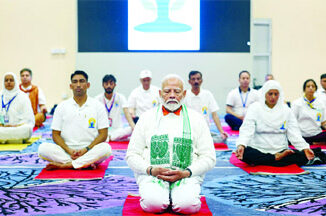
    Srinagar (TIP)- Prime Minister Narendra Modi on Friday, June 21, said the world sees yoga as a powerful agent for global good as it helps people live in the present without carrying the baggage of the past.
    Addressing a gathering at the 10th International Yoga Day event at the SKICC here, the prime minister said yoga has helped people realise that their welfare is linked to the welfare of the world around them.
    “The world is looking at yoga as a powerful agent of global good. Yoga helps us live in the present moment without the baggage of the past,” the prime minister said.
    “When we are peaceful within, we can also make a positive impact on the world…Yoga is making new ways of positive change in the society,” the prime minister said.
    The event was scheduled to be held on the lawns of the SKICC on the banks of the Dal Lake but had to be shifted indoors due to incessant rain.
    The prime minister said the number of yoga practitioners across the globe is growing every day and the regimen is becoming a part of their daily life.
    “The number of yoga followers is growing continuously. Wherever I go, there is hardly any (international) leader who does not talk to me about the benefits of yoga.
    “In many countries, yoga is becoming a part of the people’s daily lives,” Modi said as he cited the examples of Turkmenistan, Saudi Arabia, Mongolia, and Germany, saying the ancient form of meditation was fast becoming popular there.
    In his address, the prime minister also made a mentioned of 101-year-old Frenchwoman Charlotte Chopin who was awarded a Padma Shri for her services in popularising yoga in her country.
    Modi said the spread of yoga globally has led to a change in perception about it as more people are travelling to India to get authentic knowledge about it.
    “We are now seeing yoga tourism in states like Uttarakhand and Kerala. People are coming to India because they get to see authentic yoga.
    “People are now hiring personal yoga trainers for fitness, and companies are including yoga in mind and body (fitness) programmes for their employees. It has opened new avenues of livelihood,” he said.
    The prime minister said yoga provides solutions to several problems faced by people today.
    “Yoga is not only knowledge but it is science as well. In this era of information revolution, there is a flood of information sources and it is a challenge for the human mind to focus on one subject.
    “A solution for this is also in yoga as it helps the mind to focus. That is why from army to sports, yoga has been included in their routine,” he said.
    The prime minister said astronauts and people working on space projects are also trained in yoga as it increases “productivity as well as tolerance”.
    “In many prisons, the inmates are also taught yoga so that they can think positively,” he added. Modi expressed satisfaction that the people of Jammu and Kashmir are also taking up yoga which will help the tourism sector of the Union Territory.
    “I have been seeing since yesterday that yoga is becoming popular with the people of Srinagar and (rest of) Jammu and Kashmir. It is a big thing that 50,000 to 60,000 people are associated with yoga. This will attract more tourists here,” he said. Source: PTI

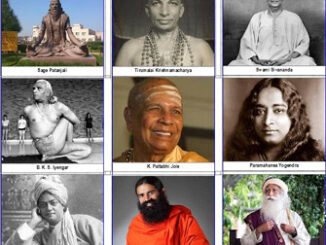
  • Eminent Yoga gurus

    Eminent Yoga gurus

    Yoga is an ancient practice is has been known for thousands of years for healing people. India is a country where this ancient practice was born 5000 years ago and a place where lord Adiyogi shiva has started this practice and later on our great Indian masters has kept the lineages of traditional yoga alive and passed to their students and the rest of the world. Those were the yoga teacher who has kept the tradition of yoga alive and spread the light of this ancient art and transformed the whole dimension of yoga teacher training courses in India with their teachings. All of these yoga gurus has followed the path of yoga but it all lead to one goal that was to spread the light of traditional yoga and connect them with their inner consciousness through the practice of yoga.
    Here are the most insiring yoga gurus in India who has changes the whole dimension of yoga all over the globe:
    Patanjali (Sage Maharshi Patanjali)
    Gonardiya, or Gonikaputra, also known as Patanjali, was a Hindu scholar, author, philosopher, and yoga guru. He is called the “Father of Moder Yoga” because he standardised and organised yogic principles that existed during his time.
    It is believed that Patanjali lived between the 2nd and 4th centuries BCE, based on the yogic texts written and compiled by him. He wrote the book “”Patanjali Yoga Sutras” by compiling all the yogic knowledge contained in ancient Indian scriptures and his own yoga knowledge.
    Patanjali’s work is mainly dedicated to the practice of Ashtanga Yoga.
    Tirumalai Krishnamacharya
    Tirumalai Krishamacharya (1888–1989) was an Indian yoga guru and scholar of Ayurveda. He is also called the “Father of Modern Yoga” because he promoted other forms of modern yoga, including postural yoga and hatha yoga.
    Krishnamacharya is responsible for the hatha yoga. Under the patronage of the King of Mysore, Krishna Raja Wadiyar IV, he travelled across India and taught yogic principles and practices to people in different regions of the country.
    Swami Sivananda
    Sivananda Saraswati, a.k.a. Swami Sivananda (1887–1963) was a prominent yoga teacher in India who was born in Tamil Nadu and worked as a physician in British Malaya (an island in Singapore) during his young adulthood. Later, he learned yoga, achieved mastery in it, and became a yoga teacher.
    Swami Sivananda founded the Divine Life Society (1936) and the Vedanta Forest Academy (148). These organisations have many branches in India and western countries that teach yoga asanas and meditations. He also wrote more than 200 books about yoga and spirituality, which are leaving a significant impact on people about the importance of yoga and spirituality.
    B. K. S. Iyengar
    Bellur Krishnamachar Sundaraja Iyengar, a.k.a. B. K. S. Iyengar (1918–2014), was an Indian yoga teacher and author who promoted yoga as a physical exercise. Guru Iyengar emphasised the importance of precision, alignment, and details related to yoga asanas or yoga postures. The methods he describes are called “Iyengar Yoga.”
    B. K. S. wrote many books about yoga, including “Light on Yoga,” “The Tree of Yoga,” “Light on Pranayama” and many others, which inspired people of western nations to learn Iyengar yoga. The first Iyengar yoga institute in India, Ramamani Iyengar Memorial Institute, Pune, was founded by Guru Iyengar in 1975. Later on, Iyengar yoga institutes were also founded by his disciples in western countries, such as the United States, Canada, Australia, Argentina, France, Belgium, Italy, Germany, Poland, and many others.
    K. Pattabhi Jois
    Kowshika Pattabhi Jois, or K. Pattabhi, was also a famous Indian yoga guru. He was contemporary to B. K. S. Iyengar and founded the Ashtanga Vinyasa form of yoga. Guru Pattabhi played a vital role in promoting Indian yogic practice in the United States of America.
    Paramahansa Yogendra
    Mukunda Lal Ghosh, a.k.a. Paramahansa Yogendra (1893–1952), was one of the most influential Indian yoga gurus. He played a vital role in reviving “Kriya Yoga,” which is a yogic practice consisting of pranayamas, mudras (gestures), and mantras (sacred utterances). This yogic practice aims to help individuals spiritually develop and provides peace of mind.
    Kriya Yoga was first mentioned in Paramahansa Yogendra’s book, “Autobiography of a Yogi.” Paramahansa Yogendra was the first Indian yoga guru who introduced the western world to yoga. He founded two organisations, the Yogendra Satsanga Society of India (1970) and the Seld-Realization Fellowship (1920), in Los Angeles, United States, to teach yoga to eastern and western people.
    Swami Vivekananda
    Narendranath Datta, a.k.a. Swami Vivekananda, was an Indian scholar, philosopher, and Hindu monk who is one of the most renowned personalities in the world because of his incredible knowledge about various subjects. Swami Vivekananda travelled to different parts of India and other nations and supported different social reforms. He also taught “Raja Yoga” to people across the world, which is a yogic practice that helps individuals become the best version of themselves.
    Baba Ramdev
    Ramkrishna Yadav, a.k.a. Baba Ramdev is the most famous Indian yoga teacher of modern times. He teaches yoga asanas and yoga pranayamas through his yoga school, Patanjali Yogapeeth, which has many branches in India, the United Kingdom, the United States, Canada, Nepal, and Mauritius.
    Baba Ramdev played a vital role in the revival of yoga and Ayurveda in India.
    Sadhguru
    Jagdish Vasudev, also known as Sadhguru, is also a modern Indian yoga teacher and spiritual leader. He promotes yoga worldwide through his organisation, the Isha Foundation, which was founded in 1992. He has been teaching yoga since 1982. His famous work based on yoga is his book, “Inner Engineering: A Yogi’s Guide to Crafting Your Destiny.” Sadhguru’s yoga courses are available online and offline in different yoga centres of the Isha Foundation worldwide.

  • Yoga: Its origin, history and development

    Yoga: Its origin, history and development

    Yoga is essentially a spiritual discipline based on an extremely subtle science, which focuses on bringing harmony between mind and body. It is an art and scince of healthy living. The word ‘Yoga’ is derived from the Sanskrit root ‘Yuj’, meaning ‘to join’ or ‘to yoke’ or ‘to unite’. As per Yogic scriptures the practice of Yoga leads to the union of individual consciousness with that of the Universal Consciousness, indicating a perfect harmony between the mind and body, Man & Nature. According to modern scientists, everything in the universe is just a manifestation of the same quantum firmament. One who experiences this oneness of existence is said to be in yoga, and is termed as a yogi, having attained to a state of freedom referred to as mukti, nirvana or moksha. Thus the aim of Yoga is Self-realization, to overcome all kinds of sufferings leading to ‘the state of liberation’ (Moksha) or ‘freedom’ (Kaivalya). Living with freedom in all walks of life, health and harmony shall be the main objectives of Yoga practice.”Yoga” also refers to an inner science comprising of a variety of methods through which human beings can realize this union and achieve mastery over their destiny.Yoga, being widely considered as an ‘immortal cultural outcome’ of Indus Saraswati Valley civilization – dating back to 2700 B.C., has proved itself catering to both material and spiritual upliftment of humanity.Basic humane values are the very identity of Yoga Sadhana.
    The practice of Yoga is believed to have started with the very dawn of civilization. The science of yoga has its origin thousands of years ago, long before the first religions or belief systems were born. In the yogic lore, Shiva is seen as the first yogi or Adiyogi, and the first Guru or Adi Guru.
    Several thousand years ago, on the banks of the lake Kantisarovar in the Himalayas, Adiyogi poured his profound knowledge into the legendary Saptarishis or “seven sages”. The sages carried this powerful yogic science to different parts of the world, including Asia, the Middle East, Northern Africa and South America. Interestingly, modern scholars have noted and marvelled at the close parallels found between ancient cultures across the globe. However, it was in India that the yogic system found its fullest expression. Agastya, the Saptarishi who travelled across the Indian subcontinent, crafted this culture around a core yogic way of life.
    The Number of seals and fossil remains of Indus Saraswati valley civilization with Yogic motives and figures performing Yoga Sadhana suggest the presence of Yoga in ancient India. The phallic symbols, seals of idols of mother Goddess are suggestive of Tantra Yoga. Presence of Yoga is available in folk traditions, Indus valley civilization, Vedic and Upanishadic heritage, Buddhist and Jain traditions, Darshanas, epics of Mahabharat and Ramayana, theistic traditions of Shaivas, Vaishnavas, and Tantric traditions. In addition, there was a primordial or pure Yoga which has been manifested in mystical traditions of South Asia. This was the time when Yoga was being practised under the direct guidance of Guru and its spritual value was given special importance. It was a part of Upasana and yoga sadhana was inbuilt in their rituals. Sun was given highest importance during the vedic period. The practice of ‘Surya namaskara’ may have been invented later due to this influence. Pranayama was a part of daily ritual and to offer the oblation. Though Yoga was being practiced in the pre-Vedic period, the great Sage Maharshi Patanjali systematized and codified the then existing practices of Yoga, its meaning and its related knowledge through his Yoga Sutras. After Patanjali, many Sages and Yoga Masters contributed greatly for the preservation and development of the field through their well documented practices and literature.
    Historical evidences of the existence of Yoga were seen in the pre-Vedic period (2700 B.C.), and thereafter till Patanjali’s period. The main sources, from which we get the information about Yoga practices and the related literature during this period, are available in Vedas (4), Upanishads(108), Smritis, teachings of Buddhism, Jainism, Panini, Epics (2), Puranas (18) etc.
    Tentatively, the period between 500 BC – 800 A.D. is considered as the Classical period which is also considered as the most fertile and prominent period in the history and development of Yoga. During this period, commentaries of Vyasa on Yoga Sutras and Bhagawadgita etc. came into existence.This period can be mainly dedicated to two great religious teachers of India –Mahavir and Buddha. The concept of Five great vows – Pancha mahavrata- by Mahavir and Ashta Magga or eightfold path by Buddha – can be well considered as early nature of Yoga sadhana. We find its more explicit explanation in Bhagawadgita which has elaborately presented the concept of Gyan yoga, Bhakti yoga and Karma Yoga. These three types of yoga are still the highest example of human wisdom and and even to day people find peace by following the methods as shown in Gita. Patanjali’s yoga sutra besides containing various aspects of yoga, is mainly identified with eight fold path of Yoga. The very important commentary on Yoga sutra by Vyasa was also written. During this very period the aspect of mind was given importance and it was clearly brought out through Yoga sadhana, Mind and body both can be brought under control to experience equanimity.The period between 800 A.D. – 1700 A.D. has been recognized as the Post Classical period wherein the teachings of great Acharyatrayas-Adi Shankracharya, Ramanujacharya, Madhavacharya-were prominent during this period. The teachings of Suradasa, Tulasidasa, Purandardasa, Mirabai were the great contributors during this period. The Natha Yogis of Hathayoga Tradition like Matsyendaranatha, Gorkshanatha, Cauranginatha, Swatmaram Suri, Gheranda, Shrinivasa Bhatt are some of the great personalities who popularized the Hatha Yoga practices during this period.
    The period between 1700 – 1900 A.D. is considered as Modern period in which the great Yogacharyas- Ramana Maharshi, Ramakrishna Paramhansa, Paramhansa Yogananda, Vivekananda etc. have contributed for the development of Raja Yoga.This was the period when Vedanta, Bhakti yoga, Nathayoga or Hatha-yoga flourished. The Shadanga-yoga of Gorakshashatakam, Chaturanga-yoga of Hathayogapradipika, Saptanga-yoga of Gheranda Samhita, were the main tenents of Hatha-yoga.
    Now in the contemporary times, everybody has conviction about yoga practices towards the preservation, maintenance and promotion of health. Yoga has spread all over the world by the teachings of great personalities like Swami Shivananda, Shri T.Krishnamacharya, Swami Kuvalayananda, Shri Yogendara, Swami Rama, Sri Aurobindo, Maharshi Mahesh Yogi, Acharya Rajanish, Pattabhijois, BKS. Iyengar, Swami Satyananda Sarasvati and the like.
    Clearing Misconceptions
    For many, the practice of yoga is restricted to Hatha Yoga and Asanas (postures). However, among the Yoga Sutras, just three sutrasare dedicated to asanas. fundamentally, hatha yoga is a preparatory process so that the body can sustain higher levels of energy. The process begins with the body, then the breath, the mind, and the inner self.
    Yoga is also commonly understood as a therapy or exercise system for health and fitness. While physical and mental health are natural consequences of yoga, the goal of yoga is more far-reaching. “Yoga is about harmonizing oneself with the universe. It is the technology of aligning individual geometry with the cosmic, to achieve the highest level of perception and harmony.”
    Yoga does not adhere to any particular religion, belief system or community; it has always been approached as a technology for inner wellbeing. Anyone who practices yoga with involvement can reap its benefits, irrespective of one’s faith, ethnicity or culture.Traditional Schools of Yoga :These different Philosophies, Traditions, lineages and Guru-shishya paramparas of Yoga lead to the emergence of differnt Traditional Schools of Yoga e.g. Jnana-yoga, Bhakti-yoga, Karma-yoga, Dhyana-yoga, Patanjala-yoga, Kundalini-yoga, Hatha-yoga, Mantra-yoga, Laya-yoga, Raja-yoga, Jain-yoga, Bouddha-yoga etc. Each school has its own principles and practices leading to altimate aim and objectives of Yoga.
    Yogic Practices for Health and Wellness
    The widely practiced Yoga Sadhanas (Practices) are: Yama, Niyama, Asana, Pranayama, Pratyahara, Dharana, Dhyana (Meditation), Samadhi /Samyama, Bandhas & Mudras, Shat-karmas, Yukta-ahara, Yukta karma, Mantra japa, etc.Yama’s are restraints and Niyama’s are observances. These are considered to be pre-requisits for the Yoga Sadhanas (Practices). Asanas, capable of bringing about stability of body and mind ‘ kuryat-tad-asanam-sthairyam…’ , consists in adopting various body (psycho-physical) patterns, giving ability to maintain a body position (a stable awareness of one’s structural existence) for a considerable length and period of time as well.
    Pranayama consists in developing awareness of one’s breathing followed by willful regulation of respiration as the functional or vital basis of one’s existence. It helps in developing awareness of one’s mind and helps to establish control over the mind. In the initial stages, this is done by developing awareness of the ‘flow of in-breath and out-breath’ (svasa-prasvasa) through nostrils, mouth and other body openings, its internal and external pathways and destinations. Later, this phenomenan is modified, through regulated, controlled and monitored inhalation (svasa) leading to the awareness of the body space/s getting filled (puraka), the space/s remaning in a filled state (kumbhaka) and it’s getting emptied (rechaka) during regulated, controlled and monitored exhalation (prasvasa).
    Pratyhara indicates dissociation of one’s consciousness (withdrawal) from the sense organs which helps one to remain connected with the external objects. Dharana indicates broad based field of attetion (inside the body and mind) which is usually understood as concentration. Dhyana (Meditation) is contemplation (focussed attention inside the body and mind) and Samadhi – integration.
    Bandhas and Mudras are practices associated with pranayama. They are viewed as (the) higher Yogic practices mainly consisting on adopting certain body (psycho-physical) patterns along with control over respiration.This further facilitates control over mind and paves way for higher yogic attainment. Shat-karmas are de-toxification procedures, help to remove the toxins acumalated in the body and are clinical in nature.
    Yuktahara (Right Food and other inputs) advocates appropriate food and food habits for healthy living. However practice of Dhyana (Meditation) helping in self-realization leading to transcendence is considered as the esssence of Yoga Sadhana (The Practice of Yoga).
    The Fundamentals of Yoga Sadhana
    Yoga works on the level of one’s body, mind, emotion and energy. This has given rise to four broad classifications of Yoga: karma yoga, where we utilize the body; bhakti yoga, where we utilize the emotions; gyana yoga, where we utilize the mind and intelect; and kriya yoga, where we utilize the energy.
    Each system of Yoga we practice would fall within the gamut of one or more of these categories. Every individual is a unique combination of these four factors. “All the ancient commentaries on Yoga have stressed that it is essential to work under the direction of a Guru.” The reason being that only a Guru can mix the appropriate combination of the four fundamental paths, as is necessary for each seeker.Yoga Education:Tradiitionally, Yoga Education was imparted by knowledgeable, experienced, and wise persons in the families (comparable with the education imparted in convents in the west) and then by the Seers (Rishis/Munis/Acharyas) in Ashramas (compared with monastries). Yoga Education, on the other hand, aims at taking care of the individual, the ‘Being’. It is presumed that a good, balanced, integrated, truthful, clean, transparent person will be more useful to oneself, family, society, nation, nature and humanity at large. Yoga education is ‘Being oriented’. Details of working with ‘being oriented’ aspect have been outlined in various living traditions and texts and the method contributing to this important field is known as ‘Yoga’.
    Present days, Yoga Education is being imparted by many eminent Yoga Institutions, Yoga Colleges, Yoga Universites, Yoga Departments in the Universities, Naturopathy colleges and Private trusts & societies. Many Yoga Clinics, Yoga Therapy and Training Centers, Preventive Health Care Units of Yoga, Yoga Research Centers etc. have been established in Hospitals, Dispensories, Medical Institiutions and Therapetical setups.
    Different social customs and rituals in India, the land of Yoga, reflect a love for ecological balance, tolerance towards other systems of thought and a compassionate outlook towards all creations.Yoga Sadhana of all hues and colours is considered panacea for a meaningful life and living. Its orientation to a comprehensive health, both individual and social, makes it a worthy practice for the people of all religions, races and nationalities.
    Now-a-days, millions and millions of people across the globe have benefitted by the practice of Yoga which has been preserved and promoted by the great eminent Yoga Masters from ancient time to this date.The practice of Yoga is blossoming, and growing more vibrant every day.

  • International Yoga Day

    International Yoga Day

    International Yoga Day is observed on June 21, the longest day of the year in the Northern Hemisphere, symbolising the significance of light and the transition to Dakshinayana, an auspicious period in Indian tradition.

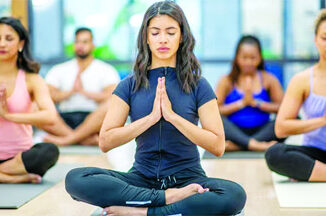
    Yoga, which has its roots in India, is a physical and mental health-enhancing activity. The 10th International Yoga Day 2024 will be celebrated around the world on June 21. The day aims to raise awareness about the numerous benefits of yoga, right from physical, mental, and spiritual. The term “Yoga” comes from the Sanskrit root “yuj,” which means “to join,” “to yoke,” or “to unite.” Yoga reflects the union of mind and body, thoughts and actions, restraint and fulfillment, and harmony between humans and nature.
    International Yoga Day 2024 Theme
    Each year, International Yoga Day adopts a specific theme to focus the celebrations and activities around a particular aspect of yoga. The theme for 2024 is “Yoga for Self and Society.”
    International Yoga Day 2024 History
    Though the origin of yoga dates back to ancient India, however, in September 2014, Prime Minister Narendra Modi proposed to observe the International Day of Yoga during his address to the United Nations General Assembly (UNGA). While addressing the 69th session of the UNGA, the prime minister had said, “Yoga is an invaluable gift from our ancient tradition. Yoga embodies unity of mind and body, thought and action … a holistic approach [that] is valuable to our health and our well-being. Yoga is not just about exercise; it is a way to discover the sense of oneness with yourself, the world and the nature.”
    After which, the UNGA on 11 December 2014, proclaimed 21 June as the International Day of Yoga.
    International Yoga Day 2024 Significance
    Over the years, yoga has become widely popular worldwide, with millions embracing it to enhance their overall health and mental well-being. Yoga is not only about physical excercises but includes breathing exercises and mediation. It not only helps to reduce stress, anxiety and depression but also improves flexibility, strength, balance, and endurance. International Yoga Day holds multifaceted significance, centered on promoting the practice of yoga and its associated benefits. Key aspects of its importance include:
    Global awareness: The day aims to educate people worldwide about the extensive health benefits of yoga. By fostering a global community of practitioners, it encourages individuals to incorporate yoga into their daily routines.
    Physical health
    Yoga is renowned for enhancing flexibility, strength, and endurance. Regular practice can prevent and manage various physical ailments, including back pain and cardiovascular issues.
    Mental well-being
    Beyond physical health, yoga significantly benefits mental well-being. It aids in stress reduction, enhances concentration, and promotes mental clarity. Practices such as pranayama (breath control) and meditation are crucial for managing anxiety and depression.
    Spiritual growth
    Rooted in spirituality, yoga fosters inner peace and harmony, guiding individuals toward self-awareness and self-realization. This spiritual aspect helps practitioners connect with themselves on a deeper level.
    Community and unity
    The theme “Yoga for Self and Society” emphasises yoga’s role in creating a harmonious society. It promotes a sense of unity and collective consciousness, transcending cultural and geographical barriers.
    Importance
    Yoga is more than just an exercise. It is a method for empowering oneself, along with the body and psyche. With today’s life, which is going so fast, everybody should integrate yoga into their everyday daily practice.


  • June 21 New York & Dallas E – Edition

    [vc_row][vc_column][vc_custom_heading text=”E-Edition” font_container=”tag:h2|text_align:center” google_fonts=”font_family:Istok%20Web%3Aregular%2Citalic%2C700%2C700italic|font_style:700%20bold%20regular%3A700%3Anormal” css=”” link=”url:https%3A%2F%2Fwww.theindianpanorama.news%2Fwp-content%2Fuploads%2F2024%2F06%2FTIP-June-21-E-Edition.pdf”][vc_single_image image=”166226″ img_size=”full” alignment=”center” onclick=”custom_link” css=”” link=”https://www.theindianpanorama.news/wp-content/uploads/2024/06/TIP-June-21-E-Edition.pdf”][/vc_column][/vc_row][vc_row][vc_column width=”2/3″][vc_custom_heading text=”Lead Stories This Week” google_fonts=”font_family:Istok%20Web%3Aregular%2Citalic%2C700%2C700italic|font_style:700%20bold%20regular%3A700%3Anormal” css=”” link=”url:https%3A%2F%2Fwww.theindianpanorama.news%2F”][vc_wp_posts number=”5″ show_date=”1″][/vc_column][vc_column width=”1/3″][vc_single_image image=”82828″ img_size=”medium” alignment=”center” onclick=”custom_link” css=”” link=”https://www.theindianpanorama.news/advertising-media-kit-portal-indian-panorama/ “][vc_single_image image=”82829″ img_size=”medium” alignment=”center” onclick=”custom_link” css=”” link=”https://www.theindianpanorama.news/advertising-media-kit-portal-indian-panorama/ “][/vc_column][/vc_row]

  • At least nine Rohingyas killed in landslides at Cox’s Bazar refugee camps

    Cox’s Bazar (TIP): At least nine Rohingyas were killed in landslides caused by heavy torrential rain in Ukhiya refugee camps of Cox’s Bazar June 19 morning, The Daily Star reported.
    Quoting Mohammad Samsudduza, additional refugee relief and repatriation commissioner, The Daily Star that the landslides took place in camp no. 9 and 10.
    “Nine bodies were recovered,” he said, adding that they are working to evacuate Rohingyas living in risky hilly areas.
    Around 1.2 million Rohingyas, most of them fled to Bangladesh facing atrocity by the Myanmar junta forces in 2017, have been living in 33 camps of Ukhiya and Teknaf of Cox’s Bazar, the report said. Cox’s Bazar has been witnessing heavy rainfall since June 18.

  • Five family members of Malaysian man who attacked police station face terrorism charges

    KUALA LUMPUR (TIP): The father of a Malaysian man who attacked a police station and killed two police officers last month was charged on June 19 with inciting terrorism in his family. His Singaporean wife and three other children were also brought to court to face charges.
    Radin Imran Radin Mohd Yassin, 62, faces four charges including promoting terrorist acts by allegedly instilling the violent ideology of the Islamic State group in his family, including his 21-year-old son Radin Luqman, who was killed by police in the attack.
    Radin Luqman stormed the police station in southern Johor state near Singapore in the early hours of May 17 with a machete. He hacked a police constable to death and then used the officer’s weapon to kill another. He wounded a third officer before being shot dead. Police initially said the man could have been planning to take firearms from the station.
    The incident sparked concerns of a wider security threat but government officials said the man and his family were reclusive, and that the attacker was believed to have acted on his own.
    Radin Imran, who is unemployed, was also accused of supporting terrorist acts by keeping four homemade air rifles in his home for Islamic State activities, according to charge sheets seen by The Associated Press.
    He also allegedly pledged allegiance in 2014 to Islamic State’s then-leader, Abu Bakr al-Baghdadi, who was killed in a U.S. raid in Syria in 2019. A book linked to the Islamic State was found in his possession.
    His eldest son, Radin Romyullah, 34, faces two separate charges of pledging loyalty to Abu Bakar and of possessing an external hard drive containing materials related to the Islamic State, the charge sheets showed. Both father and son face life imprisonment, which in Malaysia is up to 40 years, and a fine.
    Radin Imran’s Singaporean wife, Rosna Jantan, 59, and two daughters aged 19 and 23 each face a vague charge related to the omission of information related to the spread of terrorism. No details were given.
    Local media said the five were brought to a court in Johor under heavy security. The Star newspaper said no plea was recorded but the five, who were not represented by lawyers, said they understood the charges against them. The next hearing in the case will be on July 31. (AP)

  • Pak journalist shot dead in restive Khyber Pakhtunkhwa province

    PESHAWAR (TIP): A Pakistani journalist was gunned down on June 18 by unknown gunmen in the restive Khyber Pakhtunkhwa province in the country’s northwest, according to a tribal journalist association.
    Khalil Jibran, associated with Pashto News Channel ‘Khyber News’ was shot dead by shooters near his home in the Mazrina Sultankhel area of the Khyber district.
    Another person, identified as Sajid, was injured in the shooting.
    The attackers managed to flee from the scene after killing the journalist.
    Police contingents were on their way to the shooting site, according to sources.
    The Mazrina area of the tribal district is a hotbed of militants.
    Family sources confirmed Jibran’s killing, and a senior journalist alleged that it was a case of targeted killing. (PTI)

  • A Muslim mob in Pakistan torches a police station and lynches a man after accusing him of blasphemy

    A Muslim mob in Pakistan torches a police station and lynches a man after accusing him of blasphemy

    PESHAWAR, Pakistan (TIIP): A Muslim mob in northwestern Pakistan on June 20 broke into a police station, snatched a man who was held there and then lynched him over allegations that he had desecrated Islam’s holy book, the Quran.
    The attackers also torched the station in Madyan, a town in Khyber Pakhtunkhwa province, and burned police vehicles parked there, according to local police official Rahim Ullah.
    The slain man, Mohammad Ismail, was a tourist who was staying at a hotel in the town when some locals turned on him and accused him of blasphemy.
    Ullah said police officers took the man to the station for his protection but the mob swelled and pursued them. The mob then attacked the station, snatched Ismail, beat him to death and then burned his body and left it on the road.
    Additional police forces have arrived in Madyan to bring the situation under control, Ullah said.
    It wasn’t immediately known if any of the attackers were arrested.
    Attacks on people accused of blasphemy are common in this conservative Islamic nation where charges of blasphemy can carry the death sentence. International and national rights groups say blasphemy accusations have often been used to intimidate religious minorities and settle personal scores.
    Last month, a mob in Pakistan’s eastern Punjab province attacked a Christian man, Nazir Masih, 72, after accusing him of desecrating pages of Quran. He later died at a hospital. (AP)

  • Nepal suspends sales of antibiotic injection manufactured by Indian company citing ‘health risks’

    Kathmandu (TIP): The sales and distribution of Biotax 1gm, manufactured by an Indian firm, has been banned in Nepal due to “health risks.”
    The Department of Drug Administration suspended the antibiotic injection since it was not in compliance with the production specifications, The Kathmandu Post reported.
    Biotax 1gm injection is an antibiotic medicine used to treat bacterial infections, including those of the brain, lungs, ear, urinary tract, skin, soft tissues, bones and joints, blood, and heart. It is also used to prevent infections during surgery.
    The injection is manufactured by Zydus Healthcare Ltd.
    “We have directed the manufacturing company, importers and distributors to immediately suspend sales, import and distribution of the said medicine, until further notice,” said Pramod KC, spokesperson at the department. “Some serious issues have been detected in the said antibiotic. Decisions about further actions will be taken once the investigation is completed,” he was quoted as saying by The Kathmandu Post.
    According to the department, which carried out the testing in its own laboratory, BIOTAX-1gm batch F300460 is not safe for use and could risk patients’ lives. (AP)

  • Ambitious Tory hopefuls could learn from Lady Macbeth’s fate ahead of leadership battle

    Ambitious Tory hopefuls could learn from Lady Macbeth’s fate ahead of leadership battle

    London (TIP): Stefan Stern, City, University of London. Grant Shapps is running. The Tory MP has held what seems like every ministerial post possible and is famous in Westminster for his command of spreadsheets and data—in other words, for tracking the views and intentions of his fellow Tory MPs. He is ready for the battle ahead.
    Priti Patel is running. The former home secretary is on good terms with Nigel Farage, leader of the Reform party. “She could plausibly present herself as the candidate who could best unify a divided right,” according to Paul Goodman, a former Conservative MP.
    Kemi Badenoch is running. She is less of a fan of Farage’s, but has set out some sharp views, including on gender identity, which have further endeared her to many existing admirers on the right.
    Penny Mordaunt is running. She has the profile after her striking sword-bearing role in the King’s coronation. She also has a confident manner on television, as exemplified in her appearance on the first seven-way debate of the campaign, during which, it should be noted, she said her boss, the prime minister, had been “completely wrong” to leave the D-day commemoration events rather early. She also has, it must be admitted, great hair.
    Robert Jenrick is running. A new champion of tougher rules on immigration, a slimmed-down Jenrick has worked hard to establish a forceful political identity for himself.
    And Suella Braverman is running. Hope—and ambition—spring eternal. And yet none of these people appear to be running for July 4. Their sights are set firmly on July 5.
    Even as the Conservative Party stands poised to suffer one of its biggest ever election defeats, potential contenders to succeed Rishi Sunak as party leader are preparing for the fight to come. The body of the (seemingly) outgoing leader is not yet cold, but already thoughts are turning to the post-Sunak future.
    This is business as usual at Westminster, where an old, macabre joke has it that, on hearing of the death of an elderly fellow MP, the traditional response is: “Oh dear, how sad, what was the majority?”
    Future leadership contenders—Patel, Badenoch and Braverman—are positioning themselves with regard to their future relationship with Farage and the Reform Party rather than with the electorate. The current low poll rating for their own party has not dimmed their enthusiasm or energy levels.
    What explains this sort of burning ambition, which seems to manifest itself as a renewable form of energy? The subject of ambition has intrigued me for many years, so much so that eventually I wrote a book about it, which is being published next month, just as Conservative ambitions are likely to collide in a fresh leadership battle.
    The book’s title: Fair or Foul – the Lady Macbeth Guide to Ambition, hints at that ambivalence which, I think, many people experience with regard to personal and professional goals. On the one hand, we know that life can be extremely competitive and that the meek are very unlikely to inherit the earth. There is nothing wrong with being ambitious to achieve more and secure our future.
    And yet, how do we feel when confronted by the truly, deeply ambitious—those people whose ruthlessness and determination can cause unease and even revulsion? How much time do we really want to spend around people like that? For a politician seeking popularity, and votes, these are hardly trivial questions. (AFP)

  • Navigating through darkness: Ukraine’s emergency blackouts return after Russia pounds infrastructure

    Navigating through darkness: Ukraine’s emergency blackouts return after Russia pounds infrastructure

    KYIV (TIP): During daytime, entire districts of Ukraine’s capital are disconnected from the power grid to save energy. Traffic lights stop, choking traffic, accompanied by the constant rumble of generators installed outside cafes and shops.
    Ukraine, including Kyiv, is struggling to cope with a new wave of rolling blackouts after relentless Russian attacks took out half the country’s power generation capacity.
    Residents and businesses of Kyiv are adapting to the absence of electricity using generators, power banks, and flashlights and even recalculating their bathroom visits. Heavy damage inflicted to the country’s power system has left millions feeling uncertain about Ukraine’s ability to meet the national electricity demand after the warm weather months are over and the weather turns cold.
    “I light my apartment as our grandparents used to — with candles and small flashlights,” said Rudoy, a 40-year-old insurance agent from Israel who relocated from Tel Aviv to Kyiv in 2023 after Russia launched its full-scale invasion of Ukraine on Feb. 24, 2022.
    He said that he wanted a new life despite the war — to live side-by-side with old friends and reside in a milder climate — but he hadn’t foreseen the inconveniences of living without power. Rudoy bought an apartment on the seventh floor of a newly built 25-story high rise with no gas system or water supply that’s wholly dependent on electricity.
    “I have to adjust my life to the blackout schedules, otherwise it is impossible to live normally — not even to use a toilet at times,” Rudoy told The Associated Press.
    A friend in a nearby district typically has power when he doesn’t, which makes his life easier. Work often gets done at a cafe that has a generator, but there’s a catch.
    “Even if you find a free table at a cafe nearby, working generators are very noisy and spread diesel fumes,” he said. “That’s why not many cafes that operate during blackouts are actually good to work in.”
    Ukraine is struggling to meet electricity demand as systematic attacks on its power infrastructure have intensified since March, forcing utilities to ration household supplies over the last three months. The country’s top officials repeatedly called on allied countries to provide more air defense systems to protect its power plants from Russian missiles and drones, but tangible damage had already been inflicted.
    The blackouts in Kyiv are the worse since the early months of the war when Russian strikes on the country’s power grid led to major winter-time blackouts that led to authorities setting up communal heating areas and hundreds of emergency points where residents could drink tea, recharge their phones and get help. (AP)

  • Historic flooding in China’s Guangdong kills nine, warnings issued for other parts of country

    Historic flooding in China’s Guangdong kills nine, warnings issued for other parts of country

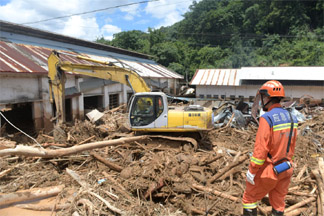
    BEIJING (TIP): Nine people have died and six are missing after downpours caused historic flooding in rural parts of Guangdong province in southern China, while authorities warned on June 21 of more flooding ahead in other parts of the country.
    Four people died and four are missing, in Meixian district in Guangdong’s Meizhou city, state broadcaster CCTV reported Thursday night. Another five are dead in Jiaoling county, which is also in Meizhou.
    The heaviest rains were from Sunday into Tuesday, toppling trees and collapsing homes. A road leading to Meixian district completely collapsed during the heavy rains. The Songyuan river, which winds through Meizhou, experienced its biggest recorded flood, according to CCTV.
    The estimated direct economic loss is 3.65 billion yuan ($502 million) in Jiaoling county, while in Meixian district, the loss is 1.06 billion yuan ($146 million).
    Other parts of the country also face torrential rains and extreme weather in the next 24 hours, with the National Meteorological Center issuing a warning for several provinces in the south and a few individual places in the north.
    Henan and Anhui provinces in central China, as well as Jiangsu province on the coast and the southern province of Guizhou, all are expecting hail and strong thunderstorms, according to the forecast. Rainfall could be as high as 50 mm to 80 mm (1.9 to 3.14 inches) in one day in Henan, Anhui and Hubei provinces, the National Meteorological Center said.
    Last week, it was southern Fujian and Guangxi provinces experienced landslides and flooding amid heavy rain. One student died in Guangxi after falling into a river swollen from the downpour. (AP)

  • Japan’s ‘beat poet’ Kazuko Shiraishi, pioneer of modern performance poetry, dies at 93

    TOKYO (TIP): Kazuko Shiraishi, a leading name in modern Japanese “beat” poetry, known for her dramatic readings, at times with jazz music, has died. She was 93.
    Shiraishi, whom American poet and translator Kenneth Rexroth dubbed “the Allen Ginsberg of Japan,” died of heart failure on June 14, Shichosha, a Tokyo publisher of her works, said on June 19.
    Shiraishi shot to fame when she was just 20, freshly graduated from Waseda University in Tokyo, with her “Tamago no Furu Machi,” translated as “The Town that Rains Eggs” — a surrealist portrayal of Japan’s wartime destruction.
    With her trademark long black hair and theatrical delivery, she defied historical stereotypes of the silent, non-assertive Japanese woman.
    “I have never been anything like pink,” Shiraishi wrote in her poem.
    It ends: “The road / where the child became a girl / and finally heads for dawn / is broken.”
    Shiraishi counted Joan Miro, Salvador Dali and John Coltrane among her influences. She was a pioneer in performance poetry, featured at poetry festivals around the world. She read her works with the music of jazz greats like Sam Rivers and Buster Williams, and even a free-verse homage to the spirit of Coltrane.
    Born in Vancouver, Canada, she moved back to Japan as a child. While a teen, she joined an avant-garde poetry group.
    Shiraishi’s personality and poems, which were sometimes bizarre or erotic, defied Japan’s historical rule-bound forms of literature like haiku and tanka, instead taking a modern, unexplored path.
    Rexroth was instrumental in getting Shiraishi’s works translated into English, including collections such as “My Floating Mother, City” in 2009 and “Seasons of Sacred Lust” in 1978.
    Over the years, her work has been widely translated into dozens of languages. She was also a translator of literature, including works by Ginsberg.
    In 1973, Paul Engle invited her to spend a year as a guest writer at the International Writing Program at the University of Iowa, an experience that broadened her artistic scope and helped her gain her poetic voice.
    “In the poems of Kazuko Shiraishi, East and West connect and unite fortuitously,” wrote German writer Gunter Kunert. “It refutes Kipling’s dictum that East is East and West is West and never the twain shall meet. In Kazuko Shiraishi’s poems this meeting has already happened.” (AP)

  • South Korea will consider supplying arms to Ukraine after Russia and North Korea sign strategic pact

    South Korea will consider supplying arms to Ukraine after Russia and North Korea sign strategic pact

    SEOUL (TIP): South Korea said on June 20 that it would consider sending arms to Ukraine, a major policy change suggested after Russia and North Korea rattled the region and beyond by signing a pact to come to each other’s defense in the event of war.
    The comments from a senior presidential official came hours after North Korea’s state media released the details of the agreement, which observers said could mark the strongest connection between Moscow and Pyongyang since the end of the Cold War. It comes at a time when Russia faces growing isolation over its war in Ukraine and both countries face escalating standoffs with the West.
    According to the text of the deal published by the North’s official Korean Central News Agency, if either country gets invaded and is pushed into a state of war, the other must deploy “all means at its disposal without delay” to provide “military and other assistance.” But the agreement also says that such actions must be in accordance with the laws of both countries and Article 51 of the United Nations Charter, which recognizes a U.N. member state’s right to self-defense.
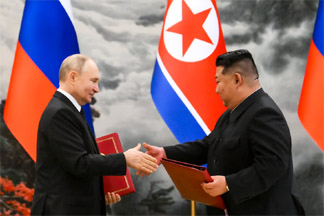
    North Korean leader Kim Jong Un and Russian President Vladimir Putin signed the pact at a summit Wednesday in Pyongyang. Both described it as a major upgrade of bilateral relations, covering security, trade, investment, cultural and humanitarian ties.
    The office of South Korean President Yoon Suk Yeol issued a statement condemning the agreement, calling it a threat to the South’s security and a violation of U.N. Security Council resolutions, and warned that it would have negative consequences on Seoul’s relations with Moscow.
    “It’s absurd that two parties with a history of launching wars of invasion — the Korean War and the war in Ukraine — are now vowing mutual military cooperation on the premise of a preemptive attack by the international community that will never happen,” Yoon’s office said.
    At the United Nations in New York, South Korean Foreign Minister Cho Tae-yul called it “deplorable” that Russia would act in violation of multiple U.N. sanctions resolutions against North Korea that Moscow voted for.
    Yoon’s national security adviser, Chang Ho-jin, said Seoul would reconsider the issue of providing arms to Ukraine to help the country fight off Russia’s invasion.
    South Korea, a growing arms exporter with a well-equipped military backed by the United States, has provided humanitarian aid and other support to Ukraine while joining U.S.-led economic sanctions against Moscow. But it has not directly provided arms to Kyiv, citing a longstanding policy of not supplying weapons to countries actively engaged in conflict.
    Speaking to reporters in Hanoi, where he traveled right after Pyongyang, Putin said Thursday that supplying weapons to Ukraine would be “a very big mistake” on South Korea’s part. (AP)

  • Town of Brookhaven Dedicates Michigan Avenue in Bellport in Memory of Tanya Indrani Bathija

    Town of Brookhaven Dedicates Michigan Avenue in Bellport in Memory of Tanya Indrani Bathija

    FARMINGVILLE, NY (TIP): A delayed report says that the Town of Brookhaven on May 23 dedicated ‘Michigan Ave’ in Bellport, to ‘Tanya Indrani Bathija Avenue in her memory.
    Tanya Bathija was an amazing young woman who, as a daughter, a sister, a friend, a powerful businesswoman and CEO, and a mentor to young ladies in our community, left a mark everywhere she went. This beautiful Dunkin Donuts (pictured at right) was once the site of a vacant and blighted building, and her vision and partnership with Brookhaven Town Councilman Michael Loguercio, was to turn this blight into light. She transformed this parcel in the community into a thriving business and supported the local residents with whom she employs there.
    Tanya was a dedicated volunteer for the Boys & Girls Club of the Bellport Area and a Director at Sunrise Day Camp-Long Island, a camp which supports and provides services for children who are battling cancer. Her philanthropic efforts will never go unnoticed, and her foundation is still carrying on with her vision to help support underprivileged children, empowering women and promoting cultural and social values.
    Councilman Loguercio said, “Tanya is missed terribly, and her life is celebrated through the many businesses and ongoing foundation work that still carries on today. I am proud to have known her and will always be inspired by her light, generosity and her incredible passion for always helping a fellow human being. Her father Ben and her family are amazing and generous people, who unfortunately lost their daughter tragically. We wish them all peace and comfort and know that she is looking down on us all and her legacy will live on forever.”

    Officials, relations, friends attended the dedication ceremony.
  • EPA Makes a Splash with Award of $315,000 to New York to Support Water Quality Monitoring at Beaches to Protect Public Health

    EPA Makes a Splash with Award of $315,000 to New York to Support Water Quality Monitoring at Beaches to Protect Public Health

    NEW YORK (TIP): The U.S. Environmental Protection Agency (EPA), on June 13, announced $315,000 in grant funding to help New York’s coastal and Great Lakes communities protect the health of beachgoers. The funding will assist New York in conducting water quality monitoring and public notification programs for their beaches.

    “This funding helps keep beaches and coastal waters clean so that people can have fun, relax and enjoy all the beauty that New York coastlines have to offer,” said Lisa F. Garcia, Regional Administrator. “EPA funding is vital for successful beach monitoring and notification programs.”

    “Protecting the health of beachgoers from bacteria in our waters is of the utmost importance for New Yorkers to enjoy this summer swimming season,” said Senate Majority Leader Schumer. “This federal EPA funding will help ensure safe water at both downstate beaches and Great Lakes beaches by giving New York the resources needed to closely monitor water quality.”

    “As thousands of beachgoers enjoy New York’s coastal and Great Lakes beaches this summer, they deserve to enjoy the waters without a threat to their health,” said Senator Kirsten Gillibrand. “This federal funding will help local authorities monitor beach water quality and ensure that swimmers know when the waters are safe. I am proud to see EPA making this critical investment and will continue to fight to ensure all can safely enjoy New York’s beaches.”

    “I have always called the Long Island Sound our ‘National Park.’ Safeguarding and conserving the Sound and our coastal beach areas has consistently been a priority of mine throughout my decades-long career in public service. This grant funding from the EPA will significantly contribute to guaranteeing that the water quality at our local beaches remains safe for everyone to enjoy throughout the entire summer season,” said Representative Tom Suozzi (NY-03).

    “Water quality monitoring and public notification programs are crucial to protecting public health and I thank the EPA for awarding this funding, especially as New Yorkers hit the beaches for the summer,” said Representative Grace Meng (NY-06). “As New York’s representative on the House of Representatives’ Regional Leadership Council – which works to promote and implement legislation signed by President Biden – I am glad that critical federal funding continues to flow to our state.”

    “Ensuring the resiliency of Great Lakes communities is a key part of protecting our environment and providing recreational opportunities for our families,” said Representative Joe Morelle (NY-25). “I’m grateful to the Environmental Protection Agency and the Biden Administration for their ongoing commitment to investing in New York’s shoreline communities as both economic and recreational assets—including this latest $315,000 grant to support water quality monitoring and beach public notification programs. I look forward to continuing to work alongside the EPA to safeguard our Great Lakes for generations to come.”

    “New York State is home to many beautiful beaches from the Great Lakes to the Atlantic Ocean, and we encourage people to get out and enjoy these areas this summer,” New York State Health Commissioner Dr. James McDonald said. “These BEACH Act grants through the Environmental Protection Agency will allow communities to keep their beaches safe for all New Yorkers, while allowing the Department and our partners to monitor beach water quality and share information with the public to ensure everyone can enjoy safe and healthy beach days.”

    Under the Beaches Environmental Assessment and Coastal Health (BEACH) Act, the EPA awards grants to eligible state, tribal, and territorial applicants to help them and their local government partners monitor water quality at coastal and Great Lakes beaches. When bacteria levels are too high for safe swimming, these agencies notify the public by posting beach advisories or closings.

    Since 2001, the EPA has awarded nearly $230 million in BEACH Act grants to test beach waters for illness-causing bacteria, identify the sources of pollution problems, and help notify the public. Three factors influenced the EPA’s allocations for the 2024 grant amounts: (1) the length of the beach season, (2) the number of miles of shoreline, and (3) the populations of coastal counties.

  • Nikhil Gupta will now face justice in American courtroom, says US attorney general

    Nikhil Gupta will now face justice in American courtroom, says US attorney general

    WASHINGTON, D.C. (TIP) : Indian national Nikhil Gupta, 53, accused of being involved in a murder-for-hire plot against a Sikh extremist on American soil, will now face justice in a US courtroom, Attorney General Merrick Garland has said, asserting that the country will not tolerate attempts to harm its citizens.

    Gupta, 53, also known as Nick, was arrested and detained in the Czech Republic on June 30, 2023, at the request of the US government on charges of being involved in a plot to assassinate Khalistani separatist Gurpatwant Singh Pannun in New York. He was extradited to the US on June 14. Gupta was produced before a federal court in New York on Monday, June 17, where he pleaded not guilty, according to his attorney, Jeffrey Chabrowe.

    “This extradition makes clear that the Justice Department will not tolerate attempts to silence or harm American citizens,” Garland said on Monday.

    “Nikhil Gupta will now face justice in an American courtroom for his involvement in an alleged plot, directed by an employee of the Indian government, to target and assassinate a US citizen for his support of the Sikh separatist movement in India,” he said.

    Gupta is charged with murder-for-hire and conspiracy to commit murder-for-hire. If convicted, he faces a maximum sentence of 10 years in prison for each charge.

    Deputy Attorney General Lisa Monaco said this murder-for-hire plot, allegedly orchestrated by an Indian government employee to kill a US citizen in New York City, was a brazen attempt to silence a political activist for exercising a quintessential American right — his freedom of speech.

    “The extradition of the defendant is a vital step towards justice,” she said.

    FBI Director Christopher Wray said the agency will not tolerate attempts by foreign nationals or anyone else to repress constitutionally-protected freedoms in the United States.

    “We will continue to work with our partners at home and abroad to protect our citizens and these sacred rights,” he said.

    According to court documents, last year, an Indian government employee (CC-1) allegedly worked together with Gupta and others in India and elsewhere to direct an assassination plot against an attorney and political activist, who is a US citizen of Indian origin, on US soil.

    Gupta is an Indian national who resides in India, is an associate of CC-1, and has described his involvement in international narcotics and weapons trafficking in his communications with CC-1 and others, a media release said. CC-1 is an Indian government agency employee who has variously described himself as a “senior field officer” with responsibilities in “security management” and “intelligence” and has referenced previously serving in India’s Central Reserve Police Force and receiving “officer training” in “battle craft” and “weapons”. CC-1 directed the assassination plot from India, it added.

    Federal prosecutors alleged that CC-1 recruited Gupta in May 2023 to orchestrate the assassination in the US.

    Pannun is a vocal critic of the Indian government and leads a US-based organization that advocates for the secession of Punjab, a state in northern India that is home to a large population of Sikhs, an ethnoreligious minority group in India, the federal prosecutors said.

    They alleged that on CC-1’s direction, Gupta contacted an individual whom he believed to be a criminal associate but he was in fact a confidential source working with the DEA (the CS) for assistance in contracting a hitman to murder the victim in New York City.

    “The CS introduced Gupta to a purported hitman, who was in fact a DEA undercover officer (the UC). CC-1 subsequently agreed, in dealings brokered by Gupta, to pay the UC USD 1,00,000 to murder the victim. On or about June 9, 2023, CC-1 and Gupta arranged for an associate to deliver USD 15,000 in cash to the UC as an advance payment for the murder. CC-1’s associate then delivered the USD 15,000 to the UC in Manhattan,” they said.

    In June 2023, in furtherance of the assassination plot, CC-1 provided Gupta with personal information about the victim, including the victim’s home address, phone numbers associated with the victim and details about the victim’s day-to-day conduct, which Gupta then passed on to the UC, they added.

    CC-1 directed Gupta to provide regular updates on the progress of the assassination plot, which Gupta accomplished by allegedly forwarding to CC-1, among other things, surveillance photographs of the victim.

    “Gupta directed the UC to carry out the murder as soon as possible, but Gupta also specifically instructed the UC not to commit the murder around the time of anticipated engagements scheduled to occur in the ensuing weeks between high-level US and Indian government officials,” the prosecutors said.

    According to the prosecutors, after Khalistani separatist Hardeep Singh Nijjar was killed outside a gurdwara in Canada on June 18, 2023, Gupta allegedly told the UC that he “was also the target” and “we have so many targets”.

    Around June 20, 2023, CC-1 sent Gupta a news article about the victim and messaged him “(i)t’s (a) priority now”, the prosecutors alleged.

    India has publicly said a high-level inquiry is looking into the evidence shared by the US in the alleged plot to kill Pannun.
    (Source: PTI)

  • India US Alumni Connect:  LDCE Alumni Meet at Chicago

    India US Alumni Connect: LDCE Alumni Meet at Chicago

    CHICAGO, IL (TIP): Lalbhai Dalpatbhai College of Engineering (LDCE), Ahmedabad, Gujarat, one of the oldest (established in June 1948) and premier institutes in the western part of India, is marching on to its Roadmap towards its 100th year, exactly on the same path as India started her journey of independence in 1947 and is on her path of development when she turns 100 in 2047.

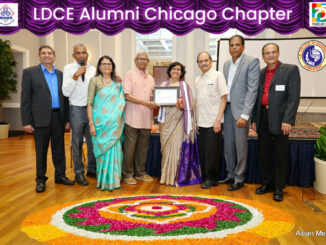
    A Core group of Alumni along with Dr. Rajul Gajjar, Vice Chancellor of Gujarat Technological University (GTU, of which LDCE is a part , as an affiliated Institute) and who is also the former Principal of LDCE , Dr. Nilay Bhuptani , current Principal of LDCE, Anand Patel , President of LDCE Alumni Association (LAA) , Prerak Shah, Vice President, and members of LAA BOG, Apoorva Thakershy, Parag Shah, Chetan Thakkar and Saleel Bhatt are on a North America tour to the 3 cities of New Jersey, Chicago and San Francisco to re-invent the Alumni Network here. LDCE has an estimated 30 to 35k Alumni across the globe, with many of them heading global companies or have created their own large and highly successful ventures and businesses.

    This Core Group from LAA- Ahmedabad is in a single-minded pursuit of bringing together this entire network of Alumni and connects them to their Alma Mater, like the mythical Kalpavruksh.

    Their endeavors have met with a tremendous response from the two Alumni Meets at NJ and Chicago, where a total of 230 alums came together in one big celebration of home-coming. Alumni travelled from different cities to meet up with old friends, found to their pleasant surprise, new friends living across their own streets who they had not met in 20-25 years so far!

    They are creating Local Chapters of LAA- USA and leaving behind a Framework for these Chapters. At home LDCE Alumni have created a Strategic Plan for LDCE@100 with KPMG to achieve global standards. They have also created a Master plan for redevelopment of the whole campus, by Aniket Bhagwat, an internationally renowned architect. The government on its own part has done matching grants to put LDCE on a fast track towards its LDCE@100 plan. A ₹ 100 cr Research Park in Emerging and Deep Tech is also on the anvil.

    This small group of Alumni Leaders is super confident of reaching out and connecting the roots with the help of the Alumni who have joined this movement across USA and India.

    (Photographs and Press release by Asian Media USA)

    LDCE Alumni Meet at Chicago (Photo credit : Asian Media USA)
  • International Yoga Day celebrated in Washington

    International Yoga Day celebrated in Washington

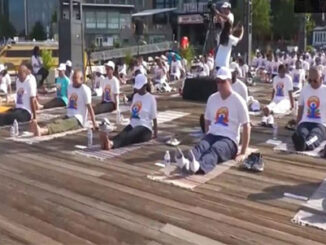
    WASHINGTON, D.C. (TIP): Hundreds of yoga enthusiasts came together to observe the International Yoga Day at an event that was addressed by India’s Deputy Ambassador to the US Sripriya Ranganathan. At the picturesque Wharf, overlooking the Potomac river, the International Yoga Day event on Wednesday, June 19, began with prayers and Indian classical dance performances. The yoga session highlighted the spirit of oneness and harmony inspired by the ancient Indian practice. The International Day of Yoga is celebrated on June 21 every year. This year’s theme is ‘Yoga for Self and Society’.

    At the event, Ranganathan said yoga illuminates the path to creating harmony and balance for a brighter future of society.

    Recognizing yoga’s universal appeal, on December 11, 2014, the United Nations proclaimed June 21 as the International Day of Yoga, she said.

    The draft resolution establishing the International Day of Yoga was proposed by India and endorsed by a record 175 member states. Since its inception in the Indus Valley civilization, the practice of yoga has travelled far and wide. Nearly 5,000 years later, hundreds of millions of people around the world practice yoga, Ranganathan said.

    The event also included elements to popularize inclusion of millets and environment-friendly products and practices in daily life, a media release said.
    (Source: PTI)

  • Indian-origin former Air Canada airline manager wanted in Canada’s largest gold heist to surrender himself

    Indian-origin former Air Canada airline manager wanted in Canada’s largest gold heist to surrender himself

    OTTAWA (TIP): A 31-year-old Indian-origin former Air Canada manager wanted in connection with Canada’s largest gold and cash heist worth CAD 22.5 million is preparing to surrender in the next few weeks, his lawyer has said, according to a report on Saturday.
    Simran Preet Panesar, wanted in the brazen multimillion-dollar gold heist at Toronto’s Pearson International Airport last year, is “very confident in the Canadian justice system,” his lawyer, Greg Lafontaine said in a statement to a news portal.
    “When this prosecution is over, he will have been absolved of any wrongdoing,” the report quoted him as saying.
    On April 17, 2023, an air cargo container carrying more than 22 million Canadian dollars’ worth of gold bars and foreign currency was stolen from a secure storage facility using fake paperwork, according to the police.
    The gold and currency had arrived on an Air Canada flight from Zurich, Switzerland, to Pearson International Airport in Toronto. Shortly after the flight’s landing, the cargo was offloaded and transported to a separate location on airport property. It was reported missing to the police a day later.
    Police have arrested six people involved in the theft, including Indian-origin people.
    Canada-wide warrants were also issued for Panesar, from Brampton, who was also an Air Canada employee at the time of the theft.
    Lawyer Lafontaine said Panesar retained him as soon as he learned he was wanted on charges in Canada, according to the report.
    The lawyer then contacted police and the Crown prosecutor to tell them Panesar planned to return voluntarily to Canada in the next few weeks.
    “He is anxious to have an opportunity to demonstrate his absolute innocence,” Lafontaine was quoted as saying. He added that Panesar is “tidying up his affairs abroad in preparation for his return to Canada”.
    The lawyer did not disclose Panesar’s locations, citing safety concerns.
    On May 6, investigators arrested and charged Indian-origin Archit Grover at the airport in Toronto as he flew in from India, according to the police. The police issued a Canada-wide warrant against his arrest earlier in connection with the theft.
    In April, two persons of Indian origin — Parmpal Sidhu, 54, and Amit Jalota, 40 — both from Ontario, were arrested in connection with the case along with Ammad Chaudhary, 43, Ali Raza, 37, and Prasath Paramalingam, 35. Peel Regional Police has said it is “following all investigative leads” to find the remaining suspects.
    The stolen cargo contained 6,600 bars of .9999 pure gold, weighing 400 kg, valued at over 20 million dollars and Canadian dollars 2.5 million worth in foreign currency.
    In an earlier statement, the police said that investigators seized one kg of gold worth approximately Canadian dollars 89,000, believed to be from the theft, smelting equipment, and approximately 434,000 dollars in Canadian currency.

  • Two Indian-origin Punjabi cousin sisters shot at by Nakodar boy in New Jersey, one dies of wounds

    Two Indian-origin Punjabi cousin sisters shot at by Nakodar boy in New Jersey, one dies of wounds

    NEW JERSEY (TIP): Two cousin sisters from Nurmahal were shot by a youth from Nakodar in New Jersey, US, in a shocking incident that claimed the life of one of the victims.
    The sisters have been identified as Jaswir Kaur (29) and Gagan (20), from Gorsiyan Peeran village in Nurmahal. Jasvir, who was married, succumbed to the gunshot wounds.
    The accused, Gaurav Gill (21), belonging to Hussainpur village, has been arrested by the police.
    Gaurav and Gagan used to study together at an IELTS center in Punjab before heading to the US. Both were from poor families, and their parents sent them abroad to alleviate their poverty.
    According to reports, on Wednesday, June 12, Gaurav went to the home of Gagan and Jaswir and shot both while they were on the sidewalk. Jaswir died on the spot while Gagan is seriously injured and receiving treatment.
    The T-shirt and slacks clad boy was seen being apprehended by the New Jersey law enforcement officials at a house lawn in footage which has gone viral on social media.
    The incident has happened just days after another shocking incident where a Kapurthala-based man killed his brother in the US, before committing suicide himself.

  • Canadian Parliament observes ‘moment of silence’ in honor of Khalistani activist Nijjar on his first death anniversary

    Canadian Parliament observes ‘moment of silence’ in honor of Khalistani activist Nijjar on his first death anniversary

    OTTAWA (TIP): Canada’s parliament on Tuesday, June 18, marked one-year death anniversary of Khalistani activist Hardeep Singh Nijjar by holding a moment of silence in the House of Commons. Nijjar, who was designated a terrorist by India’s National Investigation Agency in 2020, was shot and killed outside a gurdwara in Surrey on June 18 last year. Tuesday marked the first anniversary of Nijjar’s death.

    Ties between Canada and India became strained after Trudeau had in the House of Commons last year talked about “credible allegations” about a potential link between Indian agents and the killing of the Khalistani activist.

    India has, however, dismissed the accusations as “absurd” and “motivated.” The video of his killing that reportedly surfaced in March this year showed Nijjar being shot by armed men.

    In an interview to CBC News on Monday, on the eve of the anniversary of the killing of Khalistani terrorist Hardeep Singh Nijjar, Trudeau said, “Now that he’s through his election, I think there is an opportunity for us to engage, including on some very serious issues around national security and keeping Canadians safe and the rule of law.” Trudeau’s remarks follow his meeting with Prime Minister Modi in Italy during the G7 Summit where India was invited as an Outreach country. PM Modi had tweeted a photograph of himself with the Canadian PM as they shook hands.

    After the meeting in Italy, Trudeau told the Canada-based media channel, Cable Public Affairs Channel (CPAC) there are some “important but sensitive” issues that the two countries need to work on together. He did not share many details of what the two leaders discussed.

    In his Monday interview to CBC News, Trudeau said, “I think one of the really good things about summits is you get an opportunity to engage directly with a huge range of different leaders with whom there are various issues,” Trudeau said, according to CBC News.

    “And certainly, with India, there are massive people-to-people ties, there are really important economic ties, there’s alignment on a number of big issues that we need to work on as democracies, as a global community,” he said.
    (With inputs from ANI)

  • Indian American Suhas Subramanyam wins Democratic Congressional primary in Virginia

    Indian American Suhas Subramanyam wins Democratic Congressional primary in Virginia

    WASHINGTON, D.C. (TIP): Indian-American Suhas Subramanyam has won the Democratic primary for a Congressional seat in Virginia, defeating 11 other candidates including another fellow Indian-American Krystle Kaul.

    The first Indian-American, South Asian and Hindu to be elected to the Virginia General Assembly in 2019 and to the Virginia State Senate in 2023, Subramanyam is running for the US House of Representatives from the 10th Congressional District of Virginia, which has a sizable Indian-American population.

    Its current occupant, Democrat Congresswoman Jennifer Wexton, had announced last year that she would not be running for the seat. Subramanyam, 37, was born in Houston to Indian-American parents who migrated to the US from Bengaluru. In 2015, he was appointed by the then President Barack Obama to serve as a White House technology policy advisor.

    Wexton had endorsed Subramanyam, who now faces Mike Clancy from the Republican Party.

    In an interview to PTI early this year, Suhas said he was running for Congress to ensure a better future for America.

    “The Congress is here to solve problems and to be proactive about the future. We should not be legislating not just for the next two years, but for the next 20 or 30 years. I want my kids — I’ve got two girls who are two and three — I want them to live in a better country and in a better world than what we found,” he said.

    Suhas said he wanted everyone to have a chance at the American dream.

    “My parents are from Bengaluru and Chennai and spent some time in Secunderabad as well. They came here because they wanted to start a new life here… They wanted to be physicians, and you can make a great life in America as a physician,” he said.

    He added that his parents didn’t have much when they came here but they became successful through education and hard work.

    “I want to make sure that everyone has a chance at that American dream. Everyone has a chance of creating a great business if that’s what they want to do or being a part of a great business and that they can empower themselves economically.

    “But it really started with the fact that our community education is the great equalizer, and you can lift yourself up from any situation if you do well and study hard and work hard. And I want to make sure that stays the same way,” he said.
    (Source: PTI)