Month: July 2024

  • Ex-Agniveers to get 10% reservation, age relaxation, say CISF, BSF chiefs

    Ex-Agniveers to get 10% reservation, age relaxation, say CISF, BSF chiefs

    New Delhi (TIP)- The chiefs of CISF and the BSF on Thursday, July 11, said 10 per cent posts of constables will be reserved in their respective forces for former Agniveers in line with a decision by the Union Home Ministry.
    The remarks by CISF Director-General Nina Singh and her BSF counterpart Nitin Agrawal came amid fresh spotlight on the Agnipath recruitment scheme for short-term induction of personnel in the Army, Navy and the Air Force.
    “The Union Home Ministry has taken an important decision regarding the recruitment of ex-Agniveers. Accordingly, the CISF is also preparing the process of the recruitment of ex-Agniveer,” Singh said.
    The chief of the Central Industrial Security Force (CISF) said 10 per cent jobs will be reserved for ex-Agniveers in all future appointments of constables.
    “In physical tests also, they will be given exemption along with the relaxation on the age. In the first year the age relaxation is for five years and in the subsequent year, the age relaxation will be three years,” she told DD News.
    “Ex-Agniveer will be able to take advantage of this and the CISF will ensure that. This will be beneficial for the CISF too as the force will get trained and disciplined personnel,” Singh said.
    In June 2022, the government rolled out the Agnipath recruitment scheme with an aim to bring down the age profile of the Three Services.
    The Agnipath scheme provides for recruiting youths between the age bracket of 17-and-half years and 21 for four years with a provision to retain 25 percent of them for 15 more years.
    Several Opposition parties, including the Congress, have been targeting the government over the scheme wondering what will happen to 75 percent of the Agniveers after their four-year tenure ends as only 25 per cent of the total recruits will be retained for 15 years.

  • India’s population to peak in early 2060s to 1.7 billion before declining: UN

    India’s population to peak in early 2060s to 1.7 billion before declining: UN

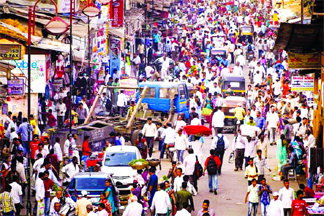
    United Nations (TIP)- India’s population is projected to peak in the early 2060s at about 1.7 billion and then decline by 12%, but the country will remain the world’s most populous throughout the century, the United Nations has said. The World Population Prospects 2024 report, released here on Thursday, July 11, said that the world’s population is expected to continue growing over the coming 50-60 years, reaching a peak of around 10.3 billion people in the mid-2080s, up from 8.2 billion in 2024. After peaking, the global population is projected to start declining gradually, falling to 10.2 billion people by the end of the century.
    India, which surpassed China as the world’s most populous nation last year, will continue to hold that position through 2100.
    “The population of India, which is expected to remain the world’s largest throughout the century, will likely decline by 12 per cent after reaching its peak in the early 2060s at about 1.7 billion,” the UN report published by the United Nations Department of Economic and Social Affairs (DESA), Population Division said.
    According to the report, India’s population in 2024 is projected at 1.45 billion and this will peak to 1.69 billion in 2054. After this, India’s population is projected to decline to 1.5 billion by the end of the century in 2100, but the country will still remain the most populous nation on earth.
    Responding to a question by PTI on population projections for India, Senior Population Affairs Officer, Population Division, UN DESA Clare Menozzi said at a press conference that “India is currently the largest country in the world in terms of population, and it is projected to stay so throughout the century. The population is currently estimated at 1.45 billion, and it’s supposed to increase further” to 1.69 billion.
    “It’s supposed to peak around the 2060s in size and then it starts to slightly decline. So by the end of the century, India is projected to be around 1.5 billion, but still the largest country in the world by a large margin.” The report said that China’s population, currently 1.41 billion in 2024, will fall to 1.21 billion in 2054 and further decline to 633 million by 2100.
    “It is anticipated that China, the country currently with the world’s second-largest population, will likely experience the largest absolute population loss between 2024 and 2054 (204 million),” followed by Japan (21 million) and Russia (10 million). “Longer-range population projections are more uncertain” for China, it said.
    Source: PTI

  • Prabhjot Singh heads to Paris to cover 2024 Olympic Games

    Prabhjot Singh heads to Paris to cover 2024 Olympic Games

    TORONTO (TIP): Senior journalist and sports editor Prabhjot Singh will head to Paris to cover the 2024 Olympic Games. He will be in Paris from July 23 till August 13. Besides covering all important events, he will also focus on the Indian Diaspora, hockey, boxing, wrestling, tennis, table tennis, athletics, badminton and other Games featuring players of Indian origin besides doing stories of human interest and general interest.

    Prabhjot Paul Singh, better known as Prabhjot Singh, is a veteran all round journalist with over 40 years of experience of working with print and electronic media, including 37 years with The Tribune – the oldest and largest circulated English daily of North India. He had also worked as Executive Editor, PTC News, the world’s largest Punjabi TV network, for more than 8 years.

    He did his M.Sc. in Journalism from PAU, Ludhiana, MA (Eng) and BSc (Medical) from Panjab University, Chandigarh, and Bachelor of Journalism from Punjabi University, Patiala.

    The man with solid ethical core, integrity, strong communication skills with knowledge of English, Urdu, Punjabi, Hindi, German, French as well as courageous attitude and analytic mind had won KK Birla Foundation Fellowship on Media and Terrorism and also KC Kulish (Rajasthan) award for Excellence in International Journalism.

    In fact, he had been a pioneer in introducing the concept sports page in Jalandhar (vernacular) newspapers in February, 1975, months before he was offered a job as a Sports Reporter by The Tribune group of newspapers.

    In 2012, Vienna based International Press Institute (IPI) has recognized his commitment to promote free exchange of accurate, balanced news among nations and for Excellence in Journalism, for publishing an investigative series into the loot of the public transport system in Punjab by Punjab politicians, he was awarded IPI-India award.

    The Sunday magazine section of The Tribune from Chandigarh dated 25 November 1984, carried an article titled “Profile of an assassin”, is his most recognized work.

    Though he has many feathers in his cap yet efforts to make IXC (Chd airport) active will be remembered always as a blessing for Punjabi Diaspora. His tireless pen had made Chandigarh airport as Chandigarh International Airport. He had raised issues related to IXC at various platforms.

    His love for sports can be witnessed from his travels to six summer Olympic games, one winter Olympic games, seven World Cups in Hockey, FIFA World Cup in 2006, besides three World Cups in Cricket, and two editions of Pan Am Games (Toronto and Lima). He has also covered Asian Games (New Delhi and Jakarta) and Commonwealth games in Melbourne and New Delhi. Also he has been to many other important international events and did spectacular stories of human interest.

    Prabhjot has been contributing to The Indian Panorama for many years now.

  • Indian American Sikh community support for Trump is 4 times more than what it was in 2020, says Jasdip Singh

    Indian American Sikh community support for Trump is 4 times more than what it was in 2020, says Jasdip Singh

    WASHINGTON, D.C. (TIP): Observing that the June 27 presidential debate did have some impact on the popularity of Donald Trump, the head of “Sikh Americans for Trump” has said the former president’s victory will depend on whether the election is free, fair and legal.
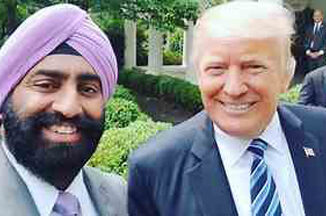
    “I think our community is very much in support. I have seen a lot of support in favor of President Trump. We are raising funds for President Trump. We are going to the convention soon,” Maryland-based community leader Jasdip Singh Jassee, head of “Sikh Americans for Trump”, told media ahead of the Republican National Convention (RNC) in Milwaukee next week.
    Republican delegates from across the country, during the four-day RNC convention in Milwaukee, would formally nominate Trump as their presidential candidate for the November 5 general election. Incumbent President Joe Biden is the presumptive nominee of the Democratic party.
    “We will be mobilizing our team nationwide this time, even on the West Coast, in New York, Texas, in support of President Trump,” said Jassee, who has been appointed on the finance committee for President Trump, the Trump 47.
    “We all knew about President Biden’s issues that he had for the last four years, but it was very interesting to see … for the American public and media, to see it during the debate how much President Biden has declined his mental capacity and his thought processes, which was very evident throughout. But somehow, the American media was kind of controlling it and not letting the people know about it,” he said in response to a question.
    “So right now, we see that the debate did have some impact on President Trump’s popularity, but the country’s overall situation, such as inflation, illegal immigration, a disorderly border at this time, the infrastructure, the violence and the crime that is happening in America, and also zero foreign policy where America is not a leader anymore,” he observed.
    “All of this has had an impact on Biden’s campaign in addition to his debate performance and his physical and mental capacity. But again, the key issue is what President Trump said in the debate when he was asked a question, will you accept the verdict? He said if it is a fair, legal, and honest election, yes, I will. So again, the key is, if this election is going to be fair, honest or legal,” Jassee said.
    “If that happens, then yes, President Trump will win, because that is what the American public wants. But if there is a swamp involved, or deep state involved, or vested interest involved, then we do not know what the result is going to be,” Jassee said.
    According to him, this year, the support of the Indian community, South Asian community, Sikh community for Trump has gotten like four times more than what it was in 2020.
    “Now, people come up to me and say, hey, we want to be in your support. Whereas in 2016 and 2020, I used to be criticized for my support or I had all the negativities coming towards me. This time, people from the community are walking up to me and asking me, hey, we want to support President Trump,” he said.
    “And that is a big change, because our community has seen the decline of America under Biden’s four years and the decline of America’s infrastructure. Most of us South Asians are in small businesses, and the crime that is hitting small businesses.
    “People are seeing that inflation, the immigration mess. On one hand, we have borders that are open. On the other hand, if you are on an H-1B (visa), it will take you like 40 years to become a US citizen. So, the country is upside down. Even in foreign policy, America’s clout, America’s supremacy has taken a big hit. And because of that, I think our community is very much in support. I have seen a big support in favor of President Trump,” Jassee said.

  • Jaisingh Bhandari Elected Official National Delegate for Democratic Convention to Represent Virginia

    Jaisingh Bhandari Elected Official National Delegate for Democratic Convention to Represent Virginia

    RICHMOND, VA (TIP): Prominent Indian American Leder and GOPIO Virgina President Jaisingh Bhandari was elected official Delegate to the National Democratic convention in Chicago from August 19 to August 21 that would formally nominate US President Joe Biden as the party Presidential Candidate.
    Joe Biden is the presumptive Democratic Party candidate for the presidential election. An influential Indian American community leader, Mr. Jay Bhandari, has been elected in Richmond, Virginia as a National Delegate at the State convention with Majority vote. President Joe Biden Endorsed him. “It is a great pleasure and honor to share the news that I have been elected as (an) official delegate at the upcoming Democratic National Convention to be held in Chicago, Illinois, from August 19 to August 21st as the party’s candidate for the November 5 presidential election. The nomination process would be completed by Democratic delegates votes from across the country. Mr. Bhandari, a lifelong member of the Party and Central Committee member of the Virginia Democratic Party. Mr. Bhandari is a well-known and successful leader of the Asian and Indian community in numerous capacities both in India and here in the United States. He is a former vice chair and commissioner of Virginia Public School Authority Board. He served in several Social, Charitable and religious organizations. He has more than 25 years of experience in running successful Businesses and industries and was appointed by Indian government and Madhya Pradesh Government in numerous capacities. He was President of Jain Society of Soth Florida, Director in Jaina. He is also on Advisory Board of Eye Foundation of America.

  • Federation of Indian Associations (FIA) Announces “FIA Star Awards Night and 78th Independence Day Celebrations”

    Federation of Indian Associations (FIA) Announces “FIA Star Awards Night and 78th Independence Day Celebrations”

    CHICAGO, IL (TIP): The Federation of Indian Associations (FIA) is thrilled to announce its upcoming mega event, the ‘Star Awards Night,’ a prestigious celebration of excellence within our community. Scheduled for August 16, 2024, at the Matrix Club in Naperville, this gala promises an evening filled with inspiring tributes, exceptional entertainment, and fine dining. This event is scheduled for August 16th, 2024, at the prestigious Matrix Club in Naperville.

    The ‘FIA Star Awards Night’ will honor outstanding achievements across various 19+ categories, including Best Community Service Organization, Entrepreneur of the Decade, Community Leader of the Year, Best Medical Professional, Fashion Icon, and more. This exclusive event will shine a spotlight on individuals and organizations that have made significant contributions to our community.

    In addition to the awards ceremony, we are proud to announce that this year’s event will coincide with FIA’s grand celebration of India’s 78th Independence Day. To mark this special occasion, Sparsh Shah, a talented singer, rapper, and Guinness World Record holder born with Osteogenesis Imperfecta, will open the event with a performance of patriotic songs.

    Adding to the excitement, FIA Team is honored to welcome Jaya Prada, an illustrious Bollywood star and multiple Filmfare Award winner. Known for her exceptional talent and beauty, Jaya Prada will join us in celebrating these two unforgettable events.

    Sunil Shah, Chairman and Founder, FIA, said about the exciting event: “In our continued tradition of honoring the Community Leaders who selflessly serve us, we have added more categories to the awards list. For the first time, we will have two award-winning international celebrities flying specifically for this FIA event to Chicago, Sparsh Shah and Bollywood Celebrity Jaya Prada.”

    Adding to this Pratibha Jairath, President mentioned, “This will be a mega-event. The presence of our community members in Chicago at this prestigious event would be incredibly meaningful as we come together to honor those who have excelled in their respective fields and made a positive impact on our community. With over four months of meticulous planning dedicated to selecting the award winners, this promises to be one of the most significant events Chicago lands has ever witnessed.

    About FIA

    The Federation of Indian Associations (FIA) is dedicated to promoting the cultural, social, and economic welfare of the Indian community in the United States. Through various events and initiatives, FIA strives to foster unity and celebrate the rich heritage of India.

    (Photographs and Press release by Asian Media USA)

  • Bangladesh suspends job quotas after student protests

    DHAKA (TIP): Bangladesh’s top court on July 10 temporarily suspended quotas for coveted government jobs after thousands of students staged nationwide protests against what they call a discriminatory system, lawyers said.
    The quota system reserves more than half of well-paid and massively over-subscribed civil service posts, totalling hundreds of thousands of government jobs, for specific groups including children of liberation heroes.
    Students launched protests earlier this month, demanding a merit-based system, with demonstrations on Wednesday blocking highways and railway lines.
    “Our only demand is that the government abolish the quota system,” said student protest leader Rasel Ahmed, from Chittagong University.
    “We will not return to classrooms until our demand is met,” Ahmed told AFP.
    The quota system was abolished in 2018 after weeks of protests, but reinstated in June by Dhaka’s High Court, sparking fury from students.
    The Supreme Court on Wednesday suspended that order for a month, said lawyer Shah Monjurul Hoque, who represents two students seeking to end the quota system. (AP)

  • Sri Lanka to end constitutional ambiguity on presidential term

    COLUMBO (TIP): The Sri Lankan Cabinet has approved a move to amend the Constitution giving clarity to terms of both the president and Parliament, restricting it to five years only, the government announced on July 10. The dispute about the president’s term arose as the independent election commission was preparing to announce the poll date for the next presidential election. The terms for both posts are already five years as per the 19th Amendment since 2015. However, the problem was over Article 83, which said the term could be extended to six from five with a referendum. A petitioner approached the Supreme Court asking it to define if the terms were five or six years.
    Earlier this week, the Supreme Court rejected the petition which sought a ruling on the seeming ambiguity between 30(2) and 83 in the Constitution, which means, it will be five years only. The amendment to be introduced now seeks to resolve the issue arising from Article 83 (b) that reads, ???extend the term of office of the president or the duration of parliament as the case may be? to over five years from the present six.
    The election commission chief RMAL Ratnayake, who held preliminary arrangements with the police and the government printer, on Tuesday said that the date for the presidential polls could be announced by the end of the month.
    The Commission had previously announced that the election would be held between September 16 and October 17.

  • Can’t progress without maintaining close friendly relations with India: Nepal’s CPN-UML

    Can’t progress without maintaining close friendly relations with India: Nepal’s CPN-UML

    KATHMANDU (TIP): The Communist Party of Nepal-Unified Marxist Leninist (CPN-UML) on July 11 said the landlocked Himalayan nation can attain economic prosperity only by maintaining close friendly relations with India, asserting that it will not allow any activity directed against the southern neighbour from the Nepalese soil.
    The remarks by a senior leader of the party led by former prime minister KP Sharma Oli came on the eve of a confidence vote in Parliament, which may see him return as the politically fragile Himalayan nation’s premier once again. “CPN-UML doesn’t believe that Nepal can progress or the interest of Nepalese people could be promoted by pursuing anti-India policy,” Dr Rajan Bhattarai, the Foreign Affairs Department chief and Standing Committee member of the CPN-UML, told PTI in an interview.
    He said the party’s chairman Oli wants to take Nepal-India relations to a new height as per the demand of the 21st century.
    “We believe that we can attract more foreign investment, promote trade, and attain economic prosperity only by maintaining close friendly relations with India,” he said.
    “We consider India as an important neighbour, and we won’t allow any activity directed against India from our soil.”
    Oli is known for his pro-China stance, and it would be interesting to see how he maintains ties of equi-proximity with both neighbours if he becomes prime minister after toppling Prime Minister Pushpa Kamal Dahal “Prachanda” after Friday’s floor test in the House of Representatives.
    “Our party has a clear view in not allowing any activity directed against another neighbour by taking the side of one neighbour,” Bhattarai told PTI.
    Although there are some problems in bilateral relations due to some provisions of the 1950 treaty, border dispute, inundation of land in the border areas and the growing trade deficit, the CPN-UML wants to resolve them through dialogue, he said.
    “We can resolve all our problems by sitting together and holding talks in a friendly manner,” he added.
    Ties between the two countries came under severe strain in 2020 after Kathmandu published a new political map that showed the three Indian territories—Limpiyadhura, Kalapani and Lipulekh—as part of Nepal.
    Then Prime Minister Oli attempted to use the issue to fend off increasing domestic pressure and challenge his leadership.
    In the past, Oli had publicly criticised India for allegedly interfering in Nepal’s internal affairs.
    Land-locked Nepal relies heavily on India for the transportation of goods and services.
    Nepal is also important for India in the context of its overall strategic interests in the region, and the leaders of the two countries have often noted the age-old ‘Roti Beti’ relationship.
    Nepal shares a border of over 1,850 km with five Indian states: Sikkim, West Bengal, Bihar, Uttar Pradesh, and Uttarakhand.
    “It is our firm belief that a stable, prosperous, peaceful, and developed Nepal will also be in the interest of India,” Bhattarai said.
    “However, we would also like to make it clear that our relations will be based on non-intervention in internal affairs and promoting national interest.”(PTI)

  • 14 dead as jeep falls from mountain road into ravine in Pakistan-occupied Kashmir

    Muzaffarabad (TIP): A jeep fell from a mountain road into a ravine in the disputed Himalayan region of Kashmir on July 10, killing 14 people and injuring two others, officials said.
    The incident happened in the Neelam Valley, government administrator Nadeem Janjua said.
    Rescuers had transported the dead and injured to a hospital while the cause of the accident is still to be determined, Janjua said.
    Kashmir is divided between neighbouring India and Pakistan, with both claiming the entire territory.
    Road accidents are common in Pakistan mainly because of to poor road infrastructure and poor enforcement of traffic laws and safety standards.
    Last month, a van fell into a river in the same district, killing 16 people, mostly children. (AP)

  • 65 missing after landslide sweeps away two buses in Nepal

    KATHMANDU (TIP): As many as 65 people were believed missing in Nepal after two buses were swept by a landslide triggered off the highway and into a swollen river on July 9, officials said.
    The two buses with 63 passengers, and two drivers went missing in the Trishuli river in the landslides at Simaltal area along the Narayanghat-Mugling road in Chitwan district.
    Rescuers were trying to locate the bus and and help with rescue the passengers but the continuous rain was making rescue efforts difficult.
    “As per the preliminary information both the buses were carrying a total of 63 people including the bus drivers. The landslide swept the buses at around 3:30 am. We are at the incident site and a search operation is underway. Incessant rain is hampering our efforts to search for the missing buses,” Indradev Yadav, Chief District Officer, Chitwan confirmed to ANI.
    The route leading to the accident area was also blocked in several places by landslides, said government administrator Khima Nanada Bhusal.
    One bus had 24 people while the other had 42 but more could have boarded the bus while on the route, Bhusal said.
    Expressing grief over the disappearance of the bus in the Trishuli River, Prime Minister Pushpa Kamal Dahal Prachanda has issued directives for immediate search and rescue operations. Further details are awaited.(Agencies)

  • 11 killed as passenger bus collides with pickup truck in northern Philippines

    TUGUEGARAO (TIP): A bus collided with a pickup truck killing 11 people and injuring six others in a northern Philippine town on July 11. Those who died were riding the small truck as it was rammed on the side by the bus, causing it to lose control and smash into a roadside food stall in Abulug town, about 600 km (373 miles) north of Manila, said police chief Maj Antonio Palattao.
    The drivers of both vehicles were injured, along with the owner of the food stall that was hit by the truck. An investigation is underway to determine who was responsible for the accident, he said.
    Deadly road accidents are common in the Philippines because of weak enforcement of traffic laws, dilapidated vehicles and dangerous road conditions, including inadequate safety signs and barriers in mountain roads and far-flung provinces.
    Heavy rains halt search for 30 people missing in an Indonesian landslide that killed at least 23
    PALU (TIP):: Incessant rains July 10 halted the search for 30 people believed trapped under a landslide that engulfed an unauthorized gold mine on Indonesia’s Sulawesi island over the weekend, killing at least 23 people.
    More than 100 villagers were digging for grains of gold on Sunday in the remote and hilly village of Bone Bolango in Gorontalo province when tons of mud plunged down the surrounding hills and buried their makeshift camps. The search was suspended Wednesday afternoon due to heavy rains, said Heriyanto, head of the provincial Search and Rescue Office. Rescuers have not yet been able to locate the missing people, he said. The National Search and Rescue Agency said Wednesday that 92 villagers managed to escape from the landslide. Several of them were pulled out by rescuers, including 18 with injuries. It said 23 bodies were recovered, including that of a 4-year-old boy, while 30 people were missing.
    More than 1,000 personnel, including army troops, have now been deployed in the search, said Edy Prakoso, the agency’s operation director.
    He said the Indonesian air force would send a helicopter to speed up the rescue operation, which has been hampered by heavy rains, unstable soil and rugged terrain.
    Photos released by the agency showed an excavator removing tons of mud and rocks that blocked access to the site. (AP)

  • Twelve children killed in South African school minibus crash

    JOHANNESBURG (TIP): Twelve children were killed in South Africa early July 10 when a minibus taking them to school near Johannesburg overturned and caught fire after being hit by another vehicle, the government said.
    The driver of the minibus was also killed and seven other children were rushed to hospital, the Gauteng provincial government said in a statement.
    It could not immediately give the ages of the children. Television images showed that the minibus was totally destroyed by the fire in the early morning crash in Merafong, more than 70 kilometres west of the city.
    The statement said “a private scholar transport minibus was involved in a tragic accident in the Kokosi-Wedela area in Merafong, claiming the lives of the 12 learners and their driver.
    “Additionally, seven other learners have been rushed to a medical facility for urgent medical attention.”
    “I am profoundly saddened by this tragic event. The loss of our children is a devastating blow to our community, and our thoughts and prayers are with the families of the deceased and injured learners,” Gauteng education minister Matome Chiloane said in the statement.
    South Africa has one of the most developed road networks on the continent but also has one of the worst road safety records. (AP)

  • China tells NATO not to create chaos in Asia and rejects label of ‘enabler’ of Russia’s Ukraine war

    China tells NATO not to create chaos in Asia and rejects label of ‘enabler’ of Russia’s Ukraine war

    BEIJING (TIP): China accused NATO on July 11 of seeking security at the expense of others and told the alliance not to bring the same “chaos” to Asia, a reflection of its determination to oppose strengthening ties between NATO members and Asian nations such as Japan, South Korea and the Philippines.
    The statement by a Foreign Ministry spokesperson came a day after NATO labelled China a “decisive enabler” of Russia’s war against Ukraine.
    “NATO hyping up China’s responsibility on the Ukraine issue is unreasonable and has sinister motives,” spokesperson Lin Jian said at a daily briefing. He maintained that China has a fair and objective stance on the Ukraine issue.
    China has broken with the United States and its European allies over the war in Ukraine, refusing to condemn Russia’s invasion or even to refer to it as an act of aggression in deference to Moscow. Its trade with Russia has grown since the invasion, at least partially offsetting the impact of Western sanctions.
    NATO, in a statement issued at a summit in Washington, said China has become an enabler of the war through its “no-limits partnership” with Russia and its large-scale support for Russia’s defense industrial base.
    Lin said China’s trade with Russia is legitimate and reasonable and based on World Trade Organization rules.
    He said NATO’s “so-called security” comes at the cost of the security of other countries. China has backed Russia’s contention that NATO expansion posed a threat to Russia, whose attack on Ukraine has only strengthened the alliance, leading to Sweden and Finland becoming formal members.
    China has expressed concern about NATO’s budding relationships with countries in the Indo-Pacific region. Australia, New Zealand, Japan and South Korea sent their leaders or deputies to the NATO summit this week.
    “China urges NATO to…stop interfering in China’s internal politics and smearing China’s image and not create chaos in the Asia-Pacific after creating turmoil in Europe,” Lin said.
    Chinese troops are in Belarus this week for joint drills near the border with Poland, a NATO member. The exercises are the first with Belarus, an ally of Russia, with which it shares a single-party system under President Alexander Lukashenko, whose regime cracked down brutally on 2020 mass protests against his rule,
    Lin described the joint training as a normal military operation that is not directed at any particular country.
    China is a key player in the Shanghai Cooperation Organization, which includes a strong military element involving Russia and several Central Asian nations, India and, most recently, Belarus.
    That is seen as creating a bulwark against Western influence in the region, but also tensions over rising Chinese influence in what Russia considers its political backyard made up of former parts of the Soviet Union, which included Belarus.
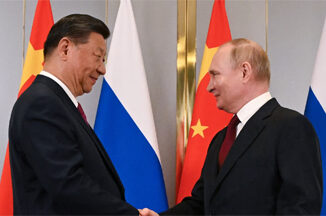
    Earlier this month, Putin and Chinese President Xi Jinping attended a meeting of leaders or top officials from the 10 SCO countries in Kazakhstan, at which Putin reiterated his demand that Ukraine withdraw its troops from parts of the country occupied by Russia. Ukraine has firmly rejected that, along with a Chinese peace proposal that makes no mention of the return of Ukrainian territory to the government in Kyiv.
    China and Russia have closely aligned their foreign policies to oppose the West, even as Russia grows increasingly reliant on China as a purchaser of its oil and gas, that make up the bulk of its foreign trade. (AP)

  • Israeli strikes hit UN agency’s building in Gaza City

    Gaza (TIP):Israeli forces launched more deadly strikes across Gaza on July 10, according to medical sources and the military, which said it targeted Hamas militants operating from inside a UN agency building.
    The Israeli army also said it was reviewing an attack on Tuesday in which hospital sources said at least 29 people were killed in a nearby school in the southern Khan Yunis area — the fourth attack on a school building in four days. Early on Wednesday, four people were killed and one critically wounded in the bombing of a house in the central town of Nuseirat, a hospital source told AFP. And two people were killed and six injured in another strike on a home in Bani Suhaila, near Khan Yunis, according to another hospital source.
    Israel has stepped up air and ground attacks in Gaza City and southern Gaza since issuing evacuation orders for tens of thousands of people in the war-stricken Palestinian territory.
    The heightened military strikes come as Israeli officials start talks in Qatar on Wednesday on reaching a truce in the war raging since the October 7 Hamas attacks.
    The Israeli military said that one overnight attack in Gaza City targeted Hamas and Islamic Jihad targets operating from inside the headquarters of the UN agency for Palestinians UNRWA.
    The UN agency has not had control of the building since October. Israeli forces said in February they had found a Hamas tunnel underneath the headquarters. The military said the militants were “operating inside UNRWA’s headquarters in the area and using it as a base to conduct attacks on IDF (Israeli Defense Forces) troops in the central Gaza Strip”. It said that militants had been “eliminated” and “large amounts of weapons” found.
    UNRWA had no immediate comment on the attack, but has said it has “no way to verify” claims that its facilities are being used by Hamas and its allies.
    Meanwhile Tuesday’s deadly strike near the Al-Awda school in Abasan, near Khan Yunis, brought new condemnation from Hamas over the Israeli military tactics.
    The Hamas government said a “majority” of the dead were women and children.
    The Israeli military said the air force had “struck a terrorist from Hamas’ military wing who took part, among other terrorist activities, in the October 7 brutal massacre” in southern Israel.
    It was the fourth time in four days that Gaza school buildings sheltering the displaced had been hit. (AFP)

  • Russia adds Navalny’s widow Yulia Navalnaya to ‘terrorists and extremists’ blacklist

    MOSCOW (TIP): Russia on July 11 added opposition figure Yulia Navalnaya to its list of “terrorists” and “extremists,” two days after it issued an arrest warrant for the exiled dissident.
    Navalnaya has vowed to continue the work of her husband Alexei Navalny, Russian leader Vladimir Putin’s main opponent who died in an Arctic prison in unclear circumstances in February.
    Her personal details appeared Thursday in an online blacklist maintained by Rosfinmonitoring, a state agency designed to combat the financing of people and organisations Moscow deems “terrorists” or involved in “extremist activity”.
    Russian officials frequently apply such labels to opposition figures and those who campaign against the Kremlin or its offensive on Ukraine.
    Navalny’s organisations were outlawed in Russia and are labelled “extremist.”
    The opposition leader himself was sentenced to 19 years in prison on charges of “extremism.”
    A court in the capital Moscow on Tuesday ordered Navalnaya arrested in absentia, also on charges of “extremism.”
    Following her husband’s death, Navalnaya, 47, vowed to take up his work and has lobbied against Putin’s government from abroad.
    “If they’re making such a fuss, then Yulia is doing everything right,” Kira Yarmysh, Navalnaya’s press secretary, said on social media after she was added to the blacklist. Navalnaya, an economist, stood by her husband as he galvanised mass protests in Russia, flying him out of the country when he was poisoned before defiantly returning to Moscow with him in 2021, knowing he would be jailed.
    Like much of Russia’s opposition, Navalnaya lives in exile and would be detained if she set foot in Russia. (AFP)

  • ‘We have nothing’: Palestinians return to utter destruction in Gaza City after Israeli withdrawal

    ‘We have nothing’: Palestinians return to utter destruction in Gaza City after Israeli withdrawal

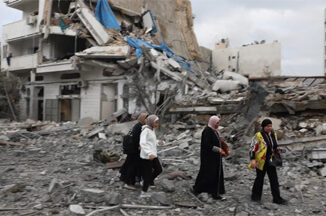
    GAZA (TIP): Palestinians returned to breathtaking scenes of destruction in the Gaza City district of Shijaiyah after Israeli troops withdrew, ending a two-week offensive there. Civil defense workers said on July 11 that so far, they had found the bodies of 60 people in the rubble.
    Families who fled the assault ventured back into Shijaiyah to see the condition of their homes or salvage whatever they could.
    Nearly every building was flattened to rubble for block after block, leaving giant piles of concrete and twisted rebar. Here and there, grey gutted concrete frames still stood a few stories high. The ever-present buzzing sound of Israeli military drones hung in the hot summer air as people on bicycles or horse-drawn carts made their way over dirt paths where the streets had apparently been bulldozed away.
    Sharif Abu Shanab found his family’s four-story building collapsed. “I can’t enter it. I can’t take anything out of it, not even a can of tuna. We have nothing, no food or drink,” he said.
    Since fleeing the district, his family sleeps in the streets, he said. “Where do we go and to whom? … We have no home or anything,” he said in despair. “There’s only one solution, hit us with a nuclear bomb and relieve us of this life.”
    Palestinian women walk through debris amid the destruction from Israeli airstrikes in Gaza.
    The Israeli military has invaded Shijaiyah several times in the nine-month war against Palestinians in Gaza. Its latest assault began in late June, when it said it was pursuing militants who had regrouped in the district. The assault sent some 80,000 people fleeing Shijaiyah, most into nearby areas, and it is not known how many people remained in the district during the fighting.
    The Israeli military said in a statement Wednesday evening that its operations in Shijaiyah had ended. It said its troops had killed dozens of militants and destroyed eight tunnels in the area. Those claims could not be independently confirmed.
    Gaza’s Civil Defense organization said that during Israel’s offensive, its emergency crews had largely been unable to respond to calls for help from residents in destroyed buildings. After the Israeli pullout, its crews entered and recovered 60 bodies, it said, adding that the search was ongoing. More bodies were believed buried under rubble, but the organization has little heavy equipment to clear debris.
    Palestinian women walk through debris amid the destruction from Israeli airstrikes in Gaza.
    The United Nations estimated earlier this week that about 300,000 Palestinians were still in northern Gaza, after much of the population left earlier in the war. Most of Gaza’s 2.3 million people are now experiencing widespread hunger while crammed into squalid tent camps.
    Israel launched the war in Gaza after Hamas’ Oct. 7 attack in which militants stormed into southern Israel, killed some 1,200 people — mostly civilians — and abducted about 250. Since then, Israeli ground offensives and bombardments have killed more than 38,300 people in Gaza, according to the territory’s Health Ministry. It does not distinguish between combatants and civilians in its count.
    The top United Nations court has ordered Israel to take steps to protect Palestinians as it examines genocide allegations against Israeli leaders. Israel denies the charge. (AP)

  • EMBASSY OF INDIA IN GUATEMALA ORGANIZES BUYERS SELLERS MEETS ON GEM & JEWELRY AND CERAMIC SECTOR

    GUATEMALA CITY (TIP): The Embassy of India has been actively engaging with local companies from Central America to attract their attention towards exporting Indian goods or manufacturing locally using raw materials from India. This endeavor has created tremendous opportunities for Indian companies to tap into the Central American market, leveraging its advantageous location to cover both the northern and southern triangles. Various Indian commerce chambers and export councils have actively supported the Embassy in promoting India’s trade image on the global stage.

    Ambassador Dr. Manoj Kumar Mohapatra highlighted Guatemala’s strategic location near the Northern Triangle, positioning it as a gateway for Indian Gems Jewelry in Central America.

    Recently, Embassy of India in Guatemala, in collaboration with the Gem and Jewellery Export Promotion Council (GJEPC) and Trade Promotion Council of India (TPCI), successfully organized two Buyers-Sellers Meets on June 24, 2025 and 27 June 2024, respectively. These events aimed to foster trade relations and open new avenues for the gem and jewelry market and provided a platform for Indian ceramic, hardware and marble companies to explore business opportunities, establish connections, and enhance trade ties between the two countries. Guatemalan companies attended the meet physically, while Indian companies participated virtually.

    The Gem and Jewellery Export Promotion Council (GJEPC) is an apex body under the Ministry of Commerce and Industry, Government of India, dedicated to the promotion of gem and jewelry exports. Established in 1966, GJEPC plays a pivotal role in enhancing the global reach and competitiveness of India’s gem and jewelry industry. It provides comprehensive support to exporters through trade fairs, buyer-seller meets, and market research. The Trade Promotion Council of India (TPCI) is a premier trade and investment promotion organization under the Department of Commerce, Government of India. It is dedicated to facilitating the growth of Indian trade by promoting exports and fostering bilateral trade relationships globally. TPCI organizes trade fairs, buyer-seller meets, and business delegations, providing a robust platform for Indian businesses to showcase their products and services.

    India and Guatemala have steadily strengthened their trade relations over the years, with significant potential for further growth. The gem and jewelry sector plays a pivotal role in enhancing these bilateral ties, as India’s exquisite craftsmanship and competitive pricing find a receptive market in Guatemala. The strategic location of Guatemala, particularly its proximity to the USA market, offers a significant advantage, making it an ideal hub for Indian businesses aiming to penetrate the Central American region. As the largest city in Central America, Guatemala City provides a robust platform for expanding trade and fostering economic collaborations, solidifying India’s presence and influence in the region.

    India and Guatemala share promising prospects in the trade of ceramics, hardware, and marble with approx. US$25 million trade in 2023-24. Guatemala’s strategic geographic position makes it an ideal hub for manufacturing and exporting these products to neighboring countries. With India’s expertise in high-quality manufacturing and Guatemala’s advantageous location facilitating access to regional markets, there is significant potential for bilateral cooperation in these sectors. The strategic location of Guatemala, particularly its proximity to the USA market, offers a significant advantage, making it an ideal hub for Indian businesses aiming to penetrate the Central American region. As the largest city in Central America, Guatemala City provides a robust platform for expanding trade and fostering economic collaborations, solidifying India’s presence and influence in the region.

    Chairman of Mr. Vipul Shah, GJEPC emphasized the commitment of Indian companies to the Central American market, highlighting the importance of strengthening trade relations and seizing opportunities

    The meet featured a comprehensive presentation by GJEPC and TPCI, emphasizing the opportunities for trade and investment in Central America, aiming to foster stronger business ties and increase market penetration. During the presentation, local participants actively engaged in discussions, demonstrating enthusiasm and raising pertinent questions. Their involvement underscored their keen interest in understanding the offerings and opportunities presented by the Indian companies. This interactive session facilitated a dynamic exchange of ideas and insights, enhancing mutual understanding and paving the way for potential collaborations and partnerships in the future. The presentation emphasized the opportunities for trade and investment in Central America, aiming to foster stronger business ties and increase market penetration.

    Ambassador Dr Manoj Kumar Mohapatra highlighted strengthening trade ties between India and Guatemala.

    Ambassador of India to Guatemala, Dr. Manoj Kumar Mohapatra, delivered insightful remarks, underscoring the significance of Guatemala’s strategic location near the Northern Triangle, positioning it as a gateway for Indian gems and jewelry in Central America. He also highlighted the high global demand for Indian gems, enhancing trade opportunities and economic ties. Ambassador underscored the event’s crucial role in nurturing strong business ties and exploring mutual trade prospects and emphasized the potential for Indian companies to leverage Guatemala’s emerging market in ceramics, hardware, and marble. Chairman of GJEPC, Mr. Vipul Shah, also addressed the attendees, emphasizing the commitment of Indian companies to the Central American market. He highlighted the importance of strengthening trade relations and seizing opportunities in the region. Mr. Suresh Makhijani, Joint Director General of TPCI, reaffirmed TPCI’s dedication to advancing bilateral trade efforts. He expressed confidence in the BSM’s outcomes, citing the enthusiastic engagement and favorable feedback from participants of both Indian and Guatemalan origins.

    Mr. Suresh Makhijani, Joint Director General, Trade Promotion Council of India address local companies of the commitment to strengthen bilateral trade.

    The overwhelming response to these Buyer-Seller Meets organized by the Embassy is a testament to India’s successful penetration in the Central American region. These countries significantly benefit from importing Indian goods, known for their high quality, diverse range, and competitive pricing. Furthermore, this burgeoning trade relationship facilitates knowledge exchange and fosters collaborations, potentially enhancing the local industries. These events mark a significant milestone in strengthening economic ties between India and the Central American countries. We eagerly anticipate future collaborations and continued success, particularly in the gem and jewelry sector, as well as other industries.

  • What Modi can learn from Sunak

    What Modi can learn from Sunak

    Former UK PM graciously accepted responsibility for the defeat of Conservative Party

    “Sunak is a practicing Hindu. It is obvious that he follows the essence of his religion. He was humble and penitent. He accepted responsibility for the defeat. The RSS should comment on this aspect of his personality and behavior like it commented on Modi’s without naming him. After all, the core teachings of the great religions in the world are similar. They all teach humility and reject arrogance. They disapprove of lies. They preach compassion and service without expectation of reward.”

    By Julio Ribeiro

    Rishi Sunak and his Conservative Party badly lost the parliamentary elections in the UK last week. He was gracious in defeat. “I can hear your anger. I take responsibility for the loss to the many good, hardworking candidates,” he said. He resigned as the Prime Minister immediately after the expected verdict was announced. The next day, he resigned as the leader of the Conservative Party, leaving the field open to ambitious politicians to vie for the top job in the party.

    Considering that only 36.56 per cent of the voters supported the BJP this time, he should listen to the voices of those who voted against his party.

    Sunak’s stature in my eyes, at least, and I am sure in the eyes of Indians who think and feel, went up by several notches. I compared his reaction to the defeat to that of our own popular Prime Minister when the BJP lost 60 seats in the Lok Sabha compared to its 2019 tally of 303.

    Narendra Modi had set his sights on winning 400 seats this time. He had launched several infrastructure projects, traversed the length and breadth of the country in his peripatetic fervor, and inaugurated the Ram Janmabhoomi temple in Ayodhya all by himself. All his efforts were in vain. His party lost ground in Uttar Pradesh and, wonder of wonders, the BJP lost the Ayodhya seat to Akhilesh Yadav’s Samajwadi Party.

    But our Prime Minister is made of sterner stuff than our former colonial master’s ex-PM. Modi did not mention ‘defeat’ even once. He claimed victory for the NDA. His pre-poll tie up with Chandrababu Naidu’s TDP and the mercurial Nitish Kumar’s JD(U) took the BJP-led alliance past the halfway mark.

    Modi began his cherished third term without batting an eyelid. For him, it was business as usual. He showed no discomfiture at the BJP’s below-par show in the Lok Sabha elections and did not think it necessary to offer any explanation to his party members for what can only be described as his personal failure as the BJP fought the elections in his name.

    Sunak is of Indian origin. His family has its roots in Punjab. His wife, Akshata Murthy, is the daughter of Narayan Murthy, the founder of Infosys. Her roots are in Karnataka. They hail from the same stock as Modi and millions of Indians. Yet, Sunak’s reaction to a setback in his career was diametrically opposite to that of Modi.

    Sunak is a practicing Hindu. It is obvious that he follows the essence of his religion. He was humble and penitent. He accepted responsibility for the defeat. The RSS should comment on this aspect of his personality and behavior like it commented on Modi’s without naming him. After all, the core teachings of the great religions in the world are similar. They all teach humility and reject arrogance. They disapprove of lies. They preach compassion and service without expectation of reward.

    Then, why do our desi politicians differ from our brethren who have migrated to other countries and achieved unbelievable recognition? Sunak became the Prime Minister of the country that ruled over us for two centuries or more. Kamala Harris, whose mother’s family migrated to the US from Tamil Nadu, is the Vice-President of the world’s most powerful country.

    Besides Indians seeking a better quality of life in the West, there are Indian-origin citizens of smaller countries in the world. Their ancestors had been recruited as indentured labor to work in the cotton and sugarcane fields in British-ruled colonies in the West Indies, Mauritius and Fiji. Starting with Sir Seewoosagar Ramgoolam, the Prime Ministers of Mauritius have been of Indian origin.

    Sir Vidiadhar Surajprasad Naipaul, whose origins are in a Dubey family from a village in Uttar Pradesh, is acknowledged as one of the greatest writers in the English language. His family was transshipped to the West Indies two or more centuries ago. He won the Nobel Prize for Literature for his writings, including A House for Mr Biswas, An Area of Darkness and India: A Wounded Civilisation. Indians are proud of his achievements like they are of many other PIOs (persons of Indian origin) whom our PM serenades whenever he travels to their adopted countries.

    Here in India, Modi is securely installed in power till 2029. Should he rule in the same manner as he did from 2014 to 2024? Considering that only 36.56 per cent of the voters supported his party this time, he should listen to the voices of the 63.44 per cent who voted against him. Should he not change course imperceptibly to begin with but with greater momentum in the third year onwards or even from the second year if his alliance loses Maharashtra, as seems likely at present?

    To begin with, he should discard Islamophobia, which is breeding disunity in the country, a sure recipe for disaster, especially if China bares its dragon teeth more often than it does at present. Of course, the US is now on our side, but even then a fifth column within the country may prove fatal.

    He should curb the enthusiasm of Central investigating agencies like the ED and the CBI to pursue only Opposition politicians and critics of his regime. The influx of Opposition legislators into the BJP will then become a trickle instead of a stream but it will recast his stature in men’s eyes in more positive terms. Presently, it has become a source of talk and banter. The preponderance of questionable politicians in his party with skeletons in their cupboards is alarming. Unless it is corrected quickly, Modi’s image will suffer, first nationally and then internationally.

    Thirdly, even if the laws he introduces are good and beneficial to the people at large, he should not announce them dramatically for effect but should share his thoughts with the stakeholders in a graded manner and prepare for the after-effects. He should ruminate at the blow he suffered with the farm laws, which many said were good but not properly explained to the farmers’ unions.

    If Modi wants to be remembered by posterity, he should at least listen to the voice of the RSS Sarsanghchalak, even if he deigns to discard the voices of ordinary Indians who did not vote for him.
    (The author is a former governor and a highly decorated retired Indian Police Service Officer)

  • Russia, China keen on rapid BRICS expansion to counter West

    Russia, China keen on rapid BRICS expansion to counter West

    “Overall, the entry of ASEAN nations into BRICS will improve its geographical coverage and bring countries in the ambit of India’s Act East Policy into the grouping. India should have no difficulty in supporting Vietnam, Malaysia and Thailand for their entry into BRICS and Indonesia whenever it seeks to join. India has close ties with these countries. And the economic and political expansion of relations with them remains a keystone of India’s Act East Policy. They are all friends of India and could benefit by balancing the composition of BRICS.”

    By Gurjit Singh

    Amid Russia’s chairmanship of BRICS, Beijing and Moscow are making efforts to rapidly expand the grouping and gain traction for the organization to challenge Western domination. They aim to position BRICS as an upholder of the values of the Global South.

    BRICS has traditionally tried to find better economic avenues not dependent on the West. It is also an important effort for a multipolar world.

    As many as 33 countries are waiting to join BRICS. This is a huge number. Since 2010, when South Africa joined BRICS, it remained a club of five countries — Brazil, Russia, India, China and South Africa. In 2023, during the South African chairmanship, six countries were invited to join the bloc: Argentina, Ethiopia, Egypt, Iran, Saudi Arabia and the UAE. Argentina withdrew, while Saudi Arabia has not ratified its membership. The criteria-based approach was ignored in this rush.

    Among Ethiopia, Iran, the UAE and Egypt, there is a mix of pro- and anti-Western countries. But the dominant theme is how to join another pole in the emerging international order and seek greater economic opportunities for themselves.

    Indonesia’s reluctance to join the first expansion has left a gap in BRICS because no Southeast Asian country is a member so far. Indonesia, which was then the chair of ASEAN and had successfully helmed the G20 in 2022, was seen as an ideal partner. But it demurred. One reason was that it did not want to be a party to the international contestation between the US and China, assuming that it saw BRICS as a China-led grouping. Economically, Indonesia placed its bets on its application for the membership of the OECD (Organisation for Economic Cooperation and Development). Hence, it did not find BRICS equally attractive.

    Currently, there are three ASEAN countries seeking BRICS membership — Vietnam, Thailand and Malaysia. Public pronouncements by their leadership have varied. Thailand and Malaysia are more public about their efforts, while Vietnam, which recently hosted Russian President Vladimir Putin, has been discreet. Other applicants include Venezuela, Senegal, Cuba, Kazakhstan, Belarus, Bahrain and Pakistan.

    Why this eagerness of ASEAN countries to join BRICS? They are not taking an ASEAN position on BRICS. Indonesia perhaps thought there should be an ASEAN point of view on BRICS before ASEAN members sought to join. On international issues like the Ukraine war and the Gaza crisis, there is minimal, if any, common ASEAN view. Various ASEAN countries see BRICS as having political and economic influence, which has been significantly higher since the outbreak of the Ukraine crisis. Russia, China and India offer economic opportunities for trade and investment, which several applicants for BRICS membership think could benefit them.

    Thailand and Malaysia view their applications as a Global South initiative to seek a more determined international order where they could have a bigger voice. They seek to leverage South-South cooperation, play a more proactive role through BRICS and participate in a more balanced international order. Prioritizing multilateralism, strengthening the role of the countries of the South and enhancing economic opportunities are the main reasons cited.

    Within Thailand and Malaysia, however, there are voices that challenge their governments’ inclination towards BRICS. They aver that ASEAN has traditionally maintained its strategic autonomy, which, in real terms, has come to mean close economic engagement with China and a security understanding with the US-led Western bloc. The discomfort that ASEAN countries had with Quad has diminished, but that this would lead to a rush to join BRICS was unanticipated.

    It is not as if Vietnam, Malaysia and Thailand have had similar voting patterns on the Ukraine crisis in the UN. They voted separately. Now, they are keen on BRICS membership, even though Russia and Iran are under US sanctions and China leads the anti-Western bloc.

    When these countries’ push for membership is challenged domestically on the grounds of strategic autonomy, they revert to citing economic opportunities. However, this does not hold much water because Vietnam, Malaysia and Thailand are closely aligned with China in economic terms. For several years, Beijing has been their largest trading partner, and they are benefiting from the Belt and Road Initiative. They are all members of the Regional Comprehensive Economic Partnership, from which India withdrew in 2019. Yet, they are all members of the Indo-Pacific Economic Framework for Prosperity, which is led by Quad countries. Vietnam is also a member of the Comprehensive and Progressive Agreement for Trans-Pacific Partnership, with several members from the Asia-Pacific; both China and Taiwan are among the applicants.

    The changing of the guard in Indonesia will take place in October, when Gen Prabowo Subianto will take over the presidency from Joko Widodo. This is likely to see a shift in the Indonesian position as well. Indonesia may not be able to enter the BRICS fray in time for the summit in Russia in October, when Vietnam, Malaysia and Thailand will be considered, but it could very well be a subsequent applicant. Prabowo has a geopolitical sense of foreign policy and is unlikely to feel the constraints that Widodo felt, even when Indonesia was a natural contender to join BRICS during the expansion in 2023.

    Overall, the entry of ASEAN nations into BRICS will improve its geographical coverage and bring countries in the ambit of India’s Act East Policy into the grouping. India should have no difficulty in supporting Vietnam, Malaysia and Thailand for their entry into BRICS and Indonesia whenever it seeks to join. India has close ties with these countries. And the economic and political expansion of relations with them remains a keystone of India’s Act East Policy. They are all friends of India and could benefit by balancing the composition of BRICS. However, all of them are close economic partners of China, whose heft with their inclusion into BRICS would be clearly felt. India has been comfortable with the new members who have had good relations with it but prosperous economic partnerships with China.

    Of the 33 current applicants, perhaps five to 10 that are acceptable to the others will be approved. ASEAN countries, with their wider reach and support from China, Russia and India, would perhaps find it easier to enter BRICS at this stage.
    (The author is a former Ambassador to Indonesia and ASEAN)

  • New Criminal Laws in India: Are they a threat to Civil Liberties?                            

    New Criminal Laws in India: Are they a threat to Civil Liberties?                            

    By George Abraham

    Monday, June 30, 2024, marked a transformative shift in the legal landscape in India, overhauling the British-era criminal laws that have existed in the country for a century or more. The ‘Bharatiya Nyaya Sanhita’ replaced the 163-year-old Indian Penal Code (IPC), ‘Bharatiya Nagrik Suraksha Sanhita’ made way for the 126-year-old ‘Criminal Procedure Code’ and the ‘Bharatiya Sakshya Adhiniyam replaced the Indian Evidence Act.’ Together, they are said to have formed the bedrock of the criminal justice system in India. The new law trims the IPC from 511 to 358 sections and adds 20 crimes, significantly changing criminal laws in India.
    Although the text of the new laws is still written in English, Hindi advocates would not miss an opportunity to send a message to mostly non-Hindi-speaking South India with any of their latest initiatives. Recently, Central funds were denied to Kerala because it said it could not comply with the Centre’s request to name NHM (National Health Mission) centers in Kerala to ‘Ayushman Arogya Mandirs’ as it is incongruent with the language and culture of the rural population in Kerala. The story is that Kerala finally capitulated to the bullying of Hindi supremacists in Delhi due to the starvation of needed funds. If it had not been for the courage of Tamil Nadu, the country would have been steamrolled over by destroying federalism, the critical concept in running the Indian democracy.
    The rewriting of these colonial-era laws cannot resolve the biggest crisis the court system faces in India. Today, 34 million cases are pending before the courts, and no end is in sight. 1.7 million are in the High Courts, and 18,122 cases are in the Supreme Court. Procedural delays, frequent adjournments, cumbersome legal procedures, and delays in submitting evidence are all blamed for the mounting crisis.  The oldest case still pending in the Indian court system goes back 38 years. The adage that ‘justice delayed is justice denied appears to have no relevance in the judicial realm of Indian society.
    Instead of helping to fast-track these pending cases and relieve those whose lives may be impacted, since most of them are filed under IPC, this unnecessary overhaul without proper discussions and necessary vetting only adds to the confusion and further delays. The biggest challenge for the system would be to operate in two parallel universes, as all the cases registered before June 30 would come under the old set of laws while the new ones would come under the purview of the newly created rules. All these new provisions may have to be interpreted by the court system, thereby further delaying the process. It should be noted that these bills were never sent to a Parliamentary Standing Committee for review but submitted as a supplementary agenda item and passed when 146 Members of Parliament were absent due to their suspension by the speaker. There were hardly any discussions with the State governments, which are supposed to implement these laws, or consultation with eminent constitutional experts available in the country. Once again, this has shown the arrogance and dictatorial ways the ruling disposition conducts the nation’s business.
    Why are the lawyers and Jurists across India quite upset about the implementation of these laws? Apart from relearning the new codes and practicing with two sets of law books, there are also serious concerns about how these would impact the civil liberties of Indian citizens. Mr. Manish Tiwari, a prominent Congress leader and a Supreme Court lawyer, summed up his concerns in the recent podcast with Mr. Sam Pitroda, the Chairman of the Indian Overseas Congress: “When you set a criminal law in motion, it is set in law by the legislation of the First Information Report (FIR). The Supreme Court in India, in the case of Lalithakumari, clearly said every complaint must be registered as a First Information Report. Therefore, they took away the discretion of the police completely as now these laws are going to be implemented in 17000 police stations across the length and breadth of this country; it is important that everyone has access to the first ladder of criminal law, that every complaint is registered as an FIR. However, this new law gives discretion to the police  (section 1733 of BNSS). For offenses that range from three to seven years, it would be at the discretion of the police whether to register an FIR or not. The practical implications of this would be that those who are disempowered,  marginalized, come from the weaker sections of society, or live far away in rural areas where communications today is an effort will be at the tender mercies of the police stations in charge where an inspector of a sub-inspector in charge set the criminal law machine into motion”.
    Another big problem with the new law is the duration for which an accused can be held in police custody. The eminent jurist and a former Supreme Court judge, V.R. Krishna Iyer, famously said there would be bail, no jail. As the law stands now, if the police arrest someone, the custody will be a maximum of 15 days simultaneously in one go, and it can go up to 15 days. After that, the person is sent to judicial custody, and your chances of getting bail on the 16th day are eminently high. However, the new law takes custody of a person for 60 days for minor offenses and 90 days for major offenses. Therefore, whenever the bail application is made within 60 or 90 days, the police could say that a person is further wanted for investigation. Consequently, one’s chances of getting bail before 60 or 90 days will be remote as these laws are being implemented.
    The handcuffing of the accused is now left to the discretion of the police. The Supreme Court once said that it is an assault on human dignity. There are enough concerns out there that this new provision will be misused against political opponents or civil rights advocates merely for the purpose of humiliating and demeaning them.
    The colonial-era sedition laws have always been a concern for human rights activists as even student demonstrators were imprisoned being falsely accused of using those draconian provisions. The revised laws removing sedition are divided into four separate activities, namely: Subversive activities, Separatist activities, Endangering the Unity and Integrity of India, and Armed rebellion. The major problem with these provisions is what truly constitutes a subversive activity! In the past, the law was leisurely used to silence political criticism. Will a public speech from a podium, a debate forum, or a careless forwarding of a social media post constitute the ‘endangering the unity and integrity’ of India?  A person who defends federalism and speaks against the Gujarat-centric rule be considered a separatist? Obviously, these areas are not well defined and may proscribe the fundamental right of free expression of India’s citizenry.
    There are also questions by many lawyers as to why the provision of Terrorism has been extrapolated into the general law as there are already existing stringent statutes to deal with it.  India’s “anti-terror act of 1967 requires prior sanction by the government and examination of all evidence by an independent authority to prosecute someone of terrorism charges. The new criminal statutes do not incorporate any such safeguard. The law defines a terrorist as someone who commits any act in India or in any foreign country to threaten the unity, integrity, and security of India with a provision to attach one’s property. Even currency smuggling will be considered a terrorist act.
    Mr. Tiwari further said, “If someone says something ironic or makes a joke out of something, it will constitute defamation. Freedom of speech and expression has been tossed out of the window. We must constitute a joint committee of the Parliament with eminent legal minds from all parties to scrutinize each of this bill provision by provision. These laws are pernicious in nature and draconian in their implementation, and they will lay the foundation of a police state in this country and will provide extensive latitude to the police because of the ambiguous nature by which certain provisions are crafted, such as bail laws”.
    With the additional provisions for capital punishment, questions are also raised about whether the judicial system is more fixated on retribution rather than reform.  The new laws replacing the old sedition laws appear more oppressive than ever. It seems that the BJP has used the opportunity under the cover of colonial baggage to enact more draconian laws that fit well into the ongoing project of Hindu nationalism. Unless they are reviewed and revised, they may constitute a severe threat to civil liberties and freedom of expression, which may ultimately undermine the democratic and secular values of the nation.
    (The author is a former Chief Technology Officer of the United Nations and is Vice Chairman of Indian Overseas Congress USA. He can be reached at gta777@gmail.com)

  • Shambhu barricades: Order to open border a win for public, protesters

    The Punjab and Haryana High Court’s order to remove barricades at the Shambhu border marks a significant moment in the ongoing protests by farmers. For over five months, the blockade, set up by the Haryana Government, has caused severe inconvenience to commuters, disrupted local businesses and ignited widespread public frustration. This court order represents a critical step towards restoring normalcy and addressing the grievances of both the protesting farmers and the affected residents. The ruling underscores the importance of balancing the right to peaceful protest with the need to maintaining public order and accessibility. The blockade, which began as a measure to prevent farmers from advancing towards Delhi, had escalated into a roadblock for ordinary citizens. The HC directive to Punjab and Haryana to coordinate the removal of the barriers highlights a judicial acknowledgment of the hardship imposed on the public.

    For the protesting farmers, this ruling is a validation of their stance. As one farmer leader pointed out, the order reveals that the barricades were a state-imposed restriction. This distinction is crucial for altering public perception and countering the narrative that farmers were responsible for the blockade. The Samyukt Kisan Morcha’s plan to discuss their next move shows a continued commitment to peaceful advocacy of their demands.

    As the barricades come down and normal traffic resumes, traders in Ambala, who faced losses due to reduced customer flow, hope for a turn towards economic recovery. Even as both state governments must facilitate a smooth transition, the farmers should ensure that their next steps do not lead to any escalation. This episode highlights the delicate balance required in handling public protests and the need for solutions that respect both civil liberties and public welfare. Dialogue remains the most effective path to resolution.
    (Tribune, India)

  • Navigating the Circus of American Democracy

    Prof. Indrajit Saluja
    By Prof. Indrajit S. Saluja

    Politics, as the adage goes, is a game of scoundrels. This sentiment seems to resonate universally, albeit with varying degrees of intensity. Whether one looks at politicians from the most developed nations or those struggling with basic infrastructure, there is a shared perception that politicians constitute a unique and often confounding species. Nowhere is this more apparent than in the United States, where the political landscape often resembles a chaotic circus rather than a beacon of democratic governance.

    As we stand on the cusp of another presidential election in 2024, the American populace finds itself grappling with a disheartening reality: the perceived lack of viable candidates fit for the highest office in the land. With a nation of over 342 million inhabitants, it is indeed perplexing that the choices for the presidency appear underwhelming, if not outright unsuitable.

    The two individuals currently vying for the White House exemplify this dilemma. Their campaigns, rather than inspiring confidence and hope, seem mired in controversy, incompetence, and a dearth of substantive policy proposals. The question naturally arises: how did we, as a nation, arrive at this juncture where the options for our next leader seem so disappointing?

    Firstly, let us acknowledge the broader context of American politics. The electoral process, while ostensibly designed to promote meritocracy and representative governance, often becomes ensnared in partisan bickering, special interests, and the omnipresent influence of money. Candidates spend exorbitant sums on campaigning, turning what should be a platform for discussing pressing issues into a spectacle of mudslinging and character assassination.

    Moreover, the American electorate finds itself increasingly polarized along ideological lines. Issues that should unite the nation—such as healthcare, education, and economic prosperity—become battlegrounds for entrenched political factions. Compromise, once a cornerstone of democratic governance, has become a rare commodity. Instead, political strategy revolves around rallying a base rather than appealing to the broader spectrum of voters.

    In this environment, the quality of candidates often takes a backseat to their ability to mobilize and energize their respective bases. This phenomenon has led to the nomination of candidates who may excel in rhetoric and theatrics but falter when it comes to leadership acumen and a genuine understanding of policy intricacies. Substance gives way to style, and governance becomes a casualty of political expediency.

    The media, too, plays a significant role in shaping public perception of political candidates. The 24-hour news cycle thrives on controversy and sensationalism, often prioritizing headlines over substantive analysis. Candidates who can generate attention, whether through provocative statements or scandalous behavior, receive disproportionate coverage, overshadowing more qualified but less flamboyant contenders.

    Against this backdrop, it is no wonder that disillusionment with the political process runs deep among American voters. Many feel disenfranchised, believing that their voices are drowned out by the cacophony of partisan warfare and media sensationalism. The very notion of public service as a noble calling has been tarnished by the perception of politics as a cynical game played by self-serving opportunists.

    Yet, amidst the gloom and disillusionment, there remains a glimmer of hope. The American democratic system, for all its flaws and shortcomings, possesses a resilience born out of its commitment to principles of freedom, equality, and the rule of law. The way forward lies not in despairing over the current state of affairs but in actively participating in the democratic process.

    Citizens must demand accountability from their elected representatives, holding them to the highest standards of integrity and competence. Grassroots movements and civic engagement can serve as catalysts for change, promoting a more inclusive and responsive political culture. Furthermore, reforms aimed at reducing the influence of money in politics and fostering greater transparency are essential to restoring faith in democratic institutions.

    Education also plays a pivotal role in shaping the future of American politics. A well-informed electorate is better equipped to discern between genuine leadership and empty promises. Civic education programs in schools can cultivate a sense of civic duty and empower young people to become active participants in shaping their communities and their country’s future.

    Ultimately, the path to reclaiming the integrity of American politics requires a collective effort. It demands that we transcend partisan divides and reaffirm our commitment to the principles upon which this nation was founded. It necessitates a reevaluation of our priorities as voters and a rejection of the politics of division in favor of a politics of unity and common purpose. As we approach the upcoming presidential election, let us not resign ourselves to the belief that politics is irredeemably broken. Instead, let us recognize the power inherent in our democratic institutions and our ability, as citizens, to effect meaningful change. The circus of American politics may be chaotic and disheartening at times, but it remains within our power to steer it towards a future defined by integrity, competence, and the common good.

  • Twelve Indo-Punjabi MPs enter UK’s House of Commons

    Twelve Indo-Punjabi MPs enter UK’s House of Commons

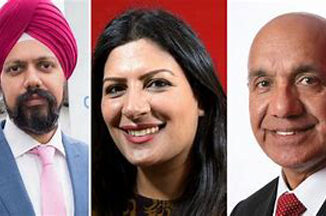
    LONDON (TIP): A record 12 Punjab-origin politicians entered the UK’s House of Commons on Friday as the Labor Party registered a historic victory in the parliamentary elections. The count stood at five in 2019.
    Of the 12 MPs, which includes six women, 11 belong to the Labor Party while Gagan Mohindra is from the Conservative Party. The prominent faces include Preet Kaur Gill from Birmingham Edgbaston, Seema Malhotra from Feltham and Heston and Tanmanjeet Singh Dhesi from Slough.
    The trio have their roots in Jalandhar. Seema has won for record fifth time while it’s third term for both Gill and Dhesi. Gill is said to be the frontrunner to be a minister in the new UK cabinet. “An honor and a privilege to be re-elected again as an MP for Birmingham Edgbaston. Thank you to everyone who put their trust in me. I will continue to serve the people and place I love,” Gill wrote on X. Her father Daljit Singh was the longest-serving president of Guru Nanak Gurdwara at Smethwick, which was the first Sikh shrine in the UK.
    Gill was elected as a councilor for Sandwell Metropolitan Borough Council in 2012 and re-elected in 2016. In 2017, she was giving the ticket by the Labor Party from Birmingham Edgbaston and she became the first woman British-Sikh MP.
    Dhesi, who is the first turbaned Sikh MP in the UK, posted on X, “Huge honor to be re-elected by the good people of #Slough as their MP. They voted for change, unity and progress, which is what I will work hard to deliver.”
    Dhesi’s father Jaspal Singh Dhesi is the former president of Guru Nanak Darbar Gurdwara at Gravesend, the largest Sikh shrine in the UK. He was first elected as a councilor to the Gravesham Borough Council in 2007. He later went on to become the Gravesham Mayor between 2011 and 2012. He lost his MP poll from Gravesham in 2015, but won in 2017, 2019 and 2024 from Slough.

  • Indian-origin student drowns at Barberville Falls in tragic incident

    Indian-origin student drowns at Barberville Falls in tragic incident

    ALBANY, NY (TIP): An Indian student from Trine University, Indiana drowned at Barberville Falls in Poestenkill, New York, on Sunday, July 7th, the last day of the long 4th of July weekend. The Indian Consulate in New York expressed deep sadness over the death of Sai Surya Avinash Gadde and extended condolences to his grieving family and friends. The Rensselaer County Sheriff’s Office reported that two men got into trouble while swimming at the falls. Multiple emergency crews responded to the scene, including the state dive team. While one man was successfully rescued by a good Samaritan, efforts to save Gadde were unsuccessful.

    The Indian Consulate in New York is providing necessary assistance, including the issuance of a No Objection Certificate (NOC) to facilitate the transportation of Gadde’s mortal remains back to India. “Our thoughts and prayers are with his family during this difficult time,” the Consulate stated in a post on X (formerly Twitter).

    The Barberville Falls is a waterfall and nature preserve located in Poestenkill, New York. The fall flows into the Poesten Kill, which is a large creek that flows through Rensselaer County.