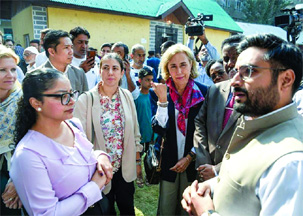
Bollywood star Alia Bhatt looked drop-dead-gorgeous as she made her Paris Fashion Week debut in a creation by ace couturier Gaurav Gupta. The actress sauntered on the ramp along with American star Andie MacDowell during the show Walk Your Worth at Palais Garnier. She wore a metal-cast silver breastplate paired with black velvet flared pants from the designer’s 2024 couture collection, Arunodaya. Gupta, who has styled renowned global head-turners, took to Instagram and wrote, “@aliaabhatt in custom Gaurav Gupta Couture for her runway debut at the L’Oréal Paris — Le Defilé show.”
Gupta’s list of celebrities, who have sported his creations, include names such as Beyonce, Paris Hilton, Mindy Kaling, Angela Bassett, Priyanka Chopra Jonas, Kriti Sanon, Janhvi Kapoor, Kareena Kapoor Khan, Shakira, Jenna Ortega, Jr Ntr. Bebe Rexha, Sharon Stone, Jeena Ortega, Sharon Stone, Ashanti, Luis Fonsi, Lizzo, Kylie Minogue, Megan Thee Stallion and Saweetie. Source: IANS
Month: September 2024
-

Alia Bhatt dazzles at Paris Fashion Week debut; Aishwarya shines too
-

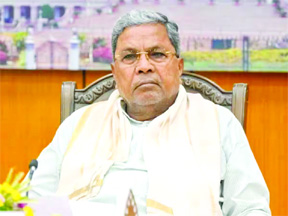
Lokayukta names Karnataka CM Sidda as ‘Accused No. 1’ in FIR
Bengaluru (TIP)- The Karnataka Lokayukta on Friday filed a first information report (FIR) against chief minister Siddaramaiah, his wife BM Parvathi and brother-in-law Mallikarjuna Swamy in connection with a land allotment case, compounding the problems for the embattled Congress leader who swept to power last year on an anti-corruption campaign.
The case involves allegations of irregularities in land allotted to Siddaramaiah’s wife, Parvathi, by the Mysuru Urban Development Authority (Muda). It came on a day Congress chief Mallikarjun Kharge rallied behind Siddaramaiah amid mounting calls for the CM’s ouster. “The FIR was filed following a direction to the Lokayukta by the special court in Bengaluru,” said TJ Udesh, superintendent of Lokayukta Police in Mysuru, confirming the FIR, a copy of which is with HT. Siddaramaiah was named as the primary accused, followed by his wife Parvathi as the second accused, and Mallikarjuna Swamy as the third. Devaraju, who sold the land to Swamy, was listed as the fourth accused, along with “others”. The FIR invoked Section 120B (criminal conspiracy), Section 166 (disobeying the law with intent to cause injury), Section 403 (dishonest misappropriation of property), Section 406 (criminal breach of trust), and Section 420 (cheating) of the Indian Penal Code. It also included charges under the Prevention of Corruption Act, the Prohibition of Benami Property Transactions Act, and the Karnataka Land Grabbing Prohibition Act. Siddaramaiah is the second sitting chief minister of Karnataka to face an FIR.
The Karnataka Lokayukta, founded in 1984, serves as the watchdog to address corruption and public complaints against state officials. Initially seen as a powerful entity in tackling corruption, its authority to investigate was taken away in 2016 and given to the Anti-Corruption Bureau (ACB), an agency controlled by the CM’s office. However, in 2022, the Karnataka high court disbanded the ACB and reinstated the Lokayukta’s authority, transferring all active cases back to it.
The CM denied any wrongdoing and dismissed calls for his resignation, attributing the case to political moves orchestrated by the Bharatiya Janata Party (BJP). “Why should I tender my resignation? You have to tender a resignation only if you have done something wrong, right? When I have not done anything wrong,” he said, addressing reporters at Mysuru airport. Kharge and the Congress rallied behind him. “Their [BJP’s] main aim is to defame the Congress. there is no question of him resigning,” Kharge said.
The Opposition in the state criticised his refusal to resign. “If Siddaramaiah continues to argue, why should I resign even after all this?, it would render his 40 years of political life meaningless. I believe he wouldn’t want to sink further in the eyes of the people, losing the remaining respect he has,” said senior BJP leader R Ashoka.
The controversy revolves around land acquisition and compensation in Mysuru’s Devanur 3rd stage layout. The disputed land is a 3.16 acre plot, which Siddaramaiah says was gifted to Parvathi by Mallikarjuna, in 1998.
In 2014, when Siddaramaiah was CM, Parvathi applied for compensation for the land after Muda allegedly took over the land for development without her permission. In 2017, Muda agreed to compensate her, and she was given 14 residential plots amounting to a total of 38,284 square feet in the prime Vijayanagar 3rd and 4th stage layouts.
The complainants argued that these 14 plots – in the heart of Karnataka’s second-largest city – were far more valuable than the original land, under Muda’s 50:50 scheme. After the controversy came to light, Siddaramiah offered to return the 14 plots if his wife was given ?62 crore as compensation.
The Muda 50:50 scheme, announced in 2016, entailed offering 50% of the developed sites as compensation to the original land owners. The controversial scheme was scrapped in 2023. -
Kharge, kin accused of ‘illegal’ land allocation
A Karnataka Bharatiya Janata Party (BJP) leader has lodged a complaint with the state Lokayukta against Congress president Mallikarjun Kharge, his son and state minister Priyank Kharge and many of their family members, accusing them of illegally acquiring public land in the state. The complaint, lodged by NR Ramesh, alleged irregularities in land allocated to the Siddhartha Vihar Trust, linked to the Kharge family, under the Congress government in the state. The charges include fraud, forgery, conspiracy to illegally acquire government land, and facilitating the unlawful appropriation of public property.
“Ramesh NR of BJP has filed a complaint with Karnataka Lokayukta against Congress president Mallikarjun Kharge and others, alleging land grab by the Siddhartha Vihar Trust owned by Kharge’s family,” BJP IT department chief Amit Malviya posted on X on Friday.
“The trust reportedly received free land from the Congress government, raising questions about nepotism and criminal breach of trust,” he added.
In his complaint, the BJP leader has named the Congress chief, his wife Radhabai Kharge, his son-in-law and Gulbarga lawmaker Radhakrishna Doddamani, son Priyank Kharge, another son Rahul Kharge, Karnataka minister MB Patil and IAS officer S Selvakumar, among others.
No FIR has been registered in the case so far.
“We call for a thorough investigation into the role of the individuals involved in these land deals and how the approvals were given by the authorities,” Ramesh said. Source: HT -

CBI Court: RG Kar ex-principal may get death penalty if found guilty
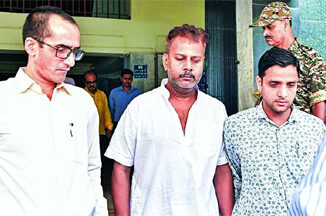
Kolkata (TIP)- A CBI court, denying bail to former RG Kar Medical College and Hospital principal Sandip Ghosh, has observed that the nature and gravity of the accusation against him is grave and it can attract capital punishment if proved. The CBI had arrested Ghosh and former officer in-charge of the Tala police station, Abhijit Mondal, for alleged tampering of evidence and delay in filing of FIR in the rape and murder of a doctor at the state-run hospital on August 9. The court in its order, dictated on September 25, said it appeared from the case diary that the process of investigation by the central probe agency was in full swing. Denying the bail prayer of Ghosh, Additional Chief Judicial Magistrate S Dey observed that the nature and gravity of the accusation was grave and if proved, it might attract capital punishment.
The judge said the court was of the opinion that “it would be injustice flouting the principle of equity to release the accused on bail”.
He said in the order that a person might commit an offence with the help of other/s, and there was no need to be present for the other accused at the place of occurrence. The court also rejected the bail prayer of Mondal.
It granted the CBI’s prayer for judicial custody of the two accused till September 30. Ghosh’s counsel claimed before the judge that he was falsely implicated and there was no act on his part to commit the crime as alleged.
CBI seeks report from Bengal govt on biomedical wastes
The Central Bureau of Investigation (CBI), which is conducting a probe into the financial irregularities at state-run R.G. Kar Medical College & Hospital in Kolkata, has sought a report from the West Bengal health department on the general practices adopted in case of disposal of biomedical wastes in different medical colleges and hospitals in the state.
The development is significant amid allegations that a major part of the alleged financial scam at R.G. Kar pertained to the smuggling of biomedical wastes.
Sources said that among the queries made by the central agency to the state health department, the first is the time when the central policies regarding biomedical wastes were implemented in the state.
The second was whether the state health department had been monitoring the medical colleges and hospitals for sticking to the laid down norms on the disposal of biomedical wastes. Sources said the CBI officials have traced severe irregularities in the disposal of biomedical wastes.
As per rules, the biomedical wastes of any hospital are supposed to be disposed of following a particular procedure to eliminate the chances of their reuse. However, in the case of R.G. Kar, a major part of the biological wastes having the potential of reuse like saline bottles, injection syringes and needles, among others, were sold in the market instead of being disposed of.
Each hospital is also supposed to maintain a record of the amount of biomedical waste being disposed of by its authorities over a certain period. Often it has been noticed that in the case of R.G. Kar the quantum of the biomedical wastes disposed of by its authorities during a certain period is much less than what was reported by other state-run medical colleges and hospitals of similar size during the same period. -

Chinese seek ‘unreasonable’ patrolling rights at two LAC spots along Arunachal Pradesh
New Delhi (TIP)- As India and China discuss a potential resolution of their dispute along the Line of Actual Control (LAC) that has been ongoing for four years, Chinese negotiators have suggested to New Delhi that their troops be allowed to patrol in two sensitive areas along Arunachal Pradesh.
The two spots — one in the Yangtse area north-east of Tawang, where the two sides had a deadly clash in December 2022, and the second in central Arunachal along the Subansiri river valley — have been firmly under Indian control for decades.
The recent Chinese demand came in response to the 21 rounds of talks that have been held between the two sides over the past four years, to discuss the existing dispute on the LAC in eastern Ladakh.
Here, Chinese soldiers have denied access to Indian troops to “patrol points” 10, 11, 12 and 13 (also known in military jargon as PP) on the LAC. All of these originate from “the bottleneck”, a geographical feature on the eastern flank of the 972 sq km Depsang plateau. Government sources, speaking to The Tribune on the condition of anonymity, said the Chinese demands were “unreasonable” and “devoid of logic”. “The last Indian Army patrol to the PP areas was in January 2020,” a source said.
The government sources reiterated that the so-called Chinese demand to allow its troops to patrol these two spots in Arunachal Pradesh was not a “quid pro quo”, as both had been in Indian control for decades.
On the other hand, the issue of patrolling PP 10, 11, 12 and 13 in eastern Ladakh is a dispute that cropped up in April 2020. Ever since, the two armies have been locked in a military standoff.
External Affairs Minister S Jaishankar, speaking at an event in the US on Tuesday, for the first-time admitted that a part of the continuing India-China dispute along the LAC was to do with access to patrolling areas. “The main issue right now is the patrolling,” Jaishankar said, pointing out that the patrolling arrangements since 2020 had been disturbed. He went on to describe the India-China relationship as “significantly disturbed”. Military sources have separately confirmed that since April 2020, Chinese troops have not allowed Indian soldiers to patrol areas — PP 10, 11, 12 and 13 — which the Indian side had patrolled until the incursions by Beijing.
The aforesaid government sources explained that the two spots in Arunachal Pradesh the Chinese are demanding access to patrol, are important to hold. After the December 2022 clash at Yangtse, Defence Minister Rajnath Singh had then told Parliament: “The PLA (People’s Liberation Army) troops on December 9 tried to transgress the LAC in Yangtse area of Tawang sector and unilaterally change the status quo.” Source: TNS -

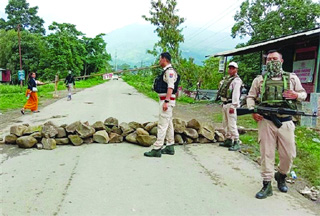
Huge cache of arms and ammo seized in Manipur
A huge cache of arms and ammunition have been seized by security forces from three districts in ethnic conflict-hit Manipur, a police statement said on September 28.
A joint team of Manipur Police and Assam Rifles seized two .303 rifles, one 9mm pistol with magazine, cartridges, four hand grenades, two detonators, and one each of country-made mortar and long-range improvised mortar from Loiching ridge in Kangpokpi district, it said.
The combined forces of state police, BSF and CRPF seized two improvised mortars, locally known as ‘pumpi’, during another search operation in Gothol village in Churachandpur district. State police and Assam Rifles also seized four HE-36 hand grenades, two ‘pumpi’ shells, three detonators, and one stun grenade, stinger grenade and tear gas shell each from Phainom hill range in Thoubal district.
All the seizures were made during search and area domination exercises by the security forces on Friday. No arrests were, however, made in connection with the seizures.
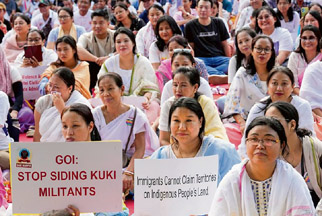
More than 200 people have been killed and thousands rendered homeless in ethnic violence between Imphal Valley-based Meiteis and adjoining hills-based Kukis in Manipur since May 3 last year. -

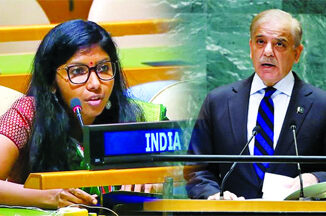
Hypocrisy at its worst: India rips apart Pak PM over Kashmir statement at UN
United Nations (TIP)- In a strong retort, India has slammed Pakistan in the UN General Assembly, saying its “fingerprints” are on terrorist incidents across the world and the country should realise that cross-border terrorism against India will “inevitably invite consequences”.
India exercised its Right of Reply in the UN General Assembly on Friday in response to Pakistan Prime Minister Shehbaz Sharif raising the issue of Jammu and Kashmir in his address at the General Debate of the 79th session of the UN General Assembly.
“This Assembly regrettably witnessed a travesty this morning. A country run by the military, with a global reputation for terrorism, narcotics trade and transnational crime has had the audacity to attack the world’s largest democracy,” First Secretary in India’s Permanent Mission to the UN Bhavika Mangalanandan said, delivering India’s Right of Reply.
She asserted that as the world knows, Pakistan has long employed cross-border terrorism as a weapon against its neighbors.
“It has attacked our Parliament, our financial capital Mumbai, marketplaces and pilgrimage routes,” she said, referring to the 2001 Indian Parliament attack and the 26/11 Mumbai terror attacks carried out by Pakistan-based terror groups.“The list is long. For such a country to speak about violence anywhere is hypocrisy at its worst,” Mangalanandan said.
In his address, Sharif raised the Kashmir issue, as expected, and said that to “secure durable peace”, India should reverse the Abrogation of Article 370 and enter into a dialogue for a “peaceful” resolution of the issue.
He said India has spurned Pakistan’s proposals for a mutual “Strategic Restraint Regime”.
Responding to this reference “to some proposal of strategic restraint”, India asserted that there “can be no compact with terrorism. In fact, Pakistan should realise that cross-border terrorism against India will inevitably invite consequences.”
Reminding the international community that this was a nation that for long hosted Al Qaeda leader Osama bin Laden, Mangalanandan said Pakistan’s “fingerprints are on so many terrorist incidents across the world, whose policies attract the dreads of many societies to make it their home.
“Perhaps it should come as no surprise that its prime minister would so speak in this hallowed hall. Yet we must make clear how unacceptable his words are to all of us. We know that Pakistan will seek to counter the truth with more lies. Repetition will change nothing. Our stand is clear and needs no reiteration,” she said.
India stressed that it is even more extraordinary for a country with a history of rigged elections to talk about political choices, that too in a democracy.
“The real truth is that Pakistan covets our territory, and in fact, has continuously used terrorism to disrupt elections in Jammu and Kashmir, an inalienable and integral part of India,” the young Indian diplomat said.
She said it is ridiculous that a nation that committed genocide in 1971 and which persecutes its minorities relentlessly even now, “dare speak about intolerances and phobias. The world can see for itself what Pakistan really is.”
A Pakistani diplomat went on to respond to Mangalanandan with a Right of Reply.
Describing India’s assertions as “baseless and misleading”, the Pakistani diplomat said the United Nations Security Council, through numerous resolutions, has unequivocally called for a free, impartial plebiscite to enable the people of Jammu and Kashmir to exercise their inalienable right to self- determination. Source: PTI -
Why did Modi return without meeting Trump, Kamala Harris?
A comment from Trump the previous week, suggesting that PM Modi was coming to meet him, had sparked speculation as to whether the Republican candidate would appear in New York City or at the diaspora event at the Nassau Coliseum in Long Island.
However, according to the report, PM Modi’s tight schedule left limited time to meet either of the candidates, who themselves were engaged in election campaigning.
The report added that polite inquiries about his schedule from those interested in arranging a meeting might have indeed occurred, and they proved enough for Trump to assume that PM Modi sought an audience with him.
This would be in keeping with Trump’s past behaviour, according to the report. For example, during a 2019 meeting with then Pakistan Prime Minister Imran Khan in the Oval Office, Trump had claimed that PM Modi had requested him to mediate in the Kashmir dispute. New Delhi had to publicly deny Trump’s statement.
However, PM Modi had invited Trump, then the US President, to the “Howdy Modi” rally in Houston in 2019, where a crowd of 50,000 attendees had impressed Trump, who has a known fascination with crowd sizes.
This event was followed by Trump’s 2020 visit to India, where he was welcomed with the “Namaste Trump” rally, organised by PM Modi in Ahmedabad, with 100,000 people packed into the newly-constructed stadium named after Modi.
The tight schedule might not have been the only reason for PM Modi to miss out on any possible meetings with the candidates.
According to the Times of India report, despite Trump praising PM Modi ahead of his US visit on Friday and calling him a “fantastic” leader, while hinting at a potential meeting, the Indian side might have decided to exercise caution based on past experience with American politics.
For example, the 2019 rally, where PM Modi had appeared to openly endorse Trump’s re-election bid by echoing the slogan “Ab ki baar, Trump sarkar”, had led to some criticism.
Given that this phrase was coined by Trump’s Indian-American supporters, who often see similarities between the two leaders as strong and assertive figures, some American commentators also suggested that PM Modi was backing Trump for a second term in 2020.
After Trump lost the 2020 election to Joe Biden, New Delhi had to reportedly recalibrate its approach to the new Democratic administration in Washington, which included Kamala Harris as Vice-President.
With this past experience in mind, the report said that PM Modi’s advisors appeared to have decided to avoid meeting either presidential candidate, with the excuse of “scheduling difficulties” due to everyone’s busy agendas.
Trump was, in fact, speaking at a rally in Pennsylvania on Monday night while PM Modi departed for New Delhi. Meanwhile, Harris, balancing her vice-presidential duties with campaign commitments, was in Washington DC, preparing to head to Pennsylvania, the most crucial among battleground states in the US elections. -

PM Modi says US visit fruitful, focused on global initiatives
Prime Minister Narendra Modi on Tuesday shared highlights of his visit to the United States, saying it has been “fruitful”, covered diverse programmes and focused on a series of subjects aimed at making the planet better. The Prime Minister shared a brief video of his engagements, from the Quad Summit to series of bilateral meetings including with US President Joe Biden. He also shared highlights of his address to the Indian diaspora, interaction with important American business leaders and address at the Summit of the Future in the United Nations.
“This has been a fruitful USA visit, covering diverse programmes and focusing on a series of subjects aimed at making our planet better. Here are the highlights,” PM Modi said in a post on X.
Quad Summit in Delaware
One of the key highlights of the visit was the Quad Summit, hosted by US President Joe Biden in his hometown of Wilmington, Delaware. PM Modi recounted the personal touch of the meeting, mentioning Biden’s gesture of taking him to his home. “His affinity and warmth was a heart-touching moment for me,” PM Modi shared, as the video showed the two leaders warmly greeting each other.
The Quad Summit, which saw participation from Japan’s Prime Minister Fumio Kishida and Australia’s Prime Minister Anthony Albanese, along with PM Modi and Biden, was another pivotal event. Reflecting on the meeting, PM Modi expressed his satisfaction in taking part at the beginning of his third term. When asked whether the Quad would continue beyond the US elections in November, Biden’s response, “way beyond November,” accompanied by a warm gesture towards PM Modi, highlighted the ongoing commitment to the alliance. India is set to host the next Quad Summit.
During the summit, PM Modi reiterated the Quad’s mission, stating, “Our message is unequivocal: QUAD is here to stay, to assist, to partner, and to complement.” He also announced India’s contribution of $7.5 million under the Quad Moonshot Initiative, aimed at supporting health measures through sampling kits, detection kits, and vaccines. “India’s vision is ‘One Earth, One Health,’” he said.
Engagement with Indian Diaspora and Business Leaders
The video also captured moments from PM Modi’s interaction with the Indian diaspora, with attendees enthusiastically cheering and waving as he spoke. In meetings with key American business leaders, PM Modi outlined the “golden opportunity” that India presents. Business leaders echoed this sentiment. Sundar Pichai, CEO of Google, praised PM Modi’s focus on using Artificial Intelligence to benefit the Indian population. “The Prime Minister wants to make sure that ultimately AI is there to benefit the people of India,” Pichai said.
Jensen Huang, CEO of Nvidia, said, “This is India’s moment, we have to seize the opportunity,” while Enrique Lores, CEO of HP Inc., shared plans to expand manufacturing in India, pointing to the country’s growing potential in both technology and production. Eli Lilly’s CEO David A. Ricks also noted India’s rise as an economic power and its expanding research base.
Accenture’s CEO Julie Sweet expressed excitement about the company’s plans to grow operations in India, while Biogen’s CEO Chris Viehbacher commended Modi’s vision of placing India at the forefront of technological progress in the 21st century. Holtec International CEO Kris Singh remarked on PM Modi’s focus on energy independence through clean energy initiatives, calling the Prime Minister “a very bright man.”
Bilateral Meetings and UN Address
The video also featured visuals of PM Modi’s meetings with various global leaders, including Japan’s Prime Minister Kishida, Australian Prime Minister Albanese, Nepal’s Prime Minister KP Sharma Oli, Kuwait’s Crown Prince Sheikh Sabah Khaled Al-Hamad Al-Mubarak Al-Sabah, Palestine’s President Mahmoud Abbas, Vietnam’s State President To Lam, and Ukraine’s President Volodymyr Zelenskyy.
At the UN Summit of the Future, PM Modi called for urgent reform of global governance institutions, including the UN Security Council. He stressed that global action must align with global ambitions.
Prime Minister Modi’s three-day visit to the United States, which began on September 21, covered a wide range of discussions and initiatives aimed at fostering global collaboration. -

UN General Assembly passes resolution demanding end to Palestine occupation
India, Australia, Canada, Denmark, Germany, Italy, Nepal, Sweden and the UK were among 43 countries that abstained as the resolution was adopted with 124 votes
The United Nations General Assembly (UNGA) has overwhelmingly adopted a resolution calling on Israel to end its illegal occupation of the Palestinian territories within a year, a move that Palestine hailed as “historic”.
The nonbinding measure passed a 124-14 vote, with 43 countries abstaining.
The UNGA demanded that “Israel brings to an end without delay its unlawful presence in the Occupied Palestinian Territory, which constitutes a wrongful act of a continuing character entailing its international responsibility, and do so no later than 12 months”.
It also called on Israel to make reparations to Palestinians for damages incurred by the occupation.
The UNGA, whose mission includes promoting “respect for human rights and fundamental freedoms”, includes every sovereign country in the world, so Wednesday’s vote underscores the depth of the international opposition to the Israeli occupation of Palestine.
The resolution backed an advisory opinion by the International Court of Justice (ICJ) – the UN’s top court – which found that Israel’s presence in the Palestinian territories is unlawful and must end.
The court ruled in July that Israel is abusing its status as an occupying power, stressing that Israeli settlements in the West Bank and East Jerusalem are illegal.
The UNGA vote comes amid Israel’s devastating war on Gaza, which has killed more than 41,250 Palestinians. The ICJ has issued rulings ordering Israel to take steps to prevent genocide in Gaza and allow adequate humanitarian aid into the territory. The United States, which claims to pursue a two-state solution to the conflict, joined Israel in opposing the UNGA resolution on Wednesday – as did Czechia, Hungary, Argentina and several small Pacific island states.
The resolution was submitted by Palestine – a permanent observer state at the UN. Palestinian Authority President Mahmoud Abbas welcomed the resolution and urged countries across the world to take steps to pressure Israel to adhere to it.
“The international consensus over this resolution renews the hopes of our Palestinian people – who are facing a comprehensive aggression and genocide in Gaza and the West Bank, including Jerusalem – to achieve its aspirations of freedom and independence and establishing a Palestinian state with East Jerusalem as its capital,” Abbas said.
Argentina: Nay vote, but committed to ceasefire efforts
Ambassador Ricardo Lagorio of Argentina said his delegation voted against the resolution for several reasons. However, he emphasised “this nay vote does not in any way mean that Argentina is no longer committed to a just and definitive peace to the Israel-Palestine conflict in conformity with international law and the relevant resolutions of the General Assembly and the Security Council of the United Nations.”
The resolution adopted goes beyond what has been established in the advisory opinion, he explained, also voicing strong support for a ceasefire to the war in Gaza.
“Only by resuming a process of dialogue based on the two-State solution, living side by side in peace and security with a secure and internationally recognised borders, will it be possible to achieve a lasting peace,” he concluded.
Japan casts favourable vote
Japan’s representative, whose delegation voted in favour of the resolution, said Tokyo attaches great importance to the ICJ and its work.
As stated in the court’s advisory opinion, he said Israeli settlement activities undermine the advancement of a two-State solution. Sanction measures should be taken based on the domestic laws of each country, he continued.
The broader goal is to rebuild trust between the parties and work towards a two-State solution, he said, adding that Tokyo will continue to support efforts by the United States, Egypt and Qatar in negotiating a ceasefire, returning the hostages and ensuring that humanitarian aid enters Gaza.
UK abstains despite call for two-State solution
United Kingdom Ambassador Barbara Woodward abstained from the resolution “not because we do not support the central findings of the ICJ’s advisory opinion, but rather because the resolution does not provide sufficient clarity to effectively advance our shared aim of a peace premised on a negotiated two-State solution”. “We respect the court and call for States to unite around renewed efforts towards a negotiated settlement in accordance with international law and the relevant resolutions of the Security Council,” she said, adding that the UK stands ready to work with other Member States on future resolutions. She condemned Israel’s expansion of settlements as “clear violations of international law”, emphasising the unprecedented levels of violence by extremist settlers over the past year used to systematically pressure Palestinian communities to leave their land. She called on Israel to hold those responsible to account and for an immediate ceasefire in Gaza in order to ensure “a safe and secure Israel alongside a safe and secure Palestinian State”.
New resolution demands end to Israeli occupation
By the newly adopted resolution, the General Assembly “demands that Israel brings to an end without delay its unlawful presence in the Occupied Palestinian Territory, which constitutes a wrongful act of a continuing character entailing its international responsibility and do so no later than 12 months from the adoption of the present resolution”.
The Assembly also “demands that Israel comply without delay with all its legal obligations under international law, including as stipulated by the International Court of Justice, by, inter alia: (a) withdrawing all its military forces from the Occupied Palestinian Territory, including its airspace and maritime space, and (b) putting an end to its unlawful policies and practices, including ceasing immediately all new settlement activity, evacuating all settlers from the Occupied Palestinian Territory and dismantling the parts of the wall constructed by Israel that are situated in the Territory, and repealing all legislation and measures creating or maintaining the unlawful situation”. -

Battle lines drawn in Haryana
Elections to the 90-member Haryana Assembly will take place on October 5 and results will be out on October 8
A multi-cornered contest is expected in the elections for Haryana’s 90 member Assembly, with Aam Aadmi Party, Indian National Congress, Bharatiya Janata Party, Jannayak Janata Party and Indian National Lok Dal all fielding candidates in the fray. BJP will seek to hold on to its mandate and return for a third term in office. Meanwhile, AAP and Congress have announced separate candidate lists after seat-sharing talks between the two parties failed.
Some Congress and BJP leaders have also entered the polls as independent candidates after not receiving tickets from their parties. Of these, several withdrew their nominations ahead of the cut-off date.
All major parties are also vying for Dalit votes in the State, which has a sizeable number of Assembly seats reserved for the Scheduled Castes, at 17. In the last Assembly elections as well as 2024 Lok Sabha polls, there was reduced support to BJP from the Dalit community, while Congress has seen gains. In 2014, BJP had won nine of the 17 seats reserved for the SC community, but in the 2019 assembly polls, this dropped to five. The Congress on the other hand, secured four and seven seats respectively in 2014 and 2019. Further, the Congress improved on its vote share among SC-reserved seats during the 2024 Lok Sabha elections, with a post-poll analysis by CSDS-Lok Niti noting that a majority of Dalits in Haryana shifted from BJP-led National Democratic Alliance to the INDIA bloc. Seeking to capitalise on this sentiment, prominent Dalit leader Selja Kumari had been fielded from Sirsa during the elections. Observers however, had suggested that it would have been more advantageous to the party if she had been fielded for the Assembly elections.
In a previous interview with The Hindu, Ronki Ram, Shaheed Bhagat Singh Chair Professor of Political Science at Panjab University, said the narrative that the BJP could end the reservation worked against them, during the 2024 Lok Sabha election and was likely to hinder them now. “The Lok Sabha elections were held only a few months ago, and the narrative that the BJP could end reservation during the poll campaign had gone deeply into the minds of SCs, which is difficult to undo at this stage. The BJP is making a desperate attempt but it would be difficult to regain the lost trust,” he noted.
Another issue which is likely to impact polls is resentment over the Union government’s farm laws, now-repealed, which had sparked large-scale protests by farmers for over a year. This may have a bearing on BJP’s performance in the Assembly elections, as it did during the poll campaign for the 2024 Lok Sabha polls.
Finally, the Agniveer scheme is a point of contention during the polls as well. In his first election rally in Haryana on September 17, Union Home Minister Amit Shah accused the Congress of playing politics over the Agnipath scheme, and assured the crowd that all Agniveers returning from the Army after four years would have jobs in Haryana, a claim likely to strike a chord in Bhiwani-Mahendragarh, which sends several soldiers to the Army each year.
In the 2019 Assembly elections, BJP had won 40 seats, while Congress came in second with 31 seats. The Jannayak Janata Party made a solid showing with 10 seats, and seven independents were also elected. One seat each went to the Haryana Lokhit Party and the Indian National Lok Dal.
Congress
In Haryana, Congress has relied on sitting MLAs, party loyalists and old faces. It has renominated all of its 28 sitting MLAs. With 24 Jat candidates, Congress has placed reliance on Jat community votes, with former CM Bhupinder Singh Hooda being a prominent representative in the party.
Among the key leaders in the State, Bhupinder Singh Hooda has been fielded from Garha Sampla-Kiloi, State Unit Chief Udai Bhan will contest from Hodai, while deputy CM Chander Mohan is in the fray from Panchkula. On September 6, former wrestler Vinesh Phogat and Olympic wrestler Bajrang Punia had both joined the Congress party. Now Vinesh Phogat has been fielded from Julana.
In a bid to strengthen party loyalty, seven relatives of party leaders have also been given tickets. Hisar MP Jai Prakash’s son Vikas Saharan has been nominated from Kalayat. Aditya Surjewala, the son of Rajya Sabha MP and congress Spokesperson Randeep Surjewala, will be contesting from Kaithal.
According to Balram Sharma, head of the political science department at the D.A.V. College in Karnal, while Hooda and his supporters garnered many of the tickets, those supporting Selja and Surjewala have also been accorded berths.
Bharatiya Janata Party
The BJP is the current ruling party in Haryana, having been in power for two terms and looking to extend its rule to a third. It has faced internal conflict of late due to its decision to drop several sitting MLAs and replace candidates, having swapped out about one-fourth of its total 90 candidates to avoid anti-incumbency sentiments. Its list is dominated by OBC, Brahmin and Punjabi candidates, in keeping with BJP’s usual strategy on banking on non-Jat communities.
The MLAs who were dropped include two ministers — School Education minister Seema Trikha,who was replaced with Dhanesh Adlakha in Badkhal, and Health Minister Banwari Lal, who was replaced by Krishna Kumar as the candidate from Bawal. Kavita Jain and Ram Bilas Sharma were also dropped, as was State party president Mohan Lal Badoli.
Among notable party leaders, Chief Minister Nayab Singh Saini is contesting from Ladwa.
Savtri Jindal, mother of Kurukshetra MP Naveen Jindal, who did not get a BJP ticket, is in the fray as an Independent candidate in Hisar, facing off against senior BJP leader Kamal Gupta.
Aam Aadmi Party
The Aam Aadmi Party has also fielded candidates for 89 seats in the Haryana Assembly election. Candidates include Raj Kaur Gill from Ambala Cantt, Lalit Tyagi from Yamunanagar, Joga Singh from Ladwa, Satbir Goyat from Kithal, Sunil Bindal from Karnal, Sukhbir Malik from Panipat Rural, and Anurag Dhanda from Kalayat. Ahead of the deadline, BJP leaders Satish Yadava and Sunil Rao, the brother-in-law of actor Rajkumar Rao, joined AAP.
In the 2019 Haryana Assembly polls, AAP had fielded 46 candidates but failed to win a single seat. It received a vote share less than the NOTA option. In the 2024 Lok Sabha elections, AAP’s Sushil Kumar Gupta— the State AAP chief— lost in the battle for the Kurukshetra seat. Seat-sharing talks with Congress failed to progress owing to this poor performance; AAP had sought 9-10 assembly segments in Haryana.
Jannayak Janata Party
The Jannayak Janata Party, which won 10 seats in the previous elections, has stitched together a pre-poll alliance with Aazad Samaj party. Among key candidates are Digvijay Chautala, contesting from Dabwali, and Dushyant Chautala, in the fray from Uchana. JJP has also expressed support to Dushyant’s uncle Ranjit Singh Chautala, contesting as an independent from Rania after being denied a ticket by the BJP.
Indian National Lok Dal
The Indian National Lok Dal, which had won one seat in the previous elections, has stitched a pre-poll alliance with the Bahujan Samaj Party. Candidates from the party in the fray include four family members, including Sunaina Chautala, the daughter-in-law of the late Partap Singh Chautala, and a brother of INLD head Om Prakash Chautala. Also in the fray are the grandsons of the late Devi Lal, Aditya Chautala, Arjun Chautala, and Om Prakash Chautala’s son and INLD secretary-general Abhay Chautala.
The party initially also supported Haryana Lokhit Party. However, INLD secretary-general Abhay Chautala said he would reconsider his alliance with the HLP after BJP threw its support behind HLP’s Gopal Kanda. -

Nearly 40% migrant Kashmiri Pandits turn out to vote
Nearly 40 per cent of migrant Kashmiri Pandits in Jammu cast their ballots in the second phase of polling for the Assembly polls in Jammu and Kashmir on Wednesday, September 25, officials said. The polling was held at 24 stations set up in Jammu, Delhi and Udhampur. “Nearly 40 per cent polling was registered at 19 polling stations in Jammu, followed by 37 per cent in Udhampur and 43 per cent in Delhi in the second phase of the Assembly elections,” Relief and Rehabilitation Commissioner Arvind Karwani told PTI.
According to official figures, a total of 6,250 voters, including 3,514 men and 2,736 women, cast their ballots.
The highest number of 2,796 votes were polled in the Habakadal constituency, which was once a bastion of Kashmiri Pandits, followed by 909 in Lal Chowk, and 417 in Zadibal.
In the first phase of the polls, 27 per cent voter turnout among the displaced Kashmiri Pandits was reported at 19 polling stations in Jammu while 31.39 per cent was reported at one polling station in Udhampur. While 9,218 Kashmiri Pandits out of 34,000 exercised their franchise for the South Kashmir seats in Jammu in the first phase of the elections on September 18, 6,250 voters out of over 15,500 voted for the Central Kashmir seat in the second phase. -
Jammu districts hit by terror attacks see around 70% voting
The Jammu districts of Poonch, Rajouri and Reasi — which have witnessed an increase in terror incidents since 2021 — saw brisk voting on Wednesday, September 25, in the second phase of the polls.
Reasi district recorded 71.81 per cent polling, followed by Poonch (71.59 per cent) and Rajouri district (67.77 per cent). Poonch district’s Surankote Assembly constituency, where four soldiers were killed in a terrorist ambush in December 2023, recorded 72.18 per cent polling. Almost all voters in the Topa Pir village cast their vote. Three residents of that village had been picked up by Army troops after the attack and died during questioning.
The adjoining Thanamandi assembly constituency’s Pangai village — from which five civilians were picked up for questioning into the Topa Pir attack and allegedly tortured — too came out in large numbers. The ST reserved constituency registered 68.44 per cent polling.
Over 69 per cent people voted in the Reasi assembly constituency, where terrorists ambushed a Katra-bound bus carrying pilgrims killing nine people and injuring 33 others in June.
Officials said polling was incident free. There were long queues throughout the day, even in the border constituencies of Kalakote-Sunderbani, Nowhera, Mendhar and Poonch — which fall on the traditional infiltration route. With elections being held in J&K after a period of ten years, the enthusiasm to have their own elected government drew people to the polling stations in huge numbers, said Mohammad Hussain, a local resident of Khari Karmara village situated along the Line of Control in Poonch. “We have numerous issues including water and electricity and need a local representative who can listen to us and get our problems solved from the government,” he said.
Similarly, in Mendhar’s Balakote village, Basharat Hussain said that through these elections, people would at least get someone whom they can approach for redressal of their grievances like repair of roads, improvement in health and education facilities etc. Source: The Indian Express -

Healthy, democratic: Foreign envoys on J&K poll as Ph-2 sees 56% turnout
Srinagar/Jammu (TIP)- With more than 56 percent voters on Wednesday, September 25, exercising their franchise in the second phase of polling for 26 seats in the Jammu and Kashmir Assembly elections, a group of diplomats from 16 countries witnessed the electoral process. The diplomats, invited by the Ministry of External Affairs, expressed satisfaction over the conduct of the elections, with some saying the process looks comparable to how it happens in their own countries.
70% polling in terror hotbeds
Militancy-hit districts Reasi, Poonch, Rajouri witness 74.7%, 73.8% and 70.95% polling.
Kashmir’s Budgam, Ganderbal and Srinagar districts record 62.98%, 60.55% and 29.51% turnout
Lower than in 2014
20 of 26 segments, which voted on Wednesday, September 25, saw lower turnout than in 2014 when the overall polling was above 60%
Jorgan K Andrews, Deputy Chief of the Mission at the US Embassy in New Delhi, said the voting process looked healthy and democratic. “It is great to see the enthusiasm. It’s great to see Kashmiris coming out for voting after a pause for 10 years. We are very excited to see the results. It looks very healthy and very democratic,” Andrews said at a polling station here. He said the process was similar to how it happened in his country. “It is very comparable. In my country, we use schools as well for voting. So it looks very similar,” he added.
Besides Andrews, diplomats from Mexico, Guyana, South Korea, Somalia, Panama, Singapore, Nigeria, Spain, South Africa, Norway, Tanzania, Rwanda, Algeria and the Philippines were part of the delegation. They first visited a polling station at Ompora in Budgam and later, in Srinagar.
South Korean diplomat Sang Woo Lim liked the idea of “pink polling stations”, which are managed by all-female staff. Singapore’s Deputy Head of the Mission Cheng Wei Wei Alice said, “The process is similar to the one in Singapore. We use government buildings so that these are easily accessible to voters.”
Meanwhile, as per election officials, 56.05 per cent polling was recorded till evening, with militancy-hit Reasi witnessing the highest 74 per cent voting. Wednesday’s turnout was, however, less than that of the Phase-I, which saw 61 per cent polling. Chief Electoral Officer Pandurang K Pole said the polling was largely peaceful.
Three militancy-hit districts of the Jammu region — Reasi, Rajouri Poonch — saw people coming out in large numbers. Reasi saw 74.7 per cent polling, Poonch 73.8 per cent and Rajouri 70.95 per cent. Kashmir’s three districts, however, saw less voting than Jammu. Budgam registered 62.98 per cent turnout, Ganderbal, 60.55 per cent and Srinagar the lowest 29.51 per cent.
In Ganderbal where former CM Omar Abdullah is in the fray, people were seen waiting in long queues to cast their vote. “I decided to vote so that we have a legislator who can resolve our problems,” said Rashid Ahmad, a local resident.
Source: TNS -

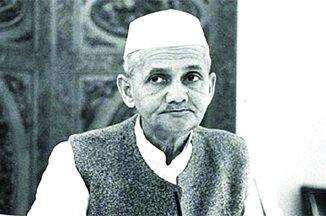
Lal Bahadur Shastri Jayanti
‘Jai Jawan, Jai Kisan’ – a phrase that resonates with every Indian, was coined by a man whose legacy continues to inspire us all — Lal Bahadur Shastri, a name synonymous with humility and dedication. Every year, on the 2nd of October, we come together to celebrate his birth anniversary, known as Lal Bahadur Shastri Jayanti.
In this article, you will learn a little more about his life, accomplishments, the profound impact he had on the nation and how his legacy continues to inspire generations.
Born on 2nd October 1904, Shastri Ji came from humble beginnings, deeply influenced by the values of honesty and hard work instilled by his mother, Ramdulari Devi, as his father, Sharada Prasad Srivastava, passed away only two years after Shastri Ji was born. He was born in the town of Mughalsarai, nestled within the Varanasi district of Uttar Pradesh, India.
His academic pursuits at Kashi Vidyapeeth earned him the title ‘Shastri’ in 1925, and he obtained degrees in philosophy and ethics, reflecting his commitment to intellectual growth.
Lal Bahadur Shastri’s Political Career
Shastri Ji’s political awakening was profoundly influenced by the likes of Mahatma Gandhi, Bal Gangadhar Tilak, Annie Besant, and other stalwarts of the freedom struggle. Their unwavering dedication to India’s cause inspired Shastri Ji to actively participate in the fight for independence. His deep admiration for Swami Vivekananda’s teachings further fueled his passion for nation-building.
In 1928, Shastri Ji joined the Indian National Congress, and two years later, in 1930, he took part in the historic Salt Satyagraha — a defining moment in the struggle for India’s freedom. His commitment to the cause saw him endure imprisonment several times, collectively amounting to seven years.
As India moved towards independence, Shastri Ji’s dedication and competence were recognised, leading to his appointment as a Cabinet Minister in the Nehru Ministry in 1952. He was entrusted with significant portfolios, including railways and transport. His tenure was marked by a strong sense of integrity.
However, in August 1956, a devastating railway accident struck Mahbubnagar, Andhra Pradesh, claiming the lives of over 100 people. Taking moral responsibility for the tragedy, Shastri Ji tendered his resignation to Prime Minister Jawaharlal Nehru. However, Nehru, recognising Lal Bahadur Shastri’s commitment and leadership, persuaded him to withdraw his resignation, believing in his ability to address the challenges that had arisen.
Tragically, just a few months later, in November 1956, another heart-wrenching railway accident occurred, this time in Ariyalur, Tamil Nadu, again, resulting in the loss of over 100 lives. Deeply affected by the recurring railway accidents and their devastating toll on human lives, Shastri Ji once again submitted his resignation to the Prime Minister. He pleaded for its early acceptance, emphasising the importance of accountability and responsibility in public service.
The second resignation, tendered by Lal Bahadur Shastri in the wake of the Ariyalur railway accident, garnered significant attention nationwide. The Pioneer, in its editorial on November 26, 1956, shortly after the Ariyalur tragedy, emphasised that while accidents could occur even in the best-regulated railways, they should be exceptions rather than the rule. The editorial did not place blame on the railway minister, recognising the complexity of the railway system’s operation and safety.
In his resignation letter, Shastri Ji expressed his belief that it would be beneficial for both him and the government if he quietly stepped down from the office he held. Notably, he used the word ‘quietly,’ underscoring his modest and unassuming nature.
Jawaharlal Nehru, addressing the dilemma he faced, acknowledged in the Lok Sabha that it was a difficult decision for him to accept Shastri Ji’s resignation. He went on to affirm his highest regard for Lal Bahadur Shastri and stressed the importance of setting an example of constitutional propriety.
Jawaharlal Nehru hinted that if he did accept the resignation, it would be based on the grounds of constitutional propriety. This aspect is noteworthy, as justifying the acceptance of the resignation on the principle of constitutional propriety faced significant scrutiny and criticism in the media.
This sequence of events reflects the depth of character and dedication to principles demonstrated by both Lal Bahadur Shastri and Jawaharlal Nehru during a critical juncture in India’s governance.
After India gained its hard-fought independence in 1947, Lal Bahadur Shastri continued his dedication to public service. He held various important positions in the Indian government, including the Minister of Police and Transport in Uttar Pradesh, which helped him understand the intricacies of governance.
In 1964, he ascended to the highest office in the country, becoming the Prime Minister of India, succeeding Jawaharlal Nehru. His leadership came at a crucial juncture in India’s history, marked by various challenges, including food scarcity and the looming threat of war with Pakistan. Shastri’s tenure was a testament to his unwavering commitment to the welfare of the nation and its people.
During his tenure, India faced one of its most challenging crises, the Indo-Pak War of 1965. Shastri Ji’s leadership during this period demonstrated his resolve and his dedication to peace.
His famous slogan, ‘Jai Jawan, Jai Kisan’ (Hail the Soldier, Hail the Farmer), captured the essence of his approach to the crisis. This slogan encapsulated the essence of his approach to the crisis and carried profound significance on multiple fronts.
– Honoring the Soldiers: ‘Jai Jawan’ hailed the soldiers on the front lines who displayed unwavering bravery and resilience in the face of adversity. It was an acknowledgement of their sacrifices and an expression of solidarity with those defending the nation’s borders.
– Recognising the Farmers: ‘Jai Kisan’ paid tribute to the farmers, emphasising the vital role they played in supporting the war effort. Shastri Ji recognised that self-sufficiency in food production was not only an economic necessity but also a strategic imperative during times of conflict. The slogan encouraged farmers to work tirelessly to ensure India had a steady supply of food.
– Unity and Resilience: Together, Jai Jawan Jai Kisan’ conveyed a powerful message of national unity and resilience. It underscored the idea that the entire nation stood as one, with soldiers and farmers working hand in hand to defend the country’s integrity and secure its future.
Lal Bahadur Shastri’s slogan not only boosted the morale of Indian soldiers but also inspired a sense of duty and patriotism among citizens from all walks of life. It highlighted the interdependence of security and sustenance, reinforcing the idea that a strong nation must be both well-defended and self-reliant.
In the midst of the conflict, Lal Bahadur Shastri’s leadership, encapsulated by this iconic slogan, steered India towards a position of strength and resilience.
Lal Bahadur Shastri’s death
Lal Bahadur Shastri’s passing remains shrouded in mystery and intrigue. On the night of January 11, 1966, while in Tashkent, Uzbekistan, for peace talks with Pakistan following the Indo-Pak War of 1965, the world was shocked to learn of his sudden demise. Shastri, then Prime Minister of India, had been engaged in intense negotiations with Pakistan’s President, Ayub Khan, to secure a lasting peace between the two nations.
The cause of his death was officially stated as a heart attack, but doubts and questions surrounding the circumstances persist to this day.
Despite the controversies surrounding his death, Lal Bahadur Shastri’s legacy endures as a symbol of unwavering commitment to the nation and its people. His sudden and untimely passing left the nation in mourning, and he was cremated with full state honours at Vijay Ghat in Delhi. Posthumously, he was awarded the Bharat Ratna in recognition of his exceptional service and leadership. -

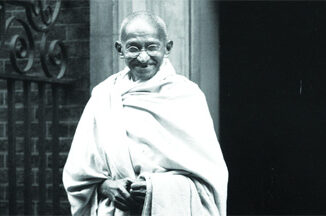
Remembering Mahatma Gandhi on his 155th birth anniversary
Mohandas Karamchand Gandhi, popularly known as Mahatma Gandhiji for his selfless struggle for independence of India from British rule. He is well-known for his battle against British atrocities without a war cry but a peaceful procession, leading the whole nation into the battlefield with no ammunition but a spirit of perseverance. He spearheads various campaigns such as Quit India, Non-Cooperation, Dandi March, and others against colonial rule. His contributions to others in freeing the nation from the heinous clutches of the British earned him honors like being called ‘Father of the Nation’ and his birthday Oct 2nd as a National holiday.
Early Life of Mahatma Gandhi
Birth – Mahatma Gandhi was born on October 2nd, 1869, originally named Mohandas Karamchand Gandhi. He was born in a coastal town called Porbandar in Gujarat, India. He was born into a Hindu Bodh Baniya family, which was deeply religious and observed rituals and vows regularly. His father, Karamchand Gandhi, was a Diwan, a chief minister of Porbandar. His mother, Putlibai, was deeply religious and a spiritual person, who observed the duties of a housewife.
Upbringing – Gandhi’s upbringing was in a religious environment that greatly influenced his later life. His father’s staunch principles fostered values like devotion, self-discipline and tolerance. His mother’s deep religious values taught him the importance of religion and spirituality.
Education – Gandhi received his primary education in Porbandar. Later he moved to Rajkot where his family later settled. With no remarkable academic achievements, he was a very shy and mediocre student during his early school days. His unquenchable curiosity and strong moral compass had guided him towards personal and political development. At the age of 18, in 1888, he traveled to London to study law at Inner Temple. Later in London, he was exposed to Western ideals and political thoughts which shaped his entire worldview.
Early Influences of Ideologies – His early influences include the religious teachings of Jainism, Vaishnavism, and Christianity. These played a pivotal role in shaping his philosophies of non-violence and truth in later years. His mother’s deeply religious and spiritual influence instilled in him a sense of empathy, sympathy, and compassion. When he was posted as a lawyer in South Africa, he faced a lot of discrimination in his early years. When he worked as a lawyer he solidified his commitment to fight injustice through peaceful and non-violent means. These early experiences and ideologies from varied authors laid a foundation for his lifelong dedication to truth and non-violence. He was greatly influenced by the writings of ‘Henry David Thoreau’.
Role in India’s Independence Movement
Gandhiji’s leadership is echoed across the globe for gathering all social, religious, and regional communities all over India and cemented his philosophy into practice in non-violent methods. The following are the movements that brought Indians together and fought for Independence.
Non – Cooperation Movement
The non-cooperation movement was observed from 1920 to 1922. This movement was one of the Gandhi’s earliest and most influential campaigns against the British rule. This was a result of the Jallianwala Bagh massacre in 1919 and other British harsh repressive measures. The main aspect of the non-cooperation movement was boycotting British goods and advocating the use of homegrown products through self-reliance. This movement has united millions of Indians across varied regions and communities. This movement emphasized dismantling the British authority peacefully without violence. However, the movement was suspended after the violence erupted in Chauri Chaura. Yet Gandhi’s focus on peaceful resistance remained a hallmark of the movement.
Civil Disobedience Movement
This movement was observed from 1930 to 1934. The Civil Disobedience Movement started with Gandhi’s famous salt march in 1930. This movement was a direct challenge to the British monopoly on salt production. The march was led by Gandhi ji and his followers later, from Sabarmati Ashram to Dandi, which covered 240 miles, by defying British laws and making salt from seawater. This movement united millions of Indians, refusing to pay taxes, defying British laws, and boycotting British goods. This movement involved urban and rural populations, characterizing non-violent resistance and mass participation. This movement led to the arrest of Gandhi and thousands of his supporters, with brutal repression. This movement significantly weakened British control and brought Indian independence close to global attention.
Quit India Movement
This movement was launched by Gandhi in 1942, the most aggressive phase of India’s freedom struggle. He observed fastings and gave famous speeches like Do or Die, urging Indians to intensify their efforts to expel British rule from India. Gandhiji utilized the time for immediate independence that was raging under World War 2 when the British sought India’s support. Widespread resistance campaigns such as strikes, protests, and acts of sabotage were observed. The British government arrested Gandhiji and his followers with brute force intending to crush the momentum. The movement was suppressed by 1944, yet it left an indelible mark during the freedom struggle.
The United Nations declared October 2 as “International Day of Non-Violence” on June 15, 2007. Several programmes and cultural events are organised to pay homage to the Father Of The Nation and spread his teachings. Many people also visit places dedicated to Mahatma Gandhi on this day – like Raj Ghat in Delhi, Mani Bhavan in Mumbai and Sabarmati Ashram in Gujarat.
A Fight Against Racism
After completing his legal education, Gandhi went to South Africa in 1893 to attend to a legal matter of Dada Abdullah Jhave. This was a pivotal moment in his life as he encountered systematic racism for the first time. One incident, where he was thrown off a train in Pietermaritzburg for refusing to leave a “whites-only” compartment, served as a turning point.
This moment of humiliation fueled his desire to fight for justice and the dignity of the oppressed. His first nonviolent resistance movement was aimed at securing the rights of Indian immigrants who were subjected to harsh labor conditions and unjust laws. He founded the ‘Natal Indian Congress’ in 1894, started Indian Opinion in 1903, and established the ‘Phoenix Settlement’ in 1904. Gandhi’s nonviolent methods laid the foundation for future movements in India, and South Africa became his testing ground for developing tactics that would later challenge British colonialism.
Return to India
In 1915, Gandhi returned to India, equipped with his principles of nonviolent civil disobedience. He was quickly drawn into the freedom struggle and started advocating for the rights of India’s poorest communities. He focused on addressing their concerns and highlighting injustices such as high taxes and exploitative British policies.
The Final Years and Legacy of Gandhi
As India moved closer to independence, tensions between Hindus and Muslims grew, leading to the partition of India in 1947. Gandhi ji, deeply pained by the resulting communal violence, traveled extensively to promote peace and reconciliation.
Tragically, on January 30, 1948, Gandhi was assassinated by Nathuram Godse, sending shockwaves across the nation and the world. His death marked a profound loss for India and those who believed in his vision of nonviolence and communal harmony.
However, Gandhi’s legacy as a champion of nonviolence and civil rights continues to influence global movements for justice and equality. Leaders like Martin Luther King Jr. and Nelson Mandela drew from his principles to advance their causes. -

SUOZZI’S BIPARTISAN BILL PASSES UNANIMOUSLY IN BUDGET COMMITTEE
WASHINGTON, D.C. (TIP): Congressman Tom Suozzi’s (D – Nassau, Queens) bipartisan legislation passed unanimously in the Budget Committee. The “Increasing Baseline Updates Act” – Co-led by Republican Blake Moore (R-UT) – would require the Congressional Budget Office and The President to provide more annual updates to budget productions and technical data to Congress. The bill, H.R. 9716, would finally amend the Congressional Budget and Impoundment Control Act of 1974. “This is another in a series of bipartisan, common-sense bills I have sponsored during the session. Today in the Budget Committee, we demonstrated that, by working together, Republicans and Democrats can still get results,” Suozzi said.
“I was trained as a CPA; I am concerned about our budget and deficits. I know the importance of accuracy in budget estimates. If Congress and the public can get better data, we will be in a better position to fix our budgets.” Suozzi explained. “The latest CBO baseline anticipated that taxpayers will accumulate more than $22 trillion in deficit spending over the next ten years. If we are going to tackle our nation’s debt, we have to get serious about knowing where our problems are and what we can do to fix it.”
CBO’s baseline is a set of detailed projections of federal spending, revenues, deficits or surpluses, and debt for the current year and the following decade. Those projections inform policymakers about budgetary trends and the nation’s fiscal condition under current law. “The bill will enhance CBO’s objectivity, and frequent updates will ensure that CBO’s budget and economic outlooks are without bias,” Suozzi explained.
CBO typically aims to release at least two baselines a year. Delays in the appropriations process can cause CBO to miss its target of three baselines. The Budget Committee strongly supports releasing three baselines in order to complete its own budget enforcement and oversight responsibilities. Baseline projections supply the Congress with information about the budgetary outlook over the coming decade under current laws and a benchmark to use in determining whether proposed legislation is subject to various budget enforcement procedures.
“This bill will help tighten congressional procedures and result in a more fiscally responsible policy,” Suozzi concluded.
-

Harris leads Trump in several battleground states, various polls say
WASHINGTON, D.C. (TIP): US Vice President Kamala Harris has taken the lead over her Republican presidential rival Donald Trump in several key battleground states like Arizona, Michigan and Pennsylvania, according to various polls released here. Harris, the Democratic presidential candidate, enjoys a slight lead over former president Trump in Michigan, as per the latest poll released by UMass Lowell’s Center for Public Opinion and YouGov. Harris is slightly leading 48 per cent to 43 per cent in the Great Lakes State against Trump, it said.
“For a swing state, this margin is good news for the vice president’s campaign,” Rodrigo Castro Cornejo, UMass Lowell political science assistant professor and Center for Public Opinion associate director, said.
If Trump wants to beat this margin, he has an uphill battle to fight in the Great Lakes State.
“The Trump campaign,” Castro Cornejo said, “has a negative favorability in Michigan that needs to be overcome if they want to remain competitive in the state.” Harris stands at 48 per cent against Trump’s 46 per cent in Pennsylvania, the UMass Lowell’s Center for Public Opinion said.
“The presidential race remains very close in Pennsylvania with the coming weeks a crucial time for both campaigns,” Cornejo said.
“As can be expected in a highly competitive race with few undecided voters, get-out-the-vote strategies will become increasingly important to mobilize supporters and ensure they go to the polls on Election Day,” he said.
According to a new poll from Fox News, Harris has a slight lead over Trump in Georgia but trails behind in Arizona.
In Georgia, Harris has 51 per cent of votes against Trump’s 48 per cent, the poll said. However, in Arizona, as per the Fox News poll, Trump leads Harris by a similar margin. He has the support of 51 per cent against Harris’ 48 per cent.
According to Real Clear Politics, which tracks all major polls, Trump trails Harris by two percentage points nationally, while in the battleground states, it is a statistical tie. Harris leads Trump by 0.3 percentage points in battleground states, it said.
(Source: PTI) -

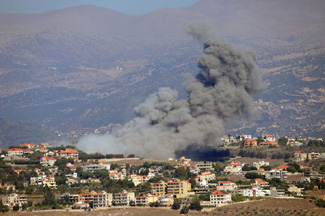
US, allies call for ‘immediate’ 21-day ceasefire between Israel and Hezbollah
The ceasefire call applies only to the Israel-Lebanon border
UNITED NATIONS (TIP): The US, France and other allies have jointly called for an “immediate” 21-day ceasefire to allow for negotiations in the escalating conflict between Israel and Hezbollah that has killed more than 600 people in Lebanon in recent days. The joint statement, negotiated on Wednesday, September 25, on the sidelines of the United Nations General Assembly in New York, says the recent fighting is “intolerable and presents an unacceptable risk of a broader regional escalation.”
“We call for an immediate 21-day cease-fire across the Lebanon-Israel border to provide space for diplomacy,” the statement reads. “We call on all parties, including the Governments of Israel and Lebanon, to endorse the temporary cease-fire immediately.”
There was no immediate reaction from the Israeli or Lebanese governments — or Hezbollah — but senior US officials said all parties were aware of the call for a ceasefire and would be speaking for themselves in the coming hours. The officials said Hezbollah would not be a signatory to the cease-fire, but they believe the government of Lebanon would coordinate its acceptance with the group.
While the ceasefire call applies only to the Israel-Lebanon border, senior US officials said they were looking to use a three-week pause in fighting there to restart stalled negotiations for a cease-fire and hostage release deal between Israel and Hamas.
The nations calling for a ceasefire include the United States, Australia, Canada, the European Union, France, Germany, Italy, Japan, Saudi Arabia, United Arab Emirates and Qatar.
Work on the proposal came together quickly this week with President Joe Biden’s national security team, led by Secretary of State Anthony Blinken and national security adviser Jake Sullivan, working with allies to get the deal together, according to a US official. The official, who spoke on the condition of anonymity to discuss the private deliberations, said the deal crystallized by late Wednesday afternoon during a conversation on the sidelines of the General Assembly between Biden and French President Emmanuel Macron.
French Foreign Minister Jean-Noël Barrot told the UN Security Council during a meeting that “we are counting on both parties to accept it without delay.”
Barrot said France, a former colonial power to Lebanon, and the US had consulted with the sides on “final parameters for a diplomatic way out of this crisis,” adding that “war is not unavoidable.”
US deputy ambassador to the UN Robert Wood encouraged the council to support the diplomatic efforts but didn’t offer specifics about the plan.
“We are working with other countries on a proposal that we hope will lead to calm and enable discussions to a diplomatic solution,” he said.
Earlier on Wednesday, Secretary of State Antony Blinken said the US administration was “intensely engaged with a number of partners to deescalate tensions in Lebanon and to work to get a cease-fire agreement that would have so many benefits for all concerned.”
Blinken and other advisers to President Joe Biden have spent the past three days at and on the sidelines of the annual UN General Assembly meeting of world leaders in New York lobbying other countries to support the plan, according to US officials, who spoke on condition of anonymity to discuss sensitive diplomatic conversations.
Biden’s national security adviser Jake Sullivan and senior advisers Brett McGurk and Amos Hochstein have been meeting with Middle East allies in New York and have been in touch with Israeli officials about the proposal, one of the US officials said.
An Israeli official said Netanyahu has given the green light to pursue a possible deal, but only if it includes the return of Israeli civilians to their homes. The official spoke on condition of anonymity because they were discussing behind-the-scenes diplomacy.
Lebanese Prime Minister Najib Mikati threw his support behind the French-US plan that “enjoys international support and which would put an end to this dirty war.”
He called on the Security Council “to guarantee the withdrawal of Israel from all the occupied Lebanese territories and the violations that are repeated on a daily basis.”
Israel’s UN Ambassador, Danny Danon, told journalists at the United Nations that Israel would like to see a ceasefire and the return of people to their homes near the border: “It will happen, either after a war or before a war. We hope it will be before.”
Addressing the Security Council later Wednesday night, he made no mention of negotiations on a temporary ceasefire but said Israel “does not seek a full-scale war.”
Both Danon and Mikati reaffirmed their governments’ commitment to a Security Council resolution that ended the 2006 Israeli-Hezbollah war in Lebanon.
Danon demanded that the resolution be enforced in full without delay: “I make this declaration here today, to remove any doubt: Never again. Never again will the Jewish people hide from the monsters whose purpose in life is to murder Jews.”
“an all-out war is possible” but said he thinks the opportunity also exists “to have a settlement that can fundamentally change the whole region.”Meanwhile, the chief of Israel’s army said Wednesday that the military is preparing for a possible ground operation in Lebanon as Hezbollah hurled dozens of projectiles into Israel, including a missile aimed at Tel Aviv that was the militant group’s deepest strike yet.
-

India, Brazil and South Africa unite against terrorism at UNGA
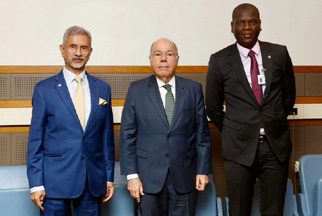
UNITED NATIONS (TIP): The Foreign Ministers of India, Brazil, and South Africa (IBSA) convened on the sidelines of the UN General Assembly (UNGA) in New York, issuing a joint statement that strongly condemns terrorism. They urged the international community to take concerted action against UN-listed terrorist organizations, including those based in Pakistan, such as Lashkar-e-Tayyiba (LeT) and Jaish-e-Mohammad (JeM).
External Affairs Minister S Jaishankar, Brazil’s Foreign Minister Mauro Vieira and South Africa’s Minister of International Relations Ronald Lamola attended the meeting. They reaffirmed their commitment to expediting the adoption of the Comprehensive Convention on International Terrorism in UNGA.
The IBSA unequivocally condemned terrorism in all its forms, advocating for a broad international counter-terrorism framework grounded in international law. This framework would support the UN’s central role in coordinating global counter-terrorism efforts.
The meeting underscored the importance of global cooperation in combating terrorism, with IBSA member-states pledging to work together to address this pressing issue.
-

Harris vows to fix US’ broken immigration system
WASHINGTON, D.C. (TIP): Democratic presidential nominee Kamala Harris has vowed to impose tougher security measures at the border and fix America’s broken immigration system, as she sought to counter frequent political attacks on the issue from her Republican rival Donald Trump ahead of the November election.
Vice President Harris’ comments came during her visit to the US-Mexico border in Douglas, Arizona, on Friday, September 27. Despite taking a hardline stance on border security, Harris said she also supports a “pathway to citizenship” for undocumented migrants currently in the US.
“As President, I will work with Congress to create, at long last, a pathway to citizenship for hardworking immigrants who have been here for years,” Harris said.
Harris was in Arizona to get a first-hand assessment of the security situation at the southern borders.
Slamming former president Trump, she said politicians have refused to come together and fix the broken immigration system. Illegal immigration is an issue that Americans have grown increasingly worried about in recent years amid record levels of migrant crossings at the southern border.
“Well, as President, I will put politics aside to fix our immigration system and find solutions to problems which have persisted for far too long…These issues are highly consequential for our nation,” she said.
Harris, 59, will take on Trump, 78, in the November 5 presidential election.
Observing that the contrast in the 2024 election is clear, Harris said it is a choice between common sense solutions and the same old political games.
“In the four years that Donald Trump was President, he did nothing to fix our broken immigration system. He did not solve the shortage of immigration judges and border agents or create lawful pathways into our nation.
He did nothing to address our outdated asylum system. And did not work with other governments in our hemisphere to deal with what is clearly a regional challenge,” she alleged.
Harris slammed Trump for wanting to run on a problem instead of fixing a problem. “The American people deserve a President who cares more about border security than playing political games,” she said.
As a former border state Attorney General, Harris noted that she understands what security and enforcing the law at the border means, prosecuting transnational criminal organizations for the trafficking of guns, drugs, and human beings. As such she unveiled her approach to “target the entire global fentanyl supply chain” to “significantly reduce the flow of precursor chemicals from China” and protect Americans from the “unimaginable destruction” it is causing. “On behalf of all communities across our nation that want to see these problems solved I say: We cannot accept Donald Trump’s failure to lead. We should not permit scapegoating instead of solutions. Or rhetoric instead of results,” she said.
In his remarks earlier in the day, Trump hammered Harris for having an unsecured border.
“This is bad timing for Kamala to show up today at the border. She didn’t go there for four years. Now today she shows up,” Trump said. Trump said Harris had betrayed her oath.
“She let our cities fail violent gangs. She let our American sons and daughters be raped and murdered at the hands of vicious monsters. She let American communities be conquered. You go out to Aurora in Colorado, where they’re taking over with AK-47s. They’re taking over real estate. Kamala turned cherished small towns into blighted refugee camps,” he said.
“What Kamala Harris has done is unforgivable. It’s a crime what she did. It’s got to be criminal. There’s no greater act of disloyalty than to extinguish the sovereignty of your own nation, and that’s what she’s done. She’s ruined our nation. She’s ruined our nation,” Trump alleged.
(Source: PTI) -

India to open new consulates in Boston and Los Angeles: PM Modi
NEW YORK (TIP): India will open two new consulates in Boston and Los Angeles, Prime Minister Narendra Modi said on Sunday, September 22, meeting the long-pending demand of the fast-growing Indian American community in these two large American cities. While Boston is considered as the education and pharma capital of the US, Los Angeles, home to Hollywood, is hosting the next summer Olympics and current US Ambassador to India Eric Garcetti is the city’s former mayor.
“Friends last year, I had announced that our government had plans to open a new consulate in Seattle. It is now operational. I had asked for suggestions from you for two more consulates. I am happy to announce that after reviewing your suggestions, India has decided to open two new consulates in Boston and Los Angeles,” Modi announced during his address to Indian Americans in New York’s Nassau Veterans Coliseum.
India currently has six consulates in New York, Atlanta, Chicago, Houston, San Francisco and Seattle. The Embassy is in Washington DC. The Permanent Mission of India to the United Nations is based in New York City.
The announcement was immediately welcomed by the residents of Los Angeles. “The Modi government listens and responds to the needs of Indian Americans and of American business and political leaders. I am grateful to Prime Minister Modi, External Affairs Minister S Jaishankar and former Indian Ambassador to the United States Taranjit Sandhu for the decision to open a consulate in Los Angeles,” Gunjan Bagla, CEO of Amritt Inc, a Los Angeles-based consulting firm, told PTI.
Bagla had led an effort in this regard. “We obtained over 3,600 signatures from Southern California residents. Dozens of American and Indian American organisations wrote letters to the Prime Minister’s Office,” he said.
Los Angeles is the second largest city in the United States and its twin ports of Los Angeles and Long Beach handle about 40 per cent of all overseas goods trade in the United States .
With the growing global importance of the Indo-Pacific, Los Angeles is the capital of the Pacific Rim and India needs to be present here. “All but one of the G20 countries have consulates here in Los Angeles. American business executives with an interest in India will feel more engaged with a local consul general representing India.
While we have been blessed with Consul General Dr Srikar Reddy visiting us from San Francisco dozens of times in the last year, there are numerous local events where the absence of India is clearly felt. NRIs and Indian Americans will benefit in the case of emergency travel needs to India by not having to fly to San Francisco,” Bagla said.
(Source: PTI) -

Modi meets delegation of the Sikhs in New York
WASHINGTON, D.C. (TIP): Prime Minister Narendra Modi has met several members of the Sikh community here in the US, who thanked him for the work done by his government for the Sikh community.
“We were so happy, and what a positive feeling we had after the meeting. We greeted the prime minister as soon as he walked in the room with the Sikh traditional jaikara of Jo Bole So Nihal, and the prime minister was so gracious to reply back Sat Sri Akaal,” Jasdip Singh Jassee from the Sikhs of America organization said after he met Modi in New York on Monday, September 23. Prominent Sikh leader from Wisconsin Darshan Singh Dhaliwal also met the Prime Minister. “We had a very good discussion. The prime minister has done a lot for the Sikh community,” Jassee told PTI after returning to Washington later in the day.
“I don’t think any other Prime Minister in history of India has done for the Sikh community what Prime Minister Modi has been doing, including the opening of Kartar Saheb Corridor, celebrations of 500 years of Guru Nanak’s 550th birthday, abolishing the blacklist of Sikhs, who could not visit India and also getting justice for the victims of the Sikh genocide that happened in 1984 under the Congress government,” Jassee said, referring to the anti-Sikh riots that took place in 1984 after the assassination of then-prime minister Indira Gandhi by her two Sikh security.
“We thanked him today for what he has done for the Sikh community and we are going to take another delegation to India to meet him pretty soon and discuss issues with him,” he said, congratulating the prime minister for his “very, very successful visit” to the United States.
-

Pegasus Publishers to Release “Sam and His Two Birds” by Neha Lohia
A Fascinating Spiritual Journey for Young Readers
NEW YORK (TIP): Neha Lohia, an accomplished filmmaker, storyteller, commercial artist and conscious entrepreneur, is set to debut her children’s picture book, Sam and His Two Birds, on September 26th, 2024, through Pegasus Publishers under their children’s book label Nightingale Books. This beautifully illustrated picture- story book by Neha offers a tender and imaginative exploration of spirituality for young readers, drawing inspiration from the sacred teachings of one short story from the great Indian text the Bhagavad Gita and a profound discourse she heard in Rishikesh India by Mooji, a renowned spiritual teacher from Jamaica.
Sam and His Two Birds is a heartwarming tale that follows Sam, a life-loving little boy, and his two feathered bird friends, H and M—representing the Heart and Mind. As Sam embarks on a journey of self-discovery guided by these two birds in the lap of nature, he learns about the power of integrating his heart-mind-body, inner peace, patience, and spiritual connection to all things. The book gently introduces young readers to profound and timeless wisdom, providing a foundation for understanding life's deeper meaning.
Drawing from the rich spiritual traditions of the Bhagavad Gita, Mooji Baba, the Tao Te Ching, and A Course in Miracles, Neha Lohia has crafted a story that empowers children to explore and connect naturally with their inner world.
Through the enchanting tale of Sam and his two birds, Lohia encourages children to harmonize their hearts and minds, leading them toward a life of balance, trust, and faith.
“I wrote and painted this book in India during the pandemic lock down, a time when the whole world was at a standstill, and I sought to contribute positively to the lives of children and their families,” says Lohia. “Through Sam’s story, I hope to inspire young readers to connect with the deeper aspects of themselves and understand the value of living an integrated life. This book is deeply spiritual but not religious, it aims to empower my little readers to dissolve all inner conflicts and duality early on.”
Sam and His Two Birds is a tool for parents to impart the foundation of Heart-Mind well-being and timeless inner integration as a primary value to their children, helping them to learn how to navigate life's challenges with grace and wisdom. This book is an attempt to understand deep psychology, Mind-Heart-Body balance, and mental wellness in a playful setting, for children and adults alike.
“Whether through films or books, my goal is to tell stories that heal, empower, and connect us to something greater than ourselves and art has always been a way for me to express what words cannot,” Lohia says. “In creating this book, I found a way to channel my own life experiences into something that could potentially help others—especially children—find peace in times of turmoil.”In a bustling city of New York where skyscrapers reach for the heavens and life moves at a relentless pace, this new children’s book quietly invites readers to pause, reflect, and journey inward.
Sam and His Two Birds, written and illustrated by Neha Lohia, is not just a story—it’s an invitation for children to make friends with their heart and mind instead of choosing one over the other. The book will be available starting September 26, 2024 across bookstores and online platforms worldwide by Pegasus Publishers.
For more information or to arrange an interview, a book reading or children interactions with the author, please visit www.nehalohia.com and contact Neha Lohia directly.
About the Author: Neha Lohia is a versatile filmmaker, storyteller, and conscious entrepreneur with over two decades of experience in the creative arts. Her work is deeply rooted in spirituality, and she is passionate about empowering women and elevating consciousness. Sam and His Two Birds is her first children’s picture book, created to inspire and educate young minds through heart-centered stories.
About Pegasus Publishers: Pegasus Publishers is a UK-based independent book publisher committed to discovering and publishing books that inspire, entertain, and educate readers globally.
-

India government plans talks with warring Kuki, Meitei community leaders in Manipur
NEW DELHI (TIP): The Centre is likely to hold talks with Kuki and Meitei communities as a step to resolve the 16-month ethnic strife in Manipur, a TNS report says. This comes amid the now unsubstantiated claims by the Manipur Government that 900 Kuki militants may launch an attack in the state on September 28.
Highly placed sources informed The Tribune that the Centre may soon initiate talks with both communities as part of its initiative to restore peace in the troubled state.
Another source closely connected with developments in Manipur also indicated that the stage is being set by the Centre as well as the state government to reach out to both communities.
This source said although the situation is relatively peaceful as no violent incident has been reported in the last fortnight, the security forces are on high alert with 80 odd companies of both the BSF and the CRPF on vigil to counter any spike in violence.
A senior security official told the Tribune correspondent that the security personnel were prepared to combat any kind of situation, though any decision would be taken only after consultations with the state government.
Last week, the security adviser to the Manipur Government and head of the unified command, Kuldeep Singh, had claimed that 900 highly trained Kuki militants had entered the state through Myanmar and were planning attacks on Meiteis on September 28. The Kuki groups had consequently given a call for a complete shutdown in areas under their domination on that day.
On September 25, the Manipur Government retracted its claim, saying reports about Kuki militants’ infiltration through Myanmar could not be substantiated. This too led to Kuki groups lambasting the government. Kuki groups went on to say that the call given for total shutdown on September 28 would remain, adding that if there was any bloodshed, then the state government would be responsible for the same.
While sources indicated that the state government climbed down from its earlier claim about infiltration by Kuki militants to prevent a flashpoint between the two communities, as several Meitei groups had also threatened to launch counter-attacks on Kukis, the situation, they added, continues to remain on a boil.
Meanwhile, there are indications that the Centre was likely to initiate talks with both groups as part of its peace initiative in a state, which has seen killing of more than 200 persons and displacement of 50,000 ever since the ethnic strife began there on May 3.
Earlier this month, Home Minister Amit Shah had said that the Centre was hopeful of controlling the situation in strife-torn Manipur, as talks were going on with both Meiteis and Kukis to find a solution to the ongoing ethnic violence.
He had further junked talks about Manipur Chief Minister N Biren Singh’s resignation or replacement. “Of late, there have been sporadic cases of violence, but Manipur has been relatively calm over the last three months. There has been no incident of violence in the last three days. We are sure of regaining control and restoring peace,” Shah had said on September 17. He further said that it was an ethnic issue that could not be resolved unless both ethnicities engage in talks. “We are talking to both Kuki and Meiteis communities, Shah said, adding that Biren Singh won’t be replaced as Chief Minister.