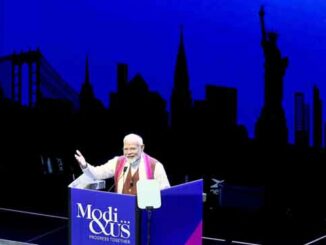
Showers praise on Indian Americans for their contribution to relation building between India and the US
I.S. Saluja
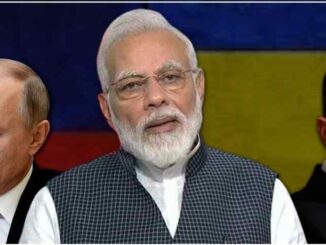
UNIONDALE, NY (TIP): It was the first day of Autum, September 22, when India’s Prime Minister Narendra Modi arrived at the Nassau Veterans Memorial Coliseum to address thousands of his supporters who greeted him with deafening chant of “Modi, Modi”.
Mr. Modi spent almost 10 minutes to shower praise on the Indian Diaspora. He spoke of the ability of Indians to “live in diversity and accommodate wherever they go”. At the same time, they “carry the feeling of Bharat Mata everywhere, whatever their language of the region”. Indians make the maximum contribution wherever they go, he said. American India -AI- is the world’s new power, said Mr. Modi. “I salute Indian Diaspora. I salute you all”.
Mr. Modi spoke about the 2024 elections which brought him to power for the consecutive third term, terming it as historic as no other Prime Minister of India ever achieved the feat. He dwelt at length on his long political career . He said he served for 13 years as the longest serving Chief Minister of Gujarat. Then he went on to highlight his government’s achievements in the past 10 years and the plans for the future.
In an election victory-like speech, Mr. Modi defended and celebrated the poll outcome in which the BJP’s majority was significantly reduced. The Prime Minister rhetorically asked the crowd about the NDA getting elected for a third term, repeatedly, “Kya hua hai? (What happened?), Abki baar? (What next?)”, as the crowd confirmed he had won.
The Prime Minister said he had very big ambitions for his third term and needed to move forward with three times the speed and strength.
Mr. Modi spoke of a Viksit Bharat that is a flower with five petals. He defined the word PUSHP (flower). P stands for Progressive Bharat. U stands for Unstoppable Bharat. S stands for Spiritual first Bharat. H stands for Humanity first Bharat . And P stands for Progressive Bharat. This description of Bharat drew loud and long applause.
The Prime Minister listed the government’s achievements since 2014, citing examples such as airport and metro systems, broadband services and poverty reduction. He highlighted India’s digitization and emphasized its environmental consciousness, while noting that it had not historically been a major contributor to climate change.
Mr. Modi said that while earlier India had a foreign policy of being equidistant from other countries, today it was keeping equally close to other countries.
“We are also a strong voice of the Global South,” he said. The Prime Minister said the world listened when India spoke at global platforms, as he cited his interaction with Russian President Vladimir Putin in 2022, when he said, “ This is not the era of war”.
Prior to Mr. Modi’s arrival, there were a number of classical, fusion and folk performances, some to reflect the melding of Indian and American nationalism and cultures, such as a fusion rendition of America the Beautiful and Vande Mataram. Some well-known artistes and social media personalities, such as the rapper Hanumankind, were among those who performed at the event.
According to the organizers over 13000 of Mr. Modi’s fans turned up , leaving thousands of chairs vacant. The organizers had claimed they had received 24000 registrations, and some claimed even a higher number. Mr. Modi himself had suggested during the speech that not all who wanted to attend could do so for lack of space. Arrangements were made to accommodate thousands who may not have been able to gain entry, but there hardly were many outside.
The event, called ‘Modi & US’ was organized by Indian American Community U.S. ( IACU), a non-profit that also describes itself as non-partisan.
NEW YORK (TIP): Asia Society, on Tuesday, September 24, hosted Dr. Subrahmanyam Jaishankar, External Foreign Affairs Minister of India, for an address and discussion with Daniel Russel, Vice President for International Security and Diplomacy.
“We have a difficult history with China. Despite the explicit agreements we had with China, we saw in the middle of Covid-19 that the Chinese moved a large number of forces in violation of these agreements to the LAC [Line of Actual Control]. It was likely a mishap would happen and it did. So, there was a clash and a number of troops died on either side. That, in a sense, overshadowed the relationship [for a while],” said Jaishankar.
Despite this complicated history, Jaishankar emphasized the importance of working towards improving India-China relations. “I think the India-China relationship is key to the future of Asia. In a way, you can say, if the world is to be multipolar, Asia has to be multipolar,” Jaishankar remarked. He noted that bilateral ties between the two countries would “influence not just the future of Asia, but in that way, perhaps the future of the world as well.”
There is still work to be done with China regarding mitigating border tensions, said Jaishankar. “When I said 75 per cent of it has been sorted out—I was asked in a way to quantify—it’s only of the disengagement. So that’s one part of the problem. The main issue right now is the patrolling. You know, how do we, both of us, patrol up to the Line of Actual Control….Some of the patrolling issues need to be resolved, but once we deal with the disengagement, there is the larger issue, which both of us have brought very large number of troops up to the border. This is what we call the de-escalation issue.”
Jaishankar doesn’t want the pursuit of relations with China to impact relations with the United States, a key ally and fellow member of the Quad: “we chew gum and walk at the same time.”
He lauded the Quad for working as a “non-treaty” way to bring together countries that are market economies, democracies, maritime powers, and have a common interest in a free and open Indo-Pacific. “I think this is the future,” Jaishankar said.
(Based on a press release by Asia Society)
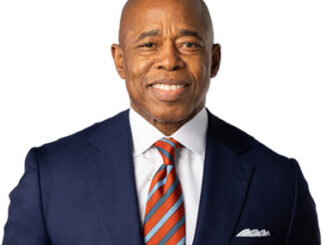
NEW YORK (TIP): New York City’s embattled mayor pleaded not guilty Friday, September 27, to federal corruption charges after prosecutors accused him of using his power and influence to garner free trips, luxury hotel stays and questionable campaign donations, according to a CNN report. Mayor Eric Adams is charged with bribery, wire fraud, conspiracy and two counts of soliciting campaign contributions from foreign nationals. “I am not guilty, your honor,” Adams said in a Lower Manhattan federal court Friday.
Magistrate Judge Katharine Parker allowed Adams to be released after the hearing – but with caveats. The mayor cannot have contact with anyone involved in the allegations in the indictment.
Aside from that, the mayor can still maintain routine business contacts and communicate with family members. The judge also allowed Adams to keep his passport.
Adams’ appearance in court as a defendant is a stark contrast from his work fighting crime as an NYPD captain – a job he often touted during his political career.
The mayor, a Democrat elected in 2021, has denied wrongdoing and said he doesn’t plan to resign. “I look forward to defending myself and defending the people of this city as I’ve done throughout my entire professional career,” Adams said Thursday, September 26.
The 15000- word indictment says that between 2016 and October 2023, Adams sought and accepted benefits such as free luxury travel and campaign donations from foreigners, including Turkish officials.
In exchange, he pressured the Fire Department of New York to approve the opening of a new Turkish consular building in the city without a fire inspection, the indictment states. In addition, his campaign used those illegal campaign donations to “steal public funds” through New York City’s matching funds, according to the indictment.
Prosecutors said the foreign nationals were able to sidestep federal law and conceal their campaign donations through these “straw donors” – US-based donors who falsely claimed they were contributing their own money.
In 2017, Adams allegedly accepted free business class tickets for three roundtrip international flights and a heavily discounted stay at a suite in the St. Regis Istanbul. The trip was worth over $41,000, and Adams did not disclose it, the indictment alleges.
Adams allegedly accepted over $123,000 worth of luxury travel benefits between 2016 and 2021, without disclosing any of it.
By 2018, the mayor allegedly “not only accepted, but sought illegal campaign contributions to his 2021 mayoral campaign, as well as other things of value, from foreign nationals.”
By January 2022, he had agreed to accept contributions of foreign money to his 2025 campaign, the indictment alleges. Meanwhile, reports have come in that New York Gov. Kathy Hochul’s team is telling allies and other stakeholders that she is now seriously considering the possibility of removing Adams from office – a power she has under state law.
Before Adams’ indictment was unsealed, Hochul reportedly hadn’t considered removing the mayor. But after reviewing the indictment, the governor suggested in a statement late Thursday, September 26, that she was leaving her options open.
“I expect the Mayor to take the next few days to review the situation and find an appropriate path forward to ensure the people of New York City are being well-served by their leaders,” Hochul said.
Lawyers in the governor’s office have started to look over the legal language of the removal authority, another source familiar with the situation said.
Though many local lawmakers have called for Adams to resign, some high-profile New York Democrats in Congress have been less vocal. House Minority Leader Hakeem Jeffries and Senate Majority Leader Chuck Schumer both stopped short of calling for Adams to step down in their most recent remarks.
“No one is above the law, including the Mayor of New York City,” Schumer said in a written statement Thursday, September 26. “The charges are serious, and the legal process should now play out speedily and fairly.”
But Jeffries could come under pressure from New York House candidates concerned the Adams scandal might hurt their prospects for election.
Adams is “entitled to the presumption of innocence,” Jeffries said, and “a jury of the Mayor’s peers will now evaluate the charges in the indictment and ultimately render a determination.”
(With inputs from CNN)
NEW YORK (TIP): External Affairs Minister S Jaishankar expressed confidence that India’s relationship with neighbours Sri Lanka and Bangladesh would continue to be “positive and constructive.”
“I would urge you not to be deterministic about it. It’s not like India is seeking to control every political move of every neighbour. That’s not how it works. It doesn’t work, not just for us, it doesn’t work for anybody else,” Jaishankar said on September 23 during an interaction at an event titled ‘India, Asia and the World’ hosted by the Asia Society and the Asia Society Policy Institute here.
The minister was responding to a question that India has given unconditional aid to Bangladesh and Sri Lanka but government changes there seemed to be potentially adverse for India.
“Every country will have its own dynamics. In foreign policy, you try to read, anticipate, and then respond to it. I’m very confident at the end of it all, in our neighbourhood, the realities of interdependence or mutual benefit and our ability to get along will serve both our interests. Those realities will assert themselves. That’s been the history,” Jaishankar said.
Jaishankar added that every few years, “something happens in our region, and people suggest that there is some kind of irretrievable situation out there. You then see the correctives beginning to manifest themselves.”
“So, I would take it in that spirit and am quite confident that in both these cases, our relationship would continue to be positive and constructive,” the EAM continued.
Jaishankar’s remarks came in light of the change of government in Sri Lanka and Bangladesh.
On Sri Lanka, Jaishankar said India stepped forward when Colombo was facing a very deep economic crisis and “very frankly, when nobody else came forward.”
“And I’m very glad we did it. We did it in a timely manner. We did it on scale. We put out USD 4.5 billion effectively,” he said, adding that the move stabilised the Sri Lankan economy.
“The rest of it was up to them. At that time we did it, it was not like we had a political conditionality which accompanied that. We were doing it as a good neighbour who did not want to see that kind of economic meltdown at our doorstep,” the EAM said.
Jaishankar said that what happens politically in Sri Lanka, “is for their politics to work out.”
“At the end of the day, each of our neighbours will have their own particular dynamics. It’s not our intention to suggest that their dynamics must necessarily adhere to what we might consider as being better for us. I think this is the real world. I mean, everybody makes their choices and then countries adjust to each other and find ways of working it out,” the minister said.
In the case of Bangladesh, he said: “It’s a little bit different. What we have done over the last decade is to do projects of various kinds, which have been good for both of us. Economic activity overall has picked up, and logistics of that region have improved.”
Jaishankar said both countries have gained a lot out of that.
In August, Nobel laureate Muhammad Yunus was sworn in as head of Bangladesh’s interim government after weeks-long violent protests culminated in the ouster of former prime minister Sheikh Hasina, who has since fled to India.
Marxist leader Anura Kumara Dissanayake, 56, was on Monday sworn in as Sri Lanka’s ninth president following his victory in the Sri Lankan presidential election. (PTI)
Karachi (TIP): The IMF has approved a USD 7 billion new bailout package for Pakistan, authorising the immediate release of the first loan tranche of less than USD 1.1 billion to reinforce the cash-strapped country’s efforts to address the ongoing economic crisis.
The International Monetary Fund (IMF) board met on September 25 in Washington to give a nod to the staff-level agreement with Pakistan after Islamabad promised to overhaul its agriculture income tax, transfer some fiscal responsibilities to provinces and agree to limit subsidies. It is the 25th IMF programme that Pakistan has obtained since 1958 and the sixth EFF.Pakistan will pay around 5 per cent interest rate on the loan. Prime Minister Shehbaz Sharif on Wednesday reiterated this would be Pakistan’s last IMF programme. (PTI)
MALE (TIP): Maldives President Mohamed Muizzu has denied having an “India Out” agenda, asserting that the island nation had a “serious problem” with the presence of foreign military on its soil.
Muizzu, who is in the US to attend the 79th Session of the United Nations General Assembly, made the remarks on september 26 while responding to a question at Princeton University’s Dean’s Leadership Series?.
“We have never been against any one country at any point. It’s not India Out. Maldives faced a serious problem with foreign military presence on this soil,” Maldivian news portal adhadhu.com quoted him as saying.
“The people of Maldives do not want a single foreign soldier in the country,” Muizzu said.
The ties between India and the Maldives came under severe strain since November last year when Muizzu, known for his pro-China leanings, took charge as Maldivian president.
Muizzu had asked India to withdraw nearly 90 Indian military personnel operating three aviation platforms gifted by the country. India withdrew its military personnel by May 10 and replaced them with civilian personnel to operate a Dornier aircraft and two helicopters. Muizzu further stressed he had taken action against deputy ministers for insulting Prime Minister Narendra Modi on social media.
“No one should say such a thing. I took action against it. I will not accept insulting anyone like that, whether he is a leader or an ordinary person. Every human being has a reputation,” the report quoted him as saying.
Earlier this year, deputy ministers in Maldives’ youth ministry were suspended for derogatory social media posts against Prime Minister Modi following a backlash, with New Delhi strongly raising the matter with Male.
The deputy ministers criticised Modi for his post on ‘X’ following his visit to Lakshadweep, inferring that it was an attempt to project the Union Territory as an alternative tourist destination to the Maldives.
Prime Minister Modi was in Lakshadweep on January 2 and 3 to inaugurate several projects. (PTI)
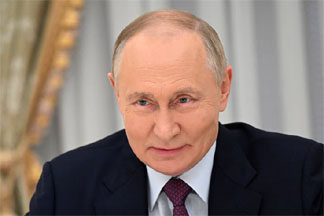
MOSCOW (TIP): Russian President Vladimir Putin said September 25 that a nuclear power supporting another country’s attack on Russia will be considered a participant in aggression under a new version of Moscow’s nuclear doctrine. Speaking at a meeting of Russia’s Security Council that considered changes in the doctrine, Putin announced that a revised version of the document says that an attack against his country by a nonnuclear power with the support of a nuclear power will be seen as their “joint attack on the Russian Federation.” Putin didn’t specify whether the modified document envisages a nuclear response to such an attack.
The change in the doctrine, which spells out condition for the use of nuclear weapons, follows Putin’s warning to the U.S. and other NATO allies that allowing Ukraine to use Western-supplied long-range weapons for strikes on Russian territory would mean that Russia and NATO are at war. Since Putin sent troops into Ukraine in 2022, he and other Kremlin voices have frequently threatened the West with Russia’s nuclear arsenal to discourage it from ramping up support for Kyiv.
The current doctrine says Moscow could use its nuclear arsenal “in response to the use of nuclear and other types of weapons of mass destruction against it and/or its allies, as well as in the event of aggression against the Russian Federation with the use of conventional weapons when the very existence of the state is in jeopardy.”
The revised version of the document spells out conditions of nuclear weapons use in greater detail, noting they could be used in case of a massive air attack involving aircraft, cruise missiles or drones, he said. (AP)
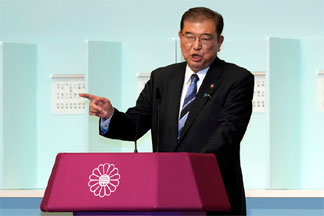
TOKYO (TIP): Japan’s ruling party on September 27 picked former defense minister Shigeru Ishiba as leader, setting him up to become prime minister next week.
The party leadership win is a ticket to the top job because the Liberal Democratic Party’s ruling coalition currently controls the parliament.
Considered a defense policy expert, Ishiba has proposed an Asian version of the NATO military alliance and a more equal Japan-U.S. security alliance. Ishiba is a supporter of Taiwan’s democracy. He calls for an establishment of a disaster management agency in one of the world’s most disaster-prone countries.
Ishiba beat out Economic Security Minister Sanae Takaichi, a staunch conservative who was running to become the country’s first female prime minister.
A record nine lawmakers, including two women, ran in a vote decided by LDP members of parliament and about 1 million dues-paying party members. That’s only 1% of the country’s eligible voters. Outgoing Prime Minister Fumio Kishida has been dogged by party corruption scandals, and the LDP wanted a fresh leader in hopes of regaining public trust before a likely general election.
Some experts believe that party turmoil could mean that Japan will return to an era similar to the early 2000s, which saw “revolving door” leadership changes and political instability.
A succession of short-lived governments hurts Japanese prime ministers’ ability to set up long-term policy goals or develop trusted relations with other leaders.
On Tuesday, Kishida and his Cabinet ministers will resign. Ishiba, after being formally elected in a parliamentary vote, will then form a new Cabinet later in the day.
The main opposition — the liberal-leaning Constitutional Democratic Party of Japan — has struggled to build momentum, despite the LDP scandals. But experts say its newly elected leader, centrist former Prime Minister Yoshihiko Noda, is pushing a conservative shift for the party, could trigger a broader political regroupings. (AP)
BEIRUT (TIP): An Israeli airstrike in Lebanon hit a building housing Syrian workers, killing 23 of them, Lebanon’s state news agency reported September 26. It was one of the deadliest single strikes in an intensified air campaign against the militant Hezbollah group.
The strike late Wednesday came as the United States and its allies called for an “immediate” 21-day cease-fire to “provide space for diplomacy.” Israel has threatened to launch a ground invasion, and the increasingly heavy exchanges of fire could trigger an all-out war.
Lebanon’s National News Agency said the strike occurred near the ancient city of Baalbek in Lebanon’s northeastern Bekaa Valley, which runs along the Syrian border. It quoted Ali Kassas, mayor of the village of Younine, as saying that the bodies of 23 Syrian citizens were pulled from under the rubble. He said four Syrians and four Lebanese were wounded.
The Lebanese Red Cross said it recovered nine bodies, while others were recovered by the Hezbollah militant group’s paramedic service and the Lebanese Civil Defense.
Lebanon, with a population of around 6 million, hosts nearly 780,000 registered Syrian refugees and hundreds of thousands who are unregistered — the world’s highest refugee population per capita.
Israel has carried out days of heavy strikes across Lebanon, targeting what it says are Hezbollah rocket launchers and other military infrastructure. The militants have fired hundreds of rockets into Israel and on Wednesday targeted Tel Aviv for the first time with a longer-range missile that was intercepted.
Israeli Prime Minister Benjamin Netanyahu, who is traveling to the United States for the U.N. General Assembly, has not yet responded to the cease-fire proposal. But his foreign minister, Israel Katz, said Israel would continue fighting “with full force until victory.”
Hezbollah has also not yet responded to the proposal. The militant group has insisted it would only halt its strikes if there is a cease-fire in Gaza, which appears out of reach despite months of negotiations led by the United States, Egypt and Qatar.
Israeli strikes since Monday have killed more than 630 people in Lebanon, according to local health authorities, who say around a quarter were women and children. Several people have been wounded by shrapnel in Israel. Israel struck 75 sites overnight across southern and eastern Lebanon, the military said. At least 45 projectiles were fired from Lebanon early Thursday, all of which were intercepted or fell in open areas, it said. (AP)
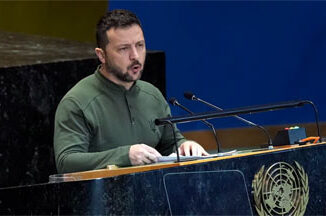
NEW YORK (tip): Ukrainian President, Volodomyr Zelenskyy has alledged that some are attempting to broker peace with the objective of getting a nobel prize and not real peace.
“As a global initiative the peace-formula has already existed for two years. And maybe somebody wants a Nobel Prize for their political biography for frozen truce instead of real peace, but the only prizes Putin will give you in return are more suffering and disasters,’’ said Zelenskyy while addressing the UNGA on September 26 in New York.
While he didn’t name anyone while making the allegation, there are many inferences people around the world have begun to draw. This includes all leaders who have been trying to talk Ukraine and Russia into peace and also former US President Donald Trump who has promised that he would ensure an end to the conflict within days (if) of his being re-elected as President of the USA.
“When some propose alternatives, half-hearted settlement plans – so-called ‘sets of principles’ – it not only ignores the interests and suffering of Ukrainians, who are affected by the war the most, it not only ignores reality but also gives Putin the political space to continue the war and pressure the world to bring more nations under control,’’ Zelenskky said adding that any parallel or alternative attempts to seek peace are, in fact, efforts to achieve a lull instead of an end to the war.
It may be recalled that the ongoing conflict between Russia and Ukraine began on February 24, 2022. Many world leaders including Prime Minister Narendra Modi, Chinese President Xi Jingping, French President Emmanuel Macron, Brazilian President Luiz Inacio Lula da Silva amongst others are trying to urge Ukraine and Russia to end the ongoing conflict.
“When the Chinese-Brazilian duo tries to grow into a choir of voices – with someone in Europe, with someone in Africa, saying something alternative to a full and just peace, the question arises – what is the true interest? Everyone must understand – you won’t boost your power at Ukraine’s expense,’’ Zelenskyy said adding, “I want peace for my people – real peace and just peace.”
India has always reaffirmed that the end to the conflict will be through dialogue and diplomacy amongst the two nations.
PM Modi met with President Zelenskyy in New York and had reaffirmed his support for the peace process. President Zelenskyy on the other hand had said that India has been invited for the second peace summit. (AP)
London (TIP): Climate campaigners on September 27 hit out at stiff jail sentences given to two activists who threw soup at Vincent van Gogh’s “Sunflowers” at a London gallery, voicing fears about the right to peaceful protest.
Just Stop Oil protesters Phoebe Plummer, 23, and Anna Holland, 22, were convicted in July of criminal damage after pouring tomato soup over the screen protecting the still life masterpiece at the National Gallery in October 2022.
Plummer was jailed for two years and Holland for 20 months. Both had pleaded not guilty.
Greenpeace UK’s co-executive director, Will McCallum, called the sentence “a draconian and disproportionate punishment for a protest that caused minor damage to a picture frame”.
Sentencing the pair, Judge Christopher Hehir said the painting could have been “seriously damaged or even destroyed”.
“Soup might have seeped through the glass. You couldn’t have cared less if the painting was damaged or not,” he added. “You had no right to do what you did to ‘Sunflowers’.”
Addressing Plummer, he said “you think your beliefs entitle you to do anything.
“The suggestion that you and others like you in a democracy are political prisoners is ludicrous, offensive and idiotic. You have no remorse and you are proud.”
The gallery, located in Trafalgar Square, said the protesters caused around £10,000 ($13,420) in damage to the frame but the painting itself was protected by a screen and was unharmed.
Holland and Plummer also glued themselves to the gallery wall during their protest. “What is worth more — art or life?” Plummer had shouted.
Both are expected to serve around half of their sentences in custody.
“It’s another grim milestone in the ongoing crackdown on peaceful protest waged by the last government,” Greenpeace UK’s McCallum said.
“Protest is by its nature inconvenient and occasionally messy. These defendants do not deserve to spend years behind bars for standing up for a liveable planet.”
Speaking before the sentencing, Holland said: “We do not expect justice from a broken system that has been corrupted by its dependence on fossil fuels. Prison sentences, no matter how long, will not deter us.”
Just Stop Oil wants an end to the extraction and burning of fossil fuels such as oil, coal and gas and say the greenhouse gas emissions they create are “driving us towards climate collapse… (that) spells disaster for human societies globally”. (AFP)
BEIRUT (TIP): A huge Israeli strike hit Beirut’s densely populated southern suburbs on September 27, flattening buildings in an operation the Israeli military said targeted Hezbollah’s headquarters but a source close to the group said its leader was “fine”. “The Israeli strikes levelled six buildings,” the source said, requesting anonymity as they were not authorised to speak to the media.
A video obtained by AFP showed an enormous explosion and thick plumes of smoke rising from buildings in the densely populated area. The strikes triggered loud explosions that were heard across the capital.
The Israeli military said it carried out “a precise strike on the central headquarters” of Hezbollah, while leading Israeli television networks reported that the group’s leader Hassan Nasrallah was the target.
“Sayyed Nasrallah is fine,” the source close to Hezbollah said.
Meanwhile, Lebanon’s health ministry said two people were killed and 76 wounded in a huge Israeli air strike in Beirut’s densely populated southern suburbs on Friday, adding it was a preliminary toll.
“The successive Israeli enemy strikes on Haret Hreik in Beirut’s southern suburbs, in a preliminary toll, killed two people and wounded 76, including… 15 that required hospitalisation,” a ministry statement said.
An AFP photographer reported scenes of panic, with residents fleeing the southern suburbs.
Hezbollah’s Al-Manar television said the strikes created huge craters in several places.
Since last week, a series of Israeli strikes have hit the southern suburbs, targeting senior Hezbollah commanders.
Lebanese Prime Minister Najib Mikati urged the international community to “stop” Israel from waging a “genocidal war” against Lebanon.
A US official said that Washington “did not get any advance warning before Israel launched this operation”. (AFP)
Celebrating unity, diversity, and shared humanity in honor of Guru Nanak Dev Ji’s 555th birth anniversary
I.S. Saluja
PISCATAWAY, NJ (TIP): Let’s Share a Meal held a press conference to announce launch Oneness: A Light for Humanity, a landmark event celebrating unity, diversity, and shared humanity in honor of Guru Nanak Dev Ji’s 555th birth anniversary.
The Oneness program, scheduled for November 9, 2024, at the New Jersey Performing Arts Center (NJPAC), will commemorate Guru Nanak Dev Ji’s teachings of compassion, equality, and community service. The event will feature engaging cultural performances and inspiring presentations from notable speakers, highlighting the ongoing significance of Guru Nanak Dev Ji’s message.
Panelists (Photo : Mohammed Jaffer / SnapsIndia)
A panelist said: “We are trying to share our spiritual value of oneness and equality at our event on November 9 at New Jersey’s Performing Arts Center in Newark. Five years ago, we conducted this at NJPAC with hundreds of people in the audience. We are again here to celebrate Guru Nanak’s 555th birth anniversary. We are fortunate to be alive during this time, and we are able, in this country to spread this kindness, spread this humanity and other wonderful values with our neighbors”.
Gathering (Photo : Mohammed Jaffer / SnapsIndia)
The organizers shared with media representatives their vision of the event’s goals, key participants, and special announcements. Mr. Onkar Singh explained that Oneness 2024 builds on the core values of equality, shared humanity, and interconnectedness, seeking to transcend the boundaries of race, religion, and nationality. The event creates a space where Guru Nanak Dev Ji’s teachings and vision of unity and equality are brought to life, showcasing its relevance in today’s world.
Organizers (Photo : Mohammed Jaffer / SnapsIndia)
To a question from Prof. Indrajit S Saluja, editor, The Indian Panorama about what the organizers thought about the need to involve the younger generation in their mission, a panelist said: “ Kids learn better when we show them what our values are versus what we preach. You know, we can tell them that the Sikhs stand for service; the Sikhs stand for equality; the Sikhs stand for social justice. But if we give them something to do and through which they can understand the value of Sikhism and the core principles, like go the Gurdwara, make langar, go to distribute food to the homeless shelter; that for me was my way as a mother of two children to teach them the value of Sikhism”.
Oneness team (Photo : Mohammed Jaffer / SnapsIndia)
“Oneness: A Light for Humanity” on November 9 promises to bring together scholars and artists from all over the world who would be contributing to spreading Guru Nanak’s message of oneness. The Guru enjoined on his followers to consider the whole humanity as one- “Maanas ki jaat, sabhe eke pahchanbo”.
Be blessed to share the Guru’s message on November 9, 2024 at the New Jersey Performing Arts Center (NJPAC).
For more information, visit www.onenessusa.com
After Conservatives now Bloc Quebecois threatens to bring down the minority Liberal government
By Prabhjot Singh
OTTAWA (TIP): It was free for all as the House of Commons witnessed a rowdy question hour before turning down no-confidence motion 211-120 for a reprieve for the minority Liberal Government. Marred by acrimonious verbal exchanges between those supporting and opposing the motion, Speaker Greg Fergus asked Conservative Leader Pierre Poilievre to leave the House after he refused to withdraw the “unparliamentary language he had used against the Prime Minister.
Pierre Poilievre tried to bring down the government with a non-confidence motion. It failed when all Bloc, NDP, Green MPs, and two Independents voted against it.
“Today, we will vote to trigger a carbon tax election between the costly carbon tax coalition of NDP-Liberals … or common-sense Conservatives who will axe the tax, build the homes, fix the budget and stop the crime,” Poilievre said, making his case to the Commons in question period. “Again with the clever little performance, with the slogans he has memorized, without any solutions for Canadians,” Trudeau shot back.
“He does not care about Canadians, he cares about his political self-interest. Little performances, little rhymes and slogans — no solutions,” Trudeau said as he returned to the House today after his official visit to the United States where he attended the general assembly session of the United Nations
The speaker called it a “remarkable question period” after MPs from all sides yelled at each other and called each other names.
“There are a couple of things that are going on here today that are not acceptable,” Fergus said.
Poilievre’s day-long suspension from the House followed his calling Prime Minister Justin Trudeau a “wacko” for supporting B.C.’s past policy of decriminalizing some hard drugs in an attempt to reduce the number of overdose-related deaths.
Poilievre maintained it was a “wacko policy” backed by “this wacko prime minister.” When Speaker Fergus asked him to withdraw the “unparliamentary language,” he refused, saying that he would replace “wacko” with “extremist” or “radical.” Poilievre’s refusal prompted Fergus to remove him.
Once the Leader of Opposition was ordered out of the House, the Conservative caucus left the Commons chamber en masse, following Pierre Poilievre.
Speaker also ordered Conservative MP Rachael Thomas to withdraw from the House of Commons for ‘disregarding the authority of the chair.’ Thomas was heard saying ‘The chair is acting in a disgraceful manner.’
It was not Pierre Poilievre alone who was cautioned by the Speaker. Even the Prime Minister was also mentioned. During question hour, Justin Trudeau said at one point that Poilievre was a “spineless” leader. This remark did result in a rebuke from Fergus. The Speaker told Trudeau not to make comments that “call into question the character of an individual member of Parliament.”
“Poilievre is trying to earn votes through personal attacks”, Trudeau said, after the Conservative leader raised Trudeau’s past episodes of wearing blackface.
As the verbal tirade continued, Trudeau accused Poilievre of courting “white nationalist groups” with his visit to an anti-carbon tax protest camp in the Maritimes earlier this month.
Another issue that snowballed into another exchange of barbs was the Trudeau accusing Conservatives of making homophobic comments during rowdy question hour.
Speaker Greg Fergus was asked by the Treasury Benches to investigate whether a Conservative MP made homophobic comments involving the prime minister on the floor of the House.
The incident that turned question hour into an all-out yelling match, started with a question from Conservative Leader Pierre Poilievre about the government’s controversial purchase of a luxury apartment for its consul general in New York.
While listing off features of the condo, including “a handcrafted copper soaking tub,” Poilievre asked Prime Minister Justin Trudeau if he visited Consul General Tom Clark at the new residence on his recent trip to the U.S.
Speaker wanted that no one should speak out of turn, Trudeau quipped, “We are used to casual homophobic comments from the other side of the House.” It led to an uproar as the Opposition benches started shouting to demand that the prime minister be kicked out for unparliamentary language.
Fergus said he heard a comment but could not tell who made it. While pleading with MPs to “treat each other with the presumption of honor and respect,” he asked Trudeau to withdraw his comment.
“Standing up to bullies requires us to call them out on their crap sometimes and that’s what I will do,” Trudeau responded.
“I will happily withdraw my comment if the member who suggested that I was sharing a bathtub with Tom Clark stands up, and takes responsibility.”
After another round of yelling and calls to “kick him out,” Trudeau withdrew what he characterized as his “comment about defecating.”
Fergus then allowed Trudeau to continue with his response to the original question.
PM Justin Trudeau fielded a few more questions from Bloc and NDP MPs before he left the House after the fracas.
When the vote was taken, the result 211-120 was on the expected lines as the Liberals, NDP, Bloc Quebecois, Green and two independents voted against the motion.
Bloc Québécois Leader Yves-François Blanchet laid out a list of demands Wednesday that he said the government must fulfil by the end of October if it wants to avoid the risk of an early election.
Speaking to the media, Blanchet said the Bloc wants the government to push through a bill, C-319, that would hike Old Age Security (OAS) payouts by 10 per cent for seniors between the ages of 65 and 74. The government topped up OAS payments for seniors aged 75 and older in 2022.
Blanchet also said he wants the government to agree to pass a Bloc private member’s bill, C-282, that exempts the supply-managed farm sectors — dairy, poultry and eggs — from any future trade negotiations.
He said those demands must be met by October 29. If they are not, he said, the Bloc will start negotiations with the Conservatives and the NDP on toppling Prime Minister Justin Trudeau’s government.
The Liberal government may not fall even if the Bloc pulls its support. Trudeau could convince the NDP to back him up again. The Conservatives are eager to go to an election as soon as possible and have threatened to table more non-confidence motions in the coming weeks to trigger a vote.
The Liberals hold 153 of the 338 seats in Parliament. To get to a majority of 169 MPs without Conservative support, the Liberals need either the NDP (25 MPs) or the Bloc (33 MPs) to stand with them.
The Conservatives (119 MPs) and the Bloc voting together wouldn’t be enough to bring down the government. They need the NDP’s support as well to get the no-confidence motion through.
(Prabhjot Singh, is a Toronto-based award-winning independent journalist, He was celebrated by AIPS, the international body of sports journalists, for covering ten Olympics at its centennial celebrations held at UNESCO Centre in Paris during the 2024 Olympic Games. Besides, he has written extensively about business and the financial markets, the health industry, the public and private sectors, and aviation. He has worked as a political reporter besides covering Sikh and Punjab politics. He is particularly interested in Indian Diaspora and Sikh Diaspora in particular. His work has also appeared in various international and national newspapers, magazines and journals.)
Tagline: Attacking one’s political opponents on foreign soil is not the right strategy
“Rahul can never attain Modi’s lofty standards of expressing thoughts that the speaker himself does not believe in. Every politician has his strengths and weaknesses. Rahul, for instance, appears to be a more sincere individual than Modi, who is fired up by an extremist ideology. He should utilise that quality to convince the electorate of his own worth. Attacking his opponents in a foreign land is not the right strategy, even if Pitroda advocates it.”
By Julio Ribeiro
Many foreign dignitaries visit New Delhi for discussions with our national leaders. Some even meet leaders of Opposition parties. There has never been an instance of these dignitaries denigrating their political opponents. Agreed that there are many reasons to criticise our Prime Minister, especially for his doublespeak, but those battles are to be fought by Indians in India. Foreigners should not be embroiled in our internal problems. Rahul can never attain Modi’s lofty standards of expressing thoughts that the speaker himself does not believe in.
Rahul is fast becoming a real threat to PM Modi. The results of the 2024 Lok Sabha elections have given him and the Congress, the principal Opposition party, a quantum leap. The Congress has doubled its strength in the Lower House. The BJP lost many seats in its stronghold of Uttar Pradesh. Wonder of wonders, it even lost the Faizabad seat in Ayodhya despite Modi taking on the role of the Shankaracharyas while inaugurating the Ram Mandir!
A more mature politician would have planned to capitalise on that mini-victory to dislodge Modi next time around. There was a feeling that Rahul was doing just that when he led the attacks on the government’s policies in the Lok Sabha, pointing to the hate and divisiveness being spread with the sole purpose of capturing political power.
And then he flies to the US and addresses select audiences targeted by his friend and confidant Pitroda, speaks against Modi and thus spoils his own copybook.
In contrast, Modi, the suave politician that he is, wowed a huge gathering of desis gathered in New York’s Times Square and recovered lost ground abroad. India’s huge and growing markets are attracting the US and various European powers. For that alone, our country’s Prime Minister is much sought after in foreign lands.
Modi is a shrewd and calculating politician. He is an orator ‘par excellence’. In New York, he did not say anything he had not stated earlier in our own land. But what he spoke was delivered with such conviction and verve that he made an indelible impression on his audience.
In my city of Mumbai, I have heard Balasaheb Thackeray, founder of the Shiv Sena, speak on at least a dozen occasions. He kept his audience mesmerised. Modi does that too. But Modi does not employ humour to attract the attention of his listeners. He is too serious for that. Thackeray would intersperse his speeches with shafts of humour that even a person whose mother tongue was not Marathi would chuckle all the way home.
Rahul can never attain Modi’s lofty standards of expressing thoughts that the speaker himself does not believe in. Every politician has his strengths and weaknesses. Rahul, for instance, appears to be a more sincere individual than Modi, who is fired up by an extremist ideology. He should utilise that quality to convince the electorate of his own worth. Attacking his opponents in a foreign land is not the right strategy, even if Pitroda advocates it.
Modi and his trusted aide, Amit Shah, addressed election rallies in the Kashmir valley recently. Modi stated that his government, which has been solely in charge of Jammu & Kashmir since the state was relegated to the status of a Union Territory in 2019, has got rid of terrorism there. Yet, every week, there are reports of terror attacks. Who are we to believe? Every week, civilians and martyred soldiers are buried or cremated.
Shah warned the voters of the Valley that if the Congress or the National Conference, led by the Abdullahs, was voted to power, terrorism in all its vile manifestations would return to the region. Modi and Shah are obviously convinced that guns and bullets would end terrorism. That is not the lesson that Ireland or Spain, and closer to home, Punjab, have learnt from their encounters with the menace. All standard books on terrorism will tell you that whereas the brainwashed terrorists have to be dealt with an iron hand, terrorism as such can only be eliminated if the community from which the terrorists belong turns against them.
In short, there is a clear distinction between terrorists and terrorism. The former can be eliminated, but when they are captured or killed, young recruits are certain to replace them. The cause is such an emotional one that getting rid of known terrorists is not the final answer.
In Punjab, terrorism ended only after Jat Sikh farmers started giving information about the presence of terrorists in their villages, information that they were reluctant to part with earlier during the conflict. In Punjab, as in Ireland, captured or killed terrorists were soon replaced by other young recruits. The farmers started helping the government only when life became unbearable for them. Nothing can be solved by the gun alone. The people have to be won over. There is no alternative to that time-tested solution.
The scrapping of Article 370 and degrading the state to a UT are factors that will work against getting the people to collaborate with the government. Modi and Shah will have to reconcile themselves to sorting out those obstacles before they can boast of putting an end to terrorism in J&K.
(The author is a former governor and a highly decorated Retired Indian Police Service (IPS) officer.)
The idea of simultaneous elections, to the Lok Sabha, the State Assemblies and the local bodies, was thrown up by the Prime Minister a couple of years ago. Frequent Assembly and local body elections kept him busy on the campaign trail in some parts of the country most of the time. This experience may have been the trigger for the idea to hold elections at one time.
This also led to the formation of a high-level committee on simultaneous elections, which was headed by the former President of India, Ram Nath Kovind. Other members of the committee included the Home Minister, Amit Shah, former Leader of the Opposition in the Rajya Sabha Ghulam Nabi Azad, former Chairman, Fifteenth Finance Commission N.K. Singh, former Secretary-General, Lok Sabha Subhash C. Kashyap, senior advocate Harish Salve and former Chief Vigilance Commissioner Sanjay Kothari. Minister of State (Independent Charge) Ministry of Law and Justice Arjun Ram Meghwal, was a special invitee. The committee’s report was submitted to the President of India in March this year. Thus, the recommendations were available to the public before the 2024 general election. Moreover, the idea of ‘simultaneous elections’ was a part of the ruling Bharatiya Janata Party’s manifesto (BJP) for this general election. If the ruling party had won a majority in this election it could have claimed that the idea had been endorsed by voters. But in the absence of a majority, it becomes difficult to assume that voters are in approval of it.
Be that as it may, it is nothing less than a miracle that a high-level committee could come up with such a voluminous report (18,626 pages) within a relatively short time on an issue of great importance. With the Union Cabinet having approved the recommendation, the subject of ‘one nation one election’ has reached almost take-off stage. In the first phase, Lok Sabha and Assembly elections will be held simultaneously, while local body elections will be conducted within 100 days of the general election.
An amendment Bill and its fate
The recommendation on simultaneous elections involves amendments to various Articles of the Constitution. The crucial amendment is on the tenure of Assemblies which will no longer have fixity. Since the tenure of the Assemblies will have to be synchronized with that of the Lok Sabha, it is only natural that State Assemblies, which, under Article 172, have a fixed tenure of five years will lose it.
But before going into further details, let us look at what the fate of the Constitution amendment Bill that will be introduced in the 18th Lok Sabha for this purpose will be. After the Bill is introduced, the next important stage is its consideration, which means a general debate on it. After the debate is concluded, the motion for consideration is put to the vote of the House. At that stage, the special majority, namely, the majority of the total membership of the House and a majority of not less than two-thirds of the members present and voting, will be required.
Only if the motion for consideration is passed with the special majority will the House consider the subsequent stages, i.e., clause by clause consideration, and finally pass the Bill. If all 543 members are present in the House to vote then the support of 362 members will be required. It is understood that the ruling National Democratic Alliance has around 292 members at present. Thus, there is a wide gap between this number and the special majority number of 362. Since the Opposition parties are opposed to the ‘one nation one election’ proposition, perhaps the government will find it extremely difficult to mobilize the special majority. Thus, in such a situation, the fate of the Constitution amendment Bill will be decided at the stage of consideration itself. The simple message from all this is that without the support of the Opposition, no Constitution amendment Bill will be able to be passed in the Parliament of today.
The arguments are thin
The high-level committee has recommended simultaneous elections for two reasons. First, the issue of savings in expenses given the humongous amounts of money spent in each election. If all elections are held only once in five years the savings will be enormous. But this is an argument that needs closer examination. Under Article 324, all elections to Parliament and the State legislatures are conducted by the Election Commission of India (ECI). The money required to hold elections is sanctioned by Parliament as a part of the Budget. For the financial year 2023-24, the total allocation made by Parliament to the ECI is ₹466 crore. Obviously, this allocation was made for meeting the expenditure in connection with the 2024 general election. For 2022-23, the total allocation was only ₹320 crore. Thus, the total amount allotted to the ECI for the general election — ₹466 crore — is not a very huge amount.
Of course, expenditure is incurred also by the State governments to meet logistical requirements in connection with elections. Under Article 324(6), staff are required to be provided to the ECI on demand for the elections. Under Section 160 of the Representation of the People Act, 1951, State governments are empowered to requisition premises and even vehicles for election purposes. All these arrangements require money which the States will have to provide. But even after all these expenses are also considered, the total expenditure incurred by the Union and State governments cannot be categorized as being huge or enormous.
Yes, the money spent by the political parties is mind boggling, but the point is that the money that would be saved by the political parties due to the holding of elections once in five years is not going to be spent on, for example, road building or the building of bridges or hospitals. No political party has ever done such things. After all, we had simultaneous elections from 1951-52 to 1967. There is no evidence that the political parties have ever built roads for instance during this long period. Therefore, the assumption that the money saved can be used for building infrastructure does not seem to be based on any empirical evidence.
The second reason is that frequent elections will disrupt developmental plans and projects of the government because of the model code of conduct being in force most of the time. Once again there is no empirical evidence to prove this argument. After all, periodic or frequent elections have been held since 1967 till today. But it is not known that elections have stopped the developmental momentum. It is interesting to note in this context that demonetization of 85% of India’s currency was done close to the Uttar Pradesh Assembly election.
A move against federalism
Curtailing the tenures of State Assemblies to synchronize them with the tenure of the Lok Sabha is an act against federalism. Under the Constitution of India, State Assemblies are autonomous law-making bodies within the India federation and are independent of the federal parliament. A fixed tenure of the Assemblies independent of the tenure of the Lok Sabha is a key aspect of the federal setup. Under the Kesavananda Bharati decision, Parliament does not have the power to alter the basic structure. Federalism is a part of the basic structure. The proposed amendments which seek to do away with the fixity of tenure of the Assemblies would amount to altering the basic structure. Whether ratification by Assemblies will be necessary or not is not the key issue. If this amendment is carried out, some Assemblies will have a term of three years. It may be two years or so for others.
As a matter of fact, frequent elections have many positive benefits. First, they will enhance the accountability of elected representatives. Frequent elections compel them to go back to the people and reconnect with them frequently. Elections once in five years would mean that representatives would not feel compelled to go to the people. They would slowly move away from them and try to reconnect with them only in the election year. Similarly, if elections are held only once in five years, political parties will slowly become lethargic and, in course of time, will cease to be the effective vehicles of peoples’ aspirations. From the angle of governments, frequent elections will show them which way the wind blows and a government in office can do course correction.
In conclusion, simultaneous elections will alter the federal balance of the Constitution and it is not a priority issue for ordinary Indians. Therefore, the game is not worth the candle.
(The author is former Secretary General, Lok Sabha)
There are indications that New Delhi is engaging with all parties and developing its role as an interlocutor but there are the ‘ifs, ands, or buts’
By Suhasini Haidar
Two years after the Government of India held that “Europe’s problems are not the world’s problems” to distance New Delhi from the theatre of the Russia-Ukraine war, speculation about its determination to help resolve the war has gained traction. Prime Minister Narendra Modi’s visits to Moscow and Kyiv, a possible meeting with Ukrainian President Volodymyr Zelenskyy at the United Nations next week and with Russian President Vladimir Putin at the BRICS Summit next month, as well as the travels of National Security Adviser Ajit Doval and External Affairs Minister S. Jaishankar all point in this direction.
The fact that Mr. Modi “briefed” United States President Joseph Biden in a phone call after the Ukraine visit, and Mr. Doval told Mr. Putin that he had been tasked to “brief” him about the visit as well when he met him in St. Petersburg last week indicate that India is engaging with all parties and developing its role as an interlocutor.
The question then is how far does Mr. Modi’s plan to play peacemaker stretch? And where can India’s role be most effective?
India’s role, the full picture
India’s advantages and reasons for playing such a role are many — it is one of the few countries that is engaging both sides of the geopolitical schism over Ukraine, i.e., the West as well as the Eurasian leadership. India’s long-held beliefs on non-alignment and strategic autonomy, which the Modi government has largely carried forward during the war with its abstention votes at the UN and refusal to accept western sanctions, help its image as an “honest broker” or mediator.
India is an important voice for the Global South and it succeeded in ensuring its G-20 presidency focused on war outcomes such as energy and food security that matter to the developing world rather than the war itself. As a result, the increase in India’s intake of Russian oil, leading to a six-fold increase in bilateral trade, has been projected as an assertion of its principles rather than profiteering.
In his third term, Mr. Modi would no doubt like to build a global legacy, much like India’s first Prime Minister Jawaharlal Nehru was able to do by mediating between the USSR and Austria for the withdrawal of Soviet troops in exchange for a policy of neutrality, or by India leading international efforts and UN commissions on wars in Korea, Vietnam and Cambodia.
If it does essay such a role, the government would need a thorough assessment of the situation, beginning with a study of the state of war in Ukraine. Russian troops remain entrenched in about a sixth of territory of the country for more than two years now, while Ukrainian forces are successfully holding the line outside of these areas. This indicates that any change in the status quo could come only from a massive escalation in the war. Mr. Zelenskyy’s move to occupy Russian territory in Kursk was a novel tactic, but was perhaps only meant to be used as a bargaining chip or “leverage” as the Ukrainian President put it, in future negotiations. As he heads to New York next week, Mr. Zelenskyy will be seeking a further escalation: western permissions for the long-range Storm Shadow missiles, and Army Tactical Missile Systems (ATACM) for airstrikes deep inside Russia, which he believes is receiving lethal weaponry from Iran and North Korea. Mr. Putin has said in no uncertain terms that if the West clears the request, it would be a declaration of direct war between the North Atlantic Treaty Organization and Russia. An alternative outcome could also arise from the U.S. elections on November 5 — a win for former U.S. President Donald Trump may mean the U.S. curtails its expenditure in support of Ukraine, seen positively by Mr. Putin, and more sobering for Ukraine and Europe, while a win for U.S. Vice-President Kamala Harris will indicate continuity in the U.S.’s support.
An offering that would have to stand out
Second, New Delhi would need to offer its own proposal for conflict resolution or de-escalation taking into account that there are already a number of proposals in the arena, all of which have been rejected by one side or the other. Mr. Putin and Mr. Zelenskyy have rejected each other’s proposals, that involve giving up territory on the ground. Mr. Putin rejected the Bürgenstock Communiqué, that India also disassociated from, which dwelt on the issues of nuclear safety, humanitarian access and the exchange of prisoners.
Mr. Zelenskyy recently rejected the six-point Brazil-China joint proposal that proposed the same measures towards a path of “de-escalation”. China has, in the past year successfully brokered agreements between Iran and Saudi Arabia and Hamas and Fatah. Hungary too, a country with access to both sides, made a ceasefire proposal which has been rejected by Ukraine.
Summing up India’s position in Berlin last week, Mr. Jaishankar listed a four-point principle: This is not the era of war; there are no solutions on the battlefield; Russia must be at the table for talks; and India is concerned and engaged to find a resolution to the conflict. While these principles are incontrovertible, they are by no means a concrete proposal, and India will need to work on a more comprehensive vision of its path to peace.
The next step would be to study what India’s role would be. During their conversation, Mr. Zelenskyy told Mr. Modi that India is simply too large and important a country to seek a role as “messenger” between Moscow and Kyiv. In any case, recent rounds of prisoner exchanges between the two countries make it amply clear that there are enough channels to relay information between them.
A larger role would imply India serving as a mediator or even the host for a summit between the two sides, although given India’s recusal from the Swiss Peace Summit outcome, may be a task left to one of the Gulf Cooperation Council countries that have been a part of the process thus far. Whatever the decision, this is an exercise that will require India to use its heft, diplomatic goodwill and other resources apart from intensified travel by officials, Ministers and the Prime Minister focused on discussing solutions to the Russia-Ukraine war.
Consistency would be the key word
At a time when the government is dealing with internal conflicts including Manipur, revving up the economy through international engagement, regional turbulence and a host of other important issues, it could justifiably question the need to spend its resources on this conflict. Externally, when civilian casualties from Israel’s bombardment of Gaza or from the civil war in Sudan are far more than those estimated to be non-military casualties in the Russia-Ukraine conflict, the question over which conflict India chooses to intervene in poses a challenge. In addition, India will be judged on the consistency of its message- if “dialogue and diplomacy” are indeed the “only way forward”, then it is difficult to account for the Modi government’s refusal to consider an opening with Pakistan, for example.
Eventually, the balance of the pull and push factors will decide how far New Delhi will go as a peace-maker in the war that has consumed Europe and the U.S. for more than 30 months. As a country of considerable consequence in the world, one that straddles the West and the east, the Global North and South, and as the only country that is member of both the Quad (Australia, India, Japan, United States) and BRICS, India is uniquely positioned. The critical element is the timing of its foray into a field that has, thus far, only seen failure. As the late Israeli interlocutor Abba Eban once said in words that are as true for the conflict he attempted to resolve as they are for the Russia-Ukraine war: “History teaches us that men and nations only behave wisely once they have exhausted all other alternatives.”
(The author is an editor with The Hindu. She can be reached at suhasini.h@thehindu.co.in)
Conflicts and wars are as old as human civilization itself. From the moment humans began forming tribes, societies, and nations, disagreements over land, resources, power, and ideology have led to violent confrontations. The pages of history are stained with blood from countless wars, from ancient skirmishes to large-scale global conflicts. Despite the progression of human society towards greater complexity, wealth, and technology, war remains a constant, as if ingrained in the very fabric of humanity. And yet, alongside this tragic inevitability, there exists in every heart a yearning for peace and a deep-seated desire for love and harmony. The paradox of human existence is stark: while we fight with ever more sophisticated tools of destruction, we also dream of a world where such conflicts do not exist.
The last century alone witnessed some of the most devastating wars humanity has ever seen. The First and Second World Wars are etched in our collective memory as periods of unprecedented destruction. The death toll, displacement, and trauma that resulted from these wars continue to shape global politics, societies, and economies even today. But these two monumental conflicts were not the only ones. Across the globe, hundreds of wars, battles, and skirmishes of various dimensions erupted in the same period, each leaving behind scars, divisions, and legacies of grief.
What is it about human nature that drives us to conflict? Perhaps, as many philosophers and historians have argued, it is inherent in us to seek power, to dominate, or to protect what we see as ours. The territorial instinct, competition for resources, and ideological differences have historically fueled our conflicts. Yet, at the same time, human beings possess the capacity for empathy, kindness, and a profound desire for peace. If anything, this duality defines the human condition: the constant tug-of-war between conflict and peace.
Despite these deep-seated contradictions, history has taught us one immutable lesson — we do not learn from history. It is often said that “history repeats itself.” This saying holds true today as much as it ever did. Humanity, despite the devastating lessons of the past, continues to walk down the same bloody paths. The more we claim to be ‘civilized,’ the more we seem to engage in savagery. We pride ourselves on advancements in technology, art, culture, and politics, yet when it comes to war, we remain trapped in ancient patterns of violence, vengeance, and destruction.
Consider the weapons of today compared to those of two centuries ago. The swords and muskets of the past have been replaced by nuclear bombs, drones, and advanced missile systems capable of causing mass destruction with the press of a button. With this evolution of warfare, the scale of destruction has escalated dramatically. No longer are wars confined to soldiers on battlefields. Civilians, homes, cities, and entire nations are swept into the chaos, with modern wars causing untold human suffering. The collateral damage of today’s conflicts — in terms of both human life and property — far exceeds anything seen before.
Currently, the world faces an ominous prospect: the potential outbreak of a Third World War. Conflicts across various regions are escalating at an alarming rate, and nowhere is this more evident than in the Middle East. The ongoing violence between Israel and Hamas has sent shockwaves across the globe. Israel, which sees Hamas as a terrorist organization bent on its destruction, is determined to annihilate the group. This has led to a level of destruction in Gaza that is both heartbreaking and terrifying. Homes, hospitals, schools — all have been reduced to rubble, and the human cost is staggering. Thousands of innocent Palestinians, many of them women and children, have been rendered homeless, displaced, and face existential threats daily. Their cries for help echo across the world, yet the conflict continues to rage on, seemingly with no end in sight.
The tragedy here is multifaceted. On the one hand, Israel claims the right to defend itself against terrorist threats, while on the other, the Palestinian people are caught in a devastating humanitarian crisis. The scale of the destruction in Gaza is shocking, and the world is witnessing one of the most intense conflicts in recent times. The misery that this war has caused is incalculable, and the suffering of innocent civilians continues to mount with every passing day.
This destruction needs to stop. Strength, as often misconstrued, does not lie in the ability to destroy. True strength lies in preserving, in protecting, and in building a future where people can live in peace and dignity. Strength is not demonstrated by perpetuating misery, but by ending it. The powerful nations of the world, as well as those directly involved in the conflict, need to realize that a solution based on destruction will only breed more hatred, more violence, and more despair.
World leaders cannot afford to remain silent spectators in the face of such immense human suffering. The responsibility to act lies not only with the nations directly involved in the conflict but also with the international community. Apathy and inaction in such moments of crisis only embolden the forces of destruction. It is crucial that global powers step in and demand a cessation of hostilities. There needs to be a concerted effort to mediate, to negotiate, and to bring the madness to an end before it spirals out of control. If not, we may find ourselves facing the terrifying possibility of a Third World War, one that will leave no nation untouched and no life unaffected.
A similar narrative is playing out in the ongoing Russia-Ukraine war. Here too, the destruction is vast, the human suffering immense. The geopolitical stakes are high, and the potential for this conflict to escalate beyond the borders of Eastern Europe is real and dangerous. The war has displaced millions, killed thousands, and left a once-thriving region in ruins. And much like the conflict in the Middle East, the Russia-Ukraine war shows no signs of abating anytime soon.
In both of these cases, and countless others around the world, the same underlying truth holds: violence begets violence. The world cannot continue to solve its problems through destruction. The path of peace, though difficult and fraught with challenges, is the only way forward.
Sanity must prevail. It is the duty of leaders across the world, whether in government, civil society, or international organizations, to pursue peace relentlessly. War, while seemingly inevitable in some historical contexts, is not the only answer. Diplomacy, dialogue, and mutual respect for humanity’s shared dignity can and should take precedence.
In a world increasingly interconnected and interdependent, the consequences of one nation’s conflict reverberate far beyond its borders. If we allow these wars to continue unchecked, we may find ourselves drawn into a global conflagration that will dwarf the devastation of the previous world wars. Let good sense prevail. Let peace, not war, be the guiding force of the future. The cost of not doing so is simply too high for humanity to bear.
NEW YORK (TIP): Boosting its international presence, Indian hospitality major Oyo’s parent company Oravel Stays is acquiring Motel 6 and Studio 6 chain with about 1,500 facilities across the US and Canada from the investment company Blackstone in a $525 million cash deal, the US firm said on Friday, September 20.
With the acquisition of G6 Hospitality, parent company of the two budget lodging chains, Oyo will become a major player in the US and Canadian hospitality industry, which is already dominated by Indian Americans.
Blackstone said that Motel 6’s franchise network produces gross room revenues of $1.7 billion.
Motel 6 is ubiquitous across the US and Canada known for its relatively cheap rooms that, however, conform to the corporate standards in maintenance and hospitality.
Stay 6 is an extended stay network for guests who want to rent rooms with more facilities for longer periods.
Oyo International CEO Gautam Swaroop said that the group will continue to operate as a separate entity.
“This acquisition is a significant milestone for a startup company like us to strengthen our international presence”, he said. “Motel 6’s strong brand recognition, financial profile and network in the US combined with Oyo’s entrepreneurial spirit will be instrumental in charting a sustainable path forward for the company”, he said.
Blackstone said, “Oyo will leverage its comprehensive technology suite as well as its global distribution network and marketing expertise to further strengthen the Motel 6 and Studio 6 brands and drive continued financial growth”.
Since its launch in the US in 2019, Oyo has steadily increased its portfolio and now operates 320 hotels– about 100 acquired last year – in 35 states, according to Blackstone.
There are 108,000 hotels and motels in the US, and, according to the Asian American Hotel Owners Association, Indian American entrepreneurs own about 60 per cent of them.
A large number of Motel 6 facilities are already run by Indians.
Blackstone bought Motel 6 from the French hotel company Accor in 2012 for $1.9 billion.
While selling the company for only $525 million may seem a bad deal, the travel industry publication Skift, said that in fact Blackstone made a sizeable profit by selling off many of the properties it acquired.
“Blackstone managed to more than triple its investors’ capital and generate over $1 billion in profit by investing $900 million in improving the properties and then selling off hundreds of them”’ the publication said.
When it was founded in 1962, Motel 6 got its name for the $6 price of hotel rooms at that time.
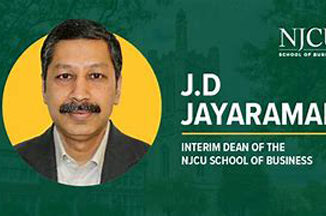
NEW JERSEY CITY (TIP): Indian American professor Jayadhurganandh “JD” Jayaraman, currently the chair of the Department of Finance at the School of Business at New Jersey City University, has been appointed the new interim dean of the school. Jayaraman, brings a wealth of academic and industry experience to his new role as the interim dean, the school stated announcing his appointment Friday. “His unique interdisciplinary background includes a PhD in finance from Oklahoma State University and additional graduate degrees in educational psychology and cognitive science from Columbia University.”
Welcoming Jayaraman, Donna Breault, the interim provost at NJCU, stated, “As our university continues to evolve and we realign our efforts with our revitalized mission and first-ever Academic Master Plan, we know that Dr. Jayaraman will provide exemplary leadership for a school that offers dynamic undergraduate and graduate programs that prepare our students for high-demand fields,”
“Throughout his academic career at NJCU, he has been a thoughtful and creative leader, and his diverse professional and academic experience will serve our students and faculty well.”
Jayaraman said he was grateful for the opportunity. “I am deeply honored to serve as the interim dean of the School of Business at NJCU,” he said. “My primary goal is to foster an enriching and inclusive environment that enhances the educational journey of our diverse student body. We will focus on empowering our students with the essential skills, global insights and practical experiences needed to thrive in today’s dynamic business landscape.”
As the chair of the Department of Finance, Jayaraman has been instrumental in creating innovative undergraduate and graduate programs in business analytics, data science and fintech, the school stated.
His research spans financial literacy, educational data mining, artificial intelligence for social good and the application of machine learning in finance, with numerous publications in peer-reviewed journals.
Before making the career transition to higher education and academia, Jayaraman gained over 20 years of experience in the financial services industry, primarily in the areas of algorithmic trading, risk management, energy markets and financial technology.
His experience includes executive leadership roles at Bloomberg LP, Citigroup, and several financial technology companies, where he specialized in risk management, quantitative modeling and financial trading technology. This blend of academic and practical expertise informs his approach to preparing students for the evolving business landscape, the school stated.
Jayaraman is committed to community engagement and service. He serves on the board for various nonprofit organizations. He has also served in leadership roles in professional organizations in New Jersey, it said.
CARY, NC (TIP): VitalEdge Technologies, a leading global provider of dealer management solutions, has appointed two Indian American executives, Mitesh Shah and Shriram Rajagopal as Chief Technology Officer (CTO) and Chief Product Officer (CPO) respectively. In the pivotal role of CTO, Shah will lead the company’s technology vision, driving innovation and ensuring the delivery of high-quality technological solutions in all aspects of software delivery, source code, architecture, and engineering output, according to a company release.
“With a deep focus on emerging technologies and client needs, Shah will spearhead efforts to enhance VitalEdge’s product offerings and guide our technical teams to deliver cutting-edge solutions, leveraging the latest technologies to propel the company through the next stages of its growth journey,” it said.
In the newly created position of CPO, Rajagopal will define and execute the company’s product vision and roadmap, the company stated.
“With over two decades of experience at VitalEdge, Rajagopal has been instrumental in driving the company’s technology strategy and achieving significant growth milestones,” it stated. “In his new role, he will establish a robust product management organization, focusing on delivering innovative, market-leading products that align with client needs and business goals.”
“We are thrilled to announce Mitesh Shah as the new Chief Technology Officer and Shriram Rajagopal as Chief Product Officer of VitalEdge,” said Jeffrey Hart, President & CEO. “Mitesh brings a proven track record of building and scaling world-class technology organizations, making him the perfect leader to drive our innovation goals forward. His vision and expertise will be critical in ensuring that our technology strategy aligns with our business objectives, enabling us to deliver world-class products that meet the evolving needs of our clients who serve critical industries including construction, agriculture, material handling, commercial transportation and more. We are excited to see the impact Mitesh will have in shaping the future of VitalEdge.”
The BAPS organization condemned the act, and is cooperating with law enforcement to address this hate crime
SACRAMENTO, CA (TIP): Less than 10 days after the desecration of BAPS Shri Swaminarayan Mandir in Melville, New York, a second temple, this time in Sacramento, California, was vandalized with hateful messages. The BAPS organization condemned the act, expressing deepened sadness but resolve.
A spokesman emphasized the temple’s integral role in the community, engaging in various activities and projects. BAPS is cooperating with law enforcement to address this hate crime.
In response, the community gathered for a prayer ceremony advocating peace, unity, and harmony, reflecting Mahant Swami Maharaj’s ideals. Local dignitaries, including California State Assembly Member Stephanie Nguyen and Mayor Bobbie Singh-Allen, attended, demonstrating solidarity.
Indian-American Congressman Ami Bera condemned the incident, urging people to reject intolerance.
“There is no place for religious bigotry and hatred in #SacramentoCounty. I strongly condemn this apparent act of vandalism in our community. All of us must stand against intolerance and ensure that everyone in our community, regardless of faith, feels safe and respected,” the Sacramento County representative said on X.
Shares with Guatemala’s lawmakers India’s vision and commitment to assist Guatemala on its developmental journey
GUATEMALA CITY (TIP): The Embassy of India in Guatemala organized a significant interaction with Congressmen from various parties of the Guatemalan Parliament on 25 September 2024, to share India’s vision and unwavering commitment to assist Guatemala on its developmental journey. The event received an overwhelming response, with over 100 Congressmen in attendance, reflecting their keen interest in India’s remarkable developmental progress. This platform also marked a celebration of the ten years of the Government of India’s Make in India initiative, which has achieved tremendous success in transforming India into a global manufacturing hub.
Embassy has been actively involved in promoting India’s investment and influence in the Central American region through various infrastructural initiatives. As a result of these concerted efforts, significant milestones have been achieved, expanding our reach beyond the local municipalities in Guatemala and El Salvador. In collaboration with Lakshmi Capital, a subsidiary of SRAM & MSRAM Group, the Embassy has initiated transformative projects aimed at advancing infrastructure development by Signing several MoUs and LOIs with Government of El Salvador, different municipalities of Guatemala including Xela and El Progress and business entities like Grupo Odepal and Association of City Bus Companies. In response to the requirement to involve Indian companies in procuring technology, materials, services, and products, Lakshmi Capital has facilitated several visits by these stakeholders to India including visit of Delhi Metro Rail Corporation (DMRC).
These infrastructural projects, coupled with the successful visits by delegations to India, exemplify India’s dedication to fostering economic development and improving infrastructure in Central America. The visible impact and successful implementation of these initiatives have drawn significant attention and admiration from various stakeholders throughout Guatemala. Witnessing the transformative effects of these projects, Mission has been constantly receiving interest from these Congressmen to know much more about these projects and India’s commitment to the region. They perceive India as a valuable partner with expertise in infrastructure development, technology transfer, and capacity building, capable of helping them address their developmental challenges and achieve long-term goals. In response to this growing interest from the Congressmen, the Embassy organized a business meet where lawmakers of the Guatemalan Parliament could interact with the Ambassador to exchange ideas and explore potential areas of collaboration. This event provided a valuable opportunity to advance India’s interests in the region and served as a platform for meaningful discussions, fostering collaboration. Furthermore, it bolstered India’s presence in the region and reaffirmed its commitment to bilateral cooperation and economic development.
Dr. Manoj Kumar Mohapatra highlighted ten years of Make in India which marks a journey of self-reliance, making India a synonym for competitiveness.Dr. Manoj Kumar Mohapatra.
Ambassador Dr. Manoj Kumar Mohapatra highlighted the significant strides made by India in infrastructure development, attributing this success to Prime Minister Modi’s vision of ‘Atmanirbhar Bharat’ (self-reliant India). He emphasized how India’s robust economic growth has positioned it as the fastest-growing economy globally, expanding India’s influence on regions where its presence was previously limited. This expansion underscores India’s commitment to Vasudhaiva Kutumbakam, the ancient Indian philosophy that translates to “the world is one family,” emphasizing the interconnectedness and united development of all nations. Dr. Mohapatra extended an invitation to all Congressmen to participate in this remarkable infrastructural growth story, emphasizing the inclusive nature of India’s development agenda. He reiterated India’s commitment to assisting in the infrastructural development of Guatemala, emphasizing the importance of strengthening ties and promoting shared values. Dr. Mohapatra highlighted spirit of Make in India igniting a wave of entrepreneurship and industrial growth that has revolutionized India’s global footprint. Ten years of Make in India shows the world that India is not just a market, but a producer, a creator, and a global economic force. India’s emphasized India’s Local Goes Global initiative celebrating the essence of our rich, diverse craftsmanship, empowering local artisans and industries to reach global markets, transforming tradition into global innovation and opportunity.”
Distinguished guests shared their views during the interaction.
Several Congressmen expressed their views commending India’s remarkable economic growth and impressive infrastructure development, acknowledging the strides made under Prime Minister Modi’s leadership. They underscored the positive impact of international partnerships and the role of India as a reliable partner in supporting the developmental aspirations of Guatemala. Mayor Fernando Lopez of Xela expressed shared his experience of his last visit to India and confidence in the capabilities of Indian companies to execute the five infrastructure projects planned for Xela. He highlighted the expertise and professionalism demonstrated by Indian firms, which he believed would contribute significantly to the development and modernization of his municipality.
During the event, Ambassador Dr. Manoj Kumar Mohapatra donated Diclofenac doses to Mayor Juan Fernando López of Xela, addressing the municipality’s healthcare needs. The event also witnessed felicitation to Dr. S.V. Anchan, Chairman, Safesea Group, a Global Shipping Company, for the development of infrastructure in Guatemala.
The event provided a valuable opportunity to engage with lawmakers from Guatemala and convey the Indian Government’s vision to support countries in the Global South. These interactions foster trust and strengthen the bond between India and Guatemala at the highest levels. The Government of Guatemala has consistently supported India’s initiatives, creating a conducive environment for Indian companies to thrive. Engaging with representatives from multiple political parties further deepens bilateral cooperation, paving the way for enhanced collaboration in areas of mutual interest, which will ultimately benefit both nations in their developmental goals.
(Based on a press release issued by Embassy of India in Guatemala)
GUATEMALA CITY (TIP): The Embassy of India in Guatemala celebrated Hindi Diwas 2024 by organizing a series of vibrant Hindi competitions, which garnered an overwhelming response from participants. The event saw enthusiastic participation from not only members of the Indian community but also local Guatemalans and friends of India, showcasing the growing appreciation for the Hindi language and culture. Throughout the month of September, various competitions were held, including poetry recitations, essay writing, and Hindi writing (Sulekh) contests, all aimed at promoting the richness and beauty of Hindi. These events provided a platform for participants to express their creativity and deepen their understanding of the language.
Hindi, an Indo-Aryan language, has its roots in the ancient languages of India, evolving through various stages influenced by Sanskrit, Prakrit, and regional dialects. Its development can be traced back to the 7th century, with significant contributions from literary figures and poets over the centuries. Recognizing the importance of Hindi as a means of communication and cultural expression, the Government of India accepted Hindi as one of the official languages of the country in the Constitution on September 14, 1949. This date is celebrated annually as Hindi Diwas, a day to honor the language and promote its usage across the nation. Hindi Diwas serves as a reminder of the linguistic diversity of India and the significance of Hindi in uniting people from various regions and backgrounds, fostering a sense of national identity and pride.
The Embassy has been instrumental in propagating and promoting Hindi through a variety of initiatives and events throughout the year in Central American region. By organizing numerous Hindi-related activities, such as competitions, workshops, and cultural programs, the embassy has fostered a deeper appreciation for the language among local communities, Indian diaspora, and friends of India. Each year, these events have witnessed a remarkable increase in participation, reflecting the growing enthusiasm for Hindi in the region. Additionally, the embassy encourages its staff to incorporate Hindi into their official communications, further enhancing the language’s visibility and relevance in diplomatic work.
This year, Hindi Diwas was celebrated with a series of engaging competitions, including essay writing, poem recitals, and Sulekh (Hindi writing). To accommodate participants amidst their busy schedules and the celebrations for Guatemala’s Independence Day occurring in the same month, the embassy decided to organize the competitions in three parts throughout September. On September 7th, the embassy hosted the Poem Recital and Sulekh competition, requiring participants to present their works in person at the chancery. For those unable to attend in person, an opportunity was provided to submit their essays via email, allowing participants from El Salvador and Honduras to join in the festivities, with September 14th set as the final submission date. Following the completion of all competitions, a prize distribution ceremony was held on September 24, 2024, attended by approximately 100 guests, including Congress members, local dignitaries, Indian community members, and friends of India.
Mr. KD Singh Gaur, a distinguished Hindi writer and scholar, was invited as the chief guest.
Mr. KD Singh Gaur, a distinguished Hindi writer and scholar, was invited as the chief guest at the prize distribution ceremony for the Hindi Diwas celebrations. His presence added immense value to the event, as he is renowned for his contributions to Hindi literature and his commitment to promoting the language on a global scale. During his inspiring speech, Mr. Gaur emphasized the significance of Hindi as not just a means of communication, but as a vital part of India’s rich cultural heritage. He encouraged the gathering to embrace the language, highlighting its beauty and relevance in today’s world. Mr. Gaur shared anecdotes from his own journey as a writer, illustrating the profound impact that Hindi has had on his life and the lives of many others. He called upon the younger generation to explore Hindi literature, engage in creative writing, and contribute to the language’s evolution in contemporary contexts.
Ambassador Dr. Manoj Kumar Mohapatra expressed his heartfelt gratitude to participants for their enthusiastic involvement in the Hindi Diwas celebrations.
During the prize distribution ceremony, Ambassador Dr. Manoj Kumar Mohapatra expressed heartfelt gratitude to all participants for their enthusiastic involvement in the Hindi Diwas celebrations. He acknowledged that the overwhelming response from the Indian community, local Guatemalans, and friends of India significantly contributed to the success of the event, enabling the embassy to expand its efforts on such a large scale. In his address, the ambassador highlighted how the collective enthusiasm and passion for Hindi had made this journey not only possible but also incredibly rewarding. Ambassador Mohapatra reassured the audience of the Government of India’s unwavering support and commitment to promoting Hindi both domestically and internationally. He spoke about various initiatives and programs that the Indian government has undertaken to propagate the language and strengthen cultural ties with countries across the globe.
Ambassador Dr. Manoj Kumar Mohapatra with winners of various Hindi competitions
The Embassy of India in Guatemala is firmly committed to promoting Hindi and celebrating its rich cultural heritage. It has successfully fostered a deeper understanding and appreciation of the language by engaging with local Guatemalans and diverse communities through various initiatives, events, and competitions. Additionally, the embassy has effectively encouraged the Indian diaspora to embrace Hindi, instilling a sense of pride in the language through direct engagement. As a result of these efforts, several local universities are now conducting lectures aimed at promoting the Hindi language. Looking ahead, the embassy will continue to organize more events and programs designed to inspire future generations to explore and cherish Hindi, ensuring that it remains a vibrant component of our shared identity and cultural dialogue.
(Based on a press release issued by the Embassy of India in Guatemala)
The 20th Dodge Poetry Festival, a collaboration of Geraldine R. Dodge Foundation (Dodge Foundation) and the New Jersey Performing Arts Center (NJPAC) brings the festival to its climax with a full line-up, October 17-19, 2024.
With its headquarters at NJPAC since 2010, the reimagined Festival will fill downtown Newark with poetry and music, as the culmination of the organizations’ year-long 2024 Dodge Poetry initiative. The lineup is a gathering of legends working in multiple poetic forms, whose words have touched hearts and made a powerful case for the need for social justice.
Over the course of 40 years, this event, the country’s largest poetry festival, has welcomed more than 150,000 people to readings, performances and more. The 2024 Festival will mix spoken word poetry with jazz, hip hop and R&B at readings, performances, outdoor events and more. All are designed to inspire a community mobilizing for racial and social justice, repair, and healing.
“The Dodge Foundation has a long legacy of creating opportunities for people to explore and engage with poetry. We are thrilled about the reimagined Dodge Poetry initiative with NJPAC, and this 20th Dodge Poetry Festival, and we look forward to expanding our ability to reach new places and people and highlight artists and activists who address issues of social justice,” says Preston D. Pinkett III, Board Chair of the Geraldine R. Dodge Foundation.
“We hope to shine a light on all the ways that poetry is, and has always been, a vehicle for making change, for promoting social justice, for bringing communities closer together by helping us see the world through someone else’s eyes,” says David Rodriguez, NJPAC’s Executive Vice President and Executive Producer.
Rodriguez continues, “At the same time, we’ve curated a series of performances for the 20th Dodge Poetry Festival at which spoken word poetry shares the stage with hip hop, jazz, R&B, and more. All these art forms complement each other and amplify each other’s impact. When you put them together under a spotlight, you get something much bigger than the sum of their parts.”
Festival highlights include:
Opening Day of the Festival — Thursday, October 17, is devoted in part to programs on artistic and professional development for poets and writers. Simultaneously, the Academy of American Poets [curators of Poem-a-Day – poets.org/poem-a-day] will present three panels on poetry’s ability to invite reflection and creative reawakening, featuring the Academy Chancellors, an honorary group of esteemed poets who advise the organization on artistic matters and serve as ambassadors of poetry at large.
That evening, the Newark-based spoken word poetry organization EvoluCulture [evoluculture.com) will host a free open mic and mixer in NICO Kitchen + Bar, the restaurant on NJPAC’s campus.
YOUNG ARTIST DAY (Photo : Courtesy njpac.org)
Friday, October 18 is ‘Young Artist Day,’ which attracts thousands of teens and chaperones from all over the United States for in-person encounters with acclaimed poets. Events on this day are also open to the public.
A community-driven celebration of poetry continues on Friday, October 18 and Saturday, October 19 featuring appearances by headlining writers including: poet, curator, educator, and organizer Mahogany L. Browne, the first-ever Lincoln Center poet-in-residence; National Book Critics Circle finalist Aracelis Girmay; Pulitzer Prize winner Tyehimba Jess; poet, essayist, and playwright Claudia Rankine, whose book ‘Citizen’ was named one of the 100 best books of the 21st century by the New York Times; poet, activist, author, and influential Black Arts Movement figure Sonia Sanchez; acclaimed poet, playwright, and translator Afaa Michael Weaver, and more.
Additional ticketed events on Saturday, October 19 include:
A conversation with iconic musician and activist Joan Baez about her first book of poetry, ’When You See My Mother, Ask Her to Dance’;
A musical performance from esteemed poet Nikki Giovanni with acclaimed tenor saxophonist Javon Jackson and eight-time Grammy Award winner and NJPAC and Newport Jazz Festival artistic advisor Christian McBride.
Saturday will also feature an afternoon-long free Family Fun Day @ Dodge Poetry in Newark’s Military Park, a first for the festival. The event will fill various corners of the park with poetry, music, face painting, drag performances, food trucks and more. Exceptional area poets will perform.
Poets who will participate in the festival this year include:
Afaa Michael Weaver; Alexis Green; Ameerah Shabazz-Bilal; Aracelis Girmay; Ariana Benson; attorious renee; Beatriz Martinez; Blas Falconer; Carlos Gomez; Carmen Calatyud; Charif Shanahan; Ching-In Chen; Cito Blank; Claudia Rankine; Cortney Lamar Charleston; Dante Micheaux; Diana Goetsch; Dianeley Antigua; Dimitri Reyes; Douglas Kearney; Dr. Craig Santos Perez; Dr. Helena D. Lewis; Eduardo Martinez-Leyva; Elliott Fant “P.O.M.E.”; Emanuel Xavier; Erin Marie Lynch; Esther Lin; Haydil Henriquez “Jaíi”; Imani Cezanne; Isabel Cruz; Issam Zineh; Italy Ja’rae Lee; J Rose; Janine Joseph; Jeri Rae; Jessica Nirvana Ram; John Murillo; Joshua Bennett; JP Howard; Kai Coggin; K. Desireé Milwood; Kathy Kremins; Kay Ulunday Barrett; Kazim Ali; Keisha-Gaye Anderson; Kween Moore; Mahogany L Browne; “King” Mariah Ayscue; Marwa Helal; Megha Sood; Myles Taylor; Nancy Mercado; Naomi Ortiz; Nicole Sealey; Niki Herd; Omotara James; Paul Con Queso; paulA neves; Positive Gunter; Purvi Shah; Raina Leon; Remica Bingham-Risher; Roque Raquel Salas Rivera; Scarlet Gomez; Sean Battle; Sonia Sanchez; Rescue Poetix; Talena Lachelle Queen; Taylor Johnson; Tehsaun Glover “Starski”; Todd Davis; torrin a greathouse; Tyehimba Jess and Vincent Toro.
For the first time this season, Dodge Poetry developed an external selection committee, which reviewed more than 350 applications and selected both emerging and mid-career poets to appear at the festival. The selection committee included:
Jubi Arriola-Headley, author of two collections of poetry and a 2024 Dodge Poetry Festival poet whose work has received support from Yaddo, Millay Arts, Lambda Literary, the Virginia Center for the Creative Arts, and the Atlantic Center for the Arts;
Kyle Dargan, who was long-listed for the Pulitzer Prize and is a professor of Creative Communication at American University and the head of the stories division for Janelle Monáe’s creative company, Wondaland, as well as a Dodge Poetry Festival poet in 2010 and again in 2020;
Iain Haley Pollock, author of three poetry collections, Director of the MFA Program at Manhattanville College, and a 2024 Dodge Poetry Festival poet;
Sakina Hofler, lecturer at the Princeton Writing Program at Princeton University and a 2024 Dodge Poetry Festival poet;
Yesenia Montilla, the author of two collections and a NAACP Image Award nominee, and a 2016 Dodge Poetry Festival poet.
TICKETING
1-day and 3-day Festival Passes are available. Festival Passes do not include special ticketed events that require separate tickets.
For Tickets, visit NJPAC.org or the NJPAC Box Office or call 888.GO.NJPAC (888.466.5722).
PROGRAMMING SCHEDULE and DESCRIPTIONS
Nikki Giovanni, Javon Jackson and Christian McBride
NIKKI GIOVANNI, JAVON JACKSON & CHRISTIAN MCBRIDE (Photo : Courtesy njpac.org)
Saturday, October 19 @ 2pm
NJPAC’S Victoria Theater
In this performance, the poems of Nikki Giovanni are paired with new takes on traditional spirituals. Tenor saxophonist Javon Jackson, one of Art Blakey’s Jazz Messengers, is joined by his excellent combo alongside NJPAC Jazz Advisor and bassist Christian McBride, a 16-time Grammy nominee and eight-time winner. The esteemed writer and civil rights activist sews her poetry into this musical quilt.
Joan Baez: An Evening of Poetry and Conversation
JOAN BAEZ (Photo : Courtesy njpac.org)
Saturday, October 19 @ 8pm
NJPAC’s Victoria Theater
Singer, songwriter, and activist comes to NJPAC’s stage in a new role: published poet. Though she’s written poetry for many years, she hasn’t shared it publicly until the release of her 2024 collection, ‘When You See My Mother, Ask Her to Dance.’ In this intimate conversation, Baez will share personal poems about childhood, family, and musical contemporaries like Bob Dylan, Leonard Cohen, and Jimi Hendrix, and their link to social change beginning in the 1960s. It’s a glimpse into the deep inner life of a cultural icon.
Family Fun Day @ Dodge Poetry
Saturday, October 19, 2024
11AM – 4PM
Military Park
Free
Express yourself at Dodge Poetry Festival’s Family Fun Day! Bring the kids to Military Park for free, family-friendly poetry performances. Experiment with writing your own poems and explore the joyful, liberating power of language. Sing and dance along with our DJ. Enjoy drag storytelling, face painting and all-ages activities. (If you work up an appetite, grab a bite at the nearby food trucks.) All are welcome at this festive community celebration of self-expression.
The Geraldine R. Dodge Foundation
Established in 1974, the Geraldine R. Dodge Foundation envisions a just and equitable New Jersey where people of all races and communities have equitable access to opportunities to thrive. Over its 50-year history, the Dodge Foundation has distributed more than $500 million in grants and technical support to New Jersey nonprofits. Today, building on decades of learning, the organization focuses its support on those who are directly addressing the root causes and repair of structural racism and inequity to transform lives in New Jersey. Learn more at grdodge.org.
The New Jersey Performing Arts Center (NJPAC)
NJPAC located in downtown Newark, New Jersey, is among the largest performing arts centers in the United States. It is the artistic, cultural, educational and civic center of New Jersey — where great performances and events enhance and transform lives every day. As New Jersey’s anchor cultural institution, NJPAC brings diverse communities together, providing access to all and showcasing the State’s and the world’s best artists, while acting as a leading catalyst in the revitalization of its home city. Through its extensive Arts Education programs, NJPAC is shaping the next generation of artists and arts enthusiasts. NJPAC has attracted more than 11 million visitors (including more than two million children) since opening its doors in 1997 and nurtures meaningful and lasting relationships with each of its constituents. Visit NJPAC.org or call 888.GO.NJPAC (888.466.5722) for more information.
Follow NJPAC Online:
Website: njpac.org
Twitter: @NJPAC
Instagram: @NJPAC
Hashtag: #NJPAC
Facebook: facebook.com/NJPAC
YouTube: NJPACtv
Follow NJPAC’s Standing in Solidarity Series Online:
Website: njpac.org/takeastand
Hashtag: #NJPACTakeAStand
Youtube: Standing in Solidarity playlist
(Mabel Pais writes on Social Issues, The Arts and Entertainment, Spirituality, Cuisine, Health & Wellness, Business, and Education)
Signup to our Newsletter!
Don’t miss out on all the happenings around the world