Month: January 2025

  • Suozzi Introduces Resolution Celebrating the American-Korean Alliance

    Suozzi Introduces Resolution Celebrating the American-Korean Alliance

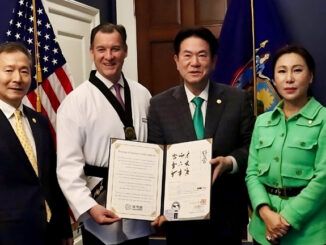
    Suozzi also Presented Honorary 7th Degree Taekwondo Black Belt For Long Time Support of the Korean American Community

    WASHINGTON, D.C. (TIP): Congressman Tom Suozzi (D-NY), on January 23, introduced a resolution celebrating the alliance between the United States and South Korea. Suozzi was also presented with an honorary seventh-degree Taekwondo black belt by Grandmaster Dr. Lee Dong-sup, President of Kukkiwon, the governing body of Taekwondo, due to his long-standing support for the Korean American community. This year marks the 80th anniversary of South Korea’s liberation from colonial rule.
    “Over the past 122 years, Korean Americans have made invaluable contributions to our communities and the culture we share,” said Suozzi. “I cherish the friendships I’ve developed within this vibrant community and encourage everyone to recognize and celebrate the rich heritage and achievements of Korean Americans.”
    “I am very pleased and honored to participate in the resolution introduced by Representative Tom Suozzi in US Congress today, the 23rd of January 2025, to proclaim Korean Culture Day in commemoration of the 80th anniversary of the independence of the Republic of Korea, to reaffirm the strength of the ROK-U.S. alliance, and to express gratitude for the dedication of Korean Americans who have contributed to the development of the United States with their diligence, perseverance, and tenacity over the past 122 years,” said Minsun Kim, President of the Museum of Korean American Heritage.
    This resolution affirms the alliance between the United States and the Republic of Korea based on principles of democracy and human rights.
    “Although I have not trained in Taekwondo, I am interested in learning, and I am deeply humbled to receive this honorary black belt,” said Suozzi. “My strong ties to the Korean communities on Long Island and in Queens reflect the deep friendship we share, making this recognition truly meaningful.”

  • Trump says he wants to send ‘repeat offenders’ in U.S. legally to foreign countries

    Trump says he wants to send ‘repeat offenders’ in U.S. legally to foreign countries

    DORAL, Fla (TIP): President Donald Trump said Monday, January 27, that he doesn’t just want to deport undocumented immigrants with criminal convictions, but also hopes to remove violent, repeat offenders — in the United States legally — from the country. President Donald Trump said his administration is “fighting hard” to restrict birthright citizenship, which he rebranded “automatic citizenship for the children of illegal aliens.” He falsely said no other countries had birthright citizenship (it’s common throughout North and South America) and mischaracterized the provision’s history as part of the 14th Amendment, which guaranteed citizenship to all freed people. “It was really meant for children of slaves,” he said incorrectly. “It was not meant for everyone to come into our country by airplane or charging across the borders from all over the world and think they’re going to become citizens.”

  • US Congress will pass sanctions against countries who don’t cooperate on deportation: House Speaker

    US Congress will pass sanctions against countries who don’t cooperate on deportation: House Speaker

    WASHINGTON, D.C. (TIP): The US Congress is ready to pass sanctions on countries which refuse to cooperate with the Trump administration’s order on deportation of undocumented immigrants, House of Representatives Speaker Mike Johnson has warned. Soon after taking over, the Trump administration started massive mass deportation. Raids are being reported from across the country. Colombia and all nations should be on notice – Congress is fully prepared to pass sanctions and other measures against those that do not fully cooperate or follow through on requirements to accept their citizens who are illegally in the United States, Johnson said.

    “President Trump is putting America first, just like he said he would. And Congress will implement policies that reinforce his agenda, he said.

    Johnson came out in support of Trump’s decision to impose tariffs on Colombia after its President Gustavo Petro turned away two US military aircraft full of detained Colombian migrants.

    The White House later on Sunday night that Colombia has agreed to the unrestricted acceptance of immigrants who entered the US illegally from Colombia and that President Donald Trump will not levy a 25 per cent tariff on the country unless Colombia fails to honour this agreement.

    In a joint statement, two influential Democratic Senators Dick Durbin, Ranking Member of the Senate Judiciary Committee, and Tammy Duckworth said these mass deportations have the potential to sweep up Dreamers who came to the United States as children, veterans who have served our nation and essential workers who care for American family members, build homes and ensure that they have food on the tables.

    Instead, we should focus on deporting those who pose a danger to our country. And we should give the rest a chance to earn legal status. They would have to register with the government, pay their dues, and submit to background checks, the two Senators said.

    Over the last few days, Chicago has seen a series of raids. The Trump Administration has approved the use of military aircraft to enforce his immigration policy.

    Congressman John Garamendi described it as deeply alarming.

    Last week, External Affairs Minister S Jaishankar said that India would be cooperating with the US in taking back undocumented Indians.

  • North American Punjabi Association (NAPA) Expresses Concern Over DHS Raids on Gurdwaras in New York and New Jersey

    North American Punjabi Association (NAPA) Expresses Concern Over DHS Raids on Gurdwaras in New York and New Jersey

    MILPITAS, CA (TIP): The North American Punjabi Association (NAPA), under the leadership of Executive Director Satnam Singh Chahal, has expressed strong concerns over recent actions by U.S. Department of Homeland Security (DHS) officials, including Immigration and Customs Enforcement (ICE), who have reportedly conducted visits to Gurdwaras in New York and New Jersey to search for undocumented immigrants.

    “These actions are deeply troubling and have hurt the religious sentiments of the Sikh community,” said Satnam Singh Chahal. “Gurdwaras are sacred places of worship dedicated to God and community service, not places to hide illegal immigrants. Raids in these spaces undermine their sanctity and create an atmosphere of fear and distrust.”

    The Sikh community has strongly condemned this approach, viewing it as a threat to the sanctity of their faith. Gurdwaras are not only places of prayer but also centers for community support, offering free meals (langar) and assistance to all individuals, regardless of their background.

    NAPA is calling on the Trump administration and the Department of Homeland Security to refrain from conducting such enforcement actions at Gurdwaras in the future. “The Sikh community is an integral part of American society, contributing significantly to the nation’s economic, cultural, and social development,” Chahal emphasized. “Actions like these risk alienating a community that has always been dedicated to upholding the values of inclusivity, hard work, and unity.”

    NAPA urges DHS to adopt an alternative approach that respects religious freedom and fosters trust within communities. Instead of targeting places of worship, the organization recommends engaging in dialogue with Sikh community leaders to ensure mutual understanding and collaboration.

    “As Americans, we must uphold the principles of religious freedom and respect for all faiths. We hope the administration will reconsider its approach to immigration enforcement and avoid actions that harm the sentiments of any religious group,” Chahal concluded.

    For further information, please contact:
    North American Punjabi Association (NAPA) / Satnam Chahal 5732: 408-221-5732

  • Queens Assemblymember Jenifer Rajkumar Enters Race for Public Advocate

    Queens Assemblymember Jenifer Rajkumar Enters Race for Public Advocate

    • Civil Rights Attorney to Challenge Democratic Socialist Jumaane Williams;
    • Will Make History as NYC’s 1st Indian-American Citywide Elected Official

    QUEENS, NY (TIP): Queens Assemblymember and Civil Rights Attorney Jenifer Rajkumar (D-38) is officially entering the race for New York City Public Advocate. After meeting with thousands of residents across all five boroughs, one thing is abundantly clear: New Yorkers are sick and tired of their elected leaders behaving like extreme activists and ignoring the kitchen table issues we all care about. As such, Assemblymember Jenifer Rajkumar is prepared to bring her record of accomplishment and decades of fighting for her neighbors to the office of Public Advocate. From cracking down on dangerous and illegal smoke shops to her work combating hate and discrimination, Assemblymember Rajkumar will be the advocate our city deserves and needs.

    “I am stepping up to be the Public Advocate for the City I love” said Rajkumar. “Our City is facing a crisis of governance and can no longer afford the out-of-touch agenda of extremists like Jumaane Williams. Instead, we need proven fighters who will focus on the issues that all New Yorkers care about. From attacking the cost-of-living crisis to restoring public safety on our streets and on our subways, I’m excited to bring bold, results-driven leadership to our City.”

    With just under 150 days until the Democratic Primary, Assemblymember Rajkumar enters the race in an extremely strong position. With over 4 times as much cash-on-hand as the incumbent Public Advocate Jumaane Williams, Assemblymember Rajkumar is already expected to qualify for over $1,000,000 in public matching funds.

    A Stanford Law graduate and civil rights attorney, Rajkumar has built an impressive legislative record, from passing the SMOKEOUT Act that closed thousands of illegal smoke shops across the state to her nationally recognized legislative win granting domestic workers human rights, to her recently introduced comprehension 20 page bill to solve New York’s mental health crisis, The Empire State of Mind Act. Assemblymember Rajkumar is bringing unprecedented resources, accomplishment, and vision to the Democratic Primary for New York City Public Advocate.

  • ITEC DAY 2024 CELEBRATIONS IN GUATEMALA, HONDURAS AND EL SALVADOR

    ITEC DAY 2024 CELEBRATIONS IN GUATEMALA, HONDURAS AND EL SALVADOR

    GUATEMALA CITY (TIP): The Embassy of India in Guatemala City, concurrently accredited to Honduras and El Salvador, celebrated ITEC Day 2024 with its alumni across these countries. To ensure maximum participation, the Embassy organized three separate events: in Guatemala City on 28 November 2024, in Tegucigalpa, Honduras, on 3 December 2024, and in San Salvador, El Salvador, on 10 January 2025. This initiative aimed to acknowledge the growing popularity of ITEC courses in the region and to promote their benefits to a wider audience, including alumni, government officials, and key dignitaries.

    ITEC courses have garnered significant appreciation in Central America for their role in capacity building, technical expertise, and fostering development partnerships. Since introduction of ITEC courses in the region in 2015, a total of 393 trainees from Guatemala (183), Honduras (122), and El Salvador (88) have so far participated in these programs. These courses have equipped participants with practical skills and technical knowledge that contribute directly to the socio-economic progress of their countries.

    Celebrating ITEC Day in these countries provided an invaluable platform for alumni to share their experiences, connect with peers, and explore potential collaborations. These events fostered a strong sense of community among ITEC alumni, showcasing the program’s tangible benefits and encouraging greater participation from diverse sectors. Furthermore, the celebrations reinforced bilateral ties between India and the host countries by demonstrating India’s commitment to capacity building and development cooperation. The events featured keynote speeches, alumni testimonials, presentations on ITEC opportunities, and networking sessions, attended by prominent dignitaries and stakeholders. Cultural segments and exhibitions highlighting ITEC success stories further enriched the program. Through these initiatives, the Embassy aimed to enhance India’s engagement with Central America, cultivate new partnerships, and position India as a trusted partner in skill development and education.

    Ambassador Dr. Manoj Kumar Mohapatra interacting with ITEC alumni in Guatemala City

    Ambassador Manoj Kumar Mohapatra engaged with the alumni in Guatemala City on 28 November 2024. He expressed his gratitude for their continued support in strengthening India-Guatemala relations and emphasized the transformative impact of the ITEC program. He underscored its role in empowering individuals and fostering stronger bilateral ties between India and Guatemala. During his address, the Ambassador encouraged the alumni to act as bridges of collaboration and friendship, further deepening the partnership between the two countries. The event featured keynote speeches, alumni testimonials, and discussions on ITEC opportunities, offering insights into how the program continues to shape careers and strengthen diplomatic relations. The celebration also included cultural presentations and exhibitions, showcasing the diverse experiences of Guatemalan professionals who have benefited from training in India. The event not only reinforced the impact of the ITEC initiative but also strengthened India’s commitment to capacity-building and development cooperation in the region.

    Ambassador Dr. Manoj Kumar Mohapatra interacting with ITEC alumni in Tegucigalpa, Honduras

    During the event in Tegucigalpa, Honduras on 3 December 2024, Ambassador Dr. Manoj Kumar Mohapatra engaged with ITEC alumni from Honduras, highlighting India’s leadership in global capacity-building initiatives and its commitment to fostering international partnerships. The event was graced by the esteemed presence of Health Minister H.E. Carla Reyes of Ministry of Health of Honduras, who underscored the value of India’s ITEC program in enhancing skills and expertise in vital sectors. The gathering included ITEC alumni from her Ministry, who shared their experiences and insights on how the training programs in India have positively impacted their professional growth and contributed to institutional development. This interaction not only celebrated the success stories of the alumni but also reinforced the strong bilateral ties between India and Honduras.

    During the event in San Salvador, El Salvador on 10 January 2025, Ambassador Dr. Manoj Kumar Mohapatra had the opportunity to engage with ITEC alumni from El Salvador, fostering a spirit of camaraderie and mutual appreciation. Ambassador highlighted the transformative impact of ITEC programs, which have provided professionals from El Salvador and across the globe with advanced training in diverse fields such as information technology, management, healthcare, and renewable energy. He pointed out that these programs are not only enhancing the skills and expertise of participants but also fostering knowledge-sharing and cross-cultural exchanges, contributing to sustainable development in partner countries. The interaction served as a platform to showcase India’s dedication to creating a more equitable and inclusive world through education, training, and technical collaboration, while reaffirming the importance of shared growth and cooperation in addressing global challenges.

    Ambassador Dr. Manoj Kumar Mohapatra interacting with ITEC alumni in El Salvador, El Salvador

    ITEC program plays a crucial role in fostering capacity building and human resource development in partner countries. By offering specialized training across diverse fields such as information technology, management, healthcare, and engineering, ITEC equips professionals with essential skills that contribute to their national development. Through this initiative, India strengthens its global presence as a reliable partner in knowledge sharing and sustainable growth. The Embassy remains committed to expanding ITEC’s outreach, ensuring that more professionals from Guatemala, Honduras, and El Salvador can benefit from these opportunities. Moving forward, the Embassy aims to introduce ITEC to a wider audience by engaging with government institutions, academia, and the private sector, further deepening India’s collaboration with the region.

    (Based on a press release issued by Ramesh Khulbey)

  • 2025 tax filing season starts as IRS begins accepting tax returns

    2025 tax filing season starts as IRS begins accepting tax returns

    Taxpayers have many options for help

    WASHINGTON, D.C. (TIP): The Internal Revenue Service opened the 2025 tax filing season today and is accepting and processing federal individual tax year 2024 returns.

    During today’s early morning opening, IRS systems have already received millions of tax returns from across the nation for processing.

    The IRS expects more than 140 million individual tax returns for tax year 2024 to be filed ahead of the Tuesday, April 15 federal deadline. More than half of all tax returns are expected to be filed this year with the help of a tax professional, and the IRS urges people to use a trusted tax pro to avoid potential scams and schemes.

    Taxpayers residing in a federally declared disaster area may have additional time to file and pay federal taxes.

    Get free help preparing and filing taxes electronically

    Taxpayers can visit IRS.gov to get answers to tax questions. IRS.gov is the quickest way for taxpayers to get help. The Interactive Tax Assistant (ITA) is a tool that provides answers to several tax law questions specific to individual circumstances. Based on input, it can determine a taxpayer’s filing status, if a person should file a tax return, if someone can be claimed as a dependent, if a type of income is taxable, if a filer is eligible to claim a credit or if an expense can be deducted.

    The IRS encourages people to file their tax returns electronically and choose direct deposit for more secure and faster refunds. According to Treasury’s Bureau of the Fiscal Service, paper refund checks are 16 times more likely to have an issue, like the check being lost, misdirected, stolen or uncashed. Filing electronically reduces tax return errors as the tax software does the calculations, flags common errors and prompts taxpayers for missing information.

    Free tax filing options

    The IRS offers free online and in-person tax preparation options for eligible taxpayers through IRS Free File, IRS Direct File and Volunteer Income Tax Assistance and Tax Counseling for the Elderly programs.

    IRS Free File. Taxpayers with income of $84,000 or less last year can use IRS Free File Guided Tax Software now through Oct. 15. IRS Free File Fillable forms, a part of this program, is available at no cost to any income level and provides electronic forms that people fill out and e-file themselves, also at no cost.

    Direct File. Now open in 25 participating states, taxpayers can use Direct File to file online directly with the IRS for free. It is a free web-based service – available in English and Spanish – that works on mobile phones, laptops, tablets or desktop computers. It guides taxpayers through a series of questions to prepare their federal tax return step-by-step. Direct File automatically guides taxpayers to state tools to complete their state taxes. Get help from IRS customer service representatives through a live chat feature in English and Spanish. Interested taxpayers can go to directfile.irs.gov, where they can determine if they are eligible.

    Volunteer Income Tax Assistance (VITA). The VITA program offers free tax help to people who generally make $67,000 or less, persons with disabilities and taxpayers whose preferred language is not English. IRS-certified volunteers provide free basic income tax return preparation with electronic filing to qualified individuals.

    In addition to VITA, the Tax Counseling for the Elderly (TCE) program offers free tax help for all taxpayers, particularly those who are 60 and older, specializing in questions about pensions and retirement-related issues unique to seniors.

    MilTax. This is a Department of Defense program available to members of the military and some veterans with no income limit. MilTax generally offers free return preparation and electronic filing software for federal income tax returns and up to three state income tax returns.

    Most refunds issued in less than 21 days: EITC refunds for many available by March 3

    The easiest way to check a refund’s status is by using “Where’s My Refund?” on IRS.gov or the IRS2Go app.

    Many factors can affect refund timing after the IRS receives a tax return. Although the IRS issues most refunds in less than 21 days, the IRS cautions taxpayers not to rely on receiving a refund by a certain date, especially when making major purchases or paying bills. Some returns may require additional review and may take longer.

    Under the federal Protecting Americans from Tax Hikes (PATH) Act, the IRS cannot issue Earned Income Tax Credit (EITC) and Additional Child Tax Credit (ACTC) refunds before mid-February. “Where’s My Refund?” should show an updated status by February 22 for most early EITC/ACTC filers. The IRS expects most EITC/ACTC related refunds to be available in taxpayer bank accounts or on debit cards by March 3 if they chose direct deposit and there are no other issues with their tax return.

    Report taxable income; don’t file before receiving key documents

    People should report all taxable income on their tax return and wait to file until they receive all of their income and informational documents. Taxpayers may receive various income and information statements such as Forms 1099 from banks or other payers, unemployment compensation, dividends, pensions, annuities or retirement plan distributions. Taxpayers receiving Forms 1099-K, for payments on sale of goods and services through an online marketplace or payment app, can visit What to do with Form 1099-K to help them figure and report the correct amount of income on their tax return.

    Choose a trusted tax professional
    More than half of taxpayers turn to a tax professional for help filing a tax return. While most tax preparers deliver exceptional and professional service, selecting the wrong preparer can lead to financial harm.

    Taxpayers should review the tips for choosing a tax preparer and learn how to avoid unethical “ghost” return preparers who don’t sign or include a valid preparer tax identification number (PTIN) on every tax return they prepare. Taxpayers can also use the IRS Directory of Federal Tax Return Preparers with Credentials and Select Qualifications to find trusted professionals. The IRS also reminds taxpayers that choosing someone affiliated with a recognized national tax association is always a good option. Tax professionals accepted into the IRS electronic filing program are authorized IRS e-file providers, qualified to prepare, transmit and process electronically filed tax returns.

    Be aware of tax scams

    Be aware of scammers, who can become more active during tax season. They will attempt to mislead people about tax refunds, credits and payments. They pressure people for personal, financial, employment information or money.

    Watch out for:

    A big payday. If it sounds too good to be true, it probably is. Bad tax advice on social media may convince people to lie on tax forms or mislead them about credits they can claim.
    Demands or threats. Impersonators want people to pay “now or else.” They threaten arrest or deportation. They don’t let people question or appeal the amount of tax they owe.
    Odd or misspelled website links. Odd or misspelled web links can take people to harmful sites instead of IRS.gov.
    Tax-related identity theft occurs when someone uses stolen personal information, including Social Security numbers, to file a tax return claiming a fraudulent refund. If a person suspects they are a victim of identity theft, they should continue to pay their taxes and file their tax return, even if they must file a paper return. Visit Identity Theft Central to find out more.

    Know the signs of identity theft

    Thousands of people have lost millions of dollars and their personal information to tax scams. Scammers use regular mail, telephone and email to set up individuals, businesses, payroll and tax professionals. Check out the latest consumer alerts and read more about the most recent tax related scams identified by the IRS.

    More help is now available

    The IRS also provides taxpayers help in-person at Taxpayer Assistance Centers nationwide.

    Some improvements taxpayers will see during the 2025 filing season are:

    IRS Individual Online Account. The IRS continues to add more functionality to this important tool. Individuals can create or access their IRS Online Account at Online account for individuals. With an IRS Online Account, people can:

    View key details from their most recent tax return, such as adjusted gross income.
    Request an Identity Protection PIN.
    Get account transcripts, to include wage and income records.
    Sign tax forms like powers of attorney or tax information authorizations.
    View and edit language preferences and alternative media. Receive and view over 200 IRS electronic notices. View, make and cancel payments.
    Set up or change payment plans and check their balance.

    New scam alert. To help protect taxpayers against emerging threats, there’s a new banner on the Online Account homepage that alerts taxpayers of potential scams and schemes, along with a link to their Digital Notices and Letters page to view correspondence sent to them from the IRS. The feature helps to educate taxpayers on common scams and fraudulent efforts to steal taxpayer information and provide taxpayers with more ability to validate the legitimacy of IRS communications.

    Redesigned notices. The IRS successfully redesigned 284 notices in 2024, exceeding the agency’s 200 notice goal. It is important to note that 200 notices were redesigned and deployed in 2024 and an additional 84 redesigned notices are in line to be deployed in 2025. All notices will be added to Individual Online Account so taxpayers receiving a specific letter can see it.

    Mobile-adaptive tax forms. Taxpayers can now access 67 forms on cell phones and tablets. The most recent forms feature “save and draft” capabilities, which allow the taxpayer to start a form, save it and return to it later. The addition of save and draft allows for future capabilities, including the ability for multiple spouses to sign a form.

    Virtual assistants to help with refunds and other questions. Whether a taxpayer uses an online tool or calls the IRS, they will experience upgraded help features. During filing season 2025, the IRS will offer voicebot services to all taxpayers calling the IRS for refund information. The voicebot is available in English and Spanish and has helped thousands of callers without the need to wait for the next available representative. Taxpayers will have to authenticate their identity to gain access to their refund information by providing select information from their tax return.

    Last year the IRS began using online chatbots for various functions. These chatbots use either guided help through choice buttons or an open text box for a customized question. The chatbots use natural language processing and understanding to interpret the input from the taxpayer to provide an appropriate response. To launch the chatbot, the taxpayer simply clicks on the “Chat” button in the lower right corner of the webpage. Currently taxpayers can use chatbots from eight webpages.

    (Press Release)

  • Celebrating Democracy Amid Challenges: On India’s 76th Republic Day

    By Prof. Indrajit S Saluja
    By Prof. Indrajit S Saluja

    India’s 76th Republic Day celebrations are a poignant reminder of the country’s remarkable achievement in sustaining its democracy, despite numerous challenges. As the world’s largest democracy, India stands tall in a global landscape where many neighboring nations and others around the world grapple with political instability, oligarchic governance, and even authoritarian regimes. India’s ability to maintain a democratic republic, despite the external and internal pressures it faces, is an achievement that deserves celebration. However, this celebration must be tempered by an honest reflection of the struggles that continue to threaten its democratic fabric.

    India’s 76th Republic Day comes at a time when the country’s constitutional rights—long cherished and fought for—are once again under threat. These threats, although not new, have intensified in recent years, particularly with regard to freedom of expression, the suppression of dissent, and the increasing influence of the government over the media. Despite these challenges, India remains a beacon of hope and a symbol of democracy on the global stage. However, the ongoing threats, both to its democratic principles and the well-being of its citizens, require urgent attention.

    The Indian Republic, founded on the ideals enshrined in its Constitution, has shown remarkable resilience, weathering numerous challenges over the years. The Constitution, which came into effect on January 26, 1950, was designed to ensure a just, inclusive, and secular republic. India adopted a parliamentary system of government and instituted fundamental rights for its citizens, promising justice, equality, and freedom for all. Despite facing challenges such as economic disparities, social unrest, and regional conflicts, India has managed to uphold its democratic ideals.

    However, there have been periods when the rights of citizens have been compromised. Notably, the Emergency period of 1975-1977, when fundamental rights were suspended, remains a dark chapter in India’s democratic history. In the decades since, constitutional rights have occasionally been under threat, and the current situation, in which the freedom of expression is endangered, suggests that the country still faces significant challenges in fully realizing its democratic potential. In recent years, this fundamental right has come under growing pressure. The government has been accused of using various means to suppress dissent, silence critics, and control the media narrative.

    The increasing control over the media has become a significant concern. Once considered a fearless institution that held power to account, the Indian media has gradually fallen under the influence of the ruling powers. Many media outlets have been accused of being compromised, whether through political pressures, economic incentives, or direct influence from the government. The result is a shrinking space for independent journalism and critical voices, which are essential to a functioning democracy.

    Furthermore, journalists and activists who speak out against the government have faced intimidation, legal harassment, and even violence. The decline in press freedom has been noted by international watchdogs, with organizations like Reporters Without Borders and Freedom House highlighting India’s deteriorating media environment.

    While it is important to acknowledge that not all is lost, and many independent journalists and media outlets continue to operate with integrity, the reality is that the threat to freedom of expression in India is very real and growing. If this trend continues, it could have long-term consequences for the health of the Indian democracy.

    Another major challenge India faces today is the growing inequality in wealth and opportunity. Although India is often celebrated for its impressive economic growth, with projections of becoming a $5 trillion economy in the near future, this growth has not been evenly distributed. The wealth divide is staggering: less than 10% of India’s population controls more than 70% of the country’s wealth, leaving the vast majority of the population struggling to access even basic resources.

    The rise of extreme inequality is a major concern, as it undermines the democratic principle of equal opportunity. While a small percentage of the population has prospered, the rest of the nation remains mired in poverty. Over 20% of Indians still live below the poverty line, and more than 50% of the population faces deprivation in terms of education, healthcare, and other essential services. This economic disparity is particularly visible in rural areas, where a large portion of India’s population resides.

    The gap between the rich and the poor is not just economic but also social. Education, healthcare, and employment opportunities are often distributed unevenly, based on factors such as caste, religion, and region. Despite the government’s efforts to implement welfare schemes and poverty alleviation programs, the scale of the problem is so vast that progress has been slow.

    India’s rise as a global economic power is undeniable, but the persistence of extreme poverty and inequality is an issue that cannot be ignored. Economic growth should benefit all sections of society, and it is crucial that the government address these disparities to ensure that the fruits of growth are shared more equitably.

    India’s aspirations to become a developed nation by 2047—the centenary of its independence—are ambitious. Prime Minister Narendra Modi has frequently spoken about transforming India into a global economic powerhouse, with the aim of making it the third-largest economy in the world, after the United States and China. While this is a laudable goal, it raises an important question: Can India truly be considered a developed nation when more than half of its population lives in poverty?

    India’s development trajectory must prioritize inclusive growth, which means ensuring that economic development benefits the most marginalized sections of society. It is difficult to imagine India becoming a fully developed nation while such a large portion of the population remains impoverished. Sustainable development must focus on eradicating poverty, reducing inequality, and improving access to basic services for all citizens, irrespective of their economic, social, or religious background.

    Despite these significant challenges, India has made tremendous progress in various fields. Indian scientists, engineers, and professionals have contributed to advancements in space exploration, technology, healthcare, and more. The nation has earned respect on the global stage for its achievements in these areas.

    However, true progress cannot be measured by economic or technological achievements alone. A nation’s greatness is also determined by the well-being of its people and the strength of its social fabric. India’s future greatness will depend on the ability of its leaders to create a society where all citizens, regardless of their background, have the opportunity to prosper.

    Furthermore, ensuring peaceful and harmonious relations among the diverse religious and social groups in the country is crucial. India’s pluralistic society is one of its greatest strengths, but it must be protected from divisive forces that seek to undermine this unity. It is the duty of the rulers to provide conditions for peace, justice, and equality. If the government fails to do so, the very democratic structure that India holds dear will be at risk of crumbling.

    Let this Republic Day be a reminder of the need for India’s rulers to pledge themselves to the democratic ideals enshrined in the Constitution—not for the propagation of any one ideology or faith, but for the advancement of the nation as a whole. Only then can India truly fulfill its promise as a vibrant, democratic republic.

  • Trump rewrites US ties with Russia & China

    Trump rewrites US ties with Russia & China

    Using India as a balance to keep China in its place suits President Trump, just now. India, in turn, still needs US cooperation.

    “The US-China relationship has, however, been heading for hard times, arising from the substantial mutual distrust and dislike between the leaders of the two powers. The restoration of trust and cooperation would take time, especially as the tone of the Trump rhetoric would have shocked people in the ‘Middle Kingdom’. But Trump can always use the good offices of Elon Musk to address differences with China, given the vast relationship and vested interests that Musk shares with the ‘Middle Kingdom’. Already, there is speculation that China is considering a plan for Elon Musk to acquire TikTok’s US business. Indians who find occasion to deal with Musk must bear this in mind.”

    Biswarup Ganguly

    At his end-of-the-year news conference in December 2024, Russian President Vladimir Putin declared: “I must say that the situation is changing dramatically.” He added: “There is movement along the entire frontline every day.”

    Putin is given to choosing his words very carefully. It is now clear that it is only a matter of time before Russia achieves its territorial objectives of forcing Ukraine out of residual Russian territory, that Moscow now wants to soon regain and control. This is the territory that Moscow had historically controlled, along its southern shores. It now appears likely that Ukraine will be forced out of the territory it took control of prior to the conflict. Russia is, even now, recovering territory that it lost, since the conflict began.

    Also, there is no doubt that this has been a case of the young and inexperienced Ukrainian President, Volodymyr Zelenskyy, being encouraged by the Biden administration and its NATO allies to enhance control of its south-eastern shores.

    It is now evident that unlike the Biden administration, the Trump administration will not back the Ukrainians in their military operations to take on Putin’s soldiers. In the process, the US seems to have forgotten that one of the main aims of the Russians has historically been to retain control of and unfettered access to the “warm waters” across their shores. Joe Biden did not evidently take note of the importance that Russia attached to the territories it controlled in its east, which provide it with access to the sea, especially across Ukraine.

    The most important change being seen with the advent of Trump is that a serious effort is underway for resolving these issues, to ensure that Moscow’s access to the sea is fully secured. Moreover, there are signs that in eastern Ukraine, the Russians are carefully seizing control of territory across the Donbas region.

    President Trump, however, appears to be deliberately oblivious of European concerns on Russia’s territorial claims. He has described Putin’s territorial claims as: “This is genius. Putin declares a big portion of Ukraine as independent. That is wonderful.” This is astonishing as one could not have expected Washington to support Moscow’s territorial claims!

    Regarding US-China relations under President Trump, while India is making efforts to end tensions on its borders with China, there appears to be little possibility of any serious breakthrough happening in Trump’s relations with China. Trump has not hesitated to allude to his differences with China’s policies. This has been reinforced by his appointment of Senator Marco Rubio as his Secretary of State and of Representative Mike Waltz as National Security Adviser.

    Rubio and Waltz are both characterized as “staunch China hawks” in Washington. Rubio has been banned twice in 2020 from entering China. One wonders if the bans are still in place. Both these Trump appointees would not exactly be welcome in China.

    Yet, another Trump ally, multi-billionaire Elon Musk, has a huge commercial interests in China, running into scores of billions of dollars. Trump is evidently keeping Beijing uncertain about his intentions.

    Despite the rhetoric, Trump is quite obviously keeping his options open with China. Using India as a balance to keep China in its place suits President Trump, just now. India, in turn, still needs US cooperation in areas ranging from high-tech, defense production and space to other spheres of security exchanges and economic cooperation. This is occurring amidst a growing, highly educated Indian population in the US, which is currently estimated at 5.1 million.

    The US-China relationship has, however, been heading for hard times, arising from the substantial mutual distrust and dislike between the leaders of the two powers. The restoration of trust and cooperation would take time, especially as the tone of the Trump rhetoric would have shocked people in the ‘Middle Kingdom’. But Trump can always use the good offices of Elon Musk to address differences with China, given the vast relationship and vested interests that Musk shares with the ‘Middle Kingdom’. Already, there is speculation that China is considering a plan for Elon Musk to acquire TikTok’s US business. Indians who find occasion to deal with Musk must bear this in mind.

    Another important factor that one cannot ignore is that Trump has a good relationship with President Putin. And countries across the world understand this clearly.

    The person to be hit the hardest by these developments is Ukraine’s besieged President Zelenskyy. He has made the rather serious miscalculation of believing that he could take on Putin’s Russia in a territorial dispute, with backing by the US, led by Joe Biden. Sadly, Biden’s successor Donald Trump is in no mood to back Zelenskyy.

    A negotiating tool that Trump has at his disposal is the battery of punitive sanctions imposed on Russia, led by the US. One of the final acts of the outgoing Biden administration has been the levy of a comprehensive sanctions package targeting Russia’s energy sector, effective January 10, 2025. Trump has frequently expressed skepticism about the effectiveness of sanctions as a standalone tool and signaled a willingness to use their reduction or removal as leverage in negotiations with Moscow. This approach may include offering a relief in sanctions in exchange for Russian concessions on Ukraine, such as agreeing to a ceasefire or territorial compromises in contested ‘independent’ regions, like Donbas.

    For India, which has significantly increased its imports of discounted Russian crude despite the tightening noose of sanctions, any potential easing could be a significant relief, stabilizing global energy markets and recalibrating supply chains. In fact, two Indian companies have been included in the January 10 sanctions list, embargoed for their alleged involvement in managing LNG carriers that transported cargo from Russia’s Arctic LNG 2 project.

    Given these emerging dynamics, India will need to carefully recalibrate its geopolitical and geostrategic ties, ensuring its interests are safeguarded while adapting to the evolving contours of the US-Russia and US-China relations under President Trump.

    (G Parthasarathy is an Indian journalist, educationist, and a former diplomat)

  • As a U.S. Citizen, I’m Threatened When Criticizing India’s Modi

    As a U.S. Citizen, I’m Threatened When Criticizing India’s Modi

    India’s transnational repression campaign has global tentacles

    By Pieter Friedrich

    The morning after Valentine’s Day 2021, the Indian government sent me an unexpected and unwelcome gift. I woke to find my phone blowing up with messages from dozens of friends asking: “Have you seen the news from India? You’re all over it. Are you ok?”

    As I slept, Delhi Police falsely accused me of fomenting anti-government protests in India by circulating a “toolkit” to spread awareness on social media. As evidence, they pointed to a 100-page dossier from a shadowy group, DisinfoLab, that even doxxed my mother.

    Police claimed I’d been under surveillance by Indian security since 2006. They labeled me a “mastermind” and “kingpin” of “disinformation warfare” against India, allegedly with Pakistani intelligence links. I was named a “proponent of Khalistan,” the Sikh movement for an independent homeland in northwestern India. Indian media seized on this story, speculating I was hiding in Malaysia.

    In truth, I’m a hillbilly turned journalist from rural Northern California whose interest in India’s human rights landscape began two decades ago after chance association with Indian-Americans in my state.

    This eventually led me to investigate Indian interference in U.S. politics. I documented how politicians like Tulsi Gabbard (Hawaii), Raja Krishnamoorthi (Illinois), Sri Preston Kulkarni (Texas), and more entertain supporters of India’s Hindu nationalist (Hindutva) movement. That angered India’s ruling Bharatiya Janata Party (BJP) and made me a target.

    Then, after Tulsi Gabbard was appointed as the U.S. Director of National Intelligence (DNI), the targeting became a more pressing and personal concern.

    In December 2023, The Washington Post revealed that DisinfoLab, which targets critics of India, is likely operated by India’s external intelligence agency, the Research & Analysis Wing (RAW). I was its first guinea pig to test its later campaigns aimed at smearing critics of the BJP’s Hindutva agenda.

    Others were also in the crosshairs.

    In April 2023, DisinfoLab targeted Hindus for Human Rights co-founder Sunita Viswanath. They featured her in a stylized “wanted” poster, doxxing her family and even her wedding photo. After Viswanath met opposition leader Rahul Gandhi, a BJP minister used DisinfoLab to accuse her of running an anti-India agenda.

    The BJP’s reach extended further.

    In 2021, U.S.-based activist Ajit Sahi discovered his phone was hacked with Pegasus spyware when he was living in India. Dr. Audrey Truschke, a Rutgers University professor, has endured death threats she attributes to BJP-linked campaigns. An online conference on “Dismantling Global Hindutva” (DGH) was flooded with trolling and backlash, including death and rape threats against participating academics.

    Indian news media fuels harassment of Modi critics.

    In 2018, Times Now aired a segment on Sikh-American activist Pawan Singh, sensationally framing his remarks at a Congressional briefing as “Anti-India Forces Storm Capitol Hill.” Figures like Sahi, Rasheed Ahmed of the Indian American Muslim Council, Raju Rajagopal of Hindus for Human Rights, and former U.S. Commission on International Religious Freedom Chair Nadine Maenza have all been targeted by DisinfoLab and slandered on X (formerly Twitter), typically as Pakistan-aligned “anti-India” figures. Notoriously BJP-aligned outlets like OpIndia and The Sunday Guardian amplify this propaganda.

    Then India added a more “hands-on” method to its toolkit for handling international critics. In June 2023, as Indian Prime Minister Narendra Modi prepared for an official state visit to Washington, DC, RAW allegedly plotted to kill “so many targets” on North American soil.

    The disclosure of assassination plots by Indian operatives in the U.S. and Canada, targeting Sikh activists, shocked many in North America.

    It was no surprise for those of us who’ve long documented India’s international harassment tactics. For over two decades, we’ve alerted the U.S. Congress, Department of Justice, State Department, and National Security Council about India’s proxy threats against U.S.-based critics.

    India often applies harsh measures even against visiting foreign nationals.

    Reverend Peter Cook of the New York State Council of Churches was deported in 2020. Pastor Bryan Nerren from Tennessee endured seven months of detention in India before U.S. intervention secured his release, also in 2020. In 2024, UK-based Kashmiri professor Nitasha Kaul was detained for 24 hours in Bangalore without water or access to her phone before being deported.

    Moreover, the Indian government has revoked “Overseas Citizen of India” status from critics such as New York Times journalist Aatish Taseer, former Vice journalist Angad Singh, and Swedish professor Ashok Swain. Now they cannot visit their home countries. Santa Clara University professor Rohit Chopra faces a prolonged defamation suit in India for exposing plagiarism in a book about V. D. Savarkar, the Hindu nationalist icon linked to Mahatma Gandhi’s assassination.

    The objective is to make critics keep their heads down and to chill the speech of others who might voice out. Yet, for the U.S. and Canadian governments, the threat posed by India’s transnational repression (TNR) may now be unavoidable.

    In September 2023, Canadian Prime Minister Justin Trudeau accused India of orchestrating the murder of Sikh activist Hardeep Singh Nijjar in British Columbia. Soon after, the U.S. Justice Department revealed a murder-for-hire plot targeting Sikh activist Gurpatwant Singh Pannun, allegedly organized by Indian intelligence. Both are major figures in North America’s Khalistani movement.

    Canada took an unusually bold stance.

    Trudeau explicitly accused India of “threatening and killing Canadian citizens on Canadian soil.” Then he expelled Indian diplomats after accusing them of gathering intelligence on Canadian Sikh activists and sharing it with criminal proxies who used the information for extortion, arson, and murder.

    Both the U.S. and Canada traced responsibility to the highest echelons of India’s government. The Washington Post reported the U.S. suspects Indian National Security Advisor Ajit Doval approved the assassination plots — then the Department of Justice indicted a RAW official. Canada has openly implicated both Doval and Home Minister Amit Shah as authorizing the operations.

    Thanks to several Congressional hearings on TNR since late 2023, the U.S. appears poised to address the issue decisively.

    In December 2023, the Senate Foreign Relations Committee held the first hearing. This was followed in 2024 by a House subcommittee session looking at TNR from a homeland security perspective, a Tom Lantos Human Rights Commission session, and a House hearing on human rights in India.

    Legislators are even making moves.

    In August 2024, then Representative Adam Schiff introduced H.R. 9707, a bill to establish a mechanism for tracking transnational repression activities by countries like India, tasking the Departments of State and Justice with investigative authority. It mentions India in the same breath as China, Iran, and Saudi Arabia. After Schiff’s election to the Senate, he’s likely to re-introduce the bill.

    Through hearings, proposed legislation, and indictments tied to assassination plots, India’s global misconduct is coming under scrutiny.

    As a targeted journalist, I am heartened and yet unsettled by these developments. I still remember how Delhi Police once warned I am on their radar. I can only wonder: do they have my home address?

    I also wonder, if Tulsi Gabbard is the new DNI, what will become of me and others who have criticized American politicians like her for aligning with the BJP?

    (Pieter Friedrich is a freelance journalist)

  • Edinburgh to Jaipur: Sanjoy K Roy’s journey Through Culture, Festivals, and Stardom

    Edinburgh to Jaipur: Sanjoy K Roy’s journey Through Culture, Festivals, and Stardom

    By Murtaza Ali Khan

    The 2025 Jaipur Literature Festival (JLF), taking place from January 30 to February 3 at Hotel Clarks Amer, Jaipur, is set to be a dynamic celebration of literature, art, and ideas. Among the highlights are engaging sessions like The Economics of Art: Policy, Innovation, and Inclusion, featuring renowned figures such as H.E. Noura bin Mohammed Al Kaabi and Scott McDonald, and The Ajanta Caves: Ancient Buddhist Painting, with art historian Benoy K. Behl and William Dalrymple. Pulitzer Prize winner Benjamin Moser will explore Dutch art and culture, while new works such as Devi and Her Avataras and The Third Eye of Indian Art will be unveiled.
    The Ojas Art Award will recognize Gond artist Ram Singh Urveti and miniature artists Vinita Sharma and Ajay Sharma, alongside the unveiling of an impressive 8×12-foot commissioned painting. Art installations by Veer Munshi, delving into Kashmir’s cultural legacy, and striking photography by Vicky Roy, celebrating human resilience, will enhance the festival’s immersive atmosphere. Additionally, the Maharaja Sawai Man Singh II Trust’s artworks will reinterpret Rajasthan’s rich heritage.
    Cultural festivals are a vibrant mix of creativity, connections, and organized chaos—a world Sanjoy K. Roy, Managing Director of Teamwork Arts and the driving force behind JLF, knows intimately. In an engaging conversation, Roy reflects on the transformative role of festivals, his personal journey, and the unforgettable memory of accompanying Indian superstar Shah Rukh Khan to Edinburgh.
    When asked about the festivals that shaped his vision, Roy is quick to acknowledge the profound influence of the Edinburgh Festival. “The first time we went to Edinburgh, it was in 1999 or 2000. It was overwhelming. We watched everything—plays, music, circus, films, literature—from nine in the morning to one at night,” he recalls with palpable enthusiasm.
    What struck him most was the city’s complete transformation during the festival. “The entire city became the festival. People poured through the gates, and there was something for everyone,” he says.
    But the magic of Edinburgh was more than just the shows. It was the connections. “We used to host this annual dinner for 159 people—festival directors, artists, venue managers. It was homemade Indian food, and everyone wanted to be there. It became an unmissable event,” Roy explains. This approach of blending food, heritage, and culture to foster relationships became a hallmark of his work, leading to lasting collaborations across the globe.
    The Edinburgh Festival wasn’t just an inspiration; it became a platform for Indian culture. Roy fondly recalls one of the most ambitious undertakings: bringing Shah Rukh Khan to the Edinburgh Film Festival.
    “When we proposed the idea, the festival organizers were skeptical. For them, Shah Rukh was just another actor, someone not in the league of Sean Connery or Brad Pitt,” Roy says. But Roy was confident in SRK’s global appeal.
    True to Roy’s prediction, the event was a sellout. “Tickets were selling for £100 in black the next day! The festival organizers panicked and scrambled to move the screening to bigger venues—first a 500-seater, then an even larger theater outside the city. But it wasn’t just about the venues; even the police and airport staff underestimated the frenzy Shah Rukh would create,” he recounts with a chuckle.
    The chaos reached its peak when fans flooded Edinburgh airport. “The airport staff thought they’d seen it all—royalty, the Queen, Hollywood stars. But they had no idea what Shah Rukh Khan meant to people,” says Roy. The turning point came when an Indian-origin police officer intervened to explain the phenomenon.
    Roy vividly describes the pandemonium outside the venue. “People were running, screaming, and pushing to get a glimpse of him. At the dinner, we had to isolate Shah Rukh in a corner, surrounded by tables, security, and police. He simply sat there, gracious but overwhelmed.”
    What stood out to Roy was not just the madness, but the joy and connection Shah Rukh brought to people. “For many in that very white, Eurocentric space, it was their first exposure to the sheer power of Indian cinema and its stars. Shah Rukh wasn’t just a person; he was a cultural phenomenon,” he emphasizes.
    Roy’s experiences at Edinburgh laid the groundwork for the Jaipur Literature Festival, now a global phenomenon in its own right. “The spirit of inclusivity, the idea of creating a festival where there’s something for everyone, came from Edinburgh. But we made it our own by infusing it with Indian sensibilities,” he says.
    JLF has become a melting pot of ideas, bringing together writers, thinkers, and audiences from around the world. Its success has inspired Teamwork Arts to create festivals in London, Boulder, and Adelaide, among other cities. “Each festival is a unique cultural dialogue. It’s not just about exporting Indian culture but also about learning from others,” Roy says.
    Amid this context, Roy sheds light on the evolution of the Jaipur Literature Festival (JLF) case study, saying, “The study has been around for 12 or 14 years—quite a long time. It started when Tarun Khanna from Harvard Business School, along with his colleagues and a lawyer from Harvard Law School, approached us to explore how JLF and, by extension, Teamwork Arts became one of the most successful arts brands.” The newly revised version, he explains, “continues to tell the same story but now looks much more specifically at the business of the arts and the complexities of running a festival of this scale in the Indian context.” It also dives deeper into pressing modern issues such as cultural diplomacy, innovation, and sustainability, reflecting how JLF has evolved alongside the global landscape of the arts.
    Undeniably, at the heart of Roy’s vision is his belief in the power of connections. Whether it’s hosting a dinner for festival directors or bringing Shah Rukh Khan to Edinburgh, Roy’s approach is deeply personal. “Festivals are not just about events; they’re about relationships. Food, music, culture—all of these are tools to bring people together,” he says.
    As he looks back on his journey, Roy remains driven by the same passion that took him to Edinburgh more than two decades ago. “Cultural festivals have the power to transform not just individuals but entire communities. They create spaces where ideas flourish and where people come together to celebrate the best of humanity,” he says.
    For Roy, the journey is far from over. With Teamwork Arts expanding its footprint and JLF continuing to grow, he’s always looking for the next big challenge. “The world is changing, and festivals must evolve too. But the core remains the same—bringing people together through the arts,” he concludes.
    In an era where cultural dialogue is more important than ever, Sanjoy K Roy’s work serves as a reminder of the power of festivals to inspire, connect, and transform. And if his journey from Edinburgh to Jaipur is any indication, the best is yet to come.
    (The author is an Indian critic and journalist who has been covering cinema, art and culture for the last decade and a half. He can be reached out at murtaza.jmi@gmail.com).

  • The Enterprising Rajni Bector

    The Enterprising Rajni Bector

    • By Prof. Indrajit S Saluja

    Recently I was in Hyderabad. My host brought me some biscuits with a cup of tea. The biscuits tasted very well, and I asked my host about the brand of the biscuits. She brought me a fresh pack. I immediately recognized the brand and recalled the person behind it.
    I have known, from my Ludhiana days, Rajni Bector, the enterprising lady who in 1978, began making ice cream, bread, and biscuits in her kitchen in Ludhiana, and then quickly gained popularity for their exceptional quality and taste.
    Rajni Bector, also known as the “Ice Cream Lady of India,” is an inspiring entrepreneur who turned a small investment of Rs 20,000 into a Rs 6,000 crore empire.
    Rajni founded Mrs. Bector’s Cremica, a brand that now offers a wide range of products, including biscuits, sauces, spreads, and breads, with a strong presence in both domestic and international markets. The company supplies major fast-food chains like McDonald’s, Burger King, and Domino’s in India.

    Rajni’s perseverance and commitment to quality led her to success, and in 2021, she was honored with the Padma Shri, one of India’s highest civilian awards, for her contribution to the food industry.
    I am now waiting for Cremica in the US.

  • India celebrates 76th Republic Day with military prowess on full display

    India celebrates 76th Republic Day with military prowess on full display

    The parade, held at the Kartavya Path in the heart of the national capital, featured key moments of pageantry and precision, with Indonesian President Prabowo Subianto serving as the chief guest

    NEW DELHI (TIP): India celebrated its 76th Republic Day on Sunday with a grand display of its military might that included elite marching contingents, missiles and indigenous weapon systems, with Indonesian President Prabowo Subianto gracing the occasion as the chief guest.

    In a first, a tri-services tableau, depicting the broader spirit of “jointness” among the armed forces, rolled down Kartavya Path, the centerpiece boulevard of the National Capital.

    It displayed a battlefield scenario, demonstrating a synchronized operation in land, water and air with the indigenous Arjun battle tank, Tejas fighter aircraft and Advanced Light Helicopter.

    The theme of the tri-services tableau was “Shashakt aur Surakshit Bharat” (strong and secure India).

    The parade commenced with President Droupadi Murmu taking the salute shortly after she and Subianto, flanked by the Indian president’s bodyguards, arrived at Kartavya Path in a “traditional buggy”.

    Prime Minister Narendra Modi, Defense Minister Rajnath Singh, several other Union ministers, the country’s top military brass, foreign diplomats and senior officials were among the spectators on both sides of Kartavya Path. The first Army contingent leading the mounted column was 61 Cavalry, led by Lieutenant Ahaan Kumar.

    Raised in 1953, 61 Cavalry is the only serving active horsed cavalry regiment in the world. It was followed by nine mechanized columns and nine marching contingents.

    Tank T-90 Bhishma, NAG missile systems, the BrahMos supersonic cruise missile, the Pinaka multi-launcher rocket system, the Agnibaan multi-barrel rocket launcher, the Akash weapon system, the integrated battlefield surveillance system and all-terrain vehicle Chetak were among the key displays by the mechanized columns. Light specialist vehicle Bajrang, vehicle-mounted infantry mortar system Airawat, quick reaction force vehicles Nandighosh and Tripurantak and the short-span bridging system were also on display.

    The Army’s marching contingents included the Brigade of the Guards, the Jat Regiment, the Garhwal Rifles, the Mahar Regiment, the Jammu and Kashmir Rifles Regiment and the Corps of Signals.

    The Indian Navy’s contingent consisted of 144 personnel led by Lieutenant Commander Sahil Ahluwalia as the contingent commander and Lt Commander Indresh Choudhary, Lt Commander Kajal Anil Bharani and Lt Devender as platoon commanders.

    It was followed by the Naval tableau, depicting a strong “Aatmanirbhar” (self-reliant) Navy, capable of protecting India’s maritime interests.

    The tableau showcased the newly-commissioned indigenous frontline state-of-the-art combatants, including destroyer INS Surat, frigate INS Nilgiri and submarine INS Vaghsheer, highlighting India’s rapid progress in indigenous warship design and construction.

    The tableau showcased the Indian Navy’s commitment to build a robust and self-sufficient defense ecosystem.

    The Indian Air Force’s (IAF) contingent comprised four officers and 144 personnel, led by Squadron Leader Mahender Singh Garati. It was followed by a fly-past by three MiG-29 aircraft in “Baaz formation”.

    Another highlight of the parade was the veterans’ tableau on the theme “Viksit Bharat ki Ore Sadaiv Agrasar”, a heartfelt tribute to the unwavering spirit of the ex-servicemen towards the nation.

    Several veterans who brought glory to India in sports were also part of the parade.

    Representing “Nari Shakti” (women power) at the parade were veteran women officers — Lieutenant Colonel Ravinderjeet Randhawa, Lieutenant Commander Mani Agarwal and Flight Lieutenant Ruchi Saha.

    In its tableau, the Defence Research and Development Organisation (DRDO) displayed many home-grown critical systems and technologies developed by it.

    The DRDO tableau, with the theme “Raksha Kavach — Multi-layer Protection against Multi-domain Threats” featured the quick reaction surface-to-air missile, the airborne early warning and control system, the 155 mm/52-calibre advanced towed artillery gun system and the drone detect, deter and destroy system.

    It also showcased the satellite-based surveillance system, medium power radar Arudhra, advanced lightweight torpedo, electronic warfare system Dharashakti, the laser-based directed energy weapon, the very short range air defense system and the unmanned aerial system.

    It was for the first time that the indigenously-developed Pralay missile system was showcased.

    A 352-member marching and band contingent from Indonesia also participated in the Republic-Day parade. This was the first time that an Indonesian marching and band contingent participated in a national-day parade abroad.

    Among the contingents marching down Kartavya Path were a 148-member all-women marching contingent of the Central Reserve Police Force (CRPF), led by Assistant Commandant Aishwarya Joy M. The Assam Rifles contingent was led by Captain Karanveer Singh Kumbhavat of 29 Assam Rifles. It comprised soldiers recruited from all over the country.

    The Camel contingent of the Border Security Force (BSF) was under the command of Deputy Commandant Manohar Singh Kheechee.

    The all-girls marching contingent of the National Cadet Corps (NCC) was led by Senior Under Officer Ekta Kumari of the Jammu Kashmir and Ladakh Directorate.

    The all-boys marching contingent was led by Senior Under Officer Prasad Prakash Waikul of the Maharashtra Directorate. The National Service Scheme (NSS) marching contingent of 148 volunteers was led by Deepak from Punjab.

    The Corps of Signals motorcycle rider display team, famously known as “The Dare Devils”, carried out breath-taking stunts during a motorcycle display.

    The team showcased its bravery and determination through a number of formations, including Bullet Salute, Tank Top, Double Jimmy, Devils Down, Ladder Salute, Shatrujeet, Shraddhanjali, Mercury Peak, Info Warriors, Lotus and Human Pyramid.

    The celebrations ended with a jaw-dropping flypast by 40 aircraft and helicopters of the IAF.

    The fleet included 22 fighter jets, 11 transport aircraft and seven helicopters.

    These included Rafale, Su-30, Jaguar, C-130, C-295, C-17, AWACS, Dornier-228 and An-32 aircraft. The helicopters were Apache and Mi-17.

    The platforms displayed a variety of formations, including Dhwaj, Ajay, Satluj, Rakshak, Arjan, Netra, Bheem, Amrit, Vajrang, Trishul and Vijay. The concluding Vertical Charlie manoeuvre was performed by a Rafale fighter aircraft.
    (With inputs from agencies)

  • US agents visit gurdwaras in New York, New Jersey as Trump escalates immigration crackdown

    US agents visit gurdwaras in New York, New Jersey as Trump escalates immigration crackdown

    NEW YORK (TIP): Law enforcement officials from the US Department of Homeland Security have started visiting gurdwaras in New York and New Jersey to check for the presence of illegal immigrants, drawing a sharp reaction from some Sikh organizations which see such actions as a threat to the sanctity of their faith.

    Some of the gurdwaras in New York and New Jersey are believed to be used as a hub by Sikh separatists, along with illegal and undocumented immigrants.

    Within hours of Donald Trump being sworn in as the 47th President of the United States, acting Department of Homeland Security Secretary Benjamine Huffman in a directive rescinded the Biden administration’s guidelines for the Immigration and Customs Enforcement (ICE) and Customs and Border Protection (CBP) enforcement actions that thwart law enforcement in or near so-called “sensitive” areas. These “sensitive” areas included places of worship like gurdwaras and churches.

    “This action empowers the brave men and women in CBP and ICE to enforce our immigration laws and catch criminal aliens—including murders and rapists—who have illegally come into our country,” a spokesperson for the Department of Homeland Security said.

    “Criminals will no longer be able to hide in America’s schools and churches to avoid arrest. The Trump administration will not tie the hands of our brave law enforcement, and instead trusts them to use common sense,” the spokesperson said.

    In a statement, the Sikh American Legal Defense and Education Fund (SALDF) expressed grave concern over the directive rescinding the guidelines that designated “sensitive areas”, such as houses of worship, where immigration enforcement actions were previously restricted.

    “This troubling shift in policy comes in tandem with community reports of DHS agents visiting gurdwaras in the New York and New Jersey areas just days after the directive was issued,” SALDF said.

    “We are deeply alarmed by the Department of Homeland Security’s decision to eliminate protections for sensitive areas and then target places of worship like gurdwaras,” said Kiran Kaur Gill, executive director of SALDEF.

    Gill said gurdwaras are not just places of worship; they are vital community centers that provide support, nourishment and spiritual solace to Sikhs and the broader community.

    “Targeting these spaces for enforcement actions threatens the sanctity of our faith and sends a chilling message to immigrant communities nationwide,” Gill said.

    Sikh Coalition said the Trump administration’s decision to rescind the DHS policy on “protected areas” (which also included hospitals, schools, social service providers, and more) opens the door to Immigrations and Customs Enforcement (ICE) agents conducting surveillance, investigations, arrests, and raids at gurdwaras.”

    “The idea that our gurdwaras could be subject to government surveillance and raids by armed law enforcement with or without warrants is unacceptable to the Sikh faith tradition. It will burden religious exercise by limiting the ability of Sikhs to gather and associate with one another in accordance with our faith,” Sikh Coalition said.

    “It also harkens to dark periods in our collective memory when governments interfered in the ability of Sikhs to practice our faith freely—with deadly consequences,” it said.

    “If Sikhs—whether documented or undocumented—are concerned with gurdwara raids and surveillance, gurdwaras may well be impacted by decreased attendance, and thus an inability to carry out essential religious practices in a meaningful manner,” said Sikh Coalition.
    (Source: PTI)

  • Indian Embassy in Washington D.C. Hosts Republic Day Celebrations

    Indian Embassy in Washington D.C. Hosts Republic Day Celebrations

    Ambassador Kwatra relays the President of India’s address to the Nation at India House on January 26, 2025

    WASHINGTON, D.C. (TIP)- Embassy of India hosted a reception to celebrate the 76th Republic Day of India with friends of India and prominent members of the Indian community. The event celebrated the spirit of Indian constitution and showcased elements of Indian culture and cuisine.

    A view of the gathering at India House to celebrate India’s 76th Republic Day on January 26, 2025

    India’s Ambassador to the United States Viny Kwatra unfurled the Tricolor and relayed the President of India’s Address to the Natin at India House on January 26. Members of the Indian Diaspora participated enthusiastically in the festivities.

  • India’s 76th Republic Day Celebrated enthusiastically at the Indian Consulate, New York

    India’s 76th Republic Day Celebrated enthusiastically at the Indian Consulate, New York

    Consul General of India Binaya Srikanta Pradhan reading out the President of India’s Address to the Nation

    NEW YORK CITY (TIP): An attractively decorated entrance to the India House in Manhattan welcomed guests to India’s 76th Republic Day celebrations on January 26th morning.

    A section of the gathering singing the Indian National Anthem.

    India’s Consul General in New York Binaya Srikanta Pradhan unfurled the Tricolor and the ornate room echoed with the enthusiastic singing of the Indian National Anthem.

    Following the flag hoisting, Consul General Pradhan read out the President of India’s Address to the Nation, and congratulated the gathered members of the Indian Diaspora on the historic occasion, which included, among others, Hon. Kris Singh, Administrative Judge of New York, and Hon. Rena Malik, Judge of the City Civil Court, New York. For the first time, the event witnessed a large presence of young students who were seen singing enthusiastically the National Anthem of India.

    The tastefully decorated entrance to India House
  • Why Trump 2.0 feels so different already

    Why Trump 2.0 feels so different already

    Donald Trump’s return to the White House has been decidedly more overwhelming than the opening days of his first administration

    “The first 100 days of an administration are about notching easy wins and deciding which tougher pushes to spend political capital on. But Trump is, as ever, burning through a pile of credit that far exceeds the collateral behind it. It’s a gambit that requires convincing anyone with the ability to push back on him that it won’t be worth checking his balance sheets. The sheer scope at which he is trying to act at once is a strategy designed for a sprint, not a marathon, in hopes of accomplishing as much as possible before anyone catches on that he’s spending beyond his political means.”

    By Hayes Brown

    It has been one week since President Donald Trump was sworn in for the second time. The past seven days have been, at best, disorienting, as the new administration has jackknifed the country to the right so fast that the centrifugal force already feels crushing. In that time, Trump acted on his promise to unleash a wave of executive actions to begin transforming the federal government in his image.

    After Trump’s win over then-Vice President Kamala Harris, many of the people I know felt numb or checked out, unable to contemplate what was coming. I told anyone who would listen that that feeling would change once the theoretical became practical and all the hypotheticals under discussion emerged into our new daily reality. A great wave of Americans has now checked back in at once — and the net effect is straining our collective mental capacity.

    Beyond the policy shifts, though, the overall feeling of Trump’s ascension is different this time.

    So far, Trump has pardoned or commuted the sentences of nearly every Jan. 6 rioter, including those who assaulted the Capitol Police. He has launched the first salvo in his quest to end birthright citizenship as guaranteed under the 14th Amendment. He has rushed to cut off immigration options for people who have been — as Republicans so often put it — waiting in line for their turn, and he has moved to enact mass deportations of those already here legally. His administration has threatened federal workers who work to improve diversity, issued a freeze on the Justice Department’s civil rights investigations, paused wide swaths of critical health research and commanded state and local officials to cooperate with his anti-immigrant sweeps or face prosecution.

    Beyond the policy shifts, though, the overall feeling of Trump’s ascension is different this time. When he won in 2016, it was a surprise for virtually the entire country, the newly elected president included. Eight years ago, the narrow Electoral College win by this garish figure was seen as a likely fluke; the country’s economic anxiety had prompted a regretful mistake in selecting Trump (and let’s not forget, there was clear evidence of foreign interference). With the proverbial adrenaline pumping on the left, the backlash from the millions who hadn’t voted for him was immediate. The stumbles in his administration’s early days made his time as a national force feel like a frightening, but ultimately temporary, stumbling block in the nation’s progress.

    This time it was impossible not to see what was coming in the event of a Trump win. The investigations and court cases surrounding his final days in office had laid bare his willingness to discard the Constitution in favor of retaining power. The Heritage Foundation’s Project 2025 was there for anyone to read, no matter how many denials and disavowals the campaign issued. After years of seeing Trump in office and out, even as the haze of nostalgia settled over Americans’ collective memory, there was no pretense about his being “a changed man.” If anything, Trump leaned into being himself, to the delight of his supporters. If his first win felt like being sucker punched rounding a corner, the second feels like having seen the threat coming from a mile away and been powerless to avoid it.

    As a result, the country has shifted to accommodate his depredations this time around. “Trump’s cultural victory has lapped his political victory,” The New York Times’ Ezra Klein wrote recently, noting how the narrowness of the president’s victory over Harris doesn’t correlate to the deeper resentments it ostensibly tapped. “The election was close, but the vibes have been a rout. … In 2016, Trump felt like an emissary of the past; in 2025, he’s being greeted as a harbinger of the future.” That’s correct, but the “future” on offer is one of maximum regression to a darker past.

    It is incumbent on his opponents not to let the present cacophony overwhelm their sense of purpose or focus. The depth of the shift hit hardest for me in a quote from White House press secretary Karoline Leavitt about Trump’s executive order on gender, which will affect trans and nonbinary Americans’ passports. “They can still apply to renew their passport — they just have to use their God-given sex, which was decided at birth,” Leavitt told NOTUS’ Oriana González. It was Leavitt’s use of “God-given sex” that threw me. Here was the chief spokesperson for the White House padding officially sanctioned bigotry with a religious justification. More concerning was the callousness with which she tossed it off, confident that it wouldn’t drive headlines or prompt any consequences for her.

    This last week’s flurry of action has been an extended flex of the MAGA movement’s newfound sense of dominance. Several people have compared the blitzkrieg underway to the “shock and awe” campaign launched against Iraq at the onset of the U.S. invasion in 2003. (We’re unfortunately seeing today’s elected Democrats showing a similar instinct to follow the tide, fearing further electoral losses instead of standing up for what is right.) What begins now, though, is the administration’s long, hard slog to make these changes stick as part of its campaign of domestic nation-building. MAGA can only succeed by convincing enough of the populace that the changes Trump is making are inevitable and everlasting.

    The first 100 days of an administration are about notching easy wins and deciding which tougher pushes to spend political capital on. But Trump is, as ever, burning through a pile of credit that far exceeds the collateral behind it. It’s a gambit that requires convincing anyone with the ability to push back on him that it won’t be worth checking his balance sheets. The sheer scope at which he is trying to act at once is a strategy designed for a sprint, not a marathon, in hopes of accomplishing as much as possible before anyone catches on that he’s spending beyond his political means.

    It is incumbent on his opponents not to let the present cacophony overwhelm their sense of purpose or focus. It may take longer to overcome the inertia many are feeling with the crashing down of that wave we all saw coming, to marshal enough resistance to reach critical mass. In the meantime, there are legal challenges being filed to counter Trump’s unlawfulness and mutual aid is being organized in communities across America. The fate of our country will not be decided in the span of a week. The biggest threat is mistaking the scale of this opening salvo for anything more than the opening of a much longer struggle.

    (Hayes Brown is a writer and editor for MSNBC Daily, where he helps frame the news of the day for readers. He was previously at BuzzFeed News and holds a degree in international relations from Michigan State University)

  • Rohit named skipper of ICC Men’s T20I of year, Bumrah, Pandya also in squad

    Rohit named skipper of ICC Men’s T20I of year, Bumrah, Pandya also in squad

    Dubai, (TIP)- India captain Rohit Sharma, who led the team to their second ICC T20 World Cup title last June, has been named skipper of the ICC Men’s T20I Team of the Year 2024.
    The team dominated by Indians also features star pacer Jasprit Bumrah and left-arm seamer Arshdeep Singh, along with all-rounder Hardik Pandya.
    Rohit had an unforgettable 2024, both as a leader and a batter.
    The seasoned opener amassed 378 runs in 11 matches at an impressive average of 42.00 and a strike rate of over 160. Rohit played a pivotal role in India’s triumphant T20 World Cup campaign, with three half-centuries, including a sensational 92 against Australia in the Super Eight stage.
    His astute leadership was instrumental in guiding a young Indian side through high-pressure situations, cementing his legacy as one of India’s greatest T20I captains.
    Pandya reaffirmed his stature as one of the world’s finest all-rounders, playing a crucial role in India’s successful campaign.
    In 17 matches, Pandya scored 352 runs and claimed 16 wickets, finishing as the top-ranked ICC Men’s T20I all-rounder.
    His standout performance came in the T20 World Cup final against South Africa, where he defended 16 runs in the last over, securing India’s title victory. His best bowling figures of 3/20 in the final underlined his ability to deliver under pressure.
    Bumrah made a remarkable return to T20I cricket in 2024, leading India’s bowling attack with precision and consistency.
    He claimed 15 wickets in eight matches at an astonishing average of 8.26, making him a nightmare for opposition batters.
    His lethal yorkers and impeccable control at the death overs played a pivotal role in India’s success, and his performances earned him a nomination for the Sir Garfield Sobers Trophy as ICC Men’s Cricketer of the Year.
    Young left-arm pacer Arshdeep Singh emerged as India’s most prolific wicket-taker in 2024, scalping 36 wickets in 18 matches at an average of 13.50. Source: PTI

  • Jannik Sinner defends Australian Open crown to script history

    Jannik Sinner defends Australian Open crown to script history

    World No. 1 Jannik Sinner defended his Australian Open title on Sunday, comfortably defeating Alexander Zverev 6-3, 7-6(4), 6-3 in the men’s final to secure his third career grand slam win. Just over a year ago, Sinner hadn’t won a grand slam title; he was still a promising youngster, unproven but earmarked for great things. Now, the 23-year-old Italian has three grand slam titles – two at the Australian Open and one at the US Open – and has been the dominant player on the men’s tour since he gained the mantle of world No. 1 last June.
    Against Zverev, he was also dominant, becoming just the fourth male player in the last 35 years to win a grand slam final without even conceding a single break point, despite never really playing his best tennis.
    But still, a cloud hangs over Sinner’s win since it comes against the backdrop of ongoing controversy off the court.
    He avoided suspension last year after testing positive for Clostebol, a banned anabolic steroid, in March 2024. The International Tennis Integrity Agency announced in August that he wasn’t at fault for the incident, but the World Anti-Doping Agency has lodged an appeal with the Court of Arbitration for Sport. The hearing is set to begin on April 16.

  • Australian Open : Keys upsets 2-time champion Sabalenka in women’s final for first Grand Slam title

    Australian Open : Keys upsets 2-time champion Sabalenka in women’s final for first Grand Slam title

    Melbourne (TIP)- Madison Keys of the United States upset two-time defending champion Aryna Sabalenka of Belarus 6-3, 2-6, 7-5 in the Australian Open final on Saturday night to collect her first Grand Slam title at age 29.
    By adding this win over the No. 1-ranked Sabalenka to an elimination of No. 2 Iga Swiatek in the semifinals on Thursday — saving a match point along the way — Keys is the first woman since Serena Williams in 2005 to defeat both of the WTA’s top two players at Melbourne Park. Keys, ranked 14th and seeded 19th, was playing in her second major final after being the runner-up at the 2017 U.S. Open.
    She prevented Sabalenka from earning what would have been her third women’s trophy in a row at the Australian Open — something last accomplished by Martina Hingis from 1997-99 — and her fourth major title overall. When it ended, Keys covered her face with her hands, then raised her arms. Soon, she was hugging her husband, Bjorn Fratangelo — who has been her coach since 2023 — and other members of her team, before sitting on her sideline bench and laughing.
    Sabalenka chucked her racket afterward, then covered her head with a white towel.
    Keys is the oldest woman to become a first-time major champion since Flavia Pennetta was 33 at the 2015 U.S. Open. This was the 46th Slam appearance for Keys, which ranks as the third-most major tournaments before winning a trophy in the Open era, behind only Pennetta’s 49 and Marion Bartoli’s 47 when she won Wimbledon in 2013.
    It was the more accomplished Sabalenka who was shakier at the outset. Keys broke three times in the first set, helped in part by Sabalenka’s four double-faults and 13 total unforced errors.
    Don’t for a moment think this was merely an instance of Sabalenka being her own undoing. Keys certainly had a lot to do with the way things were going, too. She compiled an 11-4 edge in winners in that first set, managing to out-hit the big-hitting Sabalenka repeatedly from the baseline. For a stretch, it seemed as though every shot off the strings of Keys’ racket — the one she switched to ahead of this season to protect her oft-injured right shoulder and to make it easier to control her considerable power — was landing precisely where she wanted.
    Also important was the way Keys, whose left thigh was taped for the match, covered every part of the court, racing to get to balls and send them back over the net with intent. On one terrific defensive sequence, she sprinted for a forehand that drew a forehand into the net from Sabalenka, capping a break for a 4-1 lead.
    Never one to hide her emotions during a match, Sabalenka frequently displayed frustration while trailing on the scoreboard, kicking a ball after netting a volley, dropping her racket after missing an overhead, slapping her leg after an errant forehand.
    Sabalenka took a trip to the locker room before the second set, and whether that helped clear her head or slowed Keys’ momentum — or both — the final’s complexion soon changed. Keys’ first-serve percentage dipped from 86% in the first set to 59% in the second. Sabalenka raised her winner total to 13 in the second set and began accumulating, and converting, break points.
    Source: AP

  • Mauni Amavasya

    Mauni Amavasya

    Mauni Amavasya, also known as the “Silent New Moon,” is a profound and spiritually significant day in the Hindu calendar. Falling on the no-moon day (Amavasya) in the month of Magha (January-February), it holds immense religious, cultural, and spiritual importance. In 2025, Mauni Amavasya will be observed on January 29. This day, deeply rooted in Vedic traditions, is marked by rituals, vows of silence, and the sacred act of bathing in holy rivers.
    Historical and Mythological Significance
    Mauni Amavasya derives its name from the word “Mauna,” meaning silence. According to ancient scriptures, the day is linked to the creation of the universe. It is believed that on this day, Lord Brahma commenced the act of creation, and the sacred rivers were infused with divine energy. The alignment of the celestial bodies during this period is considered to enhance spiritual vibrations, making it an auspicious time for purification and penance.
    In the Mahabharata, it is mentioned that taking a holy dip during Mauni Amavasya in the Magha month absolves one of sins, leading to liberation (Moksha). Furthermore, the day is associated with Sage Manu, the progenitor of humanity, who is said to have meditated in silence to seek divine knowledge. Hence, the observance of silence on this day symbolizes self-restraint and introspection.
    Astrological Importance
    Astrologically, Amavasya is a day when the Sun and Moon align in the same zodiac sign, creating a powerful gravitational pull. This alignment is believed to influence human emotions and energies. On Mauni Amavasya, this celestial event is particularly potent, offering a rare opportunity to align one’s spiritual energies with cosmic forces. It is said that the blessings received on this day are amplified manifold, especially when combined with acts of charity, meditation, and self-discipline.
    Key Rituals and Practices
    1. Holy Bathing (Snan)
    One of the most significant rituals of Mauni Amavasya is taking a holy dip in sacred rivers, especially the Ganges, Yamuna, and the confluence (Triveni Sangam) of Ganga, Yamuna, and the mythical Saraswati in Prayagraj (Allahabad). The act of bathing is believed to purify the body, mind, and soul, washing away past sins and karmic debts.
    In 2025, the Kumbh Mela will not be held, but the annual Magh Mela in Prayagraj will witness millions of devotees gathering for the Mauni Amavasya Snan. The atmosphere at these pilgrim sites becomes charged with devotion as chants of mantras and hymns reverberate in the air.
    2. Observance of Silence (Mauna Vrat)
    The vow of silence is central to Mauni Amavasya. Devotees abstain from speaking throughout the day to cultivate inner peace and enhance spiritual focus. This practice is a form of penance that fosters mindfulness and self-awareness. Observing silence is also seen as a way to conserve energy and redirect it towards spiritual growth.
    3. Meditation and Yoga
    Mauni Amavasya is an ideal time for meditation and yoga. Devotees engage in deep meditation to connect with their inner self and seek divine guidance. Practicing yoga, especially pranayama (breathing exercises), helps to harmonize the mind, body, and soul, complementing the spiritual benefits of the day.
    4. Charity and Annadanam
    Acts of charity hold special significance on Mauni Amavasya. Donating food, clothes, and money to the needy is believed to bring immense blessings. Feeding the poor, known as Annadanam, is considered the highest form of charity on this day. Many devotees also distribute blankets and other essentials to the underprivileged, especially during the winter season.
    5. Worship and Offerings
    Devotees perform special prayers and offer fruits, flowers, and incense to their deities. Worshipping Lord Vishnu and Lord Shiva is particularly auspicious on this day. Lighting a diya (oil lamp) and placing it near a Tulsi plant or in front of a sacred river is a common practice.
    Spiritual and Psychological Benefits
    The rituals and practices of Mauni Amavasya are designed to promote spiritual growth and psychological well-being. The act of silence helps individuals detach from worldly distractions and focus on self-reflection. Holy bathing and meditation cleanse not only the body but also the mind, fostering a sense of purity and inner peace. Additionally, acts of charity instill a sense of compassion and gratitude, reinforcing the interconnectedness of all beings.
    Mauni Amavasya at the Triveni Sangam
    The Triveni Sangam in Prayagraj holds unparalleled significance on Mauni Amavasya. This sacred confluence of the Ganga, Yamuna, and Saraswati rivers is considered the holiest site for performing rituals on this day. Thousands of saints, sadhus, and pilgrims gather at the Sangam to take a dip and perform prayers. The spiritual energy at this site is palpable, attracting devotees from across the globe.
    Modern Relevance of Mauni Amavasya
    In today’s fast-paced world, the principles of Mauni Amavasya hold timeless relevance. The practice of silence can serve as a powerful tool for stress management and mental clarity. By disconnecting from external noise and distractions, individuals can cultivate mindfulness and emotional resilience. Moreover, the emphasis on charity and selflessness resonates with the modern values of social responsibility and community welfare.
    How to Observe Mauni Amavasya
    For those unable to visit sacred rivers or participate in large gatherings, Mauni Amavasya can still be observed at home or in local temples. Here’s a simple guide:
    – Begin the Day with Purity: Take a bath early in the morning, preferably using water infused with Tulsi leaves or Ganga Jal (holy water).
    – Observe Silence: Dedicate a portion of the day to silence. Use this time for introspection, reading scriptures, or meditating.
    – Perform Puja: Offer prayers to Lord Vishnu, Lord Shiva, and other deities. Light a diya and chant mantras like the Gayatri Mantra or Om Namah Shivaya.
    – Meditate: Spend time in meditation to connect with your inner self and seek spiritual guidance.
    – Engage in Charity: Donate to the needy or support a charitable cause. Feeding animals, especially cows and birds, is also considered auspicious.
    Global Observance of Mauni Amavasya
    With the Indian diaspora spread across the globe, Mauni Amavasya has become a global observance. Temples and cultural organizations in countries like the United States, Canada, the United Kingdom, and Australia organize special events and rituals to mark the occasion. Virtual platforms also host live streams of prayers and discourses, enabling devotees to participate from anywhere in the world.

  • Puri: The Gem of Odisha

    Puri: The Gem of Odisha

    Nestled along the eastern coastline of India, Puri in Odisha is a city that perfectly blends spirituality, history, and natural beauty. Known as the “Spiritual Capital of Odisha,” Puri attracts millions of visitors annually, not only for its religious significance but also for its pristine beaches, rich cultural heritage, and vibrant festivals. Here’s an in-depth look at what makes Puri a must-visit destination.
    The Spiritual Heart: Jagannath Temple
    The Jagannath Temple is undoubtedly the crown jewel of Puri. Dedicated to Lord Jagannath, an incarnation of Lord Vishnu, this 12th-century temple is one of the Char Dham pilgrimage sites in Hinduism. Its towering spire and intricate carvings are a testament to the architectural brilliance of the Kalinga style. The annual Rath Yatra (Chariot Festival) is a grand spectacle that draws devotees and tourists from across the globe.
    Puri Beach: A Tranquil Retreat
    Puri Beach is a haven for those seeking peace and serenity. Its golden sands, lapped by the waves of the Bay of Bengal, offer a perfect spot for leisurely walks and stunning sunrises. The beach is also a hub for cultural and artistic activities, including the famous Puri Beach Festival, which showcases sand art, traditional dance, and music.
    Konark Sun Temple: A UNESCO World Heritage Site
    Located just 35 kilometers from Puri, the Konark Sun Temple is a marvel of ancient Indian architecture. Designed in the form of a colossal chariot with intricately carved wheels, pillars, and walls, this 13th-century temple is dedicated to the Sun God. A visit to this UNESCO World Heritage Site is an enriching experience, offering a glimpse into Odisha’s glorious past.
    Chilika Lake: A Biodiversity Hotspot
    Situated about 50 kilometers from Puri, Chilika Lake is the largest coastal lagoon in India and a paradise for nature lovers. This brackish water lagoon is home to a myriad of migratory birds, especially during the winter months. The picturesque Nalaban Bird Sanctuary within the lake is a must-visit for birdwatchers. Additionally, boat rides to explore the lake and its islands, such as Kalijai and Honeymoon Island, are highly recommended.
    Raghurajpur: The Heritage Crafts Village
    A short drive from Puri takes you to Raghurajpur, a village renowned for its Pattachitra art and other traditional crafts. Visitors can witness artisans meticulously creating these intricate paintings and even purchase souvenirs directly from the creators. The vibrant cultural heritage of this village is a testament to Odisha’s artistic legacy.
    Other Attractions
    – Gundicha Temple: Known as the “Garden House of Jagannath,” it plays a significant role during the Rath Yatra.
    – Sudarshan Crafts Museum: A hub for traditional Odisha craftsmanship.
    – Balukhand-Konark Wildlife Sanctuary: A serene spot for eco-tourism with lush forests and rich biodiversity.
    Festivals and Culture
    Puri’s cultural richness is best experienced during its festivals. Apart from the Rath Yatra, festivals like Chandan Yatra, Snana Yatra, and the Beach Festival showcase the city’s vibrant traditions. The local cuisine, featuring dishes like Pakhala Bhata, Chhena Poda, and the famous Jagannath Temple Mahaprasad, is a treat for food enthusiasts.
    How to Reach Puri
    – By Air: The nearest airport is Biju Patnaik International Airport in Bhubaneswar, about 60 kilometers from Puri.
    – By Rail: Puri is well-connected by rail to major cities in India.
    – By Road: Regular bus services and private taxis make Puri easily accessible from neighboring cities.
    Best Time to Visit
    The ideal time to visit Puri is from October to March when the weather is pleasant and most festivals take place.
    Puri is more than just a destination; it is an experience that touches the heart and soul. Whether you are a pilgrim, a history enthusiast, or a nature lover, Puri offers something for everyone. Plan your trip to this enchanting city and immerse yourself in its timeless charm.

  • Dollar dips as Trump eases stance on China tariffs

    Dollar dips as Trump eases stance on China tariffs

    The dollar dropped to a one-month low after President Donald Trump appeared to soften his approach toward tariffs on China. Stock futures fluctuated after the S&P 500 scaled a fresh peak.
    The president said in an interview with Fox News that he would “rather not” use tariffs against the world’s second-largest economy. He has also, so far, held back from imposing tariffs on Europe, though he warned of levies against Canada and Mexico.
    The dollar index dipped 0.4% on Friday and was on track for its biggest weekly decline in 14 months. Asian and European stocks rallied. Gold rose to near a record high, trading around $2,781 an ounce.
    “It is early days but nothing that President Donald Trump has said or done has caused a bad reaction in financial markets,” said Chris Iggo, chief investment officer of core investments at AXA Investment Managers. “Quite the contrary. It is paying to stay invested.”
    Elsewhere, the yen strengthened against the greenback. The Bank of Japan raised interest rates for the first time since July and Governor Kazuo Ueda left options open for the timing of the next hike.
    Corporate Highlights
    – Boeing shares fell in pre-market trading after announcing another quarter of charges and losses
    – Texas Instruments slide 5% on a disappointing earnings forecast
    – Burberry Group jumped after reporting better-than-expected sales
    – Novo Nordisk rose after an experimental shot delivered as much as 22% weight loss in an early-stage trial, boosting investors’ hopes for the drugmaker’s pipeline
    – Twilio Inc. surged after giving a forecast that revenue growth will top the average analyst estimate
    – American Express Co. profits increased 12% as well-heeled consumers spent more than analysts expected over the holidays
    Markets have broadly done well this week, helped by expectations that Trump’s policies will boost US corporate profits. In terms of equity flows, US stock funds got $7 billion of inflows in the week through Wednesday, according to a note from Bank of America Corp. strategists.
    In Europe, the recent rally has been so strong that strategists see little room for more upside. The Stoxx Europe 600 Index — which gained 4.5% year-to-date — will end 2025 at 534 points, according to a Bloomberg survey of strategists. That’s just 1% above Wednesday’s close.
    Source: Bloomberg

  • Forex reserves decline by $1.88 bn to $623.98 bn

    India’s forex reserves dropped by USD 1.88 billion to USD 623.983 billion in the week ended January 17, the RBI said on Frida, January 24. Earlier, the overall kitty declined by USD 8.714 billion to USD 625.871 billion in the week ended January 10, the Reserve Bank of India said.
    The reserves have been on a declining trend for the last few weeks, and the drop has been attributed to revaluation along with forex market interventions by RBI to help reduce volatilities in the rupee.
    The forex reserves had increased to an all-time high of USD 704.885 billion in end-September.
    For the week ended January 17, foreign currency assets, a major component of the reserves, decreased by USD 2.878 billion to USD 533.133 billion, the data released on Friday showed.
    Expressed in dollar terms, the foreign currency assets include the effect of appreciation or depreciation of non-US units like the euro, pound and yen held in the foreign exchange reserves. Gold reserves increased by USD 1.063 million to USD 68.947 billion during the week, the RBI said. The Special Drawing Rights (SDRs) were up by USD 01 million to USD 17.782 billion, the apex bank said. Source: PTI

  • EV sector pushes for tech investments and smart mobility solutions

    EV sector pushes for tech investments and smart mobility solutions

    As the unveiling of Budget 2025 approaches, the country’s electric vehicle (EV) sector is hopeful for measures and initiatives to make EVs more affordable and accessible to consumers.
    Industry leaders and experts anticipate that this budget would introduce policies that would accelerate EV adoption across the country, and help India achieve its goal of reducing carbon emissions by one billion tonnes by 2030.
    Akshit Bansal, Founder & CEO, Statiq urged the expansion of EVs for broader penetration across the Tier II cities. “To facilitate this transition, robust infrastructure is paramount, particularly in the form of widespread EV charging stations. Establishing a reliable charging network will instil trust amongst consumers and encourage greater adoption of electric vehicles,” he said.
    Bansal also suggested the need to convert heavy commercial vehicles to eco-friendly alternatives to address the issue of growing pollution in cities.
    Ishaan Parwanda, Director, Trinity Touch suggested lowering GST rates on lithium-ion batteries to boost EV sales.
    “Measures such as reducing the GST on EV batteries, upgrading the infrastructure status for charging stations, and implementing performance-linked incentives for manufacturing are essential. These steps would make the EV market more affordable and accessible to a broader audience,” he mentioned.
    “There is an urgent need to focus on the domestic production of key EV components, rather than relying on imports. Promoting Atmanirbhar Bharat by introducing special Production Linked Incentives (PLI) and incentives for manufacturing EV components will boost production, reduce the cost of EV vehicles, and make them more affordable for Indian consumers. Such measures will not only advance the EV sector but also position India as a leader in sustainable mobility,” Parwanda said.
    Furthermore, experts believe that technology development will play a key role in driving the growth of the EV ecosystem in India.
    Raghav Arora, Co-Founder & CTO, Statiq suggested leveraging the use of artificial intelligence (AI) and Internet of Things (IoT), to optimise charging networks and improve battery efficiency.
    “Innovations in battery technology, charging infrastructure, and smart mobility solutions are essential to overcoming existing challenges and enhancing the overall EV experience,” he said.
    “We hope that the upcoming budget will prioritise investments in technology-driven initiatives that support startups and established players alike in their quest to innovate within the EV space. This focus on technological advancement is crucial for positioning India as a global leader in sustainable mobility,” Arora added. Source: India Today