Month: July 2025

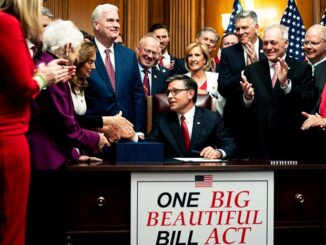
  • US House passes tax and immigration bill, sends it to President Trump

    US House passes tax and immigration bill, sends it to President Trump

    Legislation to extend tax cuts and fund border and defense programs would increase the national debt by close to $4 trillion over the next decade.

    WASHINGTON, D.C. (TIP): Republicans on Thursday notched the first major legislative victory of President Donald Trump’s second term, a mammoth tax and immigration agenda the GOP hopes will reshape the U.S. economy and unwind many of the Biden administration’s accomplishments, a Washington Post report says. The House, in a 218 to 214 vote, passed Trump’s so-called “One Big Beautiful Bill,” a $3.4 trillion measure to extend tax cuts from Trump’s first term and implement new campaign promises — such as eliminating income taxes on tips and overtime wages — while spending hundreds of billions of dollars on immigration enforcement and defense. It raises the country’s borrowing cap by $5 trillion, staving off a debt default that the Treasury was weeks away from breaching.

    The House’s approval sends the bill to Trump’s desk to be signed into law in time to beat a self-imposed July 4 deadline. The Senate passed its edition of the legislation Tuesday.

    “Any of these individual achievements would be historic victories for a Republican Congress or any Congress. And today we’re delivering on all of them in one big, beautiful bill. That’s what Americans can count on when we pass this legislation,” House Speaker Mike Johnson (R-Louisiana) said on the House floor.

    To offset the cost of the bill, the legislation cuts about $1 trillion from Medicaid, the federal health insurance program for low-income individuals and people with disabilities, and other health care programs. It reduces spending on anti-hunger programs, including SNAP, the Supplemental Nutrition Assistance Program formerly known as food stamps, by $185 billion.

    Nearly 17 million people will lose health care coverage or health care subsidies over the next decade if the bill becomes law, according to the nonpartisan Congressional Budget Office, and the bill would add roughly $4 trillion to the debt over the next decade, when factoring in debt service payments.

    The vote came after Minority Leader Hakeem Jeffries (D-New York) held the House floor for nearly nine hours to protest the measure, setting the record for the longest remarks by a party leader in the history of the lower chamber.

    “This bill is a deal with the devil,” Rep. Alexandria Ocasio-Cortez (D-New York) said earlier during the debate on the House floor. “It explodes our national debt. It militarizes our entire economy and it strips away health care and dignity of the American people.”

    Republicans heralded the legislation as a boost for the working class coalition that swept the party to victory in November’s elections, giving it unified control of Congress and the White House.

    “It is the principal vehicle for advancing President Trump’s America First agenda, unleashing a rising tide of prosperity, securing our border, modernizing our national defense and supercharging energy, agriculture, all the sectors of our economy that our government has kept in a choke hold for too long,” Budget Committee Chair Jodey Arrington (R-Texas) said during debate.

    As talks dragged on, leaders left open two votes for over five hours — a sign of the Republican conference’s dysfunction and also the furious backroom dealing to get Trump’s agenda over the finish line by an arbitrary July 4 deadline.

    Lawmakers spent Wednesday into the wee hours Thursday shuttling between talks with party leaders, Trump administration lieutenants and the president himself at the White House.

    But as Wednesday turned into Thursday morning, Johnson was still working to convince 10 lawmakers to vote to advance the bill. Republicans opened debate on the measure after 3 a.m.

    Holdouts said the prospect of forthcoming executive orders from the White House and another Republican budget bill helped ease some concerns.

    “The president is the most gifted and skilled negotiator and whip,” said Ways and Means Committee Chair Jason T. Smith (R-Missouri), one of the lead negotiators.

    Trump’s proposal to end taxes on tips — up to $25,000 — came from a Nevada restaurant server, the president bragged on the campaign trail. He often speaks about ending taxes on overtime during political events with production line workers. Trump pledged to exempt Social Security benefits from taxes; instead, Republicans passed a $6,000 bonus to the standard deduction for seniors.

    The GOP borrowed a Democratic proposal to launch savings accounts for newborns seeded with $1,000 of taxpayer money; Republicans in earlier versions of the legislation called them “Trump accounts.”

    “No one puts a deal together like President Trump. He’s a master. But I think one of the other persuasive things was just looking at the Democrats’ reaction to it,” said Rep. Warren Davidson (R-Ohio), who voted against an earlier iteration of the package. “Maybe the bill is better than I thought.”

    But for the lowest-income Americans the benefits of those provisions are wiped out by the cuts to social safety net programs, according to independent analyses of the bill, and its gargantuan debt impact could slow the U.S. economy.

    Republican Reps. Thomas Massie (Kentucky) and Brian Fitzpatrick (Pennsylvania) joined Democrats to vote against the measure.

    By 2033, the bottom 60 percent of U.S. taxpayers would be worse off because of the measure, the University of Pennsylvania’s Wharton Budget Model reported. The top 0.1 percent of taxpayers — those earning at least $5.1 million — would be more than $83,000 better off.

    “This bill is a middle finger to working people,” Rep. Jim McGovern (D-Massachusetts) said on the House floor.

    Republicans, citing their own rosy economic growth projections, insist that it would improve those household’s fortunes, and hundreds of billions of dollars of homeland security and defense spending would goose job-creating industries. Nearly $170 billion in the bill funds the Trump administration’s border and immigration crackdown and it would impose $69 billion in fees on immigrants and visitors to the country. An additional $160 billion would flow to the Defense Department, partially for Trump’s proposed “Golden Dome” continental missile defense system.

    The legislation would make permanent a trio of corporate tax deductions that make it easier for companies to invest in research and purchase new equipment while rescinding more than half a trillion dollars in clean energy programs from President Joe Biden’s 2022 Inflation Reduction Act.

    Many of the tax proposals changed as the bill pinged between the two chambers of Congress. The House passed legislation in May that had a smaller debt impact while cutting less from Medicaid.

    The Senate swiftly overhauled the measure, making it simultaneously more expensive and more punitive toward Medicaid. Republicans used the budget reconciliation process to bypass a Democratic filibuster in the Senate; that meant when the upper chamber sent its approved legislation back to the House, the lower chamber was unable to alter it and still beat Trump’s deadline. Amendments would have restarted many of the cumbersome processes needed to pass tax legislation on party lines.

    The Senate made the corporate tax cuts more generous and temporarily preserved some of the climate credits. On health care, it imposed strict limits on taxes that states charge medical providers as a roundabout way of collecting more federal Medicaid dollars.

    That prompted concern among some lawmakers about the fate of rural hospitals, which rely heavily on Medicaid patients.

    The Senate’s changes managed to frustrate both ends of the House’s GOP conference. From the center, moderates raged about the approach to health care spending.

    “I’m not happy with it at all,” raged Rep. Greg Murphy (R-North Carolina), a practicing physician. “That’s horrible policy.”

    From the right, lawmakers grumbled about the bill’s debt effects. A group of budget hawks in April extracted a promise from House Speaker Mike Johnson (R-Louisiana) that the amount in tax cuts would not exceed the amount of spending the bill cut.

    “It wasn’t achieved. It was failed,” harrumphed Rep. Chip Roy (R-Texas). “The Senate failed.”

    Members of the archconservative House Freedom Caucus circulated a three-page memo with a list of nearly two dozen deficiencies with the legislation at a Wednesday meeting at the White House.

    “Leave it to the Senate to find a way to aggravate both the moderates and the conservatives in the Freedom Caucus,” said Rep. Jeff Van Drew (R-New Jersey), who had concerns about cuts to health care programs. “That’s extraordinary that they did that. That is a real art and science to be able to aggravate everyone in the House. We had a really good bill, a good work product, got everybody on board, and they just had to play with it.” That White House meeting, though, seemed to be enough to unify Republicans.

    (Source: Washington Post)

  • ‘Not scared’, says Zohran Mamdani after Trump threatened to ‘arrest’ and ‘strip’ his citizenship

    ‘Not scared’, says Zohran Mamdani after Trump threatened to ‘arrest’ and ‘strip’ his citizenship

    NEW YORK (TIP): Trump said Mamdani should be arrested if he tries to stop US immigration agents (ICE) from doing their job in the city. He also called Mamdani a “communist” and questioned if he is even a legal US citizen.

    Mamdani responded strongly, saying: “The President of the United States just threatened to have me arrested, stripped of my citizenship, put in a detention camp and deported. Not because I have broken any law but because I will refuse to let ICE terrorize our city. His statements don’t just represent an attack on our democracy but an attempt to send a message to every New Yorker who refuses to hide in the shadow: if you speak up, they will come for you. The Democrat also attacked Trump for praising New York’s current Mayor, Eric Adams, “in his authoritarian threats”. He said Trump’s praises for Adams–who was elected in 2021 as a Democrat but is running as an independent–are unsurprising, “but highlights the urgency of bringing an end to this Mayor’s time in City Hall. At the very moment when MAGA (make America great again) Republicans are attempting to destroy the social safety net, kick millions of New Yorkers off of healthcare and enrich their billionaire donors at the expense of working families, it is a scandal that Eric Adams echoes this President’s division, distraction and hate. Voters will resoundingly reject it in November,” he said.

    Trump spoke at an immigration event and said Mamdani is a “true communist” and “crazy.” He also claimed Mamdani might not be in the country legally and that he would keep a close watch on him.

    “We don’t need a communist running New York,” Trump said. “Maybe we’ll have to arrest him.” Some Republicans are now trying to cancel Mamdani’s citizenship, even though he legally became a citizen seven years ago.

    Polls show Mamdani is currently leading in the race for mayor, ahead of both Eric Adams and Republican candidate Curtis Sliwa. The general election will be held in November.

    Mamdani says his campaign is winning because it focuses on helping working people and immigrant communities and not fear or hate.

    “We proved that when we give people something real to vote for, they will come back. We surprised everyone — even ourselves,” he said.

  • Amnesty International says Israel using starvation to commit Gaza genocide

    Amnesty International says Israel using starvation to commit Gaza genocide

    WASHINGTON, D.C. (TIP): Amnesty International issued a report Thursday, July 3, 2025,  claiming a controversial Israeli- and U.S.-backed system to distribute aid in Gaza uses starvation tactics against Palestinians to continue to commit genocide in the Gaza Strip during Israel’s war with Hamas.

    The U.K.-based human rights group condemned Israel and the Gaza Humanitarian Foundation, which the U.S. and Israel have backed to take over aid distribution in Gaza from a network led by the United Nations.

    Israel’s foreign minister denounced the Amnesty report, saying the organization has “joined forces with Hamas and fully adopted all of its propaganda lies.” Gaza’s Health Ministry says more than 500 Palestinians have been killed at or near GHF distribution centers over the past month. The centers are guarded by private security contractors and located near Israeli military positions. Palestinian officials and witnesses have accused Israeli forces of opening fire at crowds of people moving near the sites.

    The Amnesty report said Israel has “turned aid-seeking into a booby trap for desperate starved Palestinians” through GHF’s militarized hubs. The conditions have created “a deadly mix of hunger and disease pushing the population past breaking point.”

    “This devastating daily loss of life as desperate Palestinians try to collect aid is the consequence of their deliberate targeting by Israeli forces and the foreseeable consequence of irresponsible and lethal methods of distribution,” said Agnès Callamard, Amnesty’s secretary general.

    The Israeli army says it has fired warning shots to control crowds and only fires at people it says are acting suspiciously.

    The Foreign Ministry and COGAT, the Israeli defense body in charge of coordinating aid to Gaza, said Israel has facilitated the entry of over 3,000 aid trucks into the Gaza Strip since May 19 and GHF has delivered boxes of food with the equivalent of 56 million meals.

    Humanitarian organizations say that amount is not nearly enough to meet overwhelming need in Gaza. GHF did not immediately return requests for comment.

    The World Food Programme says despite the new Israel-backed initiative, food consumption reached a critical low last month, with food diversity reaching its worst level since the conflict began.

    “The continued closure of crossings, intensified violence since March, soaring food prices, and extremely limited humanitarian and commercial supplies have severely restricted access to even basic food items,” the WFP said in a June report.

    Amnesty’s report follows a statement earlier this week from more than 165 major international charities and non-governmental organizations calling for an immediate end to the foundation. They say the new mechanism allows Israel to use food as a weapon, violates humanitarian principles and is ineffective.

    It’s the latest sign of trouble for the GHF, a secretive initiative headed by an evangelical leader who is a close ally of President Donald Trump. Last month, the U.S. government pledged $30 million for the group to continue operation, the first known U.S. donation to the group, whose other funding sources remain opaque.

    GHF started distributing aid May 26 following a nearly three-month Israeli blockade that pushed Gaza’s population of more than 2 million to the brink of famine.

    Palestinian witnesses have described scenes of chaos around the distribution sites, and two contractors in the operation have told The Associated Press that colleagues fired live ammunition and stun grenades toward crowds of people. Palestinians often must travel long distances to reach the sites.

    In a statement Tuesday, GHF rejected criticism of its operations and claimed it has delivered more than 52 million meals to hungry Palestinians.

    “Instead of bickering and throwing insults from the sidelines, we would welcome other humanitarian groups to join us and feed the people in Gaza,” GHF said.

    GHF has called for Israel’s military to investigate the allegations from Gaza’s Health Ministry, but last month the organization said there has been no violence in or around its centers and its personnel have not opened fire.

    Israel demanded the alternative plan because it accuses Hamas of siphoning off aid. The U.N. and aid groups deny there is significant diversion.

    Amnesty accused Israel last year of committing genocide in the Gaza Strip during its war with Hamas, saying it has sought to deliberately destroy Palestinians by mounting deadly attacks, demolishing vital infrastructure, and preventing the delivery of food, medicine and other aid.

    Israel, which was founded in the aftermath of the Holocaust, has adamantly rejected genocide allegations against it as an antisemitic “blood libel.” It is challenging such allegations filed by South Africa at the International Court of Justice and has rejected the International Criminal Court’s accusations that Prime Minister Benjamin Netanyahu and his former defense minister committed war crimes in Gaza.

    (Source: AP)

  • Farewell Letter from the Ambassador of India to Guatemala, El Salvador, and Honduras as he says Gracias A Dios

    Farewell Letter from the Ambassador of India to Guatemala, El Salvador, and Honduras as he says Gracias A Dios

    Dear Friends and Esteemed Partners, 

    As I come to the conclusion of my tenure as the Ambassador of India to Guatemala, El Salvador, and Honduras, I write this letter with a deep sense of gratitude, affection, and fulfillment. Serving in this beautiful and dynamic region of Central America over the past three years has been both a professional privilege and a personal honor.

    To come straight, as I am, this posting has been a blessing in disguise for me. After serving as India’s Head of Commerce Wing in Washington D.C., transitioning to work in the so-called “backyard” of the United States was not particularly difficult from a diplomatic standpoint. However, the cultural and commercial gaps between our worlds were stark and deeply revealing. Despite being in the same hemisphere as the U.S., the geopolitical landscape in Central America is vastly different—more community-driven, shaped by historical challenges and aspirations for inclusion, development, and dignity. Yet, far from being a limitation, this contrast opened my eyes to the immense untapped potential that exists in Central America.

    What truly struck me was the infectious enthusiasm of the governments in Guatemala, El Salvador, and Honduras – eager to build meaningful partnerships with India across sectors. Business stakeholders, many operating in challenging environments, consistently demonstrated a willingness to explore new opportunities, embrace innovation, and engage constructively with Indian counterparts. Perhaps even more inspiring was the genuine curiosity and warmth shown by the local public toward India – its culture, traditions, technology, and global outlook. Whether in remote municipalities or bustling capital cities, I was often met with heartfelt interest in knowing more about India, and how we could work together for mutual benefit. The region’s natural beauty, rich heritage, and resilient spirit left a lasting impression on me. But beyond that, what impressed me most was the sincere desire for progress, reform, and transformation that I encountered at every level. It was this blend of aspiration and authenticity that made my tenure here not only meaningful but truly memorable.

    Ambassador Dr. Manoj Kumar Mohapatra in discussions with H.E Mr. Bernardo Arévalo, President of the Republic of Guatemala

    This genuine regional aspiration for progress, reform, and transformation motivated me to actively support the entry of Indian companies and financial institutions into Central America, paving the way for key infrastructure and development initiatives. These collaborative efforts led to significant investments by Indian enterprises such as Pakka Inc. and Pearl Global, among others. During my tenure, I had the privilege of witnessing the steady expansion of leading Indian BPO companies like 24×7.ai, HCL, and TCS, which now collectively provide employment to over 10,000 Guatemalans. These companies have emerged as trailblazers, laying a strong foundation for future Indian ventures in the region, especially in the rapidly growing data center ecosystem.

    The automobile sector also saw remarkable growth, particularly with the introduction of Indian-manufactured tuk-tuks, which have become a familiar sight across many Guatemalan towns and villages, an encouraging testament to the rising demand for Indian vehicles. Similarly, Indian pharmaceutical firms such as Krisper, Lukah Medicos, and Caplin Point have established a trusted presence in the local market. Their quality and affordability have made Indian generics a household name across the region, reinforcing India’s reputation as the “Pharmacy of the World.” The remarkable growth in trade relations between India and Guatemala, from around USD 300 million in 2021 to  USD 662 million in 2023–24, was the result of sustained and targeted efforts to identify synergies, expand market access, and build mutual confidence among business stakeholders.

    Ambassador Dr. Manoj Kumar Mohapatra with H.E. Mr. Nayib Bukele, President of El Salvador.

    Efforts to promote India’s growing infrastructural development in the region encouraged Governments of El Salvador, Honduras and several local municipalities in Guatemala to provide their citizens with similar facilities. Signing of MoU for a landmark USD 1.2 billion urban infrastructure project with Xela, USD 10 billion dry canal projects across Guatemala, metro project in El Salvador, supply of buses in the region, several solar projects, waste to management project, cable car projects were initiated first time in the region.

    India has made parallel strides in deepening its bilateral relations with El Salvador and Honduras, emphasizing innovation, digital connectivity, and capacity building. In El Salvador, India is supporting pilot projects in cybersecurity and disaster preparedness, including the introduction of an Early Warning System and Cell Broadcasting technology developed by C-DOT. Meanwhile, India is extending technical and commercial support for the deployment of 5G networks in both El Salvador and Honduras, tailored to each country’s needs. These strategic engagements are reinforced through development cooperation under Quick Impact Projects (QIPs), demonstrating India’s sustained commitment to the long-term resilience, growth, and digital transformation of its Central American partners.

    Through the SICA–India framework, India is enhancing regional disaster resilience with the deployment of Early Warning Systems. In partnership with UNDP, the Open Learning Exchange initiative is expected to transform education access for over one million learners in Guatemala. Humanitarian efforts included the donation of 650 tailor-made prosthetic limbs to Guatemalan beneficiaries under the Jaipur Foot initiative.

    Although my primary expertise has always been in the commercial domain, I have been truly fortunate to experience the rich cultural heritage and historical depth of this region. The overwhelming public enthusiasm for International Day of Yoga celebrations each year is a powerful reflection of the growing admiration for India among the people. What began as a modest gathering of 200–400 participants in 2021 has remarkably grown into a massive celebration, with over 10,000 participants joining us at a single venue in San Pedro Carchá—setting a historic milestone as the largest-ever IDY gathering outside India. It is heartening to see how India, once relatively unfamiliar to many in the region, is now embraced with warmth and curiosity. Today, Indian festivals like Holi and Diwali are celebrated with great enthusiasm and large public participation, becoming part of the local cultural calendar. I will forever remain grateful for the love, respect, and genuine affection extended to me and to India by the wonderful people of Guatemala, El Salvador, and Honduras.

    Ambassador Dr. Manoj Kumar Mohapatra with H.E. Ms. Xiomara Castro, President of Honduras.

    I remain especially grateful for the warm friendship extended to me by the governments, local authorities, business communities, academic institutions, and the Indian diaspora. The hospitality I received in Guatemala, El Salvador, and Honduras was truly exceptional and will always remain etched in my memory. I have had the opportunity to travel to some of the remotest corners of the region—each time discovering something new about the spirit and resilience of its people.

    As I bid farewell, I carry with me not only the memories of landscapes and institutions but, more importantly, of the wonderful people who enriched my experience here. I am confident that the bonds of friendship and cooperation between India and Central America will continue to grow stronger in the years ahead.

    Please accept my sincere thanks for the unwavering support extended to me and the Embassy team. I leave with a heart full of gratitude and the hope that our paths may cross again. With warm regards and best wishes for your continued success and prosperity.

  • Unveiling of Mahatma Gandhi Bust at the Embassy of India by Hon’ble Vice President of Guatemala

    Unveiling of Mahatma Gandhi Bust at the Embassy of India by Hon’ble Vice President of Guatemala

    GUATEMALA (TIP): In a landmark event symbolizing the enduring values of peace, non-violence, and India-Guatemala friendship, the Hon’ble Vice President of the Republic of Guatemala, Dr. Karin Herrera, and the Ambassador of India to Guatemala, H.E. Dr. Manoj Kumar Mohapatra, jointly unveiled a bust of Mahatma Gandhi at the Embassy premises today. The solemn and graceful ceremony was attended by around 200 distinguished guests, including Ambassadors and diplomats, senior government officials, dignitaries from various institutions, members of the Indian diaspora, and friends of India.

    The programme commenced with the national anthems of India and Guatemala, followed by the formal unveiling of the bust. Ambassador Dr. Mohapatra welcomed the guests and highlighted Mahatma Gandhi’s timeless relevance in today’s world, emphasizing that Gandhi’s ideals continue to resonate globally and inspire movements for justice, peace, and human dignity. In her remarks, Vice President Dr. Karin Herrera expressed admiration for Mahatma Gandhi’s life and legacy, underlining his influence on world leaders and his message of non-violence as particularly relevant to today’s interconnected yet divided world. The cultural segment of the programme featured soulful renditions of songs dedicated to Mahatma Gandhi and performances by local artists and members of the Indian community, creating a deeply reflective and festive atmosphere. The event concluded with light refreshments and interaction among attendees.

    Hon’ble Vice President H.E. Dr. Karin Herrera delivers her remarks during the unveiling ceremony, highlighting Mahatma Gandhi’s timeless legacy and the strong bonds between India and Guatemala.

    This bust is one of four recently received from the Indian Council for Cultural Relations, New Delhi, as part of India’s continued effort to promote the universal values embodied by Mahatma Gandhi. The other three busts were handed over to the Association of Don Bosco to be installed at their institutions across the Alta Verapaz region. With the addition of these four, Guatemala now hosts seven busts of Mahatma Gandhi in various prominent locations. The first Gandhi bust in Guatemala was installed in Tecpan. The second bust at the prestigious premises of the Ministry of Foreign Affairs was jointly unveiled by Hon’ble Minister of State for External Affairs, Smt. Meenakashi Lekhi, and the Guatemalan Foreign Minister in January 2023. The third was installed at the Municipality of Livingston and unveiled in December 2023 by Ambassador Dr. Mohapatra and Hon’ble Mayor Mr. Daniel Esaú Pinto Peña to mark the 50th anniversary of the establishment of diplomatic relations between India and Guatemala.  One the three busts handed over to Association of Don Bosco was unveiled on 23 June 2025 in Raxruha. Other two will be unveiled shortly.

    Ambassador Dr. Manoj Kumar Mohapatra addresses the gathering, emphasizing Mahatma Gandhi’s enduring relevance and the shared values of peace and non-violence that strengthen India-Guatemala relations. 

    The unveiling of this seventh Gandhi bust at the chancery premises today holds special significance. Positioned at the heart of India’s diplomatic presence in Guatemala, this installation stands as a permanent reminder of India’s moral and spiritual contribution to the world and serves as a source of inspiration for all visitors. Globally, busts and statues of Mahatma Gandhi have been placed in over 100 countries, including in front of parliaments, universities, and city squares. Each of these installations reinforces India’s commitment to the values of peace, non-violence, dialogue, and democratic coexistence. The presence of Gandhi’s likeness at the Indian Embassy in Guatemala is not only a tribute to the Mahatma’s philosophy but also a symbol of the deepening bilateral partnership between India and Guatemala.

    The event concluded with renewed commitment from both nations to uphold Gandhian values in international cooperation, people-to-people ties, and efforts to build a more peaceful and sustainable world.

  • Birthday Predictions- July 7 to July 13

    Birthday Predictions- July 7 to July 13

    • By Astrologer Chirag Daruwalla

    July 7

    Ganesha says today is an action-packed day for you. Your energy is at an all-time high, and your mind is racing with new ideas. Whether it’s a business project or a personal ambition, the time has come to take the first step. Your excitement, on the other hand, may overwhelm others around you. Keep in mind that not everyone can keep up with your pace. Today is a wonderful day to assess your investments, but avoid making any rash decisions. Your charisma is attractive in partnerships. Use this energy to repair any broken relationships or to strengthen current ones.

    July 8

    Ganesha says you’ll find yourself in a reflective mindset today. Today is ideal for reflection and self-discovery. Financial opportunities abound, but they necessitate cautious planning. Don’t make any decisions without first assessing the benefits and drawbacks. Your attention to detail will capture the notice of someone prominent in your professional life. Be open to partnerships because this could be the start of a profitable partnership. You may experience an emotional desire for steadiness. Reach out to loved ones; their support will give you the stability you need.

    July 9

    Ganesha says it is a good day to practice your communication talents. Whether you’re giving a presentation at work or having a heart-to-heart with a loved one, your words will have a big impact. Be cautious, however, as misinterpretation is possible. Check your emails twice and think before you speak. You’re on fire creatively. If you’ve been considering beginning a new project, now is the moment. Today, your intuition is especially strong, helping you through critical judgments. Listen to your inner voice; it is currently your finest advisor.

    July 10

    Ganesha says today is a day for emotional equilibrium. You may be juggling several duties at work and home. While it may be difficult, your natural inclination to nurture people will bring you through. Professionally, you will most likely be recognized for a job well done. Enjoy the moment, but remember that it is only the beginning. Financially, the day is stable, although an unexpected expense may arise. Make a backup plan in case something goes wrong. Your empathic disposition can help you connect on a deeper level with your loved ones in partnerships.

    July 11

    Ganesha says today is a day of contrasts for you. On the one hand, your self-assurance is out of this world, making you the focus of attention wherever you go. On the other hand, you may experience a sudden desire for isolation. Balance is essential. Professionally, a difficult scenario will develop, but your leadership abilities will help you effectively navigate it. Today is not the day for high-risk investments; it is not the day for gambles. Your charisma is unstoppable in love and relationships. However, keep your partner’s needs in mind; it’s not all about you.

    July 12

    Ganesha says your analytical thinking is sharper than ever today. You’ll discover solutions to issues that have been bugging you for some time. Your productivity at work will not go unnoticed. Expect favorable feedback, which could lead to larger possibilities in the future. It’s a terrific day to go over your budget and make any required changes. Your realistic attitude will save you money in the future. You may feel a little disconnected in relationships. To avoid misunderstandings, it is critical to explain your feelings openly.

    July 13

    Ganesha says today is a day of harmony and balance for you. Your diplomatic abilities will be tested in both professional and personal contexts. You may find yourself negotiating conflicting parties at work. Your sound judgment will gain you respect and, maybe, a larger role in future projects. Today is a good day to indulge financially. While pampering oneself is important, don’t overdo it. Your charisma is on full display in relationships. It’s a great day for meaningful chats and developing relationships with loved ones.

  • Weekly Horoscope- July 7, 2025 to July 10, 2025

    Weekly Horoscope- July 7, 2025 to July 10, 2025

    • By Astrologer Chirag Daruwalla 

    Aries 

    Ganesha says this week, new possibilities will open up for you. Move ahead with confidence and focus on your goals. Your ideas and efforts will be appreciated at work, which can give you some new responsibilities and opportunities. Focus on communication in personal relationships. Avoid aggression and express your ideas calmly. This is the time to resolve old differences. Spending time with family will give you emotional balance. Be health conscious. Exercise and a balanced diet will give you mental and physical strength. Overall, this week will bring you opportunities for progress and positive change. Use your adventurous nature and try to get things your way. 

    Taurus 

    Ganesha says this week will be a mixed bag. This week, you will see a flow of positivity and energy in your work. You will be ready to work a little harder to achieve your goals, and this hard work will give you good results. Your family relationships will strengthen during this time. Spending time with family will give you mental peace. An old dispute may also be resolved, which will make you feel mentally light. From an economic point of view, this week you may get a chance to do something new. New investment opportunities are waiting for you, but be a little cautious and use discretion in your decision-making. From a health point of view, this week is important for you. Regular exercise and a balanced diet will help maintain your energy levels. Resort to meditation and yoga to reduce mental stress. In short, this week is a good time for you to bring balance to your personal and professional life. Think with a cool head before making any major decisions. 

    Gemini 

    Ganesha says this week is going to be particularly active and positive. Your intelligence and communication skills will be high at this time, which will open up new possibilities in your work life. You will be able to express your ideas and create a positive atmosphere in your team. Good changes can also be seen in personal relationships. Communicating with your loved ones and understanding emotions will be beneficial for you. You will get a chance to spend time with friends and family, which will help you get away from your worldly worries and be full of new energy. From a health point of view, be a little cautious this week. Regular exercise and adopting a balanced diet will improve your mental and physical health. The situation will also be satisfactory in financial matters, but do not forget to think before taking major financial decisions. Your curiosity and creativity can lead to many new opportunities. This week, you will be in search of sources of inspiration, which will allow you to focus on your interests and goals. Spending time with your friends and close ones will give you a new vision and energy. 

    Cancer 

    Ganesha says this week is an important period. Go deep into your inner self and understand your feelings. This week indicates new possibilities in relationships. Spending time with family members will strengthen your relationship. In the field of work, your hard work and dedication will start showing fruit. This is the most suitable time to complete an important project. Colleagues will appreciate your efforts, which will increase your confidence. In terms of health, take a little caution. You will benefit from doing yoga or meditation to reduce mental stress. Do not forget to take time for yourself, as it will give you freshness and energy. The essence of this week is to connect with your inner feelings and give priority to your relationships. There will be a flow of positive energy around you; make full use of it. 

    Leo 

    Ganesha says this week, you will feel the energy around you, and your creativity will be at its peak. This is the right time to share your ideas, especially with people you like. The planetary positions are in your favor to start new projects and take on new challenges. There will be some new things in your social life as well. Spending time with friends and family will help boost your morale. Your leadership skills will be recognized, so if you are part of a group, do not hesitate to express your opinion. During this time, there is a need to be cautious in financial matters. Avoid unnecessary expenses and manage your funds wisely. In terms of health, physical activity will be important for you; doing some exercise or yoga will make you feel better. Your confidence will remain high, but do not forget to control your emotions. Listening and understanding others will be beneficial for you. Try to tone yourself this week, so that you can improve your abilities. All these aspects will help take your life in a positive direction. 

    Virgo 

    Ganesha says many positive opportunities will come your way this week. You will feel full of energy, which will speed up your work. Your focus will be on staying organized and achieving your goals. Increasing communication with colleagues at the workplace will be beneficial for you. In terms of health, this is the time to take some time for yourself. Focus on yoga or a nutritious diet, so that you can improve physical and mental health. Spending time with family will also lift your mood. Be a little careful in personal relationships. You need to keep your intentions clear. Differences may arise over a small matter, so present your ideas politely. This week is the time to experiment with your ideas. You can learn new things by adopting creativity. Whatever challenges come up, try to take them with positivity. Recognize your inner strength and move forward with confidence. This week will be full of successes for you. 

    Libra 

    Ganesha says this week, it is a time of balance and dedication for you. You may get entangled in more tasks than you can handle, but keep in mind that it is important to give priority to your mental and emotional health. Increase communication in relationships, and ensure that your feelings come out in the right way. During this period, you can make new plans that can benefit you. Your creativity will be at its peak, so it will be good for you to try your hand at art, music, or a new project. Make a thoughtful decision in terms of money. Wait a while for any big investment and consider your options. Overall, this week is a time to face challenges and personal growth. Maintain a positive attitude and try to connect with your loved ones. 

    Scorpio 

    Ganesha says today, you will feel a new energy and enthusiasm within you. Your infectious, enthusiastic spirit will inspire others as well. Disappointment has no place for you in work, as you are ready to face all challenges with your hard work and dedication. An inclination towards spirituality will make you feel relaxed. Spending some time with meditation or yoga will be beneficial for your mental health. You need to be cautious in communication to maintain harmony in relationships. Spending time with your loved ones and understanding their feelings is important for you today. Be careful in financial matters, too. There is a possibility of some sudden expenses, so it is better to maintain a budget. Take advantage of the positivity coming from all around and look for new opportunities. Focus on your goal today and keep moving forward. Your efforts will be successful. 

    Sagittarius 

    Ganesha says this week, many new possibilities are going to open up in your life. This time will be challenging but exciting for you. In the professional field, your hard work is expected to be rewarded. If you have faced difficulties in the past, now is the time when your efforts will pay off. This week can bring new opportunities for businessmen. There is a possibility of getting help from an old friend or colleague. Express your ideas clearly, as this will make you more effective. In personal life, this is the right time to strengthen relationships. Spending time with family members will deepen your relationship. If you are in a new relationship, you can think of taking it forward. Be cautious about your health this week. A little meditation and exercise will help maintain your energy. Do meditation and yoga for mental health. These will help maintain your mental balance. The main thing for Sagittarius people this week is to take their experiences positively and embrace new challenges. Move forward with determination and heartiness to get what you want. 

    Capricorn 

    Ganesha says this week is a crucial one. Your hard work and dedication will bring you fruitful results this week. At work, your resourcefulness and organisational abilities will earn you appreciation among your colleagues. Your crucial role in a particular project can take your career to new heights. In personal life, you will get an opportunity to spend quality time with family members. Take time to strengthen your emotional bonds. Try to increase mutual communication, so that relationships can get even deeper. In terms of health, this week is for you to stay balanced. Yoga or meditation will help you maintain your mental peace. Focus on regular exercise and ensure you get good nutrition. In financial matters, it is important to keep expenses under control. Think well before making any big investments. Be cautious and prioritise your savings. The company of worthy friends and colleagues will give you courage and encouragement this week. You may get many positive opportunities in the coming days. This week is yours, use it properly. 

    Aquarius 

    Ganesha says this week is the time for new possibilities to open up for you. This is a great period for your social life and networking. You will feel inspired to spend time with your friends and family, and your conversations will deepen. At work, your creativity and stream of unexpected ideas can bring positive changes to your career. If you are working on a project, slightly changing your approach will reveal new opportunities for you. This week is also a good time for personal growth. You will feel encouraged to improve yourself. If you want to work on a particular skill, then put in your efforts. In terms of health, meditation and yoga will give you mental peace. You should focus on balancing your emotions. Take care of your mental health, and in case of any dilemma, share your feelings with your close ones. This week, there are opportunities to bring positive changes to your life. Embrace them openly and be ready to make your dreams come true.


    Pisces 

    Ganesha says this week is a very exciting time for Pisces natives. You will get an opportunity to hone your inner creativity, which will allow you to express your ideas in a new and unique way. Your intuition will be very strong at this time, due to which you will be able to understand the feelings of people around you correctly. Social relationships will be of special importance this week. Spending time with friends and family will give you new energy. At the workplace, your cooperative spirit will strengthen your relationship with colleagues. There are possibilities of new opportunities in professional life, so do not hesitate to work hard. This week can remain stable for financial matters. Make a thoughtful decision before making any big investment or expenditure. Focus on long-term plans to strengthen your financial position. In terms of health, resort to meditation and yoga to maintain mental balance. Keeping a positive attitude will be beneficial for you. Overall, this week will prove to be very positive and progressive for relationships, career, and personal growth. Listen to your inner voice and move forward with courage. 

  • Socialism and Secularism are the Spirit of the Constitution

    Socialism and Secularism are the Spirit of the Constitution

    The call to erase ‘socialism’ and ‘secularism’ from the Constitution is a calculated move to have an oppressive majoritarian state

    By M.A. Baby

    India’s Constitution is not merely a legal document. It is the embodiment of the ideals and the aspirations of a nation that was forged in the crucible of an anti-colonial struggle. Among its most fundamental principles are socialism and secularism, values that are not confined to the Preamble alone but which are woven throughout its text, reflected in the Directive Principles of State Policy, in the Fundamental Rights, and in its very structure. Recent calls by the leadership of the Rashtriya Swayamsevak Sangh (RSS) leadership to remove the words socialism and secularism from the Preamble are not just an attack on semantics but is also a direct assault on the foundational vision of the Indian republic itself.

    The RSS General Secretary made this call recently under the garb of criticizing the Emergency, which happened 50 years ago, as the words socialism and secularism were added in the Preamble under the Constitution (42nd Amendment) Act, 1976 during the Emergency. It is a deceitful move by the RSS to invoke the Emergency in order to discredit these principles, especially when it colluded with the Indira Gandhi government during that time for its own survival. To use that event in history to now undermine the Constitution reflects the RSS’s hypocrisy and opportunism.

    Reflected in the Preamble and beyond

    Socialism, in the Indian Constitution, is a commitment to social and economic justice, the eradication of inequality, and the creation of a welfare state. The Preamble promises “Justice, social, economic and political” to all citizens, and seeks “Equality of status and of opportunity”. It underlines the fact that even before the 42nd Amendment, the spirit of socialism was always present in our Constitution.

    There were significant efforts in the Indian Constitution to increase the freedoms of citizens and to reduce the inequalities prevalent in society. The Fundamental Rights were major steps in that direction. Article 14 guarantees equality before law. Article 15 prohibits discrimination on grounds of religion, race, caste, sex, or place of birth. Article 16 ensures equality of opportunity in matters of public employment. These rights, read together with the Preamble and Directive Principles, enshrine a vision of a society free from exploitation, where the dignity of every individual is upheld.

    The Directive Principles of State Policy have the clearest articulation of the socialist vision, in the Indian Constitution. Articles 38 and 39 clearly lay it out, and is further explained in Articles 41, 42 and 43. These provisions are not just aspirational; they have guided landmark legislation and judicial interpretation in India.

    Secularism in the Indian Constitution is not mere religious neutrality but the positive assurance that the state will treat all religions equally, protect the rights of minorities, and ensure that no citizen suffers discrimination on the basis of faith. The original text of the Preamble, even before the addition of the word secular in 1976, had already promised “Liberty of thought, expression, belief, faith and worship” and “Fraternity assuring the dignity of the individual…”.

    Under Fundamental Rights, Articles 25 to 28 provide the Right to Freedom of Religion and further underscore the secular nature of the Indian Republic. Articles 29 and 30, on Cultural and Educational Rights, too reiterate this. These articles ensure that the state neither identifies with nor privileges any religion, and that every citizen, regardless of faith, enjoys equal rights and protections. Even the Supreme Court of India has repeatedly affirmed that secularism is part of the Constitution’s ‘basic structure’.

    The Basic Structure Doctrine was introduced in 1973 in the Supreme Court’s landmark judgment in Kesavananda Bharati. It holds that while Parliament can amend the Constitution, it cannot alter its fundamental structure, i.e., the basic structure of the Constitution is inviolable. As mentioned earlier, the 42nd Amendment which introduced the words socialism and secularism in the Preamble of the Constitution was enacted in 1976, three years after this historic verdict. Yet, the additions could be made precisely because they did not violate the basic structure of the Constitution.

    Inseparable from the Constitution’s fabric

    It is a fallacy to claim that socialism and secularism in the Preamble of the Constitution are mere ‘additions’ or ‘impositions’ from the 1970s. The Objective Resolution of the Constituent Assembly, the Constituent Assembly debates themselves and the lived experience of India’s glorious anti-colonial freedom struggle all testify that these values were central to the vision of the Republic’s founders.

    Debates show why Preamble’s original text left out the two words

    The Constitution’s commitment to social and economic justice, equality, and fraternity is inherently socialist. Its guarantee of religious liberty, non-discrimination and minority rights is inherently secular. Even if the words socialist and secular (the word secular was there in Article 25(2)(a) even before the 42nd Amendment) were to be removed from the Preamble, the Constitution’s core philosophy, structure and provisions would remain unchanged in their essence.

    Dr. B.R. Ambedkar’s final speech to the Constituent Assembly on November 25, 1949, offers profound insights that reinforce the argument that the notion of equality (which forms the foundation of the ideas of socialism and secularism) is embedded in the Constitution’s spirit and structure. B.R. Ambedkar’s words remain a guiding light against any attempt to dilute these foundational values.

    The real agenda has been exposed

    The RSS’s demand to remove socialism and secularism from the Preamble of the Constitution is a calculated move to undermine the very foundations of the Indian Republic. It exposes its long-standing agenda to replace the Constitution with a veiled Manusmriti, subvert the secular democratic republic of India, and create a theocratic Hindu Rashtra. The attempt to erase socialism and secularism from the Preamble is an attempt to rewrite history, to delegitimize the legacy of India’s anti-colonial freedom struggle, and to pave the way for an oppressive majoritarian state.

    The Constitution of India is a living document that is designed to secure justice, liberty, equality, and fraternity for all. Socialism and secularism are the pillars on which the edifice of the Indian Republic stands. To attack them is to attack the very soul of India’s democracy. All those who cherish the values of the freedom struggle — a struggle that the RSS was not part of — must stand united in defense of the lofty values of the Constitution, and resist any attempt to destroy the idea of India. 

    (M.A. Baby is the general secretary of the Communist Party of India (Marxist)

  • 6 things you probably didn’t know were in Trump’s mega-bill

    6 things you probably didn’t know were in Trump’s mega-bill

    Eliminating tax on silencers. Taxing remittances. A garden of heroes. Congress could have done better.

    “The bill’s toplines are understandably seizing much attention. It will remake the social safety net, potentially taking away food assistance from 5 million of the neediest Americans and kicking at least 17 million people off of their health insurance — resulting in premature deaths for at least 100,000 of them, according to estimates. It will increase the national debt by more than $3 trillion over the next 10 years, raising the cost of borrowing for the government — and U.S. households, which will pay thousands more each year in interest on their mortgages.”

    By Natasha Sarin

    President Donald Trump’s tax and spending bill moved through Congress so quickly that members who voted for the legislation have registered surprise about what it contains. Because the Senate-approved bill that the House passed on Thursday is 887 pages long, it’s easy to see why it’s hard to track all that is in there.

    The bill’s toplines are understandably seizing much attention.

    It will remake the social safety net, potentially taking away food assistance from 5 million of the neediest Americans and kicking at least 17 million people off of their health insurance — resulting in premature deaths for at least 100,000 of them, according to estimates. It will increase the national debt by more than $3 trillion over the next 10 years, raising the cost of borrowing for the government — and U.S. households, which will pay thousands more each year in interest on their mortgages.

    But buried in those 887 pages are changes that you likely haven’t heard as much about. Here are some that stuck out to me:

    1. Some guns and silencers will be cheaper: The bill eliminates the tax on gun silencers and certain types of rifles and shotguns, weakening the National Firearms Act that was passed a century ago. That means silencers, which have been deployed in recent mass shootings, will be less expensive. In a country that ranks No. 1 by a significant margin for gun violence, it is hard to see why making silencers more accessible is good policy.
    1. States whose food stamp programs are less accurate will be rewarded: Republicans plan to cut $186 billion over the next decade in federal funding for food stamps. The professed logic was to shift funding to states that administer these programs to ensure they have “skin in the game” and will do so carefully. Sen. Lisa Murkowski (R-Alaska) ultimately agreed to vote for the bill but only if her state was exempted from the skin. So, lawmakers delayed federal cuts for states such as Alaska that had previously registered high rates of erroneous payments. It is incomprehensible why the states with the most error-ridden food stamp programs should see the lowest funding cuts.
    1. Student borrowers who have been defrauded are more vulnerable: The bill delays regulations aimed at helping students who borrowed to fund an education they ultimately did not receive because their school misled them or closed while they were enrolled. (The regulations had been on hold because of ongoing litigation.) The basic idea behind these provisions was that some students take out high-cost loans because schools advertise certain benefits of their programs, such as likely job prospects. These regulations would protect borrowers who didn’t get the education they were promised from bearing the cost of those loans. Delaying these regulations is a mistake. We should not continue to saddle students who are unable to benefit from the education that they were advertised with debt that will loom over them.
    1. (Some) remittances will be taxed: Often immigrants in the United States send money home to their families. In 2022, more than $20 billion was sent from the U.S. to India alone. These funds are most important to poorer countries such as Lebanon and Nicaragua, where they total about 30 percent of gross domestic product. The Senate-passed bill aims to discourage remittances by taxing them. But it exempts certain types of payments: for example, those made through banks (which lobbied aggressively against the proposal) and those made with digital assets. The purported rationale for the remittance tax is to encourage self-deportation by making it more costly to ship money abroad. It is problematic in the complexity it introduces to the tax code because the applicability of the tax is dependent on how money is sent abroad. The bill gives certain financial intermediaries, such as banks, advantages over others.
    1. The tax code got less fair: Tax experts believe in “horizontal equity” in the code — or the idea that taxpayers with similar resources should face similar tax burdens. This bill delivers horizontal inequity. It includes new tax breaks for tipped and overtime workers, seniors and people who borrow to buy cars that result in similarly situated people of different ages or in different industries facing dramatically different tax rates. This is bad policy because people will spend energy on tax avoidance to earn income in the most tax-advantaged way.
    1. We’re building that garden of heroes: As one of Trump’s final acts before leaving office in his first term, he affirmed his commitment to building a statue garden of American heroes — ranging from George Washington to Julia Child to Kobe Bryant — by July 2026. Upon returning to office, he picked those plans up, calling for the construction of the garden “as expeditiously as possible.” The Senate bill moves the garden closer to reality by allocating $40 million for its construction.

    There’s a lot more in these 887 pages. We are planning on going to Mars, ending unemployment benefits for millionaires and starting new — and highly complex — Trump-branded savings accounts for children born in the next few years.

    What are perhaps even more revelatory than the legislative text are the testimonies we’ve seen from the lawmakers who drafted it. Sen. Jim Justice (R-West Virginia) voted for it but said “I wish to goodness” the Medicaid cuts that will hit low-income families had been excised. Sen. Josh Hawley (R-Missouri), also a yes, said he would plan to spend the coming years trying to pass legislation to reverse those cuts. Murkowski, who was the deciding vote in the Senate, voted for it even though she thinks it is “not good enough.”

    It is hard to disagree. The House-passed bill spends more than $3 trillion to make the tax code more complex and vulnerable Americans less healthy. Instead of curbing fraud, the legislation encourages it. In every regard, it is a mistake: It grows deficits but shrinks the economy, makes gun silencers more available but healthy food less so. What is so baffling is that Congress had months to land on a better bill before the expiration of the Trump tax provisions that has pushed this debate to the fore. Lawmakers should have taken the time they needed to craft legislation they could have read, debated and, ultimately, taken pride in — not a bill they voted for begrudgingly while trying to disown.

     (Natasha Sarin, a Washington Post contributing columnist, is a professor of law at Yale Law School with a secondary appointment at the Yale School of Management in the Finance Department. Previously, she served as deputy assistant secretary for economic policy and later as a counselor to Treasury Secretary Janet Yellen. Follow on XNatashaRSarin)

  • Can the Democratic Nominee Deliver? New Yorkers Ask for Realism, Not Rhetoric

    Can the Democratic Nominee Deliver? New Yorkers Ask for Realism, Not Rhetoric

    Mamdani’s promises speak to a deep hunger for change. But unless he and his campaign begin to share detailed, actionable, and financially viable plans, these promises risk becoming yet another chapter in New York’s long book of political disillusionment.

    By Prof. Indrajit Saluja

    In a city as iconic and vibrant as New York, promises from political candidates are often met with both enthusiasm and skepticism. The Democratic mayoral nominee, Zohran Mamdani, has captured the imagination of many with a progressive platform that promises to transform New York City into a more affordable, equitable, and livable space for all. His ambitious agenda includes raising the minimum wage to $30 per hour, providing free bus rides citywide, ensuring juice for children in public schools, and launching sweeping infrastructure and cleanliness reforms. These pledges have excited many working-class residents, youth groups, and progressive voters who are weary of rising rents, stagnating wages, and decaying public services.

    But amid the applause lies a pressing question: can these promises actually be fulfilled? With the city grappling with chronic fiscal constraints, rising crime, decaying infrastructure, and persistent urban blight, New Yorkers are right to demand clarity and realism. Can Mamdani’s vision be more than campaign rhetoric? Or are these bold declarations just the sweet music of electoral populism?

    The $30 Minimum Wage: Economics or Election Slogan?

    One of Mamdani’s most headline-grabbing promises is his commitment to raise the minimum wage in New York City to $30 per hour—nearly double the current minimum wage of $16/hour, which was implemented in 2024 under a state mandate. At first glance, this sounds like a dream for low-wage workers, especially those in retail, hospitality, and the gig economy, who have long struggled to meet the city’s ever-increasing cost of living.

    But the economic implications are profound. According to the New York State Department of Labor, there are approximately 3.8 million workers in the city, of which about 1.2 million earn less than $30/hour. To elevate all of them to the proposed wage would require massive adjustments from private employers—many of whom are still recovering from the post-pandemic economic disruptions and inflation shocks. Small businesses, in particular, could be crushed under such a wage mandate, leading to layoffs, business closures, or relocation to other states.

    More importantly, wages are not solely determined by political will; they are tightly bound to productivity, profit margins, and market dynamics. Without significant subsidies or tax relief to offset these costs, this promise, while noble, could backfire on the very workers it aims to uplift.

    Free Bus Rides: A Transit Dream That Needs a Budget

    Another key promise is free bus service across New York City, an initiative aimed at promoting equity in transit access, reducing car dependency, and alleviating the burden on working-class commuters. New York City Transit runs approximately 5,700 buses serving more than 300 routes, carrying over 2 million passengers per weekday.

    Currently, the Metropolitan Transportation Authority (MTA) faces a budget shortfall of nearly $2.5 billion over the next few years, despite receiving federal aid during the pandemic. Free bus service would add hundreds of millions in lost fare revenue annually—estimated at $800 million according to MTA’s latest financial reports.

    If the city or state does not provide a dedicated funding stream—such as new congestion pricing tolls, higher taxes on the wealthy, or increased federal grants—such a plan is unlikely to be sustainable. As appealing as “free buses” sound, transportation experts warn that without adequate funding, the quality of service—frequency, maintenance, driver salaries—could collapse. 

    Juice for Schoolkids and Other Populist Promises

    Mamdani’s pledge to provide free juice for children in public schools may seem trivial in scale compared to wage hikes and transit reform, but it symbolizes a broader political messaging style—populist, emotive, and symbolic. While such a program might cost just a few million dollars annually, it raises a broader concern: how many similar small-ticket promises are being made without clarity on funding or execution?

    New York City’s public school system serves approximately 920,000 students. Even a basic nutrition expansion program, including juice or snack supplementation, requires coordination with food vendors, health compliance, logistics, and recurring budgeting—none of which are currently detailed in Mamdani’s policy outline.

    Law and Order: A Crisis Ignored?

    While the nominee’s focus has been on affordability and social equity, many residents point to a rapidly deteriorating law-and-order situation as the most pressing issue in the city today. NYPD staffing has been cut drastically in recent years—from 36,000 uniformed officers in 2020 to about 32,500 in 2025—partly due to budget cuts and partly in response to calls for police reform following mass protests.

    Yet the reality is sobering. According to NYPD crime statistics, felony assaults rose by 11% in 2024 compared to the previous year, and property crimes increased by 9%, including widespread retail thefts and subway violence. Public confidence in safety, especially among elderly residents, women, and small business owners, has sharply declined.

    If the city is to be made truly “affordable,” it must first be safe. No amount of free bus rides or wage raises will be meaningful if New Yorkers feel unsafe on the streets or in the subways. Mamdani’s campaign has so far not outlined a clear public safety strategy—raising fears that crime will worsen under an administration focused more on slogans than security.

    A Crumbling Cityscape: Potholes, Trash, and Concrete

    Beyond wages and law enforcement, the very physical state of New York City is a daily frustration for its 8.3 million residents. Roads are cracked and riddled with potholes. Public housing units are in disrepair. Litter clogs sidewalks. According to NYC’s Department of Sanitation, the volume of trash complaints has increased by 18% since 2023. The problem worsens in outer boroughs like the Bronx and Queens, where waste collection has been deprioritized.

    Meanwhile, green cover remains poor. Beyond Central Park and a handful of city-maintained green belts, most neighborhoods look like concrete jungles. Tree canopy coverage, according to the NYC Parks Department, has fallen to 21%, down from the city’s goal of 30% by 2025. Residents in low-income neighborhoods face higher heat indexes due to this lack of greenery, exacerbating climate inequality.

    While Mamdani promises to “revitalize” the city, few specifics have been shared. What’s the budget for green renewal? How will sanitation be improved in areas with underfunded services? Where will the investment in roads, bike lanes, and pedestrian infrastructure come from?

    Fiscal Realities: Where Will the Money Come From?

    Perhaps the biggest elephant in the room is this: how will all of this be paid for? The city’s 2025 operating budget stands at $112 billion, and it is already stretched thin across schools, police, sanitation, housing, and healthcare. The city also faces a looming pension burden and debt repayments nearing $6 billion annually.

    Mamdani has vaguely gestured toward taxing the rich, ending corporate subsidies, and redirecting funds from NYPD to social programs. But these are not new ideas—and they’ve already been met with stiff political and legal resistance in Albany and beyond. Moreover, wealth taxes are largely state-level powers and cannot be unilaterally imposed by the city government.

    There is also the question of private capital flight. Over the past five years, over 350 financial firms have either downsized or relocated from New York, citing high taxes and crime. If the tax burden grows heavier, the trend could accelerate, further eroding the city’s tax base.

    New Yorkers Demand Real Plans, Not Just Poetic Promises

    To be clear, Mamdani’s campaign is inspiring for many, especially those disillusioned by decades of establishment politics. His message resonates with younger voters, communities of color, and workers exhausted by rising rent, stagnant wages, and urban decay. But inspiration is not a substitute for implementation.

    New Yorkers are asking: where is the blueprint? Where is the spreadsheet that matches spending with revenue? Where is the timeline? Where is the team that will ensure these ideas are realized in a city as complex and politically fragmented as New York?

    City governance is not a Broadway production. It demands not just slogans, but spreadsheets; not just rhetoric, but roadmaps.

    New York City is at a critical juncture. It is both a symbol of global aspiration and a city burdened with deeply entrenched problems. The next mayor—whoever he or she may be—must lead with both vision and realism.

    Mamdani’s promises speak to a deep hunger for change. But unless he and his campaign begin to share detailed, actionable, and financially viable plans, these promises risk becoming yet another chapter in New York’s long book of political disillusionment.

    As one lifelong resident put it: “Give us fewer dreams. Give us more answers.”

    (Author is the chief editor of The Indian Panorama. He can be reached at salujaindra@gmail.com)

  • Congratulations, the Free and the Brave: A 249-Year Reflection on American Independence

    Congratulations, the Free and the Brave: A 249-Year Reflection on American Independence

    By Prof. Indrajit S Saluja
    By Prof. Indrajit S. Saluja

    On this Fourth of July, 2025, Americans celebrate the 249th anniversary of the Declaration of Independence—an extraordinary milestone in human history. As fireworks light the skies and parades roll down Main Streets, this moment also marks the beginning of a year-long journey toward the 250th anniversary of American independence in 2026—a quarter of a millennium since the birth of a bold experiment in liberty, equality, and self-governance.

    On July 4, 1776, in Philadelphia, 56 signatories affixed their names to a document that changed the world—the Declaration of Independence. Drafted by Thomas Jefferson and edited by John Adams, Benjamin Franklin, and others, the document proclaimed that “all men are created equal” and are endowed with “unalienable Rights,” among them “Life, Liberty and the pursuit of Happiness.” With that bold stroke, 13 colonies severed ties with the British Crown and gave birth to a republic founded not on ethnicity or religion, but on ideals.

    The United States would go on to adopt a Constitution in 1787, creating a system of checks and balances among three coequal branches: the Executive, the Legislature, and the Judiciary. The Bill of Rights, added in 1791, further secured individual liberties: freedom of speech, religion, press, assembly, and due process.

    Where Do We Stand in 2025?

    Nearly 250 years later, Americans are justly proud of the nation’s accomplishments: a beacon of democracy, a global leader in innovation, and the custodian of a still-powerful vision of freedom and opportunity. But amid the celebrations, there is an undertone of unease. Voices across the political spectrum now ask: Are we still guided by the vision of our Founding Fathers, or have we strayed from the path?

    One of the most troubling signs is the perceived erosion of American institutions. The Legislative Branch, designed to represent the will of the people, is increasingly deadlocked. Bipartisanship has all but vanished. According to Pew Research (2024), just 21% of Americans express trust in Congress, down from over 60% in the 1970s.

    Judiciary, once a proud symbol of impartiality and reason, is increasingly seen as politicized. The U.S. Supreme Court’s decisions on abortion, voting rights, and gun control have split public opinion sharply along partisan lines. Gallup polling from late 2024 showed only 41% of Americans have confidence in the Court, a historic low.

    And the Executive Branch, far from being a steward of national unity, has often acted in self-interest. Successive presidents, from both major parties, have expanded executive powers, frequently sidestepping Congress via executive orders or emergency declarations.

    The Statue of Liberty, gifted by France in 1886, still stands tall in New York Harbor, holding her torch aloft. But her promise—the sanctuary for the “huddled masses yearning to breathe free”—feels increasingly hollow. U.S. immigration policies have become more restrictive. The number of refugee admissions has dropped sharply: from 85,000 in 2016 to just 25,000 in 2023, despite growing humanitarian crises worldwide. Meanwhile, civil liberties are under strain. In the name of national security and public safety, surveillance technologies have expanded. Laws curbing protests, tightening voting rules, and limiting free speech on college campuses are growing more common.

    Even economic liberty, once considered America’s strong suit, is faltering. Income inequality is at a record high. According to the Congressional Budget Office, the top 1% of earners now hold more than 30% of the nation’s wealth, while nearly 40 million Americans live below the poverty line. The American Dream is no longer a given; for many, it’s a memory.

     Is the American Nation Losing Its Compassion?

    America has always prided itself as a nation of compassion—evident in its philanthropy, its welcoming of immigrants, its role in rebuilding Europe after WWII, and its commitment to civil rights. But in recent years, critics say, the nation has grown harder, more divided, less empathetic.

    A January 2025 poll by the Brookings Institution found that 57% of Americans feel the country has “become more selfish and less community-oriented” than a generation ago. Homelessness has risen in major cities, mental health support remains underfunded, and health care continues to be a struggle for millions, despite being the world’s most expensive system.

    Worse, political discourse has become toxic. Social media platforms are battlegrounds of disinformation and vitriol. Civil disagreement has devolved into cultural warfare, making compromise seem like betrayal rather than democracy in action.

    Greatness Misunderstood

    In recent years, slogans like “Make America Great Again” have animated political movements. But what is greatness? If it is power, America remains unmatched: a military budget of $816 billion (FY2024), more than the next 10 nations combined. If it is wealth, the U.S. GDP of over $28 trillion (as of early 2025) is still the world’s largest.

    But if greatness means moral leadership, compassion, unity, innovation with purpose, and global goodwill—then America’s position is more precarious. Once widely admired, the U.S. is now often viewed with skepticism or fear. A 2024 Pew Global Attitudes survey found that favorable views of the United States have declined in major European and Asian democracies, particularly due to perceptions of domestic instability, racial inequality, and inconsistent foreign policy.

    So, as we stand at the threshold of America’s 250th birthday, the celebration must not be merely ceremonial. It must be reflective and aspirational. The spirit of 1776 was not static—it was revolutionary. It was meant to evolve, to perfect, to be self-correcting. That’s why the Constitution begins with “We the People”—a mandate for every generation to uphold and renew the social contract.

    The founding fathers, though products of their time and flawed in many ways, envisioned a government of laws, not of men. A republic where truth mattered, institutions endured, and power was exercised with humility and restraint.

    In his farewell address, George Washington warned against the “spirit of faction” and urged Americans to place national interest above personal or party ambition. Today, those warnings ring louder than ever.

    The path forward requires courage—not the kind displayed on battlefields, but in town halls, courtrooms, classrooms, and voting booths. Courage to listen, to compromise, to reform, to dream again.

    The next year—leading to the 250th anniversary in 2026—should be a national period of introspection. Civic education must be revived. Electoral reforms must be pursued. Judicial independence must be restored. Compassion must be rekindled.

    Only then can we say with honesty that the United States is still a “more perfect union.”

    So, congratulations to the free and the brave on this 249th Independence Day. May we celebrate not just with fireworks, but with a fiery determination to live up to the ideals of our forefathers. In trying to become great again, let us not lose the greatness we already have—the greatness of our Constitution, our diversity, our values, and our enduring hope that tomorrow can be better than today.

    The American experiment is not over. It is merely at a crossroads. Let us choose the road that leads not backward into fear, but forward into freedom.

    God Bless America!

  • Bangladesh restores Jamaat-e-Islami registration

    DHAKA (TIP): The Bangladesh Election Commission has reinstated the registration and symbol – ‘daripalla’ (weighing scales) – of the hardline Jamaat-e-Islami (JeI) party, several leaders of which had been tried and convicted for genocide, rape and other atrocities against civilians during the 1971 Liberation War. With the poll panel’s latest decision, JeI will now be able to contest the national election. The commission on Tuesday published a gazette notification to cancel its earlier notification, issued on Oct 28, 2018, that revoked JeI’s registration.
    Hasina counsel removed
    The Bangladesh International Crimes Tribunal removed the state-appointed counsel for former PM Hasina, amid a row over his social media post last year demanding for her execution. The tribunal passed the order after advocate Aminul Gani Tipu withdrew from the post citing “conflict of interest”.
    B’desh ex-CEC arrested
    Former Bangladesh chief election commissioner (CEC) Kazi Habibul Awal was arrested here on Wednesday for “election manipulation” during the Sheikh Hasina regime, days after his predecessor K M Nurul Huda was taken into custody on the same charge. (TNN)

  • Malaysia arrests 36 Bangladeshis for trying to import IS terror

    Malayasia (TIP): The Malaysian Royal Police arrested 36 Bangladesh nationals this week on charges of being involved in a “radical militant movement” founded on extremist beliefs and terror ideology. “The Special Branch team’s intelligence and coordinated action revealed that this group brought in extremist beliefs based on the Islamic State (IS) ideology into the country,” said Malaysian home minister Saifuddin Nasution Ismail in a statement Friday.
    The group created recruitment cells within their community, and were embroiled in collecting funds for terror activities, indoctrination and other subversive acts, he said. Five of those arrested are directly incriminated under the Penal Code’s Chapter VIA of this country’s law, which covers offences relating to terrorism. (TNN)

  • Tibetans face up to uncertain future as Dalai Lama turns 90

    Tibetans face up to uncertain future as Dalai Lama turns 90

    DEHRADUN (TIP): Tibetans in exile celebrate the 90th birthday of spiritual leader the Dalai Lama next week, an occasion overshadowed by uncertainty about the future of the role and what it means for their movement.
    The charismatic Nobel Peace Prize-winning Buddhist — who Tibetans say is the 14th reincarnation of the 600-year-old post — will reveal if there will be another Dalai Lama after him.
    The inevitable change ahead brings wider concerns for Tibetans over the struggle to keep their identity alive after generations in exile, following a failed 1959 uprising against Chinese rule. There is widespread support among Tibetans in exile for the Dalai Lama role to remain, said Dawa Tashi, once jailed in Tibet for his criticism of Beijing.
    The Dalai Lama has said the institution will continue only if there is popular demand. “I strongly believe the reincarnation of the 14th Dalai Lama will continue,” said Tashi, of the India-based Tibetan Centre for Human Rights and Democracy.
    “This hope is not only shared by Tibetans inside and outside Tibet, but by thousands who are connected to the Dalai Lama across the world,” he told AFP.
    The leader, who turns 90 on July 6, and thousands of other Tibetans have lived in exile in India since Chinese troops crushed the uprising in the Tibetan capital Lhasa.
    The Dalai Lama has been lauded by his followers for his tireless campaign for greater autonomy for Tibet, a vast high-altitude plateau in China about the size of South Africa.
    ‘Vested political interests’
    The Dalai Lama handed over political authority in 2011 to an exiled government chosen democratically by 130,000 Tibetans globally. At the same time, he warned that the future of his spiritual post faced an “obvious risk of vested political interests misusing the reincarnation system.”
    Many Tibetans in exile fear China will name a successor to bolster its control over Tibet.
    The Dalai Lama has said that if there is a successor it will come from the “free world” outside China’s control.
    The Dalai Lama has long said he does not seek full independence for Tibet.
    Beijing says the territory is an integral part of China and that the Dalai Lama “has no right to represent the Tibetan people”.
    Whatever the Dalai Lama decides about his role, “the freedom movement must continue regardless”, said Kunga Tashi, a 23-year-old Tibetan software engineer in India’s tech hub Bengaluru.
    “The Chinese government and even Tibetans still equate the Dalai Lama with the freedom struggle,” he said. “And that is why his reincarnation feels like a turning point.”
    ‘Continuity of the institution’
    The Dalai Lama, recognised worldwide in his red robes and wide smile, lives an austere monastic life in India’s Himalayan hill town of McLeod Ganj. He has said he wants to live until 113.
    Penpa Tsering, the sikyong or head of the government which is also based in McLeod Ganj, said that senior Buddhist elders, or lamas, will meet the Dalai Lama on July 2.
    The same day they will open the grand meeting of religious leaders, during which a video message by the Dalai Lama will be broadcast.
    No details of its message have been released.
    The Dalai Lama’s translator of nearly four decades, Thupten Jinpa, believes that “the continuity of the institution will remain”, meaning that, in time, there “will be a new Dalai Lama”.
    “Today, many young Tibetans prioritise personal success over collective struggle,” said Geshema Tenzin Kunsel, a nun in her 50s from Dolma Ling Nunnery, near McLeod Ganj.
    “In his absence, I fear what our future might look like.”
    ‘Shape our own destiny’
    Tibetans who spoke to AFP say they will keep up their campaign no matter what happens in the coming weeks.
    “While we haven’t yet achieved our goal of returning to a free Tibet, we’ve come further than anyone could have imagined — and that’s because of His Holiness (the Dalai Lama),” said Sonam Topgyal, 26, a university student in New Delhi.
    Nepal-based Sakina Batt, 35, a former civil servant with the Tibetan administration, is part of Tibet’s minority Muslim population.
    She too believes that the reincarnation process should “continue as it has for generations, preserving its sacred tradition without interruption”.
    But she also said that it depended on the people, not just one leader.
    “The future of Tibetans depends on unity and resilience,” she said. “It’s ultimately up to us to shape our own destiny.” (AFP)

  • ‘Very normal’: Pakistan confirms China sharing intel on India after Operation Sindoor; says still on alert mode

    ‘Very normal’: Pakistan confirms China sharing intel on India after Operation Sindoor; says still on alert mode

    lahore / NEW DELHI (TIP): Pakistan defence minister Khawaja Asif on Thursday admitted that China was sharing intelligence inputs on India with Islamabad following Operation Sindoor and the heightened tensions that ensued.
    In an interview with Arab News, Asif said it was common for friendly nations to share intelligence gathered via satellites or other means and “China also has disputes with India”.
    “These days, countries that are close to each other do share intelligence. It’s very normal if we are sharing any information we have,” Asif said.”It’s very normal if we are sharing any information that could pose a threat to us or the Chinese, because the Chinese also have issues with India. So I think it’s very natural to share intelligence gathered through satellites or other means,” he added. The defence minister also stated that Pakistan has remained on high alert following the recent “short conflict” with India.
    “Pakistan, since our conflict or this short war with India, has been on alert. We have not lowered our guards. I can confirm that we’ve maintained this alert status for over a month now,” Asif said.
    “The conflict is over, there is a ceasefire, and we hope things remain calm,” he added.
    This comes more than a month after India and Pakistan agreed to an immediate ceasefire following escalated cross-border tensions in the wake of the Pahalgam attack and Operation Sindoor.
    While Pakistan accepted the ceasefire without conditions, India has continued to enforce several punitive measures against its neighbour.
    The ceasefire resulted from direct engagement between Indian and Pakistani officials, with Islamabad agreeing to terms with “no preconditions, no postconditions, and no links to other issues.” (TOI)

  • Shocking’ COP30 lodging costs heap pressure on Brazil’s host city Belem

    Shocking’ COP30 lodging costs heap pressure on Brazil’s host city Belem

    RIO DE JANEIRO (TIP): “Belem is ready,” Brazilian officials have insisted ahead of the COP30 gathering in November — but eye-watering lodging costs in the northern city have panicked many would-be attendees.
    President President Luiz Inacio Lula da Silva has personally championed the symbolic choice of holding the major UN climate conference in the Amazon. And with months to go before the November 10-21 meeting, work is in full swing, AFP journalists witnessed recently. But members of national delegations, civil society, and the media have been faced with a major dilemma: how to find a room at a decent price?
    “I’ve never seen anything quite like the situation unfolding in Belem. The soaring accommodation prices, which mean it will now cost thousands of dollars a night for even basic rooms,” Mariana Paoli, with the NGO Christian Aid, told AFP. The steep rates are “not just shocking, it is exclusionary,” said Paoli, a Brazilian who has attended several UN climate summits before.
    “Delegates from across the Global South, particularly grassroots activists, Indigenous leaders, and civil society groups, already face immense barriers to participation… Now, they’re being priced out entirely.” In recent months, AFP has seen hotels offering rooms at $1,200 a night. On short-term rental platform Airbnb, some rates were even higher.
    With a total of 50,000 people expected to attend, Claudio Angelo of the Brazilian Climate Observatory collective warned that delegations are mulling cutting back on the number of attendees.
    “Everybody’s concerned because at this point, five months to the date, everybody should have hotels and no one has,” he told AFP in Bonn, Germany, where technical negotiations have been held over the past two weeks.
    Brazil is no stranger to hosting major events, particularly in Rio de Janeiro. After the 2016 Olympic Games and last year’s G20 summit, Rio will host a summit of the BRICS group of emerging economies next month.
    Some have speculated about a possible last-minute move to a large city, maybe Rio. COP30 chief Ana Toni, while sharing concerns over the lodging, ruled out any last-minute relocation to a larger city. “Let’s be very very clear, it’s all happening in Belem,” she told AFP in Bonn. (AFP)

  • Israel allegedly drugs flour bags distributed as aid to Palestinians; at least 62 killed today in Gaza

    Israel allegedly drugs flour bags distributed as aid to Palestinians; at least 62 killed today in Gaza

    Gaza Strip (TIP): Gaza’s Government Media Office (GMO) on Friday confirmed reports regarding narcotic pills of the type “Oxycodone” being found in flour bags distributed as aid to starving Palestinians by the US-backed and Israeli military-operated Gaza Humanitarian Foundation (GHF). Expressing its “deep concern and condemnation” over the discovery of narcotic pills inside flour bags, the Media Office further raised fears regarding the possibility of such substances being ground into the flour, which the Palestinians have consumed.
    “We have so far documented four testimonies from citizens who found these pills inside flour bags. More serious is the possibility that some of these narcotic substances were deliberately ground or dissolved in the flour itself, which raises the scope of the crime and transforms it into a serious attack directly targeting public health,” said the statement published by the Media Office on Telegram.
    “We hold the Israeli occupation fully responsible for this heinous crime of spreading addiction and destroying the Palestinian social fabric from within, as part of a systematic policy that constitutes an extension of the genocide it is waging against our Palestinian people,” it added.
    “The Israeli occupation’s use of drugs as a soft weapon in a dirty war against civilians, and its exploitation of the blockade to smuggle these substances as ‘aid and assistance’, constitute a war crime and a grave violation of international humanitarian law,” the statement said.
    Meanwhile, at least 62 Palestinians were killed by Israel on Friday including at least 10 who were shot dead while waiting to receive aid at the distribution sites of the GHF in southern Gaza.
    The GHF started operations in May this year, after Israel announced it would partially lift a three-month-long blockade of humanitarian assistance and allow limited aid inside the war-ravaged territory, where the UN has flagged a famine-like situation.
    Rights groups and the UN have refused to cooperate with the GHF, slamming it as a “death trap” for Palestinians and accusing it of aiding Israel in its genocidal war on Gaza.
    According to Gaza’s health ministry, Israel has killed more than 549 Palestinians at aid distribution sites since the GHF began operations last month.
    The UN agency for Palestinian refugees, UNRWA, called the GHF an “abomination” that has put Palestinians’ lives at risk, while a spokesman for the UN human rights office, Thameen Al-Kheetan, condemned the “weaponisation of food” in the territory. (Agencies)

  • Chinese flight makes emergency landing at Nanjing airport following ‘aircraft malfunction’

    BEIJING (TIP): A Chinese domestic flight made an emergency landing on Friday after experiencing an ‘aircraft malfunction’, with passengers reporting loud noises and a foul smell in the plane. A Shandong Airlines flight from Qingdao to Shanghai experienced an aircraft malfunction and the crew diverted to an airport in Nanjing after handling the situation in accordance with procedures to ensure passenger safety, the airline said in a social media post.
    Flight SC4667 was forced to make an emergency landing in Nanjing, it said.
    “All affected passengers have been properly accommodated, and another aircraft has been dispatched to operate subsequent flights,” the post said. A user claiming to have been on board the flight said in a social media post that something appeared to have been sucked into the aircraft’s left engine while it was cruising, Hong Kong-based ‘South China Morning Post’ reported on Saturday.
    “Terrifying”,?the user wrote. There were a few loud bangs, then the plane started shaking side to side by about 10 degrees, with a burnt smell that lasted for five to 10 minutes.
    The captain then announced the emergency landing in Nanjing, and the entire process was ‘very smooth’, the user said, adding: Thumbs up to the Shandong Airlines pilots, the post said. (PTI)

  • 6.1-magnitude earthquake hits off southern Philippines

    MANILA (TIP): A magnitude-6.1 earthquake struck deep off the coast of the southern Philippines on Saturday, the United States Geological Survey said. There were no immediate reports of casualties or damage from the quake, which the USGS reported occurred at a depth of 101 kilometres (63 miles) about 70 kilometres from the nearest areas of Davao Occidental province.
    “The shake was not that strong, but the tables and computers here at the office shook for (about five seconds),” Marlawin Fuentes, a provincial rescuer from the tiny island of Sarangani, told AFP.
    No tsunami alert was triggered. Quakes are a near-daily occurrence in the Philippines, which is situated on the Pacific “Ring of Fire”, an arc of intense seismic activity that stretches from Japan through Southeast Asia and across the Pacific basin. Most are too weak to be felt by humans, but strong and destructive ones come at random with no technology available to predict when and where they might strike. (AFP)

  • Bespoke bash for a billionaire: Jeff Bezos weds Lauren Sánchez in lavish Venice ceremony

    VENICE (TIP): The sky itself is no limit for billionaire Jeff Bezos and fiancée Lauren Sánchez, who have traveled into space — and expectations were about as high ahead of their wedding in Venice on Friday.
    One of the world’s most enchanting cities as backdrop? Check.
    Star-studded guestlist and tabloid buzz? Of course. Local flavor? You bet.
    And then, time to tie the knot. The couple held their wedding ceremony Friday night, and Sánchez posted to Instagram a photo of herself beaming in a white gown as she stood alongside a tuxedo-clad Bezos, the world’s fourth-richest man.
    It was the second day of events spread across the Italian lagoon city, which added complexity to what would have been a massive logistical undertaking even on dry land.
    Dozens of private jets had flocked to Venice’s airport, and yachts pulled into the city’s famed waterways. Athletes, celebrities, influencers and business leaders converged to revel in extravagance that was as much a testament to the couple’s love as to their extraordinary wealth.
    The heady hoopla recalled the 2014 wedding in Venice of actor George Clooney to human rights lawyer Amal Alamuddin, when adoring crowds lined the canals and hundreds of well-wishers gathered outside City Hall.
    Not so for these nuptials, which became a lightning rod for small, colorful protests. But any desire to dampen the prevailing fever pitch hadn’t materialized as of Friday. Instead, the glitterati were partying, and the paparazzi jostling for glimpses of the gilded gala.
    And the bride wore a classic mermaid-line gown, featuring Dolce & Gabbana’s signature Italian lace. A traditional tulle-and-lace veil completed her look.
    “Not just a gown, a piece of poetry,” she wrote on Instagram, where her name now appears as Lauren Sánchez Bezos.
    Venice is famed for its network of canals, where gondoliers croon for lovestruck couples and even ambulances are aquatic. But water transport of everything from bouquets to guests makes Venice among the world’s most challenging cities for a party, according to Jack Ezon, CEO of Embark Beyond, a luxury travel advisory and destination event service.
    “It’s a very tight-knit community; everyone there knows everyone, and you need to work with the right people,” said Ezon, whose company has put on a dozen high-end events in Venice. “There’s very tight control, especially on movement there with boats.” (AP)

  • Swedish criminal who helped inspire ‘Stockholm syndrome’ theory dies: Report

    Swedish criminal who helped inspire ‘Stockholm syndrome’ theory dies: Report

    Stockholm (TIP): Clark Olofsson, who is one of the two criminals involved in the kidnapping and bank robbery during the year 1973 in Swedish capital, which gave rise to the expression “Stockholm syndrome,” has died at the age of 78 following a lengthy illness, the BBC reports quoting his family.
    During the six-day siege, Olofsson’s hostages not only began to sympathise with him and his accomplice, but defended their actions while growing hostile to the police outside. The incident lends its name to a theorised psychological condition whereby kidnap victims develop affections for their captor, BBC said.
    According to the report, the notorious bank siege was instigated by one Jan-Erik Olsson. After seizing three women and a man hostage, he demanded Olofsson, who he had previously befriended in prison, be brought to the bank from jail.
    Swedish authorities agreed to his demand, and Olofsson, a repeated offender who spent much of his life in prison, entered the bank, which was surrounded by police.
    Years later, in an interview with the Aftonbladet newspaper, he claimed he was asked to work as an inside man to keep the captives safe in exchange for a reduced sentence, but accused officials of not honouring the agreement.
    Olofsson persuaded one of the hostages, Kristin Enmark, to speak to the Swedish prime minister on the phone on behalf of the robbers.
    She begged to be allowed to leave the bank in a getaway car with the kidnappers, telling him: “I fully trust Clark and the robber… They haven’t done a thing to us.”
    She went on: “On the contrary, they have been very nice… Believe it or not but we’ve had a really nice time here.”
    Over the course of several phone calls, Enmark (23) said she feared her captors would be harmed by police and repeatedly defended their actions.
    The hostage situation ended after six days when police officers broke through the roof and used tear gas to subdue the pair.
    Speaking on the BBC’s Sideways podcast in 2021, Enmark rubbished the concept of Stockholm syndrome, saying: “It’s a way of blaming the victim. I did what I could to survive.”
    In 1977, Paul Martinsen directed a Docudrama Clark. And according to BBC, in 2022, actor Bill Skarsgård portrayed him in the Netflix drama series Clark. (Agencies)

  • Driven to starvation, Sudanese people eat weeds and plants to survive as war rages

    Driven to starvation, Sudanese people eat weeds and plants to survive as war rages

    CAIRO (tip): With Sudan in the grips of war and millions struggling to find enough to eat, many are turning to weeds and wild plants to quiet their pangs of hunger. They boil the plants in water with salt because, simply, there is nothing else. Grateful for the lifeline it offered, a 60-year-old retired school teacher penned a love poem about a plant called Khadija Koro. It was “a balm for us that spread through the spaces of fear,” he wrote, and kept him and many others from starving.
    A.H, who spoke on the condition his full name not be used, because he feared retribution from the warring parties for speaking to the press, is one of 24.6 million people in Sudan facing acute food insecurity —nearly half the population, according to the I ntegrated Food Security Phase Classification. Aid workers say the war spiked market prices, limited aid delivery, and shrunk agricultural lands in a country that was once a breadbasket of the world.
    Sudan plunged into war in April 2023 when simmering tensions between the Sudanese army and its rival paramilitary the Rapid Support Forces escalated to fighting in the capital Khartoum and spread across the country, killing over 20,000 people, displacing nearly 13 million people, and pushing many to the brink of famine in what aid workers deemed the world’s largest hunger crisis.
    Food insecurity is especially bad in areas in the Kordofan region, the Nuba Mountains, and Darfur, where El Fasher and Zamzam camp are inaccessible to the Norwegian Refugee Council, said Mathilde Vu, an aid worker with the group based in Port Sudan. Some people survive on just one meal a day, which is mainly millet porridge. In North Darfur, some people even sucked on coal to ease their hunger.
    On Friday, U.N. Secretary-General Antonio Guterres called the Sudanese military leader Gen. Abdel-Fattah Burhan and asked him for a week-long ceasefire in El Fasher to allow aid delivery. Burhan agreed to that request, according to an army statement, but it’s unknown whether the RSF would agree to that truce.
    A.H. said aid distribution often provided slight relief. His wife in children live in Obeid and also struggle to secure enough food due to high prices in the market.
    His poem continued: “You were a world that sends love into the barren time. You were a woman woven from threads of the sun. You were the sandalwood and the jasmine and a revelation of green, glowing and longing.”
    Fighting restricted travel, worsening food insecurity
    Sudanese agricultural minister Abu Bakr al-Bashari told Al-Hadath news channel in April that there are no indicators of famine in the country, but there is shortage of food supplies in areas controlled by the paramilitary forces, known as RSF. (AP)

  • Lotus shows way to celebrate Yoga Day – with a twist

    Lotus shows way to celebrate Yoga Day – with a twist


    Eddie Stern had the audience practice Brahma Mudra

    GREAT NECK, NY (TIP): In a soulful celebration to rekindle yoga’s spiritual roots, over 200 people came together to celebrate the International Day of Yoga here. Instead of yoga postures, they were introduced to the higher steps of the discipline that originated in India. The Spirit of Yoga event on June 22 was co-hosted by Parveen Chopra, founder of ALotusInTheMud.com, and the Brahma Kumaris World Spiritual Organization.

    For Anjani, Desena and Parveen: Jennifer DeSena, Supervisor of the Town of North Hempstead, flanked by Sister Anjani Seepersaud and Parveen Chopra.

    Parveen Chopra played a video of the Lotus web magazine he founded three years ago and moderated the evening, along with Erik Larson, Director of Brahma Kumaris WSO. Sister Anjani Seepersaud, Coordinator of the Global Harmony House venue, introduced them.

    Parveen Chopra presented a crystal lotus to Piyush Singh, who represented the Indian Consulate in New York.
    Saeed Hassan, Director Interfaith Outreach for NYS Senator Steve Rhoads, presented citations on behalf of the Senator to A Lotus In The Mud (accepted by Parveen Chopra) and the Brahma Kumaris (accepted by Erik Larson and Sister Anjani Seepersaud.

    While acknowledging that almost all Yoga Day programs and yoga studios focus only on asanas and pranayam, Chopra pointed out, “Asana practice will lead many to explore the spiritual side of yoga.”

    Dr Anjali Grover presented the story of yoga in dance.

    India’s Consul General In New York Binaya Srikanta Pradhan was Chief Guest. He was represented by Piyush Singh – Consul, Press, Information, and Culture. Singh relayed the message from the Consulate: “We are privileged to support this inspiring initiative. The energy and intent that radiate from this gathering truly reflect the deeper essence of yoga. Not merely asanas, yoga is a profound spiritual discipline that harmonizes body, mind, and soul.”

    Piyush Singh was introduced by Prof Indrajit Singh Saluja, who mentioned that he was witness earlier this month to a record 10,000 people attending a yoga session in San Pedro Carcha in Guatemala, organized by the Indian embassy there, even though only 100 Indian families live in that city.

    Eddie Stern, yoga instructor and founder of the Ganesha Temple in Manhattan, positioned postures in the 8-limb yoga discipline and led the audience in doing Brahma Mudra exercise.

    Jennifer DeSena, Supervisor of the Town of North Hempstead, thanked Chopra and the Global Harmony House for hosting a meaningful celebration of Yoga Day, adding. “Yoga is not just movement—it’s a journey inward, a practice of stillness in a restless world.”

    Rakesh Bhargava, President of the World Vegan Vision (NY chapter), discussed the vegan lifestyle and yoga. Dr Anjali Grover danced the story of yoga and Andonia Fthenakis presented sound bath meditation.

    In an expression of India’s call of ‘Vasudhaiva Kutumbakam’ (The World is One Family), the speakers and attendees represented diverse religions and communities.

    Prominent people at the event included Arvind Vora, Chair of Shanti Fund and founding trustee of Lotus, Dr Faroque Khan, Chair of Interfaith Institute of Long Island, Paul Chellani, head of the Sant Nirankari Mission – New York, Kamlesh Mehta – Chairman of The South Asian Times, Prof Indrajit Saluja – Editor-Publisher of The Indian Panorama, Mohan Wanchoo, Varinder Bhalla, Mukund Padmanabhan, Chandra Bhansali, Ashok Vyas, Dr Urmilesh Arya, Rashmin Master, Jyoti Gupta and yoga teacher Anita Rana.

    After the program, people enjoyed vegetarian and vegan refreshments in the sunny outdoors.
    (Photos by Kripa Ranjan Prasad, courtesy of Parveen Chopra/ALotusInTheMud.com)