Month: August 2025
-

15 Aug 2024 to 15 Aug 2025: India’s hits & misses
A Year of Contrasts: From space milestones and semiconductor breakthroughs to economic turbulence and climate calamities, India’s story from August 2024 to August 2025 has been one of ambition tempered by reality. The challenge now is clear: translate scientific and strategic achievements into broad-based prosperity while safeguarding people against economic and environmental shocks. If India can bridge this gap, the road to its centenary of independence in 2047 will be far more secure and sustainable.
As India marched past its 78th Independence Day on August 15, 2024, it carried the momentum of an economy on the rise, a space program gaining global attention, and a rapidly digitizing society. Yet, the following year also brought sobering reminders of deep-rooted vulnerabilities-from economic turbulence to climate shocks.
The period between August 2024 and mid-2025 was marked by scientific breakthroughs, infrastructure gains, and diplomatic assertiveness-but also by economic strains, natural disasters, and policy challenges.
The Hits: Bright Spots in India’s Progress
Space Successes and Tech Ambitions
– ISRO achieved satellite docking in December 2024, making India the fourth country after the U.S., Russia, and China to master this complex capability.
– Preparations for Gaganyaan, India’s first human spaceflight, moved into final abort-test stages, strengthening India’s credentials in crewed space exploration.
– ISRO also intensified outreach programs, inspiring millions of students and predicting a Rs 40 lakh crore space economy capable of generating 3 crore jobs in coming decades.
Digital Leap and AI Leadership
– India led the world in Generative AI training enrollments in 2024-25, reflecting its drive to upskill youth for the future economy.
– The National Academic Depository pilot advanced secure digital credentialing, reducing document fraud and boosting employability.
Semiconductor Push and
Manufacturing Growth
– The government approved four semiconductor manufacturing projects worth Rs 4,594 crore in Odisha, Andhra Pradesh, and Punjab- part of India’s ambition to become a global chip hub.
– Defense Public Sector Undertakings (DPSUs), led by HAL, continued to build indigenous aerospace capability, cutting dependence on foreign suppliers.
Climate Action and
Sustainability Recognition
– Mission LiFE (Lifestyle for Environment) gained traction, promoting eco-friendly practices nationwide and earning international support.
– A women-led self-help group in Karnataka won the UN’s Equator Initiative Award for millet-based natural farming and biodiversity conservation, highlighting India’s grassroots climate leadership.
Strategic Diplomacy and Global Standing
– India deepened engagement with G20, BRICS, and Quad partners, using forums to push for tech cooperation, clean energy investment, and balanced global governance.
– Efforts to establish a global code of conduct against pilot poaching reflected India’s growing voice in international aviation policy.
The Misses: Setbacks and Challenges
Economic Strains and Market Volatility
– GDP growth slowed to 6.5% in FY 2024-25, the lowest in four years. While agriculture and construction performed well, manufacturing and job creation lagged.
– A stock market crash in mid-2025, fueled by global uncertainty and foreign fund withdrawals, shook investor confidence and triggered government intervention.
Climate Disasters and Resource Stress
– The 2024 monsoon floods affected over 7.7 million people and caused nearly 1,900 deaths across multiple states.
– A record heatwave (April-July 2025), with temperatures soaring to 48°C, led to over 450 deaths, crop failures, and severe water stress.
Diplomatic and Trade Frictions
– India-Canada tensions deepened over allegations in the Nijjar case.
– India-U.S. trade relations soured, with Washington imposing a 25% duty on Indian imports-prompting India to lean further into partnerships with BRICS, Russia, and China.
Innovation and Skills Gaps
– Despite leading the world in AI course enrollments, India still faces a critical skill gap-too few workers are industry-ready in advanced technology fields.
– India continues to lag in creating homegrown global tech giants, with systemic hurdles in R\&D investment, venture capital access, and commercialization.
Social and Governance Concerns
– Organ donation rates remained far below potential, with institutions like KGMU performing only 29 cadaveric transplants despite capacity for 50 annually, revealing structural and cultural challenges.
– Persistent wealth inequality and youth unemployment dampened the benefits of headline economic growth.
Looking Ahead: Lessons from a Mixed Year
India’s year since Independence Day 2024 showcases a nation in rapid transition-capable of reaching the Moon and preparing for human spaceflight, yet vulnerable to economic shocks and climate extremes.
To sustain momentum and avoid future setbacks, India must:
– Close the skills gap by aligning education with industry needs in AI, robotics, and semiconductor manufacturing.
– Diversify the economy, boosting manufacturing while ensuring rural development.
– Invest in climate resilience, including heat-resistant infrastructure, urban water management, and disaster preparedness.
– Strengthen global trade diplomacy to prevent tariff disputes and maintain investor confidence.
– Build inclusive social systems, ensuring the benefits of growth reach every section of society. -

India’s journey of triumphs, trials and transformation
When the clock struck midnight on August 15, 1947, a newly free India stepped into the unknown-scarred by Partition, burdened by poverty, yet fuelled by an unyielding spirit. As Pandit Nehru spoke of the nation’s “tryst with destiny,” few could have imagined that within eight decades, this struggling colony would emerge as a global powerhouse-economically dynamic, technologically advanced, and democratically resilient.
But progress has not been even. India’s post-independence journey has been a tale of two realities: extraordinary achievements on one hand, and stubborn challenges on the other.
Achievements: Building a Modern Nation
Democracy: India’s Greatest Triumph
Universal Adult Franchise from Birth: Unlike many new nations that restricted voting to the educated or wealthy, India trusted its citizens fully. Every adult, regardless of caste, gender, or literacy, had a vote.
Stable Democratic Institutions: Over seventeen general elections and hundreds of state polls, India has witnessed peaceful transfers of power-even after deeply divisive campaigns.
Robust Judiciary and Free Press: The Supreme Court’s power of judicial review and an independent media have kept governments in check. Historic judgments-from Kesavananda Bharati (1973) protecting constitutional supremacy to Navtej Johar (2018) decriminalizing homosexuality-reflect India’s evolving social contract.
Innovation in Electoral Processes: Electronic Voting Machines, Voter ID programs, and massive voter awareness drives have made India’s electoral process both efficient and inclusive.
Agricultural Transformation:
From Famine to Surplus
Green Revolution (1960s-70s): Led by M. S. Swaminathan and supported by Prime Minister Lal Bahadur Shastri’s call to “Jai Jawan, Jai Kisan,” India introduced high-yield crop varieties, irrigation expansion, and fertilizer use.
Result: India went from importing food under PL-480 aid programs to self-sufficiency in grain production by the 1970s, and today is a leading global exporter of rice and wheat.
White Revolution: Operation Flood, spearheaded by Verghese Kurien, transformed India into the largest producer of milk, empowering rural farmers.
Economic Growth and Global Integration
Planned Economy to Liberalization: Post-independence India followed Nehruvian socialism, building public-sector heavy industries, dams, and premier institutions (IITs, AIIMS).
– 1991 Economic Reforms: Facing a severe foreign exchange crisis, PM P. V. Narasimha Rao and Finance Minister Manmohan Singh dismantled the License Raj, liberalized trade, and attracted foreign investment.
– Results: GDP growth accelerated, millions entered the middle class, and India emerged as a hub for IT, outsourcing, and software exports. By 2023, India became the fifth-largest economy globally.
– Digital India Revolution: In the 2010s, Aadhaar biometric ID, UPI payment systems, and massive telecom penetration brought financial inclusion to millions, changing everyday life.
Science, Technology and Strategic Power
Space Achievements:
– Aryabhata (1975)-first satellite launch.
– Mangalyaan (2014)-world’s lowest-cost Mars mission.
– Chandrayaan-3 (2023)-soft landing on Moon’s south pole.
– Nuclear and Defense Programs: India developed indigenous nuclear capability (Smiling Buddha test in 1974, Pokhran-II in 1998) and built advanced missiles under the Integrated Guided Missile Development Program.
– Healthcare and Pharma: India became known as the “pharmacy of the world”, supplying affordable medicines and vaccines globally, particularly during the COVID-19 pandemic.
Social Justice and Inclusion
– Abolition of Untouchability (Article 17): Legal equality laid the foundation for social reforms.
– Affirmative Action: Reservations in education and employment uplifted Scheduled Castes, Tribes, and OBCs.
– Education Expansion: Literacy rose from 12% in 1947 to over 77% today, driven by schemes like Sarva Shiksha Abhiyan and Mid-Day Meals.
– Women in Leadership: From Indira Gandhi to President Droupadi Murmu, women have assumed the highest offices, while legal reforms improved inheritance, workplace equality, and political participation.
Challenges: The
Unfinished Agenda
– Poverty, Inequality, and Unemployment
– Progress but Uneven: Extreme poverty dropped sharply-from 45% in 1983 to under 10% today-yet income inequality has widened, with wealth concentrated among a few.
– Jobless Growth: While GDP has surged, employment generation has lagged, creating frustration among India’s vast youth population.
Population Pressure and
Infrastructure Deficit
– Demographic Dividend at Risk: India’s young workforce (median age \~28) could fuel economic growth-but only with adequate jobs, skills, and infrastructure.
– Urban Overcrowding: Cities like Delhi and Mumbai face congestion, housing shortages, and pollution, reflecting planning gaps.
Governance and Corruption
– Institutional Weaknesses: Despite RTI laws and digital transparency, high-profile scams (Bofors, 2G spectrum, coal allocations) have eroded public trust.
– Bureaucratic Inefficiency: Delays, red tape, and inconsistent policies continue to discourage investment and reforms.
Social Harmony Under Strain
– Caste, Religious, and Regional Tensions: Violence, discrimination, and political polarization challenge the vision of “unity in diversity.”
– Need for Inclusive Nationalism: Social cohesion must rise above divisive rhetoric to ensure long-term stability.
Environmental and Climate Crisis
– Pollution and Resource Stress: India is home to some of the most polluted cities, and rivers like the Ganga remain under stress despite cleanup efforts.
– Climate Vulnerability: Erratic monsoons, droughts, and heatwaves threaten agriculture and health. Sustainable energy and urban planning are critical for the future.
The Road Ahead: Vision for 2047
As India approaches its centenary of independence in 2047, the nation has set an ambitious goal: to become a developed country. Achieving this vision requires a multi-pronged strategy:
Inclusive Economic Growth
– Invest heavily in education, vocational training, and entrepreneurship to turn the youth bulge into a demographic dividend.
– Strengthen manufacturing through initiatives like Make in India and build global supply chain integration.
Good Governance and
Institutional Strengthening
– Deepen transparency using e-governance, AI-powered services, and judicial reforms.
– Ensure federal balance, empowering states to innovate while maintaining national cohesion.
Sustainable Development
– Aggressively expand renewable energy (solar, wind) to meet climate goals.
– Implement urban reforms to create smart, liveable cities with better public transport and waste management.
Social Harmony and Equality
– Expand affirmative action into quality education and skill-building programs, not just quotas.
– Promote dialogue, cultural exchange, and inclusive nationalism to reduce caste and communal divides.
Global Leadership
– Use India’s position in G20, BRICS, and the Quad to shape global economic, security, and climate policies.
– Leverage India’s soft power-Bollywood, yoga, diaspora, IT leadership-for cultural diplomacy.
A Nation Still in Motion
India’s journey since 1947 is a testament to resilience. From a country battling famine to a spacefaring power and global economic leader, its achievements are undeniable. Yet, poverty, inequality, and social divisions remind us that independence is not a destination but an ongoing project.
As the world’s largest democracy marches toward its centenary, India must marry growth with justice, modernity with tradition, and power with compassion. The promise of 1947 still shines bright-waiting to be fully realized by 2047. -

India’s freedom struggle: From first invasion to midnight of Independence
India’s journey to freedom was neither swift nor simple-it was a centuries-long saga of resilience, rebellion, and renaissance. While the climax arrived on 15 August 1947, the struggle had its roots in the earliest invasions that disrupted the subcontinent’s autonomy. This story spans from medieval conquests to colonial exploitation, from fragmented resistance to unified nationalism, and from armed uprisings to non-violent mass movements.
Before the Raj: Early Invasions
The Turkish and Mughal PeriodsThe first significant foreign incursions into India’s political structure began with Mahmud of Ghazni’s raids in the 11th century, followed by Muhammad Ghori’s conquests in the late 12th century. These invasions led to the establishment of the Delhi Sultanate (1206-1526), which reshaped governance and trade but also saw resistance from local rulers like the Rajputs.
The arrival of the Mughals in 1526, under Babur, ushered in a new imperial order. While the Mughal period (especially under Akbar) was known for cultural synthesis, by the 18th century, weakening central control allowed European trading companies to gain influence.
The European Footprint: Traders to Rulers
Portuguese and Dutch Presence
The Portuguese, led by Vasco da Gama’s arrival in 1498, were the first Europeans to establish a foothold, controlling ports like Goa. The Dutch East India Company followed, though their influence remained largely in trade.
The British East India Company
An official of the East India Company in processionSurrounded by Indians, a colonial official of the British East India Company moving on horseback in a procession. Watercolor on paper, c. 1825–30. The British first arrived not as conquerors, but as merchants, drawn by India’s extraordinary wealth, which had been famous in the West since Greek times. They arrived to find India dominated by the vast Mughal empire, which had been established in the 16th century by the conqueror Babur and now ruled most of the subcontinent. In 1613, the Mughal emperor Jahangir granted the British permission to establish a trading post in Surat, Gujarat, which would become the first British foothold in India.
Over the following century, the British East India Company established additional trading posts and also gradually increased its economic and political influence throughout the subcontinent. After the death of Emperor Aurangzeb in 1707, the Mughal empire entered a rapid phase of decline, providing an opening for various regional powers, including the Marathas, the Sikhs, and the northern Rajput chiefs to assert their sovereignty. By the middle of the 18th century, there was no longer a single dominant power in the subcontinent, leaving the region vulnerable to colonial ambitions.
The Battle of Plassey
The Battle of Plassey in 1757, part of the larger Seven Years’ War between Britain and France, was a turning point in the British conquest of India. The East India Company had increasingly solidified its position and was now regarded by native rulers as a serious threat. The nawab (ruler) of Bengal, Siraj al-Dawlah, favoring an alliance with the French, had previously attacked company trading posts. With the help of some of the nawab’s own generals, the British were able to defeat and depose the nawab at the Battle of Plassey and appointed their own administration in Bengal. This crucial victory marked the transformation of the British East India Company from a mere mercantile presence into a military and political power in India. The company would go on to consolidate its power over the Indian subcontinent through a series of military campaigns. It established its dominance in Bengal and Bihar with the Battle of Buxar (1764), in southern India with Tipu Sultan’s defeat in the fourth Mysore War (1799), and in the Punjab following the second Sikh war (1848-49).
The Rebellion of 1857 and the British raj
By the 1850s, the company had consolidated its rule over much of India, fostering widespread discontent and a pattern of unrest that produced localized uprisings such as the Sannyasi Rebellion in the late 18th century and the Santhal Rebellion of 1855–56. On May 10, 1857, however, a rebellion erupted in Meerut that would profoundly alter the dynamic between India and Britain. Sepoys (Indian soldiers) in the company’s service shot their British officers and marched to Delhi, rallying local troops to their cause. By the evening of May 11, they had declared the aged Bahadur Shah II the emperor of India, symbolically restoring the Mughals to power and rejecting British rule.
The Rebellion of 1857, often called as the Sepoy Mutiny in traditional British historiography, spread rapidly across northern and central India. It produced fierce battles at Delhi, Kanpur, and Lucknow, and it eventually involved leaders such as Nana Sahib, Tantia Tope, and Lakshmi Bai, the rani (“queen”) of Jhansi. Lakshmi Bai in particular became a legendary symbol of resistance against British rule; after the British attempted to annex Jhansi using the pretext of the doctrine of lapse, Lakshmi Bai took command of the rebels in the Bundelkhand region and fought valiantly before being killed in battle on June 17, 1858.
By the end of 1858, the revolt was largely suppressed. The British captured Bahadur Shah II and exiled him to Rangoon (now Yangon, Myanmar [Burma]), where he died in 1862, marking the end of the Mughal dynasty. In response to the revolt, the British government recognized the administrative failures of the East India Company, and the British crown assumed direct rule of India, initiating the period known as the British raj.
The failure of the revolt had a profound psychological impact on the people of India. The sepoys, the native princes, the queen of Jhansi, and the heir of Mughal grandeur had made their stand against the British—and they had failed. From this time all serious hope of a revival of the past or an exclusion of the West diminished. The traditional structure of Indian society began to break down and was eventually superseded by a Westernized class system, from which emerged a strong middle class with a heightened sense of Indian nationalism.
Formation of the Indian National Congress
Yet the struggle continued. On December 28, 1885, the Indian National Congress (Congress Party) was formed, marking the inception of the first major nationalist movement to emerge in the British Empire outside Britain. Led largely by Allan Octavian Hume, a retired British civil servant sympathetic to the cause of Indian freedom, the Congress Party was initially established as a platform for educated Indians to discuss political issues and advocate for a greater role in governance. The first meeting was held in Bombay (now Mumbai), drawing 72 delegates from across the Indian subcontinent. These initial delegates were largely Western-educated and from elite backgrounds and focused on moderate reforms rather than outright independence.
By the early 20th century, a strong “extremist” faction emerged within the Indian National Congress in response to British policies, especially after the 1905 partition of Bengal, which was widely viewed as an attempt to weaken nationalist sentiment in the region. The partition of Bengal sparked the Swadeshi Movement (swadeshi: “of one’s own country”), the first organized mass action against British rule; though it declined by 1908, its central aim was achieved when the partition was annulled in 1911. By 1907, a clear delineation existed within the Congress between the “extremists,” led by Bal Gangadhar Tilak, Bipin Chandra Pal, and Lala Lajpat Rai, and the “moderates,” led by Gopal Krishna Gokhale.
Formation of the All-India Muslim League
The All-India Muslim League, the first political party for Muslims in India, was founded in Dhaka (now the capital of Bangladesh) on December 30, 1906. This development was driven by the increasing dissatisfaction among Indian Muslims with the Indian National Congress, which many perceived as primarily representing Hindu interests. The party was heavily influenced by the visionary Indian Muslim leader Sir Sayyid Ahmad Khan, who had died in 1898, and was founded by leaders including Mian Muhammad Shafi, Nawab Waqar-ul-Mulk, Nawab Mohsin-ul-Mulk, Syed Ameer Ali, Mualana Mohammad Ali Jouhar, and Sir Sultan Mohammed Shah (the league’s first president, also known as Aga Khan III). Sir Muhammad Iqbal would emerge as a key voice within a few years of the party’s founding.
The league aimed to safeguard the rights of Indian Muslims and initially espoused loyalty to the British raj as a means to achieve greater civil rights and counterbalance the dominance of the Congress Party. The Muslim League would eventually lay the groundwork for modern Pakistan. Mohammed Ali Jinnah, who joined the league in 1913, would later transform the political party into a mass movement for Muslim autonomy.
Gandhi’s return from South Africa
Mohandas Karamchand Gandhi, later known as Mahatma (“Great Soul”) Gandhi, was born in 1869 in Porbandar, India, and initially trained as a lawyer in England before relocating to South Africa. There, he advocated for civil rights and developed his foundational philosophy of nonviolent resistance. After spending over two decades in South Africa, Gandhi returned to India in 1915 amid the backdrop of World War I and joined the Indian National Congress. Initially, he remained at the periphery of the movement, supporting the British war effort and refraining from political agitation. However, his perspective shifted dramatically following the enactment of the Rowlatt Act in 1919.
The Rowlatt Act is passed
In February 1919 the British government passed the Rowlatt Act, which empowered authorities to imprison suspected independence activists without trial and allowed for certain political cases to be tried without juries. The object of this act was to replace the repressive provisions of the wartime Defence of India Act with a permanent law. Indians felt profoundly betrayed after their support of Britain throughout World War I, and resentment spread throughout the country. Gandhi, provoked by the act, announced his initial satyagraha (“clinging to truth”) struggle, advocating nonviolent civil disobedience, which would lead to a political earthquake throughout the spring of 1919.
The Jallianwala Bagh Massacre
On April 13, 1919, British troops under the command of Gen. Reginald Dyer fired on a crowd of unarmed civilians in Amritsar. Following Gandhi’s calls for resistance and a one-day general strike earlier that month, protests had broken out across the country, particularly in Punjab. In Amritsar, following the arrests of prominent Indian leaders, protests had turned violent on April 10. A force of several dozen troops commanded by General Dyer was tasked with restoring order, and among the measures taken was a ban on public gatherings.
On the afternoon of April 13, a crowd of at least 10,000 men, women, and children gathered in the Jallianwala Bagh, a public garden near the Golden Temple that was nearly completely enclosed by walls and had only one exit. It is not clear how many people there were protesters who were defying the ban on public meetings and how many had come to the city from the surrounding region to celebrate Baisakhi, a spring festival. Dyer and his soldiers arrived and sealed off the exit. Without warning, the troops opened fire on the crowd, reportedly shooting hundreds of rounds until they ran out of ammunition. It is not certain how many died in the bloodbath, but, according to one official British report, an estimated 379 people were killed, and about 1,200 more were wounded. After they ceased firing, the troops immediately withdrew, leaving behind the dead and wounded.
The shooting was followed by the proclamation of martial law in Punjab that included public floggings and other humiliations. Indian outrage grew as news of the shooting and subsequent British actions spread throughout the subcontinent. The Bengali poet and Nobel laureate Rabindranath Tagore renounced the knighthood that he had received in 1915. Gandhi was initially hesitant to act, but he soon began organizing the noncooperation movement (1920–22), his first large-scale and sustained nonviolent protest campaign.
The noncooperation movement
Launched in 1920 Gandhi’s noncooperation movement, backed by the Congress Party, was a mass protest against British authority advocating nonparticipation in colonial institutions. Indians were encouraged to resign from their titles; boycott government educational institutions, courts, government services, foreign goods, and elections; and, eventually, refuse to pay taxes. The noncooperation movement rapidly gained momentum amid growing national anger toward the British raj, particularly in the wake of the Rowlatt Act and the Jallianwala Bagh massacre. The heavy-handedness of the British government and its failure to adequately address the actions of General Dyer only intensified the Indian resolve for self-governance.
By 1921 the British government, confronted with a united Indian front for the first time, was visibly shaken. The noncooperation movement had definitively shown the potential of united, nonviolent civil disobedience against the colonial regime; additionally, it marked the transition of Indian nationalism from a middle-class movement to a nationwide struggle. Gandhi, at this point, emerged as the de facto leader of both the Indian National Congress and the independence movement itself. The noncooperation movement also drew support from the Khilafat movement, which was mobilizing Muslim protest against the dissolution of the Ottoman empire after World War I. Gandhi’s solidarity with the Khilafat movement helped strengthen Hindu-Muslim unity during this phase of the independence struggle.
However, Gandhi called an end to the noncooperation movement in 1922 after an angry mob in Chauri Chaura killed 22 police officers. Gandhi feared that the movement was becoming violent, contrary to its principles. Gandhi was arrested for sedition that year and sentenced to six years in prison. Jawaharlal Nehru, a young leader within the Congress Party who would later become India’s first prime minister, had been arrested the previous year for anti-government activity and released a few months later.
Gandhi was released in 1924 after serving only two years of his sentence. By the time of his release, the political landscape had changed significantly. The Indian National Congress had split into two factions: one led by Chittaranjan Das and Motilal Nehru (the father of Jawaharlal Nehru), favoring participation in the British-dominated legislative councils as a means to gain political influence, and the other led by Chakravarti Rajagopalachari and Vallabhbhai Patel, opposing this approach and advocating for a more assertive stance against British authority. Additionally, the unity between Hindus and Muslims had deteriorated. In 1924 Gandhi was named president of the Congress Party, a position he held for a year.
Declaration of Purna Swaraj
On January 26, 1930, the Indian National Congress publicly declared its Purna Swaraj (“Complete Self-Rule”) resolution, decisively rejecting the idea of dominion status within the British Empire and establishing full sovereignty as the goal of the independence movement. Initially, some leaders within the movement had aimed for dominion status, which would have given India a position similar to that of Canada and Australia within the British Empire. However, as the movement progressed, this idea was increasingly viewed as inadequate by Congress Party leaders.
The resolution was initially passed by the Congress Party on December 19, 1929, during the presidency of Jawaharlal Nehru, who at the time was the youngest person to hold that position in the party. The resolution was publicly declared the following month, with the Congress Party urging Indians to celebrate January 26 as Independence Day. Although August 15 was later chosen as India’s official Independence Day after achieving independence in 1947, the date January 26 remained significant. The constitution of India was drafted to take effect on January 26, 1950, to honor the 1930 declaration, marking India’s transition to a republic. Today, January 26 is celebrated annually as Republic Day in India.
The Salt March
In March 1930 Gandhi launched the Salt March (popularly known as the Dandi March), a satyagraha campaign against the British monopoly on salt. Salt production and distribution in India had long been a lucrative monopoly of the British. Through a series of laws, the Indian populace was prohibited from producing or selling salt independently, and instead Indians were required to buy expensive, heavily taxed salt that often was imported. This affected the great majority of Indians, who were poor and could not afford to buy it. Indian protests against the salt tax began in the 19th century and remained a major contentious issue throughout the period of British rule.
Gandhi decided to mount a highly visible demonstration against the increasingly repressive salt tax by marching through what is now the western Indian state of Gujarat from his ashram (religious retreat) at Sabarmati (near Ahmadabad) to the town of Dandi (near Surat) on the Arabian Sea coast. He set out on foot on March 12, accompanied by several dozen followers. After each day’s march the group stopped in a village along the route, where increasingly larger crowds would gather to hear Gandhi speak about the unfairness of the tax on poor people. Hundreds more would join the core group of followers as they made their way to the sea, until on April 5 the entourage reached Dandi after a journey of some 240 miles (385 km). On the morning of April 6, Gandhi and his followers picked up handfuls of salt along the shore, thus technically “producing” salt and breaking the law.
In May Gandhi was arrested after informing Lord Irwin, the viceroy of India, of his intention to march on the Dharasana saltworks. Gandhi’s arrest further fueled the movement, prompting tens of thousands more people to join the satyagraha. On May 21 Sarojini Naidu, a well-known political activist and poet, led a march to the saltworks, where many of the 2,500 peaceful marchers were brutally attacked and beaten by police. By the end of 1930 approximately 60,000 people were imprisoned as part of the civil disobedience campaign. In January 1931 Gandhi was released from custody and began negotiations with Irwin, leading to the Gandhi-Irwin Pact, signed on March 5, 1931. This truce ended the satyagraha campaign and allowed Gandhi, accompanied by Naidu, to represent the Indian National Congress at the second section of the Round Table Conference in London later that year. This session, however failed to reach agreement, either on a constitutional framework or on communal representation.
The Poona Pact, Ambedkar, and the movement against “untouchability”
The Poona Pact, signed on September 24, 1932, was a significant agreement between Hindu leaders and Dalit representatives, granting new rights to Dalits, Hindu caste groups then labeled “untouchables.” This agreement arose from the British government’s Communal Award, which proposed separate electorates for Dalits to ensure their political representation. Bhimrao Ramji Ambedkar, the most prominent Dalit leader, supported the proposal, believing that it would allow Dalits to advance their interests. However, Mahatma Gandhi opposed separate electorates, fearing that it would divide the Hindu community and weaken India’s fight for independence. While imprisoned, Gandhi began a fast unto death on September 18, 1932, to protest the separate electorates. Faced with Gandhi’s deteriorating health, Ambedkar and Hindu leaders negotiated the Poona Pact, which increased Dalit representation within the Hindu electorate instead of creating separate electorates.
Ambedkar’s advocacy of Dalit rights was rooted in his personal experiences of discrimination and his extensive education. Born on April 14, 1891, into a Dalit Mahar family, Ambedkar faced severe social exclusion from an early age. Nonetheless, he excelled academically, to the extent that he came to the attention of Sayajirao Gaekwad III, the maharaja of Baroda (now Vadodara). The maharaja provided financial support for Ambedkar’s education at Bombay’s Elphinstone College and later at Columbia University in the United States and the London School of Economics in Britain. Ambedkar would use this education to champion the cause of Dalit rights upon his return to India. Ambedkar would also later become the chairman of the Drafting Committee of the Constitution for the future Republic of India.
Although the Poona Pact was a significant development in the movement against “untouchability,” Ambedkar felt coerced into the agreement by Gandhi’s threat of suicide by starvation. Nonetheless, Ambedkar’s work would continue. He would found several journals for Dalits and, through his later role in drafting the Indian constitution, secure special representation for them in legislative councils. His efforts laid the foundation for future advancements in social justice and the eventual outlawing of untouchability, although cultural caste prejudice continues to persist in India.
Provincial elections of 1937
Following the Government of India Act of 1935, which granted significant autonomy to the provinces of India in response to increasing momentum in the struggle against British rule, elections were held during the winter of 1936–37, and results were declared in February 1937. The Indian National Congress emerged victorious in seven provinces, demonstrating its popularity with the Indian populace. This allowed the Congress Party to form provincial governments, giving Indians significant control over local governance for the first time in over a century. The Muslim League, however, was unable to establish a government in any province, even the Muslim-majority provinces of Punjab and Bengal. The Congress Party ministries resigned only a few years later, in 1939, in protest against India being declared a belligerent nation in World War II without consultation.
World War II begins
With the outbreak of World War II in 1939, the Indian Independence Movement entered its last, crucial phase. The viceroy of India, Victor Alexander John Hope (commonly known as Lord Linlithgow), declared that India was at war with Germany, to the dismay of the Congress Party, which had not been consulted. Throughout the war, Indian soldiers would fight for Britain in Asia, Africa, and Europe.
The Indian National Congress, under the leadership of figures like Mahatma Gandhi and Jawaharlal Nehru, grappled with how to respond to the war. Gandhi, a staunch anti-fascist, was fundamentally opposed to all forms of violence, including war. However, he was equally critical of British colonialism. Initially, the Congress Party was willing to support the British war effort, provided that Britain assured India of eventual self-governance. However, the British did not agree to this condition, leading the Congress Party to distance itself from Britain as the war progressed. In contrast, the Muslim League fully supported the war effort.
The Lahore Resolution and the idea of Pakistan
In March 1940 the Muslim League fully resolved to chart its own path. In Punjab’s ancient capital of Lahore, the league called for the creation of a separate state for Muslims, under the leadership of Mohammad Ali Jinnah. The famous Lahore Resolution, later known as the Pakistan Resolution, was passed by the largest gathering of league delegates just one day after Jinnah informed his followers that “the problem of India is not of an inter-communal but manifestly of an international character.” The league resolved, therefore, that any future constitutional plan proposed by the British for India would not be “acceptable to the Muslims” unless it was so designed that the Muslim-majority “areas” of India’s “North-Western and Eastern Zones” were “grouped to constitute ‘independent States’ in which the constituent units shall be autonomous and sovereign.” Although the term “Pakistan” was not mentioned in the resolution itself, it was popularized by the Hindu press in their coverage shortly after the resolution was passed, and the term was then widely adopted by Muslims. Jinnah later clarified that the resolution envisioned the establishment of not two separately administered Muslim countries but rather a single Muslim nation-state—namely, Pakistan.
The Quit India Movement
On July 14, 1942, the Congress Party passed its “Quit India” resolution calling for an immediate end to British rule in India. The involvement of India in the war outraged many Indian political leaders, who, despite a range of opinions on the just nature of the war, thought it was morally wrong for the British to force their subjects into the fighting without consulting Indian leadership and to use Indian resources for the effort. By the war’s end 2.5 million Indians had served in the British armed forces, though the majority were volunteers.
As the war continued and Japanese armies swept through Britain’s Southeast Asian colonies—Singapore, Malaya (now Malaysia), and Burma (now Myanmar)—a faction of the Congress Party began to call for India to gain immediate independence from Britain in order to avoid a Japanese invasion. Japanese forces moved into the Bay of Bengal, attacked British ships, and bombed the east coast ports of Visakhapatnam and Kakinada, thus making the threat of full-scale war on Indian soil seem imminent. Gandhi became more adamant about the departure of the British colonists and less concerned about internal squabbles among Indian leadership. He notably demanded of the British in his magazine Harijan on May 24, 1942: “Leave India to God. If that is too much leave her to anarchy.”
The Congress Party’s resolution authorized Gandhi to lead a mass nonviolent protest movement if independence was not granted. The slogan “Quit India” was coined by the mayor of Bombay (now Mumbai), Yusuf Meherally. When the British government failed to meet its demands, the Congress Party met in Bombay and voted on August 8 to initiate the Quit India Movement. During that meeting, Gandhi delivered his “Do or Die” speech, in which he famously declared: “The mantra is ‘Do or Die.’ We shall either free India or die in the attempt; we shall not live to see the perpetuation of our slavery.”
The morning after the Quit India resolution was agreed upon in Bombay, British authorities invoked the Defense of India Act, which permitted detention without a trial, to arrest Gandhi and dozens of other leaders of the Congress Party, including Jawaharlal Nehru, Abul Kalam Azad, and Vallabhbhai Patel. Concern for Gandhi’s age and fear of worldwide condemnation persuaded the British not to jail Gandhi, and instead they confined him in the Aga Khan summer palace in Pune along with his wife, Kasturba, his secretary, and some followers. The British authorities erroneously hoped they could stifle the movement by imprisoning its leaders.
The British authorities were, however, misguided. Younger leaders stepped forward; among the most prominent of these was Aruna Asaf Ali, who presided over the August 9 Congress session in Bombay, hoisted the Congress flag, and galvanized protesters across the country. The absence of senior Congress leaders also enabled more militant forces to turn the movement in a more incendiary direction. The British government, particularly secretary of state Leopold Amery in a radio address, further fanned the flames by justifying the arrests of the Congress Party leaders as a means of preventing mass violence. Amery’s description of the movement’s disruptive tactics might have inadvertently given voice and legitimacy to those very actions among more militant protesters. Also partly due to the lack of Congress Party leaders emphasizing nonviolence, many demonstrations turned into attacks on the British themselves and parts of the British raj’s infrastructure. Telegraph lines and railroads were destroyed, and hundreds of railway stations, post offices, and police stations were burned down or damaged.
The British response to these protests was often brutal. The military, already present in India in larger than usual numbers for the war effort, was deployed to disperse rioters, and in a few cases airplanes were instructed to fire their machine guns on the crowds from the air. Parts of the United Provinces, Bihar, the North-West Frontier, and Bengal (now West Bengal state and Bangladesh) were bombed and strafed by pilots as the British raj resolved to crush all Indian resistance as swiftly as possible. Thousands of people were killed or wounded, and roughly 60,000 arrests were made in the first few months. Most of those arrested, along with the leaders of the Congress Party, were imprisoned for the duration of World War II to prevent further protests, although Gandhi was released on May 6, 1944, because of his failing health.
Although the movement failed to achieve its stated aim of gaining India’s immediate independence from British rule, its impact was profound. The Quit India Movement demonstrated the willingness of ordinary Indians to take action to advance their independence and proved to the British government the necessity of decolonization after World War II.
Subhas Chandra Bose and his Indian National Army
Running parallel to the activities of Gandhi, Nehru, and the other nationalist leaders was the career of Subhas Chandra Bose, an individual with a biography worthy of Shakespearean tragedy. Commonly known as Netaji (“Respected Leader”), he was at times an ally and at other times an adversary of Gandhi. Dedicated to the independence movement from a young age, he advocated for broad industrialization, in contrast with Gandhi’s preference for cottage industries, and favored a militant approach to the independence struggle, as opposed to Gandhi’s insistence on nonviolence.
During World War II, Bose sought alliances with Germany and Japan. Desperate for military support, he believed that they could aid India in driving the British out. In 1943, with Japanese aid and assistance, he proclaimed the establishment of a provisional independent Indian government and formed a trained army of about 40,000 troops in Japanese-occupied Southeast Asia, which he called the “Indian National Army” (Azad Hind Fauj). Alongside Japanese troops, his forces advanced to Rangoon (now Yangon) and thence overland into India, reaching Indian soil on March 18, 1944, and moving into Kohima and the plains of Imphal.
In a stubborn battle, the mixed Indian and Japanese forces, lacking Japanese air support, were defeated and forced to retreat; the Indian National Army nevertheless for some time succeeded in maintaining its identity as a liberation army, based in Burma (now Myanmar) and later broader Southeast Asia. With the defeat of Japan, however, Bose’s fortunes ended. A few days after Japan’s announced surrender in August 1945, Bose, fleeing Southeast Asia, reportedly died in a Japanese hospital in Taiwan as a result of burn injuries from a plane crash.
World War II ends
By the end of World War II, Britain was greatly diminished, under immense international pressure to decolonize and, following the Quit India Movement, increasingly recognizing the necessity of withdrawal from India. In the 1945 United Kingdom general elections, Churchill’s Conservative Party government was voted out of power, and the new Labour Party prime minister, Clement Attlee, appointed one of Gandhi’s old admirers, Lord Frederick William Pethick-Lawrence, as Secretary of State for India and Burma. With the dawn of the atomic age in August and Japan’s surrender, London’s primary concern in India was how to find the political solution to the Hindu-Muslim conflict that would most expeditiously permit the British raj to withdraw its forces and to extricate as many of its assets as possible from what seemed to the Labour Party to have become more of an imperial burden and liability than any real advantage for Great Britain.The 1946 Cabinet Mission
In 1946 Pethick-Lawrence personally led a three-man cabinet deputation to New Delhi with the hope of resolving the Congress Party–Muslim League deadlock and, thus, of transferring British power to a single Indian administration. Richard Stafford Cripps was responsible primarily for drafting the ingenious Cabinet Mission Plan, which proposed a three-tier federation for India, integrated by a minimal central-union government in Delhi, which would be limited to handling foreign affairs, communications, defense, and only those finances required to care for such unionwide matters. The subcontinent was to be divided into three major groups of provinces: Group A, to include the Hindu-majority provinces of the Bombay Presidency, Madras (now Chennai), the United Provinces (now Uttar Pradesh), Bihar, Orissa, and the Central Provinces (virtually all of what became independent India a year later); Group B, to contain the Muslim-majority provinces of Punjab, Sindh, the North-West Frontier, and Balochistan (the areas out of which the western part of Pakistan was created); and Group C, to include the Muslim-majority Bengal (a portion of which became the eastern part of Pakistan and in 1971 the country of Bangladesh) and the Hindu-majority Assam. The group governments were to be virtually autonomous in everything but matters reserved to the union center, and within each group the princely states were to be integrated into their neighboring provinces. Local provincial governments were to have the choice of opting out of the group in which they found themselves should a majority of their populace vote to do so.
Punjab’s large and powerful Sikh population would have been placed in a particularly difficult and anomalous position, for Punjab as a whole would have belonged to Group B, and much of the Sikh community had become anti-Muslim since the start of the Mughal emperors’ persecution of their Gurus in the 17th century. Sikhs played so important a role in the British Indian Army that many of their leaders hoped that the British would reward them at the war’s end with special assistance in carving out their own country from the rich heart of Punjab’s fertile canal-colony lands, where, in the kingdom once ruled by Ranjit Singh (1780–1839), most Sikhs lived. Since World War I, Sikhs had been equally fierce in opposing the British raj, and, though never more than 2 percent of India’s population, they had as highly disproportionate a number of nationalist “martyrs” as of army officers. A Sikh Akali Dal (“Party of Immortals”), which was started in 1920, led militant marches to liberate gurdwaras (“doorways to the Guru”; the Sikh places of worship) from corrupt Hindu managers. Tara Singh (1885–1967), the most important leader of the vigorous Sikh political movement, first raised the demand for a separate Azad (“Free”) Punjab in 1942. By March 1946 many Sikhs demanded a Sikh nation-state, alternately called Sikhistan or Khalistan (“Land of the Sikhs” or “Land of the Pure”). The Cabinet Mission, however, had no time or energy to focus on Sikh separatist demands and found the Muslim League’s demand for Pakistan equally impossible to accept.
Direct Action Day
As a pragmatist, Jinnah—terminally afflicted with tuberculosis and lung cancer—accepted the Cabinet Mission’s proposal, as did Congress Party leaders. The early summer of 1946, therefore, saw a dawn of hope for India’s future prospects, but that soon proved false when Nehru announced at his first news conference as the reelected president of the Congress Party that no constituent assembly could be “bound” by any prearranged constitutional formula. Jinnah read Nehru’s remarks as a “complete repudiation” of the plan, which had to be accepted in its entirety in order to work. Jinnah then convened the league’s Working Committee, which withdrew its previous agreement to the federation scheme and declared August 16, 1946, to be “Direct Action Day,” a day of nationwide protest by the “Muslim Nation.” Thus began India’s bloodiest year of civil war since the mutiny nearly a century earlier. The Hindu-Muslim rioting and killing that started in Calcutta sent deadly sparks of fury, frenzy, and fear to every corner of the subcontinent, as all civilized restraint seemed to disappear.
Lord Mountbatten’s arrival
Lord Louis Mountbatten (served March–August 1947) was sent to replace Archibald Percival Wavell as viceroy as Britain prepared to transfer its power over India to some “responsible” hands by no later than June 1948. Shortly after reaching Delhi, where he conferred with the leaders of all parties and with his own officials, Mountbatten decided that the situation was too dangerous to wait even that brief period. Fearing a forced evacuation of British troops still stationed in India, Mountbatten resolved to opt for partition, one that would divide Punjab and Bengal, rather than risk further political negotiations while civil war raged and a new mutiny of Indian troops seemed imminent. Among the major Indian leaders, Gandhi alone refused to reconcile himself to partition and urged Mountbatten to offer Jinnah the premiership of a united India rather than a separate Muslim nation. Nehru, however, would not agree to that, nor would his most powerful Congress Party deputy, Vallabhbhai Patel, as both had become tired of arguing with Jinnah and were eager to get on with the job of running an independent government of India.
The Indian Independence Act
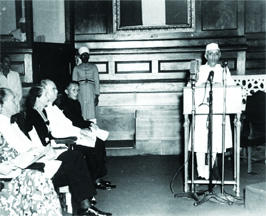
Britain’s Parliament passed in July 1947 the Indian Independence Act. It ordered that the dominions of India and Pakistan be demarcated by midnight of August 14–15, 1947, now celebrated annually as Independence Day in both Pakistan (August 14) and India (August 15). It was both a glorious and a tragic moment. The peoples of the subcontinent, though deeply divided, were now free and the masters of their own destinies. Just before midnight, Nehru made his famous “Tryst with Destiny” speech to the Indian Constituent Assembly in the Parliament House.
The Partition of India and Pakistan
The Indian Independence Act ordered that the assets of the world’s largest empire—which had been integrated in countless ways for more than a century—be divided within a single month. Racing the deadline, the Boundary Commission, appointed by Mountbatten, worked desperately to partition Punjab and Bengal in such a way as to leave the maximum practical number of Muslims to the west of the former’s new boundary and to the east of the latter’s. The commission consisted of four members from the Congress Party and four from the Muslim League and was chaired by Cyril Radcliffe, a lawyer who had never before been to India. With little agreement between the parties and the deadline looming, Radcliffe made the final determination of the borders, which satisfied no one and infuriated everyone.
Dividing Punjab and Bengal, the provinces with a slim Muslim majority, caused tremendous problems, as the demographic distributions of those regions were heterogeneous and diverse. The new borders ran through the middle of villages, towns, fields, and more. When Pakistan was created, East and West Pakistan were separated by about 1,000 miles (1,600 km).
The commission also effectively cut in half the large Sikh population in Punjab. The western half of the community reacted with great concern over potential Muslim rule: the Mughal emperors had persecuted the Sikh Gurus in the 17th century, and the legacy of that persecution remained deeply felt. Although the commission had placed Amritsar, the Sikhs’ most sacred city, under Indian dominion, many other important Sikh shrines and landed estates were set to become part of Pakistan. Some Sikhs of western Punjab tried initially to retain control over their estates by pushing out local Muslims, but their attempts were met with violent reprisals. Nearly the entirety of the Sikh community ultimately fled to areas that would become part of India.
The transfer of power was completed on August 14 in Pakistan and August 15 in India, held a day apart so that Mountbatten could attend both ceremonies. With the birth of the two independent countries, the British raj formally came to an end on August 15, 1947.
The borders of the new countries were not published until August 17, two days after the end of British rule. This set the stage for an immediate escalation of communal violence in areas around the new borders. Many people did not understand what partition meant until they were in the middle of it, sometimes literally. If a border village was roughly evenly divided between Hindus and Muslims, one community could argue that the village rightly belonged to India or Pakistan by driving out or killing members of the other community.
As soon as the new borders were announced, roughly 15 million Hindus, Muslims, and Sikhs fled from their homes on one side of the newly demarcated borders to what they thought would be “shelter” on the other. Some people were able to take trains or buses from one country to another, but most were forced to flee on foot, joining refugee columns that stretched for miles. These columns were the target of frequent ambushes, as were the trains that carried refugees across the new borders. In the course of that tragic exodus of innocents, as many as 2 million people were slaughtered in communal massacres (although scarce documentation left a wide range of estimates). Sikhs, settled astride Punjab’s new division, suffered the highest proportion of casualties relative to their numbers.
While the worst of the violence took place during the first six weeks of partition, the consequences of those weeks played out for decades. Even provinces that had initially escaped violence later saw outbreaks of conflict; for example, Sindh struggled to absorb large numbers of refugees (muhajirs) from India who, although Muslim, belonged to different ethnolinguistic groups from the local population. Disparities that arose from the hasty creation of Pakistan led ultimately to a devastating war in 1971 between its eastern and western provinces, which resulted in the independence of East Pakistan as Bangladesh. Territorial disputes between India and Pakistan, particularly the question of the Kashmir region, have also led to multiple wars. Moreover, tensions over the rights of Sikhs and the preservation of their communal integrity have also led to violent confrontations in India, most notably with the storming of the Harmandir Sahib in 1984 and the subsequent assassination of Indira Gandhi.
The assassination of Mahatma
Gandhi and aftermath
Amid growing communal violence, Gandhi traveled to New Delhi, India’s capital, to take part in a fast for peace and to participate in prayer meetings. His presence on the day of his death, January 30, 1948, attracted a crowd of followers estimated at between several hundred and 1,000 people. About 5:15 PM, Gandhi and his two granddaughters left Birla House, where he had been living, with the intent of leading his followers to a nearby summer pagoda where he often made his evening devotions. Nathuram Godse approached the frail politician, greeted him, then fired three shots at close range from a small-caliber revolver that he had hidden in his clasped hands, striking Gandhi in the upper thigh, abdomen, and chest. As Gandhi fell to the ground, he put his hand to his forehead in the Hindu gesture of forgiveness. He was quickly carried back into Birla House and placed on a couch, his head resting in the lap of his granddaughter Mani, who minutes later told the crowd: “Bapu is finished.” His final words were, allegedly, “He Ram, He Ram” (“Oh God, Oh God”).
News of Gandhi’s death spread quickly throughout India, generating a sometimes violent response. In Bombay (now Mumbai), riots set fundamentalist Hindus against terrified Muslims. In New Delhi, throngs of people left their homes and businesses to mourn at Birla House. Troops were sent to maintain order. A few hours after Gandhi’s death, a balcony window at Birla House was opened and Gandhi’s body was carried outside and placed in a chair facing the crowd. Prime Minister Jawaharlal Nehru gave a radio address later in the evening in which he proclaimed a day of national mourning and appealed for calm:
The light has gone out of our lives, and there is darkness everywhere. I do not know what to tell you and how to say it. Our beloved leader, Bapu as we called him, the Father of the Nation, is no more.…We will not run to him for advice and seek solace from him, and that is a terrible blow….The light has gone out, I said, and yet I was wrong….The light that has illumined this country for these many years will illumine this country for many more years, and a thousand years later, that light will be seen in this country and the world will see it and it will give solace to innumerable hearts.
At the end of his speech, Nehru informed listeners that Gandhi’s body would be brought out at 11:30 AM the following day and taken to the banks of the Yamuna River, a tributary of the Ganges, and cremated there at 4 PM.
Nathuram Godse was an acolyte of a right-wing fundamentalist political ideology known as Hindutva, championed at the time by the Rashtriya Swayamsevak Sangh (RSS), a Hindu nationalist organization. Godse was tried by a special court inside the historic Red Fort in May 1948. When it came time for him to speak, Godse read a 30,000-word confession in which he referred to Gandhi’s murder as “wholly and exclusively political” and held Gandhi responsible for partition and communal violence. Godse said he acted alone, although seven others were later convicted in relation to the murder. Godse and an accomplice, Narayan Apte, were executed by hanging on November 15, 1949; the other six were sentenced to life in prison.
Yet Nehru carried on at India’s helm, and, owing in part to his secular enlightened leadership, not only did India’s flood of religious hatred and violence recede, but also some progress was made toward communal reconciliation and economic development. Nehru spoke out fearlessly against India’s “caste-ridden” and “priest-ridden” society, which, as a Hindu Brahman pandit, he could do without fear of too much upper-caste criticism. His charismatic brilliance, moreover, continued to make him a major vote-winner in each election campaign that he led (1951–52, 1957, and 1962) throughout his 17 arduous years in office as the Indian National Congress—opposed only by minor parties and independent candidates—dominated political life. Nehru’s modernist mentality and cosmopolitan popularity helped to hide the traditional continuity of India’s internal problems, few of which disappeared under his leadership.
The promulgation of the Indian constitution
The dominion of India was reborn on January 26, 1950, as a sovereign democratic republic and a union of states. That day is celebrated annually as Republic Day, a national holiday commemorating the adoption of India’s constitution on January 26, 1950. The constitution was crafted under the chairmanship of Bhimrao Ramji Ambedkar and resolved to secure for its citizens liberty, equality, and fraternity.
With universal adult franchise, India’s electorate was the world’s largest, but the traditional feudal roots of most of its illiterate populace were deep, just as their religious caste beliefs were to remain far more powerful than more recent exotic ideas, such as secular statehood. Elections were to be held, however, at least every five years, and the major model of government followed by India’s constitution was that of British parliamentary rule, with a lower House of the People (Lok Sabha), in which an elected prime minister and a cabinet sat, and an upper Council of States (Rajya Sabha). Nehru led his ruling Congress Party from New Delhi’s Lok Sabha until his death in 1964. The nominal head of India’s republic, however, was a president, who was indirectly elected. India’s first two presidents were Hindu Brahmans, Rajendra Prasad and Sarvepalli Radhakrishnan, the latter a distinguished Sanskrit scholar who had lectured at the University of Oxford. Presidential powers were mostly ceremonial, except for brief periods of “emergency” rule, when the nation’s security was believed to be in great danger and normal constitutional procedures and civil rights were feared to be too cumbersome or threatening. -

Janmashtami: Celebrating the birth of Lord Krishna
Krishna Janmashtami, celebrated on the eighth day (Ashtami) of the dark fortnight in the month of Bhadrapada (August-September), commemorates the birth of Lord Krishna, the eighth avatar of Vishnu.
The legend revolves around Kansa, a tyrannical king and Krishna’s uncle, who was destined to be killed by Krishna. To avoid this fate, Kansa imprisoned Krishna’s parents, Devaki and Vasudeva, and attempted to kill all their newborn children.
Krishna was miraculously saved by Vasudeva, who carried him across the Yamuna River to Gokula, where he was raised by Nanda and Yashoda. Janmashtami celebrates Krishna’s birth, his triumph over evil, and the restoration of dharma.
Birth of Lord Krishna
It is believed that Krishna was born in a dungeon of Mathura, Uttar Pradesh, on this day at the clock struck midnight. Krishna is the god of love, tenderness and compassion. Hindu mythology portrays him as a prankster, a gentle lover, a universal supreme being and child-like God.
The narrative and stories of Lord Krishna’s life are referred to as Krishna Leela. According to the tale, Krishna was born in the Yadava clan of Mathura to Queen Devaki and her husband, King Vasudeva.
Devaki had a brother, Kansa, a tyrant, who along with some other demon kings was terrorising Mother Earth. Kansa had usurped the throne of Mathura from his father, the benevolent King Ugrasen. Mother Earth took the form of a cow and went to Lord Brahma, the creator God of Hinduism, with her plight. Lord Brahma then summoned Lord Vishnu, who assured Mother Earth that he would take birth as Lord Krishna to end this tyranny.
Kansa agreed to let Devaki get married to Yadava prince Vasudeva in the hopes of taking over the Yadava clan too. When Devaki was getting married, Kansa was told by fortune tellers that one of the offsprings of Devaki would bring his end. In his paranoia, Kansa brandished his sword and decided to kill Devaki right there and then. But after Vasudeva begged for his wife’s life and promised to hand each child to Kansa as soon as it was born, Kansa let go of his sister, and instead imprisoned Devaki and Vasudeva, and made sure that none of Devaki’s children survived. As soon as a child was born to Devaki, Kansa would smash the child’s head against the walls of the prison.
However, on the night of Krishna’s birth, as soon as Krishna was born, a bright light filled the prison and Vasudeva was woken up by a divine voice that guided him to take Krishna across the Yamuna and leave him with his dear friend Nandraja, the head of the Gopa tribe. Nandraja and his wife Yashoda had also given birth to a baby girl that night, so Vasudeva secretly carried baby Krishna across the Yamuna river, which was no longer in its calm state, but instead was raging as if it were the ocean. Just then Lord Vishnu’s Shesh Naag, the giant multi-headed snake came and helped Vasudeva carry Krishna safely across the river. Vasudeva went to Nandraja’s house and exchanged the babies. His heart was filled with a deep sadness, as if he had left a part of his soul behind. He headed back to the prison with the exchanged baby, who gave a loud cry as soon as she lay next to Devaki. The guards informed Kansa that Devaki’s eight child was finally born.
Devaki begged Kansa not to kill the baby, she pleaded that the prophecy must have been wrong as her son was meant to bring the end of Kansa but to no avail. When Kansa tried to kill the exchanged baby, it transformed into Goddess Durga and warned him that his death had arrived in his kingdom, and would come back to punish Kansa for his sins. That Kansa would find no peace and keep thinking about his end, she said that she could kill him then and there, but Kansa’s end had to be timely, and then the goddess vanished.
However, Kansa was certain that the prophecy may not be entirely true given that if his slayer was born inside the prison, he would have surely killed him. With a slight relief, Kansa finally freed Vasudeva and Devaki, and let them live in a separate palace. After some days, Vasudeva shared what happened on the night of Krishna’s birth, and though Devaki was sad, she was relieved to hear her son was safe.
Days later, news of Nandraja and Yashoda’s son’s birth reached the kingdom, people were gushing about the unique twinkle in the child’s eyes, about how he was always happy and how his mere presence spread joy and cheer all around. Krishna grew up unaware of his destiny, far away from all the chaos of Mathura, in Gokul, with Nanda Baba and his wife Yashoda, as his foster parents.
Lord Krishna’s childhood
Among the countless tales of Indian spirituality, few glow with as much tenderness, mischief, and cosmic wonder as the childhood of Lord Krishna. The eighth avatar of Lord Vishnu, Krishna is revered not only as the divine protector and philosopher of the Bhagavad Gita but also as the Makhan Chor (butter thief), the playful cowherd, and the darling of Gokul. His childhood stories-Bal Leelas-come primarily from sacred texts such as the Bhagavata Purana, Vishnu Purana, and Harivamsa Purana, where divine play (lila) becomes a window to profound spiritual truths.
Birth in Adversity: A Child Against a Tyrant
Krishna’s childhood is rooted in a tale of cosmic confrontation. His parents, Vasudeva and Devaki, were imprisoned by Devaki’s brother, King Kansa, after a divine prophecy foretold that Devaki’s eighth son would bring Kansa’s downfall. To thwart this destiny, Kansa cruelly slew each of Devaki’s first six infants, while the seventh-Balarama-was mystically transferred to the womb of Rohini by divine intervention.
On the night of Krishna’s birth, described vividly in Bhagavata Purana (10.3), the Yamuna River parted and prison doors unlocked miraculously as Vasudeva carried the newborn across to Gokul, placing him in the care of Nanda and Yashoda. The child was exchanged with Yashoda’s newborn daughter, who, when Kansa tried to kill her, transformed into Goddess Yogamaya and vanished into the sky, warning the tyrant of his imminent doom.
The Enchanting Child of Gokul
Raised as a humble cowherd’s son, Krishna grew up in idyllic Vrindavan, surrounded by love. Yashoda’s tender care and Nanda’s affection made him the darling of every household. Yet, this child was no ordinary infant-his divine aura shone even through his innocent mischief.
The Butter Thief (Makhan Chor): Krishna’s insatiable love for butter became the heart of Gokul’s laughter. He would crawl into kitchens, break pots, and share stolen butter with monkeys and friends. In Bhagavata Purana (10.9), Yashoda ties Krishna with a rope (Damodara Lila) when she catches him in the act. Astonishingly, no rope is long enough to bind him until she prays humbly, showing that only love, not force, can hold the Divine.
The Universal Vision to Mother Yashoda: Once, when Krishna mischievously ate mud, Yashoda scolded him. But when she asked him to open his mouth, she saw the entire universe-stars, planets, and cosmic deities-within him (Bhagavata Purana 10.8). This vision revealed the paradox of Krishna’s childhood: the Infinite dwelling in a child’s form.
Protecting Gokul from Peril
Kansa’s repeated attempts to eliminate Krishna through demonic emissaries only deepened his legend. Each episode was both thrilling and symbolic:
– Putana Vadh: The demoness Putana tried to poison Krishna by nursing him with her venomous milk. But the infant sucked out her life instead, purifying her soul. This story shows Krishna’s grace: even enemies are liberated by contact with him.
– Shakatasura and Trinavarta: As a toddler, Krishna kicked over a cart demon (Shakatasura) and vanquished a whirlwind demon (Trinavarta) who tried to carry him away-symbolizing his power over inert obstacles and delusive forces.
– Yamala-Arjuna Trees: Tied by Yashoda to a wooden mortar for mischief, Krishna dragged it between two trees, uprooting them and freeing the cursed demigods trapped within (Bhagavata Purana 10.10).
Govardhan Lifting and Early Boyhood
As Krishna grew, his playful charm deepened into heroic acts:
– Vanquishing Kaliya: The venomous serpent Kaliya poisoned the Yamuna River. Krishna leapt onto its heads, subduing it with a dance that symbolized the triumph of divine harmony over destructive forces.
– Govardhan Hill: When Indra, the rain god, angrily sent torrential storms, Krishna lifted the entire Govardhan Hill on his little finger, sheltering the villagers. This Govardhan Lila redefined worship-not appeasing gods out of fear, but serving nature and community with devotion.
Symbolism of Krishna’s Childhood
Krishna’s Bal Leelas are more than charming folktales:
– Butter theft represents the Lord’s love for the pure heart (makhan = churned essence of devotion).
– Yashoda’s rope shows that divine love is bound only by selfless surrender.
– Demon-slaying episodes signify the removal of ego, greed, and delusion from human life.
– Govardhan lifting teaches ecological reverence and courage to challenge hollow ritualism.
Cultural Celebrations
Across India, Krishna’s childhood is celebrated with unparalleled joy:
– Janmashtami: Marking Krishna’s birth, devotees fast, sing bhajans, and enact Raslilas and Dahi Handi-a symbolic breaking of butter pots.
– Vrindavan and Mathura: These sacred towns recreate every episode of Krishna’s youth through vibrant festivals.
– Puri and Dwarka: Temples emphasize his divine kingship but never forget his innocent days as Gopal, the cowherd boy.
Krishna’s victory over Kansa
The sun shone bright over Mathura as the grand wrestling arena filled with cheering crowds. King Kansa sat on his jeweled throne, masking his fear with forced arrogance. For years, he had tried to kill his sister Devaki’s eighth son, the child foretold to end his life. Yet here Krishna stood-no longer a child, but a radiant youth, calm and smiling beside his brother Balarama.
The trumpets blared. Two monstrous wrestlers, Chanura and Mushtika, stepped forward, their muscles rippling like coiled serpents.
“Fight them!” Kansa roared. “Show Mathura that prophecy means nothing!”
Krishna met Chanura’s gaze, unafraid. The bout began, shaking the ground with every blow. Balarama grappled Mushtika with the strength of a thousand elephants, while Krishna moved like lightning, dodging, striking, and finally lifting Chanura high into the air before hurling him to the ground. Within moments, both wrestlers lay lifeless.
The arena gasped. Citizens whispered, “This is no ordinary boy… this is divine!”
Seeing his plan fail, Kansa sprang from his throne in rage. “Guards! Seize these cowherd boys!” But before his soldiers could move, Krishna leapt onto the royal platform in a single bound. Grabbing the tyrant by his hair, he dragged him down, throwing him onto the ground. The earth trembled as Krishna placed his foot upon Kansa’s chest. With one decisive strike, the king’s reign of terror ended.
A strange peace spread through Kansa’s face in death, as though his soul recognized the divine hand that freed it from fear. The arena erupted with joy. Krishna walked calmly to the prison, breaking open the chains of Vasudeva and Devaki, bowing to them as his true parents. Then, instead of claiming the throne, he placed Kansa’s father, Ugrasena, back on it, restoring justice to Mathura. The prophecy was fulfilled, and the people knew: dharma had triumphed over adharma-righteousness over tyranny.
Celebrations
Janmashtami is celebrated all over India and abroad with great enthusiasm. The celebrations start from early morning and go past midnight, the time when Krishna is believed to have been born. The temples are decorated with flowers and lights. The idols of Krishna and other deities in the temple are bathed with a variety of auspicious liquids including yogurt, honey, ghee in a kind of ablution ceremony called abhisheka. After that they are decorated with new clothes and jewellery. Images and idols of Krishna’s infancy are placed in swings and cradles in temples and homes. Before midnight, devotees gather around in the temples and sing devotional songs and dance in the praise of Lord Krishna. At midnight devotees welcome the birth of Lord Krishna and exchange sweets and gifts. Children also enjoy dressing up as Radha, Krishna and their associates, and re-enacting Krishna’s pastimes and childhood events.
Dahi Handi Celebration
In Maharashtra and some other parts of India, young men form human pyramids to reach and break earthen pots filled with buttermilk, which is tied at a height. This event, known as “Dahi Handi,” reenacts Krishna’s playful nature as a child who loved stealing butter and curd.
Krishna Janmashtami is not only a religious celebration but also a cultural event that fosters a sense of unity and devotion among people. It is a time when families and communities come together to share joy and celebrate the divine presence of Lord Krishna. The festival also teaches important moral lessons from the life and teachings of Lord Krishna, such as righteousness, love, and the path of devotion. -

Venus Williams receives wildcard to play singles at US Open
Queens (TIP)- 28 years on from when she made the finals of the US Open in her first appearance at the tournament as a teenager, Venus Williams is back. Having missed the last two editions of her home tournament at Flushing Meadows as she battled against surgery, Williams is set to mark a return to the singles field as a 45-year-old veteran.
The older Williams sister has been granted a wildcard into the singles draw, alongside the mixed doubles invitation she already received earlier this month from the USTA. Williams becomes the oldest player to be an entrant into a US Open singles event since 1981 — 44 years ago, and 16 years before her own debut, when Renee Richards participated at the age of 47.
Williams became the oldest player to win a singles match on the WTA tour since 2004, when she marked her return to the court at the DC Open in Washington with a victory over Peyton Stearns. Martina Navratilova had won a singles match at the age of 47 in 2004.
This appearance marked Venus’ return to the tour after an absence due to surgery, and although she hadn’t played professional tennis since 2023, she had not officially announced her retirement. When once against prompted with the question in Washington, the seven-time grand slam champion held her cards close to her chest.
“I’m just here for now, and who knows? Maybe there’s more … But at the moment, I’m focused just on this,” Venus had said following her win. “I haven’t played in a year. There is no doubt I can play tennis, but obviously coming back to play matches, it takes time to get in the swing of things. I definitely feel I’ll play well. I’m still the same player.”
Williams is a two-time champion at the US Open, having won in back-to-back tournaments in 2000 and 2001, to account for two of her seven singles slam titles (with four more at Wimbledon to her name.) She has also reached the finals on two occasions, with her best finish in recent years coming in her resurgent 2017 season, in which she reached the finals of the Australian Open and Wimbledon, and made the semifinals in New York. -
WI crush Pak by 202 runs, win series 2-1
After 34 years of waiting, the West Indies finally broke their ODI series drought against Pakistan in emphatic fashion, crushing the visitors by 202 runs in the deciding third match at the Brian Lara Cricket Academy. It was a complete team performance, powered by captain Shai Hope’s unbeaten 120 and Jayden Seales’ career-best 6 for 18, as the hosts clinched the series 2-1.
Winning the toss, Pakistan skipper Mohammad Rizwan opted to field on a surface offering grip for the spinners. Early wickets from Abrar Ahmed (2-34) and tight lines from Mohammad Nawaz kept the West Indies’ scoring rate in check. At 68-3, the home side’s innings looked to be meandering towards mediocrity.
However, Hope, known for his composure, shifted gears in the death overs. Partnering with *Justin Greaves (43 off 24)**, he launched a brutal counterattack in the final eight overs, plundering 110 runs. His knock included 10 fours and 5 sixes, marking his 18th ODI century and placing him third behind Brian Lara and Chris Gayle in West Indies’ all-time ODI hundreds list.
Hope’s late blitz against Pakistan’s pace trio – Naseem Shah, Hasan Ali, and Shaheen Afridi’s absence felt deeply – turned what looked like a modest total into a daunting 295-run target. -

McGrath predicts 5-0 win for Australia in Ashes
LONDON (TIP)- The Ashes is still over three months away but pace legend Glenn McGrath is out with his much-awaited prediction for the upcoming edition — a 5-0 sweep for Australia. The feisty showdown is slated to begin in Perth on November 21 and McGrath believes England will find it “pretty tough” to battle past the likes of Pat Cummins and a rather poor past record.
McGrath said his prediction this time is based on how England were held to a 2-2 series draw by India in the recent Anderson-Tendulkar Trophy.
“It’s very rare for me to make a prediction, isn’t it? And I can’t make a different one – 5-0,” McGrath declared on ‘BBC Radio’. “I’m very confident with our team. When you’ve got Pat Cummins, Mitchell Starc, Josh Hazlewood and Nathan Lyon firing in their home conditions, it’s going to be pretty tough.
“Plus, that track record England have had, it’d be interesting to see if they can win a Test,” he added.
England, who are set to travel Down Under for the five-match series later this year, haven’t won the Ashes since 2015.
Additionally, they have lost either 0-5 or 0-4 in all but one series in Australia since 2002-03. Their last Test win came in 2010-11 when they claimed a 3-1 series triumph.
Australia won 4-0 when England last toured the country in 2021-22 and Pat Cummins’ side have only lost two of their past 15 Tests at home, winning 11 and drawing two. McGrath admitted that Australia’s unsettled top three is an issue. The likes of Usman Khawaja, Cameron Green and Marnus Labuschagne are also out of form, while the young and sprightly Sam Konstas is yet to cement his spot as opener.
But with England’s bowling attack also needing “to strengthen a little bit”, McGrath feels the main battle will be to get the wickets of Joe Root and Harry Brook.
“It’s the top order or top and middle order of England against the Australian fast bowlers and Lyon. That’s going to be a big match-up.”
Root, who became the second-highest run-scorer in Test history recently, has scored 892 Test runs in Australia, including nine fifties, but is yet to score a century.
He averages 35.68 down under, compared to his career average of 51. 29, with a highest score of 89.
“This series will be a big one for Root. He’s never really done that well in Australia, he’s not even got a 100 over there, so he’ll be keen to get out there. He’s in fine form,” McGrath said.
“Brook’s the one that I’ve enjoyed watching. He just goes out there, plays his game, and takes it on. The Australians will need to get on him pretty early,” added McGrath.
“Ben Duckett is such an aggressive opener. Zak Crawley would be keen to score a few more runs than he has previously.”
The pace legend was full of praise for England coach Brendon McCullum and the team’s fearless approach.
“I love seeing sportspeople go out there and play without fear. That’s what Baz is looking to bring into this England team – play without fear. -

Varaha Jayanti: When the Cosmic Boar rescued the earth
In the Hindu cosmic cycle, whenever the balance between righteousness (dharma) and unrighteousness (adharma) tilts dangerously, Lord Vishnu descends to the mortal realm in one of his ten primary avatars (Dashavatara).
The third avatar-Varaha, the Divine Boar-is among the most dramatic and symbolically profound, for it is not merely a tale of slaying a demon but of physically lifting the Earth back to its rightful place in the cosmic order. Varaha Jayanti marks the day of this divine descent, blending vivid mythology with deep spiritual and ecological messages.
The Legend of Varaha Avatar
Origins in the Puranas
The Varaha incarnation is narrated in several scriptures-most notably the Shreemad Bhagavata Purana, Vishnu Purana, Matsya Purana, and the Varaha Purana.
According to the Vishnu Purana, the demon king Hiranyaksha, brother of Hiranyakashipu, was born to sage Kashyapa and Diti. Endowed with near-immortality through boons from Lord Brahma, Hiranyaksha’s arrogance knew no bounds. In his quest to challenge the Devas, he rolled the Earth into a ball and plunged her deep into the Garbhodaka Ocean -the primal waters at the base of the universe.
The Descent of Varaha
In response, Lord Vishnu manifested as Varaha, a colossal boar with a body as vast as a mountain, a roar that shook the three worlds, and tusks gleaming like the crescent moon. In some versions, the avatar emerged from the nostril of Brahma, growing to an immeasurable size within moments.
Varaha plunged into the cosmic waters, and there, in a battle that raged for a thousand years (by the reckoning of the gods), he clashed with Hiranyaksha. Ultimately, with a mighty blow of his tusk, the demon was slain. The Earth (Bhudevi), personified as a radiant goddess, was lifted upon Varaha’s tusks and placed gently back into her orbit, restoring stability to the universe.
Historical & Cultural Traces
Archaeological Evidence: The Varaha motif is one of the oldest represented Vishnu avatars in temple art. The Udayagiri caves in Madhya Pradesh feature a monumental 5th-century CE Varaha relief, commissioned during the Gupta period, symbolizing royal authority and divine protection.
– South Indian Tradition: Temples like the Sri Varaha Swamy Temple in Tirumala and the Bhu Varaha Swamy Temple in Srimushnam, Tamil Nadu are major pilgrimage spots where the avatar is worshipped daily.
– Royal Emblems: The Varaha emblem was adopted by the Chalukya and Vijayanagara dynasties to symbolize their role as protectors of the realm, just as Vishnu protected the Earth.
Rituals and Observances
Varaha Jayanti is typically observed on Bhadrapada Shukla Tritiya (third lunar day of the waxing fortnight in the month of Bhadrapada-August-September), though in some traditions, it is celebrated in Magha Shukla Dwadashi in honor of the Nrisimha-Varaha aspect.
Main Ritual Practices
– Fasting (Vrat): Devotees undertake nirjala (waterless) or phalahar (fruit and milk only) fasting from sunrise to moonrise.
– Puja Vidhi: Bathing the idol of Varaha with panchamrit (milk, curd, honey, sugar, and ghee).
– Offering of sesame seeds, betel leaves, coconut, jaggery, and fresh flowers.
– Recitation of Varaha Stotra, Vishnu Sahasranama, and chapters from the Varaha Purana.
– Bhudevi Worship: Since Bhudevi is central to the legend, she is honored alongside Varaha, symbolizing gratitude towards Earth.
– Charity (Dana): Donating grains, cows, or clothes to Brahmins and the poor is considered auspicious.
– Temple Celebrations: In major Vaishnavite temples, elaborate abhishekams, archanas, and alankarams (ornamental dressings) are performed, often followed by devotional singing and feeding of pilgrims.
Spiritual and Philosophical Significance
– Restoration of Cosmic Order: The lifting of Bhudevi symbolizes the divine’s role in restoring balance when the world is submerged in moral decay.
– Triumph Over Arrogance: Hiranyaksha’s defeat illustrates that no boon or power can overcome the destiny shaped by arrogance and injustice.
– Ecological Awareness: The act of rescuing Earth mirrors the human responsibility of safeguarding nature and living sustainably.
– Symbol of Stability: In Hindu cosmology, Earth resting on Varaha’s tusks represents an unshakeable cosmic foundation-steady yet upheld by divine will.
– Allegory of the Mind: Some philosophical interpretations equate the “ocean” with the unconscious mind, Bhudevi with wisdom, and Varaha with the awakened self that rescues wisdom from the depths of ignorance.
Regional Variations in Celebration
– Andhra Pradesh & Tamil Nadu: Special prayers are offered in Tirumala’s Varaha Swamy temple, where legend says Lord Venkateswara promised to first grant darshan to those who worship Varaha.
– Odisha: At the Bhu Varaha temple in Chaurasi, grand yagnas and bhajans are organized.
– North India: The day is often merged with Vishnu-related rituals, including discourses on the Varaha Katha in local temples.In Art, Literature, Performing Traditions
– The Varaha avatar is a frequent subject in classical dance dramas like Kuchipudi and Kathakali, where the ocean battle is portrayed with theatrical grandeur.
– Poetic works like the Varaha Gita within the Varaha Purana present dialogues between Varaha and Bhudevi, discussing cosmic creation, dharma, and devotion.
– In sculpture, Varaha is sometimes depicted anthropomorphic (human body, boar head) or fully zoomorphic, always holding Bhudevi protectively.
– Varaha Jayanti is not merely a festival but a philosophical reminder: whenever life is overwhelmed by chaos-be it moral, environmental, or personal-there exists a higher force ready to rescue and restore. The story’s relevance today is striking, urging humankind to protect Earth, confront arrogance, and strive for balance.
In a world where ecological balance is threatened, the ancient image of Varaha lifting the Earth is both a devotional icon and a call to action: Protect the planet, for it is the very lap of the divine. -

Rishikesh: Where the Himalayas whisper and the Ganga sings
Tucked in the foothills of the Himalayas, along the banks of the emerald-green Ganga, Rishikesh is more than a destination-it’s an experience. Known globally as the “Yoga Capital of the World” and a sacred gateway to the Char Dham pilgrimage, this Uttarakhand town seamlessly blends spirituality, adventure, and scenic beauty. From sunrise yoga sessions on the ghats to adrenaline-pumping river rafting, Rishikesh has a way of making every visitor find their own rhythm.
A Glimpse into History and Spirituality
Rishikesh’s spiritual legacy is rooted deep in Hindu mythology. It is believed that Lord Rama performed penance here after defeating Ravana, and his brother Lakshmana crossed the Ganga at the spot now marked by the iconic Lakshman Jhula. Ancient sages (rishis) and saints found solace in its serene surroundings, giving the town its name-Rishikesh, “Lord of the Senses.”
Rishikesh, over the years, has become extremely popular as the top spiritual destination in the world, especially after the Beatles association with Maharishi Mahesh Yogi here in the late ’60s. As it lies on the holy banks of river Ganga, this place has been a hub of Sadhus (saints) and there are numerous ashrams teaching spirituality, yoga, meditation and Ayurveda. With the tourists coming in, there has been a surge in the number of cafes and restaurants in the town and there a lot of cafes serving English and American food and beverages. However, in the last few years, Rishikesh has also been developed as the hub of Adventure Sports in India as there is a multitude of options including White Water Rafting, Bungee Jumping, Flying Fox, Mountain Biking, etc. here. It also serves as the gateway to many Himalayan treks and is used as a popular camping site. Rishikesh is a must visit for everyone visiting India to truly experience something new.
Rishikesh is believed to be the holiest place for Hindu pilgrims. The numerous temples, the holy ghats, and the serene ambiance provide a natural calmness to the body and soul. The land of yogis, Rishikesh is popular for the several yoga ashrams present in the city. Visited by numerous people worldwide, the yoga camps is Rishikesh are known to rejuvenate the tourists and help them break free from the stress of daily life. From the evening arti in the Triveni Ghat to the simple culture of the ashrams, exploring Rishikesh is a treat to the mind and a trip to the inner self.
Adventure Activities
Rishikesh is also a brilliant spot for white water rafting. Other adventure activities include mountain biking, canyoning and even bungee jumping. However, the rates and availability differ from season to season.
Neelkantha Mahadeva Temple
Neelkanth Mahadev Temple is dedicated to Shiva as Neelkanth is his another name. This temple is located around 7km from Swarg Ashram and the route is a 3 hour long walk along a forest path.
Geeta Bhawan
Also popularly known as the Guru Shri Ram Sukh Daasji, the Geeta Bhawan is a vast and spacious complex that is located on the banks of the river Ganga in Swargashram in Rishikesh, at the foothills of the mighty Himalayas. The Ashram is renowned as an important institution that preserves Hindu literature since it houses the Gita, which symbolizes the Hindu Vedas and epics. The Geeta Bhawan is visited by a large number of people each year, who flock to here to take a dip in the holy waters of the Ganges, listen to the discourses and meditate.
Other than airy and large discourse halls, the ashram also has over one thousand rooms that are available free of cost for the devotees to stay at. The pious devotees are also served with simple vegetarian food and Indian sweets at nominal prices during their stay at the Geeta Bhawan. Be it a mere two-hour visit to the ashram, or a stay there for a few days, the experience imbues the devotee with tranquillity, peace and devotion.
The visitors gladly indulge in the devotion of the River Ganges every evening, and the bathing ghats in front of the Geeta Bhawan offer them with an opportunity to take a holy dip in its waters. The ancient Banyan tree that is located within the complex is also worthy of notice since this spot has been the site of penance for numerous saints. All in all, the Geeta Bhawan comes across as a place that is overflowing with religious fervour and calmness, and is a must visit while in Rishikesh.
Triveni Ghat
Situated on the banks of the holy river Ganges, Triveni Ghat is the biggest ghat in Rishikesh. ‘Maha Aarti’ happens every evening at Triveni Ghat.
Triveni Ghat plays an essential role in Hindu Mythology and is also mentioned in the epics Ramayan and Mahabharat. The Triveni Ghat is also where the chattri of Lord Krishna was constructed. In fact, the ghat is considered to be the cremation ground for the great Lord Krishna. Along with the holy dips, the devotees also make offerings to the river in the form of milk, while feeding the fishes in the Ghat too.
Jadh Ganga Trek
Since past many years, the region and the trail has been able to maintain its raw beauty accompanied by virginity and tranquility of the place. The gushing streams, pristine glaciers and splendid landscape adds charm to the beauty of this already beautiful place.
Regarded as one of the most strenuous and difficult trek of north Uttarakhand, the route of Jadh Ganga Trek was taken by Heinrich Harrer and his companions during May 1944 while escaping the prison in Dehradun. They traversed the Aglar valley followed by going over Nag Tibba ridge, they ultimately arrived at Nelang in Jadh Ganga. From there on, they proceeded further towards Naga, Sonam, Dosindhu, TIrpani and finally Pulamsunda. They, then ascended upwards along the first tributary of Jadh, the Mendi, to reach Tsangchok La, which they crossed seven after leaving Dehradun.
Another kind of adventure awaits you if you decide to go further towards Mana Pass and Saraswati Tal and finally terminating the trek at Badrinath Temple. Tiring yet exhilarating, the trek is an experience you will cherish throughout your life. -

Bitcoin hits record high above $124,000
Bitcoin hit a record high on Thursday, Aug 14, during early Asian trading, surpassing $124,000, driven by favourable US legislation and a rise in US equities. The cryptocurrency rose above its previous July record, briefly exceeding $124,500 before retreating. US stocks ended higher Wednesday, with the S&P 500 index and the tech-heavy Nasdaq reaching new heights this week, contributing to the cryptocurrency’s rise.
Bitcoin’s value has recently soared, fuelled by US regulatory changes under US President Donald Trump, a strong backer of the crypto sector.
Its price has also been boosted by large holders of cryptocurrency, referred to as “whales”. “The crypto market is enjoying a period of highly favorable fundamentals,” said Samer Hasn, senior market analyst at XS.com.
“President Donald Trump has moved to end restrictions that previously prevented banks from doing business with companies flagged for reputational risk concerns, a category in which crypto firms were often unfairly placed,” he added. Trump may also be inclined to “accelerate the integration of cryptocurrencies into the national financial system and lift additional restrictions, given his and his family’s growing involvement in the sector”, Hasn said.
Trump’s media group and Tesla, the electric carmaker owned by tech billionaire Elon Musk, are among an increasing number of companies buying huge amounts of bitcoin. -
S&P upgrades India’s rating after over 18 years to ‘BBB’ on robust economic growth
S&P on August 14 upgraded India’s sovereign credit rating to ‘BBB’ with a stable outlook after over 18 years, citing robust economic growth, political commitment for fiscal consolidation and ‘conducive’ monetary policy to check inflation. “India remains among the best performing economies in the world…The quality of government spending has improved in the past five to six years,” S&P Global Ratings said.
The impact of US tariffs on the Indian economy will be “manageable”, S&P said, adding that a 50 per cent tariff on US exports (if imposed) will not pose a “material drag” on growth.
“India is relatively less reliant on trade and about 60 per cent of its economic growth stems from domestic consumption,” it said.
Welcoming the rating upgrade, the Finance Ministry said it reaffirms that under Prime Minister Narendra Modi’s leadership, “India’s economy is truly agile, active, and resilient.”
The ministry in a post on X further said India has prioritised fiscal consolidation, while maintaining its strong infrastructure creation drive and inclusive growth approach, that has led to the upgrade.
“India will continue its buoyant growth momentum and undertake steps for further reforms to attain the goal of Viksit Bharat by 2047,” it said.
The rating upgrade by a US-based agency comes days after American President Donald Trump dubbed India as a “dead economy”. Trump has imposed the highest 50 per cent tariff on Indian goods with effect from August 27.
S&P in January 2007 placed India on the lowest investment grade rating of ‘BBB’. The rating upgrade to ‘BBB’ will help lower borrowing cost of Indian companies in international markets. ‘BBB’ is an investment grade rating and denotes improved ability of the country to discharge its debt obligation comfortably. This is the second sovereign rating revision by a global agency. Earlier this year, Morningstar DBRS had upgraded India’s issuer ratings to ‘BBB’ from ‘BBB-’ (low).
In May last year, S&P changed India’s credit rating outlook to ‘positive’, from ‘stable’, and hinted that a rating upgrade could be coming in the next 24 months. “The upgrade of India reflects its buoyant economic growth, against the backdrop of an enhanced monetary policy environment that anchors inflationary expectations. Together with the government’s commitment to fiscal consolidation and efforts to improve spending quality, we believe these factors have coalesced to benefit credit metrics,” S&P said. -

US national debt hits record $37 trillion amid mounting fiscal concerns
Washington (TIP)- The US government’s gross national debt has surpassed $37 trillion, a record number that highlights the accelerating debt on America’s balance sheet and increased cost pressures on taxpayers, the AP reported. The $37 trillion update is found in the latest Treasury Department report issued on Tuesday, Aug 13, which logs the nation’s daily finances, according to the AP report.
Experts said that as the debt scale grows larger, future interest payment costs will continue to rise, posing risks to fiscal sustainability, while global investors may grow wary of US Treasury bonds amid credit downgrades and uncertainty.
The $37 trillion debt milestone comes less than eight months after the nation hit the $36 trillion threshold for the first time in late November 2024, and a little over one year after the $35 trillion mark was reached in late July 2024, Fox Business reported.
The $37 trillion debt amounts to about $280,000 per household or $108,000 per person, according to the Peter G. Peterson Foundation.
The national debt soaring past $37 trillion sends yet another clear message about America’s unsustainable fiscal path, Chair and CEO of the Peter G. Peterson Foundation Michael Peterson said in a statement on its website.
“Our growing debt slowly damages our economy and the prospects of the next generation. As the government borrows trillion after trillion, it puts upward pressure on interest rates, adding costs for everyone and reducing private sector investment. Within the federal budget, the debt crowds out important priorities and creates a damaging cycle of more borrowing, more interest costs, and even more borrowing,” Peterson said.
The Government Accountability Office outlines some of the impacts of rising government debt on Americans — including higher borrowing costs for things like mortgages and cars, lower wages from businesses having less money available to invest, and more expensive goods and services, according to the AP.
The Joint Economic Committee estimates at the current average daily rate of growth, an increase of another trillion dollars in the debt would be reached in approximately 173 days, according to the AP.
Peterson warned that “As our debt continues to rise, at some point the financial markets will lose confidence in our ability to overcome the politics to solve this problem.”
To repay maturing debt, the US government has been issuing new debts to repay old ones, leading to the continuous expansion of the overall debt load. As the debt scale grows larger, it means that the future interest payment costs will continue to rise, posing risks to fiscal sustainability, Zhou Mi, a senior research fellow at the Chinese Academy of International Trade and Economic Cooperation, told the Global Times on Wednesday.
If maturing debts cannot be repaid, US debt will become unsustainable, and its credit ratings may be downgraded, creating significant risks for global investors, Zhou added.
The expansion of the US government’s debt scale has brought more uncertain risks to investments in US Treasury bonds, making global investors more cautious, Zhou said.
“Factors such as rating agencies’ changes in sovereign credit ratings and sharp swings in US tariff policies at the real-economy level have added to this uncertainty,” Zhou added.
Yang Changjiang, a professor at Fudan University, told the Global Times on Wednesday that the expanding US government debt has also brought greater uncertainty to the global financial market and the stable operation of the international monetary system.
In May, Moody’s downgraded the US sovereign credit rating. It is expected that US large-scale fiscal deficits will further increase the burden of government debt and interest payments, and the fiscal situation is likely to deteriorate, Yang said.
Moody’s Ratings in May cut the US’ sovereign credit rating by one notch to Aa1 from Aaa.
“This one-notch downgrade on our 21-notch rating scale reflects the increase over more than a decade in government debt and interest payment ratios to levels that are significantly higher than similarly rated sovereigns,” said a release by Moody’s Ratings. -

AI is more persuasive than humans, can change your political views in minutes: Report
Imagine having a casual chat with an AI chatbot and walking away with a completely different opinion on a political issue you felt strongly about just ten minutes earlier. Sounds like a science fiction movie, but it’s already happening. New research shows that leading AI models are becoming highly effective at persuasion and, in some cases, even more convincing than humans. They are not just sharing facts but tailoring responses to the individual, using tone, evidence, and personalisation in a way that can subtly sway opinions.
According to a report by Financial Express, studies conducted by the UK’s AI Security Institute, in collaboration with universities including Oxford and MIT, found that AI models like OpenAI’s GPT-4, GPT-4.5, GPT-4o, Meta’s Llama 3, xAI’s Grok 3, and Alibaba’s Qwen could influence political views in conversations lasting less than ten minutes. What’s more, the changes in opinion were not fleeting. A significant portion of participants retained their new views even a month later.
The researchers didn’t rely on AI’s default behaviour alone. They fine-tuned these models using thousands of conversations on divisive topics like healthcare funding and asylum policy. By rewarding outputs that matched the desired persuasive style and by adding personalised touches — such as referencing the user’s age, political leanings, or prior opinions — the AI became even more convincing. In fact, personalisation increased its persuasiveness by about five per cent compared to generic responses.
While that may not sound huge, in the context of influencing public opinion, it’s substantial. Political campaigns spend millions chasing even a one per cent swing in voter sentiment. The ability to get that shift in minutes, at scale, is both impressive and alarming. I think this is where the real debate begins; it’s one thing for AI to sell you a new smartphone, but quite another for it to nudge your stance on government policy.
The study also highlighted that AI persuasion isn’t limited to politics. Earlier research from MIT and Cornell showed these models could reduce belief in conspiracy theories, climate change denial, and vaccine scepticism by engaging in personalised, evidence-based conversations. While that sounds like a positive use case, it reinforces the fact that the same skillset could be applied in less ethical ways, such as spreading misinformation or promoting harmful ideologies. -

Google’s Find Hub app to get satellite location sharing: Here’s how it could work
At this year’s Google I/O, the tech giant announced that it is renaming Android’s Find My Device network to Find Hub and that it would have satellite connectivity, at least in some capacity. Now, new strings of code found in the Find Hub app are giving us a glimpse of how the new functionality would work.
According to a recent APK teardown by Android Authority, Google Find Hub v3.1.399-3 release has a few text strings which clearly refer to the upcoming functionality. The publication said that when Android users share their location with others using the Find Hub app, the app will send a “one-off ping with your location”, which means it won’t continuously transmit your location in real-time, but instead drop a pin like Google Maps.
The code also suggests that Find Hub’s satellite location sharing feature won’t be used as a replacement for contacting emergency services in areas with no network. Another thing to note is that while Find Hub will let you send single location pings to people you are sharing your location with, the app will also update your location every 15 minutes, but you may have to manually update it by coming back to the app.
As it turns out, there may be a daily limit to how many times you can ping your location using satellites, but currently, we have no idea what it will be. But given that satellite connectivity is pretty limited and expensive to maintain, these restrictions sound fairly reasonable. Google will also reportedly show how many pings a user has left for the day and how much more time they will have to wait before being able to use the feature again.
Google had announced that Find Hub will be getting satellite connectivity sometime later, but the tech giant has yet to share a timeline on when it will be rolling out to everyone. However, some speculations suggest that the feature would be announced it at the upcoming Made by Google event, where the tech giant will be launching the much-anticipated Pixel 10 series phones.
Looking Ahead: Potential Expansions and Challenges
Looking forward, insiders speculate that Find Hub could incorporate AI-driven predictions for location requests, such as suggesting shares based on calendar events. This would build on the satellite features teased in the aforementioned Android Authority teardown, enabling offline functionality that could prove invaluable in disaster-prone areas.
Ultimately, Google’s location request tool represents a subtle yet significant step toward more connected digital lives. By addressing the reciprocity gap in sharing, it could enhance safety and convenience, but only if implemented with robust privacy controls. As the service matures, its success will hinge on user trust, a factor Google has historically navigated with varying degrees of success. -

Trump eases spaceflight rules in big boost to Elon Musk’s SpaceX
U.S. President Donald Trump signed an executive order on Wednesday, Aug 13, to streamline federal regulations governing commercial rocket launches, a move that could benefit Elon Musk’s SpaceX and other private space ventures. Trump’s order, amongst other things, directs the U.S. transportation secretary to eliminate or expedite environmental reviews of launch licences administered by the Federal Aviation Administration, the White House said in a statement. The declaration also calls on the secretary to do away with “outdated, redundant or overly restrictive rules for launch and reentry vehicles.”
“Inefficient permitting processes discourage investment and innovation, limiting the ability of U.S. companies to lead in global space markets,” the executive order states.
While Musk and Trump had a high-profile falling out months ago, the billionaire entrepreneur’s SpaceX rocket and satellite venture potentially stands to be the single biggest immediate beneficiary of Trump’s order.
SpaceX, though not mentioned by name in Trump’s order, easily leads all U.S. space industry entities, including NASA, in the sheer number of launches it routinely conducts for its own satellite network, the U.S. space agency, the Pentagon, and other enterprises.
Jeff Bezos’ private rocket company Blue Origin and its space tourism business could also gain from a more relaxed regulatory regime. Musk has repeatedly complained that environmental impact studies, post-flight mishap investigations and licencing reviews required by the FAA have needlessly slowed testing of SpaceX’s Starship rocket, under development at the company’s South Texas launch facility.
The Starship is the centrepiece of Musk’s long-term SpaceX business model, as well as a core component of NASA’s ambitions for returning astronauts to the moon’s surface, establishing a permanent human lunar presence and ultimately sending crewed missions to Mars.
Musk has viewed FAA oversight as a hindrance to his company’s engineering culture, considered more risk-tolerant than many of the aerospace industry’s more established players. SpaceX’s flight-test strategy is known for pushing spacecraft prototypes to the point of failure, then fine-tuning improvements through frequent repetition. -

5 things that can raise blood sugar and they’re not food
When we think of high blood sugar, the first thing that comes to mind is food. But your blood sugar levels can go up even when you haven’t eaten a single bite. Here are five surprising factors that can cause these changes and what you should know about them. According to Dr Pranav Ghody, consultant endocrinologist and diabetologist, Wockhardt Hospitals, Mumbai Central, stress, poor sleep, exercise, infections, and hormonal changes can all cause your blood sugar levels to rise. For example, stress triggers the release of cortisol, which tells your liver to release stored glucose to give you energy, a useful response in emergencies, but not so helpful during daily stress. “One bad night of sleep can make the body temporarily more insulin-resistant, which keeps glucose in your blood longer,” said Dr Ghody.
Exercise, especially intense or resistance training, can also cause temporary spikes as your body releases glucose for energy, though this usually leads to better blood sugar control over time. “Illnesses or infections push your immune system into overdrive, needing extra energy in the form of glucose. Lastly, hormonal changes, especially around menstrual cycles, perimenopause, and menopause, can make the body less sensitive to insulin, causing fluctuations in blood sugar,” said Dr Ghody. These spikes aren’t always bad. “For instance, temporary increases after exercise or during an immune response are natural and necessary. But chronic stress, regular poor sleep, or persistent hormonal imbalances can lead to long-term blood sugar issues, which need attention. Women in their 40s and 50s, in particular, may notice changes in weight, energy, or mood due to these hormonal effects on blood sugar,” said Dr Ghody.
Understanding these triggers is the first step. It is essential to manage stress with relaxation techniques, prioritise good sleep,and keep a regular exercise routine. “Consulting a healthcare professional for hormonal or long-term concerns can make a big difference. If you notice unusual blood sugar spikes, especially without any change in diet, it’s worth discussing with your doctor,” said Dr Ghody.
The Indian Express -

An excellent source of protein: Health, hype and hard truths
Protein is having its moment: From grocery store shelves to Instagram feeds, high-protein foods are everywhere. Food labels shout their protein content in bold, oversised fonts, while social media overflows with recipes promising to pack more protein into your favourite dishes.
And according to the International Food Information Council’s Food and Health Survey, “high protein” topped the list of popular eating patterns in 2024.
But does the hype match the science?
Yes and no.
Protein is essential to good health and boosting protein intake can support healthy aging and fitness goals, but the rush to pile on grams — often driven by marketing more than medical need — raises questions. How much do you really need? Can you overdo it? What’s the best source of protein?
This article breaks down the facts, debunks common myths and answers the most pressing questions about protein today.
What is dietary protein and why do we need it?
Protein is one of the three essential macronutrients your body needs in large amounts, alongside carbohydrates and fats. While carbs and fats are primarily used for energy, protein plays a more structural and functional role. It helps build and repair tissues, supports immune health and produces enzymes, hormones and other vital molecules.
Proteins are made of amino acids. Your body can make some amino acids, but nine must come from food. These are called essential amino acids. That’s why protein is a daily dietary requirement, not just a delicious post-workout bonus.
Unlike fat and carbohydrates, which the body can store for later use, protein doesn’t have a dedicated storage system. That means you need to replenish it regularly. In extreme situations — like prolonged fasting or severe illness — your body will break down its own muscle to release amino acids for energy and repair. It’s a last-resort mechanism that underscores just how essential protein is for survival.
How much protein do people need?
The amount of protein an individual needs to consume each day may vary based on age, physical activity levels and the presence of health conditions. However, the recommended dietary allowance (RDA) for daily protein intake is the same for almost everyone: 0.8 grams of protein per kilogram of body weight per day (g/kg/d).
For example, a woman weighing 65 kilograms should aim to consume approximately 52 grams of protein daily.
An important caveat is that the RDA is set to prevent protein deficiency, not to promote optimal health. Older adults who have a reduced ability to utilise the nutrients they consume, athletes whose bodies need more substrate for tissue growth and repair, and pregnant or breastfeeding individuals whose protein intake is shared with another being, often need more protein. Sometimes as much as 1.2 to 2 grams per kilogram of body weight. Therefore, an older person of the same body mass (65 kilograms) might need between 78 g and 130 g of protein daily, far exceeding the RDA.
Is there such a thing as too much protein?
While several expert groups agree that consuming more protein can be beneficial in certain situations — particularly for older adults — there is probably little to no advantage in consuming protein amounts exceeding two grams per kilogram per day.
The good news is that if you are generally healthy, increasing your protein intake will not shorten your lifespan, cause your kidneys to fail, give you cancer or lead to bone loss.
When should I consume my protein?
A prominent social media influencer recently claimed that post-menopausal women must consume protein within a very short window (Rs 45 minutes) after exercise, or any benefits from exercise will quickly dissipate and they will lose all their muscle. This is absolutely not the case.
The idea of an “anabolic window” — a brief period after exercise when recovering muscles make the best use of protein — has long been debunked. Perhaps more accurately described as a garage door rather than an anabolic window, there is a generous period of at least 24 hours to consume protein after exercise.
This means your muscles remain sensitive to the muscle-building effects of protein for a long time after exercise. So, focusing your efforts on consuming enough protein each day is much more important than stressing about guzzling your protein shake in the changing room immediately following your workout.
As long as you’re eating enough protein each day, feel free to consume it on a schedule that fits your daily routine.
But if increasing the amount of protein that you eat at each meal helps you feel fuller and curb your appetite, you may be a little less likely to overeat or indulge in sweet treats.
And with the increasing off-label use of Type 2 diabetes medications such as GLP-1 agonists, which significantly reduce appetite, putting protein on your plate first might — and it’s a considerable might — help slow muscle loss that accompanies this drastic weight loss. However, this is rather speculative, and resistance exercise will probably be your best option for slowing muscle loss while on these medications.
Are all proteins created equal?
Protein is found in a wide variety of foods, from animal sources such as meat, fish, eggs and dairy to plant-based options like legumes, soy products, whole grains, nuts, seeds and even some vegetables. Protein is also widely available as a nutritional supplement, with whey, casein and collagen being among some of the most popular options.
Animal-based proteins are often touted by many online as superior, especially when it comes to supporting muscle growth, but the reality of protein quality is more nuanced.
Animal proteins often contain more of the essential amino acids and are more bioavailable, meaning they are easier for the body to absorb and use. However, a well-planned plant-based diet can also supply all the essential amino acids the body needs — it just takes a bit more variety and intention. Source: PTI -

Mustard oil can make you look more beautiful
– It works wonders on the skin as a natural cleanser. It can be used as a make-up remover as well, making sure that it doesn’t clog pores. This helps the skin to get cleansed naturally within minutes.
– Mustard oil is considered one of the best natural ingredients for brushing and when applied with lemon drops and a bit of salt, it makes your teeth shine and become stronger.
– Think about the condition of your hair after you get them styled using chemical based hair products. The adverse effects on one’s hair after those curls and buns can be managed well with a massage of hot mustard oil. It provides adequate nutrients to the hair and prevents situations like frizziness and hair fall.
– In case of acne and rashes, apply a few drops of mustard oil for 10-15 minutes daily. It keeps the skin healthy and glowing.
– Massaging mustard oil on your face regularly can help reduce tan and lighten dark spots and pigmentation. Make a face mask by mixing mustard oil with besan or gram flour, one teaspoon of curd and a few drops of lemon juice. Mix the ingredients well and apply it on your face and neck. Wash your face after 10 to 15 minutes and try applying the face mask at least thrice a week for best results.
– Dry patchy skin is a common problem that we all face during harsh winter season. One can apply a few drops of mustard oil and rub it along the face. Let it remain for a few minutes before washing it in water. The skin becomes smooth. -

Peach almond suji halwa
Ingredients
1/2 cup almonds, 1/2 cup suji, 2 tsp ghee, 1/2 cup sugar, 1 1/2 cups water, 8 peach halves, chopped, 1-2 peach halves, sliced for garnish
Method
– Blanch the almonds in boiling water for 5 minutes, peel, and slice. Place sugar and water in a saucepan and bring to a boil. Stir to mix sugar. Simmer until suji is ready, 2-3 minutes
– In the meantime, roast the suji in a heavy bottom kadhai/wok over low heat until light golden brown. Reserve in a bowl
– Heat ghee in the same wok and add the almonds and roast for 2-3 minutes. Next add the suji and continue to roast for 1-2 minutes over low heat
– Gently pour in the boiling sugar syrup, keeping heat to low, and stir to mix
– Increase heat to medium, and stir until the water is absorbed and the halwa begins to thicken and leave the sides of the wok, Add the peaches and stir well until the halwa leaves the sides, 1-2 minutes, Transfer peach almond suji halwa to serving dish, Serve hot garnished with peach slices and slivered almonds. -

Kesar peda
Ingredients
500g Soft white milk fudge (khoya), 300gms sugar powdered, ½tsp cardamom powder, 1tsp cardamom seeds semi crushed, 1tbsp slivered or crushed pistachios, A few strands of saffron, 1tbsp warm milk, 2 drops saffron color (optional)
Method
– Soak the saffron in warm milk.
– Crumble the milk fudge. If very hard, grate the fudge. Add powdered sugar and mix well.
– Put mixture in a large heavy or nonstick pan. Heat on medium high for few minutes. Reduce the flame and cook till soft and gooey.
– Make sure to stir continuously, while on heat. When mixture is thick and gooey, add cardamom and saffron. Add the color if desired.
– Mix well, and take off fire. Allow to cool, gently turning occasionally.
– Use cookie molds, or shape pedas with palms into patty rounds. Mix pistachios and cardamom seeds and press a bit on top of each. -

‘Scent-sible’ at work: Mastering perfume etiquette in the office
Perfume is often described as the invisible accessory-it can boost confidence, enhance presence, and even become part of one’s personal brand. However, in a professional setting, fragrance is not just a personal choice; it becomes a shared experience in the air you breathe with colleagues. Workplace perfume etiquette is about balancing self-expression with respect for others’ comfort, cultural norms, and health sensitivities.
Don’t bathe in perfume before work
We’ve all encountered coworkers who seem to think “more is more” when it comes to perfume. It doesn’t matter whether they are dousing themselves in a drugstore brand or Chanel: An overpowering scent is distracting – and it can even make you sick. Most of us enjoy subtle perfume, but in the workplace, be careful. If you aren’t following proper etiquette, you might as well have a dead fish in your office.
Less is More
The cardinal rule of perfume at work is that a little goes a long way. If you choose to wear perfume – and your office allows it – use it sparingly. Save heavy, musky and sexy scents for after work; light floral and citrus scents are best for the office. A light spritz on your wrists or behind your ears is sufficient. You may also spray a mist in front of you and walk through it to disperse the scent. Ideally, others should only be able to smell your perfume if they come within a couple of feet. If coworkers can smell you before you enter a room or after you leave, step away from the perfume bottle.
Don’t Reapply
You applied perfume before work, but now you can’t smell it. Or perhaps you hit that Korean joint for lunch, and now all you smell is kimchi. Resist the urge to reapply your perfume. Over time, our noses become used to smells. Even if you can’t smell your fragrance anymore, others still can. Spraying on more can make your once-subtle scent overpowering.
Confronting Others
Telling someone she’s wearing too much perfume can be excruciatingly awkward. If your great aunt Sally wears too much Chanel No. 5, you may let her slide. But at work, you can – and should – speak up, especially if the scent is preventing you from getting your work done. Avoid bluntly telling your coworker she stinks. Instead, gently say you like her perfume, but you are really sensitive to scents and would appreciate it if she could wear less. Most people will comply because they don’t realize they are using too much. If your coworker refuses to stop bathing in her perfume, you may need to get your boss or human resources involved.
Policies
Fragrance allergies are a serious concern in the workplace, and many employers have opted for a fragrance-free environment to keep employees healthy. Before you spritz on that delicious-smelling scent your husband bought you for your birthday, check your company’s policies. If perfume is banned, you’ll have to save the scent for the weekend. -
‘Scared to go outside’: Indian student plans to return home after violent attack in Ireland
Dublin (TIP)- An Indian man in Dublin was reportedly attacked by a group of teenagers over the weekend, in what he says was an unprovoked assault. “One of the youths rode up on an electric scooter and suddenly kicked me in the stomach,” the man told Irish news outlet, The Journal. “Many of my friends are even scared to go outside,” he added.
The incident marks the fourth racist attack in Dublin within a month and comes after President Michael D Higgins on Tuesday condemned the violence as “despicable” while expressing a “deep sense of gratitude” for the Indian community.
The victim, speaking on condition of anonymity to The Journal, said around 5:30 pm on Sunday, he was walking home from Fairview Park when the teenager took his metal water bottle and struck him above the eye, causing a deep cut and heavy bleeding that required eight stitches.
As he tried to walk away, two more joined in, punching and hitting him until he fell, where they continued the attack. He now plans to return to India following the assault.
Although bystanders did not intervene, two teenagers later called the police. The man was taken to hospital. Police are investigating and have appealed for witnesses.
His parents, worried after the assault, urged him to return to India. He has since requested an extension from his university to complete his thesis remotely from home.
The victim as per The Journal also said he felt “let down” by the Indian Embassy. According to him, his brother contacted the Embassy the day after the attack. He was then asked via phone to send an email outlining the incident — but has received no follow-up since.
The assault is among a spate of violent incidents targeting Indian nationals in recent weeks, including attacks in Tallaght, Waterford, and Dublin.
Other recent attacks include a man being stripped and beaten after a false accusation in Tallaght, another man assaulted on his way home from a friend’s apartment, and a six-year-old girl attacked in Waterford.
The Indian Embassy in Dublin has advised citizens to “take reasonable precautions for their personal security and avoid deserted areas, especially in odd hours.” -

Serbian anti-government protests escalate in third night of clashes
Belgrade (TIP)- Thousands of protesters took to the streets across Serbia, smashing windows of the governing party’s headquarters in the northern city of Novi Sad, where the country’s antigovernment revolt started more than nine months ago. The protesters came out in force for a third night on Thursday, following major clashes earlier in the week that saw dozens detained or injured, demanding that President Aleksandar Vucic call an early election.
In Novi Sad, where a train station canopy collapsed last year, killing 16 people and creating public anger over alleged corruption in infrastructure projects, protesters attacked the offices of the governing Serbian Progressive Party (SNS), carrying away furniture and documents, and splashing paint on the entrance.
“He is finished,” they shouted, with reference to the president as they demolished the offices. The police and Vucic’s supporters, who have guarded the office in Serbia’s second-largest city for months, were nowhere to be seen.
In Belgrade, the Serbian capital, hundreds of protesters and SNS supporters threw flares and firecrackers at each other on one of the city’s main boulevards. Police fired tear gas at least two locations to disperse the protesters and keep the opposing camps apart.
Similar protests were held in towns across the country.
Vucic told pro-government Informer television that “the state will win” as he announced a crackdown on antigovernment protesters, accusing them of inciting violence and of being “enemies of their own country”.
“I think it is clear they did not want peace and Gandhian protests. There will be more arrests,” he said during the broadcast.
He reiterated earlier claims that the protests have been organised from abroad, offering no evidence.
The previous night, there were gatherings at some 90 locations in the country, according to Interior Minister Ivica Dacic the following day.
The EU’s Commissioner for Enlargement Marta Kos said on X that the reports of violence were “deeply concerning”.
“Advancing on the EU path requires citizens can express their views freely and journalists can report without intimidation or attacks,” Kos said on X.
The Serbian president denies allegations of allowing organised crime and corruption to flourish in the country, which is a candidate for European Union membership. -
India added to UK’s ‘deport now, appeal later’ list for foreign criminals
India is among the countries being added to an expanded UK government list of countries where foreign criminals will be deported once they are sentenced before their appeals are heard as part of measures to crack down on rising migration to the country. In an announcement on Sunday, the UK Home Office confirmed that the scope of its “Deport Now Appeal Later” scheme will be nearly trebled from eight countries to 23, with foreign nationals from these countries to be deported to their home countries before they can appeal against that decision. Foreigners who have had their human rights claim refused will have a chance to take part in their UK appeal hearing remotely from overseas using video technology.
“For far too long, foreign criminals have been exploiting our immigration system, remaining in the UK for months or even years while their appeals drag on. That has to end,” said Home Secretary Yvette Cooper.
“Those who commit crimes in our country cannot be allowed to manipulate the system, which is why we are restoring control and sending a clear message that our laws must be respected and will be enforced,” she said.
The list of countries covered under the remote hearing scheme, revived in 2023 by then Conservative home secretary Suella Braverman, included Finland, Nigeria, Estonia, Albania, Belize, Mauritius, Tanzania and Kosovo.
Now, India will be added along with Angola, Australia, Botswana, Brunei, Bulgaria, Canada, Guyana, Indonesia, Kenya, Latvia, Lebanon, Malaysia, Uganda and Zambia.
The UK government said it remains in continuous discussions with “a range of other countries about joining the scheme”.
“We are leading diplomatic efforts to increase the number of countries where foreign criminals can be swiftly returned, and if they want to appeal, they can do so safely from their home country. Under this scheme, we’re investing in international partnerships that uphold our security and make our streets safer,” said Foreign Secretary David Lammy. According to the Home Office, previously offenders from the countries on the expanded list could remain in the UK for months or years while their cases were worked through the appeals system as an “added burden on the British taxpayer” beyond the end of the prison sentences.
It also released the latest figures to highlight that around 5,200 foreign nationals were deported since July 2024 when the Labour government came into office, an increase of 14%.