Month: August 2025

  • At least 87 people die in Argentina after being treated with medical-use fentanyl tainted with bacteria: Reports

    Buenos Aires (TIP)- At least 87 people have died in Argentina after being treated with medical-use fentanyl that was tainted with bacteria, reports said. According to Buenos Aires Herald, the investigation started in May, when the first nine people were confirmed to have died of an infection caused by fentanyl produced by pharmaceutical company HLB Pharma and its laboratory Laboratorio Ramallo.
    Since then, La Plata Federal Judge Ernesto Kreplak, from the Buenos Aires province judiciary, has been leading an investigation to trace the full number of victims and those responsible.
    Argentine food and drug regulator ANMAT, Buenos Aires Herald added, ordered all health centers in Argentina to stop using their fentanyl batch, and ordered the companies to halt all production. Last week, a media outlet reported that HLB Pharma had been authorized to purchase certificates to manufacture medicines.
    However, ANMAT refuted the article in a communiqué and stressed that the laboratory “cannot carry out any activity related to the manufacture, fractionation, import, export, distribution, or marketing of medical or pharmaceutical products.”
    The Guardian reported that in an interview with La Nación, the owner of HLB Pharma, Ariel García Furfaro, denied that the deaths could be directly attributed to his product, said his company pulled it from the market itself, and claimed that if the ampoules were contaminated, someone had “planted” the contaminant.
    The patients had been hospitalised for unrelated conditions and were given the drug for pain relief or anaesthetic, before becoming infected with the multidrug-resistant bacteria.
    No charges have yet been filed, but the court has named 24 people involved in the manufacture and sale of the opioid as suspects. They have been banned from leaving the country and had their assets frozen, The Guardian report said.

  • Australia to recognize Palestinian state at United Nations in September

    Australia will recognise a Palestinian state at next month’s United Nations General Assembly, Prime Minister Anthony Albanese said on Monday, a move that adds to international pressure on Israel after similar announcements from France, Britain and Canada. “Australia will recognise the State of Palestine at the 80th Sessions of the United Nations General Assembly in September, to contribute to international momentum towards a two-state solution, a ceasefire in Gaza and the release of hostages,” Albanese said in a statement. Albanese told reporters in Canberra that recognition would be predicated on commitments Australia received from the Palestinian Authority, including that Islamist militant group Hamas would have no involvement in any future state.
    “A two-state solution is humanity’s best hope to break the cycle of violence in the Middle East and to bring an end to the conflict, suffering and starvation in Gaza,” Albanese said at a press conference.
    Albanese said he spoke with Israeli Prime Minister Benjamin Netanyahu and told him a political solution was needed and not a military one. Australia last week criticised Israel’s plan to take military control of Gaza, and Albanese said the decision to recognise a Palestinian state was “further compelled” by Netanyahu’s disregard of the international community’s calls and failure to comply with legal and ethical obligations in Gaza.
    “The Netanyahu Government is extinguishing the prospect of a two-state solution by rapidly expanding illegal settlements, threatening annexation in the Occupied Palestinian Territories, and explicitly opposing any Palestinian state,” Albanese said in the joint statement with Foreign Minister Penny Wong.
    Commitments by the Palestinian Authority to reform governance, demilitarise and hold general elections, as well as Arab League demands for Hamas to end its rule in Gaza, created an opportunity, he said.
    “This is an opportunity to isolate Hamas,” he added.
    Wong said she had informed U.S. Secretary of State Marco Rubio of Australia’s decision.
    U.S. President Donald Trump last month criticised Canada’s decision to back Palestinian statehood and Rubio has said the decision by France was reckless.
    Israel’s Ambassador to Australia, Amir Maimon, criticised Australia’s decision on social media platform X as undermining Israel’s security and derailing hostage negotiations.

  • Israel announces West Bank settlement that rights groups say could imperil Palestinian state

    Israel announces West Bank settlement that rights groups say could imperil Palestinian state

    MAALE ADUMIM, West Bank (TIP) – Israel’s far-right finance minister announced approval of contentious new settlement construction in the Israeli-occupied West Bank on Thursday, Aug 14, which Palestinians and rights groups worry will scuttle plans for a future Palestinian state by effectively cutting the West Bank into two separate parts.
    The announcement comes as many countries, including Australia, Britain, France, and Canada said they would recognize a Palestinian state in September.
    “This reality finally buries the idea of a Palestinian state, because there is nothing to recognize and no one to recognize,” said Finance Minister Bezalel Smotrich during a ceremony on Thursday. “Anyone in the world who tries today to recognize a Palestinian state — will receive an answer from us on the ground,” he said. Prime Minister Benjamin Netanyahu did not publicly comment on the plan on Thursday, but he has touted it in the past.
    Development in E1, an open tract of land east of Jerusalem, has been under consideration for more than two decades, but was frozen due to U.S. pressure during previous administrations. On Thursday, Smotrich praised President Donald Trump and U.S. ambassador to Israel Mike Huckabee as “true friends of Israel as we have never had before.”
    The E1 plan is expected to receive final approval Aug. 20, capping off 20 years of bureaucratic wrangling. The planning committee on Aug. 6 rejected all of the petitions to stop the construction filed by rights groups and activists. While some bureaucratic steps remain, if the process moves quickly, infrastructure work could begin in the next few months and construction of homes could start in around a year.
    The approval is a “colonial, expansionist, and racist move,” Ahmed al Deek, the political adviser to the minister of Palestinian Foreign Affairs, told The Associated Press on Thursday.
    “It falls within the framework of the extremist Israeli government’s plans to undermine any possibility of establishing a Palestinian state on the ground, to fragment the West Bank, and to separate its southern part from the center and the north,” al Deek said.
    Rights groups also swiftly condemned the plan. Peace Now called it “deadly for the future of Israel and for any chance of achieving a peaceful two-state solution” which is “guaranteeing many more years of bloodshed.”
    The announcement comes as the Palestinian Authority and Arab countries condemned Israeli Prime Minister Benjamin Netanyahu’s statement in an interview on Tuesday that he was “very” attached to the vision of a Greater Israel. He did not elaborate, but supporters of the idea believe that Israel should control not only the occupied West Bank but parts of Arab countries.
    Israel’s plans to expand settlements are part of an increasingly difficult reality for Palestinians in the occupied West Bank as the world’s attention focuses on Gaza. There have been marked increases in settler attacks against Palestinians, evictions from Palestinian towns and checkpoints that choke freedom of movement. There also have been several Palestinian attacks on Israelis during the course of the war.
    More than 700,000 Israelis now live in the occupied West Bank and east Jerusalem, territories captured by Israel in 1967 and sought by the Palestinians for a future state. The international community overwhelmingly considers Israeli settlement construction in these areas to be illegal and obstacles to peace.
    Israel’s government is dominated by religious and ultranationalist politicians with close ties to the settlement movement. Finance Minister Smotrich, previously a firebrand settler leader, has been granted cabinet-level authority over settlement policies and vowed to double the settler population in the West Bank.
    Israel captured the West Bank, east Jerusalem and the Gaza Strip in the 1967 Mideast war. The Palestinians claim all three territories for a future independent state.

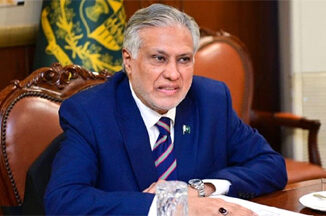
  • Pak FM to visit Bangladesh on Aug 23 amid warming ties

    Pak FM to visit Bangladesh on Aug 23 amid warming ties

    Islamabad (TIP)- Pakistan’s Foreign Minister Ishaq Dar is set to visit Bangladesh on August 23 as the two countries saw a warming up of bilateral relations after former prime minister Sheikh Hasina’s ouster from office last year.
    Dar, who is also the Deputy Prime Minister, was earlier set to visit Bangladesh in April this year, but the visit was postponed due to tension with India in the wake of the Pahalgam terror attack and subsequent conflict between India and Pakistan.
    According to official sources, Dar is now set to visit Dhaka on August 23.
    The details of the visit, however, have not been shared as yet, but he is expected to meet his counterpart Touhid Hossain, as well as the Chief Adviser of the Interim government, Muhammad Yunus.
    Ties between Pakistan and Bangladesh had plummeted during Hasina’s regime, but took a sharp upward turn as she was ousted from power on August 5 last year following a massive student-led protest.
    Last month, the two countries agreed to grant visa-free entry to holders of diplomatic and official passports from the other side.
    The deal was reached during a meeting between Interior Minister Mohsin Naqvi and Bangladesh’s Home Minister Jahangir Alam Chowdhury.
    Foreign Secretary Amna Baloch had visited Dhaka in April for Foreign Office Consultations after a 15-year break in diplomatic engagement with Bangladesh.
    In February, both countries started direct government-to-government trade after decades of troubled relations, with imports of 50,000 tonnes of rice.
    Direct private trade between the two countries restarted in November 2024 when a container ship sailed from Karachi to Chittagong.

  • UN probe finds evidence of ‘systematic torture’ in Myanmar

    United Nations investigators say they have gathered evidence of systematic torture in Myanmar’s detention facilities, identifying senior figures among those responsible.
    The Independent Investigative Mechanism for Myanmar (IIMM), set up in 2018 to examine potential breaches of international law, said on Tuesday that detainees had endured beatings, electric shocks, strangulation and fingernail removal with pliers. “We have uncovered significant evidence, including eyewitness testimony, showing systematic torture in Myanmar detention facilities,” Nicholas Koumjian, head of the mechanism, said in a statement accompanying its 16-page report. The UN team said some prisoners died as a result of the torture. It also documented the abuse of children, often detained unlawfully as proxies for their missing parents.
    According to the report, the UN team has made more than two dozen formal requests for information and access to the country, all of which have gone unanswered. Myanmar’s military authorities did not respond to media requests for comment.
    The military has repeatedly denied committing atrocities, saying it is maintaining peace and security while blaming “terrorists” for unrest.
    The findings cover a year that ended on June 30 and draw on information from more than 1,300 sources, including hundreds of witness accounts, forensic analysis, photographs and documents.
    The IIMM said it identified high-ranking commanders among the perpetrators but declined to name them to avoid alerting those under investigation.
    The report also found that both government forces and armed opposition groups had committed summary executions. Officials from neither side of Myanmar’s conflict were available to comment.
    The latest turmoil in Myanmar began when a 2021 military coup ousted an elected civilian government, sparking a nationwide conflict. The UN estimates tens of thousands of people have been detained in efforts to crush dissent and bolster the military’s ranks.
    Last month, the leader of the military government, Min Aung Hlaing, ended a four-year state of emergency and appointed himself acting president before planned elections. The IIMM’s mandate covers abuses in Myanmar dating back to 2011, including the military’s 2017 campaign against the mostly Muslim Rohingya, which forced hundreds of thousands of members of the ethnic minority to flee to Bangladesh, and postcoup atrocities against multiple communities.

  • Pakistan to create Army Rocket Force after Op Sindoor setback

    Pakistan to create Army Rocket Force after Op Sindoor setback

    Islamabad (TIP)- Pakistan, which was made to bite the dust by Indian armed forces in Operation Sindoor, has announced the creation of a new military force to supervise missile combat capabilities in a conventional conflict. Pakistan’s move on a dedicated command for missiles and rockets, modelled on China’s People’s Liberation Army Rocket Force (PLARF), is being seen as an apparent move to match India’s onslaught.
    During the four-day mini-war in May, aerial warfare prevailed. Drones, missiles, and loitering munitions were all used by both sides. Pakistan’s Chinese-made PL-15 and India’s indigenous BrahMos, Akash systems, and even the Russian S-400 were deployed. Pakistan’s missiles largely turned into duds, as almost all were intercepted and destroyed by Indian air defence using several missile systems.
    Pakistan’s Prime Minister, Shehbaz Sharif, on the eve of its Independence Day, late Wednesday (August 13, 2025), announced the creation of the Army Rocket Force at a ceremony held in Islamabad to commemorate the military confrontation with India, reported news agency Reuters.
    “It will be equipped with modern technology,” Sharif said, according to a statement from Islamabad. He added that the force will prove to be a milestone in strengthening the combat capability of Pakistan’s army.
    Sharif, however, did not provide any further details.
    A senior Pakistani security official told news agency Reuters that the new force will house a dedicated command, which will be exclusive to the handling and deployment of missiles in any event of a conventional war.
    “It is obvious that it is meant for India,” he said.
    Pakistan’s Army Rocket Force Command (ARFC) will be “modelled explicitly after China’s People’s Liberation Army Rocket Force (PLARF)”, noted Group Captain MJ Augustine (retired) in his report in the Eurasian Times.
    The PLARF, previously known as the Second Artillery Corps, serves as China’s strategic and tactical missile force. As the fourth branch of the People’s Liberation Army (PLA), the PLARF manages China’s land-based missile arsenal, including ballistic, hypersonic, and cruise missiles, both nuclear and conventional.
    Group Captain MJ Augustine (retired) explained how Pakistan’s new force being modelled after the one in China, also strengthens the Islamabad-Beijing axis. During Operation Sindoor, China provided Pakistan with real-time intelligence, satellite surveillance, and advanced military hardware. This collaboration, including the use of Chinese-supplied J-10 aircraft and AI-driven systems like CENTAIC, revealed the deep strategic nexus, with China using Pakistan as a testing ground for its military technology.
    At the regional level, the ARFC reinforces the China-Pakistan alliance, often referred to as an “all-weather friendship”. Modelled after China’s PLARF, which oversees the country’s extensive missile arsenal for both conventional and nuclear purposes, Pakistan’s force gains from Chinese technology transfers, according to the veteran.
    During Operation Sindoor, India demonstrated a decisive advantage over Pakistan in both missile interception and offensive air power.
    Indian defence systems proved highly effective in neutralising incoming threats, intercepting Pakistani missiles with precision and minimising potential damage. A night before the ceasefire, India intercepted and shot down Pakistan’s Fatah-1 missile over Haryana’s Sirsa. Its debris were found near Khaja Khera village.
    At the same time, the Indian Air Force launched a fierce and coordinated assault, striking multiple high-value and sensitive targets deep within Pakistani territory. These included PAF’s Nur Khan airbase, key communication hubs, and strategic infrastructure, disrupting Pakistan’s operational capabilities.
    The combination of technological superiority, advanced missile defence systems, and aggressive aerial tactics left Pakistan struggling to mount an effective counteroffensive.
    Rattled by this, Pakistan has seemingly responded by creating its new military unit – the Army Rocket Force.

  • August 15 New York & Dallas E – Edition

    [vc_row][vc_column][vc_custom_heading text=”E-Edition” font_container=”tag:h2|text_align:center” google_fonts=”font_family:Istok%20Web%3Aregular%2Citalic%2C700%2C700italic|font_style:700%20bold%20regular%3A700%3Anormal” css=”” link=”url:https%3A%2F%2Fwww.theindianpanorama.news%2Fwp-content%2Fuploads%2F2025%2F08%2FTIP-August-15-E-Edition.pdf”][vc_single_image image=”194118″ img_size=”full” alignment=”center” onclick=”custom_link” css=”” link=”https://www.theindianpanorama.news/wp-content/uploads/2025/08/TIP-August-15-E-Edition.pdf”][/vc_column][/vc_row][vc_row][vc_column width=”2/3″][vc_custom_heading text=”Lead Stories This Week” google_fonts=”font_family:Istok%20Web%3Aregular%2Citalic%2C700%2C700italic|font_style:700%20bold%20regular%3A700%3Anormal” css=”” link=”url:https%3A%2F%2Fwww.theindianpanorama.news%2F”][vc_wp_posts number=”5″ show_date=”1″][/vc_column][vc_column width=”1/3″][vc_single_image image=”82828″ img_size=”medium” alignment=”center” onclick=”custom_link” css=”” link=” https://www.theindianpanorama.news/advertising-media-kit-portal-indian-panorama/”][vc_single_image image=”82829″ img_size=”medium” onclick=”custom_link” css=”” link=” https://www.theindianpanorama.news/advertising-media-kit-portal-indian-panorama/”][/vc_column][/vc_row]

  • Happy 79th Independence Day!

    Happy 79th Independence Day!

    By Mike Ghouse

    I urge you not to poison or prejudice your children against any individual. When they grow up and find themselves working alongside those you have taught them to view negatively, they may struggle to connect, leading to unnecessary challenges and unhappiness. Additionally, if they aspire to hold public office, those prejudices could hinder their success.

    I wish everyone could experience true freedom—freedom from bias against any fellow Indian or human being. Let us promote unity among Indians and dare to speak out against divisive rhetoric. Take the time to learn about others. If we can respect and embrace the differences among us, conflicts will diminish, and solutions will surface.

    I officiate interfaith marriages between individuals of different faiths, races, and ethnicities, with no conversions involved.

    A Letter to my fellow Indians;

    We are Indians and nothing but Indians. An Indian is an Indian is an Indian, period.

    As a nation, we comprise Adivasis, Atheists, Bahais, Bos, Buddhists, Christians, Dalits, Hindus, Jains, Jews, Muslims, Sikhs, Tribals, Zoroastrians, and countless other identities. We are of various skin tones—brown, black, white, yellow, and green with envy—but our hearts remain Hindustani.

    Every race, nationality, ethnicity, language, culture, and religion is a part of our Motherland. We perceive the divine in one, none, and many forms; as male, female, genderless, and non-existent; as being and non-being; nameless and with innumerable names. We accept them all as we are all created by the same process.

    We take pride in our heritage—a multifaith, multicultural, multiregional, and multilingual society that embraces and respects the diverse ways people choose to live. For over 5,000 years, India has stood as a beacon of pluralism, welcoming Islam, Christianity, Judaism, Baha’i faith, and Zoroastrianism alongside indigenous religions such as Hinduism, Tribal traditions, Dalit practices, Jainism, Buddhism, and Sikhism.

    Let us consciously strive to think and act as one person within a nation, one community, and one global family. There is peace in being conflict-free. I hope each of us can shed any biases we hold against one another. There is joy in being free from ill will. From this day forward, let’s commit to being free from anything that obstructs our unity.

    Our collective philosophies promote the idea of one world. Hinduism teaches that “Vasudhaiva Kutumbakam,” or that the whole world is one family. Sikhism emphasizes the oneness of humanity—everyone is created from the same source. The Quran and the Torah convey similar messages, and Jesus embraced all people, regardless of their backgrounds. Jainism introduces Anekantwad (the theory of multiple viewpoints), while Buddhism encourages us to focus on living a happier life. These principles are found in all our religions.

    While some individuals stray from their heritage, engaging in thievery, violence, rioting, and other evils that threaten societal fabric, the majority of people from every group navigate their lives peacefully, striving to coexist without disturbing others. We should focus on supporting the 99% of the population committed to pluralism and work to bring the remaining individuals into the fold of humanity.

    On this day and every day moving forward, I urge you to embrace the identity of “I am an Indian,” instead of identifying as Malayalee, Gujarati, Bengali, Punjabi, or as a Hindu, Muslim, Sikh, or any other designation. Do not expect others to adopt this mindset immediately; allow them time. If you remain consistent for at least a year, you will inspire others to follow suit.

    India has historically led the freedom movement. Since 1947, countries around the world have liberated themselves from colonialism. Indian democracy exemplifies the peaceful transfer of power by the people.

    We are inherently secular and economically capitalistic, believing in a “live-and-let-live” ethos—the essence of capitalism. We respect everyone’s rights to choose how to eat, dress, and feel, all in pursuit of happiness. Every one of us is unique, as evidenced by our thumbprints, eyeprints, tastes, beliefs, and DNA.

    Over the years, we have shown remarkable maturity in handling extreme situations. As we encounter diverse opinions, our hearts expand, our embraces grow wider, and we become better equipped to cushion our differences. Let’s remember that there are always multiple sides to every story, and discovering the truth is our shared responsibility. I am proud of my heritage and proud to be an Indian-American.

    Believing that every Indian desires justice and fair treatment for all 1.6 billion citizens—regardless of wealth, connections, religion, or any other distinctions—we must engage in social and community life to create an exemplary India that can serve as a model nation in the world.

    We need to coexist with minimal friction. Justice is in everyone’s interest, including yours and mine, as it fosters sustainable peace and prosperity. We must find solutions for individuals who resort to extremes, regardless of their faith—be it Buddhist, Christian, Hindu, Jain, Muslim, Sikh, Zoroastrian, or otherwise. We hope they will recognize the divine space each of us occupies and understand the benefits of co-existence.

    Patriotism should be defined as taking action to uplift the hopes of our fellow citizens. Initiatives such as providing education for all, creating jobs for as many people as possible each year, ensuring housing for every individual, and promoting a better lifestyle for every Indian are crucial.

    Every public office holder, from the lowest rank to the President of India, must take this pledge and adhere to it. Any violation should disqualify them from holding public office, and there should be public oversight in place.

    I pledge to honor and treat every Indian with the utmost dignity.

    I pledge that every individual will be treated equally.

    I pledge to respect all religions.

    Mike Ghouse

    (202) 717-2892

    (Dr. Ghouse is the President and founder of the Center for Pluralism and director of the World Muslim Congress​​He is an Interfaith Wedding Officiant for InterfaithMarriages.org and a Muslim Wedding Officiant. He is a MuslimPluralist, activist, speakerauthor, and social scientist. More on- Google)

  • From Great Friend to Tariff King – The Changing Shades of the USA–India Relationship

    Can Prime Minister Modi Overcome the Hesitations of History Again?

    By V.K. Raju

    Prime Minister Narendra Modi’s recent visit to the United States marked another chapter in the long, complex journey of India–US relations. It was a celebration of friendship, shared values, and mutual aspirations. As I said then—with both enthusiasm and hope—India and the US need real Maitri (friendship) for the sake of world peace.

    The relationship between the two nations goes back decades. Under Presidents Truman, Eisenhower, and Kennedy, ties were warm and full of promise. President Kennedy famously remarked that “the hinge of fate in Asia rests with India.” When President Eisenhower visited India in 1959 to inaugurate the first US Embassy, he expressed a vision that still resonates today: if American and Indian children grew up as best friends, the world would be a safer and better place.

    But the warmth did not last uninterrupted. In 1965, relations shifted sharply, reaching one of their lowest points during President Nixon’s tenure.

    Fast forward to December 2024, when Richard Verma, US Deputy Secretary of State for Management and Resources, addressed the 25th Annual Gala of the US–India Chamber of Commerce in Dallas, Texas. He acknowledged—and echoed—Prime Minister Modi’s earlier words: that the US and India have “overcome the hesitations of history” in their partnership.

    The challenge now is to sustain that momentum in a rapidly changing and often turbulent world. The wisdom of history reminds us of what is truly at stake. As historian Dr. Arnold Toynbee once wrote:

    “It is already becoming clear that a chapter which has a Western beginning will have to have an Indian ending if it is not to end in the self-destruction of the human race…. At this supremely dangerous moment in human history, the only way of salvation for mankind is the Indian way-Emperor Ashoka’s and Mahatma Gandhi’s principle of non-violence and Sri Ramakrishna’s testimony to the harmony of religions. Here we have an attitude and spirit that can make it possible for the human race to grow together into a single family-and, in the Atomic Age, this is the only alternative to destroying ourselves.” Stay Safe”.

    (The writer is a West Virginia-based ophthalmologist. He is the President of the Eye Foundation of America. He can be reached at vkraju@comcast.net)


  • NUMC Chaos Demands Independent Probe

    NUMC Chaos Demands Independent Probe

    By Seth I. Koslow

    Nassau University Medical Center – an essential safety net health care hospital for our first responders and our region’s most vulnerable patients – has been hamstrung by political patronage, gross mismanagement, and wasteful spending. The circus-like atmosphere surrounding Matthew Bruderman’s long-overdue firing as NUMC Board Chairman – complete with tales of a mysterious break-in and alleged theft of sensitive documents – would have been bad enough on its own.

    However, the initial stages of a forensic audit into hospital finances have already unearthed disturbing findings that, commensurate with the hospital’s reliance upon federal, state and local funds, demand an immediate and full investigation by the United States Attorney for the Eastern District of New York, New York State Attorney General Letitia James, and Nassau DA Anne Donnelly to identify and prosecute any acts of criminal wrongdoing.

    On Thursday, June 19, Newsday first reported allegations that the hospital’s departing CEO, Meg Ryan, gave herself and 12 other employees $1 million in wage and leave payouts that they were not entitled to receive. Ryan was subsequently fired for cause.

    To make matters worse, Newsday further revealed that, as Ryan and other top hospital executives had one foot out the door, they spent thousands of dollars on lobster dinners, hotel, and travel reimbursements, all while the safety-net hospital teetered on the brink of financial collapse.

    As these shocking facts came to light only partway through a forensic audit being led by NUMC’s new management, there is a very good chance that this is just the tip of a big, ugly iceberg of corruption and graft.

    The blame for this latest chapter falls squarely upon the desk of Bruce Blakeman – whose disinterest in doing his job as County Executive led him, despite numerous warnings, to install an unqualified individual as hospital CEO who now stands accused of taking advantage of taxpayers.

    For generations, the Nassau County GOP has treated NUMC – a regionally significant Level 1 trauma center that provides essential drug detox services, boasts a world-class burn center, and serves as a medical lifeline for individuals who cannot afford care anywhere else – like a candy store for political patronage. There, they have packed the payroll with allies, forcing taxpayers to foot six-figure salaries for their cronies as deficits soared, the future of the hospital hung in the balance, and Republicans blamed everybody but themselves for the crisis they created.

    Blakeman and the Nassau GOP’s exploitation of NUMC goes well beyond these most current allegations. In December 2023, Blakeman appointed disgraced former Sheriff Michael Sposato, whose tenure at the County jail was marred by scandal and numerous inmate deaths, as the $275,000 per year executive director of public safety and investigations at the Hospital. On April Fool’s Day of 2022, the Republican Majority of the Legislature, at Blakeman’s behest, rubber-stamped the appointment of Matthew Bruderman as president of the NUMC board – even though his only qualifications seemed to be his reckless, vulgar mouth and the big checks he wrote to Blakeman’s political campaigns.

    In the Legislature where I currently serve, Republicans have co-signed Blakeman every step of the way with disastrous results. True leadership would have been pushing for the County to invest $30 million of the opioid lawsuit settlement funds into expanding the Hospital’s in-patient drug detox and treatment facilities. In doing so, they could have delivered much-needed treatment resources for families in crisis, helped to get opioid funds off of the County books and into the hands of life-saving agencies, and sent a message to New York State demonstrating a heightened commitment to the Hospital’s future.

    Instead, they failed to exercise their duty and responsibility as a coequal branch of government and sat on their hands as Blakeman allowed NUMC to fall apart with Meg Ryan as its CEO.

    Such a disastrous and self-serving track record creates a perfect storm in which oversight is curtailed, chaos thrives, and corruption can run rampant – and it creates an inflection point. We can either remain silent and co-sign Blakeman’s exploitation of NUMC – or be independent watchdogs, follow the facts and get this essential public resource back on the right track for the benefit of every Nassau County resident.

    (Seth I. Koslow represents the 5th District in the Nassau County Legislature. He lives in Merrick)

  • Trump confirms plans for ‘economically severe’ sanctions if Russia doesn’t move on Ukraine

    Trump confirms plans for ‘economically severe’ sanctions if Russia doesn’t move on Ukraine

    WASHINGTON, D.C. (TIP): President Trump says Russia needs to show willingness to seriously talk about the end of the war in Ukraine, as he travels to his meeting with Putin in Anchorage, Alaska. Trump also confirms his earlier threat of “severe” consequences for Russia if it fails to show willingness to seriously talk about the end of war in Ukraine.

    He says:
    “Economically severe. It will be very severe.

    I’m not doing this for my health, okay, I don’t need it. I’d like to focus on our country, but I’m doing this to save a lot of lives.

    Yeah, very severe.”

    He ends the briefing here.

    Meanwhile, ‘Time to end the war. We are counting on America,’ Zelenskyy says, as he hopes for a trilateral summit with Trump, Putin.
    Ukrainian president Volodymyr Zelenskyy has just posted on social media, saying he expects to get a report from the Ukrainian intelligence services today “on the current intentions of the Russian side and its preparations for the meeting in Alaska.”

    Directly responding to Trump’s earlier comments, he then says:
    Indeed, high stakes.
    He adds:
    “The key thing is that this meeting should open up a real path toward a just peace and a substantive discussion between leaders in a trilateral format – Ukraine, the United States, and the Russian side.

    It is time to end the war, and the necessary steps must be taken by Russia.

    We are counting on America. We are ready, as always, to work as productively as possible.”
    (Agencies)

  • FIA President Saurin Parikh Invites All to 43rd India Day Parade in New York

    FIA President Saurin Parikh Invites All to 43rd India Day Parade in New York

    Theme: “Sarve Bhavantu Sukhinah” – May All Be Happy

    NEW YORK (TIP): The Federation of Indian Associations (FIA) will host the 43rd Annual India Day Parade in New York City on Sunday, August 17, 2025, starting at noon from Madison Avenue at 38th Street.

    In an interview with The Indian Panorama, FIA President Saurin Parikh—originally from Gujarat and a licensed civil engineer—highlighted this year’s theme, “Sarve Bhavantu Sukhinah”, meaning “May All Be Happy”. The theme, he said, reflects a global call for unity, harmony, and universal well-being.

    For the first time in FIA history, the parade will feature floats representing Hindu, Muslim, Sikh, Christian, and Jain communities, alongside a rich display of India’s cultural and regional diversity. In total, 35 floats and numerous marching groups will participate.

    The grand marshals for this year’s parade are Bollywood star Rashmika Mandanna and South Indian cinema icon Vijay Deverakonda. New York City Mayor Eric Adams and several elected officials have confirmed their attendance.

    Parade attractions will include cultural performances, a vibrant street fair with Indian and international cuisines, vendor booths, and—new this year—a cricket playing area organized by title sponsor CricMax.

    • In addition to the parade, FIA will host:
    • Empire State Building Lighting Ceremony in tricolor on August 15
    • Flag Hoisting at Times Square on August 16 at 10:30 a.m.
    • Sold-out Gala Dinner at Cipriani’s, Wall Street, on August 17 evening

    Parikh acknowledged the efforts of 1,800 volunteers, the FIA Board of Trustees, and numerous sponsors, including CricMax, X-RAY Group, TEK Group, Wenzel Foundation, Mehta Foundation, ICICI Bank, State Bank of India, Bank of Baroda, and Bank of India.

    “This parade is the pride of the Indian diaspora,” said Parikh. “Join us on August 17 to celebrate India’s Independence Day in the heart of New York. It will be a moment you will never forget”.

  • PM Modi’s 79th I-Day address charts roadmap for Viksit Bharat

    PM Modi’s 79th I-Day address charts roadmap for Viksit Bharat

    Focuses on self-reliance, innovation, and citizen empowerment

    NEW DELHI (TIP): On the 79th Independence Day, India’s Prime Minister Narendra Modi delivered his longest and most decisive address from the Red Fort, lasting 103 minutes, charting a bold roadmap for a Viksit Bharat by 2047. With a sharp focus on self-reliance, innovation, and citizen empowerment, the Prime Minister highlighted India’s journey from a nation dependent on others to a globally confident, technologically advanced, and economically resilient country.

    No blackmail, no compromise

    PM Modi hailed Operation Sindoor, conducted after the Pahalgam attack, as a demonstration of India’s strategic autonomy. Using Made-in-India weapons, the operation dismantled terror networks and Pakistan-based infrastructure, signaling a new era where India will no longer accept nuclear blackmail or threats on foreign terms.

    On the issue of the Indus Waters Treaty, he made it unequivocally clear: “India has now decided, blood and water will not flow together. The people have realized that the Indus Waters Treaty was unjust. Water from the Indus River system irrigated enemy lands while our farmers suffered.” This statement reaffirmed that India will no longer compromise on its national interests, and the operation underscored the country’s ability to act swiftly and decisively, relying entirely on indigenous technology and defense platforms.

    Atmanirbhar Bharat, strengthening technology, industry

    PM Modi said, “Dependence on others raises questions about a nation’s independence. It is unfortunate when dependence becomes a habit, a dangerous one. That’s why we must remain aware and committed to becoming self-reliant. Self-reliance is not just about exports, imports, the rupee, or the dollar. It is about our capabilities, our strength to stand on our own.”

    That is why he announced that India will roll out its first Made-in-India semiconductor chip by 2025 and is opening the nuclear sector to private players, creating unprecedented opportunities in energy and technology.

    He urged every citizen, especially the youth, to take part in nation-building by innovating and producing jet engines, social media platforms, fertilizers, and other critical technologies indigenously, forging a future where India stands self-reliant, powerful, and globally respected. PM Modi also highlighted India’s bold steps to secure resources critical for its future. Through the National Critical Minerals Mission, the country is exploring 1,200 sites to ensure access to minerals essential for energy, industry, and defense.

    He emphasized that controlling these minerals strengthens India’s strategic autonomy, keeping its industrial and defense sectors truly self-reliant. Complementing this, the National Deepwater Exploration Mission will harness India’s offshore energy resources, boosting energy self-reliance and reducing dependence on foreign fuel imports, marking another step toward a fully independent and powerful India.

    PM Modi urged the nation to achieve self-reliance in medicines and innovation, highlighting India’s strength as the “pharmacy of the world”. He asked, “Shouldn’t we be the ones providing the best and most affordable medicines for the welfare of humanity?”

    He emphasized India’s growing prowess in domestic pharmaceutical innovation and the urgent need to develop new medicines, vaccines, and life-saving treatments entirely within India. Drawing inspiration from India’s COVID-19 response, where indigenous vaccines and platforms like CoWin saved millions of lives globally, he called on the nation to expand this spirit of innovation.

    Researchers and entrepreneurs were urged to secure patents for new drugs and medical technologies, ensuring that India not only meets its own healthcare needs but also becomes a global hub of medical self-reliance and innovation, demonstrating the country’s ability to lead in science, technology, and human welfare.

    Mission Sudarshan Chakra

    To strengthen India’s offensive and deterrent capabilities, PM Modi launched Mission Sudarshan Chakra, drawing inspiration from India’s rich cultural and mythological heritage. He said, “India is launching Mission Sudarshan Chakra to create a powerful weapon system to thwart any attempt by enemies to attack us.”

    The initiative is designed to enhance rapid, precise, and powerful defense responses, reinforcing India’s strategic autonomy. PM Modi added, “All public places will be covered by an expanded nationwide security shield by 2035,” ensuring comprehensive protection for the nation while showcasing India’s commitment to self-reliant defense.

    Next-generation Reforms

    PM Modi announced the formation of a Task Force for Next-Generation Economic Reforms, aimed at overhauling laws, rules, and procedures that govern economic activity.

    He highlighted that the government has already abolished over 40,000 unnecessary compliances and 1,500 outdated laws, and in the latest parliamentary session, over 280 provisions were removed. Looking ahead, Next-Generation GST reforms by Diwali will reduce taxes on daily essentials, benefiting MSMEs, local vendors, and consumers, while simultaneously stimulating economic growth and creating a more efficient, citizen-friendly economy.

    PM Viksit Bharat Rozgar Yojana, Empowering Youth: To strengthen India’s demographic dividend and ensure that the nation’s youth play a central role in its growth, PM Modi launched the PM Viksit Bharat Rozgar Yojana, a Rs1 lakh crore employment scheme under which newly employed youth will receive ₹15,000, targeting 3 crore young Indians.

    He emphasized that this initiative would transform India’s demographic potential into real economic and social prosperity, strengthening the bridge from Swatantra Bharat to Samriddha Bharat and empowering the youth to actively contribute to the nation’s progress and development. 

    Energy and Nuclear Self-Reliance: PM Modi also highlighted India’s bold steps to secure resources critical for its future. Through the National Critical Minerals Mission, the country is exploring 1,200 sites to ensure access to minerals essential for energy, industry, and defense.

    He emphasized that controlling these minerals strengthens India’s strategic autonomy, keeping its industrial and defense sectors truly self-reliant. Complementing this, the National Deepwater Exploration Mission will harness India’s offshore energy resources, reducing dependence on foreign fuel imports and boosting energy self-reliance, marking another step toward a fully independent and powerful India.

    Highlighting India’s remarkable achievements in clean energy, PM Modi noted that the country had already reached its 50% clean energy target in 2025, five years ahead of schedule.

    He also announced plans to increase India’s nuclear power generation capacity tenfold by 2047, with 10 new nuclear reactors underway, ensuring energy security and sustainable growth. He added that if India were not dependent on energy imports, the money saved could be used for the welfare of farmers, further strengthening the backbone of the nation’s prosperity. 

    Space sector independence, pioneering innovation

    PM Modi highlighted India’s growing prowess in space science. Preparations for India’s own space station are underway, building on the success of the Gaganyaan mission. Over 300 startups are now innovating in satellite technology, space exploration, and cutting-edge research, demonstrating that India is not only participating in the global space arena but leading with indigenous solutions.

    Farmers are backbone of India’s prosperity

    PM Modi declared, “India will not compromise on their interests.” He emphasized that he has stood as a wall for the farmers and livestock keepers against any detrimental policy, protecting their rights and livelihoods.

    He said that Agriculture remains a cornerstone of India’s development, with India No. 1 in milk, pulses, and jute, and No. 2 in rice, wheat, cotton, fruits, and vegetables. Agricultural exports have crossed Rs 4 lakh crore, reflecting the nation’s global competitiveness.

    To further empower farmers, he launched the PM Dhanya Dhanya Krishi Yojana for 100 backward farming districts, complementing ongoing support through PM-Kisan, irrigation schemes, and livestock protection programs, ensuring that India’s backbone of prosperity remains strong and resilient.

    PM Modi also addressed the importance of safeguarding India’s demographic integrity. He warned of challenges posed by illegal infiltration, stressing the need to protect border areas and citizens’ livelihoods. To address these concerns, he announced the High-Powered Demography Mission, aimed at ensuring India’s unity, integrity, and security, tackling both strategic and social challenges.

    Looking ahead, PM Modi outlined his vision for a Viksit Bharat 2047, emphasizing that India’s progress is built on self-reliance, innovation, and citizen empowerment.

    He reminded citizens that India’s strength lies in its people, innovation, and commitment to self-reliance, urging every Indian to contribute to nation-building, whether by buying India-made products or participating in scientific, technological, and entrepreneurial ventures to ensure a prosperous, powerful, and Viksit Bharat by the nation’s centenary of independence.

  • DC sues Trump over police takeover as Bondi ends city’s ‘sanctuary policies’ and homeless encampments are cleared

    DC sues Trump over police takeover as Bondi ends city’s ‘sanctuary policies’ and homeless encampments are cleared

    WASHINGTON, D. C. (TIP): Late yesterday, DC mayor Muriel Bowser hit back against Pam Bondi’s move to put DEA chief Terry Cole in charge of the capital’s police department. In a post on X, Bowser wrote: “there is no statute that conveys the District’s personnel authority to a federal official”.

    She also said that her office have “followed the law” and provided the services of the DC police at the request of the president, as outlined in Section 740 of the Home Rule Act.

    Bowser also reposted a letter from DC attorney general Brian Schwalb, addressed to the mayor, which said that Bondi’s order is “unlawful” and Bowser is “not legally obligated to follow it”.

    According to the federal lawsuit filed by the DC government today, the Trump administration has engaged in “a brazen usurpation of the District’s authority over its own government”.

    The suit says that the president’s move to federalize the DC police, and attorney general Pam Bondi’s order to install DEA administrator Terry Cole as “emergency police commissioner”, both “exceed the narrow delegation that Congress granted the President in Section 740”.

    A reminder, earlier this week the president invoked Section 740 of the DC Home Rule Act, which grants him a 30-day period to control the district’s local law enforcement if he declares a safety emergency. To get an extension, the president would need Congress’s approval.

    The president has said that violent crime in DC – which the justice department says experienced a 30-year low in 2024 – is “the worst it’s ever been”.

    The lawsuit also states that Section 740 only requires that the DC mayor “provide services” of the Metropolitan police department (MPD) to federal government, but “does not permit the President to seize control of MPD. Nor does it authorize the President to direct MPD in the policing of local crime.”

  • Is India still a liberal democracy?

    Is India still a liberal democracy?

    • By George Abraham

    As the Diaspora celebrates the 79th Independence Day of India, a pressing question looms in the minds of people across the globe: Is today’s India truly a liberal democracy? This week, we may witness widespread celebrations of India’s independence that will be held in many cities across the U.S. However, one may hear very little regarding whether the hard-fought freedom by the founders of modern India is in danger of being extinguished, a concern that should be at the forefront of our discussions.

    Many cultural and religious organizations that host such events seem indifferent to the steadily eroding freedoms of India’s citizens and the weakening of its democratic institutions. It is essential that the Indian diaspora, with its unique vantage point and influence, take a principled stand and speak out on these issues. Yet, far too often, these forums choose instead to recycle the same celebratory narratives of India’s history and heritage, continually invoking our noble ancestry and cultural traditions. Adding to this irony, many of the same leaders neglect to acknowledge the freedoms and opportunities they themselves have enjoyed in their adopted countries—and, in some cases, go so far as to deride the so-called “decadent culture” of the West, as though migration to this part of the world were something imposed upon them.

    A noticeable trend in recent years has been the decline of India’s rankings on several global indices, especially dealing with subjective issues such as democracy and freedom. According to Varieties of Democracy (V-Dem), which produces the most extensive global dataset on democracy, India remains an “Electoral Autocracy”. Freedom House downgraded India from “Free to” Partly Free” and maintained that classification since 2024. The Economic Intelligence Unit (EIU) ranks India as a “Flawed Democracy”.

    Under Modi’s rule, the suppression of journalists has intensified. Tactics such as raiding news organizations like the BBC and bringing up sham charges against investigative journalists have become regular tools of intimidation. The Unlawful Activities Prevention Act, counter-terrorism laws, and a new censorship bill have been used to silence any criticism. India, like any other authoritarian country, has harassed and denied foreign funding to civil society organizations and religious ones. Academic freedom has also been a casualty, leading to the dismissal of professors critical of the Government.

    The democratic Institutions that were built and maintained under the Congress rule over the years are under deep duress. There has been a growing pressure on the judiciary by the Executive, resulting in inconsistent rulings in politically sensitive areas. There is also a steep decline in debates in parliaments over critical issues, while the governing party relies more and more on the use of ordinances, marginalizing the opposition. India’s election commission appears to have compromised its impartiality while becoming a vassal for the BJP political machine.

    India leads the world in Internet shutdowns, and platforms like Twitter and YouTube have been pressured to remove content critical of the Government. There are allegations of Pegasus spyware’s use against journalists, activists, and opposition politicians, painting a picture of a surveillance state that is said to be in operation, violating fundamental civil liberties. Since the Narendra Modi government came to power, access to information through the Right to Information (RTI) Act has diminished dramatically, according to the annual report of the Central Information Commission (CIC) for 2014-15. “Every Indian deserves to know the truth,” and the BJP wants to hide the truth. The BJP believes the truth must be hidden from the people, and they must not question people in power. The changes proposed to the RTI (Right to the Information Act) would make it a useless Act,” Rahul Gandhi, the opposition leader, once said on the X platform.

    Agencies such as India’s Central Bureau of Investigation (CBI), the Enforcement Directorate of the Finance Ministry, the Tax authorities, and even local police forces are often accused of doing the Government’s bidding. The opposition has charged that their leaders have frequently been targeted for harassment, which they consider a political vendetta for expressing their opinions critical of the Government.

    Religious freedom in India continued on a downward trend, said the United States Commission on International Religious Freedom’s annual report released recently. It noted that although government statistics have indicated that communal violence has decreased over the past two years, under the BJP rule, Hindu-nationalist groups have sought to “saffronize” India through violence, intimidation, and harassment against non-Hindus and Hindu Dalits. However, the Indian Constitution guarantees freedom of religion through articles 25 and 26. Since the ascendance of Modi as the Prime Minister, tensions between minorities and the majority community have increased in many parts of the country, further pushing minorities towards marginalization.

    These days, the Embassies and Consulates of India have been utilized as propaganda machinery for the ruling party in India. In the name of promoting soft power, they have been forced to underwrite programs with intrinsic religious themes or ones that would fit their nationalist agenda. Even English is often being banished at official functions to the dismay of the attendee population, which always includes non-Hindi speaking people from the south or people who are born and brought up abroad.

    India’s electoral integrity has been a focus of critics and a growing concern in recent years. Rahul Gandhi, the opposition leader, has recently exposed wholesale fraud in the voter rolls in the Mahadevapura constituency in Bangalore in the last parliamentary election. He had earlier alleged bogus turnout in the recently concluded Maharashtra elections. His concern reflects more profound structural anxieties about the whole electoral systems where disparate voices are calling for a shift to paper ballots away from Electronic Voting Machines (EVMs), The changing of the composition of the Election Commission to majority appointees by the ruling disposition cast a serious cloud on that body for its independence and integrity to dealing with chorus of protests and complaints arising from the opposition ranks.

    The basis for democracy is Liberty,’ said Aristotle. However, today, the Institutions that were built to safeguard that principle are under duress. India is one of the most diverse nations in the world. The country has a population of 80% Hindu, 14% Muslim, Sikhs, and Christians, about 2% each. It has Castes and sub-castes, many languages and dialects, and varying customs and traditions, including different dress codes and dietary habits. That is the crossroad where India is today, with Narendra Modi in power, disregarding the aspirations of the minorities and diminishing the power structures that provided political and social equilibrium in the last six decades or more.

    Many liberal critics of the Modi regime sincerely believe that his administration is run by a political dogma inspired by the RSS ideology. That ideology is based on a common thread promoted by the Sangh Parivar organizations and is called the ‘Hindu Nationalist agenda of the BJP.’ The ultimate goal of the agenda is to transform the pluralistic and democratic India into a Hindu nation where the majority religion will have the pre-eminence and minorities are relegated to a subservient role, probably being denied equal protection or opportunities, that too, to a substantial segment of the population.

    The constitution’s framers created a democratic system wherein the legislature would make laws, the Executive would implement laws and be accountable to parliament, and an independent judiciary would interpret them. They also put in a system of checks and balances among these three organs of the state. However, over the years, these three organs of the state have pushed the boundaries of their relationship with one another. NDA has the majority in the Lok Sabha, where they pass ordinary bills and then pass them on to the Rajya Sabha as Money bills to circumvent their numerical impairment in that body. They have also shown utter disregard for deliberating on essential bills, bypassing various parliamentary committees.

    The Bhartiya Janata Party’s victory in the Lok Sabha elections of 2014 has ushered in an unprecedented attack on India’s democracy and injected new elements of intolerance and authoritarianism into the lives of people living in the country. Most political scientists agree that a liberal democracy rests on the pillars of free and fair elections, the rule of law, civil liberties, minority rights protection, pluralism, political competition, and institutional autonomy. The Modi government has utterly failed on those scores, earning India the inglorious title of a ‘flawed democracy’.

    Martin Luther King Jr. once said: Our lives begin to end the day we become silent about things that matter. The question is: will the Diaspora continue its long-held silence on the state of India’s democracy?

    (The author is a former United Nations Chief Technology Officer. He is Vice Chair of IOC USA. He can be reached at gta777@gmail.com)


  • India at 79: Pride, Promise, and the Pressing Challenges Ahead

    India at 79: Pride, Promise, and the Pressing Challenges Ahead

    Seventy-nine years after Independence, India stands tall as the world’s largest democracy—but faces mounting challenges from hostile neighbors, internal strife, and deep social divides. This Independence Day, the nation must harness its greatest asset—its youth—to fulfill the promise of freedom for all.

    By Prof. Indrajit S Saluja
    By Prof. Indrajit S Saluja

    As India prepares to celebrate its 79th Independence Day on August 15, 2025, it stands as the world’s largest democracy and a rising global power. Nearly eight decades of independence have brought impressive achievements—from advancements in technology, defense, and agriculture to space exploration and a robust democratic framework. Yet, this proud journey is shadowed by persistent and evolving challenges, both internal and external, that test the resilience of the Republic.

    Challenges from Without: A Turbulent Neighborhood

    1. The Pakistan Problem: A Legacy of Partition

    The 1947 partition sowed the seeds of one of the world’s most enduring geopolitical rivalries. Months after independence, Pakistan-backed tribal militias invaded Kashmir, prompting the first Indo-Pak war and cementing the region as a flashpoint. Wars in 1965 and 1971, the Kargil conflict of 1999, and continued cross-border terrorism have kept relations hostile. Recent incidents, such as Operation Sindoor following the killing of Hindu tourists in Pahalgam, show that Pakistan’s use of terrorism as a state policy remains a grave threat.

    1. China: A Persistent Northern Challenge

    India’s northern frontier remains unsettled due to China’s territorial ambitions. The 1962 war and more recent incidents, including the deadly 2020 Galwan Valley clash, reveal a pattern of strategic encroachment. Beijing’s military build-up, infrastructure push along the Line of Actual Control (LAC), and diplomatic resistance to India’s rise compound the threat.

    1. Regional Friction: Sri Lanka, Nepal, and Myanmar

    India’s neighborhood diplomacy must navigate complex realities—balancing strategic interests in Sri Lanka with advocacy for Tamil rights, countering China’s growing influence in Nepal, and managing security risks from Myanmar’s ongoing conflict. China’s Belt and Road Initiative continues to challenge India’s strategic space.

    Challenges from Within: The Internal Fault Lines

    1. Separatist Movements and Identity Politics

    The Khalistan movement, though militarily subdued, persists ideologically among diaspora groups abroad. Similar challenges arise from left-wing extremism in central India, where Maoist insurgents exploit poverty and alienation to sustain their campaign of violence. These movements reflect deep social and economic gaps that must be addressed alongside security measures.

    1. Poverty, Inequality, and Social Divides

    Despite economic growth, India continues to rank poorly on global hunger and malnutrition indices—111 out of 125 countries in the 2024 Global Hunger Index. The caste system and entrenched discrimination against Dalits and Adivasis remain barriers to social justice. Unemployment, particularly among the youth, threatens stability and undermines the demographic advantage.

    1. Religious Polarization

    India’s secular fabric is strained by rising religious divisions. Communal violence, anti-conversion laws, and political rhetoric targeting minorities undermine constitutional values and national unity. This polarization not only damages social harmony but also erodes India’s global image as a tolerant, pluralistic society.

    1. Corruption: The Invisible Enemy

    Corruption continues to corrode governance, from high-level scams to petty bribery. Despite reforms such as the Lokpal and digital governance tools, lack of accountability hampers public service delivery and development. The poor suffer the most, as corruption deepens inequality and mistrust in institutions.

    The Path Forward: A National Reawakening

    1. Strengthen National Security

    India must modernize its armed forces, fortify border infrastructure, and invest in intelligence and cybersecurity. Diplomacy with both neighbors and global powers should be guided by strategic realism.

    1. Address Separatism Through Development and Dialogue

    Security measures must be coupled with efforts to eliminate the root causes of insurgency—poverty, discrimination, and political alienation. Justice, development, and inclusion are as essential as enforcement.

    1. Rebuild Social Cohesion

    Political leaders must reject divisive identity politics and recommit to the secular, plural ideals of the Constitution. Hate speech and communal violence should be met with swift, impartial action.

    1. Fight Corruption with Transparency and Accountability

    Strengthen anti-corruption institutions, protect whistleblowers, and expand e-governance measures. Public audits and open data can help build trust between citizens and the state.

    1. Invest in Human Capital

    Education and healthcare must receive higher budgetary priority. Implementing the National Education Policy with a focus on skills, and expanding rural health infrastructure, will help India harness its demographic dividend.

    1. Translate Growth into Jobs

    Economic growth must generate employment. Investments in infrastructure, MSMEs, green energy, and labor reform can create sustainable livelihoods for millions.

    Rising to the Occasion

    At 79, India is at a crossroads—poised between great promise and significant peril. Its democracy has endured wars, insurgencies, and political upheavals. Its economy has grown from colonial impoverishment to a global contender. Yet, unresolved inequities, security threats, and internal divisions demand urgent, collective action.

    India’s greatest strength lies in its youth—dynamic, creative, and ambitious. If given the tools of quality education, economic opportunity, and ethical governance, they can transform the nation’s destiny.

    As the tricolor flutters high this Independence Day, it should serve not just as a symbol of past struggles, but as a rallying call for unity, justice, and renewal. The challenges from within and without are formidable, but they are not beyond the reach of a determined nation.

    The task before us is clear: to secure India’s borders, heal its divisions, and ensure that the promise of freedom reaches every citizen. Only then will we honor the sacrifices of the past and secure the future our founding fathers dreamed of.

    On this 79th Independence Day, may India rise to meet its moment—stronger, fairer, and more united than ever before.

  • How India can navigate Trump’s tariff storm in a choppy world

    How India can navigate Trump’s tariff storm in a choppy world

    Trump’s tariffs and the penalty he is likely to put on India for purchasing Russian oil have undeniably introduced a new layer of complexity to the Indo-American relationship

    By Prabhu Dayal

    Good diplomacy aims for win-win situations where all parties involved in a negotiation or agreement benefit, fostering cooperation and long-term stability. A win-win approach can de-escalate tensions and build trust between nations. This contrasts with a zero-sum approach where one party’s gain necessitates another’s loss. Win-win outcomes in diplomacy are achieved through negotiation, compromise, and a focus on mutual gains.

    India and the US have deepened their partnership across multiple sectors, driven by shared interests, democratic values, and strong people-to-people ties. Key areas of collaboration include defense, technology and innovation, space, semiconductors, biotechnology, cybersecurity, advanced telecommunications, clean energy, trade and economy, energy, education and culture.

    However, India’s relations with the US, which were progressing from strength to strength, are now facing serious challenges. Some experts are even saying that President Donald Trump has sent Indo-American ties to the drawing board.

    Indeed, a comprehensive US-India trade deal has hit several roadblocks and is currently facing uncertainty. The US has imposed a 25 per cent tariff on a broad range of Indian goods, effective August 7, 2025. This comes despite previous indications of good progress in trade talks and amidst a deadline for a possible agreement.

    In addition, President Trump has signed an Executive Order imposing an additional 25 per cent tariff on Indian imports. He has said that these additional tariffs are because India is purchasing Russian oil. That will raise the total tariff on Indian imports to the United States to 50 per cent, which is among the highest tariff rates imposed by the US. India has 21 days to respond to the additional tariffs before they go into effect.

    A major point of contention is the US’ demand for greater access to India’s agricultural and dairy sectors. India has consistently resisted, citing concerns about the livelihoods of millions of small farmers and potential disruption from subsidized US products. India is also pushing for the removal of the recently imposed tariffs and further reductions on other products, such as steel and aluminum, to gain a competitive advantage over other countries.

    The situation is deteriorating further as the US has expressed concerns about India’s continued purchases of Russian oil and military equipment, linking these actions to the current trade impasse. President Trump has accused India of profiting from the Ukraine war by selling Russian oil in the open market and said that the US will be “substantially” increasing the tariffs imposed on Indian imports in response. The Time magazine (August 5) has said that “President Trump seems unafraid to burn India, a long-time friend of the US, over its Russian oil purchases”.

    India, however, maintains that its relationship with Russia stands on its own merits and that its energy purchases are vital for its economy. India has said that such targeting by the US was “unjustified and unreasonable” in light of continued and substantial Western trade with Moscow. In a statement issued on August 4, India’s Ministry of External Affairs said:

    “Europe-Russia trade includes not just energy but also fertilizers, mining products, chemicals, iron and steel machinery and transport equipment. Where the US is concerned, it continues to import from Russia uranium hexafluoride for its nuclear industry, palladium for its EV industry, and fertilizers as well as chemicals.”

    The statement concluded by saying that like any other major economy, India will take all necessary measures to safeguard its national interests and economic security.

    The Indian government has also decried the executive order on additional tariffs. India has said:

    “It is therefore extremely unfortunate that the US should choose to impose additional tariffs on India for actions that several other countries are also taking in their own national interest. We reiterate that these actions are unfair, unjustified and unreasonable. India will take all actions necessary to protect its national interests.”

    However, the important question is whether the position taken by India will diffuse tensions with the US or escalate them even further. Going by past trends, Trump is unlikely to be swayed by the undeniable logic contained in India’s statement, as it runs counter to his own stand. Being a businessman, Trump brings a transactional approach to diplomacy. His style of functioning is such that he feels happy only when the other party is seen to be making concessions. The concessions must sound big even if they are not quite so, for Trump likes to feel that he has won the contest.

    An article entitled ‘India Defies Trump on Russian Oil Despite Tariff Threats’ in The Wall Street Journal (August 5) states that “India is digging in its heels and resisting pressure from the US to curb purchases of Russian oil, despite threats by President Trump to retaliate by imposing higher tariffs on India.” Based on this assessment, it appears that the statement by the Ministry of External Affairs could escalate tensions.

    The US tariffs could potentially damage India’s economy in several ways. They will increase the cost of Indian products for American consumers, making them less competitive compared to goods from other countries not subject to these tariffs or to lower tariffs. The tariffs could put Indian exports at a disadvantage in the US market compared to competitors like Vietnam and Bangladesh.

    Sectors heavily reliant on exports to the US, such as gemstones and jeweler, textiles and apparel, pharmaceuticals, and potentially auto components, are likely to experience the most significant negative impacts. India supplies a significant portion of US pharmaceutical needs. Tariffs could lead to decreased demand, potentially impacting earnings for Indian pharmaceutical companies which derive a substantial portion of their revenue from the US market. A decline in export orders could lead to production cuts and job losses, particularly in labor-intensive sectors and smaller businesses in India.

    The American tariffs on India, which were hiked to 50 per cent citing Delhi’s continued buying of Russian oil, could also potentially reduce the country’s GDP growth by a significant amount. Further penalties imposed by the US could weaken capital inflows and investment in India. Thus, Trump’s tariffs could be considered a near-term headwind for the Indian equity market and could contribute to volatility.

    In short, a comprehensive bilateral trade agreement remains elusive. India-US tensions are escalating and are likely to continue doing so in the immediate future. US tariffs could hurt India’s economy by making its exports less competitive, potentially impacting key industries and slowing down its overall economic growth, while also straining the diplomatic relationship between the two countries.

    The tariffs and the likely penalties linked to India’s purchase of Russian oil have already caused diplomatic friction. They will also damage the long-standing, carefully nurtured relationship between India and the US. India views the imposition of tariffs and penalties related to Russian oil purchases as an attempt at coercion and interference in its foreign policy. While India has initially ruled out immediate retaliation, it has expressed its intention to safeguard its national interests and economic security, possibly through future measures. There are reports that India could consider imposing reciprocal taxes on US imports to compensate for the anticipated $33 billion loss in exports due to the tariffs.

    There are also geopolitical factors at play which India cannot ignore. Trump has moved closer to Pakistan, with which he has historically had a complex and sometimes tense relationship. It cannot be forgotten that in January 2019, Trump had said that the US had given Pakistan 33 billion US dollars in aid, and in return, Pakistan had given only lies and deceit. He is now speaking about Pakistan in a completely different tone. Trump’s approach also raises concerns about the potential elevation of Pakistan as preferred regional partner for the US, further destabilizing the dynamics in South Asia.

    It’s widely acknowledged that high-level diplomatic intervention can sometimes achieve remarkable results in international relations. One wonders whether the need of the hour is for Prime Minister Narendra Modi to step in and stem the rot. After all, the strategic India-America bilateral relationship built over decades is now also at risk.

    PM Modi has repeatedly said that solutions to problems can only be found through dialogue and diplomacy. He has emphasized that the world needs leaders who can find solutions to global complexities and needs while prioritizing their nation’s interests on the global stage. He has received numerous international awards, including the Legion of Merit on December 21, 2020, from President Trump himself. The award recognized PM Modi’s leadership and vision for India’s global emergence, his contributions to advancing the India-United States strategic partnership, and his role in promoting global peace and prosperity. All the accolades received by him are seen as a recognition of his global leadership and standing on the world stage. However, without some concessions, Trump is unlikely to soften his position.

    What sort of concessions can PM Modi offer?

    India has often used TRQs (tariff rate quotas), which involve a two-tiered system. A specified quantity of a particular agricultural product can be imported at a lower or even zero duty. Imports exceeding this quota face a higher tariff rate. India currently has TRQs for commodities like corn, sunflower oil, rapeseed oil and milk powder. While India has reportedly offered TRQs to the US, the extent of these concessions is limited.

    According to a report prepared by the US Department of Agriculture, top agricultural prospects for US exporters include cotton, dairy products, ethanol, fresh fruit, forest products, processed food and beverages, pulses, and tree nuts. According to this report, India has tremendous potential to be a large consumer of many of the high-quality and diverse agricultural products that the United States has to offer.

    The US is seeking to significantly expand its agricultural exports to India, with a particular focus on commodities like cotton, corn and soybeans. India has concerns about allowing imports of certain products like corn and soybeans due to potential impacts on domestic farmers. However, it must be pointed out that the domestic demand for both these items is rising.

    India is a significant consumer of corn, particularly for animal feed, human consumption, and increasingly for ethanol production. While it’s also a notable producer, recent trends show a growing domestic demand that is reshaping the country’s corn market. Corn consumption in India is rising, driven by factors like the adoption of corn-based snacks and dishes, increased use in animal feed, and the growing biofuel industry.

    The Indian government’s decision to promote ethanol production from corn has significantly increased demand, leading to a surge in imports. Corn is a crucial component of animal feed, especially for poultry and dairy, and the expansion of the livestock sector also contributes to the rising demand for corn. While India is a major corn producer, the increased domestic demand, coupled with the ethanol push, is leading to a shift in focus towards more imports for meeting domestic needs.

    Likewise, India is a significant importer of soybeans and soybean oil. While India is no doubt a major producer, its domestic production is not sufficient to meet the growing demand for edible oils and animal feed. In fact, India is a big importer of soybean oil, with imports often exceeding domestic production. India relies on imports to meet a significant portion of its soybean oil needs, with a large percentage coming from countries like Argentina and Brazil.

    While China remains the largest export destination for US soybeans, India is seen as a growing market, especially for soybean oil. The war in Ukraine has led India to seek alternative sources for vegetable oils, potentially boosting soybean oil imports from countries like the US. India had restricted imports of Genetically Modified soybeans but had also temporarily relaxed these restrictions in 2021 and 2022 to address shortages and rising prices.

    To whatever extent is feasible, India could offer the US some more TRQs on specific American agricultural products like corn, soybeans and nuts while maintaining higher tariffs for quantities exceeding the quota. This could help to provide some concessions to the US in sectors where it is demanding greater market access while still protecting domestic industries.

    Dairy product imports remain a sensitive sector in India, where cultural and dietary preferences influence food choices, and some restrictions exist on imports, particularly concerning animal by-products in feed. India’s dairy imports are relatively small, with a focus on specific products like butter oil, skimmed milk powder, and ingredients like lactose and whey protein, primarily for industrial use. India does not currently offer TRQs for dairy imports and has halted such mechanisms since 2014. India also requires dairy imports to be certified as originating from animals not fed with feed containing ruminant or porcine byproducts, such as blood meal or meat and bone meal. Dairy products which do not meet this requirement cannot enter the Indian market.

    In conclusion, Trump’s tariffs and the penalty he is likely to put on India for purchasing Russian oil have undeniably introduced a new layer of complexity to the US-India relationship with significant geopolitical implications for India’s foreign policy choices, economic trajectory, and regional standing. The tensions with the US are assuming dangerous proportions and the situation cannot be brushed off lightly.

    (The writer is a retired Indian diplomat and had previously served as Ambassador in Kuwait and Morocco and as Consul General in New York.)

    (First published in First Post)


  • Beyonce wins her first Emmy for Beyonce Bowl

    Beyonce wins her first Emmy for Beyonce Bowl

    So remember when everyone was buzzing about Martin Scorsese’s Emmy nomination? Well, there’s another big headline-stealer this year — none other than Queen Bey herself. And no, this isn’t her first rodeo. After ten previous nominations, Beyoncé has finally won her first-ever Primetime Emmy Award, thanks to her show-stopping Netflix special, Beyonce Bowl.
    The special captured her unforgettable 2024 NFL Christmas Day halftime performance during the Baltimore Ravens vs. Houston Texans game. On August 13, the Television Academy announced the first set of winners for the Primetime Creative Arts Emmy Awards in juried categories, including Animation, Costume, Emerging Media Programming and Motion Design. This is where Beyonce’s win came in the category of Outstanding Costumes for Variety, Nonfiction, or Reality Programming. This category was decided by peer panels rather than through the usual nomination and voting process.
    Her victory, however, sparked divided opinions online. While fans flooded social media with support, detractors weren’t holding back. “Always find a way to give her things,” one comment on X read. Another accused, “This award is so rigged.” Some went further, saying, “They just be doing anything for her,” while one user asked, “Does she really deserve it?” Harsh words like “She stole that” and “Another bought award Gheez” also made the rounds.

  • War 2 X review: Hrithik and Jr NTR’s action thrills, but story sparks debate

    War 2 X review: Hrithik and Jr NTR’s action thrills, but story sparks debate

    Actors Hrithik Roshan and Jr NTR’s film ‘War 2’ has ignited a wave of reactions from audiences, with fans offering mixed responses following its release. While many have lauded the film’s adrenaline-fuelled action sequences and star-studded cast, others believe it fails to meet the high expectations set by its predecessor.
    Hrithik, Jr NTR, and Kiara Advani are already sending fans into a frenzy with their commanding screen presence. Fans have praised the film as a grand visual spectacle. Hrithik is celebrated for his charisma and physical prowess, while Jr NTR captivates with a powerful and intense performance. The film’s climax has been widely described as explosive and impactful.
    One fan wrote: “I’m just left speechless, what a movie #War2. Never a dull moment – full action-packed until the end. @iHrithik couldn’t take my eyes off you. #HrithikRoshan #JrNTR enjoyed seeing him in his role. Must-watch movie in theatre. Blockbuster loading (sic)”
    Another fan gushed over the film’s emotional core and Hrithik Roshan’s larger-than-life screen presence: “Not your usual Spy Universe flick – this one’s got HEART & a solid emotional connect. #HrithikRoshan = dark aura + godly presence #JrNTR x Hrithik emotional scenes >> PRE-INTERVAL BLOCK & CLIMAX = pure madness (sic)”
    A fan even shared a clip from the climax, calling it the best part of the film. In the scene, Hrithik is seen landing a punch on Jr NTR during a dramatic face-off.
    While many have heaped praise on the film, others expressed disappointment with what they perceived as its mediocrity and underwhelming VFX.
    One critic wrote: “#War2 is a strictly mediocre action thriller, leaning heavily on style over substance! The storyline deviates slightly from other Spy Universe films and had promise, but failed to fully deliver. Despite the variation, the pacing mirrors the rest of the franchise, making it feel rather ordinary and formulaic. (sic)”

  • Jennifer Aniston reveals how she tried to help Matthew Perry during his addiction struggle

    Jennifer Aniston reveals how she tried to help Matthew Perry during his addiction struggle

    Jennifer Aniston revealed that she grieved for her Friends fellow actor Matthew Perry for a “long time” prior to his death in 2023 from a drug overdose. The 56-year-old Aniston costarred with Perry as Chandler Bing in the popular comedy series from September 1994 to May 2004. After Friends ended, they stayed close for years.
    In an interview with Vanity Fair, Aniston described her efforts to support Perry throughout his battle with addiction, saying “We did everything we could when we could.”
    “But it almost felt like we’d been mourning Matthew for a long time because his battle with that disease was a really hard one for him to fight,” the actress continued.
    Explaining the difficult time and grief in wake of his demise, she described the situation “As hard as it was for all of us and for the fans, there’s a part of me that thinks this is better. I’m glad he’s out of that pain.”
    Five persons, including two doctors and a dealer known as the “ketamine queen”, were charged in connection with Perry’s overdose following an inquiry into his death.
    Perry talked candidly about his three-decade battle with addiction, which led to 15 visits to rehab during his lifetime and several near-death situations.
    In his moving 2022 memoir, Friends, Lovers and the Big Terrible Thing, Perry wrote that Friends viewers will be able to determine whether he was using drugs or alcohol “from season to season” by “gauging” his weight and monitoring his facial hair during the show.
    “When I’m carrying weight, it’s alcohol; when I’m skinny, it’s pills; when I have a goatee, it’s a lot of pills,” he stated.
    After Perry’s passing, Friends lead cast members issued a joint statement to to People, stressing that they are “utterly devastated”.
    “We are a family. There is so much to say, but right now we’re going to take a moment to grieve and process this unfathomable loss.”

  • Jennifer Lopez shops at rival brands after being denied entry at Chanel store

    Jennifer Lopez shops at rival brands after being denied entry at Chanel store

    Actor Jennifer Lopez was recently denied entry to a Chanel store in Istanbul. She was stopped at the door by a security guard, claiming the boutique was full, as reported by Trkiey Today. After walking away, Lopez was later seen shopping at other stores in the city, including rival luxury brands.
    During her recent visit to Istanbul, after being prevented from entering the store, the actor-siner cordially replied, “Okay, no problem,” and left. Later, pictures of Lopez, 56, surfaced on social media in which she is seen in a baby pink set with matching sunglasses, while shopping at Istanbul’s Istinye Park.
    However, later realising their mistake, the store’s employees reportedly approached the actor-pop icon with an invitation to come back, which she declined. Lopez redirected her shopping spree to nearby rival luxury brands. She spent tens of thousands of dollars at fashion houses such as Celine and Beymen.
    Lopez was in Turkey’s largest city for her performance at Yenikapi Festival Park during the Istanbul Festival on August 5, 2025. She has been busy with her ‘Up All Night: Live in 2025 tour’, which will wrap up on August 12 in Sardinia, Italy.
    The Istanbul stop was the ‘Unstoppable’ actor’s second visit to Turkey on the tour. On July 23, 2025, she performed at Regnum Carya Resort Hotel. She celebrated her birthday there, a day after the show.
    Lopez was last seen in the biographical sports-drama ‘Unstoppable’ (2024). The film was directed by William Goldenberg and also featured Jharrel Jerome, Michael Pena, Don Cheadle, Bobby Cannavale, Mykelti Williamson, Shawn Hatosy and others i key roles.
    The actor will next be seen in the musical drama ‘Kiss of the Spider Woman’, based on the musical by John Kander and Fred Ebb. It was based on the book of the same name by Manuel Puig.
    ‘Kiss of the Spider Woman’ is scheduled for a theatrical release on October 10, 2025.

  • Deepika Padukone steps away from acting in The Intern remake

    Deepika Padukone steps away from acting in The Intern remake

    After years of waiting, the Hindi remake of ‘The Intern’ is finally moving ahead, but this time, Deepika Padukone won’t be acting in it. She was earlier set to star with Amitabh Bachchan, but has now decided to only produce the film under her company, KA Productions.
    A source close to the development told Mid-Day, “This time, Deepika will step away from acting in the film to serve solely as a producer, overseeing the creative and logistical reboot. A new leading lady is being cast to play the part she was once slated to perform.”
    The source added that Padukone is using this shift to expand her creative horizons. “The Intern is the first of five projects she plans to mount in the coming year. She is looking to tell stories that are globally relevant.”
    Based on the 2015 Hollywood hit starring Anne Hathaway and Robert De Niro, the Hindi version has been in the works since 2020, when KA Productions acquired the rights.
    Originally, the senior role was to be played by Rishi Kapoor, but after his passing, Amitabh Bachchan came on board. However, the film’s production has faced repeated delays due to the pandemic, Padukone’s maternity break, and scheduling conflicts.
    In 2020, Padukone had said, “’The Intern’ is an intimate, relationship-driven film, set in and around the workplace; a story that I believe is very relevant to the present-day social and cultural environment. I have been looking for a light, breezy comedy-drama and this story fits in seamlessly. I cannot wait to begin this journey.”
    The Hindi remake will be co-produced by Sunil Kheterpal along with Warner Brothers India, KA Productions, and Azure Entertainment. Amit Ravindernath Sharma was attached to direct, with the film initially planned for a 2022 summer release.
    The story’s global appeal has also led to other adaptations, including a Japanese TV version in 2022, ‘Unicorn Ni Notte’, starring Hidetoshi Nishijima and Mei Nagano.

  • Fatima Sana Shaikh thinks female leads are ‘stereotypical’

    Fatima Sana Shaikh thinks female leads are ‘stereotypical’

    Fatima Sana Shaikh is known for portraying daring shades of women on screen. Right from her debut film, Dangal, the actress has been capturing the hearts of audiences with her thought-provoking roles, impressive acting skills, and powerful on-screen presence. The actress has had two remarkable releases so far this year – Metro… In Dino and Aap Jaisa Koi, in both of the films, Fatima Sana Shaikh portrayed unapologetically fearless women characters with a natural soft side. During an interview with Filmfare, Fatima opened up about her roles and her decision to play Madhu Bose in Aap Jaisa Koi, throwing light on her drive that boosts reinvention.
    Fatima shared that after Dangal, she was offered many empowering roles, but she did not want to portray aggressive women who hate men, because for her it is not the right portrayal of empowering women. “When people think of strong women, they think of aggressive women. I don’t know why! Just because we know what we want and we voice for equality does not mean we will fight with men, or we want to fight, or we want to smoke a cigarette. The idea is very stereotypical. We don’t want to do that. There is so much more; it’s about how we think and how we hold a space as women. We don’t see that in films,” she shared.
    Fatima further talked about carefully picking roles to go beyond the audience’s predictions. “I don’t need to do a film that’s dependent on a topic or is issue-related. It’s okay if I’m doing a comedy film, but we don’t see women in comedy films. That’s so rare and sad, because we also have good comic timing,” she stated, explaining that women-led films are few and far between in the commercial sense.
    Fatima was seen stressing the need to reinvent herself as an actress and explained how times have changed since she first started. “When I started it all, it was different, and now it is very different. Your relevance keeps changing,” she shared. “I’m excited today, and tomorrow I won’t be. Two films have come along; it could be my luck. People are interested in me again. But, that’s the game,” Fatima added.

  • Supreme Court seeks Centre’s reply on J&K statehood plea

    Supreme Court seeks Centre’s reply on J&K statehood plea

    New Delhi (TIP)-The Supreme Court on Thursday, Aug 14, issued notice to the Centre on a plea for restoration of statehood to Jammu and Kashmir, but observed that the killing of 26 tourists in Pahalgam could not be ignored and that ground realities must be taken into account.
    “You also have to take into consideration the ground realities. You cannot ignore what has happened in the Pahalgam terror attack,” Chief Justice B.R. Gavai told senior advocates Gopal Sankaranarayanan and Maneka Guruswamy, representing the petitioners.
    Solicitor-general Tushar Mehta questioned the maintainability of the petitions on the ground that the decision-making process in such matters involved sensitive law-and-order issues and other considerations. He sought dismissal of the petitions.
    The bench, which included Justice K. Vinod Chandran, sought a formal response from the Centre and posted the matter for consideration after eight weeks.
    The two petitions have been filed by Zahoor Ahmad Bhat and Irfan Hafiz Lone.
    Bhat cited the five-judge constitution bench judgment of December 11, 2023, by which the Supreme Court not only upheld the creation of the Union Territory of Ladakh, but also recorded a statement from solicitor-general Tushar Mehta that statehood would be restored to Jammu and Kashmir and that its status as a Union Territory was temporary.
    “…The solicitor-general submitted that statehood will be restored to Jammu and Kashmir and that its status as a Union Territory is temporary. The solicitor-general submitted that the status of the Union Territory of Ladakh will not be affected by the restoration of statehood to Jammu and Kashmir,” Bhat said.
    According to the application, even 18 months after the order, no steps have been taken to restore statehood, which is gravely affecting the rights of its residents and also violating the basic structure of federalism. The applicants also said the voter turnout in the recent Assembly elections was exemplary, suggesting that there was no impediment in restoring statehood.

  • More than 60 killed, many missing as flash flood hits J&K’s Kishtwar

    More than 60 killed, many missing as flash flood hits J&K’s Kishtwar

    Jammu (TIP)- More than 60 people were killed, and several others remain missing after torrential rain triggered a flash flood in a remote village in Jammu & Kashmir’s Kishtwar district on Thursday, Aug 14, sweeping away a community kitchen and multiple structures along the route of an annual pilgrimage, officials said.
    The flash flood, which struck around 12.30pm, sent a barrage of boulders, debris, and mud barrelling through Chishoti village, where a large number of devotees had gathered for the pilgrimage to the Chandi Mata temple inMachail village.
    Located around 80km from the Kishtwar district headquarters, Chishoti is the last motorable village on the way to the temple and serves as the point where the devotees start the 8.5-kilometre trek to the 9,500-feet-high shrine. The pilgrimage began on July 25 and was scheduled to end on September 5. Close to 130,000 devotees have already taken part in it, officials aware of the matter said, asking not to be named. The pilgrimage has been put on hold. Officials said the gushing water hit a community kitchen, or langar, when around 100-150 pilgrims were having lunch. “The langar was swept away in the deluge along with several vehicles,” a senior police officer said on condition of anonymity. The identities of the deceased were not immediately known, but officials said that most of them could be pilgrims.
    The flash flood also damaged many homes, clustered together in the foothills, and swept away a CISF picket set up near the community kitchen, killing at least two personnel.“Two CISF personnel died in the calamity. It was not immediately known if any of the securitymen are missing,” Sharma said.
    Visuals showed torrents of muddy water, silt and rubble tearing through the steep slopes in the village, which is located next to a rivulet, washing away roads and bringing down houses, shops and other structures.
    Personnel from the army, Border Security Force (BSF), National Disaster Response Force (NDRF), State Disaster Response Force (SDRF), and local police rescued 165 people till midnight, said officials, even as the unceasing rain and treacherous terrain hindered their efforts.
    “Chishoti is around 15 to 20km from Gulabgarh, and the road is blocked because of the pilgrims’ stranded vehicles. Since the road has been snapped, rescuers are covering the distance on foot to help in the search and relief operations,” he said.
    The disaster came nine days after flash floods wreaked havoc in Dharali village of Uttarakhand’s Uttarkashi district, ripping into buildings, power lines and vehicles. Just one person has been confirmed dead in the incident, but 68 continue to be missing.
    Officials on the ground said that the flood might have been triggered by a cloudburst but Indian Meteorological Department (IMD) officials said they needed more data to ascertain that.
    A cloudburst, according to IMD , is a sudden, intense downpour of over 100mm (4 inches) of rain in just one hour that can trigger sudden floods, landslides, and devastation, especially in mountainous regions. The local weather office in Srinagar predicted intense showers for several regions in Kashmir on Thursday, including Kishtwar, asking residents to exercise caution. “It’s very difficult to say if this was due to a cloudburst. For now we can say it was a massive flash flood possibly triggered by intense rain,” said Sonam Lotus, director of the meteorological department, J&K.
    In the wake of the disaster, Jammu & Kashmir chief Minister Omar Abdullah has cancelled ‘At Home’ tea party and cultural events planned as part of Friday’s Independence Day celebrations.
    “The news is grim & accurate… All possible resources are being mobilised from within & beyond J&K to manage the rescue operations,” he said in a post on X.
    Prime Minister Narendra Modi promised full central assistance in the rescue. “My thoughts and prayers are with all those affected by the cloudburst and flooding in Kishtwar, Jammu and Kashmir. The situation is being monitored closely. Rescue and relief operations are underway. Every possible assistance will be provided to those in need,” he posted on X.