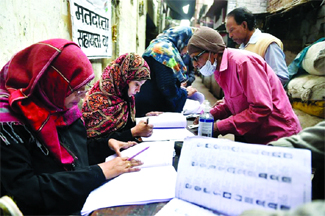
New Delhi (TIP)- The Election Commission (EC) intends to launch the nationwide Special Intensive Revision (SIR) of voter lists in November in phases. As per reports, SIR will be conducted first where assembly elections are going to be held early next year. The EC is prepping for the exvercise at a two-day conference that begun on Wednesday, 22nd October, with the Chief Election Officers of all states and UTs in India, apart from other ECI officials.
The EC plan is to implement the SIR of the voters in phases, rather than all at once. The initial states to go through this will be those with elections coming up in 2026, like Assam, Kerala, Puducherry, Tamil Nadu, and West Bengal.
However, on 15th July, authorities of Assam have informed the EC that they would prefer to complete their state’s National Register of Citizens (NRC) first before starting this voter update. Assam is the only state that has been preparing an NRC, so the EC has not reached a decision yet on whether Assam will be among the first group.
Here’s how this new verification process will work, which is based on the excerise already done in Bihar. For the upcoming nationwide exercise, all registered voters will need to fill out new forms to remain on the list. However, there’s a key difference depending on when a voter was first registered. The Election Commission is using a “cut-off year” (like 2003 for Bihar) to set the rules.
If a voter registered before the specified cut-off date, they will likely just need to submit the form. However, if one registered after that cut-off year, the voter must also provide documents proving the date or place of birth to confirm eligibility and citizenship.
There is also some good news, particularly for individuals who have shifted from one state to another for work. The EC is introducing a new regulation that’s very beneficial. While voters were allowed to only use old proof from inside Bihar during the Bihar trial, that’s being relaxed for this national rollout.
For instance, if a person was born in West Bengal and were registered there on their 2002 electoral roll, but now resides and votes in Mumbai, that person can utilise that old West Bengal proof to remain registered to vote in Mumbai. This helps migrant workers a great deal. The ongoing two-day comference is the second such meeting that the EC is having over nationwide SIR, after the first conference in September this year.
Month: October 2025
-

EC to launch nationwide SIR in 2 phases; schedule next week
-

Bengaluru-bound private bus catches fire after bike crash in Kurnool; 20 dead
Hyderabad (TIP)- A Bengaluru-bound private bus from Hyderabad caught fire in this district on Friday, Oct 24, after colliding with a two-wheeler, leaving 20 people dead, a senior police official said.
Official sources indicated that the toll may rise. Among the deceased was the biker. According to initial reports, the motorcycle collided with the bus near Chinnatekur in Kurnool and got dragged underneath with its fuel cap open, triggering the blaze.
“So far, 19 passengers and a biker have died. Police are entering the bus to assess the situation, and the fate of nine other passengers is yet to be ascertained,” Kurnool Range DIG Koya Praveen told PTI.
He added that a complete picture of casualties and survivors would emerge only after thorough investigation and identification of all those involved in the accident.
The bus door got jammed due to a short circuit and the vehicle was completely gutted within minutes. Most survivors were aged between 25 and 35 years, police further said. District Collector A Siri said 41 people were travelling in the bus, and this included the driver.
Of the 41 onboard, 21 have been traced. Those who escaped the accident are stable and out of danger, she said.
Many passengers could not escape the tragedy as it occurred during the night when they were asleep, she said.
She said the bus door did not open immediately as some wires got cut which increased the severity of the tragedy.
Most of the passengers belonged to Hyderabad, Siri added.
Officials had initially said that the bus was bound for Hyderabad in neighbouring Telangana.
Police are taking safety precautions and emptying the diesel tank of the bus. Meanwhile, a team of medical experts reached the spot to collect DNA samples of the charred bodies, said Praveen.
The Road Traffic Association should enforce stringent action if bus operators fail to follow safety measures and use proper materials to prevent similar devastating incidents in the future. The DIG noted that no fire control measures were present in the bus that caught fire, highlighting lapses in safety compliance and emergency preparedness during travel. -

Friendship does not give licence to rape: Delhi HC
The Delhi High Court has denied anticipatory bail to a man accused of raping a 17-year old girl, while rejecting his contention that the victim and accused were friends, saying friendship does not give licence to rape the victim repeatedly, confine her or beat her mercilessly.
Justice Swarana Kanta Sharma dismissed the application of the man in the case lodged under the Prevention of Child from Sexual Offences (POCSO) Act, noting that the accused had still not joined the investigation, despite his anticipatory bail plea having been either withdrawn or rejected on four occasions in the past.
“The contention on behalf of the applicant that the applicant and the complainant were friends and therefore, it could be a case of consensual relationship, cannot be accepted by this court. Even if the parties concerned were friends, friendship does not give any licence to the applicant to rape the victim repeatedly, confine her in his friend’s house and beat her mercilessly, as prima facie disclosed by the complainant in her statement…duly corroborated by the medical records,” the judge said in an order passed on October 17.
According to the FIR lodged on the basis of a complaint by the minor girl, she had known the accused for several years as a neighbour.
She alleged that he took her to his friend’s house, where he beat her and sexually assaulted her repeatedly, and threatened to kill her if she disclosed the incident to anyone.
The accused had sought the bail on the ground that there was a delay of 11 days in filing of the FIR, adding that the relationship between him and the victim was consensual.
While rejecting the accused’s contention of delay, Justice Sharma said, “Quite naturally, it was owing to the fear and trauma of the said incident that the complainant had initially resisted from disclosing about the incident to her parents.”
“Therefore, in view of the foregoing circumstances, coupled with the serious nature of allegations levelled in the present case, prima facie corroborated by the material on record, this court finds that no case for grant of anticipatory bail is made out. Accordingly, the present application stands dismissed,” the judge said. -

No bilateral with Trump as Modi to skip ASEAN meet, will join summit virtually
New Delhi (TIP)- Prime Minister Narendra Modi will not travel to Kuala Lumpur for the 47th ASEAN Summit later this week and will instead join the proceedings virtually.
The decision, announced by the Prime Minister after a phone conversation with his Malaysian counterpart Anwar Ibrahim, has sparked intense speculation in both diplomatic and political circles.
“Had a warm conversation with my dear friend, Prime Minister Anwar Ibrahim of Malaysia. Congratulated him on Malaysia’s ASEAN chairmanship and conveyed best wishes for the success of the upcoming summits. Look forward to joining the ASEAN-India Summit virtually and to further deepening the ASEAN-India Comprehensive Strategic Partnership,” Modi posted on X.
External Affairs Minister S Jaishankar will represent India at the summit in person, officials said. With Modi opting for a virtual presence, prospects of a possible bilateral meeting with US President Donald Trump on the sidelines now stand ruled out.
“The East Asia Summit will provide an opportunity to deliberate on the challenges to peace, stability and prosperity in the Indo-Pacific region and also exchange views on regional and international developments,” the Ministry of External Affairs said.
In his post, Anwar Ibrahim said Modi had informed him of his decision to attend the summit virtually due to the ongoing Diwali celebrations in India. “I respect his decision and extended my greetings for a happy Diwali to him and the people of India,” Anwar said, adding that Malaysia remained committed to strengthening ASEAN–India cooperation “towards a more peaceful and prosperous region”. However, political observers say domestic and diplomatic factors may also have played a role. The upcoming Assembly elections in Bihar—a politically crucial state for the BJP—are expected to command much of the Prime Minister’s attention in the coming weeks.
At the same time, New Delhi’s relations with Washington have faced turbulence after the Donald Trump administration’s recent steep tariff hikes on Indian goods. Diplomatic sources say the leadership may have preferred to avoid an awkward public encounter between the two leaders amid the ongoing trade friction.
Despite his absence, Modi is expected to address the ASEAN-India Summit virtually, while Jaishankar will take part in the broader deliberations and bilateral meetings.
The 47th ASEAN Summit, to be held in Kuala Lumpur on October 26–27, will bring together leaders from Southeast Asia and key dialogue partners, including India, the US, China, Japan and Australia, to discuss regional security, trade and strategic cooperation. -

India working for fair & equitable trade pact with US: Goyal in Berlin
New Delhi (TIP)- India is fully engaged with the US on the trade issue and is working towards a fair and equitable agreement, Union Commerce and Industry Minister Piyush Goyal said on Thursday, Oct 23.
Speaking in Berlin, where he is visiting to enhance bilateral trade cooperation with Germany, Goyal said India was in talks with the US for a trade deal.
“We are in a dialogue with the US. Our teams are engaged. We recently had the Commerce Secretary visit the US and he met his counterpart. We continue to engage with them and the talks are progressing,” Goyal said.
The minister added that India was hoping to work towards a fair and equitable agreement in the near future.
He refrained from setting timelines to the trade talks, maintaining the government’s official position on the issue. The government is assessing the impact of the 50 per cent US tariffs imposed by President Donald Trump on the Indian textile and fisheries sectors and is exploring alternative markets to offset potential losses.
Sources told The Tribune that the European Union recently opened up to imports of Indian shrimp, a sector that had earlier faced significant restrictions.
Internally, the major sectors are still assessing the impact of Trump tariffs and no concrete data has been shared by these sectors with the government, which remains engaged with exporters on the way forward.
Meanwhile, Goyal today held a productive meeting in Berlin with German Federal Minister of Economy and Energy Katherina Reiche. This engagement followed their video conference on August 7.
“The discussions focussed on enhancing cooperation in trade, investment, technology, green energy and skilling,” the Indian side said.
Goyal also met Levin Holle, Economic and Financial Policy Adviser at the Federal Chancellery and Germany’s G7 & G20 Sherpa, and discussed ways to further deepen the bilateral economic relationship.
Later, the minister chaired a Roundtable with CEOs and leaders of German Mittelstand companies at the Indian Embassy, who conveyed their keenness to do business in India and expand existing investments. Source: TNS -
Centre moves to appoint new CJI
With barely a month left for the retirement of Chief Justice of India BR Gavai, the Centre on Thursday initiated the process for the appointment of his successor.
The government has formally written to CJI Gavai, who is due to retire on November 23 on attaining the age of 65, to name his successor, sources said.
According to the memorandum of procedure on the appointment and transfer of Supreme Court and High Court judges, the senior-most judge of the Supreme Court considered fit to hold the office should be appointed as the CJI. CJI Gavai is expected to recommend Justice Surya Kant — the senior-most judge of the Supreme Court — as his successor. Born in a middle-class family on February 10, 1962, in Hisar district of Haryana, he obtained a bachelor’s degree in law in 1984 from Maharishi Dayanand University, Rohtak, and earned the distinction of being appointed the youngest Advocate General of Haryana on July 7, 2000, at the age of 38. He was appointed as a judge of the Punjab and Haryana High Court on January 9, 2004, and assumed charge of the office of the Chief Justice of the High Court of Himachal Pradesh with effect from October 5, 2018.
Justice Surya Kant was elevated as a judge of the Supreme Court on May 24, 2019. Once appointed, Justice Kant will become the 53rd CJI on November 24 and hold the office for nearly 15 months till February 9, 2027. -
Congress questions PM Modi on caste and reservation ahead of Bihar visit
Ahead of Prime Minister Narendra Modi’s visit to the ancestral village of former Bihar chief minister and social justice leader Karpoori Thakur, the Congress on Friday, Oct 24, posed three direct questions to him over his party’s past actions and current policies on caste and reservation.
Congress general secretary in-charge of communications Jairam Ramesh, in a post on X, said, “Today the Prime Minister is going to the ancestral village of Jannayak Karpoori Thakur ji. Here are our three straight questions to him.”
Ramesh asked whether it was not an “acknowledged fact” that the Jan Sangh, from which the BJP later emerged, had brought down Karpoori Thakur’s government in Bihar in April 1979 after he introduced reservations for Other Backward Classes. He said Thakur was subjected to the “vilest abuse” by RSS and Jan Sangh leaders at the time.
He further questioned whether it was not true that on April 28, 2024, the Prime Minister had called those demanding a caste census “urban Naxals”, and that his government had categorically rejected the idea both in Parliament on July 20, 2021, and before the Supreme Court on September 21, 2021.
Ramesh also asked whether the Prime Minister and the state government had done anything to protect Bihar’s 65 per cent reservation law for Scheduled Castes, Scheduled Tribes, OBCs and Extremely Backward Classes under the Constitution.
He said the Congress government had provided such protection to a similar law in Tamil Nadu in September 1994.
PM Modi would kick off his campaign for Bihar polls by paying tributes to late CM Karpoori Thakur at his native village Karpoori Gram in Samastipur district on Friday. After paying tributes to the late leader, he would address his first public meeting in Samastipur and then address another meeting at Begusarai the same day.
On Oct 23, Prime Minister Narendra Modi fired multiple salvos at the Opposition alliance in Bihar, calling it “lathbandhan” and invoking RJD’s erstwhile rule as “jungle raj”. The PM will start his Bihar campaign on Friday with rallies in Samastipur and Begusarai.
Speaking to the BJP booth workers virtually hours after RJD leader Tejashwi Yadav was named the chief ministerial face of the opposition, Modi said the people of Bihar will not forget “jungle raj” for 100 years.
After a woman booth worker cited Bihar’s journey “from the era of corruption under the RJD to the era of development under the NDA regime”, the PM said the opposition Mahagathbandhan was actually a “lathbandhan” alliance. -

Georgia Governor Henry McMaster celebrates Diwali with CG Atlanta and Indian American community

Indian Consul General Ramesh Babu Lakshmanan thanked the Governor for hosting the Diwali celebrations ATLANTA, GA (TIP): Georgia Gov Henry McMaster hosted a Diwali reception to India’s Consul General in Atlanta Ramesh Babu Lakshmanan and members of the Indian-American community. Speaking on the occasion, the Gov described Diwali as an event reminding us of the victory of good over evil He congratulated the Consul General and the Indian American community on the occasion and said he was pleased to host the Diwali celebration.

Presentation of a Memento Consul General Lakshmanan spoke about the importance and popularity of Diwali and thanked the Gov for hosting it.
The governor wrote on X : “A pleasure to host Indian Consul General Ramesh Babu Lakshmanan and members of the Indian-American community this evening as we celebrated Diwali.”

The gathering at the Diwali celebration at the Governor’s -

JPMorgan CEO Jamie Dimon says America has allowed itself to become too reliant on unreliable sources for critical minerals, products, and manufacturing
WASHINGTON, D.C. (TIP): JPMorgan Chase CEO Jamie Dimon has announced a $1.5 trillion investment plan which is aimed at revitalizing America’s industrial backbone and reducing dependence on foreign supply chains. As reported by Business Insider, the decade-long initiative called the Security and Resiliency Initiative will majorly target important sectors such as defense, frontier technologies, energy and advanced manufacturing. “It has become painfully clear that the United States has allowed itself to become too reliant on unreliable sources of critical minerals, products, and manufacturing—all of which are essential for our national security,” Dimon said.
As reported by Business Insider, Jamie Dimon revealed that the bank will commit $10 billion of its own capital to jumpstart the efforts with the remainder facilitated via financing, strategic investments and partnerships.
As per the Business Insider report, Dimon also outlined four key sectors which will get focused investment. The industries include:
- Defense and aerospace
Command & Control Tech
Space Launch & Spacecraft
Unmanned Systems
Munitions, Missiles & Hypersonics
Secure Communication & Mesh Networks
G Infrastructure
Critical Components
- Frontier technologies
Cybersecurity
Quantum Computing
Artificial Intelligence
Edge Computing
Sensor Hardware
- Energy technology
Nuclear Energy
Grid Resilience
Distributed Energy Systems
Battery Storage
Solar Power
- Supply chain and advanced manufacturing
Nanomaterials & Microelectronics
Critical Minerals Mining & Processing
Pharmaceutical Precursors
Autonomous Mobile Robots
Shipbuilding
Mission-Critical Real Estate
Advanced Bulk Materials
A call for unity and urgency
Jamie Dimon also stressed the fact that this initiative is not only about economic growth but it is about safeguarding the future of America. Hopefully, once again, as America has in the past, we will all come together to address these immense challenges,” he said. “We need to act now.”
The announcement from Dimon comes at a time when concerns over global instability, supply chain vulnerabilities, and the race for technological dominance are growing. JPMorgan’s move signals a bold private-sector push to reinforce U.S. resilience in the face of mounting geopolitical and economic pressures.
-

Trump says he’s ending trade talks with Canada over TV ad
WASHINGTON D.C. (TIP): An Associated Press report quoted US President Donald Trump as saying late Thursday, October 23, that he was ending “all trade negotiations” with Canada because of a television ad opposing U.S. tariffs that he said misstated the facts and called “egregious behavior” aimed at influencing U.S. court decisions.
The post on Trump’s social media site came after Canadian Prime Minister Mark Carney said he aims to double his country’s exports to countries outside the U.S. because of the threat posed by Trump’s tariffs.
Trump posted, “The Ronald Reagan Foundation has just announced that Canada has fraudulently used an advertisement, which is FAKE, featuring Ronald Reagan speaking negatively about Tariffs.”
“The ad was for $75,000. They only did this to interfere with the decision of the U.S. Supreme Court, and other courts,” Trump wrote on his social media site. “TARIFFS ARE VERY IMPORTANT TO THE NATIONAL SECURITY, AND ECONOMY, OF THE U.S.A. Based on their egregious behavior, ALL TRADE NEGOTIATIONS WITH CANADA ARE HEREBY TERMINATED.”
Carney’s office didn’t immediately respond to a request for comment Thursday night.
Earlier Thursday, the Ronald Reagan Presidential Foundation & Institute posted on X that the ad created by the government of Ontario “misrepresents the ‘Presidential Radio Address to the Nation on Free and Fair Trade’ dated April 25, 1987.” It added that Ontario did not receive foundation permission “to use and edit the remarks.”
The foundation said it is “reviewing legal options in this matter” and invited the public to watch the unedited video of Reagan’s address.
Carney met with Trump earlier this month to try to ease trade tensions as the two countries and Mexico prepare for a review of the U.S.-Mexico-Canada Agreement, a trade deal Trump negotiated in his first term, but has since soured on.
More than three-quarters of Canadian exports go to the U.S., and nearly $3.6 billion Canadian (US$2.7 billion) worth of goods and services cross the border daily.
In his own post on X last week, Doug Ford, the premier of Ontario, posted a link to the ad and the message: “It’s official: Ontario’s new advertising campaign in the U.S. has launched.”
He continued, “Using every tool we have, we’ll never stop making the case against American tariffs on Canada. The way to prosperity is by working together.”
-

80 years on, UN remains humanity’s best hope
We still have only one UN —indispensable for peace and security
In the face of global challenges, the UN system has sought to address the gigantic task within very limited resources against heavy odds, including the periodic “shooting of the messenger” (UNSG). It is no wonder that whenever the UNSG has sought to translate into action “mandates” and other Charter-ordained tasks that go against the narrow interests of some member states, those states stop funds or withdraw from the UN agencies (such as WHO and UNICEF) and even declare the UNSG persona non grata!

By Bharat H Desai On October 24, the United Nations (UN) reaches the milestone of 80 years even as it faces an uphill task in this increasingly difficult world, wherein 2 billion people live in conflict zones, 1.1 billion face multidimensional poverty, 887 million face climate hazards, 667 million go hungry, 100 economies will take at least 123 years to close the global gender gap and one in three women face physical/sexual violence at least once in their lifetime. Yet, this beleaguered political organization of 193 member states always remains ready to address each of the present-day challenges in this era of a planetary-level crisis.
Despite facing various kinds of smear campaigns, the UN has tried its best to live up to the expectations of the original 50 founding members (including India) who solemnly resolved to “save succeeding generations from the scourge of war.”
The year 2025 has brought the “race to bankruptcy” for the UN and its chief administrative officer, the Secretary-General, in view of the refusal by some countries to provide their contributions based on the UN scale of assessments. By September 2025, only 136 of the 193 member states had paid their assessments in full. Several contributors, including the US, China, Russia and Mexico, had yet to complete their payments. As a result, the UN has been forced to bring down its regular budget for 2026 by 15.1 per cent — from $3.715 billion to $3.238 billion. This will adversely affect the “UN80 Initiative”, including 11 peacekeeping operations, started by UNSG Antonio Guterres to create a stronger organization that is more agile, responsive, resilient and better equipped to deliver on all its “mandates”.
Built on the ashes of the League of Nations at the end of World War II, the UN has survived four times (1945-2025) the life of its predecessor which lasted from 1920 to 1939. Like human beings, the UN is not infallible. It was not designed to take the UN “peoples” to heaven but to try to save them from falling into a hell on earth. Hence, the UN seems to have learned vital survival skills, adaptability and resilience amidst the pitfalls of “how nations behave.” There is no other general political organization with the legitimacy, convening power and normative impact as the UN, which is genuinely working towards securing a better world for humankind.
The UN Charter was adopted on June 26, 1945 at Opera House in San Francisco after a series of confabulations held from 1941 to 45 in places such as London, the Atlantic, Moscow, Tehran, Dumbarton Oaks, Yalta and San Francisco. “The Charter of the United Nations which you have just signed is a solid structure upon which we can build a better world,” said US President Harry Truman in his closing address at the San Francisco conference.
The UN provides us vital lessons for the realization of the idealism to eliminate war. It provides a pathway to stop UN-bashing, to enable it to realize the cherished purposes and principles of the UN Charter, making international law work effectively to deter the lawlessness of powerful nations to protect the “peoples” of the UN.
Notwithstanding the trend of UN-bashing, its proverbial bureaucracy and some of its failings, we still have only one UN and it is indispensable for the maintenance of international peace and security.
Why UN matters
It is only a truism to state that the UN Charter is the cornerstone of international law. It has emphatically declared the principle of sovereign equality of all States, respect for their territorial integrity, political independence and the right to self-determination of peoples. Without the historic battles fought in the UNGA, the elimination of apartheid and the liberation of colonies would not have been possible. As a consequence, the UN membership today stands at 193 — up from the original 50.
Even though there have been numerous conflicts raging around the world, the UN has been the most important whistleblower that has sought to hammer on the principles of non-intervention in the internal affairs of States and the resolution of international disputes by peaceful means through the principal judicial organ of the International Court of Justice (ICJ).
The UN Charter provides a concrete blueprint in Article 2 (4) for the prohibition of threat or use of force, along with the right of self-defense under Article 51. Ironically, this core Charter blueprint has been eroded, as seen in conflicts raging around the world. However, that is due to the self-serving interests of the member states.
Some member states have also tried to stonewall the quest for the UN’s restructuring, including the expansion of the Security Council and the “repurposing” of the Trusteeship Council, to reflect the realities of the 21st century. A layperson needs to understand that the UN can act only when member states allow it.
Most of the member states have been looking to the UN system that comprises commissions, programs, funds and 16 ‘specialized agencies’ (functional organizations). These agencies do commendable jobs in fields such as civil aviation (ICAO), health (World Health Organisation), education and culture (UNESCO), food and agriculture (FAO) and meteorology (WMO).
In the face of global challenges, the UN system has sought to address the gigantic task within very limited resources against heavy odds, including the periodic “shooting of the messenger” (UNSG). It is no wonder that whenever the UNSG has sought to translate into action “mandates” and other Charter-ordained tasks that go against the narrow interests of some member states, those states stop funds or withdraw from the UN agencies (such as WHO and UNICEF) and even declare the UNSG persona non grata!
Life beyond 80 years
On September 29, 2025, at the conclusion of the high-level segment of the UNGA, President Annalena Baerbock underscored that “this organization was created to tackle the problems no country alone can solve…for a better future that is better together.” The institutionalization of “multilateralism” by the UN, on the bedrock of international law, would still be relevant in the remaining three quarters of the 21st century.
Hence, the task is cut out for such founding members of the UN as India, which is aspiring for a rightful seat on the UNSC’s horse-shoe table — to stand by the UN in its hour of existential crisis.
(Bharat H Desai is a professor of international law at the University of Bonn, Germany)
-

The Bolla Charity Foundation Gala 2025: A Celebration of Empathy and American Success
“I am American first,” says philanthropist Harry Bolla, whose journey from cab driver to business magnate embodies the American Dream.
-
By I.S. Saluja
EAST MEADOW, NY (TIP): The 2025 Gala of the Bolla Charity Foundation, held on October 22 at The Lannin in Eisenhower Park, East Meadow, was an evening of emotion, gratitude, and giving. Attended by elected officials, business leaders, and community members, the event honored philanthropist Harry Singh Bolla, celebrating his remarkable journey from humble beginnings to becoming a respected entrepreneur and benefactor.
A Journey Rooted in Gratitude

Nassau County Police Commissioner Patrick J Ryder (left) and Harry Singh Bolla inside the Commissioner Patrick J Ryder Intelligence Unit, speak about the facility. In his moving address, Harry Singh Bolla shared his personal story — one that began with long days behind the wheel of a taxi in New York City and led to ownership of more than 300 gas stations.
“I am American first,” he said, reflecting his deep gratitude to the nation that gave him opportunity and recognition. He spoke of the struggles and determination that shaped his life, and of his commitment to give back to the community that supported him.
Bolla emphasized the Foundation’s work for veterans and their families, recalling the story of a mother struggling to support her sons in the military. “Those who protect us deserve our support,” he said. “We must never forget the sacrifices of our servicemen and women.”
“Empathy and generosity define who we are as Americans. Let us continue to uplift those who serve and protect us”, said Harry Singh Bolla.
Tributes from Officials and Law Enforcement
Nassau County Executive Bruce Blakeman lauded Bolla’s inspiring story as “the embodiment of the American spirit.” He praised his contributions to public welfare, especially his generosity toward veterans, police, and first responders.
Nassau County Police Commissioner Patrick Ryder commended Bolla for his $1 million donation toward the Police Training Village, a cutting-edge facility that provides realistic, scenario-based training to law enforcement officers.
“Harry Bolla’s contribution has made possible a state-of-the-art center that enhances the safety of our residents,” Ryder said. He also spoke of the challenges faced by police departments — from recruiting officers to navigating policies like no-cash bail — and stressed the importance of community trust and diversity in policing.
A Day at the Police Training Village
Earlier in the day, guests toured the Nassau County Police Training Village, where Commissioner Ryder demonstrated the technological advances made in crime prevention and community safety.
He noted that the facility’s development was made possible in large part through Bolla’s $1 million contribution, an act that stands as a model of private-public partnership in community service.
An Evening of Gratitude and Giving
The Gala also featured heartfelt testimonials from veterans, police officials, and community leaders, all acknowledging the Foundation’s far-reaching work.
A silent auction brought the evening to a close, with funds raised to expand the Foundation’s ongoing programs for veterans, first responders, and underprivileged families.
Harry Bolla thanked guests, volunteers, and organizers for their efforts, saying, “This event is not about me — it’s about all of us, coming together to make life better for others.”
The Foundation’s Mission and Milestones
Founded in 2013 by Harry and Kamaljit Singh Bolla, the Bolla Charity Foundation is a 501(c)(3) nonprofit organization dedicated to serving needy families, veterans, and first responders across Nassau County.
Closely connected to the Bolla Market chain of convenience stores, the Foundation has built a strong reputation for transparency, compassion, and sustained community engagement.
Major Initiatives Include:
Police Training Village: Over $1 million donated to establish the Harry Singh Bolla Charity Foundation Training Village for the Nassau County Police Department.
Support for Veterans: Renovations of group homes for formerly homeless veterans and funding for programs pairing veterans with service dogs.
Community Aid: Food, clothing, and financial assistance distributed to families in need; educational support for children.
Support for First Responders: Assistance, recognition, and the creation of a memorial recreational field.
Youth Development: Funding youth programs, including a year of free gas for the Girl Scouts mobile STEM unit.
Recognition and Impact
As of October 2025, the Bolla Charity Foundation holds a Four-Star Rating from Charity Navigator, scoring 94% for Accountability and Financial Transparency — a reflection of its efficiency and ethical management.
A Vision of Compassion
The evening’s spirit was best captured in Bolla’s closing words:
“Empathy and generosity define us. Let’s keep building bridges of kindness and continue to serve those who serve us.”
With its unwavering focus on compassion and community service, the Bolla Charity Foundation stands today as a shining example of how success, when paired with empathy, can become a force for lasting good.
-
-

Mark Carney may embark upon a visit to India in early 2026
- By Prabhjot Singh
TORONTO (TIP): After Foreign Minister Anita Indira Anand broke the ice by visiting India early this month, the decks are now being cleared for the Prime Minister, Mark Carney, to accept an invitation from his Indian counterpart, Narendra Modi, to participate in the AI summit in New Delhi next February.
The move is being described as a sincere effort on the part of both Mark Carney and Narendra Modi to repair fractured diplomatic relations and focus on trade and investment opportunities amid a tariff war with the United States. Although India and Canada have missed several deadlines to reach the bilateral trade target of surpassing $ 15 billion annually over the past couple of decades, the two countries, with a history of hot and cold relations, could now feel the $50 billion mark attainable.
In an interview with a leading Canadian newspaper, the Indian High Commissioner to Canada, Dinesh Patnaik, revealed that India has invited Mark Carney for talks with Narendra Modi early in the New Year.
The visit of the Canadian PM to India could open doors to a comprehensive economic and free trade partnership. Incidentally, India and Canada have been in constant talks over signing a free trade agreement for more than 15 years now.
Two of his immediate predecessors – Stephen Harper (Conservative) and Justin Trudeau (Liberal) – visited India twice during their tenures as Prime Minister of Canada. Jean Chretien and Paul Martin (both Liberals), too, visited India as Prime Ministers of Canada.
DR Manmohan Singh and Narendra Modi, too, visited Canada while the latter’s second visit was only early this year during the G7 Leaders’ summit in Alberta.
Until last year, the bilateral trade between India and Canada used to hover around $11-12 billion annually. In 2024, it recorded a major jump by 12.7 billion to touch 23.6 billion.
In his interview with the Canadian newspaper, Dinesh Patnaik said:” If Canada wants to start negotiations, we would be more than happy to speed up things to do it in a fast way. You are looking at a minimum of $50 billion if we allow the proper environment for it.
Dinesh Patnaik said in the interview that India wants an early visit of the PM to India, saying “it is a relationship we do not want to go downhill.”
Free trade talks had reached the final stages before differences started cropping up. Canadians wanted security of investments, and India was promising fertile land for investments with all possible infrastructure. Relations went sour in June 2023 following the assassination of Hardeep Singh Nijjar outside a Sikh temple in Surrey. Nijjar, a Canadian national, was on the wanted list of India. After his killing outside a Sikh temple, the then Canadian Prime Minister Justin Trudeau accused the Indian Government led by Narendra Modi of playing a role in the killing of a Canadian on Canadian soil.
Canada also expelled India’s High Commissioner and five other diplomats. PM Justin Trudeau even made a statement in the House of Commons that there was a “credible allegation” of India’s direct involvement in the spurt of terrorist crime on Canadian soil. The RCMP had said at that time that it had evidence that Indian government agents had been linked to homicides, extortion and other violent activities in Canada. The name of Larence Bishnoi figured prominently in the RCMP and Liberal Government statements.
Interestingly, the new Liberal Government of Mark Carney also declared Lawrence Bishnoi’s outfit a terrorist outfit.
A diplomatic spat followed that saw both countries expelling the diplomats of each other, besides reducing the strength of diplomatic missions substantially. Allegations and counter-allegations flew freely, and a sense of uncertainty and fear gripped the large Indo-Canadian community, with the Government of India blaming its counterpart for sheltering, supporting and siding with the pro-Khalistan elements.
Though India strongly denied the allegations and responded with tit-for-tat in diplomatic expulsions.
It is only during the past few weeks that both India and Canada have had in place their new High Commissioners.
Incidentally, where India-Canada relations started returning to normalcy, both India and Canada got involved in tough “tariff war” controversies with the US President, Donald Trump. While trade relations with the US were impacted, a new venue opened up for both Canada and India to further their bilateral relations and take them to new heights.
Dinesh Patnaik said in his interview that India is keen to buy Canadian oil and gas, nuclear power, battery storage, fertilizers, processed food and agricultural products. India, he says, is also open for increased cooperation on AI and quantum computing.
Besides India, Canada is also eyeing the Indo-Pacific for expanding its trade. Before visiting India next year, Mark Carney has confirmed his visit to India Pacific later this month.
Mark Carney announced that he will travel to Malaysia, Singapore, and the Republic of Korea from October 24 to November 1, 2025, to deepen trade relationships in the Indo-Pacific region, shore up defense partnerships, and unlock new opportunities for Canadian workers and businesses.
Canada is convinced that the global trade landscape is rapidly changing. In the face of this upheaval, Canada’s new government is focused on “transforming our economy from one that is reliant on a single trade partner to one that is stronger and more resilient to global shocks. To that end, a core mission of the government is to diversify and strengthen Canada’s trade partnerships.”
(Prabhjot Singh is a Toronto-based senior journalist)
-

Bihar battle: Tejashwi CM face, Mukesh Sahni to be one of his two deputies, announces INDIA bloc
PATNA (TIP): The Opposition INDIA bloc on Thursday, October 23, declared Rashtriya Janata Dal (RJD) leader and former Deputy Chief Minister Tejashwi Yadav as its Chief Ministerial candidate for the upcoming Bihar Assembly elections. The announcement was made at a joint press conference in Patna, which was attended by all coalition partners.
Senior Congress leader Ashok Gehlot, who is also the senior observer for the Bihar polls, made the announcement. “I have talked to everyone, and we have agreed to make Tejashwi Yadav as the CM face,” Gehlot said.
“Tejashwi Yadav has a long political career ahead of him, and he will get the approval of the people,” he added. Gehlot also announced that VIP founder Mukesh Sahni would be the Deputy Chief Ministerial face of the alliance, with another Deputy CM to be announced later.
The decision to project Tejashwi Yadav as the Chief Ministerial candidate is seen as a significant boost for the Mahagathbandhan alliance, especially among youth and backward caste voters. However, rumblings were evident in the Congress over Rahul Gandhi’s absence from the alliance’s poster, which featured only Tejashwi Yadav’s photo. Independent MP Pappu Yadav said, “The vote will happen in the face of Rahul Gandhi and no one else.”
The seat-sharing issue, however, remains unresolved, with at least 11 Assembly seats witnessing contests between allies of the Mahagathbandhan.
Gehlot questioned the National Democratic Alliance (NDA) for not announcing their Chief Ministerial candidate, citing the example of Maharashtra where Eknath Shinde was projected as the CM face before the elections, only to be replaced later. He also criticised the Election Commission, calling it “partial.”
Tejashwi Yadav, while addressing the press conference, thanked everyone for making him the CM face and attacked the NDA for “using” CM Nitish Kumar. “Amit Shah is using a different language than he did in the last polls. This time, he is saying that the MLAs would elect the CM. I am worried as a fellow Bihari,” he said, accusing the Nitish Government of rampant corruption and anarchy.
“A large number of scandals took place but no action was taken.”
He said the NDA had not released any manifesto. “It is only stealing my announcements on old age pension, women empowerment, fee power, etc. They have no vision of their own. When I was in power, we did a caste survey and increased reservation to 65 per cent. But the anti-backward government at the Centre did not include it in Schedule 9 of the Constitution,” he alleged.
Yadav Promises ‘new Bihar’
Yadav promised a “new Bihar” if elected as the CM, vowing to create new job avenues in the state and ensuring that no one has to go out of the state to find a job. He also stuck to his promise of providing one government job for each family in Bihar. “The NDA talks about ‘jungle raj’. Not a day passes when people are not murdered and girls are not sexually assaulted. There is no action against the guilty.”
“We will not make any compromise with corruption nor law and order,” Yadav said. He added that despite ruling for 20 years, Nitish could not bring prosperity to the state and that it remains one of the poorest in the county. He alleged that the BJP was trying to divide the society on the line of caste and creed.
CPI-ML General Secretary Deepankar Bhattacharya also addressed the press conference, swearing to change the government in the upcoming elections. The announcement of Tejashwi as the Chief Ministerial candidate is considered a significant victory for him, given the Congress’s earlier reluctance to acknowledge him as the CM face.
-
Government Shutdown: When Politicians Play Games, Citizens Pay the Price
Two million federal employees left unpaid as political egos paralyze America’s government

By Prof. Indrajit S. Saluja “Politicians’ power games starve two million workers — governance reduced to cruel sport.”
That one line sums up the tragedy now unfolding across the United States as the federal government shutdown enters its fourth week. What began as a budget dispute has devolved into a national disgrace — a self-inflicted crisis that punishes those who serve the country, not those who caused the gridlock.
A Nation Held Hostage
The United States — the world’s richest democracy, a global symbol of stability — now finds itself in paralysis. Because its leaders cannot agree on a budget, large portions of the federal government remain unfunded and shuttered.
According to the U.S. Office of Personnel Management, more than 2.1 million federal employees have been affected. Roughly 800,000 workers are either furloughed or compelled to work without pay. Departments from Homeland Security to the Food and Drug Administration, from the National Parks Service to the IRS, are operating on fumes.
This shutdown, among the longest in U.S. history, is not just a bureaucratic failure; it is a moral failure. For every politician holding press conferences in Washington, there is a security officer at an airport wondering how to feed her children. For every strategist talking about “leverage,” there is a Coast Guard family struggling to keep the heat on.
The Human Cost of Political Stubbornness
Government employees are not elites living in luxury. They are ordinary Americans — mail carriers, food inspectors, scientists, park rangers, data clerks. They live in the same neighborhoods, shop in the same stores, send their children to the same schools. Most live paycheck to paycheck, a fragile section of the middle class that cannot afford to miss a month’s salary.
Paychecks have stopped. Bills have not. Mortgages, car loans, student fees — they all continue. Food banks across the country report a surge in demand from federal workers, many of whom have never before needed help.
A furloughed TSA worker told reporters, “I never thought I’d have to choose between rent and groceries.” Another said, “We’re being punished for a fight we didn’t start.”
Meanwhile, members of Congress and senior officials continue to draw full salaries, insulated from the chaos they created. Each side blames the other; each claims moral high ground. But if this is political courage, it is built on the suffering of millions.
Why These Shutdowns?
This is not the first time governance has collapsed under political arrogance. Since 1976, the United States has experienced over 20 shutdowns — brief or prolonged — whenever Congress and the White House failed to agree on spending.
The reasons vary: immigration, healthcare, taxation, social spending. The pattern does not. Every time, ordinary citizens become collateral damage in a war of egos.
Shutdowns are uniquely American; no other major democracy halts government operations to settle political disputes. In most parliamentary systems, governments may fall, but services continue. In Washington, however, gridlock is treated as performance art.
The Butterfly Game
This entire spectacle brings to mind an old metaphor: a cruel game children play with butterflies, catching them for amusement only to crush their fragile wings. That is what our leaders are doing today — turning governance into a game where real people get hurt.
Each furlough, each unpaid hour, each shuttered office is a broken wing. The shutdown serves no noble purpose, achieves no lasting reform. It is simply a byproduct of pride and partisanship — the refusal to compromise, the addiction to conflict, the obsession with “winning.”
One must ask: have our leaders forgotten the oath they took? To “faithfully discharge the duties” of their office, to “preserve, protect and defend” the Constitution, to serve all citizens regardless of faith, race, or political leaning?
Governance was never meant to be a hostage in partisan warfare. The federal budget is not a toy. The livelihoods of millions are not bargaining chips.
Beyond Politics — A Question of Character
This shutdown is not merely a policy failure; it is a failure of character. True leadership demands empathy, humility, and the willingness to find common ground.
A responsible government does not seek victory over its own citizens. It seeks solutions, compromise, and the welfare of the people. But today’s politics rewards confrontation, not cooperation. Each side casts the other as villain while the public suffers in silence.
The effects extend beyond federal employees. Small businesses waiting for government loans are stranded. Food safety inspections are delayed. Visa and passport applications pile up. National parks are closed. Millions of tourists and workers alike face disruption.
According to the Congressional Budget Office, previous shutdowns have cost the U.S. economy billions in lost productivity. The current one is already eroding consumer confidence, slowing growth, and tarnishing America’s image of stability.
Moral Bankruptcy in a Prosperous Nation
There is profound irony in a country that spends trillions abroad promoting democracy but cannot keep its own government open. There is something grotesque about legislators preaching fiscal responsibility while denying workers their wages.
A nation’s greatness lies not in its wealth or military might, but in how it treats its citizens — especially those who serve it faithfully. Federal employees uphold the silent machinery of American life: they secure airports, inspect food, guard monuments, issue benefits, enforce laws.
To treat them as disposable pawns in a political chess match is not only unjust — it is un-American.
The Call for Accountability
Who is to blame? The lazy answer is “both sides.” The honest one is: any leader who puts personal ambition above public duty.
Accountability cannot be an empty word. The President, Congress, and Senate must all share responsibility for this moral debacle. Governance is not a zero-sum game. Those who hold power must also bear its burden.
Voters too must remember: the ballot is not just a right; it is a tool for correction. Leaders who treat citizens as bargaining chips must be held to account. Democracy dies not only when leaders abuse power, but also when people tolerate it.
This shutdown must remain a stain on the conscience of the nation — a lesson, not a footnote.
A Plea to Conscience
The American people are exhausted — not only by this shutdown, but by the political cynicism that fuels it. They want governance, not grandstanding. They crave compassion, not confrontation.
It is time our leaders rose above partisanship and remembered the solemn oath they took — to serve all Americans, regardless of race, color, or creed.
This shutdown must end, yes. But beyond that, the mindset that allows shutdowns must end — the mindset that treats government as a theater of war and citizens as collateral damage.
To those in power, this is not just an editorial rebuke. It is a moral reminder:
Stop your nefarious games.
Stop the cruelty disguised as courage.
Stop breaking the wings of the butterflies who make this nation fly.
America deserves better. Her workers deserve better.
And history will not be kind to those who mistook power for purpose.
(Comments and responses may be addressed to editor@theindianpanorama.news)
-

What we misunderstand in the debate over free speech
“Any attempts to undercut science, to spread propaganda, to diminish educational opportunities or to consolidate control over information systems run counter to the freedom of thought. And it is thus not particularly surprising that we are seeing scientific and educational institutions attacked, while a simultaneous curtailment of free thought is being mounted by billionaires attempting to own increasing shares of the media ecosystem – from the ongoing legacy of the Murdoch family, to Elon Musk’s purchase of Twitter, and to the Ellison family’s moves to consolidate media companies and TikTok.”

By Avram Alpert For all the opinions about free speech and censorship that rage around us, there is remarkably little argument about what the “free” in free speech means. Most defenders of “free speech” only seem to care about the freedom to express themselves. They fight for the right to say anything, not whether the speech itself comes from a position of freedom.
Focusing on what makes free speech free is fundamental to our moral and political futures. Because free speech, properly conceived, is not just about the right to say what one wants. It is also about being the kind of person who has been so conscientious in their thinking, learning and discussion that they have become a free subject whose speech is directed toward the pursuit of truth. And there are serious threats today against the freedom of thought on which free speech relies.
John Stuart Mill makes the connection between free thought and free speech in his classic defense of speech, On Liberty (1859). The first chapter of Mill’s book is not called “Of free speech”, but rather “Of the liberty of thought and discussion”. That’s because speech for Mill is not an end in itself. It is rather one part of a broader freedom to find the truth that begins with a conscientious, trial-and-error attitude in which we are open to criticism and willing to learn from others and through experience. If we are beholden to prejudice, or hatred, or the pursuit of profit, or a desire to manipulate others, then our speech is constrained by these ulterior ends and not free.
Mill in fact criticizes those who “think it enough if a person assents undoubtingly to what they think true, though he has no knowledge whatever of the grounds of the opinion”. For our speech to become free, we have to undertake “due study and preparation”. We have to carefully compare what we believe with experience and reality and consult others with both humility and skepticism. We have to learn the best arguments from different points of view and then come to a considered conclusion.
Free speech is both part of this process as we try out ideas and engage with others, and the necessary end of the process when we express our findings. Starting out wrong or misguided is part of how we learn. This imperative to be considerate in how we come to our speech isn’t about putting legal limits on what can be said. Instead, the goal is to change our cultural and political norms to encourage free speech as part of a process of becoming a freer thinker.
This process is not easy. There are many factors – both benign and malign – that have incredible power to influence our thinking. Our minds, for example, tend to overemphasize negative and frightful information through what psychologists call “affect heuristics” and “availability heuristics” – shortcuts in our thinking bequeathed by evolution so that we quickly recall information and react immediately to danger.
But these same shortcuts can make us susceptible to manipulation – even when we know we’re being manipulated. That’s what makes a false idea like “immigrant crime” so powerful. Even though statistics show that migrants commit far less crime than others, these heuristics trick our minds into recalling recent news stories and becoming afraid. So when someone insists on their right to demonize immigrants, that is not free speech – it is fear speech. Again, we neither can nor should make fear speech illegal, but we can create cultural norms that promote genuine free speech.
True defenders of free speech are first and foremost defenders of free thought and discussion
This includes an open and engaged public sphere, an educational and scientific research system that expands knowledge, active public venues that encourage people to learn about each other’s points of view, and public labors to produce and circulate factual information and counter propaganda and misinformation.
As this list implies, any attempts to undercut science, to spread propaganda, to diminish educational opportunities or to consolidate control over information systems run counter to the freedom of thought. And it is thus not particularly surprising that we are seeing scientific and educational institutions attacked, while a simultaneous curtailment of free thought is being mounted by billionaires attempting to own increasing shares of the media ecosystem – from the ongoing legacy of the Murdoch family, to Elon Musk’s purchase of Twitter, and to the Ellison family’s moves to consolidate media companies and TikTok.
While these assaults on institutions are the most wide-scale and pressing dangers to free thought, there are also interpersonal concerns. The truncation of free thought can happen on an individual level when we don’t hear out dissenting views, however distasteful or even dangerous such views may be. Engaging with people we disagree with is fundamental to any robust system of free thinking and discussion.
To consider just one example: NPR reported a story in 2021 about a woman who turned against vaccines after the birth of her child. She had originally had her newborn vaccinated, and it appeared that her child had an abnormally bad reaction. The doctors didn’t take her concerns seriously, but people online did. She went down a rabbit hole and diminished her freedom of thought in exchange for a community of care.
Over time, she broke with the antivax movement because she found a doctor who listened to her concerns and explained the science without accusation. Free thought arises not only through experience and research, but also patience and listening. This is what Loretta J Ross speaks of as creating a “call-in” rather than a “call-out” culture.
True defenders of free speech are first and foremost defenders of free thought and discussion. They support not only education and scientific research, but also the kinds of caring engagements with their fellow humans that allow for the accurate transmission of ideas and shared pursuit of truth. To protect free speech, we should embody both these political and interpersonal ideals.
(Avram Alpert is a lecturer in the Princeton Writing Program. His most recent book is The Good-Enough Life)
-

“Can America Endure Without the Spirit That Built It?”

By George Abraham A troubling reality unfolding across the United States today is the growing disillusionment of a large segment of the people, mostly young, who are politically and economically upset with the current status quo. Their concerns are justified to a large extent, as the so-called American dream, a promise of upward mobility through hard work, has already slipped away beyond their reach. What once was taken for granted – a stable job, home ownership, and financial security-now feels unattainable to millions, creating a certain uncertainty about the nation’s future. As inequality widens, political polarizations intensify, creating populist movements on the left and right filled with emotions of anger and cynicism. This situation poses a potential threat to the very fabric of our society, raising the question: are we on the verge of a popular uprising that threatens the very foundations of social cohesion and democratic stability?
The primary election victory of Zohran Mamdani as the Democratic candidate is a clear sign that the political pendulum in America is shifting. His campaign, anchored in progressive policies such as rent freezes, free public transit, and higher taxes on the wealthy, has struck a powerful chord with younger voters weary of economic hardship and inequality. Yet, this shift raises profound questions about the nation’s direction. Will these radical, left-wing reforms offer meaningful relief to a generation burdened by debt, stagnant wages, and unaffordable housing? Or will they usher in a social and economic transformation so sweeping that it could alter the very character of American society—perhaps beyond the point of return?
If history is any guide, socialist revolutions have consistently failed to deliver on their promises. The collapse of the Berlin Wall remains one of the clearest testaments to that truth. When the wall finally fell, the world watched as East Germans fled not toward the socialist East but toward the freedom and prosperity of the capitalist West. Despite being surrounded by barriers, West Berliners enjoyed a standard of living, political freedom, and economic vitality unmatched anywhere across the Eastern Bloc. Time and again, socialist systems have produced not equality and abundance but shortages, stagnation, and widespread hardship.
I had the rare opportunity to live in Communist Ethiopia during the rule of Mengistu Haile-Mariam, a dictator who held power through much of the early 1980s. Those years offered me a firsthand glimpse into the grim realities of life under a repressive regime. Beyond the absence of freedom of expression, the country suffered from severe shortages of essential goods, inadequate housing, and a collapsing healthcare system. Fear and silence gripped the population, while the privileged few in power thrived. Eventually, the people’s patience ran out, and the regime was swept away by a popular uprising. It is a stark reminder that no system built on oppression and deprivation can endure indefinitely.
Right in our own backyard, Cuba and Venezuela stand as glaring examples of failed socialist experiments. Cuba remains trapped in the economics and ideology of the last century, its people burdened by stagnation and scarcity. Venezuela, once among the most affluent nations in Latin America and blessed with vast natural resources, has been reduced to chaos under socialist rule. What was once a prosperous society is now marked by poverty, hyperinflation, and mass migration, with millions fleeing their homeland in search of freedom and opportunity.
Some may argue that China, as a communist nation, has thrived under socialism. However, the truth is quite the opposite for those who look deeper. China began its remarkable transformation only after it loosened its centralized socialist controls and opened the door to private enterprise and market-driven reforms. Its leaders recognized the power of innovation and entrepreneurship while eagerly adopting Western ideas, technologies, and management practices. In essence, China’s success story is not the triumph of communism, but the outcome of its partial retreat from it.
However, capitalism became the driving force of the modern era, unleashing the power of individual liberty and human creativity. Capitalism paved the way for unprecedented scientific and technological progress by rewarding innovation and enterprise. It built the foundations of a prosperous society that lifted millions out of poverty and expanded opportunities for generations. In its best form, capitalism has proven that freedom and productivity can advance hand in hand, inspiring a hopeful vision for the future.
In the United States, capitalism does not operate unchecked. It functions within a framework of laws and regulations designed to ensure fairness and accountability. The government plays a crucial role in this, with oversight bodies and the judiciary curbing exploitation and corporate excesses. Robust anti-monopoly laws exist to prevent consumer fraud, price gouging, and the concentration of economic power in too few hands, preserving competition as the lifeblood of a healthy economy. This regulated form of capitalism, with the government as a watchdog, is a key factor in its success and the prosperity it has brought to the nation.
India too experienced an economic revival when the landmark reforms led by Dr. Manmohan Singh were introduced in the early 1990s. By dismantling the rigid controls of the license-raj system and opening the country to global trade and investment, these reforms unleashed the power of the market economy. The results were transformative while propelling India onto a path of sustained growth and helping it emerge as the world’s fourth-largest economy today.
However, for a market economy to succeed, it requires more than policies and regulations. It demands a dedicated and disciplined workforce. Hard work, integrity, and perseverance remain its most essential ingredients. The early immigrants to America are a testament to this truth. They had no Medicare, Food stamps, or Government Safety Nets. Yet, they toiled in the fields and factories, built families, and laid the foundation of a thriving society where effort was rewarded and success celebrated.
The recent generations of immigrants are the actual beneficiaries of that legacy of hard work and perseverance. America became a magnet for talent and ambition and a beacon of freedom and prosperity, a shining city on a hill that drew millions from across the world, from every culture, language, and faith. Such massive movements occur only toward nations that uphold liberty and reward merit. These immigrants joined vibrant, market-driven economies and thrived and many becoming trailblazers in their own right, creating immense wealth, generating opportunities for others, and leading multinational companies that have guided society into a new era of innovation and sustained growth. Their success stories are a testament to the opportunities that a capitalist system can provide, and the social mobility it can enable.
Capitalism and the market economy are not without their flaws. They move in cycles of expansion and recession, and in times of crisis such as the COVID-19 pandemic, the wheels of the economy can come to a grinding halt. Reckless spending by undisciplined politicians can fuel runaway inflation, while excessive regulation can stifle innovation and prevent industries from realizing their full potential. Similarly, a shortage of skilled workers can dampen productivity and slow growth. Yet, these challenges are not insurmountable — they demand dynamic leadership, sound policymaking, and the courage to innovate and adapt to changing realities.
However, the sad reality is that many of today’s immigrants appear intent on challenging or undoing the very experiment that made the United States a beacon of opportunity. One is left to wonder why anyone would come to a country only to disparage the system that built the most powerful economy in history. Unlike the immigrants of earlier generations who valued self-reliance, hard work, and personal responsibility, some now advocate for a culture of dependence, believing that wealth redistribution can solve all social ills. They overlook a fundamental truth: in every system, it is the innovators, the risk-takers, and the diligent workers who drive progress and ultimately reap the rewards of their labor.
New Yorkers face a crucial test in the coming elections. The city already carries roughly $300 billion in debt, and new taxes will disproportionately hurt the middle class. The very wealthy have options to relocate. The city budget has ballooned to some $112 billion, with excessive and wasteful spending in many corners. We should ask ourselves: do we want leaders whose primary goal is to redistribute the wealth and who speak openly about “de-commodifying” housing—a euphemism, some fear, for eroding private property rights or even about “seizing the means of production”, a term Karl Marx used to describe the capital or wealth of those he painted as villains? Do we really want to upend the very system that built New York, entrusting it to those who had no stake in building it?
History has shown that no nation can thrive by undermining the very principles that built its success. Although imperfect, capitalism has proven to be the most effective engine for innovation, progress, and human advancement, provided it is guided by integrity, discipline, and a sense of shared responsibility. The challenges America faces today, from debt and division to disillusionment, call for leadership rooted in vision, prudence, and respect for the hard-won values that shaped this great nation. Let us remember that freedom and prosperity are not entitlements, but trusts handed down by generations who toiled and sacrificed. Preserving them requires courage, wisdom, and faith in the enduring promise of the American spirit.
(George Abraham is a regular contributor to The Indian Panorama. He served as a Chief Technology Officer with the United Nations. He is Vice-Chair of the IOC. He can be reached at gta777@gmail.com)
-

How Indian American Newspapers Continue to Connect and Empower Us in 2025
Have you ever wondered how the Indian American newspaper landscape has evolved to serve our diaspora’s needs today? With a world flooded by information, what role do these specialized newspapers play in keeping us informed, connected, and empowered? For us living in the USA, Indian newspapers provide more than headlines; they are cultural bridges and community voices. This blog will explore their significance through real trends and personal touches, helping us appreciate their evolving role in our lives.
Why Indian American Newspapers Matter Now More Than Ever
In an era dominated by digital noise and global headlines, the question is simple: why do we still need an Indian American newspaper? The answer lies in relevance and trust. Our community faces unique challenges, immigration policies, cultural adaptation, and local community issues that mainstream American media often overlook. These newspapers become lifelines that bring us tailored news from homeland politics to local temple events, education updates, and more.
I remember the relief of a friend when she discovered an Indian newspaper highlighting changes in H-1B visa rules. It was more than news; it was a tool for planning her family’s future. Such moments show how deeply we rely on focused media to navigate our complex diasporic identities.
Stories That Speak Our Language and Lives
Indian newspapers do more than report facts; they tell stories in our language and cultural context. They cover festivals like Diwali in Queens or Ganesh Chaturthi in Fremont with a local flavor that connects generations. These stories showcase not only the celebrations but also the struggles and triumphs within our communities.
By weaving narratives around successful Indian entrepreneurs, student leaders, and grassroots activists, these papers build a mosaic reflecting our everyday realities. This is news that doesn’t just inform but validates our experiences, making us feel seen and heard, whether in New Jersey or California.
The Reach and Diversity of Indian Papers in the USA
The Indian papers in the USA landscape is as diverse as our diaspora. From large metropolitan dailies to niche community weeklies and vibrant online portals, the range offers something for everyone. Languages span Hindi, Tamil, Telugu, Punjabi, Gujarati, and English, reflecting our multicultural makeup.
Moreover, regional editions respond to the specific cultural and social dynamics of areas like the Midwest, Northeast, or West Coast. This targeted approach ensures news resonates deeply with local readers while connecting them to the broader Indian American tapestry.
Innovations Reshaping Diaspora Journalism
Facing challenges like declining print sales, many Indian American newspapers have embraced innovation. Digital-first strategies utilize social media, podcasts, and multimedia storytelling to engage younger audiences. Events coverage now includes live streaming of community festivals, panel discussions, and interviews, making the news experience interactive and inclusive.
User-generated content, such as opinion columns and cultural reflections from diaspora youth, enriches the fabric. This blending of tradition with technology ensures our newspapers remain relevant and accessible in a fast-paced digital world.
What We Hope to See in the Future of Our Community News
Looking forward, we want our Indian American newspapers to deepen community engagement through richer storytelling and broader inclusivity. This means more stories from underrepresented groups within the diaspora, better coverage of educational and career resources, and amplified voices from women and youth leaders.
Greater collaboration between print and digital platforms can create immersive experiences that celebrate our culture while addressing contemporary issues. Above all, we want news that empowers us to collectively navigate our bicultural lives with confidence and pride.
Indian Panorama, Your Trusted Diaspora Voice
Indian Panorama embraces the role of a beloved community storyteller and cultural compass. Through comprehensive and compassionate journalism, we knit together the threads of our diaspora’s diverse stories and aspirations. Our lens goes beyond headlines to capture moments of joy, struggle, and growth that define us.
In the spirit of David Lloyd’s evocative photography, capturing life’s raw emotions and stories, we strive to present news that resonates, inspires, and connects. Join us in this journey of discovery and dialogue, as we build a future firmly anchored in our shared heritage and collective dreams.
People Also Ask
Q1: Why is the Indian American newspaper important in 2025?
A1: It connects the diaspora with relevant news on culture, policy, and community.Q2: How diverse are Indian newspapers in the USA?
A2: They cater to multiple languages and regional diaspora communities for broader reach.Q3: What changes are Indian diaspora media undergoing?
A3: Shifts to digital, interactive content, and inclusive storytelling are key trends.Q4: How can diaspora newspapers empower youth?
A4: By featuring youth voices, career info, and cultural education tailored for new generations.Q5: Where can I find reliable Indian American newspapers online?
A5: Indian Panorama is a trusted source offering comprehensive diaspora news coverage. -

Hollywood Movies with Indian Stars: What Are Our Box Office Hits This Weekend?
We often wonder how Indian talent has made waves beyond Bollywood. Hollywood, the epicenter of global cinema, has increasingly embraced Indian actors, stories, and influences. This movement isn’t just about representation; it’s about culture, identity, and our growing footprint on the world stage. With exciting Hollywood movies with Indian stars on the rise, we find ourselves celebrating a fusion of storytelling that resonates deeply with our diaspora. Coupled with the thrill of box office hits this weekend, the moment calls for us to explore what this means for us, not only as audiences but as a community.
Hollywood’s Growing Embrace of Indian Talent
Hollywood has increasingly welcomed Indian actors who bring unique perspectives and compelling performances to the global stage. Stars like Deepika Padukone (xXx: Return of Xander Cage), Mindy Kaling (Late Night), and Dev Patel (Slumdog Millionaire) have built respected careers without any major role in Mission Impossible.
This rise mirrors a broader acceptance of diverse voices in mainstream cinema. According to Wikipedia, over 100 Indian-origin actors have starred in American productions, breaking barriers and redefining success. These actors bring stories that resonate with multicultural audiences, deepening our community’s connection with Hollywood.
Recent Breakthroughs and Blockbusters
Recent box office successes prove that movies featuring Indian actors draw global audiences. For instance, The White Tiger, starring Adarsh Gourav, received critical acclaim and multiple award nominations. Lion, featuring Dev Patel, won widespread recognition. These films, although not Mission Impossible entries, showcase the powerful contribution of Indian talent to Hollywood’s storytelling fabric.
Heralding a mix of indie spirit and blockbuster potential, these films foster pride and open the door for more nuanced stories from our culture. I remember a conversation with friends in California sharing how seeing Indian actors on international screens inspired us all.
Box Office Hits This Weekend: Celebrating Global Indian Talents
Checking out the latest box office hits this weekend, it’s clear Indian storytelling and talent are winning hearts worldwide. Films with Indian actors or Indian-themed narratives receive enthusiastic support from diasporic audiences and beyond, proving the global appetite for diverse cinema.
The weekend box office is no longer dominated solely by traditional Hollywood fare. Instead, we celebrate a fusion of cultures and narratives, supported by strong community viewership and savvy marketing. This dynamic creates a wonderful sense of belonging for us watching, and influencing, the movie scene from afar.
Future Directions: India’s Place in Global Entertainment
Looking ahead, Indian actors and filmmakers are expected to take on larger creative roles globally, from acting to directing and producing. The diaspora’s growing influence on fashion, music, and digital media ties into cinema as well, crafting a cultural ecosystem that is innovative and inclusive.
Platforms like Netflix and Amazon Prime are investing heavily in South Asian content, and Indian talent is playing starring roles both in front of and behind the camera. These trends suggest that our presence in Hollywood and global media will become richer, more diverse, and more influential in years to come.
Final Remarks: Indian Panorama, Our Cultural Compass
At Indian Panorama, we don’t just report cinema news, we celebrate the community’s triumphs and challenges. Our coverage seeks to connect cultural dots, fostering a sense of pride and engagement among our diaspora readers. Whether watching Hollywood’s Indian stars light up the screen or supporting local film festivals, we belong to a story larger than ourselves.
We invite you to stay informed, inspired, and connected with Indian Panorama as your trusted guide and cultural compass. Because our stories deserve to be told with flair, accuracy, and heart, and we’ll be here to tell them with you.
People Also Ask
Q1: Which Hollywood movies recently featured Indian actors?
Films like The White Tiger (Adarsh Gourav) and Lion (Dev Patel) have drawn acclaim.Q2: Is Priyanka Chopra Jonas in any Mission Impossible films?
No, Priyanka Chopra Jonas has not appeared in Mission Impossible movies.Q3: How do Indian actors impact global cinema?
They bring diverse stories and representation, enriching worldwide narratives.Q4: What are the current Hollywood trends involving Indian talent?
Increased roles, South Asian stories, and streaming platform investments dominate.Q5: How can diaspora audiences stay connected with Indian actors abroad?
Following trusted platforms like Indian Panorama offers curated updates and features. -

Bandi Chhor Divas: The Sikh festival of freedom and light
While Diwali is widely celebrated across India as the festival of lights, in Sikhism, the same period holds a distinct and profoundly meaningful significance: Bandi Chhor Divas, literally the “Day of Liberation.” The festival commemorates a defining moment in Sikh history – the release of Guru Hargobind Sahib, the sixth Sikh Guru, along with 52 other rulers from Mughal captivity. It is a celebration of freedom, justice, courage, and divine grace, observed with devotion, illumination, and communal spirit.
The Story Behind Bandi Chhor Divas
The story of Bandi Chhor Divas is one of courage, wisdom, and selflessness. Guru Hargobind Sahib, the sixth Sikh Guru, assumed leadership after the martyrdom of his father, Guru Arjan Dev Ji, who was executed by the Mughal emperor Jahangir in 1606. Determined to protect the Sikh community and uphold justice, Guru Hargobind combined spiritual authority with temporal power, embodying the principle of Miri-Piri – the harmony of spiritual and worldly responsibility.
In 1619, political tensions led to the Guru being summoned to Delhi and subsequently imprisoned in the formidable Gwalior Fort, a Mughal stronghold. Inside the fort, Guru Hargobind discovered that 52 Hindu kings were also held captive, accused of defying Mughal authority.
Rather than seeking his own freedom alone, Guru Hargobind made a remarkable request: he would leave the fort only if the 52 kings were released alongside him. Emperor Jahangir, impressed by the Guru’s courage, wisdom, and moral integrity, agreed to the Guru’s condition. Guru Hargobind emerged from prison not just free himself, but leading 52 liberated rulers, demonstrating the Sikh ideals of selflessness, justice, and protection of the oppressed.
This moment gave birth to the festival’s name: Bandi Chhor Divas – the Day of Liberation. The Guru’s release coincided with Diwali, linking the historical event to the symbolic theme of light triumphing over darkness.
Historical Context: Sikh-Mughal Relations
Understanding Bandi Chhor Divas requires a glance at the turbulent period of early 17th-century India. The Sikh Gurus had increasingly become influential figures in both spiritual and political spheres, which drew suspicion from the Mughal rulers. Guru Hargobind Sahib, unlike his predecessors, recognized the necessity of balancing spiritual teachings with social and political protection. He strengthened the Sikh community by organizing a disciplined, armed force, not for conquest, but for defense and justice.
The Guru’s imprisonment was part of Jahangir’s strategy to curb his influence. However, Guru Hargobind’s wisdom, diplomacy, and moral authority transformed what could have been a period of suppression into a moment of liberation for many – an enduring testament to courage, faith, and leadership.
Spiritual Significance
Bandi Chhor Divas carries profound lessons for the Sikh community and humanity:
– Freedom and Justice: True liberation encompasses selflessness, extending protection and justice to others, as Guru Hargobind demonstrated.
– Faith in Divine Grace: The Guru’s release exemplifies how courage, righteousness, and devotion align with divine will to overcome adversity.
– Light Over Darkness: Just as Diwali symbolizes the victory of good over evil, Bandi Chhor Divas represents triumph over oppression and the illumination of righteousness.
Guru Hargobind’s philosophy of Miri-Piri also reminds us that spiritual and worldly responsibilities are inseparable – one must cultivate inner virtue while taking action in the world to uphold justice and protect the vulnerable.
Celebrations and Traditions
Bandi Chhor Divas is marked with devotion, illumination, and community service:
– Illumination of Gurdwaras: Sikh temples, especially the Golden Temple in Amritsar, are decorated with thousands of diyas, candles, and lights, creating a breathtaking reflection on the sacred waters.
– Kirtan and Ardas: Devotional singing of hymns and prayers focuses on freedom, justice, and the welfare of all beings.
– Langar (Community Kitchen): Free meals are served to everyone, emphasizing equality, service, and generosity.
– Nagar Kirtans: Public processions with hymns, martial arts displays (Gatka), and community participation celebrate Sikh courage and unity.
Bandi Chhor Divas and Diwali: Shared Symbolism
Although distinct, Bandi Chhor Divas coincides with Diwali, and both festivals share themes of light, hope, and victory over darkness. Both inspire inner reflection, gratitude, and community service – whether through lighting diyas or serving langar. Together, they create a period of moral, spiritual, and communal rejuvenation.
Global Observance
Sikhs worldwide observe Bandi Chhor Divas with reverence:
– Canada, the UK, USA, Malaysia, and Australia: Gurdwaras host special prayers, illuminate their premises, and organize community meals and cultural programs.
– The festival also educates local communities about Sikh history and values, emphasizing freedom, justice, and moral courage.
Lessons for the Modern World
Bandi Chhor Divas teaches timeless values:
– Advocate for justice and freedom, not only for oneself but for all.
– Uphold moral courage in the face of oppression.
– Balance spiritual growth with worldly responsibilities.
The Guru’s example offers a model for ethical leadership, social responsibility, and the enduring power of faith and selflessness. Bandi Chhor Divas is more than a historical remembrance; it is a festival of liberation, light, and courage. By commemorating Guru Hargobind Sahib’s release and the liberation of 52 kings, Sikhs celebrate the triumph of righteousness, the power of compassion, and the eternal light of justice. As diyas illuminate homes and gurdwaras, the festival reminds humanity that courage, selflessness, and moral integrity are the true lights that dispel darkness in every era. -

Diwali across the world: Celebrating light, heritage and humanity
Diwali, the Festival of Lights, may have originated in India, but its glow now illuminates homes and streets across continents. For the Indian diaspora, Diwali is an affirmation of identity, culture, and continuity; for people of other cultures, it symbolizes universal values of hope, renewal, and the triumph of good over evil. Today, from Asia to the Americas, Africa to Europe, Diwali has become a global celebration of light and humanity.
Asia: Singapore, Malaysia, and Indonesia
In Singapore, Deepavali is a public holiday, and Little India becomes a glittering spectacle. Streets are decorated with arches of colorful lights, and cultural programs, rangoli workshops, and traditional music fill the city. Temples like Sri Veeramakaliamman host special poojas, while families perform Lakshmi Puja at home.
Malaysia celebrates Deepavali with equal fervor, especially in Kuala Lumpur and Penang. Public spaces are decorated with lights, and temples like Sri Mahamariamman attract devotees from across the region. Families exchange sweets, light diyas, and host open houses, reflecting both devotion and multicultural hospitality.
In Bali, Indonesia, where a Hindu minority thrives, Diwali is celebrated as Hari Raya Deepavali, with private home rituals, temple offerings, and community gatherings. Though smaller in scale, the celebrations focus on inner purification, lighting diyas, and cultural continuity.
Europe: United Kingdom, France, Germany, and the Netherlands
In the UK, Diwali is a major cultural event, particularly in Leicester, London, and Birmingham. Trafalgar Square hosts large public celebrations with fireworks, food stalls, and dance performances. Leicester’s Belgrave Road becomes a hub for the Indian diaspora, with rangoli competitions and traditional sweets.
In France, especially in Paris and Lyon, Diwali is celebrated in temples and community halls. Indian cultural associations organize music, dance, and food festivals, often open to the public to share Indian traditions with the French community.
In Germany, cities like Berlin and Frankfurt host Diwali events in temples and cultural centers. The celebrations focus on cultural exchange, with storytelling, arts workshops, and performances introducing non-Indian communities to Diwali’s symbolism.
The Netherlands, particularly in Amsterdam, observes Diwali through Indian cultural associations. Public performances, workshops on rangoli and diya decoration, and communal meals allow both Indian expatriates and locals to experience the festival’s vibrancy.
North America: United States and Canada
In the United States, Diwali has grown into a major multicultural celebration. Cities like New York, Houston, San Francisco, and Chicago host large community gatherings, combining rituals, cultural performances, and educational activities. Public parks, temples, and community centers light up with diyas and lanterns, and eco-friendly fireworks are increasingly used to align with sustainability. Schools incorporate Diwali storytelling and crafts to teach children about its legends and universal lessons.
In Canada, cities like Toronto, Vancouver, and Montreal see expansive celebrations. The Vaisakhi Nagar and local temples organize fairs, cultural programs, and charity drives. In Toronto, public spaces feature Diwali-themed lighting installations, reflecting both Indian heritage and multicultural inclusion.
Africa: South Africa,
Kenya, and Mauritius
South Africa has a rich tradition of Diwali among its Indian community. Durban, Johannesburg, and Pretoria host elaborate celebrations, with homes and temples illuminated by thousands of diyas. Cultural performances, charity drives, and family feasts highlight both traditional rituals and community cohesion.
In Kenya, the Indian community in Nairobi and Mombasa celebrates Diwali with temple rituals, family gatherings, and communal meals. Light decorations and fireworks mark the festival, while schools and cultural centers introduce local communities to its significance.
Mauritius celebrates Diwali as a national holiday, with streets, temples, and homes adorned with oil lamps and rangolis. Public displays, fireworks, and cultural events make it a festival of national pride, blending Indian traditions with Mauritian identity.
Caribbean: Trinidad & Tobago,
Guyana, and Suriname
In Trinidad & Tobago, Guyana, and Suriname, Diwali is a national holiday, reflecting centuries of Indian heritage in the Caribbean. Homes are decorated with diyas and candles, temples host pujas, and community celebrations include music, dance, and fairs. Local flavors often merge with traditional Indian sweets and foods, creating a unique fusion that celebrates both ancestry and the local culture.
Oceania: Australia and New Zealand
In Australia, cities like Sydney, Melbourne, and Brisbane celebrate Diwali with public events at temples, cultural centers, and community parks. Street fairs, performances, and workshops engage both the Indian diaspora and the wider Australian community. Families light diyas, perform Lakshmi Puja, and organize charitable events, emphasizing the festival’s themes of generosity and renewal.
In New Zealand, Auckland and Wellington see celebrations in temples and community halls. Diwali events here combine rituals, cultural performances, and educational programs to share Indian traditions with non-Indian residents.
The Global Message of Diwali
What unites Diwali celebrations worldwide is the festival’s universal message: light conquers darkness, knowledge triumphs over ignorance, and goodness overcomes adversity. Beyond ritual and religion, Diwali fosters community, generosity, and mindfulness. Charity drives, interfaith gatherings, and public cultural programs emphasize shared human values, allowing Diwali to transcend borders and cultures.
Modern adaptations – LED lamps, eco-friendly fireworks, and sustainable rangoli – ensure that Diwali remains relevant and environmentally conscious, without losing the essence of the festival. -

Mantras, mudras and meditation for Diwali
Diwali, the festival of lights, is not merely a celebration of material prosperity but a sacred opportunity to awaken the inner luminosity that dispels ignorance and darkness within. Beyond the fireworks, sweets, and festivities lies a deeper spiritual science – one that connects sound, gesture, and silence through the ancient triad of Mantra, Mudra, and Meditation. Together, these practices channel divine energy, purify the mind, and align the human soul with cosmic harmony.
Mantras: The Vibrations of Light
In Hindu philosophy, mantras are not just words but living vibrations – frequencies that connect the devotee to divine consciousness. During Diwali, the chanting of sacred sounds becomes especially potent, as the environment is charged with collective devotion and the spiritual energy of renewal.
The Mahalakshmi Mantra – “Om Shreem Mahalakshmyai Namah” – is one of the most powerful invocations chanted during Diwali. It aligns one’s inner energy with the vibration of abundance, grace, and spiritual wealth. Repeating it with sincerity purifies not only the aura of the individual but also the home, drawing in the subtle presence of the goddess.
Similarly, the Gayatri Mantra, recited at dawn and dusk, invokes the supreme light of consciousness:
“Om Bhur Bhuvah Swah, Tat Savitur Varenyam, Bhargo Devasya Dhimahi, Dhiyo Yo Nah Prachodayat.”
This mantra cleanses the intellect and reminds the seeker that true illumination is not external but the radiance of an awakened soul.
For those who seek inner calm amidst Diwali’s joyous commotion, the Om Namah Shivaya or Om Mani Padme Hum chants offer grounding vibrations, harmonizing the mind and balancing energy centers within.
Mudras: The Gestures of Energy Flow
While mantras are sound vibrations, mudras are physical gestures that channel pranic energy through specific nerve pathways, influencing both the body and mind. In yogic traditions, mudras are considered a form of silent prayer – a dialogue between the self and the divine.
During Diwali, certain mudras can be practiced during puja or meditation to amplify spiritual energy:
Anjali Mudra (Gesture of Reverence): Joining the palms before the heart, this mudra symbolizes unity – the merging of individual and universal consciousness. It invokes humility and gratitude, setting the perfect tone for Diwali worship.
Chin Mudra (Gesture of Consciousness): Touching the tip of the index finger to the thumb, while extending the other fingers, represents the unity of the self (jivatma) with the supreme (paramatma). Practicing Chin Mudra while meditating on the light of a diya deepens one’s awareness and serenity.
Kubera Mudra (Gesture of Prosperity): Associated with Lord Kubera, the deity of wealth, this mudra combines the thumb, index, and middle fingers together. It is believed to attract abundance, clarity, and successful endeavors – a fitting gesture for invoking prosperity during the festival.
These subtle hand movements, when combined with mindful breathing and mantra recitation, create a synergy of body, sound, and spirit that harmonizes the inner and outer worlds.
Meditation: The Flame Within
The most profound ritual of Diwali is not external – it is the lighting of the inner lamp. In yogic philosophy, this is symbolized by the jyoti or divine flame within the heart, which represents pure consciousness. Meditation during Diwali thus becomes a sacred act of self-discovery – a return to one’s true nature of light and bliss.
A simple Diwali meditation practice:
– Sit comfortably before a lit diya.
– Gaze softly at the flame while breathing deeply.
– With each inhalation, visualize divine light entering your being; with each exhalation, release darkness, doubt, and negativity.
– Silently chant Om Shreem Mahalakshmyai Namah or Om Deepajyotaye Namah.
– Gradually close your eyes and imagine the flame glowing within your heart – steady, radiant, eternal.
This meditative act symbolizes the victory of light over darkness, not just in myth but within the human soul.
The Inner Diwali: From Ritual to Realization
While the outer world celebrates with fireworks and festivity, the inner world calls for quiet illumination. The true Diwali sadhana (spiritual practice) is to purify the mind, light the lamp of awareness, and fill every thought with compassion, forgiveness, and gratitude.
When one chants mantras with devotion, performs mudras with awareness, and meditates upon the flame within, the festival transforms into an inner pilgrimage. The lights outside mirror the awakening within – a reminder that divine wealth is not gold or jewels, but the radiance of an awakened heart.
As the ancient scriptures say, “Tamaso Ma Jyotirgamaya” – “Lead me from darkness to light.” This is the essence of Diwali – and the purpose of every mantra, mudra, and meditation that graces the festival of lights.
Diwali is not confined to a religion or a region; it is a state of consciousness – a reminder that the light of truth and love exists in all. Whether one prays in a temple, mosque, church, or simply in silence, the purpose remains the same: to rise from darkness into light.
A Global Festival of Hope
Today, Diwali’s luminous spirit is embraced around the world – from New York’s Times Square to London’s Trafalgar Square, from the temples of Bali to the streets of Durban. People of every faith come together to celebrate light, community, and gratitude. The festival has evolved into a symbol of inclusivity, joy, and the shared human desire for peace.
The Eternal Message
Diwali teaches us that the light of the soul is stronger than any shadow of despair. It invites every individual – regardless of religion or culture – to become a bearer of light, spreading kindness, empathy, and awareness wherever they go.
As the diyas shimmer in countless homes and hearts across the world, they remind us of a simple truth: light has no religion. It shines equally on all, guiding humanity toward unity, understanding, and eternal hope.
In every lamp that burns this Diwali, there glows a universal message – that when we choose light, we choose love, and when we share it, the whole world shines brighter. -

Rituals of purity: Why we clean our homes before Diwali
Every year, as the festival of Diwali approaches, a familiar rhythm begins across India: the sound of sweeping, scrubbing, dusting, and polishing fills the air. From city apartments to village homes, every corner is cleared, repaired, and renewed. Cupboards are emptied, walls are repainted, old things are discarded, and the home takes on a new brightness-ready to welcome Goddess Lakshmi, the harbinger of fortune and auspiciousness.
But beneath this cultural routine lies a profound spiritual and psychological tradition. The act of cleaning one’s home before Diwali is not merely about physical tidiness-it is a sacred ritual of purification, deeply rooted in the Vedas and Hindu philosophy. It reflects an ancient understanding: that outer order influences inner harmony, and a pure environment invites divine energies.
The Vedic Roots of Cleansing
In the Vedic worldview, shaucham (cleanliness) is one of the fundamental virtues of spiritual life. The Bhagavad Gita (16.3) lists it among the divine qualities: “Purity, steadiness, self-control, and humility are the marks of one who walks the path of light.” Cleanliness, therefore, is not just about hygiene-it is a spiritual discipline, an expression of reverence toward life itself. In the Atharva Veda, purity is described as the condition that enables the flow of positive prana (vital energy). A cluttered or dusty space, according to ancient seers, traps stagnant energies (tamasic vibrations), leading to lethargy, confusion, and emotional heaviness. By purifying the physical surroundings, one invites the sattva guna-the quality of light, harmony, and clarity-essential for invoking divine blessings.
Diwali, being the festival of light, therefore begins with cleansing-because light cannot dwell in darkness, and purity cannot coexist with disorder.
Symbolism of Cleansing: Removing the Inner Dust
The act of sweeping and scrubbing, when done mindfully, carries a symbolic meaning that transcends the physical. Each stroke of the broom represents the removal of inner impurities-anger, greed, jealousy, and ego-that accumulate in the mind just as dust settles in a neglected room.
In many traditional households, cleaning begins days or even weeks before Diwali, marking a gradual purification process. As old belongings are sorted through and unnecessary items discarded, there is a simultaneous psychological release-a letting go of memories, attachments, and emotional residues.
This aligns beautifully with the Vedic principle of aparigraha-non-hoarding and non-attachment. To cling to clutter, physical or emotional, is to block the flow of new energy. By clearing our surroundings, we symbolically create space for new beginnings, for the light of insight to enter.
Invoking Lakshmi: The Goddess of Cleanliness and Order
Goddess Lakshmi, the central deity of Diwali, is not only the bestower of wealth but also the embodiment of saundarya (beauty), shri (auspiciousness), and order. The scriptures say that she resides only in places that are clean, serene, and harmonious. Her very presence is said to flee from environments of chaos, neglect, or impurity. The Padma Purana narrates that when cleanliness and discipline prevail, Lakshmi’s radiance naturally manifests. Thus, in preparing the home, devotees are not merely doing housework-they are creating a sacred atmosphere that magnetizes divine grace.
This is why, on the night of Lakshmi Puja, doors and windows are kept open, lamps are placed at thresholds, and homes are fragrant with incense and flowers. The belief is that Lakshmi will enter only those homes that radiate purity, joy, and readiness.
Psychological Science Behind the Ritual
Modern psychology now affirms what ancient wisdom long knew: our surroundings directly influence our mental and emotional states. Cluttered spaces tend to generate stress, distraction, and fatigue, while orderly and well-lit environments promote calmness, clarity, and optimism. Cleaning, therefore, is a therapeutic ritual-a form of active meditation. As one organizes, sweeps, and beautifies, the mind experiences release and renewal. Researchers describe this as “embodied mindfulness”-a physical act that cultivates mental stillness and focus. The timing of this ritual is also significant. Diwali arrives at the end of the monsoon, when homes often accumulate dampness and decay. Cleaning restores vitality not only to the space but to the psyche, symbolizing a fresh start as the new year dawns on the Hindu lunar calendar.
The Metaphysics of Space and Energy
In Vedic cosmology, every object and space vibrates with pranic energy. Dust, disorder, and unused objects create energetic stagnation-what in Sanskrit is known as tamasic bhava, the quality of inertia. The act of cleansing, in contrast, raises the vibration of the environment. Water, when sprinkled with mantras, purifies energy fields; the sound of a broom or a cloth wiping surfaces carries a rhythmic cleansing frequency; and the lighting of incense or camphor completes the ritual by replacing dense vibrations with luminous energy.
This is not mere superstition-it mirrors principles of energy flow found in yogic and Ayurvedic sciences. A clean, organized space allows the prana (life force) to circulate freely, enhancing vitality and mental well-being.
Discarding the Old: A Lesson in Detachment
Another key aspect of Diwali cleaning is the discarding of the old-broken utensils, worn-out clothes, unused objects. This practice is rooted in the philosophical idea that material accumulation binds the consciousness.
The Brihadaranyaka Upanishad teaches: “As is one’s attachment, so is one’s bondage.” To hold on to the past-through objects, emotions, or regrets-is to remain stagnant. The pre-Diwali cleansing thus becomes a symbolic ritual of renunciation: by letting go of the unnecessary, we make room for the divine to enter. In many regions, this is accompanied by Nav Varsh Shuddhi-the purification for the new year-where accounts are balanced, debts settled, and relationships reconciled. Forgiveness, gratitude, and closure are part of this spiritual renewal, aligning the outer cleaning with inner cleansing.
Rituals of Purity Across India
The tradition of pre-Diwali cleansing takes unique forms across India:
– In North India, families begin the Badi Diwali Safai weeks in advance. Walls are repainted, silverware polished, and the courtyard decorated with rangoli. Women often chant mantras while cleaning, invoking the goddess of prosperity.
– In Gujarat and Rajasthan, merchants close their ledgers and open new account books (Chopda Pujan), symbolizing a fresh financial beginning in a purified environment.
– In South India, Deepavali cleaning is accompanied by oil baths and home decoration with mango leaves and turmeric water, signifying ritual purification.
– In Bengal, homes are cleaned for Kali Puja, which coincides with Diwali, symbolizing the removal of fear and ignorance from the heart.
Across all regions, the underlying principle remains the same: purity precedes prosperity.
From Outer Cleaning to Inner Illumination
Ultimately, the pre-Diwali cleansing ritual is not about perfection but about preparation-for the light of Diwali, and for the light of consciousness within. Just as a lamp burns brighter in a clean vessel, the soul shines clearer in a purified mind.
The Sanskrit word Diwali itself stems from Deepavali-“a row of lamps.” But before one can light lamps in the outer world, the inner lamps must be rekindled. Cleaning, then, becomes a meditation-a way to prepare body, home, and heart for illumination.
When one polishes brass lamps, arranges flowers, and wipes away dust, there is a subtle parallel process within: the clearing of confusion, the softening of the heart, and the reawakening of joy. -

The spiritual science of lighting a diya
When a small clay lamp flickers to life at dusk, its flame seems fragile against the vastness of night. Yet, within that delicate glow lies an ancient truth-a reminder that even the tiniest light dispels the deepest darkness. In Hindu philosophy, lighting a diya (lamp) is not merely an act of devotion or decoration; it is a spiritual science, a profound ritual symbolizing the victory of knowledge over ignorance, purity over negativity, and consciousness over inertia.
Across temples, homes, and sacred festivals like Diwali, the diya becomes both a physical source of light and a metaphysical symbol of awakening. To understand why this humble lamp holds such immense importance, one must delve into its roots within Hindu thought, Vedic symbolism, and yogic energy dynamics.
The Flame as a Symbol of the Soul
In the Upanishads, the human soul (Atman) is often compared to a flame. The Katha Upanishad beautifully declares: “There is a light that shines beyond all things on earth, beyond us all, beyond the heavens, beyond the highest-this is the light that shines in our hearts.”
This flame represents Chaitanya-pure consciousness, the divine spark that animates all beings. When one lights a diya, it is an outward expression of this inner truth: that the divine resides within, luminous and eternal. The steady flame signifies clarity, awareness, and steadfastness-the essential qualities needed for spiritual evolution.
Just as a lamp cannot burn without oil, the soul cannot shine without devotion, self-discipline, and knowledge. Lighting a diya is thus a meditative reminder to nurture our inner flame through virtuous living and mindful awareness.
Light as the Essence of Divinity
In Hinduism, Jyoti (light) is synonymous with divinity itself. Gods and goddesses are invoked through the medium of flame-whether in a temple’s aarti, a Vedic fire ritual (yajna), or a simple household lamp placed before a deity. Light represents the formless Brahman-the infinite consciousness that pervades all creation. The Rig Veda calls Agni (fire) “the messenger of the gods,” a divine bridge between the mortal and the celestial realms. When one lights a diya, it is believed that the flame carries prayers to the divine, transforming material elements into subtle vibrations of devotion. The Gayatri Mantra-one of the most sacred chants-also invokes light: “Om Bhur Bhuvah Svah, Tat Savitur Varenyam…”, a prayer to the solar radiance that illuminates the mind and awakens inner wisdom. Thus, to kindle a flame is to awaken the same cosmic light within oneself.
The Five Elements and the Diya
A diya embodies the harmony of the Panchamahabhutas-the five fundamental elements of existence:
– Earth (Prithvi): The clay base of the lamp represents stability and grounding.
– Water (Jala): The oil or ghee signifies sustenance and flow.
– Fire (Agni): The flame embodies transformation and energy.
– Air (Vayu): The oxygen that sustains the flame symbolizes the breath of life.
– Ether (Akasha): The space around the flame signifies consciousness-the field in which all experiences occur.
When these five elements unite in balance, the diya becomes a microcosm of the universe itself-a living symbol of creation, preservation, and dissolution. Lighting it is an act of cosmic alignment, invoking harmony between the external world and the inner self.
The Science of Energy and Vibration
Ancient seers viewed fire not only as a sacred element but also as a conductor of energy. Modern science now supports this intuitive understanding: a burning flame releases photons-particles of light energy-that influence the electromagnetic field around it.
In yogic terms, the flame is associated with the Manipura Chakra (solar plexus), the energy center of willpower and transformation. Watching a steady flame during meditation (a practice known as Trataka) is said to increase concentration, purify the mind, and awaken inner energy.
When a diya is lit in a temple or home altar, it radiates subtle vibrations of positivity. The golden glow purifies the space, while the rhythmic flicker creates a soothing effect on the nervous system. The fragrance of the oil or ghee further enhances this atmosphere of serenity, making the environment conducive to meditation and prayer.
The Symbolism of Light Over Darkness
The act of lighting a lamp carries profound spiritual metaphors. Darkness represents ignorance (Avidya), fear, and attachment, while light symbolizes wisdom (Vidya), courage, and liberation. The simple gesture of striking a match and bringing flame to wick mirrors the awakening of consciousness-the moment when self-awareness dispels illusion.
This symbolism is central to Hindu festivals. During Diwali, the night of Amavasya (new moon), darkness reigns supreme. Yet it is on this very night that millions of lamps are lit, signifying that spiritual light is most powerful when the world is at its darkest. Similarly, in the Ramayana, the people of Ayodhya illuminated their city to welcome Rama’s return-symbolizing the restoration of dharma and truth after a long exile of ignorance and injustice.
The deeper message is timeless: no matter how pervasive darkness seems, it can never withstand even a single spark of truth.
Different diyas and their meanings
Each diya has its own symbolic and energetic significance:
– Single-Wick Diya: Represents the focus of the mind-unity of purpose and devotion.
– Two-Wick Diya: Symbolizes harmony between knowledge and action, or love and duty.
– Four-Wick Diya: Denotes prosperity from all four directions and the fullness of life.
– Five-Wick Diya: Represents the Panchabhutas, balance of the cosmic elements.
Traditionally, ghee lamps are considered the purest, representing selfless devotion. Oil lamps symbolize steady effort and endurance. The direction also matters: lamps facing east invoke enlightenment, while those facing north attract prosperity.
Lighting the Lamp of Inner Awareness
In spiritual psychology, lighting a diya is akin to awakening the Agni within-the fire of awareness that burns away inertia and illusion. Just as the flame consumes oil to sustain itself, the inner fire consumes ego and ignorance to sustain consciousness.
The Bhagavad Gita (10.11) says: “Out of compassion for them, I dwell in their hearts and destroy the darkness born of ignorance with the luminous lamp of knowledge.” This “lamp of knowledge” (jnana-dipika) is what every ritual diya seeks to symbolize-the illumination of the soul through self-realization.
When we light a diya, we are not merely illuminating a space; we are lighting the path of our own awakening.
Daily and Ritual Significance
Traditionally, lighting a lamp at dawn and dusk marks the transition between day and night-the Sandhya Kala-times considered spiritually potent. It represents the continuity of divine presence, protection from negativity, and gratitude for the cycle of life.
In temples, lamps are lit before deities as an offering of light back to the Source of all light. During Aarti, the circular motion of lamps before the divine image symbolizes the cosmic cycles of creation and dissolution, while devotees absorb the energy through sight (Darshan).
At home, keeping a lamp burning in the puja room or near the entrance is believed to attract prosperity, peace, and divine protection. In philosophical terms, it keeps the mind’s lamp awake-ever alert, ever radiant.