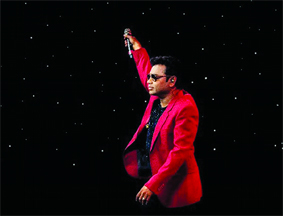
Oscar-winning composer A R Rahman has joined hands with Google Cloud for his new project Secret Mountain, a metahuman digital avatar band that blends artificial intelligence, music and storytelling to create a next-generation entertainment experience.
Under the collaboration, Google Cloud’s advanced AI models and infrastructure will power Secret Mountain, enabling hyper-realistic avatars capable of performing and interacting with audiences in real time.
Conceived by Rahman, Secret Mountain combines AI-powered synthetic avatars with genre-bending music and immersive narratives.
It features six digital avatars, including such as Cara, an Irish singer-songwriter; Zen Tam, a Tamil rapper; and Blessing, an African percussionist and vocalist.
“Secret Mountain is about reimagining how music, storytelling, and technology come together to create new experiences for audiences all over the world,” Rahman said in a statement.
“It is exciting and empowering to have a tech giant like Google as our partner. Together, we are building a bold new world of entertainment where human artistry and AI technology stand side by side to inspire audiences everywhere.”
The project uses Google Cloud’s Veo 3 for avatar embodiment and video generation, Imagen and Gemini Flash 2.5 Image for visual creation, and Gemini 2.5 Pro as the avatars’ conversational “brain” to enable real-time fan engagement.
Thomas Kurian, CEO of Google Cloud, said the collaboration demonstrates how India is leading innovation in creative AI. “By building on Google Cloud’s infrastructure and advanced AI models, Secret Mountain is not only delivering an awe-inspiring interactive digital experience, but also ensuring that security, scalability, and governance are built in,” he said.
Month: October 2025
-

AR Rahman partners with Google Cloud to create AI-powered metahuman band
-

De De Pyaar De 2 trailer: Ajay Devgn’s rom-com sequel picks up where first film left off
It’s turning out to be the year of sequels for Ajay Devgn. Following the success of ‘Raid 2’, the trailer for his next sequel, ‘De De Pyaar De 2’, has just been released. The romantic comedy picks up exactly where the 2019 original ended, continuing the story of Aashish (Devgn) and his much younger girlfriend, Ayesha (Rakul Preet Singh), as they navigate family dynamics and societal expectations.
The trailer introduces Aashish meeting Ayesha’s parents, played by R Madhavan and Gautami Kapoor. While they initially try to be progressive about the significant age gap, tensions arise when they realise that Aashish is almost as old as Ayesha’s father. The trailer also shows Meezaan Jafri’s character, planted by Ayesha’s parents to win her over and end her relationship with Aashish.
In the first film, Aashish sought approval from his estranged family and, with the help of his ex-wife Manju (Tabu), reconciled with both his family and Ayesha. The sequel focuses on Aashish seeking blessings from Ayesha’s side of the family.
While the original was directed by Akiv Ali, ‘De De Pyaar De 2’ is helmed by Anshul Sharma. Luv Ranjan, known for hits like ‘Pyaar Ka Punchnama’ and ‘Sonu Ke Titu Ki Sweety’, has written the story and co-produced the film with Bhushan Kumar under Luv Films and T-Series.
Ajay Devgn and Rakul Preet Singh reprise their roles, and Jaaved Jaaferi returns as Aashish’s comic confidant. New additions include Ishita Dutta, famously known for playing Devgn’s daughter in the ‘Drishyam’ franchise. Tabu, however, will not be part of the sequel. -

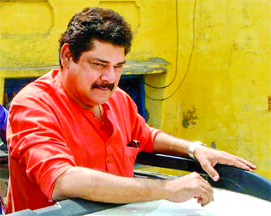
Mahabharat actor Pankaj Dheer passes away
Television star Pankaj Dheer, known for playing Karna in B R Chopra’s Mahabharat and king Shivdutt in fantasy drama Chandrakanta, has died at the age of 68 following a battle with cancer, on October 15.
“He passed away due to cancer this morning. He had been in and out of hospital in the past months,” producer and friend Ashoke Pandit informed. Dheer, who hailed from Punjab, started out as an actor in the 1980s, featuring in minor roles in many movies.
His big break came in 1988 when he was cast as Karna in the small screen adaptation of Hindu epic Mahabharata. After that, his popularity peaked and he starred in many movies such as Sadak, Sanam Bewafa and Aashik Awara.
From 1994 to 1996, Dheer starred in TV series Chandrakanta, loosely based on author Devaki Nandan Khatri’s 1888 novel of the same name. Some of his notable movies also include Bobby Deol’s Soldier, Shah Rukh Khan’s Baadshah, Akshay Kumar’s Andaz and Ajay Devgn’s Zameen and Tarzan. In the late 2000s, Dheer appeared in many daily soaps Teen Bahuraaniyaan, Raja Ki Aayegi Baraat and Sasural Simar Ka. Dheer is survived by wife Anita Dheer and son Nikitin Dheer. -
NDA Finalises Candidates For All 243 Bihar Assembly Seats
The National Democratic Alliance (NDA) released the list of candidates for all 243 constituencies ahead of the Bihar Assembly elections. The JD(U) announced its second and final list of 44 candidates while the Lok Janshakti Party (Ram Vilas) and Upendra Kushwaha’s Rashtriya Lok Morcha (RLM) also announced nominees for their remaining seats.
The JD(U) and the BJP will be contesting from 101 seats each with Chirag Paswan’s LJP(RV) contesting from 29 seats. Other allies in the alliance including the RLM and Union Minister Jitan Ram Manjhi’s Hindustani Awam Morcha (Secular) will be contesting from six seats each.
The RLM’s latest list named former Member of Legislative Council (MLC) Rameshwar Kumar Mahto as its candidate from the Bajpatti constituency, while Madan Chaudhary will contest from Paru. The party had earlier released its first list with Snehlata, the wife of RLM chief Upendra Kushwaha, contesting from Sasaram, Madhav Anand from Madhubani, Prashant Kumar Pankaj from Ujiarpur and Alok Kumar Singh from Dinara.
The LJP(RV) had released its first list of 14 candidates with the second list coming out on Thursday (16/10/2025). The party’s state unit chief, Raju Tiwary, will contest from Govindganj in East Champaran, while senior leader Hulas Pandey has been fielded from Brahampur in Buxar district. -

Prashant Kishor says won’t contest Bihar polls, predicts NDA’s defeat
Patna (TIP)- Poll strategist-turned-politician Prashant Kishor, whose Jan Suraaj Party is making a poll debut in the upcoming Bihar elections, will not be contesting the polls. Putting all speculation to rest, Kishor told news agency PTI that he would not contest the polls, and would instead focus on organisational work.
That Kishor won’t fight the elections was clear last night when Jan Suraaj announced Chanchal Singh as its candidate for the Raghopur Assembly seat. Kishor had earlier said that if he contests the polls, he would do so from Kargahar, his home constituency, or Raghopur, an RJD stronghold. In its first list, Jan Suraaj announced Ritesh Ranjan (Pandey) as its candidate from Kargahar. Chanchal Singh’s choice for Raghopur confirmed that Kishor has decided not to fight the polls. Raghopur is an RJD bastion represented by Tejashwi Yadav and Kishor would have faced an uphill battle if he chose to contest. Contesting the polls would also tie down the Jan Suraaj founder to one constituency and hit the party’s campaign because he is its most prominent face.
“Jan Suraaj decided I should concentrate on organisational work and not contest,” Kishor told PTI this morning. Setting a big target for Jan Suraaj, he said that “anything less than 150 seats” for the party would be a “defeat”.
Kishor predicted a certain defeat for the ruling NDA in Bihar, and added that the Nitish Kumar-led JDU will struggle to win even 25 seats. “The NDA is definitely on its way out and Nitish Kumar will not return as Chief Minister,” he said. “You do not need to be a psephologist to fathom what is in store for the JD(U). In the last assembly polls, Chirag Paswan staged a revolt just a few days ahead of the announcement of elections and fielded candidates, many of whom were inconsequential, against nominees of Kumar’s party, causing its tally to crash to 43,” recalled Kishor.
“The situation is no better in the INDIA bloc either. There is a never-ending tiff between RJD and the Congress. And nobody knows if former state minister Mukesh Sahani’s Vikassheel Insaan Party is still by their side,” Kishor said.
Polling for the 243-member Bihar Assembly will be held on November 6 and 11. Results will be declared on November 14. -
170 Maoists, including commander, surrender In Chhattisgarh; 258 in two days
In what was one of the largest Maoist surrenders in recent years, as many as 170 Maoists surrendered in Chhattisgarh today. Among them was Rupesh, the North-Western Sub-Zonal In-Charge and intelligence chief of the Maoist military wing.
“A landmark day in our battle against Naxalism. Today, 170 Naxalites have surrendered in Chhattisgarh. Yesterday 27 had laid down their arms in the state. In Maharashtra, 61 returned to the mainstream, yesterday. In total, 258 battle-hardened left-wing extremists have abjured violence in the last two days,” the Home Minister posted on X. According to intelligence sources, Rupesh and his associates moved towards Bhairamgarh after crossing the Indravati River through the treacherous Uspari Ghat. Once they reached Bijapur, an official surrender was announced in Jagdalpur.
“Our policy is clear: those who want to surrender are welcome, and those who continue to wield the gun will meet the wrath of our forces. I appeal again to those who are still on the path of Naxalism to lay down their weapons and join the mainstream. We are committed to uprooting Naxalism before 31st March 2026,” the Home Minister added. -

Create special jails for fugitives as per International norms: Shah to states
New Delhi (TIP)- Home Minister Amit Shah on Thursday, Oct 16, asked all states to create a special prison for fugitives that meets international standards, and cancel the passports of those facing Interpol red notices to nullify their claims of mistreatment upon extradition and stop their free movement across borders.
He said this while addressing a CBI conference titled “Extradition of Fugitives-Challenges and Strategies”.
Shah’s comments came amid past instances where several fugitives like Vijay Mallya, Nirav Modi and Mehul Choksi, have raised the issue of “poor conditions” of Indian prisons to counter their extradition in foreign courts.
“This is needed because fugitives argue in foreign courts that prisons in India are not up to the standards, that their human rights will not be protected. While I do not agree with that, if it is an excuse, why give them that chance? Every state capital should have a cell which conforms to international standards in its entirety,” Shah said.
“Until we instil fear of the Indian legal system in the minds of fugitives who harm the nation’s economy, sovereignty and security from abroad, we cannot ensure the country’s safety,” Shah added.
India has 338 extradition requests pending with various countries to bring back fugitives wanted for financial crimes, terrorism and narcotics smuggling, among others.
He said the passports of fugitives could be red-flagged upon the issuance of an Interpol Red Notice against them.
“It is not a difficult thing to do with the present technologies. When a red notice is issued, the passport should be cancelled to block the fugitive’s international travel. If we can build this provision into the system, it will help bring back the fugitives,” he said.
Giving his suggestions on the actionable outputs to be deliberated during the two-day conference being attended by all state police chiefs, the home minister said a scientific database on fugitives should be developed and shared with all states, which should include the type of crime committed by the offenders, present location, network in the country and the status of repatriation attempts. -

Omar delivers on key promise, revives Darbar Move ended by L-G in 2021
Srinagar (TIP)- Fulfilling a key electoral promise, the Jammu and Kashmir Government led by Chief Minister Omar Abdullah on Thursday, Oct 16, announced the restoration of the Darbar Move — the biannual shifting of the civil secretariat between Srinagar and Jammu– which had been discontinued by Lt Governor Manoj Sinha during the Central rule in 2021.
The announcement comes on a day the National Conference completed one year in office. It is expected to give the ruling party a boost in Jammu, where there has been strong demand for reviving the old practice.
Speaking at a press conference in Jammu, Omar confirmed that the J&K Cabinet had approved the decision and forwarded it to Lt Governor Sinha, who had signed and returned the file. “I too have signed the file for the full Darbar Move. We are restoring the age-old tradition,” he said. The government later issued a formal order on the restoration.
The practice, introduced by the Dogra rulers nearly 150 years ago, was stopped by Lt Governor Sinha in June 2021 citing the administration’s transition to an e-office system, which was projected to save around Rs 200 crore annually. Under the Darbar Move, the civil secretariat and other government offices functioned for six months each in Srinagar and Jammu during summer and winter, respectively.
The discontinuation, however, drew sharp criticism, particularly from Jammu’s business community and politicians, who described the tradition as a vital link between the two regions. The Chamber of Commerce and Industry had also urged the government to restore the practice, citing its economic benefits for the region.
Questioning the earlier decision to end the tradition, Omar said, “It was a practice even before 1947. The people taunt us that we don’t understand the history of J&K and don’t respect its great personalities. In fact, it was the BJP which destroyed their legacy. But we had promised the people that we would restore the Darbar Move.”
Expressing hope that the move would help the economy of Jammu, the Chief Minister said the decision would help counter the propaganda that his party only represented one region, “We are a party of Jammu and Kashmir, not a party of any one particular province,” he added. -
‘Frightened’: Rahul Gandhi slams PM Modi over Trump’s Russian oil claim
Following US president Donald Trump’s claim of India’s assurance to not purchase Russian oil, Lok Sabha leader of opposition Rahul Gandhi slammed Prime Minister Narendra Modi. Taking to X on Thursday, Oct 16, the Congress MP accused the prime minister of being afraid of Trump and the US.
Following US president Donald Trump’s claim of India’s assurance to not purchase Russian oil, Lok Sabha leader of opposition Rahul Gandhi slammed Prime Minister Narendra Modi. Taking to X on Thursday, the Congress MP accused the prime minister of being afraid of Trump and the US.
Gandhi’s post on X comes after Donald Trump claimed PM Modi had given him “assurance” that India will no longer purchase Russian oil.
“I was not happy that India was buying oil. And he (Modi) assured me today that they will not be buying oil from Russia. That’s a big stop,” Trump told reporters at the Oval Office, adding that he shares a “great relationship” with PM Modi.
The US President added that after India, he would now “get China to do the same thing.”
India’s purchase of Russian oil has been the headlines since August, after Trump announced an additional 25 percent tariff on New Delhi as a penalty. With this additional amount, Trump’s tariffs on India went up to a total of 50 percent.
In response to the additional levies, PM Modi stated that he would not compromise on the livelihood of farmers, even if it meant “paying a heavy price”.
Furthermore, the prime minister also renewed his push for “Make in India” and “self-reliance.” -

Let it die a natural death: SC on CJI shoe-hurling episode
New Delhi (TIP)- The Supreme Court on Thursday, Oct 16, said that the incident involving an advocate’s attempt to hurl a shoe at Chief Justice of India (CJI) Bhushan R Gavai earlier this month should be allowed to die a “natural death” rather than being kept alive on social media or by “publicity hungry” individuals, even as it agreed to examine whether contempt proceedings should be initiated against the 71-year-old lawyer, Rakesh Kishore, after the Diwali break.
A bench of justices Surya Kant and Joymalya Bagchi made the observation while hearing a mentioning by senior advocate Vikas Singh, president of the Supreme Court Bar Association (SCBA), who urged the top court to take suo motu cognisance and initiate contempt proceedings against Kishore for his act and for remaining unapologetic about it. Singh pointed out that social media platforms were repeatedly circulating the episode, giving it unnecessary traction.
“We are not against freedom of speech, but when such rights are exercised at the cost of the institution’s integrity and dignity, it assumes a different dimension,” the bench observed.
It added: “Our request to everyone is also to consider whether raking up the issue will help in reviving and giving fillip to publicity-hungry individuals…Let it die a natural death. Let it meet its fate with the contempt it deserves.”
Solicitor General Tushar Mehta informed the court that Attorney General R Venkataramani had already granted his consent for initiating contempt proceedings, saying the incident had affected the institutional integrity of the court. “Social media platforms are popularising and even supporting such acts. It is a matter of institutional integrity,” said Mehta, backing Singh’s request.
The bench, however, noted that CJI Gavai himself had shown “magnanimity” by ignoring the episode and asking others to do the same.
The bench cautioned that reviving the issue might serve only to amplify it. “Allow it to have a natural death. One of the ways is to make it face the same contempt and die on its own,” remarked the bench, warning that contempt proceedings could end up creating “another episode” and feed the social media cycle.
“Unfortunately, many of these portals have become money-spinning ventures. Algorithms are programmed to exploit our basal instincts and to monetise outrage. The moment we initiate proceedings, it will be monetised again,” observed the bench, urging lawyers not to “cooperate in monetising it.”
The bench also reflected on the need to preserve institutional dignity through conduct rather than punitive measures. “It is for us and our behaviour in court that we survive and get the respect of the people. That is the spirit the honourable CJI exhibited when he brushed it aside as an action of an irresponsible citizen,” the bench underscored.
As Singh and Mehta insisted that the matter requires consideration, Justice Kant agreed to consider the issue later, saying it would wait for a week and see if the matter still persisted in public discourse before taking a call. “Let us wait for a week and see if it still persists. We will hear it in the week after the Diwali break,” Justice Kant said. The top court will reopen on October 27 after a week-long Diwali break beginning on October 20.
Later in the day, SCBA filed its petition in the court, seeking initiation of contempt proceedings against Kishore. The plea, drawn by advocate Meenesh Kumar Dubey, also demanded “robust guidelines and Standard Operating Procedures (SOPs) for the security within the courtrooms, and to establish a protocol for dealing with such disruptive and contemptuous acts swiftly, to ensure that such an untoward incident is not repeated in the future.”
The incident took place on October 6 when Kishore, an advocate who has since been suspended, suddenly approached the dais during court proceedings before the CJI’s bench and attempted to remove his shoe before being restrained by security personnel. As he was escorted out, he was heard shouting, “Sanatan ka apmaan nahi sahenge (We will not tolerate any insult to Sanatan).”
Unfazed, CJI Gavai had calmly resumed proceedings, telling lawyers, “Don’t get distracted by all this. These things do not affect me.” He later told the court, “For us, it is a forgotten chapter,” and refused to press any charges against Kishore, asking officials to “just ignore” the episode.
However, several members of the Bar had called the act an affront to the dignity of the institution. On October 8, a Supreme Court lawyer had written to the attorney general seeking consent to initiate contempt proceedings, calling the act one that “diminishes the majesty and authority of the Supreme Court.” -

Ex-Trump adviser John Bolton indicted on charges of mishandling classified information
Eighteen-count indictment handed down by federal grand jury in Maryland as US president calls former ally a ‘bad guy’
WASHINGTON, D.C. (TIP): The justice department filed federal charges against John Bolton, the former national security adviser to Donald Trump who turned into one of his biggest critics, accusing him of transmitting and retaining highly classified information under the Espionage Act.
The 18-count indictment was handed up by a grand jury in federal district court in Maryland on Thursday. Bolton has been charged with sending diary entries to two unnamed individuals about his day-to-day activities when he was national security adviser, many of which contained highly classified information.
The indictment marked the third time in recent weeks the justice department has secured criminal charges against one of Trump’s critics.
In response to a question about the charges, Trump told reporters on Thursday that he was not aware of them but that Bolton was a “bad guy”. While Bolton parted on sour terms from the White House, the criminal investigation gained momentum during the Biden administration over disclosures that troubled the US intelligence community.
The justice department pursues Espionage Act cases in the event of so-called “aggregating factors”: willful mishandling of classified information, vast quantities of classified information to support an inference of misconduct, disloyalty to the US and obstruction.
“BOLTON took detailed notes documenting his day-to-day meetings, activities, and briefings. Frequently, BOLTON handwrote these notes on yellow notepads throughout his day at the White House complex or in other secure locations, and then later re-wrote his notes in a word processing document,” the indictment said.
“The notes that BOLTON sent to Individuals 1 and 2 using his non-governmental personal email accounts and messaging account described in detail BOLTON’s daily activities as the National Security Advisor. Often, BOLTON’s notes described the secure setting or environment in which he learned the national defense and classified information that he was memorializing in his notes.”
In a statement, Bolton said, “I look forward to the fight to defend my lawful conduct and to expose his abuse of power.” Bolton’s lawyer Abbe Lowell said his client had not engaged in wrongdoing.
“These charges stem from portions of Ambassador Bolton’s personal diaries over his 45-year career – records that are unclassified, shared only with his immediate family, and known to the FBI as far back as 2021,” Lowell said in a statement. “Like many public officials throughout history, Ambassador Bolton kept diaries – that is not a crime.”
The indictment said Bolton used personal email accounts and a group chat that existed during and after his time as national security adviser to share notes and diary entries that contained classified information to two people who did not have security clearances.
“On or about September 24, 2019, fourteen days after he was no longer employed as the National Security Advisor, BOLTON left the messaging chat group with Individuals 1 and 2 that he had used to send them more than a thousand pages of notes memorializing his time as National Security Advisor,” the indictment said.
In August, FBI agents searched Bolton’s home in Maryland and his office in Washington. They retrieved boxes of papers, computer files and other materials. Court filings related to the case later showed some of those materials with low-level classification markings.
The emails and notes were sent by Bolton in order to produce a compendium of his time as national security adviser for his 2020 memoir, The Room Where It Happened, which angered Trump officials because of his critical behind-the-scenes look into the administration.
Trump has dispensed with decades-long norms designed to insulate federal law enforcement from political pressures. In recent months, he has actively pushed attorney general Pam Bondi’s justice department to bring charges against his perceived adversaries including former FBI director James Comey and New York attorney general Letitia James, even driving out a prosecutor he deemed to be moving too slowly in doing so.
Shortly before Bolton’s book was published, the previous Trump administration sued to delay its release citing a classification review. The justice department also opened a criminal investigation into whether Bolton mishandled classified information by disclosing certain details in the book.
The Biden justice department initially dropped the lawsuit and grand jury investigation in 2021. They later reopened the investigation as the US intelligence community learned more about Bolton’s emails through a foreign spy service, according to people familiar with the matter.
Earlier this year, John Ratcliffe, the CIA director, conferred with Kash Patel, the FBI director, about Bolton’s emails and how they appeared to have been transcriptions of classified material. The briefing appeared to spur renewed interest in investigating Bolton, the people said.
-

Trade thaw likely as Indian team heads to US after Gor’s Delhi talks
Analysts estimate that the tariffs could shave 0.5 per cent off India’s GDP
NEW DELHI/WASHINGTON, D.C. (TIP): Signaling a potential thaw in trade relations, a team of senior Indian officials will visit the US this week to hold talks with the Trump administration on the proposed bilateral trade agreement, an official said in New Delhi.
“The Indian team will visit the US this week,” the official said, adding that the trade talks are progressing well. The development follows meetings between US Ambassador-designate to India Sergio Gor and Prime Minister Narendra Modi, External Affairs Minister S Jaishankar and Commerce and Industry Minister Piyush Goyal.
The trade pact was announced in February by PM Modi and President Donald Trump during Modi’s visit to the US, with the objective of doubling bilateral trade between the two countries to $500 billion.
India and the US had agreed to conclude the first tranche of the proposed trade pact by the fall (October-November) of this year. The official said both sides remain hopeful of meeting that target. So far, five rounds of negotiations have been completed.
In September, Goyal led an official delegation to the US, where he met with United States Trade Representative (USTR) Jamieson Greer and Gor. The Commerce and Industry Ministry said the delegation held constructive discussions with the US government on various aspects of the agreement. Both sides exchanged views on the possible contours of the deal and agreed to continue engagements to achieve an early, mutually beneficial conclusion.
According to reports, India has offered concessions to the US, including easing some restrictions on the import of genetically modified corn and increasing purchases of American defense and energy products.
These discussions have taken place amid heightened tensions following Washington’s imposition of a 25 per cent reciprocal tariff and an additional 25 per cent penalty on Indian goods in response to India’s purchase of Russian crude oil — resulting in a total 50 per cent import duty on Indian exports to the US.
Analysts estimate that the tariffs could shave 0.5 per cent off India’s GDP. Bilateral ties hit a low in late August after a planned US delegation visit to New Delhi for the sixth round of talks (scheduled for August 25-29) was abruptly postponed amid escalating tensions.
India’s exports to the US fell to $6.86 billion in August from $8.01 billion in July, according to Commerce Ministry data.
Exporters said the higher tariffs would start biting now, as the extra 25 per cent duties came into force only at the end of August. September trade data is expected later this week.
(Source: TNS) -

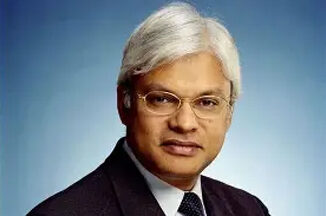
India-origin Former US Diplomat Ashley Tellis Arrested on Charges of Illegally Retaining Classified Documents
WASHINGTON, D.C. (TIP) : The U.S. Department of Justice announced on Tuesday, October 14, the arrest of Ashley J. Tellis, a prominent foreign policy expert of Indian origin and former U.S. diplomat, on federal charges of unlawfully retaining classified national defense information. Tellis, 64, was taken into custody in Vienna, Virginia, where he resides, and now faces prosecution under the Espionage Act, specifically Title 18, U.S. Code, Section 793(e).
According to a statement issued by the Justice Department, Tellis “unlawfully retained numerous documents containing national defense information, including documents marked as Top Secret and Secret.” Prosecutors allege that more than 1,000 pages of classified documents were found at his residence during an FBI search, including sensitive information about U.S. Air Force tactics and aircraft capabilities.
Tellis, widely regarded as one of Washington’s leading “India hands,” has advised multiple U.S. administrations on South Asia policy. He served as a senior official on the National Security Coagreement andhe George W. Bush administration, played a key role in shaping the U.S.-India civil nuclear agreement, and was a senior fellow at the Carnegie Endowment for International Peace.
Court filings claim that Tellis, who maintained high-level security clearances during his government service, continued to access and print classified documents from government buildings even after his tenure ended. Some of these documents were allegedly removed from secure facilities and taken home in a briefcase.
The affidavit further notes that Tellis had met with Chinese government officials on several occasions in recent years. During one such meeting in 2022, investigators say, he was seen carrying a manila folder into the meeting and leaving without it. However, prosecutors have not accused Tellis of sharing classified information with any foreign government, and there is no public allegation of espionage beyond the unauthorized retention charge.
If convicted, Tellis faces up to 10 years in prison and a fine of up to $250,000. A detention hearing is expected later this week.
The case falls under the Espionage Act’s Section 793(e), which criminalizes the unauthorized possession and retention of national defense information. While the statute does not require proof of intent to aid foreign power, it does require prosecutors to demonstrate that the defendant knowingly kept such documents without authorization.
Tellis, who was born in Mumbai and educated at the University of Chicago, is considered one of the foremost American experts on U.S.-India strategic relations. His arrest has sent shockwaves through Washington’s foreign policy community, where he was widely respected for decades of scholarship and public service.
The Justice Department emphasized that the charges are allegations and that Tellis, like any defendant, is presumed innocent unless and until proven guilty in a court of law. -

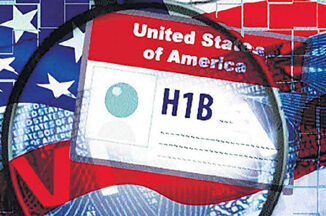
H-1B fee visa hike: US chamber sues Trump administration
WASHINGTON, D.C. (TIP): The US Chamber of Commerce has filed a lawsuit against the Donald Trump administration’s decision to impose a USD 100,000 fee on all new H-1B visa petitions, describing it as “misguided policy and plainly unlawful” action that could cripple American innovation and competitiveness.
The lawsuit, filed Thursday, October 16, in a district court in Columbia, challenges the administration’s September 19 proclamation, ‘Restriction on entry of certain nonimmigrant workers’, arguing that it violates the Immigration and Nationality Act by overriding Congress’ authority to regulate the H-1B visa programme.
The departments of Homeland Security and State, along with their secretaries, Kristi L Noem and Marco Rubio, respectively, have been named as defendants.
The exorbitant fee, up from the current level of around USD 3,600, would make it “cost-prohibitive for US employers, especially start-ups and small and midsize businesses to utilize the H-1B programme, which was created by Congress expressly to ensure that American businesses of all sizes can access the global talent they need to grow their operations here”, said Neil Bradley, Executive Vice President and Chief Policy Officer at the US Chamber.
In its complaint, the business body said the proclamation is “not only misguided policy; it is plainly unlawful”.
The president, it said, has significant authority over the entry of noncitizens into the US, but that authority is bounded by statute and cannot directly contradict laws passed by Congress.
“The proclamation does precisely that: It blatantly contravenes the fees Congress has set for the H-1B programme and countermands Congress’s judgment that the programme should provide a pathway for up to 85,000 people annually to contribute their talents to the United States for the betterment of American society,” it stated.
The proclamation exceeds the president’s lawful authority, the complaint underlined.
Bradley said the Chamber has actively backed Trump’s proposals to attract more investment in America, but to support this growth, the US economy will “require more workers, not fewer”.
Tens of thousands of highly skilled people in specialized fields boost the American economy each year after obtaining H-1B status. These workers allow businesses of all sizes, in industries across the economy, to innovate and grow. The resulting innovations lead to more American jobs, higher wages, and new products and services that improve the quality of life for all Americans.
The Chamber’s complaint contends that the new proclamation “upends” a carefully balanced statutory framework.
“If implemented, that fee would inflict significant harm on American businesses, which would be forced to either dramatically increase their labor costs or hire fewer highly skilled employees for whom domestic replacements are not readily available,” it said.
According to the Chamber, such restrictions would also hand an economic advantage to America’s rivals, “who will surely welcome the talent no longer able to accept work in the United States. That is a competitive edge that foreign employers might never cede back”.
In September, President Donald Trump signed the proclamation, raising the fee for H1-B visas to a staggering USD 100,000 (approx INR 88 lakhs) annually, in a move that could adversely impact Indian professionals on visas in the US.
Indians make up an estimated 71 per cent of all approved H-1B applications in recent years, according to the US Citizenship and Immigration Services (USCIS). Companies pay to sponsor H-1B applicants.
While the US tightens its visa regime, China has recently announced a new work permit called the K-Visa under which qualified professionals from across the world can come to the country and explore work opportunities. The K-Visa is aimed at attracting young science and technology talent and does not require a domestic employer or entity to issue an invitation.
The K-Visa category is in addition to its existing 12 ordinary visa types, available to eligible science and technology professionals. Compared to the existing visa types, K visas will offer more convenience to holders in terms of the number of permitted entries, validity period, and duration of stay.
(Source: PTI) -

Conflicting Claims by US and India on India’s Russian oil imports
NEW DELHI / WASHINGTON, D.C. (TIP): India and the United States continued to differ publicly over Russian oil as U.S. President Donald Trump said he had been assured by Prime Minister Narendra Modi that India will stop buying oil from Russia, while the Ministry of External Affairs maintained the two leaders had not spoken about the issue.
However, the MEA said that India was “broad-basing” and “diversifying” its sources of energy according to market needs, and did not specifically deny the claim that it was reducing its intake
The subject of Russian oil, which has led to the U.S. imposing penalty tariffs on India, is also believed to be holding up trade talks between the two countries. While the government has consistently denied it would bow to pressure, data analyzed by The Hindu showed that oil public sector undertakings (PSUs) have dropped their Russian imports by as much as 45% between June and September this year, even though Russia remains India’s biggest supplier overall.
“I am not aware of any conversation yesterday between the two leaders,” MEA spokesperson Randhir Jaiswal told reporters here on Thursday, also clarifying that a call between Mr. Modi and Mr. Trump last Thursday (October 16, 2025) had only dealt with the Gaza peace plan and India-U.S. trade issues.
On Wednesday, October 15, Mr. Trump had said he was confident that India would end its oil imports “soon” but not “immediately”. “I was not happy that India was buying oil, and [PM Modi] assured me today that they will not be buying oil from Russia,” Mr. Trump told reporters at the White House, with U.S. Ambassador-designate to Delhi Sergio Gor also present. “It’s a little bit of a process, but the process is going to be over with soon,” Mr. Trump said, adding, “That’s a big step. Now we’re going to get China to do the same thing.” On Thursday, the Chinese Ministry of Foreign Affairs slammed the U.S. for “unilateral bullying” over its “legitimate” imports from Russia.
Going on to praise Mr. Modi as a “great man” who “loves Trump”, Mr. Trump said he did not want to “destroy [Mr. Modi’s] political career”. “I’ve watched India for years. It’s an incredible country, and every single year you’d have a new leader,” Mr. Trump said, adding: “My friend has been there now for a long time.”
It was unclear from Mr. Trump’s words how exactly he believed Mr. Modi had relayed this commitment on oil. The two leaders last spoke, according to official statements, on October 9. Mr. Gor met with Mr. Modi, External Affairs Minister S. Jaishankar and National Security Advisor Ajit Doval on October 11, and then flew back to Washington on October 14, meeting with Mr. Trump on October 15, the day Mr. Trump made his statement.
The MEA declined to comment on whether Mr. Gor had discussed the issue with Mr. Modi. In a statement issued on Thursday, October 16, 2025, a few hours after Mr. Trump’s controversial comments, the MEA sought to clarify its position. While it did not specifically mention Russian oil, it said it was seeking to “expand” energy procurement from the U.S.
“It has been [India’s] consistent priority to safeguard the interests of the Indian consumer in a volatile energy scenario,” the statement said, referring to stable prices and secure supplies as “twin goals”. “This includes broad-basing our energy sourcing and diversifying as appropriate to meet market conditions.”
-

Historic Diwali Celebration at Kings Supreme Court Highlights the Story Behind the Diwali Stamp
- I.S. Saluja
BROOKLYN, NY (TIP): In a landmark event marking the first-ever Diwali celebration within the halls of the Kings Supreme Court on October 15, the festival of lights was honored not only as a cultural celebration but as a symbol of justice, truth, and inclusivity. Addressing the gathering of Honorable Justices, legal dignitaries, and guests, the keynote speaker, Ranju Batra, Chair, Diwali Foundation USA, Inc., extended warm Diwali greetings and reflected on the profound symbolism of seeing the “light of Diwali shining within the Supreme Court — a temple of justice and truth.”

Ranju Batra, Chair, Diwali Foundation USA, Inc, giving her Keynote Address The Keynote Speaker’s central message echoed the timeless ideals of Diwali — the triumph of light over darkness, good over evil, and justice over injustice — drawing a deep parallel between the festival’s spirit and the mission of the judiciary.

Lisa Mangal, Administrator, presenting a Memento to the Guest Speaker, Ranju Batra, Chair, Diwali Foundation USA, Inc. A major highlight of the address was the inspiring personal account of the seven-year-long journey to secure the issuance of the U.S. Postal Service’s Diwali Stamp in 2016 — a historic achievement that gave America’s multicultural identity a new symbol of inclusivity.

L to R: Attorney Ravi Batra, Justice Quinones, Appellate Division Associate Justice Deborah A. Dowling, Angela Batra, Justice Robin Sheares, Keynote Speaker Ranju Batra. The initiative began in 2010 when Ranju Batra realized that while American schools widely celebrated Christmas, Hanukkah, Kwanzaa, and Eid, there was no national recognition for Diwali. Determined to change that, she launched a grassroots movement to have Diwali represented through a U.S. postage stamp. After learning that the USPS valued paper petitions over online ones, she painstakingly designed and circulated physical petitions across the country, collecting tens of thousands of signatures over seven years.

Attorney Ravi Batra, Justice Joanne D. Quinones, Ranju Batra Despite multiple setbacks, she persisted — attending meetings with USPS officials, organizing press conferences, and securing congressional support. Her relentless efforts paid off when, on October 5, 2016, the USPS officially issued the Diwali Stamp.
Her dedication didn’t stop there — within ten days of its release, she personally sold over 170,000 Diwali stamps, making it the best-selling stamp in the history of the U.S. Postal Service.
The success story quickly gained international attention. Soon after, a United Nations event was organized to honor her achievement, attended by 24 nations. From this recognition was born the idea of the “Power of One Awards” — an initiative by the Diwali Foundation USA, which she chairs, to honor exceptional diplomats whose work advances peace and global cooperation in the spirit of Diwali’s ideals.

L to R: Uma Devi, Lisa Mangal, Ranju Batra, Justice Quinone. She emphasized that the Diwali Stamp is not merely ink on paper but a powerful emblem of belonging and acceptance. “Every time someone places that stamp on a letter,” she said, “it carries a message of light, truth, justice, and unity. It tells generations of immigrants that their stories matter — that their light belongs here too.”
Closing her remarks, she connected the ideals of Diwali with those of the judiciary: “The Supreme Court, like Diwali, is a beacon reminding us that truth and justice must always be protected and shared.”
As diyas were lit in the courthouse, she urged all to “light the flame of understanding” and continue spreading the light of justice, compassion, and inclusion — the true essence of Diwali.

L to R: Ravi Batra, Angela Batra, Ranju Batra, James Blain, Jay Sharma, Craig Schatzman, Lisa Mangal. -

What’s Shaping Our Future? A Fresh Look at Indian Politics News Today!
When was the last time we paused and asked ourselves what Indian politics means for us, not just as distant observers, but as active participants in a shared journey? Whether we live in India or are part of the growing Indian diaspora across the globe, understanding political shifts is more than news consumption, it’s a way to grasp how policies affect our lives. This post dives into the latest currents in Indian politics, connects dots with economic realities, and considers what these mean for us all.
What Are The Big Questions in Indian Politics Today?
We often ask ourselves: What’s really happening in the political landscape of India? How do election outcomes and government agendas resonate beyond our screens and impact those of us building new lives abroad? Indian politics news today covers much more than parliamentary proceedings or electoral drama. It’s about social justice movements, reforms in education and healthcare, environmental policies, and international relations that touch us personally.
Anecdotally, I recall discussing with fellow Indians in New Jersey how local political reforms in India influence our expectations around voting rights and women’s participation here. Politics is no longer “there” or “here.” It’s a thread weaving through our community’s fabric, demanding attention and understanding.
The Intersection of Politics and Economy: What We Need to Know
Our grasp of political whirls cannot be detached from the economy they shape. The Indian economy update is a critical complement to political reporting because policies define economic direction and, subsequently, our opportunities.
India’s GDP growth, currently projected at around 7% per World Bank data, is driven by decisions about infrastructure, trade, and innovation. For us abroad juggling careers, investments, or family concerns, these shifts inform everything, from remittance flows and business ventures to educational planning. As industry leader Rajesh Mehta once said, “Understanding politics without economic context is like reading half the story.”
Key Political Trends Influencing Our Diaspora Connection
Diaspora engagement has gained fresh momentum, with Indian politics increasingly relevant for NRIs and PIOs. The government’s outreach programs and voting rights expansions show an appreciation for our role. Meanwhile, debates around citizenship laws, environmental policies, and social welfare stir discussions that ripple into diaspora communities.
Indian politics news carries stories of these changes and covers how global Indian voices influence diplomatic relations, trade agreements, and cultural exchanges. This mutual influence adds richness to our diaspora identity and helps us maintain a voice in India’s evolving narrative.
Policy, Governance, and Our Collective Future
What does governance look like when filtered through our diasporic lenses? It’s a mix of hope, critique, and proactive participation. From health reforms accelerated by the pandemic to green energy targets aiming for net, zero emissions by 2070, political decisions chart a future everyone shares.
I recall a recent conversation with an academic who emphasized that “Policy is the language governance uses to tell us where it intends to lead us, and it’s up to us to listen, question, and shape that dialogue.” As Indian diaspora voters and contributors to bilateral growth, engaging with these narratives keeps us grounded and empowered.
Bridging Indian Politics with Indian Economy Update Realities
Understanding the Indian economy update in tandem with political currents offers us a 360, degree perspective. Trade policies, taxation reforms, and innovation drives blend with global geopolitical shifts affecting India. The economic rise creates ripple effects in diaspora communities, affecting jobs, investments, and cultural exchanges.
For instance, recent tariff discussions between India and the USA influence not only major industries but also startup ecosystems many diaspora members contribute to. Such intersections show how deeply interconnected we all are and highlight the necessity of comprehensive, nuanced Indian politics news.
As we parse through the evolving story of Indian politics, let’s embrace a fresh lens, a frame that goes beyond headlines and numbers to capture the human spirit fueling every movement.
At Indian Panorama, we strive to deliver those frames: comprehensive, authentic, and intimate. Because politics for us isn’t just news, it’s a narrative we compose together. Let’s keep reading, reflecting, and participating in this ongoing story with curiosity and conviction.
People Also Ask
Q1: What are the current major issues in Indian politics?
Social justice, economic reforms, environmental policies, and diaspora engagement are key.Q2: How does Indian politics affect the diaspora community?
It influences visa policies, remittances, investment opportunities, and cultural ties.Q3: Why is economic context vital in understanding politics?
Economics reflects the practical impacts of political decisions on everyday life.Q4: How can Indian diaspora stay engaged politically?
By following balanced news, participating in voting, and joining cultural forums.Q5: What makes Indian Panorama a trusted source for diaspora news?
Its nuanced, verified, and community, focused coverage connects global Indians meaningfully. -

From Internet to AI, a story of non-regulation
The objective of the Delhi summit must be to lay down foundational ground rules for the AI era
“If the Internet was transformative, artificial intelligence (AI) is transmogrifying. The critical difference between the dotcom boom and the AI explosion is the substrate upon which it is built. The Internet required a quarter-century to achieve its current ubiquity, a period of gradual, albeit rapid, adoption and infrastructure development. AI, in stark contrast, is being grafted onto the existing, globalized digital nervous system that the Internet created.”

By Manish Tewari The Internet was the most audacious experiment in anarchy, and it has succeeded beyond the wildest imagination of its initial progenitor, the US Defense Advanced Research Projects Agency (DARPA). It represents the largest ungoverned space on earth. Never before in the history of humankind has so much power concurrently resided on 5.5 billion fingertips around the world.
There is more data that is churned out daily than from the dawn of civilization to the turn of the third millennium. The future of humankind lies on the intersection of a brick-and-mortar civilization that evolved over an eternal length of time and a virtual civilization that is still metamorphosing.
The Internet that came in vogue in the mid-1990s was truly transformative in the way it has shaped life, leisure and work patterns. However, it has also been weaponized by state, semi-state and other nefarious characters, including people who have a grievance as to why they were born in the first place.
The Dark Web or the Deep Net is a classical manifestation of the noxious underbelly of the Internet. However, despite a host of acronyms that ostensibly govern the Internet — Internet Governance Forum (IGF), Internet Architecture Board (IAB), Internet Corporation for Assigned Names and Numbers (ICANN), Internet Engineering Task Force (IETF) and the World Wide Web Consortium (WSC), to name a few — there are no agreed rules of engagement in this virtual civilization.
The First Amendment absolutists of the Silicon Valley and other innovation hubs did not allow a cohesive global governance structure for the Internet to get institutionalized. This has led to myriad challenges, including the balkanization of the Internet into spheres of influence.
If the Internet was transformative, artificial intelligence (AI) is transmogrifying. The critical difference between the dotcom boom and the AI explosion is the substrate upon which it is built. The Internet required a quarter-century to achieve its current ubiquity, a period of gradual, albeit rapid, adoption and infrastructure development. AI, in stark contrast, is being grafted onto the existing, globalized digital nervous system that the Internet created.
The devices, the networks, the data streams — the entire kitchenware, as it were — are already in place, pre-heated and ready for this new recipe. This pre-existing infrastructure, coupled with a global population already accustomed to digital immersion, removes the natural friction that once slowed technological adoption.
The acceleration is not merely linear; it is geometric. This very fact places a Herculean burden upon governments, which must now comprehend and regulate a force whose ultimate societal and economic impacts are still unfathomable. To leave this force to its own devices, to allow a repeat of the laissez-faire approach of the 1990s, would be an act of profound historical negligence.
Successive global AI summits, commencing in the UK under then Prime Minister Rishi Sunak and progressing to France under President Macron, have served as vital, yet ultimately preliminary, diplomatic soundings. They have confirmed a universal recognition of the transformative power cascading from AI, but have thus far failed to forge the substantive, binding consensus required to steer this force.
The current landscape is a patchwork of fragmented and often contradictory approaches, a precarious situation that undermines global security and stalls innovation. The European Union, displaying characteristic regulatory ambition, has not waited for the dust to settle, enacting its comprehensive AI Act.
This is a significant step, but one taken largely in isolation. Across the Atlantic, the US maintains a stance of pronounced antagonism towards stringent regulation, favoring a sectoral, innovation-centric model that risks creating a dangerous regulatory vacuum.
Meanwhile, the technological reality accelerates, indifferent to these political machinations. The proliferation of foundational models, from ChatGPT and Claude to DeepSeek, has been succeeded by the deep integration of AI into the very operating systems of our lives through Apple Intelligence and Google Gemini. This is no longer a niche tool for developers; it is a pervasive layer being woven into the minutiae of human functions, from how we communicate and create to how we navigate our daily tasks.
The stage is, therefore, set for the third act in this consequential trilogy of conclaves, with the India AI-Impact Summit to be hosted in New Delhi on February 19-20, 2026.
The objective of the summit must be to lay down the foundational ground rules for the AI era. The objective is not, at this juncture, to draft a monolithic exhaustive legal code attempting to govern every conceivable application of AI.
Such an endeavor would be both futile and counterproductive, stifling the very innovation that promises so much progress. Instead, the aim must be to establish the first principles upon which all future national and international AI governance can be built.
It must be acknowledged that the AI-driven disruption is inevitable and, in many forms, desirable. The role of regulation is not to limit this growth, but to channel it, to ensure that the creative forces vastly outweigh the destructive ones, and that the benefits are distributed equitably across the globe.
The framework for these first principles must be built upon several core pillars. First, there must be a global commitment to safety, security and robustness, particularly for the most powerful, frontier AI models. This necessitates international standards for rigorous testing and evaluation, a shared understanding of critical risks, and protocols to prevent catastrophic misuse.
Second, the principles of transparency and explainability should be enshrined. Citizens and regulators alike must have insight into when and how AI systems are being used, especially in high-stakes domains like justice, finance and healthcare. Opaque algorithms making life-altering decisions are anathema to democratic accountability.
Third, a global consensus on data governance and privacy is paramount. The fuel for AI is data, and the unchecked harvesting and utilization of personal information without clear, harmonized rules represent a fundamental threat to individual autonomy.
Fourth, we must confront the profound ethical dimensions, establishing red lines against uses of AI that violate fundamental human rights, such as pervasive social scoring or lethal autonomous weapons systems operating without meaningful human control.
The term ‘to Google’ is on the cusp of becoming an archaic relic, a testament to the breathtaking velocity of this shift. This is merely the opening salvo, the software-based uprising. The true revolution, the confluence of AI with physical robotics and a fully realized Internet of Things, promises a radical reordering of our physical world within the coming decade itself.
(Manish Tewari is Lok Sabha MP and former I&B Minister)
-

The CJI’s restraint and the media’s reckoning
This is the real danger. When outrage turns profitable, civility becomes costly. The judiciary, bound by decorum, cannot compete in that marketplace.
That composure was constitutional philosophy in action. The CJI’s deliberate lack of reaction became the foundation of his decision not to press charges or initiate contempt. In that context, restraint was not leniency; it was majesty. By treating the episode as beneath response, the CJI affirmed that dignity is not lost through insult, but through insecurity.

By Sanjay Hegde On a Monday morning, an act of madness breached the quiet dignity of the Supreme Court. A 71-year-old lawyer, Rakesh Kishore, hurled an object at the Chief Justice of India BR Gavai. The projectile missed, but the insult did not. I was in that courtroom. I did not see the act itself, only the sudden stir, the hush that followed, and the CJI’s calm voice: “Don’t get distracted. We are not distracted. These things do not affect me.”
That response defined the day. There was no panic, no outburst, no order to have the man dragged away. The CJI continued to work, unruffled. Within seconds, the rhythm of proceedings resumed. It felt as if the institution, embodied in its pater familias, refused to be shaken.
That composure was constitutional philosophy in action. The CJI’s deliberate lack of reaction became the foundation of his decision not to press charges or initiate contempt. In that context, restraint was not leniency; it was majesty. By treating the episode as beneath response, the CJI affirmed that dignity is not lost through insult, but through insecurity.
The attacker did not deserve such grace. Inside court, he mumbled that his act was “intended for Gavai alone.” Outside, before cameras, his tone changed. He suddenly alleged that Sanatana Dharma had been insulted. The shift from personal pique to ideological posturing revealed the truth. This was not conviction but opportunism. Inside the court, he was an offender. Outside, in the theatre of social media, he styled himself a crusader.
Interviews, statements and talk-show appearances began. Some TV anchors painted him as a misunderstood rebel. The man turned into content. Click by click, his infamy metastasized into influence.
This is the real danger. When outrage turns profitable, civility becomes costly. The judiciary, bound by decorum, cannot compete in that marketplace.
Till that point, the CJI’s restraint drew admiration. But as the offender continued to speak, as social-media clips began to glorify him, the Bench and the Bar stirred. Justice Ujjal Bhuyan called the act “an affront to the institution.” The Attorney General for India, R Venkataramani, acting on requests from the Bar, granted consent to initiate criminal-contempt proceedings against Rakesh Kishore — a rare and serious step.
Supreme Court Bar Association president Vikas Singh, along with Solicitor General Tushar Mehta, mentioned the matter before the Bench of Justice Surya Kant and Justice Joymalya Bagchi, seeking an early listing. Singh went further. He asked the Bench for a John Doe order — an injunction against social media posts glorifying the attack. The concern went beyond one man’s misconduct. A wider ecosystem of provocation was emerging, where violence against judges could become an algorithm for fame.
Justice Surya Kant responded calmly. “Hon’ble CJI has been extremely magnanimous… that shows the institution is not affected by these kinds of incidents.” He wondered whether reopening the matter might give fresh oxygen to publicity seekers. Justice Bagchi agreed, asking if new proceedings would “revive and give a fillip to all these publicity-hungry elements.”
Their worry was understandable. Every judicial action, however justified, risks becoming a hashtag battle. A contempt case could easily become Episode No. 2 of the same media drama.
Justice Bagchi said, “It is because of our behavior in court that we survive and get the confidence of the people.” The Solicitor General described the Chief Justice’s forbearance as “a gesture of majesty.” He warned, however, that continued social media valorization was “a matter of institutional integrity.” Vikas Singh agreed, noting that Kishore had shown no regret and kept “making statements glorifying his act.”
The imagery grew more striking when Singh invoked faith. “Some people say Lord Vishnu will justify it. Lord Vishnu will never justify this kind of violence. It is an insult to Lord Vishnu also.” Justice Kant agreed. “Our holy scriptures never condoned violence.”
The moral argument was complete. Even in the language of the faith the offender claimed to defend, his act stood condemned.
Ultimately, the Bench decided to list the matter after the Diwali vacation.
Beyond this courtroom lies a larger unease. Judges across the system watch these events closely. They may draw a discouraging moral. If the CJI can face such an attack, and if institutions hesitate to respond for fear of feeding the media fire, disengagement sets in. The quiet extra-mile work that keeps the system functional becomes rarer. Institutions do not always collapse with a bang. They hollow out through small withdrawals of spirit. The relationship between the Bar and Bench, that compact of mutual trust, also begins to fray. The Bar’s immediate condemnation and the Supreme Court Bar Association’s decision to terminate the offender’s membership sent a clear signal of professional self-correction. The Bar Council of India’s suspension order reinforced that line.
The hardest test lies before the media. When coverage morphs into celebration, when exclusive interviews with offenders are promoted for views, journalists cease to be chroniclers of justice and become profiteers of chaos.
Social-media platforms, as Justice Bagchi noted, treat such incidents as money-spinning ventures. That is the heart of the problem. A man hurling a shoe at the CJI should be a figure of disgrace. If he becomes an algorithmic star instead, we are complicit in dismantling our own faith in law.
The need now is for a measured but firm institutional response. Not hysteria. Not witch-hunt. The judiciary and the Bar must issue a unified statement that such acts are beyond the pale. Freedom of expression does not extend to assault, and ideological pretexts cannot launder violence.
A John Doe injunction against glorifying such acts may raise questions about free speech. Yet, if narrowly tailored to restrain promotion rather than discussion, it can serve a limited but vital purpose. It can signal that contempt of court cannot be monetized. Sometimes the law must act not to punish the past, but to protect the future.
Ultimately, this episode is about the faith of a billion citizens who still believe that, whatever the chaos outside, justice inside the SC proceeds with reason and restraint. Every attack on a judge is an attack on that faith. Every indulgent click, share, or laugh that follows such an attack erodes it a little more. Institutions must build structural safeguards and social consensus that violence against judges is unacceptable.
The lesson of that Monday morning is twofold. First, the Chief Justice taught us the power of calm. Second, the aftermath reminds us that calm must not mean complacency. Let the offender face due process. Let the Bar remain vigilant. Let the media find its conscience again.
And for all our sake, let us hope that the sooner the hype around this incident ends, the better it is.
(Sanjay Hegde is a senior advocate at the Supreme Court)
-

Unemployment is still a core issue in Bihar
Bihar needs a strategy to revive education, create formal jobs and stem the outmigration of its workforce

By Jignesh Mevani Unemployment has consistently emerged as one of the most pressing political issues in Bihar. In the last two Assembly elections, jobs and livelihood were among the top concerns. In 2015, post-poll surveys conducted by Lokniti-CSDS showed that ‘unemployment/jobs’ was the most important issue for 9.1% of voters. By 2020, this percentage rose to nearly 21.0%, making it the second most important issue for voters. With the employment scenario still grim, it is an issue that is likely to dominate voter priorities in the forthcoming polls.
The situation needs to be looked at objectively, for which official statistics are useful. Under the Periodic Labour Force Survey (PLFS), the latest State-level indicators on employment are the April-June 2025 quarterly report and the July 2023-June 2024 annual report, with insights on Bihar.
Looking beyond the unemployment rate
The quarterly and annual releases cite Bihar’s unemployment rate as 5.2% and 3%, respectively, whereas it was 5.4% and 3.2%, respectively, at the national level for ages 15 and above. To the casual reader, Bihar’s employment/unemployment picture seems decent to good. However, such a superficial reading is misleading. To truly understand employment conditions, one must understand three interrelated indicators in the PLFS — Worker Population Ratio (WPR) or share of the population that is employed; Labour Force Participation Rate (LFPR) or the share of the population either employed or actively seeking work, and Unemployment Rate (UR) or share of the labor force that is unemployed and actively looking for work.
Looking at the UR in isolation conceals the true picture. The same quarterly and national releases cite the WPR for Bihar at 46.2% and 51.6%, respectively while the national WPR is 52% and 58.2%, respectively, which shows that the share of those employed in the working age population is much lower in Bihar.
On checking the WPR and LFPR in the table, Bihar has low WPR, low LFPR, and therefore low UR. A more holistic interpretation is grim because many in Bihar are not working (low WPR), and many are not even looking for work (low LFPR). Since those not working are not even looking for work, the unemployment rate looks deceptively low. This is a classic manifestation of the “Discouraged Worker Effect” wherein people without jobs lose hope of finding employment opportunities and completely withdraw from the labor force
A comparison of Bihar with similar/comparable States strengthens the inference and shows how bad employment conditions are in Bihar. But it is important to compare Bihar against States of a similar size and economic background. In this, two factors are crucial in determining similarity: population and per capita income.
For a meaningful comparison, Bihar was grouped with nine large, low-income States (population above three crore as in the Registrar General of India’s 2024 projections, per capita income below national average for 2025-25).
There are nine States that fall under this criteria, which are Assam, Bihar, Chhattisgarh, Jharkhand, Madhya Pradesh, Odisha, Rajasthan, Uttar Pradesh and West Bengal.
When Bihar’s indicators are compared with the chosen group of States, the results are alarming. Bihar ranks the lowest across WPR and LFPR. Uttar Pradesh fares marginally better but still hovers near the bottom.
The quarterly PLFS (April-June 2025) shows that among youth (15-29 years), the picture is even bleaker: only 28 out of 100 are working. Bihar is at the bottom in terms of youth work participation and youth labor force participation. For a generation that should be building its future, the doors of employment remain closed.
Since quarterly figures may be influenced by seasonal fluctuations in employment, it is important to look at the annual PLFS estimates as well. Quarterly estimates are based on Current Weekly Status, in which the reference period used to determine a person’s employment status is just seven days.
The annual report also presents Usual Status: principal+subsidiary status, or figures which give a more comprehensive and stable picture of employment over a long term, minimizing the distortions caused by short-term variations such as festivals, illness or crop cycles. It also captures people’s subsidiary work. However, these annual figures too reinforce the same conclusion. For those aged 15 years and above, Bihar’s WPR stands at 51.6% and LFPR at 53.2%, which are abysmally low. Only Bihar and Uttar Pradesh fall below 60% in WPR.
The situation is grave for women. Bihar’s female WPR is only 30.1%, or out of 100 women aged 15 years and above, only 30 are working. The situation is even more distressing for young women. In the 15-29 age group, Bihar’s female work participation rate stands at 31.2%, while neighboring Jharkhand records 49.3%, which is nearly 20 percentage points higher.
The quality of jobs in Bihar is equally troubling. Only 8.7% of workers are engaged in regular wage/salaried jobs, the lowest among comparable States. Bihar is the only State — not just in this group but also in the entire country — with a single digit proportion. At the same time, 23.8% of workers are employed as casual laborers, the highest share after Odisha across these States. This indicates a lack of secure and formal employment opportunities.
Such outcomes are in stark contrast to the claims of the National Democratic Alliance, which often highlights the formalization of the economy as one of its achievements. In Bihar, however, the labor market remains overwhelmingly informal, insecure and poorly remunerated.
Migration and the missing numbers
A caveat must be kept in mind while interpreting Bihar’s employment indicators. The PLFS counts only those individuals residing in the State during the reference period. The employment picture could have been better had the PLFS been capturing migration as well.
The grim labor market outcomes cannot be separated from Bihar’s governance record. Chief Minister Nitish Kumar’s government has failed to improve literacy and human capital formation. The same PLFS (annual) shows Bihar’s literacy rate at only 73.2% for the 5-plus age group, which is far below the national average. Without significant improvements in education and skills, the State cannot hope to generate meaningful employment opportunities.
Despite frequent announcements, investment summits and promises of industrial revival, little has materialized on the ground. Mr. Kumar’s political maneuvers and shifting alliances have yielded little tangible benefits for Bihar’s economy. The State has underperformed be it education, job creation, industrialization and formalization.
The employment crisis in Bihar is not a matter of perception but one of hard evidence. PLFS data consistently reveal that Bihar lags in all key labor market indicators. Mr. Kumar’s tenure of nearly two decades as the Chief Minister has failed to address these structural weaknesses. For a State with such a young population, this represents not just a missed opportunity but a potential social crisis in the making.
Bihar urgently needs a comprehensive strategy to revive education, create formal jobs, and stem the outmigration of its workforce. Anything short of this risks perpetuating the cycle of poverty, migration, and underdevelopment that has long haunted the State.
(Jignesh Mevani is a Member of the Legislative Assembly in Gujarat and Convener at the Rashtriya Dalit Adhikar Manch)
-

Weekly Horoscope-Octob er 20, 2025 to October 26, 2025
-
By Astrologer Chirag Daruwalla
Aries
Ganesha says the situation will be very positive this week. You will feel energy around you, and new possibilities will come to your mind. This is the time for you to increase social contacts. Spending time with your friends and family will improve your mood. This week, your natural leadership ability will be even stronger, which will enable you to create stability and trust in your relationships. Expressing your thoughts and feelings openly will help you build a deeper bond with your loved ones. Your reaction to news or events that disappoint you will be positive, which will strengthen your relationships. Make small plans with friends and close ones. During this time, this is a great time to make new friends or reconnect with old friends. Overall, this week will bring good progress in your life, and you will experience happiness and excitement in every relationship.
Taurus
Ganesha says this week is going to be a particularly pleasant experience. Your human relationships will deepen, and you will be happy to spend time with your loved ones. This is a time of sharing love and affection, and you are in a good position to share your feelings with those close to you. Your sensitivity and stability will make your relationships stronger. If you want to start a new relationship with someone special, this week is good for you. This is also a great time to resolve old differences and reconcile. You will have positive interactions with your loved ones, which will deepen your feelings. Do not hesitate to express your thoughts and feelings openly this week, as the power of your words will strengthen your relationships even more. With exploration and understanding, you can take your relationships to new heights. So, be prepared and enjoy this beautiful time to the fullest.
Gemini
Ganesha says this week may prove to be somewhat challenging. Small problems may come in your life, which may disappoint you. This may be a time of mental pressure, which will affect your concentration. Some worries may also affect relationships, due to which you may feel distant from your loved ones. However, do not let this negativity lower your self-esteem. Stay away from artificial stress this week and try to control your emotions. Express your feelings openly; this will improve your relationships. Talking to a close friend or family member can help you overcome this difficult time. Even if the circumstances are not favorable, focus on your personal development. Try to turn your thoughts into creativity and establish positive communication with people around you. Thus, you will get the opportunity to establish balance in your life.
Cancer
Ganesha says this week’s prediction focuses on the overall aspect of your life. This week, you may face some difficulties. Your emotions will be somewhat unstable, which may make you frustrated. You need to maintain sensitivity while communicating with people around you, as small misunderstandings can become big. You may also face unusual situations in relationships, which may cause you anxiety and difficulty expressing. This is the time to spend more time with loved ones and share your feelings. This is likely to improve your relationships. Your creativity will also be somewhat weak, due to which you will not be able to express your ideas properly. Although these challenges are difficult, you can face these problems by having faith in yourself and moving forward with a positive attitude. This week is the right time for introspection and going deeper.
Leo
Ganesha says this week, there will be an influx of enthusiasm and positivity in your life. Your energy and confidence will be at their peak, which will enable you to face every challenge. Sweetness will increase in relationships, and communication with loved ones will improve. This is the time when you can enjoy spending time with your loved ones. This flow of communication will deepen your relationship. Your understanding and loving words will strengthen your partner’s feelings. If there is any difference of opinion between you, then this is the right time to resolve it. This time can prove to be a milestone for you when your thinking ability and sensitivity will take you in the right direction. Participating in all kinds of social events will not only increase your reputation, but your relationships will also be more energetic and emotionally rich. So, listen to your heart and move forward with positivity. This week will bring happiness and prosperity in relationships for you.
Virgo
Ganesha says this week has been very wonderful. Your stability and confidence will increase at this time, which will help in positively affecting all aspects of your life. You will feel more connected to the people around you, and there will be an atmosphere of love and harmony in your relationships. This week is a great time to make new relationships and strengthen existing ones. You will also get a chance to meet an old friend or spend time with family. Your sweetness and understanding will attract others, which will deepen your relationships. Your inspiring energy and creativity will enhance your personality this week. Your contribution to society will be inspiring to others, and you will be able to express your thoughts and feelings openly. Thus, this week provides an opportunity to touch new heights in your social and personal life. Just embrace this positivity and move forward.
Libra
Ganesha says people may face many challenges this week. There may be a little imbalance in the circumstances around you, which may cause you mental stress. It will be important to maintain harmony in relationships. Small things may create tension between you and your loved ones, so it is important to be patient and communicate. You should express your thoughts clearly so that misunderstandings can be avoided. Your performance will be average at this time, but you have to maintain your confidence. Relationships require patience and cooperation so that the distance between you and your partner can be reduced. If you want to bring positivity into your relationship, understand this instability and support each other. Over time, this week will give you a new understanding and a better perspective of relationships. Take this challenging time as an opportunity for your growth.
Scorpio
Ganesha says this week will be a very favorable experience. You will be fully able to understand your emotions and make deep connections with others. There will be a flow of positivity and energy in your inner self, which will help you create an attractive personality. Chances are that you will be able to live the time spent with your loved ones more sensitively and fully. There will be depth and clarity in your conversations, which will strengthen relationships. This time is also suitable for increasing your confidence, so you will be able to express your thoughts openly. This week, your ability to connect with others can lead you to new experiences and relationships. Try to deepen your emotional relationships, as this is the time when you can lay the foundation for new relationships. Overall, this week will bring pleasant and satisfying experiences for you.
Sagittarius
Ganesha says this week, there are some challenges in every matter. You may feel that your confidence has decreased, and due to this, you may hesitate to express your feelings. This is the time to make decisions thoughtfully. You may have to talk openly about some issues with your friends and family, but it is also important to understand your feelings and stay balanced. There may be some restlessness in your relationships, but problems will definitely be resolved through conversation. Put your thoughts forward clearly and try to understand the point of view of others. Be careful in relationships this week and have honest conversations so that problems can be resolved. Avoid any kind of negativity and try to maintain a true and positive relationship with your partner. This week will be full of challenges for you, but it is also an opportunity to improve yourself. Take care of your emotional health and give priority to positivity.
Capricorn
Ganesha says this week will be very good. There will be a flow of positive energy in your life. You will be able to build better relationships with people around you. This time is favorable for resolving any kind of differences, and your personal relationships will become even stronger. The atmosphere at home will be happy and loving, which will give you mental peace. Try to spend time with your friends and family this week. Your cooperative spirit will make your relationships even deeper. If you share your thoughts and feelings honestly, you can lay the foundation of deep understanding and mutual respect. Relationships built with your generous heart and empathy will bring you closer to more people. Enjoy small joys with your loved ones this week and make them feel that you are with them. Overall, this week will provide you with a positive and golden opportunity in terms of relationships.
Aquarius
Ganesha says this week, some challenges may come in life. There may be obstacles in your social and personal relationships, which will cause mental pressure. It is important to maintain restraint at such times, as small things can create dissatisfaction in your mind. This week, your sensitivity may increase, which may increase your anxiety on some subjects. Be careful while communicating with friends and family. However, there is scope for some positive aspects even amidst the worries. With the support of friends and family, you can make this time a little easier. Your creativity may be affected at this time, due to which will prevent you from expressing your thoughts properly. Use this time to focus on meditation and positive thinking. In short, it will be very important for you to maintain restraint and patience this week. Have faith in yourself and remember that this is also a passing phase.
Pisces
Ganesha says this week may bring some difficulties in the overall experience for people. During this time, you will need to keep your thoughts and emotions balanced. Some situations may arise that may put you under stress and anxiety. You have to be careful while communicating with people around you, as you can easily fall prey to misunderstandings. There may also be instability in your personal relationships. At this time, you should try to understand your partner’s feelings and respond more patiently. Keep in mind that disputes and tensions can increase troubles. Trust your inner strength this week and try to maintain your emotional balance. Instead of expressing your feelings openly, maintain some distance so that you can think better. Try to overcome this difficulty by maintaining a positive attitude. This time is also suitable for your introspection and inner growth.
-
-
The Light Within and the Darkness We Must Conquer: On Diwali 2025

By Prof. Indrajit S Saluja As the fragrance of fresh sweets fills the air, markets dazzle with colors, and homes begin to sparkle with rows of diyas, Indians once again enter their most joyous and spiritually profound season—the festival of lights, Diwali. Scheduled this year for October 20, 2025, Diwali is not merely a cultural celebration; it is a festival that embodies the deepest moral and philosophical truths that have guided Indian civilization for millennia. It is the culmination of the long festive season that begins with Navratri and Dussehra, and it symbolizes the eternal victory of light over darkness, good over evil, and knowledge over ignorance.
According to Hindu tradition, Diwali commemorates the return of Lord Rama to his kingdom of Ayodhya after a 14-year exile and his victory over Ravana, the ten-headed king of Lanka who had abducted Rama’s wife, Sita. The people of Ayodhya, overjoyed at their beloved prince’s return, lit rows of oil lamps to illuminate the path home—a gesture that became a timeless symbol of welcoming goodness, righteousness, and divine justice back into the world. To this day, millions of Hindus across India and the diaspora reenact this ancient story through the Ramayana, celebrating it with fireworks, the exchange of gifts and sweets, and homes radiant with lights.
Yet, Diwali is not only an outward festival—it is an inward journey. Its true spirit calls for more than decoration and festivity; it demands reflection, introspection, and renewal. It asks of each of us: What is the Ravana within me?
For the tale of Rama and Ravana is not only history or mythology—it is also a moral allegory of the human condition. Within each of us, there exists both a Rama and a Ravana—the noble and the ignoble, the compassionate and the cruel, the selfless and the selfish. Every human being is a battlefield between these two forces. To light the lamp of Diwali is, therefore, not only to celebrate Rama’s victory in Ayodhya but also to kindle the flame of righteousness in our own hearts.
The symbolism of light conquering darkness extends far beyond religion. Light stands for truth, clarity, empathy, and awareness, while darkness represents ignorance, hatred, greed, and prejudice. In a world that is increasingly divided by race, religion, ideology, and economic disparity, Diwali offers a universal message: that humanity’s greatest triumphs come not through violence or domination, but through enlightenment—through the illumination of the mind and spirit.
The Sikh tradition offers a parallel and profound insight. Sikhs commemorate the same day as Bandi Chhod Divas, marking the return of Guru Hargobind Sahib Ji from imprisonment, where he secured the release of fifty-two Hindu kings unjustly detained by the Mughal emperor Jahangir. It is thus a festival of freedom and compassion, emphasizing that true victory lies not in personal gain but in securing justice and liberty for others. The Sikh teaching, “Man jeete jag jeet”—he who conquers his mind conquers the world—reminds us that the most formidable enemy we face is not outside us but within.
Indeed, the human mind, if left unchecked, can be the most destructive force in existence. It breeds greed, jealousy, intolerance, and the hunger for power that have led to wars, exploitation, and suffering throughout history. Yet the same mind, when disciplined, guided by conscience and compassion, can be the source of boundless creativity, peace, and love. The battle for the mind, therefore, is the true Kurukshetra of modern life.
If humanity could collectively conquer this inner demon—this restlessness, anger, and self-centeredness—the world’s most pressing crises would lose their fuel. Conflicts between nations would subside, the cries of the impoverished would lessen, and the exploitation of nature would cease. Diwali, in this sense, becomes not a festival of indulgence, but a call to inner revolution.
As India and Indians around the world prepare for the celebrations—with bustling bazaars, glowing lanterns, and joyous family gatherings—let us not forget that the essence of the festival lies in light, not merely in illumination. Light is symbolic of truth and consciousness, qualities sorely needed in today’s times of disinformation and moral confusion.
The fireworks that brighten our skies should remind us of the radiance we must ignite within—the light of understanding and empathy that can outshine the darkness of prejudice and hatred. The exchange of sweets and gifts should reflect the sweetness of genuine goodwill and the generosity of spirit, rather than material display. The cleaning of our homes should be accompanied by the cleansing of our hearts—of grudges, bitterness, and apathy toward the suffering of others.
In our society today, evil rarely wears the face of Ravana. It is subtler and more pervasive—it takes the form of corruption, inequality, discrimination, and moral apathy. It thrives wherever there is silence in the face of injustice or indifference to human pain. To celebrate Diwali meaningfully, therefore, is to take a stand for truth and compassion in every sphere of life, from our homes to our public institutions.
In the Northern parts of India, where Diwali festivities reach their grandest scale, the enactments of the Ramayana—called Ramlila—draw thousands of spectators each year. But as we watch Rama’s victory unfold on stage, we must remember that the true Ramlila is played out daily in our own lives. Every moment we choose honesty over deceit, empathy over indifference, forgiveness over revenge, we allow Rama to triumph once again.
At its heart, Diwali is a festival of hope. In a time when the world seems consumed by wars, environmental crises, and moral decline, its lamps remind us that darkness, however deep, cannot endure when light is kindled. Just as one small flame can ignite countless others, one act of kindness, one word of truth, one moment of courage can transform the moral landscape around us.
So, as diyas are lit across India and the diaspora this October 20, let each flame be a vow—a vow to banish the darkness within and around us, to rise above selfishness and division, to nurture the divine in ourselves and others. Let Diwali not end with the extinguishing of the lamps, but let it live on in our conduct, in our compassion, and in our conscience.
May the light of Diwali 2025 dispel not only the night but also the inner shadows that blind humanity to truth and love. May it inspire us to build a world where the light of reason, the warmth of brotherhood, and the radiance of justice burn brightly and eternally.
For in conquering the darkness within, we achieve what Lord Rama symbolized—the true victory of good over evil, not in myth or memory, but in the living world.
“Man jeete jag jeet.”
He who conquers his mind conquers the world.
Let that be the spirit of this Diwali.
HAPPY DIWALI! -

Indian American Yale researcher, Damanveer Singh Grewal, likens early solar system to LEGO blocks
NEW HAVEN, CT (TIP) : A new study led by Indian American Yale researcher suggests that from its earliest period Earth’s solar system and its planets looked more like a bin of well-used LEGO blocks than slowly-evolving spheres of untouched elements and minerals.
“Far from being made of pristine material, planets — including Earth — were built from recycled fragments of shattered and rebuilt bodies,” said Damanveer Singh Grewal, first author of a new study in the journal Science Advances.
“Our research paints a clearer picture of the violent origins of our solar system,” said Grewal, an assistant professor of Earth and planetary science in Yale’s Faculty of Arts and Science.
Scientists have long known that in the earliest days of the solar system, planets and protoplanets known as “planetesimals” formed via a combination of collisions and core formation, which triggered chemical changes to the cores’ composition, according to Yale News.
But the level of influence for each of these forces has been unknown. Adding to the mystery, some planetesimals have unusual chemical signatures that would require the presence of highly unlikely metals at the start of a naturally evolving core formation process.
Grewal and his colleagues say the explanation lies with the smash-and-rebuild nature of the early solar system — even before the last of its nebular gas had been consumed.
For the new study, the researchers created simulations of how planetary cores developed in the early years of the solar system based on a reinterpretation of data taken from iron meteorites — the remnants of the metallic cores of the first planetesimals.
The researchers hypothesize that high-energy collisions began 1 million to 2 million years after the forming of the solar system (considered “early” in cosmological terms). At that stage, some planetesimals had formed metal-rich cores, but the process was not complete.
Collisions shattered these cores, and their fragments later reassembled themselves into new planetary bodies.
“These events determined which elements and minerals young worlds carried into the next stage of planet formation,” Grewal said. “Our findings show that the pathway to planetary formation was far more dynamic and complex than previously thought.”
Varun Manilal, a graduate student in Earth and planetary sciences at Yale, is co-author of the study. -

Former Indian American Surgeon General Vivek Murthy joins Common Sense Media Board of Directors
SAN FRANCISCO, CA (TIP): Former Indian American U.S. Surgeon General Vivek Murthy has joined the Board of Directors of Common Sense Media to add public health expertise to the organization.
Murthy will bring his decades of medical expertise to Common Sense Media’s efforts to build a healthier digital landscape for children and families everywhere, according to a media release.
Dr. Vivek Murthy served as the 19th and 21st Surgeon General of the United States, serving from 2015 to 2017 and 2021 to 2025 in the Obama and Biden administrations.
In 2023, he issued an advisory on the effects of social media on youth mental health. The following year, he called for warning labels on addictive social media platforms, an effort that Common Sense Media strongly supports.
“With Dr. Murthy’s extraordinary guidance, Common Sense Media will be able to double down on our efforts to better understand and tackle technology’s role in the youth mental health crisis,” said Common Sense Media Founder and CEO James P. Steyer.
“He is a truly unique addition to our leadership team of policy experts, joining our Board at a time when substantive expertise and insights into tech’s impact on kids’ mental health are needed more than ever. His remarkable wealth of knowledge and global leadership role will be invaluable at a time when AI, including unsafe AI companion chatbots, poses an increasing threat to the mental health and well-being of our kids and families across the nation and globally.”
During his two terms as Surgeon General, Dr. Murthy’s initiatives shaped national and international conversations and compelled change across business and non-profit organizations, according to the release.
He has drawn attention to critical and under-appreciated health issues, including the epidemic of loneliness, parental mental health and well-being, the youth mental health crisis, and health worker burnout.
Common Sense Media’s ratings, research, and resources reach more than 150 million users worldwide and over 1.4 million educators and more than 100K schools worldwide every year.
Born in Huddersfield, Yorkshire to immigrants from Karnataka, India, Dr. Murthy is the grandson of the late H C Narayana Murthy, the former director of Mysore Sugar Company, and son of Florida-based H N Lakshmi Narasimha Murthy and Maithreya Murthy.
In 1978, the family crossed the Atlantic to Newfoundland, where his father worked as a district medical officer. When he was three years old, the family relocated to Miami, and his parents established their medical practice.
Dr. Murthy is a graduate of Harvard, the Yale School of Medicine, and the Yale School of Management.