Month: January 2026

  • Mars is back from blackout: Nasa gets first signals from Red Planet

    Nasa has triumphantly reestablished communications with its Mars rovers following a two-week solar conjunction blackout, marking the resumption of Red Planet operations at the dawn of an ambitious 2026 exploration campaign.
    The blackout, peaking around January 9 when Earth and Mars aligned behind the Sun, severed direct links from late December 2025 to mid-January, forcing Perseverance, Curiosity, and orbiting assets into autonomous mode.
    “Loud and clear: Curiosity and Perseverance are both back in touch with Earth following solar conjunction. They’re beginning to downlink data collected while the Sun was blocking the signal path between us and the Red Planet,” Nasa said in an update.
    Engineers at the Jet Propulsion Laboratory (JPL) confirmed signal lock with Perseverance first, followed by Curiosity and the Mars Reconnaissance Orbiter relay network.
    The rovers hunkered down flawlessly, capturing weather data, dust devil imagery, and surface scans while storing gigabytes for downlink. No anomalies have been reported, rovers remain power-positive, with Perseverance prepped for diagnostic and exploration.
    This biennial event, driven by the Sun’s plasma corona corrupting signals, halts commands to prevent spacecraft malfunctions. Rovers like Curiosity, now over 13 Martian years operational, parked in safe zones, executing pre-loaded scripts.
    Orbiters such as MAVEN, briefly offline earlier, now bolster data relays for surface missions. “We’ve downloaded petabytes already; 2026 science ramps up immediately,” noted Mars program scientist Dimitri Bykov.
    The timing couldn’t be better. With solar maximum fueling dynamic space weather, Nasa’s fleet targets sample collection for the Mars Sample Return mission and astrobiology hunts in Jezero Crater.
    Perseverance’s cache of 20+ rock cores, potential biosignatures, awaits analysis, while Curiosity drills Gale Crater for habitability clues. Upcoming: China’s Tianwen-3 sample return and ESA’s Rosalind Franklin rover, fostering global collaboration.

  • Scientists solve a major roadblock in cancer cell therapy: Study

    Scientists solve a major roadblock in cancer cell therapy: Study

    Researchers have found a reliable way to grow helper T cells from stem cells, solving a major challenge in immune-based cancer therapy. Helper T cells act as the immune system’s coordinators, helping other immune cells fight longer and harder.
    The team discovered how to precisely control a key signal that determines which type of T cell forms. This advance could lead to ready-made cell therapies that are cheaper, faster, and easier to access.
    For the first time, researchers at the University of British Columbia have shown how to consistently produce a crucial type of human immune cell, known as helper T cells, from stem cells in a controlled lab setting. The research, published on January 7 in Cell Stem Cell, removes a major barrier that has slowed the development, affordability, and large-scale production of cell therapies.
    By solving this problem, the work could help make off-the-shelf treatments more accessible and effective for conditions such as cancer, infectious diseases, autoimmune disorders, and more.
    “Engineered cell therapies are transforming modern medicine,” said co-senior author Dr. Peter Zandstra, professor and director of the UBC School of Biomedical Engineering. “This study addresses one of the biggest challenges in making these lifesaving treatments accessible to more people, showing for the first time a reliable and scalable way to grow multiple immune cell types.” Over the past several years, engineered cell therapies such as CAR-T treatments have produced dramatic, sometimes lifesaving results for people with cancers that were once considered untreatable. These therapies work by reprogramming a patient’s immune cells to recognise and destroy disease, effectively turning those cells into ‘living drugs’.
    Even with their success, cell therapies remain costly, complex to manufacture, and out of reach for many patients around the world.
    One key reason is that most existing treatments rely on a patient’s own immune cells, which must be collected and specially prepared over several weeks for each individual. “The long-term goal is to have off-the-shelf cell therapies that are manufactured ahead of time and on a larger scale from a renewable source like stem cells,” said co-senior author Dr. Megan Levings, a professor of surgery and biomedical engineering at UBC.

  • How much water should one drink daily according to age? Daily intake explained

    How much water should one drink daily according to age? Daily intake explained

    Water makes up roughly 60-70% of the human body, and the fluid leaves your system constantly through breathing, sweating and urine. So, knowing how much water to drink daily isn’t just about thirst. It’s about keeping your body working well, step by step.
    The old “eight glasses a day” idea is a general rule, but real daily water intake needs are different for each person. Factors like age, body size, lifestyle and even weather affect how much you should drink.
    DAILY WATER INTAKE BY AGE GROUP
    Understanding how much water to drink becomes simple when you break it down by age:
    Children and teenagers
    Ages 1–3: Around 1 litre per day (including water in food).
    – Ages 4–8: About 1.2 litres.
    – Ages 9–13: Around 1.6–1.9 litres.
    – Teenagers (14–18): Nearly 1.9–2.6 litres, boys slightly more than girls.
    – These recommendations help kids grow and stay active without dehydration.
    Adults
    – Men (19+): Around 3.1 litres a day.
    – Women (19+): Around 2.7 litres a day.
    This covers all fluids from drinks and food combined.
    Pregnant and breastfeeding women
    Mums-to-be need more water, pregnancy raises fluid needs to about 3 litres, and breastfeeding may need up to 3.1 litres.
    Seniors (60+)
    With age, the body’s ability to sense thirst weakens, so older adults should aim for 1.6–2 litres daily to avoid dehydration.

  • How fast should you walk for heart health? Docs say brisk pace cuts risk

    Walking has long been recommended as an easy way to stay active. But a new study suggests that when it comes to heart rhythm, pace is not optional, it’s essential.
    Research published in the journal Heart found that people who walk at a brisk pace have a significantly lower risk of developing atrial fibrillation, a common heart rhythm disorder. According to the study, brisk walkers reduced their risk by up to 43 per cent, with the strongest protection seen at faster walking speeds.
    To understand what this means outside a research paper, we spoke to Dr Saurabh Gupta, Consultant Cardiologist, who explained why speed changes the impact walking has on the heart.
    “Walking slowly is better than being inactive, but brisk walking actually trains the heart,” Dr Gupta said. “It improves how the heart beats, how it recovers, and how stable its rhythm remains over time.”
    The study followed a large group of adults over several years and compared walking pace with the risk of developing heart rhythm abnormalities, particularly atrial fibrillation.
    Participants who walked faster than 4.8 km per hour, roughly a brisk, purposeful pace, showed a noticeably lower risk. Those who walked faster than 6.4 km per hour saw the greatest benefit.
    “This is not power walking or jogging,” Dr Gupta clarified. “It’s the pace you naturally pick up when you’re slightly late and trying to get somewhere.”
    Atrial fibrillation, often called AF, causes the heart to beat irregularly. It can lead to blood clots, stroke, heart failure and long-term complications if left untreated.
    “What makes AF dangerous is that many people don’t feel symptoms at first,” Dr Gupta said. “By the time it’s detected, the risk of stroke may already be high.”
    With AF cases rising globally, especially among older adults, simple prevention tools like walking are gaining attention.
    Doctors often struggle to explain walking speed in practical terms. Dr Gupta offered a simple rule.
    “You should be able to talk, but not sing,” he said. “If you’re walking and slightly short of breath, that’s usually the right zone.”
    He added that most people don’t need smartwatches or apps. Counting steps works too. Around 100 to 120 steps per minute usually falls into the brisk category.
    The study suggests the biggest gains are seen in older adults, people who are mostly sedentary, and those with risk factors such as high blood pressure or excess weight. “Brisk walking is one of the safest ways for these groups to improve heart rhythm without stressing the body,” Dr Gupta said.

  • When love fades: Understanding why marriages end

    When love fades: Understanding why marriages end

    Marriage is often entered with hope, commitment, and the belief that love will endure. Yet for many couples, the journey takes unexpected turns. The decision to end a marriage is rarely sudden; it is usually the result of emotional distance, unresolved issues, and changing life realities that accumulate over time. Understanding the common reasons behind marital breakdown offers insight-not blame-into why relationships sometimes reach a breaking point.
    Communication Breakdown
    At the heart of most troubled marriages lies poor communication. When couples stop expressing their feelings honestly or listening empathetically, misunderstandings multiply. Small disagreements turn into lingering resentments, and silence replaces meaningful conversation. Over time, emotional disconnect becomes harder to bridge than any single conflict.
    Emotional and Physical Infidelity
    Trust is the foundation of marriage, and infidelity-emotional or physical-can shatter it completely. Emotional affairs, often dismissed initially, can be just as damaging as physical ones. When one partner feels replaced, neglected, or betrayed, rebuilding trust becomes an uphill task, and many marriages fail under that weight.
    Growing Apart
    People evolve with time. Careers change, priorities shift, and personal values mature. When couples grow in different directions without nurturing shared goals, the sense of companionship fades. What once felt like a partnership can begin to feel like coexisting parallel lives, leading to loneliness within the marriage.
    Financial Stress and Conflicts
    Money remains one of the most common sources of marital conflict. Differences in spending habits, financial secrecy, debt, or unequal earning power can create persistent tension. When financial stress combines with lack of transparency or blame, it often erodes mutual respect and trust.

  • Whipped to perfection: Butter face masks for soft, radiant skin

    Whipped to perfection: Butter face masks for soft, radiant skin

    In the world of skincare, sometimes the most effective solutions are also the most indulgent. Rich, creamy, and deeply nourishing, natural butters have quietly emerged as skincare superstars. Long used in traditional beauty rituals across Africa, Asia, and the tropics, butters like shea, cocoa, mango, and kokum are now finding their rightful place in modern face masks—offering intense hydration, repair, and a healthy glow.
    You need
    Making a butter face mask at home is a very simple process. All you need is some unsalted butter, banana, rosewater, and cucumber. In this article, we’ll learn to prepare three different variations of the butter face mask using only these above-mentioned ingredients, right at the comfort of your home. The butter face mask is simply one of the best beauty care products you can easily accomplish at home with very little effort and it is also very beneficial for the skin at the same time. So, gather up all of the ingredients, and let’s get going.
    First Variation
    To prepare the mask, you will need some unsalted milk and a banana. Peel off the banana and throw it in a bowl, then, mash the banana until it turns into something semi-liquid. Once it turns semi-liquid, heat some unsalted butter in a pan on medium to high flame and pours the melted butter into the bowl.
    Mix both the ingredients well, the banana liquid and butter mixture should blend thoroughly. Leave the mixture and the bowl aside and let it rest for 10 minutes, and that’s it. Our banana butter face mask is now ready.
    Second Variation
    To prepare this mask, we’ll need some rosewater and our main ingredient, unsalted butter. Add both of them to a bowl, melt the butter before adding. Stir both of the ingredients properly until it turns into a thick paste. Once you achieve a thick paste-like substance, you’re done. Your rosewater butter face mask is ready for facial application.
    Third Variation
    Now, for our third and last butter face mask variation recipe of this article, you will need cucumber alongside unsalted butter. Before adding both of them in a bowl, we need to attain these in a liquid form first. In order to do so, cut the cucumber into 12-13 equal small pieces and add them into a juicer. Crush them until cucumber juice is produced. For the butter, simply heat it on a low flame and there you have some melted butter. Now, add both cucumber juice and melted butter in a bowl and mix them properly. Leave the mixture aside and let it rest for about 20-30 minutes. There you go, you have successfully prepared your cucumber juice butter face mask.
    Application
    In order to apply a butter face mask, first, make sure that you wash your face well before the application. Dry it up using a towel, leaving no water on your face. Now, with the help of a cosmetic brush, apply the face mask all over your face. Let it sit for about 15-20 minutes at least. Once it dries up, clean your face using cold water and apply some moisturiser afterward.

  • Gajar Ka Halwa

    Gajar Ka Halwa

    Ingredients
    Carrots – 1 kg (preferably red, juicy carrots)
    Full-fat milk – 1 liter
    Sugar – 200-250 g (adjust to taste)
    Ghee (clarified butter) – 4-5 tbsp
    Cardamom powder – 1 tsp
    Nuts & dry fruits – 2-3 tbsp chopped almonds, cashews, pistachios, raisins
    Optional – saffron strands for aroma and richness
    Prepare the Carrots
    – Wash and peel the carrots thoroughly. Grate them finely using a box grater or food processor. The finer the grate, the softer and creamier the halwa.
    Cook the Carrots
    – In a heavy-bottomed pan or kadhai, pour full-fat milk and bring it to a boil.
    – Add the grated carrots and reduce the flame to medium. Let the mixture simmer, stirring occasionally to prevent sticking.
    – Cook until the milk reduces significantly, almost evaporating. This usually takes 30-40 minutes.
    Add Ghee and Sugar
    – Once the milk is almost absorbed, add ghee and mix well. Add sugar gradually. The mixture will release some water again as sugar melts. Continue cooking on low flame. Keep stirring frequently to prevent the halwa from sticking to the pan or burning.
    Add Flavorings
    – Sprinkle cardamom powder over the mixture for aroma. Optionally, soak a few saffron strands in a tablespoon of warm milk and add for a rich color and flavor.

  • Indus Waters Treaty suspension created unprecedented crisis: Pak envoy at UN

    Indus Waters Treaty suspension created unprecedented crisis: Pak envoy at UN

    United Nations (TIP)- Pakistan has sought to project India’s decision to hold the Indus Waters Treaty (IWT) in abeyance as an “unprecedented crisis” for its water security, raising the issue at the United Nations months after New Delhi took the step in the aftermath of the Pahalgam terror attack carried out by Pakistan-backed terrorists.
    Addressing the Global Water Bankruptcy Policy Roundtable at the UN, Pakistan’s Acting Permanent Representative Ambassador Usman Jadoon said India’s decision last April to put the 1960 treaty in abeyance had impacted downstream water security and regional stability.
    India had announced the move following the Pahalgam terror attack that killed 26 civilians, triggering a series of diplomatic and strategic measures against Pakistan. The decision to suspend participation in the decades-old treaty was framed by New Delhi as part of a broader response to cross-border terrorism emanating from Pakistan.In his statement, Jadoon claimed that India’s action, followed by what he described as disruptions in downstream flows and withholding of hydrological data, had created a crisis for Pakistan’s water security. He asserted that the treaty remained legally intact and did not permit unilateral suspension, while accusing India of “weaponising” water.
    Indian officials have underlined that the Indus Waters Treaty cannot be insulated from sustained acts of terrorism and hostile conduct, and that the April decision followed years of Pakistan’s refusal to address India’s concerns, even as New Delhi remained bound by a treaty that allocates a disproportionate share of waters to Pakistan.
    Signed in 1960, the IWT allocates the western rivers — Indus, Jhelum and Chenab — to Pakistan and the eastern rivers —Ravi, Beas and Sutlej — to India, while allowing each side specified uses of rivers allocated to the other. Under the treaty framework, India is entitled to about 20 per cent of the waters of the Indus River System, with the remaining 80 per cent flowing to Pakistan. Source: TNS

  • 5 killed, 10 injured in suicide blast at wedding in Pakistan

    At least five people were killed and ten injured in a suicide blast during wedding celebrations at the residence of a peace committee member in Pakistan’s northwestern Khyber Pakhtunkhwa province on Friday, January 23, night.
    District Police Officer Dera Ismail Khan district, Sajjad Ahmed Sahibzada, confirmed that it was a suicide bombing that occurred during a wedding celebration at the residence of the peace committee chief Noor Alam Mehsud near Qureshi morr.
    The guests were reportedly dancing when the attack happened. The blast caused the room’s roof to collapse, hampering rescue operations and making it difficult to reach those trapped under the debris.
    An emergency had been declared at the District Headquarter Hospital.
    In a statement, Khyber Pakhtunkhwa Rescue 1122 spokesperson Bilal Ahmed Faizi said five bodies and 10 injured had been taken to the hospital.
    He said that seven ambulances, a fire vehicle and a disaster vehicle reached the site of the incident soon after it was reported, adding that a rescue operation was underway.
    Authorities cordoned off the area and launched an investigation into the incident. Initial reports said peace committee leader Waheedullah Mehsud, alias Jigri Mehsud, was among the dead.
    Khyber Pakhtunkhwa Chief Minister Sohail Afridi strongly condemned the blast and sought a report from the KP inspector general of police. He said that those responsible would be brought to justice.
    Earlier this month, armed assailants had killed four members of a peace committee in KP’s Bannu district.

  • Motherland bleeding: Hasina seeks ouster of Yunus-led govt

    Motherland bleeding: Hasina seeks ouster of Yunus-led govt

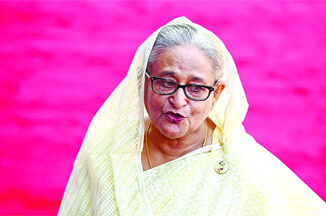
    New Delhi (TIP)- Bangladesh’s ousted Prime Minister Sheikh Hasina on Friday, January 23, warned that her country faces the threat of its territory and resources being “bartered away” to foreign interests, and called on citizens to unite and overthrow the interim government led by Mohammad Yunus.
    In a veiled reference to growing foreign influence, including from the US, China and Pakistan, Hasina said, “Dangerously, there is a treacherous plot to barter away the territory and resources of Bangladesh to foreign interests.”
    Her recorded audio message, delivered in English, was played at an event titled ‘Save Democracy in Bangladesh’ in New Delhi. Invoking the 1971 Liberation War, she exhorted supporters to “overthrow the foreign-serving puppet regime of Yunus”. Hasina, who was removed from power following mass protests in August 2024, accused Yunus of being a “murderous fascist, money launderer, plunderer and a corrupt, power-hungry traitor” who has “bled the nation dry”.
    She alleged that under the Yunus administration, violence, torture and sexual assault against women had gone unchecked, religious minorities faced persecution and “mob terror, mass looting, armed robbery and extortion” had become widespread — referring in particular to recent targeted attacks on the Hindu community.
    “Bangladesh today stands at the edge of an abyss, battered and bleeding, navigating one of the most perilous chapters in its history,” Hasina said, describing recent developments as a “monstrous onslaught” by extremist communal forces and foreign perpetrators that had trampled the rights of women and minorities.
    Calling the country “a vast prison, an execution ground and a valley of death,” she accused Yunus of orchestrating her ouster through a “meticulously engineered conspiracy”.
    Hasina said Yunus’ “false promises” had been replaced by chaos, violence, hatred and corruption. Elections are scheduled for February 12, though the Awami League has been barred from contesting. She issued a five-point call: removal of the “illegal” Yunus administration to restore democracy; an end to street violence; guarantees for the safety of religious minorities, women and vulnerable groups; an end to politically motivated legal action against journalists and opposition members; and a UN-led impartial investigation into events of the past year.

  • India to bring back diplomats’ families In Bangladesh amid security concerns

    India has decided to withdraw the families and dependents of Indian officials posted in Bangladesh amid the security concerns following the increasing activities of extremist elements in the country.
    The move comes weeks before parliamentary elections are to be held in Bangladesh.
    “Given the security situation, as a precautionary measure, we have advised the dependents of our officials in the high commission and other posts to return to India,” sources said. They further clarified that the mission and all posts in Bangladesh continue to remain open and operational.
    A “non-family” posting is one of the most stringent security measures. These are generally imposed in a country or location deemed unstable or hazardous. There is no clarity on when the families of the officials are expected to withdraw and whether they will return to India.
    Apart from the high commission in Dhaka, India has diplomatic posts in Chattogram, Khulna, Rajshahi, and Sylhet.
    India-Bangladesh relations have been strained ever since the interim government headed by Muhammad Yunus came to power in 2024, following the collapse of the Sheikh Hasina regime. Both sides have increased security at their missions amid recent protests. Violence against Hindus in Bangladesh has also seen a spike ever since the death of student leader Sharif Osman Hadi on December 12.
    India raised concerns over the violence and called on Bangladesh to firmly deal with communal incidents in the country.
    “We continue to witness a disturbing pattern of recurring attacks on minorities as well as their homes and businesses by extremists,” External Affairs Ministry Spokesperson Randhir Jaiswal said.
    New Delhi highlighted the “troubling tendency” of Bangladesh to attribute such violence to personal rivalries, political differences, or extraneous reasons. Flagging this, Jaiswal said that “such disregard only emboldens the perpetrators” and further causes fear and insecurity among minorities. “We have repeatedly addressed this issue in earlier briefings and continue to see a disturbing pattern of recurring attacks on minorities, their homes, and businesses by extremists in Bangladesh,” he added.

  • Xi urges ‘central role’ of UN in call with Lula

    Xi urges ‘central role’ of UN in call with Lula

    BEIJING (TIP)- Chinese President Xi Jinping called on countries to protect the “central role” of the United Nations in international affairs, urging his Brazilian counterpart on Friday to help safeguard international norms, state media reported.
    The comments come after US President Donald Trump unveiled plans for his new “Board of Peace” at the World Economic Forum.
    Although originally meant to oversee Gaza’s rebuilding, the board’s charter does not seem to limit its role to the Palestinian territory and has sparked concerns Trump wants to rival the United Nations.
    While China and Brazil have both been invited to join Trump’s new grouping, neither has confirmed participation.
    Xi told President Luiz Inacio Lula da Silva during their Friday morning phone call that in the current “tumultuous” international situation, China and Brazil “are constructive forces in maintaining world peace and stability,” according to a readout published by state broadcaster CCTV.
    “They should stand firmly on the right side of history… and jointly uphold the central role of the United Nations and international fairness and justice,” Xi said.
    European leaders have expressed doubts over Trump’s norm-busting proposal, with some viewing it as an attempt to potentially sideline or even replace the United Nations.
    While in Davos, Switzerland, Trump said that once complete, the board “can do pretty much whatever we want,” while adding that “we’ll do it in conjunction with the United Nations.”
    Beijing’s foreign ministry said on Wednesday that “no matter how the international situation changes, China firmly upholds the international system with the United Nations at its core.”
    Brazil has also expressed skepticism about the Board of Peace, saying it could represent “a revocation” of the United Nations. Lula’s special adviser Celso Amorim told Brazilian media that “we cannot consider a reform of the UN made by one country.”
    During Trump’s global tariff onslaught last year, China and Brazil sought to present their countries as staunch defenders of the multilateral trading system.
    Xi told Lula in August they could set an example of “self-reliance” for emerging powers.
    China, a permanent member of the UN Security Council, engages with the international body even as it has objected to what it terms internal interference. Advocacy groups like Human Rights Watch have accused China of seeking to undermine the United Nations by reducing contributions to the organization’s rights budgets, establishing an alternative international mediation body and blocking activists from UN events.

  • Ukraine-Russia-US hold talks in Abu Dhabi with territory as key issue

    Ukraine-Russia-US hold talks in Abu Dhabi with territory as key issue

    UAE (TIP)- Ukrainian and Russian negotiators held talks in the United Arab Emirates, with the key issue of territory dominating the agenda as the United States pushes for an agreement to end the nearly four-year war.
    The discussions in Abu Dhabi on Friday were the first direct public negotiations between Moscow and Kyiv on a plan being pushed by US President Donald Trump’s administration to end the conflict.
    “The talks commenced today in Abu Dhabi and are scheduled to continue over two days, as part of ongoing efforts to promote dialogue and identify political solutions to the crisis,” the UAE’s Ministry of Foreign Affairs said in a statement.
    Ukrainian President Volodymyr Zelenskyy said territorial disputes would be a central issue in the discussions but stressed that “the most important thing is that Russia should be ready to end this war, which it started”.
    In a statement shared on Telegram, Zelenskyy said he was in regular contact with the Ukrainian delegation, but it was too early to draw conclusions from Friday’s talks. “We’ll see how the conversation goes tomorrow and what the outcome will be,” he said.
    The discussions in the Emirati capital came a day after Zelenskyy met with Trump at the World Economic Forum in Davos, Switzerland – and hours after US envoy Steve Witkoff held late-night talks with Russian leader Vladimir Putin at the Kremlin. Reporting from the Russian capital Moscow, Al Jazeera’s Yulia Shapovalova said the talks between Putin and Witkoff lasted nearly four hours but did not resolve the main sticking points to reaching a deal – namely, territorial disputes and security guarantees.
    “Russia demands that the Ukrainian army leave the Donbas region, which is unacceptable to Ukraine,” Shapovalova explained.
    Kremlin spokesman Dmitry Peskov said on Friday that Russia’s insistence on Ukraine yielding all of Donbas – including the 20 percent of Donetsk which is still under Ukrainian control – was “a very important condition”.
    Kremlin foreign affairs adviser Yury Ushakov, who participated in Putin’s meeting with Witkoff, also said “it was reaffirmed that reaching a long-term settlement can’t be expected without solving the territorial issue”.
    Meanwhile, Russia’s state-run TASS news agency reported that the discussions in Abu Dhabi included possible buffer zones and monitoring mechanisms.
    For its part, Ukraine has demanded security guarantees from its Western allies, including the US, should a deal to end the war be signed, in order to deter Russia from invading again.
    Ukrainians have faced widespread power outages this winter as Russian attacks on the capital Kyiv and other parts of the country target energy infrastructure, leaving thousands of families struggling to stay warm in freezing temperatures.

  • EU has ‘serious doubts’ about Trump’s ‘Board of Peace’

    European leaders have serious doubts about the scope of President Donald Trump’s “Board of Peace” but are ready to work with the United States and the newly founded body in Gaza, EU chief Antonio Costa said Friday, January 23.
    “We have serious doubts about a number of elements in the charter of the Board of Peace related to its scope, its governance and its compatibility with the UN Charter,” the European Council president said after an EU leaders’ summit in Brussels.
    “We are ready to work together with the US on the implementation of the comprehensive Peace Plan for Gaza, with a Board of Peace carrying out its mission as a transitional administration”.
    The founding charter of Trump’s body for resolving international conflicts has a $1 billion price tag for permanent membership.
    Although originally meant to oversee Gaza’s rebuilding, the board’s charter does not seem to limit its role to the Palestinian territory and appears to want to rival the United Nations.
    Spanish Prime Minister Pedro Sanchez told reporters after the summit that his country had “declined” the invitation to participate in the body.
    Police seek man wanted in fatal shootings of 3 in small Australian town
    Police urged people in a small Australian town to stay indoors Friday as they looked for the man suspected of killing three people in a domestic violence-related shooting.
    Julian Ingram, 37, was out on bail after being charged with domestic violence-related crimes, and a restraining order had been issued in December to protect one of the victims in Thursday’s shooting, Sophie Quinn, who was 25 and pregnant.
    The others shot to death in the isolated town of Lake Cargelligo in New South Wales state were Quinn’s friend, John Harris, 32, and her aunt, Nerida Quinn, 50. A 19-year-old man who also was shot was hospitalized in serious but stable condition.
    Ingram had a long criminal history including domestic violence and police had checked on him multiple times while he was out on bail, state Police Assistant Commissioner Andrew Holland said.

  • Denmark PM goes to Greenland in show of support amid Trump crisis

    Denmark PM goes to Greenland in show of support amid Trump crisis

    NUUK (TIP)- Denmark’s Prime Minister Mette Frederiksen visited Greenland on Friday, January 23, in a show of support for the Arctic island that U.S. President Donald Trump wants to annex.
    Walking off her plane at the airport in Greenland’s capital Nuuk, Frederiksen was greeted by Greenlandic ?Prime Minister Jens-Frederik Nielsen. The two were seen embracing on the tarmac before driving away.
    Frederiksen flew straight to Nuuk from Brussels after meeting with NATO chief Mark Rutte earlier in the day to discuss how the military alliance can boost security in the wider Arctic region.
    Greenland is an autonomous territory of the Danish kingdom. The two governments say the island is not for sale and its sovereignty is not up for discussion, but they are open to talks on other topics, such as security and economic development.
    “We are preparing the next steps,” Frederiksen told reporters while walking alongside Nielsen in central Nuuk. “I’m first and foremost here to show our strong support for Greenland’s people as a difficult time.”
    Trump said on Thursday, Jan 22, he had secured total and permanent U.S. access to Greenland after talks with Rutte, who said allies would have to step up efforts to ward off threats from Russia and China. The U.S. military is already permitted wide access to Greenland under treaties, although Washington has scaled back its presence there since the Cold War to a single small base.
    The island’s future ?has prompted a crisis in transatlantic relations after Trump demanded Greenland become U.S. territory, refused to rule out military force to obtain it and announced new tariffs on European countries that objected.
    The crisis subsided after he lifted the threat to use force on Wednesday and withdrew the proposed tariffs on Thursday.
    “We agree that NATO must increase its engagement in the Arctic. Defence and security in the Arctic is a matter for the entire alliance,” Frederiksen said in ?a social media post, along with a photo of herself and ?Rutte in Brussels.
    Rutte said he was working with the Danish leader ?to enhance deterrence and defence. Denmark’s foreign minister said on Friday that diplomats from Denmark and the United States had met in Washington on Thursday, establishing a plan for how to proceed.
    “We will not communicate when those (future) meetings are, because what is needed now is to take the drama out of this… we need a calm process,” Foreign Minister Lars Lokke Rasmussen said.
    A source familiar with the matter said Rutte and Trump had ?agreed on further talks between the U.S., Denmark and Greenland on updating a 1951 agreement that governs U.S. military access and presence on ?the Arctic island.

  • Toll in Iran’s protest crackdown reaches at least 5,002 dead as Trump says US ‘armada’ approaching

    Toll in Iran’s protest crackdown reaches at least 5,002 dead as Trump says US ‘armada’ approaching

    DUBAI, United Arab Emirates (TIP)– The toll in Iran’s bloody crackdown on nationwide protests has reached at least 5,002 people killed, activists said Friday, January 23, warning many more were feared dead as the most comprehensive internet blackout in the country’s history crossed the two-week mark.
    The challenge in getting information out of Iran persists due to authorities cutting off access to the internet on Jan. 8, even as tensions rise between the United States and Iran as an American aircraft carrier group moves closer to the Middle East — a force U.S. President Donald Trump likened to an “armada” in comments to journalists late Thursday.
    The U.S.-based Human Rights Activists News Agency offered the death toll, saying 4,716 were demonstrators, 203 were government-affiliated, 43 were children and 40 were civilians not taking part in the protests. It added that more than 26,800 people had been detained in a widening arrest campaign by authorities.
    The group’s figures have been accurate in previous unrest in Iran and rely on a network of activists in Iran to verify deaths. That death toll exceeds that of any other round of protest or unrest in Iran in decades, and recalls the chaos surrounding Iran’s 1979 Islamic Revolution.
    Iran’s government offered its first death toll Wednesday, saying 3,117 people were killed. It added that 2,427 of the dead in the demonstrations that began Dec. 28 were civilians and security forces, with the rest being “terrorists.” Iran’s theocracy in the past has undercounted or not reported fatalities from unrest.
    The Associated Press has been unable to independently assess the death toll, in part due to authorities cutting access to the internet and blocking international calls into the country. Iran also reportedly has limited journalists’ ability locally to report on the aftermath, instead repeatedly airing claims on state television that refer to demonstrators as “rioters” motivated by America and Israel, without offering evidence to support the allegation.
    The new toll comes as tensions remain high over Trump laying down two red lines over the protests — the killing of peaceful demonstrators and Tehran conducting mass executions. Iran’s attorney general and others have called some of those being held “mohareb” — or “enemies of God.” That charge carries the death penalty. It had been used along with others to carry out mass executions in 1988 that reportedly killed at least 5,000 people.
    The U.S. military meanwhile has moved more military assets toward the Mideast, including the aircraft carrier USS Abraham Lincoln and associated warships traveling with it from the South China Sea.
    A U.S. Navy official, who spoke on condition of anonymity to discuss military movements, said Thursday that the Lincoln strike group is currently in the Indian Ocean. Trump said Thursday aboard Air Force One that the U.S. is moving the ships toward Iran “just in case” he wants to take action.
    “We have a massive fleet heading in that direction and maybe we won’t have to use it,” Trump said.
    Trump also mentioned the multiple rounds of talks American officials had with Iran over its nuclear program prior to Israel launching a 12-day war against the Islamic Republic in June, which saw U.S. warplanes bomb Iranian nuclear sites. He threatened Iran with military action that would make earlier U.S. strikes against its uranium enrichment sites “look like peanuts.”
    “They should have made a deal before we hit them,” Trump added.
    The United Kingdom’s Defense Ministry separately said its joint Eurofighter Typhoon fighter jet squadron with Qatar, 12 Squadron, “deployed to the (Persian) Gulf for defensive purposes noting regional tensions.”

  • AR RAHMAN AND RAMAYANA

    AR RAHMAN AND RAMAYANA

    By Mike Ghouse

    Sri Ram is a figure revered by people of all faiths; he is our cultural icon, and we are all influenced by the Maryada Purushottam, as he is often called. As a Muslim, I view him as an integral part of our legacy and hold him in high regard among humanity’s great personalities. I grew up listening to Kathas (stories) in my hometown of Yelahanka, near Bangalore, and while in Dallas, I had the opportunity to hear Morari Bapuji at the Ekta Mandir. He highlighted all the virtues of Sri Ram.

    Some narrow-minded individuals try to confine Sri Ram as if he were their personal property. However, no one truly owns Ram; instead, he belongs to all of us. Each of us can learn from the values he embodied and strive to follow them.

    Sri Ram, also known as Rama, is one of the most revered figures in Hinduism. He is celebrated as the embodiment of moral virtue, righteousness (dharma), duty, compassion, courage, and ideal leadership. Often referred to as Maryada Purushottama, meaning “the supreme man,” he upholds the highest standards of conduct and honor. His life and adventures are central to the ancient Hindu epic, the Ramayana, which is attributed to the sage Valmiki. This epic is one of the two major epics of Hinduism, the other being the Mahabharata. The story symbolizes the triumph of good over evil, emphasizes the importance of fulfilling one’s duty even in times of adversity, and highlights the power of devotion and loyalty.

    Music maestro A.R. Rahman recently discussed his work on the album for Nitesh Tiwari’s upcoming film, “Ramayana,” emphasizing that his faith did not hinder his connection to the project. He also shared insights about collaborating with Hans Zimmer on the film starring Ranbir Kapoor and Yash. We need to embrace a Muslim artist like Rahman as musical director for the epic “Ramayana,” as it highlights the universality of Sri Ram’s character. Rather than diminishing Ram, we should celebrate his significance.

    In an interview with BBC Asian’s YouTube channel, Rahman was asked whether his religious beliefs influenced his composition process. Responding to this, he said, “I studied in a Brahmin school, and every year we had Ramayana and Mahabharata, so I know the story. The story is about how virtuous a person is, higher ideals, and all that stuff. People may argue, but I value all those good things — any good things that you can learn from. The prophet has said that knowledge is something invaluable, no matter where you get it from — a king, a beggar, a good act, or a bad one. You can’t shy away from things.”

    He further reflected on the larger message of unity and growth, adding, “I think we need to elevate from small-mindedness and selfishness. Because when we elevate, and we become radiant, we become a radiant of that, and that’s very important. I am proud of the whole project because it’s from India to the whole world, with such love. Hans Zimmer is Jewish, I am Muslim, and the Ramayana is Hindu.”

    (Dr. Ghouse is the President and founder of the Center for Pluralism and director of the World Muslim Congress. He is an Interfaith Wedding Officiant for InterfaithMarriages.org and a Muslim Wedding Officiant. He is a Muslim, a Pluralist, an activist, a speaker, an author, and a social scientist. More on Google.)

  • Andrew Pappachen Receives 2025 Good Samaritan Award for Decades of Service

    Andrew Pappachen Receives 2025 Good Samaritan Award for Decades of Service

    Celebrated Indian American Leader Recognized by Global Malayalee Christian Forum and CMS College Alumni

    • Ajay Ghosh

    KOTTAYAM (TIP): Andrew Pappachen, a distinguished Indian American community leader, was honored with the 2025 Good Samaritan Award by the Global Malayalee Christian Forum in a solemn ceremony at the Kochi Ramada Inn on January 17, 2026. This prestigious award celebrates his unwavering commitment to the Indian diaspora, acknowledging over 30 years of dedicated service and leadership.

    In a separate event marked by warmth and nostalgia, Pappachen was felicitated by his classmates and professors from CMS College in Kottayam. The gathering, held on a recent Saturday, highlighted his significant contributions to the global Malayalee community and brought together friends, mentors, and supporters from his formative years.

    Renowned writer Prof. S. Sivadas, classmate Rev. Dr. K.M. George, and professors including Dr. George Cherian, Dr. Joseph Cherian, Dr. Mary Kuruvilla, Prof. Parvathy, Thomas Job, and Prof. John presented Andrew with a ceremonial shawl, signifying their respect and admiration.

    Expressing his gratitude, Pappachen described the recognition as the greatest honor of his life, emphasizing the humility and pride he felt in receiving such accolades from both his professional community and alma mater.

    Andrew is honored.

    Andrew Pappachen’s journey began in Kerala, India, where he earned a master’s degree in chemistry from Kerala University. After migrating to the United States in 1973, he continued his academic pursuits, obtaining a master’s degree in environmental engineering from Stevens Institute of Technology, New Jersey. Furthering his expertise, he completed a doctoral program and earned specialized Mini master’s degrees in water Pollution and Air Pollution, as well as a degree in Public Administration from Rutgers University.

    With a career spanning 47 years in government service, Pappachen worked for the City of Newark, New Jersey, from 1974 to 2018. He held key positions such as Chief Engineer, Director of Operations for Newark Watershed Conservation and Development Corporation, and Director of Public Works. Between 2012 and 2019, he served as Environmental Commissioner in Montville Township, where he continues to reside. Currently, he works as an Environmental Consultant and is a New Jersey State certified water distribution system and water treatment operator. Since 2000, he has also served as an Adjunct Professor, teaching courses on water pollution, water and wastewater treatment, and environmental regulations.

    Andrew is awarded a plaque.

    Pappachen is an accomplished author, with several books published in both English and Malayalam. His English titles include Love With The Ghost, A Journey Alone, Rays of Light From The Darkness of A Prison Cell, Zero to Infinity, and Story of Achu, each offering unique perspectives and narratives. His Malayalam works, published by Prabath Book House in Trivandrum, comprise Thalamurakalethedi, Theerdhadanathintte Kadha, Eruttil Ninnu Velichathilaekku, and Sophi.

    Beyond literature and academia, Andrew Pappachen has played a pivotal role in numerous organizations. He is the founder, former Global President, and chairman of the World Malayalee Council, and has held leadership posts at the Kerala Center New York, Asian American Heritage Council, Asia Society, and Festival of People in New Jersey. His community service has been recognized by various associations, including the Asian American Political Coalition, Federation of Indian Associations, Kerala Center New York, Staten Island Malayalee Association, Kerala Cultural Association, and YMCA.

    Driven by a vision to unite Malayalees worldwide, Pappachen founded the World Malayalee Voice and has worked tirelessly to foster communication and preserve Malayalee identity across generations. He is the son of Korah and Lucy Andrews from Kollad, Kerala. His wife, Somini, hails from Vadavathoor, Kottayam. Their daughter, Simmy, is an executive in healthcare management, while their son, Kevin, manages fraud investigations at a New Jersey bank. Kevin’s wife, Grace, and their daughter, Anna, complete the family.

    Andrew Pappachen’s life and career stand as a testament to dedicated service, visionary leadership, and the enduring power of community.

    (Press release issued by Ajay Ghosh, Media Coordinator, AAPI)

  • Global UN Leader Siddharth Chatterjee to Deliver Keynote at House of Lords Commemoration of International Day for a World Without Childhood Blindness

    Global UN Leader Siddharth Chatterjee to Deliver Keynote at House of Lords Commemoration of International Day for a World Without Childhood Blindness

    LONDON (TIP): The House of Lords will host a landmark global commemoration of the International Day for a World Without Childhood Blindness on January 31, 2026, marking 49 years of transformative, on-ground impact by the Eye Foundation of America (EFA) for children since 1977—largely across India and Africa.

    Adding exceptional global gravitas to the occasion, Siddharth Chatterjee, United Nations Resident Coordinator in China, will join the commemoration and deliver a high-level keynote address, underscoring childhood blindness as a critical, solvable development challenge at the intersection of health, education, equity, and economic productivity.

    Hosted at the House of Lords, the event brings together senior leaders from the United Nations system, global philanthropy, Rotary and Lions leadership, diplomats, policymakers, clinicians, CSR heads, and youth champions—united by a shared commitment to end preventable childhood blindness worldwide.

    Mr. Chatterjee’s address will highlight the urgency of integrated public health action, scalable partnerships, and outcomes-driven investment—calling for governments, multilaterals, and the private sector to accelerate proven models that protect sight early in life. His participation reflects the growing global consensus that vision is foundational to learning, human capital formation, and inclusive growth.

    For nearly five decades, Eye Foundation of America has led pioneering, community-rooted programs—saving and restoring sight for millions of children through neonatal screening, pediatric eye care, capacity building, and systems strengthening. EFA’s work has demonstrated that early detection and timely intervention can change the trajectory of a child’s life—and a nation’s future.

    The January 31 commemoration also reinforces a global call to action: institutionalize childhood blindness prevention within national health systems and CSR frameworks, and rally the world toward a future where no child is needlessly blind.

    About the International Day for a World Without Childhood Blindness

    Observed on January 31, the Day mobilizes governments, multilaterals, civil society, and the private sector to advance solutions that eliminate preventable childhood blindness and secure every child’s right to sight.

    High-Level Statement

    Siddharth Chatterjee said

    “A world without childhood blindness is not an aspiration—it is an achievable global development goal. When we protect a child’s sight, we protect education, dignity, and the future of nations.”

    Distinguished Global Presence

    The commemoration at the House of Lords will also witness the presence of senior leaders and representatives from the Commonwealth Secretariat, Lions Clubs International, and Rotary International, reinforcing a powerful, cross-continental coalition committed to eliminating preventable childhood blindness worldwide.

  • International Day for a World Without Childhood Blindness to Be Commemorated at the House of Lords

    LONDON (TIP): Global leaders from health, policy, philanthropy, and youth movements will gather at the **House of Lords, London**, on **Saturday, January 31, 2026**, to commemorate the **International Day for a World Without Childhood Blindness (IDWWCB)**—a global observance dedicated to eliminating preventable childhood blindness worldwide.

    The high-level commemoration marks **49 years of service to children since January 31, 1977**, when the first eye camp was conducted, launching a movement that has since transformed millions of young lives through prevention, treatment, and long-term systems of pediatric eye care across continents.

    The event is led by the **Eye Foundation of America (EFA)** in collaboration with global partners and youth leaders, and is hosted at one of the world’s most influential legislative institutions—underscoring the importance of integrating childhood vision care into **public health policy, education systems, and global development agendas**.

    Childhood blindness remains one of the most preventable public health challenges. With over **90% of learning dependent on vision**, unaddressed eye conditions significantly impact educational outcomes, economic opportunity, and lifelong well-being. The International Day aligns with the **United Nations Sustainable Development Goals**, particularly **SDG 3 (Good Health and Well-Being)** and **SDG 4 (Quality Education)**, reinforcing vision care as a critical enabler of equity and human potential.

    The global movement was founded by **Dr. V. K. Raju**, an internationally respected ophthalmologist and humanitarian whose work spans India, Africa, the United States, and beyond. The commemoration is supported by **Lord Rami Ranger**, Member of the House of Lords and a longstanding advocate for global humanitarian causes.

    The January 31 commemoration serves as a unified call to governments, multilateral agencies, corporate leaders, and civil society to accelerate collective action toward a future where no child is blind due to avoidable causes.
    (Based on a Press Release)

  • Makar Sankranti Celebrated with Great Enthusiasm by BJANA and Bihar Foundation USA (ETZ) at Toms River Temple

    Makar Sankranti Celebrated with Great Enthusiasm by BJANA and Bihar Foundation USA (ETZ) at Toms River Temple

    President BJANA: Ms. Priti Kashyap.

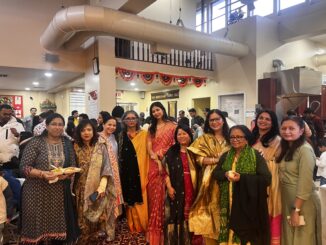
    Despite challenging weather conditions across New Jersey—with heavy snowfall in several areas and milder conditions near the venue—the spirit of unity and tradition remained strong as the Bihar Jharkhand Association of North America (BJANA), in collaboration with members of Bihar Foundation USA – East Zone (ETZ), celebrated Makar Sankranti at the sacred Shri Siddhivinayak Temple, Toms River, NJ.

    More than 150 community members attended the celebration, demonstrating deep commitment to cultural traditions, togetherness, and community bonding.

    The newly elected BJANA President (2026–2027), Ms. Priti Kashyap, warmly connected with attendees and expressed heartfelt gratitude to all participants. She also acknowledged the dedication of her committee members and the BJANA Advisory Board for their continued guidance and support.

    A Powerful Example of Community Spirit

    A touching moment was shared by Nidhi from Jersey City (originally from Patna) and her husband Raghavendra Singh (from Jhansi, Uttar Pradesh). Although the temple was more than an hour’s drive from their home, they chose to attend their first BJANA event. They shared that the experience helped them truly understand how organizations like BJANA foster cultural connection, togetherness, and the spirit of selfless service.

    Community members joined the celebration.

    Several new members traveled long distances—including attendees from Philadelphia and locations over 100 miles away—reflecting the growing strength and reach of the BJANA community.

    Cultural & Culinary Highlights

    The celebration was enriched with traditional flavors and authentic delicacies, including:

    Chura–Dahi; Tilkoot directly sourced from India;  Khichdi served with special homemade curd prepared in traditional earthen (soil-crafted) utensils; Refreshing special chai prepared by the BJANA team.

    Children thoroughly enjoyed the festive atmosphere and food, while seniors deeply appreciated the warmth, hospitality, and nostalgic taste of traditional cuisine.

    The event became even more soulful when Nidhi Mishra and other community members led folk songs, devotional prayers, and bhajans, creating a deeply emotional and cultural environment.

    Community Leadership Reflections

    Temple Trustee Dr. Geeta Gupta thanked all attendees and emphasized that such cultural gatherings strengthen unity and help preserve cultural roots within the diaspora.

    Community leaders including Past President Shashi Sinha, Anurag Kumar, and Immediate Past President Sanjeev Singh encouraged members to continue working collectively to strengthen BJANA and uplift the community.

    Sanjeev Singh, Rama Mishra, Pankaj Sharan, Alok Kashyap, Alok Kumar, Abhishek Kumar, Sushant Krishen, Shashi Shankar, Pankaj P., Uttam Gupta, Shashi Sinha , Anurag Kumar, Dipen, Priti Kashyap, Dr. Geeta Gupta, Komal Sharan and Priti Singh, Anupam and Narendra ji.

    Alok Kumar, Chairman of Bihar Foundation USA – ETZ, expressed his happiness at seeing strong participation despite difficult weather conditions—especially the enthusiastic presence of children. He emphasized that communities must continue to support those in need, celebrate together, and build long-term unity.

    Event Organization & Acknowledgment

    The successful event was organized by the BJANA leadership team, consisting of Sushant Krishnan (Vice President), Rakesh Roy (Treasurer), Bishwanath Sharma (Secretary), Dipen,  Priya Ranjan Ji, along with the entire BJANA volunteer team.

    Their collective dedication made it possible to experience an authentic and memorable Makar Sankranti celebration in New Jersey—preserving tradition while strengthening diaspora bonds.

    (Based on a press release issued by Alok Kumar)

  • AAPI Delegation Champions Unity and Healthcare Collaboration in Gujarat

    AAPI Delegation Champions Unity and Healthcare Collaboration in Gujarat

    Historic Meetings Advance Shared Vision for Medical Excellence in India and Beyond

    • Ajay Ghosh

    AHMEDABAD (TIP): The American Association of Physicians of Indian Origin (AAPI) reaffirmed its commitment to unity and healthcare advancement during a series of pivotal engagements in Gujarat, India. At the heart of these meetings was the message that unity is the cornerstone of AAPI’s impact—both within its membership and in its partnerships with Indian healthcare leaders.

    During the Indian Medical Association (IMA) convention in Ahmedabad, an AAPI delegation led by President Dr. Amit Chakrabarty met with the Honorable Chief Minister of Gujarat, Shri Bhupendra Rajnikant Patel. The delegation presented a comprehensive memorandum addressing critical healthcare challenges, including “the urgent need to expand postgraduate training slots in emergency medicine and the importance of structured training programs for first responders and EMTs,” a priority strongly advocated by Dr. Lokesh Edara, former Chair of the AAPI Board of Trustees.

    Dr. Hetal Gor, AAPI Chairwoman, eloquently shared AAPI’s mission and objectives in Gujarati, emphasizing the organization’s dedication to enhancing healthcare across India. “Our vision is to collaborate, innovate, and uplift the standards of care in every community we touch,” Dr. Gor stated. The Chief Minister responded with deep appreciation, requesting that the IMA, in collaboration with AAPI, prepare and submit a formal memorandum to his office for further action.

    The delegation’s visit to the iconic Statue of Unity served as a powerful symbol of their message. Reflecting on the legacy of Sardar Vallabhbhai Patel, the Iron Man of India, the group drew inspiration from his pivotal role in uniting the nation. “Standing before this monumental tribute, we were reminded that unity is not just a word—it is the very foundation upon which greatness is built,” remarked Dr. Chakrabarty.

    Patel’s achievements resonated with AAPI’s ongoing efforts. “Patel’s legacy teaches us that when diverse voices come together under shared principles, no challenge is insurmountable. Division weakens, but unity empowers,” Dr. Chakrabarty emphasized. He called upon all AAPI members to “stand shoulder to shoulder, celebrate our shared identity, and carry forward the torch of solidarity.”

    Unity, the delegation stressed, remains AAPI’s “greatest power.” It is the force that “gives us credibility in the halls of power, amplifies our service to patients and communities, and ensures that AAPI continues to rise as a beacon of excellence, dignity, and heritage.”

    Another highlight of the Gujarat visit was the historic meeting with IMA leadership during the organization’s centennial conference. The gathering culminated in the drafting of a Memorandum of Understanding (MOU) between AAPI and IMA, laying the groundwork for future collaborative events that will blend Indian and American medical expertise. “This meeting was not just about agreements—it was about building bridges, fostering trust, and envisioning a future of collaboration,” said Dr. Chakrabarty.

    AAPI members actively participated in the conference, delivering lectures and engaging in vibrant exchanges of ideas. The event underscored “the importance of dialogue in shaping evidence-based practices that serve patients with compassion and clarity.”

    Dr. Chakrabarty concluded, “AAPI is our collective home, our shared voice, and our enduring strength. Just as Patel refused to let India fragment, we must refuse to let discord dilute our mission.” As AAPI and its partners continue to build bridges and uplift communities, their unity remains the guiding light for a future of medical excellence and service to humanity.

  • AAPI’s Landmark Odisha Global Health Summit

    AAPI’s Landmark Odisha Global Health Summit

    Forging Partnerships, Celebrating Achievements, and Shaping the Future

    • Ajay Ghosh

    BHUBANESWAR (TIP): The American Association of Physicians of Indian Origin (AAPI) organized its 19th annual Global Health Summit (GHS) from January 9–11, 2026, in Bhubaneswar, Odisha, which was attended by over 100 Physician leaders from the United States, along with nearly 500 participants from India.

    Organized for the first time in the state of Odisha under the leadership of AAPI President Dr. Amit Chakrabarty, the Summit brought together leading physicians, researchers, educators, and public health experts from India and the United States, united in their mission to advance medical innovation, global partnerships, and community impact. Held across the Kalinga Institute of Medical Sciences (KIMS), Kalinga Institute of Industrial Technology (KIIT), Mayfair Lagoon, and Swosti Premium, the summit showcased groundbreaking medical developments and collaborative initiatives aimed at strengthening healthcare delivery in India.

    Setting the Stage for Global Collaboration

    Dr. Amit Chakrabarty opened the summit by highlighting its transformative potential of the Summit: “Global Healthcare Summit 2026 reflects AAPI’s unwavering commitment to elevating global health standards. When experts from two of the world’s most dynamic healthcare systems come together, the impact extends far beyond conference halls—it reaches communities, hospitals, and future generations.”

    India’s Minister for Health, Shri Jagat Prakash Nadda, in a video message at GHS, commended AAPI’s role as a bridge between India and the United States: “AAPI stands as a powerful symbol of professional excellence, global leadership and dedicated service to humanity, representing over 100,000 Physicians of Indian origin practicing in the United States. Through sustained academic collaboration, knowledge exchange and capacity building, AAPI has significantly strengthened healthcare systems in both nations. Service beyond borders is the highest form of leadership.”

    Dr. Achyuta Samanta, Founder of KIIT, emphasized the university’s partnership with AAPI: “KIIT is one of India’s leading private universities, known for its academic excellence, world-class infrastructure, and impressive placement records.” He lauded AAPI, which represents over 100.000 Indian American physicians, playing a vital role as a bridge between India and the US through academic collaboration, research, knowledge sharing, and capacity building.

    Welcoming AAPI delegates, Prof. R C Das, Dean and Principal of KIMS, said, “A hearty welcome to AAPI delegates to the Kalinga Institute of Medical Sciences, which has redefined healthcare services in Odisha and neighboring states, anchored on a genuine desire to promote a healthy society and provide advanced medical care.”

    Others who addressed the audience during the inaugural ceremony were Prof. CBK Mohanty, Pro Vice Chancelor of KIMS; Dr. Atashu Nayak, President, Odisha Physicians of America; Dr. Ajit K Mohanty, Chair of GHS Host Committee.

    Rabi N. Samanta, Director of the GHS Host Committee, stated, “We are extremely happy to have the esteemed delegates of AAPI from the United States, join us here in Odisha with the objective of enhancing healthcare delivery in India.”

    During the gala on the first day of the GHS, AAPI recognized and honored Dr. Sita Kanta Dash for his contributions to society both in the USA and Odisha. Dr. Dash is the Chairman of Kalinga Hospital, a part-sponsor of this year’s GHS. Dr. Dosh rose from rural Odisha to global acclaim through education and innovation in the field of Probiotics.

    Dr. Santosh Dora, CEO of Kalinga Hospital, was also honored during the gala for his support in organizing the GHS.

    “Our community programs reflect AAPI’s heart. Beyond CMEs and conferences, we are committed to protecting and empowering the next generation,” emphasized Dr. Meher Medavaram, President-Elect of AAPI. “Our workshops and community collaboration are designed to strengthen frontline decision-making. These are the skills that save lives in the golden hour,”

    Clinical Excellence and Youth Empowerment

    Under the leadership of Dr. Chakrabarty, GHS prioritized youth engagement and medical education, drawing participants from both India and the United States. A diverse lineup of activities for medical students, residents, and early-career clinicians included poster presentations and hands-on skills workshops.

    Among the summit’s highlights, the AAPI-IMG Section Update provided a vital lifeline for international medical graduates. “We want to demystify the process for those seeking U.S. residencies—guidance on applications, interview strategies, and what to expect in a new healthcare system,” said Dr. Amit Chakrabarty, President of AAPI.

    “We aimed to create an inclusive and interactive learning environment, including the much sought after AAPI’s Poster Contest, where over 150 students could showcase their research, practice clinical skills, and network with global experts,” shared Dr. Priyanka Kolli, President of AAPI’s Medical Students, Residents, and Fellows section.

    “These workshops and mentoring sessions are investments in our collective future,” explained Dr. Abhishek Kashyap, co-coordinator of the student activities.

    The Scientific Forum featured high-impact CME sessions, addressing metabolic syndrome (Dr. Prasun K. Jalal), advances in hemoglobinopathy treatment (Dr. Arun Panigrahi), healthcare gaps in India (Dr. Lokesh Edara), and cervical cancer updates (Dr. Bhagyalaxmi Nayak). The sessions on PSA Tightrope Balancing (Dr. Amit Chakrabarty), New Data and Techniques in Management of Carotid Stenosis (Dr. Uttam Tripati) and Navigating the Thin Red Line in The ED & ICU (Dr. Ajit Kayal).

    Live robotic and minimally invasive surgical demonstrations, broadcast live from the United States by internationally renowned experts exemplified advances in surgical technology. The session on “Cutting Edge Developments in Urology” was chaired by Dr. Ashok Hemal and was Co-Chaired by Dr. Amit Chakrabarty,

    A parallel breakout star studded session on Ayurveda Consortium was headed by Dr. Amit Shah and Dr. Arti Prasad, which featured luminaries, including Mr. Rajesh Kotecha (Secretary, Union Ministry, AYUSH, India) and Dr. Charles Elder, Executive Director, Maharishi International University.

    The session on Physician, Heal Thyself: Mental Health, Suicide Risk, and the Implementation of Prevention Programs, presented by Dr, Tarak Vasavada highlighted the very important concerns experienced by the medical fraternity around the world.

    A large-scale Mass CPR Training Event for students under the leadership of Dr. Vemury Murthy reinforced AAPI’s dedication to community empowerment.

    Artificial Intelligence and Emergency Care Innovation

    This Summit spotlighted Artificial Intelligence in Medicine, with a pioneering session on “AI in Global Medical Practices,” and was led by Dr. Suresh Reddy, and Dr. Inderpal Chhabra. Panelists, Kinjal Saxena (CTO, AIG), Dr. Vidhur Mahajan (CEO, CARPL.AI), Dr. Suvrankar Datta, and Dr. Priyaa Jain shared insights into the transformative role of AI.

    “AI is transforming medicine at a pace we’ve never seen before. AAPI is committed to ensuring that Indian and U.S. physicians lead this transformation with responsibility and vision,” said Dr. Seema Arora, Secretary of AAPI.

    The Resuscitation & Emergency Medical Care Workshop, led by Dr. Vemury Murthy and Dr. Anjali Gulati, covered the 2025 AHA Resuscitation Guidelines, sudden cardiac arrest research, and the National Emergency Life Support Program, with hands-on simulations and AI-based clinical case discussions.

    Dr. Krishan Kumar, President-Elect of AAPI noted, “A major objective of the GHS has been providing education on current trends in medicine, cutting edge technologies and on relevant policies. These discussions are not just academic, they are actionable. Our goal is to bring evidence‑based solutions to the forefront of India’s healthcare landscape.”

    Recognizing the dire need for an increased donor pool amongst people of Indian origin across the globe, the Stem Cell Donor Drive in the United States was launched in 2024, by Dr. Satheesh Kathula, the immediate past president of AAPI. This noble initiative achieved remarkable success under the leadership of Dr. Shahi Kuppala, Chair of the Stem Cell Drive.

    With the objective of enhancing the stem donor pool, Dr Chakrabarty launched the Stem Donor Drive during the Global Healthcare Summitt in Odisha, in collaboration with the Global Association of Indian Medical Students.

    “We received 238 Stem Donors who registrations at our Stem Donor Registry during the Global Healthcare Summit,” said Dr. Sashi Kuppala. “To put it in context, we would have had to do 20 drives to get those many registrations in the United States. Thanks to Dr. Amit Chakrabarthy, we successfully launched the project in India.”

    Dr. Chakrabarty expressed his “deep gratitude to the many AAPI members, and the students and staff at Kalinga Institute of Medical Sciences, who have overwhelmingly supported and participated at AAPI’s Stem Cell Drive during the GHS in Orissa.

    Prof. R C Das, Dean and Principal of KIMS stressed the importance and urged the medical students at KIM to come forward and register for Stem Donorship. The students were then led to pledge and commit to encourage Stem Donorship among the patient population they are committed to serve.

    Parallel CME collaborative educational forum focused on TB elimination, led by Dr. Manoj Jain, and Dr. Smita Joshi: Diabetes and Obesity, led by Dr. Dibyajiban Mohapatra; and, Critical Care Skills, led by Dr. Kalpalatha Guntupalli and Dr Siddhatha Mishra.

    “GHS 2026 was truly memorable. The hosts were exceptional, setting a gold standard for collaboration and hospitality,” said Dr. Soumya Neravetla, Treasurer, AAPI. “This summit strengthened Indo-U.S. partnerships, inspired young clinicians, and advanced community impact.”

    Women’s Leadership and Community Initiatives

    The final day centered on women’s leadership in medicine, with the Women in Healthcare CME co-chaired by Dr. Kalpalatha Guntupalli, and Dr. Tapti Panda. Sessions addressed gender equity, leadership pathways, and the evolving role of women in global healthcare. “The Real and the Reel,” led by Dr. Priya Abraham (Director, ICMR–National Institute of Virology), celebrated the story behind India’s COVID-19 vaccine, Covaxin, with panelists Pallavi Joshi and Vivek Ranjan Agnihotri discussing the intersection of science and storytelling.

    “From Pitch to Policy” honored four visually challenged cricket champions from Odisha, members of India’s victorious women’s blind cricket team at the inaugural Blind Women’s T20 World Cup 2025 in Colombo.

    Other community health initiatives during the GHS included the launching of the first AAPI -HPV Vaccination Drive India at the MKCG Medical College, where 100 girls were vaccinated. Dr. Chakrabarty said, “The HPV Project by AAPI will continue for the next several years with the objective of vaccinating 5,000 girls.”

    Faculty from MKCG Medical College, including Dr. Bharati Mishra and Dr. Suchitra Das, expressed gratitude for AAPI’s flagship event and advocated continued collaboration in healthcare and mentoring. Dr. Chakrabarty expressed his heartfelt gratitude to his Alma Matter for hosting the AAPI delegation.

    In addition, during the GHS, AAPI launched the AAPI Child Welfare Initiative India, chaired by Dr Sunitha Pollepalli. AAPI will continue the efforts, where AAPI has adopted Four Orphanages and Schools for the Blind, donating blankets, clothes, and other essential equipment in Cuttack, Odisha.

    Describing GHS as “Truly an exceptional experience,” Dr Hetal Gor, AAPI BOT Chair, said, “Not only we interacted with local physicians, residents, & students, and judged poster presentations, but it was a spiritual and cultural experience, visiting several holy Temples and cultural sites.”

    The mesmerizing cultural spectacular on Jan 9th was performed by talented artists from the Orissa Dance Academy. On Jan 10th at the Rose Garden, KITT, led by Saswat Joshi, who has popularized Odisha’s Culture, Music, Dance and Handlooms across the globe, the GHS delegates were presented with live performances, depicting the rich and diverse cultural heritage of Odisha through captivating live dance and music performances.

    AAPI’s Vision Forward

    As GHS 2026 drew to a close, AAPI leadership reaffirmed its commitment to strengthening Indo-U.S. medical collaboration. Dr. Chakrabarty summed up the summit’s spirit: “AAPI’s strength lies in our unity, our expertise, and our purpose. Together, we are shaping a healthier future for India and the world.” For further details, visit: www.summit.aapiusa.org

    (Report by Ajay Ghosh, Media Coordinator, AAPI, in consultation with Dr. Amit Chakrabarty)

  • Trump’s Peace Board raises old questions

    Trump’s Peace Board raises old questions

    As India ponders Trump’s invite to join the Board of Peace, here’s a recall of Vajpayee’s refusal to send troops in support of Iraq invasion.

    “Trump is far more ambitious than Bush, a different creature altogether. Diplomacy has no place in his narcissistic schemes. It is not too late for India to find its voice, just as the Vajpayee government did two decades ago, to stand up to Trump and say no to his new plan to reshape the world in his image. In doing so, India may even inspire others to call out the plan for what it is and decline the invitation categorically.”

    By Nirupama Subramanian

    The Board of Peace established by US President Donald Trump has so far found few takers. Invitations have reportedly gone out to 60 countries, asking them to join “an international organization that seeks to promote stability, restore dependable and lawful governance, and secure enduring peace in areas affected or threatened by conflict.” Quite clearly, it is not the same Board of Peace that was envisaged in Trump’s facile 20-point Gaza peace plan. That one was to be a transitional body, headed by Trump, to supervise a proposed interim, technocratic Palestinian committee for the day-to-day running of Gaza. The UNSC endorsed the idea and gave the Board a two-year mandate.

    This one is entirely different. Trump sees it as a free-range body, unrestricted by national boundaries or questions of sovereignty, to intervene in situations of conflict around the world, all under his leadership. With his offer of “permanent seats” to countries that will pay a membership fee of $1 billion, Trump does not see the body as bound by any UN rules, much less the UNSC’s two-year mandate that is due to end in November 2027.

    France has let on that it does not intend to join this latest of Trump’s many unilateral moves to reshape the world in his image. Canada’s PM Mark Carney has said he was prepared to consider it “on principle”, but he will not pay for membership.

    India has received the invitation, too, and is reported to be weighing its options, like most other nations facing this googly. It is worth remembering that this is not the first time that India has been invited to join a US-led coalition to carry out the agenda of the president-in-office at the time.

    The pressure the US brought to send soldiers to Iraq in 2003 is no secret. Admittedly, today’s US under its current President is unrecognizable from the one 22 years ago, and the geopolitics is far more complex today. But then, so was India not half the country it is today, nor did its leadership flaunt itself as Vishwaguru. The story of how Delhi held its nerve during those tense months serves as a useful reminder of a time when Raisina Hill was able to stiffen its back and hold its own in tough circumstances.

    When George W Bush invaded Iraq on the double lie that Saddam Hussein had weapons of mass destruction and that he was in cahoots with Osama bin Laden, the US-India romance was in its early stages.

    On March 19, 2003, without explicit authorization from the Security Council, the US and the UK carried out what they called a “pre-emptive” attack on Iraq. Earlier, in an effort to build an international “coalition of the willing” for the war, the US had asked 50 countries — India was not in this list — to assist it in the endeavor, hoping in this way to build international legitimacy.

    Only 30 responded, and apparently 15 others wanted their names to not be listed publicly. Britain sent 45,000 troops, while Australia and Poland also sent small numbers of ground forces. Others gave assistance in a non-combat capacity.

    It was only weeks after Bush declared in May 2003 that the US mission in Iraq had been accomplished that the US approached India for a division of troops (around 18,000 soldiers) to work under the overall command of the two occupying powers, the US and the UK, and help “stabilize” the situation.

    The Indian Parliament had “deplored” (rather than the stronger “condemned’) the invasion of Iraq and called the US military action “unacceptable”. The Vajpayee government’s response to the US request for assistance — that it had good relations with both the US and Iraq, and therefore would take the “middle path” — saw US diplomacy swing into action.

    The US envoy in India, Robert Blackwill, who enjoyed enormous goodwill and access in Delhi, and other especially dispatched Bush emissaries worked on the government. In an interview to The Hindu, Blackwill spoke of a “major role” for India on the “inner board of directors” that would be in charge of security in Iraq during its transition to democracy. Blackwill projected that India’s role on the security side would also give it influence on the political and diplomatic aspects of the transition.

    When Home Minister LK Advani visited the US in early June, President Bush and Secretary of Defense Donald Rumsfeld spoke to him on the subject of India sending soldiers to Iraq. Advani made no commitment. His visit was followed by the arrival of Pentagon officials in India. The strategic community was divided. Those who supported sending troops said it would help India break out of its “South Asia box” and increase its standing in the world.

    The late B Raman, who retired as head of the counter-terrorism division of the Research and Analysis Wing, warned of dire consequences. “Indian troops will get sucked into a bloody counter-insurgency operation as the surrogates of the U.S., losing whatever goodwill India had earned in Iraq and the rest of the Arab world in the past,” Raman wrote warning that “a new breed of jehadi terrorists born out of the Iraq war” would start targeting India, making the domestic counter-terrorism challenge even tougher.

    Finally, on July 14, 2003, India announced it would not send troops to Iraq without a UN mandate. “The Government of India has given careful thought to the question of sending Indian troops to Iraq. Our longer term national interest, our concern for the people of Iraq, our long-standing ties with the Gulf region as a whole, as well as our growing dialogue and strengthened ties with the US have been key elements in this consideration.

    India remains ready to respond to the urgent needs of the Iraqi people for stability, security, political progress and economic reconstruction. Were there to be an explicit UN mandate for the purpose, the Government of India could consider the deployment of our troops in Iraq.”

    India refused to send troops even after the October 2003 UNSC Resolution 1511, “authorizing a multinational force under unified command to take all necessary measures to contribute to the maintenance of security and stability in Iraq.” Delhi said it could not send troops due to the situation in Kashmir, but pledged $10 million for Iraqi reconstruction.

    Trump is far more ambitious than Bush, a different creature altogether. Diplomacy has no place in his narcissistic schemes. It is not too late for India to find its voice, just as the Vajpayee government did two decades ago, to stand up to Trump and say no to his new plan to reshape the world in his image. In doing so, India may even inspire others to call out the plan for what it is and decline the invitation categorically.
    (Nirupama Subramanian is a senior journalist)

  • NYC MAYOR’S OFFICE OF IMMIGRANT AFFAIRS OPPOSES FEDERAL ADMINISTRATION’S DECISION TO END HAITIAN TEMPORARY PROTECTED STATUS

    NYC MAYOR’S OFFICE OF IMMIGRANT AFFAIRS OPPOSES FEDERAL ADMINISTRATION’S DECISION TO END HAITIAN TEMPORARY PROTECTED STATUS

    NEW YORK (TIP): The NYC Mayor’s Office of Immigrant Affairs (MOIA) Commissioner Manuel Castro, on January 21, issued a statement opposing the February 3rd termination of Temporary Protected Status for Haitian nationals living in the United States.

    The Statement reads: “The Trump administration’s decision to terminate Haitian Temporary Protected Status (TPS) protections puts tens of thousands of New York families at risk of separation and economic hardship. TPS is a vital humanitarian protection that allows Haitian immigrants to live and work legally while conditions in Haiti remain unsafe.
    We call on federal leaders to redesignate TPS for Haiti and provide clear, timely guidance so families can plan for their futures without fear. TPS brings stability not only to Haitian families, but to New York’s economy and cultural life. Haitian TPS holders contribute more than $3.4 billion to our nation’s economy. When we defend these protections, we strengthen our city and our country. New York City is home to one of the largest Haitian communities in the world. Haitian New Yorkers are our neighbors, small business owners, caregivers, essential workers, and faith leaders who power the economic and cultural heartbeat of our City and State every day.”
    The Mayor, MOIA Commissioner and the City of New York will always stand by and support Haitian New Yorkers.”