SEC alleges a fraud and bribery scheme involving $265 million.
NEW YORK (TIP): U.S. Securities and Exchange Commission has asked a U.S. court for permission to personally email summons to Indian billionaire Gautam Adani and group executive Sagar Adani over alleged fraud and a $265 million bribery scheme, filings show.
The SEC said that India has previously refused two requests to serve the summons.
In the most high-profile legal case in the U.S. involving an Indian conglomerate, the SEC has been trying to send summons to Adani group founder Gautam Adani and his nephew Sagar since last year.
Adani group has called the allegations “baseless” and said that it would seek “all possible legal recourse” to defend itself. It did not immediately respond to Reuters’ request for comment on the latest SEC filing, dated January 21.
In the response to the New York court, the U.S. markets regulator said it “does not expect service to be completed” through the current route and should be allowed to directly email the summons to the Adani group executives.
India’s law ministry also did not immediately respond to a Reuters’ request seeking comment on the latest filing. It has previously described the issue as a legal issue between private firms and the United States.
ALLEGED SCHEME TO BRIBE INDIAN OFFICIALS
The indictment, which was unsealed in November 2024, accused Adani group executives of being part of a scheme to pay bribes to Indian officials for buying electricity produced by Adani Green Energy, a unit of the Adani group.
The SEC complaint says the executives also misled U.S. investors by providing information about the company’s anti-graft practices.
The two rejections by India to serve the summons, the SEC filing said, were based on procedural reasons, such as signature and seal requirements, none of which it said is needed in summons sent to individuals in another country under the international treaties of the Hague Convention.
In its second rejection in December last year, the court filing added that India’s law ministry appeared to raise doubts about the SEC’s authority to request service of summons. “These responses demonstrate that further attempts through the Hague Convention are unlikely to succeed,” the SEC filing said.
(Agencies)
First Lady to host a private White House screening on Saturday
NEW YORK (TIP): First lady Melania Trump will host a private White House screening on Saturday, January 24, of a new film documenting her life in the 20 days leading up to President Donald Trump’s second inauguration, an adviser said.
The movie, “Melania”, is set for a global release on January 30. Saturday’s showing will be the first time the president, her family and close friends see the film in full, said Marc Beckman, the first lady’s outside adviser and agent.
The film offers rare behind-the-scenes access to the first lady, who has kept a low public profile during her husband’s second term. The trailer opens on Inauguration Day in January 2025, showing her donning a navy wide-brimmed hat for the ceremony at the US Capitol. It also depicts her role as an adviser to the president, including a moment in which she encourages him to emphasize “peacemaker and unifier” in his inaugural address.
Beckman, who produced the film, oversaw the $40 million movie deal with Amazon’s MGM Studios, plus a follow-up documentary series set for release later this year focusing on some of Melania Trump’s priorities, including children in foster care. “This is not a political film at all,” Beckman said in an interview, adding that the first lady spearheaded the film’s creative direction.
The movie highlights her fashion choices, diplomatic engagements and the operations surrounding her Secret Service protection. Beckman said viewers also will see moments that capture the president’s sense of humor.
Ahead of the public theatrical release of the film next week, the president and first lady will attend a premiere on Thursday, January 29, at the John F. Kennedy Center for the Performing Arts, renamed the Trump-Kennedy Center by the Trump-appointed board of directors.
The first lady is also scheduled to ring the opening bell at the New York Stock Exchange on Wednesday, January 28, to promote the film, Beckman added.
Organizers demand ICE leave state and agency be investigated for constitutional violations
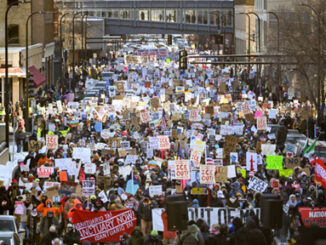
MINNEAPOLIS (TIP): Tens of thousands of Minnesotans marched in Minneapolis and otherwise participated in an economic blackout on Friday to protest against the Immigration and Customs Enforcement (ICE) surge in the state.
About 100 clergy members were arrested by police during the action, video footage showed.
Beside faith leaders, the “no work, no school, no shopping” day of protest was kicked off by community leaders and labor unions – and included actions around the state, plus business closures in solidarity.
The “Day of Truth & Freedom” protest came in the wake of the killing of Renee Good, the unarmed woman shot by a federal immigration officer in Minneapolis earlier this month.
The protesters’ demands include that ICE leave Minnesota, that the ICE officer who killed Good be legally held accountable, an end to additional federal funding for ICE, and for the agency to be investigated for human rights and constitutional violations.
Hundreds of local businesses in Minnesota announced closures in solidarity. Thousands of people took the day off from their jobs to join the action, while others participated by not shopping on Friday. The Minneapolis city council endorsed the day of action and the general strike.
The state’s cultural institutions – including the Walker Art Center, the Minneapolis Institute of Art, the Science Museum of Minnesota and the Minnesota Children’s Museum – closed on Friday as well.
During a protest at the Minneapolis-St Paul airport on Friday morning, hundreds of clergy members called for an end to the ICE surge and urged airline companies to join them in opposing ICE in the state. Video of the action showed hundreds of people walking outside the airport in sub-zero temperatures, singing songs and praying together. Deportation flights go in and out of the airport daily.
On Friday afternoon, thousands clad in winter gear and carrying signs filled the streets of downtown Minneapolis to march in subzero temperatures, ending in a rally inside the Target Center, an arena downtown.
“We are going to be having dangerously cold weather on Friday – -10F with wind chills. Like the high is going to be -10F with wind chills of up to -20F,” Chelsie Glaubitz Gabiou, president of the Minnesota Regional Labor Federation, AFL-CIO, had told the Guardian earlier.
“We are a northern state, and we are built for the cold, and we are going to show up, but folks are going to need to pay attention to not just the march, but what people are doing, the individual stories of solidarity that people are going to be doing.” The Minnesota AFL-CIO, the state’s federation of more than 1,000 affiliated local unions, endorsed the day of action, along with dozens of local labor unions.
“I think what generated the idea for this action came out of the need to figure out what we can meaningfully do to stop it,” Kieran Knutson, the president of Communications Workers of America (CWA) Local 7250 in Minneapolis, told the Guardian last week. “The government in the state of Minnesota has not offered any path towards stopping these attacks, this violence.”
A childcare worker in Minneapolis, who requested anonymity for fear of retaliation toward the immigrant families they serve, said they were shutting down for the day after consulting and receiving immense support from the families of the children they care for.
“We had time to ask the families that we serve if they would be on board with shutting down and we got a hugely positive response,” they said. “We serve families that are on childcare assistance, families that pay out of pocket. So they were all in agreement, even ones that have been trying to go to work, even during this time where they were fearful of being out of their houses. So it was really the families. They all stood up for it, too.”
At the University of Minnesota campuses in Minneapolis, St Paul, and Duluth, labor unions representing student workers and staff have called for the university system to shut down on Friday to allow students and workers to participate in the day of action.
The University of Minnesota graduate labor union said ICE’s operations have had an impact on student workers since the beginning of the Trump administration. In early 2025, at least three international students at the University of Minnesota were arrested and detained by ICE, despite an immigration judge ordering their release.
“It’s really concerning to us that the university is remaining neutral in a time when immigrant communities and international students are literally under attack,” said Abaki Beck, president of the University of Minnesota graduate labor union. “One of the other things we’re pushing for on campus specifically is increased support for immigrant workers and international students.”
A spokesperson for the University of Minnesota cited a guidance memo from university leadership in response to the day of action. They said in a statement: “The University of Minnesota fully supports the rights of faculty, staff, and students to engage in lawful civic expression. We also must ensure continuity of operations and meet our responsibilities to students and the university community.” The Department of Homeland Security (DHS) claimed to have made 3,000 arrests in Minnesota over the past six weeks.
The US army put 1,500 soldiers on standby for possible deployment to Minnesota, as 3,000 immigration officers have been dispatched to the state by the Trump administration.
“This is beyond insane. Why would these labor bosses not want these public safety threats out of their communities?” a DHS spokesperson said in an email in response to the economic blackout.
“These are the criminals these labor bosses are trying to protect,” the spokesperson added, citing 23 uncaptioned photos of claimed undocumented immigrants with criminal records who have been arrested by ICE.
Nationwide, immigrants with no criminal record continue to make up the largest group in US immigration detention, which is at record levels. (Agencies)
235 million brace for weekend winter weather; Travel disruptions inevitable
More than 8000 flights canceled; Air India cancels New York, Newark flights
DALLAS/ NEW YORK (TIP): Freezing rain fell in parts of Texas on Friday , January 23, as a huge, days long winter storm began a trek that threatened to bring snow, sleet, ice, bone-chilling temperatures and extensive power outages to about half the US population. Forecasters warned that catastrophic damage, especially in areas pounded by ice, could rival that of a hurricane.
Schools in Chicago and other Midwestern cities called off classes, airlines cancelled thousands of weekend flights, churches moved Sunday services online and the Grand Ole Opry in Nashville, Tennessee, decided to hold its Saturday night radio performance without fans. Carnival parades in Louisiana were cancelled or rescheduled.
At least 182 million people were under watches or warnings for ice and snow, and more than 210 million were under cold weather advisories or warnings. In many places those overlapped.
Utility companies braced for power outages because ice-coated trees and power lines can keep falling long after a storm has passed.
“It’s going to be a big storm,” Maricela Resendiz said as she picked up chicken, eggs and pizzas at a Dallas store to get her, her 5-year-old son and her boyfriend through the weekend. Her plans: “Staying in, just being out of the way.”
Freezing rain slickened roads in Lubbock, Texas, in the afternoon as temperatures dropped.
After sliding into the South, the storm was expected to move into the Northeast, dumping about a foot (30 centimeters) of snow from Washington through New York and Boston, the National Weather Service predicted.
Arctic air was the first piece to fall in place
Frigid air that spilled down from Canada prompted the cancellations of classes at schools throughout the Midwest. Wind chills as low as minus 40°F (minus 40 Celsius) meant that frostbite could set in within 10 minutes, making it too dangerous to walk to school or wait for the bus.
Despite the bitter cold, a protest over an immigration crackdown went on as planned in Minnesota, with thousands demonstrating in downtown Minneapolis.
Nationwide, more than 1,000 flights were delayed or cancelled Friday, with well over half of them in Dallas, according to the flight tracking website FlightAware. About 2,300 were called off for Saturday.
In Oklahoma, Department of Transportation workers treated roads with salt brine, the Highway Patrol cancelled troopers’ days off and National Guard units were activated to help stranded drivers.
The federal government put nearly 30 search and rescue teams on standby. Officials had more than 7 million meals, 600,000 blankets and 300 generators placed throughout the area the storm was expected to cross, according to the Federal Emergency Management Agency.
President Donald Trump said via social media that his administration was coordinating with state and local officials and “FEMA is fully prepared to respond.” Ice could take down power lines and pipes could freeze After the storm passes, it will take a while to thaw out. Ice can add hundreds of pounds to power lines and branches and make them more susceptible to snapping, especially if it’s windy. In at least 11 Southern states from Texas to Virginia, a majority of homes are heated by electricity, according to the US Census Bureau.
A severe cold snap five years ago took down much of the power grid in Texas, leaving millions without power for days and resulting in hundreds of deaths. Gov Greg Abbott vowed that it will not happen again, and utility companies were bringing in thousands of employees to help keep the lights on.
Northeast braces for possibly heaviest snow in years
Boston declared a cold emergency through the weekend, and Connecticut was working with neighboring New York and Massachusetts in case travel restrictions are needed on major highways.
Connecticut Gov Ned Lamont urged people to go grocery shopping now and “stay home on Sunday.”
Philadelphia announced schools would be closed Monday. Superintendent Tony B Watlington Sr told students, “It’s also appropriate to have one or two very safe snowball fights.”
(Agencies)
Iran’s top prosecutor has vehemently denied U.S. President Donald Trump’s claim that his intervention halted the execution of 800 people detained in the nationwide protests, dismissing the comments as “completely false.” The denial casts further doubt on the possibility of mass executions over the protests, even as officials confirm that some detainees face death penalty charges.
Mohammad Movahedi, quoted by the news agency of Iran’s judiciary, Mizan, said, “This claim is completely false; no such number exists, nor has the judiciary made any such decision.” The strong rebuttal comes as Trump has warned that mass executions and the killing of peaceful protesters are both red lines for a possible U.S. military strike on Iran.
Meanwhile, activists have revealed that the toll in Iran’s bloody crackdown on nationwide protests has reached a staggering 5,000 people killed, with fears that many more have lost their lives as the most comprehensive internet blackout in the country’s history crosses the two-week mark. The ongoing challenge in obtaining information from Iran persists due to authorities cutting off internet access on Jan. 8.
As the situation in Iran remains volatile, tensions between the United States and the Islamic Republic continue to escalate. An American aircraft carrier group is moving closer to the Middle East, a force that U.S. President Donald Trump described as an “armada” in comments to journalists late Thursday, January 22.
Prime Video has announced that Elle, the prequel series to the Legally Blonde franchise, will premiere on July 1. The streamer has also confirmed that the show has been renewed for a second season, with production scheduled to begin in the spring. The series is set during Elle Woods’ high school years and explores the experiences that shaped her personality and ambitions before the events of the 2001 film. According to the official description, Elle “follows Elle Woods (Lexi Minetree) in high school as we learn about the life experiences that shaped her into the iconic young woman we came to know and love in the first Legally Blonde film.”
Reese Witherspoon, who played Elle Woods in the original films and serves as an executive producer on the series, said the project offers a meaningful extension of the franchise. “Twenty-five years after the world met Elle Woods for the first time, it’s a dream come true to share the story of how she became the unstoppable force we all fell in love with,” Witherspoon said. She also praised lead actor Lexi Minetree, adding, “Discovering Lexi Minetree and watching her step into Elle’s fabulous shoes has been one of the most gratifying experiences of my career.”
Internal emails from Sony Pictures, revealed through unsealed court documents, show senior studio executives privately criticising Blake Lively during the It Ends With Us controversy, even as the company publicly expressed support for the actor.
As reported by People, the emails include remarks from Sanford Panitch, president of Sony Pictures Motion Picture Group, who questioned Lively’s future in Hollywood despite the film’s commercial success. In one email, Panitch wrote that it was “quite ironic” that Lively had a film headed towards $300 million at the global box office but “probably will never work again, or not for a while.”
While another Sony executive suggested that public backlash would eventually subside, Panitch disagreed, stating, “She is done for. At least for a while. It’s cooked.” He attributed the backlash to Lively’s own actions, writing, “She did it to herself.”
Panitch also criticised Lively for failing to protect “the show”, calling it a departure from established industry norms. He further took issue with the timing of Lively’s haircare brand launch, Blake Brown, which coincided with the controversy surrounding the film. Describing the move as “epic-level stupid”, Panitch suggested it worsened the situation. A source, however, said the launch had been scheduled with retail partner Target months in advance, before production delays caused the overlap.
Sony chairman Tom Rothman also expressed concern in internal communications, describing the situation as “a f***ing disaster.” He wrote that the focus had shifted away from questions of right or wrong, adding, “The mess is the story now, and it will define the film.”
Additionally, he also said in an email that the actor “has so much – looks, money, fame, hunk husband, kids – that the instinct of the crowd is to tear her down. Like what happened to Anne Hathaway, and neither of them deserve it, even though she did bring it on herself by refusing to listen to advice, and by selling her products.”
Actors Scarlett Johansson, Cate Blanchett and Joseph Gordon-Levitt have united behind a new anti-AI campaign calling out the tech companies exploiting copyrighted work without permission. The campaign, comprising 700 artists, writers and creators, argues that “Stealing our work is not innovation. It’s not progress. It’s theft – plain and simple.”
Johansson, Blanchett, and Gordon-Levitt are among the many artists emphasising that the battle for authorship safeguards both their personal rights and the broader US creative industry. This sector, which includes television, film, music, digital media, and publishing, “supports millions of jobs, fuels economic growth and projects cultural power globally,” the statement read, as reported by Variety. That creative ecosystem faces a serious threat from AI developers who harvest original work. This process frequently occurs without the creators’ permission, fair payment, or any level of clear transparency regarding how the data is being utilised.
“America’s creative community is the envy of the world. But rather than respect and protect this valuable asset, some of the biggest tech companies – many backed by private equity and other funders — are using American creators’ work to build AI platforms without regard for copyright law,” the statement emphasises.
The initiative encourages organisations to establish formal content agreements or strategic partnerships, following the precedent set by several firms that have already adopted this collaborative approach. “A better way exists. It is possible to have it all. We can have advanced, rapidly developing AI and ensure creators’ rights are respected,” the statement highlights.
Johansson has long been a prominent voice against the risks of artificial intelligence, actively resisting the unauthorised use of her image for years. In early 2024, she publicly denounced a viral clip that featured an AI-generated version of herself seemingly protesting anti-semitic remarks made by Kanye West. Her legal battles continued in late 2023 when she sued an AI application for utilising her name and appearance in digital ads without consent.
Additionally, in May 2024, the actor criticised OpenAI for basing their GPT-4o “Sky” voice on her performance in the 2013 film Her directed by Spike Jonze. The 41-year-old was last seen in the science-fiction action film Jurrassic World: Rebirth.
Blanchett has also stressed the subject multiple times, most notably during the 2024 Toronto International Film Festival. While speaking with TIFF CEO Cameron Bailey, she emphasised the necessity of debating emerging technologies. She warned that society must approach these advancements with extreme care, noting that “innovation without imagination is a very, very dangerous thing.”
In 2025, Blanchett and Levitt joined a coalition of 400 industry leaders—including actors, writers, musicians, and filmmakers—in signing an open letter to the White House’s Office of Science and Technology Policy. The group urged the Trump administration to uphold existing copyright laws and resist pressure from AI firms seeking to diminish these essential protections.
Rumors of Akshaye Khanna having a fullfledged role in Dhurandhar 2 as Rahman Dakait could be untrue, but an emerging report suggests that Vicky Kaushal is all set to join the cast of Aditya Dhar’s Dhurandhar 2 in an extended cameo. The actor will reportedly play Major Vihaan Shergill, his character from Dhar’s 2019 blockbuster, Uri: The Surgical Strike. Industry sources say the entry of Vicky Kaushal’s Major Vihaan Shergill in the world of Dhurandhar indicates a larger spy universe in the making, which will unite characters from Uri with those of the Ranveer Singh-starrer Dhurandhar.
“Aditya has been tightlipped about the star power he is adding to Dhurandhar 2. The director, who plans to build the Dhurandhar universe, has smartly woven in a track from Uri despite the difference in the two stories’ timelines,” a source says, according to an unconfirmed report in Mid-Day.
Uri: The Surgical Strike is based on real incidents of September 2016, when the Indian Army crushed an attempted attack by a group of militants near the town of Uri. Vicky’s character, Major Vihaan Shergill, leads the Indian military charge in the film that earned over Rs 341 crore against a budget of around Rs 42 crore upon release in January 2019.
Speaking about the possible presence of Vicky Kaushal’s Uri character in Dhurandhar 2, the source says, “It remains unclear whether he and Ranveer’s character cross paths,” adding: “The cameo includes a few action blocks.”
The possibility of Vicky Kaushal’s presence in Dhurandhar 2 got a boost when a fan theory went viral on social media, stating that Uri had references that hinted at such a connection.
In Dhurandhar, Ranveer Singh plays an Indian agent by the name of Hamza Ali Mazari who arrives in Karachi’s notorious Lyari area to gather intelligence data for India. After a tense build-up sees Hamza witness the planning of execution of the 26/11 Mumbai attacks, his name is revealed to be Jaskirat Singh Rangi at the end of the film.
Border 2 is a likeable film, but you can’t quite love it. At three hours and 19 minutes, it stretches itself thin in places, asking for patience even when its intentions are sincere. It isn’t careless, and not lazy either. But when a film carries a title as loaded as Border, effort alone doesn’t suffice. Legacy demands something else entirely.
JP Dutta’s Border (1997) was more than a war film, it was an emotional memory shared across generations. It arrived at a time when watching a film meant sitting in front of a bulky television set. The film allowed the battlefield to declare its patriotism. Its emotions rose organically from dust, fear, camaraderie and loss. Nearly three decades later, Border 2 inherits that memory, and struggles under its weight.
Sunny Deol remains the clearest bridge between the two films. At 68, his physicality is striking, his command unchanged. Whether in hand combat or scenes showcasing grief, he understands the grammar of this universe instinctively. In many ways, he carries the film on his shoulders, just as he did in 1997. But this time, he often stands alone.
Diljit Dosanjh offers solid support, bringing sincerity and restraint to his part. Varun Dhawan and Ahan Shetty are competent, serviceable, but not commanding. In a film so sharply shaped by memory, performances which are just fine feel insufficient. The original Border elevated its ensemble, making each soldier look like an inevitable force. Here, that collective force is missing. Legacy seems like a solitary act.
One of the film’s biggest shortcomings lies in its music. The new soundtrack fails to leave a lasting impression. The emotional recall comes almost entirely from the original album: Sandese Aate Hain, Toh Chaloon — songs that already carry decades of feeling within them. As beautiful and enduring as Sandese Aate Hain remains, it doesn’t land the same way here. In fact, the scenes leading up to it feel designed to accommodate the song, not grow into it. The dependence exposes the film’s emotional gaps.
In Border 2, the narrative spends more time on personal lives and emotional backstories than on sustained battle sequences. The film is built around four major confrontations from the 1971 India-Pakistan war: Operation Changez Khan in the air, the Battle of Munawar Tawi in Jammu and Kashmir, the Battle of Basantar, and the INS Khukri naval battle. Four powerful stories, four leaders, immense real-life loss and valour. The intention to do justice to all of them is clear. But intention alone doesn’t translate into immersion.
For a film of this length, the battle sequences feel fleeting, leaving you wanting more — an odd feeling for a war drama stretched across over three hours. The original Border made the battlefield feel intimate. Border 2 makes you aware of its scale, but rarely allows you to understand its depth.
Homebound has missed out on a nomination in the Best International Feature Film category at the 2026 Oscars. The last film from India that made it to the Oscars nominations was Aamir Khan’s Lagaan, back in 2002.
The films nominated in this category are The Secret Agent (Brazil); It Was Just an Accident (France); Sentimental Value (Norway); Sirât (Spain); The Voice of Hind Rajab (Tunisia)
Produced by Dharma Productions’ Karan Johar, Apoorva Mehta and Adar Poonawalla, Homebound is based on a New York Times article by Basharat Peer, which was published in 2020. The film follows the story of two friends – Shoaib and Chandan – who come from oppressed backgrounds, and struggle to make their place in a society that is plagued by discrimination on a systemic level. The story follows them through the COVID-19 lockdown when they lose their livelihood and are left in a lurch, finding ways to come back home.
In the past, Indian films that have had Oscar campaigns, have spoken about the expenses associated with such campaigns. Karan, in an earlier chat with Peeping Moon, said that funding an Oscar campaign was a “bottomless pit” and an “uphill task” as they don’t know the end result. “You have to employ publicists and travel and make noise and do media abroad and screenings abroad. But Adar said Karan, this is a great opportunity and a great film, let’s do everything in our capacity. Let’s not think of profit and loss on this one. Let’s think of passion over any monetary benefit. That’s what we did. It is not a money making exercise for us. It is about credibility, we will do other films for survival, but Homebound was always a passion project. There is no monetary game in that film,” he said.
A few months ago, journalist-turned-author Puja Changoiwala initiated legal action against Homebound alleging that the makers had plagiarised her 2021 novel of the same name. Dharma Productions responded to her allegations and called them “baseless and unfounded.” “The allegations of copyright infringement are baseless and unfounded, and Dharma Productions categorically denies the same. Homebound is an officially licensed adaptation inspired by the New York Times article by Basharat Peer, with all requisite rights lawfully acquired and due credit duly provided,” they told HT.
New delhi (TIP)- More than 30,000 police personnel and over 70 companies of paramilitary forces will be deployed across Delhi to secure Republic Day celebrations, officials said on Friday, January 23.
In a first, security forces will use AI-enabled smart glasses equipped with facial recognition system (FRS) and thermal imaging technology.
The Indian-made smart glasses will be linked in real-time to a police database of criminals, suspected and proclaimed offenders. This will allow personnel on the ground to identify individuals in crowded areas instantly.
“The wearable devices will connect to mobile phones used by police officers, giving them access to the criminal database,” Additional Commissioner of Police (New Delhi) Devesh Kumar Mahla said.
He explained that a green box appears on the device if a person has no criminal history, while a red box signals a criminal record.
The security grid includes multi-layered barricading and six layers of checking and frisking. Thousands of CCTV cameras, including those with FRS, have been installed in the National Capital. Mobile vehicles equipped with FRS will also be deployed at various points. “Delhi Police is well prepared to tackle any kind of situation,” Mahla said, adding that mock drills are being conducted with multiple security agencies. Of the total deployment, 10,000 personnel will be stationed specifically in the New Delhi.
The DCPs of all districts are properly briefed about the security arrangements. Police officers would remain on high alert and promptly report any suspicious activity immediately, he said.
Another officer said approximately 4,000 rooftop security points have been identified across the New Delhi, North and Central districts. About 500 high-resolution AI cameras are being installed along the parade route and surrounding areas. All attendees of the Republic Day parade will be provided with security stickers.
Deputy Commissioners of Police (DCPs) have completed route surveys and anti-sabotage checks. Vigilance has been increased in high-footfall areas such as bus stops, railway station and popular markets.
Preventive measures currently underway include tenant and servant verification drives across the city. Police are also holding “eyes and ears” awareness sessions with auto-rickshaw and taxi drivers, vendors, and local service providers. Source: TNS
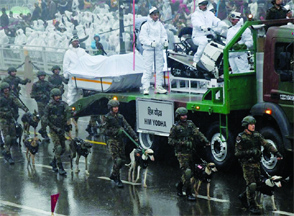
New Delhi (TIP)- The Republic Day Parade, a 90-minute spectacle, will feature a tableau depicting strikes on terror camps in Pakistan during Operation Sindoor, while showcasing India’s technological prowess and cultural diversity. The event also carries diplomatic significance in a fast-changing global order, with the European Union’s top political leadership in attendance. The armed forces will present a tri-service tableau, ‘Operation Sindoor: Victory through Jointness’, at the 77th Republic Day Parade on Kartavya Path on January 26.
European Council President António Luís Santos da Costa and European Commission President Ursula von der Leyen will be the chief guests. India and the EU, both recalibrating ties amid shifting US policies under President Donald Trump, are expected to conclude a free trade agreement on January 27.
The Operation Sindoor tableau represents India’s evolving military doctrine, marking a decisive transition towards precision, integration and indigenous capability. It signals India’s embrace of joint, self-reliant and decisive military power.
The opening segment highlights naval maritime dominance, asserting control over the seas and denying adversaries operational freedom. This transitions to the Army’s firepower, with M777 Ultra-Light Howitzers delivering calibrated strikes, backed by the Akash air defence system symbolising a layered aerial shield.
At the core of the tableau is the strike narrative — rapid response, controlled escalation and precision. A loitering munition neutralises an enemy air defence radar, followed by a Rafale fighter launching SCALP missiles against terror infrastructure. The sequence intensifies as a Sukhoi-30 MKI fires a BrahMos supersonic cruise missile to destroy hardened aircraft shelters.
The finale features the S-400 air defence system executing a long-range engagement at 350 km to neutralise an enemy airborne early-warning platform — underscoring India’s doctrine: detect first, decide first and destroy first, the Ministry of Defence said.
For the Indian Air Force, a special attraction will be a composite flypast formation named ‘Sindoor’, comprising Rafale, Sukhoi-30 MKI, MiG-29 and Jaguar fighters. A helicopter will carry the Operation Sindoor flag. Source: TNS
New Delhi (TIP)- With the Kerala Assembly elections approaching, the Congress leadership on Friday held a strategy meeting with senior leaders from the state to fine-tune its poll roadmap, strengthen coordination within the United Democratic Front (UDF) and project unity ahead of the high-stakes contest expected in April.
The meeting, chaired by Congress president Mallikarjun Kharge at his residence, was attended by Leader of the Opposition in the Lok Sabha Rahul Gandhi and most members of the party’s top leadership from Kerala.
However, the absence of senior leader and Thiruvananthapuram MP Shashi Tharoor triggered speculation about possible discontent within the state unit. The Congress leadership dismissed such suggestions, saying Tharoor had informed the party well in advance about his inability to attend due to prior commitments. Party leaders said discussions centred on election preparedness, campaign messaging, alliance management within the UDF and consolidating gains made in recent local body elections. Those present included AICC general secretary (organisation) K C Venugopal, Kerala in-charge Deepa Dasmunshi, senior observers Sachin Pilot and K J George, former state Congress president Ramesh Chennithala, Leader of the Congress Legislature Party V D Satheesan and newly appointed Kerala Pradesh Congress Committee president Sunny Joseph.
Chennithala said that seat-sharing within the UDF was discussed and cited the alliance’s performance in recent panchayat elections as indicative of public support. He rejected reports of internal discord, stating that Tharoor had prior engagements in Kozhikode, which he had communicated earlier.
He also criticised Prime Minister Narendra Modi over the Sabarimala gold loss issue, alleging inaction by the Centre.
Party sources, however, said certain developments in recent weeks had contributed to perceptions of Tharoor’s dissatisfaction. Earlier this month, Rahul Gandhi did not acknowledge Tharoor on stage at a public event in Kochi. However, Tharoor’s office reiterated that his absence was solely due to his participation in the Kerala Literature Festival in Kozhikode.
What began as a routine homeschooling session ended in tragedy in Faridabad, where a man allegedly beat his four-year-old daughter to death after she failed to write numbers up to 50, police said on Friday, January 23.
The accused, Krishna Jaiswal (31), was arrested following a complaint at the Sector 58 police station. He was produced before a city court and sent to one-day police remand, according to news agency PTI. Jaiswal, a native of Kheratiya village in Uttar Pradesh’s Sonbhadra district, was living in a rented house in Faridabad with his family.
Police said both Jaiswal and his wife were employed in private companies. While the mother went to work during the day, Jaiswal stayed back at home to look after the children and oversee his daughter’s studies.
The incident took place on January 21. Investigators said Jaiswal asked the child to write numbers from one to 50. When she could not complete the exercise, he allegedly lost his temper and assaulted her, causing fatal injuries.
The case surfaced in the evening when the mother returned from work and found the girl lying dead at home. She immediately alerted the police. A team from the local police station reached the spot and took the body into custody.
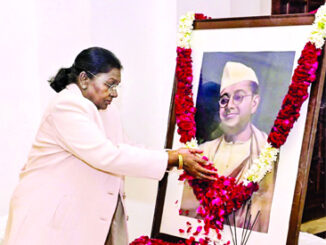
The Centre on Friday, January 23, organised ‘Parakram Diwas–2026’ to mark the 129th birth anniversary of Netaji Subhas Chandra Bose, as his daughter Anita Bose Pfaff renewed her appeal for bringing the freedom fighter’s remains from Japan to India.
In a statement, Anita said Netaji, who spent much of his life in forced exile while fighting for India’s freedom, would have been deeply distressed that his remains continue to lie outside the country more than 80 years after his death and 78 years after Independence.
“As Netaji’s daughter, I invite the Indians of today who still revere him to support his posthumous return from exile; to support the transfer of his mortal remains to India for a final and fitting disposal,” she said.
Meanwhile, the Ministry of Culture is organising ‘Parakram Diwas–2026’ from January 23 to 25 in the Andaman and Nicobar Islands, along with events at 13 other iconic locations associated with Netaji’s life and legacy.
Madhuranthakam (TIP)- Prime Minister Narendra Modi on Friday, January 23, embarked on a high-octane campaign across Kerala and Tamil Nadu, intensifying outreach, targeting incumbent state governments and highlighting National Democratic Alliance (NDA)-led initiatives in the two poll-bound states where the Bharatiya Janata Party (BJP) is seeking to make inroads. Modi kicked off his southern tour from Thiruvananthapuram, launching an all-out attack on the Left Democratic Front (LDF) government and the Congress-led United Democratic Front (UDF), accusing them of trapping Kerala in a web of “corruption, misgovernance and dangerous politics of appeasement”.
“Their flags and symbols may be different, but their politics and agenda remain the same… You have to choose a new pro-people and pro-good governance administration,” he said during a rally at the Putharikandam Maidan after holding a roadshow.
During his Kerala visit, Modi also flagged off four new trains and unveiled a slew of development projects at an event attended by chief minister Pinarayi Vijayan and governor Rajendra Vishwanath Arlekar. He also laid the foundation stone for a CSIR-NIIST Innovation, Technology and Entrepreneurship Hub and launched the PM SVANidhi Credit Card — a UPI-linked, interest-free revolving credit facility.
Modi accused the CPI(M)-led ruling alliance of creating hurdles in the implementation of central government schemes to serve its own interests.
“They are obstructing the implementation of the next phase of the PM Awas Yojana (Urban) and causing delays in the provision of piped water… They are preventing underprivileged children from accessing modern schools… Such anti-poor actions by the LDF warrant a strong response,” the PM said. He also attacked the chief minister Vijayan-led government over the Sabarimala gold case, accusing it of tarnishing the traditions of Lord Ayyappa. “Gold has been stolen from God. As soon as a BJP government is formed, the culprits will be put in jail. This is Modi’s guarantee,” he said.
In his address, Modi referred to the Congress as “MMC” — Muslim League Maoist Congress – and said it was important to remain vigilant against it. “The Congress party lacks a developmental agenda. Today, it has adopted positions that are more Communist than those of the Maoists and more communal than the Muslim League. In Kerala, the Congress is actively promoting hardline elements,” he alleged
The BJP has historically struggled in Kerala’s electoral landscape, which is dominated by the LDF and the UDF. Its lone assembly election victory was in Nemom constituency in 2016. It won its first Lok Sabha seat from Thrissur in 2024. It has fared relatively better in local body elections, with its most significant victory coming this year in the Thiruvananthapuram Municipal Corporation, which it won for the first time. Modi alluded to the BJP’s victory in Thiruvananthapuram , saying it would serve as a catalyst for the party’s growth in the state. He recalled that the BJP’s rise to power in Gujarat started with winning the Ahmedabad Municipal Corporation in 1987 and said the same will happen in Kerala. “Our journey began in one city in Gujarat, and similarly, in Kerala, our beginnings have started with a single city. I believe this demonstrates that the people of Kerala are beginning to place their trust in the BJP, connecting with us in the same way Gujarat once did,” the PM said.
The CPI(M) and Congress rejected Modi’s charges. Vijayan accused BJP affiliates of attacking principles of the Constitution. “Across India, the secular fabric of our nation is under sustained attack. This coordinated attempt to undermine constitutional democracy and impose the Sangh Parivar’s communal politics must be firmly resisted. The Congress accused the BJP of trying to polarise Kerala. “Yet another speech where it became clear that PM Modi and BJP don’t understand Kerala and are desperately struggling to find relevance… He resorted to his usual communal drivel, in a failed attempt to polarise a state proud of its pluralism,” senior Congress leader KC Venugopal said.
New Delhi does not have deep pockets with surplus funds like China to positively impact policies of other countries.
“The absence of a power leverage explains the cozying up of Bangladesh with Pakistan despite Dhaka knowing well the pitfalls of neglecting its big neighbor which helped it get independence. We now have another border to tend and it would be interesting to see which party comes to power in the forthcoming national elections.”
By Air Vice Marshal Manmohan Bahadur retd
India’s neighborhood has become complex. Setting aside PR rhetoric, to say that New Delhi has no true friends on its borders (barring Bhutan) would not be wrong. By any yardstick, the political power of a nation with a $4-trillion economy (fourth largest in the world) should catalyze relations with its neighbors to its advantage. That it is not exactly so needs a clinical assessment.
Pakistan as an adversary is a no-brainer and so too is China — notwithstanding the handshakes in public between PM Narendra Modi and President Xi Jinping during the Shanghai Cooperation Organization meeting in September 2025.
While Islamabad would be feeling hurt considering the statement made by the Indian Air Force on May 10, last year, with its deadly pan-Pakistan precision strikes on military installations, it would also be planning to get back — not necessarily through a kinetic engagement; one is already seeing some increased terrorist activity in the Valley.
Relations with China are more complex since we are dependent on it in more ways than one in non-military areas and yet, militarily, have to match them 24×7 — man for man, tank for tank on our northern borders. With Beijing aiming for a multiple aircraft carrier navy, it would not be long before a PLAN carrier group makes a foray in the Indian Ocean, mandating another front for New Delhi to address.
But what about the others with whom India shares land and maritime contiguity? A color-coded map of India’s neighborhood friends would have more shades of red than blue. The osmotic effects of New Delhi’s economic, military and cultural positioning, that should have translated to positive influence around us, are conspicuous by their absence.
Writing on what constitutes power, strategist George Friedman has termed it an intangible entity; the ambiguity that real power exudes about the likely future course of action (deterrent or kinetic) is what gives it the coercive quotient. A nation has to reach that standing in the power matrix to enable it to sway sentiment in its favor without going kinetic.
Have we, instead of nursing relationships with our neighbors, jumped the starter’s gun and started expecting deference that automatically accrues to real power?
In 2011, cautioning against mistaking influence and weight with power, India’s then NSA Shiv Shankar Menon had said that “For a considerable amount of time, India will be a major power with several poor people. Power is the ability to create and sustain outcomes — weight we have, our influence is growing, but our power remains to grow and should first be used for our domestic transformation.”
The absence of a power leverage explains the cozying up of Bangladesh with Pakistan despite Dhaka knowing well the pitfalls of neglecting its big neighbor which helped it get independence. We now have another border to tend and it would be interesting to see which party comes to power in the forthcoming national elections.
In Nepal, the Chinese have already made inroads through infrastructure projects (rail, roads, energy) and digital technology programs. Their tourist inflows have also increased substantially with direct air and road connectivity. Indian media has not helped with its intrusive behavior as the scenes of ‘Indian media go back’ witnessed in the 2015 earthquake were seen again during the Gen-Z uprising.
The story has been similar in the Maldives and Sri Lanka when new governments took office. Luckily, the downturn seems to be reversing — but there is still a fair distance to cover. Myanmar has to be watched, considering the deep Chinese inroads there and our unsettled and volatile North-East.
Despite these unhelpful vibes, the Budget allocates developmental assistance to many of these neighbors since we share centuries-old cultural ties and are mindful of social sensitivities of our own border communities as well. So, where lies the problem when India has always been helpful, even ferrying items as basic as water to the Maldives?
The answer lies in the question posed earlier — “have we jumped the starter’s gun and are confusing influence and weight with power?”
On the hard power matrix, despite a welcome increase in defense exports, the growth of our military industrial complex has yet to impact India’s unenviable position as the second largest arms importer in the world — this, without factoring in the $3.25-billion Rafale import coming up soon.
A GDP of $4 trillion is excellent, but the per capita GDP where India is 143rd in world rankings, is the true determinant of a nation’s economic depth. With millions still below the poverty line requiring succor, New Delhi does not have deep pockets with surplus funds like China to positively impact policies of other countries.
The worldwide upheaval due to Trump’s arm-twisting edicts has shown what real economic power can do — the Venezuela regime change has hardly created any condemnation and the usurping of Greenland, if it happens, would be another validation of the analysis of Thucydides in 404 BCE: “The strong do what they can and the weak suffer what they must.”
China too is no exception —the use of its monopoly on rare earths to keep the US tariffs at bay is an example.
So, even as our diplomats burn the midnight oil working their charm, let us continue on the path of an economic surge that has been the vision of all governments since Independence.
If our endeavors for a Viksit Bharat by 2047 are to remain focused, then amicable relations with neighbors are a sine qua non.
Till then, to avoid being ‘the ugly Indian’ and frittering away goodwill in our neighborhood, our talk and actions should heed the Margaret Thatcher view that “Being powerful is being like a lady; if you have to say you are, you aren’t.”
(Air Vice Marshal Manmohan Bahadur Retd is Ex-Addl Director General, Centre for Air Power Studies)
It is a mixed bag as far as the global outlook for 2026 is concerned, marked by an updated version of the U.S.’s ‘shock and awe’ tactics
By M K Narayanan
The new year began with a stark reminder that the over 200-year-old ‘Monroe Doctrine’ is not merely alive but has been given a fresh dimension, in keeping with the personality of United States President Donald Trump. In a swift operation as 2026 unfolded, U.S. airborne troops abducted Venezuelan President Nicolás Maduro and his wife and incarcerated them in the U.S. on charges of undermining the security of the U.S. This action is being sanctified as the new ‘Donroe Doctrine’.
Actions under the Trump administration
Protests worldwide against the U.S.’s action in violating the sovereignty of Venezuela have, however, been rather muted. This seems to convey the belief that the post-1945 international order is dead, and what exists now is a ‘free for all’ in the global commons. Voices are also being heard ‘sotto voce’, that the latest action by the U.S. might well become a prelude for similar actions by nations such as China and Russia to lay claim to countries and regions falling within their zone of influence — China’s claim to Taiwan being one.
The action carried out has been characterized by Mr Trump himself as a modern version of the (1823) Monroe Doctrine, viz., that the U.S. is the sole guarantor of security in the Western Hemisphere and would not brook any interference by powers outside the Hemisphere. A careful reading of President Trump’s latest U.S. National Security Strategy, or NSS (November 2025) — which unequivocally states that after years of neglect, the U.S. expects to reassert its pre-eminence in the Western Hemisphere, denying non-Hemispheric competitors the ability to position forces or threaten U.S. vital assets in the Hemisphere — would suggest that the Venezuelan operation was a carefully thought through maneuver, and an updated 21st century version of ‘US shock and awe’ tactics. There is even an implicit threat of actions similar to Venezuela against Cuba, Colombia and Mexico. There is again an implicit reference to taking control of Greenland which is viewed by the U.S. as a security necessity.
From a U.S. perspective, it would seem that 2026 could see significant changes in different regions of the globe. Europe, for instance, which has come in for sharp criticism in the NSS document, has been excoriated on the ground that it had lost most, if not all, its sheen, alongside the suggestion that the U.S. could help Europe regain its former greatness if it backed patriotic European parties and ‘genuine democracy’. The NSS document wants Europe to assume ‘primary responsibility for its own defense’, alongside a veiled reference to achieving strategic stability with Russia.
Going beyond Mr. Trump’s NSS, realistically speaking, it would seem that the conflict in Ukraine, which appears stalemated at present, could move toward resolution, but which could be unsatisfactory to both sets of antagonists. The alternative, according to U.S. policymakers, appears to be that otherwise, it could lead to further escalation, alongside fears that it would engulf more regions of Europe.
The situation closer to India
The situation in West Asia, it would seem, is beginning to resemble the proverbial curate’s egg, good in parts. Israel’s pogrom has come to an end for the present, but peace in the regime remains highly elusive. The situation in Gaza, in particular, remains highly sensitive and violence seems for the most part just round the corner.
Meantime, the growing violence and unrest that have engulfed Iran and the Khamenei regime is acting as a catalyst for a fresh round of conflict in and across the region. Iran is witnessing widespread internal violence, and the declared that it is “fighting on four fronts, viz., an economic war, a psychological war, a military war against the US and Israel, and ‘a war on terrorism’”. The West has responded with warnings of imposing additional sanctions on Iran. Implicit in all this, is that both Israel and the U.S. see an opportunity to complete the unfinished conflict of 2025, and ensure that it reaches a ‘satisfactory conclusion’ in undermining the Khamenei regime in Iran.
Northwest Asia, specially Afghanistan, is meanwhile, set to confront more troubles this year. The Tehreek-e-Taliban and other Afghan terrorist groups appear, of late, to have gained a fresh lease of life, and this spells problems for Pakistan as well. The Afghanistan-Pakistan border will, hence, continue to remain troubled during much of this year. So, 2026 is again, not likely to be a good year for democracy in Pakistan, with the military taking firmer control of the country’s affairs and Field Marshal Asim Munir eclipsing the importance of Prime Minister Shehbaz Sharif, striking another blow to the country’s democratic trajectory. However, Pakistan does appear to have gained a fresh lease of life, with the U.S. embracing it as an ally, promising a fresh tranche of state-of-the-art weapons, and in some ways being perceived as ‘the most favored nation of the US’ in this part of the world. Meantime, uncertainty about the future of democracy will continue to prevail in the highly troubled state of Bangladesh, notwithstanding the promise of fresh elections and restoration of an elected government.
For China, 2025 seemed like a good year. While China-U.S. rivalry appeared to intensify, Beijing successfully withstood the tariff barrage unleashed by Mr. Trump, and even seemed to turn it to its advantage. China raised the value of its manufacturing and also demonstrated its hold over global supply chains.
China’s restrictions on rare earth exports in the tussle with the U.S., seemed to enhance its ability to not only withstand U.S. pressures but also to convert the situation in its favor. While there were few opportunities for a trial of strength in the Pacific, China’s growing presence in Southeast Asia is adding to China’s importance in Asian and world affairs. It is increasingly becoming apparent as well that the Eastern Pacific is no longer a U.S. bailiwick. China’s presence in the Indian Ocean is also growing and represents not only a major threat to nations bordering the Indian Ocean but, more importantly, also a challenge to U.S. supremacy here.
Notes for New Delhi
As 2026 progresses, India appears to stand at the crossroads, unsure as to where it stands. There has been no letup in Mr. Trump’s tirade against India for continuing to import subsidized Russian oil, notwithstanding the fact that India is inclined to side with the U.S. on most matters. An implicit coldness in India-U.S. relations seems to be affecting India’s relations with many other countries, resulting in New Delhi’s relative isolation when it comes to conflict zones such as West Asia. Mr. Trump’s public endorsement of Field Marshal Munir and the lifting of restrictions on arms supplies to Pakistan is also not helping. Despite this, there have been some positive developments with regard to an expansion of India-U.S. cooperation in some areas. Several mini-lateral initiatives, such as the I2U2 (India, Israel, the U.S., the UAE) and the India–Middle East–Europe Economic Corridor appear to be progressing.
As of now, Washington’s foreign policy calculus and Beijing’s disinterested approach to India are putting India at a disadvantage in political and economic terms, especially the latter. China’s tactical advantage in trade and tariff disputes leaves little room or scope for India to hedge against U.S. threats to further raise tariffs on trade, thus aggravating current anxieties. For India, there is again little room for comfort in the fact that China’s economic growth has not picked up of late, or that its domestic consumption remains stagnant. All this is notwithstanding an improvement in India-China ties following the Tianjin meeting of Prime Minister Modi and President Xi Jinping in 2025. A further stabilization of India-China ties does not, however, appear likely in 2026.
Overall, 2026 may not have any great prospects for India. It may not, however, face any major terror attack during the year, but terrorism will remain an ever-present reality. West Asia having just undergone a sustained military campaign by Israel may be spared major terror attacks, but the upheaval in Iran and the attempt by Israel and the U.S. to wade into troubled waters could instigate some terror attacks. The Islamic State and al Qaeda seem better positioned in Africa as of now, but this is no reason to let one’s guard down, as, overall, more attacks by insurgent and terrorist entities can be anticipated in Asia, West Asia and Africa. Terrorism could, hence, be regarded as a critical national security threat during 2026.
(M.K. Narayanan is a former Director, Intelligence Bureau, a former National Security Adviser, and a former Governor of West Bengal)
For Indians who migrated to the United States a few years ago—particularly those in their thirties and beyond—India is not a distant idea but a lived reality. They have grown up with its sights and sounds, absorbed its contradictions, and carried its memories across continents. Though settled abroad, they continue to follow the social, political, and economic journey of the land of their birth with keen interest. It is therefore natural for them to celebrate India’s national days—Independence Day and Republic Day—with the same warmth and emotion as their religious and cultural festivals such as Diwali, Vaisakhi, Pongal, Onam, Holi, Lohri, Chhath and many others. Each national day rekindles patriotic feelings and invites reflection on the state of the nation. On the occasion of the 77th Republic Day of India, The Indian Panorama invited its readers of Indian origin to share their views. We are pleased to present a selection of their thoughtful reflections here.
Amit Verma Country Head, US Operations State Bank of India, New York
As the tricolor unfurls across India on its 77th Republic Day, I join the Indian diaspora in the United States in celebrating the triumph of our Constitution and the spirit of our resilient democracy. I salute every Indian who carries forward our rich heritage while contributing to global progress. May this day inspire us to strengthen the ties between India and USA and work together for a brighter future.
Jai Hind!
==========================
Comment – VK Raju
VK Raju, MD President, Eye Foundation of America Morgantown, West Virginia
When INDIA became independent from British rule in 1947 and began a pioneering post-colonial experiment in democratic nation building , many sages had shaken their heads not giving exciting new experiment any chance to last long. INDIA has defied such dire predictions .
On India’s 77th Republic Day , I reflect as someone born in India (got stellar medical education almost for free ) post graduate training and education in Ophthalmology in UK and long settled in United States. There are no two democracies( both are British colonies ) like India – the largest, and the United States – the most powerful . if these two nations can build true Maitri (friendship) rooted in restraint, respect, and compassion they can still help bend history towards peace . In an age of growing violence, the real test of democracy is whether it can protect the future of our children .
Today we the people of the world pray for peace and worship war heroes . It sounds paradoxical , doesn’t it? As Bhrihadaranyakopanishad says —can we move from darkness to light , from division to understanding and from fear to compassion?
May there be peace in all within us and around us!
==========================
Comment – Dr. Satish K Sharma
Dr. Satish K Sharma Former Director of the DAV College Managing Committee (CMC), New Delhi Ludhiana
On the eve of Republic Day, I offer you my heartiest congratulations!
On January 26, 76 years ago, our founding document, the Constitution of India, came into effect.
Republic Day is indeed a matter of collective joy and pride for all of us. Today, we should first recall the brave souls who made great sacrifices to free the motherland from the shackles of foreign rule.
The Constitution has become a living document. It binds us together as a family. Today, let us humbly express our gratitude to Dr. Ambedkar, who chaired the Drafting Committee and other distinguished members of the Constituent Assembly, who worked hard and bequeathed us this most wonderful document.
The 76 years of the Constitution are marked by an all-round progress of a young republic. Today, India is taking leadership positions in international forums. This transformation would not have been possible without the blueprint laid down by our Constitution.
Our brothers and sisters living abroad have taken the best of our culture and civilization to different parts of the globe and have made us proud with their achievements in diverse fields.
The key to our future is our youth and especially the young women. Their dreams are molding the India of tomorrow. They have the potential to contribute greatly in the realization of aim of Viksit Bharat by 2047.
Let me once again congratulate you all on the occasion of Republic Day.
My best wishes to you in all your endeavors.
Thank you, Jai Hind!
India is targeted to become the third global economy behind the USA and China in the next 3 to 5 years. India could easily become the second economy within ten years. INDIA IS THE YOUNGEST IN THE WORLD
50% of India’s 1.5 billion is under age 25. 65% are under 35. Compare this with shortage of babies in China, USA, and Western Europe.
India graduates 1.5 million engineers yearly against 200,000 in the USA. Currently, many educated Indians are underemployed and unemployed. Most enterprising and well to do Indians go abroad.
India also graduates a large number of management professionals. I cannot believe the present Dean of Harvard School of Business has degree from the Indian Institute of Management, Ahmedabad and no foreign degree. What does this tell you?
Technological revolution has been creating many opportunities for educated and qualified professionals to seek opportunities. As most of the work is done or processed thru computers there is no requirement that professionals attend office or should be in a particular location. This is going to create huge opportunities for the educated unemployed in India. Why do you think Google, Microsoft, Amazon and Matta have decided to invest $100 billion dollars combined for AI storage in India?
I anticipate India will become the world’s headquarters for delivering products, processes and services based on high technology. IMPACT OF 40 MILLION INDIAN DIASPORA ON INDIAN ECONOMY
India has been leading in foreign remittances. This is helping India’s foreign exchange position. I expect more and more Indians will be immigrating to Australia, New Zealand, Canada, Ireland, Germany, U.K., U.S.A., Russia, China, Japan, Middle Eastern Arab countries, and others.
Guyana has a sizeable Indian population. After it struck oil, it has started attracting foreign manpower. Guyana is a great opportunity for Indians to invest and settle down. Guyana pretty soon will be a rich country because of oil.
Indians should be learning foreign languages such as Chinese, Japanese, Spanish, Korean, Russian, German, French so that it will be easier for them to seek immigration. FRIENDLY RELATIONS WITH INDIA’S NEIGHBORS
It is important India creates most friendly relations with all its neighbors: Nepal, Bangladesh, Sri Lanka and Maldives.
As we embark on the 77th Republic Day of India I am most optimistic about India’s future. I am convinced developed populations are a great asset.
Ven Parameswaran, a former Indian diplomat and CEO, First Asian Securities Corporation, NYC came to the USA in 1954 on Mrs.Vijayalakshmi Pandit Scholarship. He is a graduate of Columbia U Business School.
The 77th Republic Day is not only a celebration of India’s past but also a reminder of its responsibilities for the future. As the nation progresses in areas such as technology, economy, education, and social development, Republic Day inspires citizens to uphold democratic ideals and contribute to building a strong, inclusive, and self-reliant India.
Republic Day stands as a symbol of national pride, unity in diversity, and the enduring spirit of the Indian Constitution.
As a child I remember my parents in Delhi will take me to watch India Republic day parade at India Gate. I will watch the parade and feel proud watching colorful parade , floats from various states , marching bands playing Vande Matram and other patriotic songs and displays of India’s military strength and inspiring slogans for loving India.
As an Indian living in New York , Republic Day holds a special place in my heart. Though far from India . Celebrating this national day allows me to reconnect with my roots, honor the sacrifices of our freedom fighters, and cherish the values India represents.
In conclusion, celebrating Republic Day as an NRI is a heartfelt blend of nostalgia, pride, and gratitude. It allows me to honor my roots while sharing the beauty of Indian culture with others. Each year, this day serves as a reminder that no matter where life takes me, the spirit of India will always be a part of who I am. Together, as a community of Indians abroad, we cherish the ideals of our nation and proudly proclaim, I love you India and Jai Bharat.
Would you believe that in 1947, the price of gold in India was around ₹88 per 10 grams, while silver was ₹107 per kg? Petrol sold for about ₹0.25-0.27 per liter, rice for ₹0.12 per kg, milk for ₹0.12 per liter, and potatoes for approximately ₹0.25 per kg.
The 24C gold price per 10 gm from 1940 to the present day reflects our fiscal management. Do we have any explanation for the surge between 2010 and 2025? Starting with 1940, it was Rs 36; 1950—Rs 98; 1960—Rs 112; 1970—Rs 185; 1980—Rs 1300; 1990—Rs 3200; 2000—Rs 4400; 2010—Rs 18500; 2020—Rs 48000; 2025—Rs 150000 (as of October 2025).
These figures, taken from the web, have a story to tell. Are we happy with the progress we have made since we became a republic? Many would argue about what gold prices have to do with the progress the country has made. True, gold prices are not the sole criterion for judging a country.
While gold reserves depict the fiscal health of a nation, marketable crude or fuel indicates the energy available to the people of a nation to progress. Gold has gone up from Rs 88/10 gm, and petrol has, during the same period, reached Rs 100/liter. Does it make an argument?
In 77 years, we as a nation are still not able to claim that we have made quality or potable drinking water available to our population. Water, unlike gold or crude, is a necessity. You can survive without gold or even crude, but not without drinking water. Then how do we measure the progress we have made since Independence, especially when potable water is still out of reach of a substantial section of the population, especially in rural and remote areas? Women in remote and rural areas walk several km to bring home a bucket full of water from the nearest unregulated source.
Do the changes in nomenclature or new names to old historic cities or the rechristening of the laws make a meaningful change to the lifestyle of people? Does it help people get better and affordable healthcare or quality and affordable education at their doorstep?
We need to do a lot of introspection and focus on common man-related issues rather than talking big. Yes, we may soon be the third-largest growing economy, and we must not forget that problems grow with the population. We will soon be the world’s most populous nation! And like providing potable drinking water, we have also failed to check the growth of our population.
On behalf of the Association of Indians in America (AIA), and as the National President, I extend warm congratulations to the people of Indian origin on the occasion of India’s Republic Day. We wish India continued growth rooted in peace, unity, and progress. The Constitution of India remains a powerful foundation for the world’s largest democracy and its expanding global leadership.
Founded in 1967, the Association of Indians in America is the oldest National Organization of Asian Indians in the United States. For nearly six decades, AIA has provided a unified voice for Indian Americans, strengthening their integration into American society while maintaining Bharatiya (Indian) heritage and American commitment through cultural, educational, charitable, and development initiatives.
As Bharat marks Republic Day 2026 with the theme of 150 years of Vande Mataram, we reaffirm our hope for a strong and forward-looking partnership between Bharat and America. We urge leaders of both nations to move beyond symbolism and usher deeper cooperation by advancing shared prosperity, security, innovation, and people-to-people ties while addressing global challenges with resolve and purpose.
Janam Bhumi and Karam Bhumi
India is our janam bhumi—the land of our birth, values, and identity. The United States is our karam bhumi—the land where we work, grow, and build our future. As NRIs, we carry India in our hearts while contributing sincerely to the country that has given us opportunities.
On 26th January, we proudly celebrate 77 years of India as a Republic. This historic day reminds us of the Constitution, democracy, and the sacrifices of our freedom fighters. Across many counties in the USA, the Indian tricolor is hoisted with honor, and cultural programs fill the air with patriotic songs and vibrant dances, keeping our traditions alive even miles away from home.
We extend our heartfelt congratulations to all Indians and to Indian Panorama for their special edition celebrating this occasion.