

Democracy Expanded, Democracy Denied
“American democracy grew wider for white men-and harsher for many people kept outside its promise.
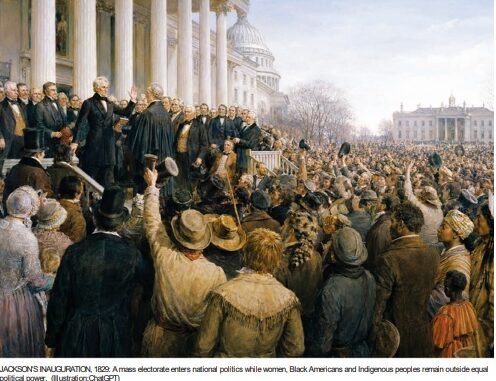
During the early nineteenth century, most states removed property requirements for voting by white men. Presidential electors were increasingly chosen by popular vote rather than state legislatures. Turnout rose; campaigns became public spectacles of rallies, songs, banners, newspapers and organized local committees. Politics moved beyond a small governing elite and entered taverns, workshops, farms and public squares. The expansion was profound but racially and sexually bounded. As white male suffrage widened, several states restricted or eliminated voting rights previously held by free Black men. Women remained excluded from the ballot. Indigenous peoples were treated as obstacles to settlement rather than members of the electorate. Democracy expanded by defining more sharply who belonged within it.
THE ELECTION OF 1824
Four Democratic-Republican candidates divided the electoral vote in 1824. Andrew Jackson won a plurality of popular and electoral votes but not an electoral majority. The House selected John Quincy Adams after Henry Clay supported him; Adams then appointed Clay secretary of state. Jackson’s followers denounced a “corrupt bargain,” although no conclusive evidence proves an explicit deal. The accusation fueled four years of organization.
THE ELECTION OF 1828
Jackson defeated Adams in a bitter, highly personal campaign. Supporters presented him as the champion of the common white man against privileged elites. His military fame, frontier identity and sense of personal grievance matched a political culture increasingly suspicious of inherited status. Yet Jackson was also a wealthy slaveholding planter and experienced officeholder-not an outsider to power.
“Jacksonian democracy attacked privilege while constructing a powerful new political establishment of its own.”

Be the first to comment