

The opposition’s move to defeat the 131st Constitution Amendment Bill was not at all about women’s reservation. It was about stopping the government from redrawing India’s electoral map under cover of empowerment
“The public today is more receptive to the opposition’s counterargument: if the government is so concerned about the representation of women in legislatures, why has it not yet implemented the Women’s Reservation Act that was passed unanimously by Parliament in September 2023? Why did it not notify the Act until April 16, 2026, the very eve of the vote on the Constitution Amendment Bill? Can women’s reservation not be applied within the existing strength of 543 members? Why is an expansion of the House necessary to grant 33 per cent reservation to women?”

April 17, 2026, will be recorded as one of the most consequential dates in the history of Indian democracy. On this day, the opposition parties demonstrated a collective awareness of the threat to the democratic structure that had been absent in 2019—when the Citizenship Amendment Bill was passed or when Article 370 was abrogated. This time, they stood together and defeated the government’s attempt to alter the structure and composition of Parliament.
This defeat was essential for the survival of Indian democracy. This is not only a defeat for the government, but it should also be seen as a victory for the opposition. It has restored confidence in the opposition. Among the public, too, there is a growing curiosity about the opposition’s perspective. Citizens observed and listened to the parliamentary debates this time with heightened attention. They are looking beyond the “mainstream” media to understand where and how the government deploys deception. The public, it appears, is unlikely to accept the government’s claim that it was merely bringing in a law for women’s representation and had been blocked by a “misogynistic” opposition.
The public today is more receptive to the opposition’s counterargument: if the government is so concerned about the representation of women in legislatures, why has it not yet implemented the Women’s Reservation Act that was passed unanimously by Parliament in September 2023? Why did it not notify the Act until April 16, 2026, the very eve of the vote on the Constitution Amendment Bill? Can women’s reservation not be applied within the existing strength of 543 members? Why is an expansion of the House necessary to grant 33 per cent reservation to women?
Commentators like Siddharth Varadarajan have rightly observed that the government’s true intent was not to increase women’s representation but to preserve male dominance in the legislatures. Opposition parties have also correctly alleged that the real motive, concealed behind the rhetoric of women’s empowerment, is a redistribution of parliamentary seats that would most severely disadvantage the non-Hindi-speaking States, cementing the hegemony of the Hindi heartland.
The government’s hollow defense
The government’s defense is pathetically flimsy. It claims that had the opposition agreed, it would have added a clause to increase seat numbers by 50 per cent across the board. If this was indeed so, why was it not part of the text of the Bill itself, as opposition parties pointed out?
The government, rather amusingly, is aggrieved that the opposition is so “uncivilized” that it refuses to trust even the Prime Minister’s assurance. It is not as if the government has shown it can be trusted; and governments and courts function on the written word, not on faith or verbal assurances.
Priyanka Gandhi is right to assert that this Prime Minister and his government cannot be taken at their word. A government that systematically erodes every constitutional process cannot demand trust. Narendra Modi and his Ministers are incapable of speaking the truth. Even supporters of the government concede that it has shown itself to be a master of falsehood and deceit—they take pride in the fact that its lies have consistently been accepted as truth. They call it being “shrewd.”
Why does the public accept these lies? Largely because the media broadcasts them as established facts. Even now, the media went to town claiming that the opposition had “toppled” the Women’s Reservation Bill. This is a lie. The truth is that the opposition defeated a government attempt to alter the structure and fabric of Parliament and State Legislatures under the pretext of women’s reservation. If that is not the case, why was the delimitation of constituencies linked to women’s reservation? The objective was not to expand space for women but to use them as a pretext to redraw India’s electoral map. The conspiracy to marginalize and render ineffective the representation of States in the south and the northeast is not difficult to discern. We have already seen how the delimitation process in Assam and Jammu & Kashmir was used to politically disempower Muslims. Why is delimitation necessary simply to give women their due?
This is the simplest question the media should be asking, but it remains silent. Instead, it stirs up a storm of government propaganda to blind people to what is actually being done. A tribe of analysts is now busily interpreting the entire episode as another “masterstroke” by Narendra Modi. This lot claims the government knew the Bill would fail but introduced it anyway to paint the opposition as anti-woman. Now, they say, the opposition must disprove this.
This logic is hollow. The government is not so prescient as to have known beforehand that it would fail to fracture the opposition this time. It tried. But the collective injustice of the large-scale deletion of voters’ names during the SIR process in Bihar, Bengal, and elsewhere had already sharpened the opposition’s vigilance. They have recognized that this government uses every available device to ensure its permanence. It is this democratic alertness that kept the opposition steadfast in its refusal to take the government’s bait.
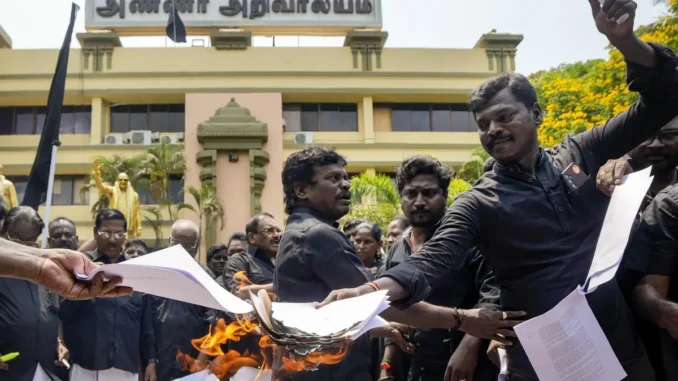
Having lost in Parliament, the government has now taken to the streets—as if it were itself the opposition—to campaign for women’s reservation. A Bill that was already passed in 2023! To conceal the sting of a decisive defeat, it has resorted to old tactics, but they are only spreading the realization that Narendra Modi—who projects himself as invincible—can indeed be defeated.
The Prime Minister used the sanctity of an address to the nation on Doordarshan to attack the opposition for the Bill’s failure. Modi specifically targeted the Congress, the Trinamool, and the DMK—all three parties with a stake in the upcoming Tamil Nadu and Bengal elections. This government is known for its petty and unethical politics, but such an address on the eve of elections is unacceptable. The Election Commission should have issued a notice and barred Modi from campaigning. But we know that the Election Commission now functions as a wing of the BJP, whose purpose is to convert the BJP’s electoral defeats into victories.
It will be interesting to see how many newspapers and television channels criticize this unethical act by the Prime Minister. It will reveal who in this country actually cares for the survival of democracy.
Whether the media or anyone else cares for democracy or not, we the people must. Just as the workers of Noida and Panipat or the Adivasis of Odisha are fighting to protect their rights, we must all unite with the opposition to safeguard our democratic freedoms. This could be the moment of democracy’s homecoming, or we could lose it forever through our own negligence. The choice is ours.
(Apoorvanand teaches Hindi at Delhi University and writes literary and cultural criticism)


Be the first to comment