

From Noida’s streets to furnace rooms in Chhattisgarh, India’s new labor regime delivers for employers — and for workers, what it long warned of

This year, May Day arrives not as a commemoration, but as a diagnosis. Within a single fortnight last month, two events clarified the state of Indian labor more sharply than any official review.
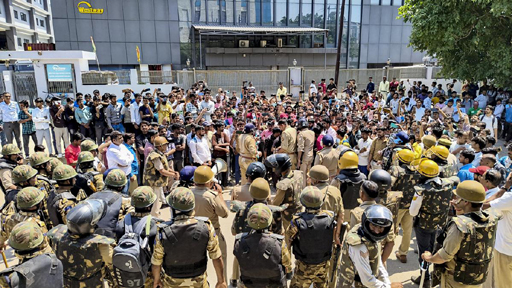
On April 10, thousands of garment workers in Noida’s Phase 2 Hosiery Complex stepped out of nearly 300 factories and onto the streets, demanding a minimum monthly wage of ₹20,000. On April 14, a high-pressure steam tube ruptured at Vedanta’s 1,200 MW Singhitarai thermal plant in Chhattisgarh, killing 20 workers and injuring 15. One protest was about the price of labor; the other, about the price of being alive while performing it. Both answer the same question: what has India’s labor reform actually produced?
The Noida strike began with a specific arithmetic grievance. On April 9, the Haryana government notified a 35% hike in minimum wages, raising unskilled monthly wages from ₹11,274 to ₹15,220, with effect from April 1, 2026. Across the border in Noida, unskilled workers were earning roughly ₹435 a day, compared to ₹585 in Haryana for identical work. Protesters at the Hosiery Complex — employees of different companies — assembled in B Block, blocked traffic, and refused to disperse without written assurances.
By April 13, the administration had deployed over 1,200 personnel, including the Provincial Armed Constabulary and Rapid Action Force; lathi charges and stone-pelting followed, and nearly 400 people were detained. Under pressure, the Uttar Pradesh government announced an interim 21% hike, setting wages at ₹13,690 for unskilled workers in Gautam Buddha Nagar and ₹16,868 for skilled workers. The workers rejected it; their demand remained ₹20,000.
Between pay and survival
The gap between ₹16,868 and ₹20,000 is not a bargaining position. It is the difference between what a family pays for rent, gas, and school fees in the NCR and what the state is willing to concede as a dignified minimum.
Four days later, the furnace at Singhitarai did its own counting. A preliminary report from the Chief Boiler Inspector, backed by the Forensic Science Laboratory in Sakti, Chhattisgarh, attributed the explosion to ‘excessive fuel buildup inside the furnace’, which produced pressure surges that displaced critical piping. The probe flagged “repeated negligence in equipment upkeep” by Vedanta and its contractor NGSL (NTPC GE Power Services Pvt. Ltd.). A first information report has been registered against Vedanta’s Chairman Anil Agarwal, the plant manager, and others under Sections 106(1), 289 and 3(5) of the Bharatiya Nyaya Sanhita.
The dead were not Vedanta’s own employees; they worked for a subcontractor. This, too, is a pattern.
Chhattisgarh alone has recorded 296 industrial deaths over three years. Across India, the Directorate General of Factory Advice Service and Labor Institutes recorded 3,331 factory deaths between 2018 and 2020 — three a day — yet only 14 people were imprisoned under the Factories Act during the same period. The global union IndustriALL counted over 400 workplace fatalities in India in 2024, with the chemical sector alone accounting for 220. In July 2025, an explosion at Sigachi Industries in Telangana had killed 44 people, mostly migrant workers, at a plant that the State fire department found lacked basic fire alarms and heat sensors.
A structural shift
These are not disconnected episodes. They are the operating conditions of an economy that, on November 21, 2025, formally adopted the four labor codes. In a single stroke, and without any transition period, the four codes — the Code on Wages, the Industrial Relations Code, the Social Security Code and the Occupational Safety, Health and Working Conditions (OSHWC) Code — replaced 29 central labor laws. The Indian Labor Conference, the country’s apex tripartite forum, had not been convened since 2015.
The new regime raises the threshold for prior government permission for layoffs, retrenchment, and closure from 100 workers to 300 under the Industrial Relations Code, 2020, enabling firms below that size — an estimated majority of India’s factory units — to retrench workers without administrative scrutiny. A peer-reviewed analysis in the National Library of Medicine archive notes that this merely restores the pre-1982 threshold, reversing an Emergency-era protection enacted after a wave of mass layoffs affected over half a million workers.
The OSHWC Code, 2020, simultaneously raises the statutory definition of a ‘factory’ from 10 workers in a factory with power to 20, and from 20 workers in a factory without power to 40, lifting an entire tier of smaller workplaces — where India’s textile, garment, metal, hosiery, and food-processing clusters are concentrated — out of mandatory safety oversight. Labor economists warn that this technical reclassification has a profound impact on worker coverage, since a majority of India’s small manufacturing units employ fewer than 20 workers.
The inspection architecture has been similarly diluted. The OSHWC Code replaces unannounced inspections with an ‘Inspector-cum-Facilitator’ model, combined with randomized, web-based allocation through the Shram Suvidha portal and employer self-certification — a shift that, as the International Labor Organization’s India Labor Inspection Profile notes, may contravene the requirement for independent, unannounced inspections under ILO Convention No. 81.
Procedural hurdles for collective action have also stiffened. Under the IR Code, no worker may strike without 60 days’ prior notice, flash strikes are prohibited outright, and strikes are barred during and for weeks after any conciliation or tribunal proceeding. “Mass casual leave” by more than 50% of a workforce is now deemed a strike. Trade unions argue that, in combination, these provisions make lawful industrial action virtually impossible to organize, completing the regime’s pro-employer tilt.
A reform that raises statutory thresholds in almost every operative clause is not rationalizing protection. It is removing it. The enforcement chapters read more like a facilitation framework than a compliance regime.
Ten central trade unions, excluding the Bharatiya Mazdoor Sangh (BMS), observed a “Black Day” on November 26, 2025, calling the codes a “deceptive fraud on the working class”. Their objection was not sentimental. When the legal definition of a factory excludes the smallest and most dangerous workplaces; when inspectors announce their visits through a portal; when retrenchment requires no permission below 300 workers; and when strikes are bound by procedural tightropes, the predictable result is the Noida street and the Singhitarai shop floor.
The wage stagnation that drove workers from Motherson Sumi and Richa Global into a baton charge, and the deferred maintenance that caused a boiler tube to rupture, are not separate problems. They are two ends of the same system.
Old laws, new realities
There is an honest public case for labor reform. The Factories Act of 1948 is older than most Indian States; the Workmen’s Compensation Act of 1923 predates the Constitution. A regulatory architecture built for the industrial economy of late-colonial India — of jute mills, textile mills, and railway workshops — cannot plausibly govern a workforce that today includes gig workers, platform workers, and digital-media workers. No serious observer, and no Indian trade union, disputes that consolidation was overdue. The question is not whether the law should have changed; it is what it changed into.
Consolidation is not dilution, and simplification is not exemption.
On May Day, the test for any labor framework is modest: does it allow a worker to earn enough to live, and to live through the shift? In April 2026, the answer from Noida and Singhitarai is the same. In Noida, police fired tear gas at factory workers protesting for a living wage as fuel-driven inflation outpaced wages. In Singhitarai, a boiler tube burst at a Vedanta power plant on April 14, releasing 600°C steam onto workers eating lunch; 20 were killed, all contract workers employed through a business partner rather than as direct employees. Neither a wage that sustains life, nor a workplace that preserves it. A regime that cannot deliver the second while pricing out the first has not been rationalized. It has been rewritten against the very people it was meant to protect.
(Rejimon Kuttappan is a workers’ rights expert.)



Be the first to comment