

Hubris never fails to bring overconfident politicians down

In the recently-held elections to five Assemblies, three sitting governments were ousted — in Kerala, Tamil Nadu and West Bengal — while two, in Assam and Puducherry, saw a strong return to power by the incumbents. Why is it that seemingly entrenched political parties fail to read the growing impatience of the electorate correctly in adequate time to make amends?
The more popular a leader today, the more careful he or she should be, since his confidants may have a vested interest in blocking ground-level information from reaching them, more so when toadyism is mistaken for loyalty.
Conversely, when do voters give incumbents yet another term in office? It simply means that the governments have broadly delivered on promises, and additionally not done the things that irritate voters.
In Assam, Himanta Biswa Sarma also tapped into the Assamese Hindu and smaller communities’ fears about being deluged by the rising Muslim demographic. The combination worked this time, but it cannot be invoked all the time. In 2031, it may be a different story. After three terms in power, there may be a desire for change.
But how did the incumbents in Kerala, Tamil Nadu and West Bengal fail to read the tea leaves? The Kerala outcome, where the LDF was sent packing after two terms in office, was largely because the state has had a history of alternating governments, with Pinarayi Vijayan’s second term being the result of a demoralized Congress party in 2021. The Congress-led UDF merely had to tap into the anti-incumbency sentiment against the LDF. It won handsomely, though the BJP ate into the LDF’s Hindu vote this time, making the UDF victory massive.
The BJP’s rise in the future cannot be ruled out, provided it works out a Kerala-specific strategy that brings three communities together — the Nairs, Ezhavas and some Christian groups. The party has won three seats in the Assembly, with 11.5% of the vote.
That brings us to the main questions: How did the seemingly entrenched Dravidian parties lose to a rank outsider like Joseph Vijay’s Tamilaga Vettri Kazhagam (TVK)? How did the BJP, which failed to capitalize on the growing anti-incumbency against Mamata’s Trinamool Congress in 2021, manage to turn the tide this time?
In West Bengal, it was rather easy to start believing that the deletions related to the Special Intensive Revision (SIR) of electoral rolls may have been a factor, but one would be wrong. The deletions of people who may be dead or have permanently migrated cannot be seen as invalid deletions. What matters is the 2.7 million voters whose names were flagged as having “logical discrepancies”, which could include some non-citizens who may have been added illegally.
But the actual vote share difference between the BJP and the Trinamool was around 3.2 million, and even if the 2.7 million exclusions were to be added back to benefit only the Trinamool, the BJP could have won. Especially since a large share of the Trinamool vote was in concentrated pockets.
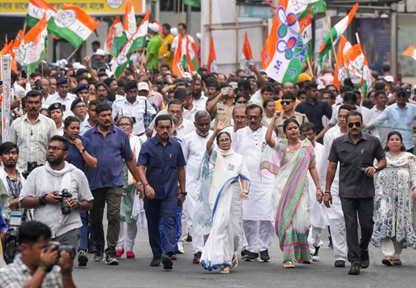
The real reasons why Mamata lost are the following: One, she assumed that with 27% of the Muslim vote in the bag even before the counting started, she only needed 20% of the remaining vote to secure victory. It turned out even Muslims were looking for alternatives.
Two, she also believed that she was popular with women, and that most would vote for her. But women were as concerned about safety as they were about cash in the bank.
Three, having turned the local media into her fan club, she was unable to see the tide of Hindu resentment and the anti-incumbency wave building against her. She also failed to see how the second center of power in her party, her nephew Abhishek Banerjee, had managed to alienate many in her own party with his high-handed ways.
The worst thing a leader can do is to start believing the hype building around her own personality, happily ratcheted up by a pliant media.
We saw this happen at the national level too in 2024, when the media hyped up Narendra Modi’s ‘400-paar’ slogan, and ignored the growing internal dissidence in the party in Uttar Pradesh, Maharashtra and Rajasthan, among others.
Hubris never fails to bring overconfident politicians down. The BJP has corrected this fault, but it still may have issues to deal with in the forthcoming Assembly elections in Uttar Pradesh in 2027 and the general election in 2029.
In Tamil Nadu, we saw another political earthquake — a totally unexpected one. While West Bengal has been in economic decline, Tamil Nadu is not only the second largest state by gross state domestic product, but has also been topping the growth indices in recent years. Then why did MK Stalin fail to win another term?
Corruption and women’s safety were said to be big issues for the electorate, but this did not benefit the primary opposition alliance. Tamil Nadu’s results are important not only because the anti-incumbency tide overwhelmed the party in power, but also the party in waiting, the AIADMK-led National Democratic Alliance. This can only be explained as a growing weariness with Dravidianism and anti-North rhetoric, with the tiring of ideological rigidity.
Vijay’s TVK steered clear of these old tropes and appeared different. For someone looking for change, both the DMK and AIADMK seemed like more of the same. The voter was not looking to choose between Tweedledum and Tweedledee when she had a third option.
The lessons for political parties are clear. One, don’t fall for your own hype and media willingness to praise you to the skies. The media tends to be kind to those who are in power, and cannot be relied upon to test your own popularity. Two, even if you have a solid base in a state, you should be constantly looking for disruptors who may challenge the status quo.
Just as new technology threatens traditional businesses, new political entrepreneurs can always capture the imagination of voters. Three, no party can afford to be arrogant and take any voter for granted. Elections can be lost even if you have delivered on the economic front, and sometimes the voter may also respond positively to a party that seems to be doing its best even if it hasn’t delivered.
After demonetization, which caused lots of hardships to people, the BJP won a huge mandate in Uttar Pradesh because the voters believed that the Modi government was trying to root out corruption.
No party can afford complacency at any time. All leaders should worry about personal hubris, which the voter can send crashing down in one day. Leaders must be as wary of naysayers as yeasayers, the acolytes of the boss.
(R. Jagannathan is a Mumbai based Senior Freelance Journalist, writer, and author)


Be the first to comment