
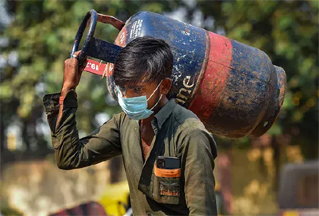

New Delhi (TIP): The Centre on Thursday, June 25, lifted restrictions on the commercial supply of liquefied petroleum gas (LPG) cylinders, and eased the curbs on sale of bulk LPG to industrial customers, signalling that the energy crunch triggered by the blockade of the Strait of Hormuz has eased considerably.
“In a major relief to industrial and commercial LPG consumers, Government has removed all sectoral restrictions on the supply of Non-Domestic Packed LPG and restored supplies to the levels prevailing prior to the West Asia crisis,” the petroleum ministry said in a statement. Packed LPG refers to the 19kg cylinders used by hotels, restaurants and industrial units.
The supply of bulk LPG, suspended at the onset of the crisis, has been relaxed to 50% of pre-crisis consumption levels, it added. Packed LPG generally refers to the 19kg cylinders used by hotels, restaurants and commercial units. Industries consuming more than 50 tonnes a month generally have bulk LPG facilities on their premises.
India imports about 60% of its LPG, almost 90% of which transits the Strait of Hormuz.
Petroleum secretary Neeraj Mittal wrote to chief secretaries of all states and union territories to ensure smooth implementation of the revised supply arrangements. “It has now been decided to remove all sectoral restrictions on supply of non-domestic Packed LPG and restore it to pre-crisis levels. Further, restriction on supply of bulk LPG also stands relaxed by 50% of the pre-crisis consumption levels,” he said in the letter.
The war in West Asia and the closure of the strait — a route carrying a fifth of the world’s energy supplies — had disrupted India’s gas supplies. In early March, the government invoked the Essential Commodities Act to ration natural gas distribution to commercial consumers, in order to meet the full requirements of households and commuters.
The Union government subsequently rationed LPG supply to non-domestic consumers, releasing limited quantities to commercial entities such as hostels, restaurants and hotels through state-run oil marketing companies (OMCs), under the guidance of respective state governments. The restrictions on commercial consumers, combined with a March 8 directive to domestic refineries to ramp up LPG output, helped meet the cooking gas demand of over 330 million domestic users. Refiners raised LPG production by using C3-C4 streams exclusively for LPG, at the cost of petrochemicals output.
Bulk LPG supply, suspended at the onset of the crisis, has now been relaxed to 50% of pre-crisis consumption levels — significant relief for commercial and industrial consumers, the ministry said. “The restoration follows the recent improvement in the LPG supply situation,” it said, adding: “Taking note of the improved indigenous LPG production and the projected availability of imported LPG cargoes, Government has also decided to reduce the diversion of C3/C4 streams to LPG pool.”
The enhanced allocation of C3-C4 streams to non-LPG uses will be carried out while ensuring domestic LPG availability remains unaffected, with aggregate indigenous production maintained at not less than 40 thousand metric tonnes (TMT) a day, the ministry said. The government had accorded the highest priority to uninterrupted LPG availability for households, which is why temporary restrictions were imposed on commercial packed LPG, the statement said. “The timely policy interventions and coordinated efforts by OMCs helped maintain stable supplies despite challenging global supply chains,” it added.
OMCs have been directed to continue maintaining comprehensive data on commercial and industrial LPG consumers for efficient planning, with a unified sectoral database to be maintained across OMCs to strengthen monitoring and coordination.
The government’s drive to shift LPG consumers to piped natural gas (PNG), wherever infrastructure is available, continues. “Commercial and bulk consumers who have already shifted to PNG will continue to remain on PNG. Other eligible LPG consumers having access to the PNG network, or those in the process of shifting to PNG, will be progressively transitioned to PNG in coordination with City Gas Distribution (CGD) entities,” the ministry said.



Be the first to comment