
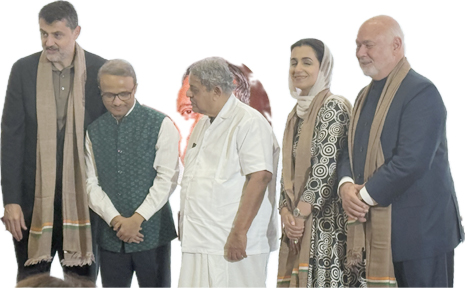

Meditation Guru Dr. H.R. Nagendra in Conversation with The Indian Panorama Editor Prof. Indrajit S. Saluja
-
Indrajit Saluja
NEW YORK (TIP): A day after the International Day of Yoga, celebrated on June 21, Prof. Indrajit S. Saluja, Chief Editor of The Indian Panorama, met internationally acclaimed Yoga and Meditation Guru Dr. H.R. Nagendra at the Consulate General of India in New York. Fresh from leading thousands of yoga enthusiasts at Times Square, Dr. Nagendra spoke about his lifelong mission to establish Yoga as a scientific discipline, his plans to expand Yoga education internationally, and why he believes yoga is much more than physical exercise—it is a complete science of human evolution.
About Dr. H.R. Nagendra
Dr. H.R. Nagendra is one of the world’s foremost authorities on Yoga, meditation, and yogic research. Trained initially as a mechanical engineer, he later devoted his life to the scientific study and teaching of yoga. He is the Chancellor of S-VYASA (Swami Vivekananda Yoga Anusandhana Samsthana), a Deemed-to-be University in Bengaluru, India, internationally recognized for its pioneering research in yoga therapy and holistic health.
For more than five decades, Dr. Nagendra has worked to integrate the ancient wisdom of Yoga with modern scientific research. Under his leadership, S-VYASA has produced over 1,500 research papers, trained thousands of yoga professionals, and established itself as a global center for yoga education, research, and healthcare. His life’s mission is to spread Yoga as a means of promoting physical health, mental well-being, social harmony, and spiritual growth across the world.
The Interview: A Vision for Taking Yoga from the Mat to the Mind—and to the Universities of the World
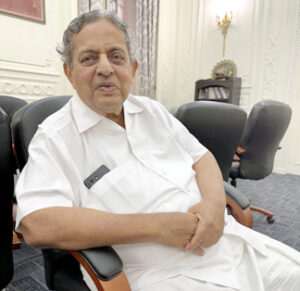
Here are some Excerpts.
Prof. Indrajit S. Saluja:
Dr. Nagendra, we are truly blessed to have you with us today. I had heard so much about you and read extensively about your work. But meeting you in person is a privilege. After listening to your inspiring address at Times Square yesterday, I believe everyone present felt enriched.
You were trained as a mechanical engineer and had a successful engineering career. What inspired you to dedicate your life to yoga?
Dr. H.R. Nagendra:
I would not say I left engineering. Rather, I moved from mechanical engineering to human engineering.
To me, yoga is an expansion of science. Modern science has explored the physical world remarkably well. But yoga goes much further. It studies not only the body but also prana (life energy), the mind, emotions, intellect, consciousness, and the deeper causal dimensions of existence.
The ancient sages of India understood that creation is not merely physical. There are subtle and causal dimensions that modern science is only now beginning to appreciate. This profound knowledge is preserved in our yogic texts.
As someone interested in scientific inquiry, I found yoga to be a natural continuation of my journey. I simply expanded my field of research—from machines to human consciousness.
Prof. Saluja:
Your institution, S-VYASA University, offers degree programs in yoga, and yesterday you spoke about introducing yoga into universities. You also expressed the hope that yoga should become part of higher education in the United States.
However, I wonder whether the foundation should begin even earlier. Shouldn’t yoga become an integral part of school education?
Dr. Nagendra:
That process has already begun.
When Prime Minister Narendra Modi initiated the International Day of Yoga, he emphasized that yoga should not remain a one-day annual event but become part of everyday life. Our team was asked to develop a structured curriculum for schools.
We designed comprehensive modules—not merely teaching a few postures—but focusing on the holistic development of children.
Our curriculum includes the development of eyesight, hearing, voice culture, memory, creativity, emotional balance, physical stamina, stress management, intelligence, and overall personality development.
We began implementing these programs as early as 1978. Over the years, we trained nearly 65,000 teachers, and yoga has now been incorporated into educational policy in India. Similar curricula have also been developed for undergraduate and postgraduate education.
Prof. Saluja:
While policy has evolved, implementation still varies from state to state. During my recent visit to Punjab, I noticed that yoga has not yet become an everyday part of school life.
Would it not be beneficial if Yoga replaced or supplemented conventional physical education?
Dr. Nagendra:
Education is primarily a state subject in India, so implementation differs.
We have consistently advocated allocating even one or two periods each week exclusively for Yoga because its benefits extend far beyond physical fitness. Yoga transforms the individual—physically, mentally, emotionally, and intellectually.
The Government of India has made yoga compulsory in institutions receiving central assistance, and progress continues. Some states have adopted it enthusiastically, while others are still moving in that direction.
Prof. Saluja:
Turning now to your work in America, what do you expect from the Indian-American community in helping spread Yoga across the United States?
Dr. Nagendra:
In India, we built a nationwide network through VYASA with nearly 300 centers.
Now we are establishing VYASA USA, beginning in Dallas, and expanding to New York, New Jersey, Los Angeles, and other cities.
Our immediate goal is to train qualified Yoga teachers through structured certification programs.
The scientific evidence supporting yoga is now overwhelming. More than 1,500 research papers demonstrate its effectiveness in managing diabetes, hypertension, heart disease, epilepsy, migraine, stress-related disorders, and many other non-communicable diseases.
America already has thousands of Yoga studios. Our objective is to take yoga beyond exercise classes—to the level of academic study, scientific research, and professional education.
Eventually, we hope to establish a VYASA International University in the United States.
Prof. Saluja:
So, your plan is to begin with affiliated centers and eventually establish an independent university offering internationally recognized qualifications?
Dr. Nagendra:
Exactly.
We already have an academic collaboration with Parker University in Dallas, where Yoga programs have begun successfully.
Our long-term vision is to establish an independent international university. Modern technology also enables us to deliver high-quality online undergraduate and postgraduate programs across the world.
We are currently working with the Government of India to obtain approval for our online degree programs, after which they can be offered globally.
Prof. Saluja:
How important is media support in achieving this mission?
Dr. Nagendra:
It is absolutely essential.
Scientific research alone cannot reach society unless it is communicated effectively. We need newspapers, television, digital media, and social platforms to spread awareness.
At S-VYASA, our greatest strength is scientific validation. Inspired by Swami Vivekananda’s vision of combining “the best of the East with the best of the West,” we have spent fifty years producing rigorous scientific research that has earned worldwide recognition.
Our university today includes a 600-bed specialty hospital and world-class research laboratories dedicated to yoga and integrative medicine.
Prof. Saluja:
I would be happy to contribute in whatever way possible. Please include The Indian Panorama among your regular media contacts so that we may continue informing our readers about your work.
I also believe temples and community centers across America can become important centers for yoga education.
Dr. Nagendra:
Absolutely.
Temple priests themselves should receive proper training. We have already developed specialized programs that combine traditional knowledge with scientific inquiry.
Our researchers are also studying the scientific foundations of ancient practices such as yajnas, homas, and other Vedic rituals. Our objective is to demonstrate that these are not merely matters of faith but have measurable scientific dimensions.
With hundreds of doctoral researchers and thousands of postgraduate students engaged in this work, we expect significant advances in the coming years.
Prof. Saluja:
Since the United Nations adopted the International Day of Yoga, Yoga has become enormously popular worldwide. It has truly transformed global awareness.
Dr. Nagendra:
Much of the credit goes to Prime Minister Narendra Modi for bringing yoga onto the global stage.
His vision is that Yoga should reach every village and every community because yoga has the power to transform individuals, families, societies, and ultimately the world.
Yoga is not merely about physical health. It is a pathway to peace, harmony, and human evolution.
Prof. Saluja:
Dr. Nagendra, thank you very much for sharing your inspiring vision with the readers of The Indian Panorama. We wish you every success in your mission of taking the timeless wisdom of Yoga to the world.
Dr. Nagendra:
Thank you very much.


Be the first to comment