

Power realignments may follow the United States-Iran deal

Ever since 1945, the dominance of the United States and western Europe in world affairs has been taken for granted, largely because of their military power, technological innovations, and financial strength. This situation continued until fairly recently. However, the rise of China, along with the growing prominence of certain “middle powers” in recent years, has begun to dent — though not eclipse — the image of the U.S. as a superpower.
As China’s influence over world affairs has grown, driven by its technological and innovative capabilities and its stranglehold over scarce strategic resources, the supremacy of the U.S. and the West has, however, appeared to wane. Many experts, nevertheless, continued to believe that there was still time before the West faced an effective challenge to its leadership. Concerns had, no doubt, grown about the U.S.’s structural vulnerabilities, though few expected that a country such as Iran would effectively deal a mortal blow to the image of the U.S. as the world’s leading power.
The (now deceased) Iranian Supreme Leader, Ayatollah Ali Khamenei, had once observed that, while Americans constantly threatened war, they lacked “staying power”. This has now become apparent in ample measure. By contrast, in the course of the Iran-Iraq war (1980-1988), Iran’s Islamic regime demonstrated remarkable endurance, resilience, and determination to preserve the regime by all means necessary. U.S. President Donald Trump’s failure to recognize this aspect has since cost him dearly. One leader who is seen to have emerged from the ashes of the U.S.-Iran conflict is Ali Khamenei’s presumed successor, his son Mojtaba Khamenei, who is presently viewed by many as a “living martyr”.
The new Iran-U.S. framework
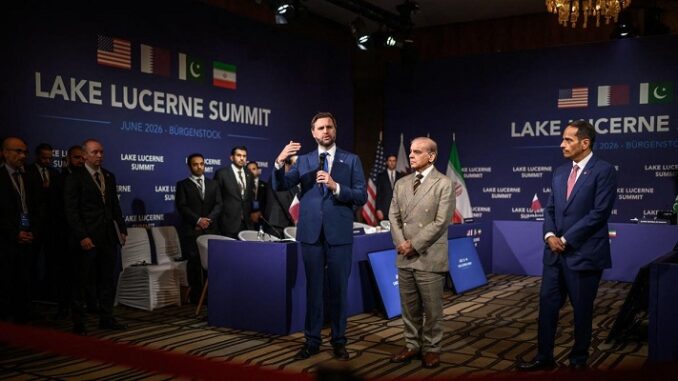
Even prior to embarking upon substantive negotiations in Switzerland on all contentious issues, the U.S. and Iran entered into an “initial deal” (mid-June 2026) to end the war and reopen the Strait of Hormuz. The announcement of the talks was cautiously welcomed by world leaders, though all agreed that difficult negotiations lay ahead. Prior to the formal talks, a 14-point Memorandum of Understanding was, interestingly enough, signed by Mr. Trump at the Palace of Versailles, France, on June 17, 2026, evoking comparisons with the 1919 Treaty of Versailles, which is widely regarded as having imposed humiliating terms on Germany following the First World War.
The June 17 agreement was widely criticized as little more than a latter-day endorsement of the status quo that had existed prior to the U.S.-Israel strikes on Iran, on February 28, 2026. The terms of the agreement included the reopening of the Strait of Hormuz, the lifting of the U.S. blockade, and a vague commitment by the U.S. and its regional partners to initiate plan, for at least $300 billion, for the reconstruction and economic development of Iran — the U.S. has since declared that no U.S. funds would flow directly to Iran. If so, this commitment could possibly refer to the release of Iranian assets that have been frozen by the U.S. over the years. The agreement also reportedly contains an important pledge by Iran not to develop a nuclear weapon.
The talks in Switzerland soon thereafter seemed little more than a formality, with the U.S. claiming, following their successful conclusion, that it had achieved a major milestone by persuading Tehran to allow inspectors from the International Atomic Energy Agency back into the country, thereby opening a pathway to international monitoring of its nuclear programme. But Iran is said to have told its state media that Tehran had made “no new commitments” on nuclear inspections. The conclusion of the talks appeared to many observers to represent a “desperately needed truce” for the U.S., as it was followed shortly thereafter by the lifting of U.S. oil sanctions on Iran and the issuance of a 60-day waiver authorizing the sale and transport of Iranian crude oil and petroleum products.
Newspaper headlines across the world had little to say about the deal and instead harped on the enormity of the setback to the image of the U.S. resulting from its coming to terms with Iran. Perhaps the most telling headline appeared on the front page of The Times of India (June 19, 2026): “Versailles II: Trump rushes where historians would dread to tread”. Apart from the fact that the U.S. and its President have been excoriated for what critics have termed the “surrender blunder”, the reality is that the deal has brought the U.S. few tangible benefits.
Intrinsic to, or as part of the deal are several other aspects of considerable interest, apart from sanctions relief for Iran’s oil exports, viz., the possibility of Iran assuming a formal role in managing traffic through the Strait of Hormuz and, (potentially), charging transit fees for passage through the Strait. Questions remain, however, regarding the safety of shipping routes, vessel security procedures, naval protection, and emergency response mechanisms. Many of these issues remain to be clarified.
The deal is important, even though its wording remains inchoate. It is widely portrayed as a deal between unequals, with Goliath having been worsted — or at least caught unawares by David. It also does not read like a standard diplomatic document. The implications of a superpower — the world’s leading nuclear power — conceding ground to a battered Iran are huge and are unlikely to be lost on nations and major powers across the globe.
Israel-U.S. relations fracture
It also entails an important rupture in relations between the U.S. and Israel. Israel Prime Minister Benjamin Netanyahu’s devious plans to inveigle the U.S. in a conflict in West Asia, which was aimed at decimating Iran and establishing Israel’s undisputed supremacy over the region has now become part of the detritus of history. The Israel-U.S. rupture, unless Tel Aviv bends substantially hereafter, could alter power equations in West Asia, leading to either an unsettled peace or further wranglings among Arabs, Iranians and Israelis.
What is also quite plausible is that Iran’s claims to have bested the Great Satan, could lead the new Iranian regime, now increasingly under the tutelage of Islamic Revolutionary Guard Corps (IRGC) hotheads rather than the Ayatollahs, to revive conflicts with other Arab nations, apart from Israel itself. Such ‘adventurism’ could lead to more disparate conflicts in a vital region, which incorporates a critical artery of global energy supplies.
Many imponderables are still present. For one, the U.S.-Iran Agreement is almost certain to give a boost to hardliners in Iran who may believe that they have managed to ‘defeat’ the mighty U.S., signaling scope for a still more hardline policy, vis-à-vis not only Israel, the U.S., and other Arab States in the region but also their own people as well. For another, the IRGC, already on the ascendant, could feel more emboldened to act with impunity, having a new Ayatollah identified with it. The impact of all this would be felt not only in Iran but also in countries with large Shia populations, including India. A worsening of Shia-Sunni tensions in different pockets across the globe cannot, therefore, be ignored.
For a third, Israel and its leaders could be expected to behave like ‘wounded tigers’. Their ploy of inveigling the U.S. into supporting their bid for supremacy in West Asia having failed —and with the U.S. President distancing himself from Mr. Netanyahu — they could be expected to embark on a fresh bout of ‘adventurism’, especially with their Arab neighbors and across West Asia. This could aggravate tensions and undermine the fragile peace that has existed since the Abraham Accords. Furthermore, with the U.S. seen as a major loser and its influence across the region set to wane, Gulf nations may be prompted to take a hard look at relying on the U.S. for protection against external threats, including a resurgent Iran. Interestingly, there could also be growing demands to reduce the presence of U.S. troops in West Asia.
Radical groups could regain ground
Neither Russia nor China have gained much from the conflict, even as both claim to have supported Iran and some of the other Arab countries. What the world needs to examine closely is whether this level of uncertainty could lead to the re-emergence of well-organized terrorist organizations and entities such as al Qaeda, capable of even greater destruction than their forebears. They could well become the forerunners of many more disparate Arab groups and forces centered in West Asia, capable of extending their activities from Africa and parts of Asia to Europe, if not the U.S. itself.
(M.K. Narayanan is a former Director, Intelligence Bureau, a former National Security Adviser, and a former Governor of West Bengal)


Be the first to comment