
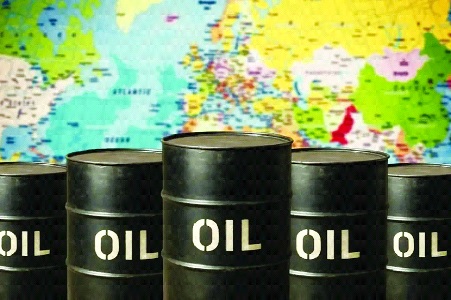

Vienna (TIP): International crude oil prices eased marginally in early Asian trading on Friday, July 10, as investors booked profits following a sharp rally, but benchmark contracts remained on course for strong weekly gains amid persistent concerns over global supply disruptions linked to heightened geopolitical tensions in the Middle East.
Brent crude futures slipped 6 cents, or 0.08%, to $76.24 a barrel, while US West Texas Intermediate (WTI) crude futures fell 4 cents, or 0.06%, to $72.04 a barrel in early trade.
The slight decline follows three consecutive sessions of gains that lifted oil prices to their highest levels in several weeks. Market sentiment has remained firmly supported by fears that escalating tensions involving the United States and Iran could threaten crude exports from the Gulf, one of the world’s most important oil-producing regions.
Despite Friday’s modest pullback, Brent crude is poised to end the week with gains of around 6%, while WTI is on track to rise nearly 5%, underscoring the growing geopolitical risk premium built into energy markets.
Traders continue to closely monitor developments around the Strait of Hormuz, through which roughly one-fifth of global oil consumption passes every day. Although there has been no major disruption to shipping or production so far, any escalation in the conflict could interrupt supplies and trigger a fresh spike in oil prices.
Analysts said Friday’s decline was primarily driven by profit-booking after the recent rally rather than any improvement in the geopolitical outlook. They noted that investors remain cautious as uncertainty surrounding the Middle East conflict continues to dominate market sentiment.
Apart from geopolitical developments, investors are also assessing the broader economic picture. Stronger-than-expected US labour market data has eased concerns about slowing fuel demand in the world’s largest economy, while recent economic indicators from China have raised hopes of improving industrial activity that could support crude consumption.
The market is also watching upcoming policy signals from major central banks, as interest rate decisions can influence economic growth, industrial production and, consequently, global oil demand.
On the supply side, investors are keeping a close eye on production trends among major oil-producing nations, including the OPEC+ alliance. While the group has been gradually increasing output in recent months, analysts believe any unexpected disruption in the Middle East could outweigh additional supplies and keep prices elevated.
A stronger US dollar and concerns over the pace of global economic growth continue to act as limiting factors for crude prices. However, these have largely been overshadowed by geopolitical risks over the past week.
Energy analysts expect crude markets to remain highly volatile in the near term, with prices likely to react sharply to any fresh developments related to the Middle East conflict, supply disruptions, shipping activity through the Strait of Hormuz and economic data from major oil-consuming nations.
With geopolitical uncertainty showing little sign of easing, traders are expected to remain cautious, keeping oil prices supported even as periodic bouts of profit-taking trigger short-term declines.



Be the first to comment