
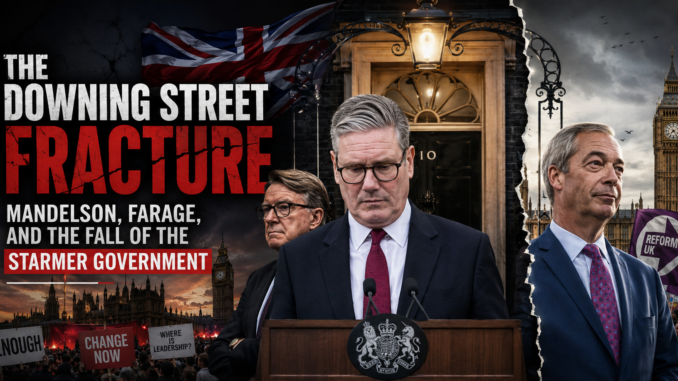

The political architecture of the United Kingdom was sent into a state of absolute chaos on Monday, June 22, 2026, when Prime Minister Keir Starmer stood behind a lone lectern outside Number 10 Downing Street and announced his official resignation. Less than twenty-four months after leading the Labour Party to a historic parliamentary landslide victory in July 2024, Starmer bowed to relentless, mounting pressure from his own cabinet ministers and parliamentary backbenchers, making him the fifth prime minister to vacate the office in a turbulent four-year window.
UK Leadership Attrition Timeline (2016 – 2026)
| Order | Prime Minister | Tenure Exit / Status | Primary Reason for Departure |
| 1 | David Cameron | Resigned (2016) | Defeat of the “Remain” campaign in the Brexit referendum |
| 2 | Theresa May | Resigned (2019) | Systemic parliamentary gridlock over the Brexit withdrawal agreement |
| 3 | Boris Johnson | Resigned (2022) | Loss of cabinet support following a series of domestic ethics scandals |
| 4 | Liz Truss | Resigned (2022) | Sudden market crash triggered by her controversial “mini-budget” proposal |
| 5 | Rishi Sunak | Defeated (2024) | Landslide loss in the July 2024 General Election |
| 6 | Keir Starmer | Resigned (June 22, 2026) | Severe internal party mutiny and cabinet collapse |
| 7 | Andy Burnham | Incoming (July 2026) | Current Leader-in-Waiting following the Downing Street fracture |
The announcement has set the stage for an immediate, orderly transition of power, with former Greater Manchester Mayor Andy Burnham emerging as the near-certain successor following a strategic endorsement from key party rivals. For global political analysts tracking the stability of the Western European democratic corridor via The Indian Panorama, the sudden collapse of the Starmer government offers an instructive case study in the highly volatile nature of modern electoral coalitions.
How did an ambassadorial appointment trigger a catastrophic political scandal?
While corporate media outlets have focused heavily on the UK’s stagnating macroeconomic metrics and public service strikes, the internal collapse of Starmer’s authority within the Labour Party can be traced directly to a single, critical error in administrative judgment. In early 2025, Starmer bypassed standard diplomatic vetting procedures to appoint Peter Mandelson as Britain’s official ambassador to the United States.
The decision provoked immediate, intense internal backlash due to Mandelson’s well-documented historical ties to the deceased financier and convicted child sex offender Jeffrey Epstein. The crisis breached a point of no return when a secondary, unredacted cache of financial logs and communication data was made public by international journalists in September 2025. Although Starmer moved swiftly to dismiss Mandelson from his post, the political damage was already done. The revelation that the Prime Minister’s inner circle had willfully ignored initial intelligence warnings regarding the true extent of these historical ties alienated the party’s progressive wing and triggered a wave of high-profile ministerial resignations that left the cabinet entirely dysfunctional.
To review our complete suite of geopolitical insights, international governance reports, and sovereign economic briefs, visit our comprehensive services and products directory.
Why did a local special election in Makerfield seal the Prime Minister’s fate?
The external catalyst that turned a localized Westminster scandal into an absolute panic across the Labour ranks was the rapid, unchecked rise of Reform UK, the right-wing populist party led by Nigel Farage. Throughout the municipal and local elections held in early May 2026, Farage’s anti-immigration and anti-net-zero messaging systematically eroded Labour’s traditional working-class strongholds across the north of England, causing the ruling party to lose over 1,000 local council seats and its historic 27-year grip on the Welsh legislature.
The final breaking point arrived during the recent Makerfield special election on June 18, 2026. Recognizing the extreme vulnerability of the national leadership, Labour strategists deployed Andy Burnham, who had recently vacated his mayoral seat, to contest the seat. While Burnham secured a resounding, decisive victory over the Reform UK candidate, his success served as the ultimate indictment of Starmer’s national unpopularity. The election data proved that while the Labour brand remained viable under a charismatic, pragmatic leader like Burnham, Starmer had transformed into a severe electoral liability. Within forty-eight hours of the Makerfield result, a coordinated delegation of cabinet ministers privately informed the Prime Minister that his path to the next general election was entirely gone.
If your policy institute or corporate regulatory group wishes to contribute executive commentary or collaborate on upcoming European trade features, please reach us via our official contact page.
What can the international community expect from a Burnham administration?
The transition timeline confirmed by the Labour National Executive Committee indicates that formal nominations for the leadership will open on July 9, 2026, with the next prime minister scheduled to take office by mid-July. Burnham’s immediate policy layout represents a significant departure from Starmer’s cautious, technocratic approach.
The incoming administration is expected to pause outstanding defense investment reviews to prioritize a sweeping emergency funding package aimed at stabilizing the tattered National Health Service. More importantly, Burnham has signaled a willingness to adopt a more assertive posture on energy security, indicating a potential policy shift toward expanding domestic extraction licenses in the North Sea to counter the compounding cost-of-living crisis hitting British households.
For an unceasing, daily flow of independent journalism covering the intersection of international politics, global market realignments, and diaspora movements, return to our home page for your daily briefing.
Can Westminster Restore Stability in an Age of Instant Attrition?
The ongoing political drama inside Downing Street highlights a broader structural reality: modern heads of government no longer enjoy long honeymoon periods, as digital media metrics and real-time polling data allow backbench MPs to trigger leadership challenges the moment national popularity declines. The United Kingdom faces the daunting challenge of convincing international investors that its democratic institutions can provide long-term continuity amid rapid leadership turnover. Whether Andy Burnham can successfully unite the fractured factions of the Labour Party or if the populist surge will continue to gain ground depends entirely on how quickly the next administration can deliver tangible economic relief to a fatigued electorate.
Be the first to comment