
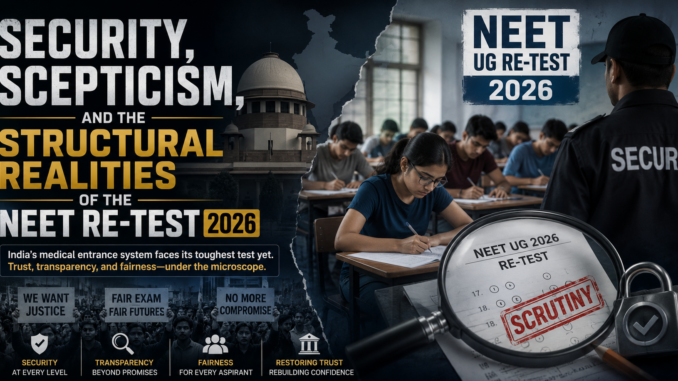

The institutional credibility of India’s medical entrance evaluation infrastructure is facing its most critical trial of the modern era. As hundreds of thousands of candidates across the country head back into examination centers for the highly scrutinized NEET UG Re-Test 2026, the atmosphere is defined not by the usual academic nervousness, but by a profound, pervasive public skepticism.
| Structural Parameter | Operational Specification & Details |
| Total Registered Candidates | 22.70 Lakh students nationwide |
| Domestic Test Venue Count | 5,440 Certified Centers |
| Overseas Satellite Venues | 14 International Hubs |
| Monitoring Infrastructure | AI-Enabled Live Video Telemetry |
| Identity Verification Layer | Biometric Scans (Linked to Central Identity Database) |
| Primary Academic Challenge | High-Calculation Advanced Physics |
Following a series of systemic paper leaks, digital data vulnerabilities, and administrative errors that compromised the original May 3 testing cycle earlier this year, the National Testing Agency has deployed an unprecedented, multi-layered security protocol designed to protect the integrity of every single evaluation sheet.
For family networks and academic observers monitoring these domestic educational adjustments via The Indian Panorama, the re-test represents a historic turning point in the battle to secure the country’s meritocratic selection systems.
How do you secure a national exam when paper distribution fails?
The structural breakdown that forced this national re-test revealed that traditional, physical methods of test paper distribution are inherently vulnerable to human manipulation. In past cycles, printing high-stakes question sheets weeks in advance and storing them in regional bank vaults created multiple intercept opportunities for organized cheating syndicates.
To eliminate these vulnerabilities for the June 21 re-test, the ministry has implemented a strict digital lock architecture. Question sheets are no longer printed in advance. Instead, they are maintained as heavily encrypted files inside a secure cloud network managed by a centralized command center.
The decryption keys are released to regional test centers exactly thirty minutes before the scheduled start time, provided that the center completes a dual-factor biometric authentication process. The localized high-speed printing systems then produce the required number of physical sheets under continuous, live closed-circuit television telemetry, cutting out the transit vulnerabilities that historically allowed bad actors to compromise the exam integrity.
To access comprehensive educational policy briefs, structural governance reports, and community development columns, visit our comprehensive services and products directory.
Will biometric facial recognition put an end to proxy test-takers?
Beyond securing the question documents, the NTA has focused heavily on eliminating the issue of proxy candidates who are paid to take exams on behalf of registered students. The 2026 re-test centers have replaced manual admit card checks with a rigorous biometric identification layer.
As a candidate steps through the perimeter, a high-resolution camera captures their facial geometry, comparing it instantly against the government’s centralized Aadhaar identity database. The software measures specific facial markers and depth ratios to guarantee that the individual entering the hall matches the person who registered for the course, flagging any anomalies for immediate administrative review before the student is permitted to sit down.
If your academic institution, legal firm, or community advocacy group wishes to contribute editorial perspectives or collaborate on upcoming public policy briefs, please reach our desk via our official contact page.
What is the real cost of this operational friction on candidate performance?
While these aggressive security measures are essential for restoring public trust, they introduce a significant layer of psychological friction into an environment where students are already managing extreme pressure. Candidates reported being required to arrive at centers up to three hours before the exam to clear the security checkpoints, navigating invasive body scans and strict dress code enforcements that prohibit standard items like digital watches, specific footwear, and traditional clothing accessories.
Educational psychologists point out that treating students like potential security risks right before a career-defining academic assessment can lead to heightened anxiety levels, potentially impacting their cognitive processing and overall performance during the evaluation. This was especially evident during the physics section of the re-test, which candidates described as the most time-consuming and conceptually complex paper in recent history, demanding extensive, multi-step calculations under strict time constraints.
For a completely independent, daily stream of verified journalism covering sports, science, national politics, and diaspora achievements, return to our home page for your daily update.
Can Restored Protocols Revive Faith in Meritocracy?
The baseline standard of India’s medical entrance system has long-term consequences that stretch far beyond domestic borders, as the physicians produced by these academic structures form a foundational workforce for healthcare networks across North America and Europe. For decades, the sheer rigor of clearing this massive elimination hurdle has served as an implicit stamp of intellectual excellence, assuring international medical boards and premier western hospital networks of the clinical aptitude possessed by Indian graduates. When systemic cracks open in this domestic screening process, the ripple effects jeopardize the global reputation of Indian medical qualifications, threatening to slow down the pipeline of high-caliber healthcare professionals who annually migrate to fortify understaffed western clinical systems.
Therefore, the absolute success of the 2026 re-test security upgrades will not be measured merely by the technical absence of leaked answer keys or the statistical containment of irregular anomalies. Instead, the ultimate metric of success rests on whether the National Testing Agency can restore a profound sense of democratic fairness and institutional integrity to the millions of students who rely on these entry systems to fulfill their professional dreams. For a country where a medical seat is often a family’s singular ticket to generational mobility, the screening matrix must remain entirely beyond reproach.
As the advanced optical mark recognition evaluation software begins processing the secure OMR sheets for the final national merit list, the entire nation watches with bated breath. This tense waiting period is a collective trial of patience for students, parents, and policy architects alike, all hoping that this new architecture of digital locks, biometric perimeters, and localized cloud encryption will hold firm against the forces of administrative compromise, finally cementing a transparent blueprint for public testing.
Be the first to comment