
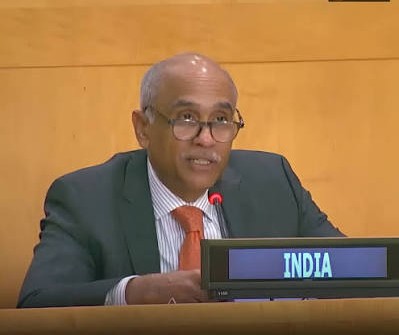

Ambassador Parvathaneni outlines five-point framework to terminate outdated mandates and clarify conflict definitions.
-
I.S. Saluja
UNITED NATIONS (TIP): India’s Permanent Representative to the United Nations, Ambassador Harish Parvathaneni, called for a clear distinction between armed aggression and peaceful disputes during a United Nations Security Council (UNSC) open debate on Tuesday.
Speaking at the session on strengthening mechanisms for the peaceful settlement of disputes, India outlined a five-point approach to conflict resolution while urging the UN to eliminate outdated mandates draining its budget. The debate also saw a sharp diplomatic exchange, with India strongly rejecting statements made by Pakistan regarding Jammu and Kashmir.
Five-Point Framework for Reform
Ambassador Parvathaneni emphasized that the Security Council must adapt its Charter mechanisms to reflect modern geopolitical realities. He presented five core principles to guide the council’s future actions.
Defining Conflicts Clearly
India cautioned against projecting armed aggression or illegal occupation as mere “disputes”. Parvathaneni noted that the council rarely makes formal determinations of armed aggression, creating ambiguity over whether Chapter VI (peaceful settlement) or Chapter VII (enforcement actions) applies.
Rejecting Identity-Based Division
The ambassador stated that linking dispute settlements to race, ethnicity, or religion reflects a divisive approach and a lack of good-faith engagement.
Reviewing Chapter VI Interventions
India argued that tools under Chapter VI do not hold perpetual validity. Interventions must respect existing bilateral procedures and be reviewed as circumstances change.
Terminating Obsolete Mandates
India called for a comprehensive evaluation of UNSC mandates under the “UN80” framework. Parvathaneni asserted that outdated mandates should not continue indefinitely without sunset clauses at the expense of the constrained UN budget.
Evaluating Regional Groupings
While noting that established regional organizations can complement UN efforts, India argued that cross-regional groups lacking geographic ties or domain expertise should not be treated with the same validity.
Rejection of Pakistani Statements
During the session, the Indian delegation strongly criticized Pakistan for attempting to use the UN platform to advance a divisive agenda.
“The Union Territory of Jammu and Kashmir has always been, is, and will remain an integral and inalienable part of India,” Parvathaneni stated, adding that the legal and constitutional reality is being deliberately ignored by Islamabad. He maintained that the sole outstanding issue regarding the region is the illegal occupation of Indian territory by Pakistan.
The ambassador further raised concerns over the domestic situation in Pakistan, citing the suppression of fundamental freedoms in Pakistan-occupied Jammu and Kashmir. He pointed to broader governance challenges within the country, including the incarceration of a former Prime Minister, the restriction of the main opposition party, and military influence over constitutional amendments, urging Pakistan to focus on its internal stability.
Concluding the address, Ambassador Parvathaneni reaffirmed India’s commitment as a founding member of the United Nations, stating that New Delhi stands ready to work alongside member states to help the organization fulfill its foundational purpose of maintaining international peace and security.

Be the first to comment