
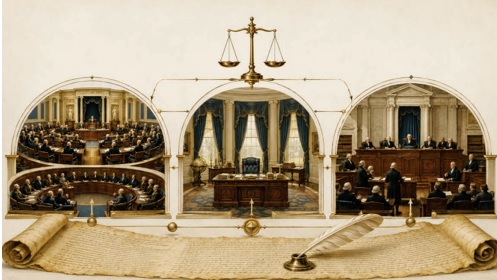

The framers sought a national government strong enough to tax, regulate commerce, conduct foreign affairs, provide defense and enforce law. They also feared that power-even republican power-could be abused. Their solution divided authority horizontally among branches and vertically between nation and states.
LEGISLATIVE
Article I grants Congress enumerated powers, including taxation, borrowing, regulation of interstate and foreign commerce, naturalization, coinage and war. The House is elected directly for two-year terms; senators were originally chosen by state legislatures for six-year terms. Bicameralism deliberately makes lawmaking difficult.
EXECUTIVE
Article II creates a single president charged with executing laws and serving as commander in chief, while sharing treaty and appointment powers with the Senate. The Electoral College reflected distrust of direct national election as well as compromises among states; slavery increased southern influence through population calculations used for representation and electors.
JUDICIAL
Article III establishes a Supreme Court and permits Congress to create lower federal courts. Judicial independence rests upon tenure during good behavior and protection against salary reduction. The Constitution did not explicitly state the full practice of judicial review, but constitutional adjudication developed from its structure and early American legal thought.
FEDERALISM AND CHECKS
The president can veto legislation; Congress can override, fund, investigate and impeach; the Senate confirms appointments and consents to treaties; courts interpret law; states retain substantial governing authority. No branch is purely isolated. The system makes ambition counter ambition, but it also depends upon officials and citizens respecting constitutional limits.
The Constitution does not trust power. It divides power, checks powerand still requires character in those who exercise it.”


Be the first to comment