
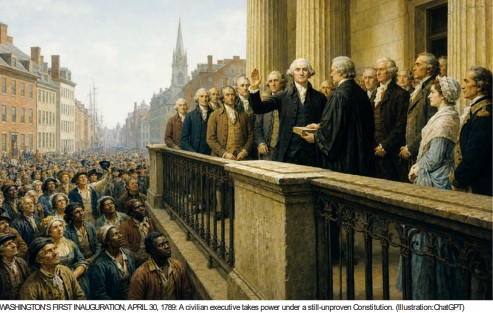

Washington, Hamilton, Jefferson and the Test of Self-Government
“The Constitution provided a framework. The first generation had to turn parchment into government.”
INVENTING THE PRESIDENCY
When George Washington took the oath of office in New York on April 30, 1789, the Constitution described his powers but provided few details about daily presidential government. Washington understood that nearly every action might become a precedent. He sought dignity without monarchy, authority without personal rule and national leadership without extinguishing the states. The title remained simply “President of the United States,” rejecting elaborate alternatives. Washington established a cabinet of department heads, delivered messages to Congress, used the veto sparingly and conducted executive business through written opinions and consultation. He made presidential power visible while emphasizing that it came from law rather than inheritance.
THE FIRST GOVERNMENT
Congress created the Departments of State, Treasury and War and the office of Attorney General. The Judiciary Act of 1789 established federal district and circuit courts and a Supreme Court of six justices. The first Congress also sent constitutional amendments to the states; ten became the Bill of Rights in 1791. Washington selected Thomas Jefferson as secretary of state, Alexander Hamilton as secretary of the treasury, Henry Knox as secretary of war and Edmund Randolph as attorney general. The cabinet was not specified in the Constitution. It developed because a president governing a continental nation required specialized counsel.
Washington’s most enduring precedent was that the president was powerful-but temporary, civilian and accountable to law.”


Be the first to comment