

The French Revolution divided Americans. DemocraticRepublicans celebrated its republican promise; Federalists increasingly recoiled from its violence and feared radicalism at home. When Britain and revolutionary France went to war in 1793, the United States faced pressure to honor its French alliance while lacking the military and financial strength for another conflict. Washington proclaimed neutrality. Jefferson questioned aspects of executive authority but agreed that war would be dangerous. The Citizen Genêt affair-during which a French diplomat attempted to mobilize American support and privateersreinforced Washington’s determination to keep the nation out of European war.
JAY’S TREATY
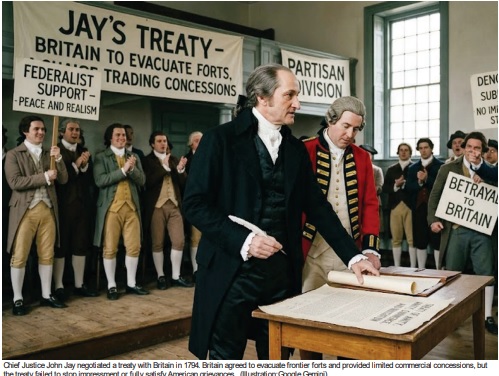
Chief Justice John Jay negotiated a treaty with Britain in 1794. Britain agreed to evacuate frontier forts and provided limited commercial concessions, but the treaty failed to stop impressment or fully satisfy American grievances. Federalists defended it as peace-preserving realism; Democratic-Republicans denounced it as submission to Britain. Ratification deepened partisan division.
WASHINGTON’S FAREWELL
Washington declined a third term and warned against sectionalism, destructive party spirit and permanent foreign entanglements. His voluntary retirement reinforced the principle that presidential power should be relinquished. The two-term tradition endured until Franklin Roosevelt and became constitutional law through the Twenty-Second Amendment.
“Washington strengthened the presidency by exercising power-and strengthened the republic by surrendering it.



Be the first to comment