
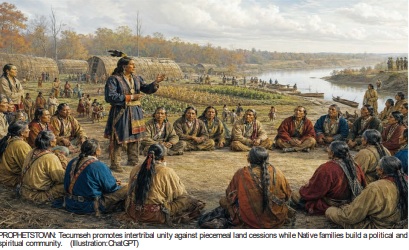

American settlers and officials continued acquiring western lands through treaties often signed under pressure or by leaders whose authority to sell communal territory was disputed. The Shawnee leader Tecumseh and his brother Tenskwatawa, known as the Prophet, sought to build a broad Indigenous confederacy. Tecumseh argued that land belonged collectively to Native peoples and could not be ceded nation by nation. While Tecumseh traveled to build alliances, Governor William Henry Harrison’s forces confronted Tenskwatawa’s followers at Tippecanoe in 1811 and destroyed Prophetstown. The conflict weakened but did not end Indigenous resistance. When war with Britain began, Tecumseh allied with the British as the stronger available barrier to American expansion. Tecumseh was killed at the Battle of the Thames in 1813. His death and Britain’s declining ability to defend Native allies weakened organized resistance in the Old Northwest. American victory was therefore not only a conflict with Britain; it accelerated the transfer of Indigenous land to settlers.
For many Americans, the West represented opportunity. For Native nations, American opportunity often meant dispossession.”


Be the first to comment