
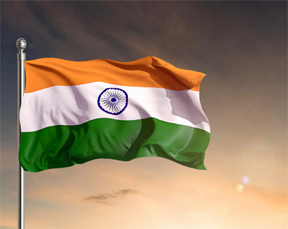

On August 15, 2026, India will celebrate its 80th Independence Day. Across India, the Tricolor will fly proudly from government buildings, schools, homes and public squares. The national anthem will be sung, the sacrifices of the freedom fighters will be remembered, and a nation of more than a billion people will once again celebrate the freedom won after a long struggle.
Far beyond India’s shores, too, preparations are underway. Wherever Indians have made their homes—from the United States and Canada to Britain, Europe, Africa, the Middle East, Australia and elsewhere—August 15 will bring communities together in celebration and remembrance.
To all Indians, at home and abroad, we extend our warmest greetings on this historic occasion: Happy Independence Day!
Eighty years is a considerable journey in the life of a modern nation. And India’s journey deserves to be celebrated.
The India that awakened to freedom in 1947 was burdened by poverty, illiteracy, disease and the enormous human tragedy of Partition. Its economy was weak, its institutions were young, and many outside observers doubted whether such a vast, diverse and desperately poor country could survive as a functioning democracy.
Yet India survived. More than that, it advanced.
It built democratic institutions and held elections after election. It established universities, laboratories, industries and scientific research centers. It achieved remarkable progress in agriculture and food production. It created a formidable scientific and technological establishment, developed nuclear and space capabilities, produced generations of doctors, engineers, scientists, teachers and entrepreneurs, and eventually emerged as one of the world’s major economies.
Today, Indian scientists send missions to the Moon and study the Sun. Indian technology professionals occupy important positions across the world. Indian doctors serve humanity on almost every continent. Indian entrepreneurs have created enterprises of global significance. Indians lead some of the world’s most influential institutions and corporations.
That achievement should inspire pride.
But anniversaries must do more than invite celebration. They should also invite reflection.
While recently working on a special commemorative edition of The Indian Panorama marking 250 years of American independence, I found myself repeatedly encountering a simple historical truth: America did not begin with independence. Long before there was a United States of America, there were people living upon that land, building communities, creating cultures and shaping histories.
The thought led me naturally toward India.
India, too, did not begin on August 15, 1947.
The sovereign Republic is young compared with the civilization from which it emerged. For thousands of years, the people of the Indian subcontinent cultivated philosophy, mathematics, astronomy, medicine, literature, art, architecture and traditions of intellectual inquiry. Civilizations rose and declined, kingdoms appeared and disappeared, rulers came and went, but the people remained.
And therein lies an important lesson for India at 80.
A nation is ultimately its people.
The opening words of India’s Constitution proclaim:
“We, the People of India…”
Those words carry an extraordinary promise. They tell us where sovereignty resides. Not in governments. Not in political parties. Not in leaders, bureaucracies or institutions. Ultimately, the Republic belongs to its people.
Therefore, India’s progress cannot be measured only by the size of its economy, the height of its skyscrapers, the strength of its military, the reach of its technology or its position among the world’s economic powers.
The more difficult question is: How does India treat its people?
Here the celebration must be accompanied by introspection.
There remain millions for whom the promise of independence has not yet translated fully into a life of dignity and opportunity. Economic inequality remains painfully visible. Extraordinary wealth exists alongside desperate poverty. Magnificent urban developments can stand within sight of settlements where families struggle for basic sanitation, healthcare, education and secure livelihoods.
Social divisions—of caste, class, religion, gender and region—continue to wound the idea of equal citizenship. Too many Indians still encounter indignity because of who they are, where they were born, what they believe, how little they possess or where they stand in the social hierarchy.
No economic ranking can make these realities irrelevant.
India is rightly proud of its economic rise. It should aspire to greater prosperity. Growth is indispensable: without wealth creation, no nation can sustainably finance education, healthcare, infrastructure, employment or social welfare.
But economic growth must never become an end in itself.
The purpose of an economy is ultimately to improve human life.
A country cannot be considered truly rich merely because its GDP has risen if millions of its citizens remain deprived of dignity, opportunity and basic security. Nor should human beings be regarded simply as instruments for producing economic growth.
Indeed, the opposite is closer to the truth: human beings are the engines of economic progress.
Invest in them. Educate them. Keep them healthy. Protect their freedoms. Give their children opportunities. Allow their talents to flourish. Treat their labor with respect. Ensure that justice is accessible regardless of wealth or influence. Protect the dignity of the weakest citizen as carefully as the privilege of the most powerful.
Do that, and economic progress will acquire something even more valuable: human meaning.
India’s ancient traditions celebrated knowledge and inquiry. Its modern achievements demonstrate what Indians can accomplish when education, opportunity and scientific temperament come together. The task of the coming decades must therefore be to extend those opportunities more widely.
The child in a poor village deserves the chance to become a scientist.
The daughter of a laborer deserves the opportunity to become a physician.
The street vendor deserves respect from the state.
The farmer deserves security and dignity.
The worker who builds India’s cities deserves to share in India’s prosperity.
And every Indian, irrespective of religion, caste, gender, language, region or economic standing, deserves the assurance that the Constitution’s magnificent opening words— “We, the People”—include them without qualification.
At this 80th Independence Day, Robert Frost’s celebrated words seem particularly appropriate:
“And miles to go before I sleep.”
India has traveled many miles.
It has traveled from colonial subjugation to sovereignty; from widespread hunger toward food security; from limited industrial capacity to technological ambition; from modest scientific infrastructure to missions in space; from economic weakness to a place among the world’s largest economies.
These are not small accomplishments. They belong not merely to one government or one political party, but to generations of Indians who worked, struggled, dreamed and built.
Yet there are miles to go.
Let Indians everywhere celebrate the extraordinary journey of eighty years. Let us remember with gratitude those who sacrificed for freedom and those countless citizens—farmers, workers, teachers, scientists, soldiers, doctors, entrepreneurs, artists, civil servants and ordinary families—who built independent India.
But when the celebrations are over and the flags are carefully folded, let India’s leaders remember the first three words in whose name they exercise power:
We, the People.
Put the people above political calculations. Put their dignity above statistics. Put education, health, justice and opportunity alongside economic ambition. Measure national greatness not only by how high India rises among the economies of the world, but also by how deeply the benefits of that rise reach the lives of ordinary Indians.
Happy 80th Independence Day, India.

Be the first to comment