
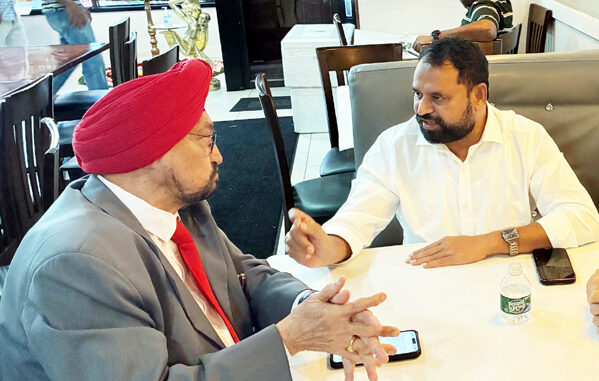

Telangana MLC Dr. Addanki Dayakar talks to Prof. Indrajit S. Saluja about his political journey, social justice, Rahul Gandhi, the RSS, electoral integrity—and his ambitious search for a global language of equality
-
By Prof. Indrajit S. Saluja
It was Onam, and what began as an afternoon of friendship and traditional Kerala hospitality unexpectedly became an opportunity for a candid conversation about Indian politics, democracy and social justice.
My good friend George Abraham, former United Nations Technology officer and currently Chairman of the Indian Overseas Congress, USA, and his wife, Lona Abraham, had graciously invited a few friends to Onam celebrations at Dilbar Indian Restaurant in Bellerose, Queens. The warmth of Onam was everywhere, not least in the magnificent traditional meal served, as custom demands, on large banana leaves. The owners Philipose Joseph, Dipu, and Hemachandran took extra care to make the guests comfortable.
Among those present were Dr. Addanki Dayakar, Member of the Telangana Legislative Council and Government Whip; his wife, Addanki Nagamani, Banjara Bharath National Convenor; and Ashok Arora, senior advocate of the Supreme Court of India and former Secretary of the Bar Council of India.
Between conversation and the pleasures of the Onam table, I caught up with Dr. Dayakar. What began as an introduction soon ranged across his journey from the Telangana movement to electoral politics, his pursuit of social justice, filmmaking, Rahul Gandhi and the Congress, his criticism of the BJP and RSS, concerns about India’s electoral system, and an ambitious international initiative devoted to equality and humanity.
Dayakar spoke candidly. His political opinions are strongly held—and are his own. What follows is an edited version of our conversation.
SALUJA: Dr. Dayakar, let us begin with you. Tell our readers something about yourself and your journey into public life.
DAYAKAR: I come from the Telangana movement. For about ten years, from 2004 to 2014, I worked as a movement leader and spokesperson associated with the Telangana Joint Action Committee. After the realization of Telangana statehood, I joined the Indian National Congress in 2014.
I contested elections in 2014 and again in 2018. Later, I became a Member of the Telangana Legislative Council, and today I serve as Government Whip with Minister of State rank.
Academically, I have studied computer applications and law and completed my Ph.D. from Osmania University. I am also participating in a leadership program at Harvard University involving storytelling, leadership and human empowerment. My journey has therefore moved from social movement to politics, but my interest in social justice has remained constant.
SALUJA: You speak repeatedly about equality and justice. But equality is an enormous concept. What kind of equality are you seeking—economic, social, political, racial?
DAYAKAR: Equality is a very broad idea. We must work to reduce social, economic and political inequalities and discrimination based on caste, religion, gender, region and other identities.
My concern is this: governments spend enormous resources on science, technology and space exploration. These are important. But what are we investing in humanity, equality and justice?
Where is our comparable investment in making human beings understand one another?
That is the question I want society to consider.
SALUJA: The aspiration is admirable. But what is the roadmap? How do you actually move society toward greater equality?
DAYAKAR: That is precisely what I want to explore. I want to bring together professors, intellectuals, NGOs, social organizations and people working for equality and justice.
My plan is to organize international conferences in different countries and develop concrete resolutions and recommendations. I would like these eventually to reach governments and international institutions, including the United Nations.
Education must also play a role. Humanity and respect for others should become part of what young people learn. Laws are necessary, but humanity cannot be created by law alone.
My ambition is global because discrimination itself is global.
SALUJA: Can such an ambitious—even utopian—idea be translated into reality without political power?
DAYAKAR: Political power can accomplish certain things, but not everything.
The idea of humanity must grow within society. Today, when two countries fight, many other countries fear the consequences. We still lack adequate mechanisms for resolving human conflicts.
Political power can create institutions and policies. But ultimately society itself must develop a stronger consciousness of humanity.
SALUJA: You have also ventured into cinema. Are you an actor, producer, director—or a politician who happened to enter films?
DAYAKAR: I am basically a movement leader who became a political leader. A friend saw that my own public role and ideology could become the basis of a film and offered me an opportunity to act.
The film is called The India Files.
It explores India’s cultural and political transformation and ideas such as socialism, secularism, democracy and the Constitution. I play a role close to my own public personality.
The purpose was not simply commercial success. We wanted to communicate ideas.
SALUJA: So this was not conceived as an answer to films such as The Kashmir Files?
DAYAKAR: No. My idea was different. The India Files looks at a much longer sweep of Indian cultural and political transformation. We are working toward making it available in several Indian languages and English.
For us, box-office success was not the principal objective. We wanted to communicate our understanding of India’s culture and its constitutional idea.
SALUJA: Let us come directly to politics. You are a Congress leader and a strong supporter of Rahul Gandhi. What, in your assessment, is happening to Indian democracy?
DAYAKAR: I believe India is witnessing dangerous divisive politics. Religion, caste and community are increasingly being used politically.
I strongly oppose the political philosophy of the BJP and RSS. I believe Congress must defend constitutional democracy, secularism and social justice.
I also strongly support Rahul Gandhi. I see his political journey, including the Bharat Jodo Yatra, as an effort to bring people together and defend democratic values.
These are my political convictions, and I speak about them openly.
SALUJA: But criticizing the government is one thing. Defeating it democratically is another. Opposition parties in India have repeatedly found it difficult to remain united. What must democratic opposition forces actually do?
DAYAKAR: They must go continuously to the people.
Political parties cannot merely raise an issue for a few days and then forget it. People must be made aware of what is happening, and democratic forces must remain united.
We use political campaigns, public meetings, media, articles, films and other forms of communication. The task is to create public awareness and keep it alive.
Ultimately, no political alliance can succeed without the people.
SALUJA: You contested the 2018 election and have made serious allegations about EVMs and discrepancies in that contest. What exactly is your contention?
DAYAKAR: I lost that election by 1,857 votes. I found discrepancies that caused me to question the EVM process, and I pursued the matter through an election petition.
My concern about EVMs comes partly from my academic understanding of computers and networking. I believe the electoral system must be completely transparent and capable of earning the confidence of every voter and candidate.
I have been pursuing my case for years, and I continue to believe these questions deserve serious examination.
Editor’s Note: Dr. Dayakar’s statements concerning EVM manipulation are allegations made by him and should not be read as independently established findings by The Indian Panorama. Questions concerning the 2018 election figures, his litigation and the relevant electoral record require independent verification.
SALUJA: That brings us to a larger problem. Political parties frequently raise serious issues—EVMs, electoral practices, institutional accountability—but campaigns often disappear after the headlines fade. Isn’t a sustained democratic campaign more important than episodic protest?
DAYAKAR: Yes. Sustained public awareness is essential.
The media should also play an important role. Traditionally, we call the press the fourth pillar of democracy. Today we additionally have social media and enormous amounts of propaganda, and people sometimes find it difficult to distinguish what is true from what is false.
The mainstream media must question those in power as rigorously as it questions the opposition. Democracy requires accountability from everybody.
SALUJA: Then who finally protects democracy—the courts, Election Commission, political parties, media or political leaders?
DAYAKAR: Institutions are important. Political leaders are important.
But finally, the people are the saviors of democracy.
Leaders come and leaders go. Parties come and parties go.
The Indian voter remains.
Politicians may believe they are powerful. Governments may believe they are permanent. They are not.
The voter has the final power.
Indian voters are the saviors of Indian democracy.
THE LAST WORD
That final observation perhaps provided the most fitting conclusion to our brief conversation.
Dr. Addanki Dayakar and I disagree on some questions and may debate many others when we meet again. His politics are unmistakably partisan, his criticism sharp and his faith in his causes intense.
But beneath those arguments was a proposition considerably larger than Congress, BJP, Rahul Gandhi, Narendra Modi—or any individual politician:
Political power is temporary. The sovereignty of the citizen is permanent. In a democracy, that is worth remembering.
Leaders come. Leaders go. Parties rise. Parties fall. The voter remains.
And perhaps there, amid an Onam gathering thousands of miles from India, our conversation found its most appropriate destination: The people are not spectators of democracy. They are its owners.
Be the first to comment